Chapter 8
     Multiply by Two-Digit Numbers
Click the mouse or press the space bar to continue.
Multiply by Two-Digit Numbers
8


    Lesson 8-1       Multiply by Tens
    Lesson 8-2       Estimate Products
    Lesson 8-3       Problem-Solving Strategy: Act It Out
    Lesson 8-4       Multiply Two-Digit Numbers
    Lesson 8-5       Multiply Three-Digit Numbers by
                     Two-Digit Numbers
    Lesson 8-6       Problem-Solving Investigation:
                     Choose a Strategy
    Lesson 8-7       Multiply Greater Numbers
8-1     Multiply by Tens


      Five-Minute Check (over Chapter 7)
      Main Idea
      California Standards
      Example 1
      Example 2
8-1      Multiply by Tens


      • I will multiply a whole number by a multiple of ten.
8-1      Multiply by Tens


            Standard 4NS3.3 Solve problems
      involving the multiplication of multidigit
      numbers by two-digit numbers.
8-1      Multiply by Tens


             Standard 4NS3.2 Demonstrate an
      understanding of, and the ability to use,
      standard algorithms for multiplying a multidigit
      number by a two-digit number and for dividing a
      multidigit number by a one-digit number; use
      relationships between them to simplify computations
      and to check results.
8-1   Multiply by Tens


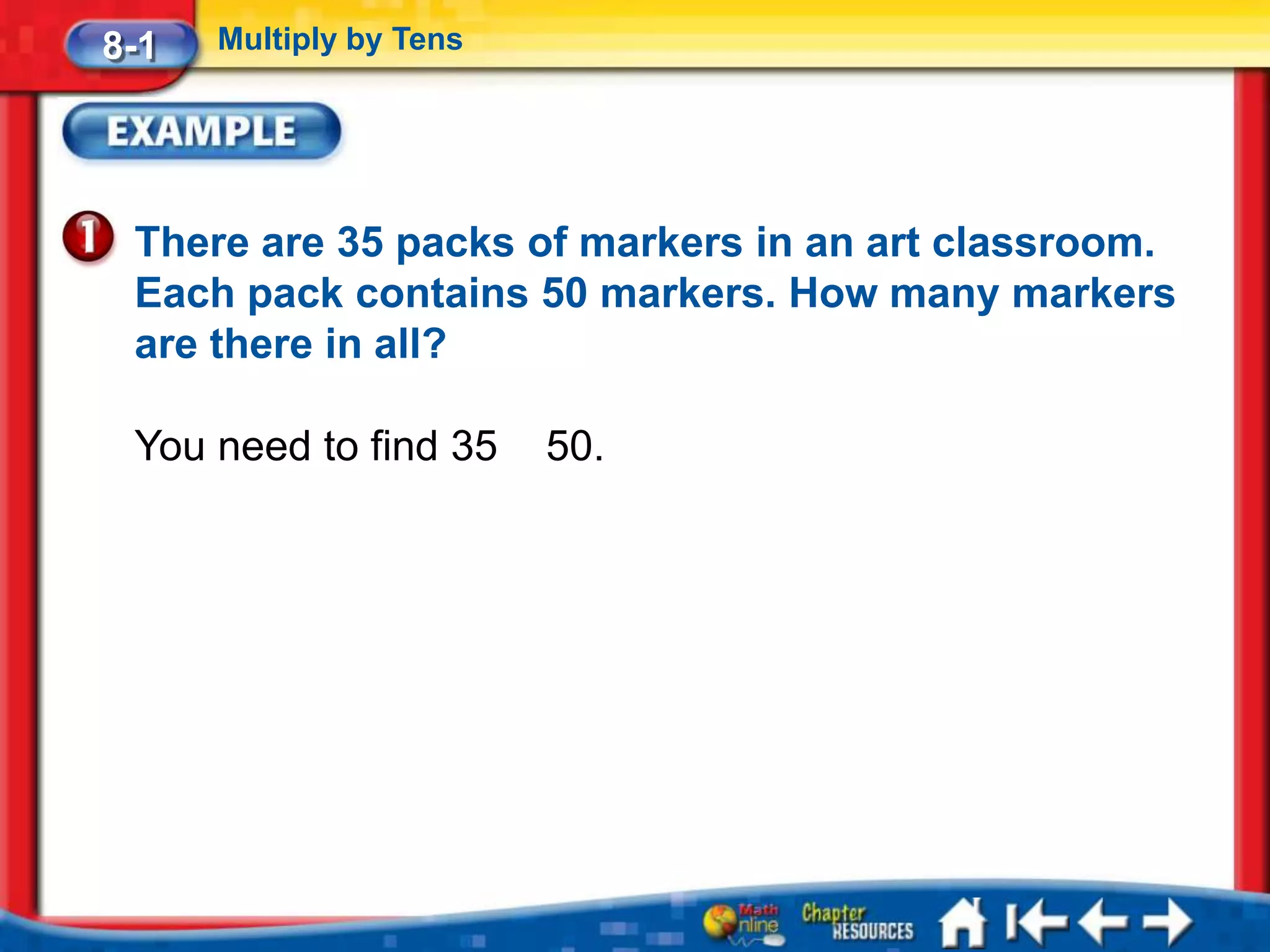
 There are 35 packs of markers in an art classroom.
 Each pack contains 50 markers. How many markers
 are there in all?

 You need to find 35     50.
8-1     Multiply by Tens


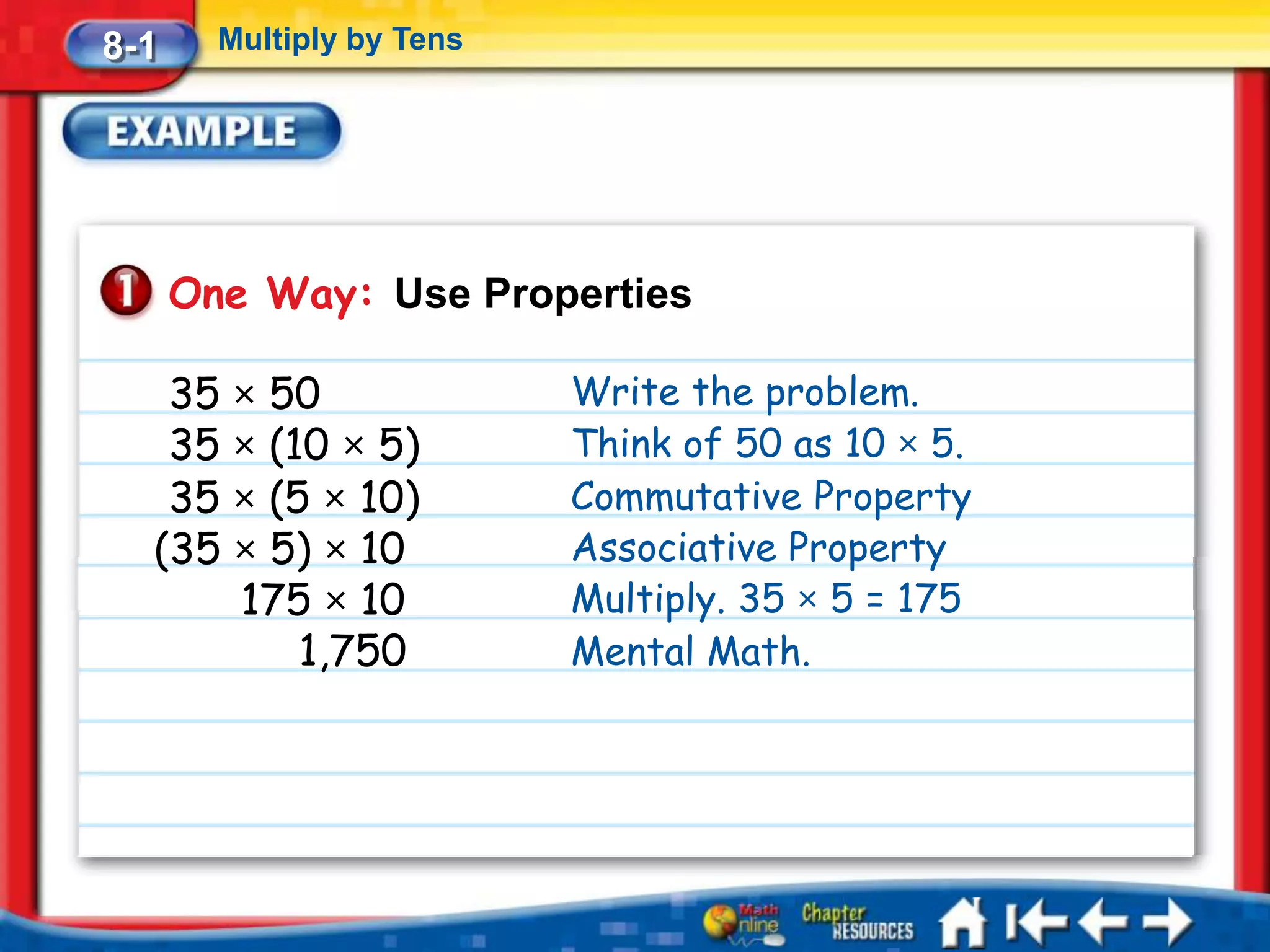
      One Way: Use Properties

   35 × 50                 Write the problem.
   35 × (10 × 5)           Think of 50 as 10 × 5.
   35 × (5 × 10)           Commutative Property
  (35 × 5) × 10            Associative Property
      175 × 10             Multiply. 35 × 5 = 175
          1,750            Mental Math.
8-1     Multiply by Tens


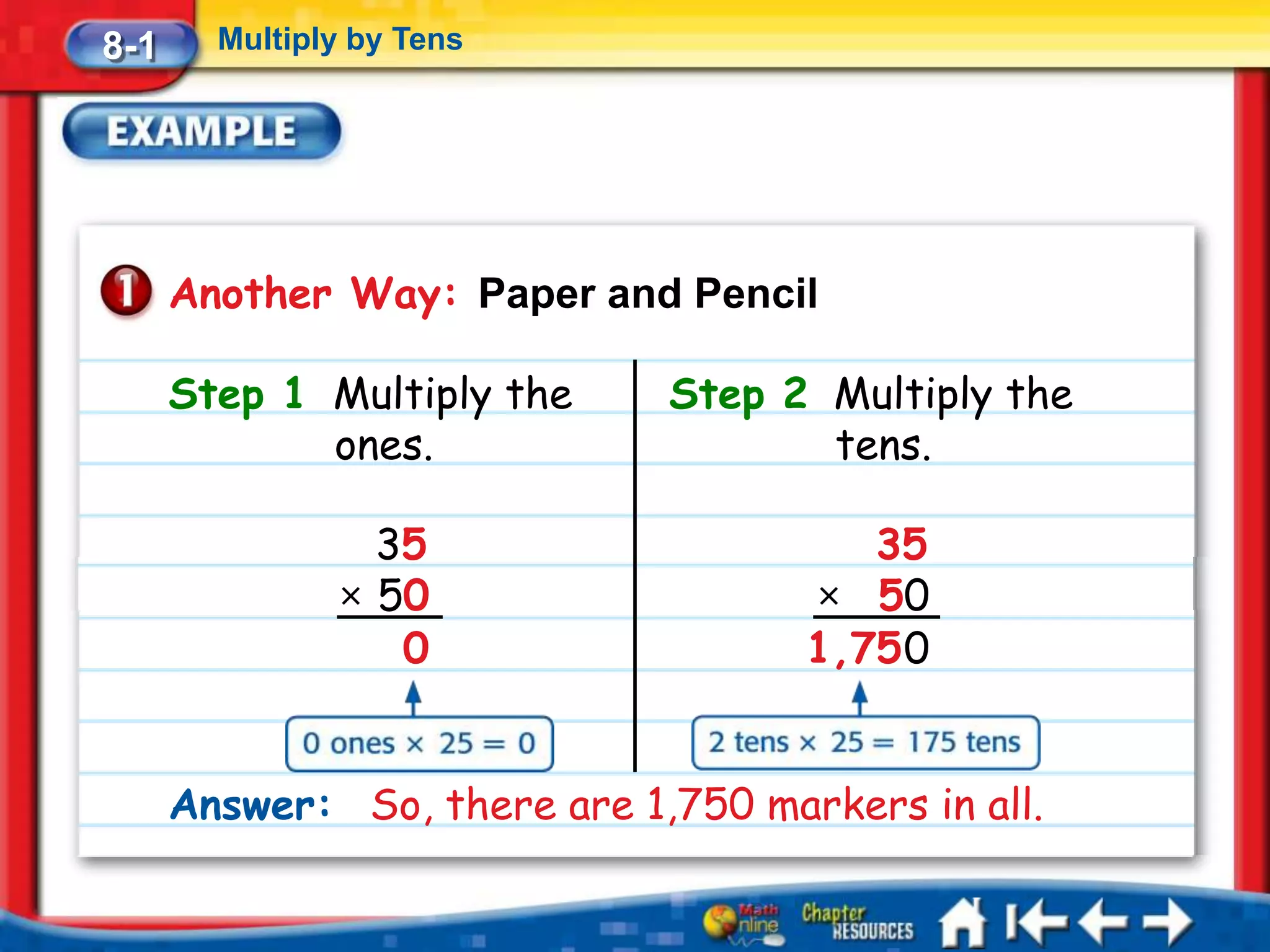
      Another Way: Paper and Pencil

      Step 1 Multiply the     Step 2 Multiply the
             ones.                   tens.

                 35                     35
               × 50                  × 50
                  0                  1,75 0


      Answer: So, there are 1,750 markers in all.
8-1   Multiply by Tens


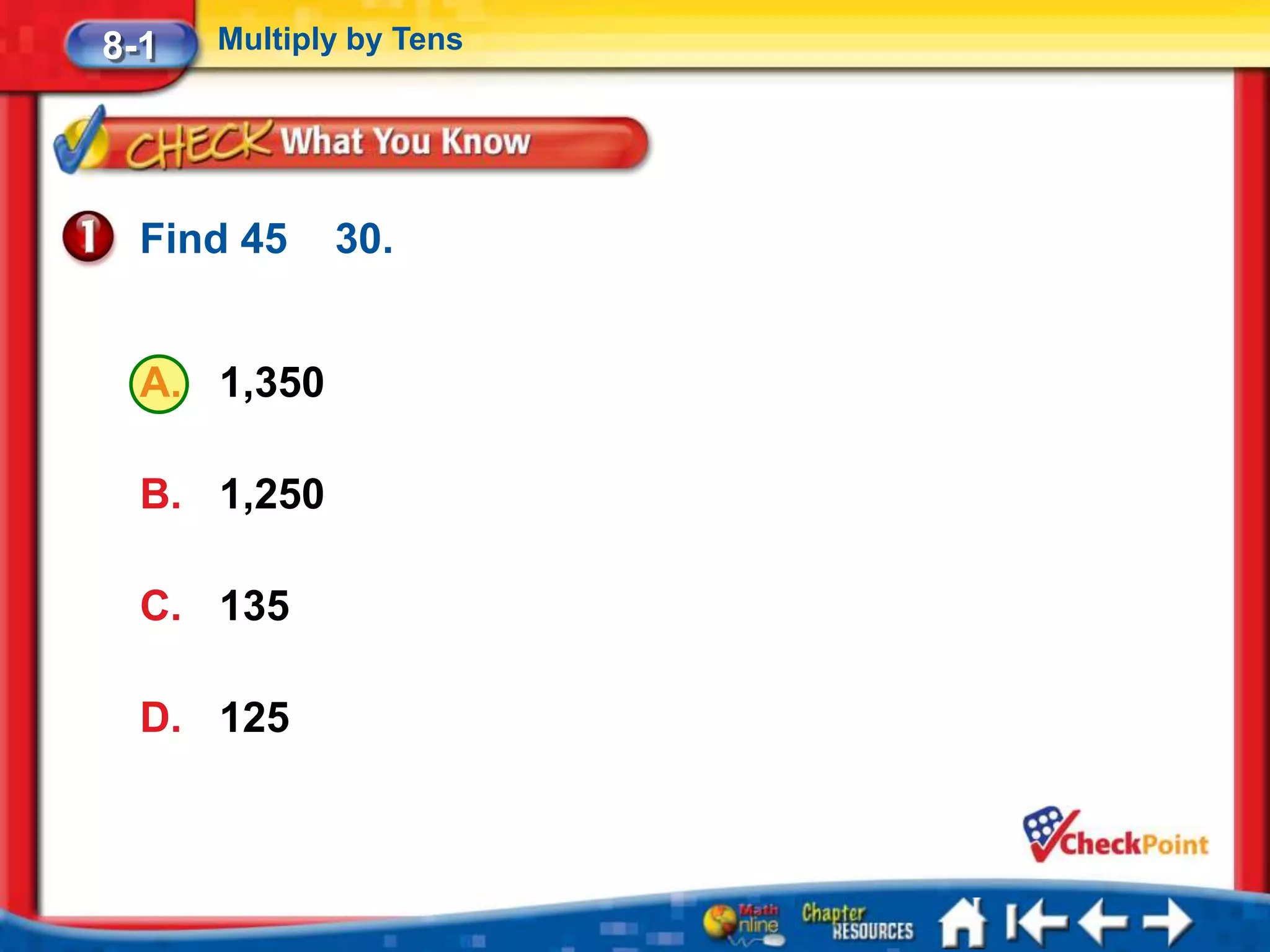
  Find 45    30.


  A. 1,350

  B. 1,250

  C. 135

  D. 125
8-1   Multiply by Tens


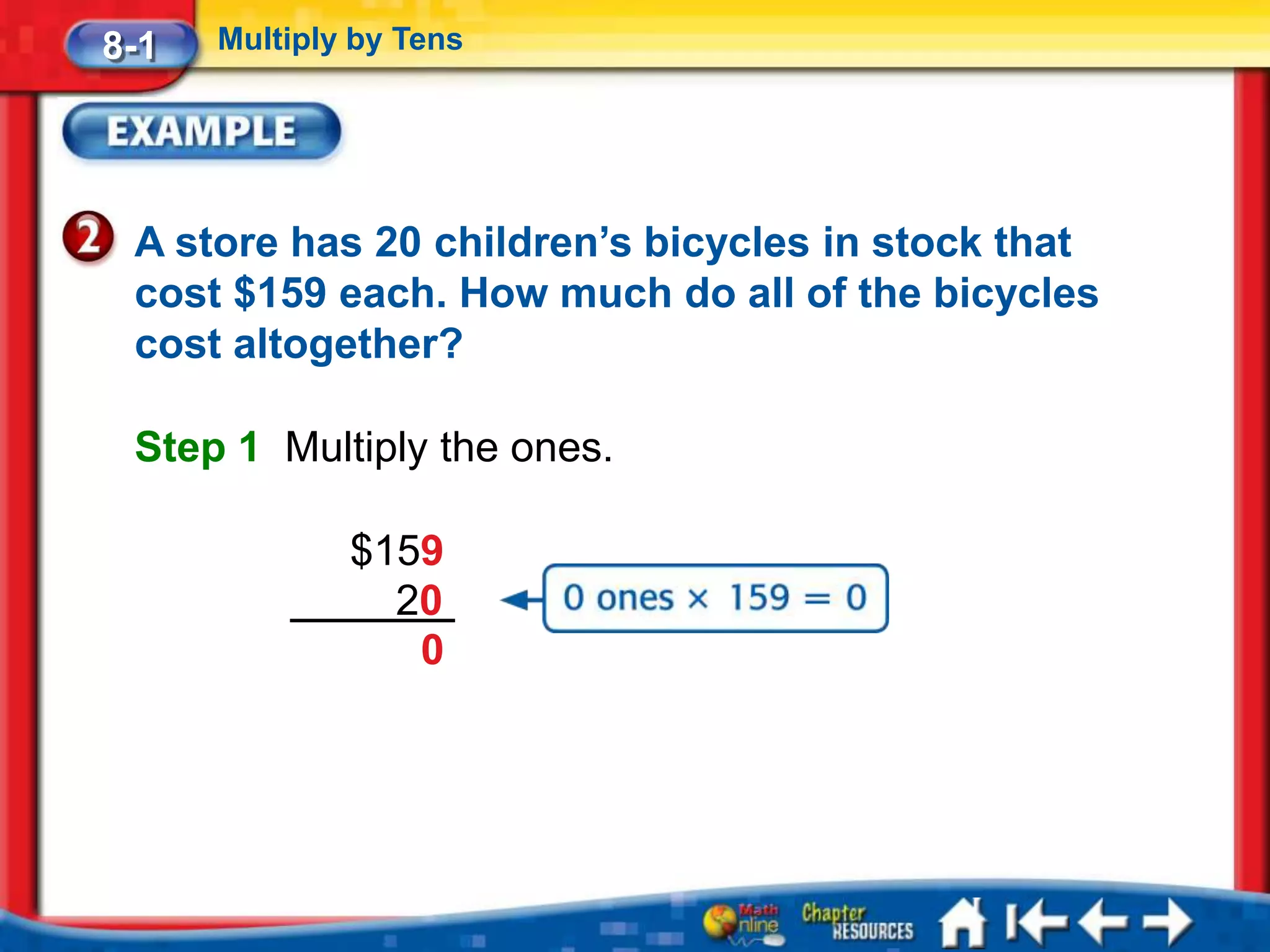
 A store has 20 children’s bicycles in stock that
 cost $159 each. How much do all of the bicycles
 cost altogether?

 Step 1 Multiply the ones.

              $159
                20
                 0
8-1   Multiply by Tens


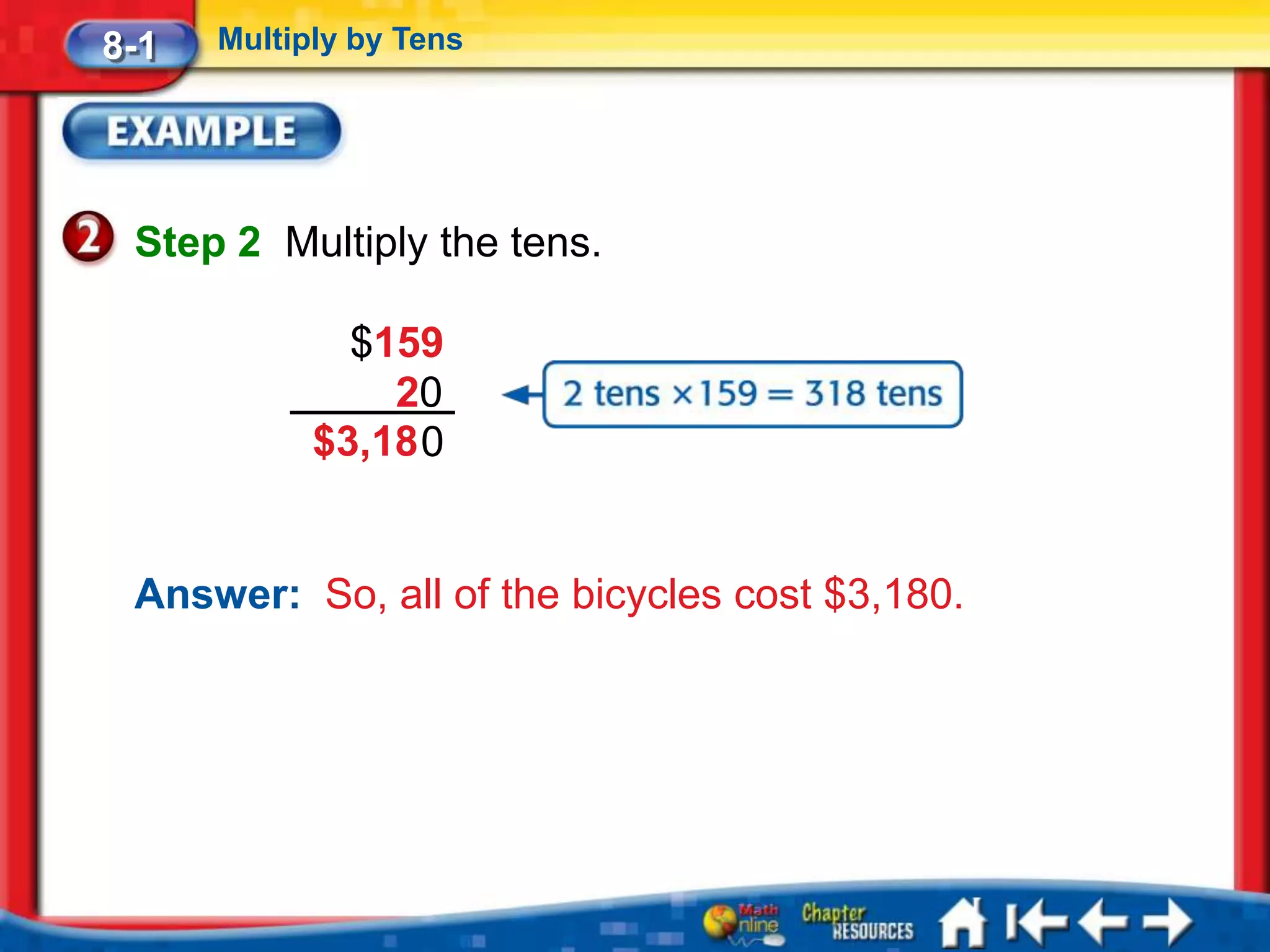
 Step 2 Multiply the tens.

              $159
                20
            $3,18 0


 Answer: So, all of the bicycles cost $3,180.
8-1   Multiply by Tens


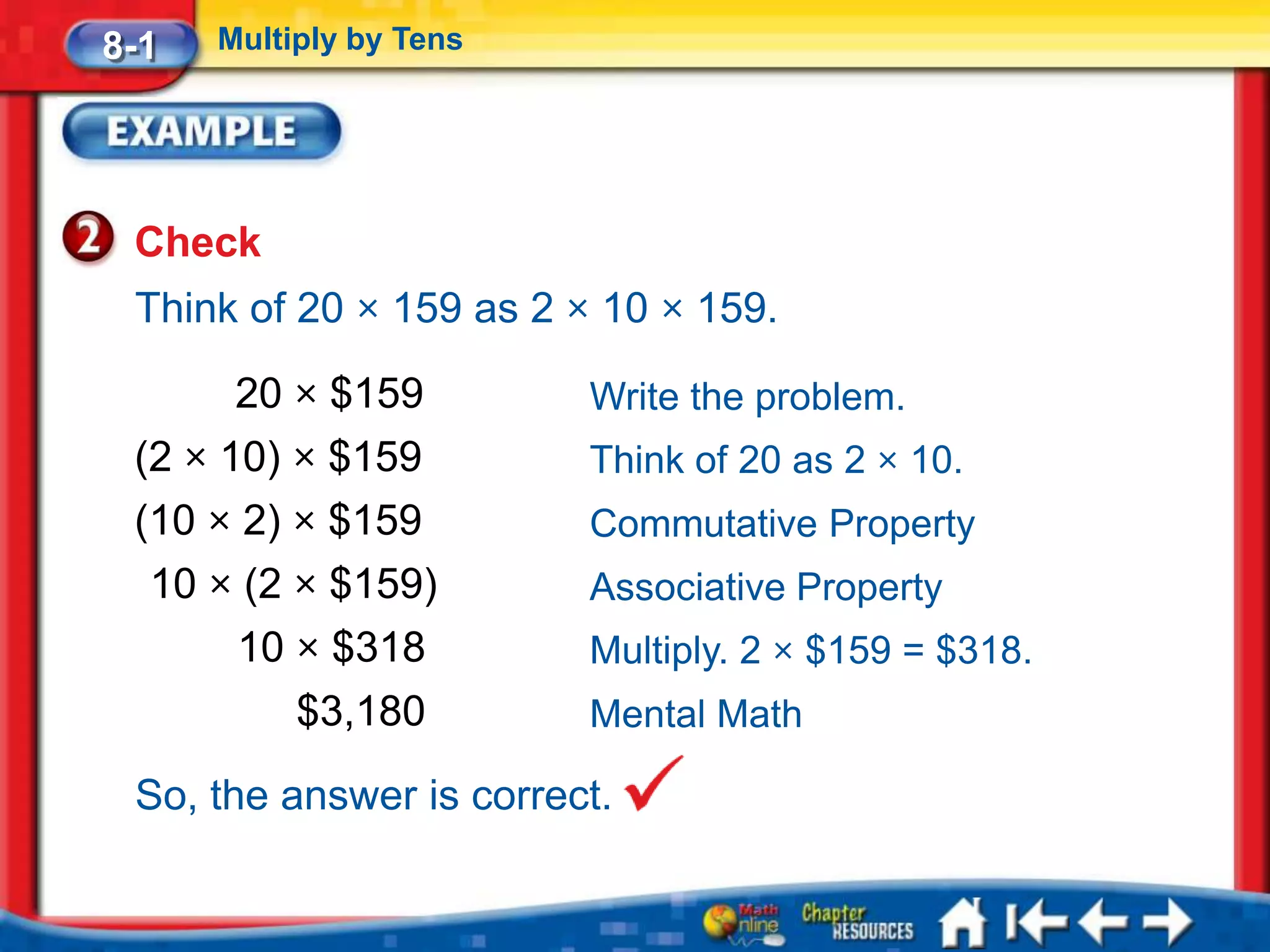
 Check
 Think of 20 × 159 as 2 × 10 × 159.

       20 × $159         Write the problem.
 (2 × 10) × $159         Think of 20 as 2 × 10.
 (10 × 2) × $159         Commutative Property
  10 × (2 × $159)        Associative Property
       10 × $318         Multiply. 2 × $159 = $318.
           $3,180        Mental Math

 So, the answer is correct.
8-1   Multiply by Tens


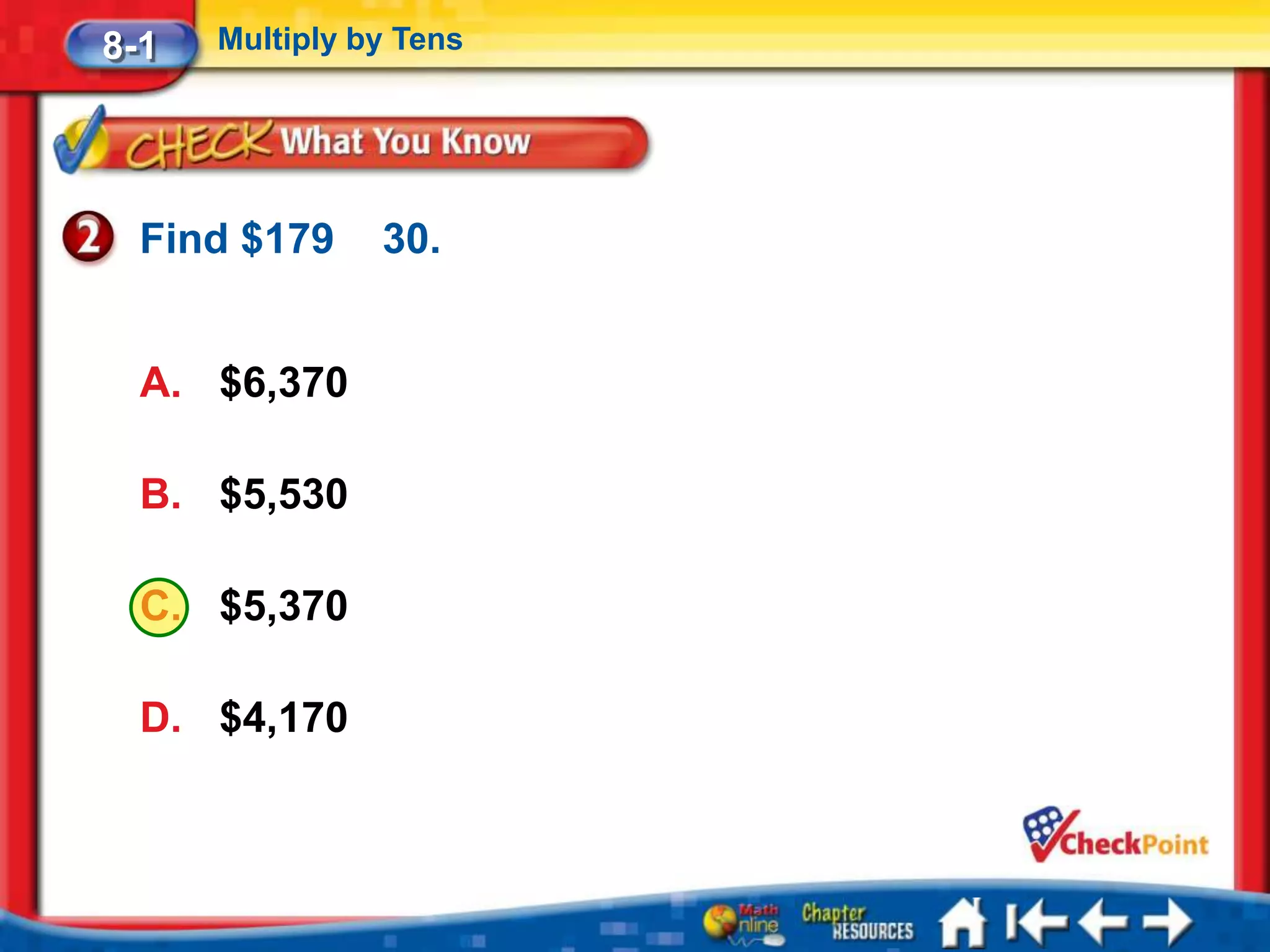
  Find $179     30.


  A. $6,370

  B. $5,530

  C. $5,370

  D. $4,170
8-2     Estimate Products


      Five-Minute Check (over Lesson 8-1)
      Main Idea
      California Standards
      Example 1
      Example 2
8-2      Estimate Products


      • I will estimate products by rounding.
8-2     Estimate Products


            Standard 4NS3.3 Solve problems involving
      multiplication of multidigit numbers by two-digit
      numbers.

            Standard 4NS1.3 Round whole numbers
      through the millions to the nearest
      ten, hundred, thousand, ten thousand, or
      hundred thousand.
8-2   Estimate Products


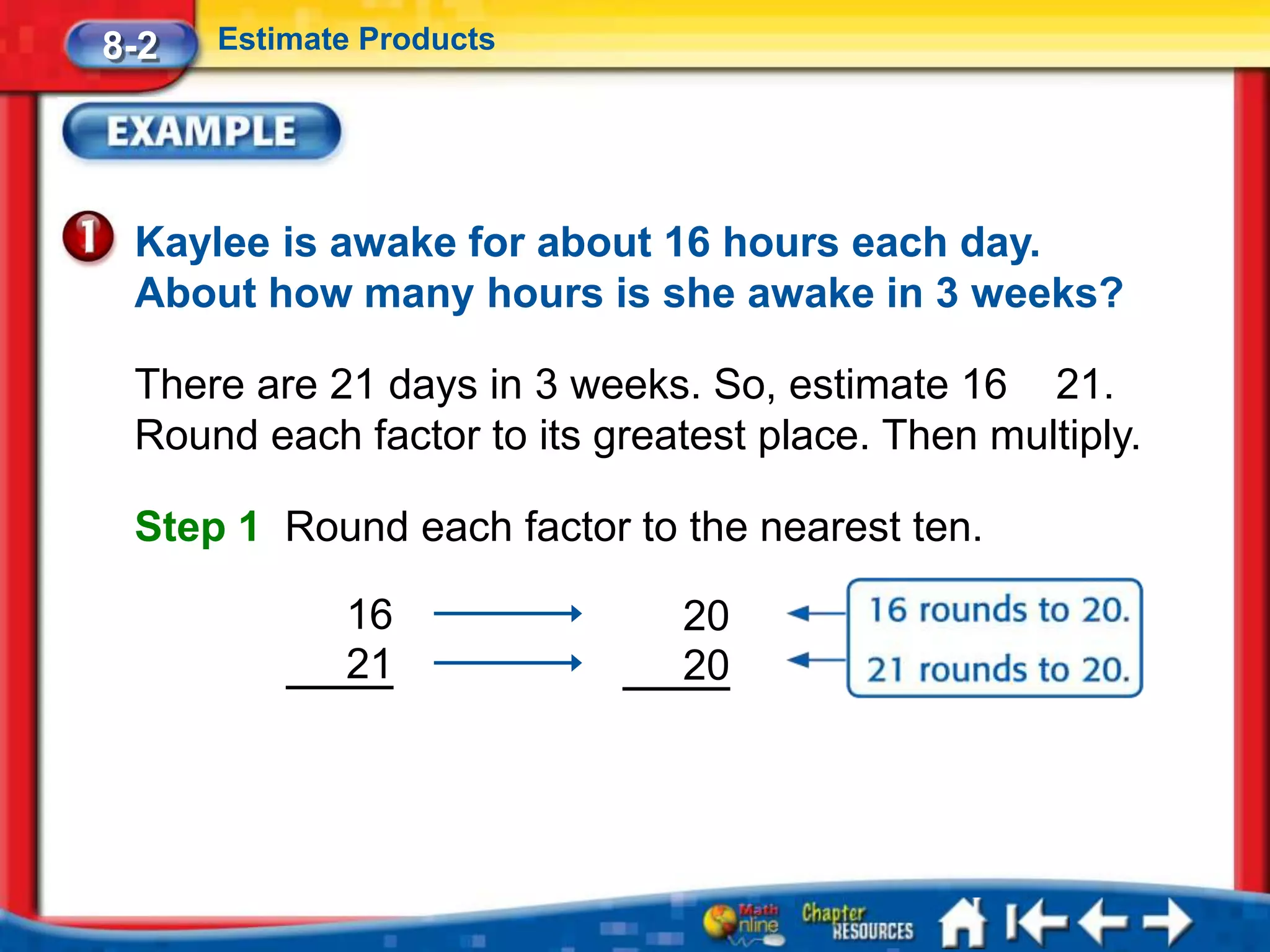
 Kaylee is awake for about 16 hours each day.
 About how many hours is she awake in 3 weeks?

 There are 21 days in 3 weeks. So, estimate 16 21.
 Round each factor to its greatest place. Then multiply.

 Step 1 Round each factor to the nearest ten.
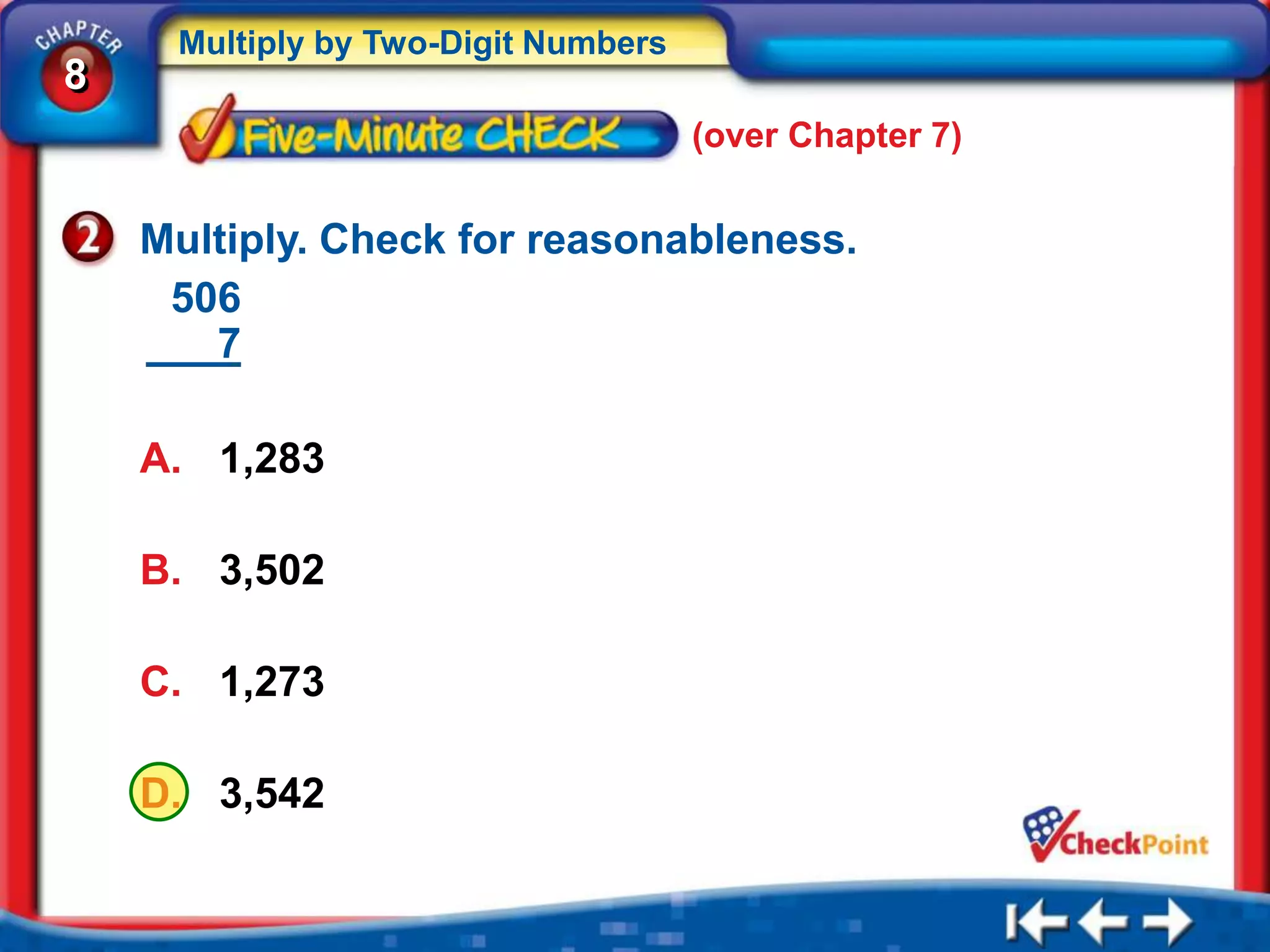
             16               20
             21               20
8-2   Estimate Products


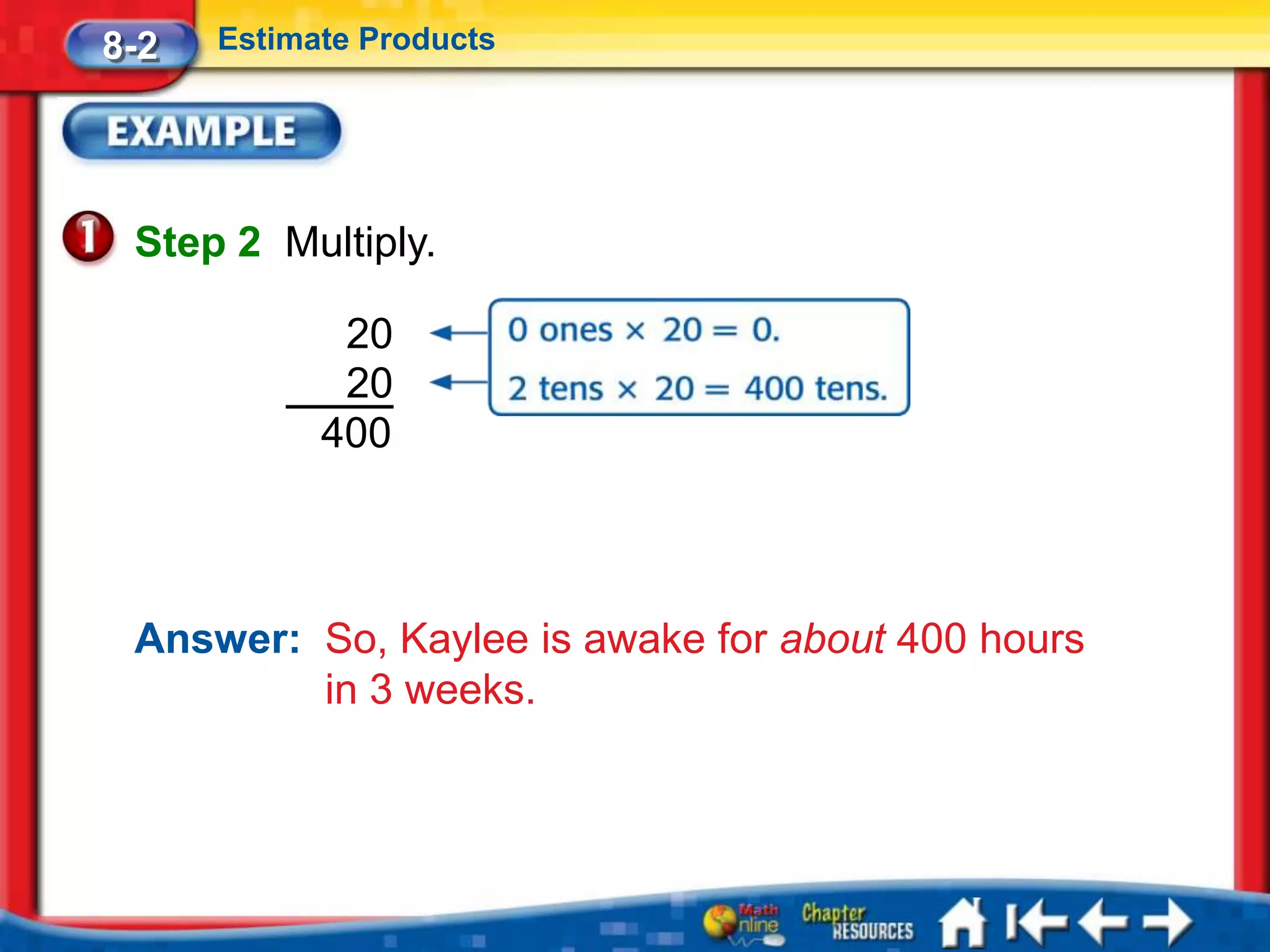
 Step 2 Multiply.
             20
             20
            400


 Answer: So, Kaylee is awake for about 400 hours
         in 3 weeks.
8-2   Estimate Products


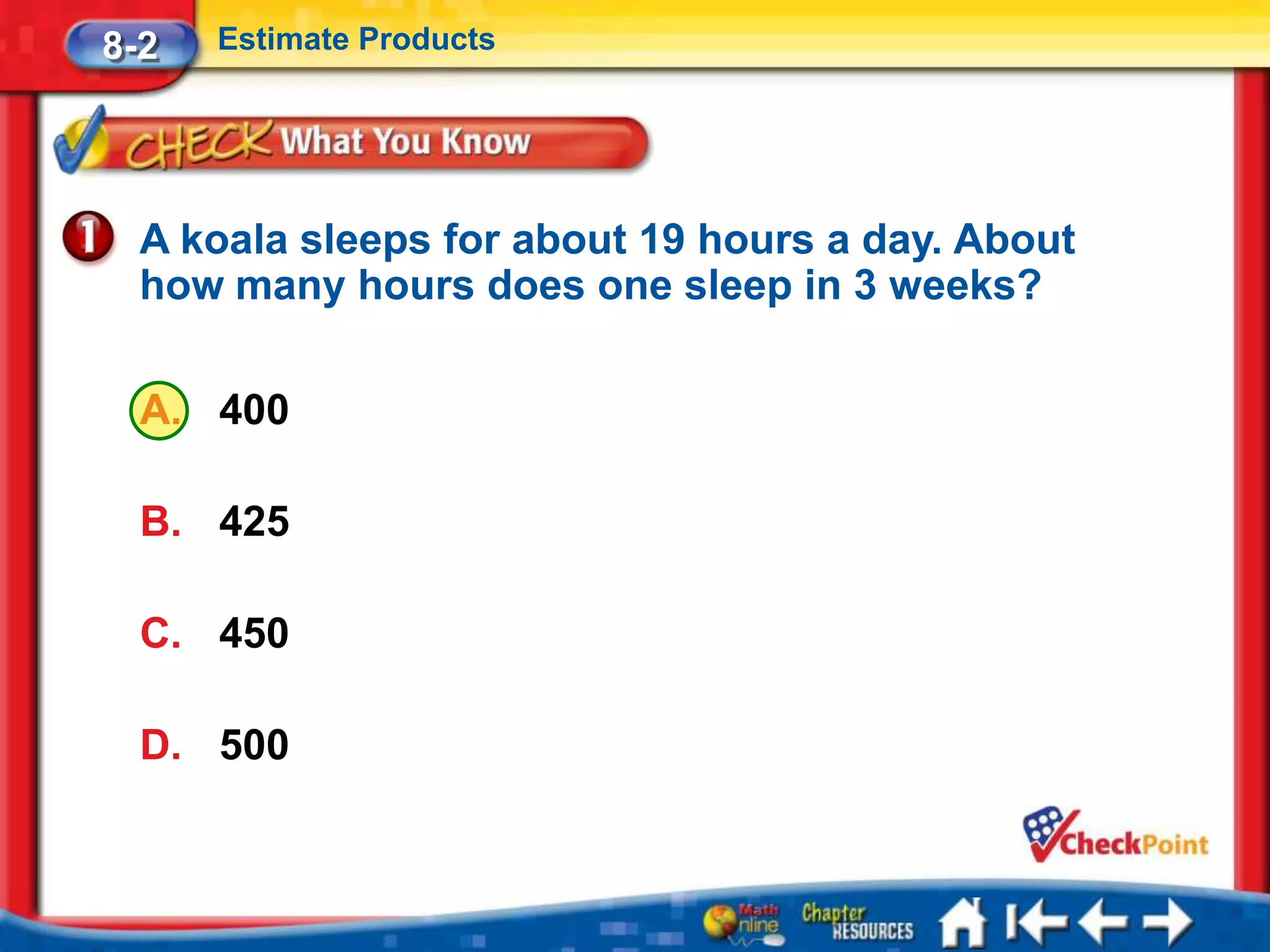
  A koala sleeps for about 19 hours a day. About
  how many hours does one sleep in 3 weeks?

  A. 400

  B. 425

  C. 450

  D. 500
8-2   Estimate Products


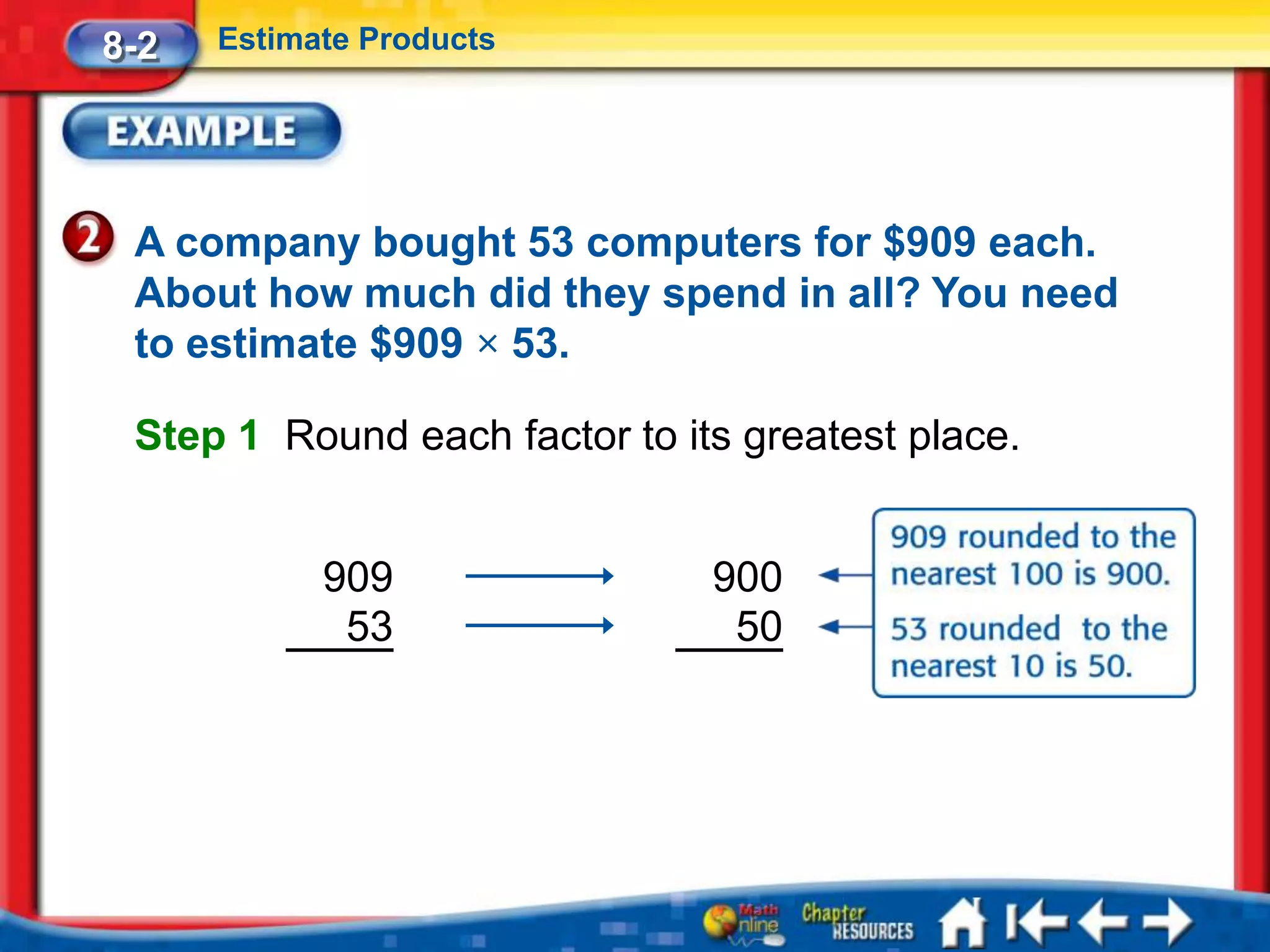
 A company bought 53 computers for $909 each.
 About how much did they spend in all? You need
 to estimate $909 × 53.

 Step 1 Round each factor to its greatest place.


            909                900
             53                 50
8-2   Estimate Products


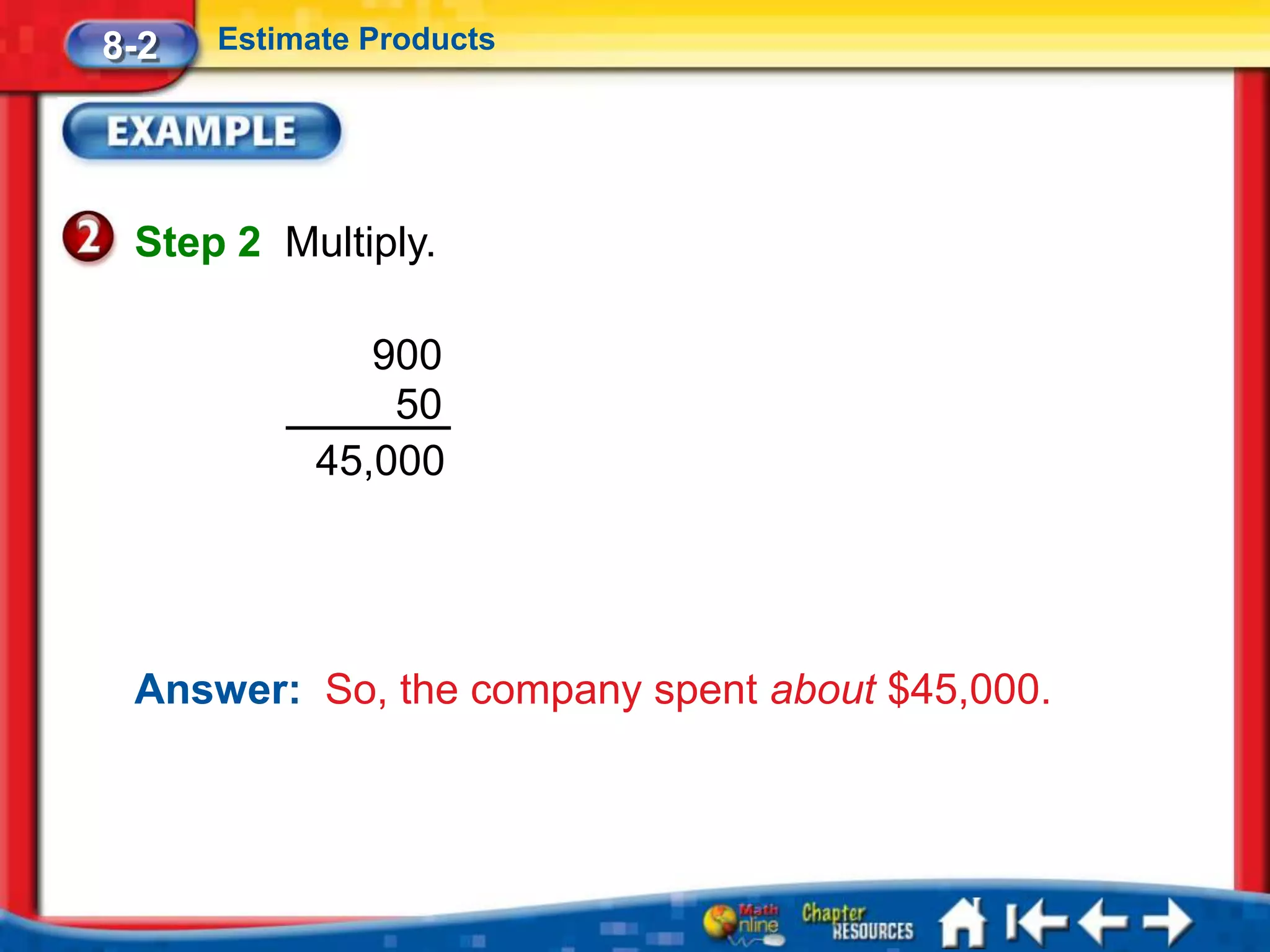
 Step 2 Multiply.

               900
                50
            45,000


 Answer: So, the company spent about $45,000.
8-2   Estimate Products


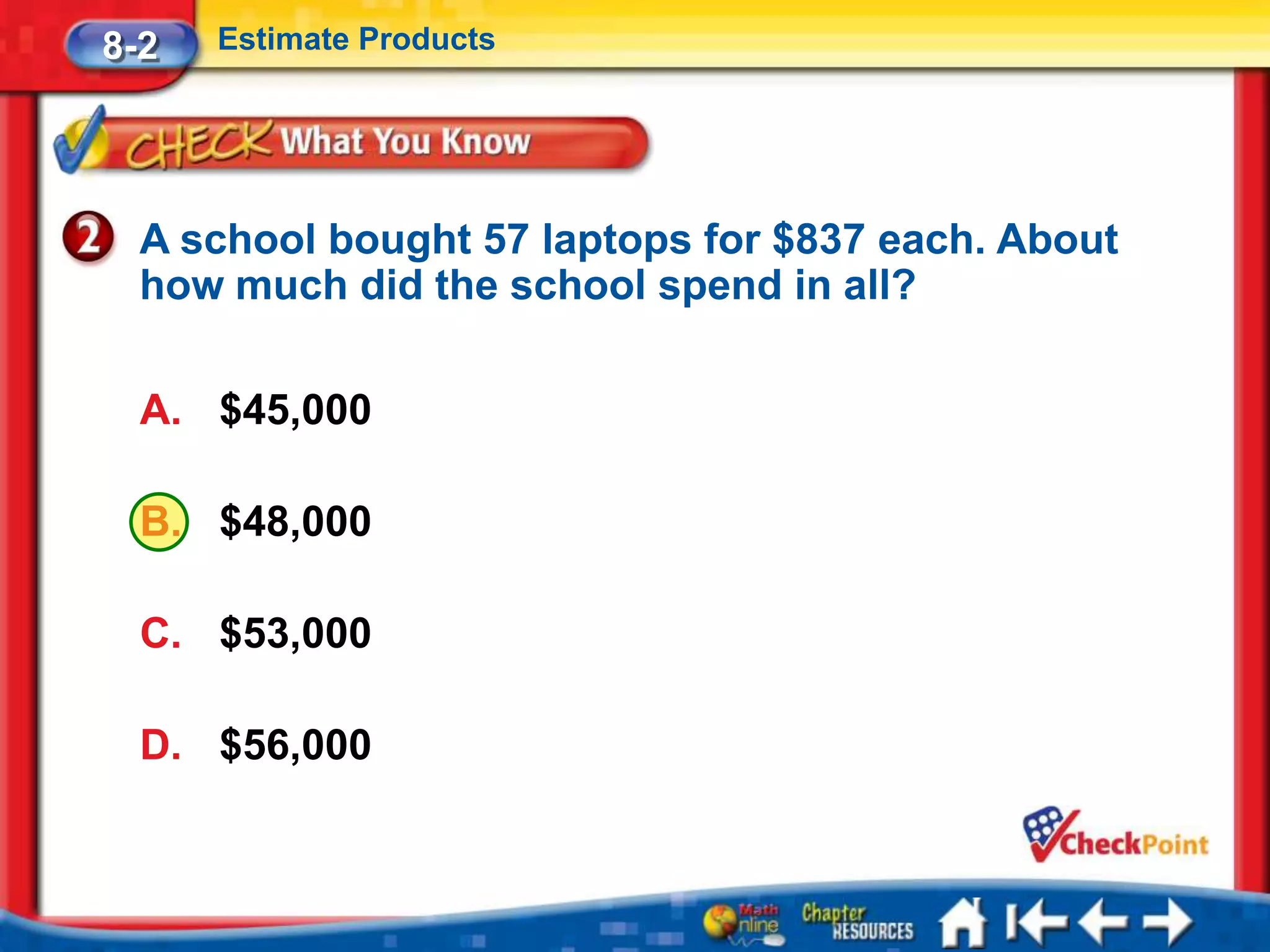
  A school bought 57 laptops for $837 each. About
  how much did the school spend in all?

  A. $45,000

  B. $48,000

  C. $53,000

  D. $56,000
8-3     Problem-Solving Strategy: Act It Out


      Five-Minute Check (over Lesson 8-2)
      Main Idea
      California Standards
      Example 1: Problem-Solving Strategy
8-3      Problem-Solving Strategy: Act It Out


      • I will solve a problem by acting it out.
8-3     Problem-Solving Strategy: Act It Out


      Standard 4MR2.3 Use a variety of methods,
      such as words, numbers, symbols, charts,
      graphs, tables, diagrams, and models, to
      explain mathematical reasoning.
8-3      Problem-Solving Strategy: Act It Out


             Standard 4NS3.0 Students solve problems
      involving addition, subtraction, multiplication, and
      division of whole numbers and understand the
      relationships among the operations.
8-3   Problem-Solving Strategy: Act It Out


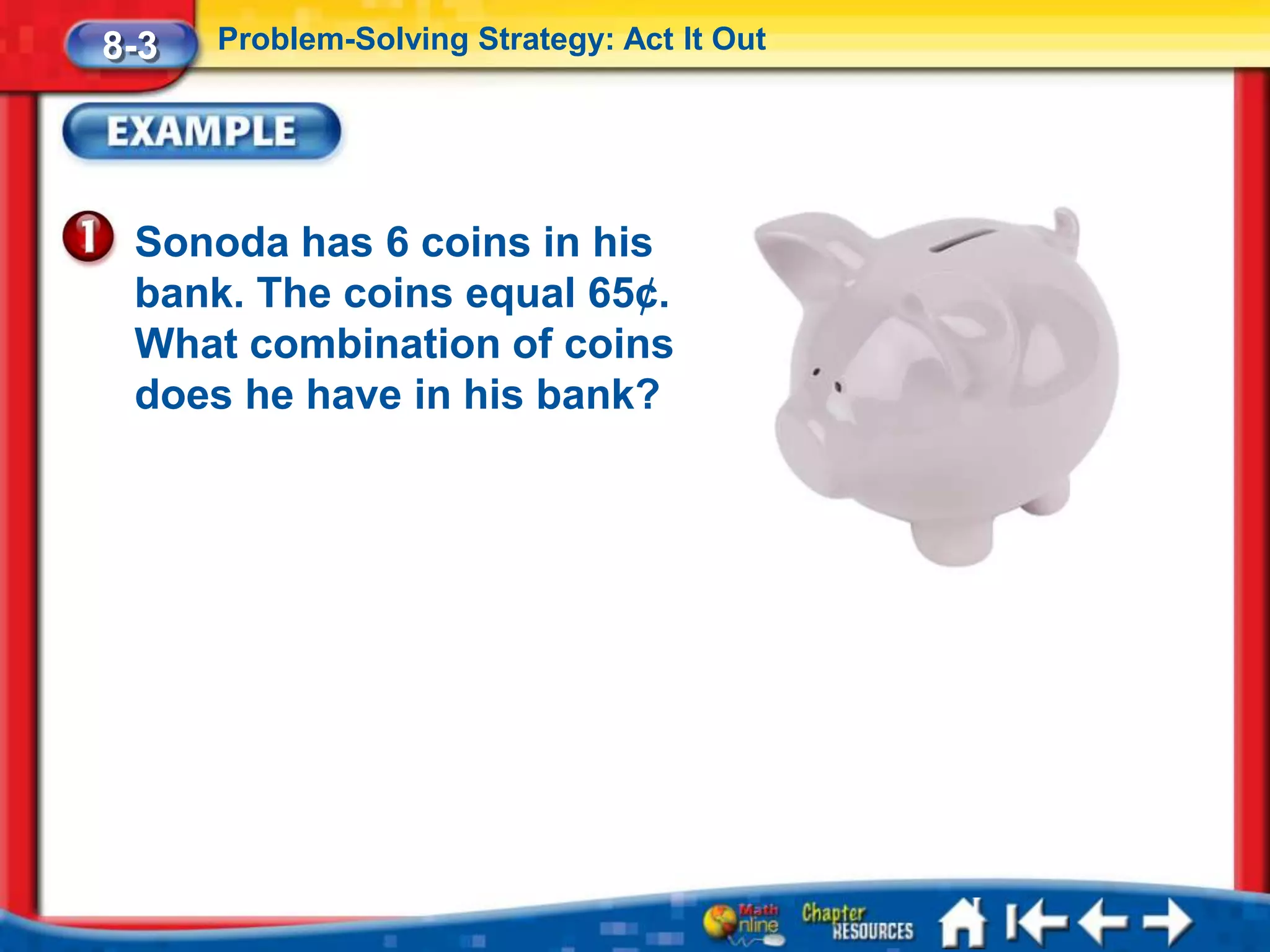
 Sonoda has 6 coins in his
 bank. The coins equal 65¢.
 What combination of coins
 does he have in his bank?
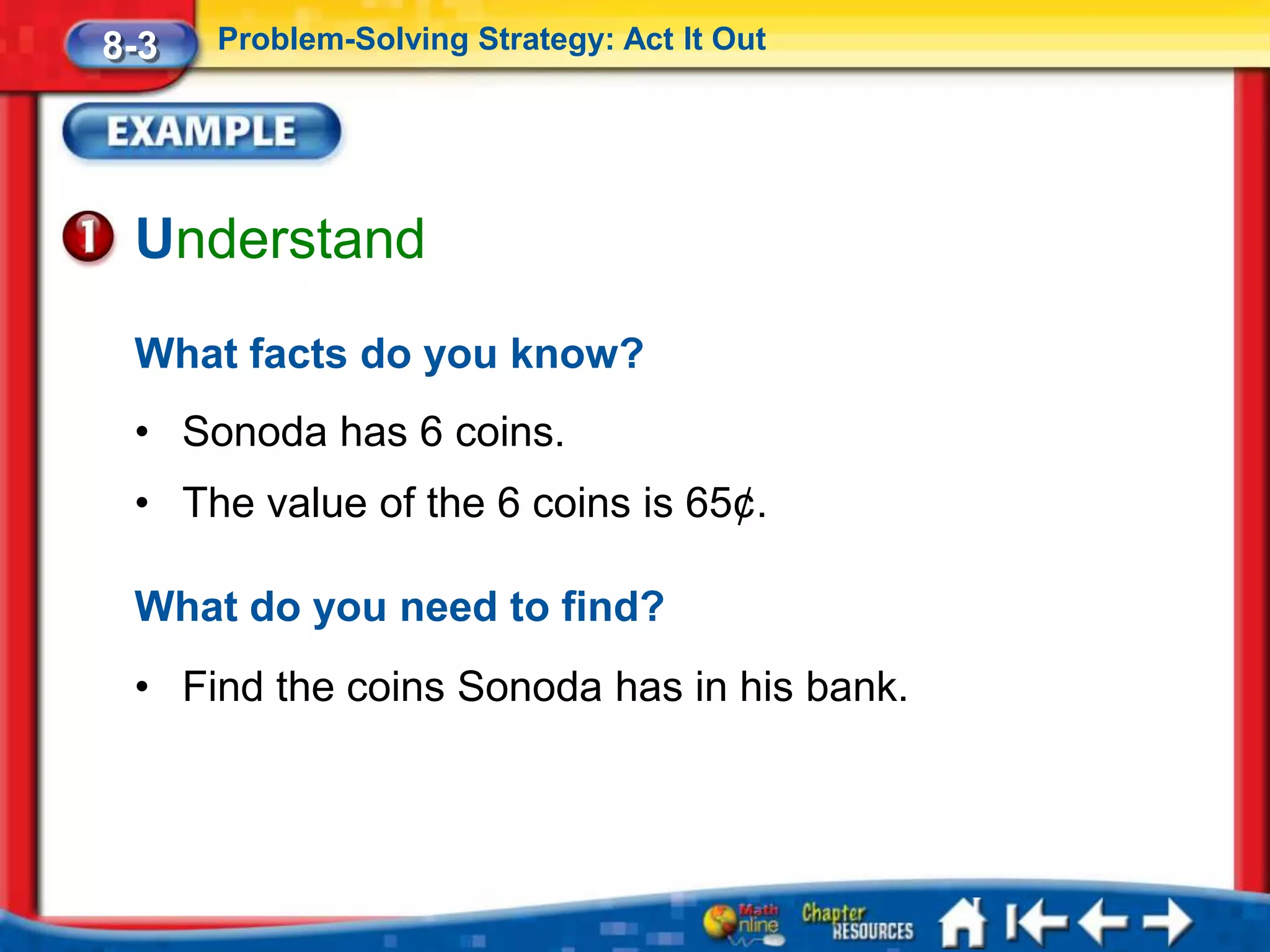
8-3   Problem-Solving Strategy: Act It Out


 Understand
 What facts do you know?
 • Sonoda has 6 coins.
 • The value of the 6 coins is 65¢.

 What do you need to find?
 • Find the coins Sonoda has in his bank.
8-3   Problem-Solving Strategy: Act It Out


 Plan
 You can use play money to act out different
 combinations of 65¢.
8-3   Problem-Solving Strategy: Act It Out


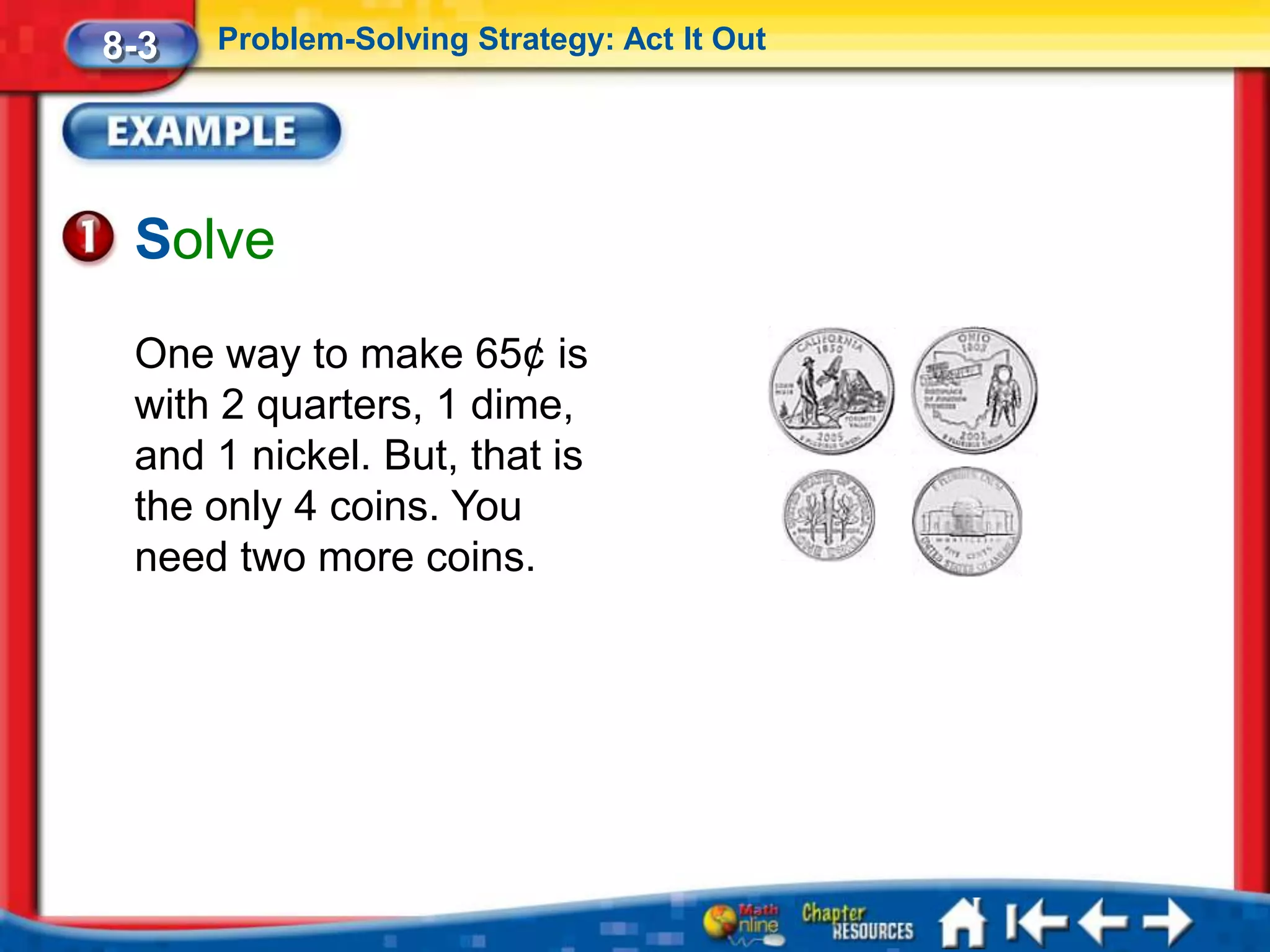
 Solve
 One way to make 65¢ is
 with 2 quarters, 1 dime,
 and 1 nickel. But, that is
 the only 4 coins. You
 need two more coins.
8-3   Problem-Solving Strategy: Act It Out


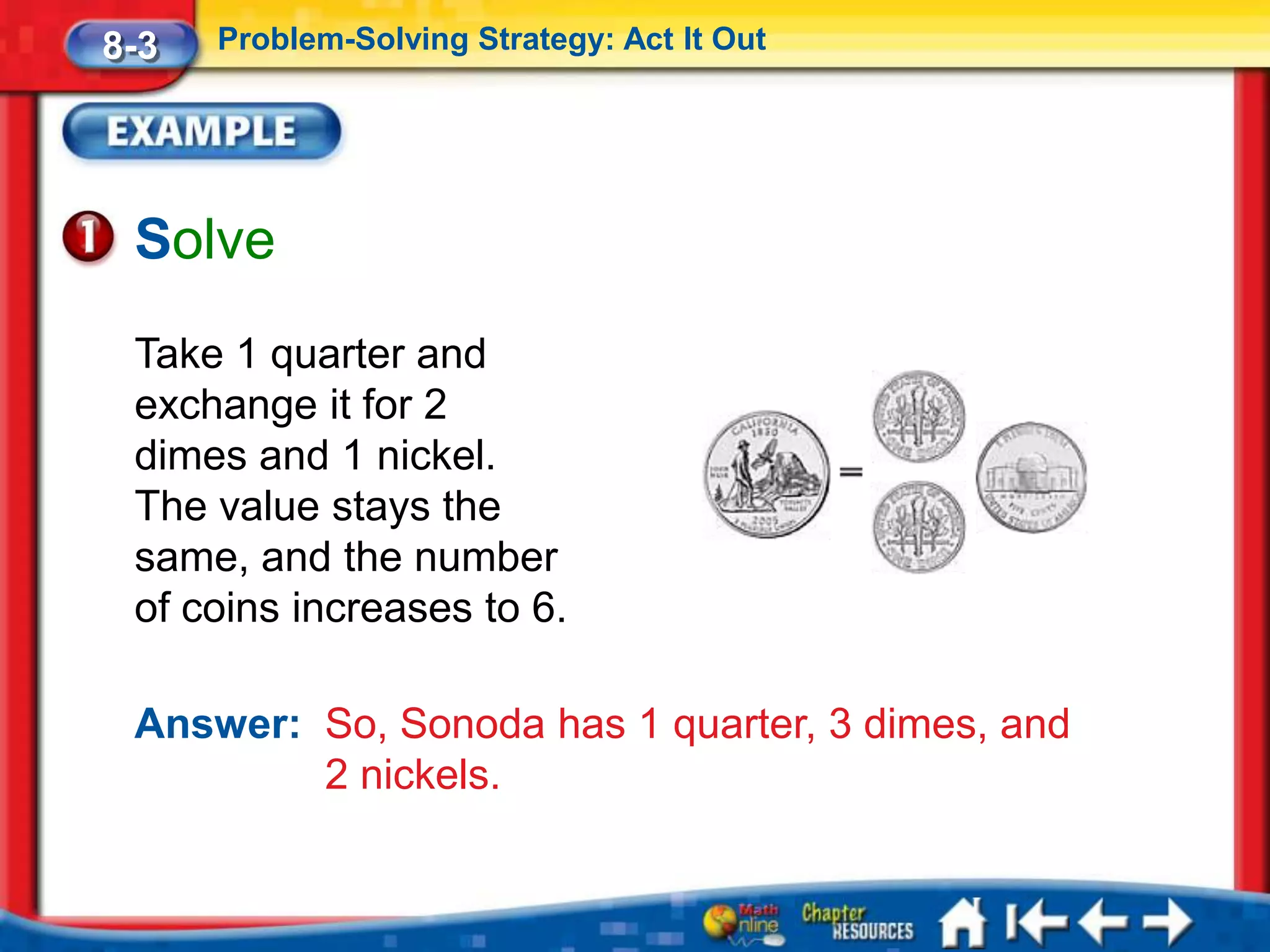
 Solve
 Take 1 quarter and
 exchange it for 2
 dimes and 1 nickel.
 The value stays the
 same, and the number
 of coins increases to 6.

 Answer: So, Sonoda has 1 quarter, 3 dimes, and
         2 nickels.
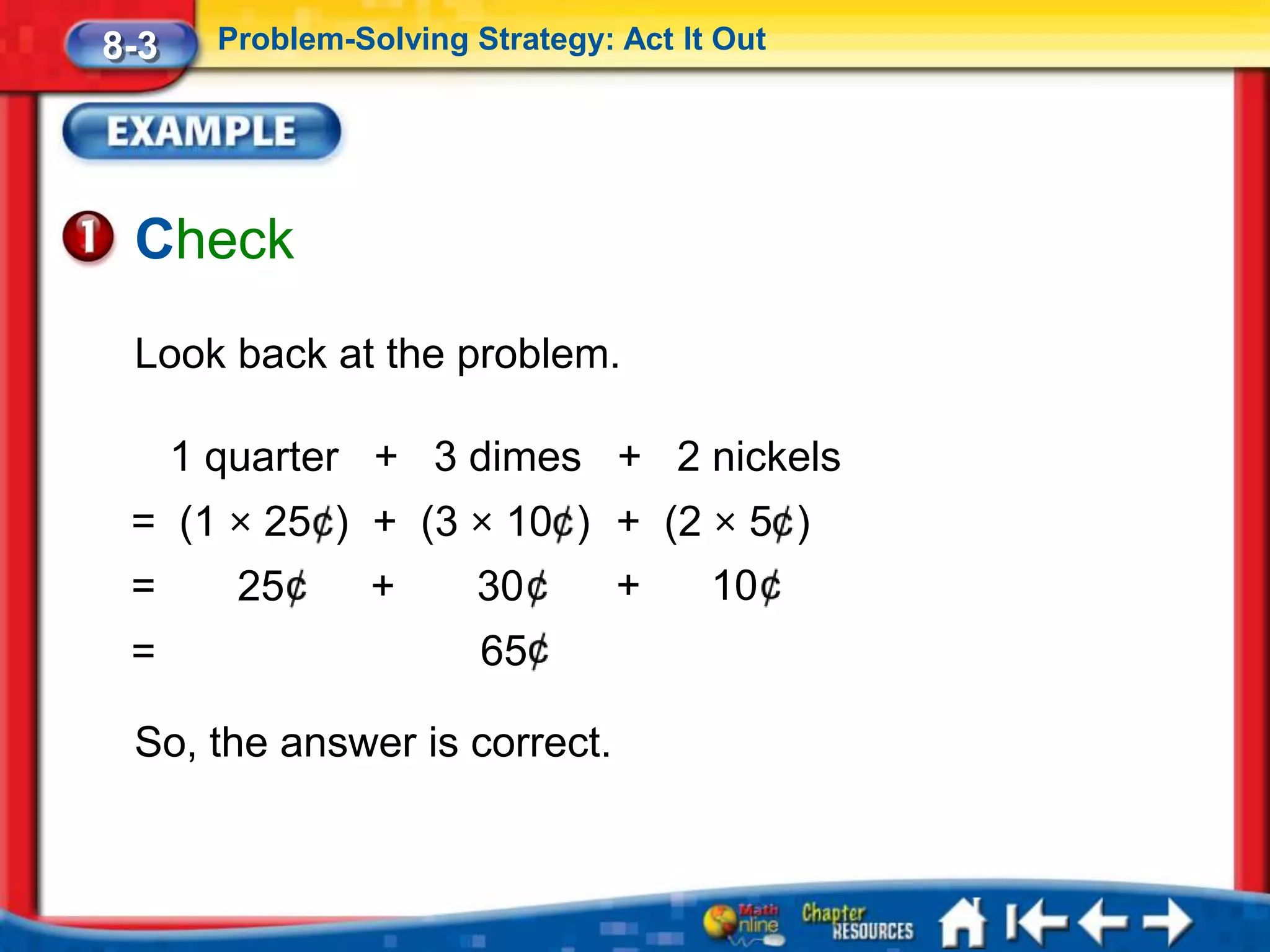
8-3     Problem-Solving Strategy: Act It Out


 Check
 Look back at the problem.

      1 quarter + 3 dimes + 2 nickels
 = (1 × 25 ) + (3 × 10 ) + (2 × 5 )
 =       25       +      30       +     10
 =                       65

 So, the answer is correct.
8-4     Multiply Two-Digit Numbers


      Five-Minute Check (over Lesson 8-3)
      Main Idea
      California Standards
      Example 1
      Example 2
8-4      Multiply Two-Digit Numbers


      • I will multiply two-digit numbers.
8-4      Multiply Two-Digit Numbers


             Standard 4NS3.2 Demonstrate an
      understanding of, and the ability to use, standard
      algorithms for multiplying a multidigit number by a
      two-digit number and for dividing a multidigit
      number by a one-digit number; use the relationships
      between them to simplify computations and to
      check results.
8-4      Multiply Two-Digit Numbers


            Preparation for Standard 4NS3.3 Solve
      problems involving multiplication of multidigit
      numbers by two-digit numbers.
8-4   Multiply Two-Digit Numbers


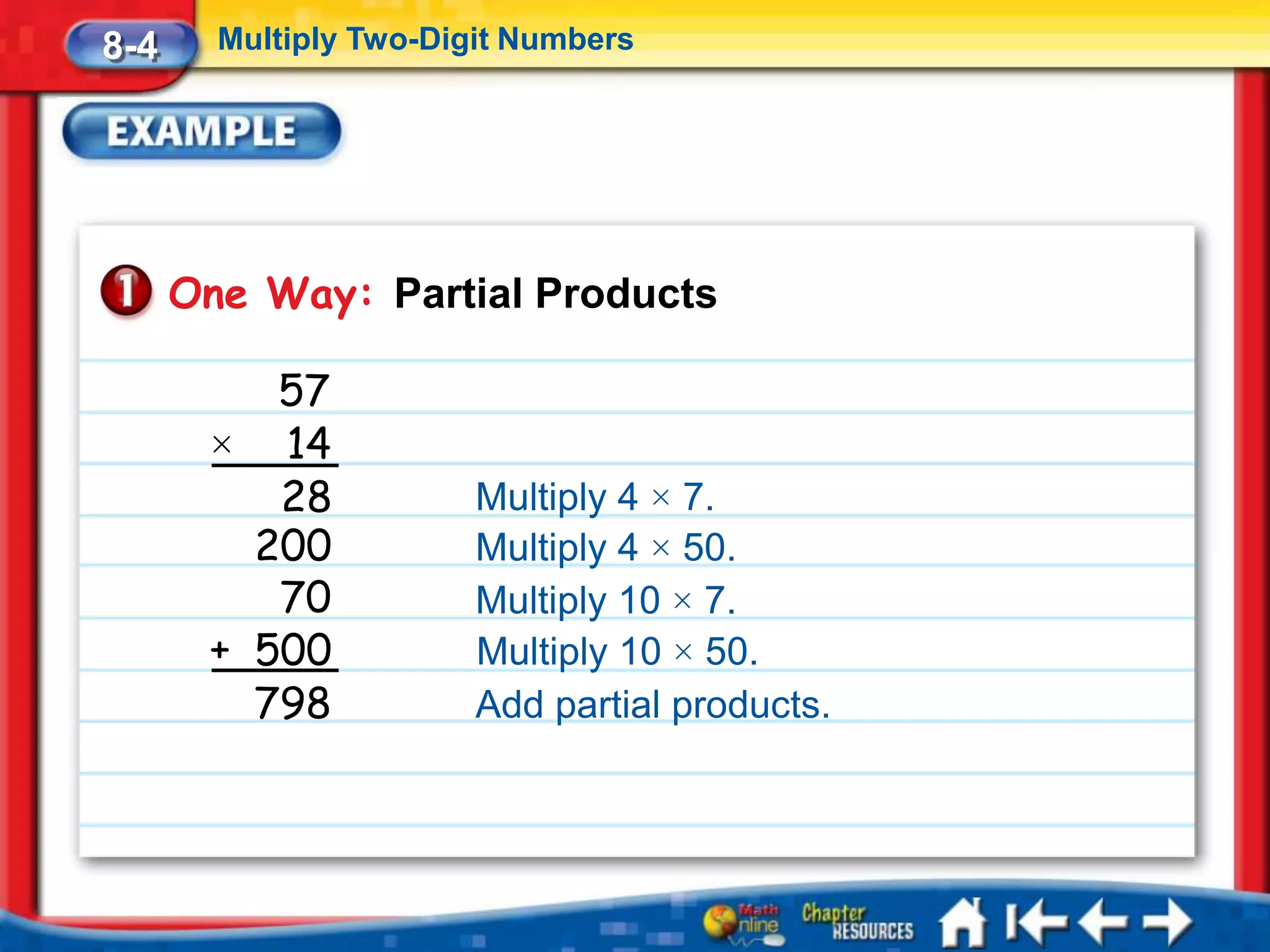
 How far can a truck travel in 14 hours if it is
 traveling an average of 57 miles per hour?
8-4     Multiply Two-Digit Numbers


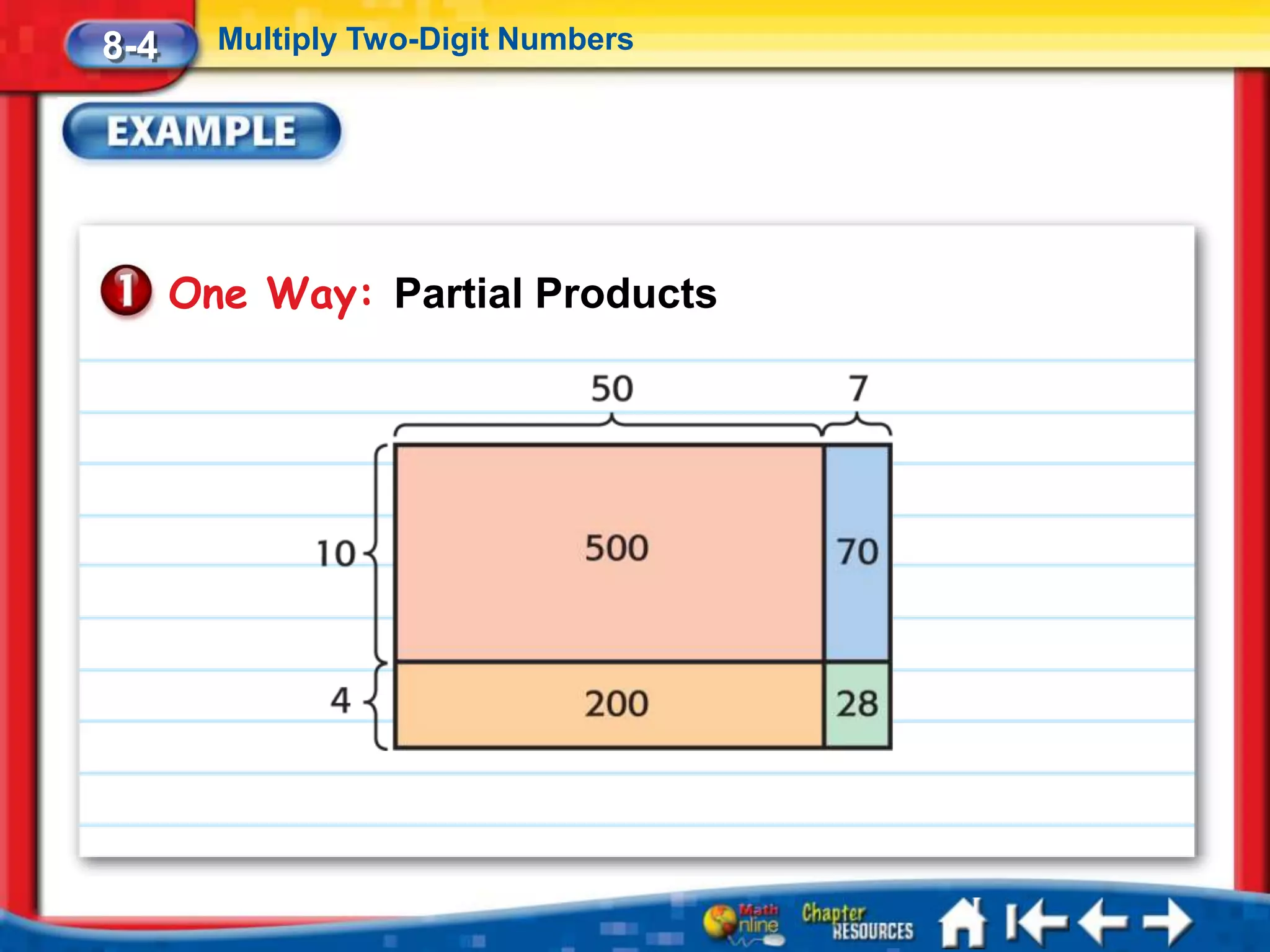
      One Way: Partial Products

          57
       × 14
          28            Multiply 4 × 7.
         200            Multiply 4 × 50.
          70            Multiply 10 × 7.
       + 500            Multiply 10 × 50.
         798            Add partial products.
8-4     Multiply Two-Digit Numbers


      One Way: Partial Products
8-4     Multiply Two-Digit Numbers


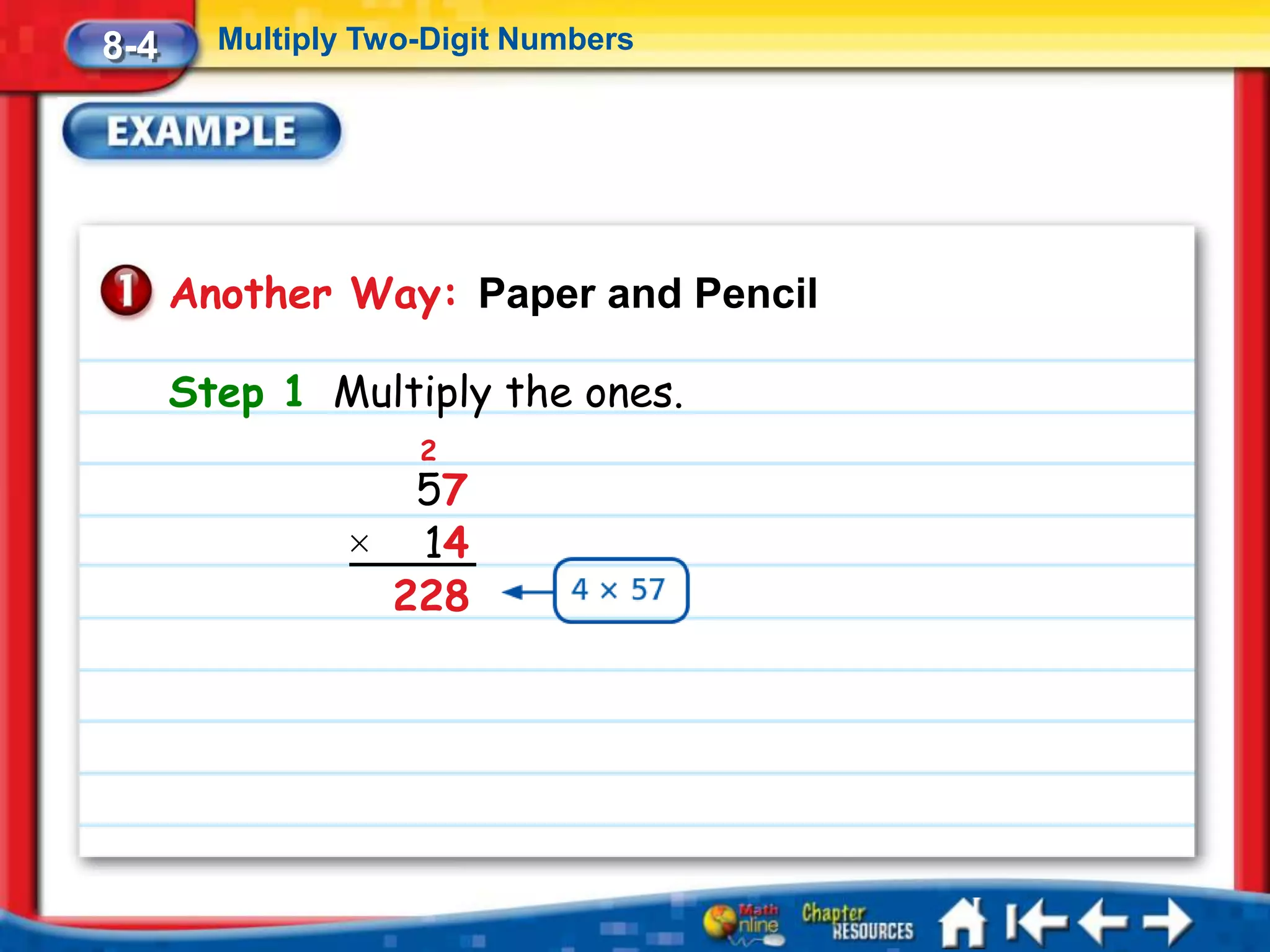
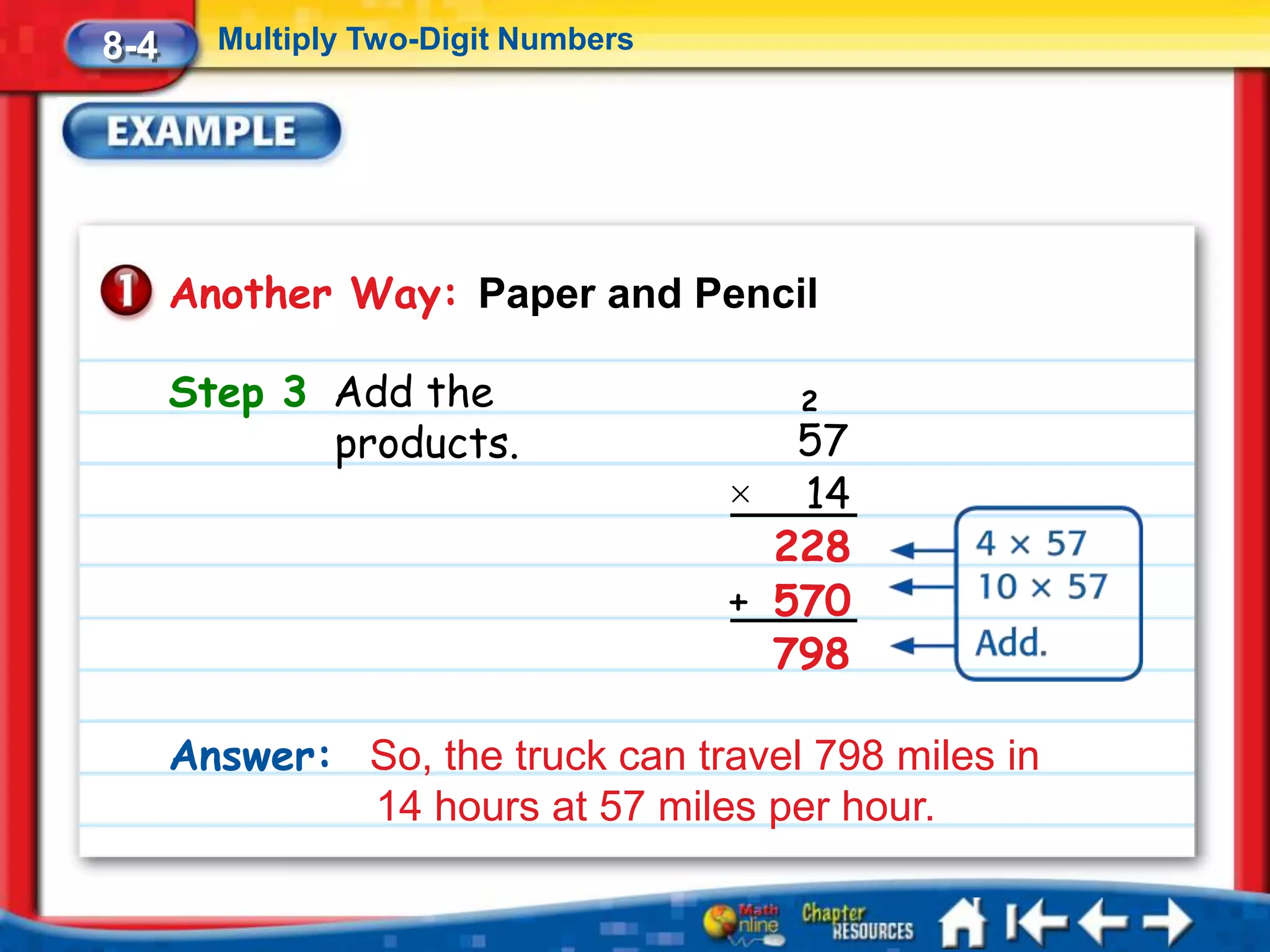
      Another Way: Paper and Pencil

      Step 1 Multiply the ones.
                    2
                  57
                × 14
                 228
8-4     Multiply Two-Digit Numbers


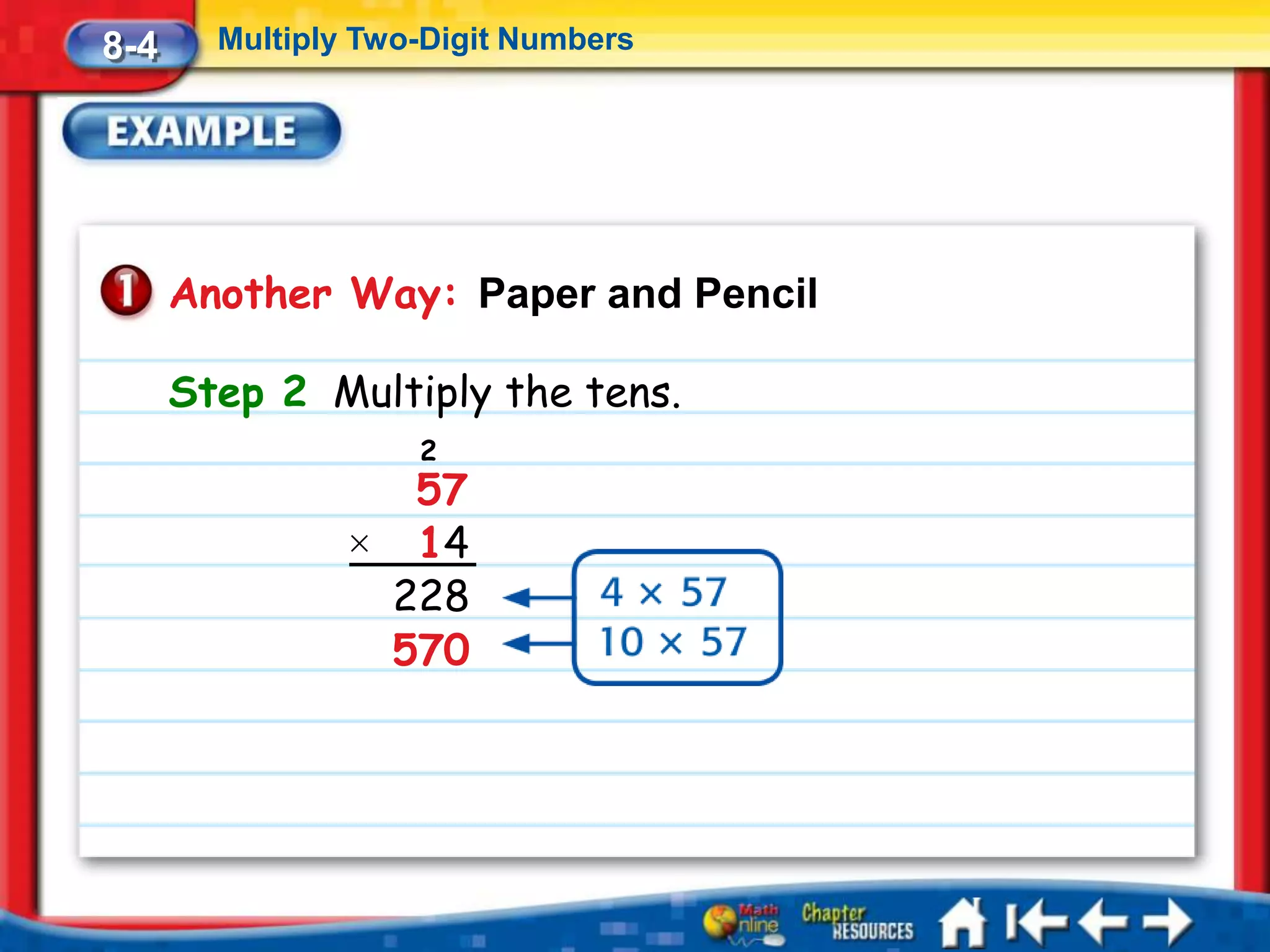
      Another Way: Paper and Pencil

      Step 2 Multiply the tens.
                    2
                  57
                × 14
                 228
                 570
8-4     Multiply Two-Digit Numbers


      Another Way: Paper and Pencil

      Step 3 Add the                   2
             products.                  57
                                     × 14
                                       228
                                     + 570
                                       798

      Answer: So, the truck can travel 798 miles in
              14 hours at 57 miles per hour.
8-4   Multiply Two-Digit Numbers


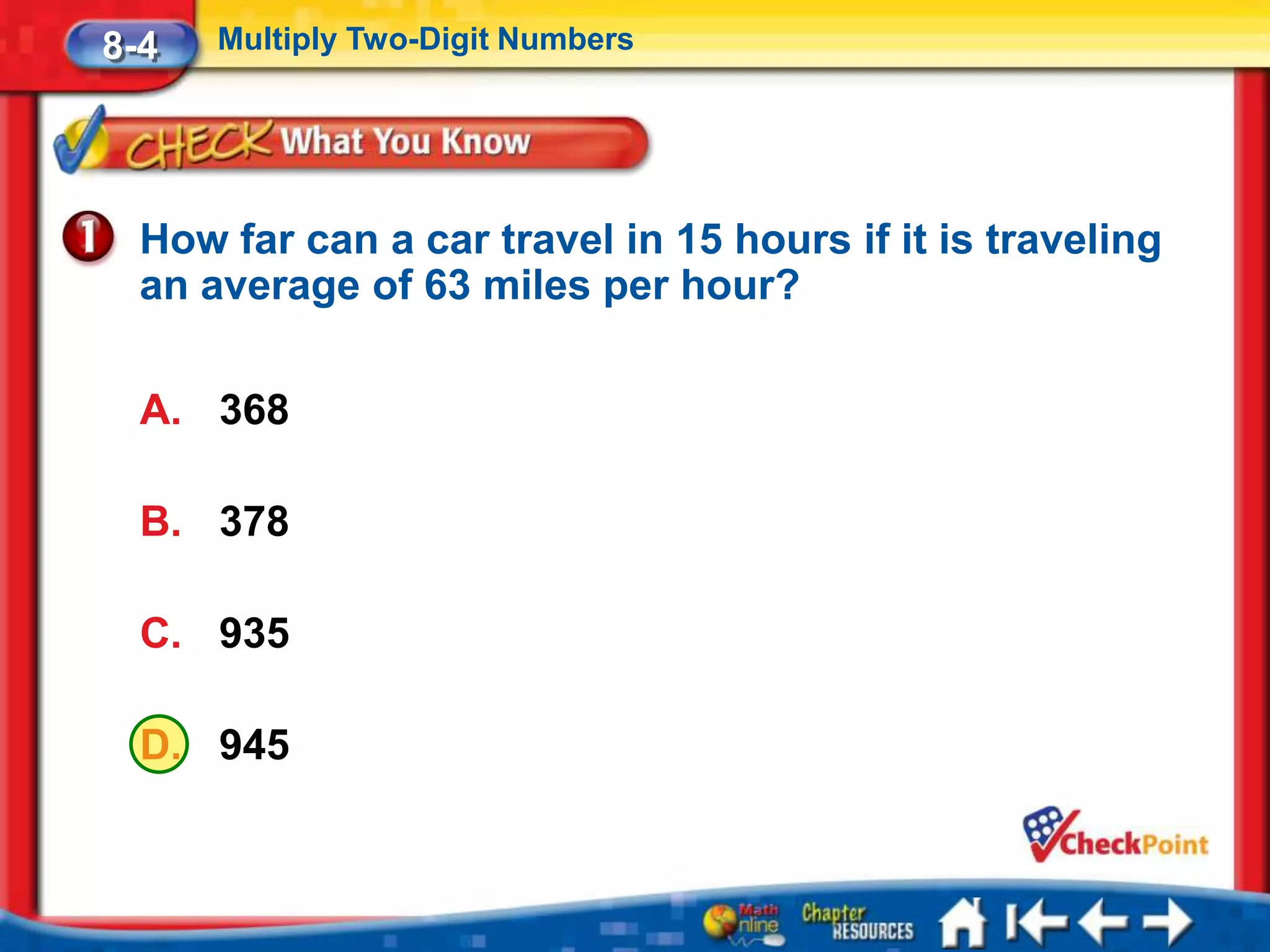
  How far can a car travel in 15 hours if it is traveling
  an average of 63 miles per hour?

  A. 368

  B. 378

  C. 935

  D. 945
8-4   Multiply Two-Digit Numbers


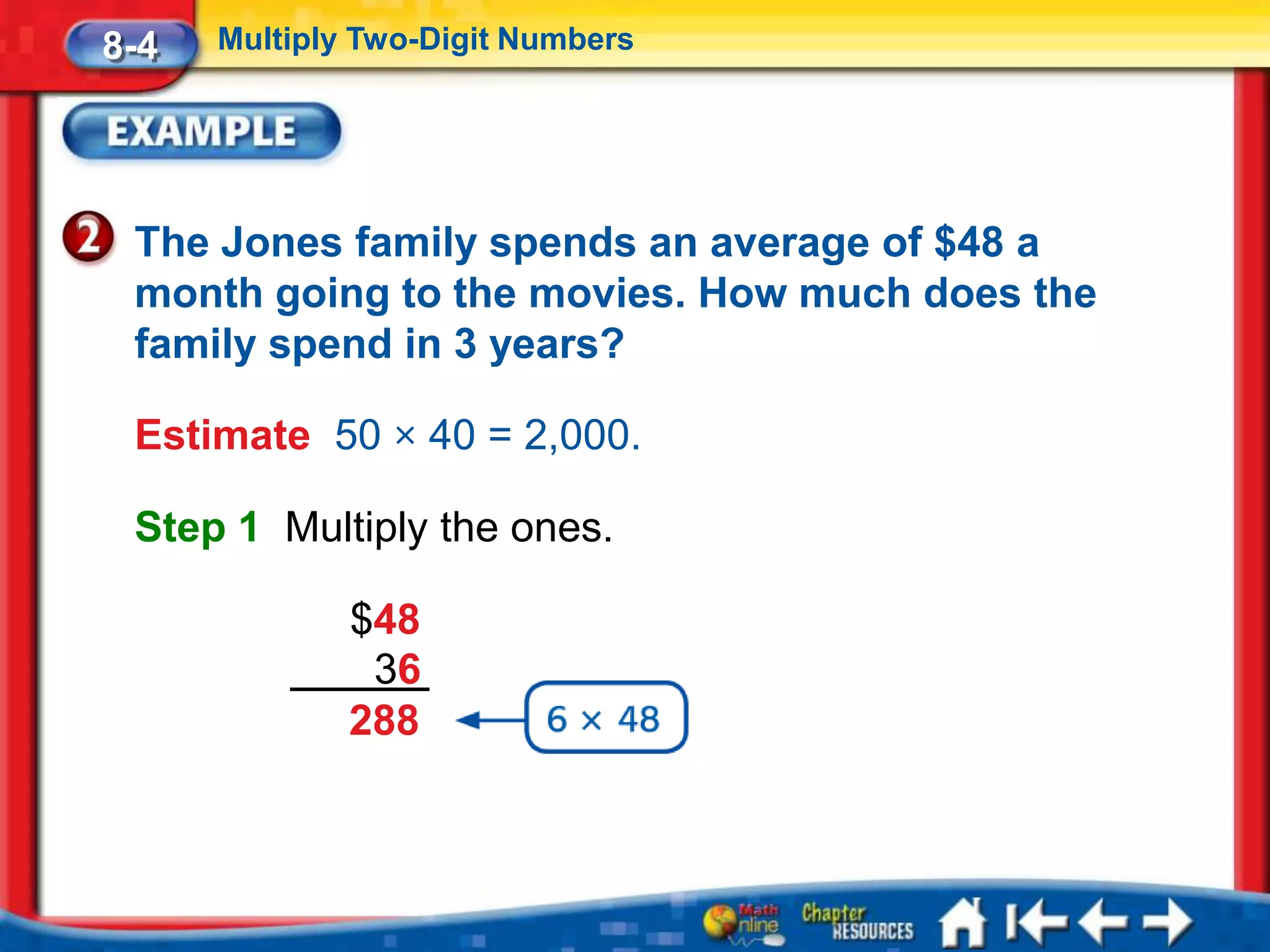
 The Jones family spends an average of $48 a
 month going to the movies. How much does the
 family spend in 3 years?

 Estimate 50 × 40 = 2,000.

 Step 1 Multiply the ones.

              $48
               36
              288
8-4   Multiply Two-Digit Numbers


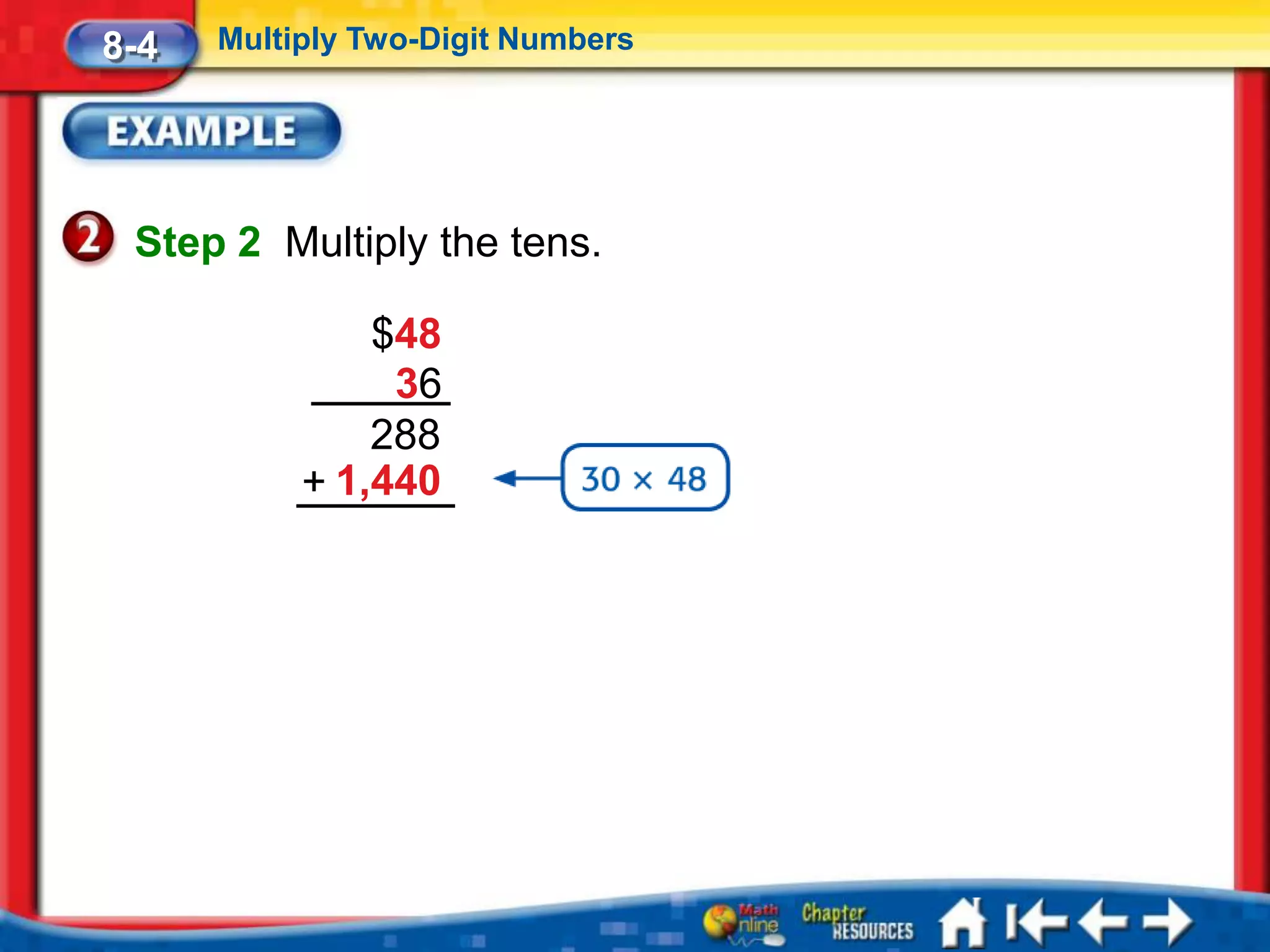
 Step 2 Multiply the tens.

               $48
                36
               288
           + 1,440
8-4   Multiply Two-Digit Numbers


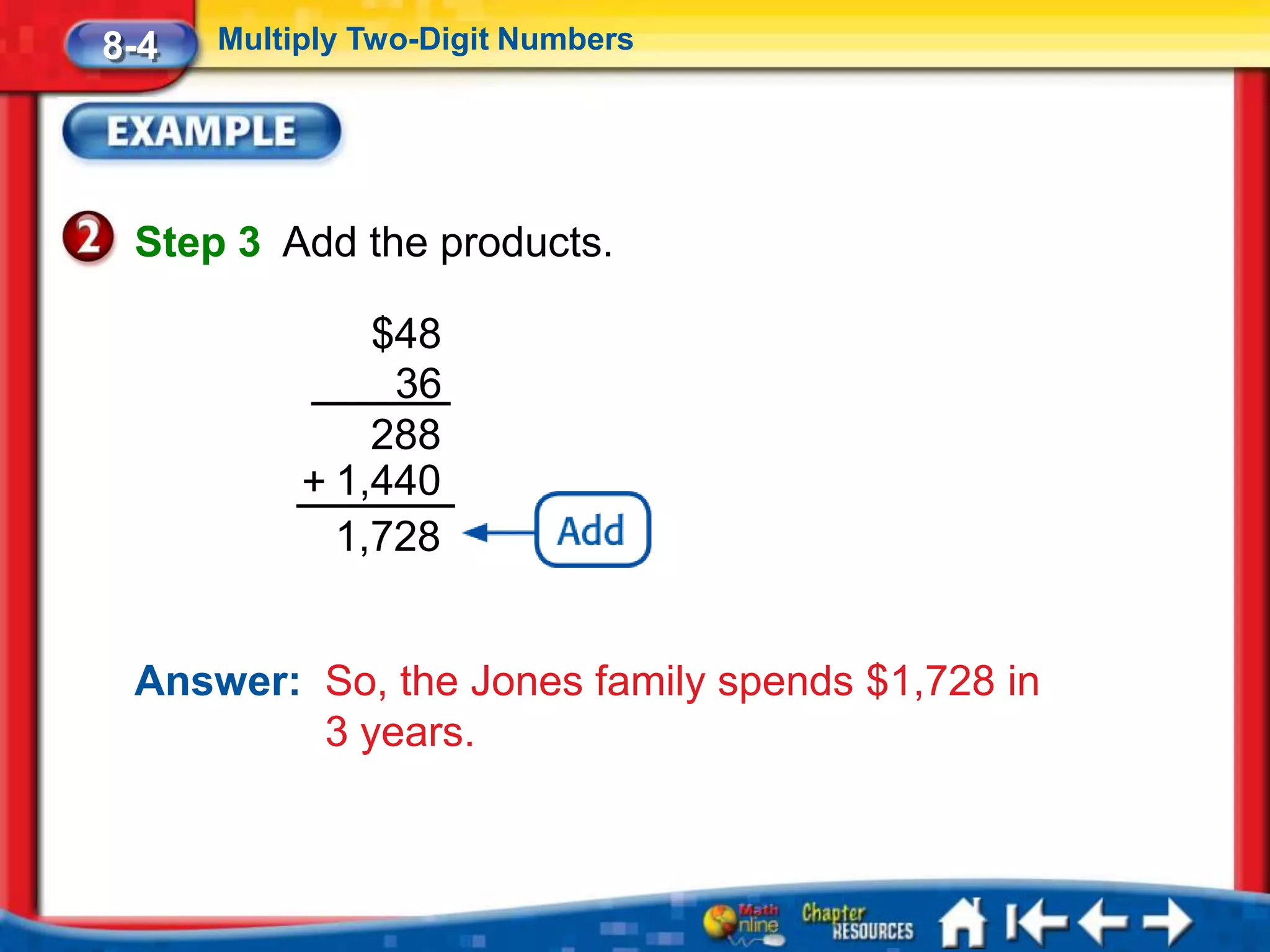
 Step 3 Add the products.

               $48
                36
               288
           + 1,440
             1,728


 Answer: So, the Jones family spends $1,728 in
         3 years.
8-4   Multiply Two-Digit Numbers


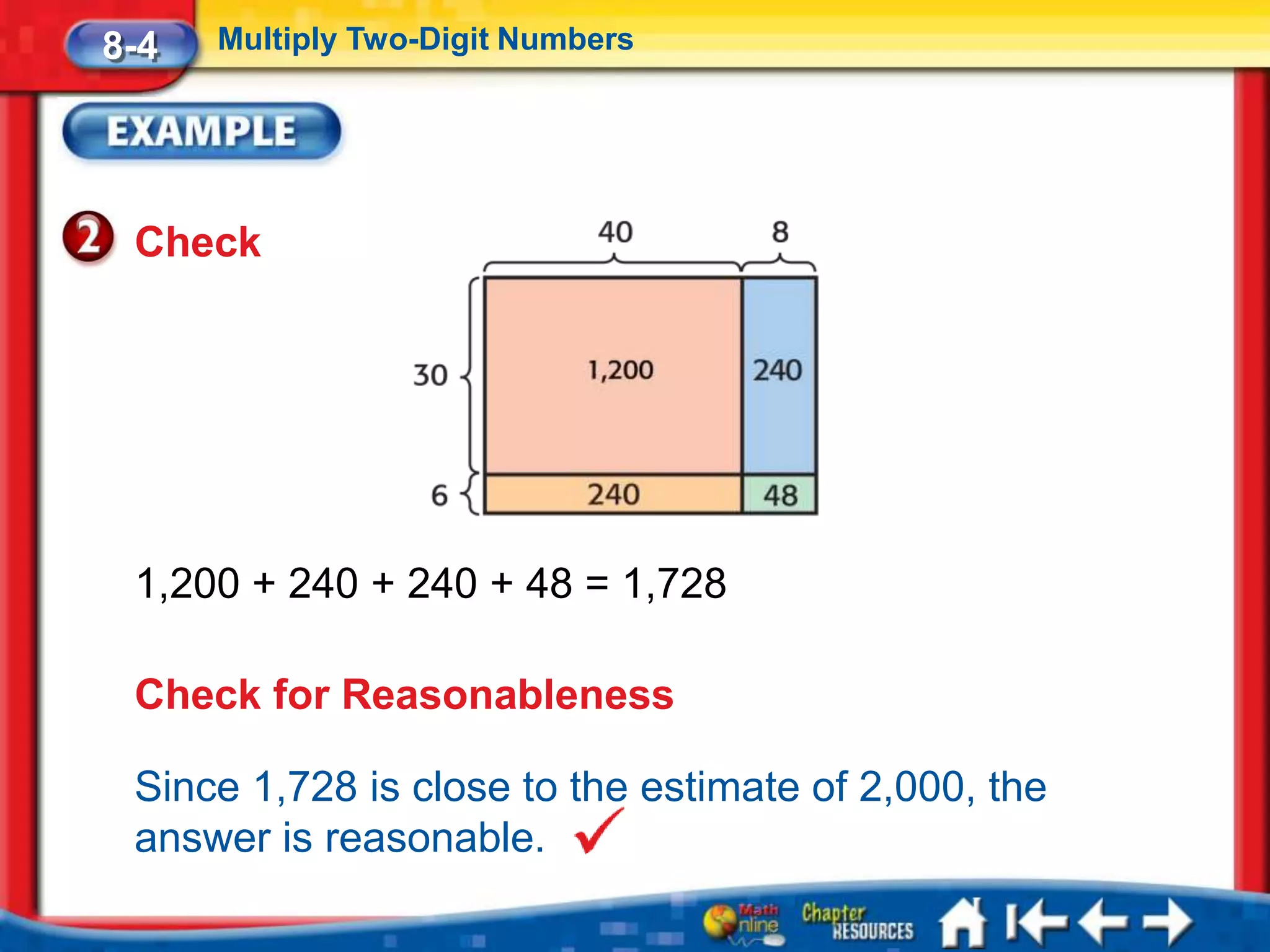
 Check


 1,200 + 240 + 240 + 48 = 1,728

 Check for Reasonableness

 Since 1,728 is close to the estimate of 2,000, the
 answer is reasonable.
8-4   Multiply Two-Digit Numbers


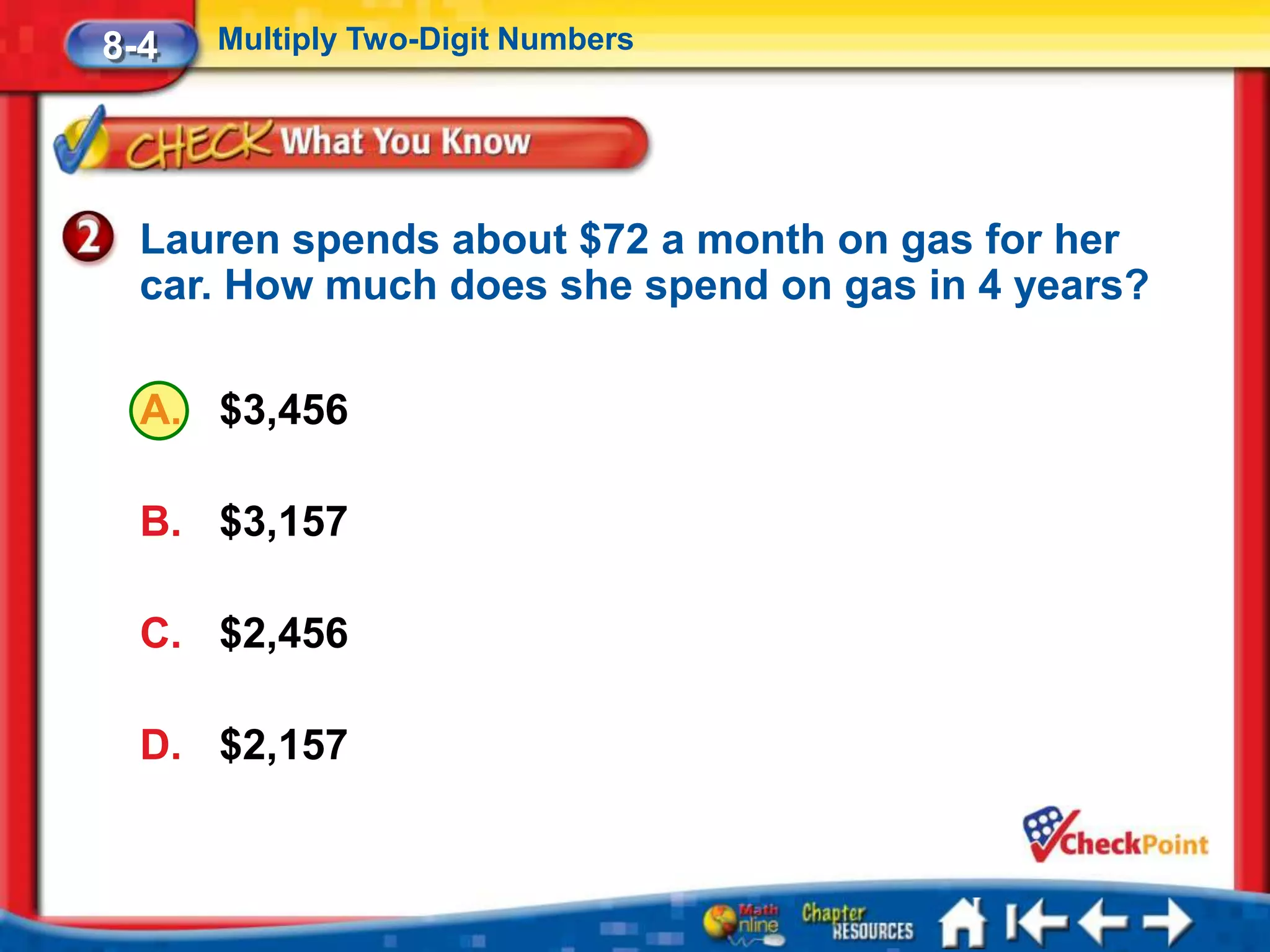
  Lauren spends about $72 a month on gas for her
  car. How much does she spend on gas in 4 years?

  A. $3,456

  B. $3,157

  C. $2,456

  D. $2,157
8-5     Multiply Three-Digit Numbers by Two-Digit Numbers


      Five-Minute Check (over Lesson 8-4)
      Main Idea
      California Standards
      Example 1
      Example 2
8-5      Multiply Three-Digit Numbers by Two-Digit Numbers


      • I will multiply a three-digit number by a two-digit
        number.
8-5      Multiply Three-Digit Numbers by Two-Digit Numbers


             Standard 4NS3.2 Demonstrate an
      understanding of, and the ability to use,
      standard algorithms for multiplying a multidigit
      number by a two-digit number and for dividing a
      multidigit number by a one-digit number; use the
      relationships between them to simplify computations
      and to check results.
8-5     Multiply Three-Digit Numbers by Two-Digit Numbers


            Standard 4NS3.3 Solve problems involving
      multiplication of multidigit numbers by two-digit
      numbers.
8-5   Multiply Three-Digit Numbers by Two-Digit Numbers


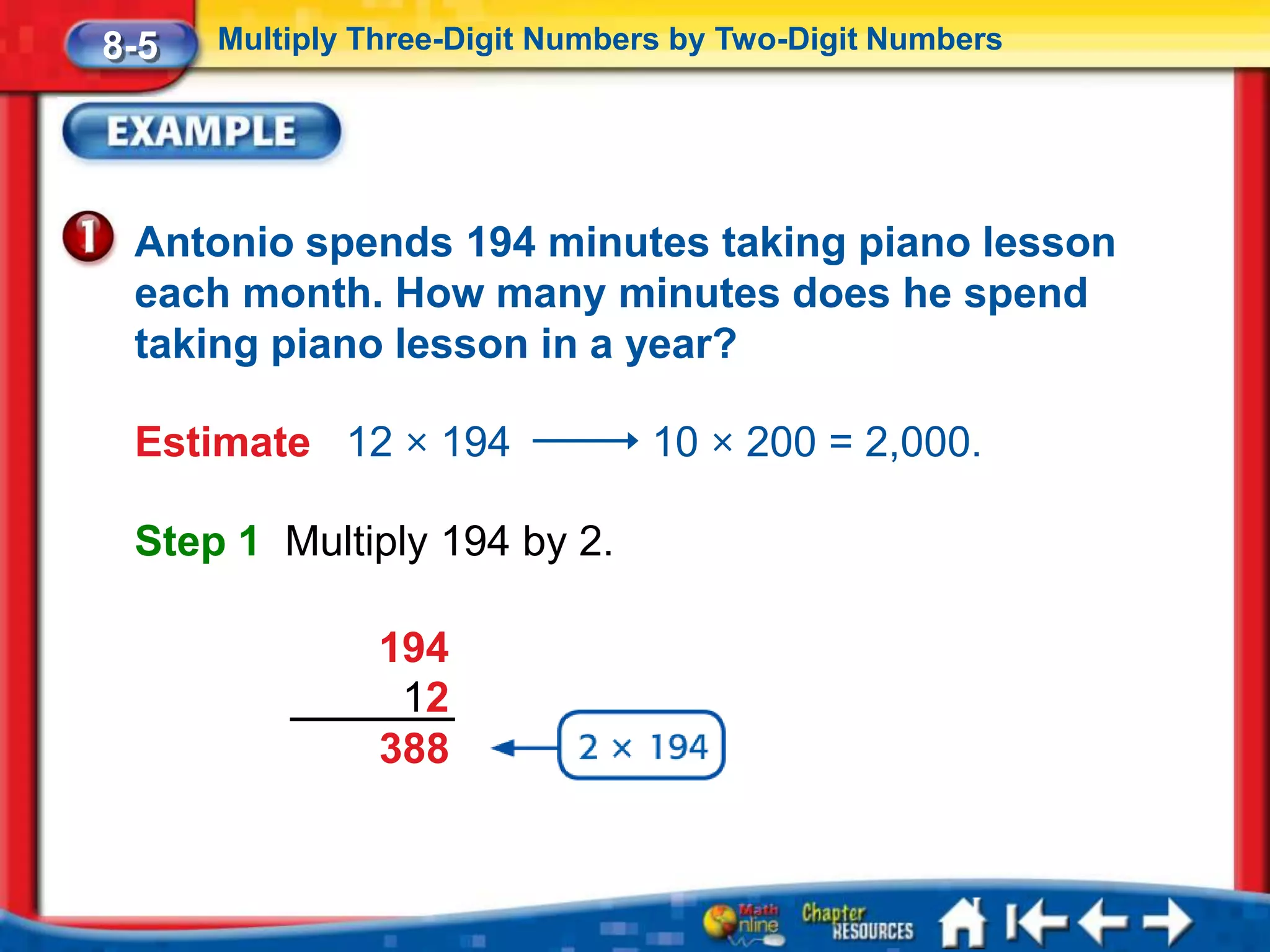
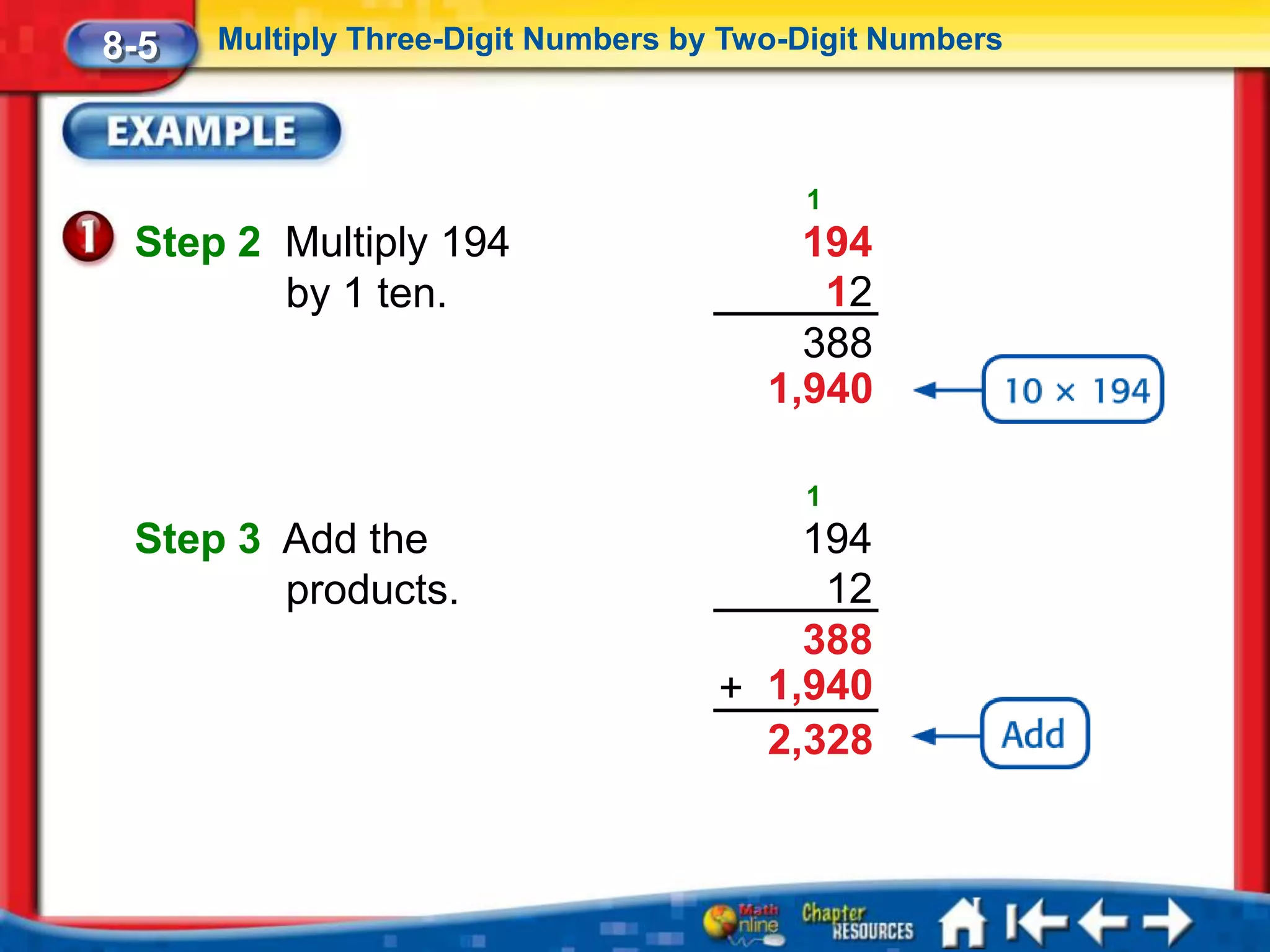
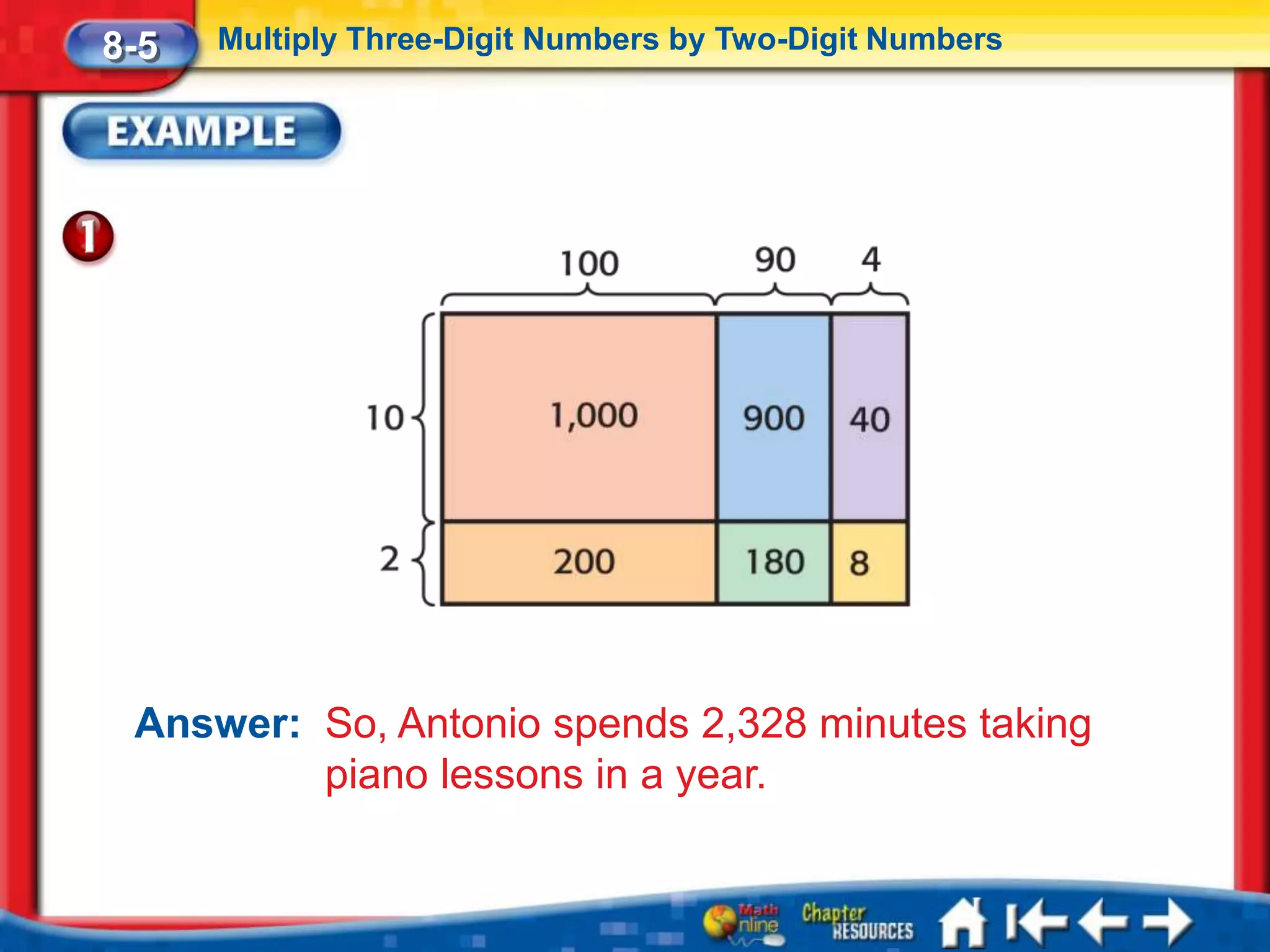
 Antonio spends 194 minutes taking piano lesson
 each month. How many minutes does he spend
 taking piano lesson in a year?

 Estimate 12 × 194               10 × 200 = 2,000.

 Step 1 Multiply 194 by 2.

                194
                 12
                388
8-5   Multiply Three-Digit Numbers by Two-Digit Numbers


                                          1
 Step 2 Multiply 194                      194
        by 1 ten.                          12
                                          388
                                        1,940

                                          1
 Step 3 Add the                          194
        products.                         12
                                         388
                                     + 1,940
                                       2,328
8-5   Multiply Three-Digit Numbers by Two-Digit Numbers


 Answer: So, Antonio spends 2,328 minutes taking
         piano lessons in a year.
8-5   Multiply Three-Digit Numbers by Two-Digit Numbers


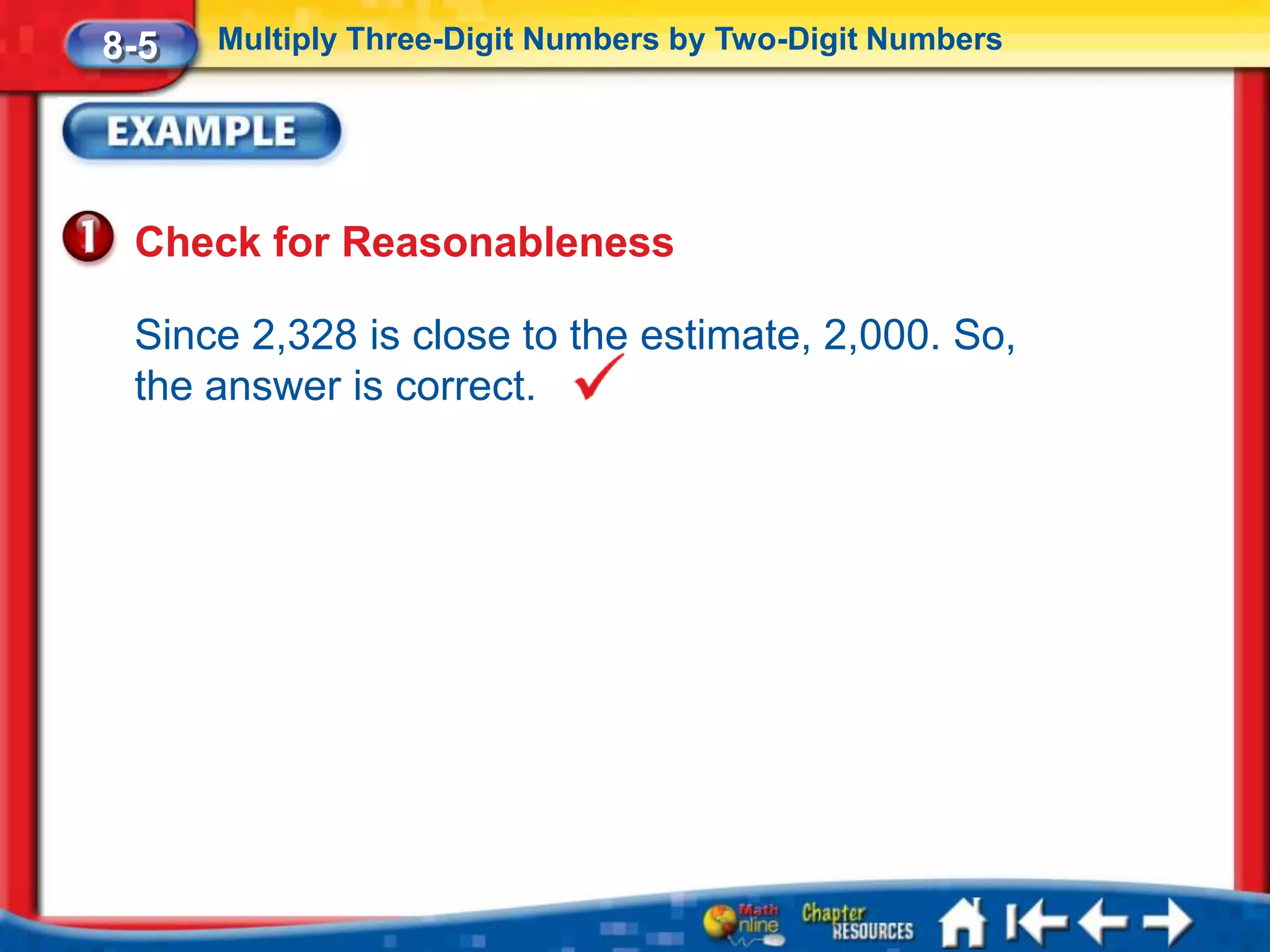
 Check for Reasonableness

 Since 2,328 is close to the estimate, 2,000. So,
 the answer is correct.
8-5   Multiply Three-Digit Numbers by Two-Digit Numbers


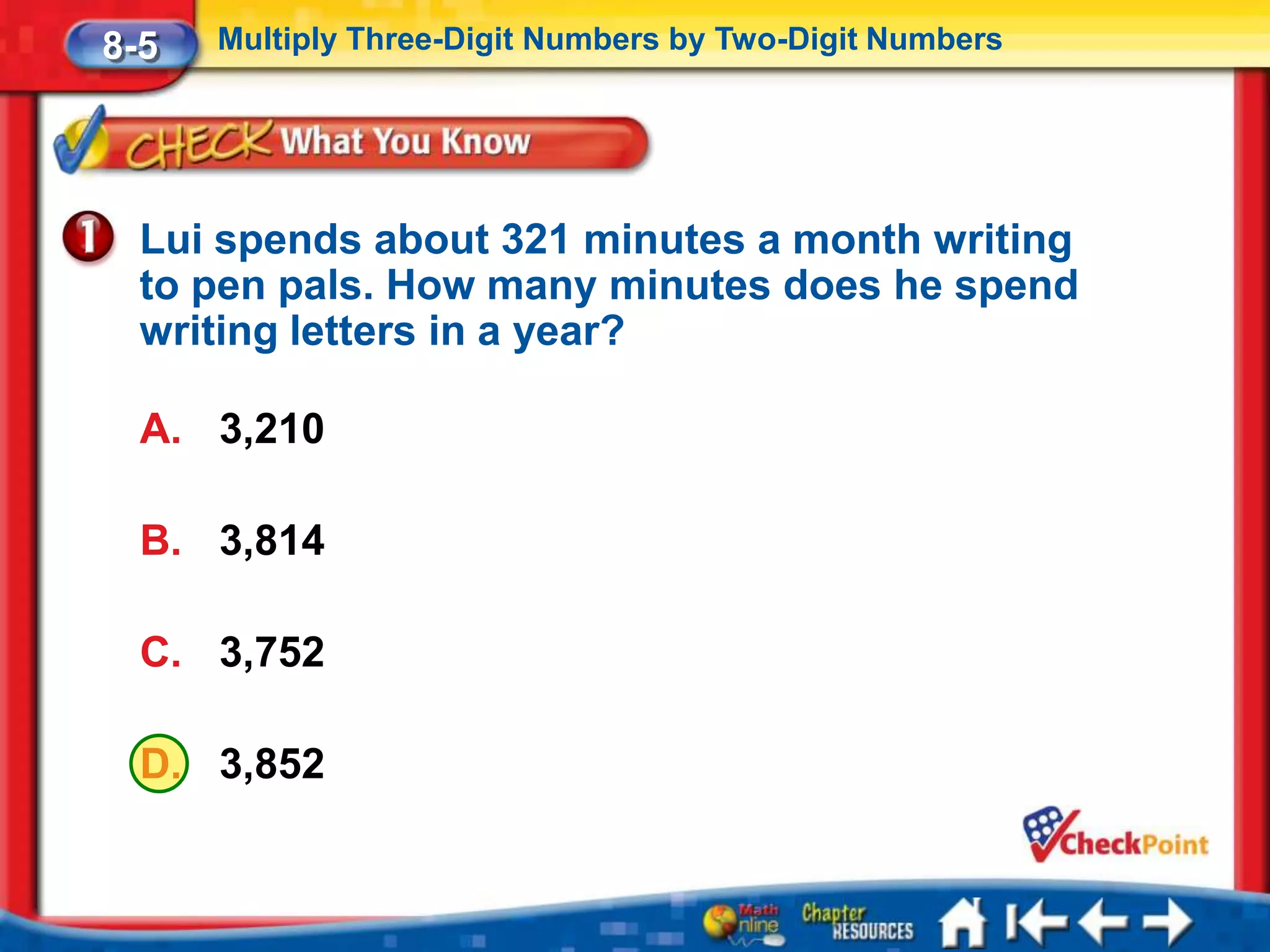
  Lui spends about 321 minutes a month writing
  to pen pals. How many minutes does he spend
  writing letters in a year?

  A. 3,210

  B. 3,814

  C. 3,752

  D. 3,852
8-5   Multiply Three-Digit Numbers by Two-Digit Numbers


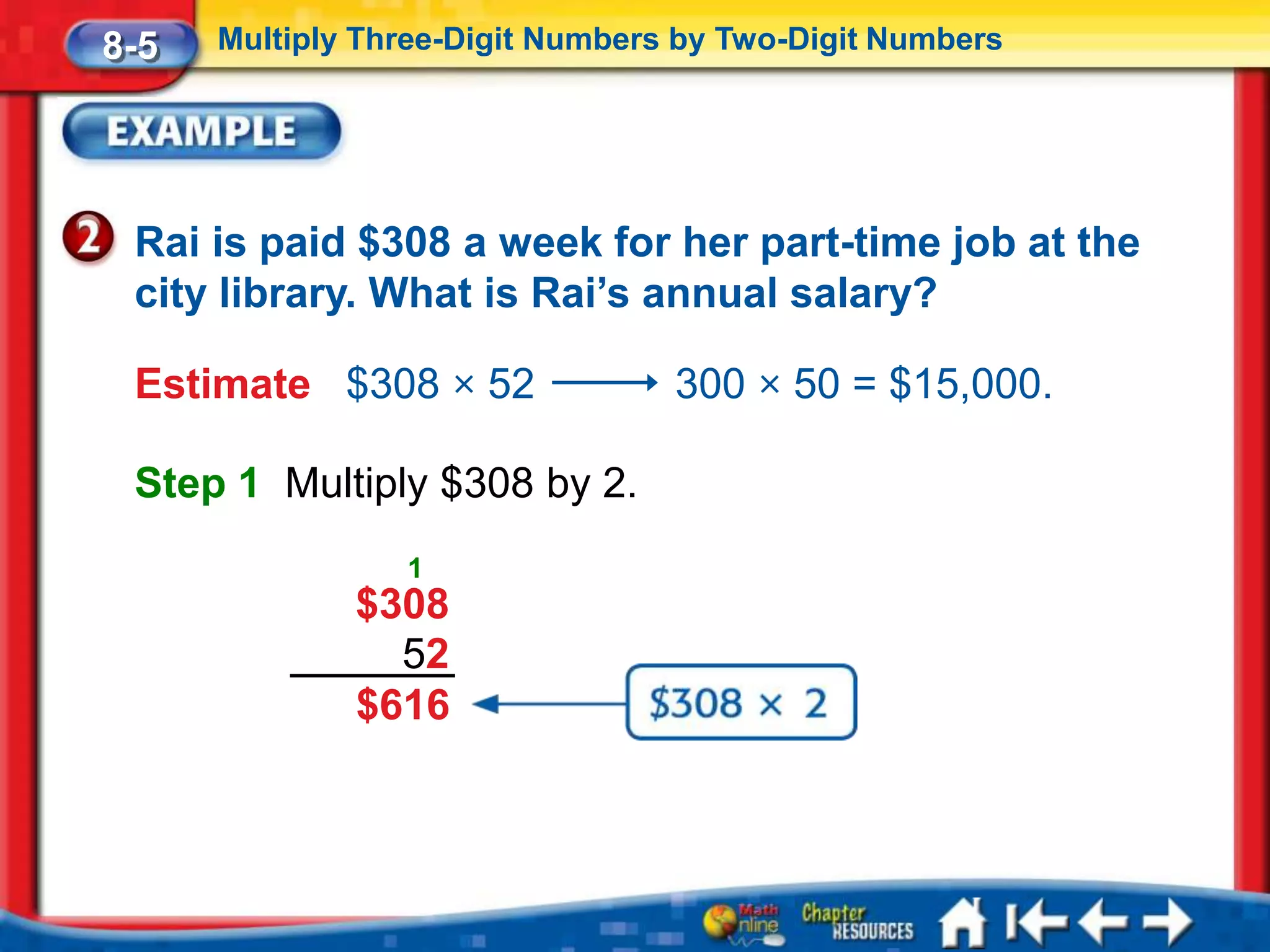
 Rai is paid $308 a week for her part-time job at the
 city library. What is Rai’s annual salary?

 Estimate $308 × 52               300 × 50 = $15,000.

 Step 1 Multiply $308 by 2.
                 1
              $308
                52
              $616
8-5   Multiply Three-Digit Numbers by Two-Digit Numbers


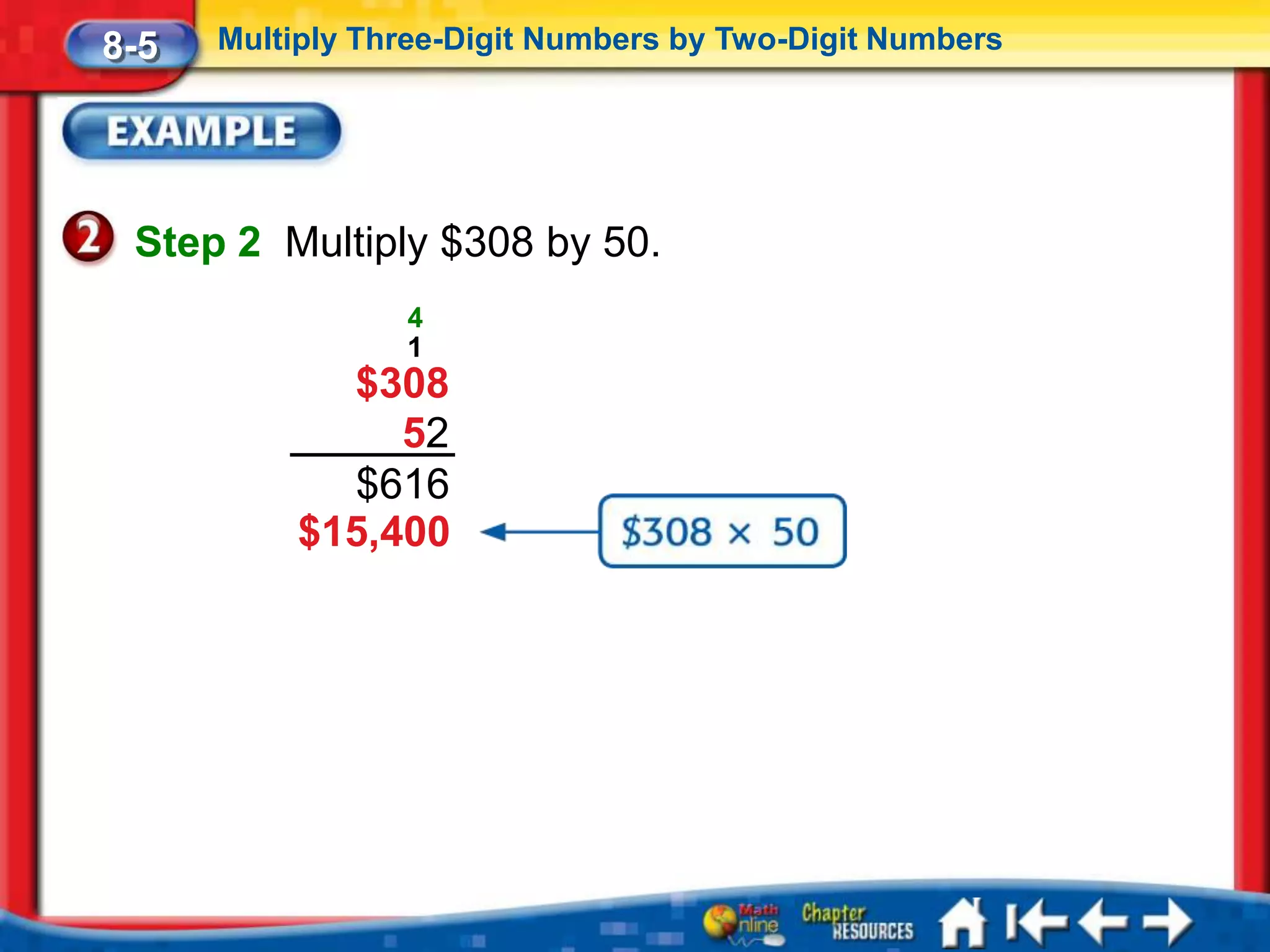
 Step 2 Multiply $308 by 50.
                 4
                 1
             $308
                52
             $616
           $15,400
8-5   Multiply Three-Digit Numbers by Two-Digit Numbers


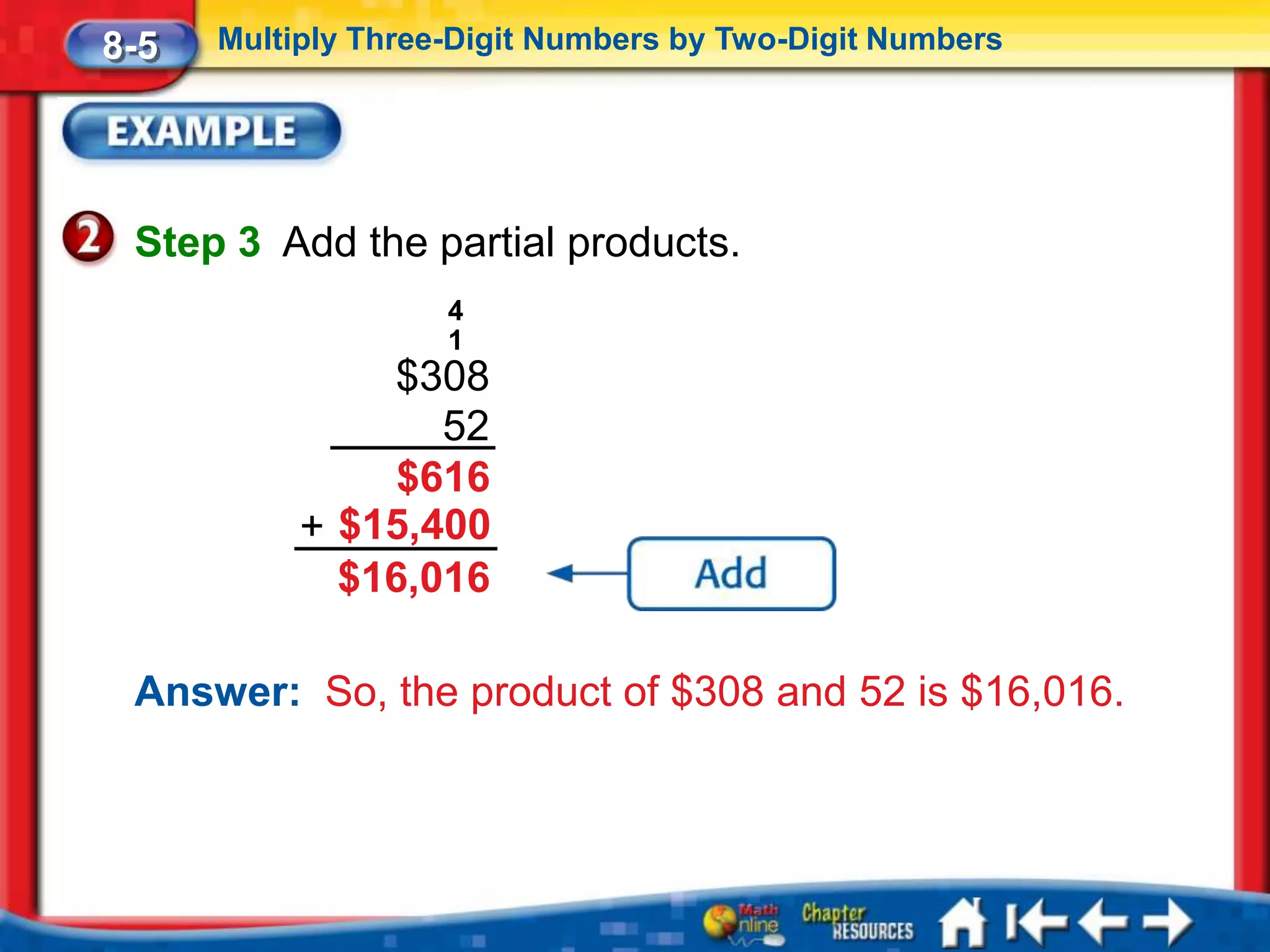
 Step 3 Add the partial products.
                    4
                    1
               $308
                  52
                $616
           + $15,400
             $16,016

 Answer: So, the product of $308 and 52 is $16,016.
8-5   Multiply Three-Digit Numbers by Two-Digit Numbers


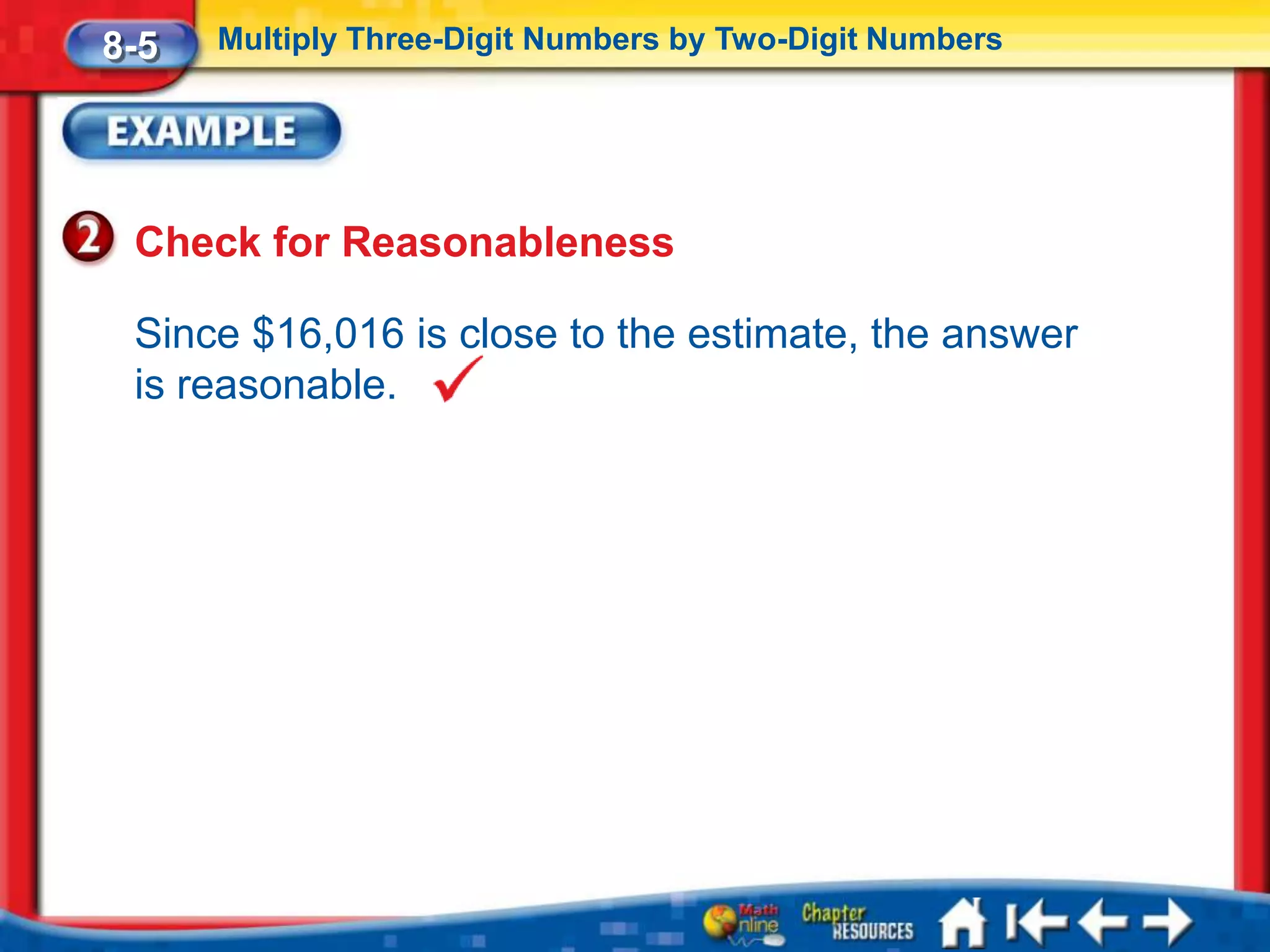
 Check for Reasonableness

 Since $16,016 is close to the estimate, the answer
 is reasonable.
8-5   Multiply Three-Digit Numbers by Two-Digit Numbers


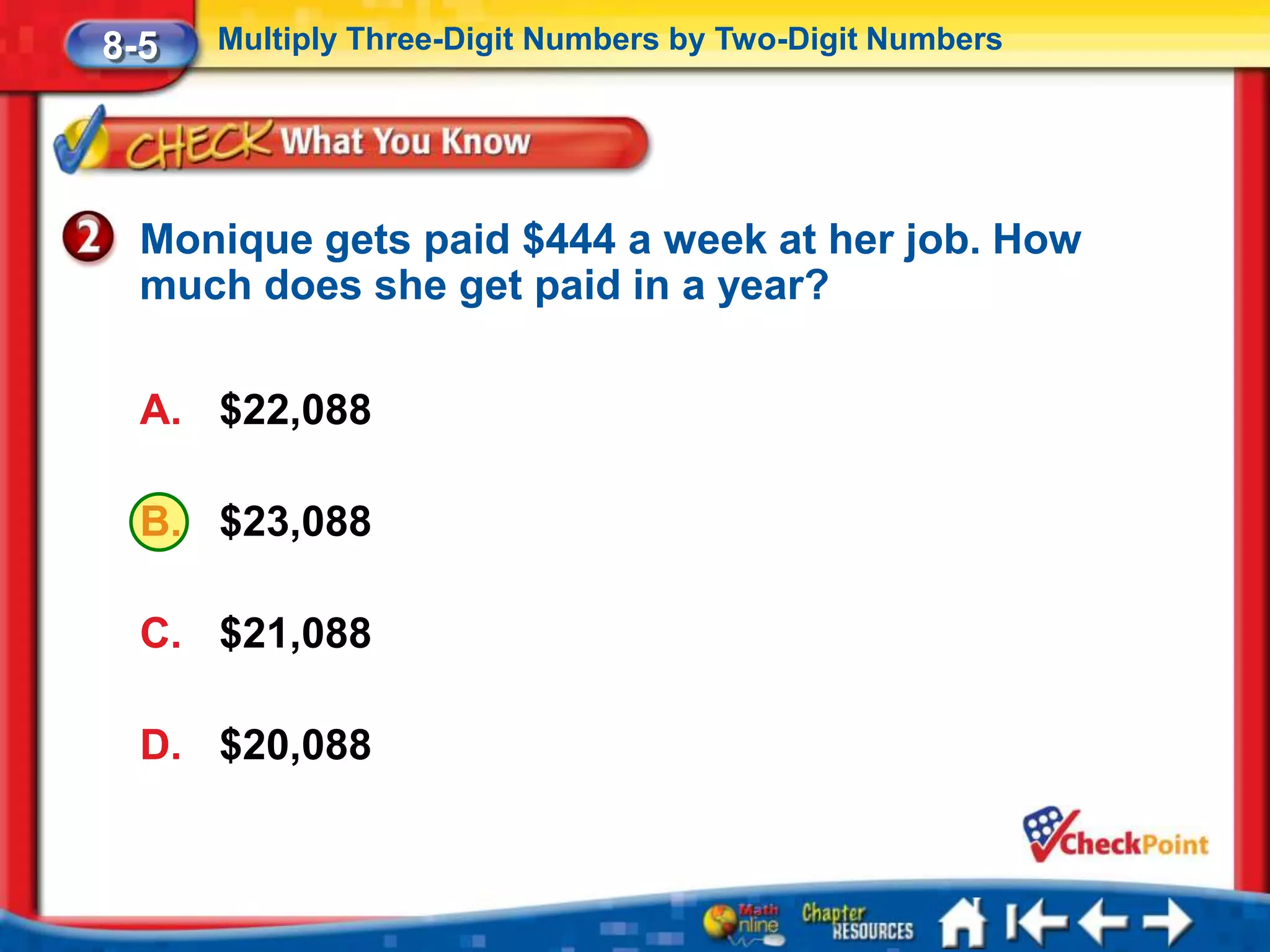
  Monique gets paid $444 a week at her job. How
  much does she get paid in a year?

  A. $22,088

  B. $23,088

  C. $21,088

  D. $20,088
8-6     Problem-Solving Investigation: Choose a Strategy


      Five-Minute Check (over Lesson 8-5)
      Main Idea
      California Standards
      Example 1: Problem-Solving Investigation
8-6      Problem-Solving Investigation: Choose a Strategy


      • I will choose the best strategy to solve a problem.
8-6     Problem-Solving Investigation: Choose a Strategy


      Standard 4MR1.1 Analyze problems by
      identifying relationships, distinguishing relevant
      from irrelevant information, sequencing and
      prioritizing information, and observing patterns.
8-6      Problem-Solving Investigation: Choose a Strategy


             Standard 4NS3.0 Students solve problems
      involving addition, subtraction, multiplication, and
      division of whole numbers and understand the
      relationships among the operations.
8-6    Problem-Solving Investigation: Choose a Strategy


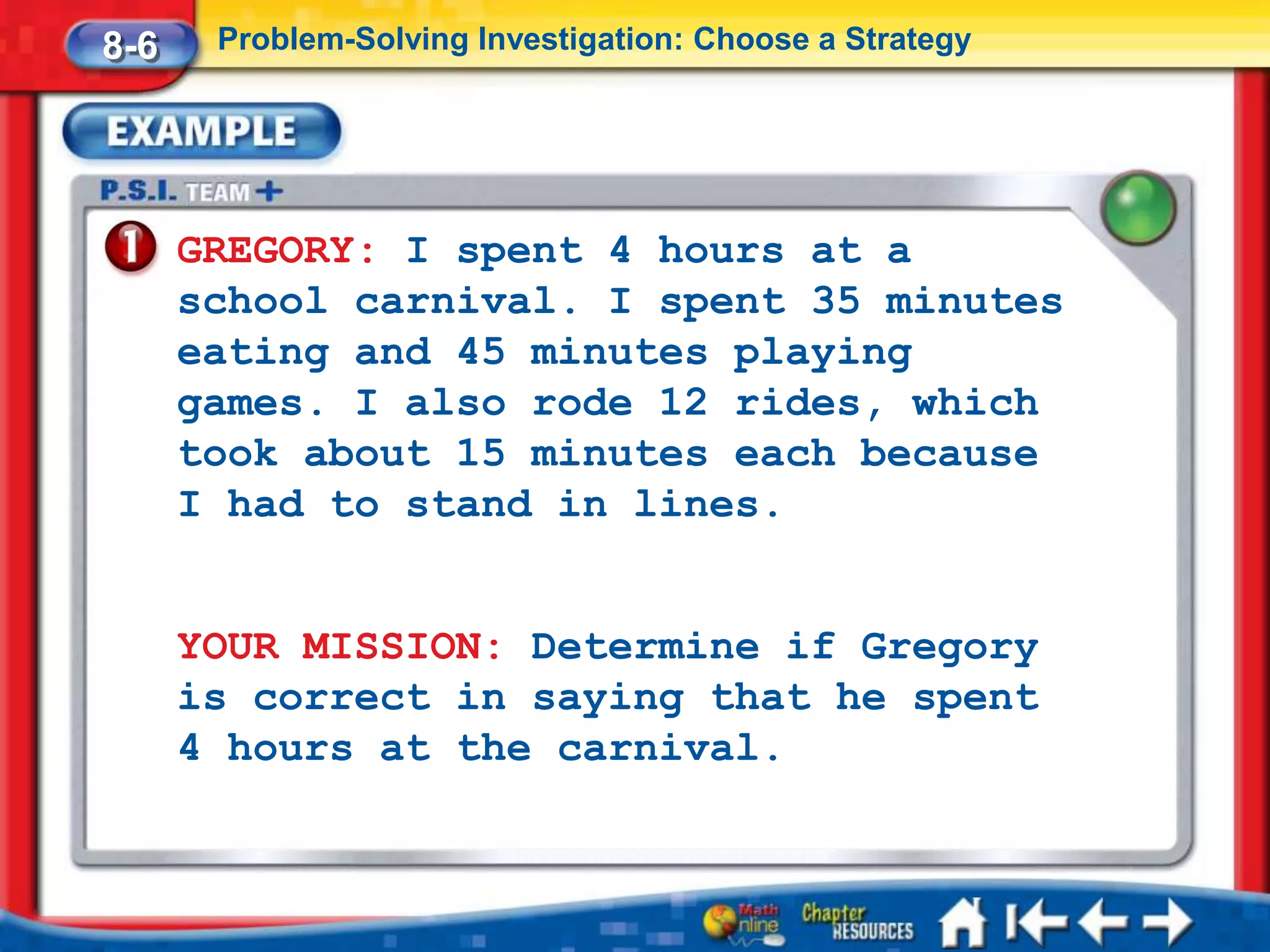
      GREGORY: I spent 4 hours at a
      school carnival. I spent 35 minutes
      eating and 45 minutes playing
      games. I also rode 12 rides, which
      took about 15 minutes each because
      I had to stand in lines.


      YOUR MISSION: Determine if Gregory
      is correct in saying that he spent
      4 hours at the carnival.
8-6     Problem-Solving Investigation: Choose a Strategy


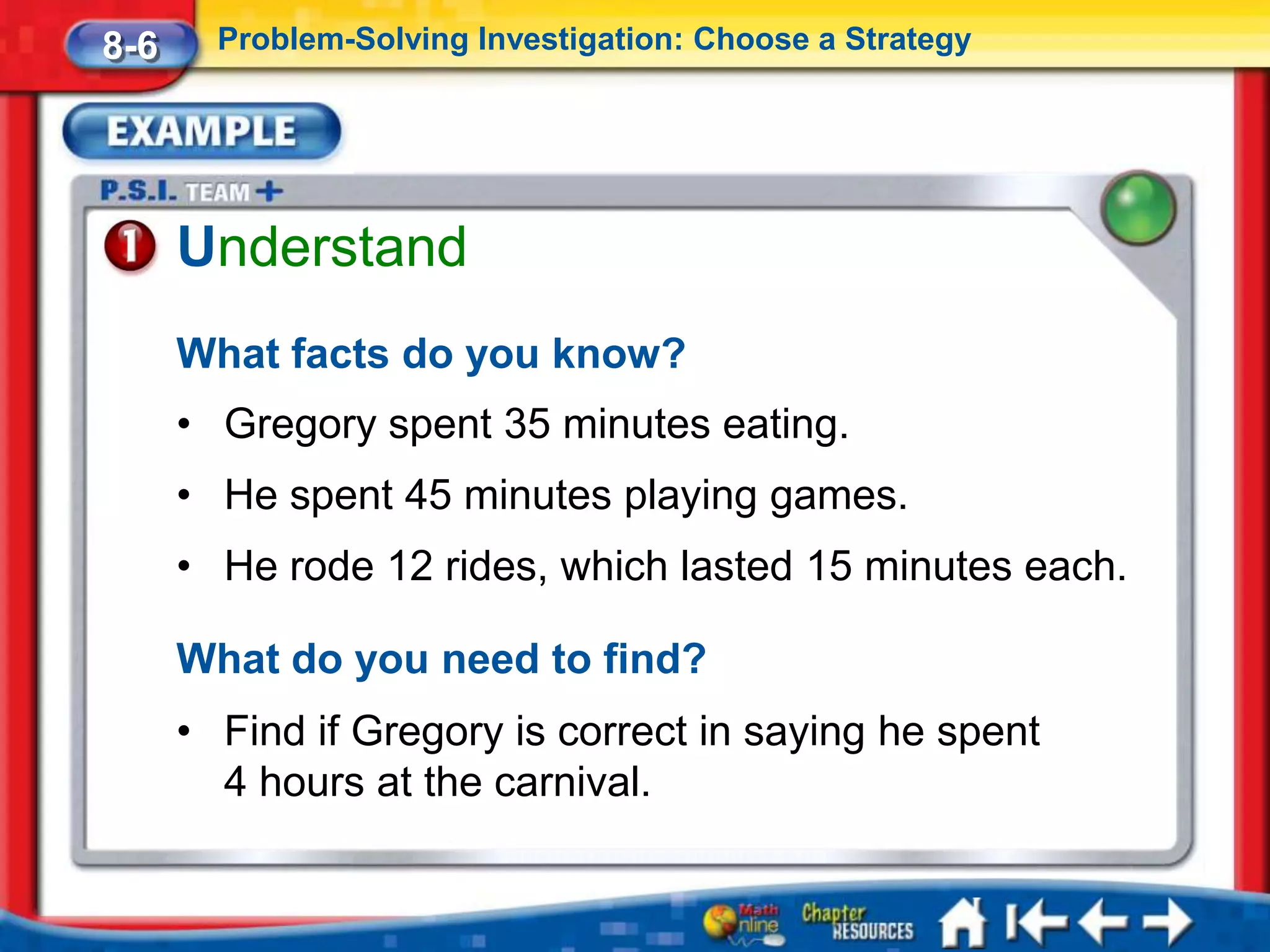
      Understand
      What facts do you know?
      • Gregory spent 35 minutes eating.
      • He spent 45 minutes playing games.
      • He rode 12 rides, which lasted 15 minutes each.

      What do you need to find?
      • Find if Gregory is correct in saying he spent
        4 hours at the carnival.
8-6     Problem-Solving Investigation: Choose a Strategy


      Plan
      Find the total number of minutes spent on
      carnival activities and compare to 4 hours.
8-6     Problem-Solving Investigation: Choose a Strategy


      Solve
      Gregory gave the amount of time spent at the
      carnival in hours. The amount of time spent on
      each activity was given in minutes. So, change
      hours to minutes. Then compare the two
      amounts of time.
8-6    Problem-Solving Investigation: Choose a Strategy


      Solve
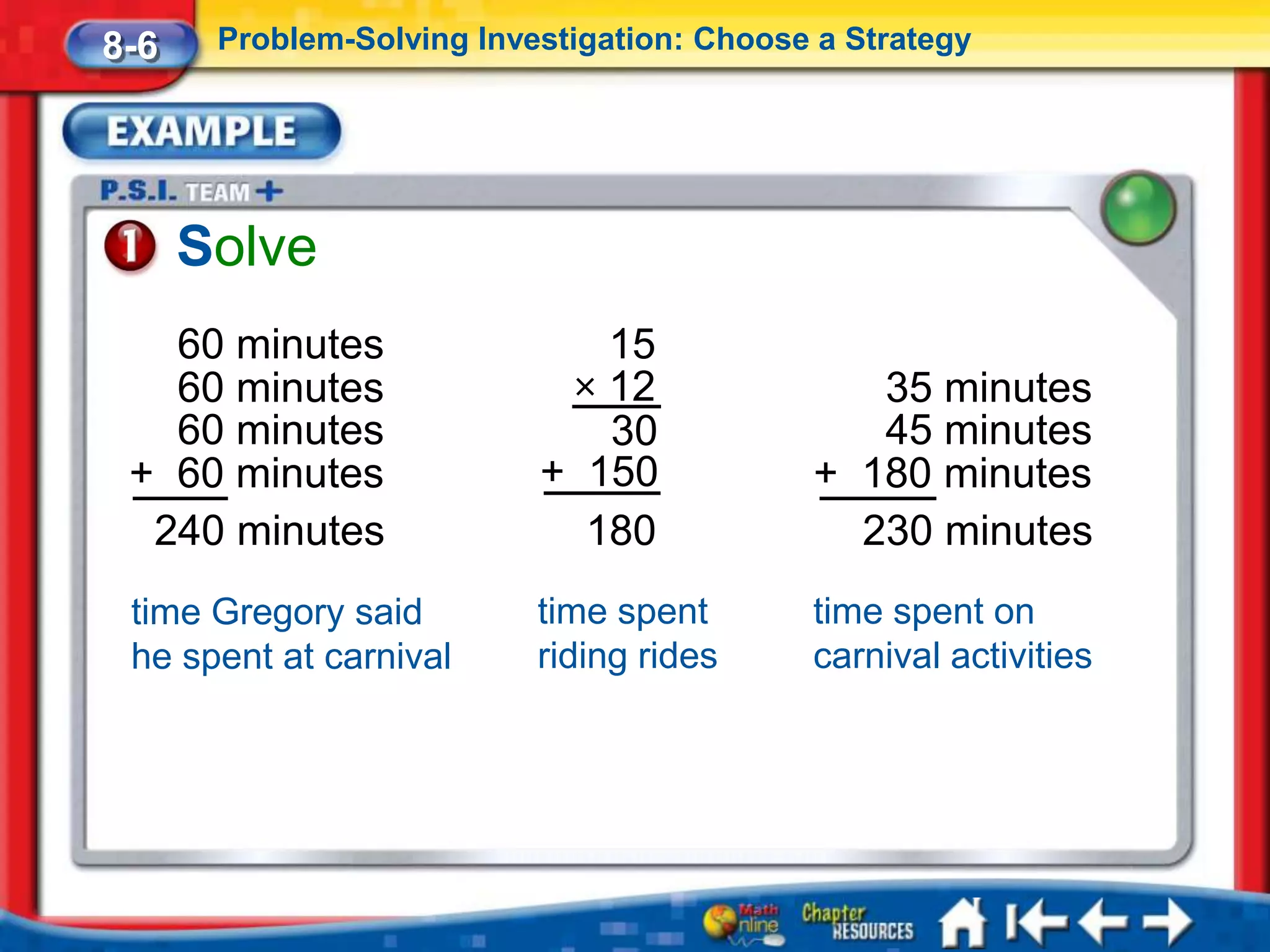
   60 minutes                 15
   60 minutes               × 12               35 minutes
   60 minutes                 30               45 minutes
 + 60 minutes              + 150            + 180 minutes
  240 minutes                180              230 minutes
 time Gregory said         time spent       time spent on
 he spent at carnival      riding rides     carnival activities
8-6     Problem-Solving Investigation: Choose a Strategy


      Solve
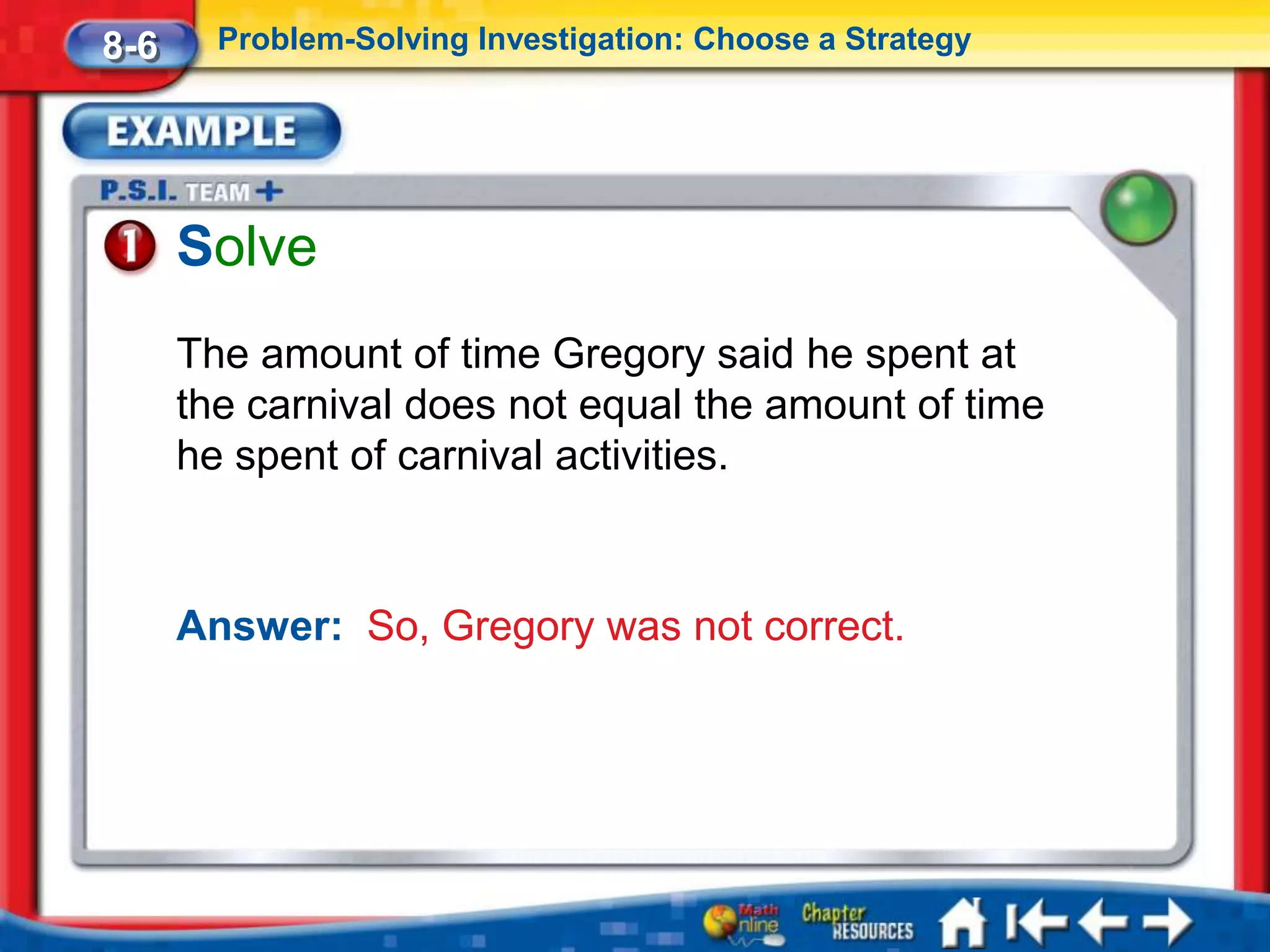
      The amount of time Gregory said he spent at
      the carnival does not equal the amount of time
      he spent of carnival activities.


      Answer: So, Gregory was not correct.
8-6     Problem-Solving Investigation: Choose a Strategy


      Check
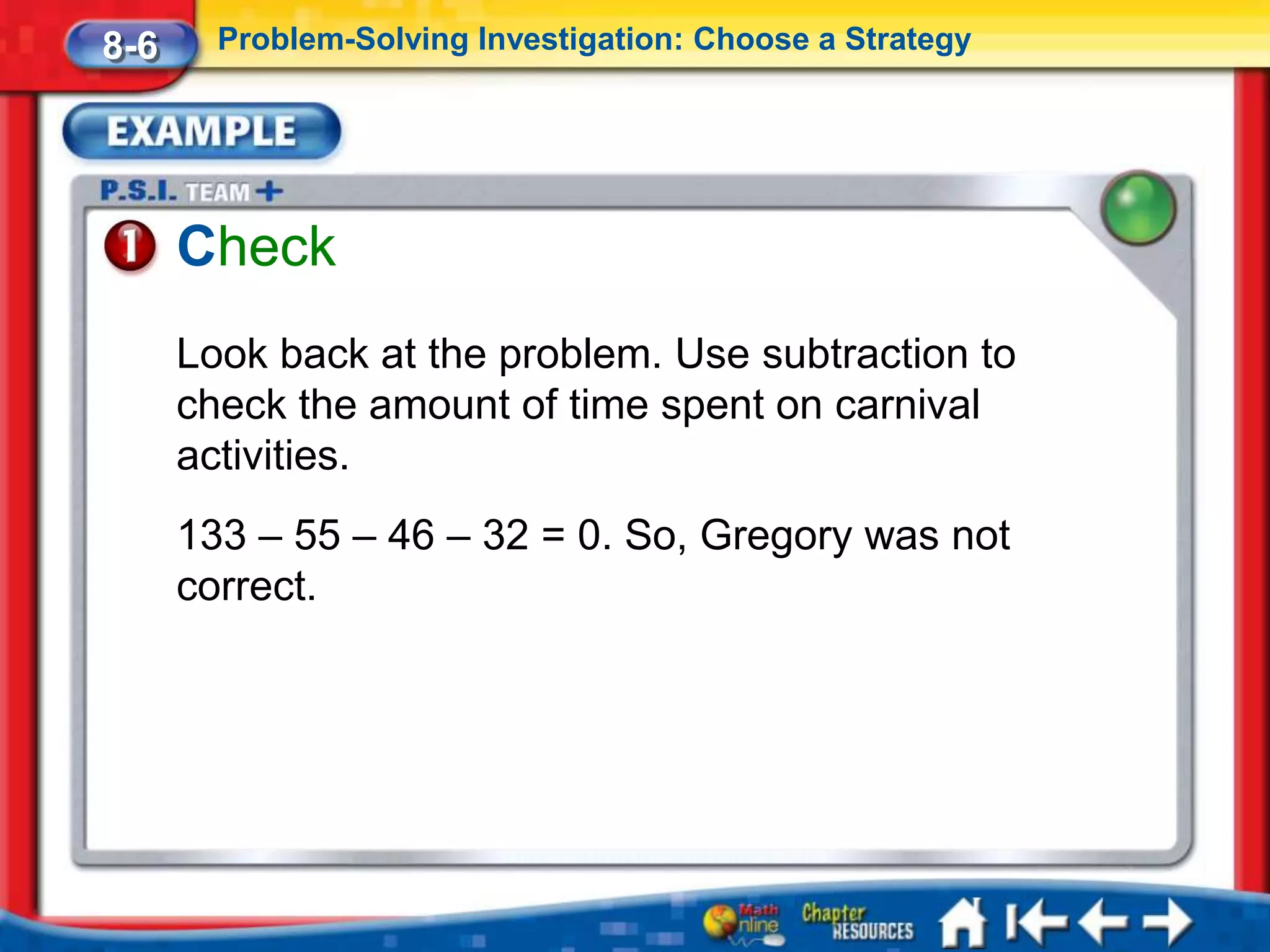
      Look back at the problem. Use subtraction to
      check the amount of time spent on carnival
      activities.
      133 – 55 – 46 – 32 = 0. So, Gregory was not
      correct.
8-7     Multiply Greater Numbers


      Five-Minute Check (over Lesson 8-6)
      Main Idea
      California Standards
      Example 1
      Example 2
8-7      Multiply Greater Numbers


      • I will multiply four- and five-digit numbers by a
        two-digit number.
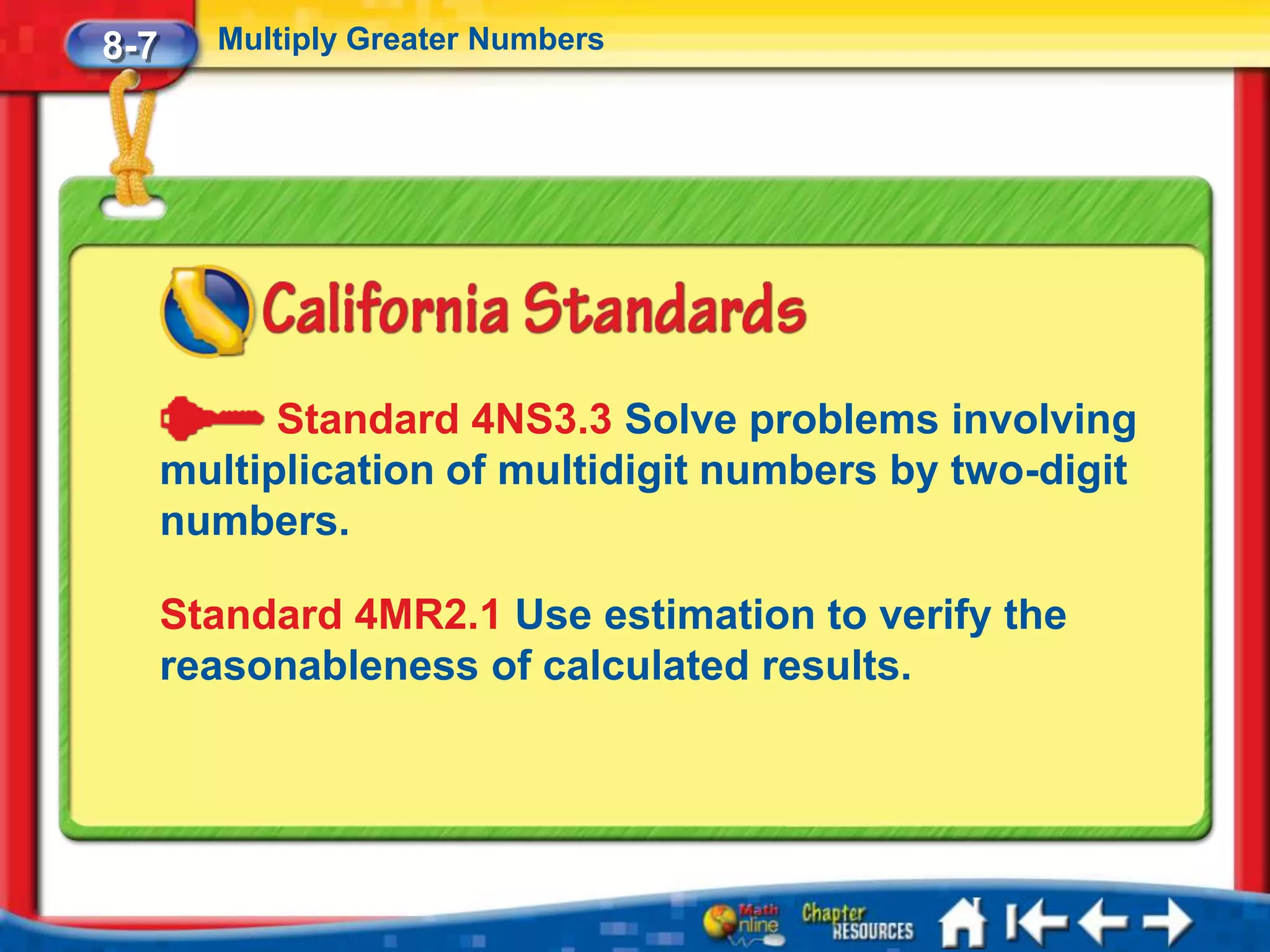
8-7     Multiply Greater Numbers


            Standard 4NS3.3 Solve problems involving
      multiplication of multidigit numbers by two-digit
      numbers.

      Standard 4MR2.1 Use estimation to verify the
      reasonableness of calculated results.
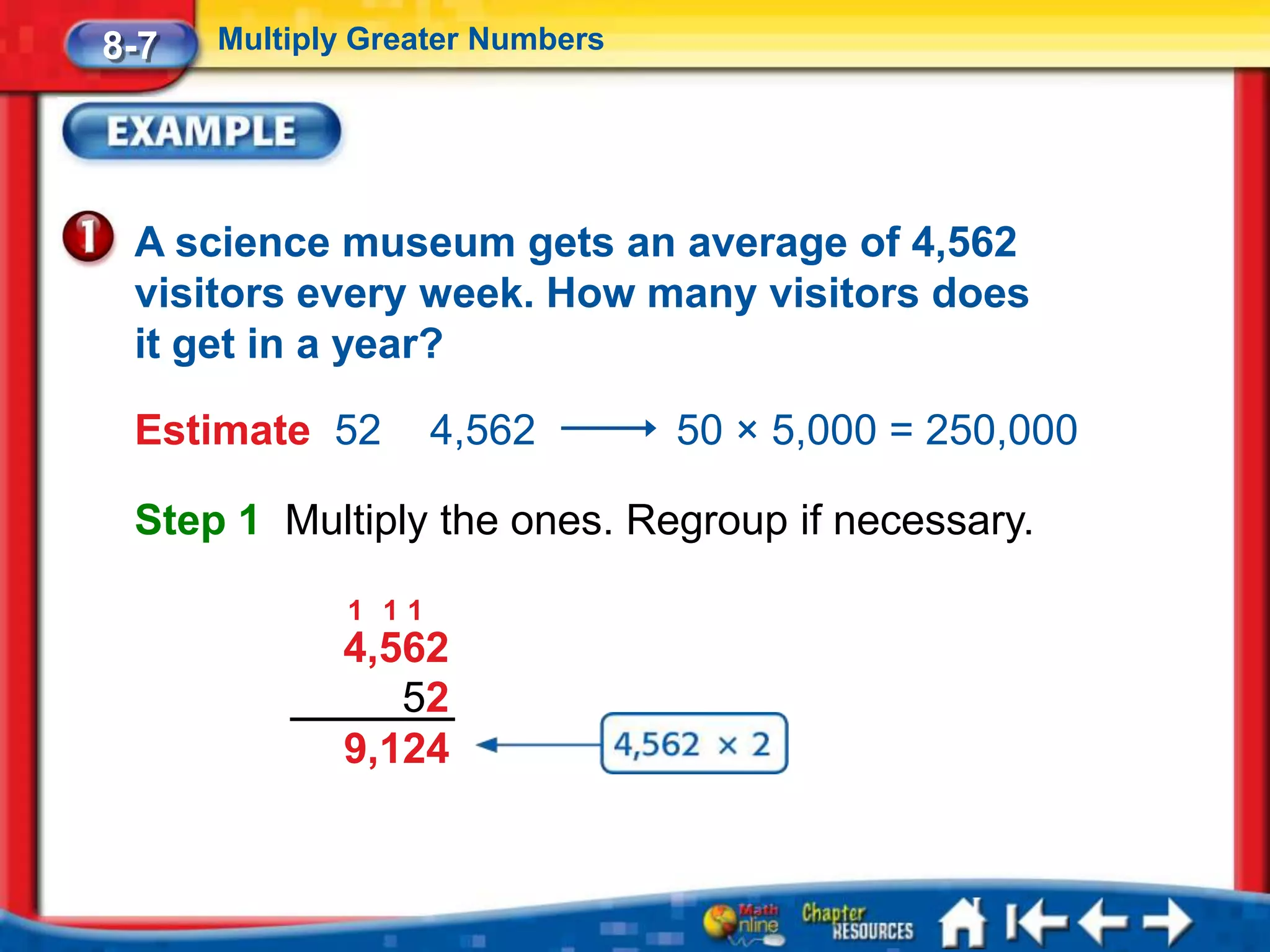
8-7   Multiply Greater Numbers


 A science museum gets an average of 4,562
 visitors every week. How many visitors does
 it get in a year?

 Estimate 52         4,562       50 × 5,000 = 250,000

 Step 1 Multiply the ones. Regroup if necessary.

              1 11
             4,562
                52
             9,124
8-7   Multiply Greater Numbers


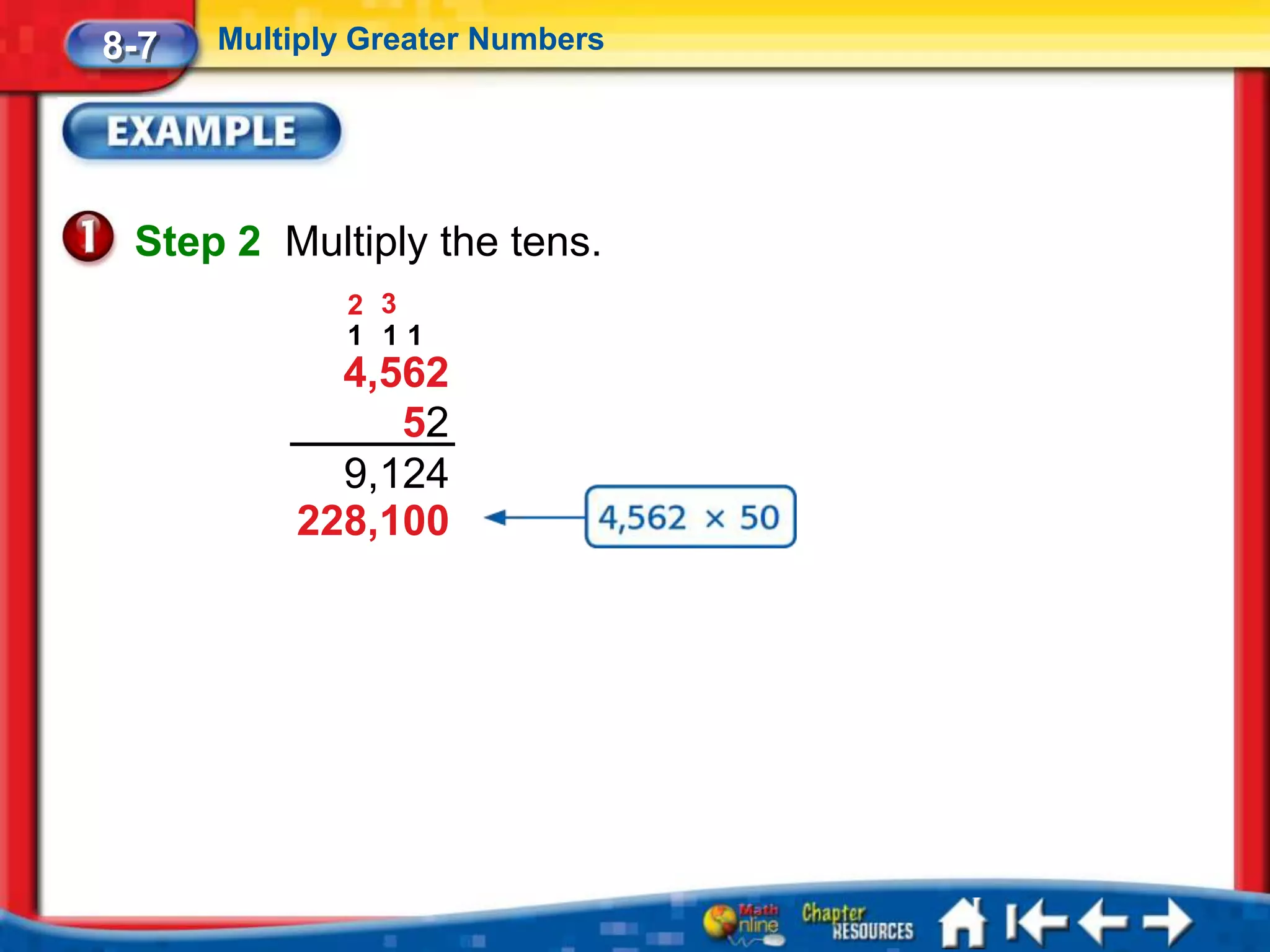
 Step 2 Multiply the tens.
              2 3
              1 11
            4,562
               52
            9,124
          228,100
8-7   Multiply Greater Numbers


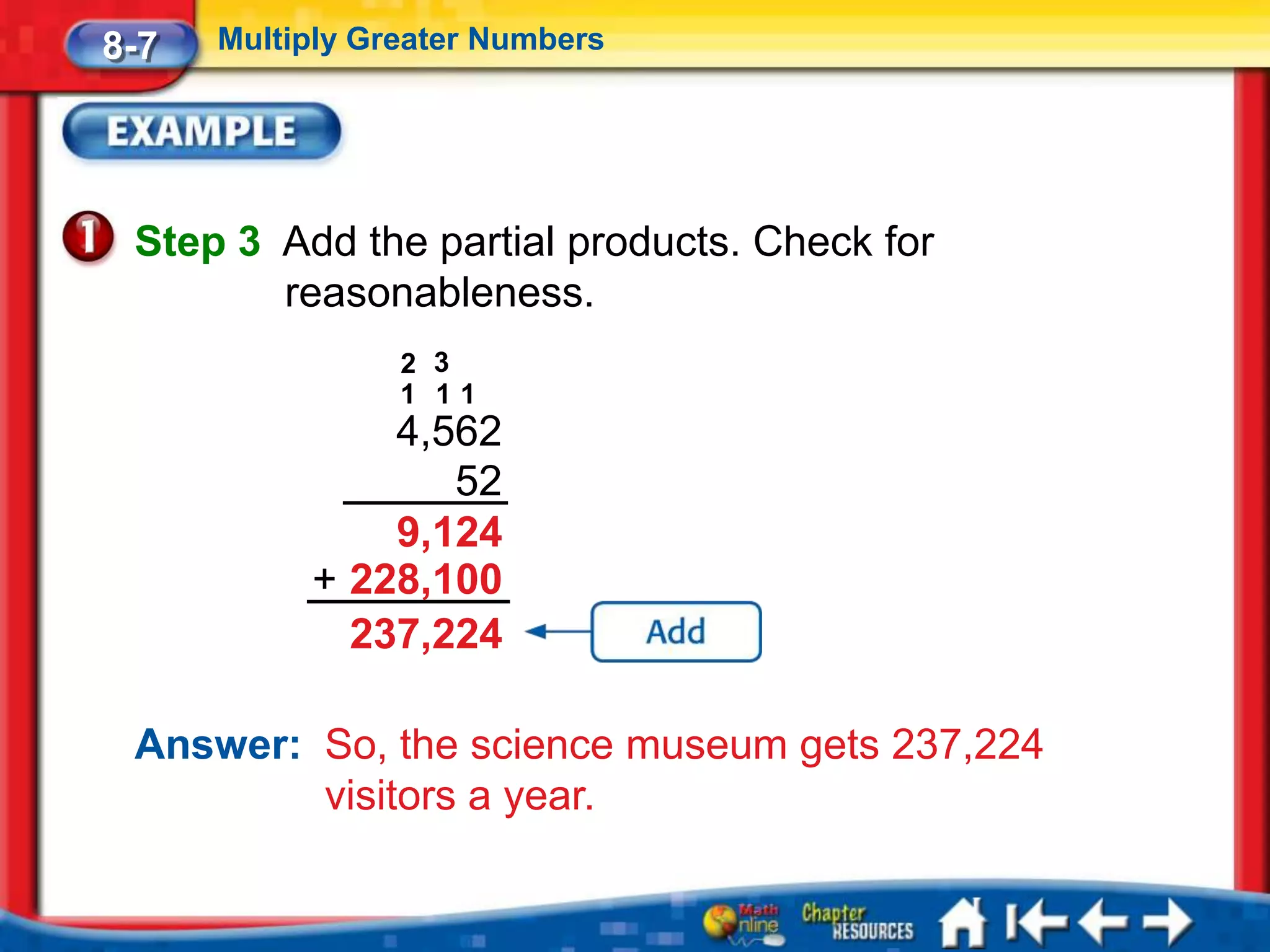
 Step 3 Add the partial products. Check for
        reasonableness.
                 2 3
                 1 11
               4,562
                  52
               9,124
           + 228,100
             237,224

 Answer: So, the science museum gets 237,224
         visitors a year.
8-7   Multiply Greater Numbers


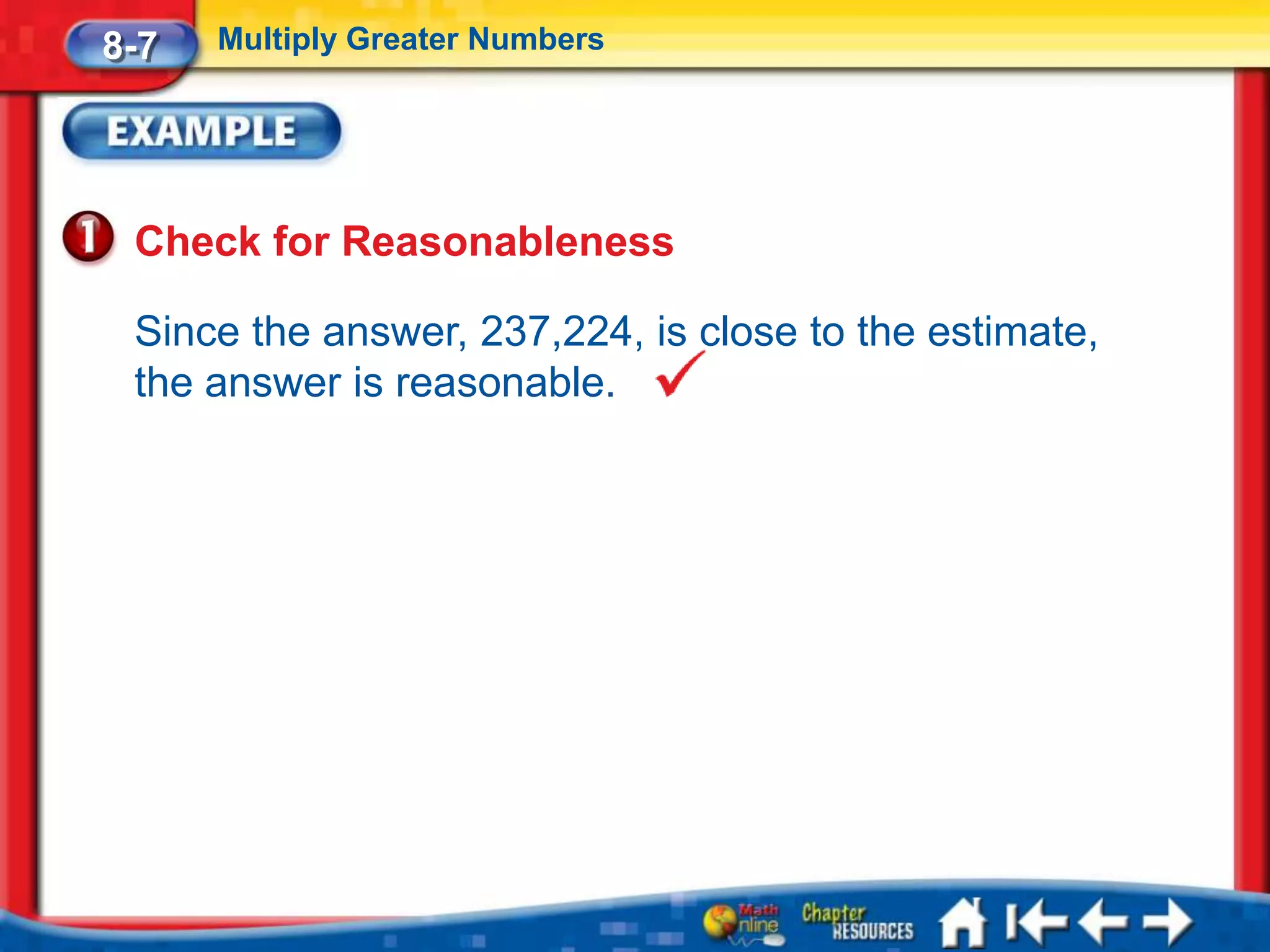
 Check for Reasonableness

 Since the answer, 237,224, is close to the estimate,
 the answer is reasonable.
8-7   Multiply Greater Numbers


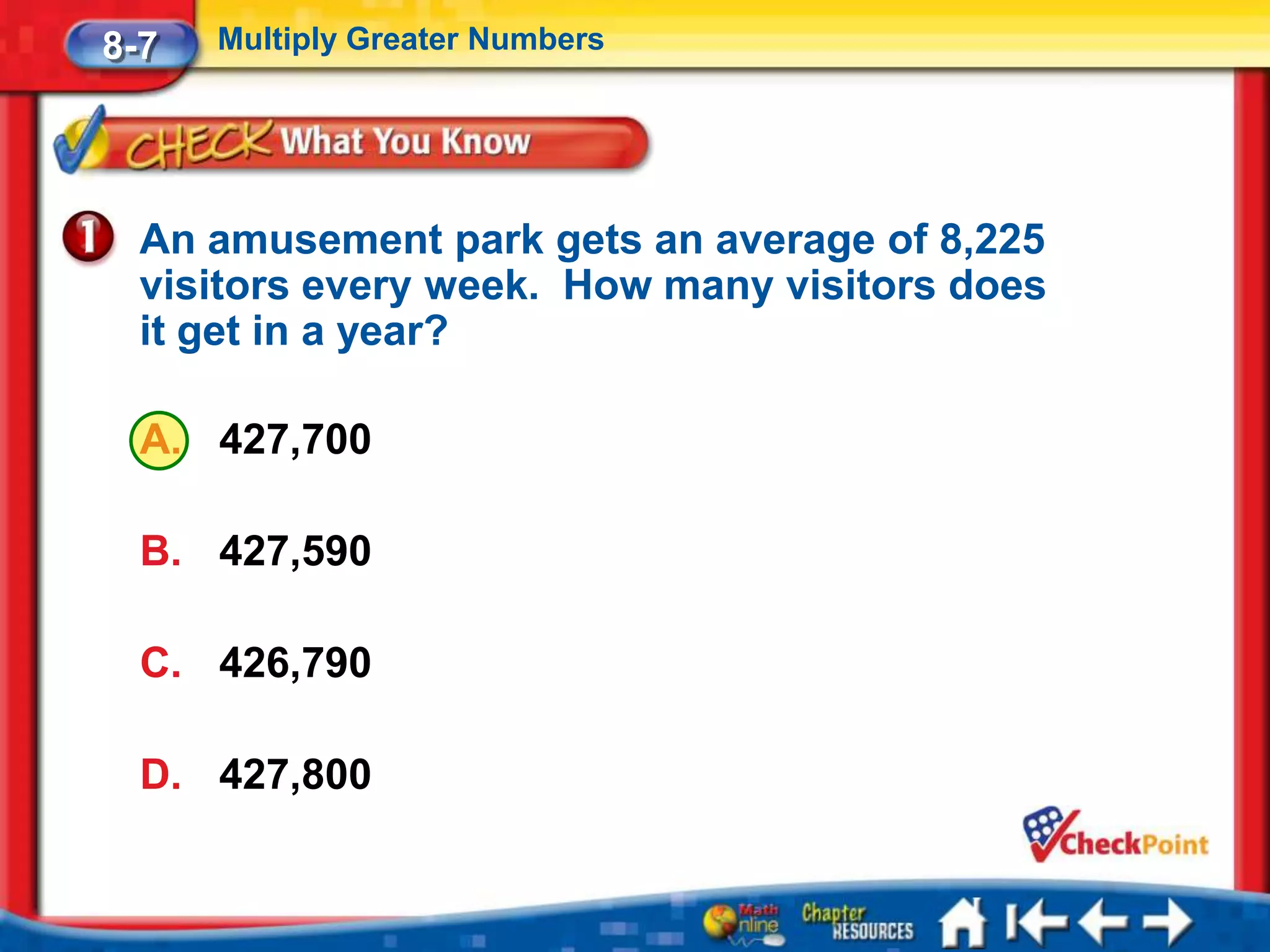
  An amusement park gets an average of 8,225
  visitors every week. How many visitors does
  it get in a year?

  A. 427,700

  B. 427,590

  C. 426,790

  D. 427,800
8-7   Multiply Greater Numbers


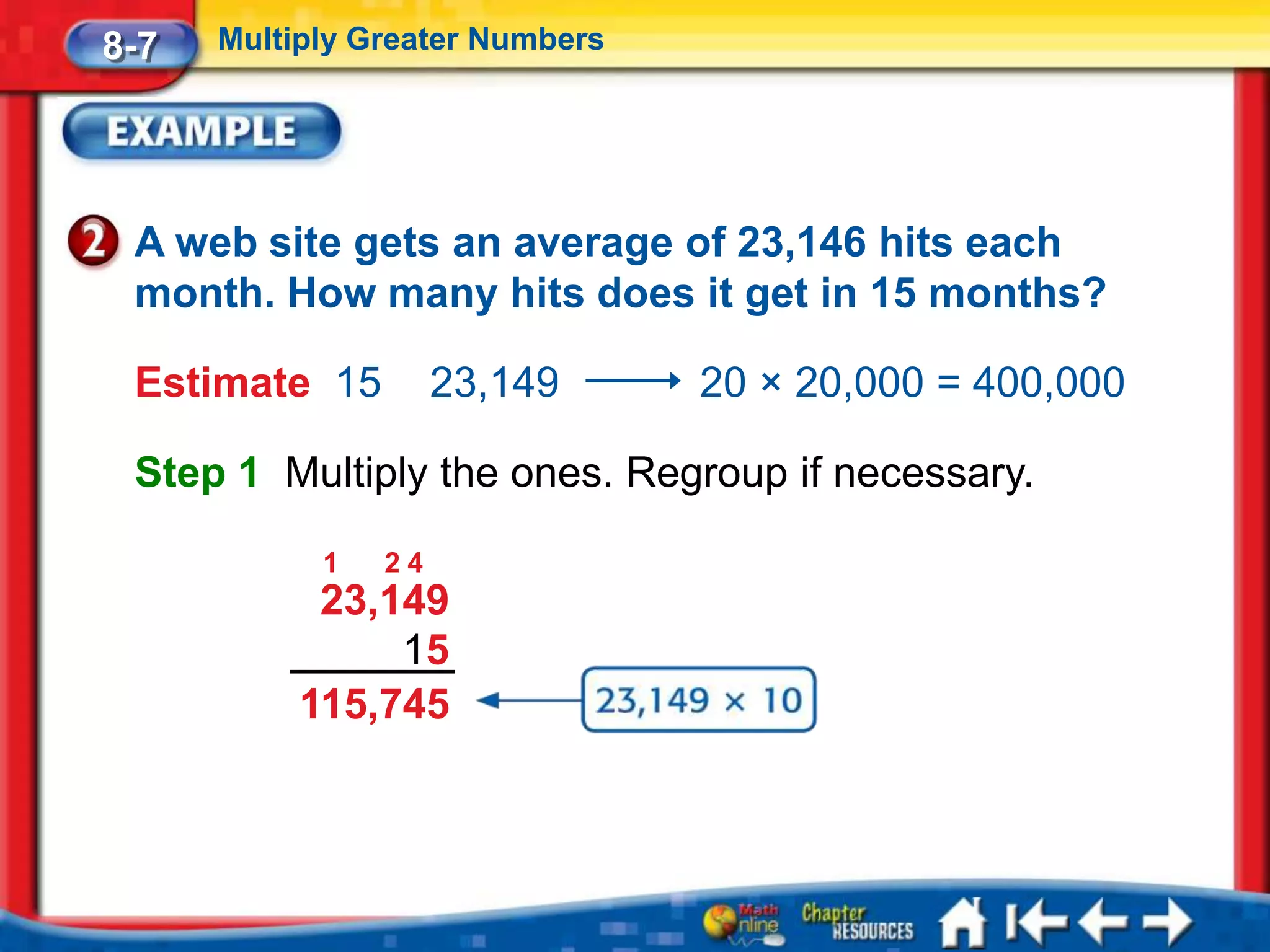
 A web site gets an average of 23,146 hits each
 month. How many hits does it get in 15 months?

 Estimate 15         23,149      20 × 20,000 = 400,000

 Step 1 Multiply the ones. Regroup if necessary.

            1   24
            23,149
                15
           115,745
8-7   Multiply Greater Numbers


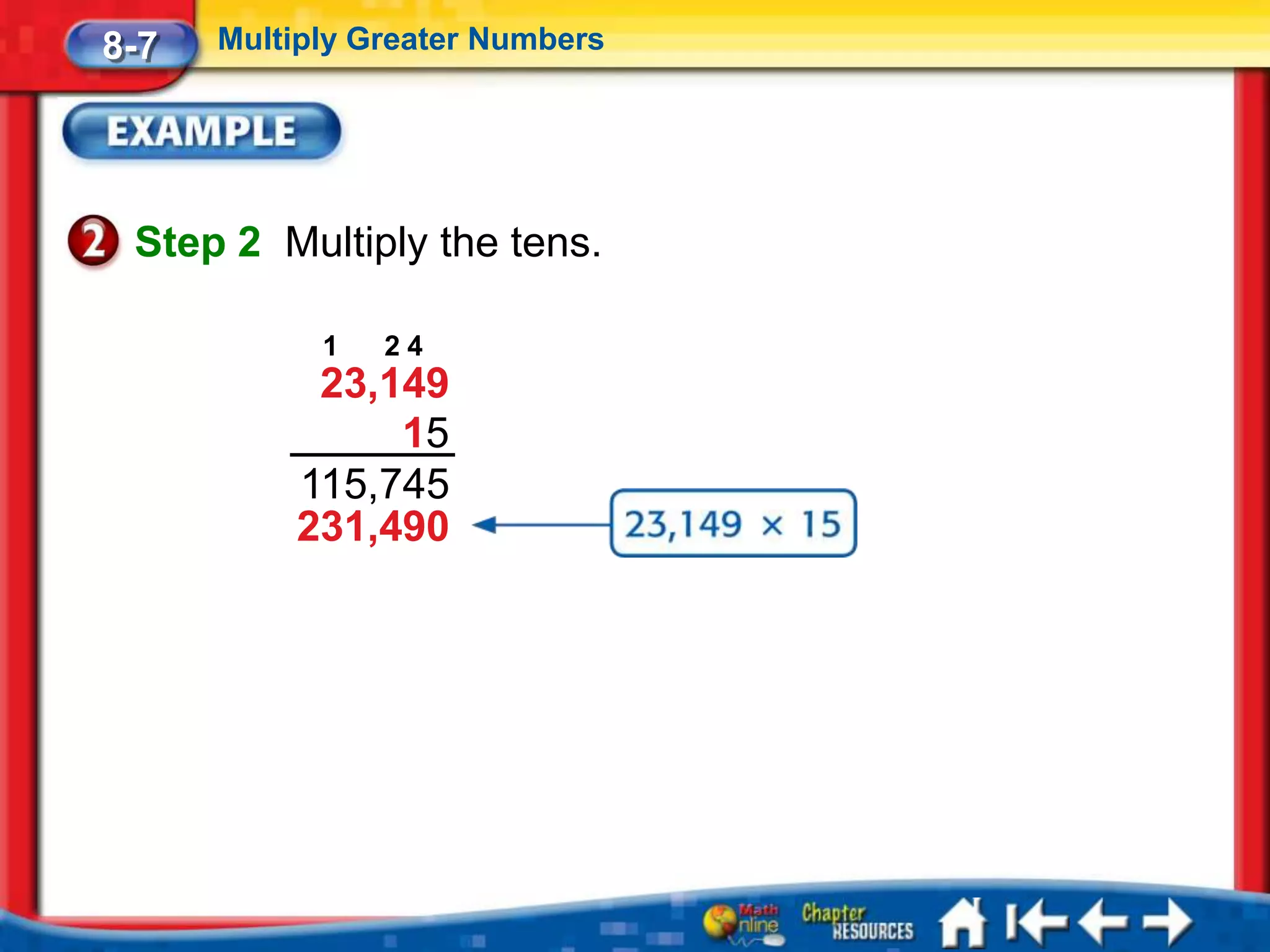
 Step 2 Multiply the tens.

            1   24
           23,149
               15
          115,745
          231,490
8-7   Multiply Greater Numbers


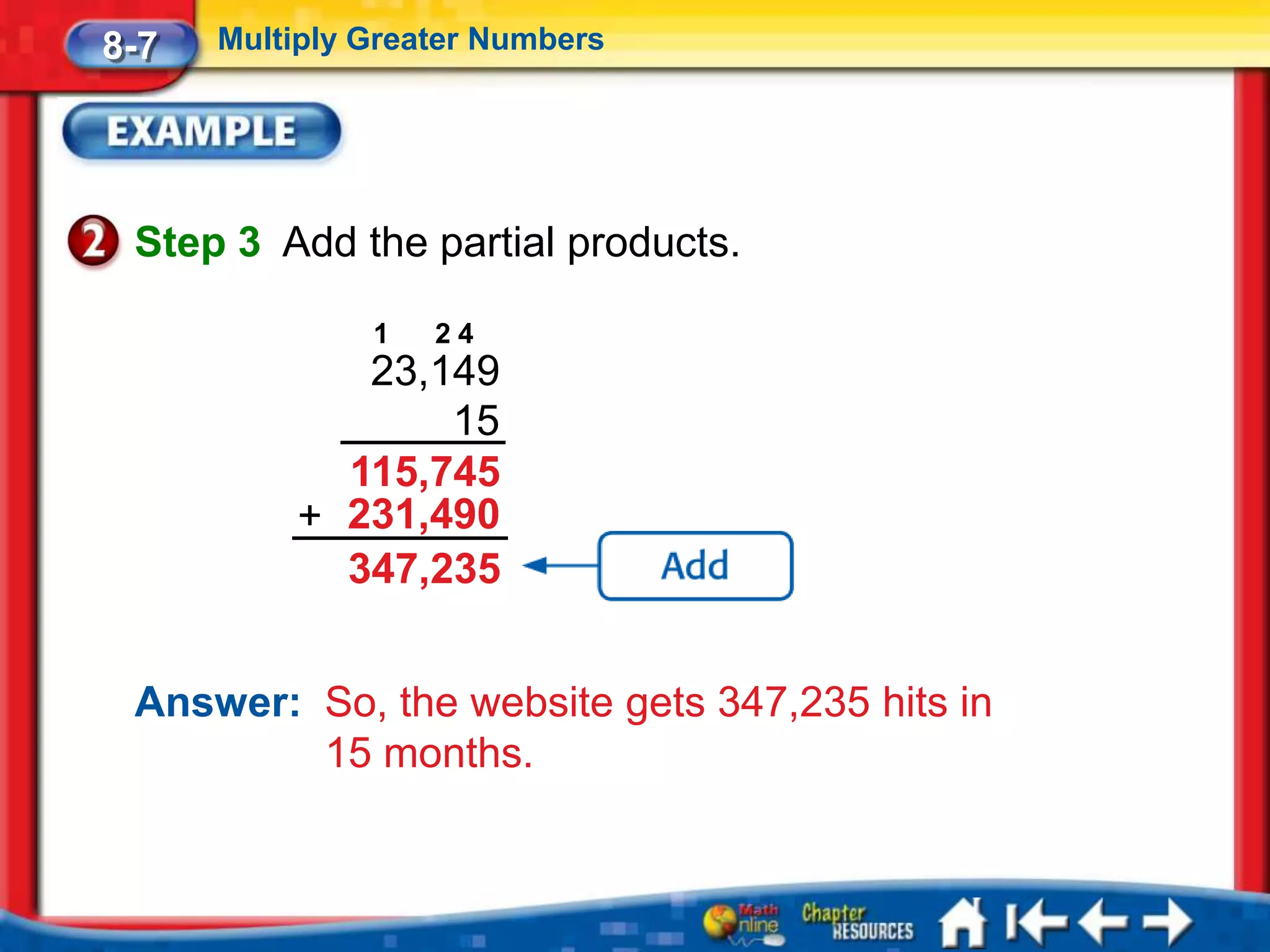
 Step 3 Add the partial products.

               1   24
             23,149
                 15
            115,745
          + 231,490
            347,235


 Answer: So, the website gets 347,235 hits in
         15 months.
8-7   Multiply Greater Numbers


 Check for Reasonableness

 Since 347,235 is close to the estimate, the answer
 is reasonable.
8-7   Multiply Greater Numbers


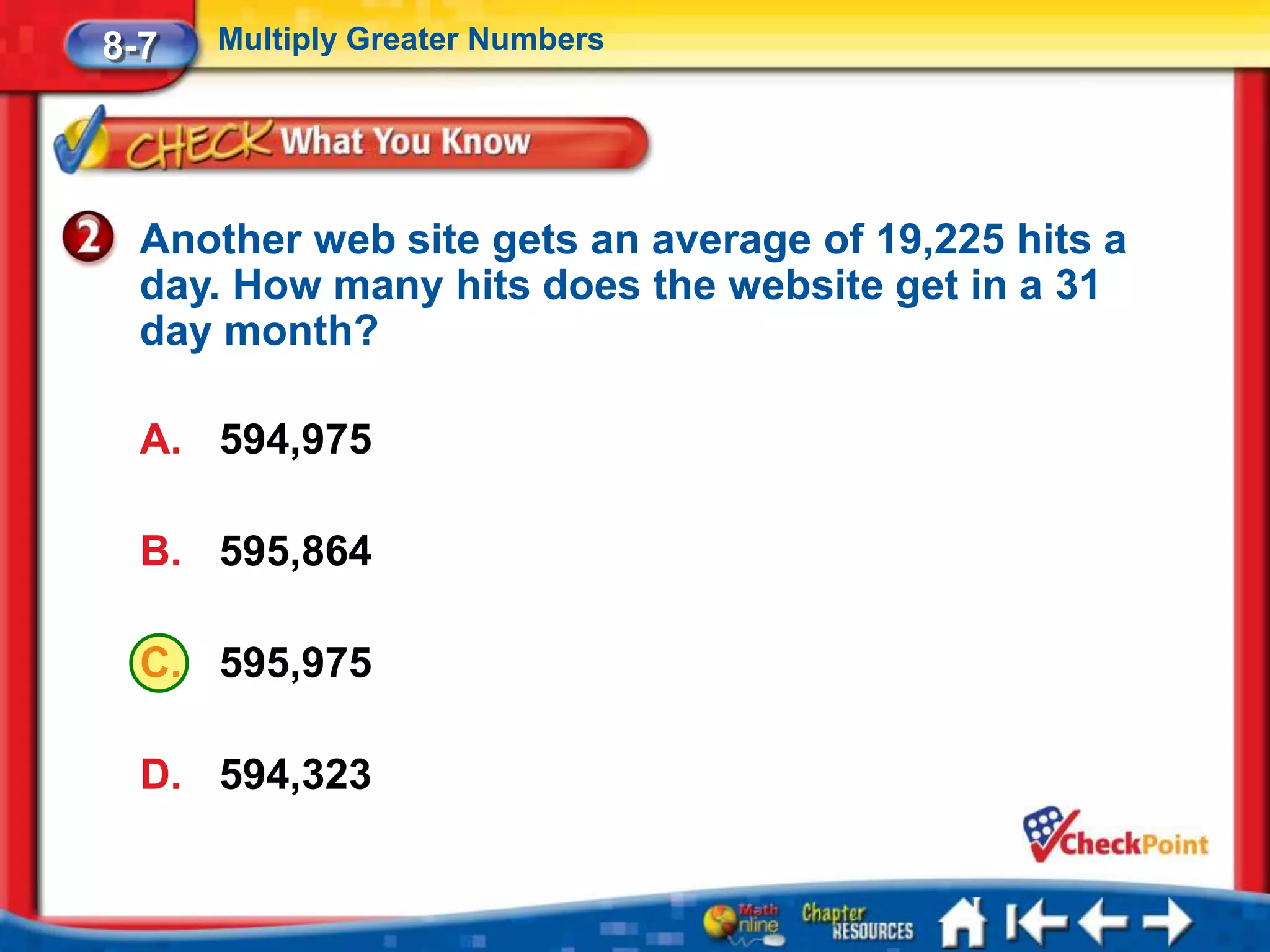
  Another web site gets an average of 19,225 hits a
  day. How many hits does the website get in a 31
  day month?

  A. 594,975

  B. 595,864

  C. 595,975

  D. 594,323
Multiply by Two-Digit Numbers
8


                  Five-Minute Checks
Multiply by Two-Digit Numbers
8


    Lesson 8-1      (over Chapter 7)
    Lesson 8-2      (over Lesson 8-1)
    Lesson 8-3      (over Lesson 8-2)
    Lesson 8-4      (over Lesson 8-3)
    Lesson 8-5      (over Lesson 8-4)
    Lesson 8-6      (over Lesson 8-5)
    Lesson 8-7      (over Lesson 8-6)
Multiply by Two-Digit Numbers
8
                                     (over Chapter 7)


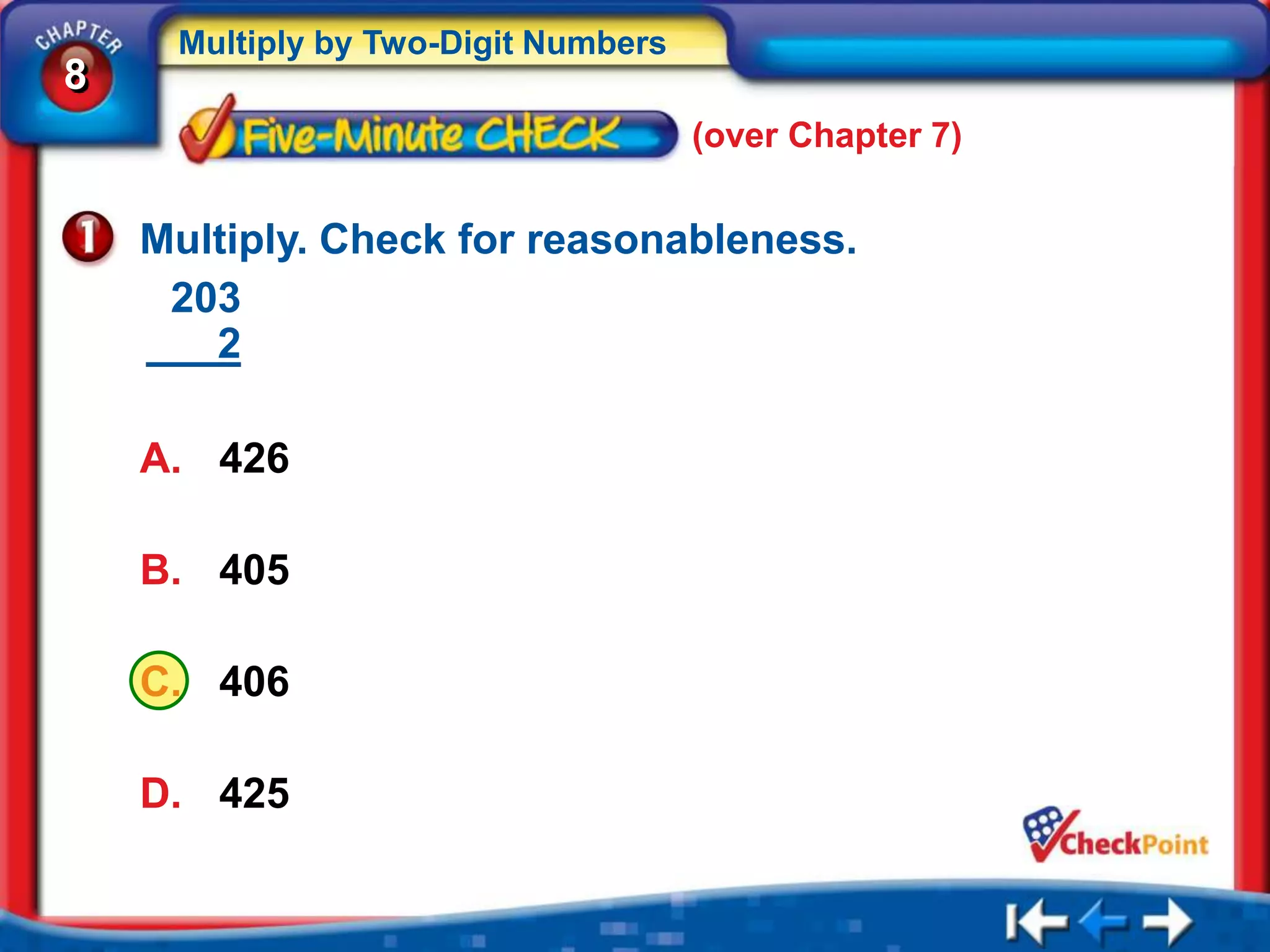
    Multiply. Check for reasonableness.
     203
       2

    A. 426

    B. 405

    C. 406

    D. 425
Multiply by Two-Digit Numbers
8
                                     (over Chapter 7)


    Multiply. Check for reasonableness.
     506
       7

    A. 1,283

    B. 3,502

    C. 1,273

    D. 3,542
Multiply by Two-Digit Numbers
8
                                     (over Chapter 7)


    Multiply. Check for reasonableness.
    3 7,035


    A. 21,105

    B. 21,095

    C. 10,368

    D. 21,405
Multiply by Two-Digit Numbers
8
                                     (over Chapter 7)


    Multiply. Check for reasonableness.
    8 $4,209


    A. $32,743

    B. $33,672

    C. $13,097

    D. $33,752
Multiply by Two-Digit Numbers
8
                                     (over Chapter 7)


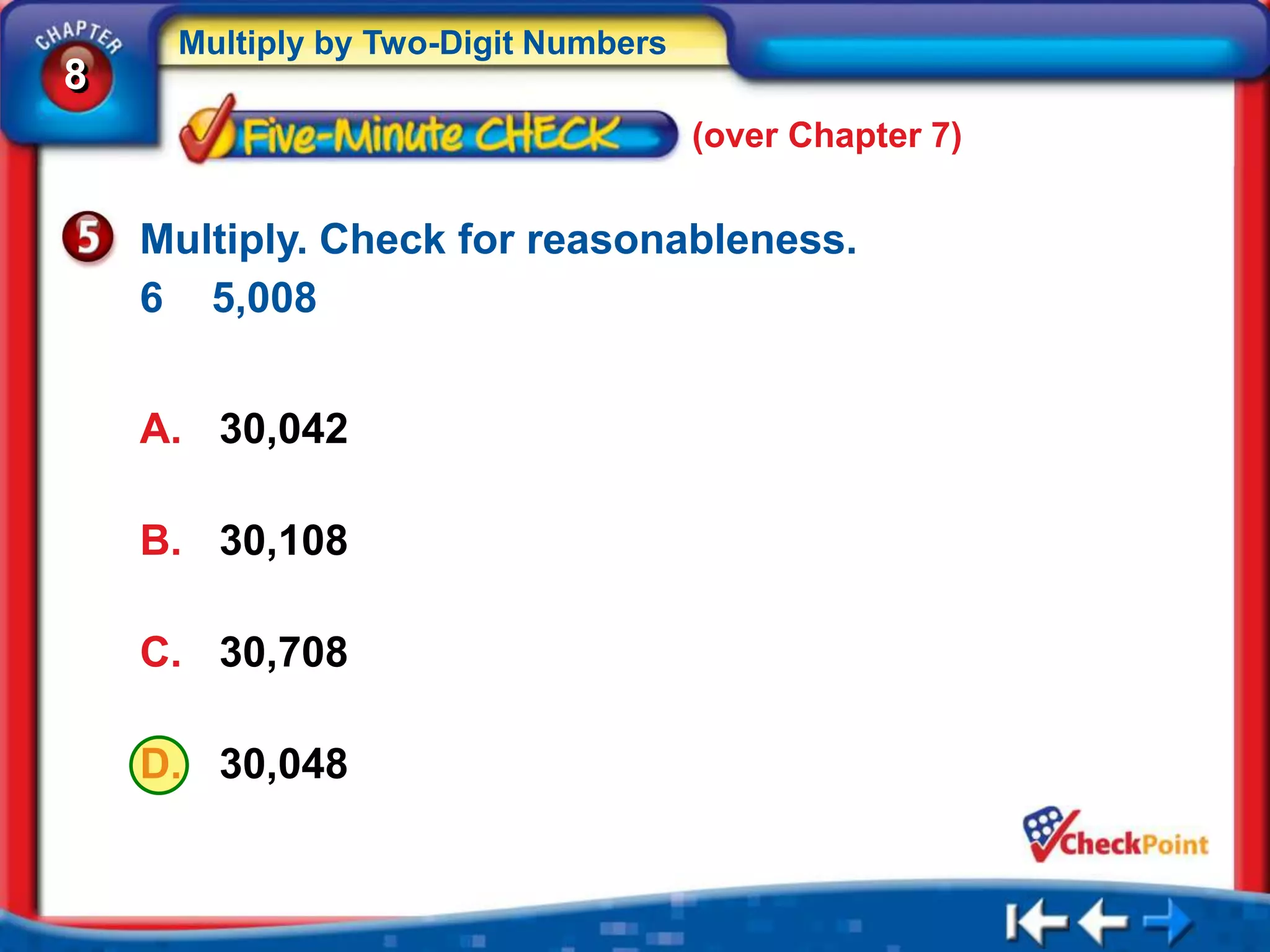
    Multiply. Check for reasonableness.
    6 5,008


    A. 30,042

    B. 30,108

    C. 30,708

    D. 30,048
Multiply by Two-Digit Numbers
8
                                      (over Lesson 8-1)


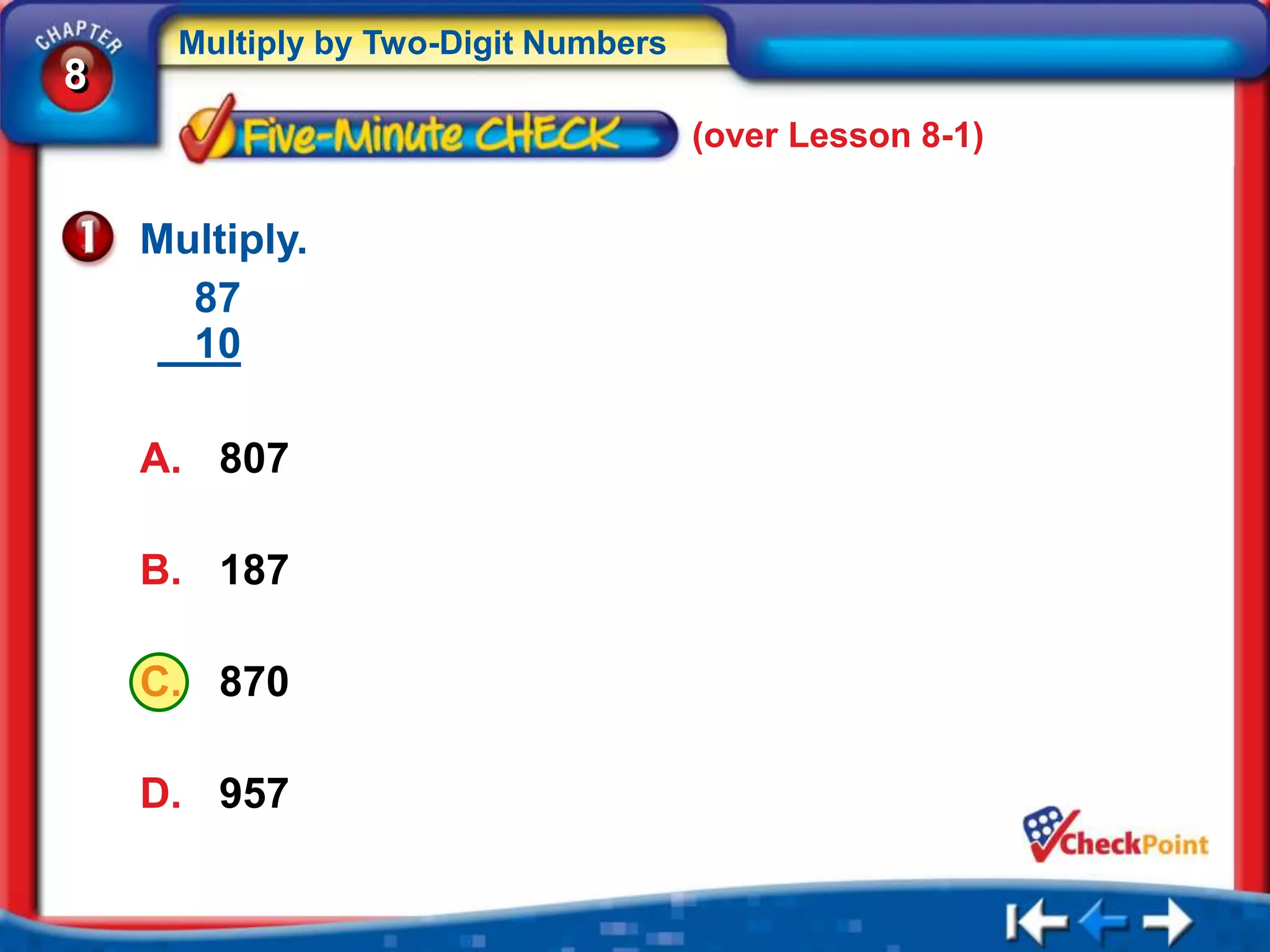
    Multiply.
      87
      10

    A. 807

    B. 187

    C. 870

    D. 957
Multiply by Two-Digit Numbers
8
                                      (over Lesson 8-1)


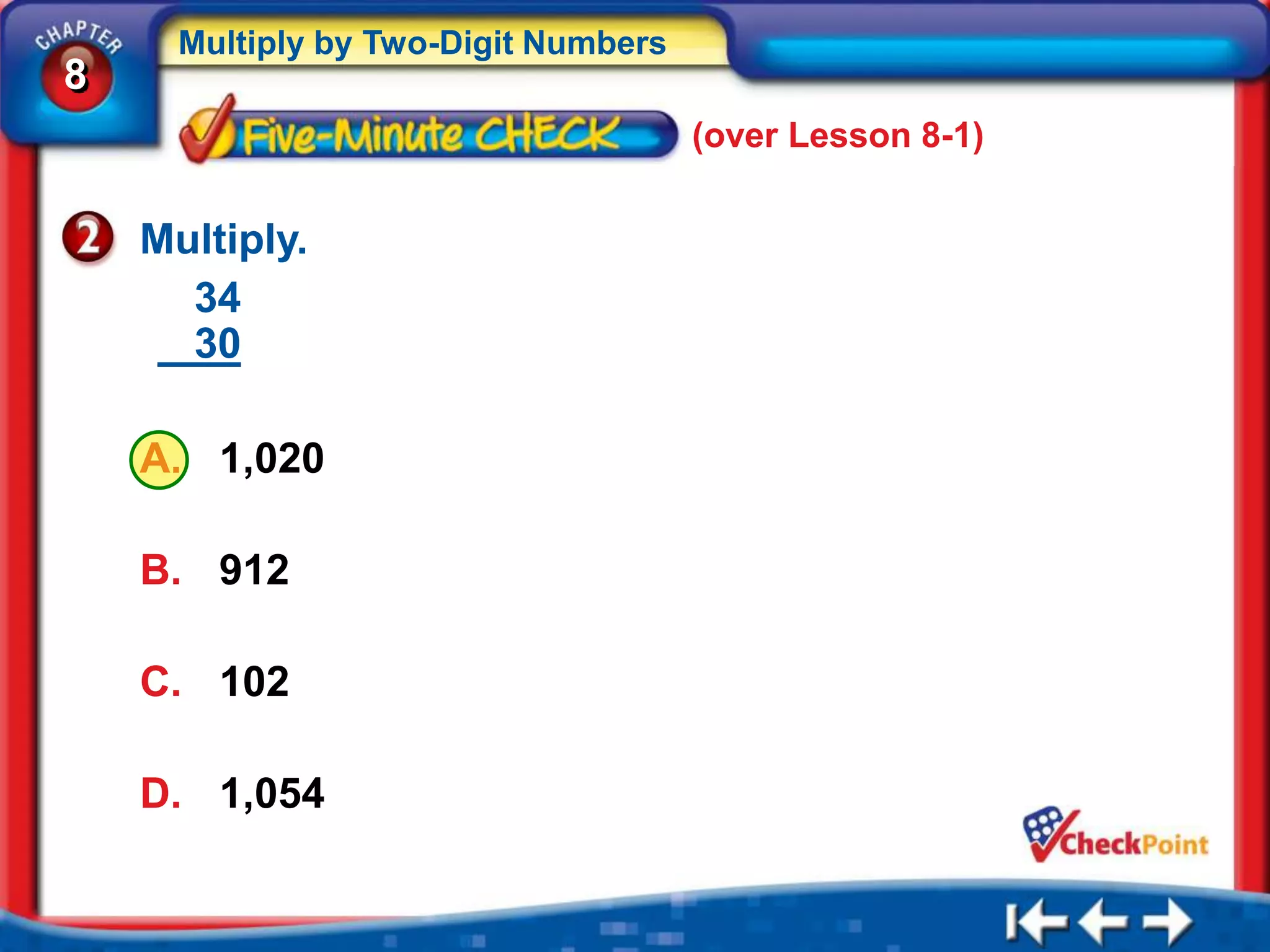
    Multiply.
      34
      30

    A. 1,020

    B. 912

    C. 102

    D. 1,054
Multiply by Two-Digit Numbers
8
                                      (over Lesson 8-1)


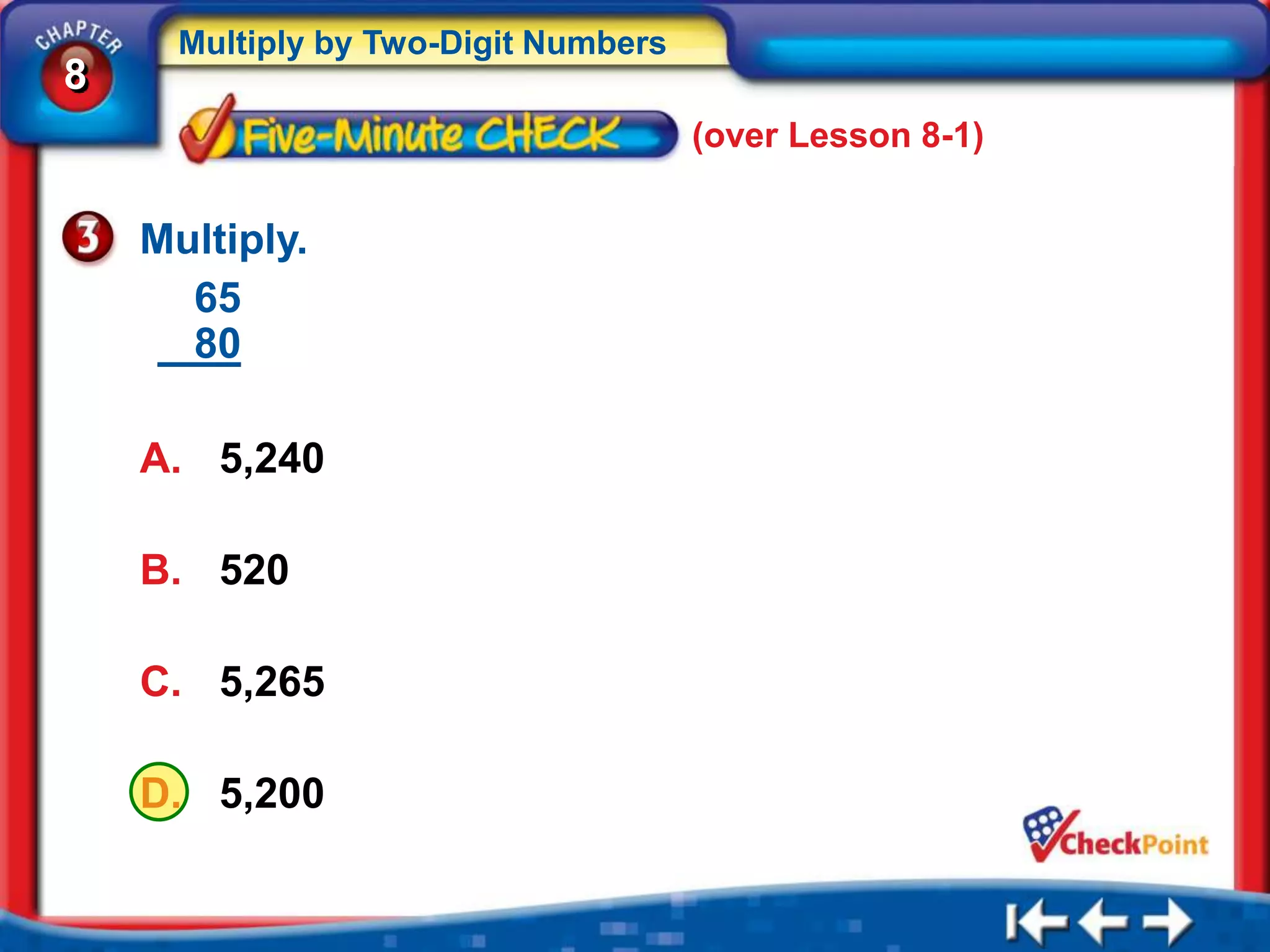
    Multiply.
      65
      80

    A. 5,240

    B. 520

    C. 5,265

    D. 5,200
Multiply by Two-Digit Numbers
8
                                      (over Lesson 8-1)


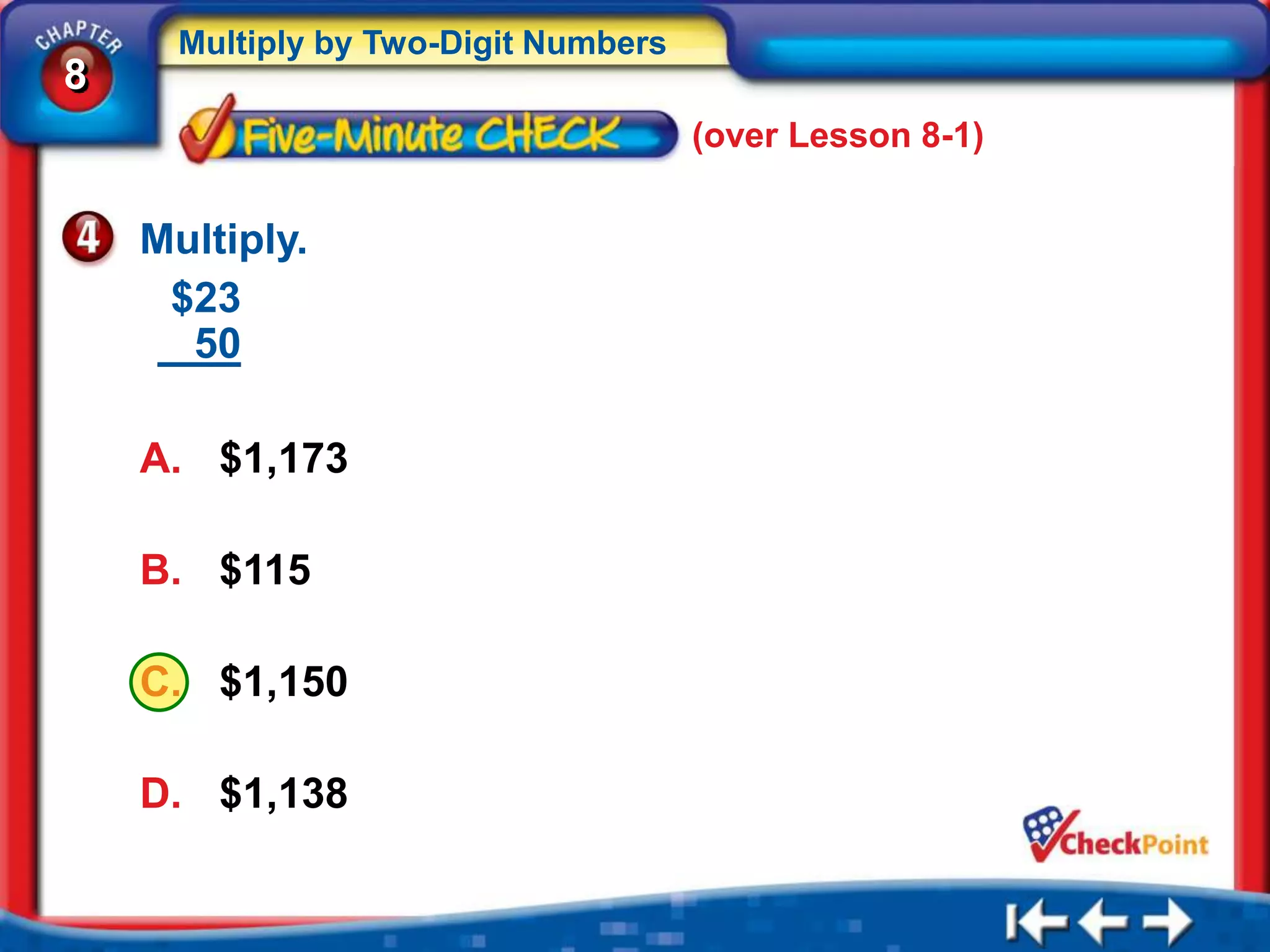
    Multiply.
     $23
      50

    A. $1,173

    B. $115

    C. $1,150

    D. $1,138
Multiply by Two-Digit Numbers
8
                                      (over Lesson 8-1)


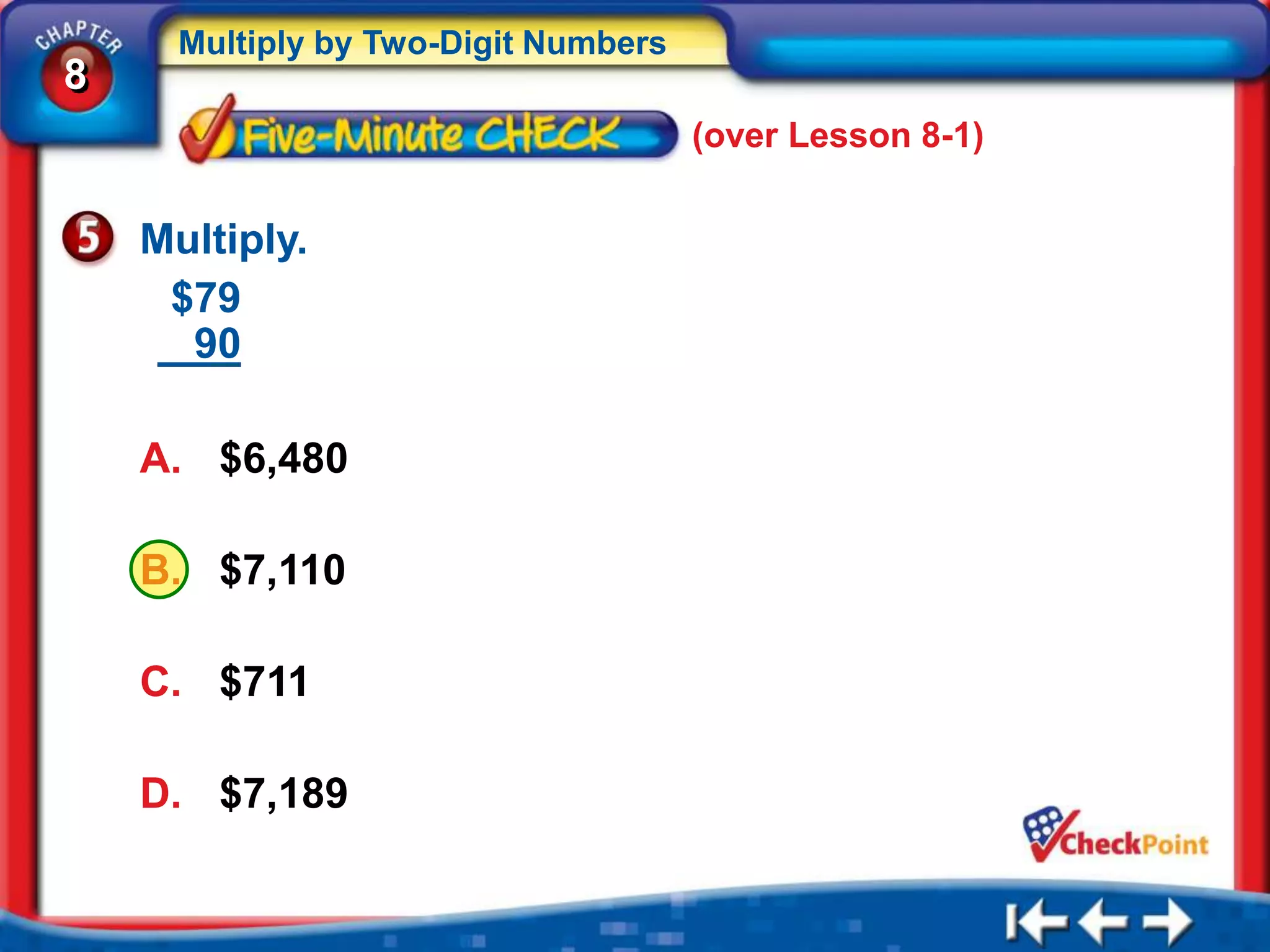
    Multiply.
     $79
      90

    A. $6,480

    B. $7,110

    C. $711

    D. $7,189
Multiply by Two-Digit Numbers
8
                                      (over Lesson 8-1)


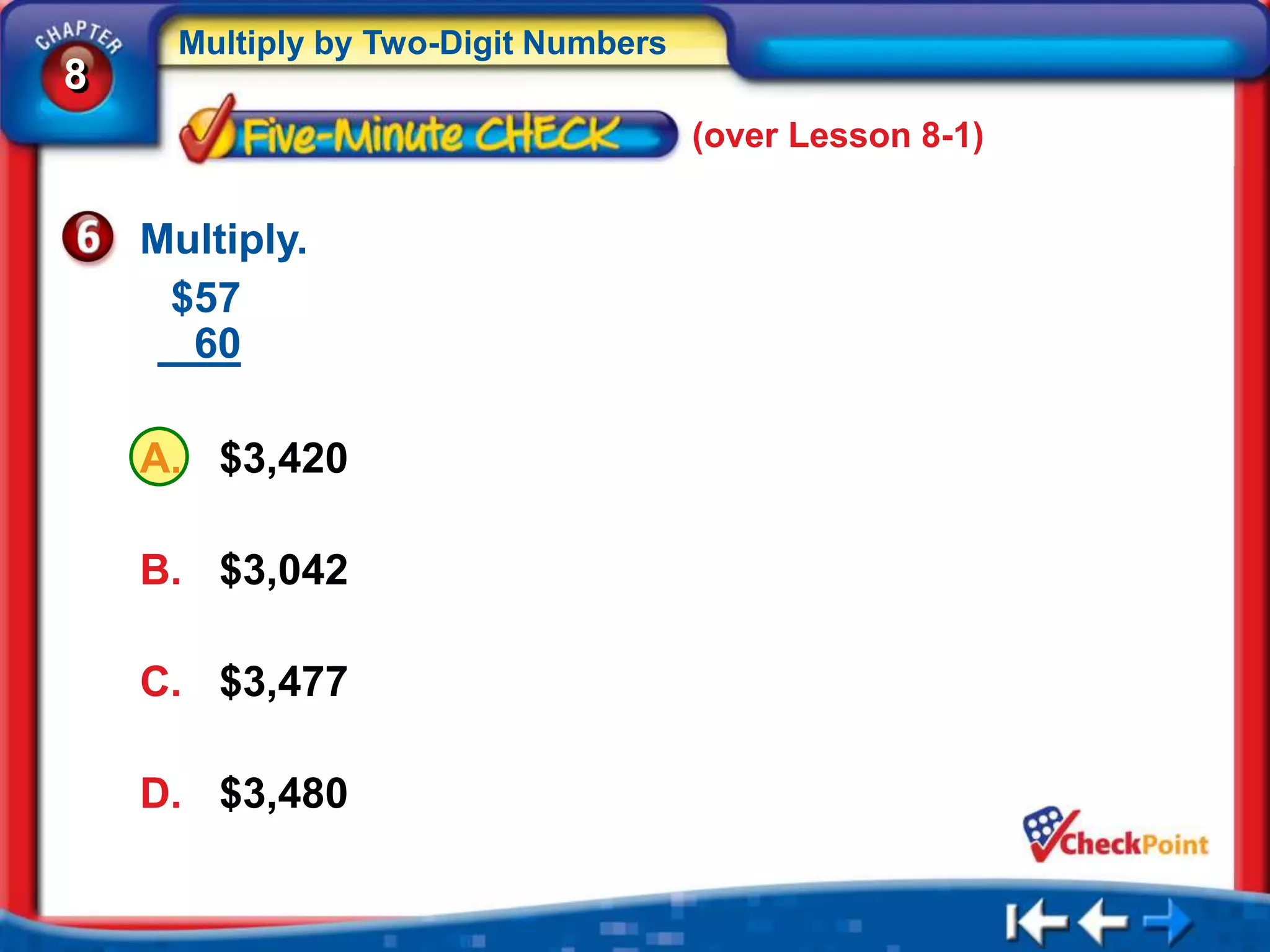
    Multiply.
     $57
      60

    A. $3,420

    B. $3,042

    C. $3,477

    D. $3,480
Multiply by Two-Digit Numbers
8
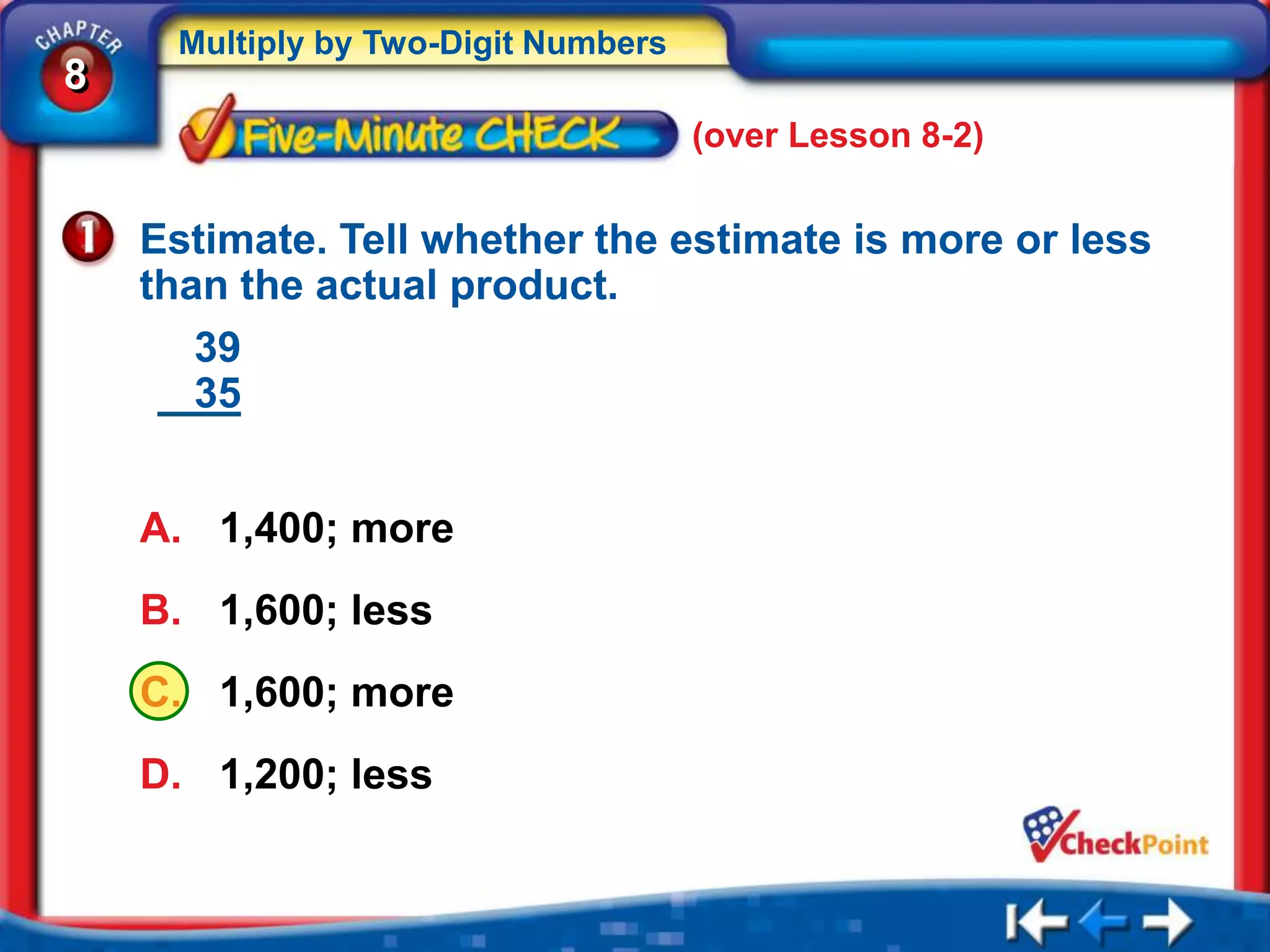
                                     (over Lesson 8-2)


    Estimate. Tell whether the estimate is more or less
    than the actual product.
       39
       35


    A. 1,400; more
    B. 1,600; less
    C. 1,600; more
    D. 1,200; less
Multiply by Two-Digit Numbers
8
                                     (over Lesson 8-2)


    Estimate. Tell whether the estimate is more or less
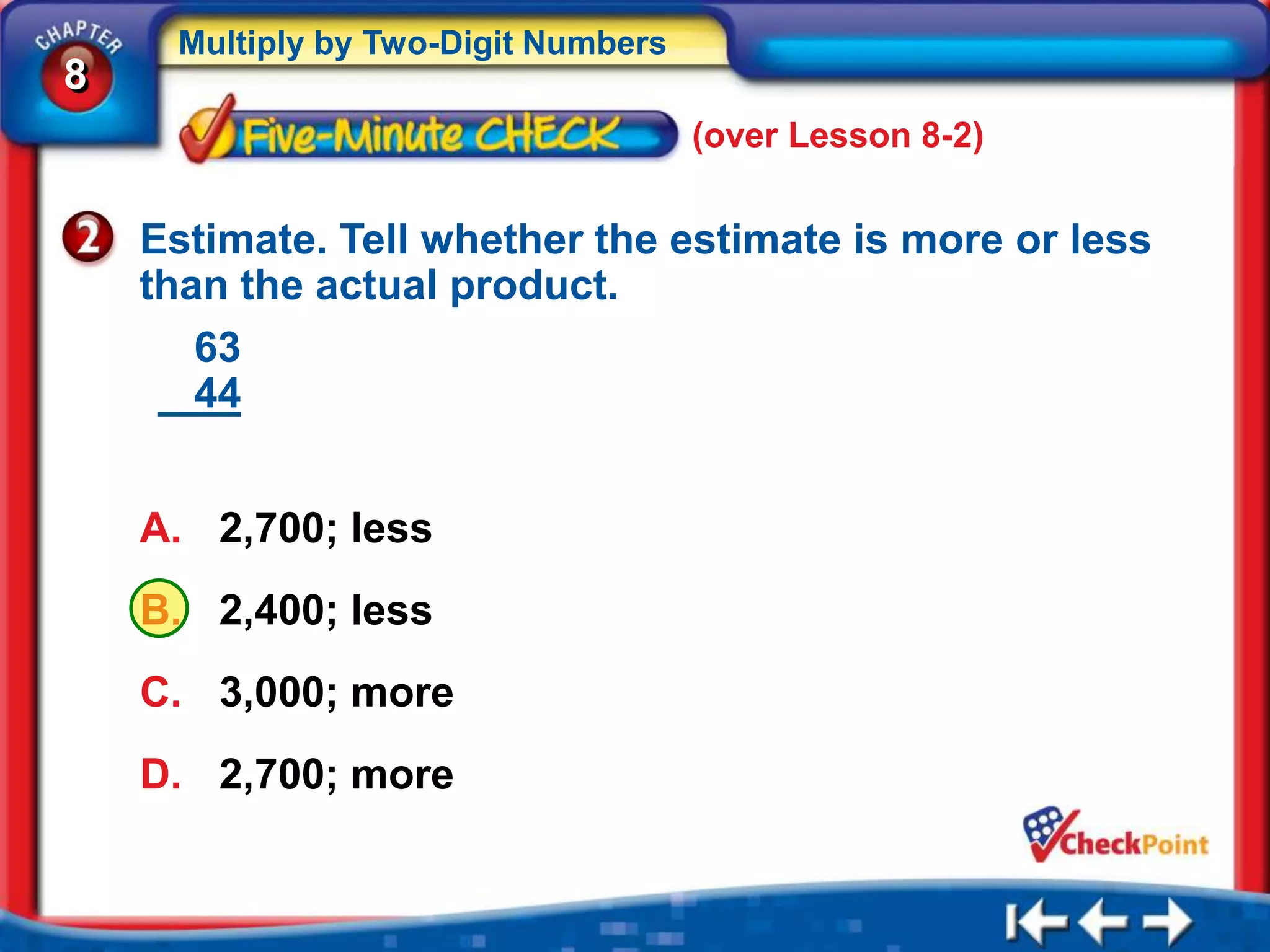
    than the actual product.
       63
       44


    A. 2,700; less
    B. 2,400; less
    C. 3,000; more
    D. 2,700; more
Multiply by Two-Digit Numbers
8
                                     (over Lesson 8-2)


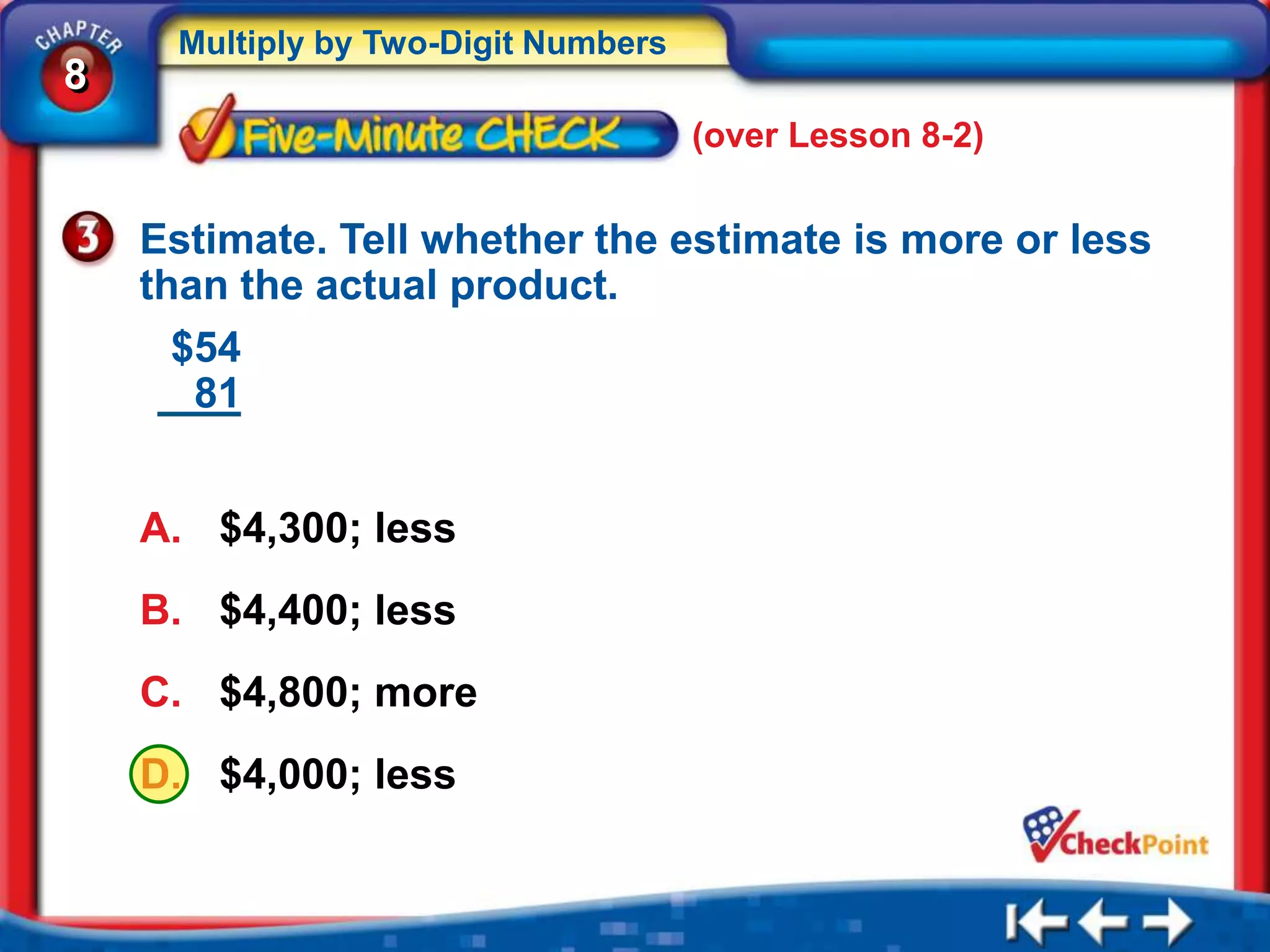
    Estimate. Tell whether the estimate is more or less
    than the actual product.
      $54
       81


    A. $4,300; less
    B. $4,400; less
    C. $4,800; more
    D. $4,000; less
Multiply by Two-Digit Numbers
8
                                     (over Lesson 8-2)


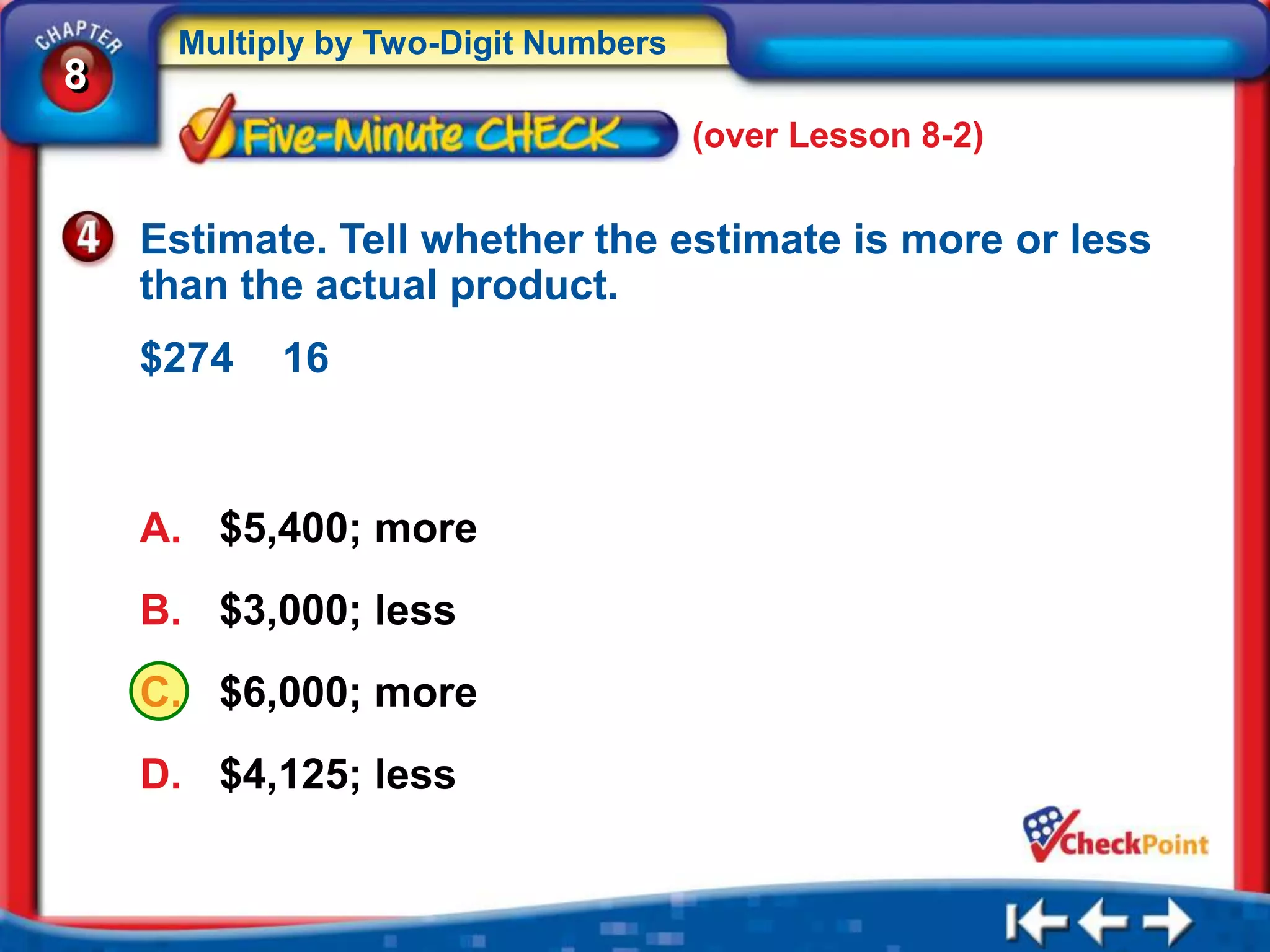
    Estimate. Tell whether the estimate is more or less
    than the actual product.
    $274   16


    A. $5,400; more
    B. $3,000; less
    C. $6,000; more
    D. $4,125; less
Multiply by Two-Digit Numbers
8
                                     (over Lesson 8-2)


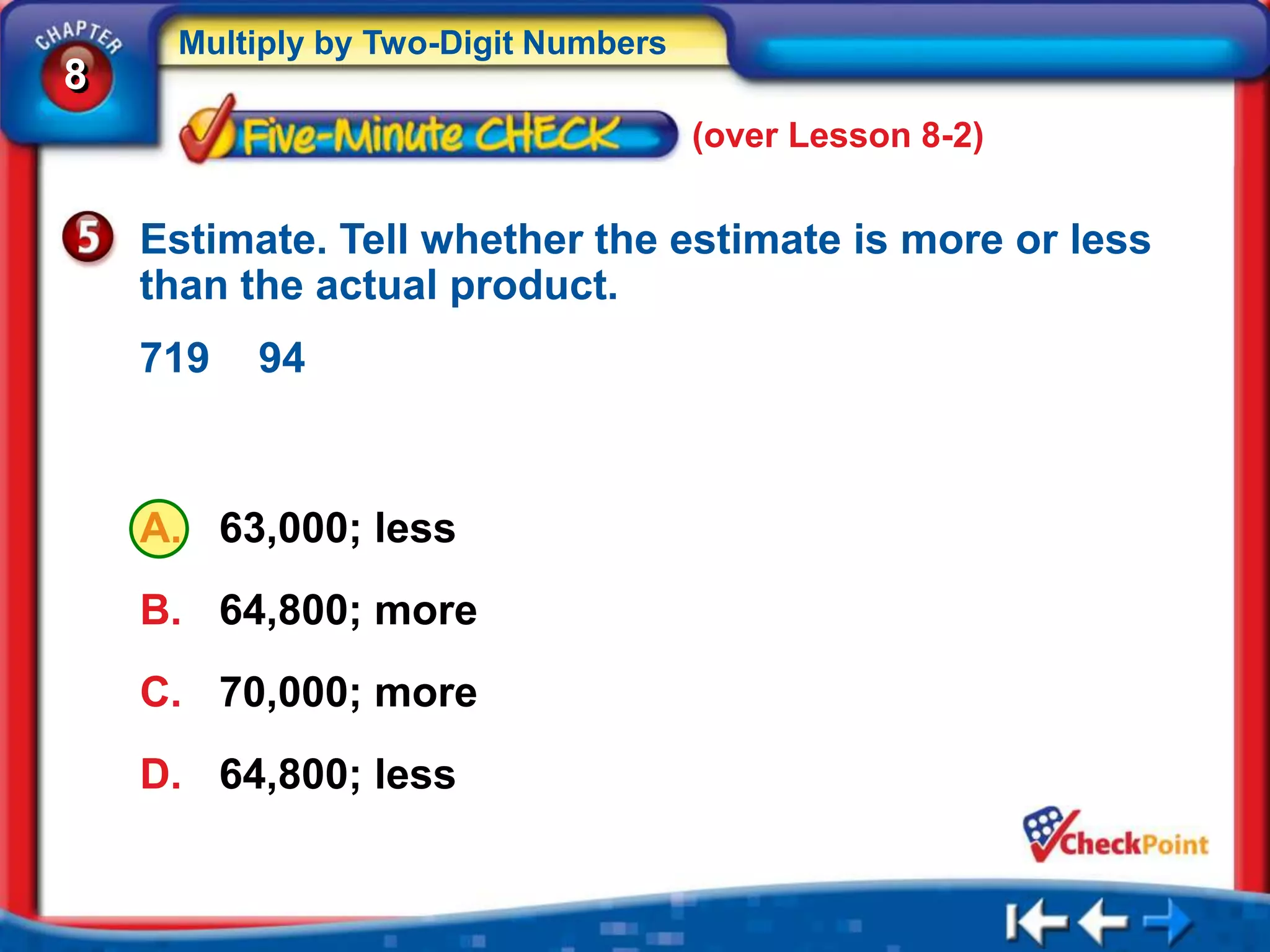
    Estimate. Tell whether the estimate is more or less
    than the actual product.
    719   94


    A. 63,000; less
    B. 64,800; more
    C. 70,000; more
    D. 64,800; less
Multiply by Two-Digit Numbers
8
                                      (over Lesson 8-3)


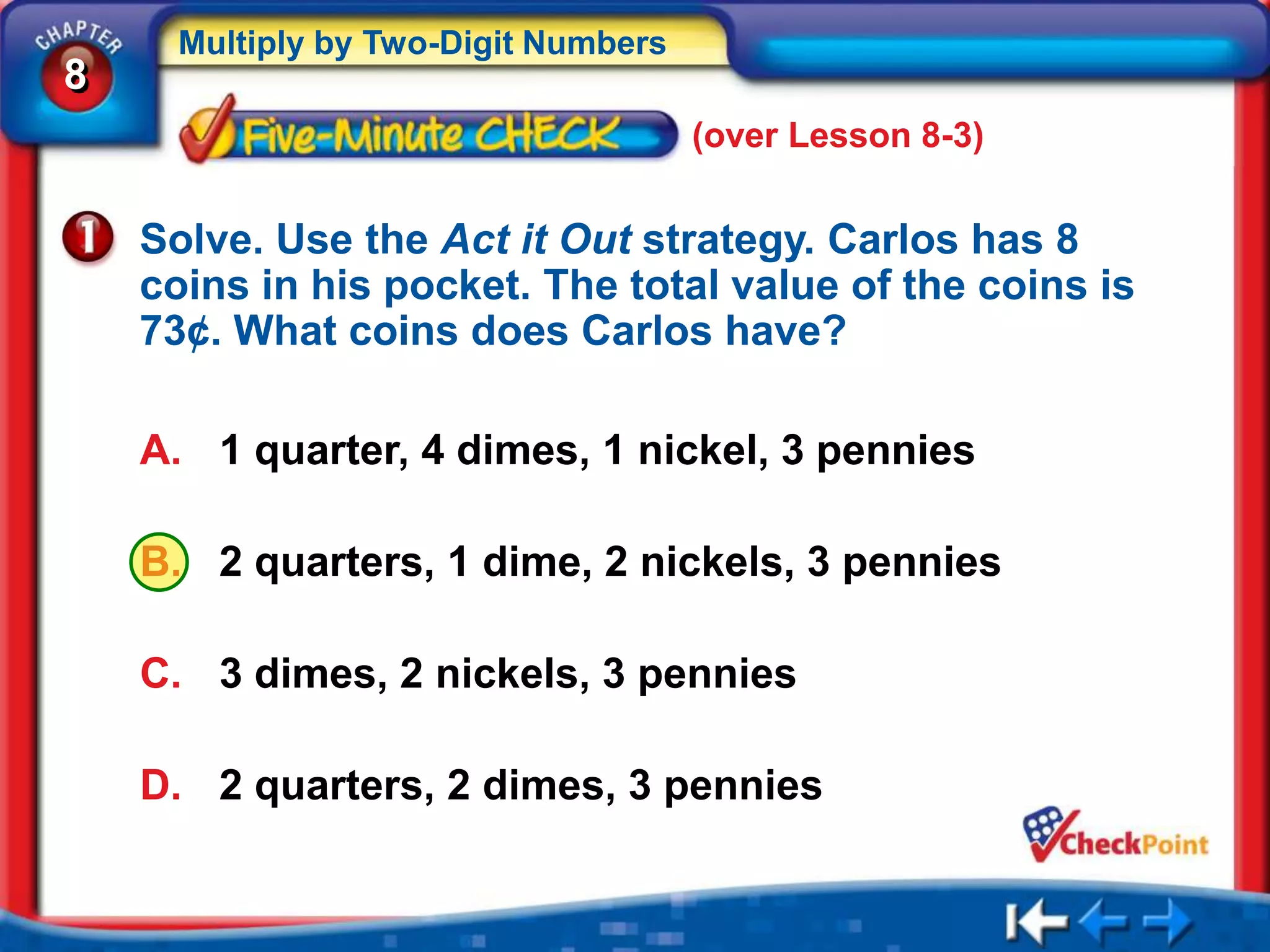
    Solve. Use the Act it Out strategy. Carlos has 8
    coins in his pocket. The total value of the coins is
    73¢. What coins does Carlos have?

    A. 1 quarter, 4 dimes, 1 nickel, 3 pennies

    B. 2 quarters, 1 dime, 2 nickels, 3 pennies

    C. 3 dimes, 2 nickels, 3 pennies

    D. 2 quarters, 2 dimes, 3 pennies
Multiply by Two-Digit Numbers
8
                                      (over Lesson 8-4)


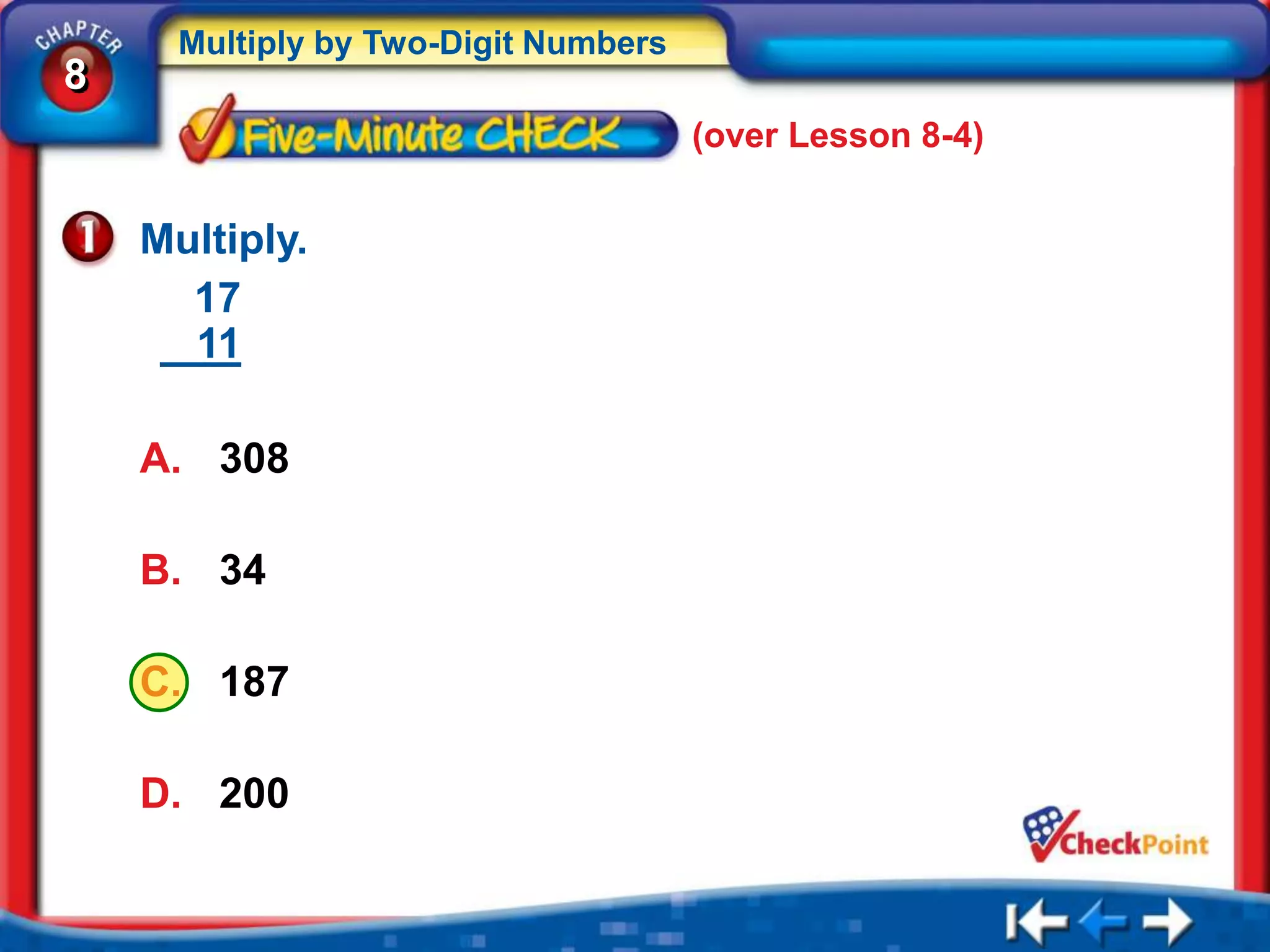
    Multiply.
      17
      11

    A. 308

    B. 34

    C. 187

    D. 200
Multiply by Two-Digit Numbers
8
                                      (over Lesson 8-4)


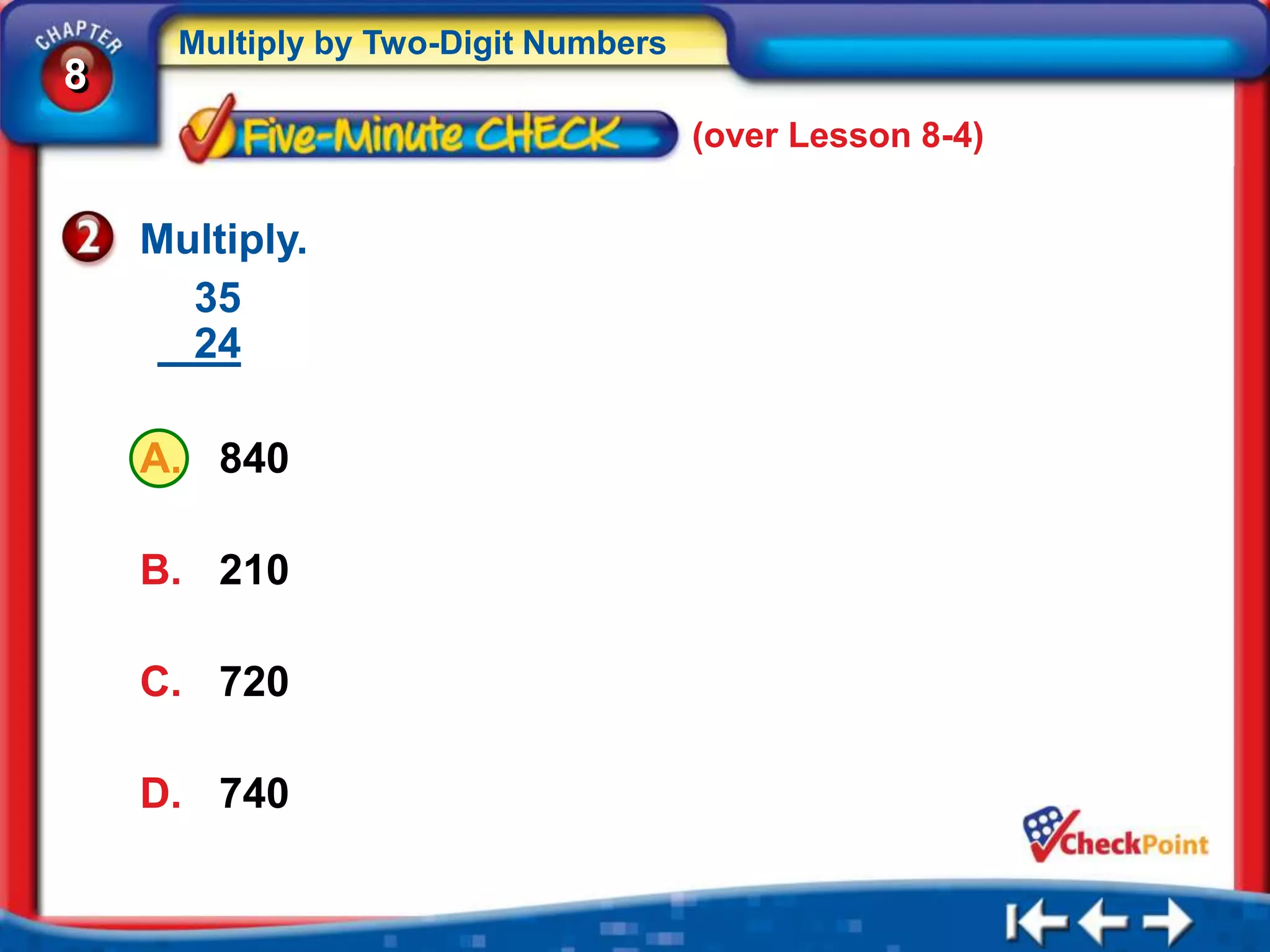
    Multiply.
      35
      24

    A. 840

    B. 210

    C. 720

    D. 740
Multiply by Two-Digit Numbers
8
                                      (over Lesson 8-4)


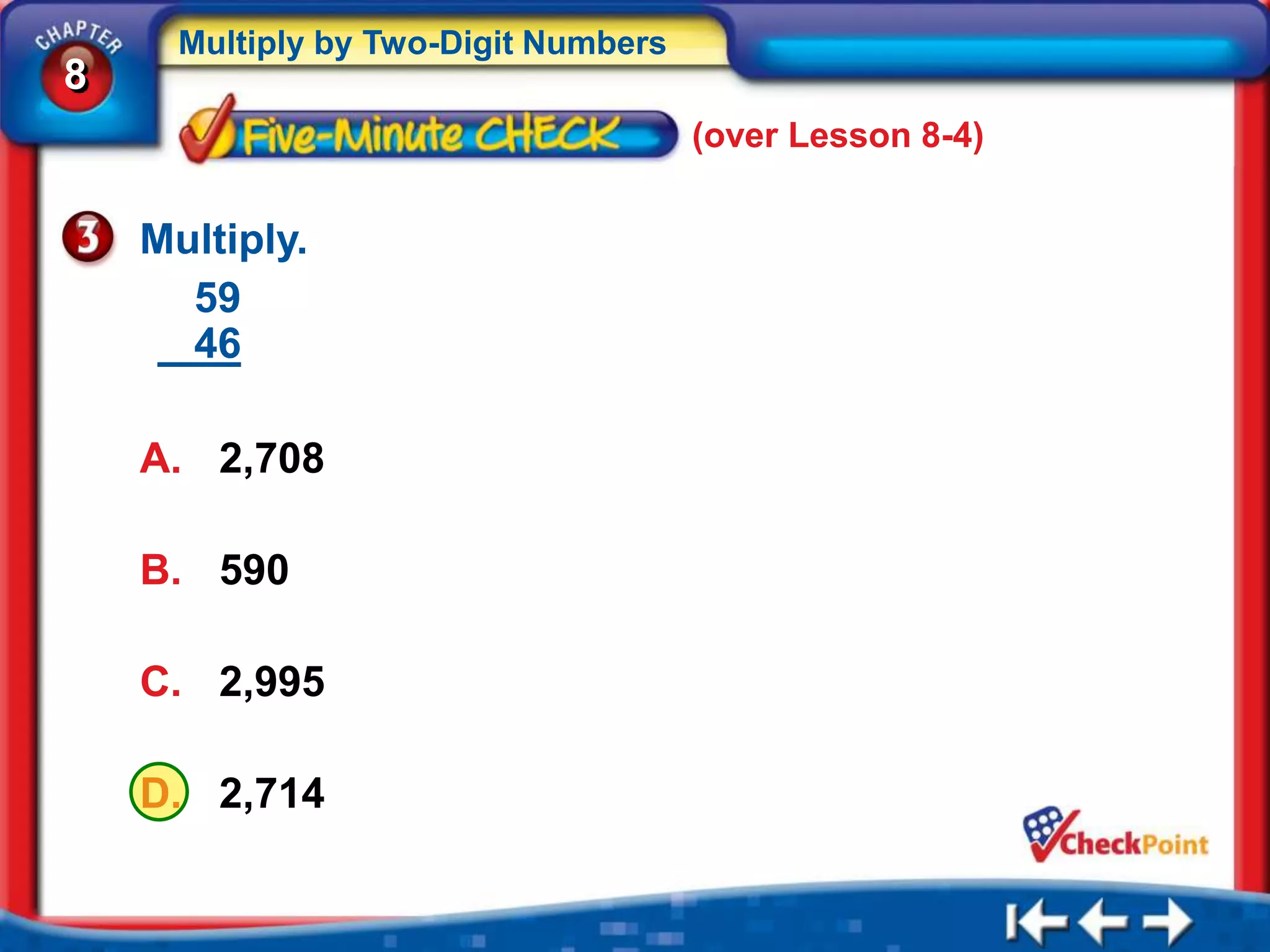
    Multiply.
      59
      46

    A. 2,708

    B. 590

    C. 2,995

    D. 2,714
Multiply by Two-Digit Numbers
8
                                      (over Lesson 8-4)


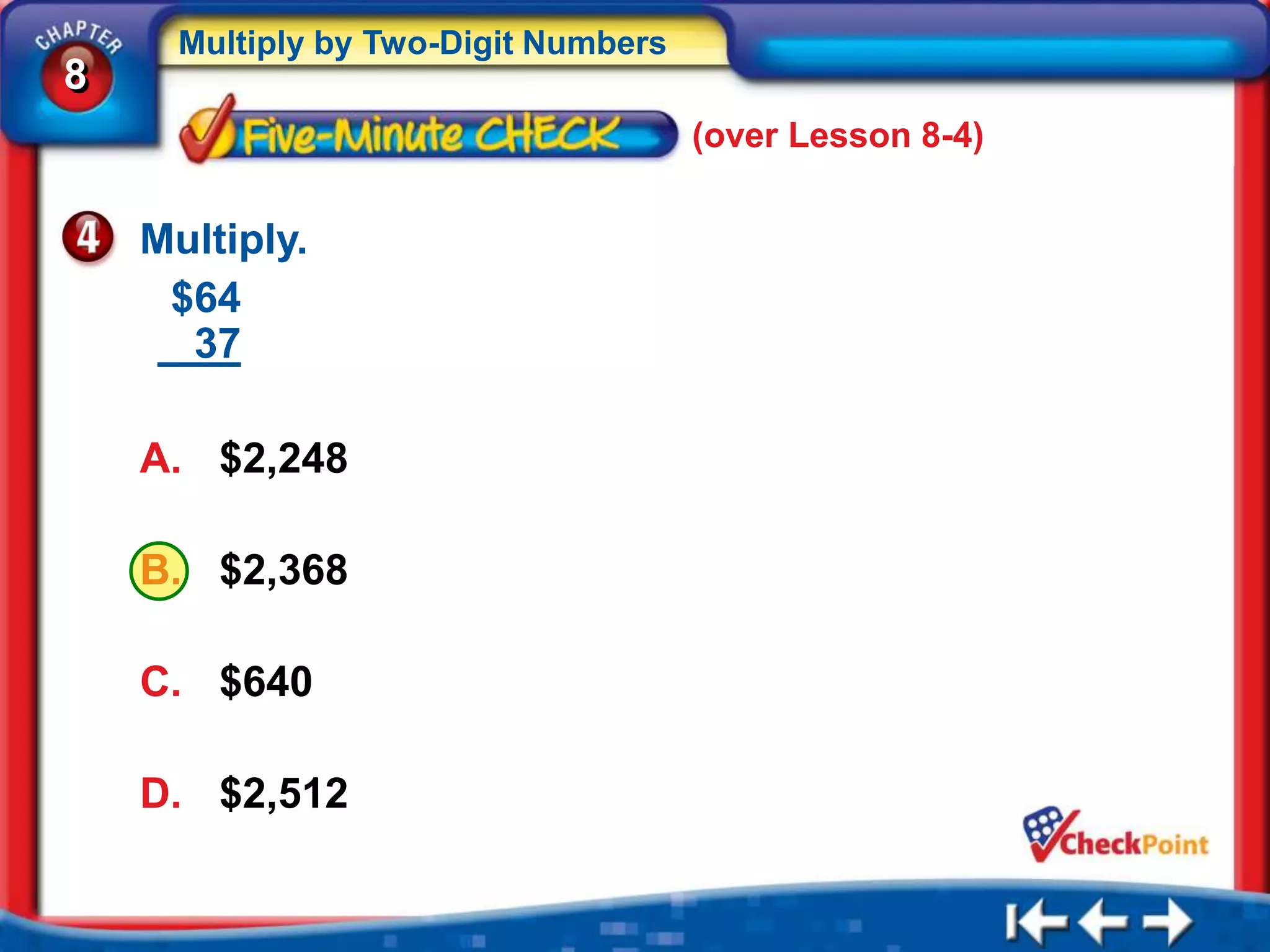
    Multiply.
     $64
      37

    A. $2,248

    B. $2,368

    C. $640

    D. $2,512
Multiply by Two-Digit Numbers
8
                                      (over Lesson 8-4)


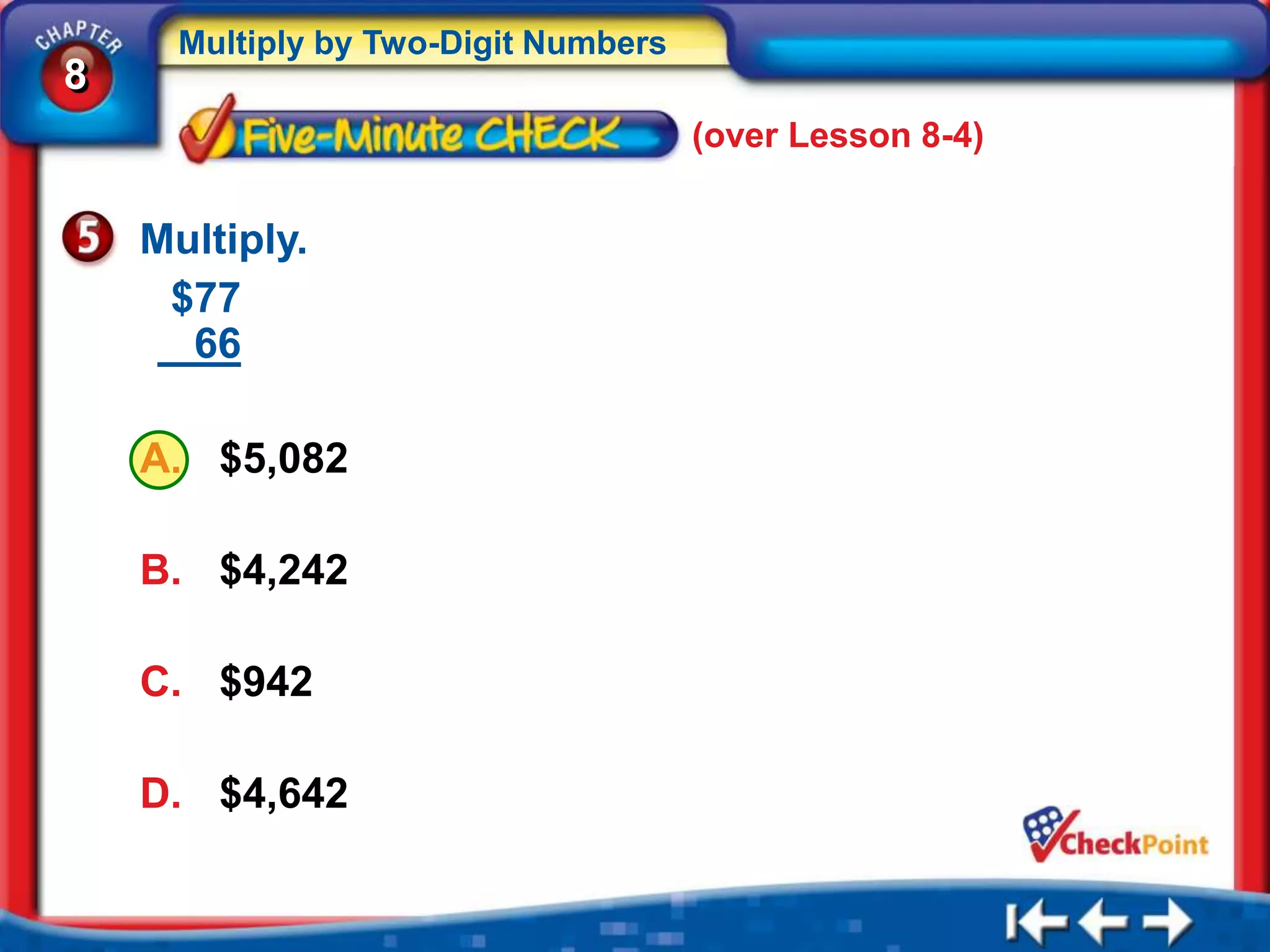
    Multiply.
     $77
      66

    A. $5,082

    B. $4,242

    C. $942

    D. $4,642
Multiply by Two-Digit Numbers
8
                                      (over Lesson 8-4)


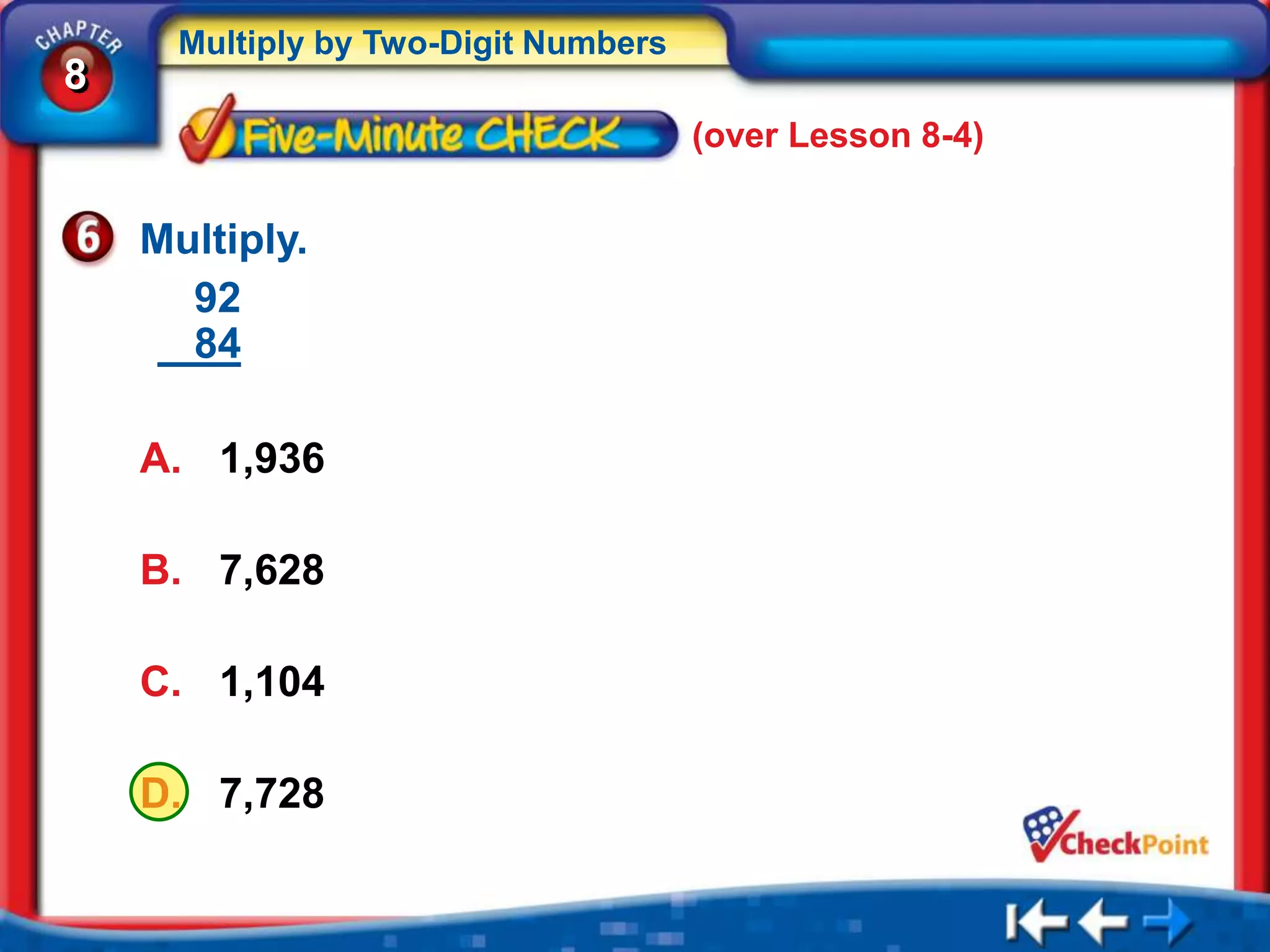
    Multiply.
      92
      84

    A. 1,936

    B. 7,628

    C. 1,104

    D. 7,728
Multiply by Two-Digit Numbers
8
                                      (over Lesson 8-5)


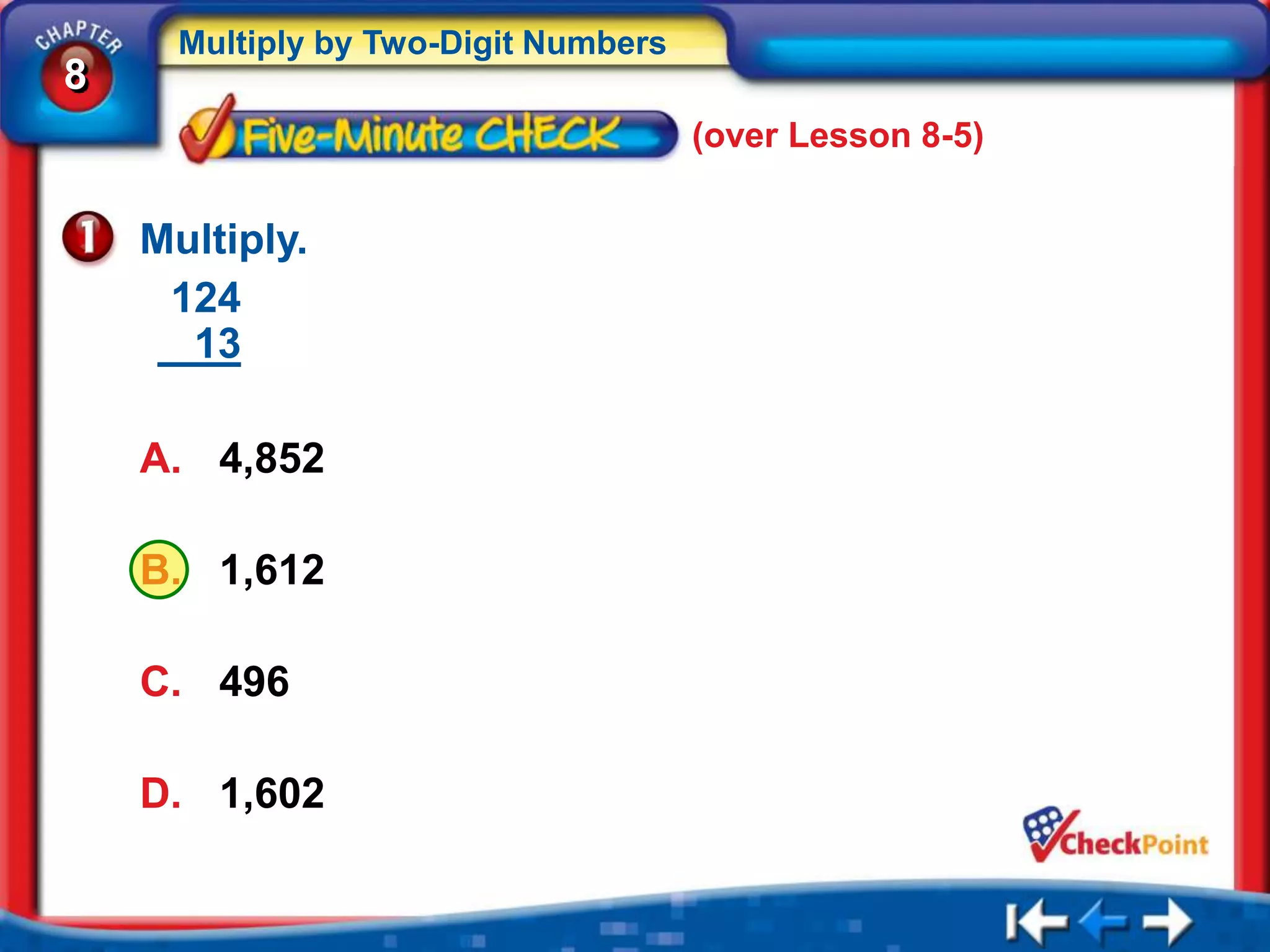
    Multiply.
     124
      13

    A. 4,852

    B. 1,612

    C. 496

    D. 1,602
Multiply by Two-Digit Numbers
8
                                      (over Lesson 8-5)


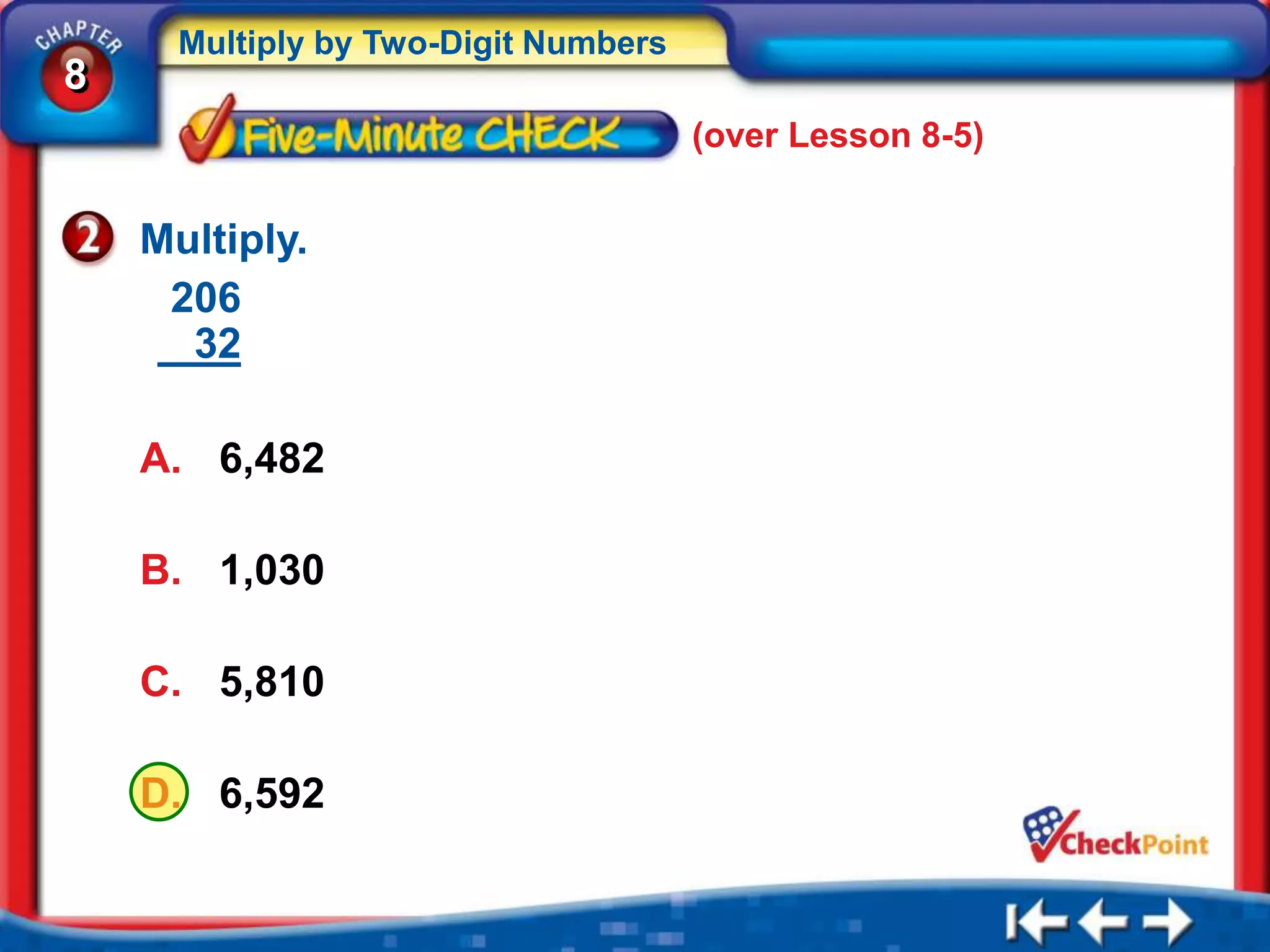
    Multiply.
     206
      32

    A. 6,482

    B. 1,030

    C. 5,810

    D. 6,592
Multiply by Two-Digit Numbers
8
                                      (over Lesson 8-5)


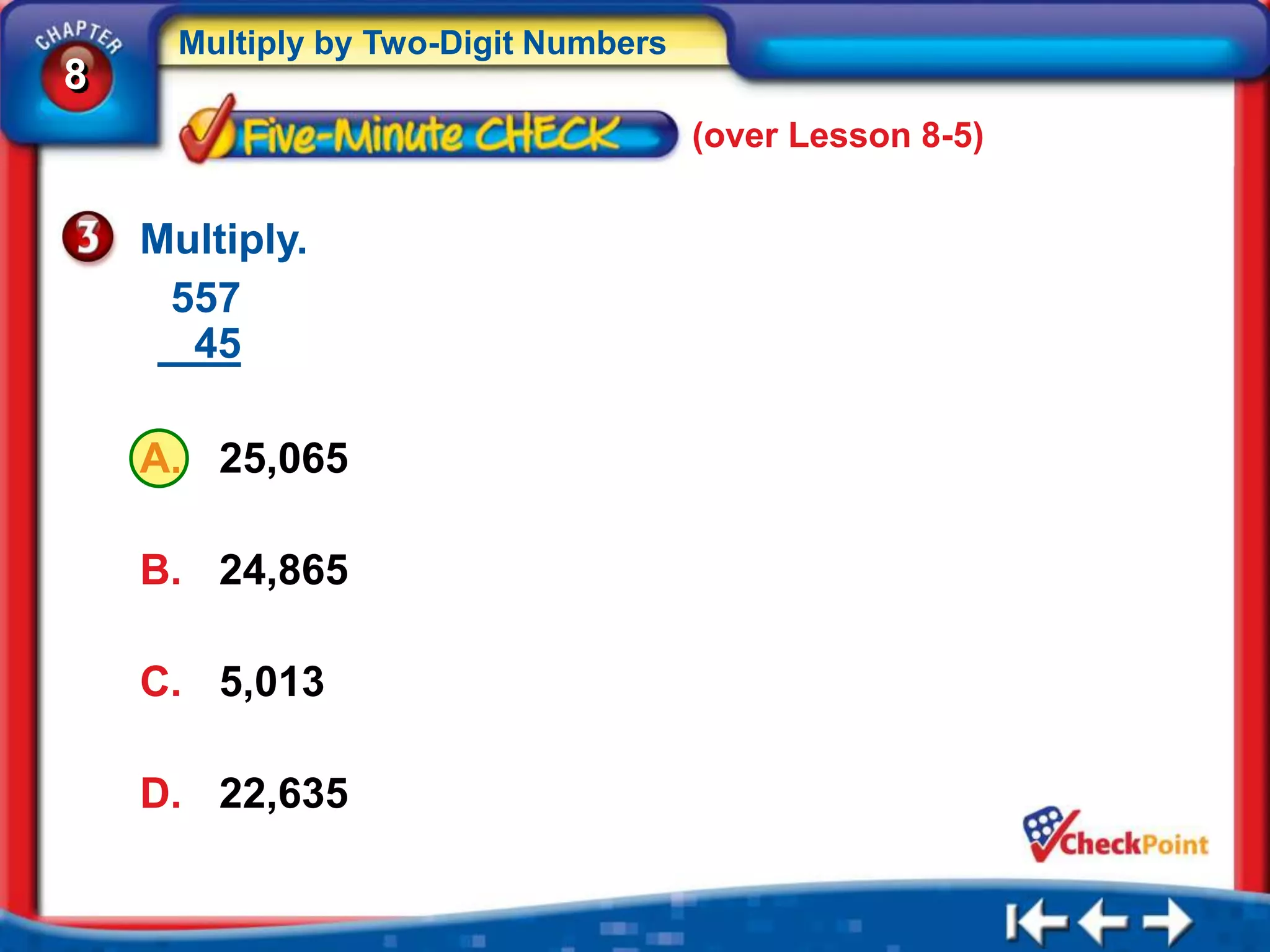
    Multiply.
     557
      45

    A. 25,065

    B. 24,865

    C. 5,013

    D. 22,635
Multiply by Two-Digit Numbers
8
                                      (over Lesson 8-5)


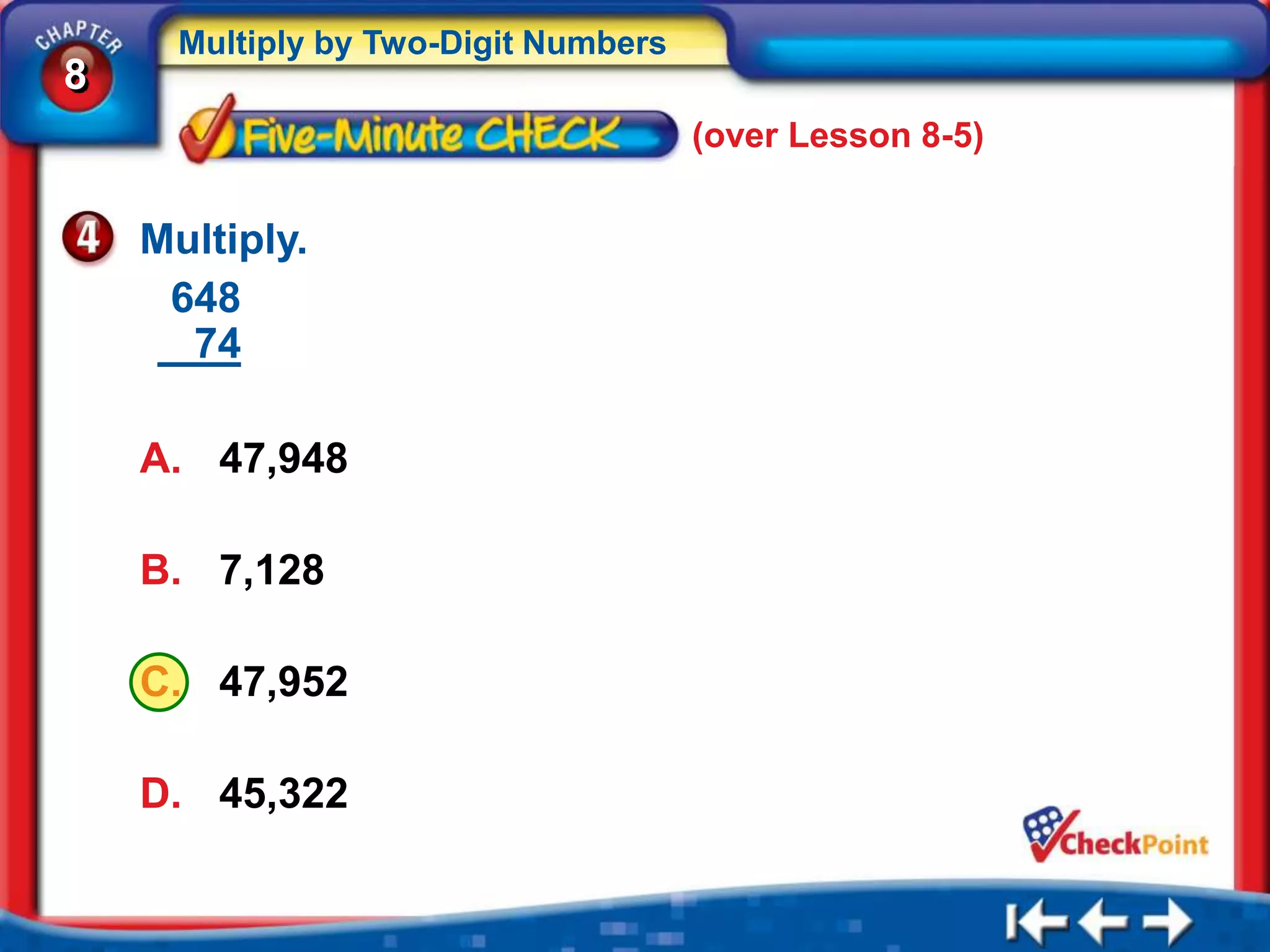
    Multiply.
     648
      74

    A. 47,948

    B. 7,128

    C. 47,952

    D. 45,322
Multiply by Two-Digit Numbers
8
                                      (over Lesson 8-5)


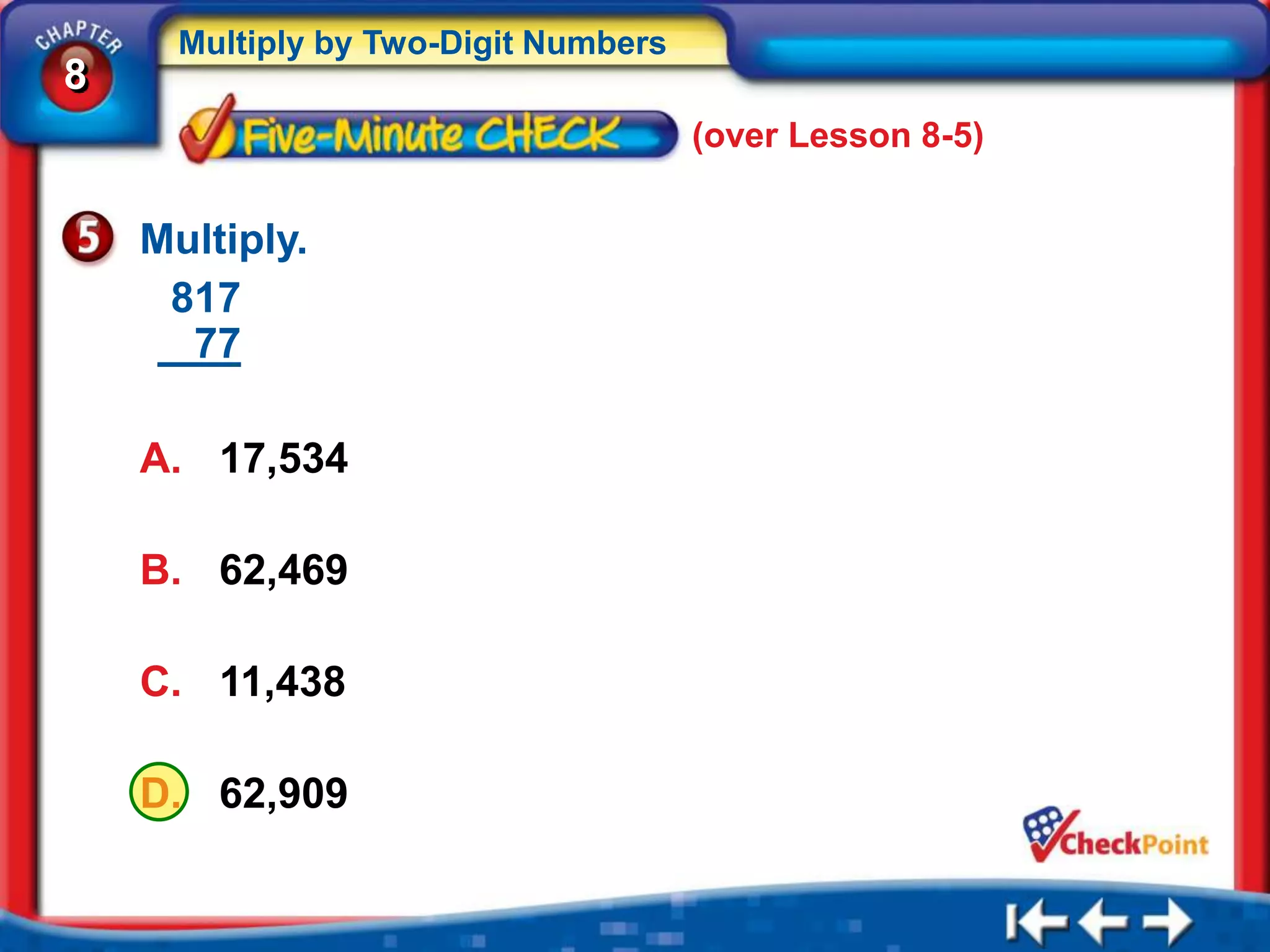
    Multiply.
     817
      77

    A. 17,534

    B. 62,469

    C. 11,438

    D. 62,909
Multiply by Two-Digit Numbers
8
                                      (over Lesson 8-5)


    Multiply.
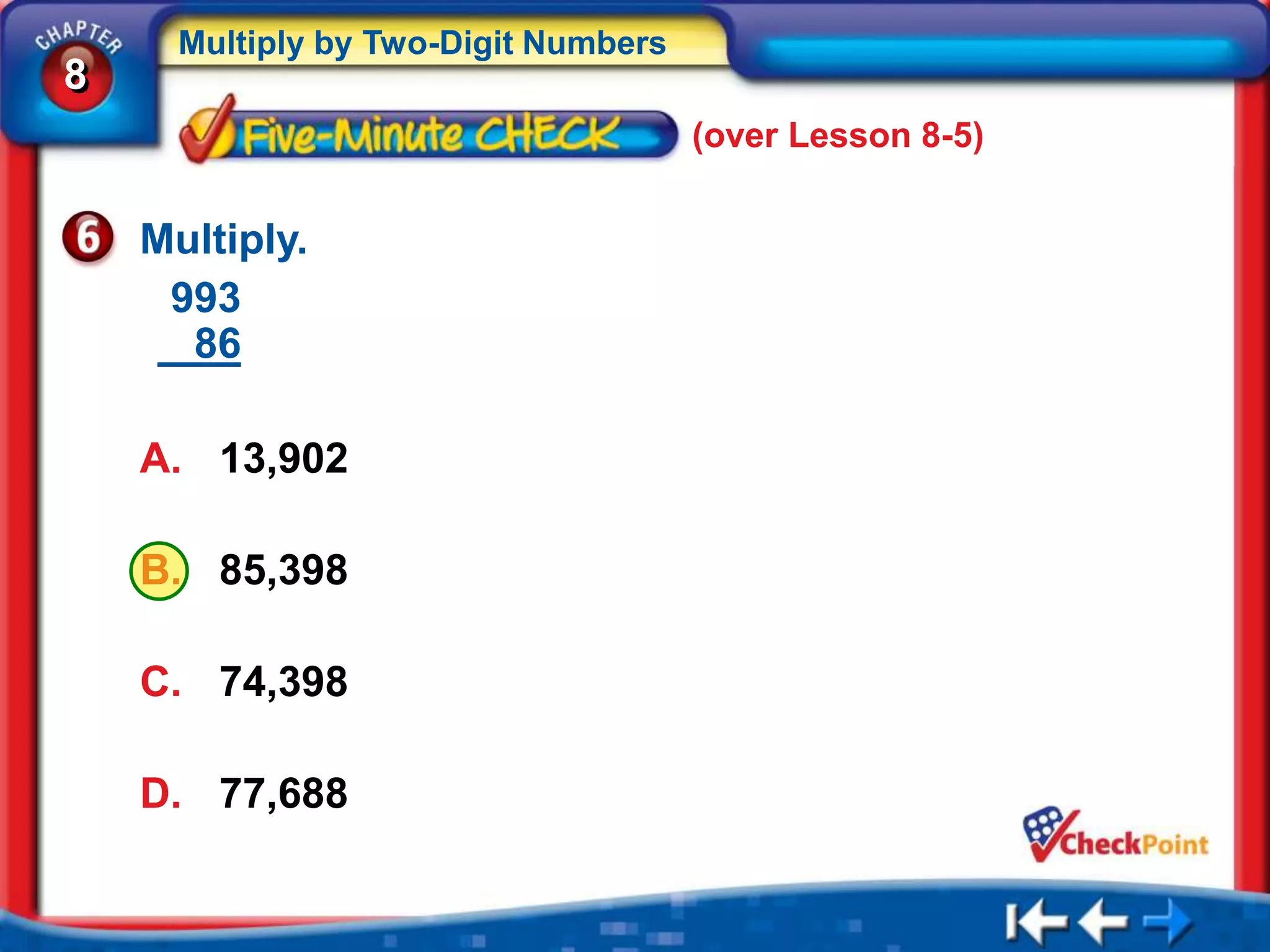
     993
      86

    A. 13,902

    B. 85,398

    C. 74,398

    D. 77,688
Multiply by Two-Digit Numbers
8
                                     (over Lesson 8-6)


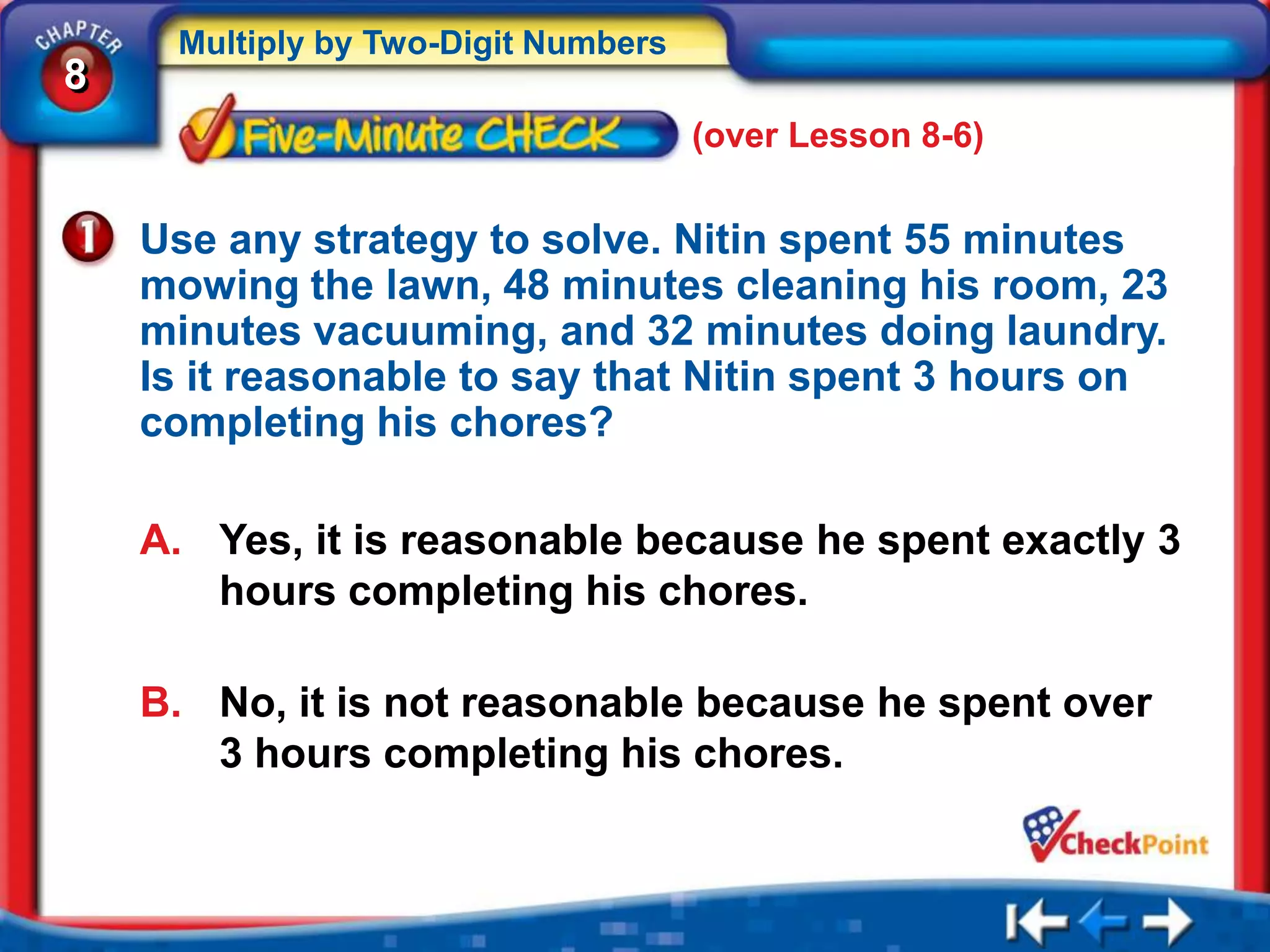
    Use any strategy to solve. Nitin spent 55 minutes
    mowing the lawn, 48 minutes cleaning his room, 23
    minutes vacuuming, and 32 minutes doing laundry.
    Is it reasonable to say that Nitin spent 3 hours on
    completing his chores?

    A. Yes, it is reasonable because he spent exactly 3
       hours completing his chores.

    B. No, it is not reasonable because he spent over
       3 hours completing his chores.
Multiply by Two-Digit Numbers
8
                                     (over Lesson 8-6)


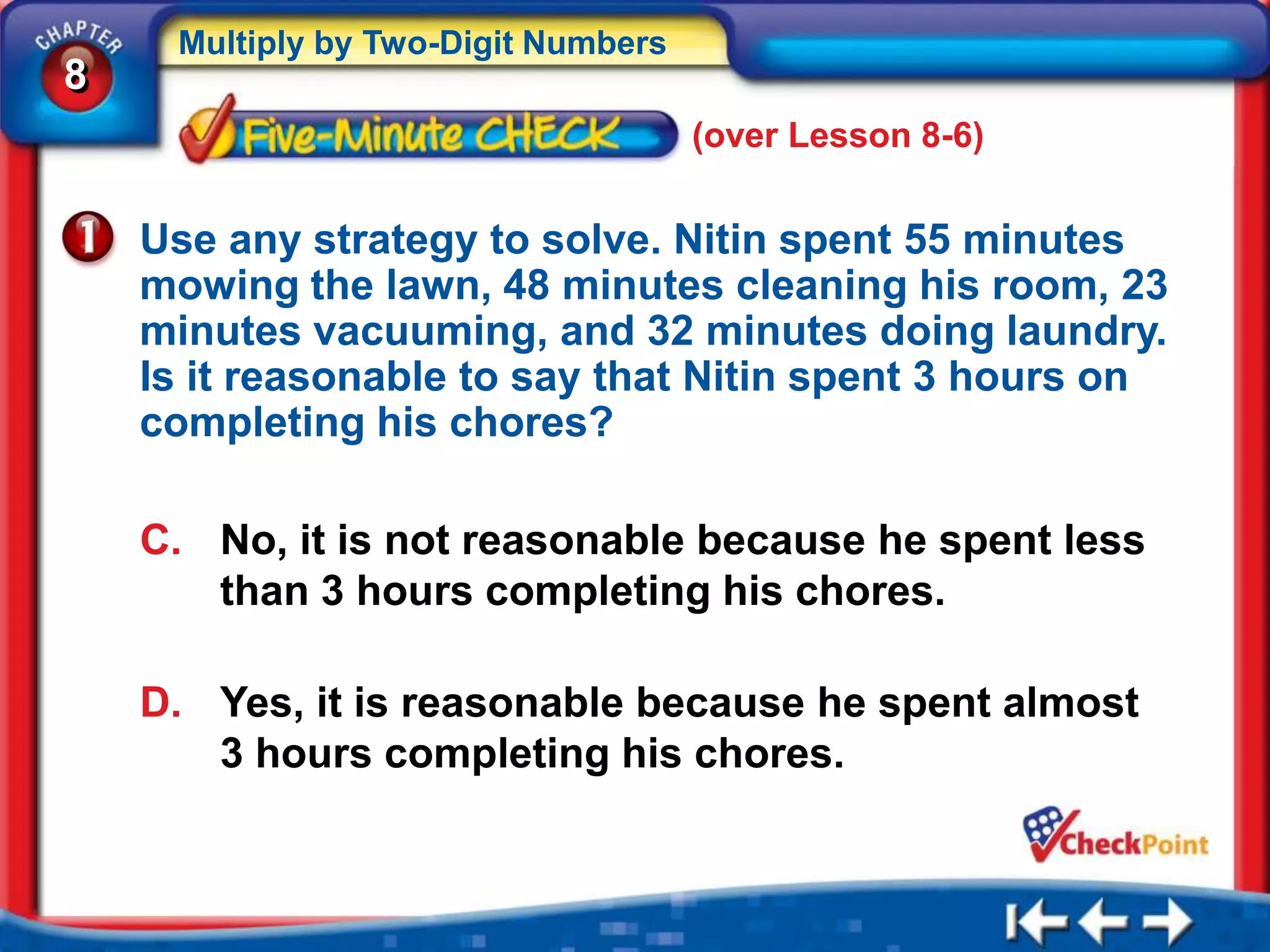
    Use any strategy to solve. Nitin spent 55 minutes
    mowing the lawn, 48 minutes cleaning his room, 23
    minutes vacuuming, and 32 minutes doing laundry.
    Is it reasonable to say that Nitin spent 3 hours on
    completing his chores?

    C. No, it is not reasonable because he spent less
       than 3 hours completing his chores.

    D. Yes, it is reasonable because he spent almost
       3 hours completing his chores.
Multiply by Two-Digit Numbers
8
                                     (over Lesson 8-6)


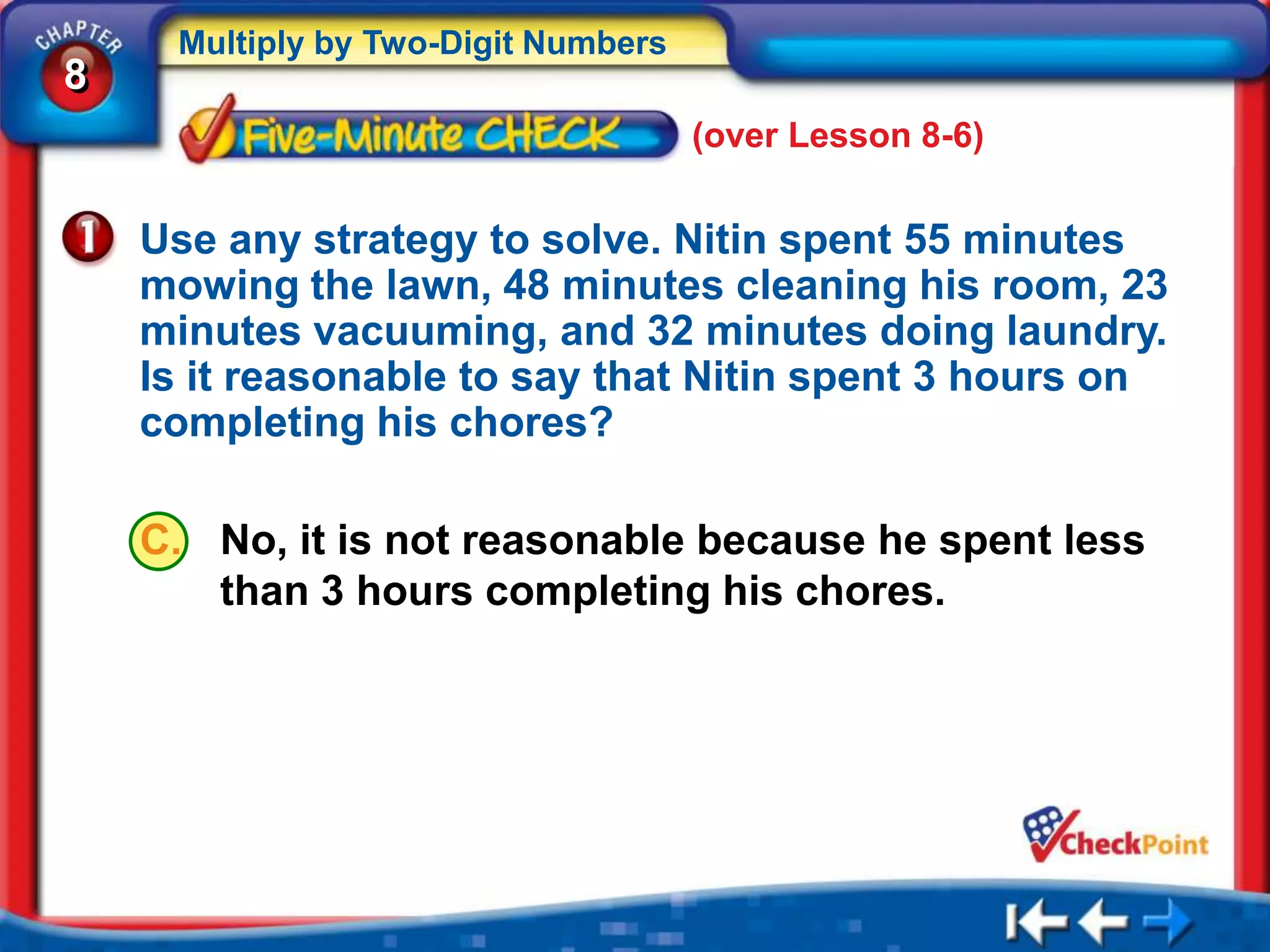
    Use any strategy to solve. Nitin spent 55 minutes
    mowing the lawn, 48 minutes cleaning his room, 23
    minutes vacuuming, and 32 minutes doing laundry.
    Is it reasonable to say that Nitin spent 3 hours on
    completing his chores?

    C. No, it is not reasonable because he spent less
       than 3 hours completing his chores.
This slide is intentionally blank.

Math Gr4 Ch8

  • 1.
    Chapter 8 Multiply by Two-Digit Numbers Click the mouse or press the space bar to continue.
  • 2.
    Multiply by Two-DigitNumbers 8 Lesson 8-1 Multiply by Tens Lesson 8-2 Estimate Products Lesson 8-3 Problem-Solving Strategy: Act It Out Lesson 8-4 Multiply Two-Digit Numbers Lesson 8-5 Multiply Three-Digit Numbers by Two-Digit Numbers Lesson 8-6 Problem-Solving Investigation: Choose a Strategy Lesson 8-7 Multiply Greater Numbers
  • 3.
    8-1 Multiply by Tens Five-Minute Check (over Chapter 7) Main Idea California Standards Example 1 Example 2
  • 4.
    8-1 Multiply by Tens • I will multiply a whole number by a multiple of ten.
  • 5.
    8-1 Multiply by Tens Standard 4NS3.3 Solve problems involving the multiplication of multidigit numbers by two-digit numbers.
  • 6.
    8-1 Multiply by Tens Standard 4NS3.2 Demonstrate an understanding of, and the ability to use, standard algorithms for multiplying a multidigit number by a two-digit number and for dividing a multidigit number by a one-digit number; use relationships between them to simplify computations and to check results.
  • 7.
    8-1 Multiply by Tens There are 35 packs of markers in an art classroom. Each pack contains 50 markers. How many markers are there in all? You need to find 35 50.
  • 8.
    8-1 Multiply by Tens One Way: Use Properties 35 × 50 Write the problem. 35 × (10 × 5) Think of 50 as 10 × 5. 35 × (5 × 10) Commutative Property (35 × 5) × 10 Associative Property 175 × 10 Multiply. 35 × 5 = 175 1,750 Mental Math.
  • 9.
    8-1 Multiply by Tens Another Way: Paper and Pencil Step 1 Multiply the Step 2 Multiply the ones. tens. 35 35 × 50 × 50 0 1,75 0 Answer: So, there are 1,750 markers in all.
  • 10.
    8-1 Multiply by Tens Find 45 30. A. 1,350 B. 1,250 C. 135 D. 125
  • 11.
    8-1 Multiply by Tens A store has 20 children’s bicycles in stock that cost $159 each. How much do all of the bicycles cost altogether? Step 1 Multiply the ones. $159 20 0
  • 12.
    8-1 Multiply by Tens Step 2 Multiply the tens. $159 20 $3,18 0 Answer: So, all of the bicycles cost $3,180.
  • 13.
    8-1 Multiply by Tens Check Think of 20 × 159 as 2 × 10 × 159. 20 × $159 Write the problem. (2 × 10) × $159 Think of 20 as 2 × 10. (10 × 2) × $159 Commutative Property 10 × (2 × $159) Associative Property 10 × $318 Multiply. 2 × $159 = $318. $3,180 Mental Math So, the answer is correct.
  • 14.
    8-1 Multiply by Tens Find $179 30. A. $6,370 B. $5,530 C. $5,370 D. $4,170
  • 16.
    8-2 Estimate Products Five-Minute Check (over Lesson 8-1) Main Idea California Standards Example 1 Example 2
  • 17.
    8-2 Estimate Products • I will estimate products by rounding.
  • 18.
    8-2 Estimate Products Standard 4NS3.3 Solve problems involving multiplication of multidigit numbers by two-digit numbers. Standard 4NS1.3 Round whole numbers through the millions to the nearest ten, hundred, thousand, ten thousand, or hundred thousand.
  • 19.
    8-2 Estimate Products Kaylee is awake for about 16 hours each day. About how many hours is she awake in 3 weeks? There are 21 days in 3 weeks. So, estimate 16 21. Round each factor to its greatest place. Then multiply. Step 1 Round each factor to the nearest ten. 16 20 21 20
  • 20.
    8-2 Estimate Products Step 2 Multiply. 20 20 400 Answer: So, Kaylee is awake for about 400 hours in 3 weeks.
  • 21.
    8-2 Estimate Products A koala sleeps for about 19 hours a day. About how many hours does one sleep in 3 weeks? A. 400 B. 425 C. 450 D. 500
  • 22.
    8-2 Estimate Products A company bought 53 computers for $909 each. About how much did they spend in all? You need to estimate $909 × 53. Step 1 Round each factor to its greatest place. 909 900 53 50
  • 23.
    8-2 Estimate Products Step 2 Multiply. 900 50 45,000 Answer: So, the company spent about $45,000.
  • 24.
    8-2 Estimate Products A school bought 57 laptops for $837 each. About how much did the school spend in all? A. $45,000 B. $48,000 C. $53,000 D. $56,000
  • 26.
    8-3 Problem-Solving Strategy: Act It Out Five-Minute Check (over Lesson 8-2) Main Idea California Standards Example 1: Problem-Solving Strategy
  • 27.
    8-3 Problem-Solving Strategy: Act It Out • I will solve a problem by acting it out.
  • 28.
    8-3 Problem-Solving Strategy: Act It Out Standard 4MR2.3 Use a variety of methods, such as words, numbers, symbols, charts, graphs, tables, diagrams, and models, to explain mathematical reasoning.
  • 29.
    8-3 Problem-Solving Strategy: Act It Out Standard 4NS3.0 Students solve problems involving addition, subtraction, multiplication, and division of whole numbers and understand the relationships among the operations.
  • 30.
    8-3 Problem-Solving Strategy: Act It Out Sonoda has 6 coins in his bank. The coins equal 65¢. What combination of coins does he have in his bank?
  • 31.
    8-3 Problem-Solving Strategy: Act It Out Understand What facts do you know? • Sonoda has 6 coins. • The value of the 6 coins is 65¢. What do you need to find? • Find the coins Sonoda has in his bank.
  • 32.
    8-3 Problem-Solving Strategy: Act It Out Plan You can use play money to act out different combinations of 65¢.
  • 33.
    8-3 Problem-Solving Strategy: Act It Out Solve One way to make 65¢ is with 2 quarters, 1 dime, and 1 nickel. But, that is the only 4 coins. You need two more coins.
  • 34.
    8-3 Problem-Solving Strategy: Act It Out Solve Take 1 quarter and exchange it for 2 dimes and 1 nickel. The value stays the same, and the number of coins increases to 6. Answer: So, Sonoda has 1 quarter, 3 dimes, and 2 nickels.
  • 35.
    8-3 Problem-Solving Strategy: Act It Out Check Look back at the problem. 1 quarter + 3 dimes + 2 nickels = (1 × 25 ) + (3 × 10 ) + (2 × 5 ) = 25 + 30 + 10 = 65 So, the answer is correct.
  • 37.
    8-4 Multiply Two-Digit Numbers Five-Minute Check (over Lesson 8-3) Main Idea California Standards Example 1 Example 2
  • 38.
    8-4 Multiply Two-Digit Numbers • I will multiply two-digit numbers.
  • 39.
    8-4 Multiply Two-Digit Numbers Standard 4NS3.2 Demonstrate an understanding of, and the ability to use, standard algorithms for multiplying a multidigit number by a two-digit number and for dividing a multidigit number by a one-digit number; use the relationships between them to simplify computations and to check results.
  • 40.
    8-4 Multiply Two-Digit Numbers Preparation for Standard 4NS3.3 Solve problems involving multiplication of multidigit numbers by two-digit numbers.
  • 41.
    8-4 Multiply Two-Digit Numbers How far can a truck travel in 14 hours if it is traveling an average of 57 miles per hour?
  • 42.
    8-4 Multiply Two-Digit Numbers One Way: Partial Products 57 × 14 28 Multiply 4 × 7. 200 Multiply 4 × 50. 70 Multiply 10 × 7. + 500 Multiply 10 × 50. 798 Add partial products.
  • 43.
    8-4 Multiply Two-Digit Numbers One Way: Partial Products
  • 44.
    8-4 Multiply Two-Digit Numbers Another Way: Paper and Pencil Step 1 Multiply the ones. 2 57 × 14 228
  • 45.
    8-4 Multiply Two-Digit Numbers Another Way: Paper and Pencil Step 2 Multiply the tens. 2 57 × 14 228 570
  • 46.
    8-4 Multiply Two-Digit Numbers Another Way: Paper and Pencil Step 3 Add the 2 products. 57 × 14 228 + 570 798 Answer: So, the truck can travel 798 miles in 14 hours at 57 miles per hour.
  • 47.
    8-4 Multiply Two-Digit Numbers How far can a car travel in 15 hours if it is traveling an average of 63 miles per hour? A. 368 B. 378 C. 935 D. 945
  • 48.
    8-4 Multiply Two-Digit Numbers The Jones family spends an average of $48 a month going to the movies. How much does the family spend in 3 years? Estimate 50 × 40 = 2,000. Step 1 Multiply the ones. $48 36 288
  • 49.
    8-4 Multiply Two-Digit Numbers Step 2 Multiply the tens. $48 36 288 + 1,440
  • 50.
    8-4 Multiply Two-Digit Numbers Step 3 Add the products. $48 36 288 + 1,440 1,728 Answer: So, the Jones family spends $1,728 in 3 years.
  • 51.
    8-4 Multiply Two-Digit Numbers Check 1,200 + 240 + 240 + 48 = 1,728 Check for Reasonableness Since 1,728 is close to the estimate of 2,000, the answer is reasonable.
  • 52.
    8-4 Multiply Two-Digit Numbers Lauren spends about $72 a month on gas for her car. How much does she spend on gas in 4 years? A. $3,456 B. $3,157 C. $2,456 D. $2,157
  • 54.
    8-5 Multiply Three-Digit Numbers by Two-Digit Numbers Five-Minute Check (over Lesson 8-4) Main Idea California Standards Example 1 Example 2
  • 55.
    8-5 Multiply Three-Digit Numbers by Two-Digit Numbers • I will multiply a three-digit number by a two-digit number.
  • 56.
    8-5 Multiply Three-Digit Numbers by Two-Digit Numbers Standard 4NS3.2 Demonstrate an understanding of, and the ability to use, standard algorithms for multiplying a multidigit number by a two-digit number and for dividing a multidigit number by a one-digit number; use the relationships between them to simplify computations and to check results.
  • 57.
    8-5 Multiply Three-Digit Numbers by Two-Digit Numbers Standard 4NS3.3 Solve problems involving multiplication of multidigit numbers by two-digit numbers.
  • 58.
    8-5 Multiply Three-Digit Numbers by Two-Digit Numbers Antonio spends 194 minutes taking piano lesson each month. How many minutes does he spend taking piano lesson in a year? Estimate 12 × 194 10 × 200 = 2,000. Step 1 Multiply 194 by 2. 194 12 388
  • 59.
    8-5 Multiply Three-Digit Numbers by Two-Digit Numbers 1 Step 2 Multiply 194 194 by 1 ten. 12 388 1,940 1 Step 3 Add the 194 products. 12 388 + 1,940 2,328
  • 60.
    8-5 Multiply Three-Digit Numbers by Two-Digit Numbers Answer: So, Antonio spends 2,328 minutes taking piano lessons in a year.
  • 61.
    8-5 Multiply Three-Digit Numbers by Two-Digit Numbers Check for Reasonableness Since 2,328 is close to the estimate, 2,000. So, the answer is correct.
  • 62.
    8-5 Multiply Three-Digit Numbers by Two-Digit Numbers Lui spends about 321 minutes a month writing to pen pals. How many minutes does he spend writing letters in a year? A. 3,210 B. 3,814 C. 3,752 D. 3,852
  • 63.
    8-5 Multiply Three-Digit Numbers by Two-Digit Numbers Rai is paid $308 a week for her part-time job at the city library. What is Rai’s annual salary? Estimate $308 × 52 300 × 50 = $15,000. Step 1 Multiply $308 by 2. 1 $308 52 $616
  • 64.
    8-5 Multiply Three-Digit Numbers by Two-Digit Numbers Step 2 Multiply $308 by 50. 4 1 $308 52 $616 $15,400
  • 65.
    8-5 Multiply Three-Digit Numbers by Two-Digit Numbers Step 3 Add the partial products. 4 1 $308 52 $616 + $15,400 $16,016 Answer: So, the product of $308 and 52 is $16,016.
  • 66.
    8-5 Multiply Three-Digit Numbers by Two-Digit Numbers Check for Reasonableness Since $16,016 is close to the estimate, the answer is reasonable.
  • 67.
    8-5 Multiply Three-Digit Numbers by Two-Digit Numbers Monique gets paid $444 a week at her job. How much does she get paid in a year? A. $22,088 B. $23,088 C. $21,088 D. $20,088
  • 69.
    8-6 Problem-Solving Investigation: Choose a Strategy Five-Minute Check (over Lesson 8-5) Main Idea California Standards Example 1: Problem-Solving Investigation
  • 70.
    8-6 Problem-Solving Investigation: Choose a Strategy • I will choose the best strategy to solve a problem.
  • 71.
    8-6 Problem-Solving Investigation: Choose a Strategy Standard 4MR1.1 Analyze problems by identifying relationships, distinguishing relevant from irrelevant information, sequencing and prioritizing information, and observing patterns.
  • 72.
    8-6 Problem-Solving Investigation: Choose a Strategy Standard 4NS3.0 Students solve problems involving addition, subtraction, multiplication, and division of whole numbers and understand the relationships among the operations.
  • 73.
    8-6 Problem-Solving Investigation: Choose a Strategy GREGORY: I spent 4 hours at a school carnival. I spent 35 minutes eating and 45 minutes playing games. I also rode 12 rides, which took about 15 minutes each because I had to stand in lines. YOUR MISSION: Determine if Gregory is correct in saying that he spent 4 hours at the carnival.
  • 74.
    8-6 Problem-Solving Investigation: Choose a Strategy Understand What facts do you know? • Gregory spent 35 minutes eating. • He spent 45 minutes playing games. • He rode 12 rides, which lasted 15 minutes each. What do you need to find? • Find if Gregory is correct in saying he spent 4 hours at the carnival.
  • 75.
    8-6 Problem-Solving Investigation: Choose a Strategy Plan Find the total number of minutes spent on carnival activities and compare to 4 hours.
  • 76.
    8-6 Problem-Solving Investigation: Choose a Strategy Solve Gregory gave the amount of time spent at the carnival in hours. The amount of time spent on each activity was given in minutes. So, change hours to minutes. Then compare the two amounts of time.
  • 77.
    8-6 Problem-Solving Investigation: Choose a Strategy Solve 60 minutes 15 60 minutes × 12 35 minutes 60 minutes 30 45 minutes + 60 minutes + 150 + 180 minutes 240 minutes 180 230 minutes time Gregory said time spent time spent on he spent at carnival riding rides carnival activities
  • 78.
    8-6 Problem-Solving Investigation: Choose a Strategy Solve The amount of time Gregory said he spent at the carnival does not equal the amount of time he spent of carnival activities. Answer: So, Gregory was not correct.
  • 79.
    8-6 Problem-Solving Investigation: Choose a Strategy Check Look back at the problem. Use subtraction to check the amount of time spent on carnival activities. 133 – 55 – 46 – 32 = 0. So, Gregory was not correct.
  • 81.
    8-7 Multiply Greater Numbers Five-Minute Check (over Lesson 8-6) Main Idea California Standards Example 1 Example 2
  • 82.
    8-7 Multiply Greater Numbers • I will multiply four- and five-digit numbers by a two-digit number.
  • 83.
    8-7 Multiply Greater Numbers Standard 4NS3.3 Solve problems involving multiplication of multidigit numbers by two-digit numbers. Standard 4MR2.1 Use estimation to verify the reasonableness of calculated results.
  • 84.
    8-7 Multiply Greater Numbers A science museum gets an average of 4,562 visitors every week. How many visitors does it get in a year? Estimate 52 4,562 50 × 5,000 = 250,000 Step 1 Multiply the ones. Regroup if necessary. 1 11 4,562 52 9,124
  • 85.
    8-7 Multiply Greater Numbers Step 2 Multiply the tens. 2 3 1 11 4,562 52 9,124 228,100
  • 86.
    8-7 Multiply Greater Numbers Step 3 Add the partial products. Check for reasonableness. 2 3 1 11 4,562 52 9,124 + 228,100 237,224 Answer: So, the science museum gets 237,224 visitors a year.
  • 87.
    8-7 Multiply Greater Numbers Check for Reasonableness Since the answer, 237,224, is close to the estimate, the answer is reasonable.
  • 88.
    8-7 Multiply Greater Numbers An amusement park gets an average of 8,225 visitors every week. How many visitors does it get in a year? A. 427,700 B. 427,590 C. 426,790 D. 427,800
  • 89.
    8-7 Multiply Greater Numbers A web site gets an average of 23,146 hits each month. How many hits does it get in 15 months? Estimate 15 23,149 20 × 20,000 = 400,000 Step 1 Multiply the ones. Regroup if necessary. 1 24 23,149 15 115,745
  • 90.
    8-7 Multiply Greater Numbers Step 2 Multiply the tens. 1 24 23,149 15 115,745 231,490
  • 91.
    8-7 Multiply Greater Numbers Step 3 Add the partial products. 1 24 23,149 15 115,745 + 231,490 347,235 Answer: So, the website gets 347,235 hits in 15 months.
  • 92.
    8-7 Multiply Greater Numbers Check for Reasonableness Since 347,235 is close to the estimate, the answer is reasonable.
  • 93.
    8-7 Multiply Greater Numbers Another web site gets an average of 19,225 hits a day. How many hits does the website get in a 31 day month? A. 594,975 B. 595,864 C. 595,975 D. 594,323
  • 95.
    Multiply by Two-DigitNumbers 8 Five-Minute Checks
  • 96.
    Multiply by Two-DigitNumbers 8 Lesson 8-1 (over Chapter 7) Lesson 8-2 (over Lesson 8-1) Lesson 8-3 (over Lesson 8-2) Lesson 8-4 (over Lesson 8-3) Lesson 8-5 (over Lesson 8-4) Lesson 8-6 (over Lesson 8-5) Lesson 8-7 (over Lesson 8-6)
  • 97.
    Multiply by Two-DigitNumbers 8 (over Chapter 7) Multiply. Check for reasonableness. 203 2 A. 426 B. 405 C. 406 D. 425
  • 98.
    Multiply by Two-DigitNumbers 8 (over Chapter 7) Multiply. Check for reasonableness. 506 7 A. 1,283 B. 3,502 C. 1,273 D. 3,542
  • 99.
    Multiply by Two-DigitNumbers 8 (over Chapter 7) Multiply. Check for reasonableness. 3 7,035 A. 21,105 B. 21,095 C. 10,368 D. 21,405
  • 100.
    Multiply by Two-DigitNumbers 8 (over Chapter 7) Multiply. Check for reasonableness. 8 $4,209 A. $32,743 B. $33,672 C. $13,097 D. $33,752
  • 101.
    Multiply by Two-DigitNumbers 8 (over Chapter 7) Multiply. Check for reasonableness. 6 5,008 A. 30,042 B. 30,108 C. 30,708 D. 30,048
  • 102.
    Multiply by Two-DigitNumbers 8 (over Lesson 8-1) Multiply. 87 10 A. 807 B. 187 C. 870 D. 957
  • 103.
    Multiply by Two-DigitNumbers 8 (over Lesson 8-1) Multiply. 34 30 A. 1,020 B. 912 C. 102 D. 1,054
  • 104.
    Multiply by Two-DigitNumbers 8 (over Lesson 8-1) Multiply. 65 80 A. 5,240 B. 520 C. 5,265 D. 5,200
  • 105.
    Multiply by Two-DigitNumbers 8 (over Lesson 8-1) Multiply. $23 50 A. $1,173 B. $115 C. $1,150 D. $1,138
  • 106.
    Multiply by Two-DigitNumbers 8 (over Lesson 8-1) Multiply. $79 90 A. $6,480 B. $7,110 C. $711 D. $7,189
  • 107.
    Multiply by Two-DigitNumbers 8 (over Lesson 8-1) Multiply. $57 60 A. $3,420 B. $3,042 C. $3,477 D. $3,480
  • 108.
    Multiply by Two-DigitNumbers 8 (over Lesson 8-2) Estimate. Tell whether the estimate is more or less than the actual product. 39 35 A. 1,400; more B. 1,600; less C. 1,600; more D. 1,200; less
  • 109.
    Multiply by Two-DigitNumbers 8 (over Lesson 8-2) Estimate. Tell whether the estimate is more or less than the actual product. 63 44 A. 2,700; less B. 2,400; less C. 3,000; more D. 2,700; more
  • 110.
    Multiply by Two-DigitNumbers 8 (over Lesson 8-2) Estimate. Tell whether the estimate is more or less than the actual product. $54 81 A. $4,300; less B. $4,400; less C. $4,800; more D. $4,000; less
  • 111.
    Multiply by Two-DigitNumbers 8 (over Lesson 8-2) Estimate. Tell whether the estimate is more or less than the actual product. $274 16 A. $5,400; more B. $3,000; less C. $6,000; more D. $4,125; less
  • 112.
    Multiply by Two-DigitNumbers 8 (over Lesson 8-2) Estimate. Tell whether the estimate is more or less than the actual product. 719 94 A. 63,000; less B. 64,800; more C. 70,000; more D. 64,800; less
  • 113.
    Multiply by Two-DigitNumbers 8 (over Lesson 8-3) Solve. Use the Act it Out strategy. Carlos has 8 coins in his pocket. The total value of the coins is 73¢. What coins does Carlos have? A. 1 quarter, 4 dimes, 1 nickel, 3 pennies B. 2 quarters, 1 dime, 2 nickels, 3 pennies C. 3 dimes, 2 nickels, 3 pennies D. 2 quarters, 2 dimes, 3 pennies
  • 114.
    Multiply by Two-DigitNumbers 8 (over Lesson 8-4) Multiply. 17 11 A. 308 B. 34 C. 187 D. 200
  • 115.
    Multiply by Two-DigitNumbers 8 (over Lesson 8-4) Multiply. 35 24 A. 840 B. 210 C. 720 D. 740
  • 116.
    Multiply by Two-DigitNumbers 8 (over Lesson 8-4) Multiply. 59 46 A. 2,708 B. 590 C. 2,995 D. 2,714
  • 117.
    Multiply by Two-DigitNumbers 8 (over Lesson 8-4) Multiply. $64 37 A. $2,248 B. $2,368 C. $640 D. $2,512
  • 118.
    Multiply by Two-DigitNumbers 8 (over Lesson 8-4) Multiply. $77 66 A. $5,082 B. $4,242 C. $942 D. $4,642
  • 119.
    Multiply by Two-DigitNumbers 8 (over Lesson 8-4) Multiply. 92 84 A. 1,936 B. 7,628 C. 1,104 D. 7,728
  • 120.
    Multiply by Two-DigitNumbers 8 (over Lesson 8-5) Multiply. 124 13 A. 4,852 B. 1,612 C. 496 D. 1,602
  • 121.
    Multiply by Two-DigitNumbers 8 (over Lesson 8-5) Multiply. 206 32 A. 6,482 B. 1,030 C. 5,810 D. 6,592
  • 122.
    Multiply by Two-DigitNumbers 8 (over Lesson 8-5) Multiply. 557 45 A. 25,065 B. 24,865 C. 5,013 D. 22,635
  • 123.
    Multiply by Two-DigitNumbers 8 (over Lesson 8-5) Multiply. 648 74 A. 47,948 B. 7,128 C. 47,952 D. 45,322
  • 124.
    Multiply by Two-DigitNumbers 8 (over Lesson 8-5) Multiply. 817 77 A. 17,534 B. 62,469 C. 11,438 D. 62,909
  • 125.
    Multiply by Two-DigitNumbers 8 (over Lesson 8-5) Multiply. 993 86 A. 13,902 B. 85,398 C. 74,398 D. 77,688
  • 126.
    Multiply by Two-DigitNumbers 8 (over Lesson 8-6) Use any strategy to solve. Nitin spent 55 minutes mowing the lawn, 48 minutes cleaning his room, 23 minutes vacuuming, and 32 minutes doing laundry. Is it reasonable to say that Nitin spent 3 hours on completing his chores? A. Yes, it is reasonable because he spent exactly 3 hours completing his chores. B. No, it is not reasonable because he spent over 3 hours completing his chores.
  • 127.
    Multiply by Two-DigitNumbers 8 (over Lesson 8-6) Use any strategy to solve. Nitin spent 55 minutes mowing the lawn, 48 minutes cleaning his room, 23 minutes vacuuming, and 32 minutes doing laundry. Is it reasonable to say that Nitin spent 3 hours on completing his chores? C. No, it is not reasonable because he spent less than 3 hours completing his chores. D. Yes, it is reasonable because he spent almost 3 hours completing his chores.
  • 128.
    Multiply by Two-DigitNumbers 8 (over Lesson 8-6) Use any strategy to solve. Nitin spent 55 minutes mowing the lawn, 48 minutes cleaning his room, 23 minutes vacuuming, and 32 minutes doing laundry. Is it reasonable to say that Nitin spent 3 hours on completing his chores? C. No, it is not reasonable because he spent less than 3 hours completing his chores.
  • 129.
    This slide isintentionally blank.