Isaac School District, No. 5
                                                       Mathematics Curriculum Guide: Fifth Grade


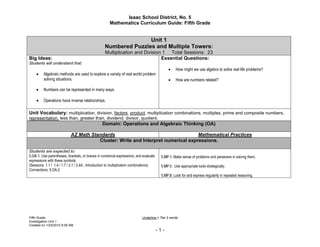
                                                                  Unit 1
                                                   Numbered Puzzles and Multiple Towers:
                                                   Multiplication and Division 1 Total Sessions: 23
Big Ideas:                                                                    Essential Questions:
Students will understand that:
                                                                                                How might we use algebra to solve real life problems?
     Algebraic methods are used to explore a variety of real world problem
       solving situations.                                                                      How are numbers related?

     Numbers can be represented in many ways.

     Operations have inverse relationships.

Unit Vocabulary: multiplication, division, factors, product, multiplication combinations, multiples, prime and composite numbers,
representation, less than, greater than, dividend, divisor, quotient,
                                                  Domain: Operations and Algebraic Thinking (OA)

                            AZ Math Standards                                     Mathematical Practices
                                       Cluster: Write and Interpret numerical expressions.

Students are expected to:
5.OA.1. Use parentheses, brackets, or braces in numerical expressions, and evaluate       5.MP.1. Make sense of problems and persevere in solving them.
expressions with these symbols.
(Sessions: 1.1 / 1.4 / 1.7 / 2.1 / 2.4A ; Introduction to multiplication combinations)    5.MP.5. Use appropriate tools strategically.
Connections: 5.OA.2
                                                                                          5.MP.8. Look for and express regularity in repeated reasoning.


Fifth Grade                                                                  Underline = Tier 2 words
Investigation Unit 1
Created on 1/23/2012 9:26 AM
                                                                                         -1-
Isaac School District, No. 5
                                                      Mathematics Curriculum Guide: Fifth Grade


Explanations and Examples
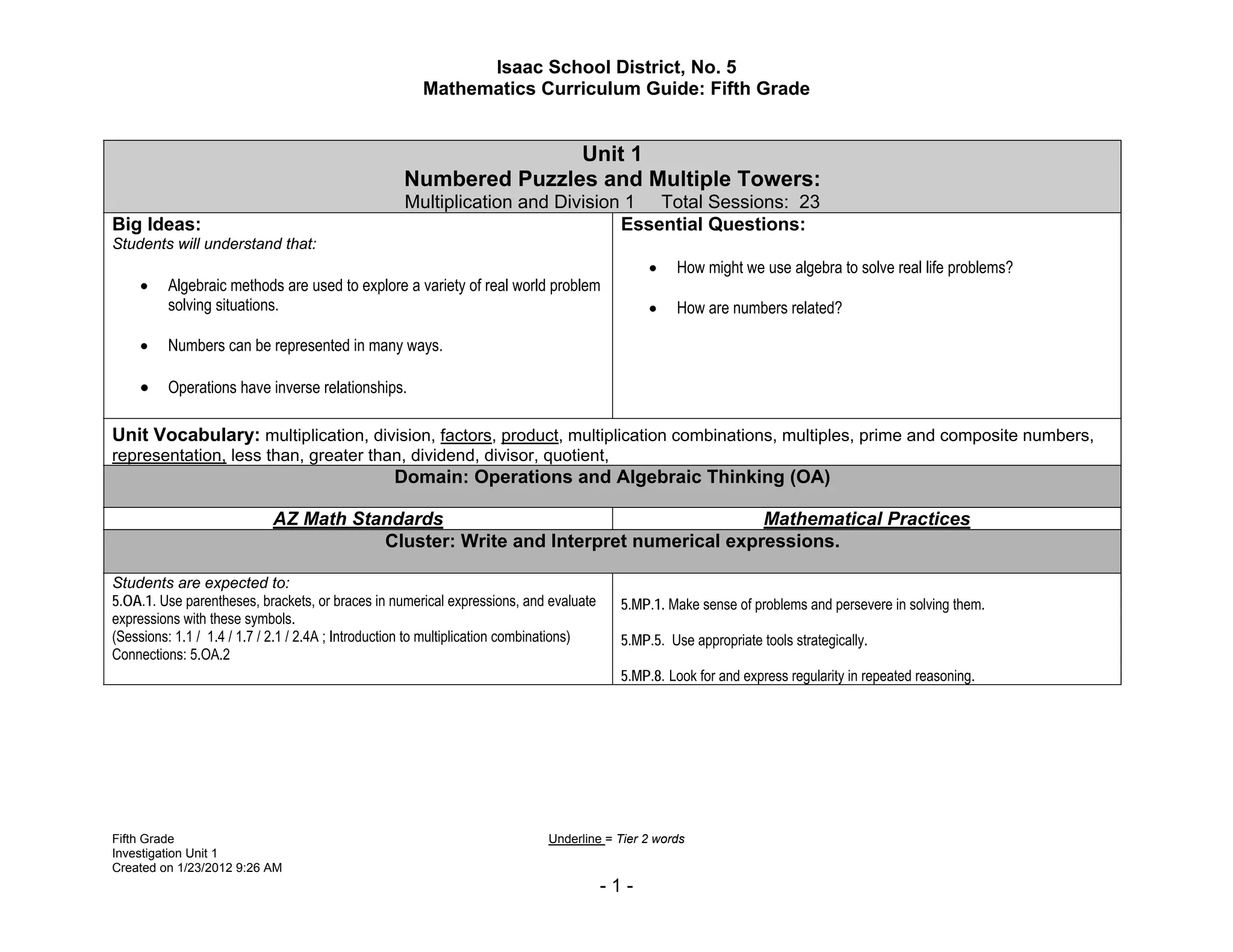
This standard builds on the expectations of third grade where students are expected to start learning the conventional order. Students need experiences with multiple
expressions that use grouping symbols throughout the year to develop understanding of when and how to use parentheses, brackets, and braces. First, students use these
symbols with whole numbers. Then the symbols can be used as students add, subtract, multiply and divide decimals and fractions.

Examples:
            (26 + 18) 4                                  Answer:   11
            {[2 x (3+5)] – 9} + [5 x (23-18)]            Answer:   32
            12 – (0.4 x 2)                               Answer:   11.2
            (2 + 3) x (1.5 – 0.5)                        Answer:   5
                 1 1                                   Answer: 5 1/6
              6  
                    2 3
            { 80 ÷ [ 2 x (3 ½ + 1 ½ ) ] }+ 100 Answer:   108

To further develop students’ understanding of grouping symbols and facility with operations, students place grouping symbols in equations to make the equations true or they
compare expressions that are grouped differently.

Examples:
     15 - 7 – 2 = 10 → 15 - (7 – 2) = 10
     3 x 125 ÷ 25 + 7 = 22 → [3 x (125 ÷ 25)] + 7 = 22
     24 ÷ 12 ÷ 6 ÷ 2 = 2 x 9 + 3 ÷ ½ → 24 ÷ [(12 ÷ 6) ÷ 2] = (2 x 9) +              (3 ÷ ½)
     Compare 3 x 2 + 5 and 3 x (2 + 5)
     Compare 15 – 6 + 7 and 15 – (6 + 7)


Fifth Grade                                                                 Underline = Tier 2 words
Investigation Unit 1
Created on 1/23/2012 9:26 AM
                                                                                     -2-
Isaac School District, No. 5
                                                        Mathematics Curriculum Guide: Fifth Grade

Students are expected to:
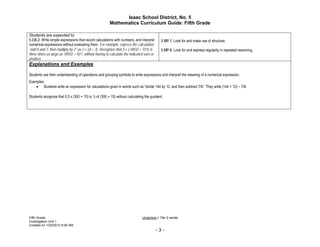
5.OA.2. Write simple expressions that record calculations with numbers, and interpret      5.MP.7. Look for and make use of structure.
numerical expressions without evaluating them. For example, express the calculation
“add 8 and 7, then multiply by 2” as 2  (8 + 7). Recognize that 3  (18932 + 921) is      5.MP.8. Look for and express regularity in repeated reasoning.
three times as large as 18932 + 921, without having to calculate the indicated sum or
product.
Explanations and Examples

Students use their understanding of operations and grouping symbols to write expressions and interpret the meaning of a numerical expression.
Examples:
     Students write an expression for calculations given in words such as “divide 144 by 12, and then subtract 7/8.” They write (144 ÷ 12) – 7/8.

Students recognize that 0.5 x (300 ÷ 15) is ½ of (300 ÷ 15) without calculating the quotient.


Fifth Grade                                                                   Underline = Tier 2 words
Investigation Unit 1
Created on 1/23/2012 9:26 AM
                                                                                        -3-
Isaac School District, No. 5
                                                      Mathematics Curriculum Guide: Fifth Grade

                                               Domain: Number and Operations in Base Ten (NBT)

                              AZ Math Standards                                   Mathematical Practices
                                            Cluster: Understand the place value system.

Students are expected to:
5.NBT.2. Explain patterns in the number of zeros of the product when multiplying a      5.MP.2. Reason abstractly and quantitatively.
number by powers of 10, and explain patterns in the placement of the decimal point
when a decimal is multiplied or divided by a power of 10. Use whole-number              5.MP.6. Attend to precision.
exponents to denote powers of 10.
Recommended Placement * Extensions Necessary
                                                                                        5.MP.7. Look for and make use of structure.
Connections: 5.NBT.1; 5.RI.3; 5.W.2b
Explanations and Examples

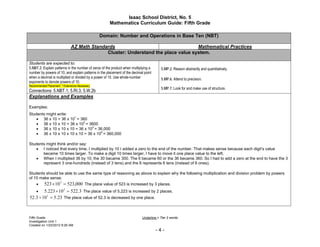
Examples:
Students might write:
     36 x 10 = 36 x 101 = 360
     36 x 10 x 10 = 36 x 102 = 3600
     36 x 10 x 10 x 10 = 36 x 103 = 36,000
     36 x 10 x 10 x 10 x 10 = 36 x 104 = 360,000

Students might think and/or say:
     I noticed that every time, I multiplied by 10 I added a zero to the end of the number. That makes sense because each digit’s value
       became 10 times larger. To make a digit 10 times larger, I have to move it one place value to the left.
     When I multiplied 36 by 10, the 30 became 300. The 6 became 60 or the 36 became 360. So I had to add a zero at the end to have the 3
       represent 3 one-hundreds (instead of 3 tens) and the 6 represents 6 tens (instead of 6 ones).

Students should be able to use the same type of reasoning as above to explain why the following multiplication and division problem by powers
of 10 make sense.
      523  10 3  523,000 The place value of 523 is increased by 3 places.
    5.223  10  522 .3 The place value of 5.223 is increased by 2 places.
                   2


52.3  101  5.23 The place value of 52.3 is decreased by one place.


Fifth Grade                                                                 Underline = Tier 2 words
Investigation Unit 1
Created on 1/23/2012 9:26 AM
                                                                                     -4-
Isaac School District, No. 5
                                                        Mathematics Curriculum Guide: Fifth Grade


                        AZ Math Standards                                    Mathematical Practices
               Cluster: Perform operations with multi-digit whole numbers and with decimals to hundredths.

Students are expected to:
5.NBT.5. Fluently multiply multi-digit whole numbers using the standard algorithm.          5.MP.2. Reason abstractly and quantitatively.

                                                                                            5.MP.6. Attend to precision.

                                                                                            5.MP.7. Look for and make use of structure.

                                                                                            5.MP.8. Look for and express regularity in repeated reasoning.
Explanations and Examples

In prior grades, students used various strategies to multiply. Students can continue to use these different strategies as long as they are efficient, but must also understand and
be able to use the standard algorithm. In applying the standard algorithm, students recognize the importance of place value.

Example:
123 x 34. When students apply the standard algorithm, they, decompose 34 into 30 + 4. Then they multiply 123 by 4, the value of the number in the ones place, and then multiply
123 by 30, the value of the 3 in the tens place, and add the two products.
Students are expected to:
5.NBT.6. Find whole-number quotients of whole numbers with up to four-digit                5.MP.2. Reason abstractly and quantitatively.
dividends and two-digit divisors, using strategies based on place value, the properties
of operations, and/or the relationship between multiplication and division. Illustrate and 5.MP.3. Construct viable arguments and critique the reasoning of others.
explain the calculation by using equations, rectangular arrays, and/or area models.
(Sessions: 3.1-3.8)                                                                        5.MP.4. Model with mathematics.
Connections: ET05-S1C2-02
                                                                                            5.MP.5. Use appropriate tools strategically.

                                                                                            5.MP.7. Look for and make use of structure.


Fifth Grade                                                                    Underline = Tier 2 words
Investigation Unit 1
Created on 1/23/2012 9:26 AM
                                                                                        -5-
Isaac School District, No. 5
                                                         Mathematics Curriculum Guide: Fifth Grade

Explanations and Examples
In fourth grade, students’ experiences with division were limited to dividing by one-digit divisors. This standard extends students’ prior experiences with strategies, illustrations,
and explanations. When the two-digit divisor is a “familiar” number, a student might decompose the dividend using place value.
Example:
      Using expanded notation ~ 2682 ÷ 25 = (2000 + 600 + 80 + 2) ÷ 25
      Using his or her understanding of the relationship between 100 and 25, a student might think ~
           o I know that 100 divided by 25 is 4 so 200 divided by 25 is 8 and 2000 divided by 25 is 80.
           o 600 divided by 25 has to be 24.
           o Since 3 x 25 is 75, I know that 80 divided by 25 is 3 with a reminder of 5. (Note that a student might divide into 82 and not 80)
           o I can’t divide 2 by 25 so 2 plus the 5 leaves a remainder of 7.
           o   80 + 24 + 3 = 107. So, the answer is 107 with a remainder of 7.
Using an equation that relates division to multiplication, 25 x n = 2682, a student might estimate the answer to be slightly larger than 100 because s/he recognizes that 25 x 100
= 2500.
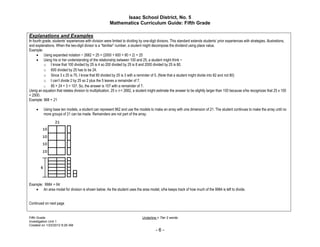
Example: 968 ÷ 21

        Using base ten models, a student can represent 962 and use the models to make an array with one dimension of 21. The student continues to make the array until no
          more groups of 21 can be made. Remainders are not part of the array.


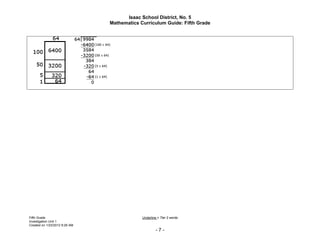
Example: 9984 ÷ 64
     An area model for division is shown below. As the student uses the area model, s/he keeps track of how much of the 9984 is left to divide.


Continued on next page


Fifth Grade                                                                     Underline = Tier 2 words
Investigation Unit 1
Created on 1/23/2012 9:26 AM
                                                                                         -6-
Isaac School District, No. 5
                               Mathematics Curriculum Guide: Fifth Grade


Fifth Grade                                 Underline = Tier 2 words
Investigation Unit 1
Created on 1/23/2012 9:26 AM
                                                     -7-

Unit 1 Fifth Grade cs 2012 2013

  • 1.
    Isaac School District,No. 5 Mathematics Curriculum Guide: Fifth Grade Unit 1 Numbered Puzzles and Multiple Towers: Multiplication and Division 1 Total Sessions: 23 Big Ideas: Essential Questions: Students will understand that:  How might we use algebra to solve real life problems?  Algebraic methods are used to explore a variety of real world problem solving situations.  How are numbers related?  Numbers can be represented in many ways.  Operations have inverse relationships. Unit Vocabulary: multiplication, division, factors, product, multiplication combinations, multiples, prime and composite numbers, representation, less than, greater than, dividend, divisor, quotient, Domain: Operations and Algebraic Thinking (OA) AZ Math Standards Mathematical Practices Cluster: Write and Interpret numerical expressions. Students are expected to: 5.OA.1. Use parentheses, brackets, or braces in numerical expressions, and evaluate 5.MP.1. Make sense of problems and persevere in solving them. expressions with these symbols. (Sessions: 1.1 / 1.4 / 1.7 / 2.1 / 2.4A ; Introduction to multiplication combinations) 5.MP.5. Use appropriate tools strategically. Connections: 5.OA.2 5.MP.8. Look for and express regularity in repeated reasoning. Fifth Grade Underline = Tier 2 words Investigation Unit 1 Created on 1/23/2012 9:26 AM -1-
  • 2.
    Isaac School District,No. 5 Mathematics Curriculum Guide: Fifth Grade Explanations and Examples This standard builds on the expectations of third grade where students are expected to start learning the conventional order. Students need experiences with multiple expressions that use grouping symbols throughout the year to develop understanding of when and how to use parentheses, brackets, and braces. First, students use these symbols with whole numbers. Then the symbols can be used as students add, subtract, multiply and divide decimals and fractions. Examples:  (26 + 18) 4 Answer: 11  {[2 x (3+5)] – 9} + [5 x (23-18)] Answer: 32  12 – (0.4 x 2) Answer: 11.2  (2 + 3) x (1.5 – 0.5) Answer: 5  1 1 Answer: 5 1/6 6    2 3  { 80 ÷ [ 2 x (3 ½ + 1 ½ ) ] }+ 100 Answer: 108 To further develop students’ understanding of grouping symbols and facility with operations, students place grouping symbols in equations to make the equations true or they compare expressions that are grouped differently. Examples:  15 - 7 – 2 = 10 → 15 - (7 – 2) = 10  3 x 125 ÷ 25 + 7 = 22 → [3 x (125 ÷ 25)] + 7 = 22  24 ÷ 12 ÷ 6 ÷ 2 = 2 x 9 + 3 ÷ ½ → 24 ÷ [(12 ÷ 6) ÷ 2] = (2 x 9) + (3 ÷ ½)  Compare 3 x 2 + 5 and 3 x (2 + 5)  Compare 15 – 6 + 7 and 15 – (6 + 7) Fifth Grade Underline = Tier 2 words Investigation Unit 1 Created on 1/23/2012 9:26 AM -2-
  • 3.
    Isaac School District,No. 5 Mathematics Curriculum Guide: Fifth Grade Students are expected to: 5.OA.2. Write simple expressions that record calculations with numbers, and interpret 5.MP.7. Look for and make use of structure. numerical expressions without evaluating them. For example, express the calculation “add 8 and 7, then multiply by 2” as 2  (8 + 7). Recognize that 3  (18932 + 921) is 5.MP.8. Look for and express regularity in repeated reasoning. three times as large as 18932 + 921, without having to calculate the indicated sum or product. Explanations and Examples Students use their understanding of operations and grouping symbols to write expressions and interpret the meaning of a numerical expression. Examples:  Students write an expression for calculations given in words such as “divide 144 by 12, and then subtract 7/8.” They write (144 ÷ 12) – 7/8. Students recognize that 0.5 x (300 ÷ 15) is ½ of (300 ÷ 15) without calculating the quotient. Fifth Grade Underline = Tier 2 words Investigation Unit 1 Created on 1/23/2012 9:26 AM -3-
  • 4.
    Isaac School District,No. 5 Mathematics Curriculum Guide: Fifth Grade Domain: Number and Operations in Base Ten (NBT) AZ Math Standards Mathematical Practices Cluster: Understand the place value system. Students are expected to: 5.NBT.2. Explain patterns in the number of zeros of the product when multiplying a 5.MP.2. Reason abstractly and quantitatively. number by powers of 10, and explain patterns in the placement of the decimal point when a decimal is multiplied or divided by a power of 10. Use whole-number 5.MP.6. Attend to precision. exponents to denote powers of 10. Recommended Placement * Extensions Necessary 5.MP.7. Look for and make use of structure. Connections: 5.NBT.1; 5.RI.3; 5.W.2b Explanations and Examples Examples: Students might write:  36 x 10 = 36 x 101 = 360  36 x 10 x 10 = 36 x 102 = 3600  36 x 10 x 10 x 10 = 36 x 103 = 36,000  36 x 10 x 10 x 10 x 10 = 36 x 104 = 360,000 Students might think and/or say:  I noticed that every time, I multiplied by 10 I added a zero to the end of the number. That makes sense because each digit’s value became 10 times larger. To make a digit 10 times larger, I have to move it one place value to the left.  When I multiplied 36 by 10, the 30 became 300. The 6 became 60 or the 36 became 360. So I had to add a zero at the end to have the 3 represent 3 one-hundreds (instead of 3 tens) and the 6 represents 6 tens (instead of 6 ones). Students should be able to use the same type of reasoning as above to explain why the following multiplication and division problem by powers of 10 make sense.  523  10 3  523,000 The place value of 523 is increased by 3 places.  5.223  10  522 .3 The place value of 5.223 is increased by 2 places. 2 52.3  101  5.23 The place value of 52.3 is decreased by one place. Fifth Grade Underline = Tier 2 words Investigation Unit 1 Created on 1/23/2012 9:26 AM -4-
  • 5.
    Isaac School District,No. 5 Mathematics Curriculum Guide: Fifth Grade AZ Math Standards Mathematical Practices Cluster: Perform operations with multi-digit whole numbers and with decimals to hundredths. Students are expected to: 5.NBT.5. Fluently multiply multi-digit whole numbers using the standard algorithm. 5.MP.2. Reason abstractly and quantitatively. 5.MP.6. Attend to precision. 5.MP.7. Look for and make use of structure. 5.MP.8. Look for and express regularity in repeated reasoning. Explanations and Examples In prior grades, students used various strategies to multiply. Students can continue to use these different strategies as long as they are efficient, but must also understand and be able to use the standard algorithm. In applying the standard algorithm, students recognize the importance of place value. Example: 123 x 34. When students apply the standard algorithm, they, decompose 34 into 30 + 4. Then they multiply 123 by 4, the value of the number in the ones place, and then multiply 123 by 30, the value of the 3 in the tens place, and add the two products. Students are expected to: 5.NBT.6. Find whole-number quotients of whole numbers with up to four-digit 5.MP.2. Reason abstractly and quantitatively. dividends and two-digit divisors, using strategies based on place value, the properties of operations, and/or the relationship between multiplication and division. Illustrate and 5.MP.3. Construct viable arguments and critique the reasoning of others. explain the calculation by using equations, rectangular arrays, and/or area models. (Sessions: 3.1-3.8) 5.MP.4. Model with mathematics. Connections: ET05-S1C2-02 5.MP.5. Use appropriate tools strategically. 5.MP.7. Look for and make use of structure. Fifth Grade Underline = Tier 2 words Investigation Unit 1 Created on 1/23/2012 9:26 AM -5-
  • 6.
    Isaac School District,No. 5 Mathematics Curriculum Guide: Fifth Grade Explanations and Examples In fourth grade, students’ experiences with division were limited to dividing by one-digit divisors. This standard extends students’ prior experiences with strategies, illustrations, and explanations. When the two-digit divisor is a “familiar” number, a student might decompose the dividend using place value. Example:  Using expanded notation ~ 2682 ÷ 25 = (2000 + 600 + 80 + 2) ÷ 25  Using his or her understanding of the relationship between 100 and 25, a student might think ~ o I know that 100 divided by 25 is 4 so 200 divided by 25 is 8 and 2000 divided by 25 is 80. o 600 divided by 25 has to be 24. o Since 3 x 25 is 75, I know that 80 divided by 25 is 3 with a reminder of 5. (Note that a student might divide into 82 and not 80) o I can’t divide 2 by 25 so 2 plus the 5 leaves a remainder of 7. o 80 + 24 + 3 = 107. So, the answer is 107 with a remainder of 7. Using an equation that relates division to multiplication, 25 x n = 2682, a student might estimate the answer to be slightly larger than 100 because s/he recognizes that 25 x 100 = 2500. Example: 968 ÷ 21  Using base ten models, a student can represent 962 and use the models to make an array with one dimension of 21. The student continues to make the array until no more groups of 21 can be made. Remainders are not part of the array. Example: 9984 ÷ 64  An area model for division is shown below. As the student uses the area model, s/he keeps track of how much of the 9984 is left to divide. Continued on next page Fifth Grade Underline = Tier 2 words Investigation Unit 1 Created on 1/23/2012 9:26 AM -6-
  • 7.
    Isaac School District,No. 5 Mathematics Curriculum Guide: Fifth Grade Fifth Grade Underline = Tier 2 words Investigation Unit 1 Created on 1/23/2012 9:26 AM -7-