• 1. GED Practice (Writing Decimals as
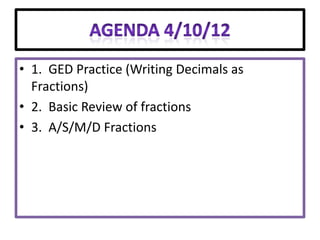
  Fractions)
• 2. Basic Review of fractions
• 3. A/S/M/D Fractions
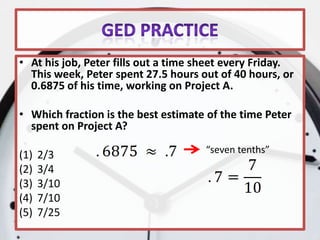
• At his job, Peter fills out a time sheet every Friday.
  This week, Peter spent 27.5 hours out of 40 hours, or
  0.6875 of his time, working on Project A.

• Which fraction is the best estimate of the time Peter
  spent on Project A?
                                      “seven tenths”
(1)   2/3
(2)   3/4
(3)   3/10
(4)   7/10
(5)   7/25
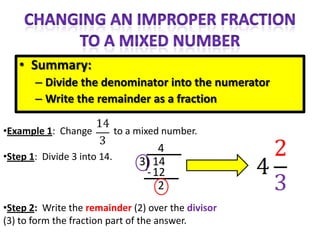
• Summary:
       – Divide the denominator into the numerator
       – Write the remainder as a fraction

•Example 1: Change           to a mixed number.
                                      4
•Step 1: Divide 3 into 14.
                                  3) 14
                                   - 12
                                      2
•Step 2: Write the remainder (2) over the divisor
(3) to form the fraction part of the answer.
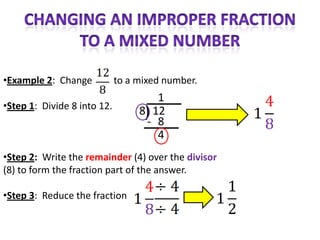
•Example 2: Change           to a mixed number.
                                      1
•Step 1: Divide 8 into 12.
                                  8) 12
                                   - 8
                                      4
•Step 2: Write the remainder (4) over the divisor
(8) to form the fraction part of the answer.

•Step 3: Reduce the fraction
• Summary:
       – Multiply the whole number by the denominator
       – Add to the numerator
       – Place over the current denominator

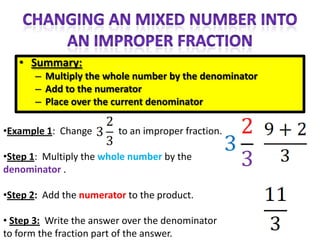
•Example 1: Change       to an improper fraction.

•Step 1: Multiply the whole number by the
denominator .

•Step 2: Add the numerator to the product.

• Step 3: Write the answer over the denominator
to form the fraction part of the answer.
• Summary: Reducing changes the numbers in
   a fraction, but it does not change the VALUE
   of a fraction.

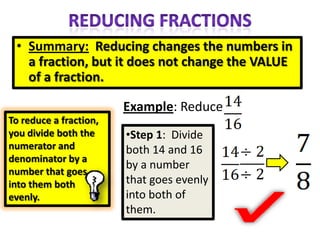
                        Example: Reduce
To reduce a fraction,
you divide both the     •Step 1: Divide
numerator and           both 14 and 16
denominator by a
                        by a number
number that goes
into them both          that goes evenly
evenly.                 into both of
                        them.
• You will need to know how to set up fractions
    and reduce them.

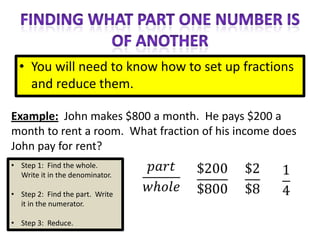
Example: John makes $800 a month. He pays $200 a
month to rent a room. What fraction of his income does
John pay for rent?
• Step 1: Find the whole.
  Write it in the denominator.

• Step 2: Find the part. Write
  it in the numerator.

• Step 3: Reduce.
• Summary: Reducing changes the numbers in
   a fraction, but it does not change the VALUE
   of a fraction.
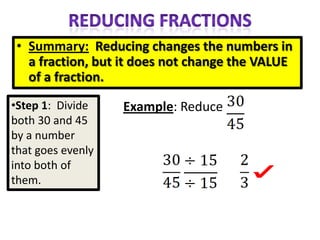
•Step 1: Divide    Example: Reduce
both 30 and 45
by a number
that goes evenly
into both of
them.
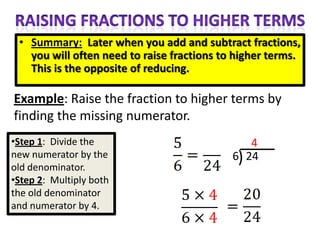
• Summary: Later when you add and subtract fractions,
   you will often need to raise fractions to higher terms.
   This is the opposite of reducing.

Example: Raise the fraction to higher terms by
finding the missing numerator.
•Step 1: Divide the                             4
new numerator by the                        6) 24
old denominator.
•Step 2: Multiply both
the old denominator
and numerator by 4.
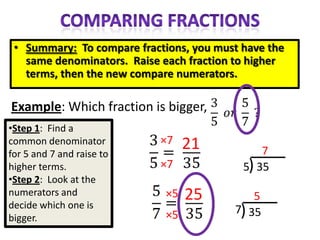
• Summary: To compare fractions, you must have the
   same denominators. Raise each fraction to higher
   terms, then the new compare numerators.

Example: Which fraction is bigger,
•Step 1: Find a
common denominator          ×7    21
for 5 and 7 and raise to                       7
higher terms.               ×7             5) 35
•Step 2: Look at the
numerators and
decide which one is
                             ×5   25         5
                             ×5          7) 35
bigger.
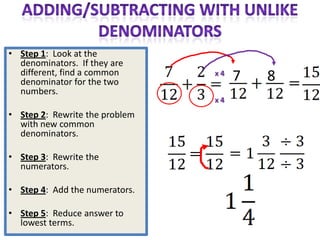
• Step 1: Look at the
  denominators. If they are
  different, find a common
  denominator for the two
                                x4
                                     7   8
  numbers.
                                x4
• Step 2: Rewrite the problem
  with new common
  denominators.

• Step 3: Rewrite the
  numerators.

• Step 4: Add the numerators.

• Step 5: Reduce answer to
  lowest terms.
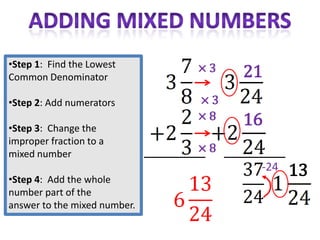
•Step 1: Find the Lowest      ×3
Common Denominator                 21
•Step 2: Add numerators       ×3
                              ×8   16
•Step 3: Change the
improper fraction to a
mixed number                  ×8

•Step 4: Add the whole
                                    -24   13
number part of the
answer to the mixed number.
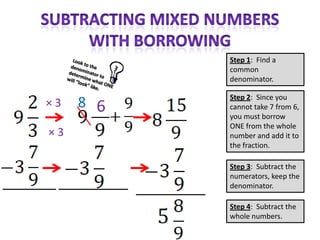
Step 1: Find a
           common
           denominator.

           Step 2: Since you
×3   8 6   cannot take 7 from 6,
           you must borrow
           ONE from the whole
×3         number and add it to
           the fraction.

           Step 3: Subtract the
           numerators, keep the
           denominator.

           Step 4: Subtract the
           whole numbers.
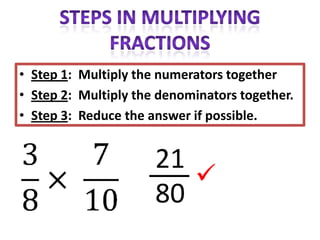
• Step 1: Multiply the numerators together
• Step 2: Multiply the denominators together.
• Step 3: Reduce the answer if possible.


                      21
                         
                      80
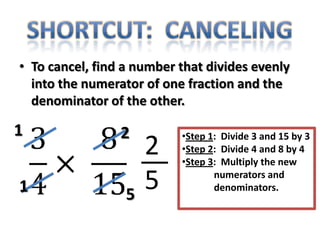
• To cancel, find a number that divides evenly
  into the numerator of one fraction and the
  denominator of the other.

1                2         •Step 1: Divide 3 and 15 by 3
                      2    •Step 2: Divide 4 and 8 by 4
                           •Step 3: Multiply the new

1                 5
                      5           numerators and
                                  denominators.
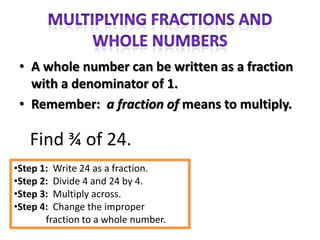
• A whole number can be written as a fraction
   with a denominator of 1.
 • Remember: a fraction of means to multiply.

   Find ¾ of 24.
•Step 1: Write 24 as a fraction.
•Step 2: Divide 4 and 24 by 4.
•Step 3: Multiply across.
•Step 4: Change the improper
       fraction to a whole number.
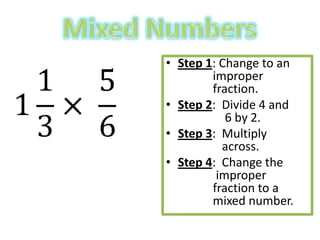
• Step 1: Change to an
        improper
        fraction.
• Step 2: Divide 4 and
           6 by 2.
• Step 3: Multiply
          across.
• Step 4: Change the
         improper
        fraction to a
        mixed number.
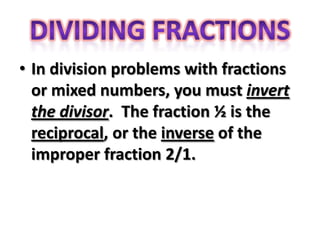
• In division problems with fractions
  or mixed numbers, you must invert
  the divisor. The fraction ½ is the
  reciprocal, or the inverse of the
  improper fraction 2/1.
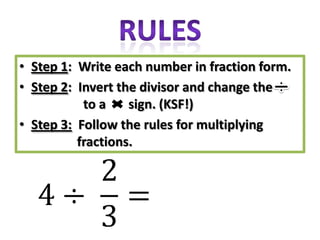
• Step 1: Write each number in fraction form.
• Step 2: Invert the divisor and change the
           to a    sign. (KSF!)
• Step 3: Follow the rules for multiplying
          fractions.
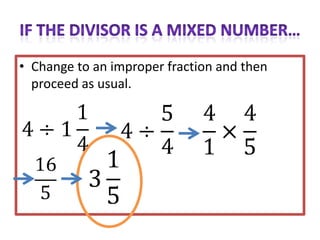
• Change to an improper fraction and then
  proceed as usual.

8:00 GED Math Week 1 Tue

  • 1.
    • 1. GEDPractice (Writing Decimals as Fractions) • 2. Basic Review of fractions • 3. A/S/M/D Fractions
  • 2.
    • At hisjob, Peter fills out a time sheet every Friday. This week, Peter spent 27.5 hours out of 40 hours, or 0.6875 of his time, working on Project A. • Which fraction is the best estimate of the time Peter spent on Project A? “seven tenths” (1) 2/3 (2) 3/4 (3) 3/10 (4) 7/10 (5) 7/25
  • 3.
    • Summary: – Divide the denominator into the numerator – Write the remainder as a fraction •Example 1: Change to a mixed number. 4 •Step 1: Divide 3 into 14. 3) 14 - 12 2 •Step 2: Write the remainder (2) over the divisor (3) to form the fraction part of the answer.
  • 4.
    •Example 2: Change to a mixed number. 1 •Step 1: Divide 8 into 12. 8) 12 - 8 4 •Step 2: Write the remainder (4) over the divisor (8) to form the fraction part of the answer. •Step 3: Reduce the fraction
  • 5.
    • Summary: – Multiply the whole number by the denominator – Add to the numerator – Place over the current denominator •Example 1: Change to an improper fraction. •Step 1: Multiply the whole number by the denominator . •Step 2: Add the numerator to the product. • Step 3: Write the answer over the denominator to form the fraction part of the answer.
  • 6.
    • Summary: Reducingchanges the numbers in a fraction, but it does not change the VALUE of a fraction. Example: Reduce To reduce a fraction, you divide both the •Step 1: Divide numerator and both 14 and 16 denominator by a by a number number that goes into them both that goes evenly evenly. into both of them.
  • 7.
    • You willneed to know how to set up fractions and reduce them. Example: John makes $800 a month. He pays $200 a month to rent a room. What fraction of his income does John pay for rent? • Step 1: Find the whole. Write it in the denominator. • Step 2: Find the part. Write it in the numerator. • Step 3: Reduce.
  • 8.
    • Summary: Reducingchanges the numbers in a fraction, but it does not change the VALUE of a fraction. •Step 1: Divide Example: Reduce both 30 and 45 by a number that goes evenly into both of them.
  • 9.
    • Summary: Laterwhen you add and subtract fractions, you will often need to raise fractions to higher terms. This is the opposite of reducing. Example: Raise the fraction to higher terms by finding the missing numerator. •Step 1: Divide the 4 new numerator by the 6) 24 old denominator. •Step 2: Multiply both the old denominator and numerator by 4.
  • 10.
    • Summary: Tocompare fractions, you must have the same denominators. Raise each fraction to higher terms, then the new compare numerators. Example: Which fraction is bigger, •Step 1: Find a common denominator ×7 21 for 5 and 7 and raise to 7 higher terms. ×7 5) 35 •Step 2: Look at the numerators and decide which one is ×5 25 5 ×5 7) 35 bigger.
  • 11.
    • Step 1:Look at the denominators. If they are different, find a common denominator for the two x4 7 8 numbers. x4 • Step 2: Rewrite the problem with new common denominators. • Step 3: Rewrite the numerators. • Step 4: Add the numerators. • Step 5: Reduce answer to lowest terms.
  • 12.
    •Step 1: Findthe Lowest ×3 Common Denominator 21 •Step 2: Add numerators ×3 ×8 16 •Step 3: Change the improper fraction to a mixed number ×8 •Step 4: Add the whole -24 13 number part of the answer to the mixed number.
  • 13.
    Step 1: Finda common denominator. Step 2: Since you ×3 8 6 cannot take 7 from 6, you must borrow ONE from the whole ×3 number and add it to the fraction. Step 3: Subtract the numerators, keep the denominator. Step 4: Subtract the whole numbers.
  • 14.
    • Step 1:Multiply the numerators together • Step 2: Multiply the denominators together. • Step 3: Reduce the answer if possible. 21  80
  • 15.
    • To cancel,find a number that divides evenly into the numerator of one fraction and the denominator of the other. 1 2 •Step 1: Divide 3 and 15 by 3 2 •Step 2: Divide 4 and 8 by 4 •Step 3: Multiply the new 1 5 5 numerators and denominators.
  • 16.
    • A wholenumber can be written as a fraction with a denominator of 1. • Remember: a fraction of means to multiply. Find ¾ of 24. •Step 1: Write 24 as a fraction. •Step 2: Divide 4 and 24 by 4. •Step 3: Multiply across. •Step 4: Change the improper fraction to a whole number.
  • 17.
    • Step 1:Change to an improper fraction. • Step 2: Divide 4 and 6 by 2. • Step 3: Multiply across. • Step 4: Change the improper fraction to a mixed number.
  • 18.
    • In divisionproblems with fractions or mixed numbers, you must invert the divisor. The fraction ½ is the reciprocal, or the inverse of the improper fraction 2/1.
  • 19.
    • Step 1:Write each number in fraction form. • Step 2: Invert the divisor and change the to a sign. (KSF!) • Step 3: Follow the rules for multiplying fractions.
  • 20.
    • Change toan improper fraction and then proceed as usual.