5th
     Grade
 Fractions &
Word Problems

      Laura Chambless
     RESA Consultant
www.protopage.com/lchambless
CCSS and Gaps
  What are your gaps in curriculum?
1. Review CCSS for Fractions
2. Think about your resources
3. Think about your teaching
  – Highlight anything your resources
    covers well in YELLOW.
  – Highlight any part of the standard you
    would like more clarification on in
    BLUE.
Learning Target

Use equivalent fractions as a strategy to
  add and subtract fractions.
                   5.NF.1, 5.NF.2


Apply and extend previous understandings
  of multiplication and division to multiply
  and divide fractions.
        5.NF.3, 5.NF.4, 5.NF.5, 5.NF.6, 5.NF.7
Fraction Word Problem
40 students joined the soccer club.
  5/8 of the students were boys.
  How many girls joined the soccer
  club?
      Draw a picture and solve it.
1. 2 min. working problem on own
2. 5 min. sharing with group
3. Class discussion
Found at: http://www.mathplayground.com/wpdatabase/Fractions1_3.htm
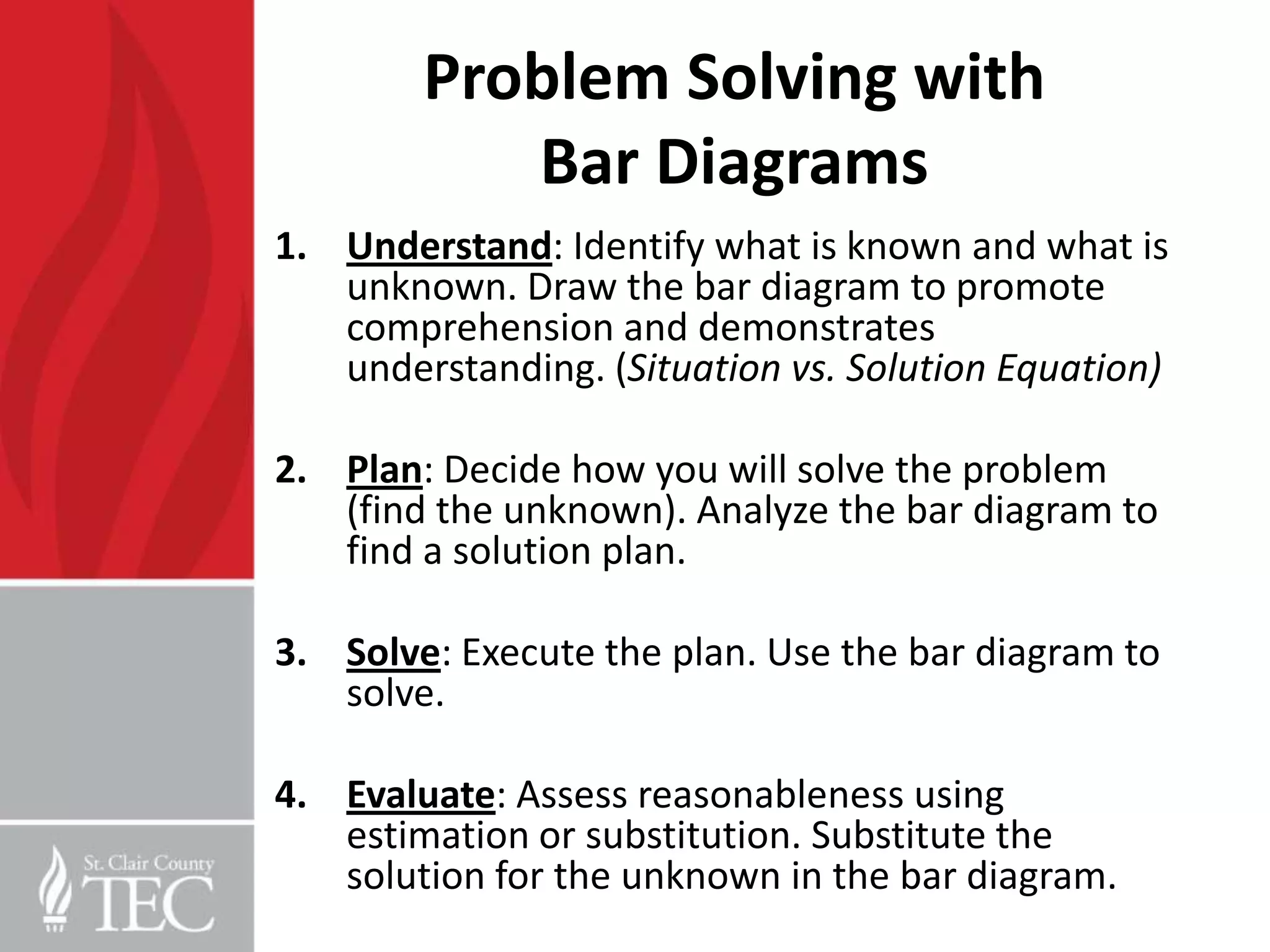
Problem Solving with
           Bar Diagrams
1. Understand: Identify what is known and what is
   unknown. Draw the bar diagram to promote
   comprehension and demonstrates
   understanding. (Situation vs. Solution Equation)

2. Plan: Decide how you will solve the problem
   (find the unknown). Analyze the bar diagram to
   find a solution plan.

3. Solve: Execute the plan. Use the bar diagram to
   solve.

4. Evaluate: Assess reasonableness using
   estimation or substitution. Substitute the
   solution for the unknown in the bar diagram.
Bar Diagrams
Watch Introduction Video
http://www.mhschool.com/math/com
   mon/pd_video/mathconnects_bardi
   agram_p1/index.html
http://www.mhschool.com/math/com
   mon/pd_video/mathconnects_bardi
   agram_p2/index.html
Practice Bar Diagrams
To: Rani earned $128 mowing lawns and $73
  babysitting. How much money did Rani earn?

With: Jin had $67 in his pocket after he bought a
  radio controlled car. He went to the store with
  $142. How Much did Jin spend on the car?

By: There are 9 puffy stickers. There are 3 times
  as many plain stickers as puffy stickers. How
  many plain stickers are there?

You pick 2 more to do by yourself. Share with
  partner
Draw Your Way to Problem Solving Success Handout, Robyn Silbey
Thinking Blocks
http://www.mathplayground.com/think
  ingblocks.html

         Explore the site 

 When done exploring go to my
 Protopage and look at your grade
 level math tab.
Fractions


            Stand and Share
Make a list of what you know and any
 connections you have about the
 fraction ¼.
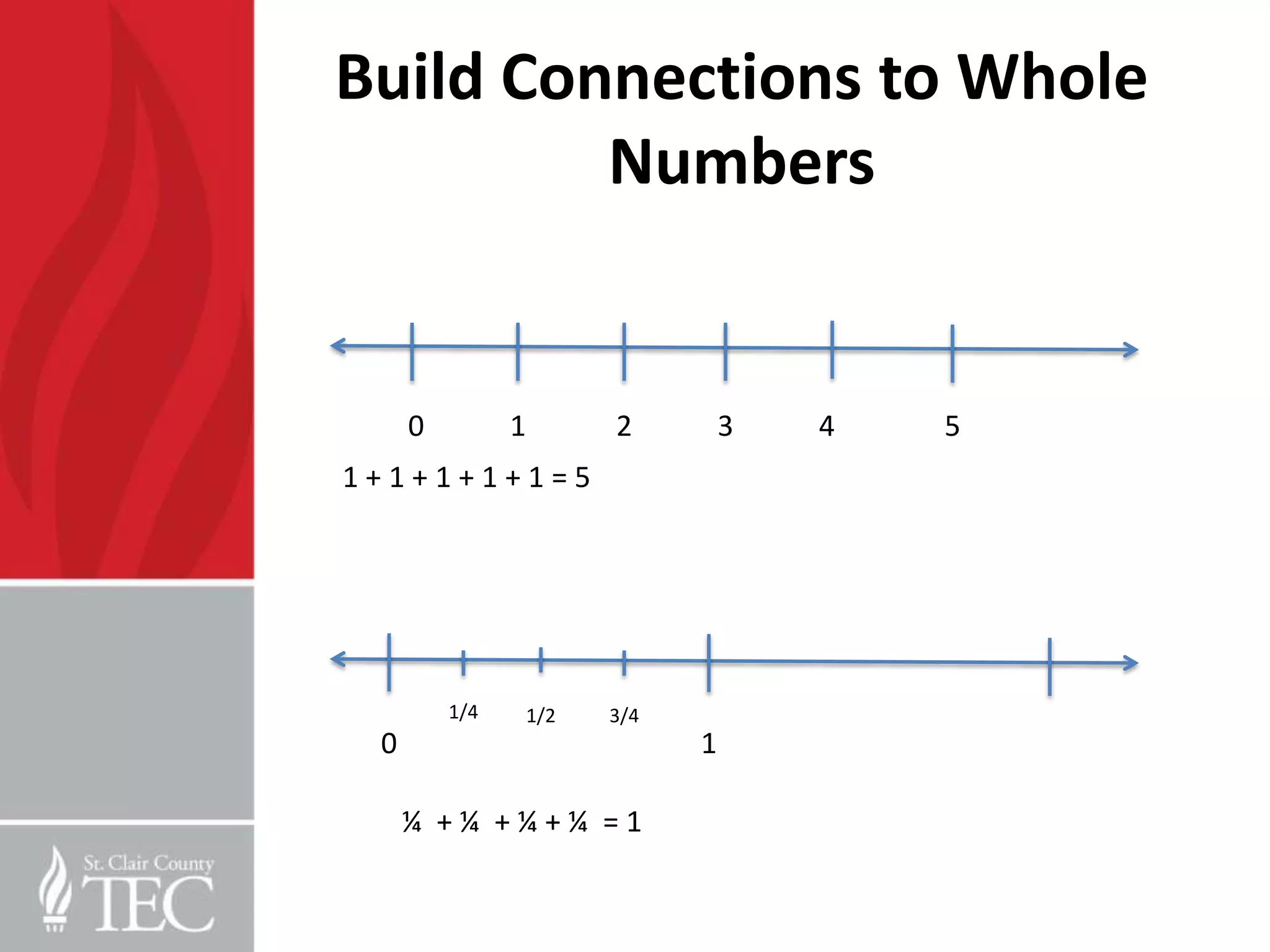
Build Connections to Whole
         Numbers


     0         1         2         3   4   5
1+1+1+1+1=5


         1/4       1/2   3/4
 0                             1

     ¼ +¼ +¼+¼ =1
Fractions
                    Fraction Activity
Paper Strips Fraction Kit:
       1, ½, 1/4 , 1/8, 1/16

Add to Fraction Kit: 1/3, 1/6, 1/12

Add to Fraction Kit: 1/5, 1/10

 Compare/Add/Subtract/Multi./Divide with Strips
                   READ and DO:
  5.NF.1, 5.NF.2, 5.NF.3, 5.NF.4, 5.NF.5, 5.NF.6, 5.NF
                           .7

Smaller Answer Wins (need dice)
• Prove with Fraction Strips
Lunch
Definition of Fractions
1. Make a list of what you would like
   to have in a definition of a fraction

2. Partner up and compare lists

3. Group discussion
Definition of a Fraction
Create a working definition of a fraction

  – Watch Dev-TEAM video 3:5 and 3:6
  – Give article: Definitions and Defining in
    Mathematics and Mathematics Teaching
    by: Bass and Ball
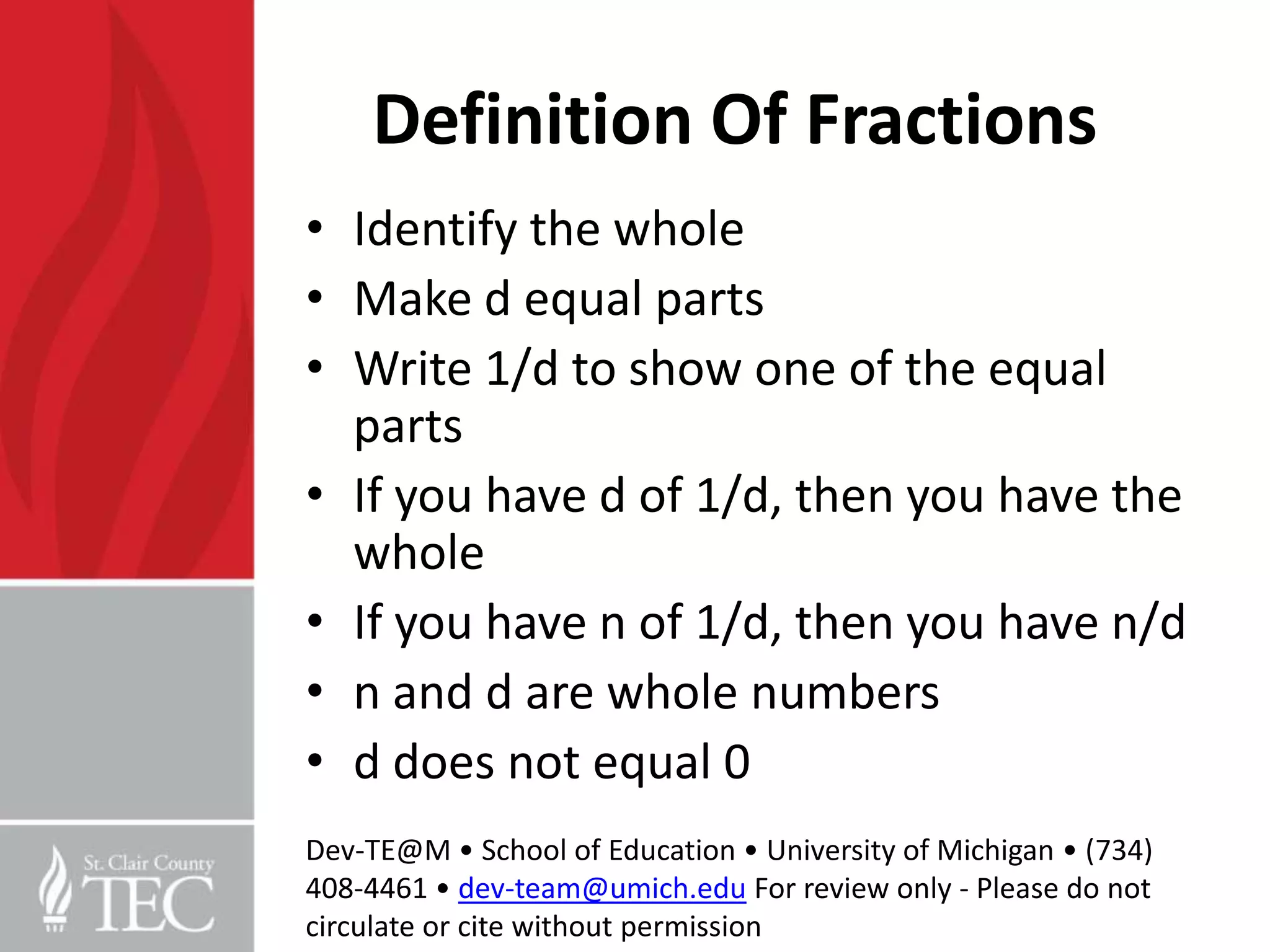
Definition Of Fractions
• Identify the whole
• Make d equal parts
• Write 1/d to show one of the equal
  parts
• If you have d of 1/d, then you have the
  whole
• If you have n of 1/d, then you have n/d
• n and d are whole numbers
• d does not equal 0
Dev-TE@M • School of Education • University of Michigan • (734)
408-4461 • dev-team@umich.edu For review only - Please do not
circulate or cite without permission
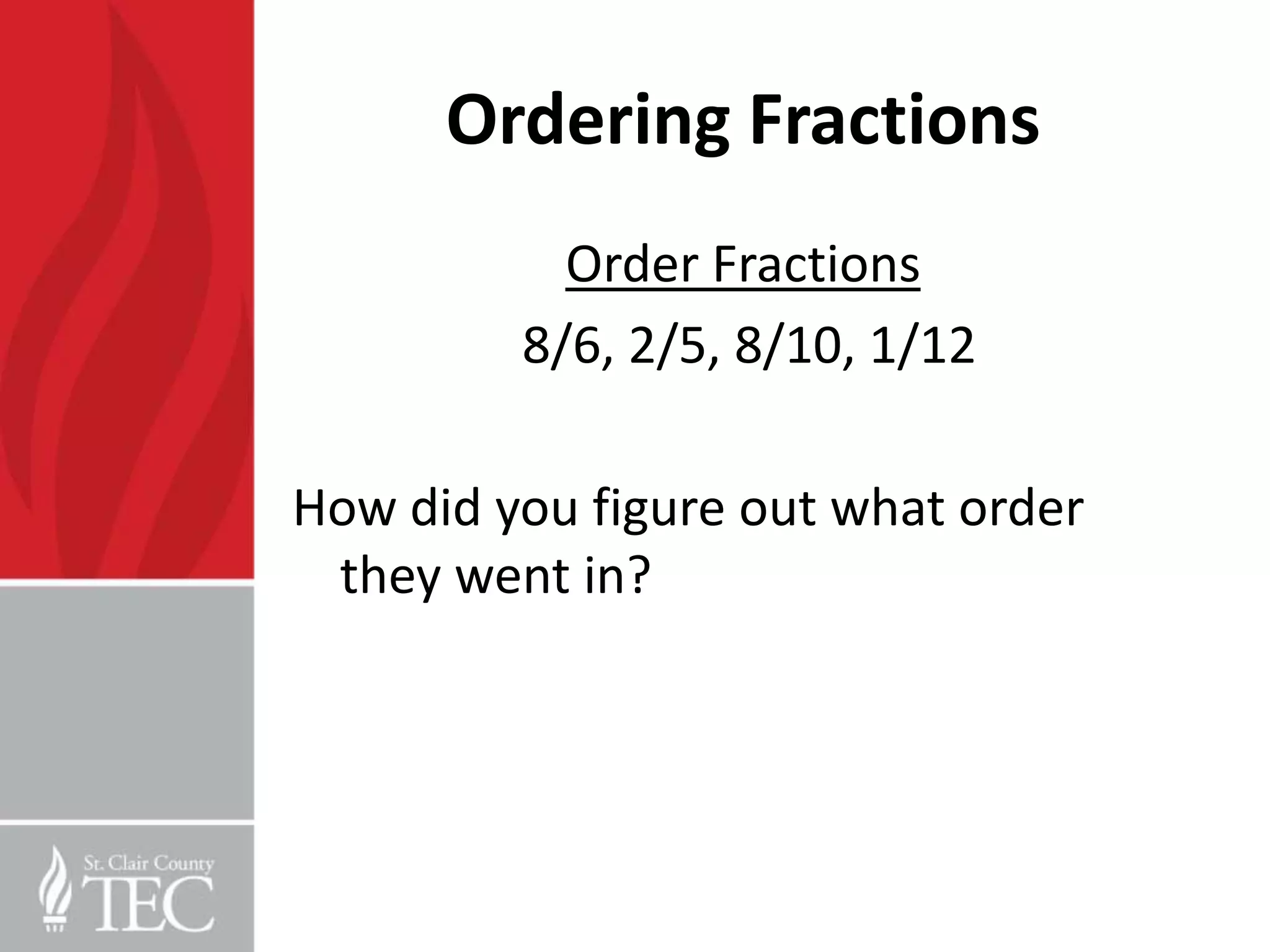
Ordering Fractions
           Order Fractions
         8/6, 2/5, 8/10, 1/12

How did you figure out what order
 they went in?
Fractions
        Prove with Fraction Strips

Number Line: (Benchmarks) 0, ½, 1

Equivalent Fractions: Same Name Frame

Compare (>/<): same numerator or same
  denominator
Strategies for Comparing
           Fractions
• Dev-TE@M session 9
Fraction On A Number Line
Writing about Fractions:
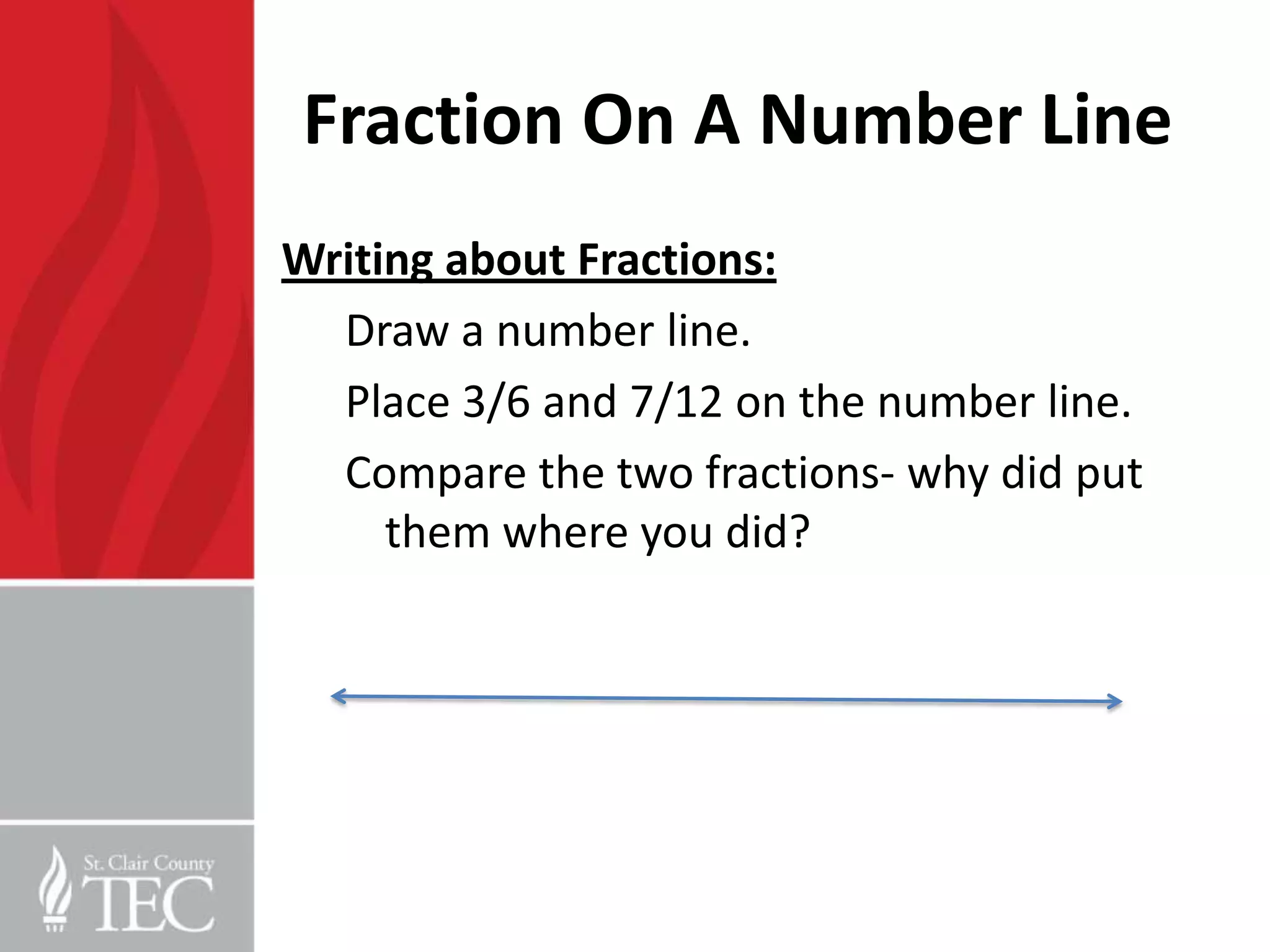
  Draw a number line.
  Place 3/6 and 7/12 on the number line.
  Compare the two fractions- why did put
     them where you did?
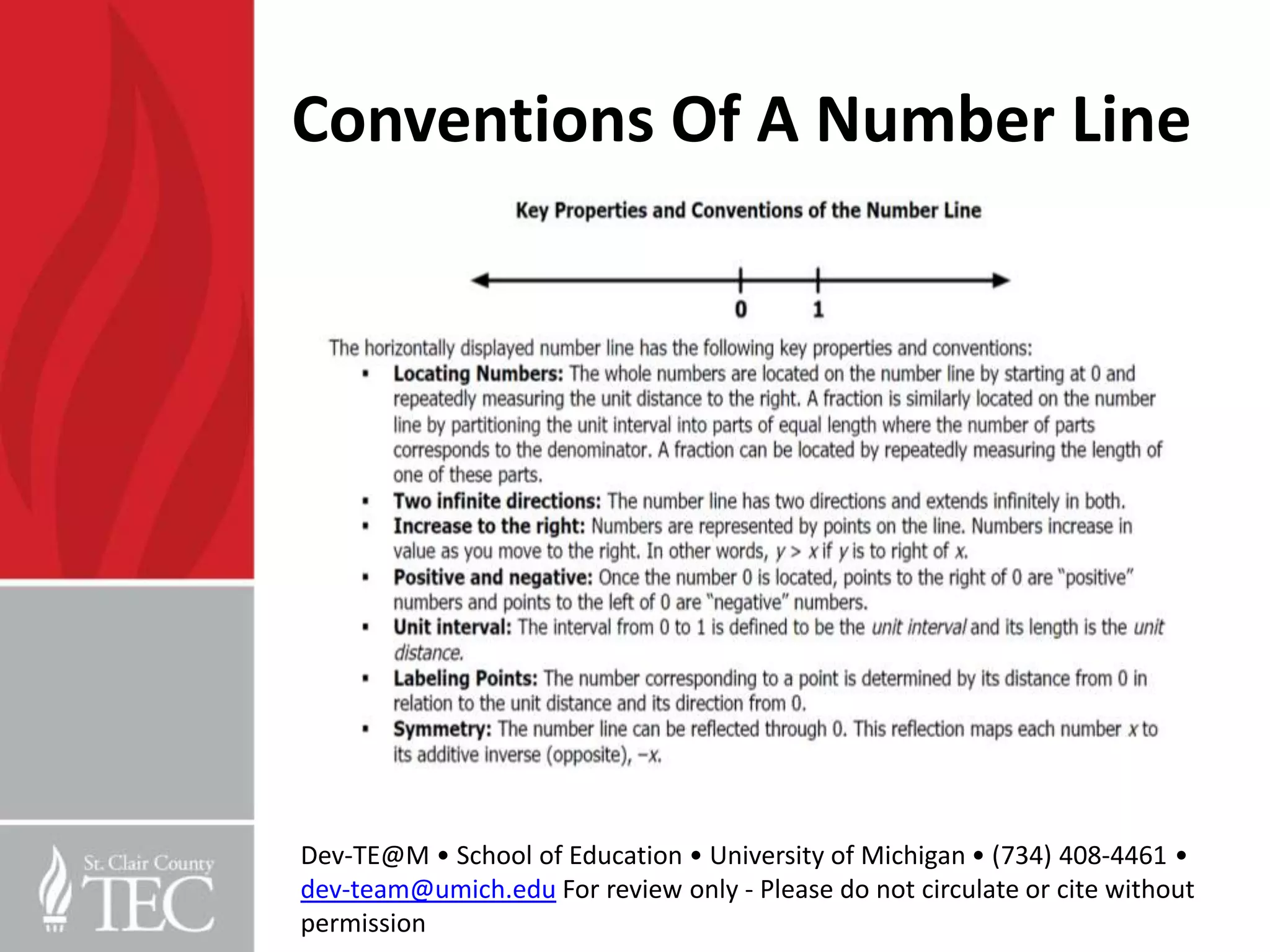
Conventions Of A Number Line


Dev-TE@M • School of Education • University of Michigan • (734) 408-4461 •
dev-team@umich.edu For review only - Please do not circulate or cite without
permission
Model of Number Line Talk
• Watch Dev-TE@M Session 4:5 (video)
Talking Through A Number Line
1. Understand the problem.

2. Think about which representation you
   are going to use.

3. Describe your thinking process while
   constructing the number line.

4. Sum up the solution that proved your
   answer.

Model Example: 3/10 & 6/8
Fraction On A Number Line
Using a number line, compare 5/6 and
  3/8 and tell which one is greater .
  Have a partner listen to you as you
  construct the fractions and find the
  answer.
Fractions

What conceptual understanding do students need?

   1.   Begin with simple contextual tasks.
   2.   Connect the meaning of fraction computation with
        whole number computation.
   3.   Let estimation and informal methods play a big role in
        the development of strategies.
   4.   Explore each of the operations using models.


Van De Walle Book: Number Sense and Fraction
  Algorithms Pg. 310
Equivalence with Fraction
            Strips
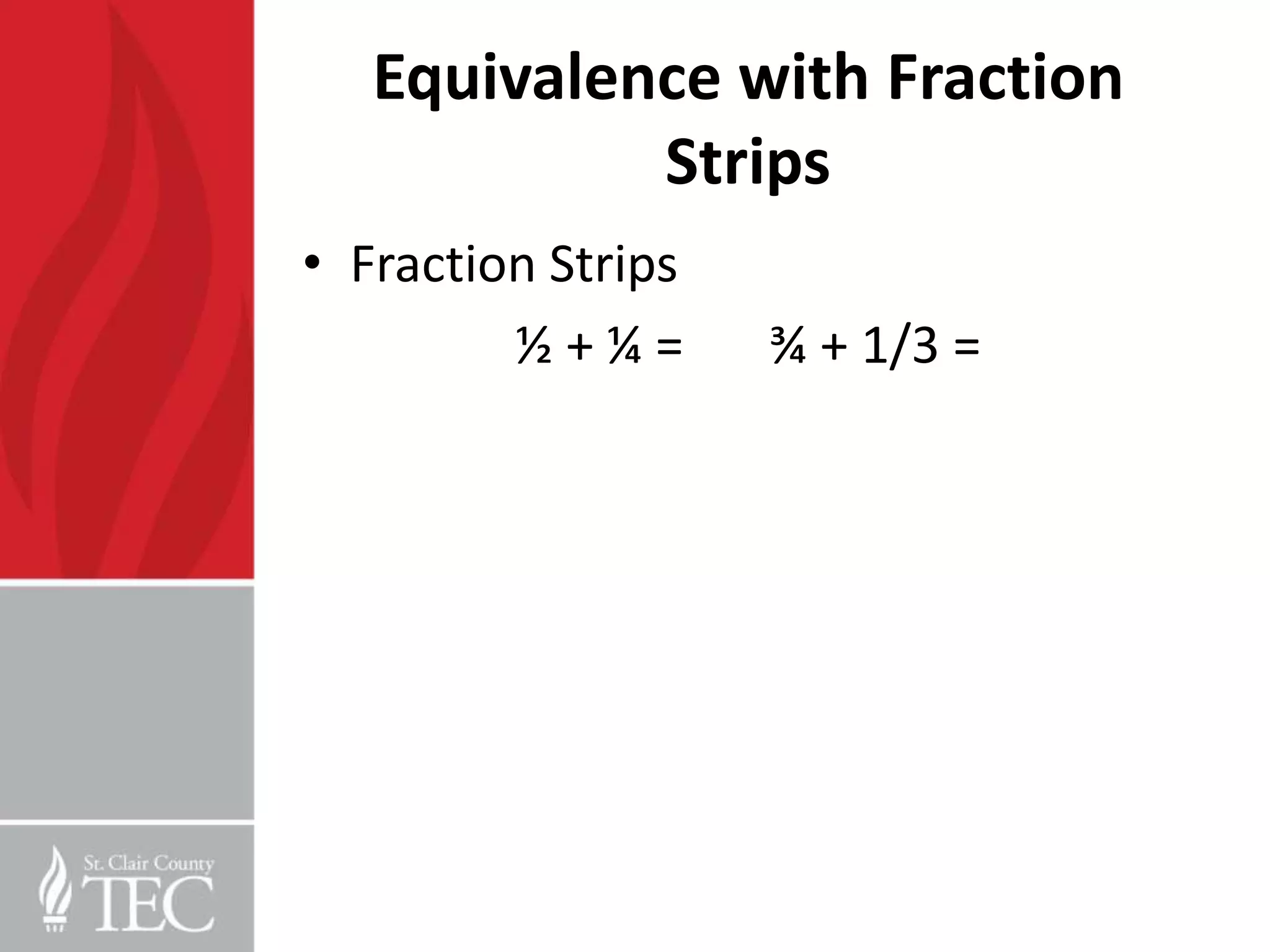
• Fraction Strips
         ½+¼=       ¾ + 1/3 =
Methods for Generating and
Explaining Equivalent Fractions
• Dev-TE@M session 9
Add/Subtract Fractions with
    Unlike Denominators
    Developing Equivalent Fractions
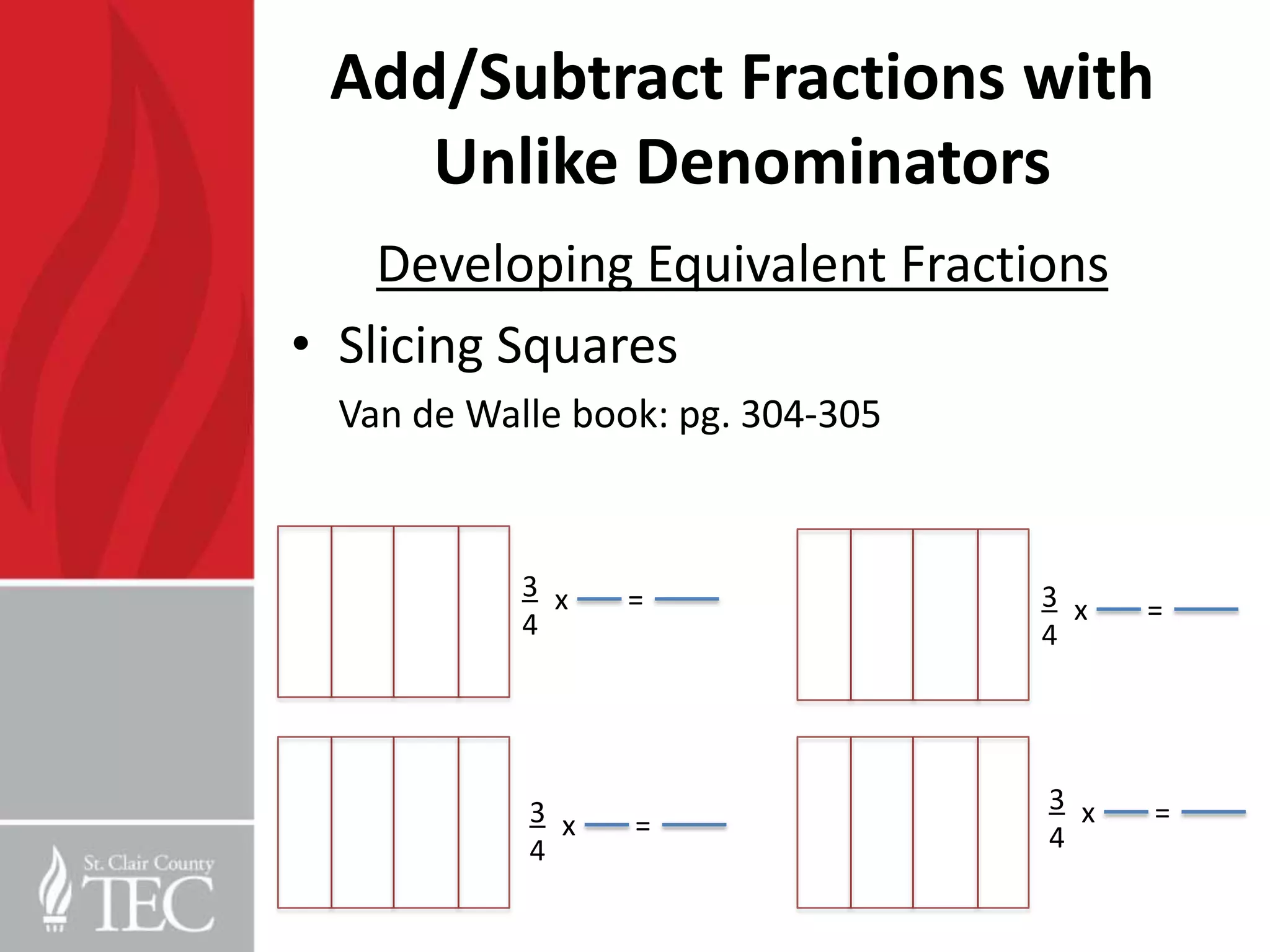
• Slicing Squares
  Van de Walle book: pg. 304-305


            3 x   =                3 x
            4                            =
                                   4


            3 x                    3 x   =
                  =                4
            4
Add/Subtract Fractions with
    Unlike Denominators
   Developing Equivalent Fractions
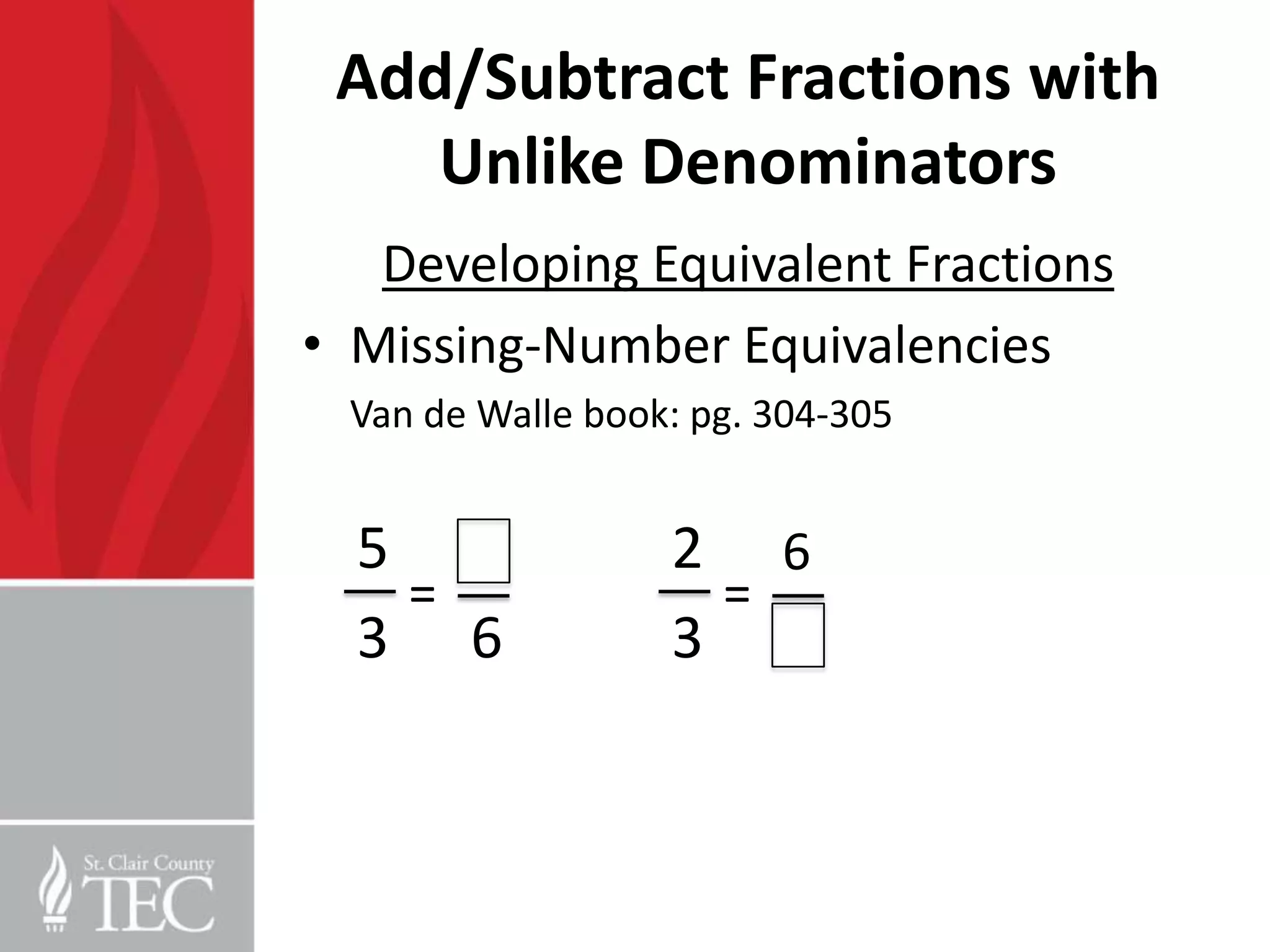
• Missing-Number Equivalencies
 Van de Walle book: pg. 304-305


  5               2 6
    =               =
  3 6             3
Fraction Multiplication
            Strategies
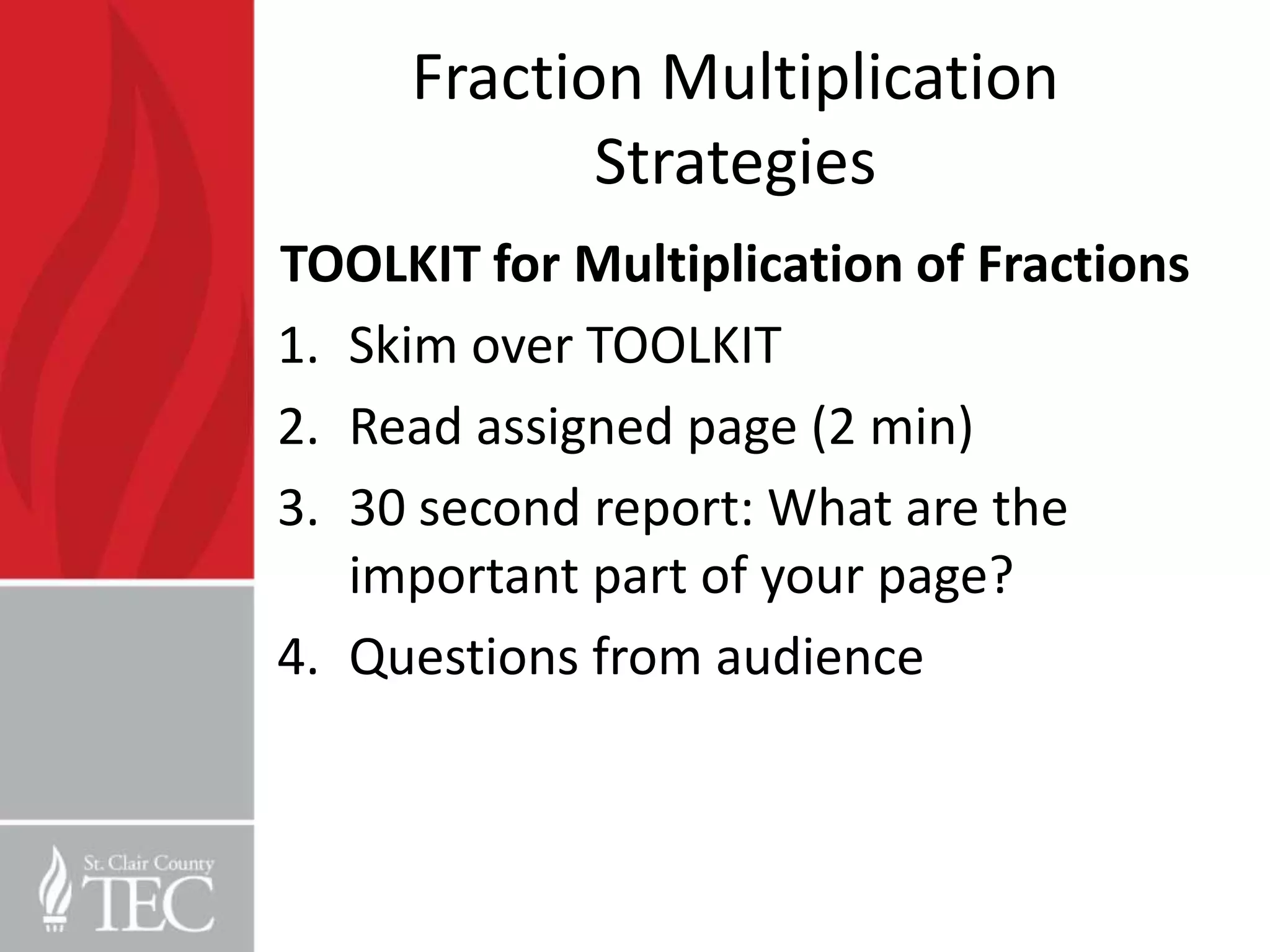
TOOLKIT for Multiplication of Fractions
1. Skim over TOOLKIT
2. Read assigned page (2 min)
3. 30 second report: What are the
   important part of your page?
4. Questions from audience
Fractions
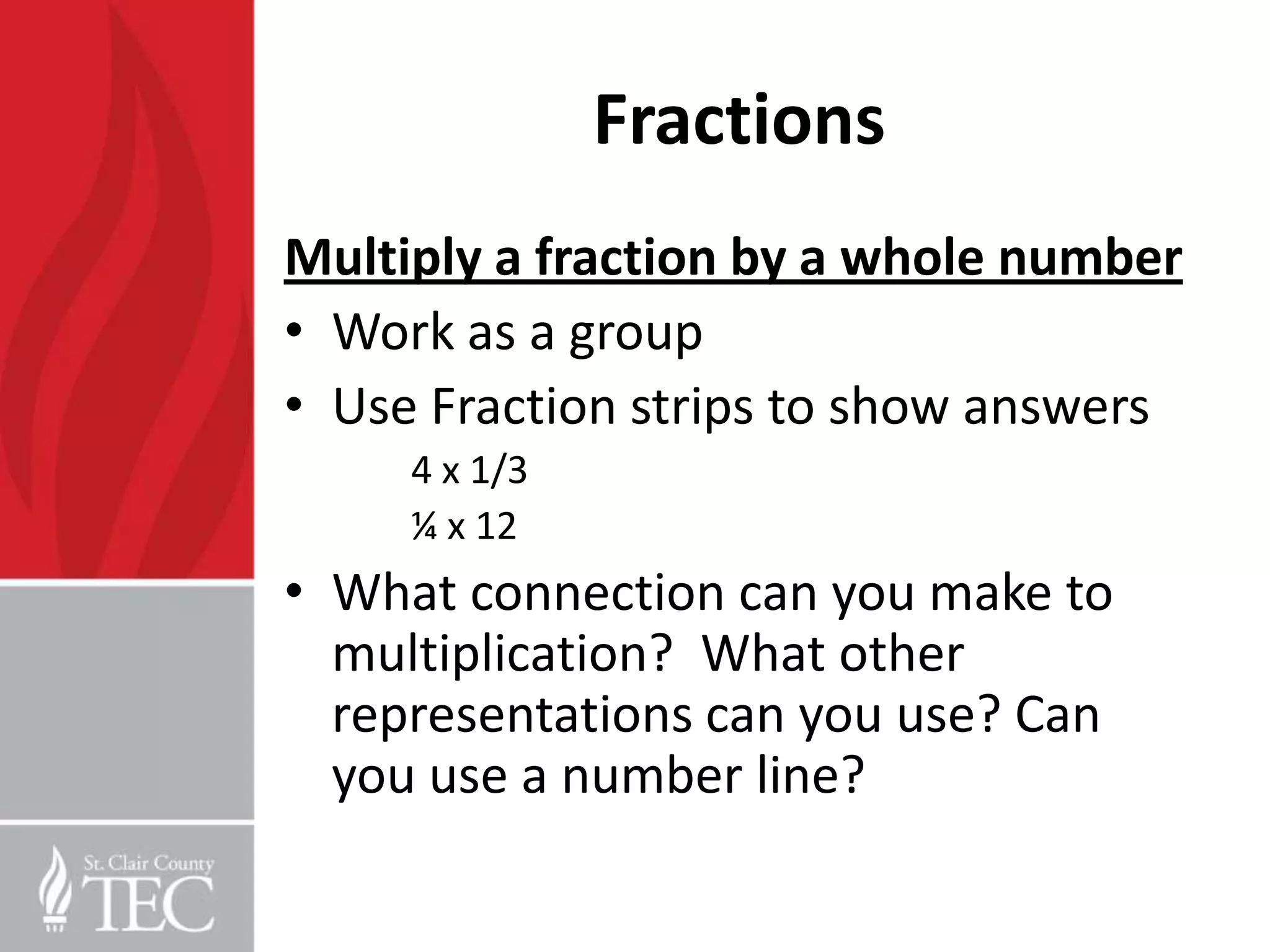
Multiply a fraction by a whole number
• Work as a group
• Use Fraction strips to show answers
     4 x 1/3
     ¼ x 12
• What connection can you make to
  multiplication? What other
  representations can you use? Can
  you use a number line?
Multiple a Fraction by a Whole
           Number
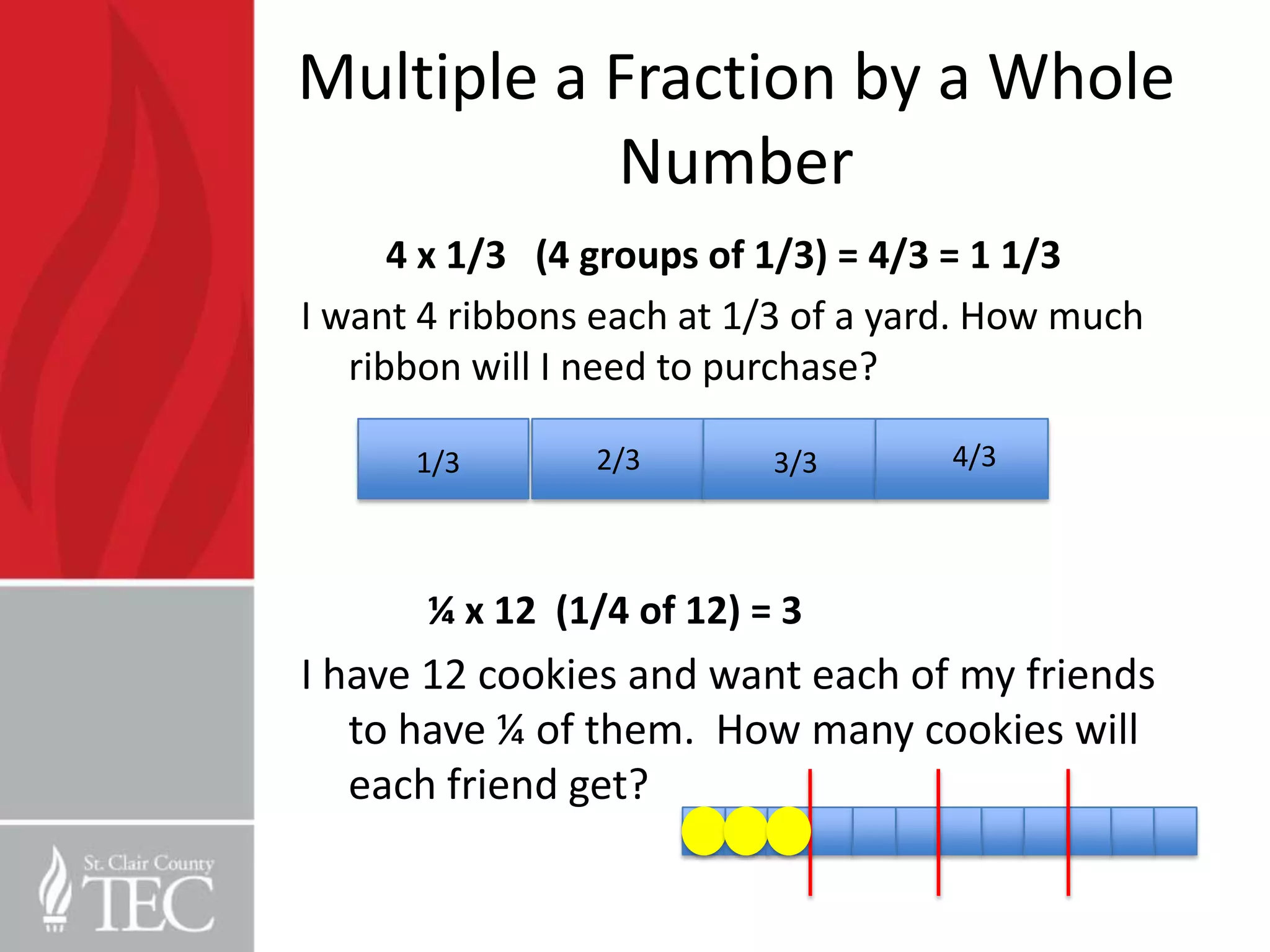
      4 x 1/3 (4 groups of 1/3) = 4/3 = 1 1/3
I want 4 ribbons each at 1/3 of a yard. How much
   ribbon will I need to purchase?

      1/3       2/3        3/3       4/3


       ¼ x 12 (1/4 of 12) = 3
I have 12 cookies and want each of my friends
   to have ¼ of them. How many cookies will
   each friend get?
Scaling (resizing)
• 5.NF.5
  – Read learning targets and discuss
  – Prove greater/less than given number
    statements with last slide.
  – Making equivalent fractions
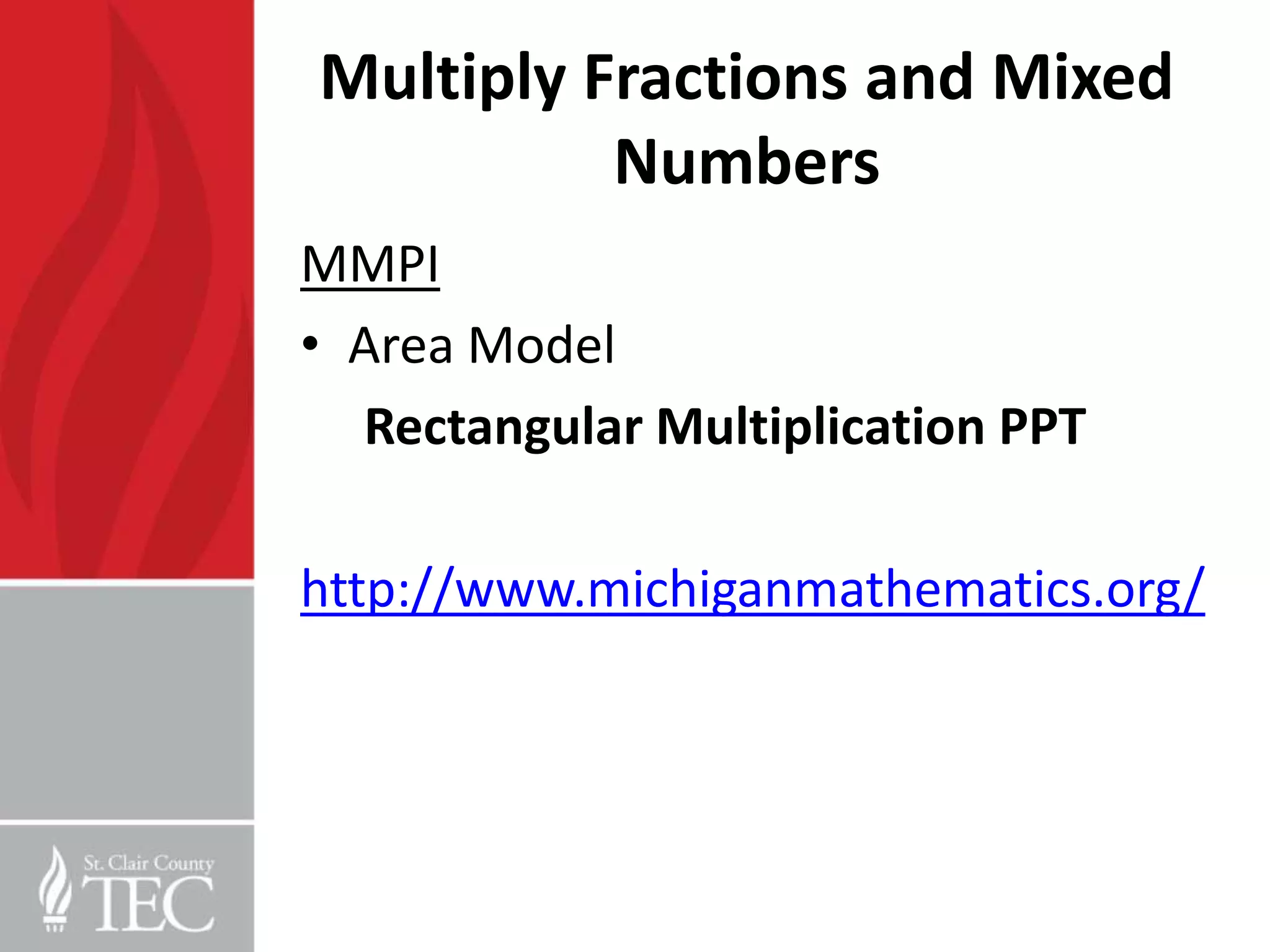
Multiply Fraction by Fraction
AIMS
• Fair Squares and Cross Products

MMPI
• Worksheet 1: Show different
  representations
         2/3 of ¾   ¾ of 2/3
Multiply Fractions and Mixed
          Numbers
MMPI
• Area Model
  Rectangular Multiplication PPT

http://www.michiganmathematics.org/
Fraction as Division
             (a/b = a ÷ b)
• I can explain that fractions (a/b) can be
  represented as a division of the numerator
  by the denominator (a ÷ b) can be
  represented by the fraction a/b.
• I can solve word problems involving the
  division of whole numbers and interpret the
  quotient- which could be a whole number,
  mixed number, or fraction – in the context of
  the problem.
• I can explain or illustrate my solution
  strategy using visual fraction models or
  equations that represent the problem.
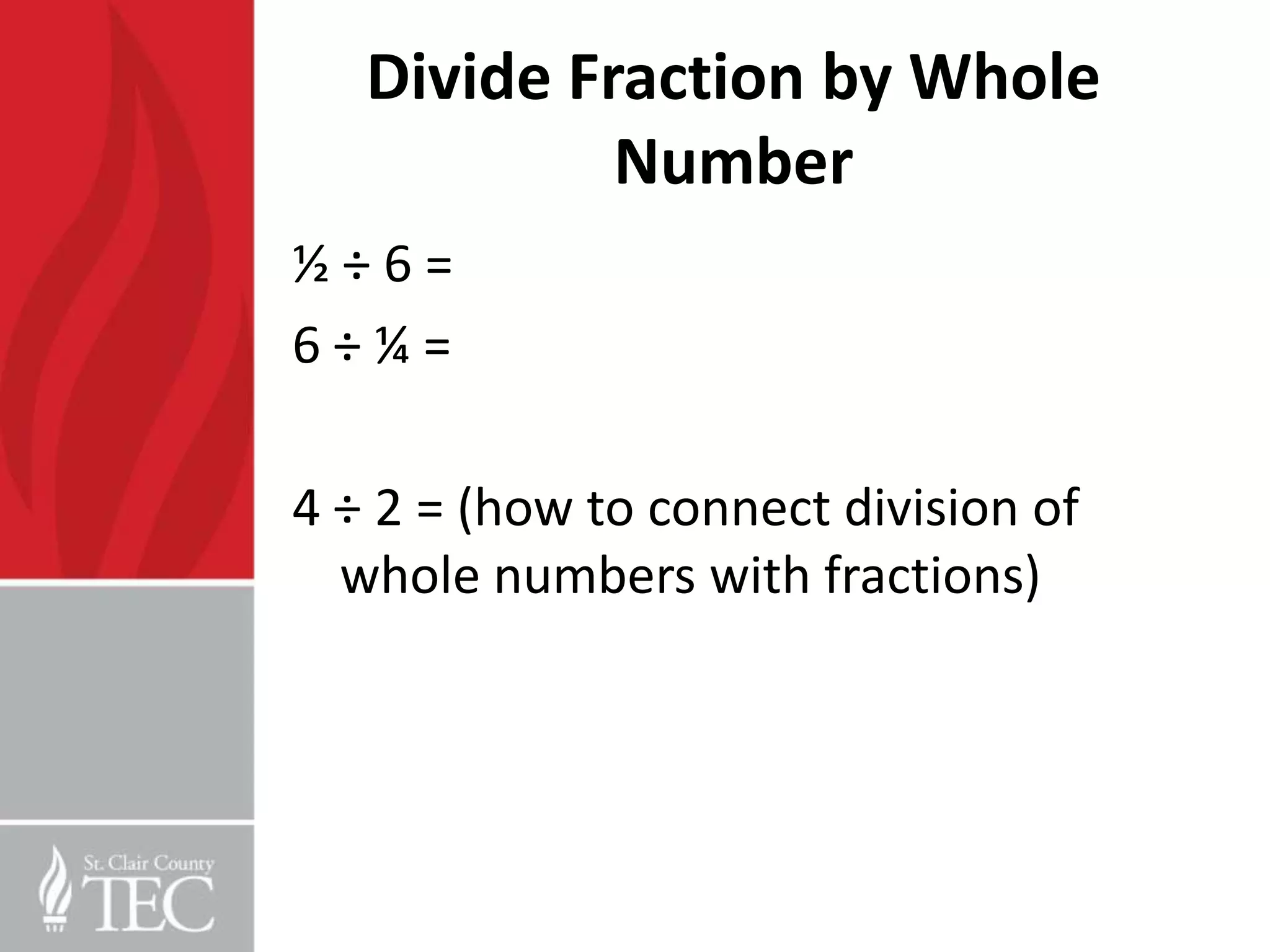
Divide Fraction by Whole
            Number
½÷6=
6÷¼=

4 ÷ 2 = (how to connect division of
  whole numbers with fractions)
Divide Fraction by Whole
             Number
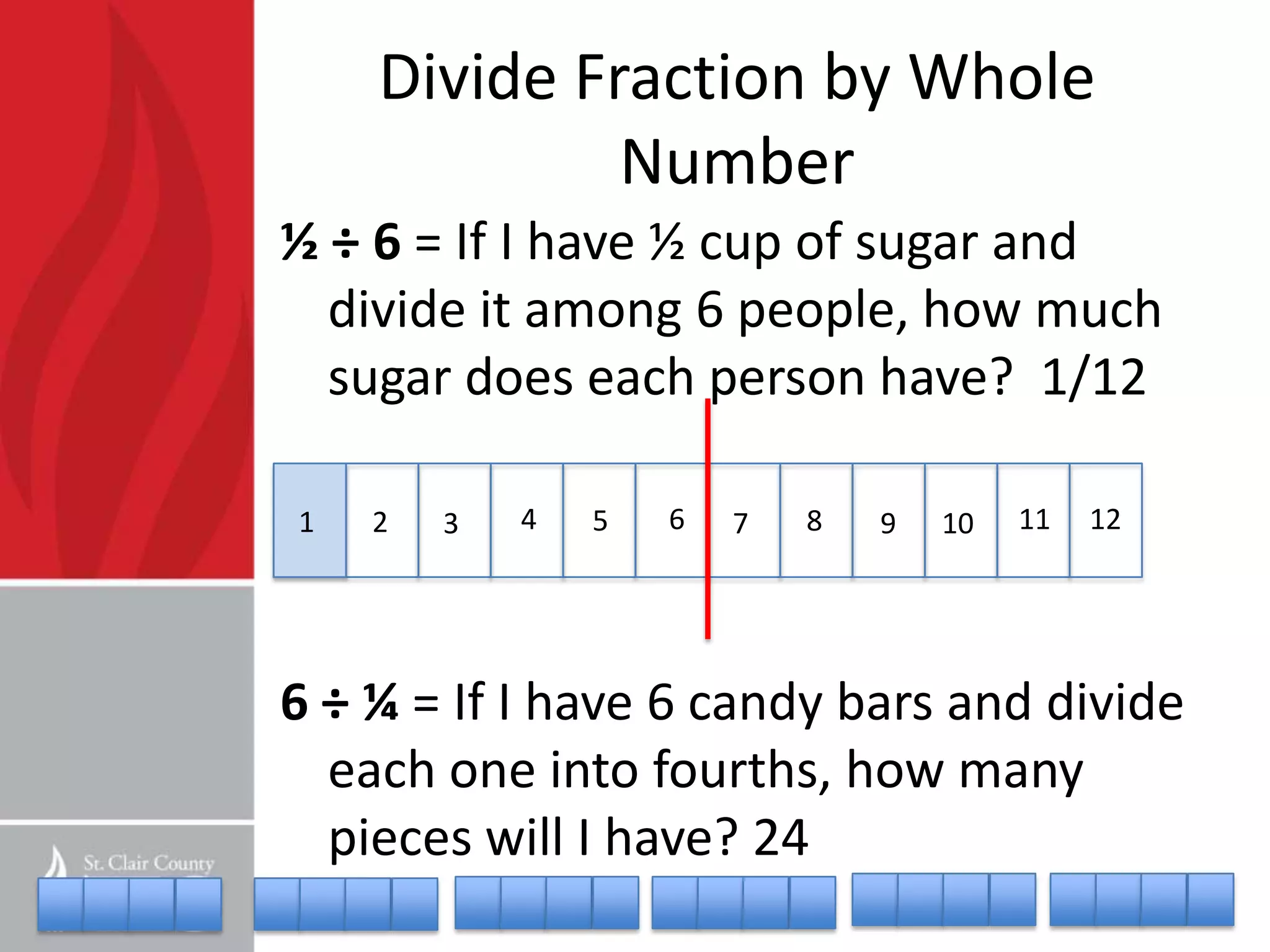
½ ÷ 6 = If I have ½ cup of sugar and
  divide it among 6 people, how much
  sugar does each person have? 1/12

1   2   3   4   5   6   7   8   9   10   11   12


6 ÷ ¼ = If I have 6 candy bars and divide
  each one into fourths, how many
  pieces will I have? 24
MOPLS
        http://mi.learnport.org
         Search: MOPLS Math
      (navigate by using top tabs)

Look at Concepts Tab
–   Introduction
–   Math Behind the Math
–   Misconceptions
–   Tasks & Strategies
Fractions Online


Check out some sites on my 5th
 grade math Protopage
Learning Target

Use equivalent fractions as a strategy to
  add and subtract fractions.
                   5.NF.1, 5.NF.2


Apply and extend previous understandings
  of multiplication and division to multiply
  and divide fractions.
        5.NF.3, 5.NF.4, 5.NF.5, 5.NF.6, 5.NF.7
Closer Activity


List something you learn about story
  problems and fractions today.
Thanks for a great day 


Please contact me if you have any questions or
  would like more information.

5th grade word problems and fractions pd

  • 1.
    5th Grade Fractions & Word Problems Laura Chambless RESA Consultant www.protopage.com/lchambless
  • 2.
    CCSS and Gaps What are your gaps in curriculum? 1. Review CCSS for Fractions 2. Think about your resources 3. Think about your teaching – Highlight anything your resources covers well in YELLOW. – Highlight any part of the standard you would like more clarification on in BLUE.
  • 3.
    Learning Target Use equivalentfractions as a strategy to add and subtract fractions. 5.NF.1, 5.NF.2 Apply and extend previous understandings of multiplication and division to multiply and divide fractions. 5.NF.3, 5.NF.4, 5.NF.5, 5.NF.6, 5.NF.7
  • 4.
    Fraction Word Problem 40students joined the soccer club. 5/8 of the students were boys. How many girls joined the soccer club? Draw a picture and solve it. 1. 2 min. working problem on own 2. 5 min. sharing with group 3. Class discussion Found at: http://www.mathplayground.com/wpdatabase/Fractions1_3.htm
  • 5.
    Problem Solving with Bar Diagrams 1. Understand: Identify what is known and what is unknown. Draw the bar diagram to promote comprehension and demonstrates understanding. (Situation vs. Solution Equation) 2. Plan: Decide how you will solve the problem (find the unknown). Analyze the bar diagram to find a solution plan. 3. Solve: Execute the plan. Use the bar diagram to solve. 4. Evaluate: Assess reasonableness using estimation or substitution. Substitute the solution for the unknown in the bar diagram.
  • 6.
    Bar Diagrams Watch IntroductionVideo http://www.mhschool.com/math/com mon/pd_video/mathconnects_bardi agram_p1/index.html http://www.mhschool.com/math/com mon/pd_video/mathconnects_bardi agram_p2/index.html
  • 7.
    Practice Bar Diagrams To:Rani earned $128 mowing lawns and $73 babysitting. How much money did Rani earn? With: Jin had $67 in his pocket after he bought a radio controlled car. He went to the store with $142. How Much did Jin spend on the car? By: There are 9 puffy stickers. There are 3 times as many plain stickers as puffy stickers. How many plain stickers are there? You pick 2 more to do by yourself. Share with partner Draw Your Way to Problem Solving Success Handout, Robyn Silbey
  • 8.
    Thinking Blocks http://www.mathplayground.com/think ingblocks.html Explore the site  When done exploring go to my Protopage and look at your grade level math tab.
  • 9.
    Fractions Stand and Share Make a list of what you know and any connections you have about the fraction ¼.
  • 10.
    Build Connections toWhole Numbers 0 1 2 3 4 5 1+1+1+1+1=5 1/4 1/2 3/4 0 1 ¼ +¼ +¼+¼ =1
  • 11.
    Fractions Fraction Activity Paper Strips Fraction Kit: 1, ½, 1/4 , 1/8, 1/16 Add to Fraction Kit: 1/3, 1/6, 1/12 Add to Fraction Kit: 1/5, 1/10 Compare/Add/Subtract/Multi./Divide with Strips READ and DO: 5.NF.1, 5.NF.2, 5.NF.3, 5.NF.4, 5.NF.5, 5.NF.6, 5.NF .7 Smaller Answer Wins (need dice) • Prove with Fraction Strips
  • 12.
  • 13.
    Definition of Fractions 1.Make a list of what you would like to have in a definition of a fraction 2. Partner up and compare lists 3. Group discussion
  • 14.
    Definition of aFraction Create a working definition of a fraction – Watch Dev-TEAM video 3:5 and 3:6 – Give article: Definitions and Defining in Mathematics and Mathematics Teaching by: Bass and Ball
  • 15.
    Definition Of Fractions •Identify the whole • Make d equal parts • Write 1/d to show one of the equal parts • If you have d of 1/d, then you have the whole • If you have n of 1/d, then you have n/d • n and d are whole numbers • d does not equal 0 Dev-TE@M • School of Education • University of Michigan • (734) 408-4461 • dev-team@umich.edu For review only - Please do not circulate or cite without permission
  • 16.
    Ordering Fractions Order Fractions 8/6, 2/5, 8/10, 1/12 How did you figure out what order they went in?
  • 17.
    Fractions Prove with Fraction Strips Number Line: (Benchmarks) 0, ½, 1 Equivalent Fractions: Same Name Frame Compare (>/<): same numerator or same denominator
  • 18.
    Strategies for Comparing Fractions • Dev-TE@M session 9
  • 19.
    Fraction On ANumber Line Writing about Fractions: Draw a number line. Place 3/6 and 7/12 on the number line. Compare the two fractions- why did put them where you did?
  • 20.
    Conventions Of ANumber Line Dev-TE@M • School of Education • University of Michigan • (734) 408-4461 • dev-team@umich.edu For review only - Please do not circulate or cite without permission
  • 21.
    Model of NumberLine Talk • Watch Dev-TE@M Session 4:5 (video)
  • 22.
    Talking Through ANumber Line 1. Understand the problem. 2. Think about which representation you are going to use. 3. Describe your thinking process while constructing the number line. 4. Sum up the solution that proved your answer. Model Example: 3/10 & 6/8
  • 23.
    Fraction On ANumber Line Using a number line, compare 5/6 and 3/8 and tell which one is greater . Have a partner listen to you as you construct the fractions and find the answer.
  • 24.
    Fractions What conceptual understandingdo students need? 1. Begin with simple contextual tasks. 2. Connect the meaning of fraction computation with whole number computation. 3. Let estimation and informal methods play a big role in the development of strategies. 4. Explore each of the operations using models. Van De Walle Book: Number Sense and Fraction Algorithms Pg. 310
  • 25.
    Equivalence with Fraction Strips • Fraction Strips ½+¼= ¾ + 1/3 =
  • 26.
    Methods for Generatingand Explaining Equivalent Fractions • Dev-TE@M session 9
  • 27.
    Add/Subtract Fractions with Unlike Denominators Developing Equivalent Fractions • Slicing Squares Van de Walle book: pg. 304-305 3 x = 3 x 4 = 4 3 x 3 x = = 4 4
  • 28.
    Add/Subtract Fractions with Unlike Denominators Developing Equivalent Fractions • Missing-Number Equivalencies Van de Walle book: pg. 304-305 5 2 6 = = 3 6 3
  • 29.
    Fraction Multiplication Strategies TOOLKIT for Multiplication of Fractions 1. Skim over TOOLKIT 2. Read assigned page (2 min) 3. 30 second report: What are the important part of your page? 4. Questions from audience
  • 30.
    Fractions Multiply a fractionby a whole number • Work as a group • Use Fraction strips to show answers 4 x 1/3 ¼ x 12 • What connection can you make to multiplication? What other representations can you use? Can you use a number line?
  • 31.
    Multiple a Fractionby a Whole Number 4 x 1/3 (4 groups of 1/3) = 4/3 = 1 1/3 I want 4 ribbons each at 1/3 of a yard. How much ribbon will I need to purchase? 1/3 2/3 3/3 4/3 ¼ x 12 (1/4 of 12) = 3 I have 12 cookies and want each of my friends to have ¼ of them. How many cookies will each friend get?
  • 32.
    Scaling (resizing) • 5.NF.5 – Read learning targets and discuss – Prove greater/less than given number statements with last slide. – Making equivalent fractions
  • 33.
    Multiply Fraction byFraction AIMS • Fair Squares and Cross Products MMPI • Worksheet 1: Show different representations 2/3 of ¾ ¾ of 2/3
  • 34.
    Multiply Fractions andMixed Numbers MMPI • Area Model Rectangular Multiplication PPT http://www.michiganmathematics.org/
  • 35.
    Fraction as Division (a/b = a ÷ b) • I can explain that fractions (a/b) can be represented as a division of the numerator by the denominator (a ÷ b) can be represented by the fraction a/b. • I can solve word problems involving the division of whole numbers and interpret the quotient- which could be a whole number, mixed number, or fraction – in the context of the problem. • I can explain or illustrate my solution strategy using visual fraction models or equations that represent the problem.
  • 36.
    Divide Fraction byWhole Number ½÷6= 6÷¼= 4 ÷ 2 = (how to connect division of whole numbers with fractions)
  • 37.
    Divide Fraction byWhole Number ½ ÷ 6 = If I have ½ cup of sugar and divide it among 6 people, how much sugar does each person have? 1/12 1 2 3 4 5 6 7 8 9 10 11 12 6 ÷ ¼ = If I have 6 candy bars and divide each one into fourths, how many pieces will I have? 24
  • 38.
    MOPLS http://mi.learnport.org Search: MOPLS Math (navigate by using top tabs) Look at Concepts Tab – Introduction – Math Behind the Math – Misconceptions – Tasks & Strategies
  • 39.
    Fractions Online Check outsome sites on my 5th grade math Protopage
  • 40.
    Learning Target Use equivalentfractions as a strategy to add and subtract fractions. 5.NF.1, 5.NF.2 Apply and extend previous understandings of multiplication and division to multiply and divide fractions. 5.NF.3, 5.NF.4, 5.NF.5, 5.NF.6, 5.NF.7
  • 41.
    Closer Activity List somethingyou learn about story problems and fractions today.
  • 42.
    Thanks for agreat day  Please contact me if you have any questions or would like more information.

Editor's Notes

  • #28 Activity 15.8Slicing SquaresGive students a worksheet with four squares in a row, each approximately 3 cm on a side. Have them shade in the same fraction in each square using vertical dividing line. You can use the context of a garden or farm. For example, slice each square in fourths and shade three-fourths as in Figure 15.20. Next, tell students to slice each square into equal-sized horizontal slices. Each square must be partitioned differently, using from one to eight slices. For each sliced square, they record an equations showing the equivalent fractions. Have them examine their equations and drawings to look for any patterns. You can repeat this with four more squares and different fractions.What product tells how many parts are shaded?What product tells how many parts in the whole?Notice that the same factor is used for both part and whole
  • #29 Give students an equation expressing an equivalence between two fraction but with one of the numbers missing and ask them to draw a picture to solve. Here are four different examples:5/3 = _/62/3 = 6/_8/12 = _/39/12 = 3/_The missing number can be either a numerator or a denominator. Furthermore, the missing number can either be larger or smaller that the corresponding part of the equivalent fraction. (All four possibilities are represented in the examples.) The examples shown involve simple whole-number multiples between equivalent fractions. Next, consider pairs such as 6/8 = _/12 or 9/12 = 6/_. In these equivalences, one denominator or numerator is not a whole number multiple of the other.