

Adding and
Subtr acting
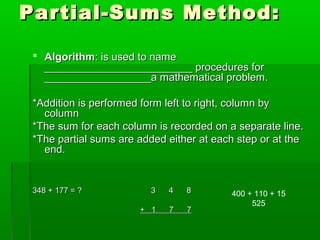
Partial-Sums Method:
 Algorithm: is used to name
_________________________ procedures for
__________________a mathematical problem.
*Addition is performed form left to right, column by
column
*The sum for each column is recorded on a separate line.
*The partial sums are added either at each step or at the
end.

348 + 177 = ?

3

4

8

+ 1

7

7

400 + 110 + 15
525
Partial-Sums Method:
Algorithm: is used to name
_________________________ procedures for
__________________a mathematical problem.
*Addition is performed form left to right, column by
column
*The sum for each column is recorded on a separate line.
*The partial sums are added either at each step or at the
end.
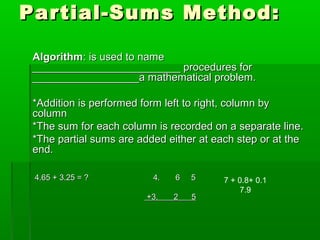
4.65 + 3.25 = ?

4.

6

5

+3.

2

5

7 + 0.8+ 0.1
7.9
The Column-Addition
Method

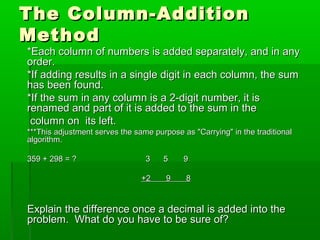
*Each column of numbers is added separately, and in any
order.
*If adding results in a single digit in each column, the sum
has been found.
*If the sum in any column is a 2-digit number, it is
renamed and part of it is added to the sum in the
column on its left.
***This adjustment serves the same purpose as "Carrying" in the traditional
algorithm.
359 + 298 = ?

3
+2

5
9

9
8

Explain the difference once a decimal is added into the
problem. What do you have to be sure of?
  
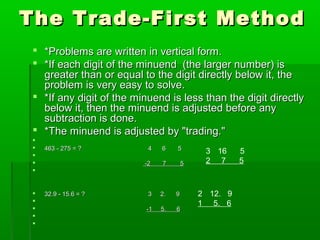
The Trade-First Method
 *Problems are written in vertical form.
 *If each digit of the minuend (the larger number) is
greater than or equal to the digit directly below it, the
problem is very easy to solve.
 *If any digit of the minuend is less than the digit directly
below it, then the minuend is adjusted before any
subtraction is done.
 *The minuend is adjusted by "trading."












463 - 275 = ?

6

-2

32.9 - 15.6 = ?

4

5

7

3

2.

9

-1

5.

6

5

3 16
2 7

2 12. 9
1 5. 6

5
5
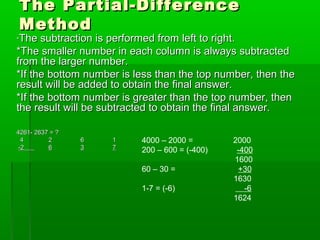
The Partial-Difference
Method

The subtraction is performed from left to right.
*The smaller number in each column is always subtracted
from the larger number.
*If the bottom number is less than the top number, then the
result will be added to obtain the final answer.
*If the bottom number is greater than the top number, then
the result will be subtracted to obtain the final answer.
*

4261- 2637 = ?
4
2
-2
6

6
3

1
7

4000 – 2000 =
200 – 600 = (-400)
60 – 30 =
1-7 = (-6)

2000
-400
1600
+30
1630
-6
1624
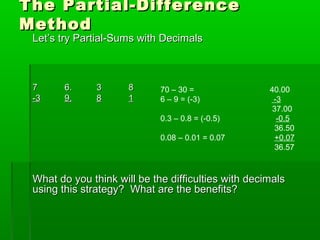
The Partial-Difference
Method
Let’s try Partial-Sums with Decimals

7
-3

6.
9.

3
8

8
1

70 – 30 =
6 – 9 = (-3)
0.3 – 0.8 = (-0.5)
0.08 – 0.01 = 0.07

40.00
-3
37.00
-0.5
36.50
+0.07
36.57

What do you think will be the difficulties with decimals
using this strategy? What are the benefits?
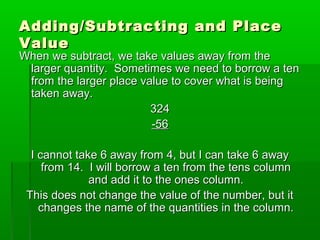
Adding/Subtracting and Place
Value

When we subtract, we take values away from the
larger quantity. Sometimes we need to borrow a ten
from the larger place value to cover what is being
taken away.
324
-56
I cannot take 6 away from 4, but I can take 6 away
from 14. I will borrow a ten from the tens column
and add it to the ones column.
This does not change the value of the number, but it
changes the name of the quantities in the column.
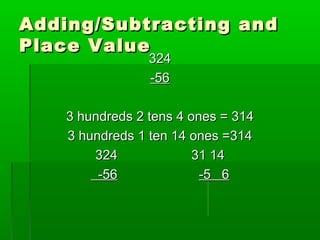
Adding/Subtracting and
Place Value
324
-56

3 hundreds 2 tens 4 ones = 314
3 hundreds 1 ten 14 ones =314
324
31 14
-56
-5 6
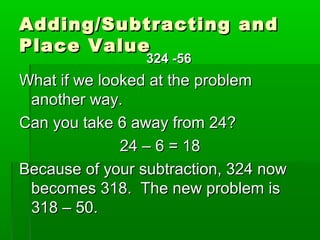
Adding/Subtracting and
Place Value
324 -56

What if we looked at the problem
another way.
Can you take 6 away from 24?
24 – 6 = 18
Because of your subtraction, 324 now
becomes 318. The new problem is
318 – 50.
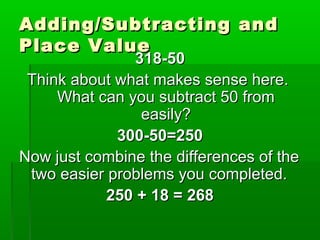
Adding/Subtracting and
Place Value

318-50
Think about what makes sense here.
What can you subtract 50 from
easily?
300-50=250
Now just combine the differences of the
two easier problems you completed.
250 + 18 = 268
What About Decimals?
 How do these strategies apply to
decimals?
 What are the possible problems you will
have with these methods?
Time to Practice
 Get with a partner you work well with.
 Partners will coach each other through
these strategies.
 It is important that you understand how to
use each of these strategies before you
decide if they work for you or not.
 Complete both sides of the page.
 Check in with the teacher when you are
finished.

Adding and subtracting

  • 1.
  • 2.
    Partial-Sums Method:  Algorithm:is used to name _________________________ procedures for __________________a mathematical problem. *Addition is performed form left to right, column by column *The sum for each column is recorded on a separate line. *The partial sums are added either at each step or at the end. 348 + 177 = ? 3 4 8 + 1 7 7 400 + 110 + 15 525
  • 3.
    Partial-Sums Method: Algorithm: isused to name _________________________ procedures for __________________a mathematical problem. *Addition is performed form left to right, column by column *The sum for each column is recorded on a separate line. *The partial sums are added either at each step or at the end. 4.65 + 3.25 = ? 4. 6 5 +3. 2 5 7 + 0.8+ 0.1 7.9
  • 4.
    The Column-Addition Method *Each columnof numbers is added separately, and in any order. *If adding results in a single digit in each column, the sum has been found. *If the sum in any column is a 2-digit number, it is renamed and part of it is added to the sum in the column on its left. ***This adjustment serves the same purpose as "Carrying" in the traditional algorithm. 359 + 298 = ? 3 +2 5 9 9 8 Explain the difference once a decimal is added into the problem. What do you have to be sure of?
  • 5.
       The Trade-First Method *Problems are written in vertical form.  *If each digit of the minuend (the larger number) is greater than or equal to the digit directly below it, the problem is very easy to solve.  *If any digit of the minuend is less than the digit directly below it, then the minuend is adjusted before any subtraction is done.  *The minuend is adjusted by "trading."           463 - 275 = ? 6 -2 32.9 - 15.6 = ? 4 5 7 3 2. 9 -1 5. 6 5 3 16 2 7 2 12. 9 1 5. 6 5 5
  • 6.
    The Partial-Difference Method The subtractionis performed from left to right. *The smaller number in each column is always subtracted from the larger number. *If the bottom number is less than the top number, then the result will be added to obtain the final answer. *If the bottom number is greater than the top number, then the result will be subtracted to obtain the final answer. * 4261- 2637 = ? 4 2 -2 6 6 3 1 7 4000 – 2000 = 200 – 600 = (-400) 60 – 30 = 1-7 = (-6) 2000 -400 1600 +30 1630 -6 1624
  • 7.
    The Partial-Difference Method Let’s tryPartial-Sums with Decimals 7 -3 6. 9. 3 8 8 1 70 – 30 = 6 – 9 = (-3) 0.3 – 0.8 = (-0.5) 0.08 – 0.01 = 0.07 40.00 -3 37.00 -0.5 36.50 +0.07 36.57 What do you think will be the difficulties with decimals using this strategy? What are the benefits?
  • 8.
    Adding/Subtracting and Place Value Whenwe subtract, we take values away from the larger quantity. Sometimes we need to borrow a ten from the larger place value to cover what is being taken away. 324 -56 I cannot take 6 away from 4, but I can take 6 away from 14. I will borrow a ten from the tens column and add it to the ones column. This does not change the value of the number, but it changes the name of the quantities in the column.
  • 9.
    Adding/Subtracting and Place Value 324 -56 3hundreds 2 tens 4 ones = 314 3 hundreds 1 ten 14 ones =314 324 31 14 -56 -5 6
  • 10.
    Adding/Subtracting and Place Value 324-56 What if we looked at the problem another way. Can you take 6 away from 24? 24 – 6 = 18 Because of your subtraction, 324 now becomes 318. The new problem is 318 – 50.
  • 11.
    Adding/Subtracting and Place Value 318-50 Thinkabout what makes sense here. What can you subtract 50 from easily? 300-50=250 Now just combine the differences of the two easier problems you completed. 250 + 18 = 268
  • 12.
    What About Decimals? How do these strategies apply to decimals?  What are the possible problems you will have with these methods?
  • 13.
    Time to Practice Get with a partner you work well with.  Partners will coach each other through these strategies.  It is important that you understand how to use each of these strategies before you decide if they work for you or not.  Complete both sides of the page.  Check in with the teacher when you are finished.

Editor's Notes