1
Introduction to Operations Management
SAGE UNIVERSITY INDORE
Submitted By :-Bablu
mukati
Submitted To:- Rishabh Pare
Subject :-Material requirement planing
2
Introduction to Operations Management
Material Requirements
Planning
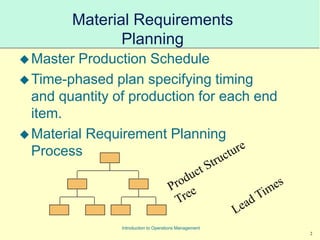
Master Production Schedule
Time-phased plan specifying timing
and quantity of production for each end
item.
Material Requirement Planning
Process
3
Introduction to Operations Management
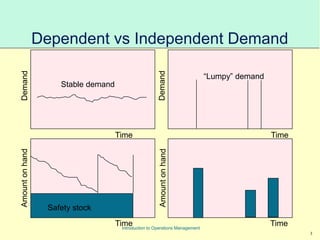
Dependent vs Independent Demand
Time
Time Time
Time
Demand
Amount
on
hand
Amount
on
hand
Demand
Stable demand
“Lumpy” demand
Safety stock
4
Introduction to Operations Management
Objectives of MRP
MRP answers the following production
decision of a firm
What is needed?
How much is needed?
When is it needed?
5
Introduction to Operations Management
Material decision
Decision on
Quantity (how much)
Time (when)
Type (what)
The first two are same as in inventory
management. The last one is needed
because it involves more than one type
of parts or components.
6
Introduction to Operations Management
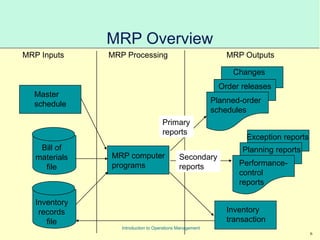
MRP Overview
MRP Inputs MRP Processing MRP Outputs
Master
schedule
Bill of
materials
file
Inventory
records
file
MRP computer
programs
Changes
Order releases
Planned-order
schedules
Exception reports
Planning reports
Performance-
control
reports
Inventory
transaction
Primary
reports
Secondary
reports
7
Introduction to Operations Management
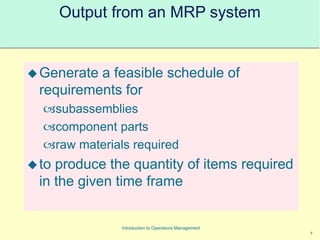
Output from an MRP system
Generate a feasible schedule of
requirements for
subassemblies
component parts
raw materials required
to produce the quantity of items required
in the given time frame
8
Introduction to Operations Management
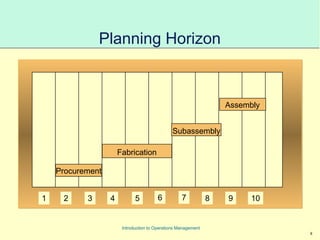
Planning Horizon
1 2 3 4 5 6 7 8 9 10
Procurement
Fabrication
Subassembly
Assembly
9
Introduction to Operations Management
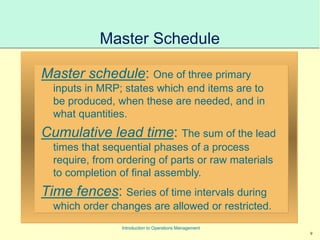
Master Schedule
Master schedule: One of three primary
inputs in MRP; states which end items are to
be produced, when these are needed, and in
what quantities.
Cumulative lead time: The sum of the lead
times that sequential phases of a process
require, from ordering of parts or raw materials
to completion of final assembly.
Time fences: Series of time intervals during
which order changes are allowed or restricted.
10
Introduction to Operations Management
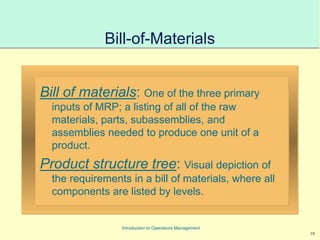
Bill-of-Materials
Bill of materials: One of the three primary
inputs of MRP; a listing of all of the raw
materials, parts, subassemblies, and
assemblies needed to produce one unit of a
product.
Product structure tree: Visual depiction of
the requirements in a bill of materials, where all
components are listed by levels.
11
Introduction to Operations Management
BOM
Accuracy is important since errors
may multiply many times
12
Introduction to Operations Management
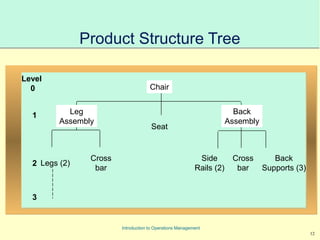
Product Structure Tree
Chair
Seat
Legs (2)
Cross
bar
Side
Rails (2)
Cross
bar
Back
Supports (3)
Leg
Assembly
Back
Assembly
Level
0
1
2
3
13
Introduction to Operations Management
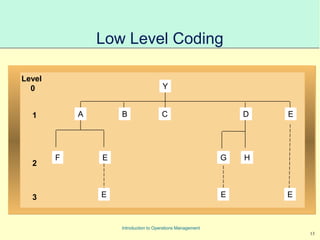
Low Level Coding
Y
C
F E G H
A D
Level
0
1
2
3
E
E
E
E
B
14
Introduction to Operations Management
MRP Processing
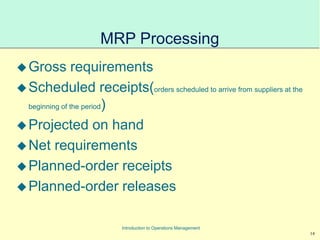
Gross requirements
Scheduled receipts(orders scheduled to arrive from suppliers at the
beginning of the period)
Projected on hand
Net requirements
Planned-order receipts
Planned-order releases
15
Introduction to Operations Management
MRP Processing
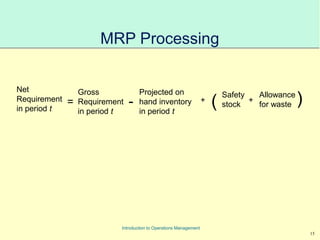
Net
Requirement
in period t
=
Gross
Requirement
in period t
Projected on
hand inventory
in period t
- +
(
Safety
stock
Allowance
for waste
+ )
16
Introduction to Operations Management
Assembly Time Chart
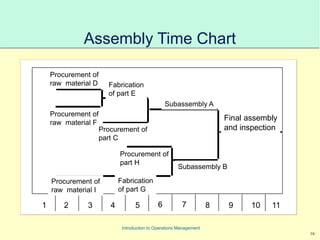
1 2 3 4 5 6 7 8 9 10 11
Procurement of
raw material D
Procurement of
raw material F
Procurement of
part C
Procurement of
part H
Procurement of
raw material I
Fabrication
of part G
Fabrication
of part E
Subassembly A
Subassembly B
Final assembly
and inspection
17
Introduction to Operations Management
MRP Outputs
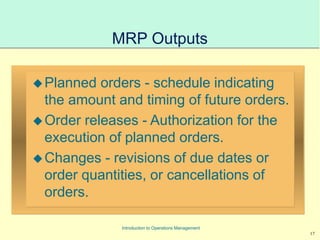
Planned orders - schedule indicating
the amount and timing of future orders.
Order releases - Authorization for the
execution of planned orders.
Changes - revisions of due dates or
order quantities, or cancellations of
orders.
18
Introduction to Operations Management
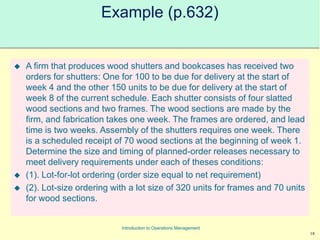
Example (p.632)
 A firm that produces wood shutters and bookcases has received two
orders for shutters: One for 100 to be due for delivery at the start of
week 4 and the other 150 units to be due for delivery at the start of
week 8 of the current schedule. Each shutter consists of four slatted
wood sections and two frames. The wood sections are made by the
firm, and fabrication takes one week. The frames are ordered, and lead
time is two weeks. Assembly of the shutters requires one week. There
is a scheduled receipt of 70 wood sections at the beginning of week 1.
Determine the size and timing of planned-order releases necessary to
meet delivery requirements under each of theses conditions:
 (1). Lot-for-lot ordering (order size equal to net requirement)
 (2). Lot-size ordering with a lot size of 320 units for frames and 70 units
for wood sections.
19
Introduction to Operations Management
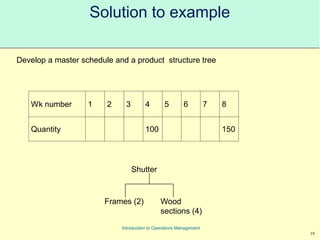
Solution to example
Develop a master schedule and a product structure tree
Wk number 1 2 3 4 5 6 7 8
Quantity 100 150
Shutter
Frames (2) Wood
sections (4)
20
Introduction to Operations Management
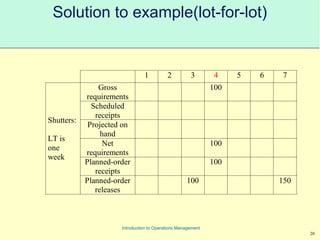
Solution to example(lot-for-lot)
1 2 3 4 5 6 7
Gross
requirements
100
Scheduled
receipts
Projected on
hand
Net
requirements
100
Planned-order
receipts
100
Shutters:
LT is
one
week
Planned-order
releases
100 150
21
Introduction to Operations Management
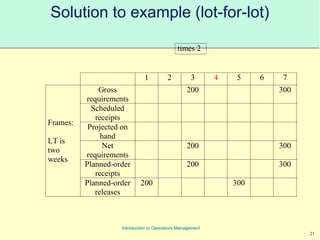
Solution to example (lot-for-lot)
times 2
1 2 3 4 5 6 7
Gross
requirements
200 300
Scheduled
receipts
Projected on
hand
Net
requirements
200 300
Planned-order
receipts
200 300
Frames:
LT is
two
weeks
Planned-order
releases
200 300
22
Introduction to Operations Management
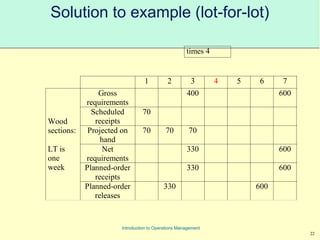
Solution to example (lot-for-lot)
times 4
1 2 3 4 5 6 7
Gross
requirements
400 600
Scheduled
receipts
70
Projected on
hand
70 70 70
Net
requirements
330 600
Planned-order
receipts
330 600
Wood
sections:
LT is
one
week
Planned-order
releases
330 600
23
Introduction to Operations Management
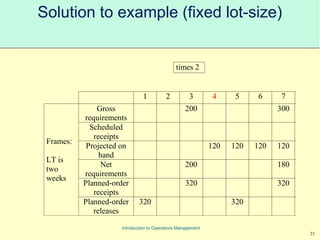
Solution to example (fixed lot-size)
times 2
1 2 3 4 5 6 7
Gross
requirements
200 300
Scheduled
receipts
Projected on
hand
120 120 120 120
Net
requirements
200 180
Planned-order
receipts
320 320
Frames:
LT is
two
weeks
Planned-order
releases
320 320
24
Introduction to Operations Management
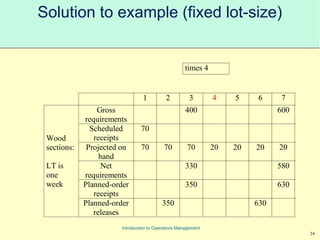
Solution to example (fixed lot-size)
times 4
1 2 3 4 5 6 7
Gross
requirements
400 600
Scheduled
receipts
70
Projected on
hand
70 70 70 20 20 20 20
Net
requirements
330 580
Planned-order
receipts
350 630
Wood
sections:
LT is
one
week
Planned-order
releases
350 630
25
Introduction to Operations Management
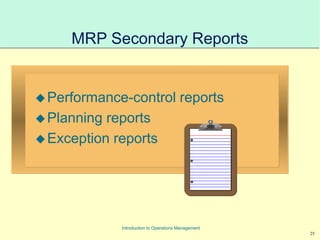
MRP Secondary Reports
Performance-control reports
Planning reports
Exception reports
26
Introduction to Operations Management
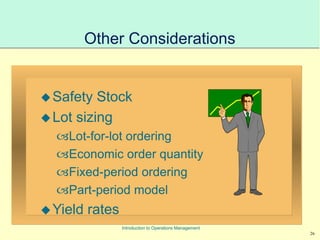
Other Considerations
Safety Stock
Lot sizing
Lot-for-lot ordering
Economic order quantity
Fixed-period ordering
Part-period model
Yield rates
27
Introduction to Operations Management
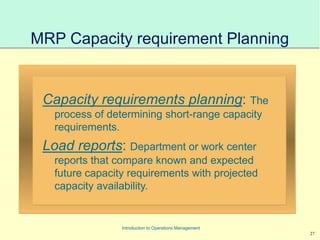
MRP Capacity requirement Planning
Capacity requirements planning: The
process of determining short-range capacity
requirements.
Load reports: Department or work center
reports that compare known and expected
future capacity requirements with projected
capacity availability.
28
Introduction to Operations Management
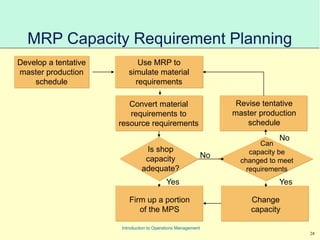
MRP Capacity Requirement Planning
Develop a tentative
master production
schedule
Use MRP to
simulate material
requirements
Convert material
requirements to
resource requirements
Firm up a portion
of the MPS
Is shop
capacity
adequate?
Can
capacity be
changed to meet
requirements
Revise tentative
master production
schedule
Change
capacity
Yes
No
Yes
No
29
Introduction to Operations Management
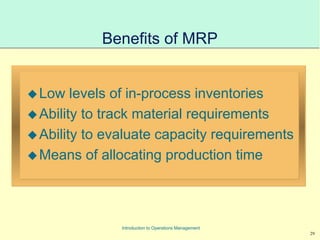
Benefits of MRP
Low levels of in-process inventories
Ability to track material requirements
Ability to evaluate capacity requirements
Means of allocating production time
30
Introduction to Operations Management
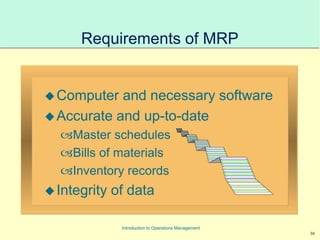
Requirements of MRP
Computer and necessary software
Accurate and up-to-date
Master schedules
Bills of materials
Inventory records
Integrity of data
31
Introduction to Operations Management
MRP II
Expanded MRP with and emphasis
placed on integration
Financial planning
Marketing
Engineering
Purchasing
Manufacturing
32
Introduction to Operations Management
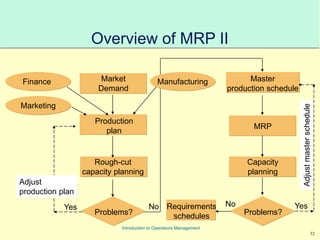
Overview of MRP II
Market
Demand
Production
plan
Problems?
Rough-cut
capacity planning
Yes No Yes
No
Finance
Marketing
Manufacturing
Adjust
production plan
Master
production schedule
MRP
Capacity
planning
Problems?
Requirements
schedules
Adjust
master
schedule

Material requirement planning

  • 1.
    1 Introduction to OperationsManagement SAGE UNIVERSITY INDORE Submitted By :-Bablu mukati Submitted To:- Rishabh Pare Subject :-Material requirement planing
  • 2.
    2 Introduction to OperationsManagement Material Requirements Planning Master Production Schedule Time-phased plan specifying timing and quantity of production for each end item. Material Requirement Planning Process
  • 3.
    3 Introduction to OperationsManagement Dependent vs Independent Demand Time Time Time Time Demand Amount on hand Amount on hand Demand Stable demand “Lumpy” demand Safety stock
  • 4.
    4 Introduction to OperationsManagement Objectives of MRP MRP answers the following production decision of a firm What is needed? How much is needed? When is it needed?
  • 5.
    5 Introduction to OperationsManagement Material decision Decision on Quantity (how much) Time (when) Type (what) The first two are same as in inventory management. The last one is needed because it involves more than one type of parts or components.
  • 6.
    6 Introduction to OperationsManagement MRP Overview MRP Inputs MRP Processing MRP Outputs Master schedule Bill of materials file Inventory records file MRP computer programs Changes Order releases Planned-order schedules Exception reports Planning reports Performance- control reports Inventory transaction Primary reports Secondary reports
  • 7.
    7 Introduction to OperationsManagement Output from an MRP system Generate a feasible schedule of requirements for subassemblies component parts raw materials required to produce the quantity of items required in the given time frame
  • 8.
    8 Introduction to OperationsManagement Planning Horizon 1 2 3 4 5 6 7 8 9 10 Procurement Fabrication Subassembly Assembly
  • 9.
    9 Introduction to OperationsManagement Master Schedule Master schedule: One of three primary inputs in MRP; states which end items are to be produced, when these are needed, and in what quantities. Cumulative lead time: The sum of the lead times that sequential phases of a process require, from ordering of parts or raw materials to completion of final assembly. Time fences: Series of time intervals during which order changes are allowed or restricted.
  • 10.
    10 Introduction to OperationsManagement Bill-of-Materials Bill of materials: One of the three primary inputs of MRP; a listing of all of the raw materials, parts, subassemblies, and assemblies needed to produce one unit of a product. Product structure tree: Visual depiction of the requirements in a bill of materials, where all components are listed by levels.
  • 11.
    11 Introduction to OperationsManagement BOM Accuracy is important since errors may multiply many times
  • 12.
    12 Introduction to OperationsManagement Product Structure Tree Chair Seat Legs (2) Cross bar Side Rails (2) Cross bar Back Supports (3) Leg Assembly Back Assembly Level 0 1 2 3
  • 13.
    13 Introduction to OperationsManagement Low Level Coding Y C F E G H A D Level 0 1 2 3 E E E E B
  • 14.
    14 Introduction to OperationsManagement MRP Processing Gross requirements Scheduled receipts(orders scheduled to arrive from suppliers at the beginning of the period) Projected on hand Net requirements Planned-order receipts Planned-order releases
  • 15.
    15 Introduction to OperationsManagement MRP Processing Net Requirement in period t = Gross Requirement in period t Projected on hand inventory in period t - + ( Safety stock Allowance for waste + )
  • 16.
    16 Introduction to OperationsManagement Assembly Time Chart 1 2 3 4 5 6 7 8 9 10 11 Procurement of raw material D Procurement of raw material F Procurement of part C Procurement of part H Procurement of raw material I Fabrication of part G Fabrication of part E Subassembly A Subassembly B Final assembly and inspection
  • 17.
    17 Introduction to OperationsManagement MRP Outputs Planned orders - schedule indicating the amount and timing of future orders. Order releases - Authorization for the execution of planned orders. Changes - revisions of due dates or order quantities, or cancellations of orders.
  • 18.
    18 Introduction to OperationsManagement Example (p.632)  A firm that produces wood shutters and bookcases has received two orders for shutters: One for 100 to be due for delivery at the start of week 4 and the other 150 units to be due for delivery at the start of week 8 of the current schedule. Each shutter consists of four slatted wood sections and two frames. The wood sections are made by the firm, and fabrication takes one week. The frames are ordered, and lead time is two weeks. Assembly of the shutters requires one week. There is a scheduled receipt of 70 wood sections at the beginning of week 1. Determine the size and timing of planned-order releases necessary to meet delivery requirements under each of theses conditions:  (1). Lot-for-lot ordering (order size equal to net requirement)  (2). Lot-size ordering with a lot size of 320 units for frames and 70 units for wood sections.
  • 19.
    19 Introduction to OperationsManagement Solution to example Develop a master schedule and a product structure tree Wk number 1 2 3 4 5 6 7 8 Quantity 100 150 Shutter Frames (2) Wood sections (4)
  • 20.
    20 Introduction to OperationsManagement Solution to example(lot-for-lot) 1 2 3 4 5 6 7 Gross requirements 100 Scheduled receipts Projected on hand Net requirements 100 Planned-order receipts 100 Shutters: LT is one week Planned-order releases 100 150
  • 21.
    21 Introduction to OperationsManagement Solution to example (lot-for-lot) times 2 1 2 3 4 5 6 7 Gross requirements 200 300 Scheduled receipts Projected on hand Net requirements 200 300 Planned-order receipts 200 300 Frames: LT is two weeks Planned-order releases 200 300
  • 22.
    22 Introduction to OperationsManagement Solution to example (lot-for-lot) times 4 1 2 3 4 5 6 7 Gross requirements 400 600 Scheduled receipts 70 Projected on hand 70 70 70 Net requirements 330 600 Planned-order receipts 330 600 Wood sections: LT is one week Planned-order releases 330 600
  • 23.
    23 Introduction to OperationsManagement Solution to example (fixed lot-size) times 2 1 2 3 4 5 6 7 Gross requirements 200 300 Scheduled receipts Projected on hand 120 120 120 120 Net requirements 200 180 Planned-order receipts 320 320 Frames: LT is two weeks Planned-order releases 320 320
  • 24.
    24 Introduction to OperationsManagement Solution to example (fixed lot-size) times 4 1 2 3 4 5 6 7 Gross requirements 400 600 Scheduled receipts 70 Projected on hand 70 70 70 20 20 20 20 Net requirements 330 580 Planned-order receipts 350 630 Wood sections: LT is one week Planned-order releases 350 630
  • 25.
    25 Introduction to OperationsManagement MRP Secondary Reports Performance-control reports Planning reports Exception reports
  • 26.
    26 Introduction to OperationsManagement Other Considerations Safety Stock Lot sizing Lot-for-lot ordering Economic order quantity Fixed-period ordering Part-period model Yield rates
  • 27.
    27 Introduction to OperationsManagement MRP Capacity requirement Planning Capacity requirements planning: The process of determining short-range capacity requirements. Load reports: Department or work center reports that compare known and expected future capacity requirements with projected capacity availability.
  • 28.
    28 Introduction to OperationsManagement MRP Capacity Requirement Planning Develop a tentative master production schedule Use MRP to simulate material requirements Convert material requirements to resource requirements Firm up a portion of the MPS Is shop capacity adequate? Can capacity be changed to meet requirements Revise tentative master production schedule Change capacity Yes No Yes No
  • 29.
    29 Introduction to OperationsManagement Benefits of MRP Low levels of in-process inventories Ability to track material requirements Ability to evaluate capacity requirements Means of allocating production time
  • 30.
    30 Introduction to OperationsManagement Requirements of MRP Computer and necessary software Accurate and up-to-date Master schedules Bills of materials Inventory records Integrity of data
  • 31.
    31 Introduction to OperationsManagement MRP II Expanded MRP with and emphasis placed on integration Financial planning Marketing Engineering Purchasing Manufacturing
  • 32.
    32 Introduction to OperationsManagement Overview of MRP II Market Demand Production plan Problems? Rough-cut capacity planning Yes No Yes No Finance Marketing Manufacturing Adjust production plan Master production schedule MRP Capacity planning Problems? Requirements schedules Adjust master schedule