Prepared and presented by,
N. Ganesha Pandian
FINANCIAL MANAGEMENT
COURSE CODE: BA 5203
UNIT 4: WORKING CAPITAL MANAGEMENT
1
MSM MBA Financial Management - Ganesha
Pandian
CONTENT
 Principles of working capital
 Concepts, Needs, Determinants, issues and estimation
of working capital
 Accounts Receivables Management and factoring
 Inventory management
 Cash management
 Working capital finance : Trade credit, Bank finance and
Commercial paper
2
MSM MBA Financial Management -
Ganesha Pandian
INTRODUCTION
 Firm needs to survive short term, in order to make
profit in long term.
Meaning of Working capital:
 Amount of funds required for meeting day to day
expenses of the business.
 Part of firm’s capital which is required for financing
short term or current assets such as cash,
marketable securities, debtors and inventories
MSM MBA Financial Management -
Ganesha Pandian
3
 Funds in current assets – revolving fast and
are constantly converted into cash and back
into asset.
 Also known as revolving or circulating or
short term capital
MSM MBA Financial Management -
Ganesha Pandian
4
DEFINITION OF WORKING CAPITAL
 Shubin : Working Capital is a part of capital
which is required to purchase of raw
materials and for meeting day to day
expenditure on salaries, wages, rent and
advertisement etc.,
 C.W. Gerstenberg: Working Capital is the
excess of current assets over current
MSM MBA Financial Management -
Ganesha Pandian
5
CONCEPT OF WORKING CAPITAL
1. Gross concept: amount of funds invested in current
assets that are employed in the firm.
Current assets and working capital both used
interchangeably
Current assets: refers to those assets which can be
converted into cash in hand within a short period (one
accounting year)
MSM MBA Financial Management -
Ganesha Pandian
6
Contd…
Current assets
 includes cash in hand, with banks, stock
finished, work in progress, receivables, sale
merchandise, marketable securities, prepaid
expenses and accrued income
MSM MBA Financial Management -
Ganesha Pandian
7
Contd…
2. Net concept: Working capital is the excess of
current assets over current liabilities.
Net working capital = current assets – current
liabilities
Current liabilities includes: claims of outsiders
expected to mature within one accounting
period
MSM MBA Financial Management -
Ganesha Pandian
8
Contd…
 Current liabilities includes: sundry creditors,
bills payable, bank overdraft, outstanding
expenses , short term loans, advances and
deposits and etc.,
When current assets exceeds current liability – it
is positive working capital
When current liabilities exceeds current assets – it
is negative working capital
MSM MBA Financial Management -
Ganesha Pandian
9
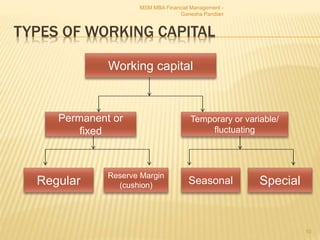
TYPES OF WORKING CAPITAL
MSM MBA Financial Management -
Ganesha Pandian
10
Working capital
SpecialSeasonal
Temporary or variable/
fluctuating
Permanent or
fixed
Reserve Margin
(cushion)Regular
PERMANENT WORKING CAPITAL
Amount of funds required to produce goods and
services
Tandon Committee named it as “Core current
Assets”
Such capital is constantly changing from one
asset to another asset without leaving business
process and doesn't change over the time
period.
MSM MBA Financial Management -
Ganesha Pandian
11
1. REGULAR WORKING CAPITAL
 Regular working capital is the
minimum amount of liquid capital
needed to keep up the circulation of the
capital from cash to inventories to
receivable and again to cash.
MSM MBA Financial Management -
Ganesha Pandian
12
2. RESERVE MARGIN/ CUSHION WORKING
CAPITAL
 Reserve working capital is the excess over
the need for regular working capital
 For contingencies that arise at unstated
period
 Contingencies such as price rise, business
depression, war condition, strike, fire and
severe competition
MSM MBA Financial Management -
Ganesha Pandian
13
FEATURES OF PERMANENT WORKING CAPITAL
 Classified on the basis of time factor
 Constantly changes from one asset to
another asset
 Size increases with the growth of business
 Should be financed out of long term funds
MSM MBA Financial Management -
Ganesha Pandian
14
TEMPORARY WORKING CAPITAL
 Working capital over and above
permanent working capital and is
dependent on factors like peak season,
trade cycle, boom and etc,.
MSM MBA Financial Management -
Ganesha Pandian
15
1. SEASONAL WORKING CAPITAL
Additional amount of capital asset
(cash, receivables and inventory)
required during the most active
business seasons of the year.
MSM MBA Financial Management -
Ganesha Pandian
16
SPECIAL WORKING CAPITAL
Required for financing special
operations
It is not always gainful
MSM MBA Financial Management -
Ganesha Pandian
17
SIGNIFICANCE OF WORKING CAPITAL
 Working capital supply adequate funds
1. To equip raw materials (production)
2. Cash to meet wage bills
3. Capacity to wait for market for its finished
products
4. The ability to grant credit to its customers
MSM MBA Financial Management -
Ganesha Pandian
18
ADVANTAGES OF ADEQUATE WORKING CAPITAL
1. Cash discount
2. Sense of security and confidence
3. Credit worthiness
4. Continuous supply of raw materials
5. Exploitation of good opportunities
6. Increase in productivity
7. Attractive dividend
8. Meeting unforeseen contingencies
MSM MBA Financial Management -
Ganesha Pandian
19
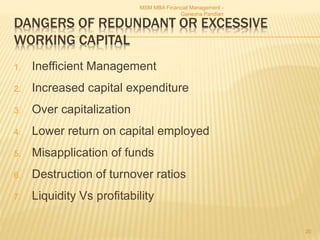
DANGERS OF REDUNDANT OR EXCESSIVE
WORKING CAPITAL
1. Inefficient Management
2. Increased capital expenditure
3. Over capitalization
4. Lower return on capital employed
5. Misapplication of funds
6. Destruction of turnover ratios
7. Liquidity Vs profitability
MSM MBA Financial Management -
Ganesha Pandian
20
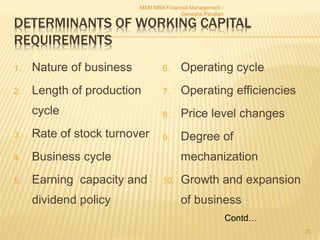
DETERMINANTS OF WORKING CAPITAL
REQUIREMENTS
1. Nature of business
2. Length of production
cycle
3. Rate of stock turnover
4. Business cycle
5. Earning capacity and
dividend policy
6. Operating cycle
7. Operating efficiencies
8. Price level changes
9. Degree of
mechanization
10. Growth and expansion
of business
MSM MBA Financial Management -
Ganesha Pandian
21
Contd…
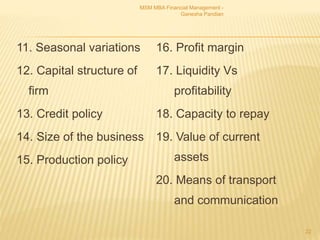
11. Seasonal variations
12. Capital structure of
firm
13. Credit policy
14. Size of the business
15. Production policy
16. Profit margin
17. Liquidity Vs
profitability
18. Capacity to repay
19. Value of current
assets
20. Means of transport
and communication
MSM MBA Financial Management -
Ganesha Pandian
22
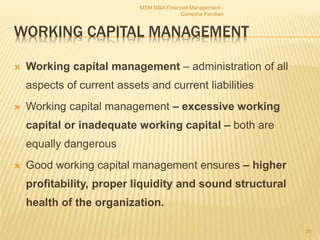
WORKING CAPITAL MANAGEMENT
 Working capital management – administration of all
aspects of current assets and current liabilities
 Working capital management – excessive working
capital or inadequate working capital – both are
equally dangerous
 Good working capital management ensures – higher
profitability, proper liquidity and sound structural
health of the organization.
MSM MBA Financial Management -
Ganesha Pandian
23
 Two functions of finance manager in
working capital management:
1. Forecasting the working capital
requirements
2. Finding the sources of working capital
MSM MBA Financial Management -
Ganesha Pandian
24
I. FORECASTING THE WORKING CAPITAL
REQUIREMENT S
 There are two methods adopted to
forecast the working capital
requirements
1. Operating cycle method
2. Estimation of components of
working capital method
MSM MBA Financial Management -
Ganesha Pandian
25
OPERATING CYCLE METHOD
MSM MBA Financial Management -
Ganesha Pandian
26
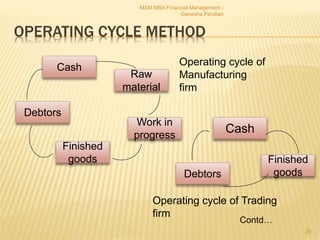
Cash
Raw
material
Debtors
Work in
progress
Finished
goods Finished
goods
Cash
Debtors
Operating cycle of
Manufacturing
firm
Operating cycle of Trading
firm
Contd…
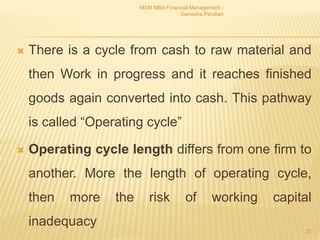
 There is a cycle from cash to raw material and
then Work in progress and it reaches finished
goods again converted into cash. This pathway
is called “Operating cycle”
 Operating cycle length differs from one firm to
another. More the length of operating cycle,
then more the risk of working capital
inadequacy
MSM MBA Financial Management -
Ganesha Pandian
27
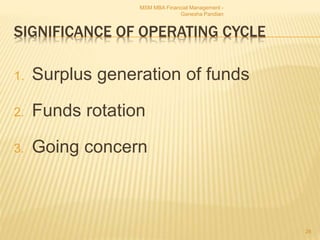
SIGNIFICANCE OF OPERATING CYCLE
1. Surplus generation of funds
2. Funds rotation
3. Going concern
MSM MBA Financial Management -
Ganesha Pandian
28
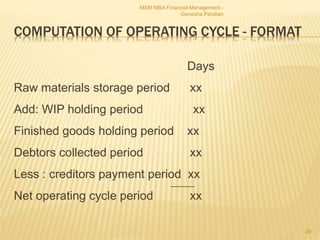
COMPUTATION OF OPERATING CYCLE - FORMAT
Days
Raw materials storage period xx
Add: WIP holding period xx
Finished goods holding period xx
Debtors collected period xx
Less : creditors payment period xx
Net operating cycle period xx
MSM MBA Financial Management -
Ganesha Pandian
29
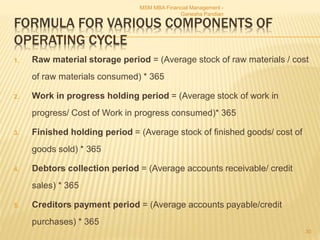
FORMULA FOR VARIOUS COMPONENTS OF
OPERATING CYCLE
1. Raw material storage period = (Average stock of raw materials / cost
of raw materials consumed) * 365
2. Work in progress holding period = (Average stock of work in
progress/ Cost of Work in progress consumed)* 365
3. Finished holding period = (Average stock of finished goods/ cost of
goods sold) * 365
4. Debtors collection period = (Average accounts receivable/ credit
sales) * 365
5. Creditors payment period = (Average accounts payable/credit
purchases) * 365
MSM MBA Financial Management -
Ganesha Pandian
30
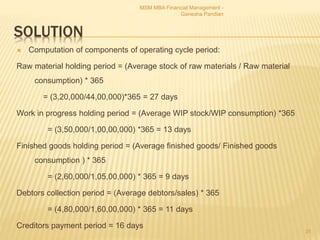
SOLUTION
 Computation of components of operating cycle period:
Raw material holding period = (Average stock of raw materials / Raw material
consumption) * 365
= (3,20,000/44,00,000)*365 = 27 days
Work in progress holding period = (Average WIP stock/WIP consumption) *365
= (3,50,000/1,00,00,000) *365 = 13 days
Finished goods holding period = (Average finished goods/ Finished goods
consumption ) * 365
= (2,60,000/1,05,00,000) * 365 = 9 days
Debtors collection period = (Average debtors/sales) * 365
= (4,80,000/1,60,00,000) * 365 = 11 days
Creditors payment period = 16 days
MSM MBA Financial Management -
Ganesha Pandian
31
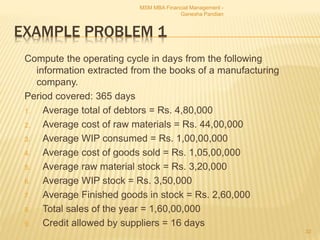
EXAMPLE PROBLEM 1
Compute the operating cycle in days from the following
information extracted from the books of a manufacturing
company.
Period covered: 365 days
1. Average total of debtors = Rs. 4,80,000
2. Average cost of raw materials = Rs. 44,00,000
3. Average WIP consumed = Rs. 1,00,00,000
4. Average cost of goods sold = Rs. 1,05,00,000
5. Average raw material stock = Rs. 3,20,000
6. Average WIP stock = Rs. 3,50,000
7. Average Finished goods in stock = Rs. 2,60,000
8. Total sales of the year = 1,60,00,000
9. Credit allowed by suppliers = 16 days
MSM MBA Financial Management -
Ganesha Pandian
32
COMPUTATION OF NET OPERATING CYCLE
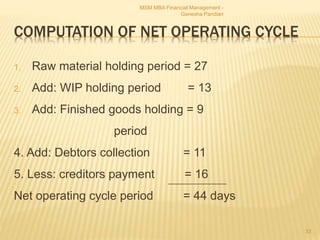
1. Raw material holding period = 27
2. Add: WIP holding period = 13
3. Add: Finished goods holding = 9
period
4. Add: Debtors collection = 11
5. Less: creditors payment = 16
Net operating cycle period = 44 days
MSM MBA Financial Management -
Ganesha Pandian
33
II. ESTIMATION OF COMPONENTS OF WORKING
CAPITAL METHOD
 Working capital can be estimated by working
out different constituents of current assets
and current liabilities.
2 components of estimation 1. current assets
2. current liabilities
MSM MBA Financial Management -
Ganesha Pandian
34
FORMULA FOR ESTIMATING CURRENT ASSETS
a. Stock of raw materials = [ estimated production
* estimated cost of RM/unit]*Average RM
holding period/365
b. Stock of finished goods = [estimated
production * estimated cost of production/unit] *
average holding period of finished goods/365
MSM MBA Financial Management -
Ganesha Pandian
35
Contd…
 Stock of Work in progress calculation is
different 50% labor and 50% overheads
consumed
[estimated production * estimated cost of Work in
progress]* average WIP holding period/365 =
xxx
Add: Labor
[estimated production * estimated cost of labor in
progress]* average WIP holding period/365 * 1/2 =
xxx
Add: overheads
[estimated production * estimated cost of overheads]*
average WIP holding period/365*1/2 =
xxx
MSM MBA Financial Management -
Ganesha Pandian
36
Contd…
C, stock of finished goods = [estimated
production*cost of
production/unit]*Average holding period of
finished goods/365
D, Trade debtors = [estimated credit
sales*cost of sales/units]* debt collection
period
MSM MBA Financial Management -
Ganesha Pandian
37
FORMULA FOR ESTIMATING CURRENT
LIABILITIES
a. Trade creditors = [estimated production (units)* cost of raw
material/ unit] * average payment period/ 365
b. Outstanding expenses:
Outstanding wages = [estimated production(units) * Direct labor] *
average time lag in payment of wages/365
Outstanding overheads = [estimated production (units)*
overheads/unit] * average time lag of payment of OH/365
Note: In case of selling overheads, the relevant item would be
sales volume instead of production volume
MSM MBA Financial Management -
Ganesha Pandian
38
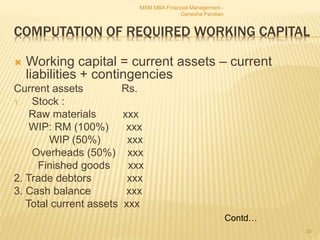
COMPUTATION OF REQUIRED WORKING CAPITAL
 Working capital = current assets – current
liabilities + contingencies
Current assets Rs.
1. Stock :
Raw materials xxx
WIP: RM (100%) xxx
WIP (50%) xxx
Overheads (50%) xxx
Finished goods xxx
2. Trade debtors xxx
3. Cash balance xxx
Total current assets xxx
MSM MBA Financial Management -
Ganesha Pandian
39
Contd…
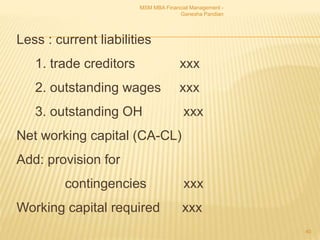
Less : current liabilities
1. trade creditors xxx
2. outstanding wages xxx
3. outstanding OH xxx
Net working capital (CA-CL)
Add: provision for
contingencies xxx
Working capital required xxx
MSM MBA Financial Management -
Ganesha Pandian
40
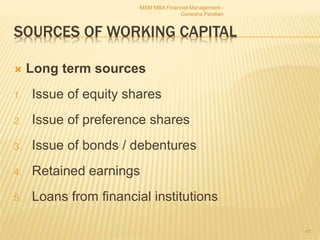
SOURCES OF WORKING CAPITAL
 Long term sources
1. Issue of equity shares
2. Issue of preference shares
3. Issue of bonds / debentures
4. Retained earnings
5. Loans from financial institutions
MSM MBA Financial Management -
Ganesha Pandian
41
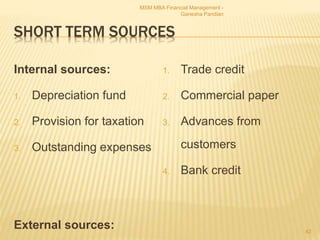
SHORT TERM SOURCES
Internal sources:
1. Depreciation fund
2. Provision for taxation
3. Outstanding expenses
External sources:
1. Trade credit
2. Commercial paper
3. Advances from
customers
4. Bank credit
MSM MBA Financial Management -
Ganesha Pandian
42
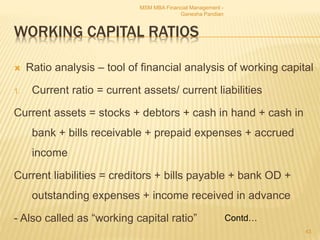
WORKING CAPITAL RATIOS
 Ratio analysis – tool of financial analysis of working capital
1. Current ratio = current assets/ current liabilities
Current assets = stocks + debtors + cash in hand + cash in
bank + bills receivable + prepaid expenses + accrued
income
Current liabilities = creditors + bills payable + bank OD +
outstanding expenses + income received in advance
- Also called as “working capital ratio”
MSM MBA Financial Management -
Ganesha Pandian
43
Contd…
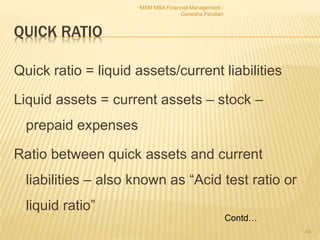
QUICK RATIO
Quick ratio = liquid assets/current liabilities
Liquid assets = current assets – stock –
prepaid expenses
Ratio between quick assets and current
liabilities – also known as “Acid test ratio or
liquid ratio”
MSM MBA Financial Management -
Ganesha Pandian
44
Contd…
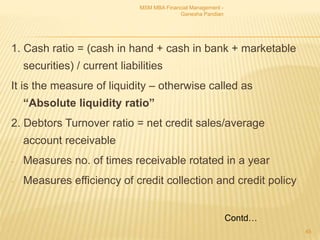
1. Cash ratio = (cash in hand + cash in bank + marketable
securities) / current liabilities
It is the measure of liquidity – otherwise called as
“Absolute liquidity ratio”
2. Debtors Turnover ratio = net credit sales/average
account receivable
- Measures no. of times receivable rotated in a year
- Measures efficiency of credit collection and credit policy
MSM MBA Financial Management -
Ganesha Pandian
45
Contd…
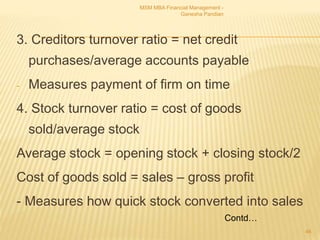
3. Creditors turnover ratio = net credit
purchases/average accounts payable
- Measures payment of firm on time
4. Stock turnover ratio = cost of goods
sold/average stock
Average stock = opening stock + closing stock/2
Cost of goods sold = sales – gross profit
- Measures how quick stock converted into sales
MSM MBA Financial Management -
Ganesha Pandian
46
Contd…
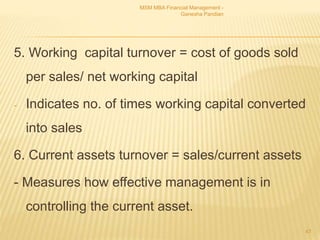
5. Working capital turnover = cost of goods sold
per sales/ net working capital
- Indicates no. of times working capital converted
into sales
6. Current assets turnover = sales/current assets
- Measures how effective management is in
controlling the current asset.
MSM MBA Financial Management -
Ganesha Pandian
47
CASH MANAGEMENT
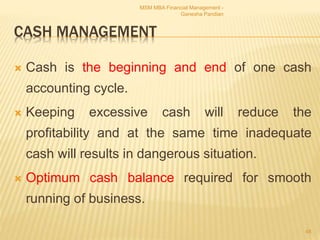
 Cash is the beginning and end of one cash
accounting cycle.
 Keeping excessive cash will reduce the
profitability and at the same time inadequate
cash will results in dangerous situation.
 Optimum cash balance required for smooth
running of business.
MSM MBA Financial Management -
Ganesha Pandian
48
MEANING OF CASH
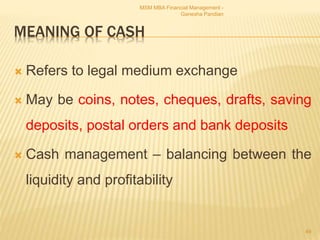
 Refers to legal medium exchange
 May be coins, notes, cheques, drafts, saving
deposits, postal orders and bank deposits
 Cash management – balancing between the
liquidity and profitability
MSM MBA Financial Management -
Ganesha Pandian
49
OBJECTIVES OF CASH MANAGEMENT
1. To make payment according to
payment schedule
2. To minimize cash balance
MSM MBA Financial Management -
Ganesha Pandian
50
CASH BUDGET
 A cash budget shows the cash inflows
and outflows expected in a budget period
and net effect of these flows on cash
balances
MSM MBA Financial Management -
Ganesha Pandian
51
UTILITY OF CASH BUDGET
1. Indicates effect on the cash position – seasonal requirements,
large inventories, unusual receipts and payments.
2. Cash need for expansion project
3. Additional funds taken from external sources
4. Indicates the availability of cash
5. Helps in planning of liquidity and investment
6. Shows the excess availability of funds for long and short term
investments
MSM MBA Financial Management -
Ganesha Pandian
52
METHODS OF PREPARING CASH BUDGET
1. Receipts and payments method
2. Adjusted profit and loss method
3. Balance sheet method
MSM MBA Financial Management -
Ganesha Pandian
53
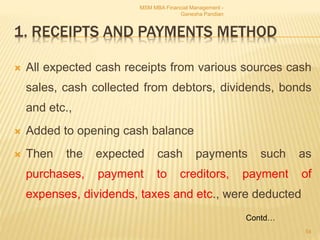
1. RECEIPTS AND PAYMENTS METHOD
 All expected cash receipts from various sources cash
sales, cash collected from debtors, dividends, bonds
and etc.,
 Added to opening cash balance
 Then the expected cash payments such as
purchases, payment to creditors, payment of
expenses, dividends, taxes and etc., were deducted
MSM MBA Financial Management -
Ganesha Pandian
54
Contd…
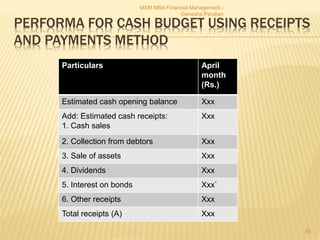
PERFORMA FOR CASH BUDGET USING RECEIPTS
AND PAYMENTS METHOD
Particulars April
month
(Rs.)
Estimated cash opening balance Xxx
Add: Estimated cash receipts:
1. Cash sales
Xxx
2. Collection from debtors Xxx
3. Sale of assets Xxx
4. Dividends Xxx
5. Interest on bonds Xxx`
6. Other receipts Xxx
Total receipts (A) Xxx
MSM MBA Financial Management -
Ganesha Pandian
55
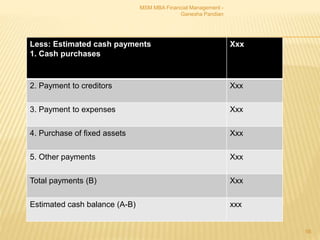
Less: Estimated cash payments
1. Cash purchases
Xxx
2. Payment to creditors Xxx
3. Payment to expenses Xxx
4. Purchase of fixed assets Xxx
5. Other payments Xxx
Total payments (B) Xxx
Estimated cash balance (A-B) xxx
MSM MBA Financial Management -
Ganesha Pandian
56
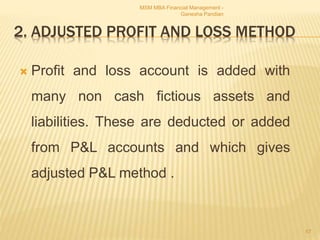
2. ADJUSTED PROFIT AND LOSS METHOD
 Profit and loss account is added with
many non cash fictious assets and
liabilities. These are deducted or added
from P&L accounts and which gives
adjusted P&L method .
MSM MBA Financial Management -
Ganesha Pandian
57
3. BALANCE SHEET METHOD
 In this method, the cash flows are found out
by balance sheet prepared at the end of the
year.
 Defects in this method are 1. ignores income
and expense 2. cash position known after
balance sheet prepared.
MSM MBA Financial Management -
Ganesha Pandian
58
CASH MANAGEMENT CONTROL
 Receipts of cash speed up and the cash
receipts ensured by two collection process:
1. Concentration banking – make bank to
accept payment
2. Lock box system – nearest company
location (box)
MSM MBA Financial Management -
Ganesha Pandian
59
CASH MANAGEMENT MODELS
Objective to maintain optimum cash balance
2 categories of estimating optimal cash
balance
1. Inventory type model
2. Stochastic model
MSM MBA Financial Management -
Ganesha Pandian
60
INVENTORY TYPE MODEL – EOQ MODEL
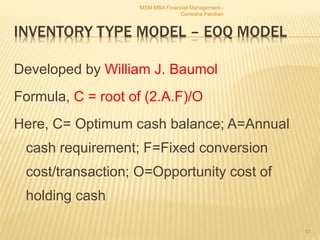
Developed by William J. Baumol
Formula, C = root of (2.A.F)/O
Here, C= Optimum cash balance; A=Annual
cash requirement; F=Fixed conversion
cost/transaction; O=Opportunity cost of
holding cash
MSM MBA Financial Management -
Ganesha Pandian
61
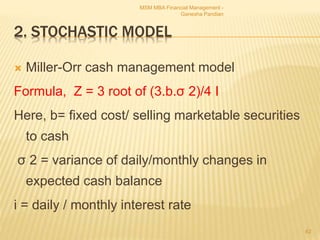
2. STOCHASTIC MODEL
 Miller-Orr cash management model
Formula, Z = 3 root of (3.b.σ 2)/4 I
Here, b= fixed cost/ selling marketable securities
to cash
σ 2 = variance of daily/monthly changes in
expected cash balance
i = daily / monthly interest rate
MSM MBA Financial Management -
Ganesha Pandian
62
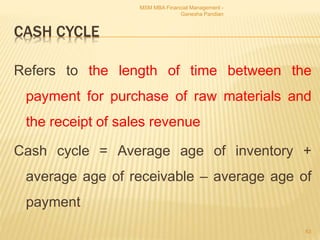
CASH CYCLE
Refers to the length of time between the
payment for purchase of raw materials and
the receipt of sales revenue
Cash cycle = Average age of inventory +
average age of receivable – average age of
payment
MSM MBA Financial Management -
Ganesha Pandian
63
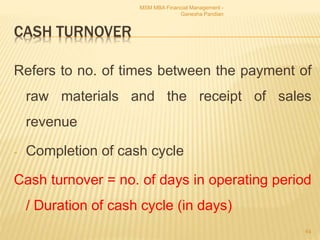
CASH TURNOVER
Refers to no. of times between the payment of
raw materials and the receipt of sales
revenue
- Completion of cash cycle
Cash turnover = no. of days in operating period
/ Duration of cash cycle (in days)
MSM MBA Financial Management -
Ganesha Pandian
64
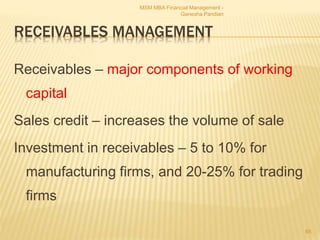
RECEIVABLES MANAGEMENT
Receivables – major components of working
capital
Sales credit – increases the volume of sale
Investment in receivables – 5 to 10% for
manufacturing firms, and 20-25% for trading
firms
MSM MBA Financial Management -
Ganesha Pandian
65
MEANING OF RECEIVABLES MANAGEMENT
Refers to all the sum of cash owned to firm by
the customers arising from the sales of
goods.
Asset side of balance sheet contains debtors,
accounts receivable, trade receivable
MSM MBA Financial Management -
Ganesha Pandian
66
RECEIVABLES MANAGEMENT
 Process of taking decisions regarding the
amount of investment in receivables
 Higher the receivables; higher sales ; higher
bad debts, interest rate and collection cost.
 Lower the receivables; lower sales;
opportunity cost; loss of customers; lower
bad debts
MSM MBA Financial Management -
Ganesha Pandian
67
PURPOSE OF MAINTAINING RECEIVABLES
1. Increase in sales
2. Increase in profits
3. Meeting competition
MSM MBA Financial Management -
Ganesha Pandian
68
COST OF MAINTAINING RECEIVABLES
1. Capital cost – cost incurred to pay the outsider
2. Administrative cost – cost incurred for maintaining
the customer accounts
3. Collection cost – cost of expenses for collecting
credit back from customers
4. Defaulting cost – cost incurred for taking serious
steps in collecting from defaulting customers
MSM MBA Financial Management -
Ganesha Pandian
69
ASPECTS OF MANAGEMENT OF RECEIVABLES
 3 aspects are:
1. Credit policy
2. Credit analysis
3. Control of receivables
MSM MBA Financial Management -
Ganesha Pandian
70
I. CREDIT POLICY
 Criteria/standard set by the company
- If below standard, then lenient credit policy
followed.
- If above the standard, then tight credit policy
is followed
MSM MBA Financial Management -
Ganesha Pandian
71
Contd…
1. In liberal/lenient credit policy – high
collection cost; increased average collection
period; high bad debts and high sales
2. In restrictive credit policy – low collection
cost; decreased average collection period;
low bad debts and low credit sales
MSM MBA Financial Management -
Ganesha Pandian
72
II CREDIT TERMS
- Terms and conditions of credit sales.
Two components are 1. credit period 2. cash
discount
1. Credit period – duration of time period,
credit extended
2. Cash discount – discounts offered to
creditors and induce the prompt payment
MSM MBA Financial Management -
Ganesha Pandian
73
III CREDIT ANALYSIS
- Rate the various customers who seek credit
facility
- Credit worthiness of the project
Sources of credit information:
1. Published information 2. Bank references
3. Trade references 4. Salesman’s interview
5. Report from the agencies 6. Past
MSM MBA Financial Management -
Ganesha Pandian
74
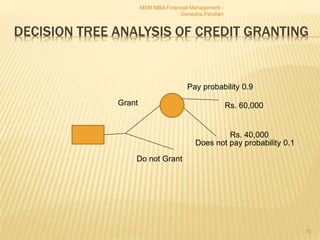
DECISION TREE ANALYSIS OF CREDIT GRANTING
MSM MBA Financial Management -
Ganesha Pandian
75
Grant
Do not Grant
Pay probability 0.9
Does not pay probability 0.1
Rs. 60,000
Rs. 40,000
CONTROL OF RECEIVABLES
1. Degree of collection efforts
2. Type of collection efforts
MSM MBA Financial Management -
Ganesha Pandian
76
MONITORING OF RECEIVABLES
 Receivables have to be monitored
continuously to ensure the revenue of
collection efforts
1. Average collection period
2. Ageing schedule
MSM MBA Financial Management -
Ganesha Pandian
77
INVENTORY MANAGEMENT
- Risk reduced considerably by holding
inventory
Meaning of inventory:
1. Refers to the stock pile of the product
2. Composed of assets that will be sold off in
the course of business operation.
MSM MBA Financial Management -
Ganesha Pandian
78
DEFINITION OF INVENTORY
 According to International Accounting
Standards committee
Inventory is a tangible property
a. Held for sale in ordinary course of business
b. In the process of production of such sale (Or)
c. To be consumed in the production of goods or
services for sale
MSM MBA Financial Management -
Ganesha Pandian
79
CATEGORIES OF INVENTORIES
1. Raw material
2. Purchased parts
3. Work in progress
4. Finished goods
5. Supplies
MSM MBA Financial Management -
Ganesha Pandian
80
NEED/PURPOSE OF HOLDING INVENTORY
1. Transaction motive: smooth and uninterrupted
production and sale operations
2. Precaution motive: the firm may like to hold them to
guard against risk of unpredictable changes in
demand and supply forces
3. Speculative motive: price advantage for bulk
purchasing or anticipated price rise risk in near
future
MSM MBA Financial Management -
Ganesha Pandian
81
BENEFITS OF HOLDING INVENTORY
1. Avoiding loss of sales
2. Gaining quality discount
3. Reducing ordering cost
4. Achieve efficient production runs
5. Reducing risk of production shortages
MSM MBA Financial Management -
Ganesha Pandian
82
INVENTORY MANAGEMENT
 Focuses on determining and maintaining an
optimum level of inventory in the firm
 It minimizes the procurement cost and
maintaining the optimum inventory level
MSM MBA Financial Management -
Ganesha Pandian
83
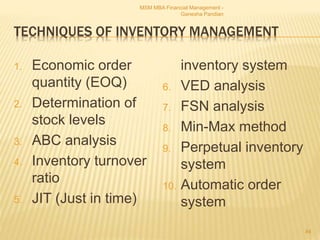
TECHNIQUES OF INVENTORY MANAGEMENT
1. Economic order
quantity (EOQ)
2. Determination of
stock levels
3. ABC analysis
4. Inventory turnover
ratio
5. JIT (Just in time)
inventory system
6. VED analysis
7. FSN analysis
8. Min-Max method
9. Perpetual inventory
system
10. Automatic order
system
MSM MBA Financial Management -
Ganesha Pandian
84
MSM MBA Financial Management -
Ganesha Pandian
85

Financial management unit 4 working capital management

  • 1.
    Prepared and presentedby, N. Ganesha Pandian FINANCIAL MANAGEMENT COURSE CODE: BA 5203 UNIT 4: WORKING CAPITAL MANAGEMENT 1 MSM MBA Financial Management - Ganesha Pandian
  • 2.
    CONTENT  Principles ofworking capital  Concepts, Needs, Determinants, issues and estimation of working capital  Accounts Receivables Management and factoring  Inventory management  Cash management  Working capital finance : Trade credit, Bank finance and Commercial paper 2 MSM MBA Financial Management - Ganesha Pandian
  • 3.
    INTRODUCTION  Firm needsto survive short term, in order to make profit in long term. Meaning of Working capital:  Amount of funds required for meeting day to day expenses of the business.  Part of firm’s capital which is required for financing short term or current assets such as cash, marketable securities, debtors and inventories MSM MBA Financial Management - Ganesha Pandian 3
  • 4.
     Funds incurrent assets – revolving fast and are constantly converted into cash and back into asset.  Also known as revolving or circulating or short term capital MSM MBA Financial Management - Ganesha Pandian 4
  • 5.
    DEFINITION OF WORKINGCAPITAL  Shubin : Working Capital is a part of capital which is required to purchase of raw materials and for meeting day to day expenditure on salaries, wages, rent and advertisement etc.,  C.W. Gerstenberg: Working Capital is the excess of current assets over current MSM MBA Financial Management - Ganesha Pandian 5
  • 6.
    CONCEPT OF WORKINGCAPITAL 1. Gross concept: amount of funds invested in current assets that are employed in the firm. Current assets and working capital both used interchangeably Current assets: refers to those assets which can be converted into cash in hand within a short period (one accounting year) MSM MBA Financial Management - Ganesha Pandian 6 Contd…
  • 7.
    Current assets  includescash in hand, with banks, stock finished, work in progress, receivables, sale merchandise, marketable securities, prepaid expenses and accrued income MSM MBA Financial Management - Ganesha Pandian 7 Contd…
  • 8.
    2. Net concept:Working capital is the excess of current assets over current liabilities. Net working capital = current assets – current liabilities Current liabilities includes: claims of outsiders expected to mature within one accounting period MSM MBA Financial Management - Ganesha Pandian 8 Contd…
  • 9.
     Current liabilitiesincludes: sundry creditors, bills payable, bank overdraft, outstanding expenses , short term loans, advances and deposits and etc., When current assets exceeds current liability – it is positive working capital When current liabilities exceeds current assets – it is negative working capital MSM MBA Financial Management - Ganesha Pandian 9
  • 10.
    TYPES OF WORKINGCAPITAL MSM MBA Financial Management - Ganesha Pandian 10 Working capital SpecialSeasonal Temporary or variable/ fluctuating Permanent or fixed Reserve Margin (cushion)Regular
  • 11.
    PERMANENT WORKING CAPITAL Amountof funds required to produce goods and services Tandon Committee named it as “Core current Assets” Such capital is constantly changing from one asset to another asset without leaving business process and doesn't change over the time period. MSM MBA Financial Management - Ganesha Pandian 11
  • 12.
    1. REGULAR WORKINGCAPITAL  Regular working capital is the minimum amount of liquid capital needed to keep up the circulation of the capital from cash to inventories to receivable and again to cash. MSM MBA Financial Management - Ganesha Pandian 12
  • 13.
    2. RESERVE MARGIN/CUSHION WORKING CAPITAL  Reserve working capital is the excess over the need for regular working capital  For contingencies that arise at unstated period  Contingencies such as price rise, business depression, war condition, strike, fire and severe competition MSM MBA Financial Management - Ganesha Pandian 13
  • 14.
    FEATURES OF PERMANENTWORKING CAPITAL  Classified on the basis of time factor  Constantly changes from one asset to another asset  Size increases with the growth of business  Should be financed out of long term funds MSM MBA Financial Management - Ganesha Pandian 14
  • 15.
    TEMPORARY WORKING CAPITAL Working capital over and above permanent working capital and is dependent on factors like peak season, trade cycle, boom and etc,. MSM MBA Financial Management - Ganesha Pandian 15
  • 16.
    1. SEASONAL WORKINGCAPITAL Additional amount of capital asset (cash, receivables and inventory) required during the most active business seasons of the year. MSM MBA Financial Management - Ganesha Pandian 16
  • 17.
    SPECIAL WORKING CAPITAL Requiredfor financing special operations It is not always gainful MSM MBA Financial Management - Ganesha Pandian 17
  • 18.
    SIGNIFICANCE OF WORKINGCAPITAL  Working capital supply adequate funds 1. To equip raw materials (production) 2. Cash to meet wage bills 3. Capacity to wait for market for its finished products 4. The ability to grant credit to its customers MSM MBA Financial Management - Ganesha Pandian 18
  • 19.
    ADVANTAGES OF ADEQUATEWORKING CAPITAL 1. Cash discount 2. Sense of security and confidence 3. Credit worthiness 4. Continuous supply of raw materials 5. Exploitation of good opportunities 6. Increase in productivity 7. Attractive dividend 8. Meeting unforeseen contingencies MSM MBA Financial Management - Ganesha Pandian 19
  • 20.
    DANGERS OF REDUNDANTOR EXCESSIVE WORKING CAPITAL 1. Inefficient Management 2. Increased capital expenditure 3. Over capitalization 4. Lower return on capital employed 5. Misapplication of funds 6. Destruction of turnover ratios 7. Liquidity Vs profitability MSM MBA Financial Management - Ganesha Pandian 20
  • 21.
    DETERMINANTS OF WORKINGCAPITAL REQUIREMENTS 1. Nature of business 2. Length of production cycle 3. Rate of stock turnover 4. Business cycle 5. Earning capacity and dividend policy 6. Operating cycle 7. Operating efficiencies 8. Price level changes 9. Degree of mechanization 10. Growth and expansion of business MSM MBA Financial Management - Ganesha Pandian 21 Contd…
  • 22.
    11. Seasonal variations 12.Capital structure of firm 13. Credit policy 14. Size of the business 15. Production policy 16. Profit margin 17. Liquidity Vs profitability 18. Capacity to repay 19. Value of current assets 20. Means of transport and communication MSM MBA Financial Management - Ganesha Pandian 22
  • 23.
    WORKING CAPITAL MANAGEMENT Working capital management – administration of all aspects of current assets and current liabilities  Working capital management – excessive working capital or inadequate working capital – both are equally dangerous  Good working capital management ensures – higher profitability, proper liquidity and sound structural health of the organization. MSM MBA Financial Management - Ganesha Pandian 23
  • 24.
     Two functionsof finance manager in working capital management: 1. Forecasting the working capital requirements 2. Finding the sources of working capital MSM MBA Financial Management - Ganesha Pandian 24
  • 25.
    I. FORECASTING THEWORKING CAPITAL REQUIREMENT S  There are two methods adopted to forecast the working capital requirements 1. Operating cycle method 2. Estimation of components of working capital method MSM MBA Financial Management - Ganesha Pandian 25
  • 26.
    OPERATING CYCLE METHOD MSMMBA Financial Management - Ganesha Pandian 26 Cash Raw material Debtors Work in progress Finished goods Finished goods Cash Debtors Operating cycle of Manufacturing firm Operating cycle of Trading firm Contd…
  • 27.
     There isa cycle from cash to raw material and then Work in progress and it reaches finished goods again converted into cash. This pathway is called “Operating cycle”  Operating cycle length differs from one firm to another. More the length of operating cycle, then more the risk of working capital inadequacy MSM MBA Financial Management - Ganesha Pandian 27
  • 28.
    SIGNIFICANCE OF OPERATINGCYCLE 1. Surplus generation of funds 2. Funds rotation 3. Going concern MSM MBA Financial Management - Ganesha Pandian 28
  • 29.
    COMPUTATION OF OPERATINGCYCLE - FORMAT Days Raw materials storage period xx Add: WIP holding period xx Finished goods holding period xx Debtors collected period xx Less : creditors payment period xx Net operating cycle period xx MSM MBA Financial Management - Ganesha Pandian 29
  • 30.
    FORMULA FOR VARIOUSCOMPONENTS OF OPERATING CYCLE 1. Raw material storage period = (Average stock of raw materials / cost of raw materials consumed) * 365 2. Work in progress holding period = (Average stock of work in progress/ Cost of Work in progress consumed)* 365 3. Finished holding period = (Average stock of finished goods/ cost of goods sold) * 365 4. Debtors collection period = (Average accounts receivable/ credit sales) * 365 5. Creditors payment period = (Average accounts payable/credit purchases) * 365 MSM MBA Financial Management - Ganesha Pandian 30
  • 31.
    SOLUTION  Computation ofcomponents of operating cycle period: Raw material holding period = (Average stock of raw materials / Raw material consumption) * 365 = (3,20,000/44,00,000)*365 = 27 days Work in progress holding period = (Average WIP stock/WIP consumption) *365 = (3,50,000/1,00,00,000) *365 = 13 days Finished goods holding period = (Average finished goods/ Finished goods consumption ) * 365 = (2,60,000/1,05,00,000) * 365 = 9 days Debtors collection period = (Average debtors/sales) * 365 = (4,80,000/1,60,00,000) * 365 = 11 days Creditors payment period = 16 days MSM MBA Financial Management - Ganesha Pandian 31
  • 32.
    EXAMPLE PROBLEM 1 Computethe operating cycle in days from the following information extracted from the books of a manufacturing company. Period covered: 365 days 1. Average total of debtors = Rs. 4,80,000 2. Average cost of raw materials = Rs. 44,00,000 3. Average WIP consumed = Rs. 1,00,00,000 4. Average cost of goods sold = Rs. 1,05,00,000 5. Average raw material stock = Rs. 3,20,000 6. Average WIP stock = Rs. 3,50,000 7. Average Finished goods in stock = Rs. 2,60,000 8. Total sales of the year = 1,60,00,000 9. Credit allowed by suppliers = 16 days MSM MBA Financial Management - Ganesha Pandian 32
  • 33.
    COMPUTATION OF NETOPERATING CYCLE 1. Raw material holding period = 27 2. Add: WIP holding period = 13 3. Add: Finished goods holding = 9 period 4. Add: Debtors collection = 11 5. Less: creditors payment = 16 Net operating cycle period = 44 days MSM MBA Financial Management - Ganesha Pandian 33
  • 34.
    II. ESTIMATION OFCOMPONENTS OF WORKING CAPITAL METHOD  Working capital can be estimated by working out different constituents of current assets and current liabilities. 2 components of estimation 1. current assets 2. current liabilities MSM MBA Financial Management - Ganesha Pandian 34
  • 35.
    FORMULA FOR ESTIMATINGCURRENT ASSETS a. Stock of raw materials = [ estimated production * estimated cost of RM/unit]*Average RM holding period/365 b. Stock of finished goods = [estimated production * estimated cost of production/unit] * average holding period of finished goods/365 MSM MBA Financial Management - Ganesha Pandian 35 Contd…
  • 36.
     Stock ofWork in progress calculation is different 50% labor and 50% overheads consumed [estimated production * estimated cost of Work in progress]* average WIP holding period/365 = xxx Add: Labor [estimated production * estimated cost of labor in progress]* average WIP holding period/365 * 1/2 = xxx Add: overheads [estimated production * estimated cost of overheads]* average WIP holding period/365*1/2 = xxx MSM MBA Financial Management - Ganesha Pandian 36 Contd…
  • 37.
    C, stock offinished goods = [estimated production*cost of production/unit]*Average holding period of finished goods/365 D, Trade debtors = [estimated credit sales*cost of sales/units]* debt collection period MSM MBA Financial Management - Ganesha Pandian 37
  • 38.
    FORMULA FOR ESTIMATINGCURRENT LIABILITIES a. Trade creditors = [estimated production (units)* cost of raw material/ unit] * average payment period/ 365 b. Outstanding expenses: Outstanding wages = [estimated production(units) * Direct labor] * average time lag in payment of wages/365 Outstanding overheads = [estimated production (units)* overheads/unit] * average time lag of payment of OH/365 Note: In case of selling overheads, the relevant item would be sales volume instead of production volume MSM MBA Financial Management - Ganesha Pandian 38
  • 39.
    COMPUTATION OF REQUIREDWORKING CAPITAL  Working capital = current assets – current liabilities + contingencies Current assets Rs. 1. Stock : Raw materials xxx WIP: RM (100%) xxx WIP (50%) xxx Overheads (50%) xxx Finished goods xxx 2. Trade debtors xxx 3. Cash balance xxx Total current assets xxx MSM MBA Financial Management - Ganesha Pandian 39 Contd…
  • 40.
    Less : currentliabilities 1. trade creditors xxx 2. outstanding wages xxx 3. outstanding OH xxx Net working capital (CA-CL) Add: provision for contingencies xxx Working capital required xxx MSM MBA Financial Management - Ganesha Pandian 40
  • 41.
    SOURCES OF WORKINGCAPITAL  Long term sources 1. Issue of equity shares 2. Issue of preference shares 3. Issue of bonds / debentures 4. Retained earnings 5. Loans from financial institutions MSM MBA Financial Management - Ganesha Pandian 41
  • 42.
    SHORT TERM SOURCES Internalsources: 1. Depreciation fund 2. Provision for taxation 3. Outstanding expenses External sources: 1. Trade credit 2. Commercial paper 3. Advances from customers 4. Bank credit MSM MBA Financial Management - Ganesha Pandian 42
  • 43.
    WORKING CAPITAL RATIOS Ratio analysis – tool of financial analysis of working capital 1. Current ratio = current assets/ current liabilities Current assets = stocks + debtors + cash in hand + cash in bank + bills receivable + prepaid expenses + accrued income Current liabilities = creditors + bills payable + bank OD + outstanding expenses + income received in advance - Also called as “working capital ratio” MSM MBA Financial Management - Ganesha Pandian 43 Contd…
  • 44.
    QUICK RATIO Quick ratio= liquid assets/current liabilities Liquid assets = current assets – stock – prepaid expenses Ratio between quick assets and current liabilities – also known as “Acid test ratio or liquid ratio” MSM MBA Financial Management - Ganesha Pandian 44 Contd…
  • 45.
    1. Cash ratio= (cash in hand + cash in bank + marketable securities) / current liabilities It is the measure of liquidity – otherwise called as “Absolute liquidity ratio” 2. Debtors Turnover ratio = net credit sales/average account receivable - Measures no. of times receivable rotated in a year - Measures efficiency of credit collection and credit policy MSM MBA Financial Management - Ganesha Pandian 45 Contd…
  • 46.
    3. Creditors turnoverratio = net credit purchases/average accounts payable - Measures payment of firm on time 4. Stock turnover ratio = cost of goods sold/average stock Average stock = opening stock + closing stock/2 Cost of goods sold = sales – gross profit - Measures how quick stock converted into sales MSM MBA Financial Management - Ganesha Pandian 46 Contd…
  • 47.
    5. Working capitalturnover = cost of goods sold per sales/ net working capital - Indicates no. of times working capital converted into sales 6. Current assets turnover = sales/current assets - Measures how effective management is in controlling the current asset. MSM MBA Financial Management - Ganesha Pandian 47
  • 48.
    CASH MANAGEMENT  Cashis the beginning and end of one cash accounting cycle.  Keeping excessive cash will reduce the profitability and at the same time inadequate cash will results in dangerous situation.  Optimum cash balance required for smooth running of business. MSM MBA Financial Management - Ganesha Pandian 48
  • 49.
    MEANING OF CASH Refers to legal medium exchange  May be coins, notes, cheques, drafts, saving deposits, postal orders and bank deposits  Cash management – balancing between the liquidity and profitability MSM MBA Financial Management - Ganesha Pandian 49
  • 50.
    OBJECTIVES OF CASHMANAGEMENT 1. To make payment according to payment schedule 2. To minimize cash balance MSM MBA Financial Management - Ganesha Pandian 50
  • 51.
    CASH BUDGET  Acash budget shows the cash inflows and outflows expected in a budget period and net effect of these flows on cash balances MSM MBA Financial Management - Ganesha Pandian 51
  • 52.
    UTILITY OF CASHBUDGET 1. Indicates effect on the cash position – seasonal requirements, large inventories, unusual receipts and payments. 2. Cash need for expansion project 3. Additional funds taken from external sources 4. Indicates the availability of cash 5. Helps in planning of liquidity and investment 6. Shows the excess availability of funds for long and short term investments MSM MBA Financial Management - Ganesha Pandian 52
  • 53.
    METHODS OF PREPARINGCASH BUDGET 1. Receipts and payments method 2. Adjusted profit and loss method 3. Balance sheet method MSM MBA Financial Management - Ganesha Pandian 53
  • 54.
    1. RECEIPTS ANDPAYMENTS METHOD  All expected cash receipts from various sources cash sales, cash collected from debtors, dividends, bonds and etc.,  Added to opening cash balance  Then the expected cash payments such as purchases, payment to creditors, payment of expenses, dividends, taxes and etc., were deducted MSM MBA Financial Management - Ganesha Pandian 54 Contd…
  • 55.
    PERFORMA FOR CASHBUDGET USING RECEIPTS AND PAYMENTS METHOD Particulars April month (Rs.) Estimated cash opening balance Xxx Add: Estimated cash receipts: 1. Cash sales Xxx 2. Collection from debtors Xxx 3. Sale of assets Xxx 4. Dividends Xxx 5. Interest on bonds Xxx` 6. Other receipts Xxx Total receipts (A) Xxx MSM MBA Financial Management - Ganesha Pandian 55
  • 56.
    Less: Estimated cashpayments 1. Cash purchases Xxx 2. Payment to creditors Xxx 3. Payment to expenses Xxx 4. Purchase of fixed assets Xxx 5. Other payments Xxx Total payments (B) Xxx Estimated cash balance (A-B) xxx MSM MBA Financial Management - Ganesha Pandian 56
  • 57.
    2. ADJUSTED PROFITAND LOSS METHOD  Profit and loss account is added with many non cash fictious assets and liabilities. These are deducted or added from P&L accounts and which gives adjusted P&L method . MSM MBA Financial Management - Ganesha Pandian 57
  • 58.
    3. BALANCE SHEETMETHOD  In this method, the cash flows are found out by balance sheet prepared at the end of the year.  Defects in this method are 1. ignores income and expense 2. cash position known after balance sheet prepared. MSM MBA Financial Management - Ganesha Pandian 58
  • 59.
    CASH MANAGEMENT CONTROL Receipts of cash speed up and the cash receipts ensured by two collection process: 1. Concentration banking – make bank to accept payment 2. Lock box system – nearest company location (box) MSM MBA Financial Management - Ganesha Pandian 59
  • 60.
    CASH MANAGEMENT MODELS Objectiveto maintain optimum cash balance 2 categories of estimating optimal cash balance 1. Inventory type model 2. Stochastic model MSM MBA Financial Management - Ganesha Pandian 60
  • 61.
    INVENTORY TYPE MODEL– EOQ MODEL Developed by William J. Baumol Formula, C = root of (2.A.F)/O Here, C= Optimum cash balance; A=Annual cash requirement; F=Fixed conversion cost/transaction; O=Opportunity cost of holding cash MSM MBA Financial Management - Ganesha Pandian 61
  • 62.
    2. STOCHASTIC MODEL Miller-Orr cash management model Formula, Z = 3 root of (3.b.σ 2)/4 I Here, b= fixed cost/ selling marketable securities to cash σ 2 = variance of daily/monthly changes in expected cash balance i = daily / monthly interest rate MSM MBA Financial Management - Ganesha Pandian 62
  • 63.
    CASH CYCLE Refers tothe length of time between the payment for purchase of raw materials and the receipt of sales revenue Cash cycle = Average age of inventory + average age of receivable – average age of payment MSM MBA Financial Management - Ganesha Pandian 63
  • 64.
    CASH TURNOVER Refers tono. of times between the payment of raw materials and the receipt of sales revenue - Completion of cash cycle Cash turnover = no. of days in operating period / Duration of cash cycle (in days) MSM MBA Financial Management - Ganesha Pandian 64
  • 65.
    RECEIVABLES MANAGEMENT Receivables –major components of working capital Sales credit – increases the volume of sale Investment in receivables – 5 to 10% for manufacturing firms, and 20-25% for trading firms MSM MBA Financial Management - Ganesha Pandian 65
  • 66.
    MEANING OF RECEIVABLESMANAGEMENT Refers to all the sum of cash owned to firm by the customers arising from the sales of goods. Asset side of balance sheet contains debtors, accounts receivable, trade receivable MSM MBA Financial Management - Ganesha Pandian 66
  • 67.
    RECEIVABLES MANAGEMENT  Processof taking decisions regarding the amount of investment in receivables  Higher the receivables; higher sales ; higher bad debts, interest rate and collection cost.  Lower the receivables; lower sales; opportunity cost; loss of customers; lower bad debts MSM MBA Financial Management - Ganesha Pandian 67
  • 68.
    PURPOSE OF MAINTAININGRECEIVABLES 1. Increase in sales 2. Increase in profits 3. Meeting competition MSM MBA Financial Management - Ganesha Pandian 68
  • 69.
    COST OF MAINTAININGRECEIVABLES 1. Capital cost – cost incurred to pay the outsider 2. Administrative cost – cost incurred for maintaining the customer accounts 3. Collection cost – cost of expenses for collecting credit back from customers 4. Defaulting cost – cost incurred for taking serious steps in collecting from defaulting customers MSM MBA Financial Management - Ganesha Pandian 69
  • 70.
    ASPECTS OF MANAGEMENTOF RECEIVABLES  3 aspects are: 1. Credit policy 2. Credit analysis 3. Control of receivables MSM MBA Financial Management - Ganesha Pandian 70
  • 71.
    I. CREDIT POLICY Criteria/standard set by the company - If below standard, then lenient credit policy followed. - If above the standard, then tight credit policy is followed MSM MBA Financial Management - Ganesha Pandian 71 Contd…
  • 72.
    1. In liberal/lenientcredit policy – high collection cost; increased average collection period; high bad debts and high sales 2. In restrictive credit policy – low collection cost; decreased average collection period; low bad debts and low credit sales MSM MBA Financial Management - Ganesha Pandian 72
  • 73.
    II CREDIT TERMS -Terms and conditions of credit sales. Two components are 1. credit period 2. cash discount 1. Credit period – duration of time period, credit extended 2. Cash discount – discounts offered to creditors and induce the prompt payment MSM MBA Financial Management - Ganesha Pandian 73
  • 74.
    III CREDIT ANALYSIS -Rate the various customers who seek credit facility - Credit worthiness of the project Sources of credit information: 1. Published information 2. Bank references 3. Trade references 4. Salesman’s interview 5. Report from the agencies 6. Past MSM MBA Financial Management - Ganesha Pandian 74
  • 75.
    DECISION TREE ANALYSISOF CREDIT GRANTING MSM MBA Financial Management - Ganesha Pandian 75 Grant Do not Grant Pay probability 0.9 Does not pay probability 0.1 Rs. 60,000 Rs. 40,000
  • 76.
    CONTROL OF RECEIVABLES 1.Degree of collection efforts 2. Type of collection efforts MSM MBA Financial Management - Ganesha Pandian 76
  • 77.
    MONITORING OF RECEIVABLES Receivables have to be monitored continuously to ensure the revenue of collection efforts 1. Average collection period 2. Ageing schedule MSM MBA Financial Management - Ganesha Pandian 77
  • 78.
    INVENTORY MANAGEMENT - Riskreduced considerably by holding inventory Meaning of inventory: 1. Refers to the stock pile of the product 2. Composed of assets that will be sold off in the course of business operation. MSM MBA Financial Management - Ganesha Pandian 78
  • 79.
    DEFINITION OF INVENTORY According to International Accounting Standards committee Inventory is a tangible property a. Held for sale in ordinary course of business b. In the process of production of such sale (Or) c. To be consumed in the production of goods or services for sale MSM MBA Financial Management - Ganesha Pandian 79
  • 80.
    CATEGORIES OF INVENTORIES 1.Raw material 2. Purchased parts 3. Work in progress 4. Finished goods 5. Supplies MSM MBA Financial Management - Ganesha Pandian 80
  • 81.
    NEED/PURPOSE OF HOLDINGINVENTORY 1. Transaction motive: smooth and uninterrupted production and sale operations 2. Precaution motive: the firm may like to hold them to guard against risk of unpredictable changes in demand and supply forces 3. Speculative motive: price advantage for bulk purchasing or anticipated price rise risk in near future MSM MBA Financial Management - Ganesha Pandian 81
  • 82.
    BENEFITS OF HOLDINGINVENTORY 1. Avoiding loss of sales 2. Gaining quality discount 3. Reducing ordering cost 4. Achieve efficient production runs 5. Reducing risk of production shortages MSM MBA Financial Management - Ganesha Pandian 82
  • 83.
    INVENTORY MANAGEMENT  Focuseson determining and maintaining an optimum level of inventory in the firm  It minimizes the procurement cost and maintaining the optimum inventory level MSM MBA Financial Management - Ganesha Pandian 83
  • 84.
    TECHNIQUES OF INVENTORYMANAGEMENT 1. Economic order quantity (EOQ) 2. Determination of stock levels 3. ABC analysis 4. Inventory turnover ratio 5. JIT (Just in time) inventory system 6. VED analysis 7. FSN analysis 8. Min-Max method 9. Perpetual inventory system 10. Automatic order system MSM MBA Financial Management - Ganesha Pandian 84
  • 85.
    MSM MBA FinancialManagement - Ganesha Pandian 85