What is dividend Policy ? The decision to pay out earnings  versus retaining and reinvesting them Dividend policy includes : High or low dividend payout ?  Stable or irreguler dividends?  How frequent to pay dividends ? Announce the policy?
Do investors prefer high or low dividend payouts? Three theories of dividend policy Dividend irrelevance : Investor don’t care about payout Bird in-the-hand : Investors prefer a high payout. Tax preference : Investors prefer a low payout.
Bird-in-the hand theory Investors think dividends are less risky than potential future capital gains, hence they like dividends. If so, investors would value high payout firm more highly, i.e., a high payout would result in a high P 0 .
Teori Ketidak relevanan Dividen, Bird-in-the hand, dan Prefensi Pajak Bird in the hand MM: Ketidakrelevanan Preferensi pajak Pembayaran Harga Saham, Po ($) 50% 100% 30 20 10 0 40
Teori Ketidak relevanan Dividen, Bird-in-the hand, dan Prefensi Pajak Preferensi pajak MM : Ketidakrelevanan Bird in the hand Pembayaran Biaya Ekuitas = Ks (%) 11,25 15 22,5 50% 100%
Alternatif kebijakan pembagian dividen Persentase pembagian Persentase yang ditahan DPS g 0% 100% $ 0 15% 50% 50% $ 2,25 7,5% 100% 0% $ 4,5 0%
Kemungkinan situasi (hanya satu yg bisa direalisasikan) Catatan: Nilai buku=nilai pasar awal=$30 persaham ROE=15%,EPS=$30(0,15)=$4,5,g=(%yg ditahan)(ROE)=(% yg ditahan)(15%),contoh pada pembagian 50% g=0,5(15%)=7,5% k s =  Hasil dividen+laju   pertumbuhan. MM:Ketidakrelevanan Bird-in-the hand Preferensi Pajak P 0 D/P 0 ks P 0 D/P 0 ks P 0 D/P 0 ks $30 0,0% 15% $30 0,00% 15% $30 0,0% 15% $30 7,5% 15% $35 6,43 13,93 25 9% 16,5% $30 15% 15% $40 11,25 11,25 20 22,5 22,5%
Which theory is most correct ? Emphirical testing has not been able to determine which theory, if any, is correct. Thus, managers use judgment when setting policy. Analysis  is used, but it must be applied with judgment.
What`s the “information content,” or signaling Hypothesis ? Managers hate to cut dividends, so they won`t raise dividends unless they think raise is sustainable. So, Investors view dividend increases as signals of management`s view of the future. Therefore, a stock price increase at time of a dividend increse could reflect higher expectations for future EPS, not a desire for dividends
What is the “residual dividend model”? Find the retained earnings needed for the capital budget. Pay out any leftover earnings (the residual) as dividends. Thus policy minimizes flotation and equity signaling cost, hence minimizes the WACC
Residual dividend model Dividends = Capital budget : $800,000 Target Capital Struktur : 40% debt,60%equity Forecasted net income $600,000 How much of the forecasted net income should be paid out as dividends? How much DPR ? target equity  ratio   Total capital budget Net Income  x -
Residual dividend model : Calculating dividends paid Calculate portion of capital budget to be funded by equity - Of the $800.000 capital budget, 0,6($800.000)=$480,000 will be funded with equity. - Calculate exess or need for equity capital. with net income of $600.000,there is more than enough equity to fund the capital budget. There will be $600.000-$480,000 =$120,000 leftover to pay as dividends. Calculate dividend payout ratio : $120,000/$600,000 = 0,20 = 20%
What`s a”dividend reinvesment plan (DRIP)”? Shareholders can automatically reinvest their dividends in shares of the company`s common stock. Get more stock than cash There are two types plans : - Open Market - New Stock
Setting Dividend Policy Forecast capital needs over a planning horizon,often 5 years Set a target capital structure. Estimate annual equity needs Set target payout based on the residual model. Generally, some dividend growth rate emerges. Maintain target growth rate if possible,varying capital structure somewhat if necessary.
Stock Repurchases Buying own stock back from stockholders Reasons for Repurchases : - As an alternative to distributing cash as dividends - To dispose of one time cash from an asset sale - To make a large capital structure change
Advantages of Repurchases Stockholders can tender or not Helps avoid setting a high dividend that cannot be maintained Repurchased Stock can be used in takeovers or resold to raise cash as needed Income received is capital gains rather than higher-taxed dividends. Stockholders may take as a positive signal management thinks stock is undervalued.
Pengaruh dari Pembelian Kembali Saham EPS saat ini = Total laba / Jumlah saham=$4,4 juta/1,1 juta =$4 per saham Rasio P/E = $20/$4= 5 kali EPS sesudah pembelian kembali  100.000 saham =$4,4 juta/1 juta = $4,4 per saham Harga pasar yang diharapkan sesudah pembelian kembali = (P/E0(EPS)=(5)($4,4) = $22 per saham
Stock dividends vs Stock Splits Stock dividend :  Firm issues new shares in lieu of paying a cash dividend. If 10%, get 10 shares for each 100 shares owned. Stock Splits : Firm increases the number of shares outstanding, say 2:1. Sends shareholders more shares Both stock dividends and Stock Splits increase the number of shares outstanding, so “the pie is divided into smaller pieces.”
Stock dividends vs Stock Splits Unless the stock dividends or Splits conveys information, or is accompanied by another event like higher dividends, the stock price falls so as to keep each investor`s wealth unchanged. But split/stock dividends may get us to an “optimal price range.”
Faktor-faktor yang mempengaruhi kebijakan dividen Kontrak Hutang Pembatasan Saham Preferen Ketidak cukupan laba Ketersediaan Kas Denda Pajak atas penahanan laba yang tidak wajar
EPS,Cash Flow,DPS DPS EPS CFPS Dollar Year
Bahan diskusi Mengapa perusahaan dengan tk pertumbuhan yg tinggi cenderung memiliki rasio pembayaran dividen yg rendah dan perush dg tk pertumbuhan yg rendah cenderung memiliki rasio pembayaran dividen yg tinggi ? Sebutkan keunggulan dan kelemahan dari kebijakan pembayaran dividen stabil perlembar saham dan rasio pembayaran dividen stabil sebagai kebijakan dividen perusahaan ! Berikan definisi dividen saham dan pemecahan saham. Apa pengaruhnya thd nilai saham ? Apa yang dimaksud dengan rencana investasi kembali dividen dan bagaimana rencana ini membantu para pemegang saham

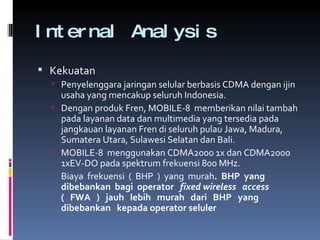
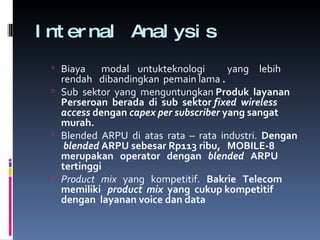
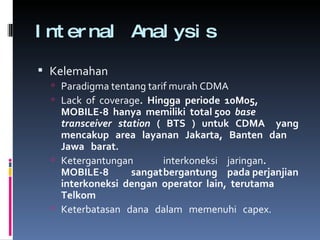
Mobile 8

  • 1.
  • 2.
    What is dividendPolicy ? The decision to pay out earnings versus retaining and reinvesting them Dividend policy includes : High or low dividend payout ? Stable or irreguler dividends? How frequent to pay dividends ? Announce the policy?
  • 3.
    Do investors preferhigh or low dividend payouts? Three theories of dividend policy Dividend irrelevance : Investor don’t care about payout Bird in-the-hand : Investors prefer a high payout. Tax preference : Investors prefer a low payout.
  • 4.
    Bird-in-the hand theoryInvestors think dividends are less risky than potential future capital gains, hence they like dividends. If so, investors would value high payout firm more highly, i.e., a high payout would result in a high P 0 .
  • 5.
    Teori Ketidak relevananDividen, Bird-in-the hand, dan Prefensi Pajak Bird in the hand MM: Ketidakrelevanan Preferensi pajak Pembayaran Harga Saham, Po ($) 50% 100% 30 20 10 0 40
  • 6.
    Teori Ketidak relevananDividen, Bird-in-the hand, dan Prefensi Pajak Preferensi pajak MM : Ketidakrelevanan Bird in the hand Pembayaran Biaya Ekuitas = Ks (%) 11,25 15 22,5 50% 100%
  • 7.
    Alternatif kebijakan pembagiandividen Persentase pembagian Persentase yang ditahan DPS g 0% 100% $ 0 15% 50% 50% $ 2,25 7,5% 100% 0% $ 4,5 0%
  • 8.
    Kemungkinan situasi (hanyasatu yg bisa direalisasikan) Catatan: Nilai buku=nilai pasar awal=$30 persaham ROE=15%,EPS=$30(0,15)=$4,5,g=(%yg ditahan)(ROE)=(% yg ditahan)(15%),contoh pada pembagian 50% g=0,5(15%)=7,5% k s = Hasil dividen+laju pertumbuhan. MM:Ketidakrelevanan Bird-in-the hand Preferensi Pajak P 0 D/P 0 ks P 0 D/P 0 ks P 0 D/P 0 ks $30 0,0% 15% $30 0,00% 15% $30 0,0% 15% $30 7,5% 15% $35 6,43 13,93 25 9% 16,5% $30 15% 15% $40 11,25 11,25 20 22,5 22,5%
  • 9.
    Which theory ismost correct ? Emphirical testing has not been able to determine which theory, if any, is correct. Thus, managers use judgment when setting policy. Analysis is used, but it must be applied with judgment.
  • 10.
    What`s the “informationcontent,” or signaling Hypothesis ? Managers hate to cut dividends, so they won`t raise dividends unless they think raise is sustainable. So, Investors view dividend increases as signals of management`s view of the future. Therefore, a stock price increase at time of a dividend increse could reflect higher expectations for future EPS, not a desire for dividends
  • 11.
    What is the“residual dividend model”? Find the retained earnings needed for the capital budget. Pay out any leftover earnings (the residual) as dividends. Thus policy minimizes flotation and equity signaling cost, hence minimizes the WACC
  • 12.
    Residual dividend modelDividends = Capital budget : $800,000 Target Capital Struktur : 40% debt,60%equity Forecasted net income $600,000 How much of the forecasted net income should be paid out as dividends? How much DPR ? target equity ratio Total capital budget Net Income x -
  • 13.
    Residual dividend model: Calculating dividends paid Calculate portion of capital budget to be funded by equity - Of the $800.000 capital budget, 0,6($800.000)=$480,000 will be funded with equity. - Calculate exess or need for equity capital. with net income of $600.000,there is more than enough equity to fund the capital budget. There will be $600.000-$480,000 =$120,000 leftover to pay as dividends. Calculate dividend payout ratio : $120,000/$600,000 = 0,20 = 20%
  • 14.
    What`s a”dividend reinvesmentplan (DRIP)”? Shareholders can automatically reinvest their dividends in shares of the company`s common stock. Get more stock than cash There are two types plans : - Open Market - New Stock
  • 15.
    Setting Dividend PolicyForecast capital needs over a planning horizon,often 5 years Set a target capital structure. Estimate annual equity needs Set target payout based on the residual model. Generally, some dividend growth rate emerges. Maintain target growth rate if possible,varying capital structure somewhat if necessary.
  • 16.
    Stock Repurchases Buyingown stock back from stockholders Reasons for Repurchases : - As an alternative to distributing cash as dividends - To dispose of one time cash from an asset sale - To make a large capital structure change
  • 17.
    Advantages of RepurchasesStockholders can tender or not Helps avoid setting a high dividend that cannot be maintained Repurchased Stock can be used in takeovers or resold to raise cash as needed Income received is capital gains rather than higher-taxed dividends. Stockholders may take as a positive signal management thinks stock is undervalued.
  • 18.
    Pengaruh dari PembelianKembali Saham EPS saat ini = Total laba / Jumlah saham=$4,4 juta/1,1 juta =$4 per saham Rasio P/E = $20/$4= 5 kali EPS sesudah pembelian kembali 100.000 saham =$4,4 juta/1 juta = $4,4 per saham Harga pasar yang diharapkan sesudah pembelian kembali = (P/E0(EPS)=(5)($4,4) = $22 per saham
  • 19.
    Stock dividends vsStock Splits Stock dividend : Firm issues new shares in lieu of paying a cash dividend. If 10%, get 10 shares for each 100 shares owned. Stock Splits : Firm increases the number of shares outstanding, say 2:1. Sends shareholders more shares Both stock dividends and Stock Splits increase the number of shares outstanding, so “the pie is divided into smaller pieces.”
  • 20.
    Stock dividends vsStock Splits Unless the stock dividends or Splits conveys information, or is accompanied by another event like higher dividends, the stock price falls so as to keep each investor`s wealth unchanged. But split/stock dividends may get us to an “optimal price range.”
  • 21.
    Faktor-faktor yang mempengaruhikebijakan dividen Kontrak Hutang Pembatasan Saham Preferen Ketidak cukupan laba Ketersediaan Kas Denda Pajak atas penahanan laba yang tidak wajar
  • 22.
    EPS,Cash Flow,DPS DPSEPS CFPS Dollar Year
  • 23.
    Bahan diskusi Mengapaperusahaan dengan tk pertumbuhan yg tinggi cenderung memiliki rasio pembayaran dividen yg rendah dan perush dg tk pertumbuhan yg rendah cenderung memiliki rasio pembayaran dividen yg tinggi ? Sebutkan keunggulan dan kelemahan dari kebijakan pembayaran dividen stabil perlembar saham dan rasio pembayaran dividen stabil sebagai kebijakan dividen perusahaan ! Berikan definisi dividen saham dan pemecahan saham. Apa pengaruhnya thd nilai saham ? Apa yang dimaksud dengan rencana investasi kembali dividen dan bagaimana rencana ini membantu para pemegang saham