Matching
Type Test
1
Table of Contents
• Definition of Terms
• Guidelines in Constructing Matching type
• Advantage and Disadvantage
• The columns of matching type test
• When to you Matching type
2
Definition of term
The matching-type test is similar to
the multiple-choice test. In this kind
of test, the examinee associates an
item in one column with a choice in
the second column.
3
Measures the ability to identify the
relationship between a set of
similar items, each of which has two
components, such as words and
their definitions, symbols and their
meanings, dates and events, causes
and effects, people and their
accomplishments, problems and
solutions, etc.
A “recognition” and “structured-
response” type of test.
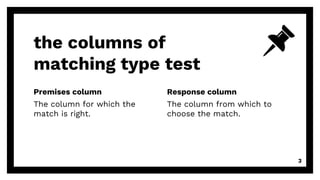
Premises column
The column for which the
match is right.
the columns of
matching type test
Response column
The column from which to
choose the match.
3
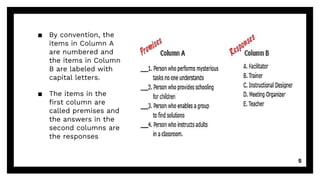
▪ By convention, the
items in Column A
are numbered and
the items in Column
B are labeled with
capital letters.
5
▪ The items in the
first column are
called premises and
the answers in the
second columns are
the responses
Guidelines in
Constructing Matching
Type
6
7
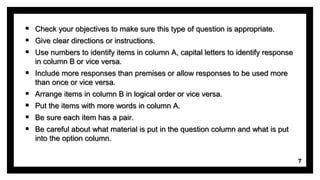
 Check your objectives to make sure this type of question is appropriate.
 Give clear directions or instructions.
 Use numbers to identify items in column A, capital letters to identify response
in column B or vice versa.
 Include more responses than premises or allow responses to be used more
than once or vice versa.
 Arrange items in column B in logical order or vice versa.
 Put the items with more words in column A.
 Be sure each item has a pair.
 Be careful about what material is put in the question column and what is put
into the option column.
When to use
Matching
Type
8
9
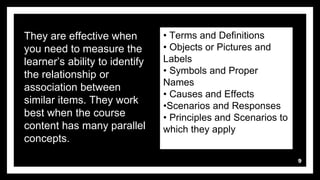
They are effective when
you need to measure the
learner’s ability to identify
the relationship or
association between
similar items. They work
best when the course
content has many parallel
concepts.
• Terms and Definitions
• Objects or Pictures and
Labels
• Symbols and Proper
Names
• Causes and Effects
•Scenarios and Responses
• Principles and Scenarios to
which they apply
Advantages and
Disadvantages
Advantage
▪ The matching-type test is simple to construct and score. It
is well suited in measuring associations. Like a multiple-
choice test, it presents the student with questions and
alternatives.
▪ It reduces the effects of guessing, although the chance of
guessing increases as the student progresses in answering
items. This, however, is easily remedied by adding more
options.
11
Disadvantage
▪ It tends to ask students to associate trivial information.
Unfortunately, most matching-type tests emphasize
memorization, although it is impossible to construct items
that measure more complex cognitive skills.
▪ In case of commercial answer sheets, matching items can
accommodate no more than five options.
12
Team Presentation
13
Maribeth Maraya Camille Rose
Margate
Jirahmae Diasanta Jeleanna Imecille
Batica
Kemuel Rabi
Thank you!
14

Matching Type Test.pptx

  • 1.
  • 2.
    Table of Contents •Definition of Terms • Guidelines in Constructing Matching type • Advantage and Disadvantage • The columns of matching type test • When to you Matching type 2
  • 3.
    Definition of term Thematching-type test is similar to the multiple-choice test. In this kind of test, the examinee associates an item in one column with a choice in the second column. 3 Measures the ability to identify the relationship between a set of similar items, each of which has two components, such as words and their definitions, symbols and their meanings, dates and events, causes and effects, people and their accomplishments, problems and solutions, etc. A “recognition” and “structured- response” type of test.
  • 4.
    Premises column The columnfor which the match is right. the columns of matching type test Response column The column from which to choose the match. 3
  • 5.
    ▪ By convention,the items in Column A are numbered and the items in Column B are labeled with capital letters. 5 ▪ The items in the first column are called premises and the answers in the second columns are the responses
  • 6.
  • 7.
    7  Check yourobjectives to make sure this type of question is appropriate.  Give clear directions or instructions.  Use numbers to identify items in column A, capital letters to identify response in column B or vice versa.  Include more responses than premises or allow responses to be used more than once or vice versa.  Arrange items in column B in logical order or vice versa.  Put the items with more words in column A.  Be sure each item has a pair.  Be careful about what material is put in the question column and what is put into the option column.
  • 8.
  • 9.
    9 They are effectivewhen you need to measure the learner’s ability to identify the relationship or association between similar items. They work best when the course content has many parallel concepts. • Terms and Definitions • Objects or Pictures and Labels • Symbols and Proper Names • Causes and Effects •Scenarios and Responses • Principles and Scenarios to which they apply
  • 10.
  • 11.
    Advantage ▪ The matching-typetest is simple to construct and score. It is well suited in measuring associations. Like a multiple- choice test, it presents the student with questions and alternatives. ▪ It reduces the effects of guessing, although the chance of guessing increases as the student progresses in answering items. This, however, is easily remedied by adding more options. 11
  • 12.
    Disadvantage ▪ It tendsto ask students to associate trivial information. Unfortunately, most matching-type tests emphasize memorization, although it is impossible to construct items that measure more complex cognitive skills. ▪ In case of commercial answer sheets, matching items can accommodate no more than five options. 12
  • 13.
    Team Presentation 13 Maribeth MarayaCamille Rose Margate Jirahmae Diasanta Jeleanna Imecille Batica Kemuel Rabi
  • 14.