(binary- choice Items)
Alternative choice test in which the student or
examinee indicates whether each of
several statements is true or false.
-are utilized to assess a student's ability to recognize
the accuracy of a declarative statement. Due to the
nature of this type of assessment, true-false
statements are particularly useful in measuring a
student's ability to differentiate between forced-
choice statements :
true-false Yes- no
Correct-
incorrect
 Used to measure ability to identify whether
statements of facts, principles, generalizations,
relationships, or evaluative statements are correct.
 Can be factual or can be a thought question that
requires reasoning.
 Can be used in most disciplines.
 Used to quickly poll a class as an introduction to a
discussion or determine knowledge of topic.
 To be most effective in assessing specific learning
objectives, each true-false item should target only
one fact at a time and should restrict statements to
a single idea.
 instructors should include an equivalent number of
true and false items within the assessment.
 avoid using exact wording from the textbook.
 test designers should try to make all true-false items
similar in length.
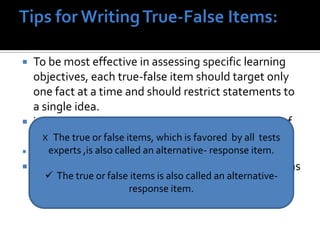
X The true or false items, which is favored by all tests
experts ,is also called an alternative- response item.
 The true or false items is also called an alternative-
response item.
 instructors should make wrong answers more
attractive by wording statements in a way that is
supported by superficial logic or popular
misconception.
 avoid absolute words (such as all, always, never) and
indefinite adjectives, generalizations, and qualifying
terms (such as usually, generally, sometimes).
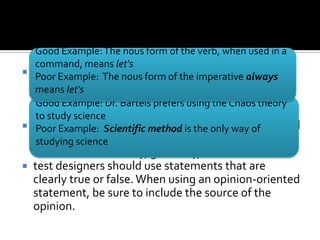
 test designers should use statements that are
clearly true or false.When using an opinion-oriented
statement, be sure to include the source of the
opinion.
Good Example: Dr. Bartels prefers using the Chaos theory
to study science
Poor Example: Scientific method is the only way of
studying science
Good Example: Dr. Bartels prefers using the Chaos theory to study science
Poor Example: Scientific method is the only way of studying science
Good Example:The nous form of the verb, when used in a
command, means let's
Poor Example: The nous form of the imperative always
means let's
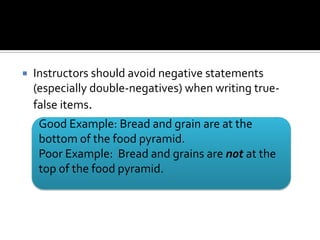
 Instructors should avoid negative statements
(especially double-negatives) when writing true-
false items.
Good Example: Bread and grain are at the
bottom of the food pyramid.
Poor Example: Bread and grains are not at the
top of the food pyramid.
 Quite easy to write
 Easy to score
 Scoring is objective
 More information is sampled from a lot of content
 Effective as either a written or oral assessment.
 Limits bias due to poor writing and or reading skills.
 Useful for questions where there are only two
reasonable answers.
 Useful in testing misconceptions.
 Amendable to item analysis.
 Versatility
 Reliability
 Effeciency
 May overestimate learning due to the influence of
guessing
 Difficult to differentiate between effective difficult
items and trick items
 Often leads to testing of trivial facts or bits of
information
 Generally less discriminating than multiple-choice
items
 May not accurately reflect realistic circumstances in
which issues are not absolutely true or false
 Often criticized for encouraging rote memorization
 Measures only low level of learning - facts,
knowledge, comprehension
 Need a larger number of items to distinguish
stronger and weaker knowledge levels.
 Students have a 50 percent chance of being correct,
just by chance.
 May be perceived as an unfair judgment of learning
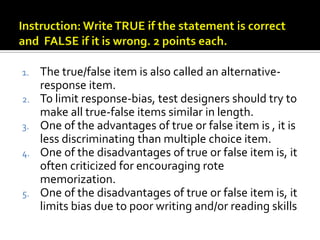
1. The true/false item is also called an alternative-
response item.
2. To limit response-bias, test designers should try to
make all true-false items similar in length.
3. One of the advantages of true or false item is , it is
less discriminating than multiple choice item.
4. One of the disadvantages of true or false item is, it
often criticized for encouraging rote
memorization.
5. One of the disadvantages of true or false item is, it
limits bias due to poor writing and/or reading skills

True or false items

  • 1.
  • 2.
    Alternative choice testin which the student or examinee indicates whether each of several statements is true or false.
  • 3.
    -are utilized toassess a student's ability to recognize the accuracy of a declarative statement. Due to the nature of this type of assessment, true-false statements are particularly useful in measuring a student's ability to differentiate between forced- choice statements : true-false Yes- no Correct- incorrect
  • 4.
     Used tomeasure ability to identify whether statements of facts, principles, generalizations, relationships, or evaluative statements are correct.  Can be factual or can be a thought question that requires reasoning.  Can be used in most disciplines.  Used to quickly poll a class as an introduction to a discussion or determine knowledge of topic.
  • 5.
     To bemost effective in assessing specific learning objectives, each true-false item should target only one fact at a time and should restrict statements to a single idea.  instructors should include an equivalent number of true and false items within the assessment.  avoid using exact wording from the textbook.  test designers should try to make all true-false items similar in length. X The true or false items, which is favored by all tests experts ,is also called an alternative- response item.  The true or false items is also called an alternative- response item.
  • 6.
     instructors shouldmake wrong answers more attractive by wording statements in a way that is supported by superficial logic or popular misconception.  avoid absolute words (such as all, always, never) and indefinite adjectives, generalizations, and qualifying terms (such as usually, generally, sometimes).  test designers should use statements that are clearly true or false.When using an opinion-oriented statement, be sure to include the source of the opinion. Good Example: Dr. Bartels prefers using the Chaos theory to study science Poor Example: Scientific method is the only way of studying science Good Example: Dr. Bartels prefers using the Chaos theory to study science Poor Example: Scientific method is the only way of studying science Good Example:The nous form of the verb, when used in a command, means let's Poor Example: The nous form of the imperative always means let's
  • 7.
     Instructors shouldavoid negative statements (especially double-negatives) when writing true- false items. Good Example: Bread and grain are at the bottom of the food pyramid. Poor Example: Bread and grains are not at the top of the food pyramid.
  • 8.
     Quite easyto write  Easy to score  Scoring is objective  More information is sampled from a lot of content  Effective as either a written or oral assessment.  Limits bias due to poor writing and or reading skills.  Useful for questions where there are only two reasonable answers.  Useful in testing misconceptions.  Amendable to item analysis.  Versatility  Reliability  Effeciency
  • 9.
     May overestimatelearning due to the influence of guessing  Difficult to differentiate between effective difficult items and trick items  Often leads to testing of trivial facts or bits of information  Generally less discriminating than multiple-choice items  May not accurately reflect realistic circumstances in which issues are not absolutely true or false  Often criticized for encouraging rote memorization
  • 10.
     Measures onlylow level of learning - facts, knowledge, comprehension  Need a larger number of items to distinguish stronger and weaker knowledge levels.  Students have a 50 percent chance of being correct, just by chance.  May be perceived as an unfair judgment of learning
  • 11.
    1. The true/falseitem is also called an alternative- response item. 2. To limit response-bias, test designers should try to make all true-false items similar in length. 3. One of the advantages of true or false item is , it is less discriminating than multiple choice item. 4. One of the disadvantages of true or false item is, it often criticized for encouraging rote memorization. 5. One of the disadvantages of true or false item is, it limits bias due to poor writing and/or reading skills