MASTERING THE
INTERPRETIVE MODE
Presented by
Lou Baskinger & Ed Weiss
APAC 2014
TODAY’S AGENDA
DEFINITION – THE INTERPRETIVE MODE
MATERIALS FOR INTERPRETIVE MODE
INTERPRETIVE MODE ON THE AP EXAM
DEMONSTRATION OF TEACHING STRATEGIES
audio and written examples
TEACHER RESOURCES / STUDENT ACCESS
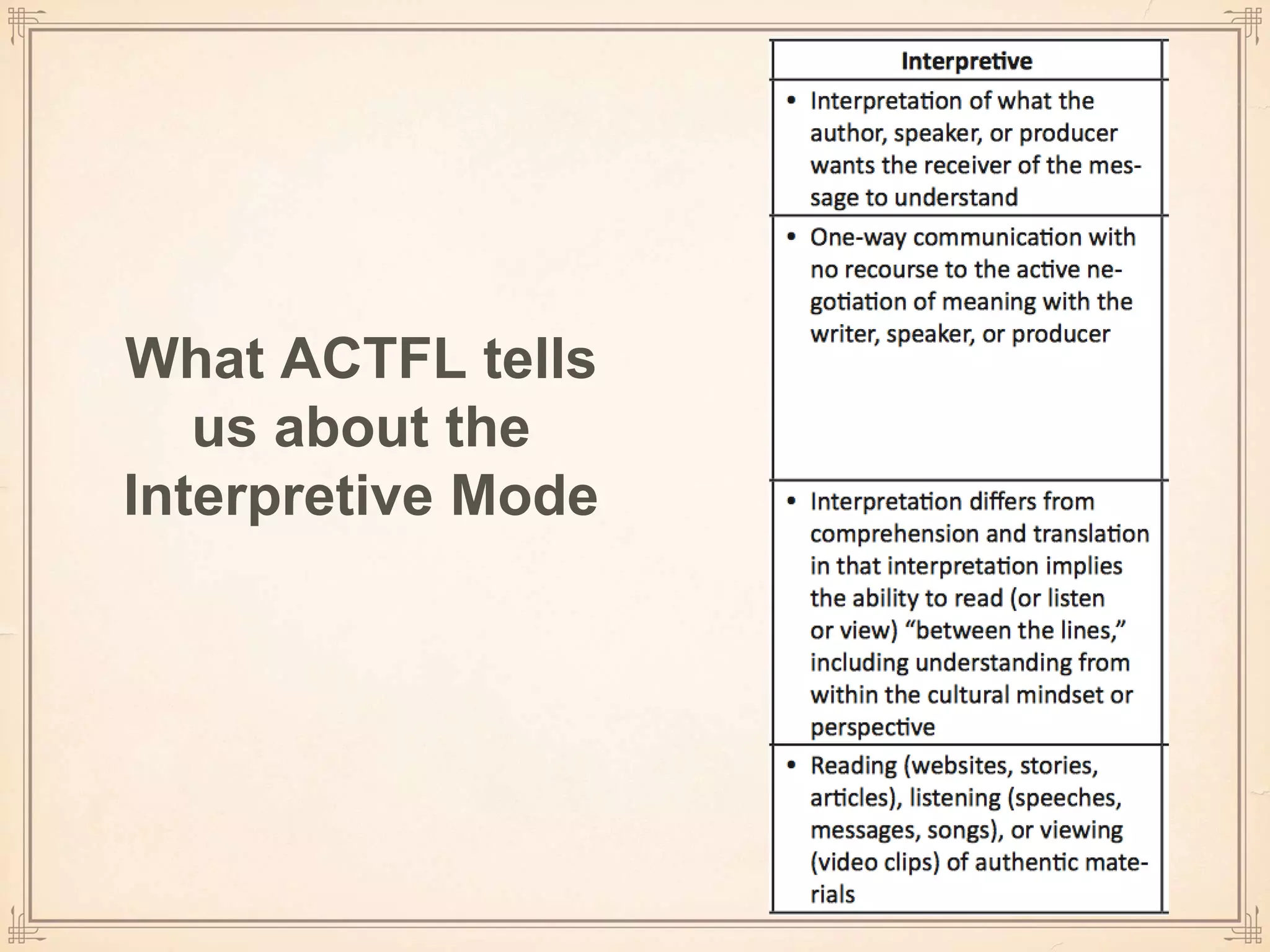
What ACTFL tells
us about the
Interpretive Mode
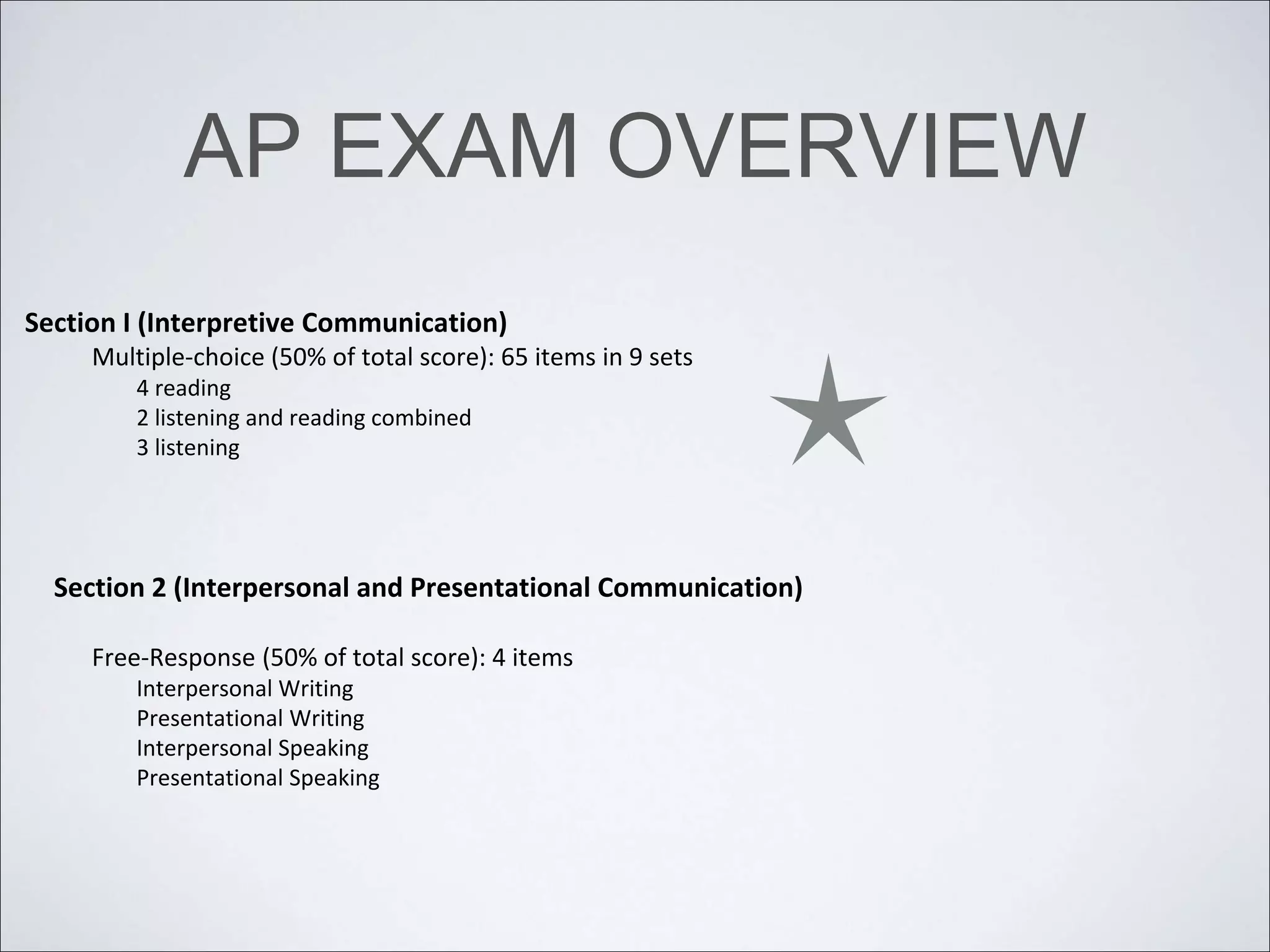
AP EXAM OVERVIEW
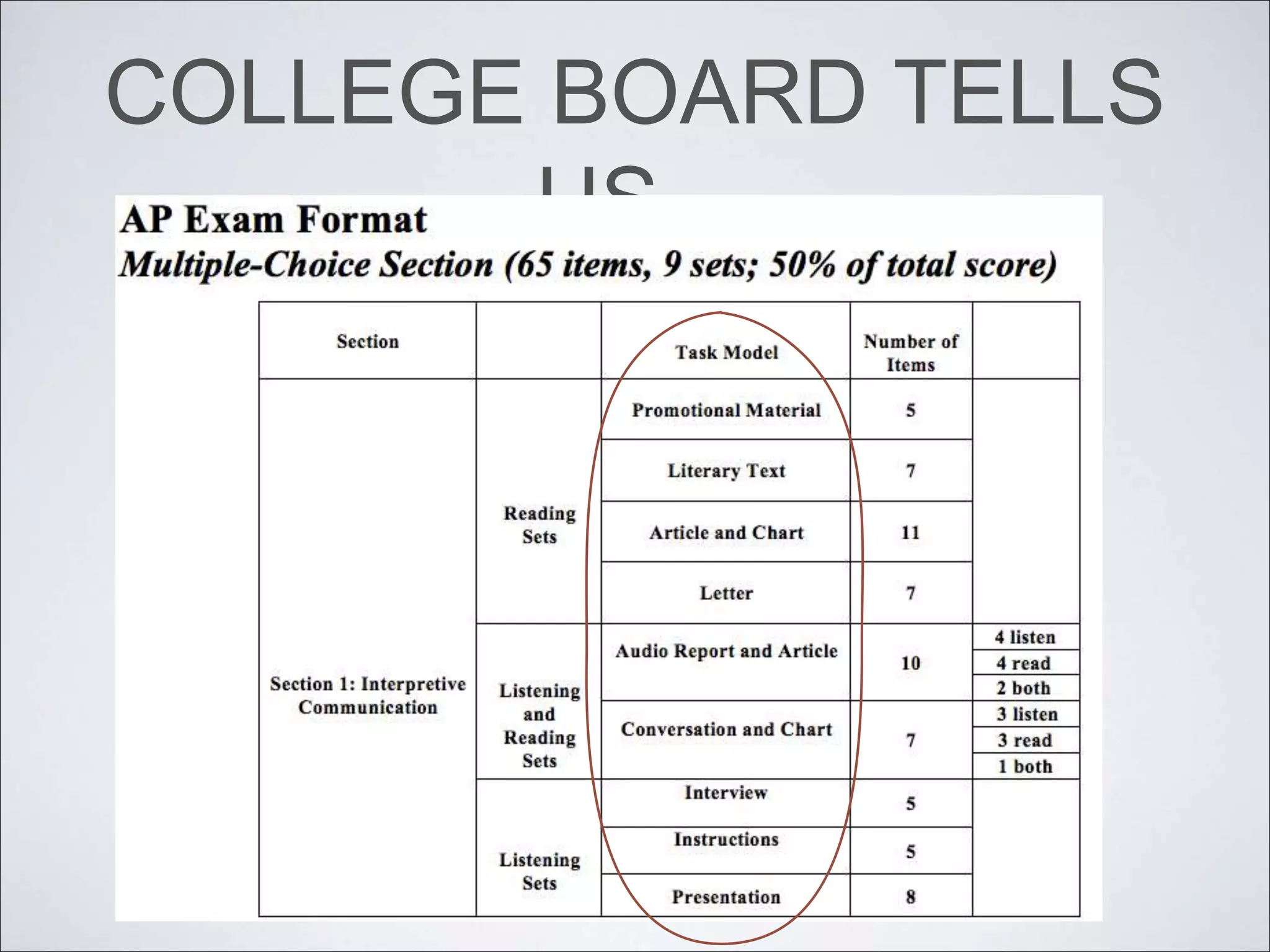
Section I (Interpretive Communication)
Multiple-choice (50% of total score): 65 items in 9 sets
4 reading
2 listening and reading combined
3 listening
Section 2 (Interpersonal and Presentational Communication)
Free-Response (50% of total score): 4 items
Interpersonal Writing
Presentational Writing
Interpersonal Speaking
Presentational Speaking
COLLEGE BOARD TELLS
US...
AUTHENTIC MATERIALS
MUST BE USED THROUGHOUT
YOUR PROGRAM
• Exposure to authentic materials
begins day one of year one!
• Scaffolding these materials through the various levels
of your program builds proficiency
• The rich diversity of these materials will energize
your lessons and engage students
AUTHENTIC MATERIALS
ARE...
• those designed for native speakers. They are real
text designed not for language students, but for the
speakers of the language in question. (Nunan)
• stretches of real language, produced by a real
speaker or writer for a real audience and designed to
carry a real message. (Harmer)
• “appropriate” and “quality” in terms of goals,
objectives, learner needs and interest and “natural” in
terms of real life and meaningful communication.
(Rogers)
A PARTIAL LIST...
• online articles
• charts / graphs / maps
• videos
• magazines /
newspapers
• films
• music
• advertisements
AUDIO SOURCES
• Radio interviews
• General interest podcasts
• PSAs
• Brief lectures
• Audio guides - museums, travel
comprehensibility & relevance are #1
WRITTEN SOURCES
• Literary texts
• Journalistic articles
• Letters
• Ads
• Instructions
• The above may be combined with maps, charts, or
table
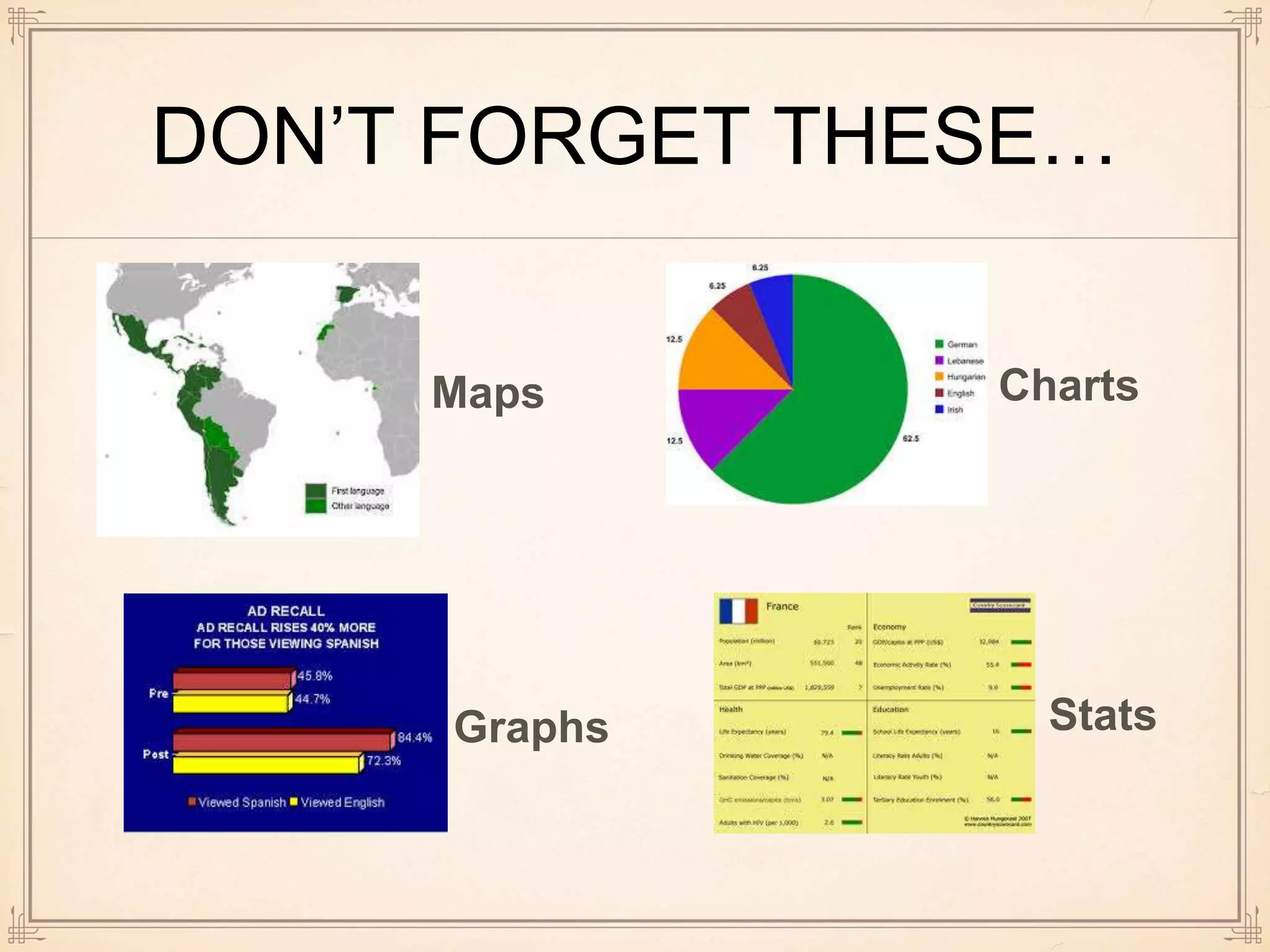
DON’T FORGET THESE…
Maps
Graphs
Charts
Stats
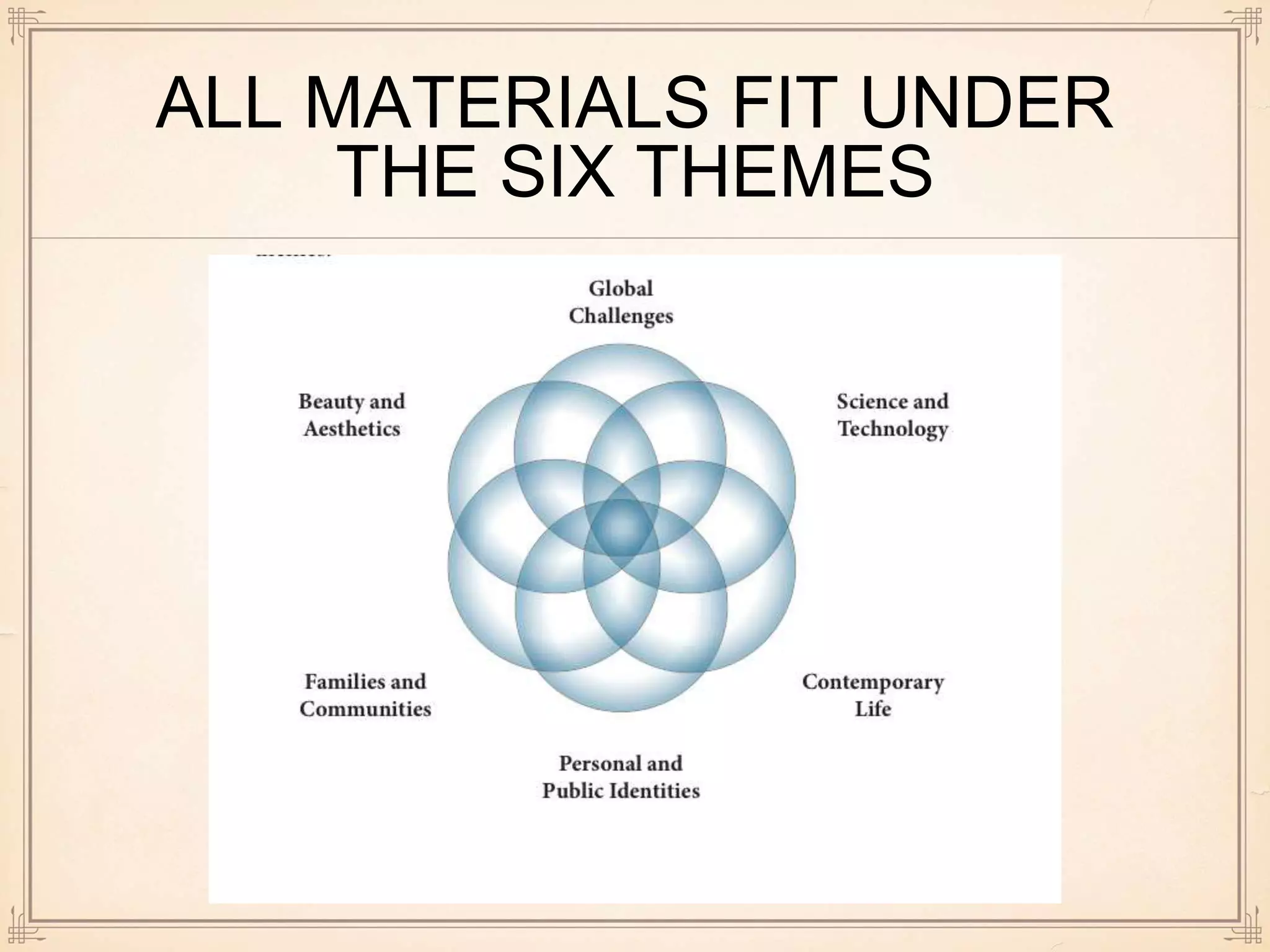
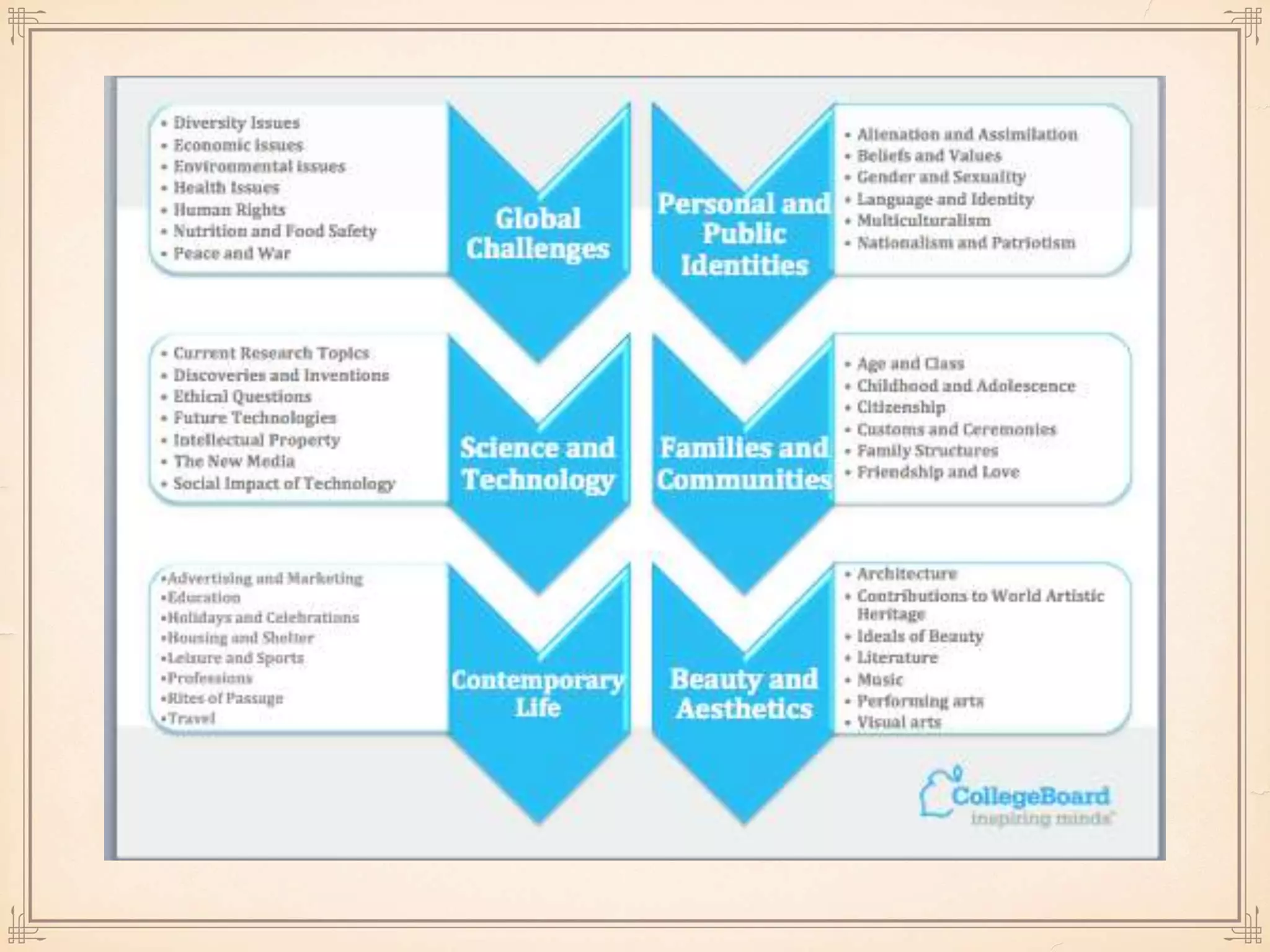
ALL MATERIALS FIT UNDER
THE SIX THEMES
THE AP LANGUAGE AND
CULTURE EXAM
- Strategies for success with interpretive questions
- Student responsibilities
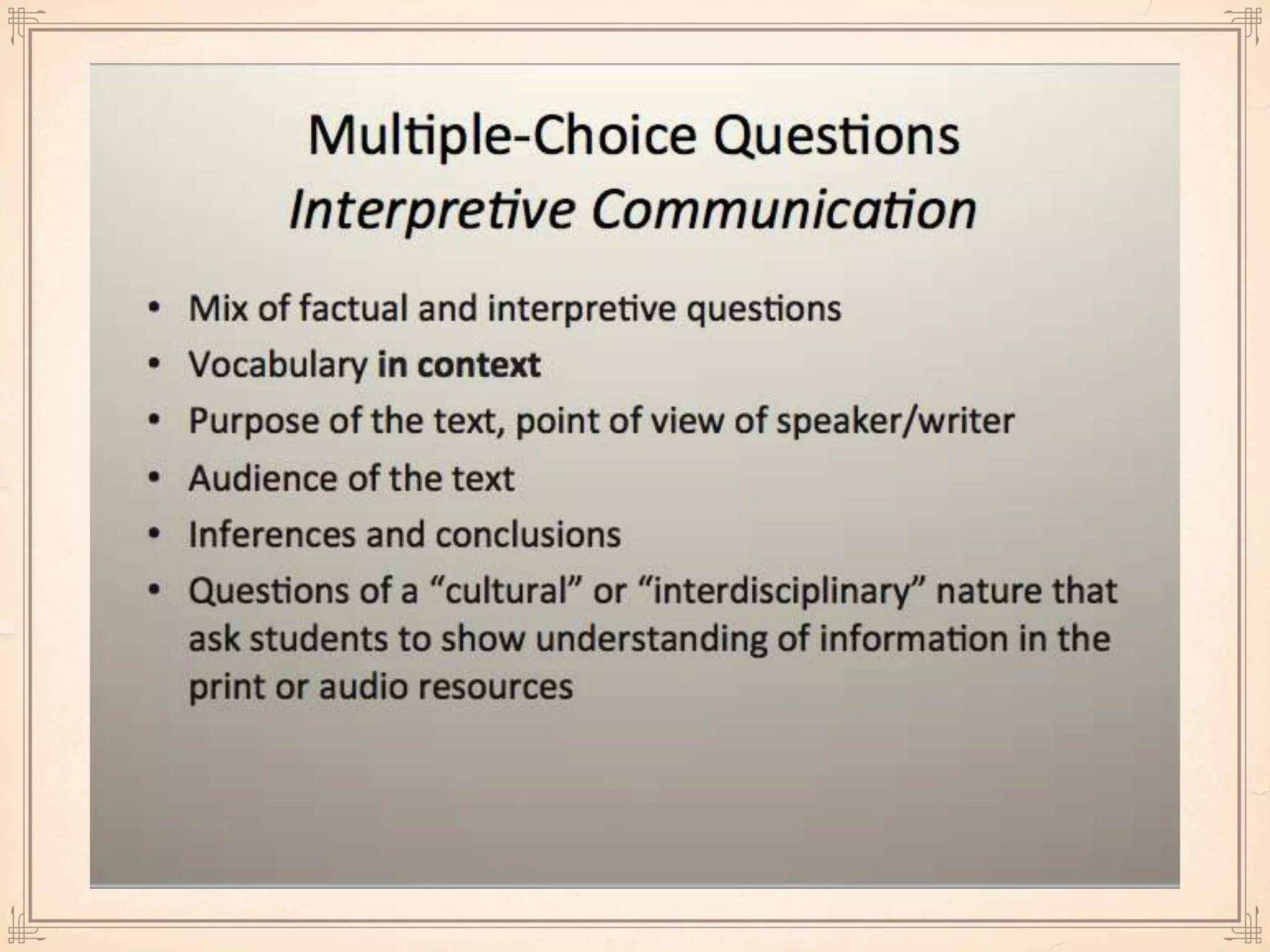
- Types of questions
STRATEGIES
• Each audio piece is played two times
• Note taking is permitted and encouraged
• Scanning questions in advance
• Having a knowledge of the question types is key
• Key terms that guide listening:
• comprehension, tone, audience, meaning, purpose
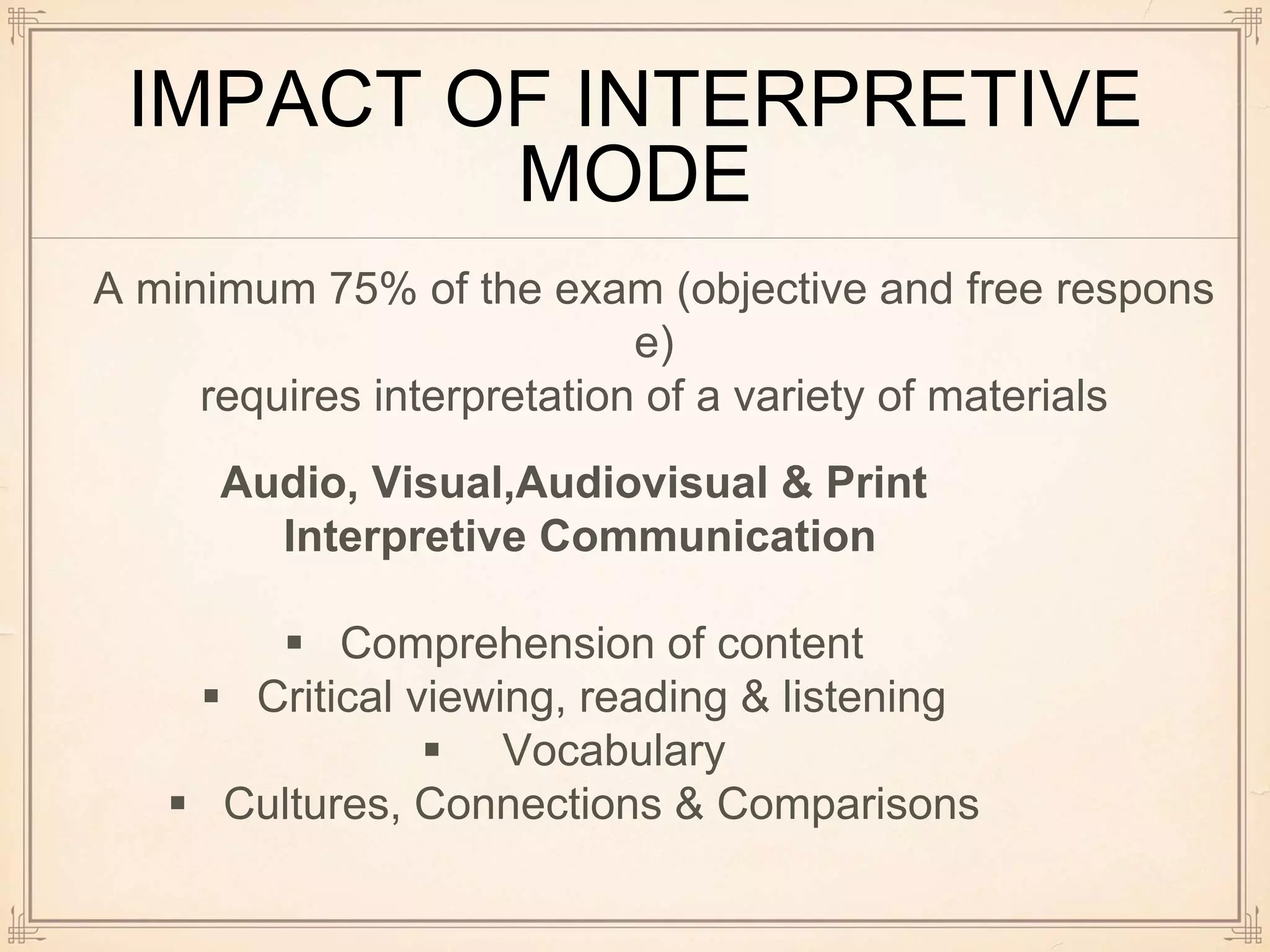
IMPACT OF INTERPRETIVE
MODE
A minimum 75% of the exam (objective and free respons
e)
requires interpretation of a variety of materials
Audio, Visual,Audiovisual & Print
Interpretive Communication
 Comprehension of content
 Critical viewing, reading & listening
 Vocabulary
 Cultures, Connections & Comparisons
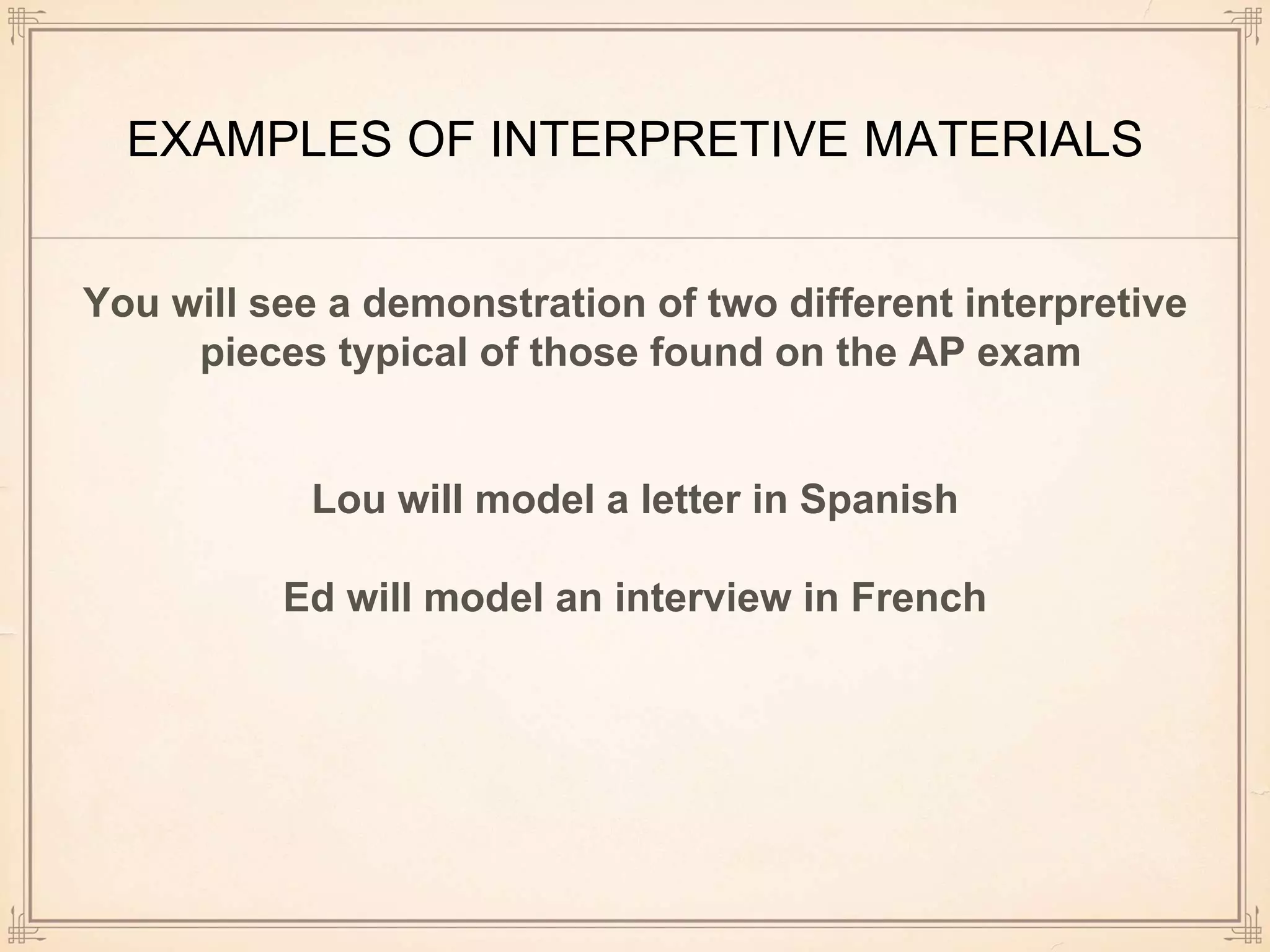
EXAMPLES OF INTERPRETIVE MATERIALS
You will see a demonstration of two different interpretive
pieces typical of those found on the AP exam
Lou will model a letter in Spanish
Ed will model an interview in French
BEST PRACTICES WHEN USING
MATERIALS
FOR THE INTERPRETIVE MODE
• Advanced Organizer - a pre-reading or pre-listening
teaching aide that prepares the students for what is to
come
Tema curricular: La belleza y la estética
Introducción
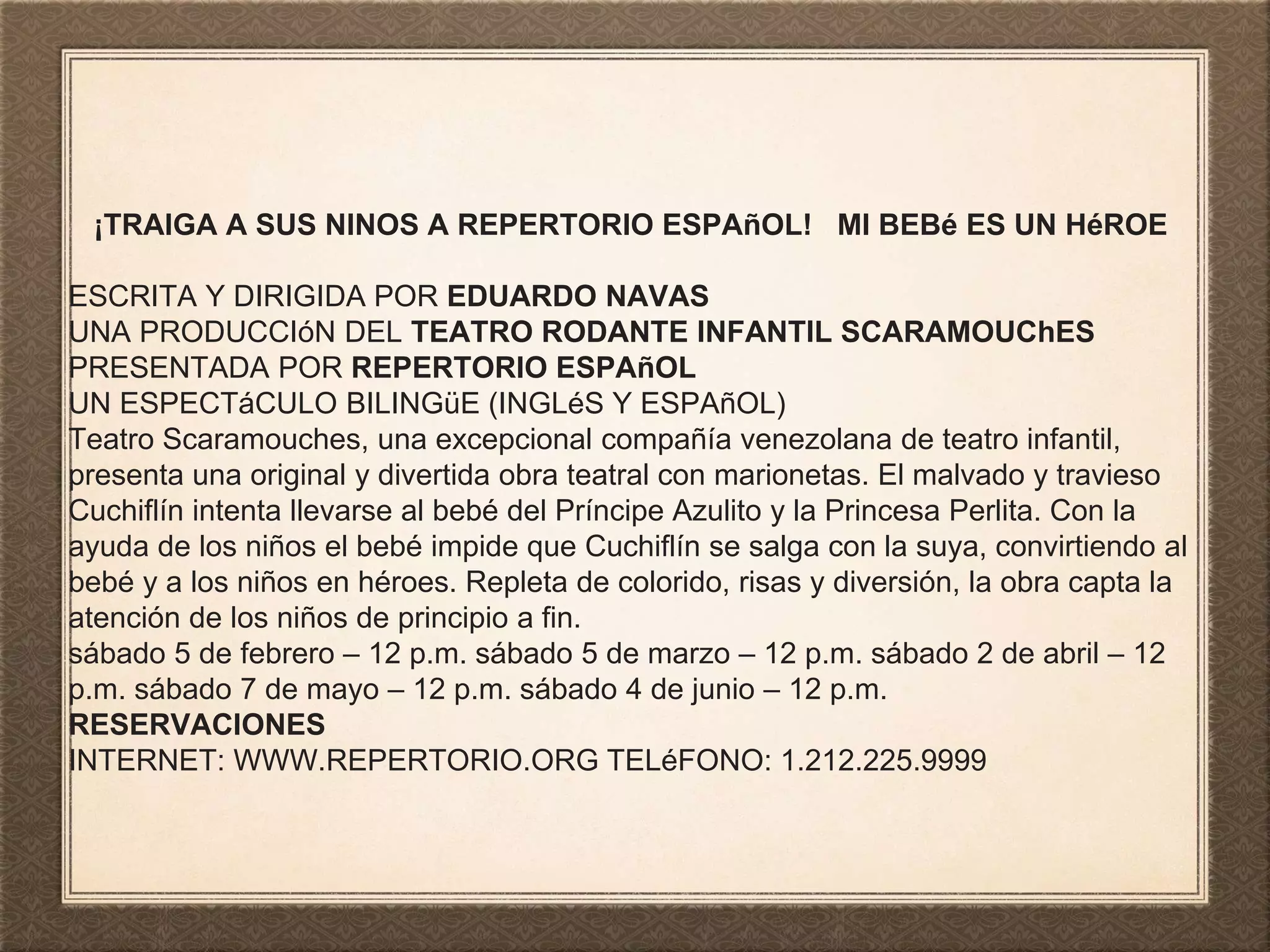
Este texto trata de una obra de teatro para niños.
El anuncio original fue publicado en marzo de
2011 en Nueva York, Estados Unidos.
¡TRAIGA A SUS NINOS A REPERTORIO ESPAñOL! MI BEBé ES UN HéROE
ESCRITA Y DIRIGIDA POR EDUARDO NAVAS
UNA PRODUCCIóN DEL TEATRO RODANTE INFANTIL SCARAMOUChES
PRESENTADA POR REPERTORIO ESPAñOL
UN ESPECTáCULO BILINGüE (INGLéS Y ESPAñOL)
Teatro Scaramouches, una excepcional compañía venezolana de teatro infantil,
presenta una original y divertida obra teatral con marionetas. El malvado y travieso
Cuchiflín intenta llevarse al bebé del Príncipe Azulito y la Princesa Perlita. Con la
ayuda de los niños el bebé impide que Cuchiflín se salga con la suya, convirtiendo al
bebé y a los niños en héroes. Repleta de colorido, risas y diversión, la obra capta la
atención de los niños de principio a fin.
sábado 5 de febrero – 12 p.m. sábado 5 de marzo – 12 p.m. sábado 2 de abril – 12
p.m. sábado 7 de mayo – 12 p.m. sábado 4 de junio – 12 p.m.
RESERVACIONES
INTERNET: WWW.REPERTORIO.ORG TELéFONO: 1.212.225.9999
INTERPRETIVE TEACHING
How to implement
Interpretive Teaching
into your class
A lesson plan
INTERPRETIVE TEACHING
Ways to incorporate the interpretive mode into your lessons
A typical story from your curriculum that is not
from the AP level
Remember… Scaffold into lower levels
Third year honors class
Fourth year class
GREGORIO LÓPEZ Y FUENTES
1940
A SUMMARY OF THE STORY
UNA CARTA A DIOS
SUMMARY OF THE
STORY
GRAMMATICALLY
NEWSWORTHY
HOLIDAY
TIMING IS EVERYTNG!
SETTING THE STAGE
Essential Questions
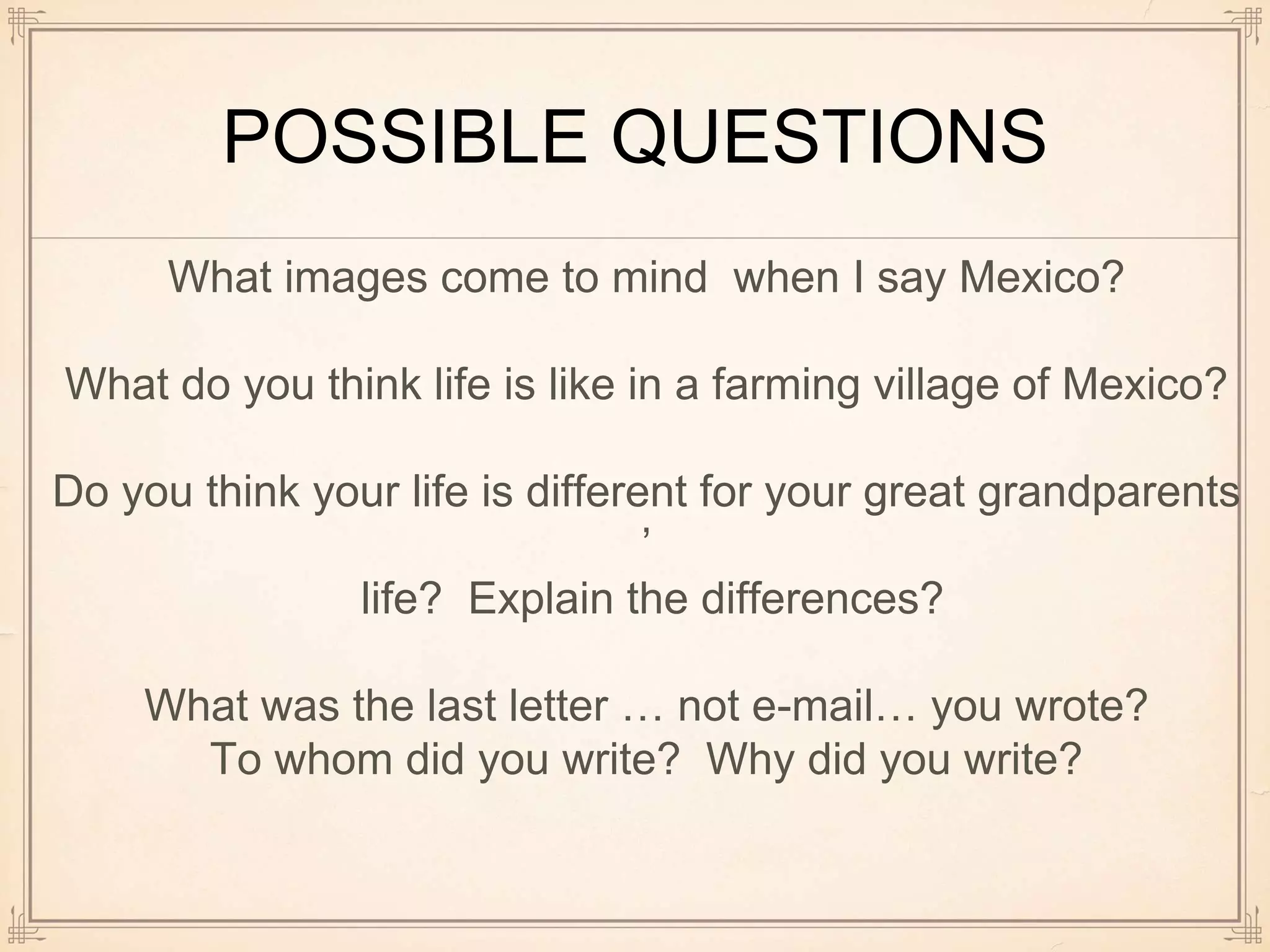
POSSIBLE QUESTIONS
What images come to mind when I say Mexico?
What do you think life is like in a farming village of Mexico?
Do you think your life is different for your great grandparents
’
life? Explain the differences?
What was the last letter … not e-mail… you wrote?
To whom did you write? Why did you write?
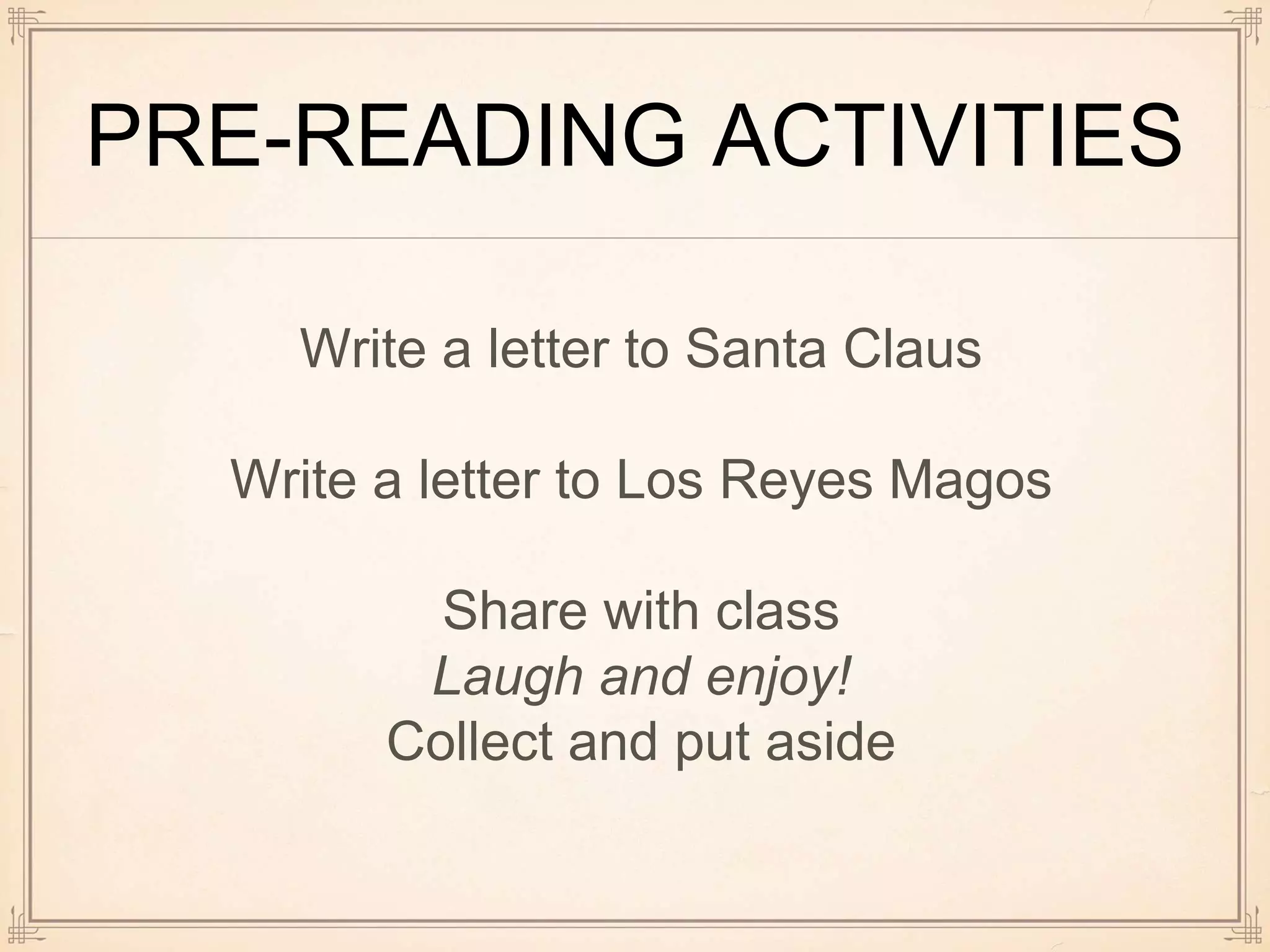
PRE-READING ACTIVITIES
Write a letter to Santa Claus
Write a letter to Los Reyes Magos
Share with class
Laugh and enjoy!
Collect and put aside
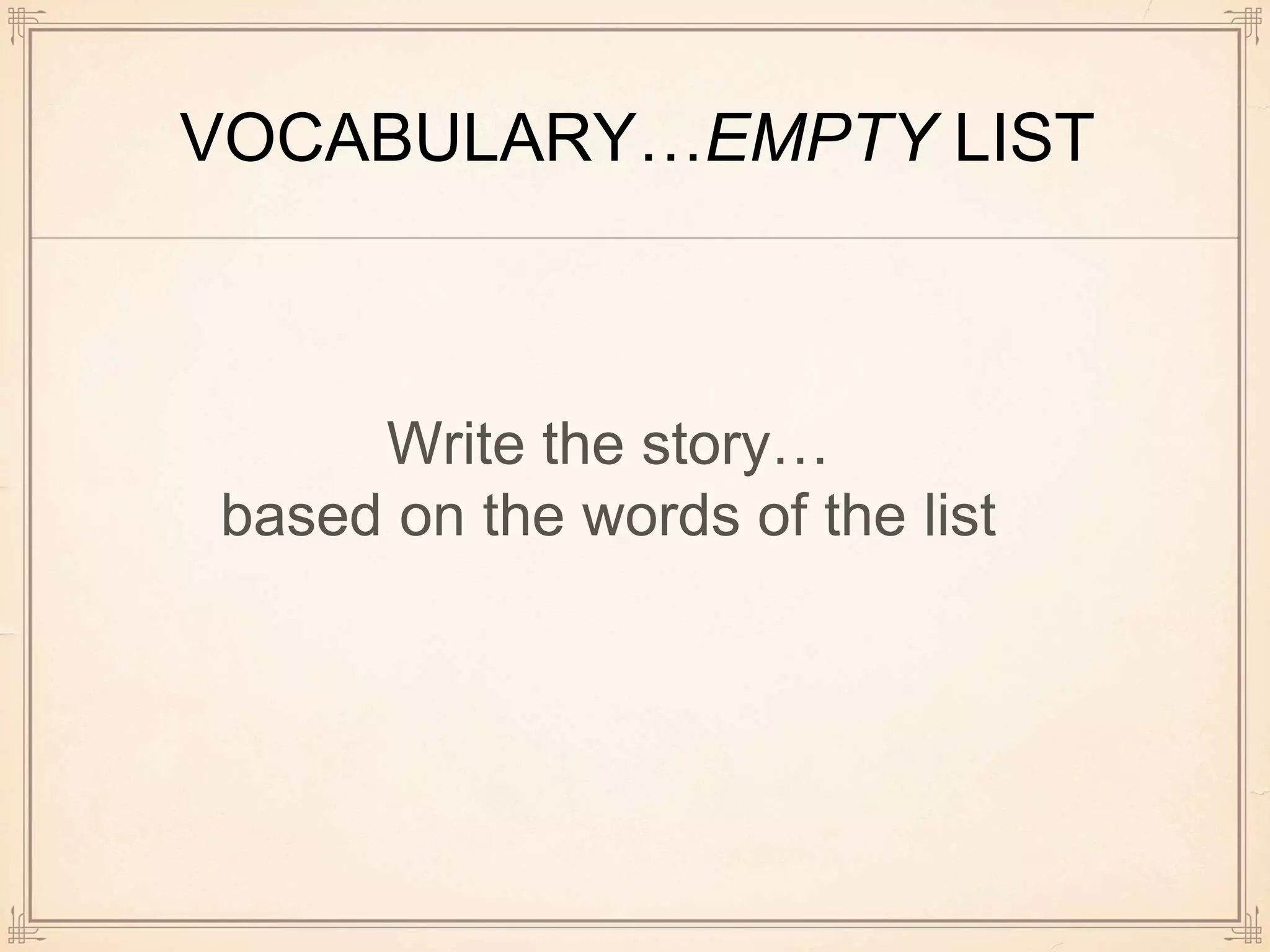
VOCABULARY…EMPTY LIST
Write the story…
based on the words of the list
READ AND DISCUSS
Create questions for comprehension
(Formative assessment)
Create questions for discussion
(Summative assessment)
Connect to Essential questions
(Interpretive mode)
STOP!
Lencho’s second letter….
You write it!
COMPARISON
Students’ letters to Lencho’s lette
r
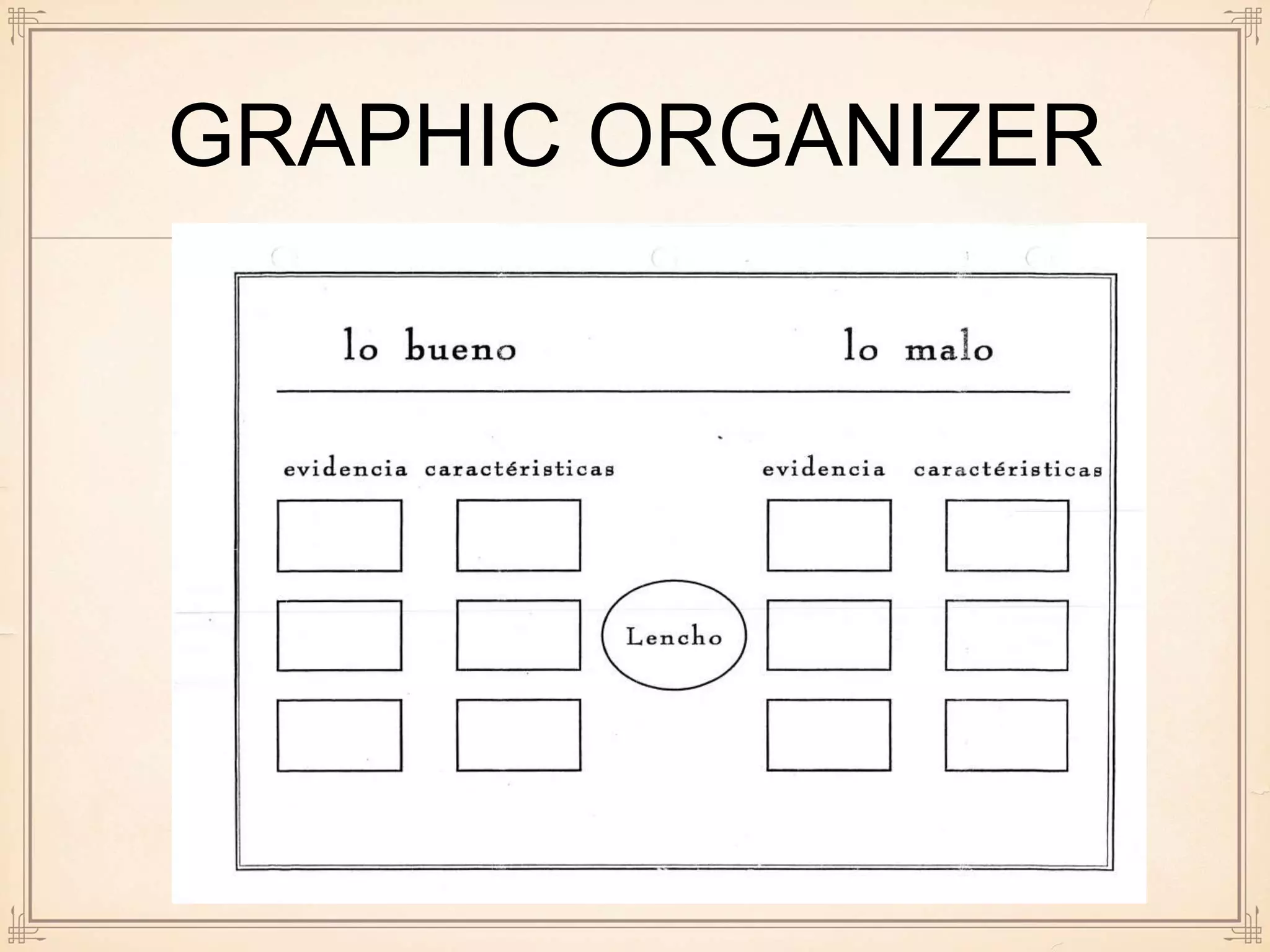
WRITING ASSIGNMENT
INTERPRETIVE MODE
Is Lencho a good man or a bad man… or is
he like most of us… a combination of good
and bad qualities?
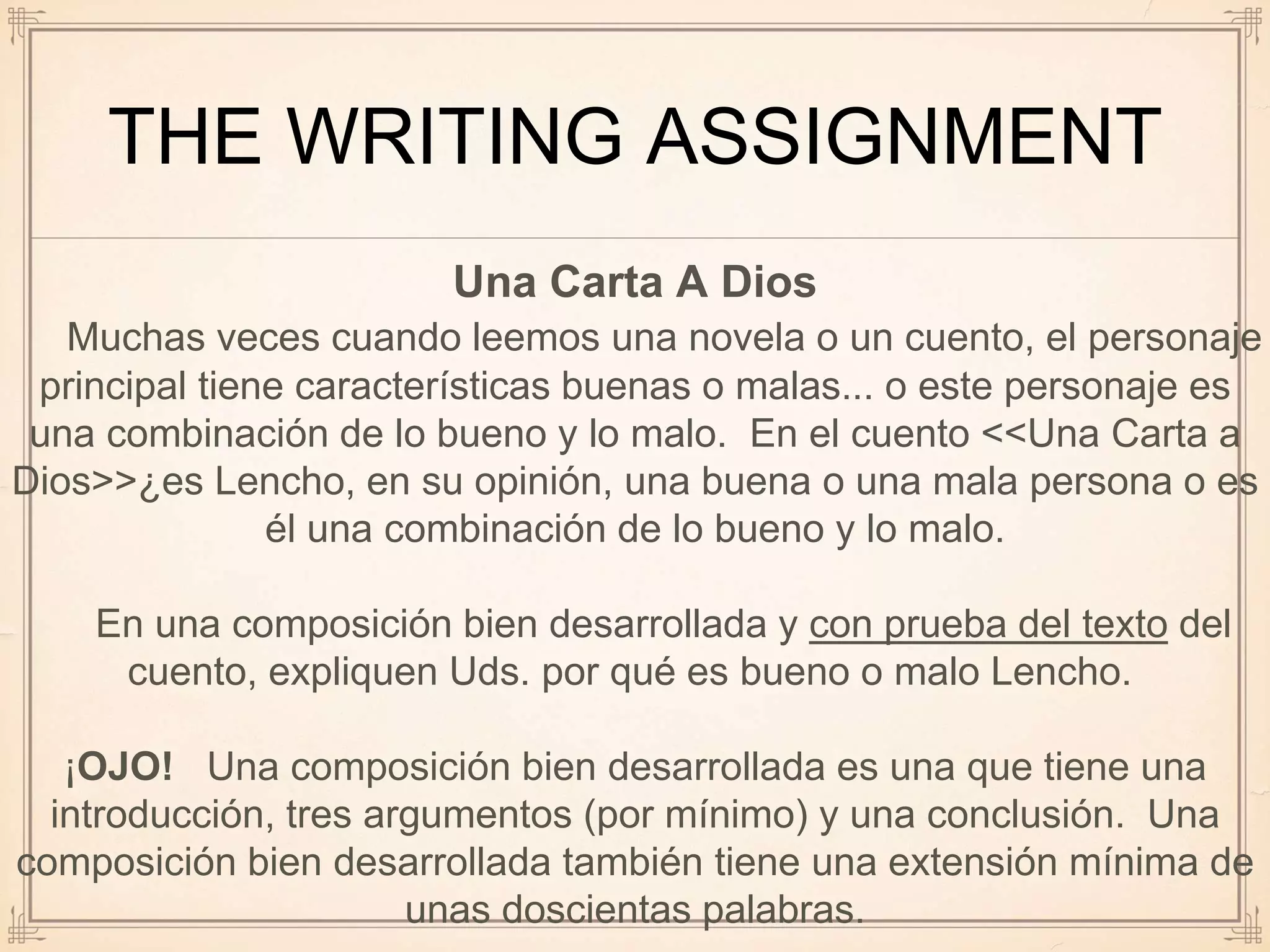
THE WRITING ASSIGNMENT
Una Carta A Dios
Muchas veces cuando leemos una novela o un cuento, el personaje
principal tiene características buenas o malas... o este personaje es
una combinación de lo bueno y lo malo. En el cuento <<Una Carta a
Dios>>¿es Lencho, en su opinión, una buena o una mala persona o es
él una combinación de lo bueno y lo malo.
En una composición bien desarrollada y con prueba del texto del
cuento, expliquen Uds. por qué es bueno o malo Lencho.
¡OJO! Una composición bien desarrollada es una que tiene una
introducción, tres argumentos (por mínimo) y una conclusión. Una
composición bien desarrollada también tiene una extensión mínima de
unas doscientas palabras.
GRAPHIC ORGANIZER
Missing : The organizer
LET’S LOOK AT AN EXAMPLE
OF A LISTENING PIECE
This example will be an interview in Frenc
h
Many of the following strategies can be
applied to reading interpretation as well
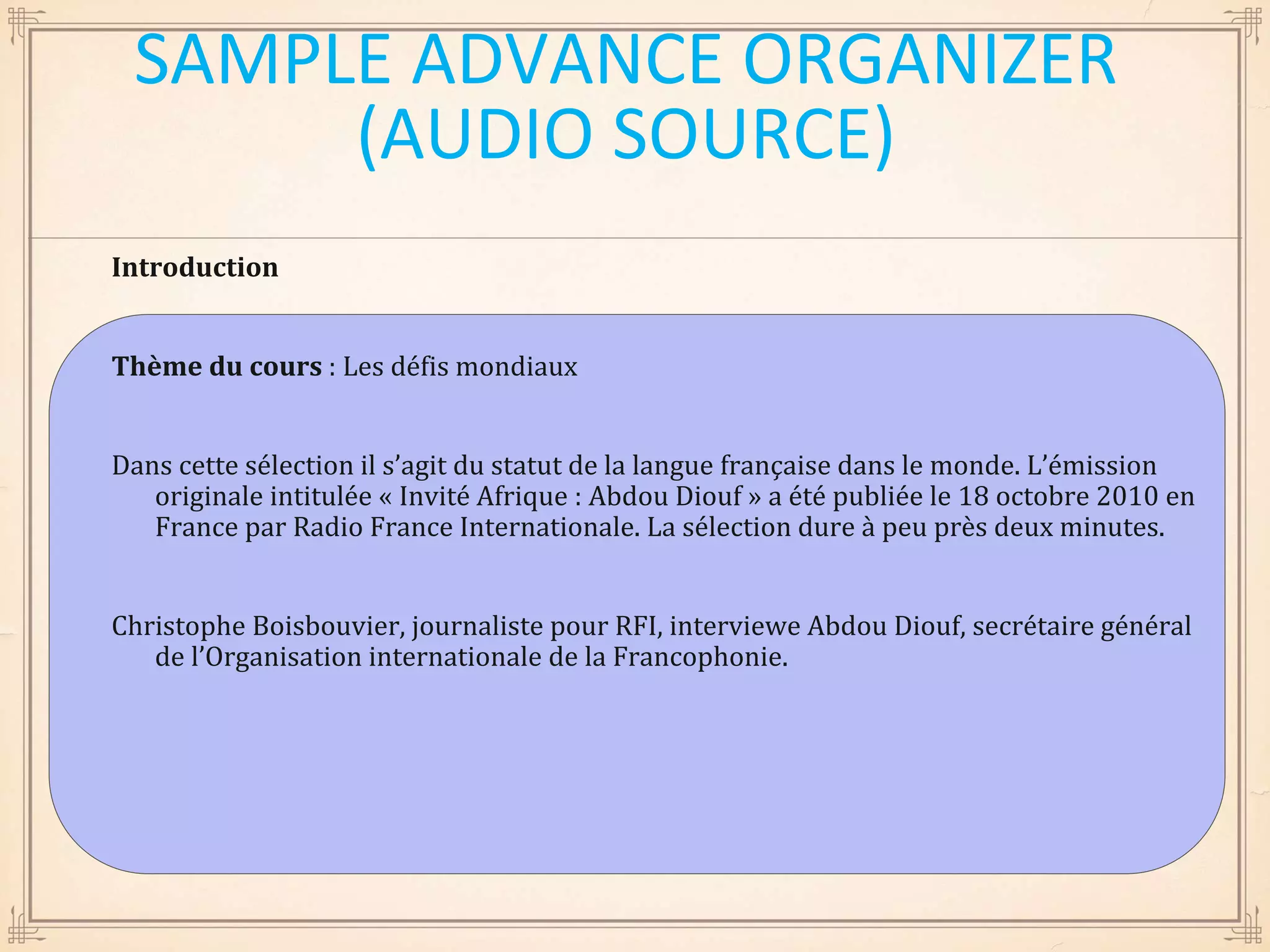
Introduction
Thème du cours : Les défis mondiaux
Dans cette sélection il s’agit du statut de la langue française dans le monde. L’émission
originale intitulée « Invité Afrique : Abdou Diouf » a été publiée le 18 octobre 2010 en
France par Radio France Internationale. La sélection dure à peu près deux minutes.
Christophe Boisbouvier, journaliste pour RFI, interviewe Abdou Diouf, secrétaire général
de l’Organisation internationale de la Francophonie.
SAMPLE ADVANCE ORGANIZER
(AUDIO SOURCE)
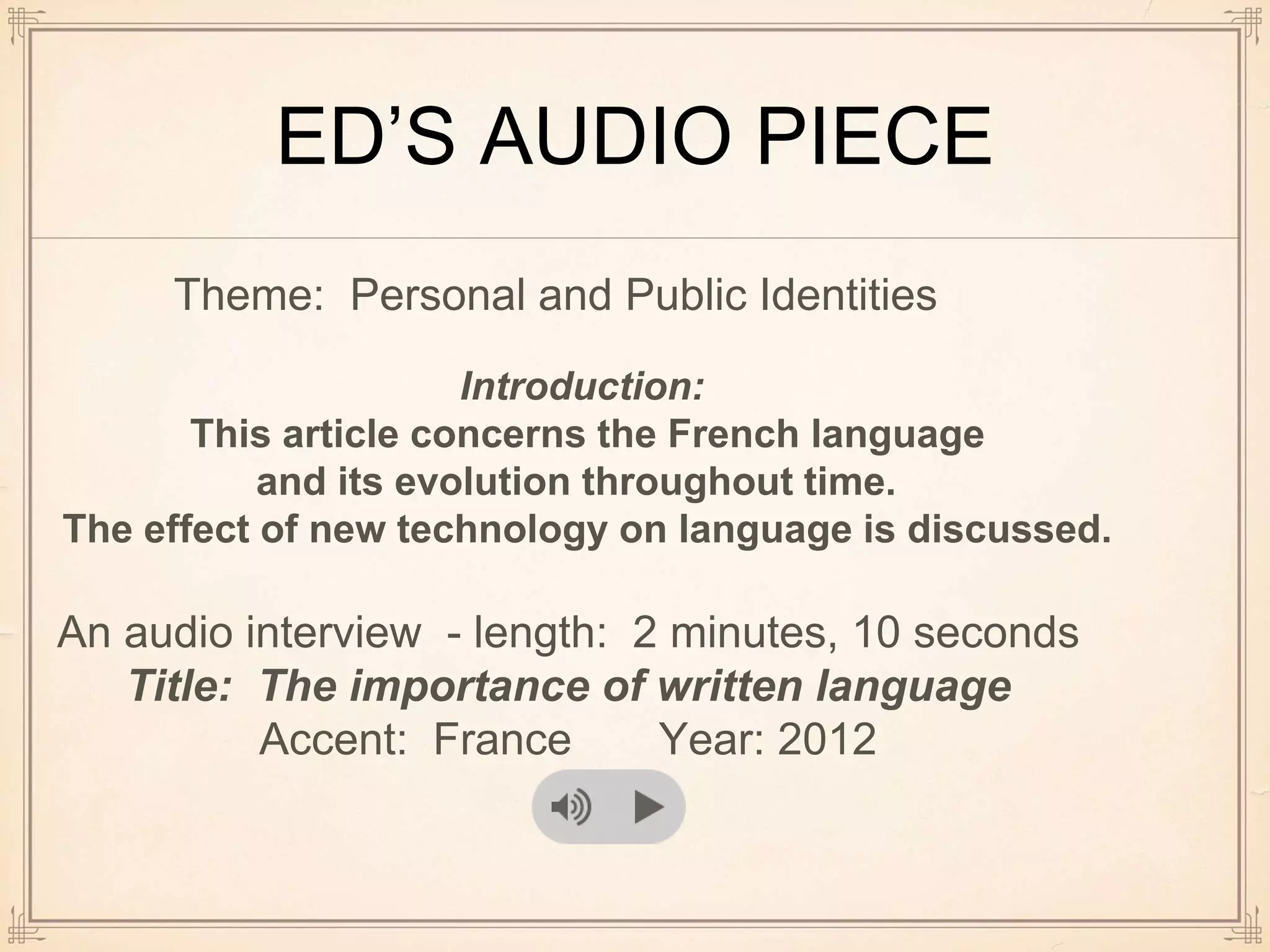
ED’S AUDIO PIECE
Theme: Personal and Public Identities
Introduction:
This article concerns the French language
and its evolution throughout time.
The effect of new technology on language is discussed.
An audio interview - length: 2 minutes, 10 seconds
Title: The importance of written language
Accent: France Year: 2012
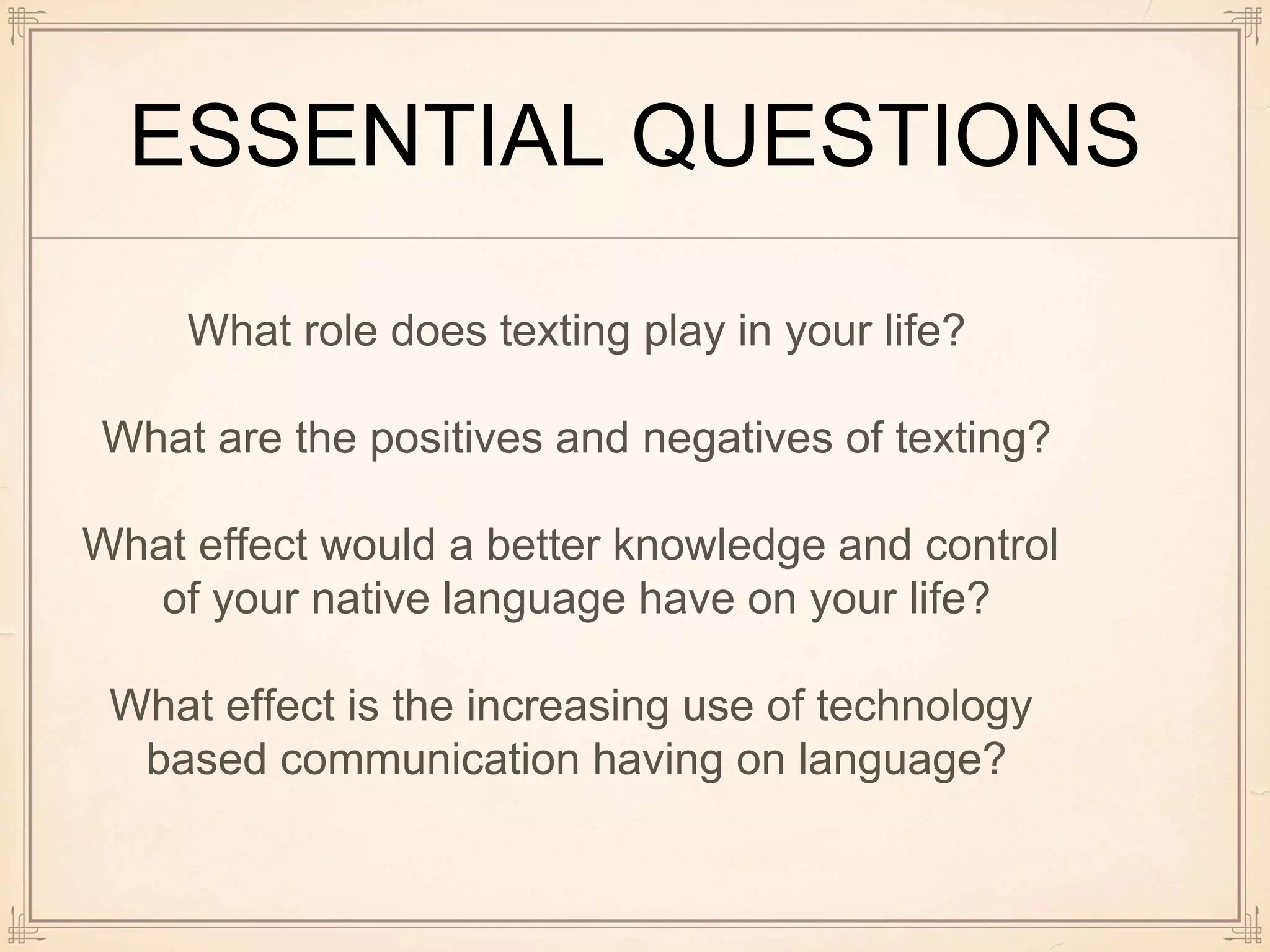
ESSENTIAL QUESTIONS
What role does texting play in your life?
What are the positives and negatives of texting?
What effect would a better knowledge and control
of your native language have on your life?
What effect is the increasing use of technology
based communication having on language?
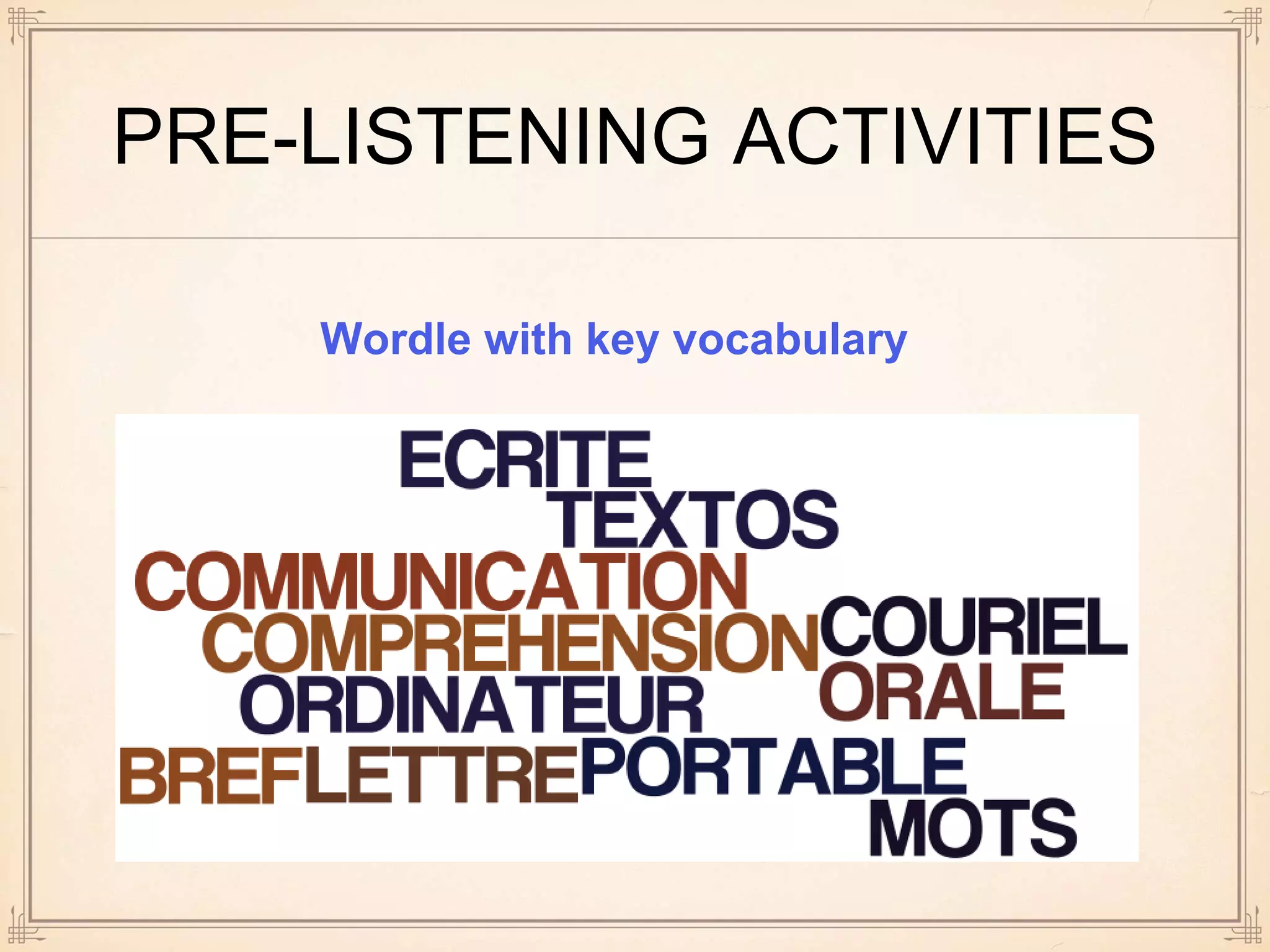
PRE-LISTENING ACTIVITIES
Wordle with key vocabulary
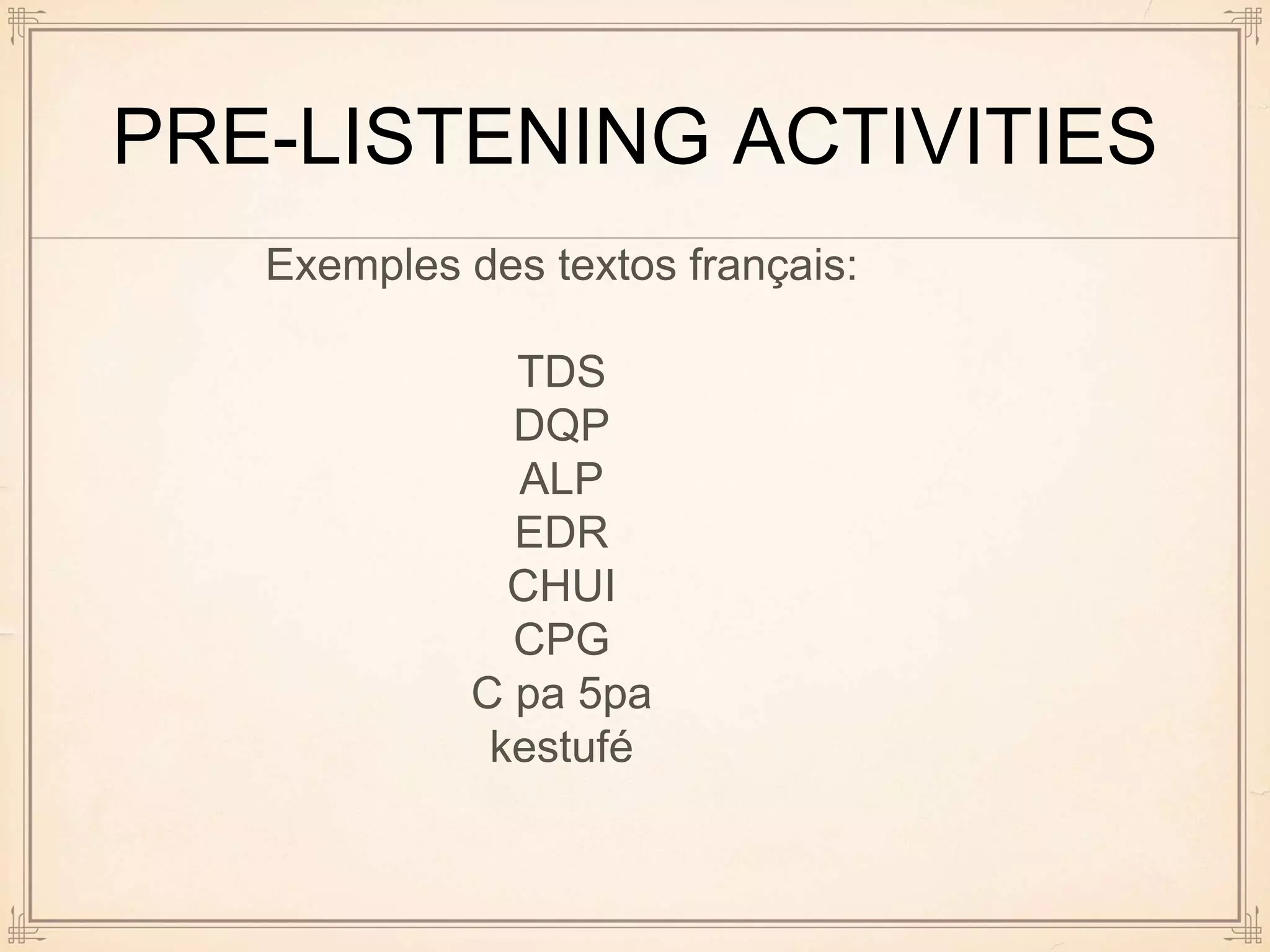
PRE-LISTENING ACTIVITIES
Exemples des textos français:
TDS
DQP
ALP
EDR
CHUI
CPG
C pa 5pa
kestufé
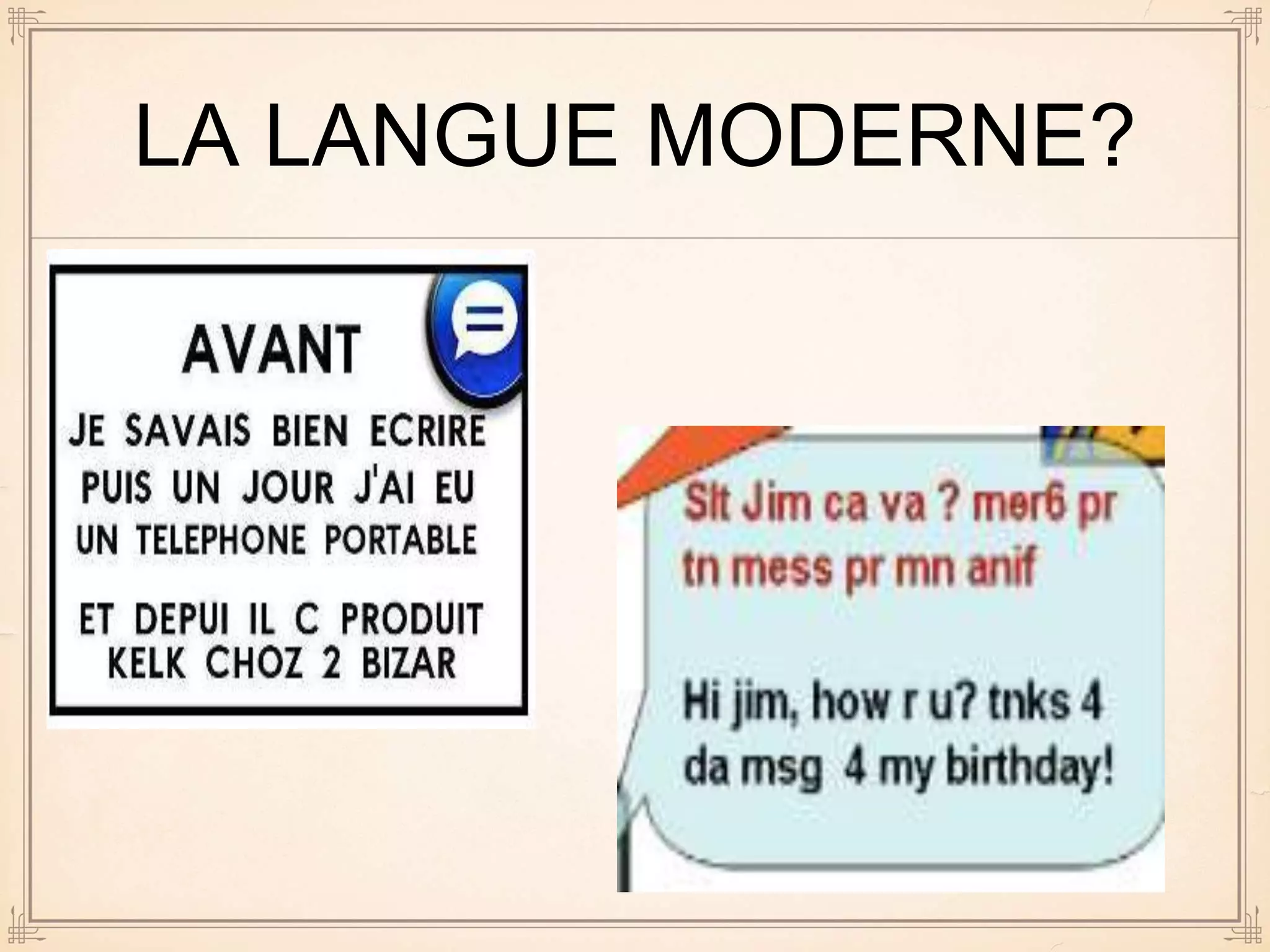
LA LANGUE MODERNE?
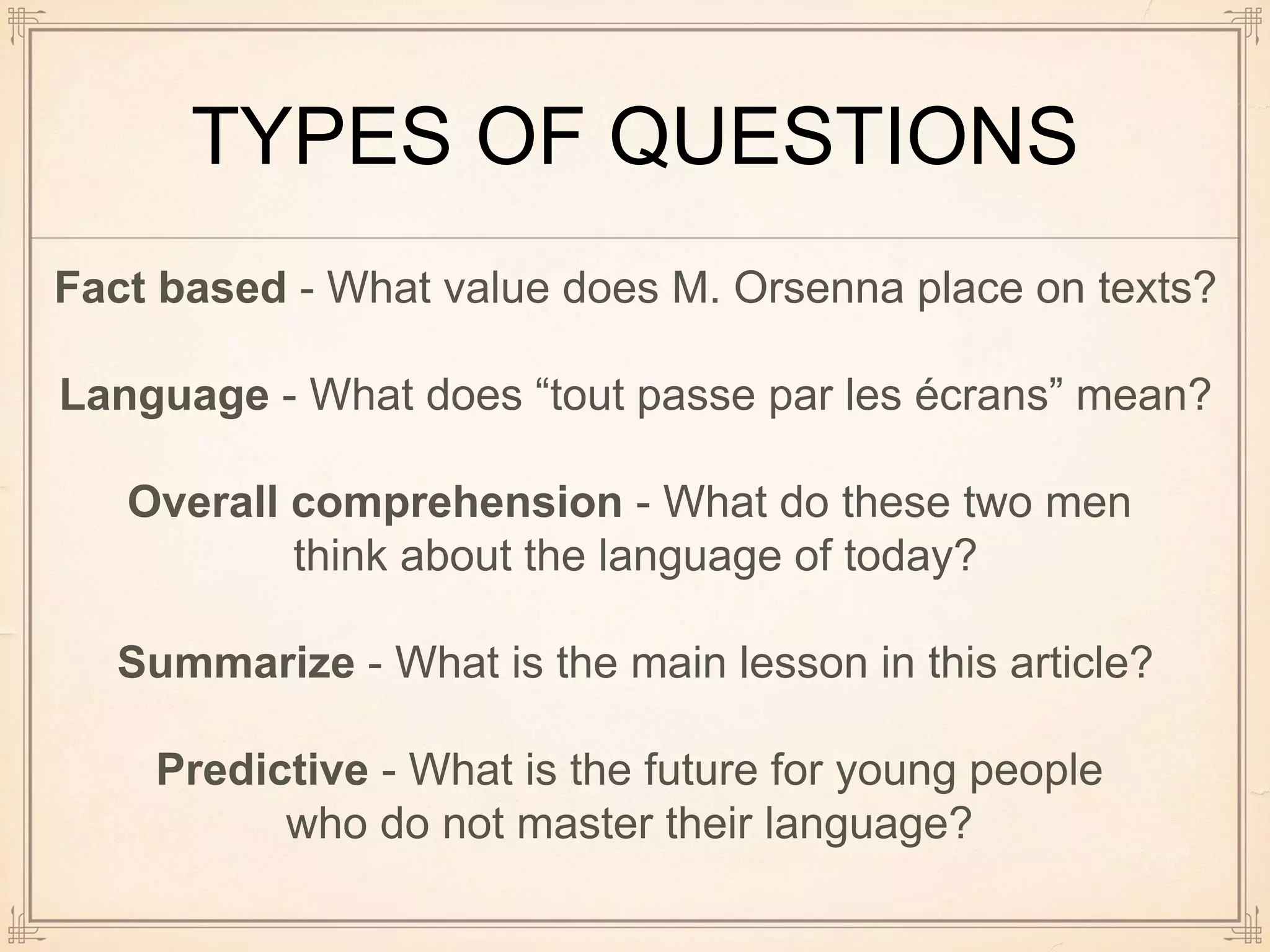
TYPES OF QUESTIONS
Fact based - What value does M. Orsenna place on texts?
Language - What does “tout passe par les écrans” mean?
Overall comprehension - What do these two men
think about the language of today?
Summarize - What is the main lesson in this article?
Predictive - What is the future for young people
who do not master their language?
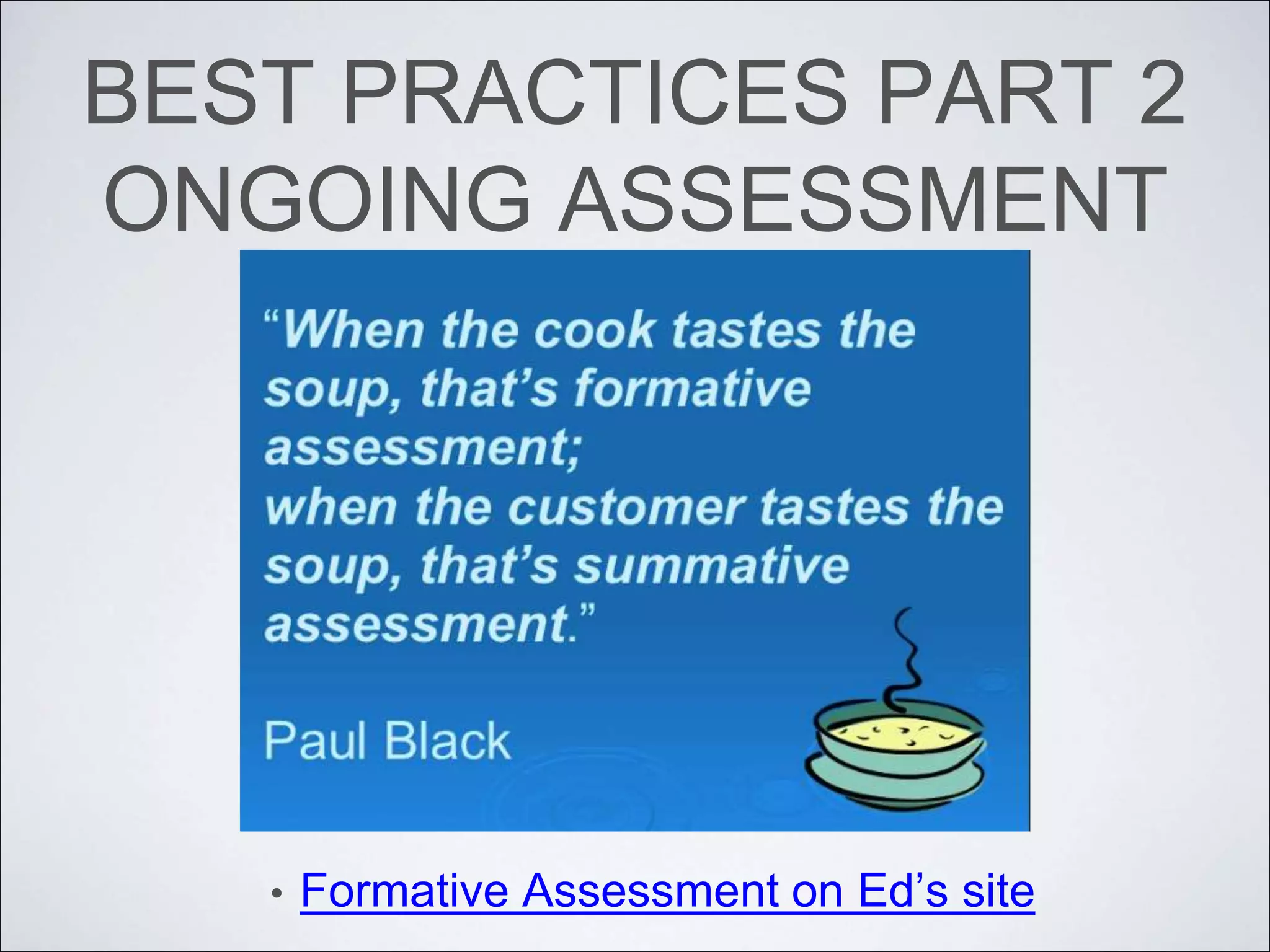
BEST PRACTICES PART 2
ONGOING ASSESSMENT
• Formative Assessment on Ed’s site
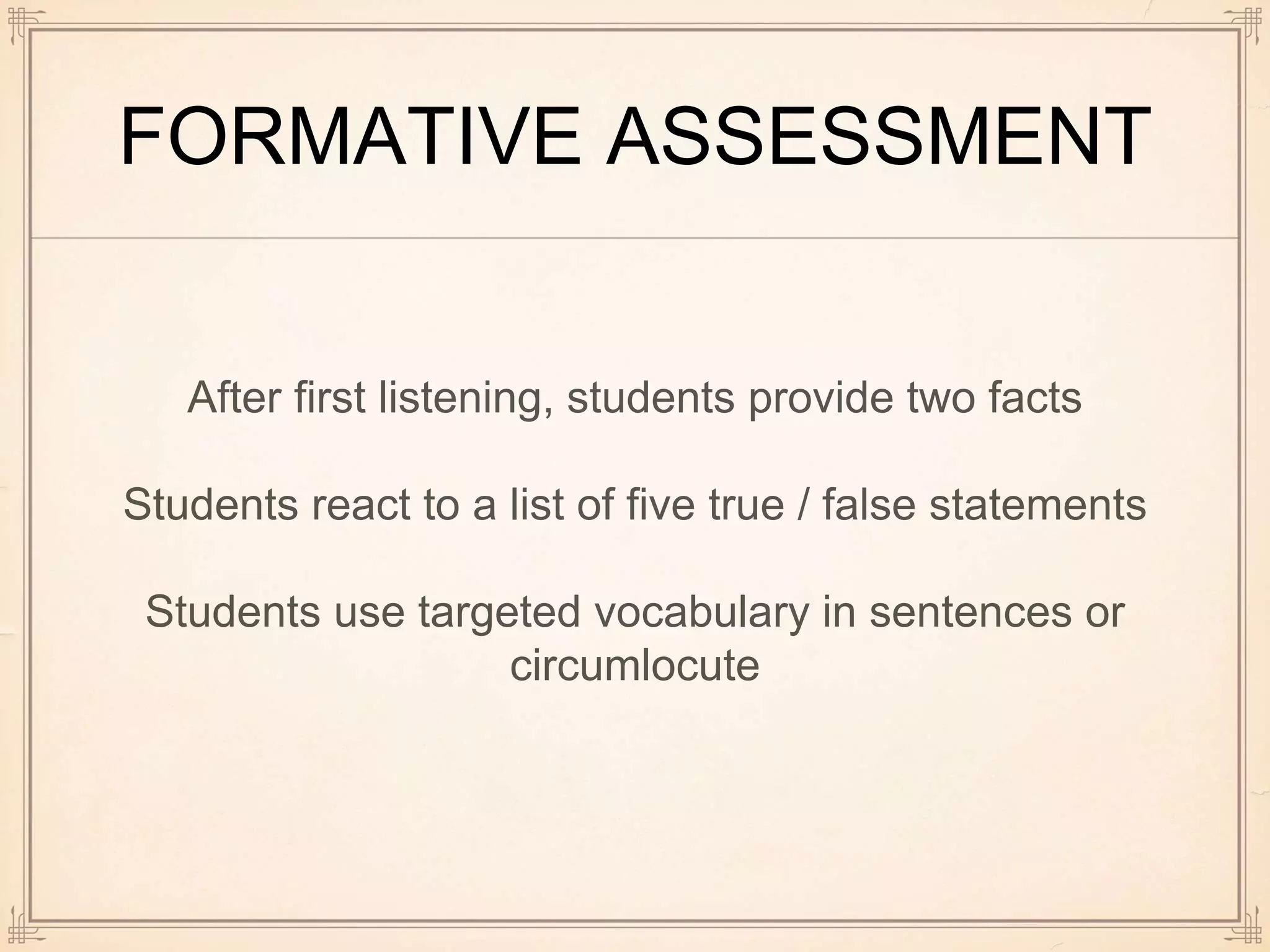
FORMATIVE ASSESSMENT
After first listening, students provide two facts
Students react to a list of five true / false statements
Students use targeted vocabulary in sentences or
circumlocute
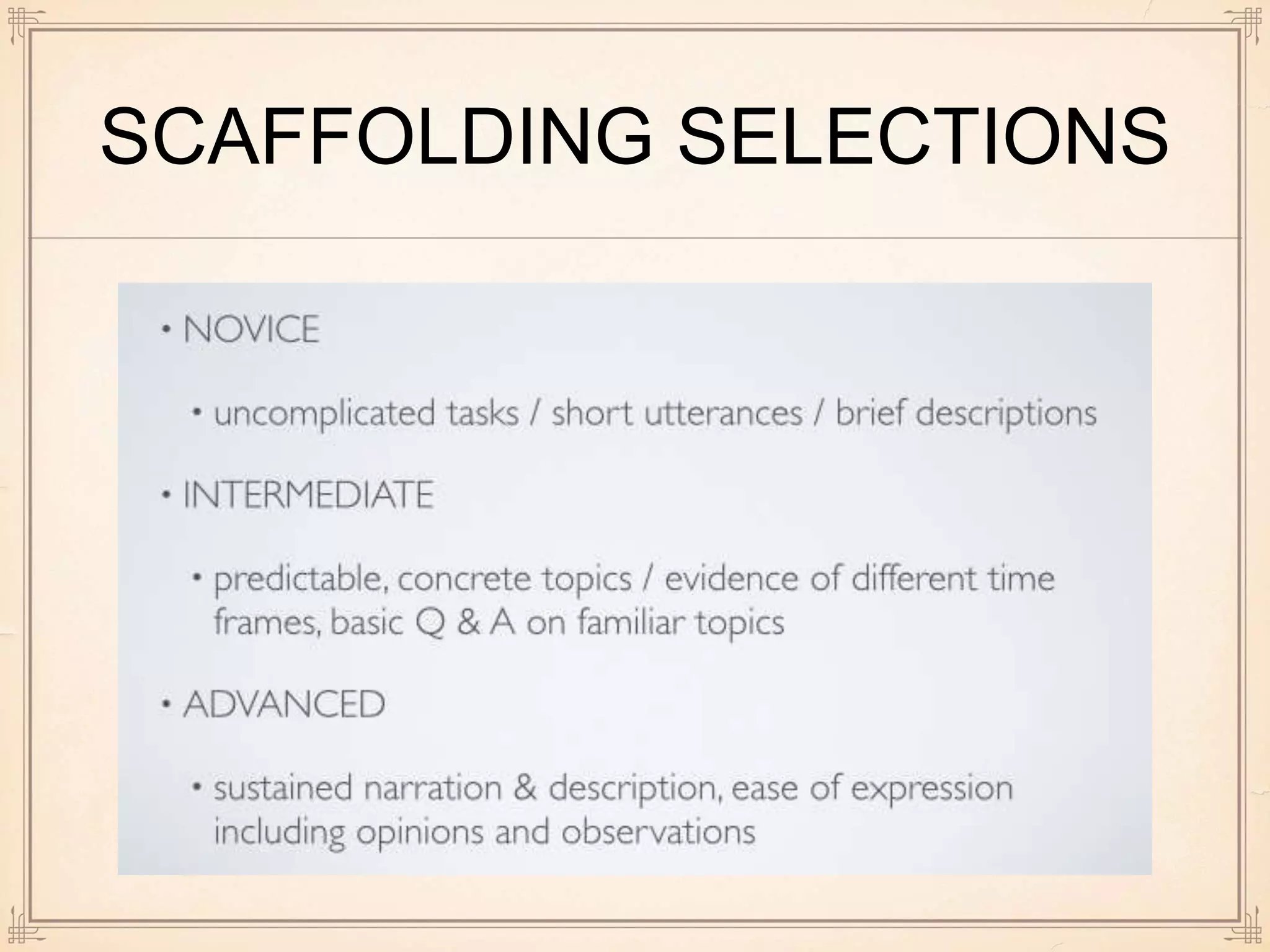
SCAFFOLDING SELECTIONS
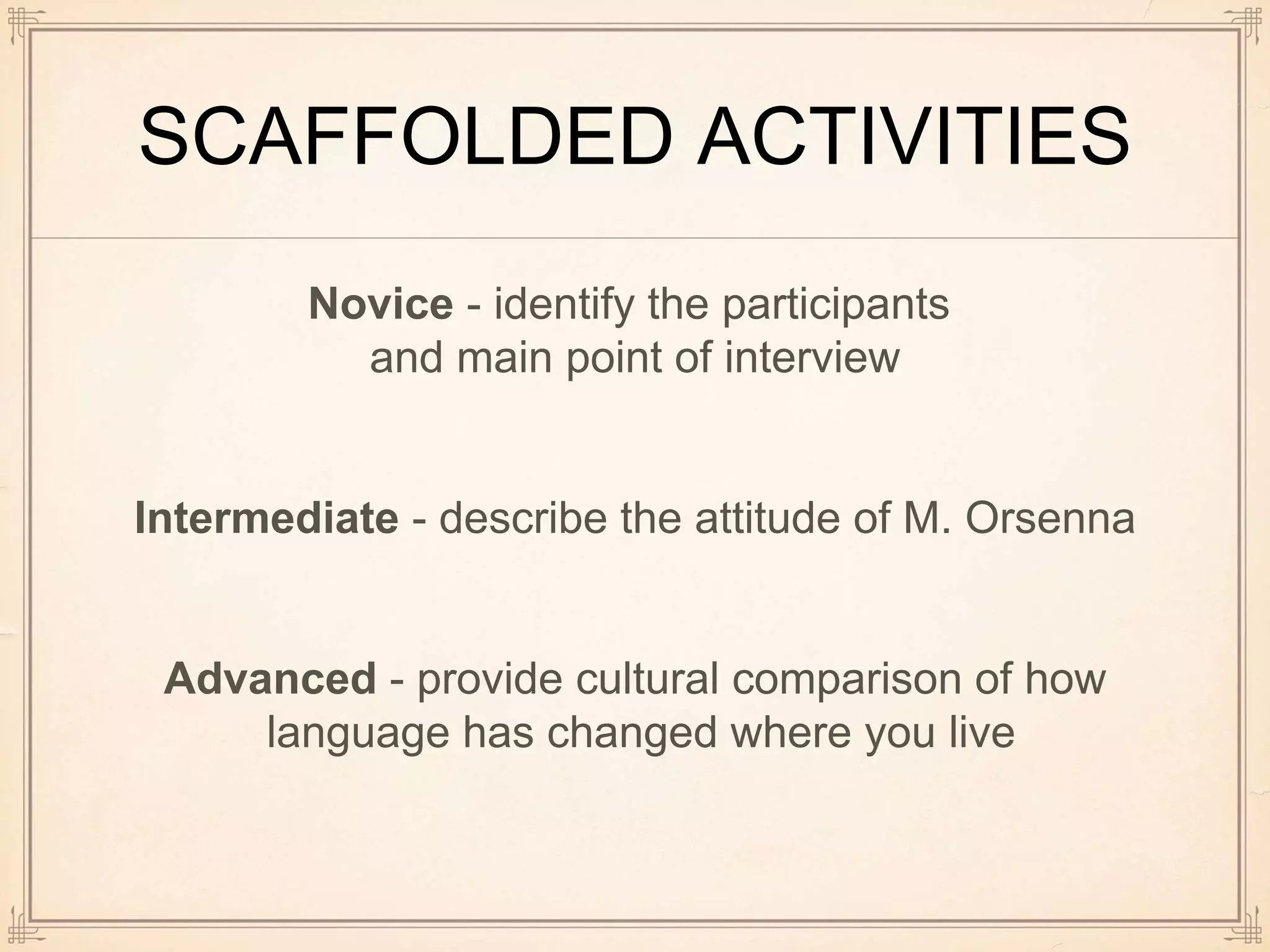
SCAFFOLDED ACTIVITIES
Novice - identify the participants
and main point of interview
Intermediate - describe the attitude of M. Orsenna
Advanced - provide cultural comparison of how
language has changed where you live
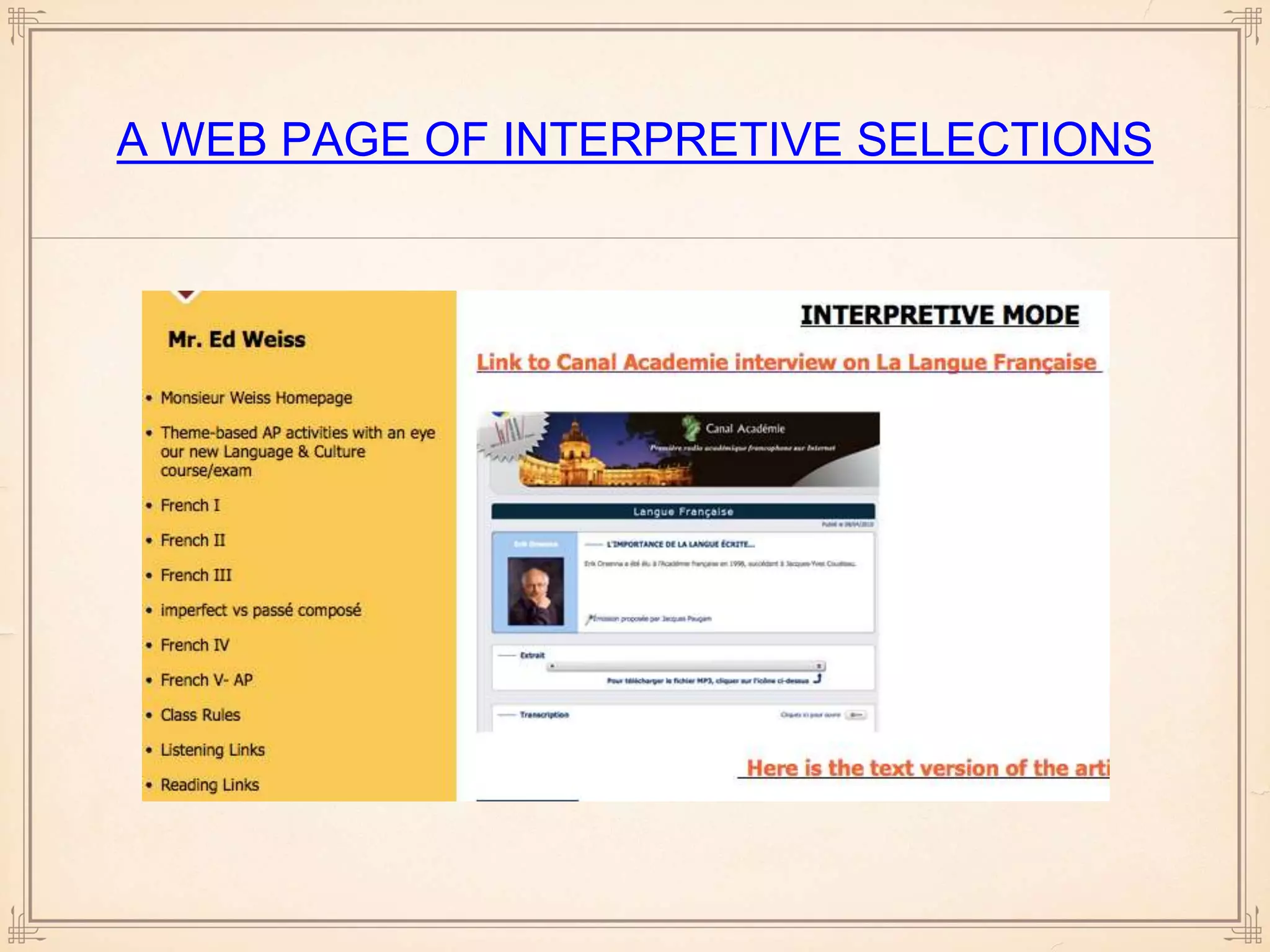
A WEB PAGE OF INTERPRETIVE SELECTIONS
INTERACTIVE TECHNOLOGY SUPPORTING
STUDENT ACCESS TO MATERIALS
Lingtlanguage
Audioboo podcaster
Voicethread
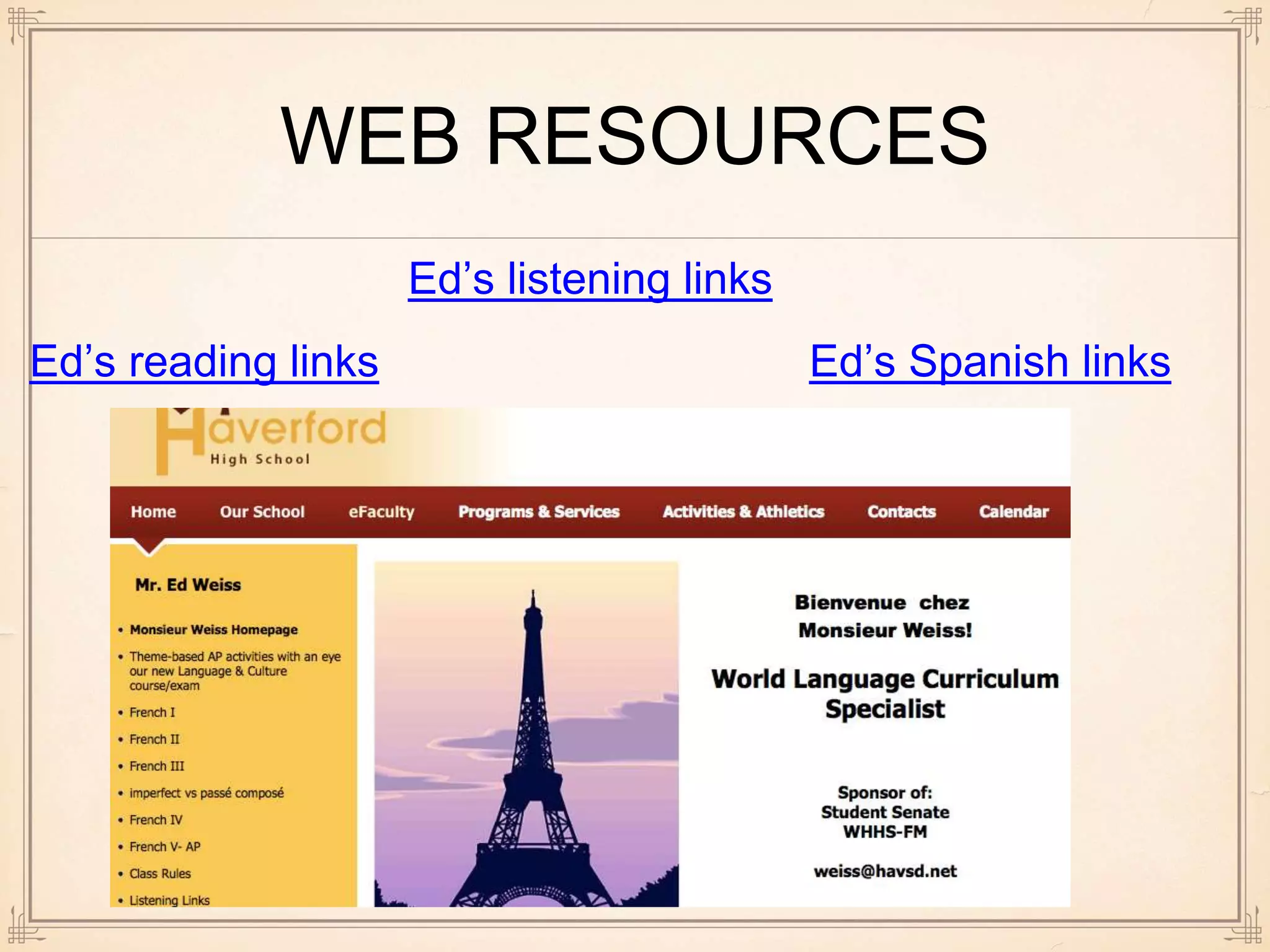
WEB RESOURCES
Ed’s listening links
Ed’s reading links Ed’s Spanish links
CONTACT INFORMATION
Lou Baskinger – lgbaskin@aol.com
Ed Weiss – edweiss@comcast.net
The entire presentation can be viewed at Eds site:
Simply Google “Ed Weiss”
The last link on Ed’s site is titled “APAC”
Link to Ed’s listening piece:
http://www.canalacademie.com/apprendre/fiche.php?id=
61

Mastering interpretive mode 2

  • 1.
    MASTERING THE INTERPRETIVE MODE Presentedby Lou Baskinger & Ed Weiss APAC 2014
  • 2.
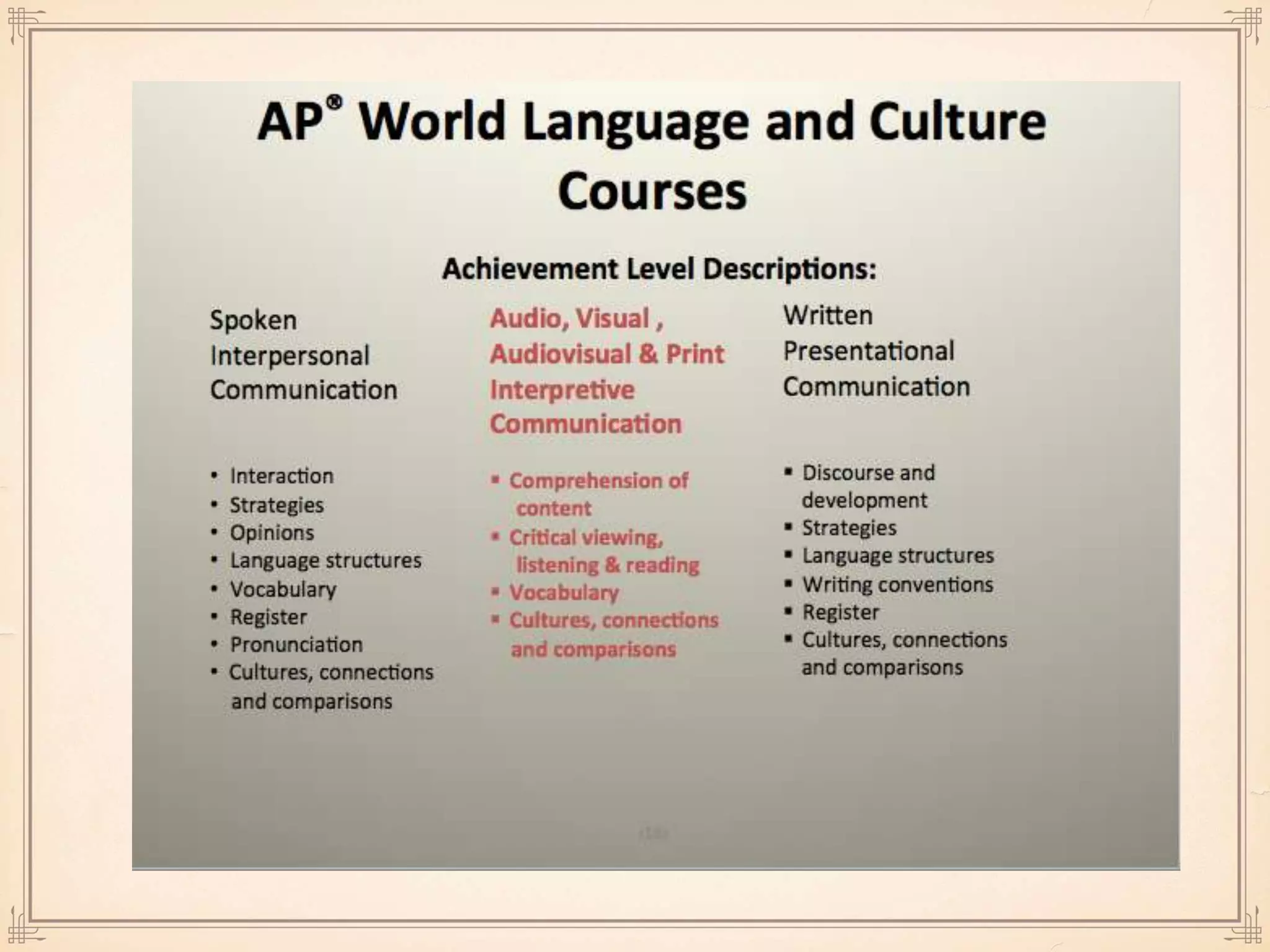
    TODAY’S AGENDA DEFINITION –THE INTERPRETIVE MODE MATERIALS FOR INTERPRETIVE MODE INTERPRETIVE MODE ON THE AP EXAM DEMONSTRATION OF TEACHING STRATEGIES audio and written examples TEACHER RESOURCES / STUDENT ACCESS
  • 3.
    What ACTFL tells usabout the Interpretive Mode
  • 4.
    AP EXAM OVERVIEW SectionI (Interpretive Communication) Multiple-choice (50% of total score): 65 items in 9 sets 4 reading 2 listening and reading combined 3 listening Section 2 (Interpersonal and Presentational Communication) Free-Response (50% of total score): 4 items Interpersonal Writing Presentational Writing Interpersonal Speaking Presentational Speaking
  • 5.
  • 6.
    AUTHENTIC MATERIALS MUST BEUSED THROUGHOUT YOUR PROGRAM • Exposure to authentic materials begins day one of year one! • Scaffolding these materials through the various levels of your program builds proficiency • The rich diversity of these materials will energize your lessons and engage students
  • 7.
    AUTHENTIC MATERIALS ARE... • thosedesigned for native speakers. They are real text designed not for language students, but for the speakers of the language in question. (Nunan) • stretches of real language, produced by a real speaker or writer for a real audience and designed to carry a real message. (Harmer) • “appropriate” and “quality” in terms of goals, objectives, learner needs and interest and “natural” in terms of real life and meaningful communication. (Rogers)
  • 8.
    A PARTIAL LIST... •online articles • charts / graphs / maps • videos • magazines / newspapers • films • music • advertisements
  • 9.
    AUDIO SOURCES • Radiointerviews • General interest podcasts • PSAs • Brief lectures • Audio guides - museums, travel comprehensibility & relevance are #1
  • 10.
    WRITTEN SOURCES • Literarytexts • Journalistic articles • Letters • Ads • Instructions • The above may be combined with maps, charts, or table
  • 11.
  • 12.
    ALL MATERIALS FITUNDER THE SIX THEMES
  • 15.
    THE AP LANGUAGEAND CULTURE EXAM - Strategies for success with interpretive questions - Student responsibilities - Types of questions
  • 16.
    STRATEGIES • Each audiopiece is played two times • Note taking is permitted and encouraged • Scanning questions in advance • Having a knowledge of the question types is key • Key terms that guide listening: • comprehension, tone, audience, meaning, purpose
  • 18.
    IMPACT OF INTERPRETIVE MODE Aminimum 75% of the exam (objective and free respons e) requires interpretation of a variety of materials Audio, Visual,Audiovisual & Print Interpretive Communication  Comprehension of content  Critical viewing, reading & listening  Vocabulary  Cultures, Connections & Comparisons
  • 20.
    EXAMPLES OF INTERPRETIVEMATERIALS You will see a demonstration of two different interpretive pieces typical of those found on the AP exam Lou will model a letter in Spanish Ed will model an interview in French
  • 21.
    BEST PRACTICES WHENUSING MATERIALS FOR THE INTERPRETIVE MODE • Advanced Organizer - a pre-reading or pre-listening teaching aide that prepares the students for what is to come
  • 22.
    Tema curricular: Labelleza y la estética Introducción Este texto trata de una obra de teatro para niños. El anuncio original fue publicado en marzo de 2011 en Nueva York, Estados Unidos.
  • 23.
    ¡TRAIGA A SUSNINOS A REPERTORIO ESPAñOL! MI BEBé ES UN HéROE ESCRITA Y DIRIGIDA POR EDUARDO NAVAS UNA PRODUCCIóN DEL TEATRO RODANTE INFANTIL SCARAMOUChES PRESENTADA POR REPERTORIO ESPAñOL UN ESPECTáCULO BILINGüE (INGLéS Y ESPAñOL) Teatro Scaramouches, una excepcional compañía venezolana de teatro infantil, presenta una original y divertida obra teatral con marionetas. El malvado y travieso Cuchiflín intenta llevarse al bebé del Príncipe Azulito y la Princesa Perlita. Con la ayuda de los niños el bebé impide que Cuchiflín se salga con la suya, convirtiendo al bebé y a los niños en héroes. Repleta de colorido, risas y diversión, la obra capta la atención de los niños de principio a fin. sábado 5 de febrero – 12 p.m. sábado 5 de marzo – 12 p.m. sábado 2 de abril – 12 p.m. sábado 7 de mayo – 12 p.m. sábado 4 de junio – 12 p.m. RESERVACIONES INTERNET: WWW.REPERTORIO.ORG TELéFONO: 1.212.225.9999
  • 24.
    INTERPRETIVE TEACHING How toimplement Interpretive Teaching into your class A lesson plan
  • 25.
    INTERPRETIVE TEACHING Ways toincorporate the interpretive mode into your lessons A typical story from your curriculum that is not from the AP level Remember… Scaffold into lower levels Third year honors class Fourth year class
  • 26.
    GREGORIO LÓPEZ YFUENTES 1940 A SUMMARY OF THE STORY UNA CARTA A DIOS
  • 27.
  • 28.
  • 29.
  • 30.
    POSSIBLE QUESTIONS What imagescome to mind when I say Mexico? What do you think life is like in a farming village of Mexico? Do you think your life is different for your great grandparents ’ life? Explain the differences? What was the last letter … not e-mail… you wrote? To whom did you write? Why did you write?
  • 31.
    PRE-READING ACTIVITIES Write aletter to Santa Claus Write a letter to Los Reyes Magos Share with class Laugh and enjoy! Collect and put aside
  • 32.
    VOCABULARY…EMPTY LIST Write thestory… based on the words of the list
  • 33.
    READ AND DISCUSS Createquestions for comprehension (Formative assessment) Create questions for discussion (Summative assessment) Connect to Essential questions (Interpretive mode)
  • 34.
  • 35.
  • 36.
    WRITING ASSIGNMENT INTERPRETIVE MODE IsLencho a good man or a bad man… or is he like most of us… a combination of good and bad qualities?
  • 37.
    THE WRITING ASSIGNMENT UnaCarta A Dios Muchas veces cuando leemos una novela o un cuento, el personaje principal tiene características buenas o malas... o este personaje es una combinación de lo bueno y lo malo. En el cuento <<Una Carta a Dios>>¿es Lencho, en su opinión, una buena o una mala persona o es él una combinación de lo bueno y lo malo. En una composición bien desarrollada y con prueba del texto del cuento, expliquen Uds. por qué es bueno o malo Lencho. ¡OJO! Una composición bien desarrollada es una que tiene una introducción, tres argumentos (por mínimo) y una conclusión. Una composición bien desarrollada también tiene una extensión mínima de unas doscientas palabras.
  • 38.
  • 39.
    LET’S LOOK ATAN EXAMPLE OF A LISTENING PIECE This example will be an interview in Frenc h Many of the following strategies can be applied to reading interpretation as well
  • 40.
    Introduction Thème du cours: Les défis mondiaux Dans cette sélection il s’agit du statut de la langue française dans le monde. L’émission originale intitulée « Invité Afrique : Abdou Diouf » a été publiée le 18 octobre 2010 en France par Radio France Internationale. La sélection dure à peu près deux minutes. Christophe Boisbouvier, journaliste pour RFI, interviewe Abdou Diouf, secrétaire général de l’Organisation internationale de la Francophonie. SAMPLE ADVANCE ORGANIZER (AUDIO SOURCE)
  • 41.
    ED’S AUDIO PIECE Theme:Personal and Public Identities Introduction: This article concerns the French language and its evolution throughout time. The effect of new technology on language is discussed. An audio interview - length: 2 minutes, 10 seconds Title: The importance of written language Accent: France Year: 2012
  • 42.
    ESSENTIAL QUESTIONS What roledoes texting play in your life? What are the positives and negatives of texting? What effect would a better knowledge and control of your native language have on your life? What effect is the increasing use of technology based communication having on language?
  • 43.
  • 44.
    PRE-LISTENING ACTIVITIES Exemples destextos français: TDS DQP ALP EDR CHUI CPG C pa 5pa kestufé
  • 45.
  • 46.
    TYPES OF QUESTIONS Factbased - What value does M. Orsenna place on texts? Language - What does “tout passe par les écrans” mean? Overall comprehension - What do these two men think about the language of today? Summarize - What is the main lesson in this article? Predictive - What is the future for young people who do not master their language?
  • 47.
    BEST PRACTICES PART2 ONGOING ASSESSMENT • Formative Assessment on Ed’s site
  • 48.
    FORMATIVE ASSESSMENT After firstlistening, students provide two facts Students react to a list of five true / false statements Students use targeted vocabulary in sentences or circumlocute
  • 49.
  • 50.
    SCAFFOLDED ACTIVITIES Novice -identify the participants and main point of interview Intermediate - describe the attitude of M. Orsenna Advanced - provide cultural comparison of how language has changed where you live
  • 51.
    A WEB PAGEOF INTERPRETIVE SELECTIONS
  • 52.
    INTERACTIVE TECHNOLOGY SUPPORTING STUDENTACCESS TO MATERIALS Lingtlanguage Audioboo podcaster Voicethread
  • 53.
    WEB RESOURCES Ed’s listeninglinks Ed’s reading links Ed’s Spanish links
  • 54.
    CONTACT INFORMATION Lou Baskinger– lgbaskin@aol.com Ed Weiss – edweiss@comcast.net The entire presentation can be viewed at Eds site: Simply Google “Ed Weiss” The last link on Ed’s site is titled “APAC” Link to Ed’s listening piece: http://www.canalacademie.com/apprendre/fiche.php?id= 61