Interculturality:
Building bridges with
language and culture
Ed Weiss
AATF 2019
Today’s Agenda
• What is culture?
• Connection between language and culture
• The question of teaching culture – interculturality
• The concepts of products, practices, and perspective
• Specific examples of presenting culture:
• Enriching vocabulary and language structures
• Understanding differences between people
• Comparing cultures
• Finding resources
• Project-based assessment/IPA
Culture Defined
• How do you define culture?
• What role does culture play in our curriculum?
• What cultural aspects are important to your teaching?
Scholarly Views of Culture
• Culture is what binds people together
• Culture is all the accepted and patterned ways of
behavior of a given people
• Culture is our social legacy
Without the study of culture, world language
instruction is inaccurate and incomplete.
More Views of Culture
Foreign language instruction at any level should be a
humanistic pursuit intended to sensitize students to
other cultures, to the relativity of values, to
appreciation of similarities among peoples and
respect for the differences among them.
– President’s Commission on Foreign
Language and International Studies
Scholarly Views of Culture
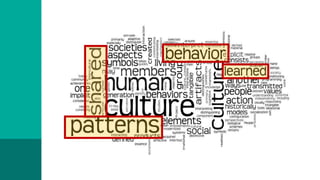
Culture is an integrated pattern of human behavior
that includes thoughts, communications, languages,
practices, beliefs, values, customs, courtesies, rituals,
manners of interacting and roles, relationships and
expected behaviors of a racial, ethnic, religious or
social group
– NCCC, Georgetown University
What is your greatest challenge
in integrating culture into
everyday instruction?
Interculturality
• As a philosophy for instruction, it goes against traditional
teaching methodology stressing authentic cultural
interaction vs. intense grammar approach
• At its core, introducing students to language via
interactions with speakers from target language area to
better understand their cultural background
• It is student-centered, supported by the “flipped
classroom” model
• Its goal – prepare students for real world language
experiences and interactions
Possible features of instruction:
• Students first encounter language forms in context
• Grammar aspects such as conjugation are handled
via videos viewed at home – the flipped classroom
• Video blogs by students in target language countries
expose our learners to language
• Continuous exposure to authentic materials
• IPA is used for assessment – centered on both
cultural and linguistic competence
Outcomes of Interculturality
• Appreciate the similarities and differences between their own
and cultures of others where target language is spoken
• Identify the perspective of people who live in target language
communities
• Use this knowledge to develop a more objective view of their
own customs and ways of thinking
• Have the ability to use language in real life situations for
meaningful interactions
Linking Language & Culture
How do we know that the
role of culture needs to be emphasized in our
teaching?
How has ACTFL come to think
of the role of culture in our profession
over the past twenty years?
• Standards for Foreign Language Learning in the 21st
Century (1999)
• “Language and communication are at the heart of the
human experience. The United States must educate
students who are linguistically and culturally equipped to
communicate successfully in a pluralistic American
society and abroad. This imperative envisions a future in
which ALL students will develop and maintain proficiency
in English and at least one other language, modern or
classical.”
ACTFL World Readiness Standards (2015)
“The World-Readiness Standards for Learning
Languages create a roadmap to guide learners to
develop competence to communicate effectively and
interact with cultural competence to participate in
multilingual communities at home and around the
world.”
1999-2015 Culture Focus
Let’s look at the 5 C’s & their evolution
Communication
(1999) Communicate in Languages other than English
(2015) Communicate effectively in more than one language in
order to function in a variety of situations and for multiple
purposes
Cultures
(1999) Gain knowledge and Understanding of other cultures
(2015) Interact with cultural competence and understanding
Connections
(1999) Connect with other disciplines and acquire information
(2015) Connect with other disciplines and acquire information
and diverse perspectives in order to use the language to
function in academic and career-related situations
Comparisons
(1999) Develop insight into the nature of language and culture
(2015) Develop insight into the nature of language and culture
in order to interact with cultural competence
Communities
(1999) Participate in multilingual communities at home and
around the world
(2015) Communicate and interact with cultural competence in
order to participate in multilingual communities at home and
around the world
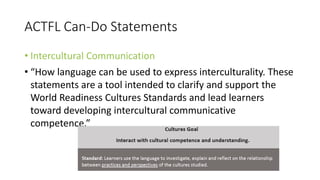
ACTFL Can-Do Statements
• Intercultural Communication
• “How language can be used to express interculturality. These
statements are a tool intended to clarify and support the
World Readiness Cultures Standards and lead learners
toward developing intercultural communicative
competence.”
Teach? Learn?
savoir
saber
sapere
wissen
connaître
conocer
conoscere
kennen
APPRECIATE

Presentation1 a

  • 1.
  • 2.
    Today’s Agenda • Whatis culture? • Connection between language and culture • The question of teaching culture – interculturality • The concepts of products, practices, and perspective • Specific examples of presenting culture: • Enriching vocabulary and language structures • Understanding differences between people • Comparing cultures • Finding resources • Project-based assessment/IPA
  • 3.
    Culture Defined • Howdo you define culture? • What role does culture play in our curriculum? • What cultural aspects are important to your teaching?
  • 4.
    Scholarly Views ofCulture • Culture is what binds people together • Culture is all the accepted and patterned ways of behavior of a given people • Culture is our social legacy Without the study of culture, world language instruction is inaccurate and incomplete.
  • 5.
    More Views ofCulture Foreign language instruction at any level should be a humanistic pursuit intended to sensitize students to other cultures, to the relativity of values, to appreciation of similarities among peoples and respect for the differences among them. – President’s Commission on Foreign Language and International Studies
  • 6.
    Scholarly Views ofCulture Culture is an integrated pattern of human behavior that includes thoughts, communications, languages, practices, beliefs, values, customs, courtesies, rituals, manners of interacting and roles, relationships and expected behaviors of a racial, ethnic, religious or social group – NCCC, Georgetown University
  • 8.
    What is yourgreatest challenge in integrating culture into everyday instruction?
  • 9.
    Interculturality • As aphilosophy for instruction, it goes against traditional teaching methodology stressing authentic cultural interaction vs. intense grammar approach • At its core, introducing students to language via interactions with speakers from target language area to better understand their cultural background • It is student-centered, supported by the “flipped classroom” model • Its goal – prepare students for real world language experiences and interactions Possible features of instruction: • Students first encounter language forms in context • Grammar aspects such as conjugation are handled via videos viewed at home – the flipped classroom • Video blogs by students in target language countries expose our learners to language • Continuous exposure to authentic materials • IPA is used for assessment – centered on both cultural and linguistic competence
  • 10.
    Outcomes of Interculturality •Appreciate the similarities and differences between their own and cultures of others where target language is spoken • Identify the perspective of people who live in target language communities • Use this knowledge to develop a more objective view of their own customs and ways of thinking • Have the ability to use language in real life situations for meaningful interactions
  • 11.
  • 12.
    How do weknow that the role of culture needs to be emphasized in our teaching?
  • 14.
    How has ACTFLcome to think of the role of culture in our profession over the past twenty years?
  • 15.
    • Standards forForeign Language Learning in the 21st Century (1999) • “Language and communication are at the heart of the human experience. The United States must educate students who are linguistically and culturally equipped to communicate successfully in a pluralistic American society and abroad. This imperative envisions a future in which ALL students will develop and maintain proficiency in English and at least one other language, modern or classical.” ACTFL World Readiness Standards (2015) “The World-Readiness Standards for Learning Languages create a roadmap to guide learners to develop competence to communicate effectively and interact with cultural competence to participate in multilingual communities at home and around the world.”
  • 16.
    1999-2015 Culture Focus Let’slook at the 5 C’s & their evolution Communication (1999) Communicate in Languages other than English (2015) Communicate effectively in more than one language in order to function in a variety of situations and for multiple purposes Cultures (1999) Gain knowledge and Understanding of other cultures (2015) Interact with cultural competence and understanding Connections (1999) Connect with other disciplines and acquire information (2015) Connect with other disciplines and acquire information and diverse perspectives in order to use the language to function in academic and career-related situations Comparisons (1999) Develop insight into the nature of language and culture (2015) Develop insight into the nature of language and culture in order to interact with cultural competence Communities (1999) Participate in multilingual communities at home and around the world (2015) Communicate and interact with cultural competence in order to participate in multilingual communities at home and around the world
  • 17.
    ACTFL Can-Do Statements •Intercultural Communication • “How language can be used to express interculturality. These statements are a tool intended to clarify and support the World Readiness Cultures Standards and lead learners toward developing intercultural communicative competence.”
  • 18.
  • 19.

Editor's Notes

  • #12 I suggest swapping out this image. I would find a higher quality one to replace it.
  • #14 These images are low quality. I suggest swapping them out with higher quality images.
  • #19 I suggest finding a new image to replace this one. If you find one on Shutterstock you would like to use let me know and we can download it for you.
  • #20 I suggest finding a new image to replace this one. If you find one on Shutterstock you would like to use let me know and we can download it for you.