Creating spaces for autonomous 
learning in an EST course 
Lindsay Miller & Christoph A. Hafner 
Department of English, City University of Hong Kong 
http://www1.english.cityu.edu.hk/acadlit 
Spaces for Learning Symposium: AILA Brisbane, August 12, 2014
Background and context 
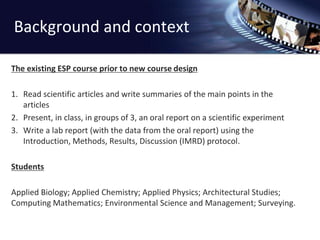
The existing ESP course prior to new course design 
1. Read scientific articles and write summaries of the main points in the 
articles 
2. Present, in class, in groups of 3, an oral report on a scientific experiment 
3. Write a lab report (with the data from the oral report) using the 
Introduction, Methods, Results, Discussion (IMRD) protocol. 
Students 
Applied Biology; Applied Chemistry; Applied Physics; Architectural Studies; 
Computing Mathematics; Environmental Science and Management; Surveying.
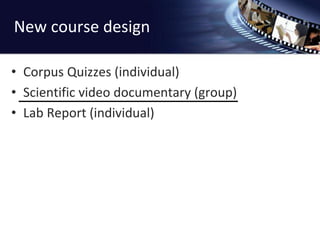
New course design 
• Corpus Quizzes (individual) 
• Scientific video documentary (group) 
• Lab Report (individual)
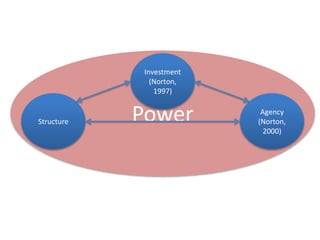
Power Structure 
Agency 
(Norton, 
2000) 
Investment 
(Norton, 
1997)
Structure 
Course design
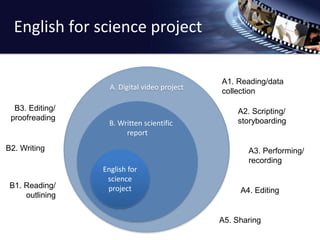
English for science project 
A. Digital video project 
B. Written scientific 
report 
English for 
science 
project 
A1. Reading/data 
collection 
A2. Scripting/ 
storyboarding 
A3. Performing/ 
recording 
A4. Editing 
A5. Sharing 
B3. Editing/ 
proofreading 
B2. Writing 
B1. Reading/ 
outlining
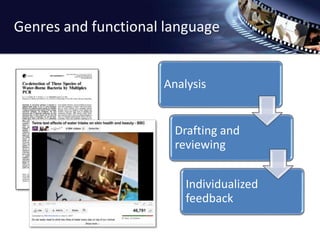
Genres and functional language 
Analysis 
Drafting and 
reviewing 
Individualized 
feedback
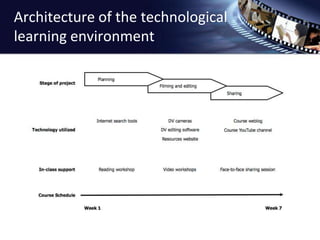
Architecture of the technological 
learning environment
Methods
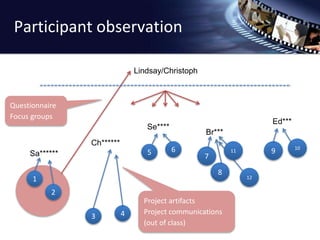
Participant observation 
Lindsay/Christoph 
Se**** 
Sa****** 
1 
2 
Ch****** 
Br*** 
Ed*** 
3 4 
5 6 
7 
8 
11 
12 
9 10 
Project artifacts 
Project communications 
(out of class) 
Questionnaire 
Focus groups
Participants 
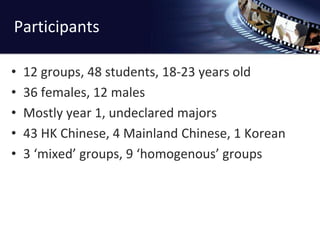
• 12 groups, 48 students, 18-23 years old 
• 36 females, 12 males 
• Mostly year 1, undeclared majors 
• 43 HK Chinese, 4 Mainland Chinese, 1 Korean 
• 3 ‘mixed’ groups, 9 ‘homogenous’ groups
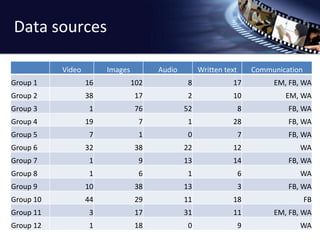
Data sources 
Video Images Audio Written text Communication 
Group 1 16 102 8 17 EM, FB, WA 
Group 2 38 17 2 10 EM, WA 
Group 3 1 76 52 8 FB, WA 
Group 4 19 7 1 28 FB, WA 
Group 5 7 1 0 7 FB, WA 
Group 6 32 38 22 12 WA 
Group 7 1 9 13 14 FB, WA 
Group 8 1 6 1 6 WA 
Group 9 10 38 13 3 FB, WA 
Group 10 44 29 11 18 FB 
Group 11 3 17 31 11 EM, FB, WA 
Group 12 1 18 0 9 WA
Findings 
Spaces for language learning
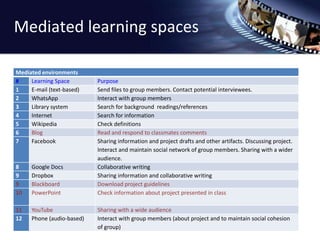
Mediated learning spaces 
Mediated environments 
# Learning Space Purpose 
1 E-mail (text-based) Send files to group members. Contact potential interviewees. 
2 WhatsApp Interact with group members 
3 Library system Search for background readings/references 
4 Internet Search for information 
5 Wikipedia Check definitions 
6 Blog Read and respond to classmates comments 
7 Facebook Sharing information and project drafts and other artifacts. Discussing project. 
Interact and maintain social network of group members. Sharing with a wider 
audience. 
8 Google Docs Collaborative writing 
9 Dropbox Sharing information and collaborative writing 
9 Blackboard Download project guidelines 
10 PowerPoint Check information about project presented in class 
11 YouTube Sharing with a wide audience 
12 Phone (audio-based) Interact with group members (about project and to maintain social cohesion 
of group)
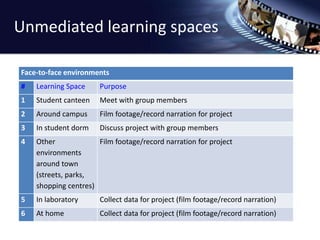
Unmediated learning spaces 
Face-to-face environments 
# Learning Space Purpose 
1 Student canteen Meet with group members 
2 Around campus Film footage/record narration for project 
3 In student dorm Discuss project with group members 
4 Other 
environments 
around town 
(streets, parks, 
shopping centres) 
Film footage/record narration for project 
5 In laboratory Collect data for project (film footage/record narration) 
6 At home Collect data for project (film footage/record narration)
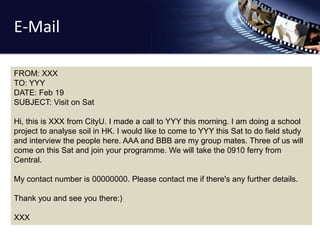
E-Mail 
FROM: XXX 
TO: YYY 
DATE: Feb 19 
SUBJECT: Visit on Sat 
Hi, this is XXX from CityU. I made a call to YYY this morning. I am doing a school 
project to analyse soil in HK. I would like to come to YYY this Sat to do field study 
and interview the people here. AAA and BBB are my group mates. Three of us will 
come on this Sat and join your programme. We will take the 0910 ferry from 
Central. 
My contact number is 00000000. Please contact me if there's any further details. 
Thank you and see you there:) 
XXX
E-Mail 
C: This is an email to that Arc Eden staff, right, … So, why did you choose 
English? 
R: She is a foreigner [Group 2] 
L: In your email communication was it in English or Chinese? 
G: English 
L: for the whole group? 
E: yeah…. 
W: the difference between whatsapp and email is that this one is more close to 
our life so its more close to spoken language so we feel so relax to type in 
Chinese…but in email we feel so official… 
E: more formal way… [Group 11]
WhatsApp: Project talk 
J: Can someone give me ur email address so I can send back the video 
H: XXXXGmail.com 
J: Ok. Do u hv a drop box 
There r a lot of video 
If I hv to send email 
U will be receiving abt 20 
一係用手指攞 
Or use finger [USB drive] 
H:  [emoji] 
I give you usb on monday 
J: Ok 
Btw the file is quite large  [emoji] 
H: How many Gb? 
J: Nearly 1 
But can't seed email xd [emoticon] 
[Group 12]
Facebook: Project talk 
Q: 麻煩您地幫我check 有無漏了[Please help me check if I have missed any] 
我硬系覺得漏左好多[I always have the feeling that I missed a lot.] 
March 10 at 0:07 
AL: 我見到我個d 已齊>< [I can see that I got all for my part] 
March 10 at 0:10 via mobile 
RH: REMEMBER TO FIND THE WATER SOUND @ 
March 10 at 13:42 
RH: @@ 
March 10 at 13:42 
RH: KCY you still have the overall comment of the open area outside not yet record 
March 10 at 13:52 
KCY: o i will record it tonite 
March 10 at 13:55 via mobile 
RH: (y) (Thumb up)
Recording narration 
L: What happened when you were doing the narration, the story? Did you do that once? 
W: No, recording my voice at least one half day in my room and then they did their own 
later on. 
G: …yes I did my own again at home, because I thought my voice was maybe too 
nervous…not good enough, so I need to do it again. 
L: Do you know how many times you recorded it before you were happy? 
G: Oh…more than 10 times! (laugh) 
W: …yes, more than 10 times, it’s like only 5 minutes when we are actually recording…so 
totally speaking it’s like 3 to 4 hours to practice 
(all four students agree). 
L: What kind of things were you not happy with when you heard your voice? 
W: …it’s very strange for me to hear my voice (laugh)…and I kind of think “is that 
me?”…and it’s not fluent, and sometimes we will speak a wrong words and so we will 
start over again. [Group 11]
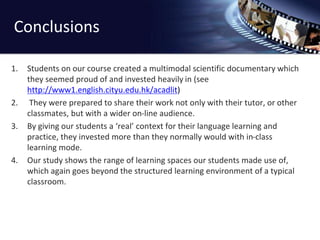
Conclusions
Conclusions 
1. Students on our course created a multimodal scientific documentary which 
they seemed proud of and invested heavily in (see 
http://www1.english.cityu.edu.hk/acadlit) 
2. They were prepared to share their work not only with their tutor, or other 
classmates, but with a wider on-line audience. 
3. By giving our students a ‘real’ context for their language learning and 
practice, they invested more than they normally would with in-class 
learning mode. 
4. Our study shows the range of learning spaces our students made use of, 
which again goes beyond the structured learning environment of a typical 
classroom.
Thank you 
http://www1.english.cityu.edu.hk/acadlit

AILA Creating spaces for autonomous learning in an EST course

  • 1.
    Creating spaces forautonomous learning in an EST course Lindsay Miller & Christoph A. Hafner Department of English, City University of Hong Kong http://www1.english.cityu.edu.hk/acadlit Spaces for Learning Symposium: AILA Brisbane, August 12, 2014
  • 2.
    Background and context The existing ESP course prior to new course design 1. Read scientific articles and write summaries of the main points in the articles 2. Present, in class, in groups of 3, an oral report on a scientific experiment 3. Write a lab report (with the data from the oral report) using the Introduction, Methods, Results, Discussion (IMRD) protocol. Students Applied Biology; Applied Chemistry; Applied Physics; Architectural Studies; Computing Mathematics; Environmental Science and Management; Surveying.
  • 3.
    New course design • Corpus Quizzes (individual) • Scientific video documentary (group) • Lab Report (individual)
  • 4.
    Power Structure Agency (Norton, 2000) Investment (Norton, 1997)
  • 5.
  • 6.
    English for scienceproject A. Digital video project B. Written scientific report English for science project A1. Reading/data collection A2. Scripting/ storyboarding A3. Performing/ recording A4. Editing A5. Sharing B3. Editing/ proofreading B2. Writing B1. Reading/ outlining
  • 7.
    Genres and functionallanguage Analysis Drafting and reviewing Individualized feedback
  • 8.
    Architecture of thetechnological learning environment
  • 9.
  • 10.
    Participant observation Lindsay/Christoph Se**** Sa****** 1 2 Ch****** Br*** Ed*** 3 4 5 6 7 8 11 12 9 10 Project artifacts Project communications (out of class) Questionnaire Focus groups
  • 11.
    Participants • 12groups, 48 students, 18-23 years old • 36 females, 12 males • Mostly year 1, undeclared majors • 43 HK Chinese, 4 Mainland Chinese, 1 Korean • 3 ‘mixed’ groups, 9 ‘homogenous’ groups
  • 12.
    Data sources VideoImages Audio Written text Communication Group 1 16 102 8 17 EM, FB, WA Group 2 38 17 2 10 EM, WA Group 3 1 76 52 8 FB, WA Group 4 19 7 1 28 FB, WA Group 5 7 1 0 7 FB, WA Group 6 32 38 22 12 WA Group 7 1 9 13 14 FB, WA Group 8 1 6 1 6 WA Group 9 10 38 13 3 FB, WA Group 10 44 29 11 18 FB Group 11 3 17 31 11 EM, FB, WA Group 12 1 18 0 9 WA
  • 13.
    Findings Spaces forlanguage learning
  • 14.
    Mediated learning spaces Mediated environments # Learning Space Purpose 1 E-mail (text-based) Send files to group members. Contact potential interviewees. 2 WhatsApp Interact with group members 3 Library system Search for background readings/references 4 Internet Search for information 5 Wikipedia Check definitions 6 Blog Read and respond to classmates comments 7 Facebook Sharing information and project drafts and other artifacts. Discussing project. Interact and maintain social network of group members. Sharing with a wider audience. 8 Google Docs Collaborative writing 9 Dropbox Sharing information and collaborative writing 9 Blackboard Download project guidelines 10 PowerPoint Check information about project presented in class 11 YouTube Sharing with a wide audience 12 Phone (audio-based) Interact with group members (about project and to maintain social cohesion of group)
  • 15.
    Unmediated learning spaces Face-to-face environments # Learning Space Purpose 1 Student canteen Meet with group members 2 Around campus Film footage/record narration for project 3 In student dorm Discuss project with group members 4 Other environments around town (streets, parks, shopping centres) Film footage/record narration for project 5 In laboratory Collect data for project (film footage/record narration) 6 At home Collect data for project (film footage/record narration)
  • 16.
    E-Mail FROM: XXX TO: YYY DATE: Feb 19 SUBJECT: Visit on Sat Hi, this is XXX from CityU. I made a call to YYY this morning. I am doing a school project to analyse soil in HK. I would like to come to YYY this Sat to do field study and interview the people here. AAA and BBB are my group mates. Three of us will come on this Sat and join your programme. We will take the 0910 ferry from Central. My contact number is 00000000. Please contact me if there's any further details. Thank you and see you there:) XXX
  • 17.
    E-Mail C: Thisis an email to that Arc Eden staff, right, … So, why did you choose English? R: She is a foreigner [Group 2] L: In your email communication was it in English or Chinese? G: English L: for the whole group? E: yeah…. W: the difference between whatsapp and email is that this one is more close to our life so its more close to spoken language so we feel so relax to type in Chinese…but in email we feel so official… E: more formal way… [Group 11]
  • 18.
    WhatsApp: Project talk J: Can someone give me ur email address so I can send back the video H: XXXXGmail.com J: Ok. Do u hv a drop box There r a lot of video If I hv to send email U will be receiving abt 20 一係用手指攞 Or use finger [USB drive] H:  [emoji] I give you usb on monday J: Ok Btw the file is quite large  [emoji] H: How many Gb? J: Nearly 1 But can't seed email xd [emoticon] [Group 12]
  • 19.
    Facebook: Project talk Q: 麻煩您地幫我check 有無漏了[Please help me check if I have missed any] 我硬系覺得漏左好多[I always have the feeling that I missed a lot.] March 10 at 0:07 AL: 我見到我個d 已齊>< [I can see that I got all for my part] March 10 at 0:10 via mobile RH: REMEMBER TO FIND THE WATER SOUND @ March 10 at 13:42 RH: @@ March 10 at 13:42 RH: KCY you still have the overall comment of the open area outside not yet record March 10 at 13:52 KCY: o i will record it tonite March 10 at 13:55 via mobile RH: (y) (Thumb up)
  • 20.
    Recording narration L:What happened when you were doing the narration, the story? Did you do that once? W: No, recording my voice at least one half day in my room and then they did their own later on. G: …yes I did my own again at home, because I thought my voice was maybe too nervous…not good enough, so I need to do it again. L: Do you know how many times you recorded it before you were happy? G: Oh…more than 10 times! (laugh) W: …yes, more than 10 times, it’s like only 5 minutes when we are actually recording…so totally speaking it’s like 3 to 4 hours to practice (all four students agree). L: What kind of things were you not happy with when you heard your voice? W: …it’s very strange for me to hear my voice (laugh)…and I kind of think “is that me?”…and it’s not fluent, and sometimes we will speak a wrong words and so we will start over again. [Group 11]
  • 21.
  • 22.
    Conclusions 1. Studentson our course created a multimodal scientific documentary which they seemed proud of and invested heavily in (see http://www1.english.cityu.edu.hk/acadlit) 2. They were prepared to share their work not only with their tutor, or other classmates, but with a wider on-line audience. 3. By giving our students a ‘real’ context for their language learning and practice, they invested more than they normally would with in-class learning mode. 4. Our study shows the range of learning spaces our students made use of, which again goes beyond the structured learning environment of a typical classroom.
  • 23.