i
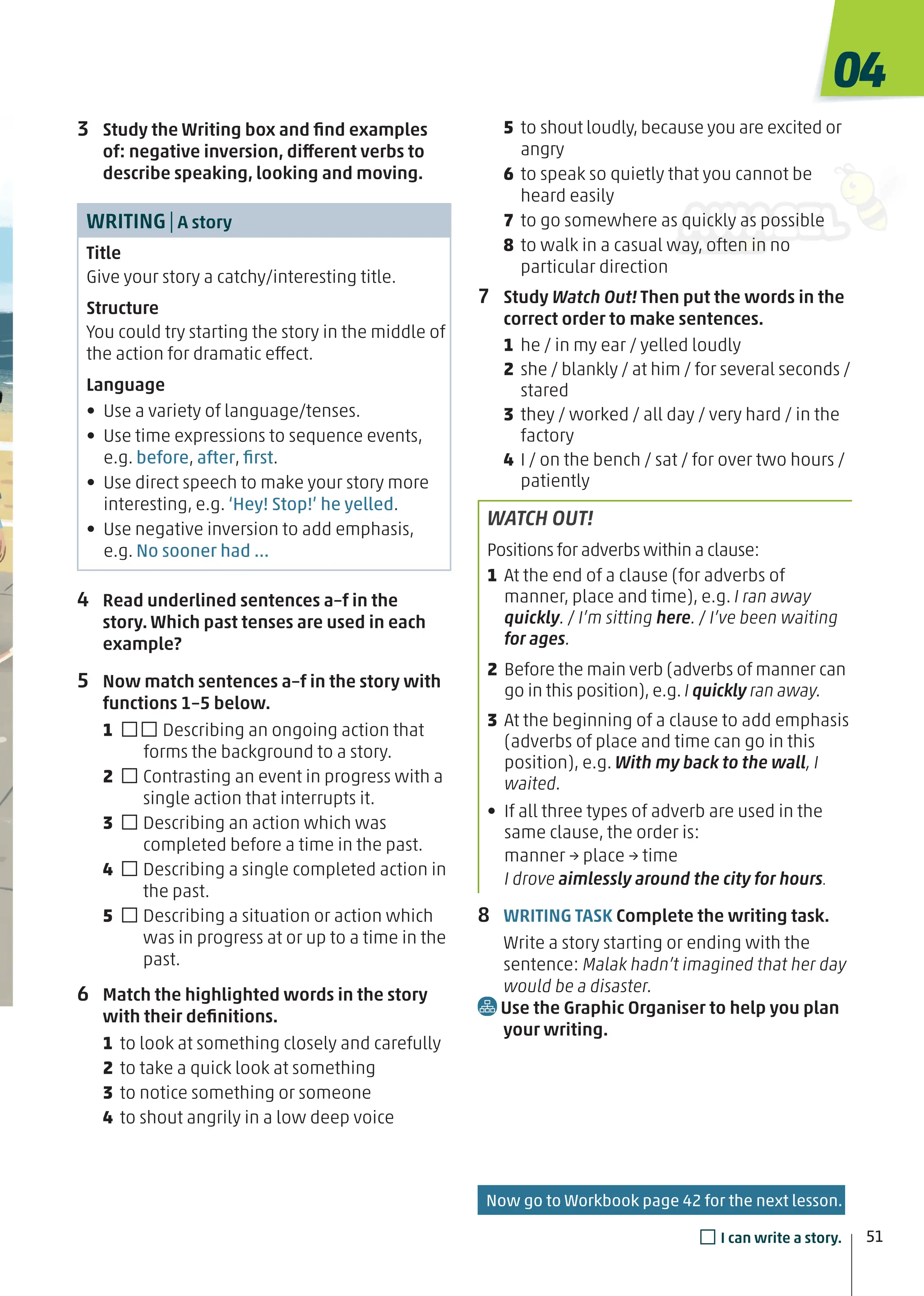
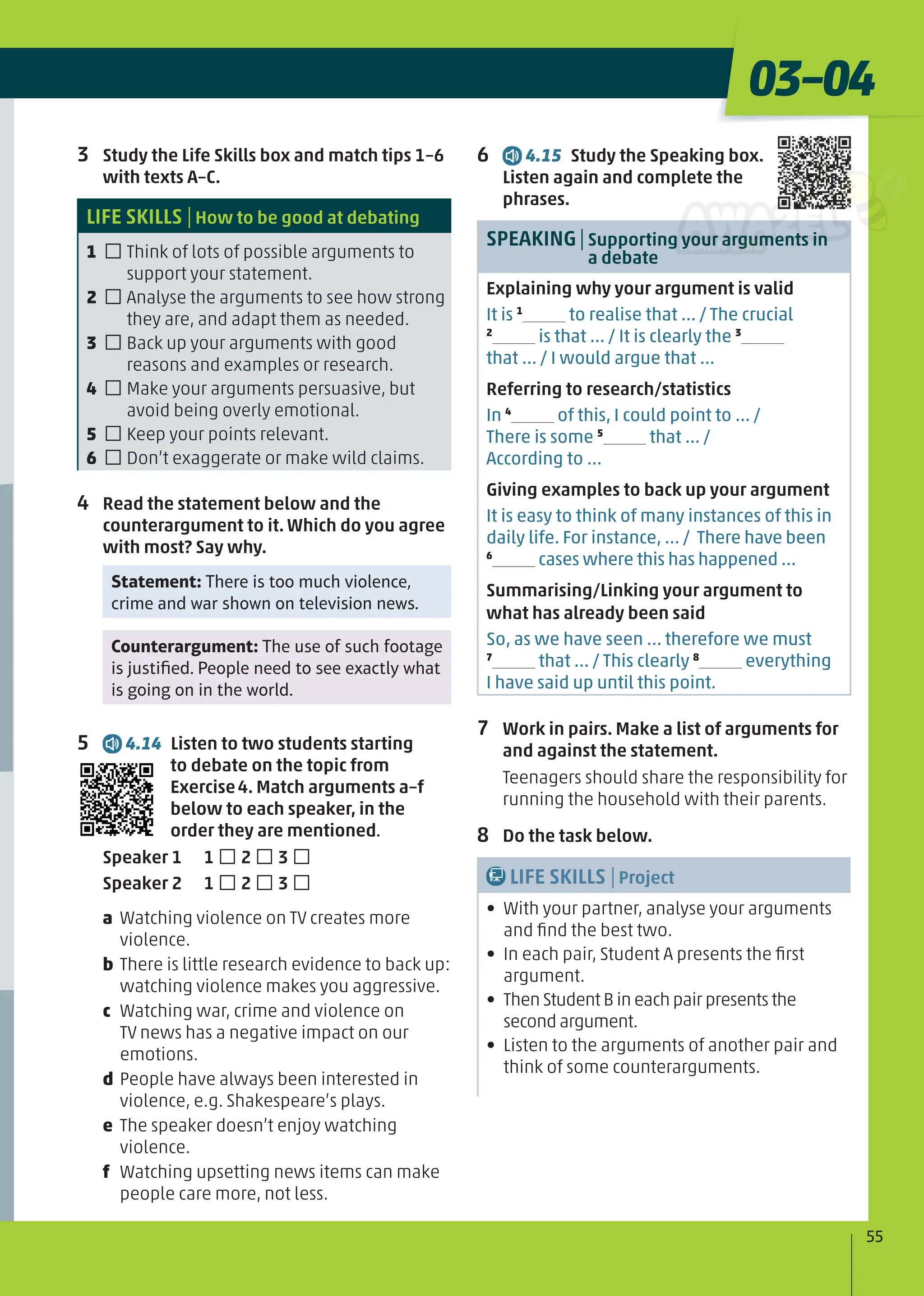
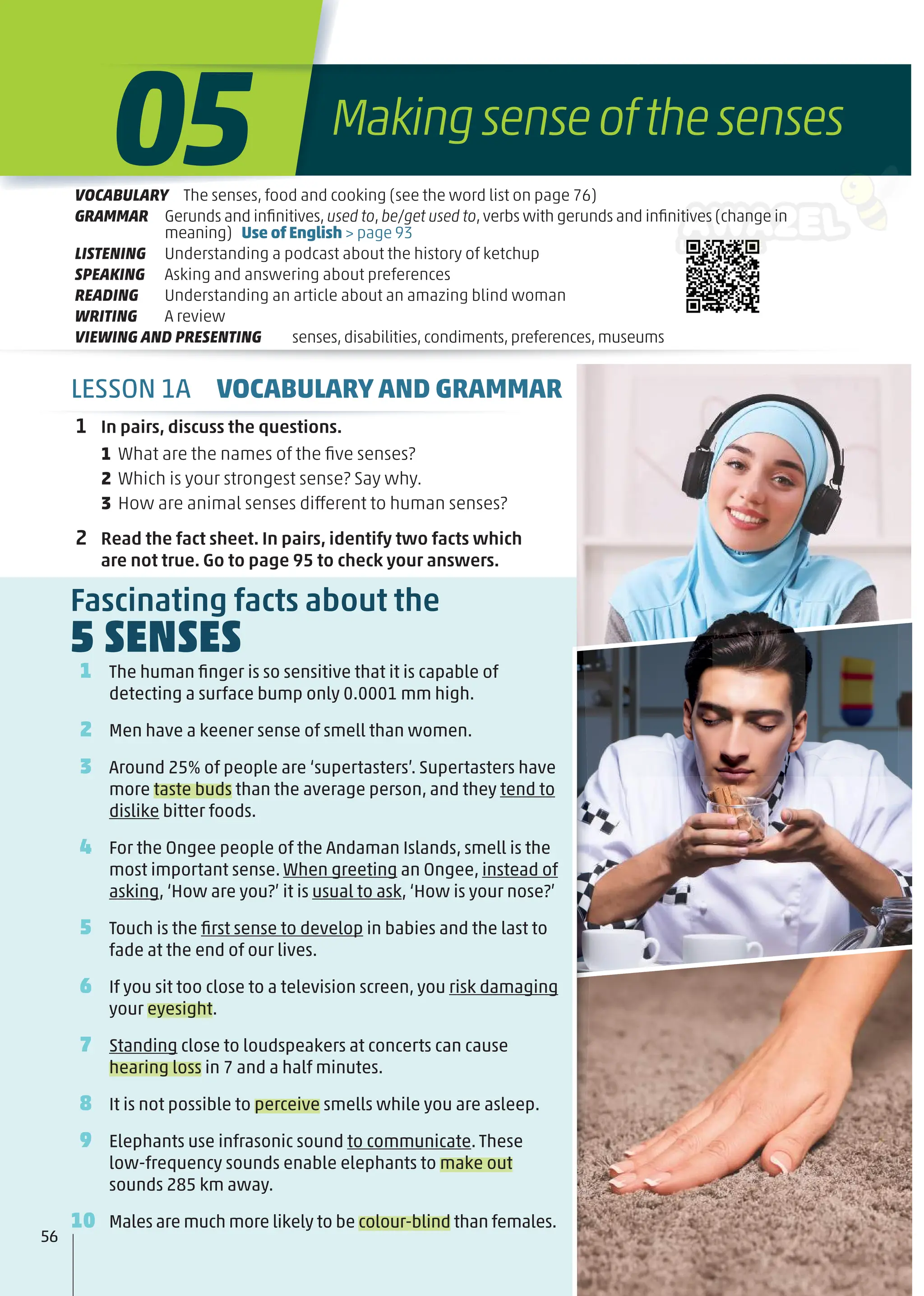
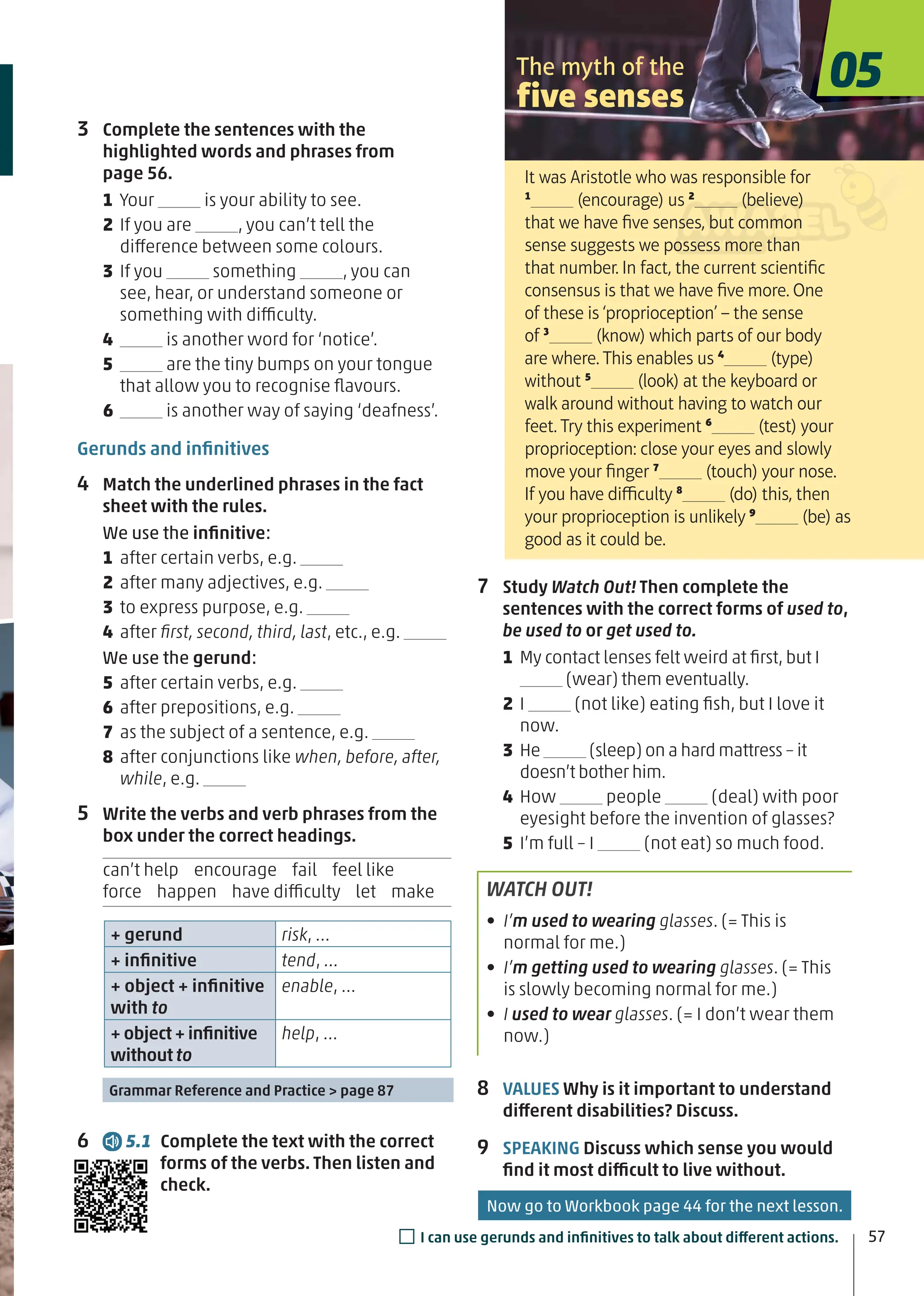
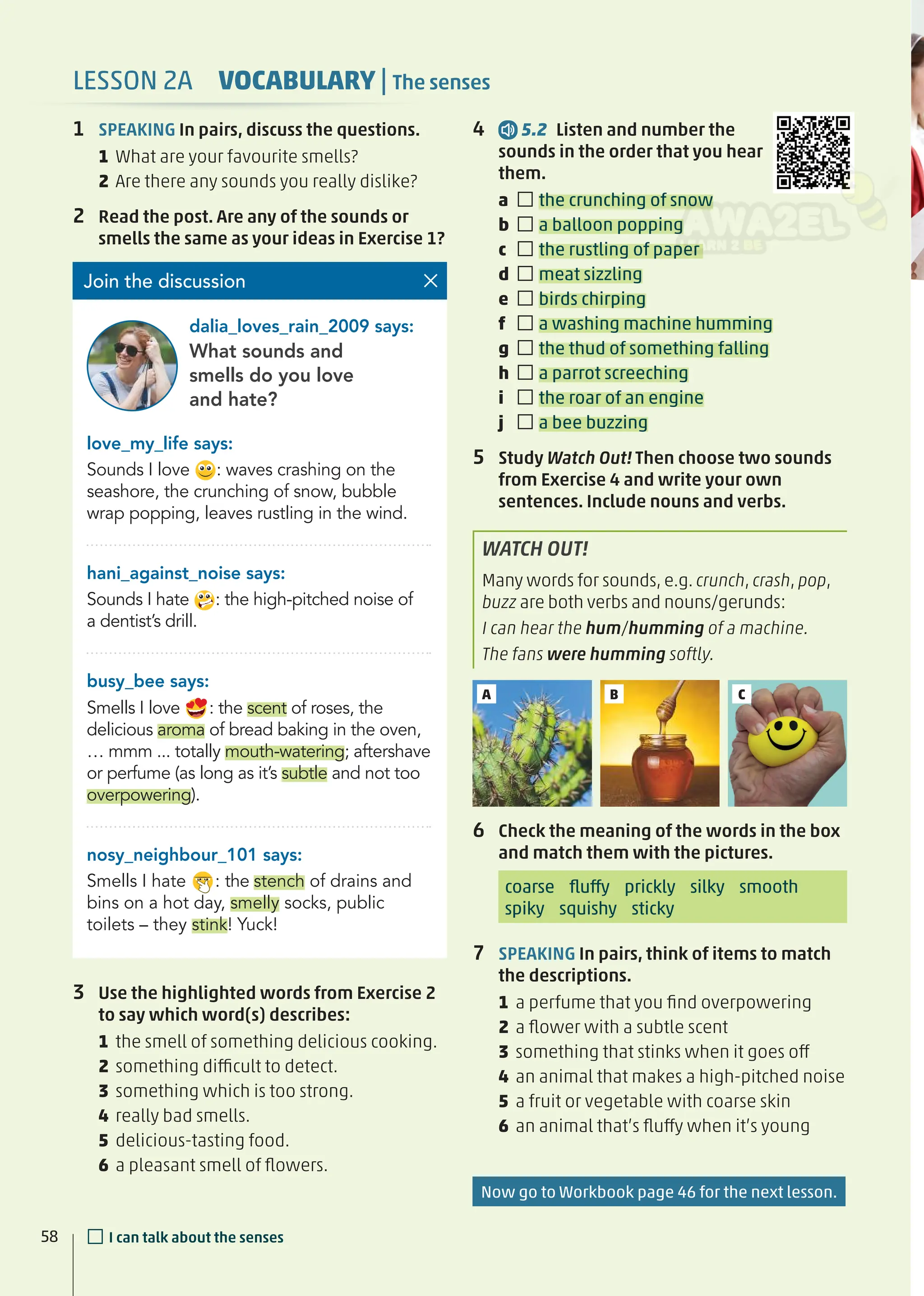
T
H
E
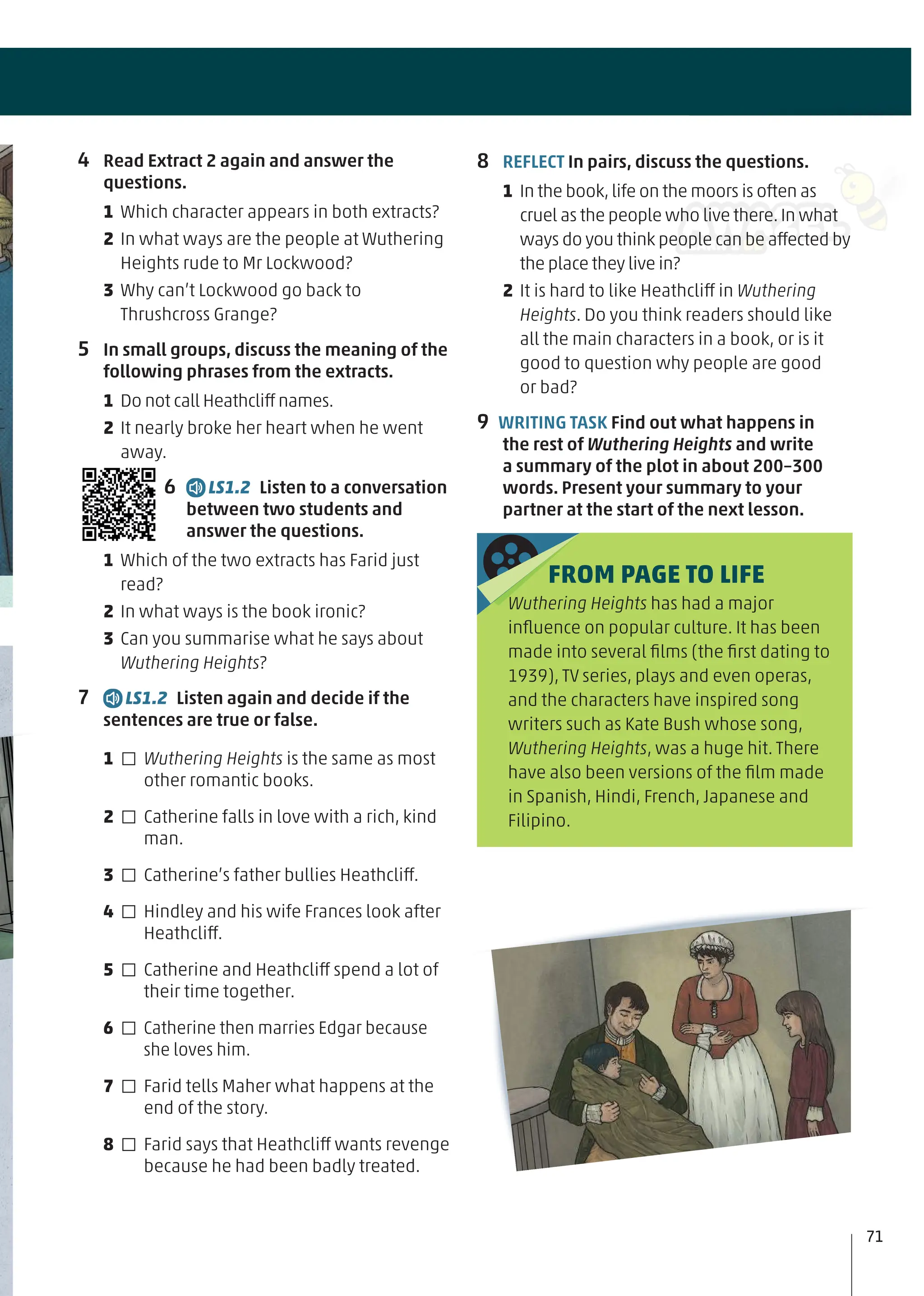
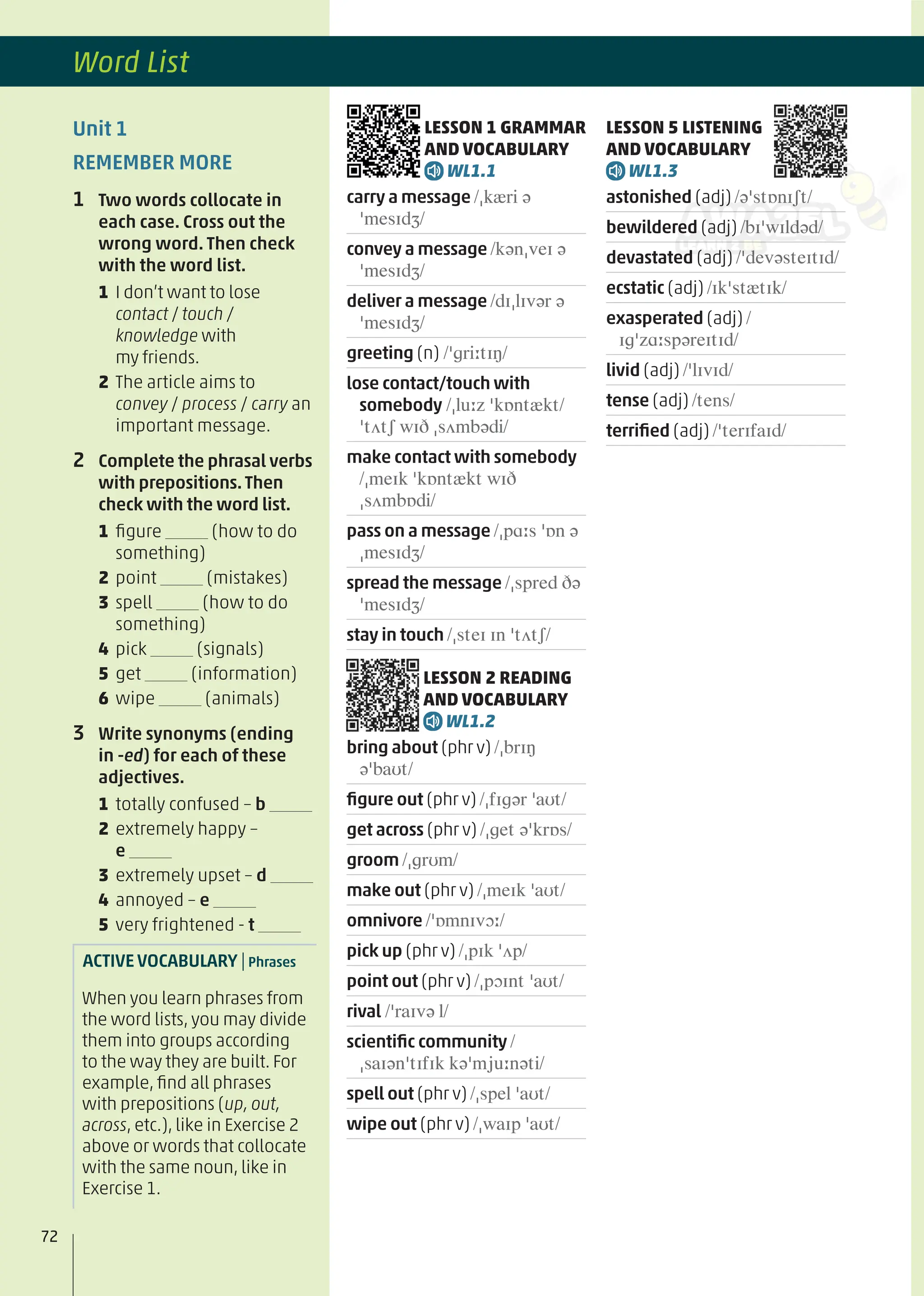
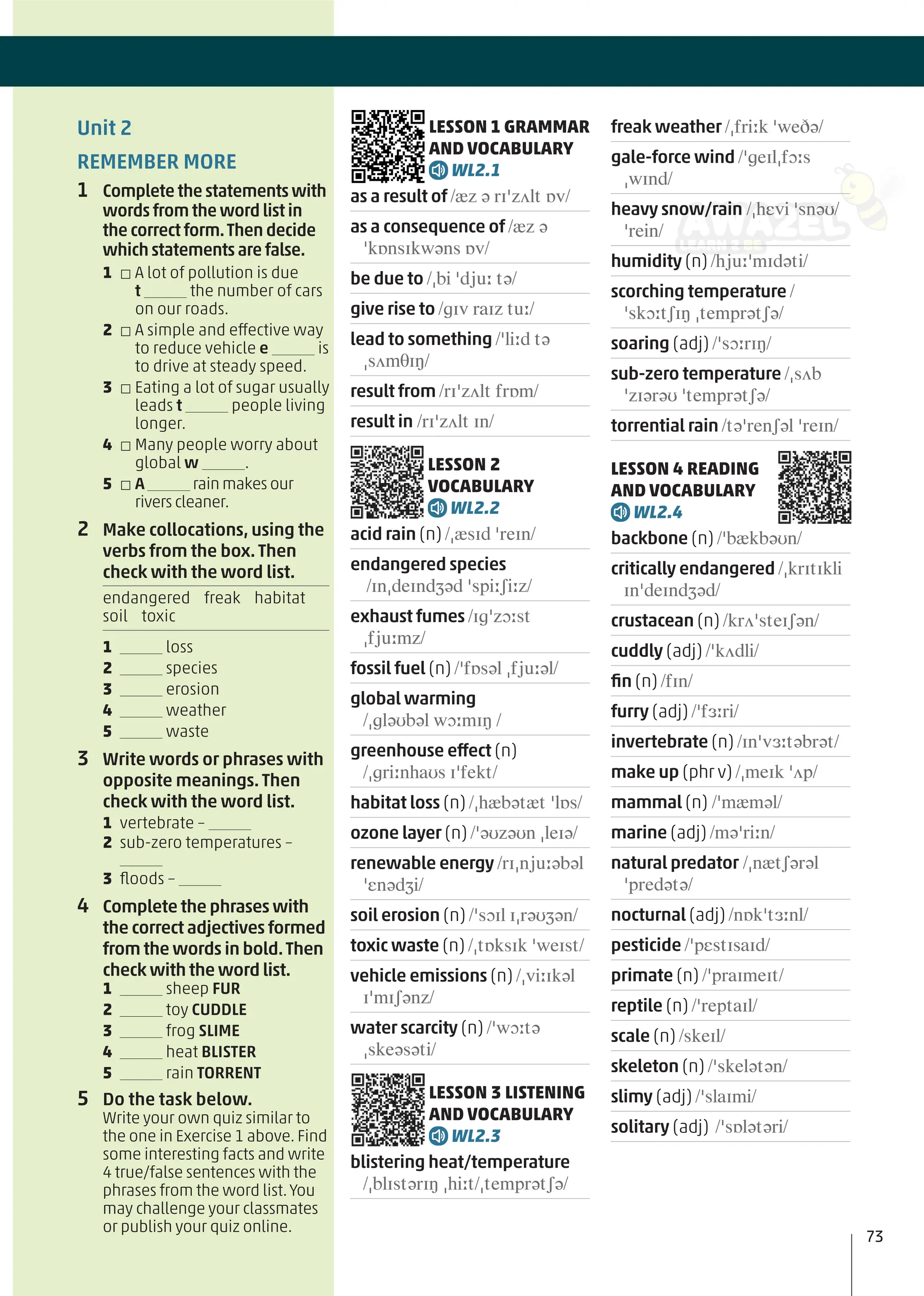
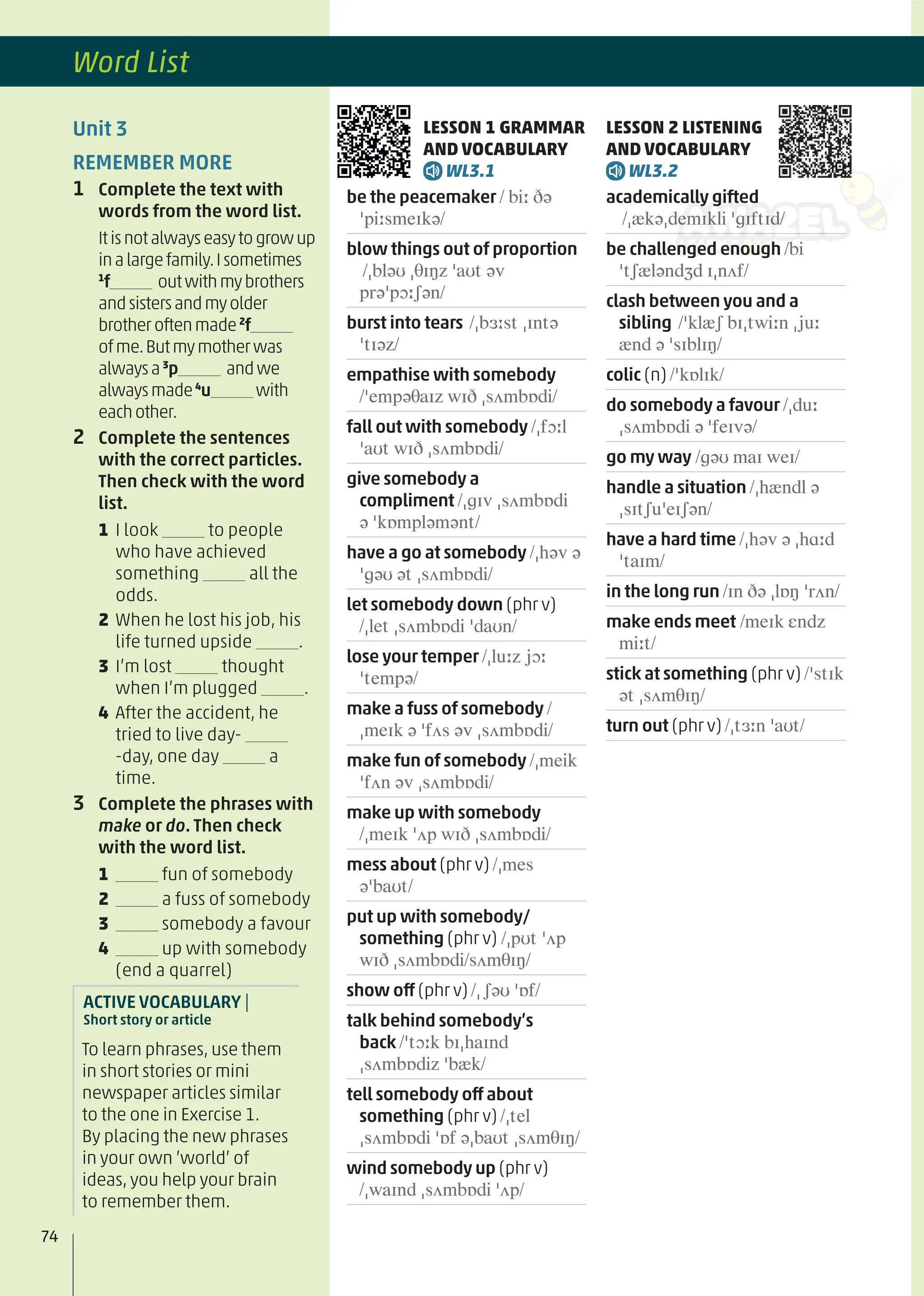
H
A
S
H
E
M
ITE KINGDOM
O
F
J
O
R
D
A
N
M
I
N
ISTRY OF EDUCATI
O
N
Jordan
Jordan
Grade11
Semester1
Student’sBook
The National Center for Curriculum Development is pleased to have your
feedback and comments on this book through the following contact details:
06-5376262 / 237 06-5376266 P.O.Box: 2088 Amman 11941
@nccdjor feedback@nccd.gov.jo www.nccd.gov.jo
Publisher: The National Center for Curriculum Development
Evaluation and Adaptation Committee
Prof. Nayel Darweesh Al-Shara’h (Head)
Prof. Jihad Mohammad Hamdan Prof. Abdallah Ahmad Bani Abdelrahman Dr. Mania Moayad Mubaslat
ii
The Ministry of Education has decided to adopt this book for Jordanian schools in accordance with
the approval of the Supreme Council of the National Curriculum Center in its meeting No. 3/2024 on
7/5/2024 and the approval of the Board of Education decision No. 53/2024 in its meeting No. 3/2024
on 26/6/2024 for the 2024/2025 academic year.
© Pearson Education Limited and York Press Ltd. 2024
ISBN: 978-9923-41-618-1
The Hashemite Kingdom of Jordan
Deposit number by the National Library Department
(2024/4/2422)
Primary indexing data for the book
Book title Jordan High Note, Grade 11: Student’s Book, Semester 1
Prepared by Jordan National Center for Curriculum Development
Publication data Amman: National Center for Curriculum Development, 2024
Classification number 373,19
Descriptors /English Language//Courses//Secondary Education/
Edition data First edition
The author bears full legal responsibility for the content of their work, and this work does not
express the opinion of the National Library Department.
Academic arbitration
Prof. Thafer Y. Assaraira
The right of Rachael Roberts, Caroline Krantz, Lynda Edwards, Catherine Bright, Bob Hastings and
Emma Szlachta to be identified as authors of this work has been asserted by them in accordance with
the Copyright, Designs and Patents Act, 1988.
All rights reserved; no part of this publication may be reproduced, stored in a retrieval system,
or transmitted in any form or by any means, electronic, mechanical, photocopying, recording, or
otherwise without the prior written permission of the Publishers.
First edition (trial): ‫م‬ 2024 / 1445
Grade11
Jordan
Jordan
Student’sBook
T
H
E
H
A
S
H
E
M
ITE KINGDOM
O
F
J
O
R
D
A
N
M
I
N
ISTRY OF EDUCATI
O
N
Semester1
Rachael Roberts | Caroline Krantz
Lynda Edwards | Catherine Bright |
Bob Hastings | Emma Szlachta
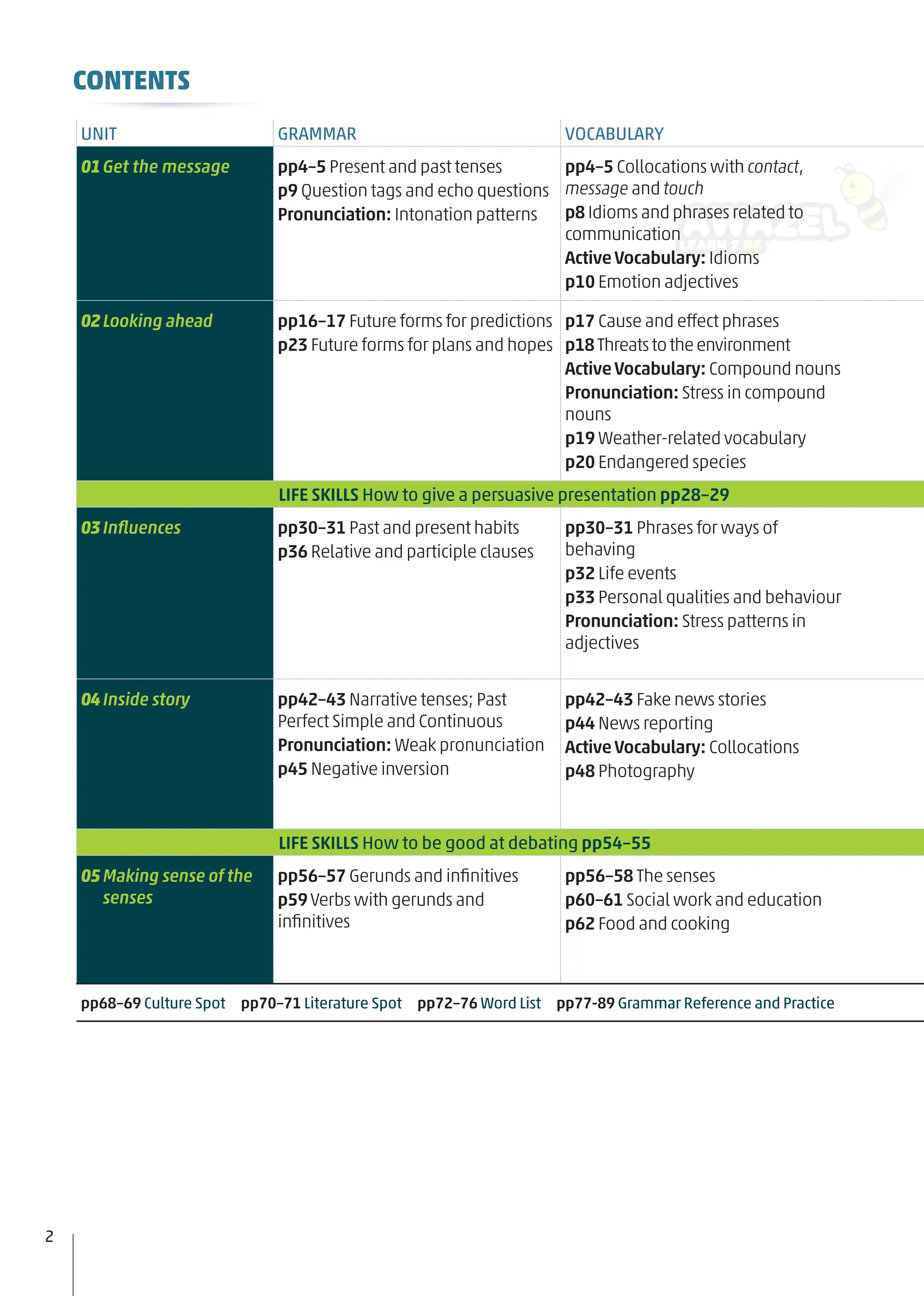
UNIT GRAMMAR VOCABULARY
01Get the message pp4–5 Present and past tenses
p9 Question tags and echo questions
Pronunciation: Intonation patterns
pp4–5 Collocations with contact,
message and touch
p8Idiomsandphrasesrelatedto
communication
ActiveVocabulary: Idioms
p10 Emotion adjectives
02Looking ahead pp16–17 Future forms for predictions
p23 Future forms for plans and hopes
p17 Cause and effect phrases
p18Threatstotheenvironment
ActiveVocabulary: Compound nouns
Pronunciation: Stress in compound
nouns
p19 Weather-related vocabulary
p20 Endangered species
LIFE SKILLS How to give a persuasive presentation pp28–29
03Influences pp30–31 Past and present habits
p36 Relative and participle clauses
pp30–31 Phrases for ways of
behaving
p32 Life events
p33 Personal qualities and behaviour
Pronunciation: Stress patterns in
adjectives
04Inside story pp42–43 Narrative tenses; Past
Perfect Simple and Continuous
Pronunciation: Weak pronunciation
p45 Negative inversion
pp42–43 Fake news stories
p44 News reporting
ActiveVocabulary: Collocations
p48 Photography
LIFE SKILLS How to be good at debating pp54–55
05Making sense of the
senses
pp56–57 Gerunds and infinitives
p59Verbs with gerunds and
infinitives
pp56–58 The senses
p60–61 Social work and education
p62 Food and cooking
pp68–69 Culture Spot pp70–71 Literature Spot pp72–76 Word List pp77-89 Grammar Reference and Practice
2
CONTENTS
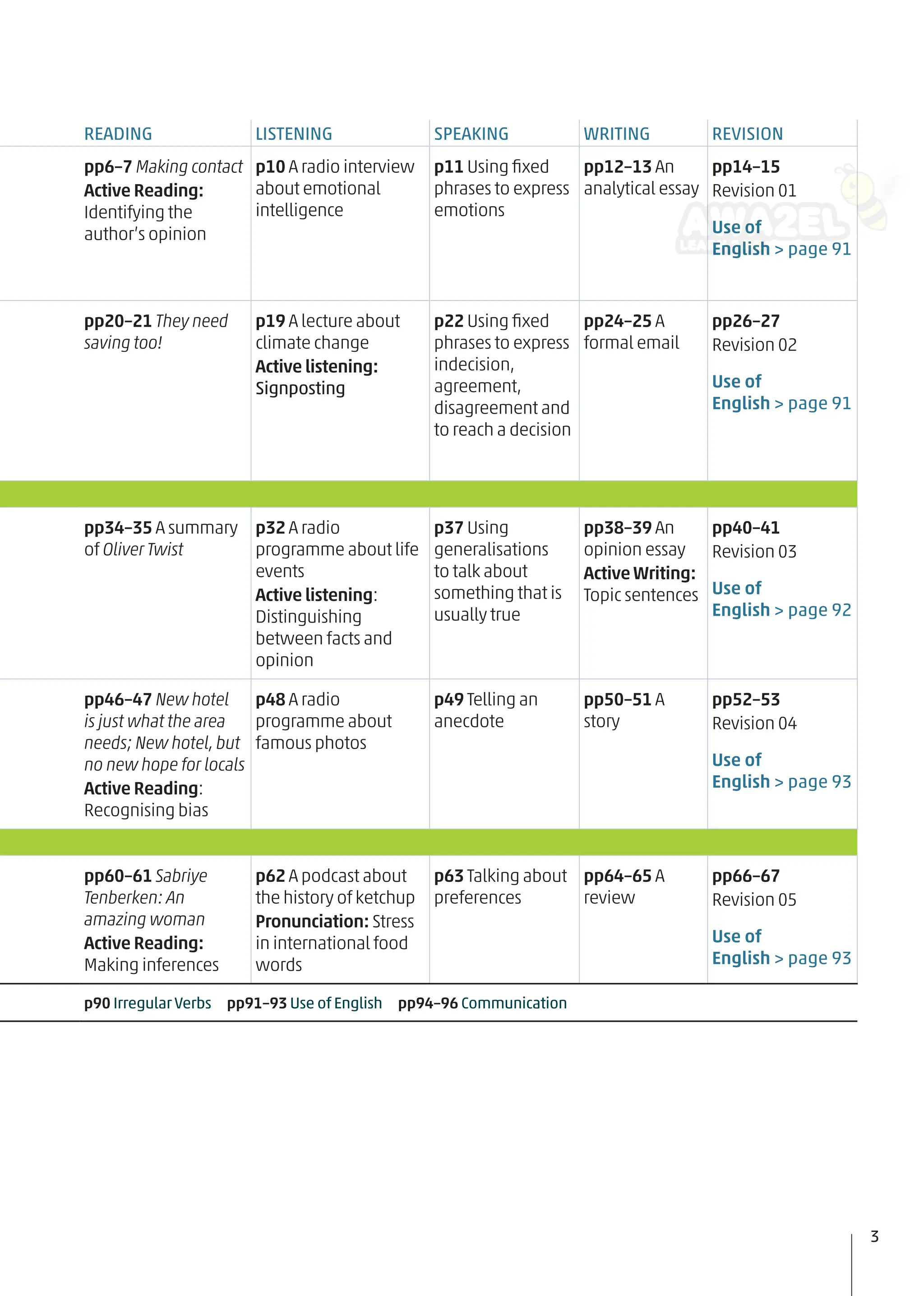
READING LISTENING SPEAKING WRITING REVISION
pp6–7 Making contact
Active Reading:
Identifying the
author’s opinion
p10 A radio interview
about emotional
intelligence
p11 Using fixed
phrases to express
emotions
pp12–13 An
analytical essay
pp14–15
Revision 01
Use of
English > page 91
pp20–21 They need
saving too!
p19 A lecture about
climate change
Active listening:
Signposting
p22 Using fixed
phrases to express
indecision,
agreement,
disagreement and
to reach a decision
pp24–25 A
formal email
pp26–27
Revision 02
Use of
English > page 91
pp34–35 A summary
of OliverTwist
p32 A radio
programme about life
events
Active listening:
Distinguishing
between facts and
opinion
p37 Using
generalisations
to talk about
something that is
usually true
pp38–39 An
opinion essay
ActiveWriting:
Topic sentences
pp40–41
Revision 03
Use of
English > page 92
pp46–47 New hotel
is just what the area
needs; New hotel,but
no new hope for locals
Active Reading:
Recognising bias
p48 A radio
programme about
famous photos
p49Telling an
anecdote
pp50–51 A
story
pp52–53
Revision 04
Use of
English > page 93
pp60–61 Sabriye
Tenberken: An
amazing woman
Active Reading:
Making inferences
p62 A podcast about
the history of ketchup
Pronunciation: Stress
in international food
words
p63Talking about
preferences
pp64–65 A
review
pp66–67
Revision 05
Use of
English > page 93
p90 IrregularVerbs pp91–93 Use of English pp94–96 Communication
3
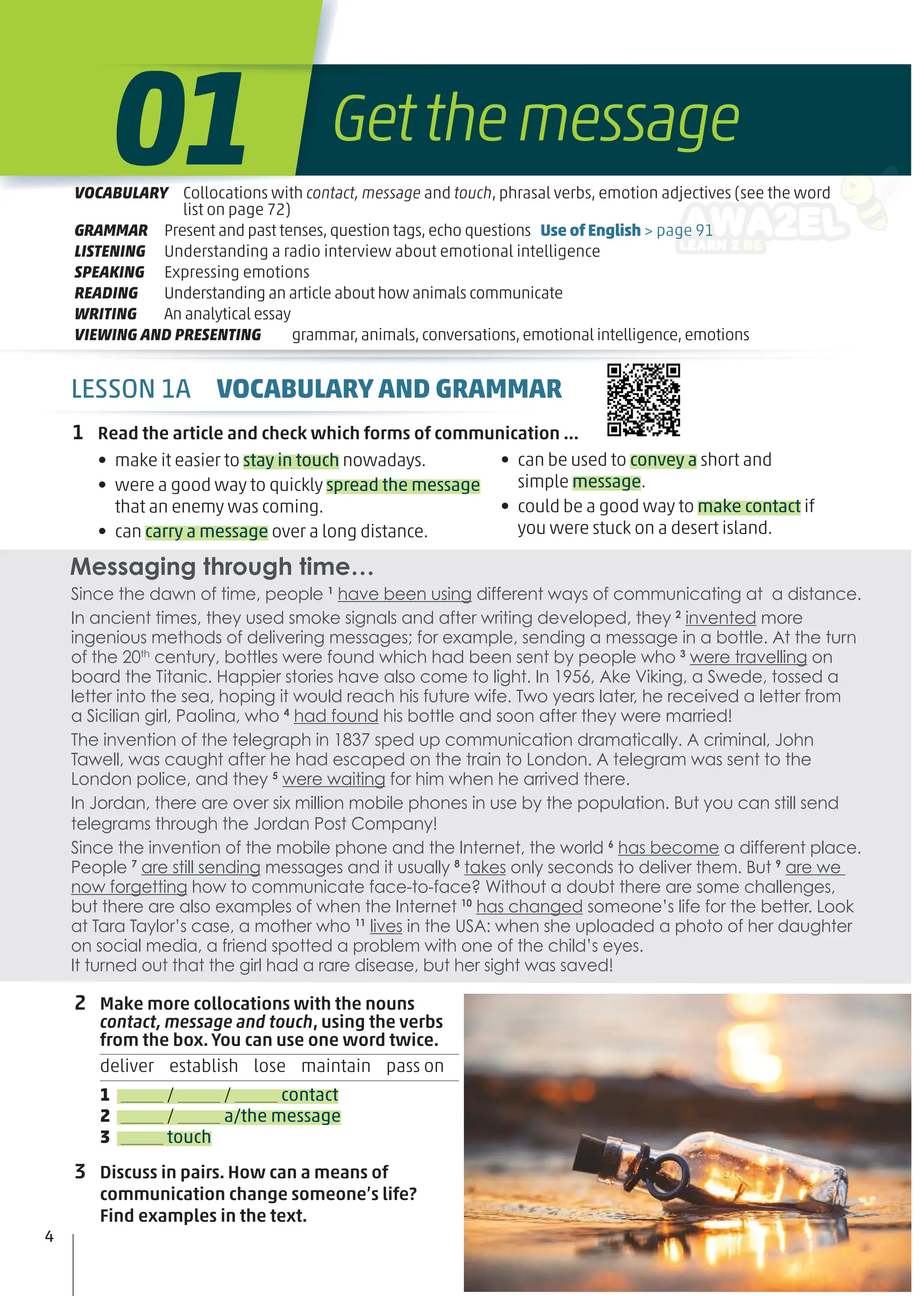
Messaging through time…
1 Read the article and check which forms of communication …
• make it easier to stay in touch nowadays.
• were a good way to quickly spread the message
that an enemy was coming.
• can carry a message over a long distance.
• can be used to convey a short and
simple message.
• could be a good way to make contact if
you were stuck on a desert island.
2 Make more collocations with the nouns
contact, message and touch, using the verbs
from the box. You can use one word twice.
deliver establish lose maintain pass on
1 / / contact
2 / a/the message
3 touch
3 Discuss in pairs. How can a means of
communication change someone’s life?
Find examples in the text.
Since the dawn of time, people 1
have been using different ways of communicating at a distance.
In ancient times, they used smoke signals and after writing developed, they 2
invented more
ingenious methods of delivering messages; for example, sending a message in a bottle. At the turn
of the 20th
century, bottles were found which had been sent by people who 3
were travelling on
board the Titanic. Happier stories have also come to light. In 1956, Ake Viking, a Swede, tossed a
letter into the sea, hoping it would reach his future wife. Two years later, he received a letter from
a Sicilian girl, Paolina, who 4
had found his bottle and soon after they were married!
The invention of the telegraph in 1837 sped up communication dramatically. A criminal, John
Tawell, was caught after he had escaped on the train to London. A telegram was sent to the
London police, and they 5
were waiting for him when he arrived there.
In Jordan, there are over six million mobile phones in use by the population. But you can still send
telegrams through the Jordan Post Company!
Since the invention of the mobile phone and the Internet, the world 6
has become a different place.
People 7
are still sending messages and it usually 8
takes only seconds to deliver them. But 9
are we
now forgetting how to communicate face-to-face? Without a doubt there are some challenges,
but there are also examples of when the Internet 10
has changed someone’s life for the better. Look
at Tara Taylor’s case, a mother who 11
lives in the USA: when she uploaded a photo of her daughter
on social media, a friend spotted a problem with one of the child’s eyes.
It turned out that the girl had a rare disease, but her sight was saved!
4
LESSON 1A VOCABULARY AND GRAMMAR
Getthemessage
01
VOCABULARY Collocations with contact, message and touch, phrasal verbs, emotion adjectives (see the word
list on page 72)
GRAMMAR Present and past tenses,question tags,echo questions Use of English > page 91
LISTENING Understanding a radio interview about emotional intelligence
SPEAKING Expressing emotions
READING Understanding an article about how animals communicate
WRITING An analytical essay
VIEWING AND PRESENTING grammar,animals,conversations,emotional intelligence,emotions
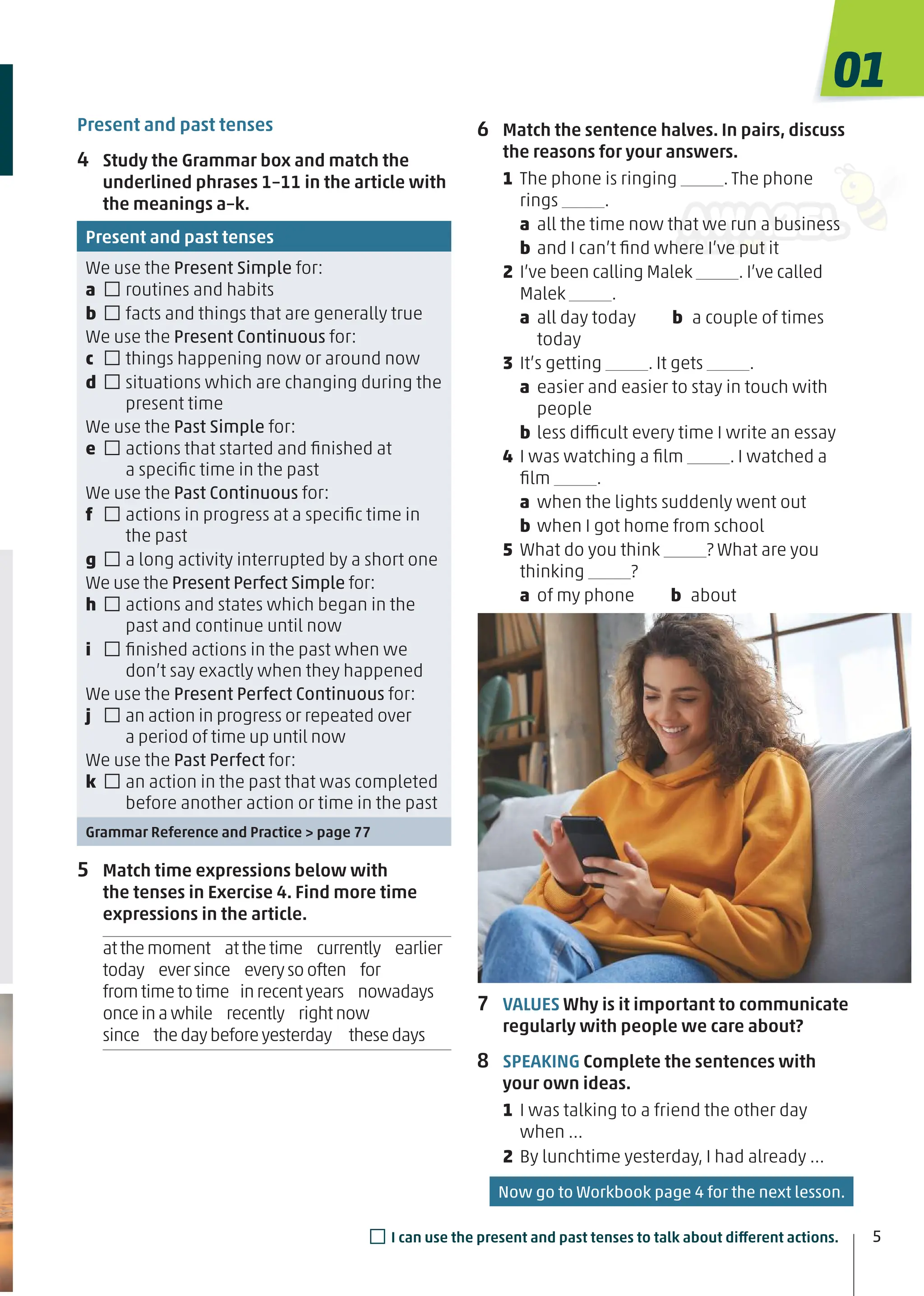
Present and past tenses
4 Study the Grammar box and match the
underlined phrases 1–11 in the article with
the meanings a–k.
Present and past tenses
We use the Present Simple for:
a □routines and habits
b □facts and things that are generally true
We use the Present Continuous for:
c □things happening now or around now
d □situations which are changing during the
present time
We use the Past Simple for:
e □actions that started and finished at
a specific time in the past
We use the Past Continuous for:
f □actions in progress at a specific time in
the past
g □a long activity interrupted by a short one
We use the Present Perfect Simple for:
h □actions and states which began in the
past and continue until now
i □finished actions in the past when we
don’t say exactly when they happened
We use the Present Perfect Continuous for:
j □an action in progress or repeated over
a period of time up until now
We use the Past Perfect for:
k □an action in the past that was completed
before another action or time in the past
Grammar Reference and Practice > page 77
5 Match time expressions below with
the tenses in Exercise 4. Find more time
expressions in the article.
atthemoment atthetime currently earlier
today eversince everysooften for
fromtimetotime inrecentyears nowadays
onceinawhile recently rightnow
since thedaybeforeyesterday thesedays
6 Match the sentence halves. In pairs, discuss
the reasons for your answers.
1 The phone is ringing . The phone
rings .
a all the time now that we run a business
b and I can’t find where I’ve put it
2 I’ve been calling Malek . I’ve called
Malek .
a all day today b a couple of times
today
3 It’s getting . It gets .
a easier and easier to stay in touch with
people
b less difficult every time I write an essay
4 I was watching a film . I watched a
film .
a when the lights suddenly went out
b when I got home from school
5 What do you think ? What are you
thinking ?
a of my phone b about
7 VALUES Why is it important to communicate
regularly with people we care about?
8 SPEAKING Complete the sentences with
your own ideas.
1 I was talking to a friend the other day
when …
2 By lunchtime yesterday, I had already …
5
□I can use the present and past tenses to talk about different actions.
01
Now go to Workbook page 4 for the next lesson.
LESSON 2A READING AND VOCABULARY
1 SPEAKING In pairs,discuss the question.
What do you think would happen if we could talk to animals?
2 CRITICAL THINKING Read the article and study Active Reading. What opinions about
communication does the author express? How far do you agree with him?
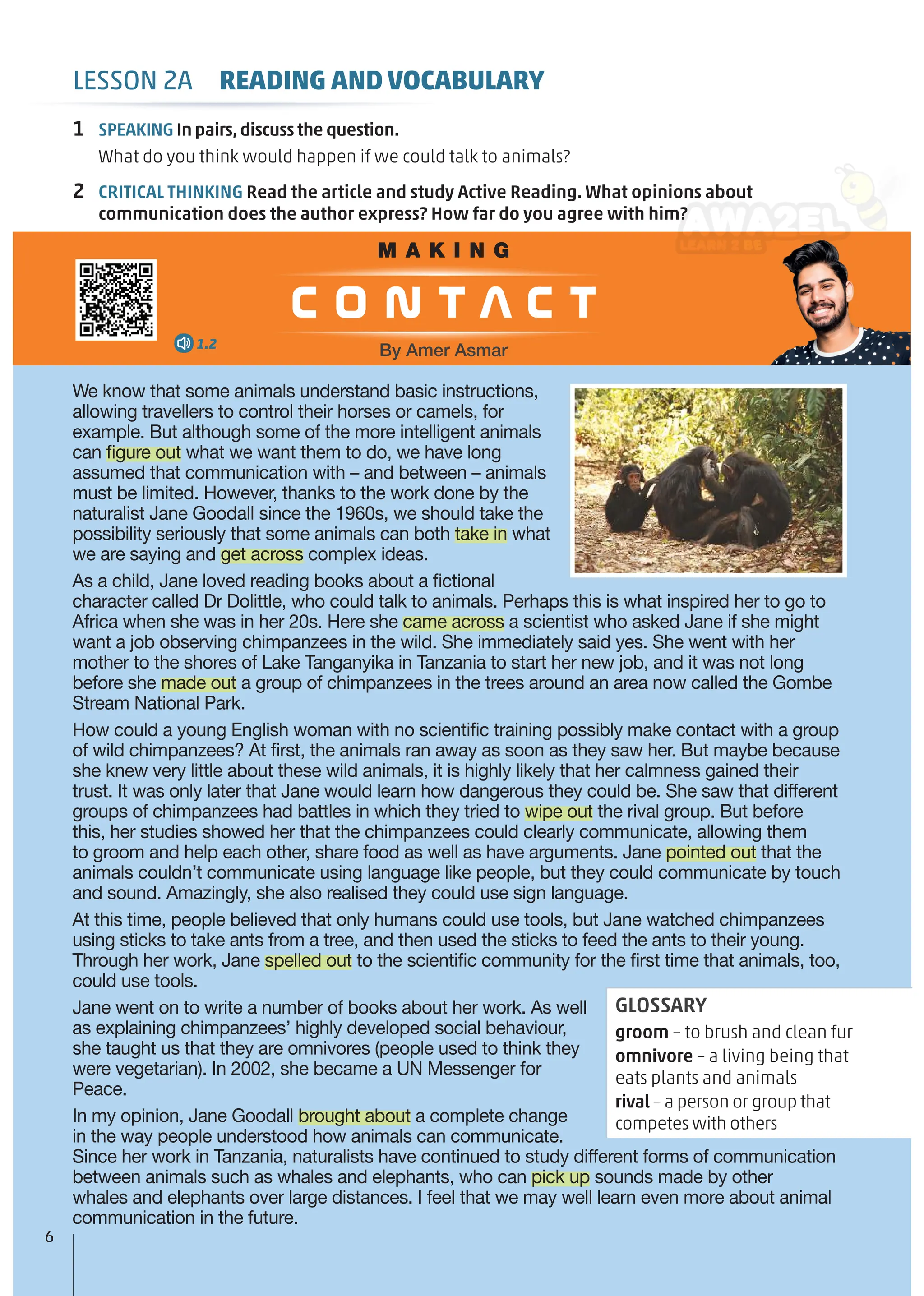
We know that some animals understand basic instructions,
allowing travellers to control their horses or camels, for
example. But although some of the more intelligent animals
can figure out what we want them to do, we have long
assumed that communication with – and between – animals
must be limited. However, thanks to the work done by the
naturalist Jane Goodall since the 1960s, we should take the
possibility seriously that some animals can both take in what
we are saying and get across complex ideas.
As a child, Jane loved reading books about a fictional
character called Dr Dolittle, who could talk to animals. Perhaps this is what inspired her to go to
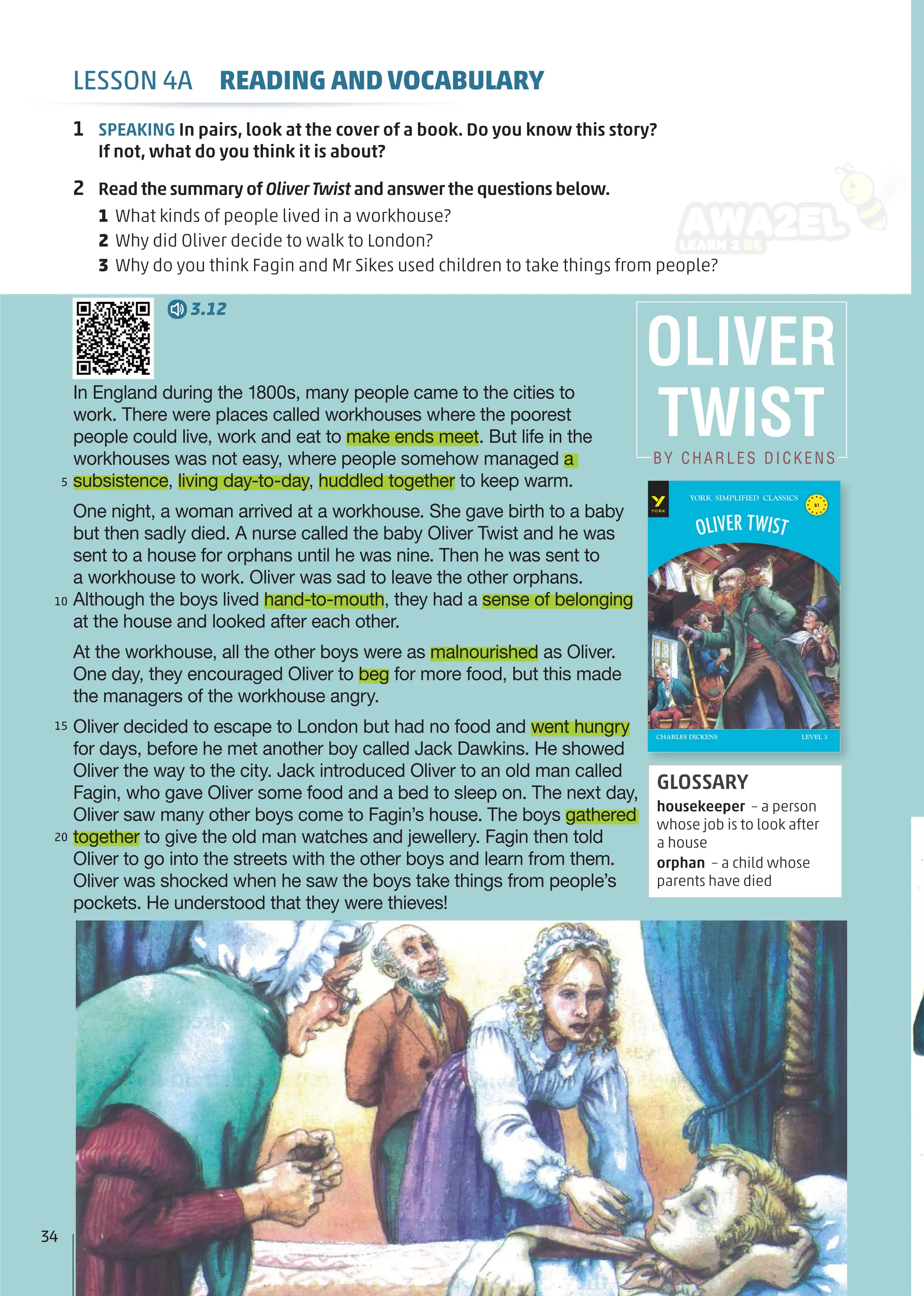
Africa when she was in her 20s. Here she came across a scientist who asked Jane if she might
want a job observing chimpanzees in the wild. She immediately said yes. She went with her
mother to the shores of Lake Tanganyika in Tanzania to start her new job, and it was not long
before she made out a group of chimpanzees in the trees around an area now called the Gombe
Stream National Park.
How could a young English woman with no scientific training possibly make contact with a group
of wild chimpanzees? At first, the animals ran away as soon as they saw her. But maybe because
she knew very little about these wild animals, it is highly likely that her calmness gained their
trust. It was only later that Jane would learn how dangerous they could be. She saw that different
groups of chimpanzees had battles in which they tried to wipe out the rival group. But before
this, her studies showed her that the chimpanzees could clearly communicate, allowing them
to groom and help each other, share food as well as have arguments. Jane pointed out that the
animals couldn’t communicate using language like people, but they could communicate by touch
and sound. Amazingly, she also realised they could use sign language.
At this time, people believed that only humans could use tools, but Jane watched chimpanzees
using sticks to take ants from a tree, and then used the sticks to feed the ants to their young.
Through her work, Jane spelled out to the scientific community for the first time that animals, too,
could use tools.
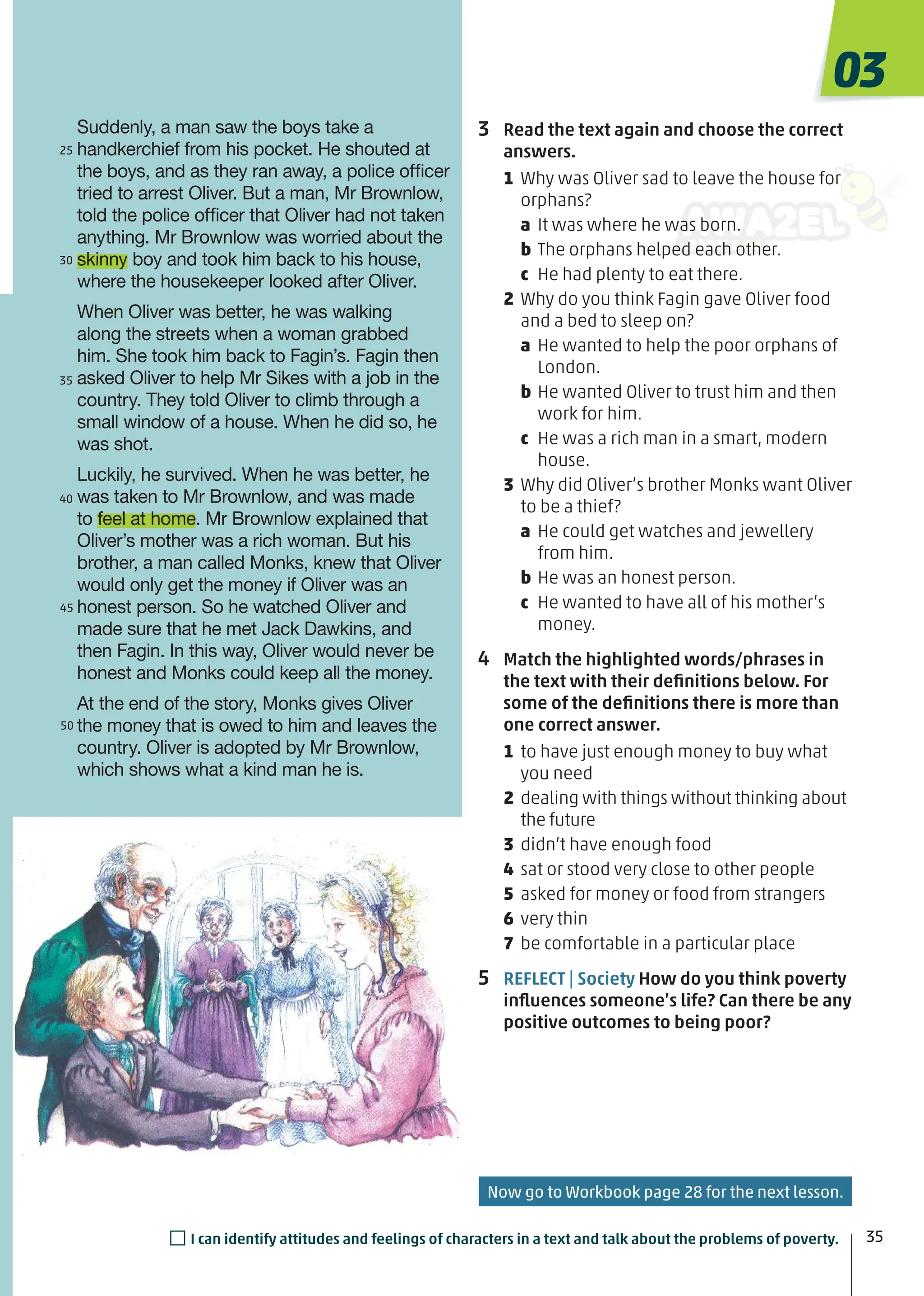
Jane went on to write a number of books about her work. As well
as explaining chimpanzees’ highly developed social behaviour,
she taught us that they are omnivores (people used to think they
were vegetarian). In 2002, she became a UN Messenger for
Peace.
In my opinion, Jane Goodall brought about a complete change
in the way people understood how animals can communicate.
Since her work in Tanzania, naturalists have continued to study different forms of communication
between animals such as whales and elephants, who can pick up sounds made by other
whales and elephants over large distances. I feel that we may well learn even more about animal
communication in the future.
GLOSSARY
groom – to brush and clean fur
omnivore – a living being that
eats plants and animals
rival – a person or group that
competes with others
M A K I N G
c o n t a c t
By Amer Asmar
1.2
6
ACTIVE READING|Identifying the author’s
opinion
In a text, the author presents his/her point of
view on a topic and different arguments to
support that view.
• Writers often use opinion verbs and phrases
to signal their position, e.g. I feel …, I think …,
In my opinion …, etc.
• Sometimes they express their views more
subtly by using modal verbs, e.g.
We should …, It must be …, etc.
• They may also use phrases of probability,
e.g. Maybe …, Possibly …, etc.
Remember that you can form your own
opinion, rather than uncritically accepting
what the author has to say.
3 Read the article again and choose the
correct answers.
1 According to the author, how did Jane get
the chimpanzees to trust her?
a She talked to them.
b She was relaxed with them.
c They did not know she was there.
2 What were the two most important
discoveries that Jane made?
a The chimpanzees could talk and make
tools.
b The chimpanzees had fights and
disciplined their children.
c The chimpanzees could use tools and
communicate using sign language.
3 What does the author believe might
happen if humans could talk to animals?
a We would change our minds about how
animals communicate.
b We might learn to communicate like
whales and elephants.
c They might teach us important lessons.
4 Match the highlighted phrasal verbs from
the article with their definitions below.
1 to receive sounds, phone signals, etc.
2 to cause something to happen
3 to tell someone something you think they
don’t know
4 to see something with difficulty
5 to destroy something completely
6 to successfully communicate a message/
an idea
7 to explain something very clearly
8 to meet or find something or someone
9 to solve or understand something
10 to understand and remember something
you are told
5 Complete the sentences with the phrasal
verbs from the article, in the correct form.
1 I was embarrassed when he that I
had made some basic spelling mistakes.
2 It was cloudy, but he could still the
distant star.
3 I an interesting article about space
exploration the other day.
4 Technology has many changes in the
way we live.
5 My science teacher is very good at
difficult ideas so that we always
understand them.
6 It took me ages to exactly how to
use the telescope.
7 You don’t understand? Do I have to
what I mean?
8 We couldn’t use our mobile phones in the
desert, but started to signals when
we went into the mountains.
6 SPEAKING In small groups,ask and answer
the question.
If you could communicate with animals,
which animal would you like to talk to most?
Why?
7 REFLECT | Culture In small groups, discuss
what questions you would like to ask if you
could talk to an animal.
7
7
01
□I can identify the author’s opinion and talk about animal communication.
Now go to Workbook page 6 for the next lesson.
2 Study the phrases highlighted in the article.
Then complete the second sentence so that
it means the same as the first.
1 He started talking to the new neighbour.
STRUCK He with the new
neighbour.
2 She gave the impression of being very
self-confident. ACROSS She being
very self-confident.
3 Abeer commented on how nice her shoes
were. PAID Abeer about her shoes.
4 I immediately liked him. TOOK I
immediately.
5 We found it really funny. LAUGH We
really about it.
6 I didn’t really like her friends when I met
them. OFF I didn’t really with her
friends when I met them.
3 1.3 Listen to someone
talking about breaking the ice.
What behaviour does she find
annoying when meeting new
people?
4 Match idioms 1–6 with definitions a–f.
1 □jump down somebody’s throat
2 □put somebody on the spot
3 □fire questions at someone
4 □refuse to let something drop
5 □insist on having the last word
6 □not get a word in edgeways
a to be unable to say anything because
someone else is talking all the time
b to embarrass someone by forcing them to
answer a difficult question
c to have to make the final point
d to not stop talking about something
e to react angrily to something
f to ask someone a lot of questions quickly
5 REFLECT | Society In pairs, make a list of five
rules for making a good impression when
you meet people for the first time.
8
ACTIVE VOCABULARY| Idioms
• An idiom is a fixed phrase that has a special
meaning which is different from the usual
meaning of the individual words.
8 □I can talk about making new friends.
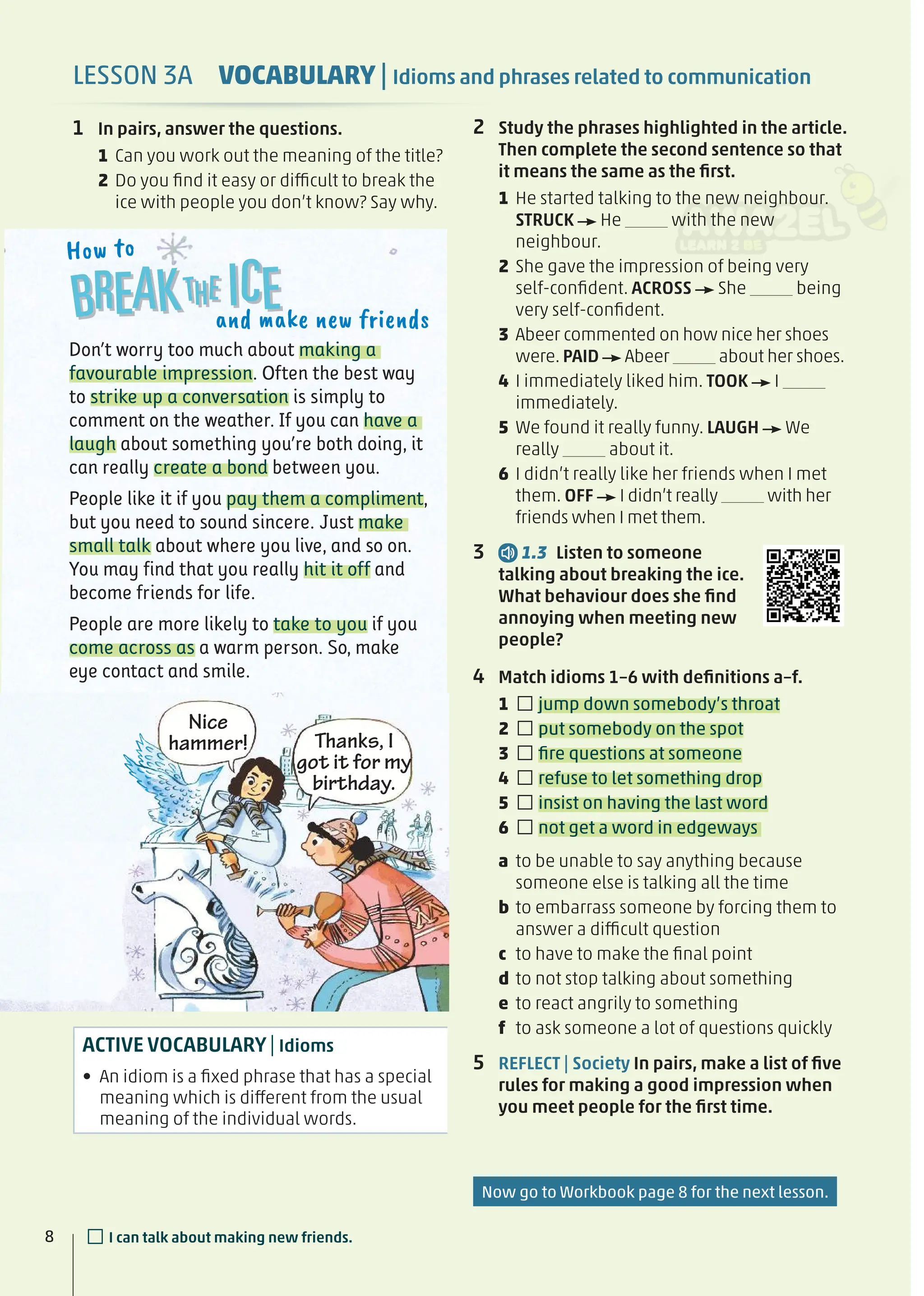
Don’t worry too much about making a
favourable impression. Often the best way
to strike up a conversation is simply to
comment on the weather. If you can have a
laugh about something you’re both doing, it
can really create a bond between you.
People like it if you pay them a compliment,
but you need to sound sincere. Just make
small talk about where you live, and so on.
You may find that you really hit it off and
become friends for life.
People are more likely to take to you if you
come across as a warm person. So, make
eye contact and smile.
and make new friends
How to
and ma
LESSON 3A VOCABULARY | Idioms and phrases related to communication
1 In pairs, answer the questions.
1 Can you work out the meaning of the title?
2 Do you find it easy or difficult to break the
ice with people you don’t know? Say why.
Nice
hammer! Thanks, I
got it for my
birthday.
Now go to Workbook page 8 for the next lesson.
5 1.6 Look at these more unusual
question tags. Choose the correct
words to complete the sentences.
Listen and check.
1 This is silly, isn’t it / this?
2 Nothing ever changes, do / does it?
3 Come and look at this, will / don’t you?
4 Everyone was there, weren’t / wasn’t they?
5 Don’t be late, are / will you?
6 No one likes him, do / does they?
6 In pairs, look at the echo question in italics.
Then answer questions 1−3 below.
Habib Actually, it’s my birthday tomorrow.
Faisal Is it? Do you have anything special
planned?
1 What is the function of an echo question?
2 Do we use a positive or a negative
question to reply to a positive statement?
3 Which intonation pattern from Exercise 4
do we use with an echo question: A or B?
Grammar Reference and Practice > page 78
7 1.7 Complete the conversation
with no more than three words in
each gap. Listen and check your
answers.
Imad Where would you go on holiday if
you could go anywhere in the world?
Jamal 1
a good question, isn’t it? I don’t
think I’ve ever really thought about it
before. Hmm … Somewhere with nice
beaches, I guess.
Imad But 2
are lovely beaches in this
country,aren’t there?
Jamal Oh yes, there are, but I’d like to go to
a beach where it’s not too hot in the
summer. It can be too hot here, 3
?
Imad Actually, I used to live in France.
Jamal 4
you? I bet 5
too hot there
in the summer, was it?
Imad No, it was quite cool, actually.
Jamal That sounds great.
8 SPEAKING In pairs, write and role play a
conversation. Go to page 94.
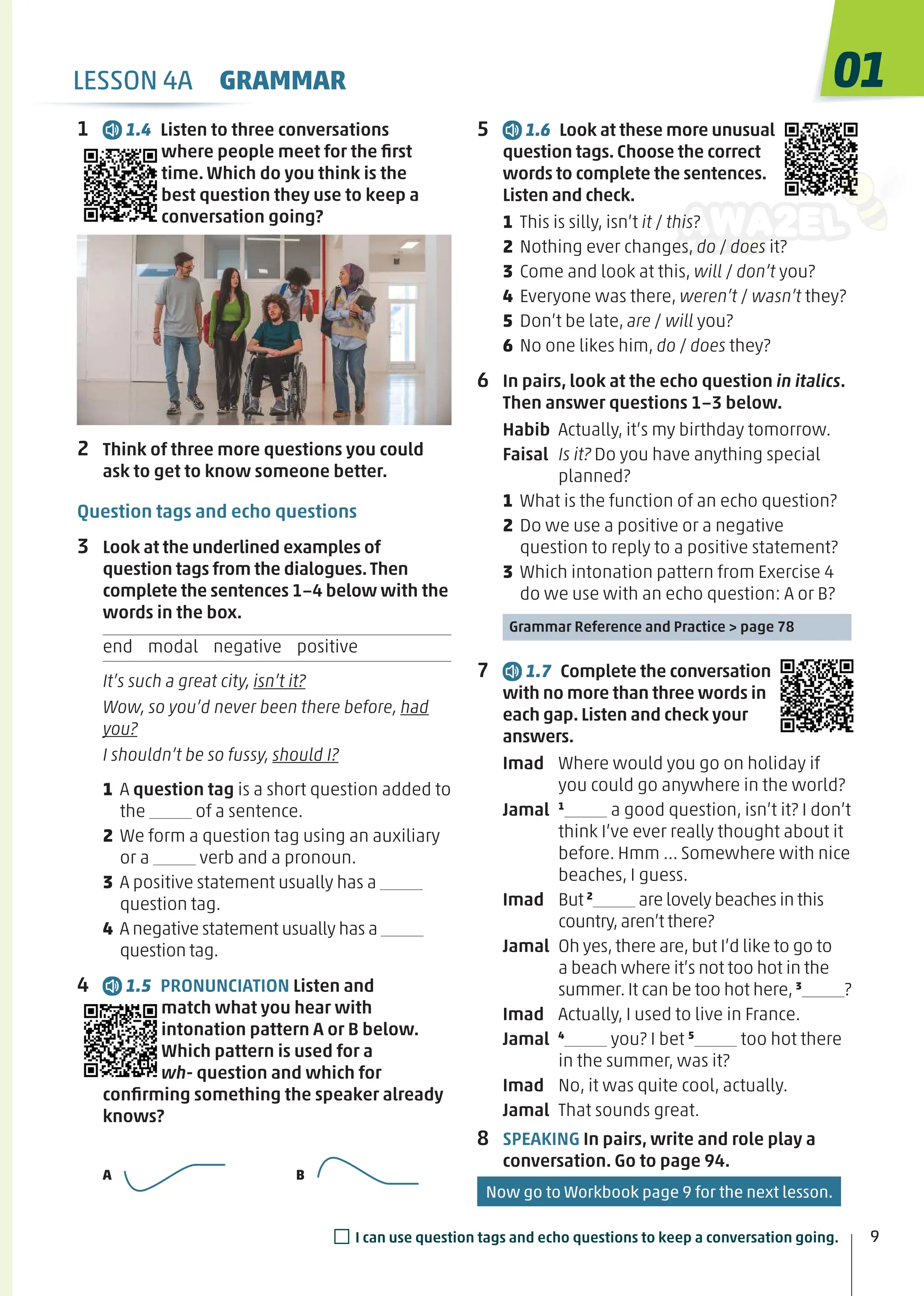
1 1.4 Listen to three conversations
where people meet for the first
time. Which do you think is the
best question they use to keep a
conversation going?
2 Think of three more questions you could
ask to get to know someone better.
Question tags and echo questions
3 Look at the underlined examples of
question tags from the dialogues.Then
complete the sentences 1−4 below with the
words in the box.
end modal negative positive
It’s such a great city, isn’t it?
Wow, so you’d never been there before, had
you?
I shouldn’t be so fussy, should I?
1 A question tag is a short question added to
the of a sentence.
2 We form a question tag using an auxiliary
or a verb and a pronoun.
3 A positive statement usually has a
question tag.
4 A negative statement usually has a
question tag.
4 1.5 PRONUNCIATION Listen and
match what you hear with
intonation pattern A or B below.
Which pattern is used for a
wh- question and which for
confirming something the speaker already
knows?
A B
LESSON 4A GRAMMAR
9
01
9
□I can use question tags and echo questions to keep a conversation going.
Now go to Workbook page 9 for the next lesson.
LESSON 5A LISTENING AND VOCABULARY
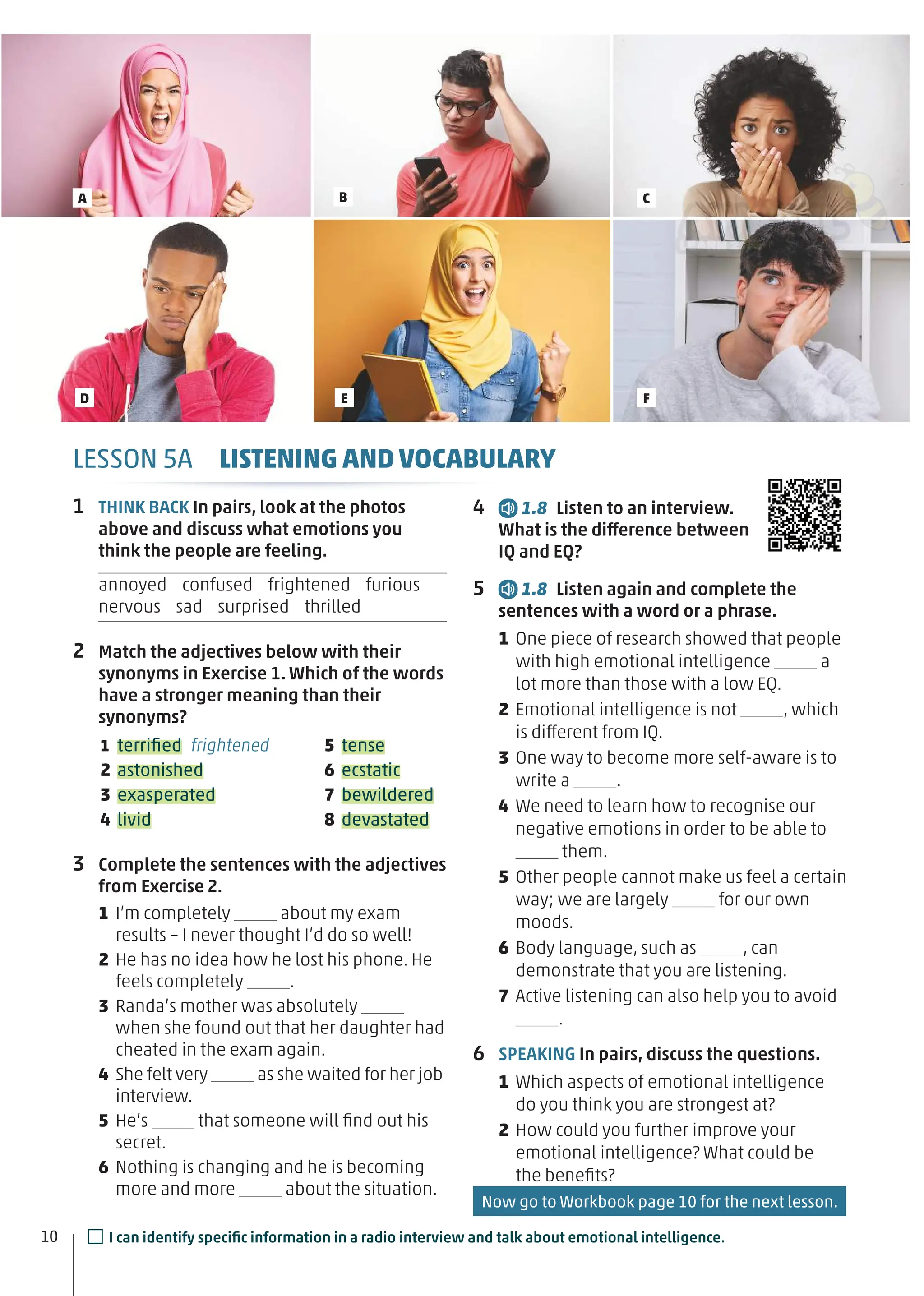
1 THINK BACK In pairs, look at the photos
above and discuss what emotions you
think the people are feeling.
annoyed confused frightened furious
nervous sad surprised thrilled
2 Match the adjectives below with their
synonyms in Exercise 1. Which of the words
have a stronger meaning than their
synonyms?
1 terrified frightened
2 astonished
3 exasperated
4 livid
5 tense
6 ecstatic
7 bewildered
8 devastated
3 Complete the sentences with the adjectives
from Exercise 2.
1 I’m completely about my exam
results – I never thought I’d do so well!
2 He has no idea how he lost his phone. He
feels completely .
3 Randa’s mother was absolutely
when she found out that her daughter had
cheated in the exam again.
4 She felt very as she waited for her job
interview.
5 He’s that someone will find out his
secret.
6 Nothing is changing and he is becoming
more and more about the situation.
4 1.8 Listen to an interview.
What is the difference between
IQ and EQ?
5 1.8 Listen again and complete the
sentences with a word or a phrase.
1 One piece of research showed that people
with high emotional intelligence a
lot more than those with a low EQ.
2 Emotional intelligence is not , which
is different from IQ.
3 One way to become more self-aware is to
write a .
4 We need to learn how to recognise our
negative emotions in order to be able to
them.
5 Other people cannot make us feel a certain
way; we are largely for our own
moods.
6 Body language, such as , can
demonstrate that you are listening.
7 Active listening can also help you to avoid
.
6 SPEAKING In pairs, discuss the questions.
1 Which aspects of emotional intelligence
do you think you are strongest at?
2 How could you further improve your
emotional intelligence? What could be
the benefits?
10
A B C
D E F
□I can identify specific information in a radio interview and talk about emotional intelligence.
Now go to Workbook page 10 for the next lesson.
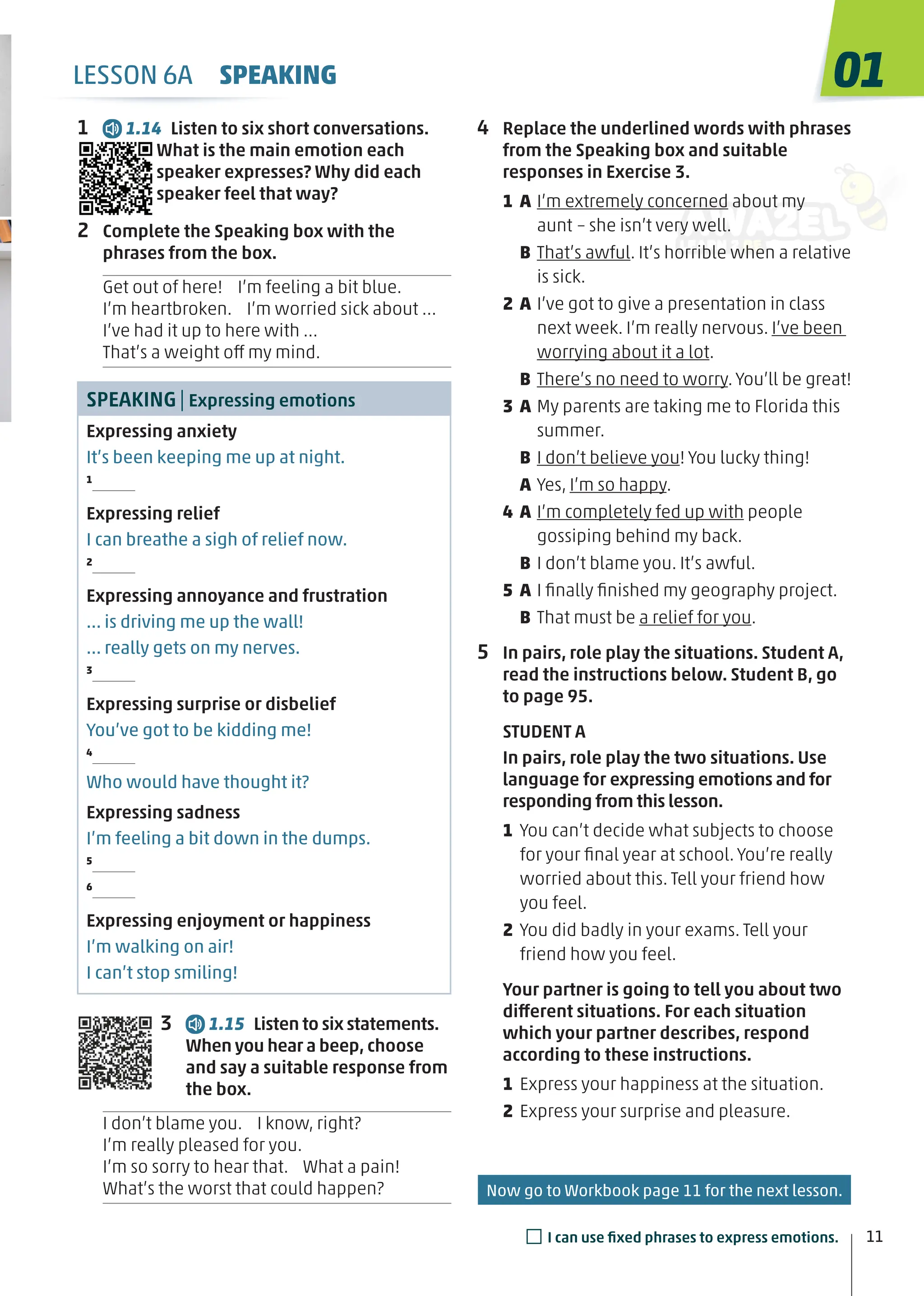
LESSON 6A SPEAKING
1 1.14 Listen to six short conversations.
What is the main emotion each
speaker expresses? Why did each
speaker feel that way?
2 Complete the Speaking box with the
phrases from the box.
Get out of here! I’m feeling a bit blue.
I’m heartbroken. I’m worried sick about …
I’ve had it up to here with …
That’s a weight off my mind.
SPEAKING| Expressing emotions
Expressing anxiety
It’s been keeping me up at night.
1
Expressing relief
I can breathe a sigh of relief now.
2
Expressing annoyance and frustration
… is driving me up the wall!
… really gets on my nerves.
3
Expressing surprise or disbelief
You’ve got to be kidding me!
4
Who would have thought it?
Expressing sadness
I’m feeling a bit down in the dumps.
5
6
Expressing enjoyment or happiness
I’m walking on air!
I can’t stop smiling!
3 1.15 Listen to six statements.
When you hear a beep, choose
and say a suitable response from
the box.
I don’t blame you. I know, right?
I’m really pleased for you.
I’m so sorry to hear that. What a pain!
What’s the worst that could happen?
4 Replace the underlined words with phrases
from the Speaking box and suitable
responses in Exercise 3.
1 A I’m extremely concerned about my
aunt – she isn’t very well.
B That’s awful. It’s horrible when a relative
is sick.
2 A I’ve got to give a presentation in class
next week. I’m really nervous. I’ve been
worrying about it a lot.
B There’s no need to worry. You’ll be great!
3 A My parents are taking me to Florida this
summer.
B I don’t believe you! You lucky thing!
A Yes, I’m so happy.
4 A I’m completely fed up with people
gossiping behind my back.
B I don’t blame you. It’s awful.
5 A I finally finished my geography project.
B That must be a relief for you.
5 In pairs, role play the situations. Student A,
read the instructions below. Student B, go
to page 95.
STUDENT A
In pairs, role play the two situations. Use
language for expressing emotions and for
responding from this lesson.
1 You can’t decide what subjects to choose
for your final year at school. You’re really
worried about this. Tell your friend how
you feel.
2 You did badly in your exams. Tell your
friend how you feel.
Your partner is going to tell you about two
different situations. For each situation
which your partner describes, respond
according to these instructions.
1 Express your happiness at the situation.
2 Express your surprise and pleasure.
11
01
□I can use fixed phrases to express emotions.
Now go to Workbook page 11 for the next lesson.
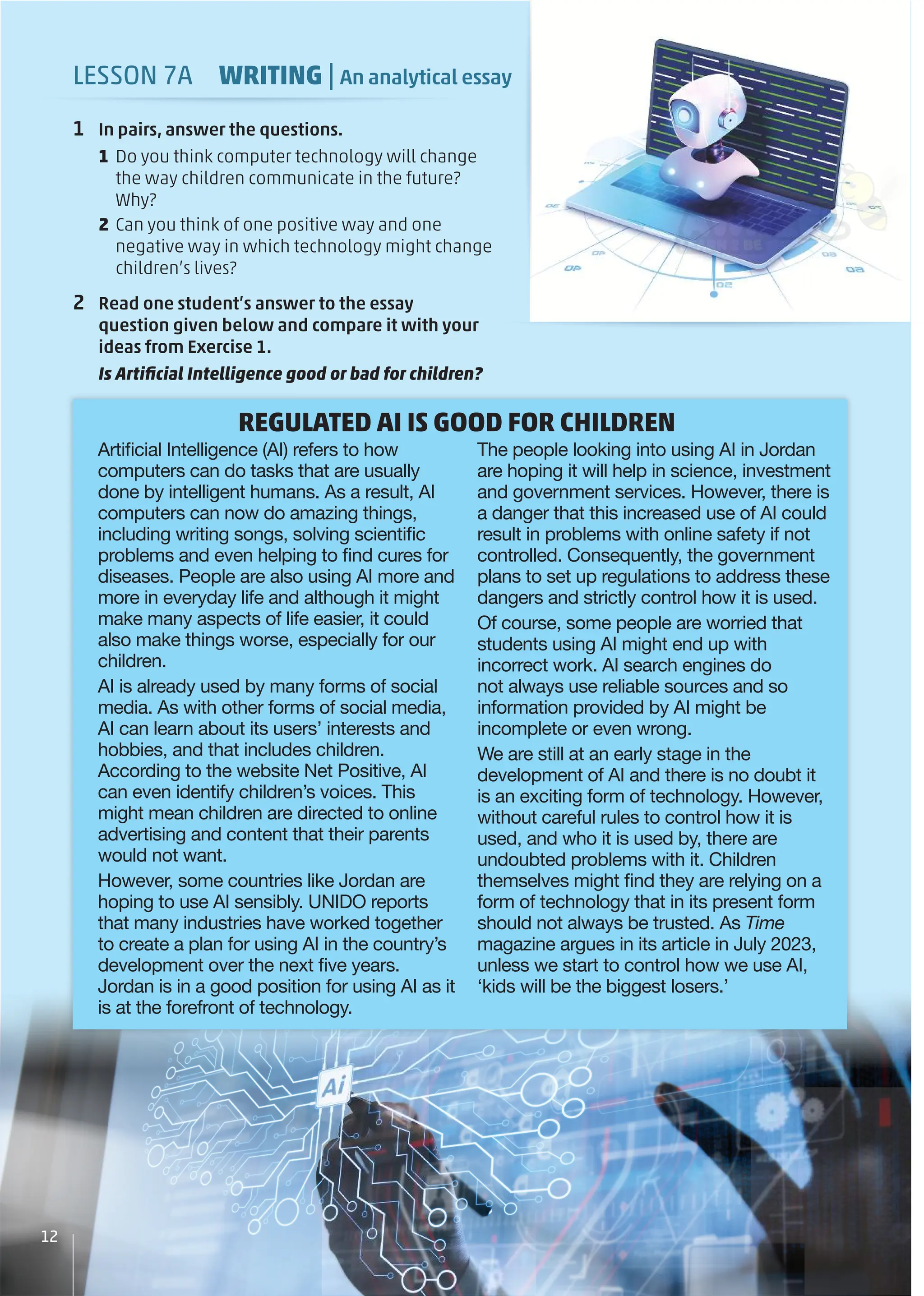
LESSON 7A WRITING | An analytical essay
1 In pairs, answer the questions.
1 Do you think computer technology will change
the way children communicate in the future?
Why?
2 Can you think of one positive way and one
negative way in which technology might change
children’s lives?
2 Read one student’s answer to the essay
question given below and compare it with your
ideas from Exercise 1.
Is Artificial Intelligence good or bad for children?
Artificial Intelligence (AI) refers to how
computers can do tasks that are usually
done by intelligent humans. As a result, AI
computers can now do amazing things,
including writing songs, solving scientific
problems and even helping to find cures for
diseases. People are also using AI more and
more in everyday life and although it might
make many aspects of life easier, it could
also make things worse, especially for our
children.
AI is already used by many forms of social
media. As with other forms of social media,
AI can learn about its users’ interests and
hobbies, and that includes children.
According to the website Net Positive, AI
can even identify children’s voices. This
might mean children are directed to online
advertising and content that their parents
would not want.
However, some countries like Jordan are
hoping to use AI sensibly. UNIDO reports
that many industries have worked together
to create a plan for using AI in the country’s
development over the next five years.
Jordan is in a good position for using AI as it
is at the forefront of technology.
The people looking into using AI in Jordan
are hoping it will help in science, investment
and government services. However, there is
a danger that this increased use of AI could
result in problems with online safety if not
controlled. Consequently, the government
plans to set up regulations to address these
dangers and strictly control how it is used.
Of course, some people are worried that
students using AI might end up with
incorrect work. AI search engines do
not always use reliable sources and so
information provided by AI might be
incomplete or even wrong.
We are still at an early stage in the
development of AI and there is no doubt it
is an exciting form of technology. However,
without careful rules to control how it is
used, and who it is used by, there are
undoubted problems with it. Children
themselves might find they are relying on a
form of technology that in its present form
should not always be trusted. As Time
magazine argues in its article in July 2023,
unless we start to control how we use AI,
‘kids will be the biggest losers.’
12
ur
REGULATED AI IS GOOD FOR CHILDREN
5 Answer the questions.
1 Which are the topic sentences in the essay?
2 Which idea is included that the writer does
not fully agree with? Why?
3 How many sources are listed?
6 Many verbs are followed by a specific
preposition.Complete the table with
examples from the essay on page 12.
on 1
to 2
, 3
about 4
7 Complete the sentences with the correct
preposition in each gap.
1 I can see my grandparents struggle to
learn the latest developments
in computing.
2 Social media sites explain ways that
parents can have control their
children’s internet use.
3 We know that social media directs
advertisements its users.
4 Too many children probably rely
social media to make friends.
8 Read the analytical essay question below.
Do you agree or disagree? Research facts
that can back up your argument.
• Social media is a good thing because
young people have more friends in more
places than ever before. Do you agree?
9 WRITING TASK Write your essay. Use the
Writing box and remember to use sources.
Don’t forget to only include facts and not
opinions.
Use the Graphic Organiser to help you
plan your writing.
13
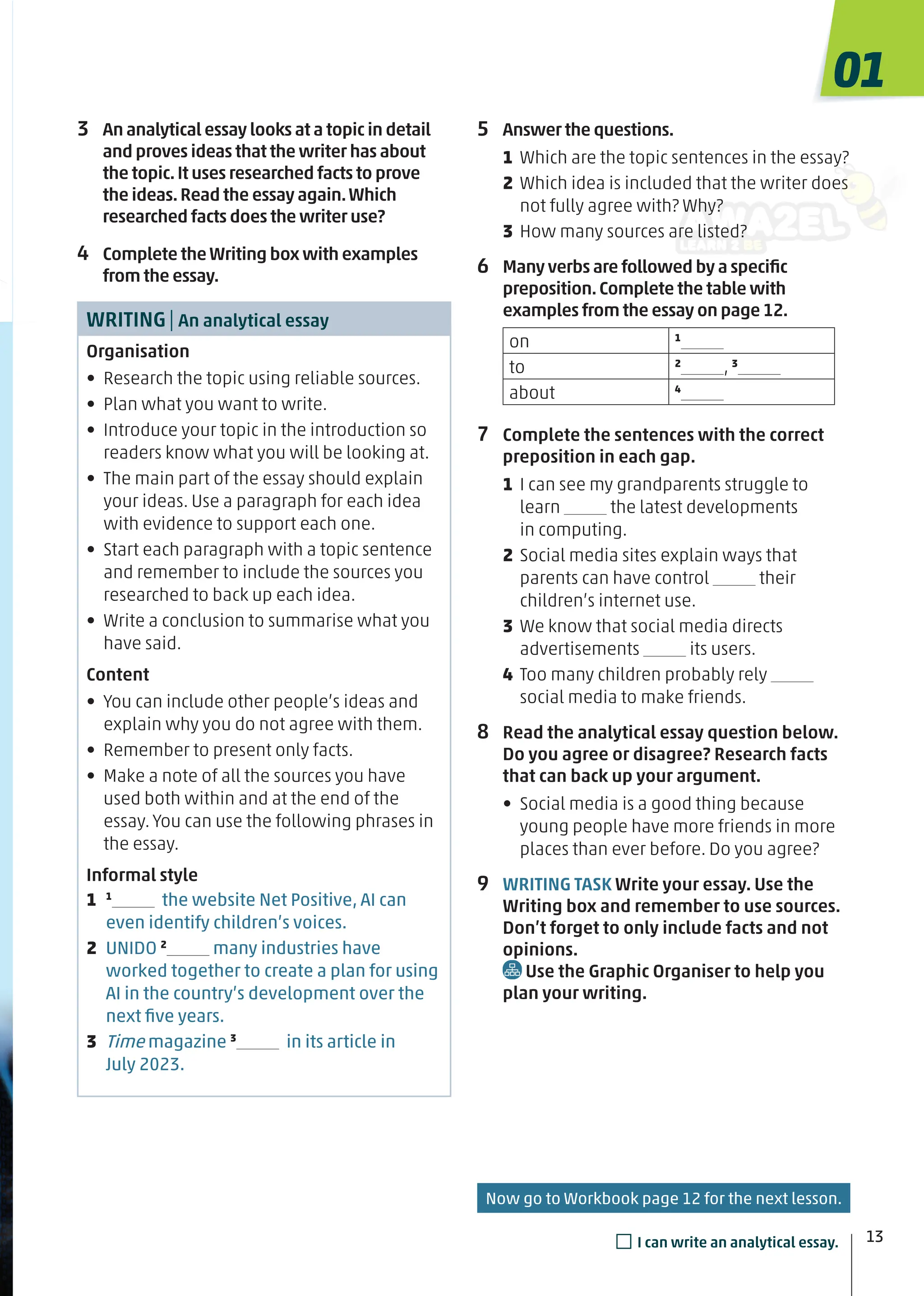
3 An analytical essay looks at a topic in detail
and proves ideas that the writer has about
the topic.It uses researched facts to prove
the ideas.Read the essay again.Which
researched facts does the writer use?
4 Complete theWriting box with examples
from the essay.
WRITING| An analytical essay
Organisation
• Research the topic using reliable sources.
• Plan what you want to write.
• Introduce your topic in the introduction so
readers know what you will be looking at.
• The main part of the essay should explain
your ideas. Use a paragraph for each idea
with evidence to support each one.
• Start each paragraph with a topic sentence
and remember to include the sources you
researched to back up each idea.
• Write a conclusion to summarise what you
have said.
Content
• You can include other people’s ideas and
explain why you do not agree with them.
• Remember to present only facts.
• Make a note of all the sources you have
used both within and at the end of the
essay. You can use the following phrases in
the essay.
Informal style
1 1
the website Net Positive, AI can
even identify children’s voices.
2 UNIDO 2
many industries have
worked together to create a plan for using
AI in the country’s development over the
next five years.
3 Time magazine 3
in its article in
July 2023.
01
13
□I can write an analytical essay.
Now go to Workbook page 12 for the next lesson.
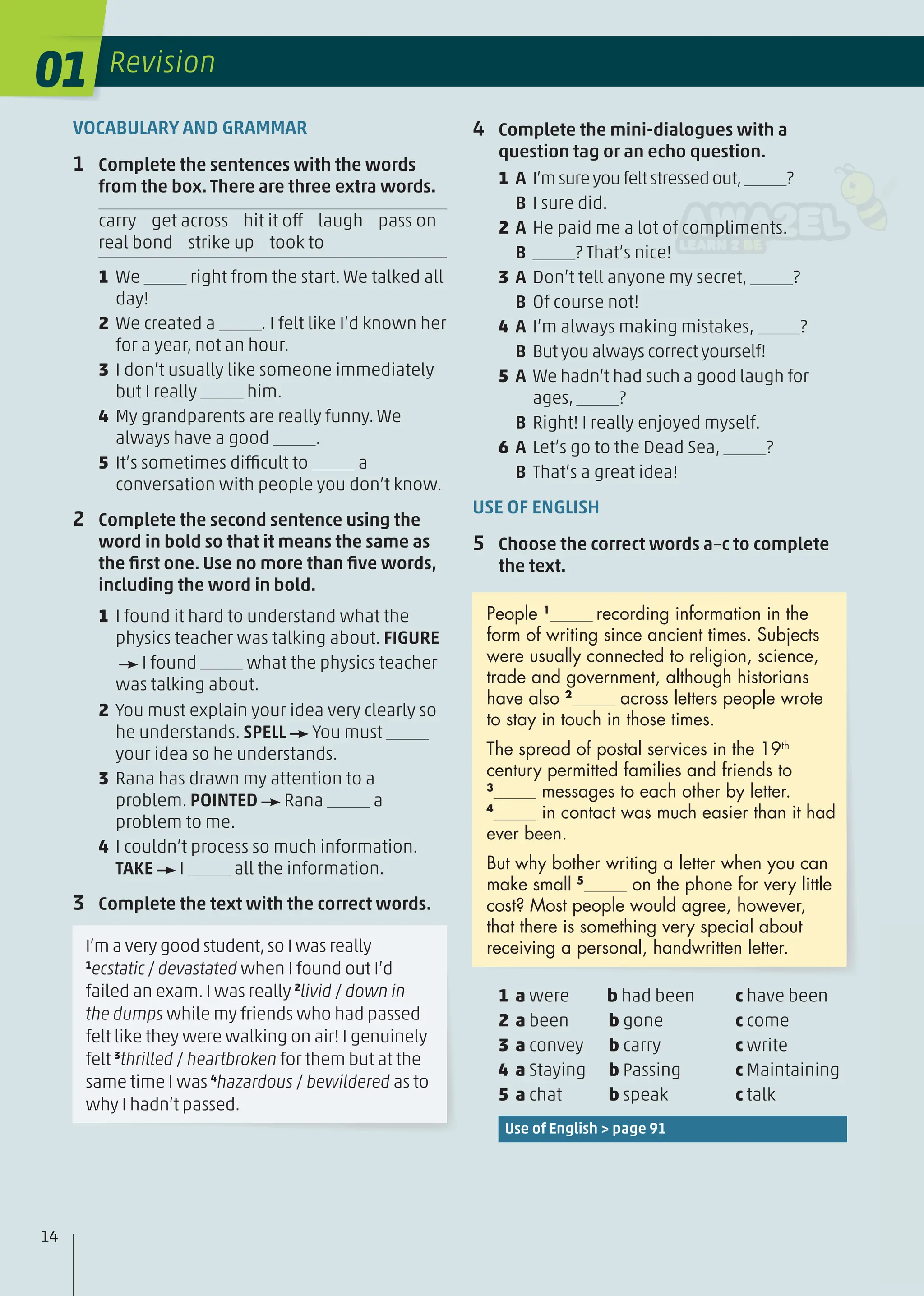
VOCABULARY AND GRAMMAR
1 Complete the sentences with the words
from the box. There are three extra words.
carry get across hit it off laugh pass on
real bond strike up took to
1 We right from the start. We talked all
day!
2 We created a . I felt like I’d known her
for a year, not an hour.
3 I don’t usually like someone immediately
but I really him.
4 My grandparents are really funny. We
always have a good .
5 It’s sometimes difficult to a
conversation with people you don’t know.
2 Complete the second sentence using the
word in bold so that it means the same as
the first one. Use no more than five words,
including the word in bold.
1 I found it hard to understand what the
physics teacher was talking about. FIGURE
I found what the physics teacher
was talking about.
2 You must explain your idea very clearly so
he understands. SPELL You must
your idea so he understands.
3 Rana has drawn my attention to a
problem. POINTED Rana a
problem to me.
4 I couldn’t process so much information.
TAKE I all the information.
3 Complete the text with the correct words.
I’m a very good student,so I was really
1
ecstatic / devastated when I found out I’d
failed an exam. I was really 2
livid / down in
the dumps while my friends who had passed
felt like they were walking on air! I genuinely
felt 3
thrilled / heartbroken for them but at the
same time I was 4
hazardous / bewildered as to
why I hadn’t passed.
4 Complete the mini-dialogues with a
question tag or an echo question.
1 A I’msureyoufeltstressedout, ?
B I sure did.
2 A He paid me a lot of compliments.
B ? That’s nice!
3 A Don’t tell anyone my secret, ?
B Of course not!
4 A I’m always making mistakes, ?
B But you always correct yourself!
5 A We hadn’t had such a good laugh for
ages, ?
B Right! I really enjoyed myself.
6 A Let’s go to the Dead Sea, ?
B That’s a great idea!
USE OF ENGLISH
5 Choose the correct words a–c to complete
the text.
People 1
recording information in the
form of writing since ancient times. Subjects
were usually connected to religion, science,
trade and government, although historians
have also 2
across letters people wrote
to stay in touch in those times.
The spread of postal services in the 19th
century permitted families and friends to
3
messages to each other by letter.
4
in contact was much easier than it had
ever been.
But why bother writing a letter when you can
make small 5
on the phone for very little
cost? Most people would agree, however,
that there is something very special about
receiving a personal, handwritten letter.
1 a were b had been c have been
2 a been b gone c come
3 a convey b carry c write
4 a Staying b Passing c Maintaining
5 a chat b speak c talk
Use of English > page 91
01 Revision
14
READING
6 Read the text. Match sentences A–F with
gaps 1–6 in the text.
A Finally, we shouldn’t forget that when
students learn a foreign language, they
are also learning about the culture of the
country or countries where it is spoken.
B It is easy to get your message across in a
hotel or restaurant in Spanish and French,
but neither is as widely spoken or as
simple to learn as English.
C This was attributed to a mixture of cultural
reasons and past government policies.
D Perhaps students are wasting their time by
learning French and German, and should
be turning their attention to Mandarin, the
most spoken language in the world.
E India and China are considered to be the
main emerging economies, so it would
seem to make sense to study one of the
main languages spoken in these countries.
F The vast majority of students at secondary
school learn a foreign language, which is
often English.
WRITING
7 Read the task below.
Social media sites are never popular for
long because people invent other sites that
are more interesting. Do you agree?
1 Decide if you agree or not.
2 Research facts to support your ideas.
3 Plan an analytical essay in paragraphs.
Write your essay.
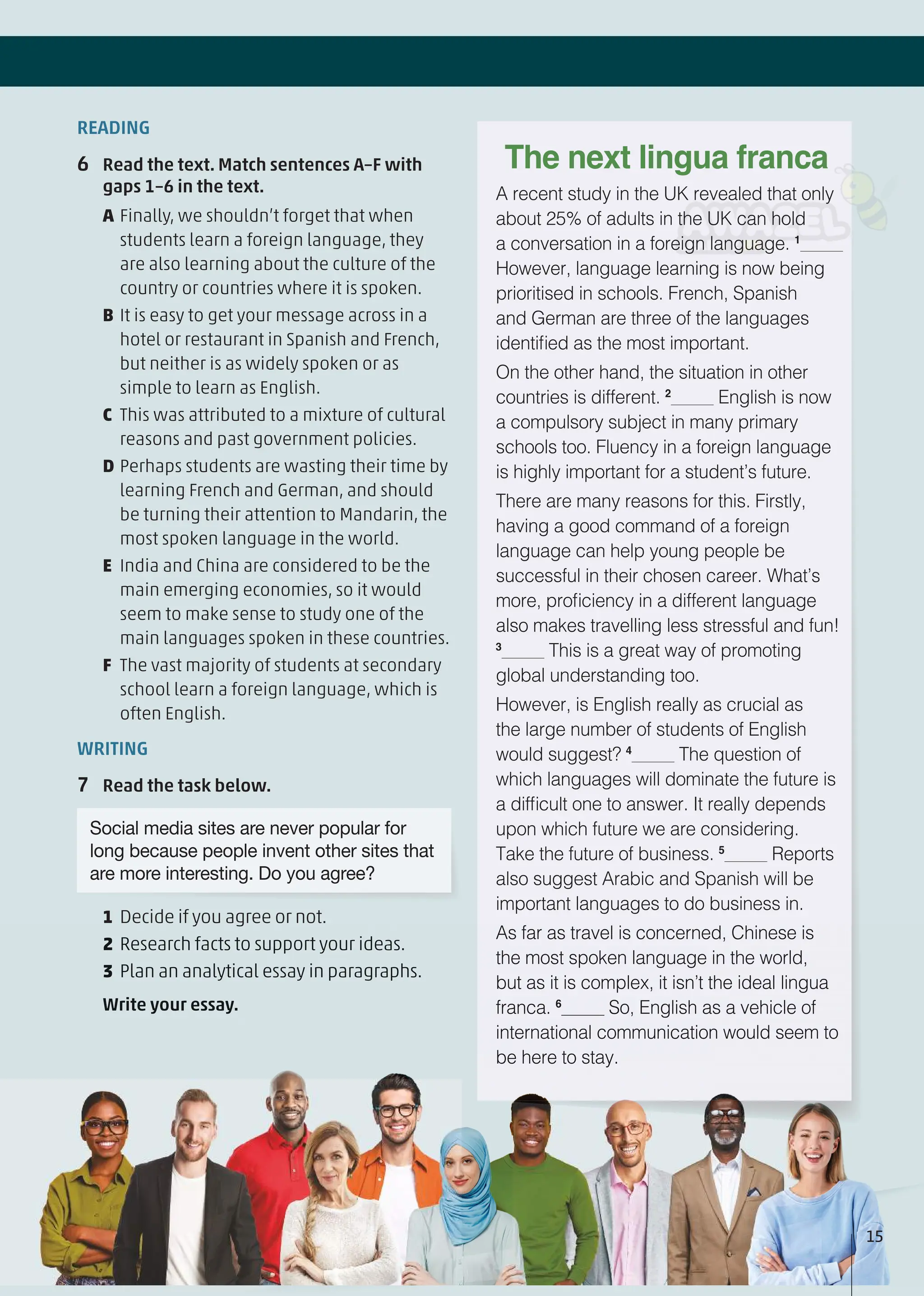
A recent study in the UK revealed that only
about 25% of adults in the UK can hold
a conversation in a foreign language. 1
However, language learning is now being
prioritised in schools. French, Spanish
and German are three of the languages
identified as the most important.
On the other hand, the situation in other
countries is different. 2
English is now
a compulsory subject in many primary
schools too. Fluency in a foreign language
is highly important for a student’s future.
There are many reasons for this. Firstly,
having a good command of a foreign
language can help young people be
successful in their chosen career. What’s
more, proficiency in a different language
also makes travelling less stressful and fun!
3
This is a great way of promoting
global understanding too.
However, is English really as crucial as
the large number of students of English
would suggest? 4
The question of
which languages will dominate the future is
a difficult one to answer. It really depends
upon which future we are considering.
Take the future of business. 5
Reports
also suggest Arabic and Spanish will be
important languages to do business in.
As far as travel is concerned, Chinese is
the most spoken language in the world,
but as it is complex, it isn’t the ideal lingua
franca. 6
So, English as a vehicle of
international communication would seem to
be here to stay.
The next lingua franca
y g
2 Research facts to support your ideas.
3 Plan an analytical essay in paragraphs.
Write your essay.
As far as travel is concerned, Chinese is
the most spoken language in the world,
but as it is complex, it isn’t the ideal lingua
franca. 6
So, English as a vehicle of
international communication would seem to
be here to stay.
15
FUTURE’S…
THE
… BRIGHT … TERRIFYING!
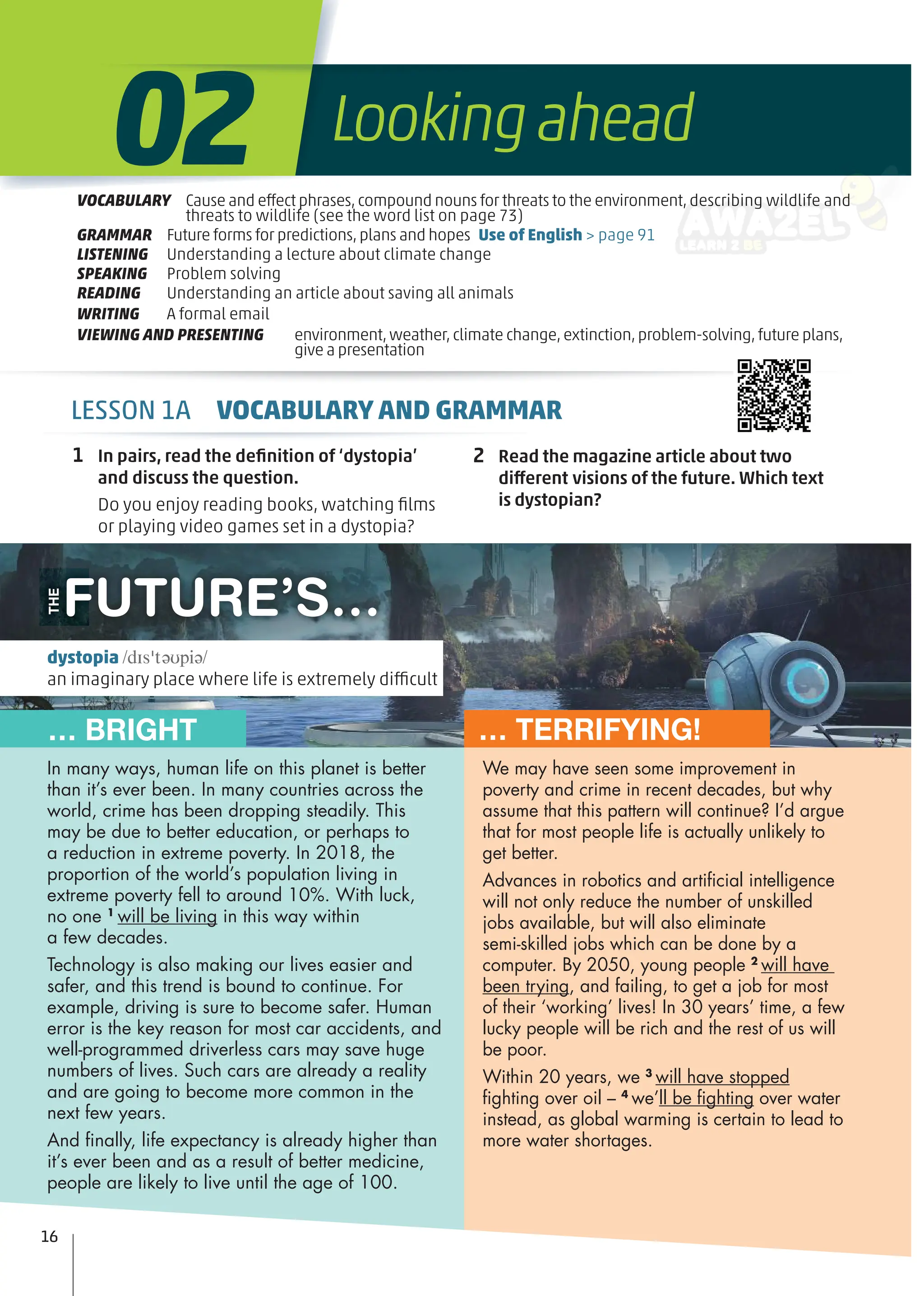
1 In pairs, read the definition of ‘dystopia’
and discuss the question.
Do you enjoy reading books, watching films
or playing video games set in a dystopia?
2 Read the magazine article about two
different visions of the future. Which text
is dystopian?
We may have seen some improvement in
poverty and crime in recent decades, but why
assume that this pattern will continue? I’d argue
that for most people life is actually unlikely to
get better.
Advances in robotics and artificial intelligence
will not only reduce the number of unskilled
jobs available, but will also eliminate
semi-skilled jobs which can be done by a
computer. By 2050, young people 2
will have
been trying, and failing, to get a job for most
of their ‘working’ lives! In 30 years’ time, a few
lucky people will be rich and the rest of us will
be poor.
Within 20 years, we 3
will have stopped
fighting over oil – 4
we’ll be fighting over water
instead, as global warming is certain to lead to
more water shortages.
In many ways, human life on this planet is better
than it’s ever been. In many countries across the
world, crime has been dropping steadily. This
may be due to better education, or perhaps to
a reduction in extreme poverty. In 2018, the
proportion of the world’s population living in
extreme poverty fell to around 10%. With luck,
no one 1
will be living in this way within
a few decades.
Technology is also making our lives easier and
safer, and this trend is bound to continue. For
example, driving is sure to become safer. Human
error is the key reason for most car accidents, and
well-programmed driverless cars may save huge
numbers of lives. Such cars are already a reality
and are going to become more common in the
next few years.
And finally, life expectancy is already higher than
it’s ever been and as a result of better medicine,
people are likely to live until the age of 100.
16
dystopia /dɪsˈtəʊpiə/
an imaginary place where life is extremely difficult
VOCABULARY Cause and effect phrases,compound nouns for threats to the environment,describing wildlife and
threats to wildlife (see the word list on page 73)
GRAMMAR Future forms for predictions,plans and hopes Use of English > page 91
LISTENING Understanding a lecture about climate change
SPEAKING Problem solving
READING Understanding an article about saving all animals
WRITING A formal email
VIEWING AND PRESENTING environment,weather,climate change,extinction,problem-solving,future plans,
give a presentation
Lookingahead
02
LESSON 1A VOCABULARY AND GRAMMAR
By 2075 the population of the world 1
to
more than nine billion. This 2
that we will
need to use more and more land for housing.
We will also need to produce more food and it
3
that we will be able to produce enough
meat to feed all those people without further
damaging the environment. Our eating habits
4
change.
Luckily, scientists are already working on
alternatives to meat, such as insects and
synthetic protein. It may sound disgusting,
but in a few years, all of us 5
it!
What will we be eating in the future?
Future forms for predictions
3 THINK BACK Look at two predictions
from the texts. Which verb form is used
when there is some evidence now for
the prediction?
1 Driverless cars are already a reality and are
going to become commonplace in the next
few years.
2 A few lucky people will be rich and the rest
of us will be much poorer.
4 Match the underlined phrases (1–4) in the
article to these tenses.
a □Future Perfect Simple
b □Future Perfect Continuous
c □□Future Continuous
5 Now match tenses a–c in Exercise 4 to
explanations 1–3 below.
1 □an activity in progress at a specific time
in the future
2 □an activity which will be completed by
a specific time
3 □an activity which continues up to a
specific point in the future
6 Choose the correct answers to complete
the sentences.
1 By 2050, software will be able / will have
been able to predict traffic jams.
2 In a few years, tablets won’t exist
anymore. They will be / will have been
replaced by smartwatches.
3 By the time today’s young people retire,
they will be working / will have been
working for 70 years.
4 I don’t think we will need / are going to
need passwords, as computers will be able
to recognise our faces.
5 In a few decades, everyone
will be growing / will have been growing
their own food.
Grammar Reference and Practice > page 80
7 2.1 Complete the article with
the phrases from the box. Then
listen and check.
is likely to mean is unlikely
will be eating will have risen will have to
8 Rewrite the sentences below using the
phrases from the box.
a big cause of as a consequence of
cause(v) giveriseto resultfrom resultin
1 This may be due to better education.
2 As a result of better medicine, people are
likely to live until the age of 100.
3 Global warming is certain to lead to water
shortages.
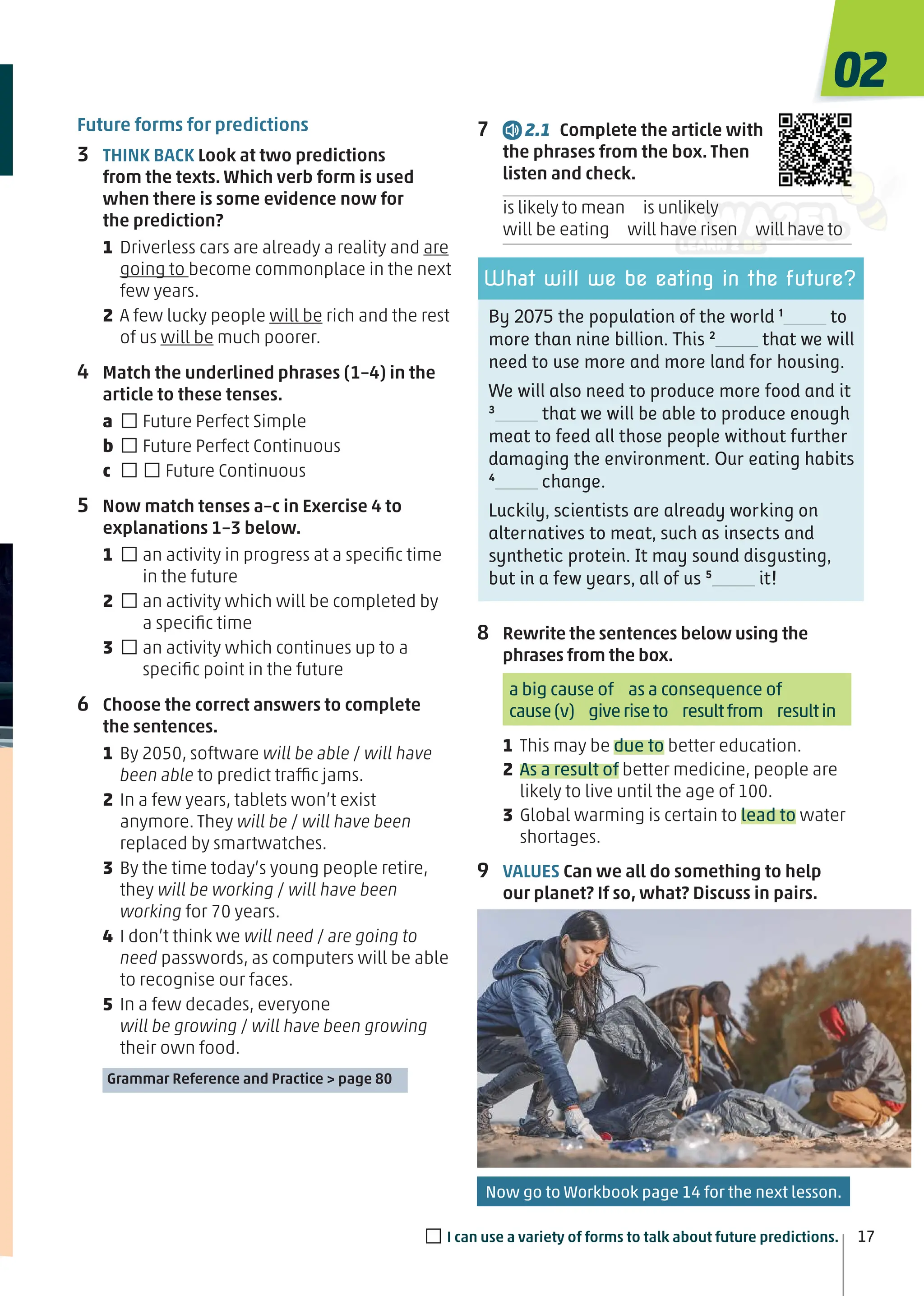
9 VALUES Can we all do something to help
our planet? If so, what? Discuss in pairs.
17
02
□I can use a variety of forms to talk about future predictions.
Now go to Workbook page 14 for the next lesson.
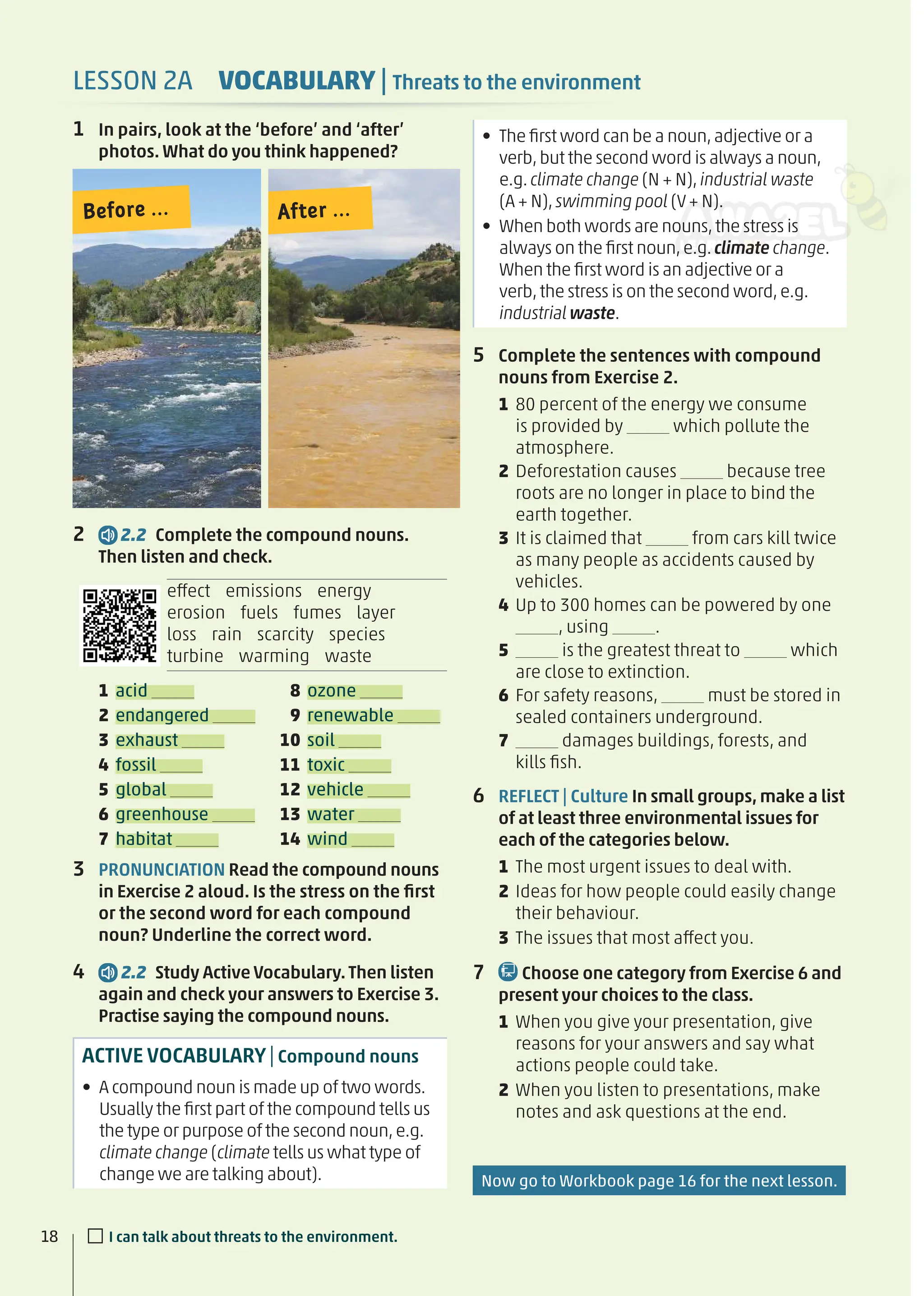
Before ... After ...
1 In pairs, look at the ‘before’ and ‘after’
photos. What do you think happened?
2 2.2 Complete the compound nouns.
Then listen and check.
effect emissions energy
erosion fuels fumes layer
loss rain scarcity species
turbine warming waste
1 acid
2 endangered
3 exhaust
4 fossil
5 global
6 greenhouse
7 habitat
8 ozone
9 renewable
10 soil
11 toxic
12 vehicle
13 water
14 wind
• The first word can be a noun,adjective or a
verb,but the second word is always a noun,
e.g.climate change (N + N),industrial waste
(A + N),swimming pool (V+ N).
• When both words are nouns,the stress is
always on the first noun,e.g.climate change.
When the first word is an adjective or a
verb,the stress is on the second word,e.g.
industrial waste.
5 Complete the sentences with compound
nouns from Exercise 2.
1 80 percent of the energy we consume
is provided by which pollute the
atmosphere.
2 Deforestation causes because tree
roots are no longer in place to bind the
earth together.
3 It is claimed that from cars kill twice
as many people as accidents caused by
vehicles.
4 Up to 300 homes can be powered by one
, using .
5 is the greatest threat to which
are close to extinction.
6 For safety reasons, must be stored in
sealed containers underground.
7 damages buildings, forests, and
kills fish.
6 REFLECT | Culture In small groups, make a list
of at least three environmental issues for
each of the categories below.
1 The most urgent issues to deal with.
2 Ideas for how people could easily change
their behaviour.
3 The issues that most affect you.
7 Choose one category from Exercise 6 and
present your choices to the class.
1 When you give your presentation, give
reasons for your answers and say what
actions people could take.
2 When you listen to presentations, make
notes and ask questions at the end.
3 PRONUNCIATION Read the compound nouns
in Exercise 2 aloud. Is the stress on the first
or the second word for each compound
noun? Underline the correct word.
4 2.2 Study Active Vocabulary.Then listen
again and check your answers to Exercise 3.
Practise saying the compound nouns.
ACTIVE VOCABULARY|Compound nouns
• A compound noun is made up of two words.
Usually the first part of the compound tells us
the type or purpose of the second noun,e.g.
climate change (climate tells us what type of
change we are talking about).
LESSON 2A VOCABULARY | Threats to the environment
18 □I can talk about threats to the environment.
Now go to Workbook page 16 for the next lesson.
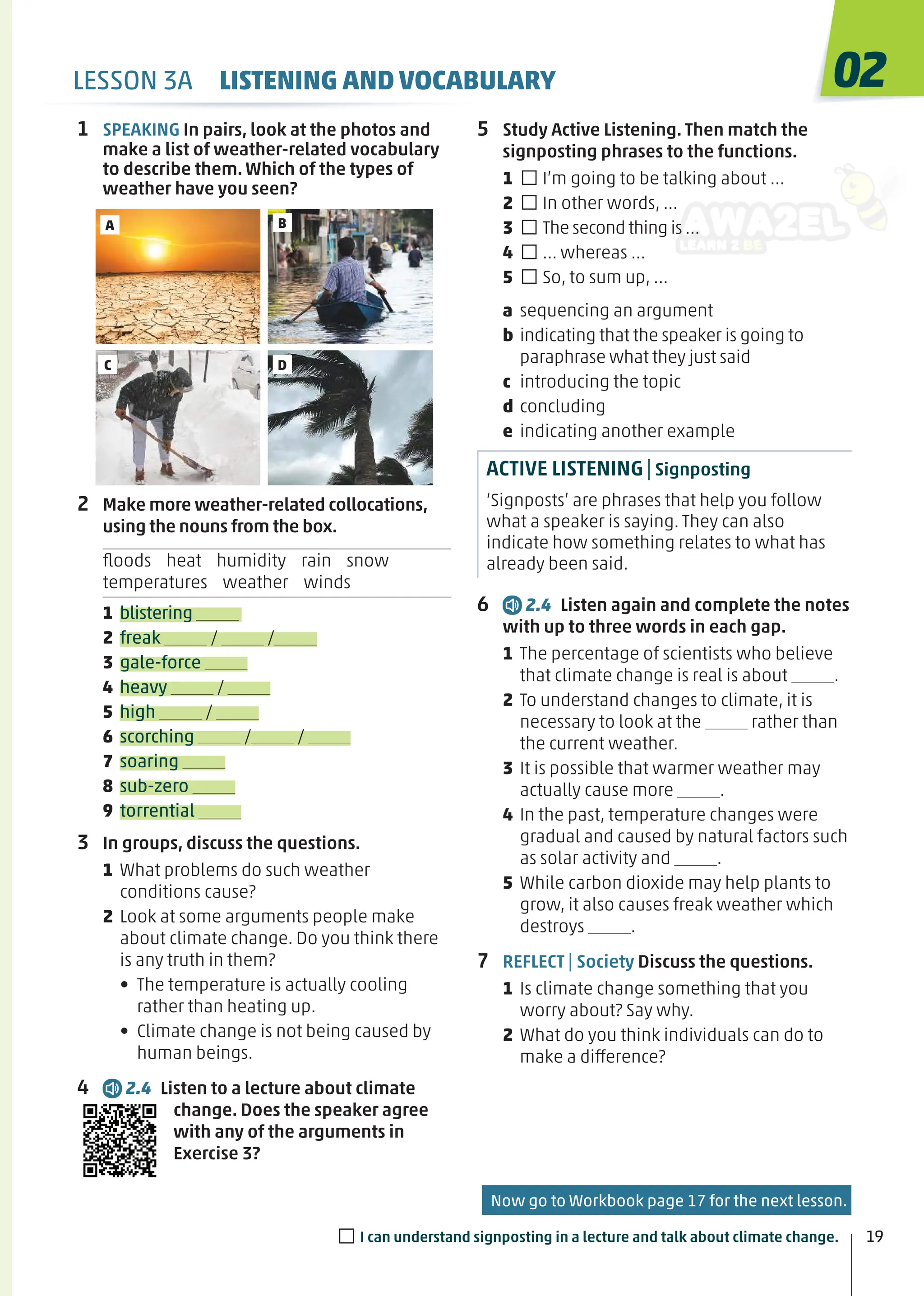
A
C
B
D
1 SPEAKING In pairs, look at the photos and
make a list of weather-related vocabulary
to describe them. Which of the types of
weather have you seen?
2 Make more weather-related collocations,
using the nouns from the box.
floods heat humidity rain snow
temperatures weather winds
1 blistering
2 freak / /
3 gale-force
4 heavy /
5 high /
6 scorching / /
7 soaring
8 sub-zero
9 torrential
3 In groups, discuss the questions.
1 What problems do such weather
conditions cause?
2 Look at some arguments people make
about climate change. Do you think there
is any truth in them?
• The temperature is actually cooling
rather than heating up.
• Climate change is not being caused by
human beings.
4 2.4 Listen to a lecture about climate
change. Does the speaker agree
with any of the arguments in
Exercise 3?
5 Study Active Listening. Then match the
signposting phrases to the functions.
1 □I’m going to be talking about …
2 □In other words, …
3 □The second thing is …
4 □… whereas …
5 □So, to sum up, …
a sequencing an argument
b indicating that the speaker is going to
paraphrase what they just said
c introducing the topic
d concluding
e indicating another example
ACTIVE LISTENING|Signposting
‘Signposts’ are phrases that help you follow
what a speaker is saying. They can also
indicate how something relates to what has
already been said.
6 2.4 Listen again and complete the notes
with up to three words in each gap.
1 The percentage of scientists who believe
that climate change is real is about .
2 To understand changes to climate, it is
necessary to look at the rather than
the current weather.
3 It is possible that warmer weather may
actually cause more .
4 In the past, temperature changes were
gradual and caused by natural factors such
as solar activity and .
5 While carbon dioxide may help plants to
grow, it also causes freak weather which
destroys .
7 REFLECT | Society Discuss the questions.
1 Is climate change something that you
worry about? Say why.
2 What do you think individuals can do to
make a difference?
19
02
LESSON 3A LISTENING AND VOCABULARY
Now go to Workbook page 17 for the next lesson.
□I can understand signposting in a lecture and talk about climate change.
A It’s no accident that the symbol of the World Wide
Fund for Nature is a giant panda. These animals are
cute or beautiful, or both, and of course we all want
to save them. This popularity enables organisations
such as the WWF to raise money to support a range of critically
endangered species. However, less well-known or ‘exciting’
creatures are far more likely to become extinct because they
don’t get enough attention from researchers. Invertebrates
(animals without a backbone) make up over 90% of all the
creatures on Earth, but get only a tiny percentage of the
money available to protect our wildlife.
B And what about those creatures that many people would
find positively ugly? With its tiny eyes, big mouth and slimy
pink body, the blobfish is far from attractive. This marine
creature lives deep in the ocean, where the pressure is very
high. As a result, it has tiny fins and no skeleton, which keeps
it from being crushed by the water pressure. Unfortunately,
when fishing boats sweep the ocean floor, looking for other
fish and crustaceans, these fish can get swept into the nets
accidentally.
C The threat faced by the pangolin, however, is far from accidental.
They are more often targeted by poachers than any other animal
in the world. Unique among mammals, it is covered in scales, like a reptile.
They may not look very cuddly or cute, but these scales are highly prised in
traditional Chinese medicine, which has caused the population of pangolins
in China to fall by around 90% since the 1960s. Their scales protect them from
their natural predators, but it’s simple for a poacher to just pick them up.
D Other creatures become endangered precisely because people find them ugly.
Take|the aye aye for example. Found only on the island of Madagascar, the aye
aye is the world’s largest nocturnal primate. During the day they sleep in nests
in the trees, coming out to hunt at night. They are solitary creatures, furry, and
harmless but unfortunately, they are often killed.
5
10
15
20
25
30
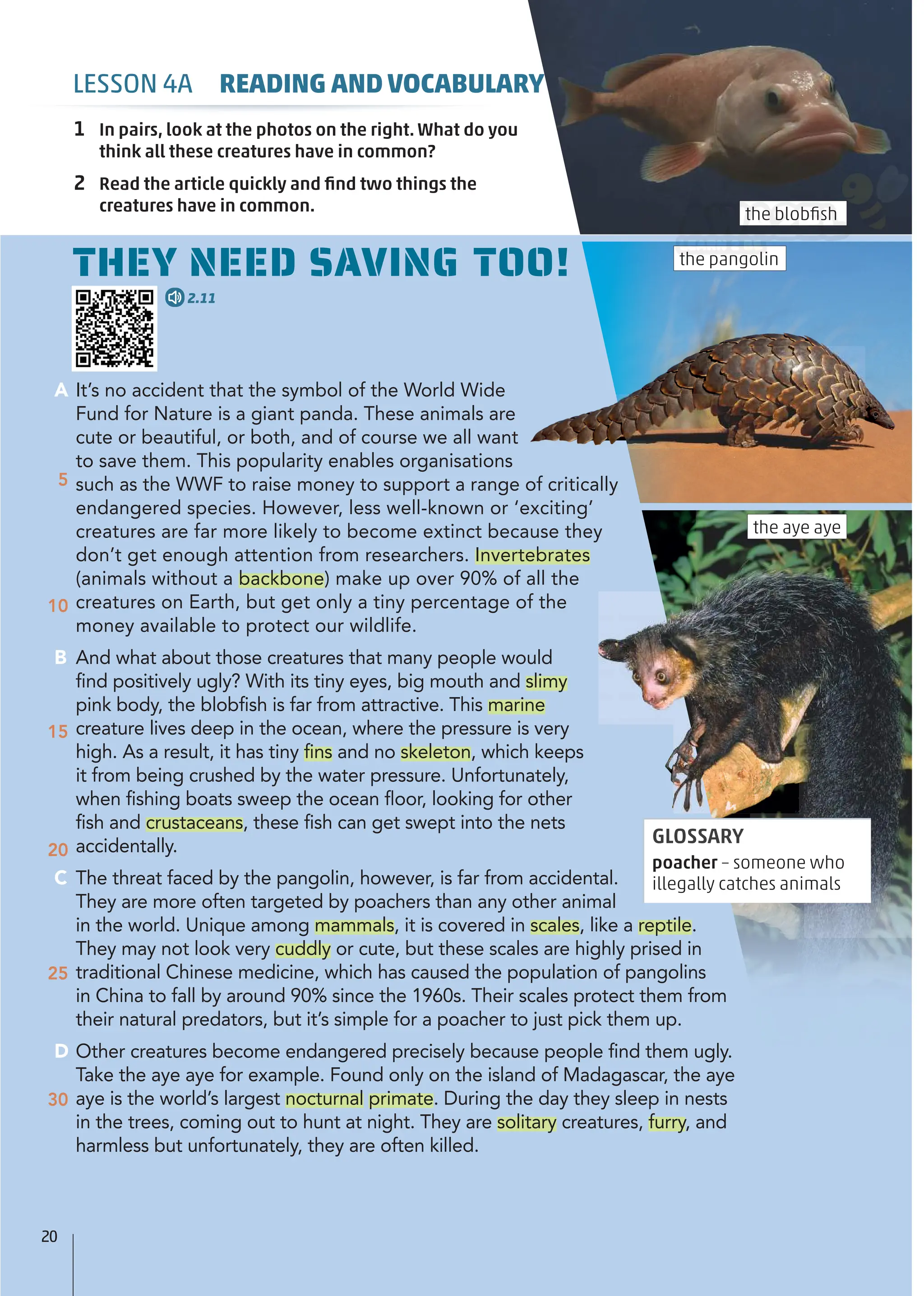
the pangolin
the blobfish
the aye aye
GLOSSARY
poacher – someone who
illegally catches animals
1 In pairs, look at the photos on the right. What do you
think all these creatures have in common?
2 Read the article quickly and find two things the
creatures have in common.
THEY NEED SAVING TOO!
2.11
LESSON 4A READING AND VOCABULARY
20
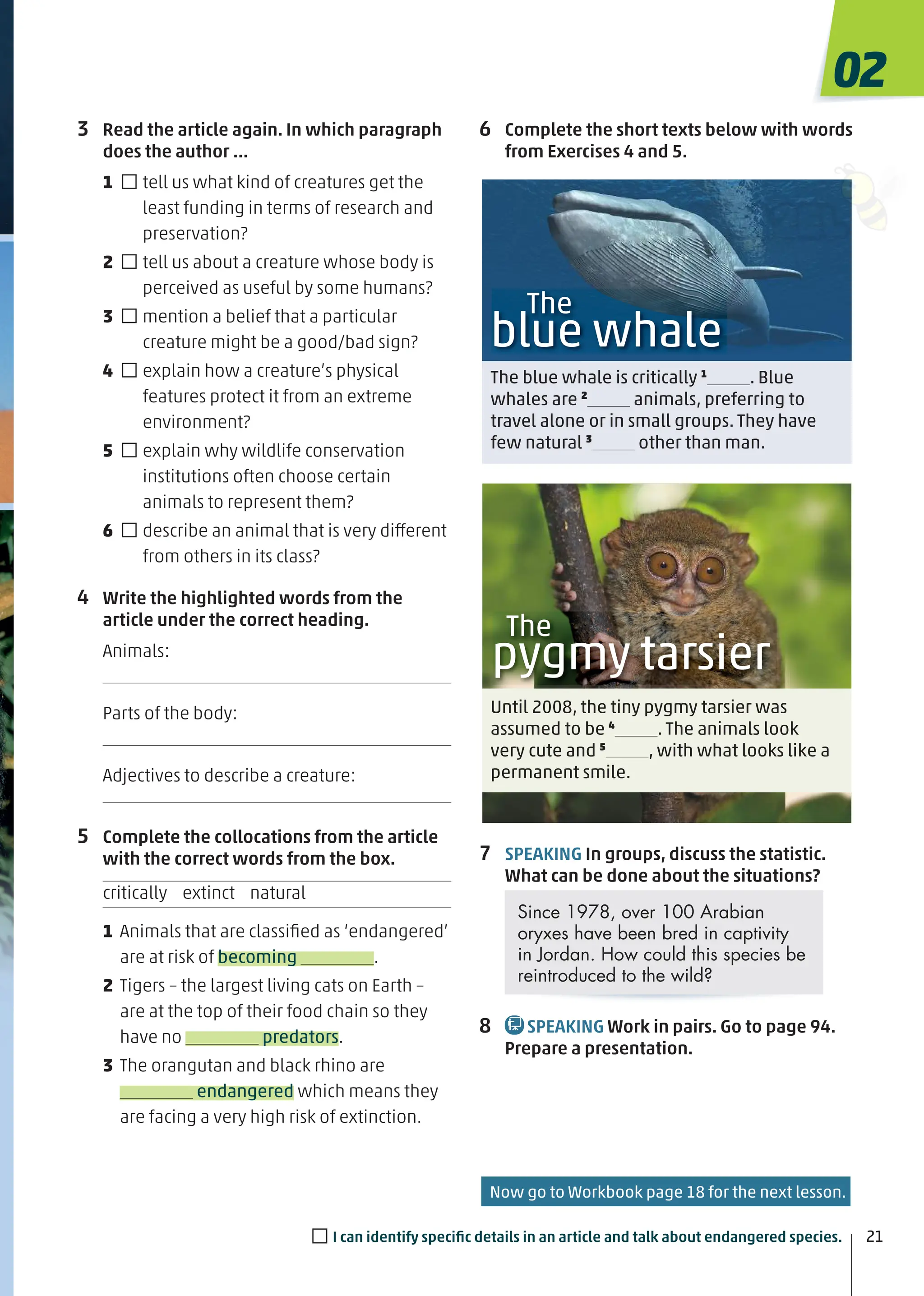
The
blue whale
The blue whale is critically 1
. Blue
whales are 2
animals, preferring to
travel alone or in small groups. They have
few natural 3
other than man.
Until 2008, the tiny pygmy tarsier was
assumed to be 4
. The animals look
very cute and 5
, with what looks like a
permanent smile.
The
pygmy tarsier
3 Read the article again. In which paragraph
does the author …
1 □tell us what kind of creatures get the
least funding in terms of research and
preservation?
2 □tell us about a creature whose body is
perceived as useful by some humans?
3 □mention a belief that a particular
creature might be a good/bad sign?
4 □explain how a creature’s physical
features protect it from an extreme
environment?
5 □explain why wildlife conservation
institutions often choose certain
animals to represent them?
6 □describe an animal that is very different
from others in its class?
4 Write the highlighted words from the
article under the correct heading.
Animals:
Parts of the body:
Adjectives to describe a creature:
5 Complete the collocations from the article
with the correct words from the box.
critically extinct natural
1 Animals that are classified as ‘endangered’
are at risk of becoming .
2 Tigers – the largest living cats on Earth –
are at the top of their food chain so they
have no predators.
3 The orangutan and black rhino are
endangered which means they
are facing a very high risk of extinction.
6 Complete the short texts below with words
from Exercises 4 and 5.
7 SPEAKING In groups, discuss the statistic.
What can be done about the situations?
Since 1978, over 100 Arabian
oryxes have been bred in captivity
in Jordan. How could this species be
reintroduced to the wild?
8 SPEAKING Work in pairs. Go to page 94.
Prepare a presentation.
02
21
□I can identify specific details in an article and talk about endangered species.
Now go to Workbook page 18 for the next lesson.
LESSON 5A SPEAKING
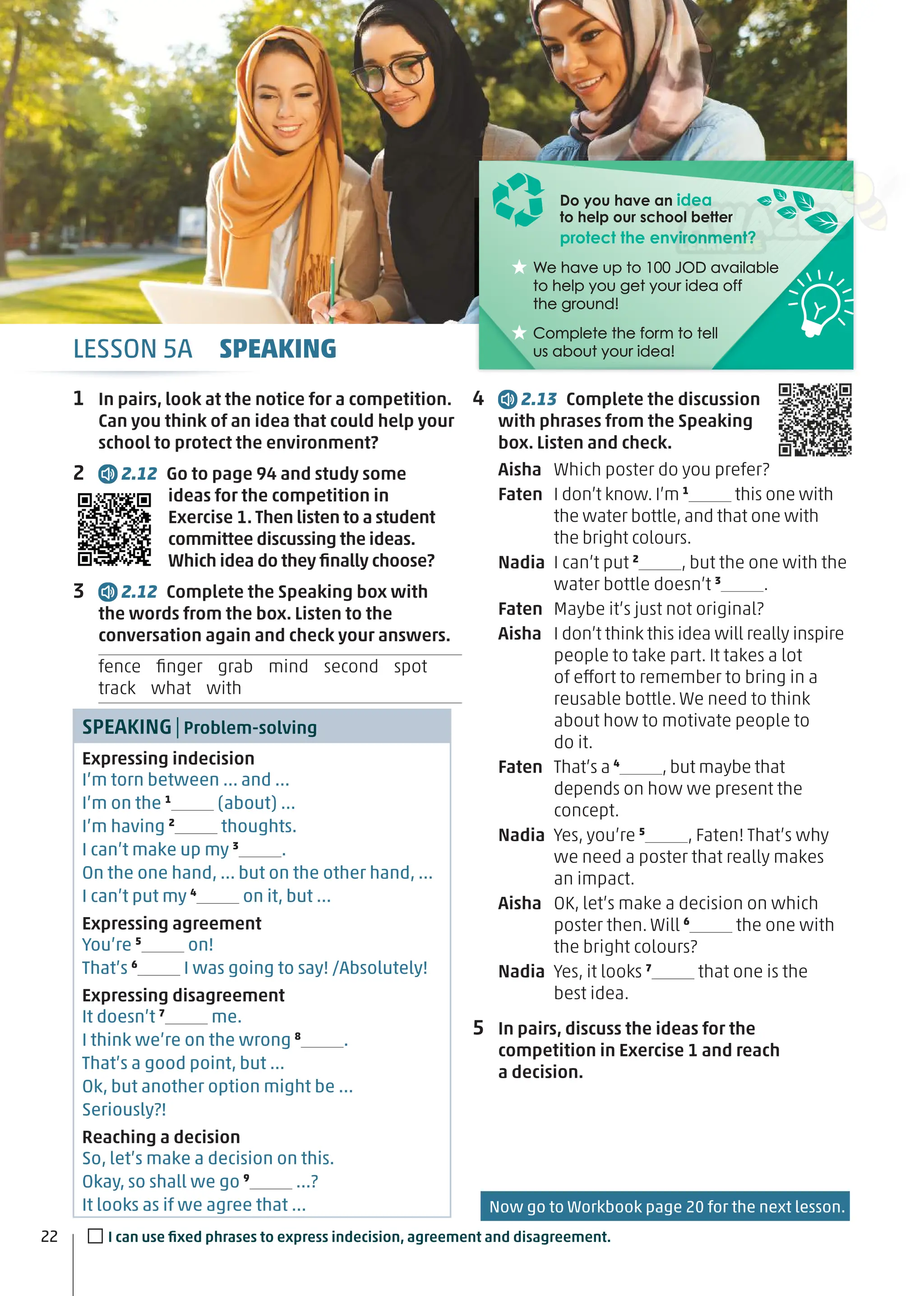
Do you have an idea
to help our school better
protect the environment?
We have up to 100 JOD available
to help you get your idea off
the ground!
the ground!
Complete the form to tell
us about your idea!
us about your idea!
1 In pairs, look at the notice for a competition.
Can you think of an idea that could help your
school to protect the environment?
2 2.12 Go to page 94 and study some
ideas for the competition in
Exercise 1. Then listen to a student
committee discussing the ideas.
Which idea do they finally choose?
3 2.12 Complete the Speaking box with
the words from the box. Listen to the
conversation again and check your answers.
fence finger grab mind second spot
track what with
SPEAKING|Problem-solving
Expressing indecision
I’m torn between … and …
I’m on the 1
(about) …
I’m having 2
thoughts.
I can’t make up my 3
.
On the one hand, … but on the other hand, …
I can’t put my 4
on it, but …
Expressing agreement
You’re 5
on!
That’s 6
I was going to say! /Absolutely!
Expressing disagreement
It doesn’t 7
me.
I think we’re on the wrong 8
.
That’s a good point, but …
Ok, but another option might be …
Seriously?!
Reaching a decision
So, let’s make a decision on this.
Okay, so shall we go 9
…?
It looks as if we agree that …
4 2.13 Complete the discussion
with phrases from the Speaking
box. Listen and check.
Aisha Which poster do you prefer?
Faten I don’t know. I’m 1
this one with
the water bottle, and that one with
the bright colours.
Nadia I can’t put 2
, but the one with the
water bottle doesn’t 3
.
Faten Maybe it’s just not original?
Aisha I don’t think this idea will really inspire
people to take part. It takes a lot
of effort to remember to bring in a
reusable bottle. We need to think
about how to motivate people to
do it.
Faten That’s a 4
, but maybe that
depends on how we present the
concept.
Nadia Yes, you’re 5
, Faten! That’s why
we need a poster that really makes
an impact.
Aisha OK, let’s make a decision on which
poster then. Will 6
the one with
the bright colours?
Nadia Yes, it looks 7
that one is the
best idea.
5 In pairs, discuss the ideas for the
competition in Exercise 1 and reach
a decision.
22 □I can use fixed phrases to express indecision, agreement and disagreement.
Now go to Workbook page 20 for the next lesson.
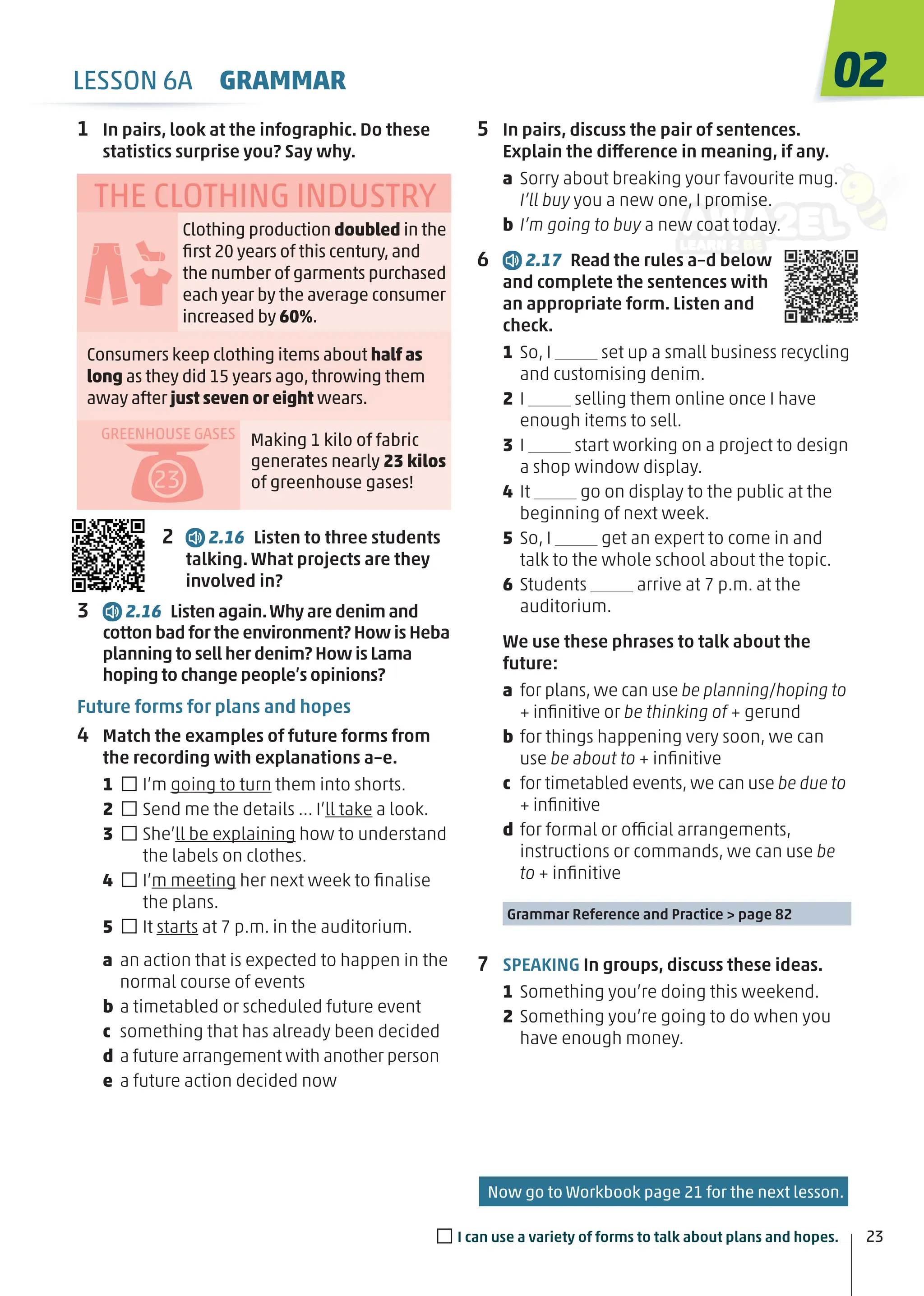
THE CLOTHING INDUSTRY
Clothing production doubled in the
first 20 years of this century, and
the number of garments purchased
each year by the average consumer
increased by 60%.
Consumers keep clothing items about half as
long as they did 15 years ago, throwing them
away after just seven or eight wears.
Making 1 kilo of fabric
generates nearly 23 kilos
of greenhouse gases!
GREENHOUSE GASES
23
1 In pairs, look at the infographic. Do these
statistics surprise you? Say why.
2 2.16 Listen to three students
talking. What projects are they
involved in?
3 2.16 Listen again.Why are denim and
cotton bad for the environment? How is Heba
planning to sell her denim? How is Lama
hoping to change people’s opinions?
Future forms for plans and hopes
4 Match the examples of future forms from
the recording with explanations a–e.
1 □I’m going to turn them into shorts.
2 □Send me the details … I’ll take a look.
3 □She’ll be explaining how to understand
the labels on clothes.
4 □I’m meeting her next week to finalise
the plans.
5 □It starts at 7 p.m. in the auditorium.
a an action that is expected to happen in the
normal course of events
b a timetabled or scheduled future event
c something that has already been decided
d a future arrangement with another person
e a future action decided now
5 In pairs, discuss the pair of sentences.
Explain the difference in meaning, if any.
a Sorry about breaking your favourite mug.
I’ll buy you a new one, I promise.
b I’m going to buy a new coat today.
6 2.17 Read the rules a–d below
and complete the sentences with
an appropriate form. Listen and
check.
1 So, I set up a small business recycling
and customising denim.
2 I selling them online once I have
enough items to sell.
3 I start working on a project to design
a shop window display.
4 It go on display to the public at the
beginning of next week.
5 So, I get an expert to come in and
talk to the whole school about the topic.
6 Students arrive at 7 p.m. at the
auditorium.
We use these phrases to talk about the
future:
a for plans, we can use be planning/hoping to
+ infinitive or be thinking of + gerund
b for things happening very soon, we can
use be about to + infinitive
c for timetabled events, we can use be due to
+ infinitive
d for formal or official arrangements,
instructions or commands, we can use be
to + infinitive
Grammar Reference and Practice > page 82
7 SPEAKING In groups, discuss these ideas.
1 Something you’re doing this weekend.
2 Something you’re going to do when you
have enough money.
Now go to Workbook page 21 for the next lesson.
02
23
LESSON 6A GRAMMAR
□I can use a variety of forms to talk about plans and hopes.
A B
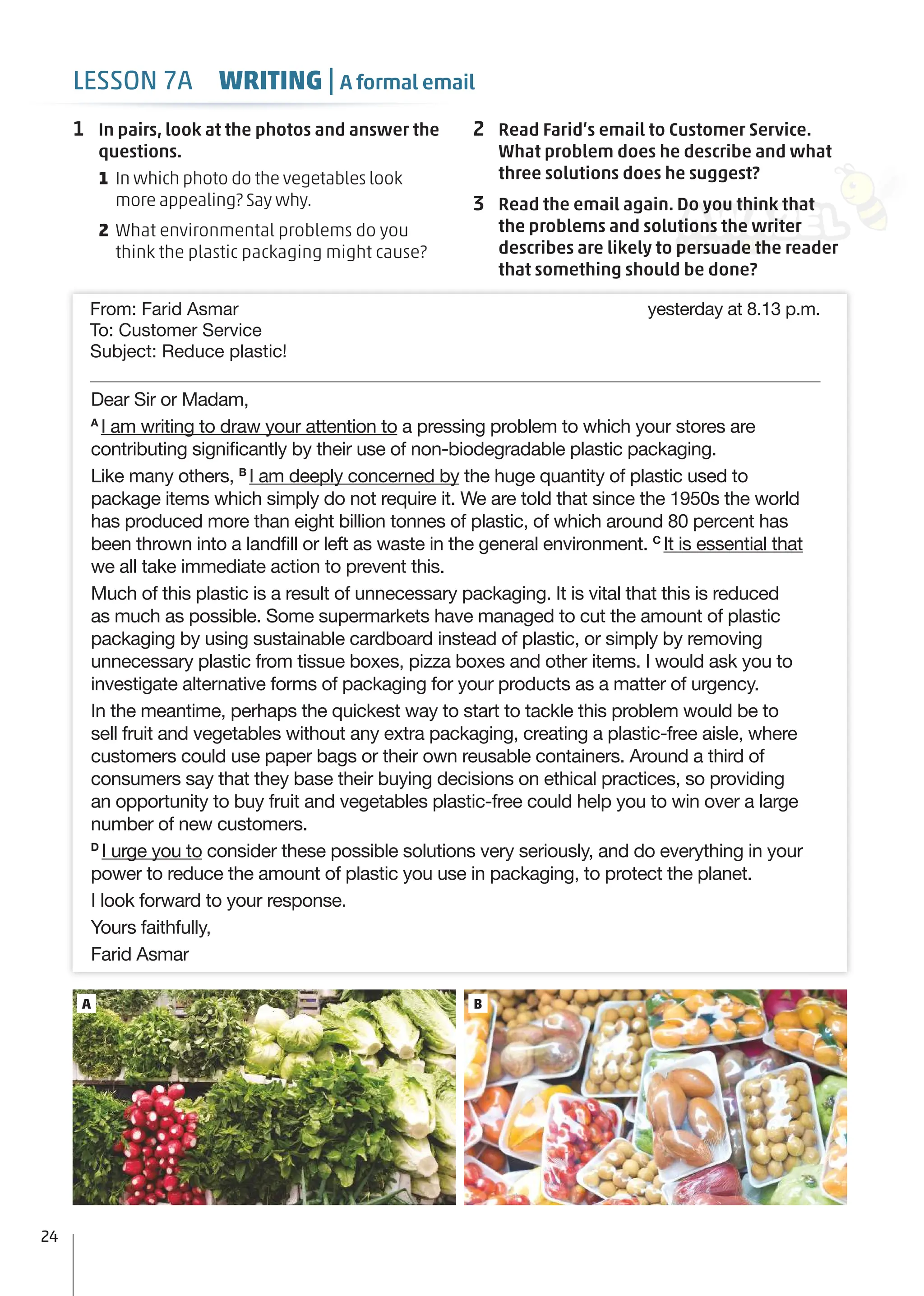
Dear Sir or Madam,
A
I am writing to draw your attention to a pressing problem to which your stores are
contributing significantly by their use of non-biodegradable plastic packaging.
Like many others, B
I am deeply concerned by the huge quantity of plastic used to
package items which simply do not require it. We are told that since the 1950s the world
has produced more than eight billion tonnes of plastic, of which around 80 percent has
been thrown into a landfill or left as waste in the general environment. C
It is essential that
we all take immediate action to prevent this.
Much of this plastic is a result of unnecessary packaging. It is vital that this is reduced
as much as possible. Some supermarkets have managed to cut the amount of plastic
packaging by using sustainable cardboard instead of plastic, or simply by removing
unnecessary plastic from tissue boxes, pizza boxes and other items. I would ask you to
investigate alternative forms of packaging for your products as a matter of urgency.
In the meantime, perhaps the quickest way to start to tackle this problem would be to
sell fruit and vegetables without any extra packaging, creating a plastic-free aisle, where
customers could use paper bags or their own reusable containers. Around a third of
consumers say that they base their buying decisions on ethical practices, so providing
an opportunity to buy fruit and vegetables plastic-free could help you to win over a large
number of new customers.
D
I urge you to consider these possible solutions very seriously, and do everything in your
power to reduce the amount of plastic you use in packaging, to protect the planet.
I look forward to your response.
Yours faithfully,
Farid Asmar
From: Farid Asmar yesterday at 8.13 p.m.
To: Customer Service
Subject: Reduce plastic!
1 In pairs, look at the photos and answer the
questions.
1 In which photo do the vegetables look
more appealing? Say why.
2 What environmental problems do you
think the plastic packaging might cause?
2 Read Farid’s email to Customer Service.
What problem does he describe and what
three solutions does he suggest?
3 Read the email again. Do you think that
the problems and solutions the writer
describes are likely to persuade the reader
that something should be done?
24
LESSON 7A WRITING | A formal email
Now go to Workbook page 22 for the next lesson.
6 Rewrite the sentences in a more formal
style using the words in brackets.
1 I heard that sea plastic is harming over 600
species. (estimated)
2 It’s important to look after nature. (vital)
3 You’ve got to stop using plastic! (urge)
4 All the best, Ibrahim. (faithfully)
5 I’m really bothered by the amount of
plastic we use. (concerned)
6 Get rid of plastic packaging! (banned)
7 I’m writing to tell you how bothered I am
about … (express)
8 You should look into other options. (ask/
investigate)
9 It’s important to do this right away.
(essential/action)
10 You must do it now. (done/urgency)
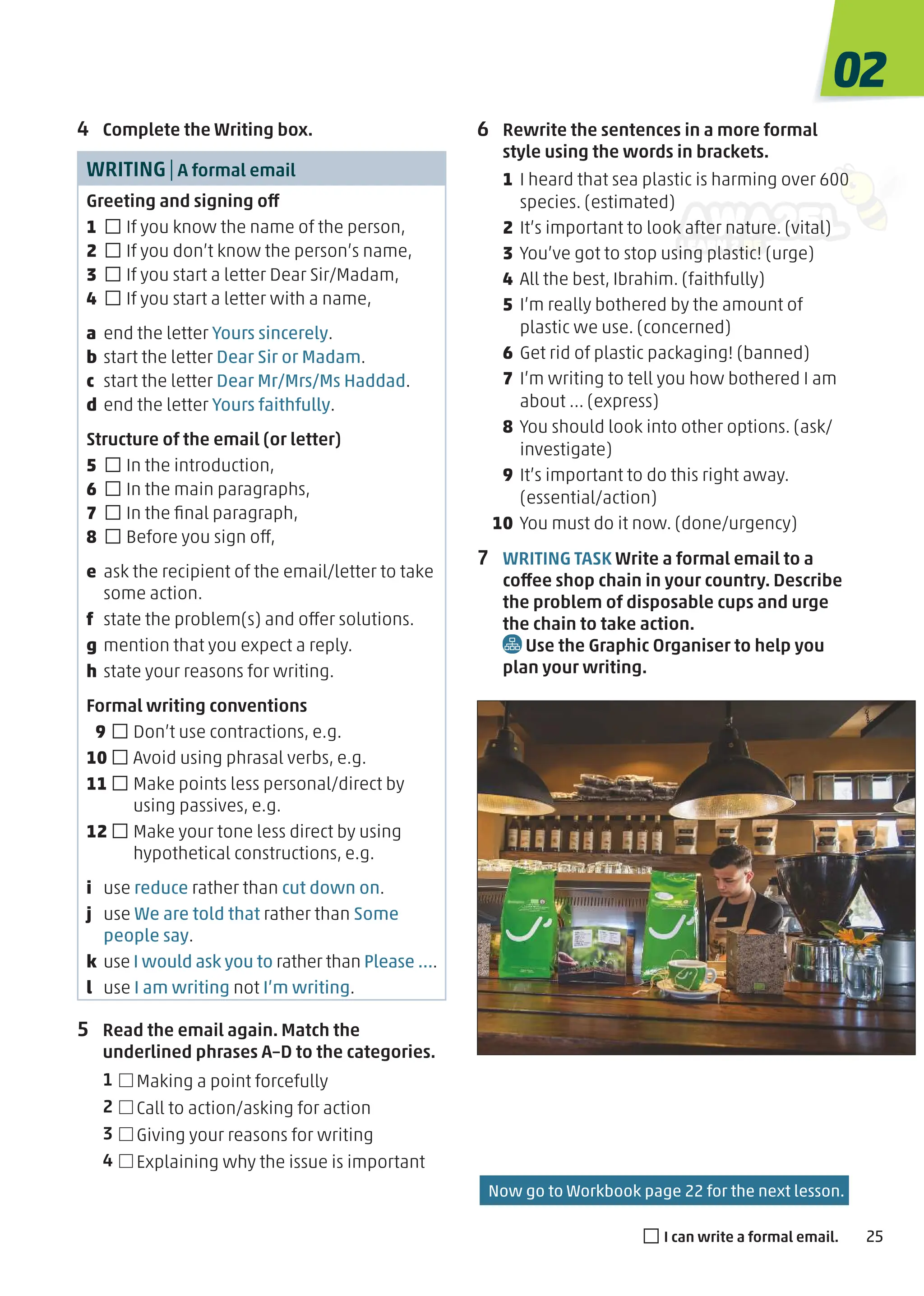
7 WRITING TASK Write a formal email to a
coffee shop chain in your country. Describe
the problem of disposable cups and urge
the chain to take action.
Use the Graphic Organiser to help you
plan your writing.
4 Complete the Writing box.
WRITING|A formal email
Greeting and signing off
1 □If you know the name of the person,
2 □If you don’t know the person’s name,
3 □If you start a letter Dear Sir/Madam,
4 □If you start a letter with a name,
a end the letter Yours sincerely.
b start the letter Dear Sir or Madam.
c start the letter Dear Mr/Mrs/Ms Haddad.
d end the letter Yours faithfully.
Structure of the email (or letter)
5 □In the introduction,
6 □In the main paragraphs,
7 □In the final paragraph,
8 □Before you sign off,
e ask the recipient of the email/letter to take
some action.
f state the problem(s) and offer solutions.
g mention that you expect a reply.
h state your reasons for writing.
Formal writing conventions
9 □Don’t use contractions, e.g.
10 □Avoid using phrasal verbs, e.g.
11 □Make points less personal/direct by
using passives, e.g.
12 □Make your tone less direct by using
hypothetical constructions, e.g.
i use reduce rather than cut down on.
j use We are told that rather than Some
people say.
k use I would ask you to rather than Please ….
l use I am writing not I’m writing.
5 Read the email again. Match the
underlined phrases A–D to the categories.
1 Making a point forcefully
2 Call to action/asking for action
3 Giving your reasons for writing
4 Explaining why the issue is important
02
25
□I can write a formal email.
VOCABULARY AND GRAMMAR
1 Complete the sentences with the words
from the box. There are three extra words.
acid blistering boiling erosion
freak freezing fumes greenhouse
layer ozone scarcity torrential
turbines vehicle
1 The weather is really weird. It’s cold
one minute and then hot the next.
2 Pollution in the atmosphere results in
rain.
3 Soil happens when the plants and
trees that keep it in place are destroyed by
the elements or man.
4 The heat caused the pavement to
melt!
5 Powerful wind use wind power to
create energy.
6 A good way of reducing emissions
is to promote the production of electric
cars, which don’t produce harmful exhaust
.
7 Because of global warming, weather
conditions are more common with periods
of drought followed by rain.
8 Below average rainfall can result in water
.
2 Look at the underlined expressions. Tick
(✔) the correct ones, cross (✘) those that
are wrong and correct them.
1 I hope I’ll earn ✘ so much money by the
time I’m 40 that I won’t need to work
anymore ✔. will have earned
2 This time next week, you are going to
give your presentation about climate
change but you won’t have finished
yet!
3 Some scientists think that by the end of
the 21st
century we will be discovering a
cure to many serious illnesses so probably
we are going to live a lot longer.
4 By six o’clock, they will be working for
24 hours non-stop to clear up the damage
caused by the flood. Extra help is certain to
arrive soon.
3 Complete the dialogues with the correct
future forms of the verbs in brackets.
1 A What are you up to later?
B Well, I (hope) to finish my school
project. After that, I (go) to the
‘Save the Planet’ lecture. I’ve arranged
to meet everyone at 5 p.m.
2 A Are you ready yet? The guests
(arrive) soon. It’s almost seven o’clock!
B They (come) at eight, not seven.
Don’t panic!
3 A What do you think of the new weather
app?
B I haven’t used it yet. I (give) it a try
later on. Then I (let) you know.
4 A I (plan) to go to the lecture on
the blobfish. What time it
(start)?
B At 2 p.m. So hurry up!
USE OF ENGLISH
4 Complete the second sentence using the
word in bold so that it means the same as
the first one. Use between two and five
words, including the word in bold.
1 The lecture is going to start soon. ABOUT
The lecture .
2 It's been so hot today that it’s very probable
there will be a storm here. BOUND
It’s been so hot today that a storm
here.
3 The bridge was closed because of gale
force winds. TO
The bridge was closed .
4 It is probable global warming will be
worse in 50 years. LIKELY
Global warming in 50 years.
5 We have arranged to meet on Thursday
morning. PLANNING
on Thursday morning.
6 Global warming has caused freak weather
in many parts of the world. RISE
Global warming freak weather in
many parts of the world.
Use of English > page 91
02 Revision
26
LISTENING
5 2.18 You are going to hear four short
recordings. Read questions 1–4
and the possible answers. Then
listen and choose the correct
answer for each recording.
STRATEGY|Multiple choice
• Read the questions and underline key
words. Decide on the focus of each
question, so you know what you’re
listening for.
• The task may include questions where you
have to decide if the speakers agree or
disagree about something. Remember the
speakers may agree about some issues but
disagree about others.
• Before you choose the answer, listen to the
whole recording.
1 You are going to hear a radio weather
forecast. What does the presenter
announce?
a It is about to snow in the south.
b The weather will get better.
c Temperatures are below 5˚C
everywhere.
2 You are going to hear two friends
talking about something. What are they
discussing?
a Which animal to sponsor.
b Which animal photo to put on a website.
c Whichanimalsareinthegreatestdanger
ofextinction.
3 You are going to hear a student talking to
a teacher. Why did the student choose this
volunteering project?
a It was recommended to him.
b It will help him to learn people skills.
c He would like to work with animals.
4 You are going to hear a young woman
talking about a hobby. How does she feel
about it?
a She finds it boring.
b She finds it addictive.
c She would like to be better at it.
WRITING
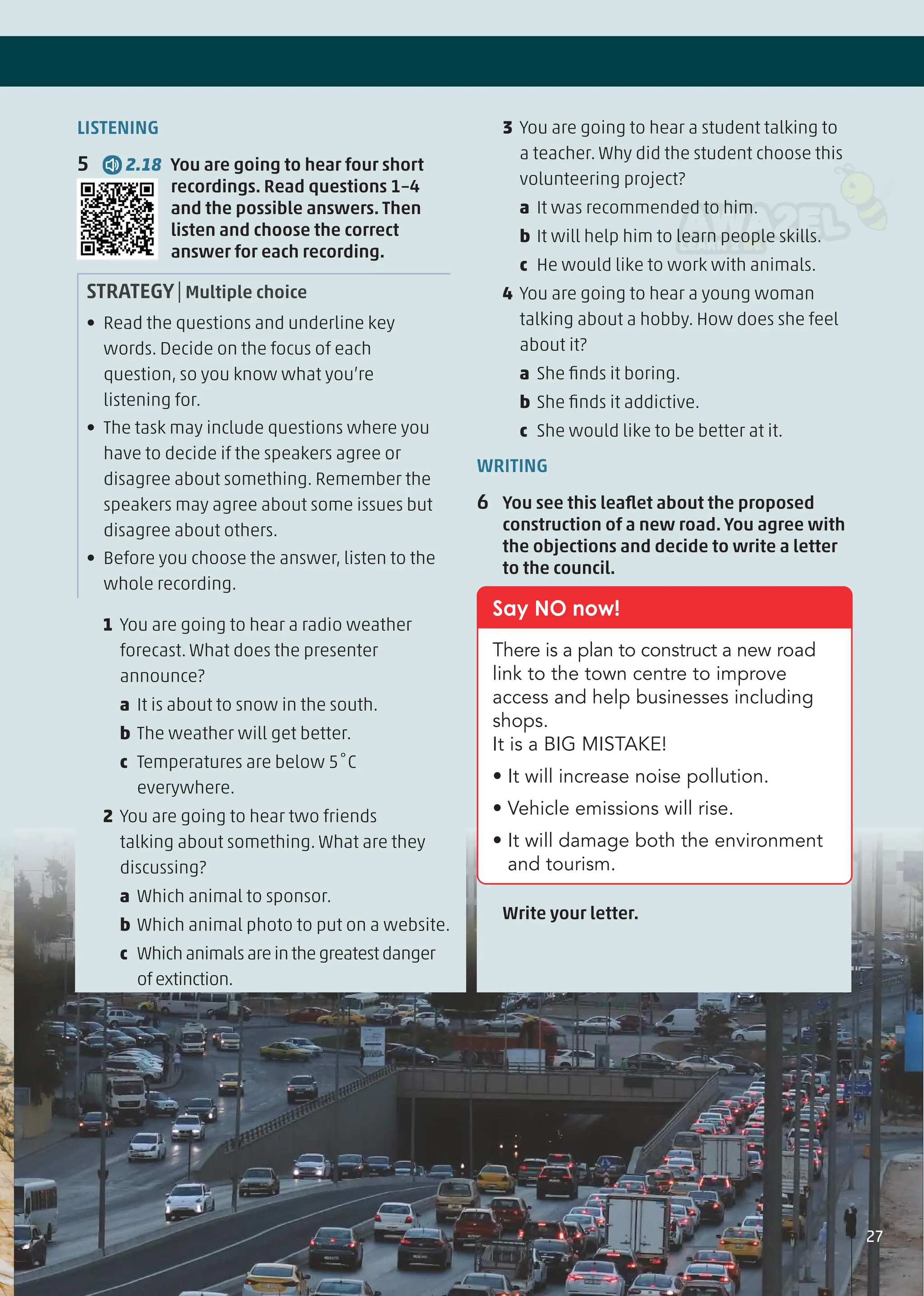
6 You see this leaflet about the proposed
construction of a new road. You agree with
the objections and decide to write a letter
to the council.
Say NO now!
There is a plan to construct a new road
link to the town centre to improve
access and help businesses including
shops.
It is a BIG MISTAKE!
• It will increase noise pollution.
• Vehicle emissions will rise.
• It will damage both the environment
and tourism.
Write your letter.
27
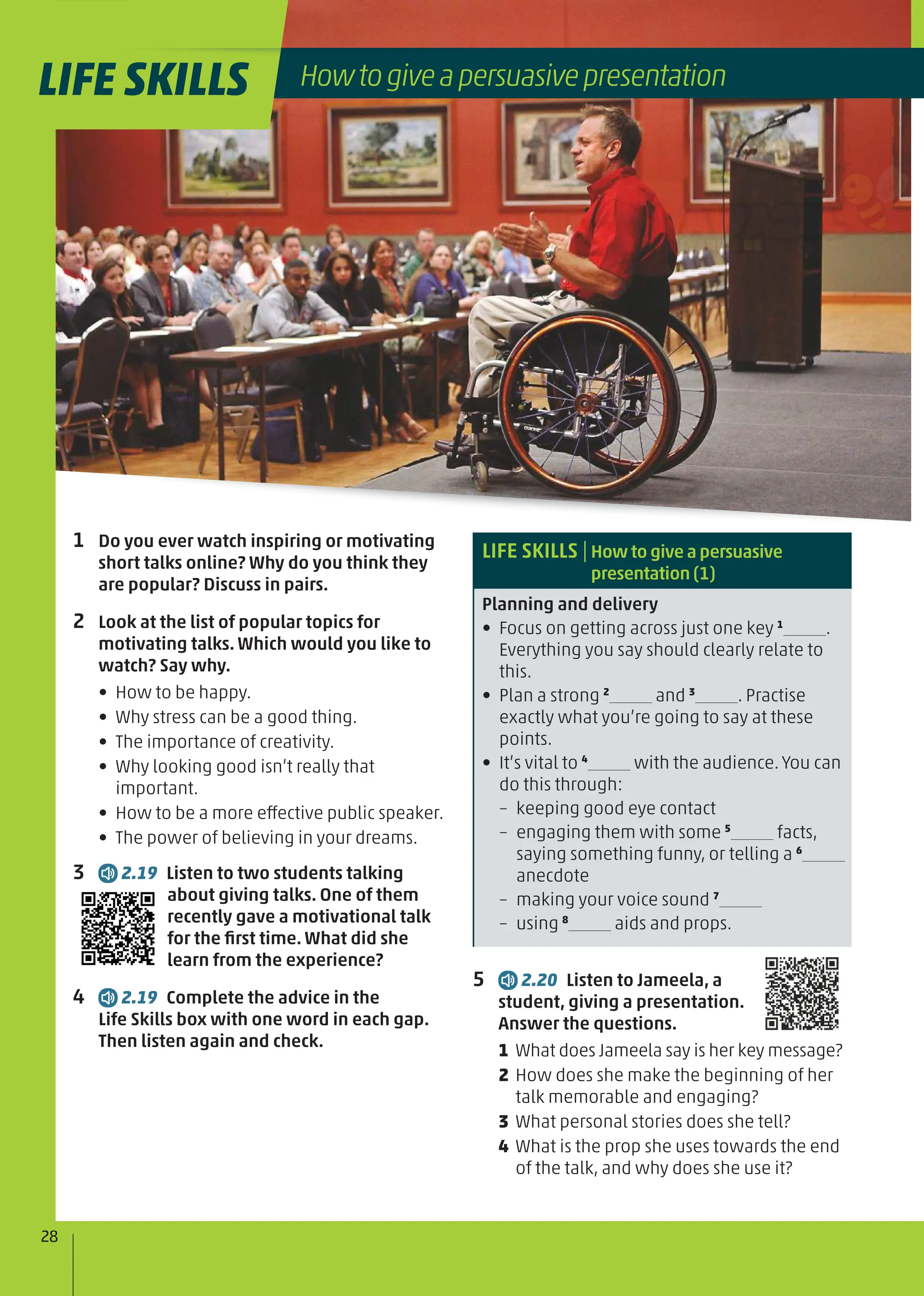
1 Do you ever watch inspiring or motivating
short talks online? Why do you think they
are popular? Discuss in pairs.
2 Look at the list of popular topics for
motivating talks. Which would you like to
watch? Say why.
• How to be happy.
• Why stress can be a good thing.
• The importance of creativity.
• Why looking good isn’t really that
important.
• How to be a more effective public speaker.
• The power of believing in your dreams.
3 2.19 Listen to two students talking
about giving talks. One of them
recently gave a motivational talk
for the first time. What did she
learn from the experience?
4 2.19 Complete the advice in the
Life Skills box with one word in each gap.
Then listen again and check.
LIFE SKILLS |How to give a persuasive
presentation (1)
Planning and delivery
• Focus on getting across just one key 1
.
Everything you say should clearly relate to
this.
• Plan a strong 2
and 3
. Practise
exactly what you’re going to say at these
points.
• It’s vital to 4
with the audience. You can
do this through:
– keeping good eye contact
– engaging them with some 5
facts,
saying something funny, or telling a 6
anecdote
– making your voice sound 7
– using 8
aids and props.
5 2.20 Listen to Jameela, a
student, giving a presentation.
Answer the questions.
1 What does Jameela say is her key message?
2 How does she make the beginning of her
talk memorable and engaging?
3 What personal stories does she tell?
4 What is the prop she uses towards the end
of the talk, and why does she use it?
LIFE SKILLS
28
Howtogiveapersuasivepresentation
LIFE SKILLS
6 2.21 Study the Life Skills box. Then
listen to five extracts from
Jameela’s talk. Write the number
of each extract next to the
rhetorical device. Some extracts
relate to more than one point.
LIFE SKILLS|How to give a persuasive
presentation (2)
Using rhetorical devices
Rhetorical devices are techniques used by a
speaker to make their language or arguments
more persuasive or convincing.
□Emotion
People tend to respond to emotional
language, or an appeal to their emotions.
□Rhetorical questions
A rhetorical question is asked to make a point,
rather than to get an answer.
□Quotations
A well-selected quotation from a famous
person can give your argument more weight.
□Repetition
The repetition of a particular word or phrase,
usually something which carries a key
meaning.
□Tripling
People seem to respond to information in
threes, so speeches often list three similar
things, or make three similar points.
7 2.23 Look at some sentences
from Jameela’s talk and
underline key words. Listen and
check which words Jameela
stresses.
1 I’d like to talk about the aims and ambitions
we all have.
2 We need to have something to reach for
and to help us move forward.
3 If you’ve got something you really want to
do,then you shouldn’t let anything stop you.
4 For as long as I can remember, I’ve loved
to swim.
5 But what they hadn’t realised was just
how determined I was.
8 Work in pairs. Choose one of the topics
below, or think of another one that
you feel strongly about. Make a list of
arguments and examples to support them.
1 It is more important to enjoy life than
make money.
2 Developing self-discipline is essential to
success in life.
9 Do the task below.
LIFE SKILLS |Project
Use your notes from Exercise 8 to give a short
presentation.
• Prepare a presentation based on your plan.
• Organise your arguments and examples into
clear sections.
• Use the tips from the Life Skills box to
make your presentation as persuasive and
motivating as possible.
• Use some of the rhetorical devices from the
Speaking box.
• Giveyourtalktotheclass.Thinkaboutstress
andintonation.
• Listen to other students’ presentations.Notice
what techniques they use to make their
presentation impactful.
• Choose the most persuasive presentation.
29
01–02
3 Match the definitions 1–9 with the phrases
for ways of behaving from the box.
be the peacemaker
blow things out of proportion
burst into tears
have a go at somebody
make a fuss of somebody
mess about show off
tell somebody off
wind somebody up
1 to say things in order to annoy somebody
2 to react as if what has happened is much
worse than it is
3 to try and impress somebody
4 to suddenly start crying
5 to behave in a silly way
6 to criticise someone
7 to give someone a lot of attention
8 to help other people resolve an argument
9 to speak to somebody angrily about
something wrong that they have done
1 In pairs, ask and answer the questions.
1 Look at the photos. What are the benefits
of being from a small/large family?
2 What do you think are the good and bad
things about being an only child?
2 THINK BACK Look at the phrases describing
ways of behaving towards other people.
Are these positive or negative things to do?
Can you add any other phrases?
empathise with somebody
fall out with somebody
give somebody a compliment
let somebody down
lose your temper
make fun of somebody/something
make up with somebody
put up with somebody/something
talk behind somebody’s back
30
LESSON1A VOCABULARYANDGRAMMAR
Influences
03
VOCABULARY Behaviour,life events (see the word list on page 74)
GRAMMAR Past and present habits, defining and non-defining relative clauses, participle
clauses Use of English > page 92
LISTENING Understanding a radio programme about life events
SPEAKING Generalising
READING Understanding a summary of Oliver Twist
WRITING An opinion essay
VIEWING AND PRESENTING family,being kind,phrases,celebrities,books,technology,characteristics
7 3.1 PRONUNCIATION Listen
to sentences about present and
past habits.Does each speaker
sound neutral (N) or annoyed (A)?
How does the intonation change?
1
2
3
4
5
6
7
8 Look at sentences a–d and complete rules
1–3 with used to or would.
a As a child, I used to spend my weekends
playing with my friends. We would play all
day together.
b I was an only child and I used to feel bored
at home on my own.
c On Saturdays, I would go swimming with
my dad.
d I used to get up early when I was younger,
but I nearly always have a lie-in now.
1 We often use 1
to set the scene, and
then, when the time reference is clear, we
can use 2
for other examples of past
habitual behaviour.
2 We DON’T use 3
to describe a past
state.
3 We use 4
to talk about a past state or
a situation that doesn’t happen any longer.
Grammar Reference and Practice > page 83
9 Complete the short text with used to or
would. Sometimes both are possible.
When he was younger, Hamzah 1
play
basketball. He 2
be quite tall for his age,
but then all the other boys caught up. In fact,
his younger brother, who 3
be tiny, is
now quite a bit taller than him. Hamzah
4
be the best player in the basketball
team, but now he prefers football!
10VALUES Why is it important not to make fun
of people? Discuss in pairs.
4 SPEAKING In pairs, talk about how you
get on with members of your family. Do
you think being the oldest, youngest or
middle child, or an only child, affects your
personality?
5 Read the short texts. Which one describes
an only or oldest child, a middle child and
a youngest child? Go to page 95 to check
your ideas.
Past and present habits
6 Look at the examples showing two forms
which can be used to talk about past and
present habits. Find more examples of such
forms in the texts in Exercise 5.
Habits in the present
My brother is always showing off.
Habits in the past
When I was little, my parents were forever
telling me off.
AWhen I was little, my parents were forever
telling me off about the things I’d done. I
was quite naughty and I used to mess about
from time to time, sure. I mean, there was one
time when I dressed up in my dad’s clothes
and went down the High Street pretending to
be him! It was hilarious, but my parents didn’t
get the joke. They took it way too seriously and
blew it completely out of proportion. I really
wasn’t that bad as a child!
BMy brother is always showing off. I’m not
sure he even realises he’s doing it.
He’ll go on and on about how great he’s doing
at school, and everyone always makes a big
fuss of him. It really winds me up, but if I say
anything, my parents tell me I’m being jealous.
It’s not fair.
CMy brother gets attention for being great
at school, and my sister is the clown of
the family. Me? I’m not really sure what my
role is. I’m certainly the peacemaker when my
brother and sister argue. They’re really loud and
emotional, whereas I tend to keep my emotions
to myself, really. I don’t burst into tears easily or
start shouting.
Now go to Workbook page 24 for the next lesson.
31
03
□I can use a variety of forms to talk about present and past habits.
4 3.3 Listen to therestofthe
programmeand makenotesforthe
fourspeakers: Habib,Lama,Dalia
andJawad.
1 What was the life event?
2 How was it stressful?
3 What influence did it have?
4 What did he/she learn from it?
5 3.3 Listen again and choose the correct
answers.
1 What prevented Habib from doing well at
secondary school?
a He wasn’t being challenged enough.
b He wasn’t very academically gifted.
c He was friends with people who didn’t
pay attention in class.
2 Which of the following is an opinion?
a Colic can have a variety of causes.
b Colic is usually worse at night.
c Lying flat makes colic more of a
problem.
3 What was the hardest thing for Dalia when
she went to school in Germany?
a Struggling to communicate with people.
b Leaving her old friends behind.
c Not being treated well by the other kids.
4 The bullies stopped teasing Jawad because
a the new pupil defended Jawad.
b Jawad grew taller as he got older.
c Jawad learnt to ignore them.
6 SPEAKING In pairs, discuss the meaning of
these phrases from the recording.
1 wasn’t doing me any favours
2 things don’t immediately go my way
3 turn out to be positive in the long run
4 the value of sticking at something
1 Which of the life events in the box can you
see in photos A–C? Which of them can be the
most challenging?
a clash between you and a sibling
a newborn baby in the family
a row with your best friend
flunking an important exam
relocating to a different town or country
2 3.2 Listen to the first part of
a radio programme and answer
the questions.
1 Why does the speaker think that
what happens to us can influence our
personality?
2 Does the speaker think that negative
events are to be avoided? Say why.
3 CRITICAL THINKING Study Active Listening. Is
the extract from the recording below a fact
or an opinion? How do you know?
People sometimes think that stressful or
upsetting events shape us negatively,and joyful
events have a positive effect,but to my mind,the
opposite can also be true.
ACTIVELISTENING|Distinguishing between
facts and opinions
• An opinion is an individual’s belief or
viewpoint. It is subjective, rather than being
based on evidence.
It may be signalled by the use of such words
as feel, believe or think or phrases such as If
you ask me … / I have the impression that …
• A fact is something for which there is some
objective evidence which can be checked or
verified. It may be signalled by a phrase such
as The data shows … / The research indicates …
32
LESSON 2A LISTENING AND VOCABULARY
Now go to Workbook page 26 for the next lesson.
□I can distinguish between opinion and facts in a radio programme and talk about life events.
A
B
C
6 PRONUNCIATION Match the adjectives
from Exercise 2 to the correct stress
patterns in the table.There are several
adjectives for some of the stress patterns.
1 2 3 4
conceited
5 6 7 8
7 3.10 Listen and check.
8 3.11 Listen to Kareem and
Jamal talking about good and
bad role models.Tick the words
and phrases which
you hear.
□a bad influence (on somebody)
□a good/shining example of …
□admire □despise
□find somebody inspirational
□follow in somebody’s footsteps
□idolise □loathe
□look down on □look up to
□put somebody on a pedestal
□set a good example
9 SPEAKING Ask and answer the questions.
1 Do famous people have a responsibility
to be good role models? Say why.
2 Who has more influence on you – public
figures, your friends or your family?
1 In pairs, ask and answer the questions.
Abdullah Shelbayh Khetam Abuawad
Mondher Rayahneh Ziyad Qasim
1 Which of the people in the box do you
recognise? What are they known for?
2 Do you admire any of them? Say why.
2 In pairs, decide if the adjectives in the box are
positive or negative. Are there any which could
be both?
bigoted capable charming compassionate
conceited decent dedicated defensive
hypocritical idealistic immature
inspirational modest passionate pushy
sincere tough trustworthy
3 3.8 Listen and match the
definitions you hear to ten of the
words from Exercise 2.
4 Complete the sentences with the remaining
words from Exercise 2.
1 He’s really ; always telling everyone how
great he is.
2 She’s so ; she’s determined to get what
she wants.
3 He’s so that he refuses to accept anyone
who thinks differently from him.
4 She’s really about animals; they’re so
important to her.
5 He’s quite ; you would never know that
he’s a big star.
6 You can’t say anything to criticise her at all or
she gets angry; she’s so .
7 She will look after your baby well; she’s
reliable, responsible and completely .
8 She can deal with the most difficult situations;
she’s very .
5 3.9 Complete the description
with some of the adjectives from
Exercise 2. Listen and check.
and thinks we should all help to stop climate
change. Aunt Abeer has proved that she is
4
of making a real change to young
people’s lives, and she is now an 5
figure
for everyone in my family.
I would like to tell you about someone who I
am really proud of. It’s my Aunt Abeer! She is
a hard-working and 1
nurse who works
at a children’s hospital. She has always wanted
to help children who have had problems in
their lives and she is a really 2
person.
She is also 3
about the environment
03
33
□I can talk about personal qualities and behaviour.
LESSON 3A VOCABULARY | Personal qualities and behaviour
Now go to Workbook page 27 for the next lesson.
1 SPEAKING In pairs, look at the cover of a book. Do you know this story?
If not, what do you think it is about?
2 Read the summary of OliverTwist and answer the questions below.
1 What kinds of people lived in a workhouse?
2 Why did Oliver decide to walk to London?
3 Why do you think Fagin and Mr Sikes used children to take things from people?
In England during the 1800s, many people came to the cities to
work. There were places called workhouses where the poorest
people could live, work and eat to make ends meet. But life in the
workhouses was not easy, where people somehow managed a
subsistence, living day-to-day, huddled together to keep warm.
One night, a woman arrived at a workhouse. She gave birth to a baby
but then sadly died. A nurse called the baby Oliver Twist and he was
sent to a house for orphans until he was nine. Then he was sent to
a workhouse to work. Oliver was sad to leave the other orphans.
Although the boys lived hand-to-mouth, they had a sense of belonging
at the house and looked after each other.
At the workhouse, all the other boys were as malnourished as Oliver.
One day, they encouraged Oliver to beg for more food, but this made
the managers of the workhouse angry.
Oliver decided to escape to London but had no food and went hungry
for days, before he met another boy called Jack Dawkins. He showed
Oliver the way to the city. Jack introduced Oliver to an old man called
Fagin, who gave Oliver some food and a bed to sleep on. The next day,
Oliver saw many other boys come to Fagin’s house. The boys gathered
together to give the old man watches and jewellery. Fagin then told
Oliver to go into the streets with the other boys and learn from them.
Oliver was shocked when he saw the boys take things from people’s
pockets. He understood that they were thieves!
5
10
15
20
GLOSSARY
housekeeper – a person
whose job is to look after
a house
orphan – a child whose
parents have died
3.12
OLIVER
TWIST
BY CHARLES DICKENS
YORK SIMPLIFIED CLASSICS
B1
CHARLES DICKENS
OLIVER TWIST
LEVEL 3
34
LESSON 4A READING AND VOCABULARY
3 Read the text again and choose the correct
answers.
1 Why was Oliver sad to leave the house for
orphans?
a It was where he was born.
b The orphans helped each other.
c He had plenty to eat there.
2 Why do you think Fagin gave Oliver food
and a bed to sleep on?
a He wanted to help the poor orphans of
London.
b He wanted Oliver to trust him and then
work for him.
c He was a rich man in a smart, modern
house.
3 Why did Oliver’s brother Monks want Oliver
to be a thief?
a He could get watches and jewellery
from him.
b He was an honest person.
c He wanted to have all of his mother’s
money.
4 Match the highlighted words/phrases in
the text with their definitions below. For
some of the definitions there is more than
one correct answer.
1 to have just enough money to buy what
you need
2 dealing with things without thinking about
the future
3 didn’t have enough food
4 sat or stood very close to other people
5 asked for money or food from strangers
6 very thin
7 be comfortable in a particular place
5 REFLECT | Society How do you think poverty
influences someone’s life? Can there be any
positive outcomes to being poor?
Suddenly, a man saw the boys take a
handkerchief from his pocket. He shouted at
the boys, and as they ran away, a police officer
tried to arrest Oliver. But a man, Mr Brownlow,
told the police officer that Oliver had not taken
anything. Mr Brownlow was worried about the
skinny boy and took him back to his house,
where the housekeeper looked after Oliver.
When Oliver was better, he was walking
along the streets when a woman grabbed
him. She took him back to Fagin’s. Fagin then
asked Oliver to help Mr Sikes with a job in the
country. They told Oliver to climb through a
small window of a house. When he did so, he
was shot.
Luckily, he survived. When he was better, he
was taken to Mr Brownlow, and was made
to feel at home. Mr Brownlow explained that
Oliver’s mother was a rich woman. But his
brother, a man called Monks, knew that Oliver
would only get the money if Oliver was an
honest person. So he watched Oliver and
made sure that he met Jack Dawkins, and
then Fagin. In this way, Oliver would never be
honest and Monks could keep all the money.
At the end of the story, Monks gives Oliver
the money that is owed to him and leaves the
country. Oliver is adopted by Mr Brownlow,
which shows what a kind man he is.
25
30
40
35
45
50
03
35
□I can identify attitudes and feelings of characters in a text and talk about the problems of poverty.
Now go to Workbook page 28 for the next lesson.
6 Rewrite the pairs of sentences as one
sentence using a relative clause.
1 Televisions used to have a dial. The
dial was used to change channel.
2 Technology is always changing. I find
this exciting.
3 Husam has lost his phone. He is very
absent-minded.
7 Study two participle clauses from the
conversation in Exercise 2, and compare
them with similar sentences using full
relative clauses. Complete the rules
below.
a There was a wire attaching the phone
to the wall. (present participle clause)
There was a wire which attached the
phone to the wall. (relative clause)
b The copy made by the carbon paper
was called the carbon copy. (past
participle clause)
The copy which was made by the
carbon paper was called the carbon
copy. (relative clause)
1 We use a present participle to replace
a relative clause with an active / a
passive verb.
2 We use a past participle to replace
a relative clause with an active / a
passive verb.
Grammar Reference and Practice > page 83
8 SPEAKING In pairs,tell your partner
about a piece of technology,using
relative and participle clauses.Student A,
go to page 94.Student B,go to page 96.
1 SPEAKING In pairs,discuss the question.
What do you think is the origin of these phrases?
cc an email go online hang up the phone
2 3.13 Listen to Heba talking to her
grandfather. Check your ideas from
Exercise 1. What new expressions does
Heba teach him?
Relative and participle clauses
3 THINK BACK Study the underlined relative
clauses a and b and answer the questions.
a The house which we just walked past belongs
to my grandfather.
b My grandfather’s house, which I love,
isn’t very modern.
1 Which sentence gives essential information
that cannot be omitted? (defining relative
clause)
2 Which sentence gives extra information that
can be omitted? (non-defining relative clause)
4 Read some extracts from the conversation
between Heba and her grandfather. Which of
the underlined relative clauses are defining?
1 … phones are something that you can keep in
your pocket.
2 I had to go into the hall,where the phone was
kept,and everyone could hear every word I said.
3 My best friend,who I was usually talking to,used
to get fed up with me whispering all the time!
4 … you had to have a wire that connected your
computer with the telephone line.
5 Oliver is adopted by Mr Brownlow, which
shows what a kind man he is.
5 Read the sentences in Exercise 4 and answer
the questions.
1 In which type of relative clause can we use that
instead of which or who?
2 In which sentence can you omit the relative
pronoun without affecting the meaning? Why
is this?
3 What does the relative pronoun in Sentence 2
refer to?
4 In which sentence is the relative clause a
comment on the whole of the main clause?
Grammar Reference and Practice > page 83
36 □I can use defining and non-defining relative clauses to give additional information.
LESSON 5A GRAMMAR
Now go to Workbook page 30 for the next lesson.
4 Rewrite the sentences as generalisations
using the words in brackets.
1 In small groups, look at memes A–D about
different generations. What characteristics
are they joking about? Are the jokes fair?
2 3.14 Listen to a radio phone-in
programme about three
different generations and
make notes.
Baby
boomers
(born
1946–1964)
Generation X
(born 1965–
1980)
Millennials
(born 1981–
2000)
Events which
influenced them
Attitude towards
work
Personality
characteristics
3 3.14 Study the Speaking box.Then listen
again and tick the phrases you hear.
SPEAKING| Generalising
Talking about what is generally true
□On the whole, … □In general, …
□In some/many/most cases, …
□Broadly speaking, … □By and large, …
□More often than not, …
□Nine times out of ten, …
□90 percent of the time, …
□To some/a great extent, …
□… tend to think/say/believe …
□There’s a tendency for … to …
Acknowledging that you are generalising
□This is a bit of a sweeping statement, but …
□I may be overgeneralising, but …
□You might think this is an
overgeneralisation, but …
5 In pairs, discuss the questions and
prepare a short presentation about
your generation.
1 Do you feel you belong to Generation Z?
2 Do you agree with the generalisations
about Generation Z in Exercise 4? Say why.
3 Can you think of any generalisations that
people make about other generations?
6 REFLECT | Society How can society overcome
generation gaps?
Baby boomers: retired at
56 on a full pension – think
young people are lazy.
How Gen X sent
text messages.
Millennial elevator has three
buttons: up, down and whatever.
Gen Z: You can’t say that –
it hurts my feelings!
A B C D
1 Generation Z spend a lot of time online.
(general)
2 They know how to make the best of social
media. (whole)
3 They take offence very easily. (tend)
4 They have an entrepreneurial spirit. (nine)
5 They like getting a bargain. (cases)
6 They are into experiences rather than
material possessions. (extent)
Generation Z (or Gen Z):
people born from 2001 onwards
Now go to Workbook page 31 for the next lesson.
03
37
□I can use generalisations to talk about something that is usually true.
LESSON 6A SPEAKING
1 In pairs, read the Fact Box and answer the questions.
1 Do any of the facts surprise you? If so, which ones? If not, why not?
2 Would you agree that families have less quality time together than in the past?
3 Are families less close than they used to be?
2 Read one student’s answer to the essay question given below and compare it with your ideas
from Exercise 1.
Some people think that families are not as close as they used to be. Do you agree? Write about …
• mobile technology • changes in working life • your own ideas
ARE FAMILIES AS CLOSE AS THEY USED TO BE?
Many people today feel that relationships between members of the same family are not as
close as they were a few generations ago. Changes in our working lives and the advent
of technology have certainly altered how families interact, but I would argue that families
generally remain as close as they ever were.
Increasingly, parents are seeking a greater work-life balance. This means that even in a family
where both parents work, they are often able to ensure that at least one parent is available
to take their children to after-school activities or to attend shows and concerts at the school.
A better work-life balance also enables families to spend more quality time together.
It is commonly accepted that the time needed to run a household has also decreased over
the last few decades as more and more labour-saving devices have been invented. A striking
example of this is the humble washing machine, which Hans Rosling, a well-known Swedish
statistician, called ‘the greatest invention of the industrial revolution’ because of the way that
it liberated parents to spend more time with their children. Prior to its invention, it was usual to
spend an entire day doing laundry.
Going online can be seen as a way of bringing families together as well as a distraction.
Whereas in the past family members living apart would have to write letters and often wait a
long time for a reply, nowadays there are many more ways to keep in touch, such as social
media and video calls. Overall, I believe that family members do communicate with each other
more than in the past, whether through technology or face-to-face.
In conclusion, I would say that while society may have changed, families remain as close as
they were, aided by technology and greater flexibility in working patterns.
FACT BOX Internet use in Jordan
• Around 50% of children in Jordan can access
the internet.

• Around 97% of these children spend up to 6
hours a day online.
• Around 74% of these children who are under 10
use video-sharing sites online.
• 94% of students use the internet for online
discussions, doing research and using
messaging apps.
38
LESSON 7A WRITING | An opinion essay
3 Read the essay again. Which paragraphs
are about the topics listed in the essay
question?
4 Study the Writing box and answer the
questions.
1 What is the thesis of the essay?
2 What arguments does the writer give to
support the thesis?
3 How does the thesis relate to the
conclusion?
WRITING| An opinion essay
Content and organisation
Introduction: Summarise the topic of the
essay, using your own words as far as possible,
and state your position (thesis) with regard to
the topic.
Main body: Include two or three paragraphs
setting out your arguments. You must include
the two topics given in the essay question,
plus an idea of your own. Each paragraph
should be about one main idea.
Conclusion: Summarise the main points of the
essay and restate your opinion or thesis on the
topic.
Style and register
• Use semi-formal or quite formal register.
• Give your personal opinion using:
Personally, ... /In my opinion, ... /My
personal conviction is that ... /1
/2
/3
.
Include more impersonal views using:
It is often argued that … /It is often held
that ... /It is widely believed that ... /4
/5
/6
.
• Try to use a variety of linkers:
Nevertheless, …, In addition, …,
Therefore, …
5 Complete the Writing box with the
underlined phrases from the essay.
6 CRITICAL THINKING Study Active Writing.
Then underline the topic sentences in
paragraphs 2, 3 and 4 of the model essay in
Exercise 2.
ACTIVE WRITING| Topic sentences
• In academic writing, each paragraph has a
‘topic sentence’ which contains the main
idea of the paragraph. The other sentences
should support the topic sentence, giving
further details, reasons or examples.
A coherent paragraph will have sentences
in logical order.
7 For each topic sentence below, write a
paragraph with two supporting sentences.
1 Social media is often seen as a key reason
people are interacting less face-to-face.
2 Working parents are simply too busy to
spend time with their family.
8 WRITING TASK Read the essay question
below and write your essay. Make notes to
support your opinion.
People in your family are more influential
in your life than your friends, or any other
influence. Do you agree?
Use the Graphic Organiser to help you
plan your writing.
Now go to Workbook page 32 for the next lesson.
03
39
□I can write an opinion essay.
USE OF ENGL
6 Complete the text.
VOCABULARY AND GRAMMAR
1 Complete the text with the words/phrases
from the box. There are two extra words.
compassionate decent despise idolise
immature influence making a fuss
modest pushy showing
News stories about 1
citizens who help
old women across the road, and 2
individuals who are concerned about others
do make the news from time to time. 3
people who perform heroic acts without
4
and telling everyone about it can be
interesting.
However, the stories in some types of
newspapers and websites are often about
5
, attention-seeking individuals,
who simply love 6
off. Some of these
celebrities even have their own TV shows.
Why should the public be interested in who
they row with? People like this are a bad
7
on young people. Surely, we shouldn’t
8
them and give them celebrity status!
2 Choose the correct words/phrases to
complete the sentences.
1 I lost my temper / empathised with my
sister last night. I usually control myself.
2 He’s the peacemaker / capable and always
does his best to resolve arguments.
3 A good friend should never talk about /
fall out with you behind your back.
4 She doesn’t earn much money and finds it
hard to make ends meet /
live hand-to-mouth.
5 They are both very defensive / sincere and
always tell the truth.
6 I admire / loathe people who behave like
that. What she did was unacceptable!
7 You can always count on her. She’s the
most trustworthy / compassionate person
I know.
3 Complete the sentences. Use the Present
Continuous or Past Continuous, will, used
to or would. Sometimes more than one
answer is possible.
1 My sister forever (borrow)
my clothes without asking me. It’s very
irritating!
2 When I was a child, we (live) in a
house by the sea, but now we live in a city.
3 My brother can’t keep a secret. He
(post) anything you tell him on his blog
immediately.
4 Rewrite the sentences as one sentence
using a defining or non-defining
relative clause.
1 Thatboy’smumisJapanese.He’sfluentin
fivelanguages.
That boy .
2 My grandma’s house has no wi-fi. It’s very
annoying.
My .
3 Theygo to that beachinsummer.It’s their
favouriteplace.
The beach .
5 Replace the underlined phrase with a
participle clause.
1 People who want to make an appointment
should do so online.
2 Did you see that car which was parked
next to ours?
Use of English > page 92
40
03 Revision
USE OF ENGLISH
6 Complete the text.
You might think this is an overgeneralisation but on 1
whole I believe that people don’t
change much. Take my old school friend, Mariam Sabah. Mariam was a quiet girl who everyone
looked 2
to because she always did the right thing. She was a dedicated student who 3
always come top of the class in everything. When she was 14, she seemed to be very
grown up in relation to the rest of us. She never behaved badly and always 4
a good
example. Mariam never went out much but was a very popular girl.
1 When it comes to friendship smartphones
are .
2 Wherever you are smartphones help you
with your friends.
3 With smartphones you don’t need to be
with your friends to have together.
4 You can send a message to your friends if
you need .
5 Our friendships can become as
smartphones help us stay connected.
WRITING
8 Read the task below.
‘We learn more from our school environment
than we do from our friends.’ Do you agree?
Write about …
1 values such as honesty.
2 skills.
3 your own idea.
Write your essay.
READING
7 Read the article and complete the notes with 1–4 words in each gap.
Smartphones are a magic tool when it comes to friendship! One of the most obvious
benefits is how easy it is to keep in touch with your friends no matter where they are.
It’s like having your friends right in your pocket!
What’s really awesome is all the amazing stuff you can do with your friends on
smartphones. These shared experiences not only make existing friendships stronger
but also create opportunities for you to make new connections.
And when you need some advice, your friends are just a message away. Whether it’s
sharing a joke to make someone’s day better or listening when they need someone to
talk to, smartphones make it easy to support each other.
So, while some people worry that technology might pull us apart, smartphones actually
bring us closer together. They help us stay connected, have fun, and be there for each
other, making our friendships even stronger and more meaningful.
FRIENDSHIPS
HOW SMARTPHONES AFFECT
41
1 In pairs, discuss the questions.
1 What is fake news?
2 What fake news stories have you heard of?
3 When do you think fake news started?
2 4.1 Listen to a podcast and
check your answers to Exercise 1
question 3.
3 Check you understand the words from the
podcast in the box. Find two synonyms for
each word 1–8 below.
bizarre claim clues dependable
drop enigma expose fraud go down
hints hoax maintain puzzle reveal
trustworthy weird
1 decrease (v)
2 fake (n)
3 reliable
4 mystery
5 signs
6 state (v)
7 strange
8 uncover
4 4.1 Complete the questions with words
from Exercise 3.Sometimes more than one
answer is possible.Then listen again and
answer the questions.
1 Why did a news report that social
media accounts would close if users made
a spelling mistake?
2 Why do you think a newspaper reported
animals living on the moon?
3 Why did egg companies want the
newspaper to say egg prices had ?
4 How did the city newspaper the truth
that the other city newspaper was copying
its stories?
5 Which of the news stories in the
podcast do you think is the best one?
42
VOCABULARY News reporting, collocations, noun suffixes (see the word list on page 75)
GRAMMAR Narrative tenses, Past Perfect Simple and Continuous, negative inversion
Use of English > page 93
LISTENING Understanding a radio programme about famous photos
SPEAKING Telling anecdotes
READING Understanding two newspaper reports
WRITING A story
VIEWING AND PRESENTING fake news,journalism,news stories,photos,anecdotes,debating
Insidestory
04
LESSON 1A VOCABULARY AND GRAMMAR
6 Match the underlined phrases in the
extracts to the descriptions.
1 □They reported a fake news story
about a man who was in hospital
after he had been shot at a mine.
2 □They later had to admit that they had
been copying the other newspaper
for years.
a This is an action in progress in the past.
b This is a completed action.
7 Complete the rules by writing Past
Perfect Simple, Past Perfect Continuous
or both.
1 We use to make clear that a past
action happened earlier than another
past action.
2 We use to talk about an earlier
completed action.
3 We use to talk about a situation or
action which continued up to a certain
time in the past.
Grammar Reference and Practice > page 85
8 Study Watch Out! Then complete the text
with the correct past tense forms of the
verbs in brackets.
WATCH OUT!
• We use the Past Perfect Continuous when we
want to focus on the length of an activity or
when we explain a past result,e.g.He was
tired as he had been flying for hours.
9 4.2 PRONUNCIATION Listen
to the sentences from the text.
What do you notice about the way
that the words had and been are
pronounced?
1 Before the EBAP visited the Black Desert
of Jordan, nobody had explored the
archaeology of this large area.
2 Animals that had been running away from
the people could not escape from this
point in the walls.
10 SPEAKING In pairs, discuss why people
believe fake news. Go to page 95.
Before the Eastern Badia Archaeological Project
(EBAP) visited the Black Desert of Jordan, nobody
1
(explore) the archaeology of this large
area. When the archaeologists started work,
stones from ancient houses 2
(lie) under
the ground for more than 8,000 years. The
people who built these houses also 3
(build)
amazing long walls called ‘kites’ to catch animals
with. The walls were many kilometres long and
they met at a point. Animals that 4
(run)
away from the people could not escape from this
point in the walls. Archaeologists think that the
walls at Jibal al-Khashabiyeh might be the oldest
in the world: nobody 5
(made) anything like
this before. The kites show that the people who
lived in the Black Desert 6
(work) together
in large teams to find food much earlier than
they expected.
ARCHAEOLOGISTS
DISCOVER
ANCIENT WALLS
Now go to Workbook page 34 for the next lesson.
43
04
□I can use narrative tenses to talk about past events.
A few years later, in 1835, a newspaper in
New York 1
published a series of amazing
stories about the findings of the famous British
astronomer, John Herschel. The newspaper
said that while he 2
was studying the moon,
he 3
found lots of strange animals living there.
They later admitted that the reports were not
true, but by that time, sales of the newspaper
4
had increased dramatically.
• We do not use the Past Perfect Continuous
with repeated actions when we say how
frequently something happened,e.g. She
had been visiting him regularly.
Narrative tenses; Past Perfect Simple and
Continuous
5 THINK BACK Which past tense is used in
each of the underlined parts?
4 4.3 Complete the sentences with the
words from the box to make collocations.
Listen again and check.
attention clickbait corruption generates
go hit light present public verify
1 I’m responsible for creating all those
headlines that attract attention.
2 If the posts I write viral, that could
mean hundreds of thousands of page
views, which more advertising
revenue for the news site.
3 Articles published online need to be very
brief because everyone has such a short
span these days.
4 The articles I write rarely shed much
on the key issues that have the
headlines.
5 I’d love to cover traditional news stories
which are in the interest, where I
could expose .
6 I’d also prefer to have the time to my
sources or the space to both sides of
the story.
5 Match the adjectives from the box with their
definitions 1–10. Are the adjectives related
to clickbait viral news stories?
balanced exclusive hard-hitting
heartbreaking heartwarming
newsworthy off the record quirky
sensational topical
1 includes strong criticism
2 unusual in an interesting way
3 very sad
4 interesting enough to be reported
5 considering all sides equally
6 related to things that are happening
7 not meant to be publicly reported
8 shocking and exciting, not serious
9 (a news story) published only in one place
10 causing feelings of happiness
6 SPEAKING Would you like to work as a
journalist? Say why.
1 In pairs, look at the headlines and discuss
the questions.
1 Why do you think news sites write these
kinds of headlines?
2 Do you think the information in these
kinds of stories is reliable? Say why.
2 4.3 Listen to a clickbait journalist
talking about his work. Why does
he think news sites write these
kinds of headlines?
3 Study Active Vocabulary and find two more
examples of collocations in the headlines
in Exercise 1.
ACTIVE VOCABULARY|Collocations
A collocation is a combination of two or more
words, e.g. disprove a theory
The most common structures for collocations are:
• adjective + noun, e.g. a bizarre theory
• verb + noun, e.g. reveal the truth
• adverb + adjective, e.g. potentially embarrassing
• verb + adverb, e.g. discuss calmly
Trending now
A father and son from
Irbid tried out their device
to protect swimmers
from shark attacks.
You won’t believe what
happened next!
SHARK SURPRISE!
The devastating truth
behind those delicious
prawns. This story will
melt your heart!
SECRETS OF SHRIMP
FARMING
5
Now go to Workbook page 36 for the next lesson.
44 □I can talk about the news.
LESSON 2A VOCABULARY | News reporting
1 Read the newspaper article. What type of
text is it? How do you know?
book/film review celebrity profile
gossip column human interest story
news item opinion piece
Negative inversion
2 Look at sentences a–b from the article and
answer questions 1–2. Then study the box
and check. Find more examples of negative
adverbials in the text.
a No sooner had they huddled together in
the basement than the wind blew a hole
in the basement.
b Little did they imagine how much was
growing there.
1 What do you notice about the word order
after the negative adverbials?
2 What effect does using negative adverbial
phrases like these have on the reader?
Negative inversion
We use negative inversion to add emphasis to a
sentence. After a negative adverb or phrase the
word order changes: I had never felt so afraid. →
Never had I felt so afraid.
Some common adverbs and adverbial phrases:
• hardly/barely/scarcely … when …
• never/at no time
• under no circumstances/in no way
• no sooner
• not only … but also …
• little (did I/they know/imagine …)
Grammar Reference and Practice > page 86
3 Rewrite the sentences without changing
their meaning.
1 They had only just left when the house
exploded. Scarcely .
2 You should not approach the animal,
which is dangerous. Under .
3 As well as winning the race, she also broke
a world record. Not only .
4 He didn’t imagine that his friend was a spy!
Little .
4 4.4 Listen and write the
sentences. Then rewrite each of
them using a negative adverbial.
5 SPEAKING In pairs, look at the sentences
you wrote in Exercise 3. Imagine each one
is part of a different news story. What could
each news story be about?
Take Shelley, who lived on the island of
Vanuatu. The people in her village knew a
large cyclone was heading their way. The
villagers decided to take shelter in one house,
but in no way could they imagine how strong
the cyclone would be. When the wind got
stronger, they told the children to hide under
the beds and under no circumstances should
they come out. But as the storm was passing
over their house, it took the roof off and soon
their room was full of flying objects. No sooner
had they huddled together in the basement
than the wind blew a hole into the basement.
Luckily, they were able to survive until the
storm passed.
Noura’s family were lucky to win a holiday in
Wadi Rum, where they were taught traditional
techniques to survive in the desert from a local
Bedouin guide. The guide showed Noura how
to find her way using the sun or the stars. She
found out that wearing long black clothes can
help people stay cool in extreme heat. The
family found out about where to find water in
the desert. Little did they imagine how much
was growing there. They realised how full of
plants the desert really was.
Meet two readers who have had
experiences with extreme weather
04
45
□I can use negative inversion to add emphasis.
LESSON 3A GRAMMAR
Now go to Workbook page 37 for the next lesson.
When developers released a statement that
they were going to build a luxury new hotel at
the local beach, everyone in the town was very
excited. 1
.
We all have to seize the opportunity and realise
that the hotel will not only give us work, but
offer improvements to the whole area around
the beach. The developers have promised a
new road with wide pavements to and from the
beach and a replacement of the sad old beach
restaurants which have been there for years.
We have asked for such development for years
and I’m so happy that the developers have
come up with a solution to help local people.
2
.
I was very surprised to hear that there are
protesters who are against the plan. Just last
week, some activists tried to stop lorries from
entering the beach to start building work, and
I reported the incident to the police. 3
.
There has even been an accusation that I am
working to promote the hotel company, but
this is not true.
We must remember that the hotel will solve
many of the problems in our area, and I
support it 100%.
When we first received information about a new
hotel at our local beach, many local people were
pleased and thought that the development could
give us job security. 4
. It is very clear that
the hotel is an international company and in all
its branches, it employs an international staff. It
also uses the same building contractors for all its
hotels, and none of them are from our area.
In addition, the developers plan to replace the
traditional restaurants which have been on the
beach for years with new, upmarket restaurants,
also with their own staff. These restaurants
will be too expensive for most people in our
neighbourhood. 5
.
My investigation also revealed a plan to build
several new roads to the beach which will affect
bird and animal life in a sensitive nature area. I am
not an activist and I refute the allegation that I tried
to obstruct building work last week. 6
. I plan
to join the other protesters who want a suspension
of the building work until we know exactly how
many jobs will go to local people. Tension will also
continue until the plans for new roads are moved
away from the sensitive nature areas.
NEW HOTEL, BUT NO
NEW HOPE FOR LOCALS
4.5
NEW HOTEL IS JUST
WHAT THE AREA NEEDS
1 In pairs, look at the photos from two news
reports. What do you think the reports are about?
2 Read the news reports and answer the questions.
1 What opportunities does the development bring
according to the first report?
2 What other things will be built as well as
the hotel?
3 Why does the second report think the
development won’t be good?
4 What do the protesters want to happen?
46
LESSON 4A READING ANDVOCABULARY
5 Find examples of nouns in the news reports
with the suffixes in the table.
Suffixes Nouns
-ment statement, …
-tion information, …
-sion/-cion tension, …
-ist
-er/-or worker, …
-ity opportunity, …
-hood
-dom
6 Complete the sentences with the correct
noun forms of the words from the box.
allege improve replace solve
1 The two sides need to sit down and find
a(n) .
2 It will be difficult to find a suitable
for Laila when she leaves her post.
3 The against him are shocking, but he
denies all of them.
4 There has been a(n) in the standard
of living in my country.
7 Complete the collocations from the articles
with the correct verbs from the box. Then
check your answers in the text.
come up with refute release report
1 The accident was bad enough for them to
the incident to the police.
2 Locals living on the street the
allegation that they did anything illegal.
3 Perhaps they can try to a solution.
4 The developers a statement about
their ‘improvement’ scheme.
3 Read the reports again. Match sentences
A–H with gaps 1–6 in the texts. There are
two extra sentences.
A However, people should have the freedom
to protest about things they do not
agree with.
B Everyone has the right to protest, but such
obstruction is illegal.
C There have been talks for years about
opportunities for new developments, but
they never seem to happen.
D People were furious and took to the
streets in protest.
E I am also sure that locals who work at
the old restaurants will probably lose
their jobs.
F Not only will the hotel need local workers
but there are sure to be other jobs in
tourism when the hotel guests start
to arrive.
G But when I put in a request to find out
more about the developers on the
internet, I quickly changed my mind.
H She stressed it was ridiculous to believe
the residents could be guilty of harming
the workers.
4 CRITICAL THINKING Study Active Reading.
Then read the news reports again and find
examples which demonstrate bias.Why is it
important to recognise bias?
ACTIVE READING|Recognising bias
Very few texts are completely balanced or
objective, but there are some key indicators
that a text is more strongly biased:
• facts are missing or exaggerated
• there are overgeneralisations
• there is little respect for different opinions
• there are quotation marks to indicate that
the writer does not agree with a different
opinion.
04
47
□I can recognise bias in news reports and talk about protests.
Now go to Workbook page 38 for the next lesson.
1 Check you understand the highlighted
words. Then look at photos A–D and match
them with these descriptions.
1 The shot looks like he is moving forward,
but is not cropped very well because the
background is actually a photo.
2 The image really captures the close
relationship she developed with all the
animals she worked with over her long
career. It also shows a likeness between
people and chimpanzees.
3 The men are shown having their lunch
break; they look very natural, not as if they
were posing.
4 This poignant photo is carefully composed;
it looks like he is standing alone.
2 4.6 Listen to four people (1–4) talking
about famous photos. Match each
speaker with their statement (a–d).
Speaker: 1 □ 2 □ 3 □ 4 □
a The photographer knew immediately that
the photo would become iconic.
b The photo shows how much designs have
changed.
c The photo was taken as a kind of positive
propaganda.
d The subject of this photo only became well-
known after it was taken.
C D
B
A
3 4.6 Listen again and answer the
questions.
1 Why is the year that the photo of the
workers was taken significant?
2 What had just happened when the photo
was taken of William Walker Martin?
3 Why was it surprising that Martin was such
a fast cyclist?
4 Why was Jane’s relationship with David
Greybeard particularly important?
5 Who took the photo of Buzz Aldrin?
6 What evidence is there that Buzz Aldrin
was not alone when the photo was taken?
4 SPEAKING In pairs, share some of your
favourite photos. Ask and answer the
questions.
1 Who or what is the subject matter of
the photo?
2 What does the photo mean to you and
what does it capture?
3 What had happened just before the photo
was taken?
LESSON 5A LISTENING AND VOCABULARY
□I can identify specific details in a radio programme and talk about photos.
48
Now go to Workbook page 40 for the next lesson.
4 4.10 Listen again and tick the phrases in
the Speaking box that you hear.
5 Choose the most suitable comment adverb
to complete the sentences. In pairs, explain
your choices.
1 Obviously, / Theoretically, you don’t
need any help with this – you’re doing
brilliantly!
2 Disappointingly, / Foolishly, I forgot to take
an umbrella. I should have known it would
rain.
3 Presumably, / Apparently, attention
spans are getting shorter – I read that
somewhere.
4 Surely, / Fortunately, you don’t expect me
to believe that.
5 Presumably, / Unbelievably, he doesn’t like
vegetables; I’ve never seen him eating
any.
6 Personally, / Surely, I like him, but a lot of
people can’t stand him.
7 Theoretically, / Clearly, your job is not
important to you, or you wouldn’t keep
turning up late.
8 Unbelievably, / Surely, she was rude to a
customer not just once, but four times!
6 Plan an anecdote that could become
an urban myth. Then tell your anecdote
in pairs. Are there any true parts in your
partner’s story?
1 What is an urban myth? Discuss in pairs.
2 4.10 Listen and decide which
stories are true, false or partly
true? Then go to page 95 to
check the answer.
3 Study the Speaking box and complete it.
Guess what?
I was travelling on the bus,when ...
It was probably the most embarrassing
moment of my life!
Obviously,I was a bit taken aback.
You’ll never believe what happened to me ...
SPEAKING|Telling an anecdote
Saying that an anecdote is about to start
□1
□That reminds me of (a time when) … .
□Have I ever told you about …?
□A friend of a friend told me this story.
Giving background information
□2
□ Well, I’m not sure if you know …, but …
□There was this guy who …
Introducing a turning point
□Anyway, to cut a long story short, …
□Suddenly, …
□No sooner had … than …
□Hardly had we … when …
□It turned out that …
□Before we knew what was happening …
□3
Showing the speaker’s attitude
□4
□I couldn’t believe what was happening.
□Obviously/Presumably/Unbelievably, etc.
□And then, to top it all, …
□I mean – I’ve done it, haven’t you?
□No word of a lie!
□Would you believe it?
Rounding off the anecdote
□5
□I’ll never forget …
□I’ll never … again.
04
49
□I can tell an anecdote.
LESSON 6A SPEAKING
Now go to Workbook page 41 for the next lesson.
2 Now, read the last paragraph and check your predictions.
1 Work in pairs. Read the story. What do you think happens at the end?
The man in black
At that moment, I saw something falling from the sky. A crane from a building site across the
road was toppling over some bricks. No sooner had the man pulled the woman away than
crane crashed on the ground where she had been standing! Shame flooded through me.
I had thought he was a criminal, but in fact he was a hero who had saved her!
‘Hey, stop!’ he yelled. a
I turned round and saw the man in black. I could see that he was
running towards an old lady. She was probably about 75, walking slowly with a leather
handbag. He probably thought it would be very easy to take something from a person like
that. b
My heart was pounding furiously in my chest as the man raced towards her. I thought
I knew what he planned to do.
c
The day had started so well. d
I had been wandering aimlessly around the city, taking
photographs, stopping occasionally for an ice cream or a coffee, without a care in the world.
I first spotted him walking along the beach. He looked out of place among the families
and young couples. e
He was wearing a black suit and tie with dark glasses, and
looked typical of a bad guy in films. He was muttering into a phone.
I watched him as he sat down on a bench. He peered curiously at me as I
walked past him, but his attention was soon distracted by another call on
his phone.
f
The old woman glanced at the man and stopped as she was walking past.
‘Stop!’ He bellowed again. Then, he grabbed her by the arm.
50
LESSON 7A WRITING | A story
3 Study the Writing box and find examples
of: negative inversion, different verbs to
describe speaking, looking and moving.
WRITING|A story
Title
Give your story a catchy/interesting title.
Structure
You could try starting the story in the middle of
the action for dramatic effect.
Language
• Use a variety of language/tenses.
• Use time expressions to sequence events,
e.g. before, after, first.
• Use direct speech to make your story more
interesting, e.g. ‘Hey! Stop!’ he yelled.
• Use negative inversion to add emphasis,
e.g. No sooner had …
4 Read underlined sentences a–f in the
story. Which past tenses are used in each
example?
5 Now match sentences a–f in the story with
functions 1–5 below.
1 □□Describing an ongoing action that
forms the background to a story.
2 □Contrasting an event in progress with a
single action that interrupts it.
3 □Describing an action which was
completed before a time in the past.
4 □Describing a single completed action in
the past.
5 □Describing a situation or action which
was in progress at or up to a time in the
past.
6 Match the highlighted words in the story
with their definitions.
1 to look at something closely and carefully
2 to take a quick look at something
3 to notice something or someone
4 to shout angrily in a low deep voice
5 to shout loudly, because you are excited or
angry
6 to speak so quietly that you cannot be
heard easily
7 to go somewhere as quickly as possible
8 to walk in a casual way, often in no
particular direction
7 Study Watch Out! Then put the words in the
correct order to make sentences.
1 he / in my ear / yelled loudly
2 she / blankly / at him / for several seconds /
stared
3 they / worked / all day / very hard / in the
factory
4 I / on the bench / sat / for over two hours /
patiently
WATCH OUT!
Positions for adverbs within a clause:
1 At the end of a clause (for adverbs of
manner, place and time), e.g. I ran away
quickly. / I’m sitting here. / I’ve been waiting
for ages.
2 Before the main verb (adverbs of manner can
go in this position), e.g. I quickly ran away.
3 At the beginning of a clause to add emphasis
(adverbs of place and time can go in this
position), e.g. With my back to the wall, I
waited.
• If all three types of adverb are used in the
same clause, the order is:
manner → place → time
I drove aimlessly around the city for hours.
8 WRITING TASK Complete the writing task.
Write a story starting or ending with the
sentence: Malak hadn’t imagined that her day
would be a disaster.
Use the Graphic Organiser to help you plan
your writing.
04
51
□I can write a story.
Now go to Workbook page 42 for the next lesson.
VOCABULARY AND GRAMMAR
1 Choose the correct words.
1 The journalist exposed / claimed his story
was true, although it is difficult to believe
him.
2 Tourists love posing / peering for photos in
front of famous buildings.
3 She spent four years in prison for hoax /
fraud.
4 No one will ever know what really
happened. It remains a clue / an enigma.
5 The men refuted the expression / allegation
that they had committed the crime.
6 I love taking landscape / composed photos
of the countryside.
7 This photo captures / evokes a feeling of
nostalgia.
2 Complete the dialogue.
A: I’d like to work in journalism. I think it
would be very rewarding to help
1
e _ _ _ _ _ corruption.
B: I agree,although it depends what type of a
journalist you are! Some don’t work in the
2
p _ _ _ _ _ interest.They love exaggerating
and write 3
s _ _ _ _ _ _ _ _ _ _ stories about
things that aren’t really very important
at all,just to get people to read their
reports.People seem to love clicking on
their clickbait 4
h _ _ _ _ _ _ _ _ ,whatever
the story.
A: True.What makes a story worth publishing
depends on the newspaper or site. Some
of them seem to think that stories about
absolute rubbish are 5
n _ _ _ _ _ _ _ _ _ .
I’d like to write 6
b _ _ _ _ _ _ _ articles
presenting both 7
s _ _ _ _ of a story. I’d
really like to shed 8
l _ _ _ _ on issues of real
importance that people should know about.
B: What if you had to write a really sad,
9
h _ _ _ _ _ _ _ _ _ _ _ _ story? Could you
do it?
A: I guess so, but I’d like to work on happy,
10
h _ _ _ _ _ _ _ _ _ _ _ ones too which help
readers feel good.
3 Circle the odd one out.
1 glance / race / spot / peer
2 shuffle / snap / wander / tiptoe
3 bellow / yell / shriek / whisper
4 Complete the sentences with the correct
form of the verbs in brackets.
1 They were delighted as they
(just / solve) the puzzle.
2 Mustafa (break) his leg last week.
Before he (fall), he (try) to
climb to the top of the mountain.
3 The concert was great, but when the band
(play) their second song, the lights
(go) out. It was a shame because it is
my favourite song!
4 The protesters (stand) outside the
mine for two hours when the reporters
(arrive).
5 The airport (close) two days ago
because someone (phone) to say
there (be) a bad storm coming.
Luckily, it (be) only a hoax.
5 Complete the sentences with the phrases
from the box.
Little did Never have I heard
No sooner had Not only did Scarcely had
Under no circumstances
1 such a weird story!
2 should you leave the building.
3 he run a marathon, but he did it
alone!
4 she made the statement than she
realised she had made a big mistake.
5 he know what a lucky escape he had
had.
6 she started reading when she
realised it was a hoax.
Use of English > page 93
04 Revision
52
1 Who or what influences people the most?
a the Internet
b the mass media
c people we know and respect
2 Why does Mazen tell the story about
The War of the Worlds broadcast?
a To show what a good writer Orson
Welles was.
b To demonstrate people usually trust
the media.
c To show that Americans don’t believe
fiction.
3 What opinion about the media does
Mazen express?
a It should keep people informed about
important subjects and people.
b Journalists should be better trained.
c It is often deliberately biased.
4 What does Mazen say about fake news?
a The social media is responsible for it.
b People enjoy passing round untrue
stories.
c It is passed round because people
believe it.
5 How does Mazen feel about people’s
attitude to news?
a confused
b worried
c frustrated
WRITING
8 You read this advertisement on your
college website about a competition and
decide to enter.
Write a story beginning or ending with the
sentence:
It was the most unusual day Omar had ever
had!
We look forward to reading your story!
Writing Club
Writing Club
Write your story.
USE OF ENGLISH
6 Complete the text with the correct words formed from the verbs in bold.
53
By the year 2000, online news sites had begun
to spread, although the vast 1
(MAJOR) of
people still read their news in a traditional print
newspaper. Soon after, many people switched
to online news sites because of rapid 2
(IMPROVE) in mobile Internet technology and the
digital media itself.
Many employees of print media 3
(ORGANISE) lost their jobs due to the widespread
closures of local and regional press offices.
In order to survive, the national daily print
newspapers took the opportunity to develop digital
media alternatives. 4
(CLEAR), this strategy
THE DEATH OF THE PRINT MEDIA?
worked as it pleased both readers who preferred
print and the new online readership. However,
and perhaps 5
(BELIEVE), not only are the
big printed dailies still here, but they are still the
preferred form for people to get news. In the UK,
25% of adults still read a printed newspaper.
So, we can perhaps conclude that digital media
isn’t simply a 6
(REPLACE) for old-fashioned
print media, but rather a compliment. Anyway,
surely it is the 7
(FREE) of the press that
matters, rather than the way information is
presented to us?
LISTENING
7 4.13 You are going to hear part of a radio interview with a journalist.
Listen and choose the correct answer.
Are you ready for the
Roundhills Debating Club
meeting next Thursday?
In case you are still working on your
talks, we’ve asked our last month’s
debate champions to give some tips.
Muneer
Preparation is really important. Take some time to think through all
your arguments really well. Do you have any evidence to support
what you’re saying? Think of some good examples you can give;
it can be hard to think of these on the spot. Are you sure that the
point you want to make is really relevant or logical? Be sure that
your opponent can’t easily find flaws in what you’re saying.
Issa
If you want to be good at debating, you have to learn to put
your personal views to one side. It doesn’t really matter what
you personally believe, you have to stay objective. It’s fine to
be passionate and try to get people on your side, but that
isn’t the same thing as being aggressive or bursting into tears.
Noura
You have to be flexible, because you might have to argue for
something you don’t even agree with. It’s a good idea just to try and
come up with lots of different arguments to begin with. Then you
can start to analyse them and see if they really are strong arguments
or not. A good tip is to avoid any statements that are too extreme.
As soon as you find yourself using language such as ‘always’ or ‘never’,
it’s a clue that your argument might not actually be that strong.
1 In pairs, discuss the questions.
1 How is a debate different from a
conversation?
2 Put the points of a debate structure in the
correct order.
a □The debate is summed up and winner
announced.
b □The speakers for the proposition
and opposition present the main
arguments.
c □Teams hear the statement for the
debate and in their groups come up
with arguments.
d □Speakers from both teams present their
rebuttals.
2 Read some advice on a student Debating
Club website on how to be good at debating.
Choose the piece of advice you find most
useful.Compare your ideas with a partner.
A
B
C
54
LIFE SKILLS Howtobegoodatdebating
3 Study the Life Skills box and match tips 1–6
with texts A–C.
LIFE SKILLS |How to be good at debating
1 □Think of lots of possible arguments to
support your statement.
2 □Analyse the arguments to see how strong
they are, and adapt them as needed.
3 □Back up your arguments with good
reasons and examples or research.
4 □Make your arguments persuasive, but
avoid being overly emotional.
5 □Keep your points relevant.
6 □Don’t exaggerate or make wild claims.
4 Read the statement below and the
counterargument to it. Which do you agree
with most? Say why.
Statement: There is too much violence,
crime and war shown on television news.
Counterargument: The use of such footage
is justified. People need to see exactly what
is going on in the world.
5 4.14 Listen to two students starting
to debate on the topic from
Exercise4. Match arguments a–f
below to each speaker, in the
order they are mentioned.
Speaker 1 1 □2 □3 □
Speaker 2 1 □2 □3 □
a Watching violence on TV creates more
violence.
b There is little research evidence to back up:
watching violence makes you aggressive.
c Watching war, crime and violence on
TV news has a negative impact on our
emotions.
d People have always been interested in
violence, e.g. Shakespeare’s plays.
e The speaker doesn’t enjoy watching
violence.
f Watching upsetting news items can make
people care more, not less.
55
03–04
6 4.15 Study the Speaking box.
Listen again and complete the
phrases.
SPEAKING|Supporting your arguments in
a debate
Explaining why your argument is valid
It is 1
to realise that ... / The crucial
2
is that ... / It is clearly the 3
that ... / I would argue that ...
Referring to research/statistics
In 4
of this, I could point to … /
There is some 5
that ... /
According to ...
Giving examples to back up your argument
It is easy to think of many instances of this in
daily life. For instance, … / There have been
6
cases where this has happened …
Summarising/Linking your argument to
what has already been said
So, as we have seen … therefore we must
7
that ... / This clearly 8
everything
I have said up until this point.
7 Work in pairs. Make a list of arguments for
and against the statement.
Teenagers should share the responsibility for
running the household with their parents.
8 Do the task below.
LIFE SKILLS |Project
• With your partner, analyse your arguments
and find the best two.
• In each pair, Student A presents the first
argument.
• Then Student B in each pair presents the
second argument.
• Listen to the arguments of another pair and
think of some counterarguments.
1 The human finger is so sensitive that it is capable of
detecting a surface bump only 0.0001 mm high.
2 Men have a keener sense of smell than women.
3 Around 25% of people are ‘supertasters’. Supertasters have
more taste buds than the average person, and they tend to
dislike bitter foods.
4 For the Ongee people of the Andaman Islands, smell is the
most important sense. When greeting an Ongee, instead of
asking, ‘How are you?’ it is usual to ask, ‘How is your nose?’
5 Touch is the first sense to develop in babies and the last to
fade at the end of our lives.
6 If you sit too close to a television screen, you risk damaging
your eyesight.
7 Standing close to loudspeakers at concerts can cause
hearing loss in 7 and a half minutes.
8 It is not possible to perceive smells while you are asleep.
9 Elephants use infrasonic sound to communicate. These
low-frequency sounds enable elephants to make out
sounds 285 km away.
10 Males are much more likely to be colour-blind than females.
Fascinating facts about the
5 SENSES
56
1 In pairs, discuss the questions.
1 What are the names of the five senses?
2 Which is your strongest sense? Say why.
3 How are animal senses different to human senses?
2 Read the fact sheet. In pairs, identify two facts which
are not true. Go to page 95 to check your answers.
Makingsenseofthesenses
05
VOCABULARY The senses, food and cooking (see the word list on page 76)
GRAMMAR Gerunds and infinitives,used to,be/get used to,verbs with gerunds and infinitives (change in
meaning) Use of English > page 93
LISTENING Understanding a podcast about the history of ketchup
SPEAKING Asking and answering about preferences
READING Understanding an article about an amazing blind woman
WRITING A review
VIEWING AND PRESENTING senses,disabilities,condiments,preferences,museums
LESSON 1A VOCABULARY AND GRAMMAR
7 Study Watch Out! Then complete the
sentences with the correct forms of used to,
be used to or get used to.
1 My contact lenses felt weird at first, but I
(wear) them eventually.
2 I (not like) eating fish, but I love it
now.
3 He (sleep) on a hard mattress – it
doesn’t bother him.
4 How people (deal) with poor
eyesight before the invention of glasses?
5 I’m full – I (not eat) so much food.
WATCH OUT!
• I’m used to wearing glasses. (= This is
normal for me.)
• I’m getting used to wearing glasses. (= This
is slowly becoming normal for me.)
• I used to wear glasses. (= I don’t wear them
now.)
8 VALUES Why is it important to understand
different disabilities? Discuss.
9 SPEAKING Discuss which sense you would
find it most difficult to live without.
3 Complete the sentences with the
highlighted words and phrases from
page 56.
1 Your is your ability to see.
2 If you are , you can’t tell the
difference between some colours.
3 If you something , you can
see, hear, or understand someone or
something with difficulty.
4 is another word for ‘notice’.
5 are the tiny bumps on your tongue
that allow you to recognise flavours.
6 is another way of saying ‘deafness’.
Gerunds and infinitives
4 Match the underlined phrases in the fact
sheet with the rules.
We use the infinitive:
1 after certain verbs, e.g.
2 after many adjectives, e.g.
3 to express purpose, e.g.
4 after first, second, third, last, etc., e.g.
We use the gerund:
5 after certain verbs, e.g.
6 after prepositions, e.g.
7 as the subject of a sentence, e.g.
8 after conjunctions like when, before, after,
while, e.g.
5 Write the verbs and verb phrases from the
box under the correct headings.
can’t help encourage fail feel like
force happen have difficulty let make
+ gerund risk, …
+ infinitive tend, …
+ object + infinitive
with to
enable, …
+ object + infinitive
without to
help, …
Grammar Reference and Practice > page 87
6 5.1 Complete the text with the correct
forms of the verbs. Then listen and
check.
It was Aristotle who was responsible for
1
(encourage) us 2
(believe)
that we have five senses, but common
sense suggests we possess more than
that number. In fact, the current scientific
consensus is that we have five more. One
of these is ‘proprioception’ – the sense
of 3
(know) which parts of our body
are where. This enables us 4
(type)
without 5
(look) at the keyboard or
walk around without having to watch our
feet. Try this experiment 6
(test) your
proprioception: close your eyes and slowly
move your finger 7
(touch) your nose.
If you have difficulty 8
(do) this, then
your proprioception is unlikely 9
(be) as
good as it could be.
The myth of the
five senses
05
57
□I can use gerunds and infinitives to talk about different actions.
Now go to Workbook page 44 for the next lesson.
1 SPEAKING In pairs, discuss the questions.
1 What are your favourite smells?
2 Are there any sounds you really dislike?
2 Read the post. Are any of the sounds or
smells the same as your ideas in Exercise 1?
3 Use the highlighted words from Exercise 2
to say which word(s) describes:
1 the smell of something delicious cooking.
2 something difficult to detect.
3 something which is too strong.
4 really bad smells.
5 delicious-tasting food.
6 a pleasant smell of flowers.
love_my_life says:
Sounds I love : waves crashing on the
seashore, the crunching of snow, bubble
wrap popping, leaves rustling in the wind.
hani_against_noise says:
Sounds I hate : the high-pitched noise of
a dentist’s drill.
busy_bee says:
Smells I love : the scent of roses, the
delicious aroma of bread baking in the oven,
… mmm ... totally mouth-watering; aftershave
or perfume (as long as it’s subtle and not too
overpowering).
nosy_neighbour_101 says:
Smells I hate : the stench of drains and
bins on a hot day, smelly socks, public
toilets – they stink! Yuck!
What sounds and
smells do you love
and hate?
Join the discussion
dalia_loves_rain_2009 says:
A C
B
6 Check the meaning of the words in the box
and match them with the pictures.
coarse fluffy prickly silky smooth
spiky squishy sticky
7 SPEAKING In pairs, think of items to match
the descriptions.
1 a perfume that you find overpowering
2 a flower with a subtle scent
3 something that stinks when it goes off
4 an animal that makes a high-pitched noise
5 a fruit or vegetable with coarse skin
6 an animal that’s fluffy when it’s young
4 5.2 Listen and number the
sounds in the order that you hear
them.
a □the crunching of snow
b □a balloon popping
c □the rustling of paper
d □meat sizzling
e □birds chirping
f □a washing machine humming
g □the thud of something falling
h □a parrot screeching
i □the roar of an engine
j □a bee buzzing
5 Study Watch Out! Then choose two sounds
from Exercise 4 and write your own
sentences. Include nouns and verbs.
WATCH OUT!
Many words for sounds, e.g. crunch, crash, pop,
buzz are both verbs and nouns/gerunds:
I can hear the hum/humming of a machine.
The fans were humming softly.
58
LESSON 2A VOCABULARY | The senses
□I can talk about the senses
Now go to Workbook page 46 for the next lesson.
5 Complete the pairs of sentences with the
correct forms of the verbs in brackets.
1 a Remember (take) your swimming
kit.
b I remember (bring) my swimming
kit, but now I can’t find it.
2 a Becoming a perfumer means
(give) up spicy food.
b Oops! I didn’t mean (put) so much
chilli sauce on my chips!
3 a I’ll never forget (taste) ice cream
for the first time.
b Don’t forget (put) the ice cream in
the freezer.
4 a We regret (inform) you that the
restaurant has closed down.
b I regret (not study) harder last
year.
6 Complete the sentences with the correct
forms of the verbs from the box.
land practise score sign wash
1 I can hear my neighbour his violin.
2 Hanan felt the mosquito on her leg.
3 Did you see him the winning goal?
4 Do these grapes need ?
5 These documents require .
7 5.6 Listen and say what
you heard.
I heard a whistle / someone
whistling.
1 In pairs, think of jobs which require a very
good sense of smell, hearing, touch, etc.
2 5.4 Listen and match speakers
1–4 with photos A–D.
Verbs with gerunds and infinitives
3 5.5 Complete the extracts with the
correct forms of the verbs in
brackets. Use a gerund or an
infinitive (with or without to).
Then listen again and check.
1 Obviously, the animal would need
(have) an X-ray for confirmation.
2 You need good hearing too because if
someone is trapped in a building, you need
to be able to hear them (shout).
3 In an emergency, you can’t stop (ask)
questions.
4 Or worse – they’ll stop (come) here to
eat!
4 Look at the sentences in Exercise 3. Then
complete rules a–d with infinitive and
gerund or choose the correct word.
a Some verbs like forget, go on, mean, regret,
remember, stop and try can be followed by
1
or 2
, but the meaning changes
depending on which form we use.
b To talk about a completed action after
the verbs feel, hear, listen to, see and watch,
we use object + 3
.
c To talk about an action in progress after
those verbs, we use object + 4
.
d After the verbs need, deserve and require
the gerund has 5
a passive / an active sense.
Grammar Reference and Practice > page 87
□A
□C
□B
□D
05
59
□I can use verbs with gerunds and infinitives to talk about different actions.
LESSON 3A GRAMMAR
Now go to Workbook page 47 for the next lesson.
German-born Sabriye Tenberken became
blind at the age of 12. Life was not easy
for her at her first school. She was
desperate to fit in, but other children were
often cruel to her and her teachers did not
understand her needs.
She often tried to hide her blindness until
she went to a special boarding school
for the blind. Here she realised that blind
people were capable of doing the same
things as everyone else. The school taught
her to come to terms with being blind.
She learnt various sports including horse
riding and she also learnt how to read
Braille. She quickly grew in confidence.
She later studied Tibetan at Bonn
University. She learnt that many Tibetan
people had problems with their eyesight,
partly because of their diet but mainly
because of the damaging sun at high
altitudes. There was no Braille in Tibetan,
so she decided to write a Tibetan Braille
system. At first, she did this to help
her with her own studies, but then she
realised its potential to help people in the
mountainous region of China.
She had always wanted to go to Tibet
and when she was 26 she decided to
pursue her dream and visit the country
to introduce her Braille system to local
people.
Although she travelled with two Tibetans,
it was tough for Sabriye to travel around
rural parts of Tibet, but that did not put
her off. Many people did not believe she
was blind because she travelled by horse,
and she was shocked to find how blind
children were treated. Some were never
allowed outside because their parents
believed they would hurt themselves. So,
she became determined to help them and
word was quickly spread
about the blind woman
who also wanted to set
up a school for the blind.
Sabriye later met Paul
Kronenberg, who became her business
partner. Together they set up a school,
called Braille Without Borders. It has a
vision to help blind children to adjust to
their blindness and to learn many of the
same skills that she had learnt as a girl.
Sabriye realised that blindness has given
her the opportunity to help people like
herself. Her work has become famous and
she was even nominated for the Nobel
Peace Prize in 2005. She has also won
awards for her work and has also written a
book called My Path Leads to Tibet about
her life and work.
5
10
15
20
25
30
35
40
45
50
55
60
5.7
1 SPEAKING Skim the article and explain how
the photos relate to the text.
60
LESSON 4A READING ANDVOCABULARY
SABRIYE
TENBERKEN
An amazing woman Sabriye teaching
in her school for
visually impaired
children in Lhasa.
“A lot of
people say I can’t
do it because I’m
blind.
”
5 Look at the highlighted words in the article
and discuss what other meanings each
word could have in a different context.Then
complete the pairs of sentences.
1 a He did it in a moment of panic.
b She trains guide dogs for the .
2 a I would like to a career in
journalism.
b The police didn’t the speeding car
as it was going too fast.
3 a The new head teacher explained her
for the future of the school.
b Cats have very good night .
4 a Her accident her riding
horses.
b He his degree for a year.
5 a She her ambition of becoming a
pilot.
b She no one was listening.
6 a He found the exam very .
b She’s a very person. She isn’t easily
defeated.
6 Complete the sentences with the correct
prepositions from the box.
about of to (x2) with
1 It wasn’t until she went to boarding school
for the blind that she finally came to terms
her blindness.
2 She decided to travel to rural Tibet, to
spread the word her Braille system.
3 Sabriye wanted to prove the world that
she was as capable doing things as
anyone else.
4 Sabriye explains that to adjust her
blindness, she had to make herself focus
on what she could rather than couldn’t do.
5 Desperate fit in, she did all she could
to hide her blindness.
7 REFLECT | Society In pairs, ask and answer
the question.
Do disabled people in your country face any
prejudices or challenges?
2 Read the article again and answer the
questions.
1 How did her classmates treat her before
she changed schools?
2 Why was it difficult for Sabriye to read
Tibetan texts when she first went to
university?
3 What is the main reason for the high
incidence of blindness in Tibet?
4 Why did some Tibetans keep blind children
inside?
5 How does the school founded by Sabriye
and Paul help children?
3 CRITICAL THINKING Study Active Reading.
Then look at the statements below and
decide if they are true or false. Find the
matching underlined sections in the text
(1–5) and explain why you think the
information is implied.
1 Sabriye used to feel ashamed of being
blind. We can make a guess that this
sentence is true, because it says ‘She often
tried to hide her blindness’.
2 She felt better when she changed schools
because she no longer felt isolated.
3 While at university, Sabriye wanted to
study the Tibetan language but wasn’t
able to.
4 Sabriye founded Braille Without Borders
on her own.
5 Sabriye won the Nobel Peace Prize.
ACTIVE READING| Making inferences
Sometimes writers do not state information
directly. You can work out the missing
information by making guesses or inferences.
Inferences are made based on clues in the
text and on our background knowledge and
experience.
4 SPEAKING In pairs, discuss the question.
Do you agree with Sabriye’s philosophy that
‘it’s a blessing not to have too many options
in life’? Give reasons for your answer.
05
61
□I can identify clues in a text and talk about disabilities.
Now go to Workbook page 48 for the next lesson.
1 Complete the recipe for tomato ketchup.
boil chill food processor pan peel
puree simmer slice stir whizz
2 5.8 Listen to a podcast about
ketchup and tick the topics that
are mentioned.
1 □the origins of ketchup
2 □the meaning of ‘ketchup’
3 □attitudes to tomatoes
4 □ketchup bottles
5 □ketchup sales
6 □different countries’ tastes in ketchup
7 □where to store ketchup
3 5.8 In pairs, read the sentences and
decide what kind of words might fit in each
gap. Then listen again and complete the
sentences.
1 Ketchup was first created in in the
sixth century.
2 The first British ketchup recipes contained
fish, mushrooms and , but not
tomatoes.
3 In the 17th
and 18th
centuries, Europeans
thought that tomatoes were .
4 Tomato-based ketchup recipes didn’t gain
popularity until .
5 The was invented in 1983.
6 Scientists have recently developed a
substance that could prevent ketchup from
at the bottom of a bottle.
7 In the UK and Venezuela, ketchup is
than the ketchup in the USA.
8 Although ketchup in the Philippines is
made from , it doesn’t taste like it.
9 Consumer research shows that young
people like ingredients such as in
Galayet Bandora.
4 Match words 1–5 with their opposites a–e.
1 □thick a sweet
2 □crunchy b runny/watery
3 □savoury c tasty
4 □bland d mild
5 □spicy e smooth
5 Use the words and phrases in Exercise 4 to
describe the condiments in the pictures.
6 SPEAKING In pairs, discuss the questions.
1 Do you agree that young people prefer
fresh ingredients to condiments? Is this
true in your family?
2 Are there any tastes that you dislike? What
do you think has influenced your dislike?
7 5.9 PRONUNCIATION Listen and
underline the stressed syllable in
the food words. Listen again and
repeat.
croissant falafel gnocchi guacamole
lasagne mayonnaise meringue
mustard pretzel quiche schnitzel
8 REFLECT | Culture Why do you think some
tastes are universal?
Take 2kg of tomatoes and 1
them
in half (no need to 2
them).
Place in a large 3
, then 4
in
500ml of vinegar, 300g of sugar and
some salt and pepper.
Bring to the 5
, then reduce the heat
and 6
gently for about 20 mins.
Transfer to a blender or 7
and
8
until you have a smooth 9
.
10
before serving.
EASY
TOMATO
KETCHUP
pickled gherkins
mayonnaise chilli sauce
62
LESSON 5A LISTENING AND VOCABULARY
□I can identify specific details in a podcast and talk about food and cooking.
Now go to Workbook page 50 for the next lesson.
4 Study the Speaking box and Watch Out! Then
complete the second sentences.
1 I don’t want to eat too late.
= I’d rather .
2 I like home-cooked meals more than
takeaways. = I prefer .
3 Would you rather eat inside or outside?
= Which ?
4 I really don’t mind. = I’m .
5 If I could choose, I’d prefer to go
somewhere quiet. = Given .
6 I don’t like one more than the other.
= I like .
7 I don’t mind where we go. = I’ll go .
WATCH OUT!
• We use an infinitive without to after would
rather and would sooner:
I’d rather eat something light.
I’d rather not go out tonight.
I’d sooner sit outside. (This is more formal.)
• We use I prefer + gerund to talk about
general preferences: I prefer eating out.
• We use would prefer + infinitive with to for
a specific situation: I would prefer to eat at
home this evening.
• We use would rather + subject + past tense
to say that we don’t want somebody to
do something: I’d rather you didn’t tell me
what to order!
Grammar Reference and Practice > page 87
5 In pairs, ask and answer questions about
the topics. Give detailed answers.
• sweet / savoury food
• eating with friends / family
6 In groups of three, look at the adverts on
page 95. Role play the conversation and
decide which of the restaurant you would
like to go to. Discuss the options, explaining
your preferences.
Student: A = page 94, B = page 96, C = page 96
1 In pairs, discuss the questions.
1 What is your favourite savoury dish?
2 What is your favourite dessert?
3 Which is your favourite restaurant?
2 5.13 Listen to a conversation.
What do the friends choose to
eat?
3 5.13 Study the Speaking box. Then
listen again and tick the phrases in the box
which the friends use in their conversation.
SPEAKING|Talking about preferences
Asking about preferences
□Which do/would you prefer? … or …?
□What would you rather do? … or …?
Expressing general preferences
□I prefer … (gerund) to … (gerund).
□I don’t like either of them.
□I like them both equally.
□I generally favour … over …
Making a choice
□I’d prefer (to) … rather than …
□I’d rather …
□I’d sooner (do) … than …
□Given the choice, …
□I’d go for … any day/every time.
□I have a (slight) preference for (+ noun/
gerund)
Giving someone else the choice
□It’s up to you.
□It’s your call.
□I’m easy.
□Whatever/Wherever/Whichever you
prefer.
05
63
LESSON 6A SPEAKING
□I can ask and answer questions about preferences.
Now go to Workbook page 51 for the next lesson.
I happened to come across this gem of a museum last week on a family
trip to Jordan, so we decided to check it out. I’m so glad we did as it
turned out to be a hugely enjoyable experience.
The museum opened recently in the Ras al-‘Ayn district of Amman,
near the Citadel, and tells the story of Jordan through history. It’s in
a very beautiful building too, a combination of stone (reflecting the
past) and glass (reflecting Jordan’s present and future).
The large permanent collection starts off with a look at what the
country was like in the Stone Age, some 1.5 million years ago.
You can then move on to different galleries that take you through
Jordan’s history in chronological order, with a look at more than
2,000 artifacts covering the Romans, Nabatean history and much
more.
What I really liked was the only copper Dead Sea scrolls, which
is totally mind-blowing. Another highlight is one of the world’s
oldest human statues, dating back to 7500 BCE.
The extremely varied themes of the museum include food
production, the development of visual arts and architecture,
international trade and communication, and the growth of
industry. These are explained using modern graphics and
interactive displays which are absolutely fascinating.
I was also impressed by the special children’s area where
children can take part in interactive exhibits and even take
part in performing arts activities inspired by the museum’s
exhibits.
My only criticism of the museum is that the experience just
went by too fast. I really enjoyed all the exhibits, but would
love to have been able to see and experience even more.
Despite that, I’d definitely recommend going to the
museum if you are in Amman because not only is it
informative and educational, but it’s also a lot of fun. And
if this was not enough, there is also a pretty amazing gift
shop and café!
review by Osama Jabari
The Jordan Museum
1 SPEAKING In pairs, look at the photos from the Jordan Musem and discuss the questions.
1 What can you see in the photos?
2 What do you think you can see and learn about there?
2 Read a review of the museum and answer the questions.
1 Was the reviewer’s overall impression positive or negative? Which words tell you this?
2 Would you describe the tone of the review as formal or informal? Say why.
3 What was the reviewer most impressed by?
4 Was there anything he didn’t like about it?
64
LESSON 7A WRITING | A review
• Absolutely, completely, totally and utterly
can only be used with non-gradable
adjectives, e.g.
The exhibition was absolutely fascinating.
• Pretty, really and seriously can be used with
both types of adjectives.
5 Complete the sentences with the adjectives.
deafening fascinating impressive
interesting loud mind-blowing
petrified ridiculous scared silly
1 a I was seriously when we walked
across the tight rope.
b I was totally .
2 a The sound effects were incredibly .
b Yes, they were really !
3 a I look completely in this photo.
How embarrassing!
b Yes, you do look pretty .
4 a The interactive displays were utterly
.
b Yes, I found them very too.
5 a The Dead Sea scrolls were extremely
.
b I thought they were totally .
6 WRITING TASK Write a review of one of the
items in the box.
a café a computer game a music album
a restaurant an exhibition
• Before you begin, make notes about what
you liked/didn’t like.
• Use a lively, informal style.
• Use a range of adjectives and adjective
intensifiers to emphasise your opinions.
• Give a clear recommendation at the end.
Use the Graphic Organiser to help you
plan your writing.
3 Complete the gaps in the Writing box with
examples from Osama’s review.
WRITING| A review
Introduction
Give brief details of where and when you
went, and your overall impression.
First main paragraph
Describe the event/exhibition/museum/show,
etc. in more detail (sight, sound, etc.).
Second main paragraph - positive aspects
What I 1
liked was …
The/A/One/Another 2
was …
I was (also) 3
/blown away by …
Third main paragraph - negative aspects
My only 4
is …
If I have one criticism, it’s …
It didn’t live up to my expectations.
I was (also) disappointed by …
Conclusion - recommendations
I’d 5
recommend going …
I don’t recommend seeing …
It’s (not) worth visiting … (if …)
Style and register
• Use informal, conversational vocabulary,
e.g. lots of, mind-blowing, gross, etc.
• Use phrasal verbs, e.g. check out, etc.
• Share your personal feelings, e.g. What I
liked was …, I was disappointed by …
• Use exclamation marks, e.g. There was a
great gift shop and café!
4 Study Watch Out! Then find eight more
examples of intensifiers in the review.
WATCH OUT!
We can use an intensifier (e.g.very,extremely,
absolutely) before an adjective to make its
meaning stronger. Use a range of intensifiers
to make your writing more interesting.
• Very, extremely, super, hugely, highly,
incredibly can only be used with gradable
adjectives, e.g.
The sound effects were extremely loud.
05
65
□I can write a review.
Now go to Workbook page 52 for the next lesson.
VOCABULARY AND GRAMMAR
1 Complete the text with the correct words.
I have a keen sense of 1
aroma / smell and
I could tell something was burning in the
restaurant’s kitchen. Added to that, my
friend and I were seated at a table near to
the rubbish bins. The 2
stench / scent when
someone opened the bins was so 3
subtle /
overpowering that we felt sick.
Then, my friend told me the colour scheme
wasn’t very attractive. I am 4
short-sighted
/ colour-blind, so I couldn’t 5
tell / see. My
friend said the colour green was putting her
6
off / away from any food.
I don’t like strong, 7
savoury / spicy food so I
ordered a mild curry. It looked 8
tasty / sweet
enough, but the reality was disappointing.
It was 9
bland / mouth-watering and had very
little taste.
2 Choose the correct words to complete the
sentences.
1 Don’t touch that cactus. It’s super prickly /
silky / squishy.
2 The child’s hands are very sticky / coarse /
spiky because she has been sticking things
with glue.
3 We could smell the subtle scent / aroma /
stink of roses as we entered the room.
4 The Maths exam was really smooth /
tough / bland but I managed to get a
good grade.
5 There was no noise except for the
humming / buzzing / rustling of paper as
the students began the test.
3 Complete the sentences with the correct
form of the verbs in brackets.
1 Soon after the car stopped (make)
a funny noise, I stopped (buy) some
petrol.
2 Look at that boy (leave) the shop! I
saw him (buy) a very expensive new
laptop.
3 A This wardrobe needs (sort) out. It’s
full of old clothes!
B Sorry. I meant (do) it last week!
4 A Did you remember (bring) the
tickets?
B Oh no! I remember (put) them in
my wallet but I can’t find them now!
USE OF ENGLISH
4 Complete the text with words a-c.
1 a on b up c off
2 a making b suggesting c trying
3 a finally b absolutely c utterly
Use of English > page 93
More people than we realise suffer from
insomnia. They just can’t get to sleep
or stay asleep. Some insomniacs try to
put 1
going to bed and when they
are eventually ready, they do the most
bizzare things just to fall asleep, such
as counting sheep. They think it’s worth
2
anything!
Well, help may be at hand! Scientists
have found that ‘pink noise’ can improve
deep sleep. Ocean waves, waterfalls,
heartbeats and even traffic are natural
examples of this type of noise. Listening
to pink noise is 3
safe.
Pink noise
05 Revision
66
4 The writer’s purpose is to
a show how gastronomy has changed
over time.
b explain why our senses are important
when we eat.
c teach us about molecular gastronomy.
WRITING
6 You have seen this announcement.
We’re looking for reviews of the best places
for students to hang out and to eat in town.
Tell us about your experiences!
• Describe your favourite places.
• Tell us why you recommend them.
• Is there anywhere you would advise
against?
WHAT’S ON IN TOWN?
Write your review.
READING
5 Readthearticleandchoosethecorrect
answers.
1 The information on the Yale tablets tells us
a how to cook dishes.
b what people ate every day.
c what dishes were popular with the
wealthy.
2 What happened in the 1800s?
a People started to enjoy food more.
b Gastronomy began in France.
c People started to consider eating as a
sensual experience.
3 The author thinks restaurant owners and
cooks should
a pay more attention to the chemical
aspects of cooking.
b introduce molecular cuisine.
c consider the diner’s whole sensory
experience.
The art and science of choosing, preparing
and appreciating food is known as
‘gastronomy’. We tend to associate this concept
with top chefs and food connoisseurs who
spend their time fine dining and writing reviews
of their eating experiences. In fact, it covers
such diverse areas as food science, cultural
food studies and food manufacturing.
Gastronomy itself has been around as long
as food has. Cookery books from different
periods in time reveal a lot not only about the
food people liked to eat then, but also about
society. The oldest ‘cookery’ books are in fact
three tablets from Yale University Babylonian
Collection dating back to 1700 BCE. They show
us the kinds of things the rich liked to eat:
mainly meat-based stews and different kinds of
breads. Interestingly, only the ingredients are
listed and there are no cooking instructions.
It was in the 1800s that gastronomy began to
emerge as a field of study that went beyond
food preparation and simple enjoyment.
Led by the French, gastronomists began to
see dining as an experience in which all of the
senses interacted, enabling us to fully enjoy
a meal. From then on, our understanding of
how our senses work and interact with our
environment increased hugely.
One interesting scientific development that
made a big impact on the world of restaurant
and home cooking at the end of the 20th
century was molecular gastronomy. This
concerns the physical and chemical changes
that occur during cooking. Chefs who
understand this can create mouth-watering
and unusual dishes. For instance, they can
make fruit look and taste like meat!
However, restaurants that still serve well-
known traditional dishes are also enjoyed by
everyone. For example, Hashem Restaurant in
Amman is famous for its food. It is the oldest
restaurant in Amman and serves local food
at cheap prices – but despite that it hosts
celebrities and even royalty! Traditional food
can be special because it uses the senses to
connect to memories too.
FOOD AND SCIENCE
67
CULTURE SPOT The influence of Shakespeare
1 Work in pairs and answer the questions.
1 How many of Shakespeare’s plays can you
name?
2 Look at photos 1–3 on page 69.Match the
plays A–C to the photos.What do you know
about the stories?
A Hamlet B Macbeth
C A Midsummer Night’s Dream
2 CS1.1 In pairs, discuss different ways
Shakespeare’s work has influenced
culture. Think about: film, literature,
music, psychology, theatre.
3 Read the article on page 69. Which of your
ideas from Exercise 2 are mentioned?
4 Read the article again and answer the
questions.
1 Why does the writer mention The Beatles?
2 Why, according to the writer, are
Shakespeare’s plays still valid today?
3 How can studying Shakespeare help
students today?
4 How did Shakespeare change the theatre
in his lifetime?
5 Why are Shakespeare’s history plays
important for us?
5 Complete sentences 1–3 with nouns
formed from the words in the box.
assume familiar interpret
1 Students need to show with
Shakespeare’s Hamlet to answer the
questions.
2 People often make ______ about things
without knowing all the facts.
3 Everybody tends to have a different
_________ of the play.
6 CS1.2 Listen to a conversation
about new words that Shakespeare
is believed to have created and
complete the sentences.
1 Shakespeare appears to have invented
between words.
2 His plays were recorded because of the
invention of the .
3 Today, people use about of these
words.
4 The technique of creating new words as
Shakespeare did is known as .
5 An example of a simple word he created is
.
6 Today, we use his word ‘rant’ to describe
when we .
7 Look at some expressions made popular by
Shakespeare.What do you think they mean?
1 a heart of gold
2 to be in a pickle
3 to come full circle
4 to be on a wild goose chase
5 to do something by the skin of your teeth
8 CS1.3 Listen to the rest of the
conversation and check your
answers.
9 In pairs, tell your partner about …
1 a time when you were in a bit of a pickle.
2 something that has come full circle.
3 a time when you were on a wild goose chase.
4 something you recently managed to do by
the skin of your teeth.
5 someone you know who has a heart of gold.
10 REFLECT | Culture Look at the quotes from
Shakespeare’s plays and answer the
questions.
1 What do the quotes mean? Give an
explanation in English.
2 Do you have any similar sayings in your
language?
3 Can you think of a playwright or novelist
who has had a similar influence on your
language and culture? Talk about him/her.
All’s well that ends well.
All that glistens is not gold.
Brevity is the soul of wit.
The robb’d that smiles, steals
something from the thief.
68
Let’s have a quick look at modern pop
culture. A great number of musicians
featured the themes and quotes from
Shakespeare’s plays in a whole range of
works: from The Beatles and Dire Straits to
the Lumineers.
All of Shakespeare’s works have led to a
variety of interpretations and adaptations
which have impacted our lives in various ways.
There is a magic about Shakespeare’s
stories and characters that reach out
across the centuries. And that’s because
he dealt with the issue: what it means to be
human. His plays feature universal themes
and emotions, and the questions he poses
engage people from century to century all
over the world. Shakespeare’s plays mirror
our society today and the messages are still
relevant. That is why they can be performed
in a multitude of different ways and places –
Macbeth can be the Scottish King, or he
can be a police inspector. Romeo and
Juliet can be children of feuding families, or
members of different groups in the streets
of New York.
Not of an age, but for all time. – Ben Jonson
1
2
The questions Shakespeare asks in his
plays are just that – questions. He leaves
it to us, his audiences, to discuss and find
our own responses. This is another way
Shakespeare has influenced education
today. Looking at Shakespeare’s plays and
analysing the motivation of the protagonists
can help students develop critical thinking
skills. By questioning our assumptions and
beliefs we become better thinkers.
Shakespeare also had other significant
impacts on our culture. It was his work
that helped redefine modern theatre. He
interacted with people from all backgrounds
and classes and his staging of plays
brought theatre to the general public.
His plots also helped modern cinematic
techniques develop; familiarity with the
storylines of Shakespeare’s plays allowed
early cinema pioneers to experiment with
silent movies. In addition to this,
Shakespeare shaped what we know about
history and historical figures. As well as this,
questions he raised about people’s thought
processes and behaviour, prompted early
investigations into psychoanalysis. Last but
not least, of course, one of Shakespeare’s
major influences was on the English
language itself. He added a huge amount of
vocabulary to enrich the English language
so every day English speakers unthinkingly
use Shakespearean words or phrases. He
was also famous for his sonnets, a type of
poem with 14 lines, a rhythm called a metre
and a specific rhyme scheme.
5
10
15
20
25
30
35
40
45
50
55
60
Shakespeare died over 400 years ago, but today
his plays and sonnets are still studied by over
half the pupils in the world. The writer’s
influence is everywhere.
Hamlet’s ‘to be or not to be’ is as
valid today as it has ever been.
3
69
5
10
15
5
10
15
1 What do you know about Emily Brontë? What did she write?
2 Read Extract 1. Describe the characters in the extract.
3 Read Extract 2. In what ways has Heathcliff changed?
Extract 1
While Catherine was out of the room, Ellen Dean spoke
to Mr Edgar Linton. She felt that she should warn her
master that Heathcliff had returned. ‘What? That gypsy!’
he said. ‘Why didn’t you warn my wife Catherine?’ ‘Do not
call Heathcliff names, sir,’ Ellen replied. ‘Mrs Linton would
be very upset to hear you. It nearly broke her heart when
he went away.’ Just then Catherine came into the room.
‘Edgar,’ she cried, ‘Edgar, my love, Heathcliff has come
back.’ Catherine was very excited. ‘Where have you been,
Heathcliff? What have you been doing?’ she asked. ‘I have
been in the army for three years and made some money,’
he answered. And Heathcliff certainly looked stronger
than when he had left Wuthering Heights. His speech, his
manners and his clothes were also greatly improved. He
had spent his time well.
Mr Lockwood’s story
In November 1801 I decided to leave London and
move to the country. I went up to the north of England
and visited a house on the Yorkshire moors. I arranged
to visit the owner of Thrushcross Grange, a man called
Heathcliff.
Heathcliff and I had hardly spoken on my first visit. I
had not stayed long because he was rude. But I was
interested in getting to know the man, so I decided to
go back to Wuthering Heights the next day.
I knocked on the front door but there was no answer.
Then a boy opened the door. The boy was almost as rude as his master was on my first visit.
‘This way,’ he said, without looking at me. The boy led me to the living room, where a young
woman was sitting in front of the fire. Heathcliff entered the room at that moment.
He was covered in snow. ‘I wonder if I may stay here for a short time, sir,’ I asked. ‘I will leave
when it stops snowing.’ ‘It won’t stop,’ Heathcliff replied impatiently. ‘The weather won’t
change, and you’ll never find your way back across the moors in this snow.’ Just then the boy
came into the room again. He spoke to the young girl. ‘Are you going to make the tea?’ he
asked. The girl pointed in my direction and said to Heathcliff, ‘Is he going to have tea?’ ‘Get
it ready,’ he said angrily. I understood that I was not a welcome guest.
LITERATURE SPOT Wuthering Heights
70
LS1.1
4 Read Extract 2 again and answer the
questions.
1 Which character appears in both extracts?
2 In what ways are the people at Wuthering
Heights rude to Mr Lockwood?
3 Why can’t Lockwood go back to
Thrushcross Grange?
5 In small groups, discuss the meaning of the
following phrases from the extracts.
1 Do not call Heathcliff names.
2 It nearly broke her heart when he went
away.
6 LS1.2 Listen to a conversation
between two students and
answer the questions.
1 Which of the two extracts has Farid just
read?
2 In what ways is the book ironic?
3 Can you summarise what he says about
Wuthering Heights?
7 LS1.2 Listen again and decide if the
sentences are true or false.
1 □ Wuthering Heights is the same as most
other romantic books.
2 □ Catherine falls in love with a rich, kind
man.
3 □ Catherine’s father bullies Heathcliff.
4 □ Hindley and his wife Frances look after
Heathcliff.
5 □ Catherine and Heathcliff spend a lot of
their time together.
6 □ Catherine then marries Edgar because
she loves him.
7 □ Farid tells Maher what happens at the
end of the story.
8 □ Farid says that Heathcliff wants revenge
because he had been badly treated.
8 REFLECT In pairs, discuss the questions.
1 In the book,life on the moors is often as
cruel as the people who live there.In what
ways do you think people can be affected by
the place they live in?
2 It is hard to like Heathcliff in Wuthering
Heights. Do you think readers should like
all the main characters in a book, or is it
good to question why people are good
or bad?
9 WRITING TASK Find out what happens in
the rest of Wuthering Heights and write
a summary of the plot in about 200–300
words. Present your summary to your
partner at the start of the next lesson.
FROM PAGE TO LIFE
Wuthering Heights has had a major
influence on popular culture. It has been
made into several films (the first dating to
1939), TV series, plays and even operas,
and the characters have inspired song
writers such as Kate Bush whose song,
Wuthering Heights, was a huge hit. There
have also been versions of the film made
in Spanish, Hindi, French, Japanese and
Filipino.
71
LESSON 1 GRAMMAR
AND VOCABULARY
WL1.1
carry a message /ˌkæri ə
ˈmesɪdʒ/
convey a message /kənˌveɪ ə
ˈmesɪdʒ/
deliver a message /dɪˌlɪvər ə
ˈmesɪdʒ/
greeting (n) /ˈɡriːtɪŋ/
lose contact/touch with
somebody /ˌluːz ˈkɒntækt/
ˈtʌtʃ wɪð ˌsʌmbədi/
make contact with somebody
/ˌmeɪk ˈkɒntækt wɪð
ˌsʌmbɒdi/
pass on a message /ˌpɑːs ˈɒn ə
ˌmesɪdʒ/
spread the message /ˌspred ðə
ˈmesɪdʒ/
stay in touch /ˌsteɪ ɪn ˈtʌtʃ/
LESSON 2 READING
AND VOCABULARY
WL1.2
bring about (phr v) /ˌbrɪŋ
əˈbaʊt/
figure out (phr v) /ˌfɪɡər ˈaʊt/
get across (phr v) /ˌɡet əˈkrɒs/
groom /ˌɡrʊm/
make out (phr v) /ˌmeɪk ˈaʊt/
omnivore /ˈɒmnɪvɔː/
pick up (phr v) /ˌpɪk ˈʌp/
point out (phr v) /ˌpɔɪnt ˈaʊt/
rival /ˈraɪvə l/
scientific community /
ˌsaɪənˈtɪfɪk kəˈmjuːnəti/
spell out (phr v) /ˌspel ˈaʊt/
wipe out (phr v) /ˌwaɪp ˈaʊt/
Unit 1
REMEMBER MORE
1 Two words collocate in
each case. Cross out the
wrong word. Then check
with the word list.
1 I don’t want to lose
contact / touch /
knowledge with
my friends.
2 The article aims to
convey / process / carry an
important message.
2 Complete the phrasal verbs
with prepositions.Then
check with the word list.
1 figure (how to do
something)
2 point (mistakes)
3 spell (how to do
something)
4 pick (signals)
5 get (information)
6 wipe (animals)
3 Write synonyms (ending
in -ed) for each of these
adjectives.
1 totally confused – b
2 extremely happy –
e
3 extremely upset – d
4 annoyed – e
5 very frightened - t
ACTIVE VOCABULARY |Phrases
When you learn phrases from
the word lists, you may divide
them into groups according
to the way they are built. For
example, find all phrases
with prepositions (up, out,
across, etc.), like in Exercise 2
above or words that collocate
with the same noun, like in
Exercise 1.
LESSON 5 LISTENING
AND VOCABULARY
WL1.3
astonished (adj) /əˈstɒnɪʃt/
bewildered (adj) /bɪˈwɪldəd/
devastated (adj) /ˈdevəsteɪtɪd/
ecstatic (adj) /ɪkˈstætɪk/
exasperated (adj) /
ɪɡˈzɑːspəreɪtɪd/
livid (adj) /ˈlɪvɪd/
tense (adj) /tens/
terrified (adj) /ˈterɪfaɪd/
72
Word List
LESSON 1 GRAMMAR
AND VOCABULARY
WL2.1
as a result of /æz ə rɪˈzʌlt ɒv/
as a consequence of /æz ə
ˈkɒnsɪkwəns ɒv/
be due to /ˌbi ˈdjuː tə/
give rise to /ɡɪv raɪz tuː/
lead to something /ˈliːd tə
ˌsʌmθɪŋ/
result from /rɪˈzʌlt frɒm/
result in /rɪˈzʌlt ɪn/
LESSON 2
VOCABULARY
WL2.2
acid rain (n) /ˌæsɪd ˈreɪn/
endangered species
/ɪnˌdeɪndʒəd ˈspiːʃiːz/
exhaust fumes /ɪɡˈzɔːst
ˌfjuːmz/
fossil fuel (n) /ˈfɒsəl ˌfjuːəl/
global warming
/ˌɡləʊbəl wɔːmɪŋ /
greenhouse effect (n)
/ˌɡriːnhaʊs ɪˈfekt/
habitat loss (n) /ˌhæbətæt ˈlɒs/
ozone layer (n) /ˈəʊzəʊn ˌleɪə/
renewable energy /rɪˌnjuːəbəl
ˈɛnədʒi/
soil erosion (n) /ˈsɔɪl ɪˌrəʊʒən/
toxic waste (n) /ˌtɒksɪk ˈweɪst/
vehicle emissions (n) /ˌviːɪkəl
ɪˈmɪʃənz/
water scarcity (n) /ˈwɔːtə
ˌskeəsəti/
LESSON 3 LISTENING
AND VOCABULARY
WL2.3
blistering heat/temperature
/ˌblɪstərɪŋ ˌhiːt/ˌtemprətʃə/
freak weather /ˌfriːk ˈweðə/
gale-force wind /ˈɡeɪlˌfɔːs
ˌwɪnd/
heavy snow/rain /ˌhɛvi ˈsnəʊ/
ˈrein/
humidity (n) /hjuːˈmɪdəti/
scorching temperature /
ˈskɔːtʃɪŋ ˌtemprətʃə/
soaring (adj) /ˈsɔːrɪŋ/
sub-zero temperature /ˌsʌb
ˈzɪərəʊ ˈtemprətʃə/
torrential rain /təˈrenʃəl ˈreɪn/
LESSON 4 READING
AND VOCABULARY
WL2.4
backbone (n) /ˈbækbəʊn/
critically endangered /ˌkrɪtɪkli
ɪnˈdeɪndʒəd/
crustacean (n) /krʌˈsteɪʃən/
cuddly (adj) /ˈkʌdli/
fin (n) /fɪn/
furry (adj) /ˈfɜːri/
invertebrate (n) /ɪnˈvɜːtəbrət/
make up (phr v) /ˌmeɪk ˈʌp/
mammal (n) /ˈmæməl/
marine (adj) /məˈriːn/
natural predator /ˌnætʃərəl
ˈpredətə/
nocturnal (adj) /nɒkˈtɜːnl/
pesticide /ˈpɛstɪsaɪd/
primate (n) /ˈpraɪmeɪt/
reptile (n) /ˈreptaɪl/
scale (n) /skeɪl/
skeleton (n) /ˈskelətən/
slimy (adj) /ˈslaɪmi/
solitary (adj) /ˈsɒlətəri/
Unit 2
REMEMBER MORE
1 Complete the statements with
words from the word list in
the correct form.Then decide
which statements are false.
1 □ A lot of pollution is due
t the number of cars
on our roads.
2 □ A simple and effective way
to reduce vehicle e is
to drive at steady speed.
3 □ Eating a lot of sugar usually
leads t people living
longer.
4 □ Many people worry about
global w .
5 □ A rain makes our
rivers cleaner.
2 Make collocations, using the
verbs from the box.Then
check with the word list.
endangered freak habitat
soil toxic
1 loss
2 species
3 erosion
4 weather
5 waste
3 Write words or phrases with
opposite meanings.Then
check with the word list.
1 vertebrate –
2 sub-zero temperatures –
3 floods –
4 Complete the phrases with
the correct adjectives formed
from the words in bold.Then
check with the word list.
1 sheep FUR
2 toy CUDDLE
3 frog SLIME
4 heat BLISTER
5 rain TORRENT
5 Do the task below.
Write your own quiz similar to
the one in Exercise 1 above. Find
some interesting facts and write
4 true/false sentences with the
phrases from the word list.You
may challenge your classmates
or publish your quiz online.
73
Unit 3
REMEMBER MORE
1 Complete the text with
words from the word list.
Itisnotalwayseasytogrowup
inalargefamily.Isometimes
1
f outwithmybrothers
andsistersandmyolder
brotheroftenmade2
f
ofme.Butmymotherwas
alwaysa3
p andwe
alwaysmade4
u with
eachother.
2 Complete the sentences
with the correct particles.
Then check with the word
list.
1 I look to people
who have achieved
something all the
odds.
2 When he lost his job, his
life turned upside .
3 I’m lost thought
when I’m plugged .
4 After the accident, he
tried to live day-
-day, one day a
time.
3 Complete the phrases with
make or do. Then check
with the word list.
1 fun of somebody
2 a fuss of somebody
3 somebody a favour
4 up with somebody
(end a quarrel)
ACTIVE VOCABULARY |
Short story or article
To learn phrases, use them
in short stories or mini
newspaper articles similar
to the one in Exercise 1.
By placing the new phrases
in your own ’world’ of
ideas, you help your brain
to remember them.
LESSON 1 GRAMMAR
AND VOCABULARY
WL3.1
be the peacemaker / biː ðə
ˈpiːsmeɪkə/
blow things out of proportion
/ˌbləʊ ˌθɪŋz ˈaʊt əv
prəˈpɔːʃən/
burst into tears /ˌbɜːst ˌɪntə
ˈtɪəz/
empathise with somebody
/ˈempəθaɪz wɪð ˌsʌmbɒdi/
fall out with somebody /ˌfɔːl
ˈaʊt wɪð ˌsʌmbɒdi/
give somebody a
compliment /ˌɡɪv ˌsʌmbɒdi
ə ˈkɒmpləmənt/
have a go at somebody /ˌhəv ə
ˈɡəʊ ət ˌsʌmbɒdi/
let somebody down (phr v)
/ˌlet ˌsʌmbɒdi ˈdaʊn/
lose your temper /ˌluːz jɔː
ˈtempə/
make a fuss of somebody /
ˌmeɪk ə ˈfʌs əv ˌsʌmbɒdi/
make fun of somebody /ˌmeik
ˈfʌn əv ˌsʌmbɒdi/
make up with somebody
/ˌmeɪk ˈʌp wɪð ˌsʌmbɒdi/
mess about (phr v) /ˌmes
əˈbaʊt/
put up with somebody/
something (phr v) /ˌpʊt ˈʌp
wɪð ˌsʌmbɒdi/sʌmθɪŋ/
show off (phr v) /ˌʃəʊ ˈɒf/
talk behind somebody’s
back /ˈtɔːk bɪˌhaɪnd
ˌsʌmbɒdiz ˈbæk/
tell somebody off about
something (phr v) /ˌtel
ˌsʌmbɒdi ˈɒf əˌbaʊt ˌsʌmθɪŋ/
wind somebody up (phr v)
/ˌwaɪnd ˌsʌmbɒdi ˈʌp/
LESSON 2 LISTENING
AND VOCABULARY
WL3.2
academically gifted
/ˌækəˌdemɪkli ˈɡɪftɪd/
be challenged enough /bi
ˈtʃæləndʒd ɪˌnʌf/
clash between you and a
sibling /ˈklæʃ bɪˌtwiːn ˌjuː
ænd ə ˈsɪblɪŋ/
colic (n) /ˈkɒlɪk/
do somebody a favour /ˌduː
ˌsʌmbɒdi ə ˈfeɪvə/
go my way /ɡəʊ maɪ weɪ/
handle a situation /ˌhændl ə
ˌsɪtʃuˈeɪʃən/
have a hard time /ˌhəv ə ˌhɑːd
ˈtaɪm/
in the long run /ɪn ðə ˌlɒŋ ˈrʌn/
make ends meet /meɪk ɛndz
miːt/
stick at something (phr v) /ˈstɪk
ət ˌsʌmθɪŋ/
turn out (phr v) /ˌtɜːn ˈaʊt/
74
Word List
LESSON 2
VOCABULARY
WL4.1
attention span (n) /əˈtenʃən
ˌspæn/
clickbait headlines /ˈklɪkˌbeɪt
ˌhedlaɪnz/
expose corruption /ɪkˌspəʊz
kəˈrʌpʃən/
generate revenue /ˌdʒenəreɪt
ˈrevənjuː/
go viral /ˌɡəʊ ˈvaɪərəl/
hit the headlines /ˌhɪt ðə
ˈhedlaɪnz/
in the public interest /ɪn ðə
ˈpʌblɪk ˌɪntrɪst/
present both sides of the story
/prɪˈzɛnt ˌbəʊθ ˌsaɪdz əv ðə
ˈstɔːri/
raise awareness /ˌreɪz
əˈweənəs/
shed light on something /ˌʃed
ˈlaɪt ɒn ˌsʌmθɪŋ/
verify sources /ˌverɪfaɪ ˈsɔːsəs/
LESSON 4 READING
AND VOCABULARY
WL4.2
accusation (n) /ˌækjəˈzeɪʃən/
activist (n) /ˈæktɪvɪst/
allegation (n) /ˌælɪˈɡeɪʃən/
come up with something (phr
v) /ˌkʌm ˈʌp wɪθ ˌsʌmθɪŋ/
obstruct (v) /əbˈstrʌkt/
pavement (n) /ˈpeɪvmənt/
put something in (phr v) /ˌpʊt
ˌsʌmθɪŋ ˈɪn/
release a statement /rɪˌliːz ə
ˈsteɪtmənt/
replacement (n) /rɪˈpleɪsmənt/
report something to the police
/rɪˈpɔːt ˌsʌmθɪŋ tə ðə pəˈliːs/
request (n) /rɪˈkwest/
seize an opportunity /ˌsiːz ən
ˌɒpəˈtjuːnəti/
suspension (n) /səˈspenʃən/
tension (n) /ˈtenʃən/
LESSON 5
LISTENING AND
VOCABULARY
WL4.3
capture an image /ˌkæptʃə ən
ˈɪmɪdʒ/
cropped (adj) /krɒpt/
evoke (v) /ɪˈvəʊk/
landscape photo (n) /
ˌlændskeɪp ˈfəʊtəʊ/
poignant (adj) /ˈpɔɪnjənt/
pose (v) /pəʊz/
subject matter (n) /ˈsʌbdʒɪkt
ˌmætə/
LESSON 7 WRITING
AND VOCABULARY
WL4.4
bellow (v) /ˈbeləʊ/
glance (v) /ɡlɑːns/
mutter (v) /ˈmʌtə/
peer (v) /pɪə/
race (v) /reɪs/
spot something (v) /ˈspɒt
ˌsʌmθɪŋ/
wander (v) /ˈwɒndə/
yell (v) /jel/
Unit 4
REMEMBER MORE
1 Choose the correct words.
Check with the word list.
1 Newspapers use clickbait/
hit headlines to grab
readers’ attention.
2 The news story shed light/
clothes on what really
happened last night.
3 We think this story is in the
public headlines / interest.
4 It’s a good article which
presents both ends / sides of
the story.
2 Complete the sentences
with the correct preposition.
1 The writers of fake news
can come with some
amazing stories.
2 We reported what
happened the police.
3 The journalist put
a request for information.
4 The children posed
a photo.
3 Complete the text with the
correct form of the words
in brackets. Then check
with the word list.
I was 1
(wander) down
a road when I 2
(spot) a
two boys.They wanted to
3
(race) across the road
but a car was coming. I 4
(bellow) at them to stop.
They did, and one boy 5
(mutter) thanks to me.
4 Match the two parts of the
collocations. Then check
with the word list.
1 attention
2 expose
3 raise
4 verify
a awareness
b span
c sources
d corruption
5 Do the task below.
Write 2–3 standard and
clickbait headlines for events
that happened globally or
locally. Remember that the
clickbait headlines must grab
the reader’s attention.
75
LESSON 1 GRAMMAR
AND VOCABULARY
WL5.1
colour-blind(adj)/ˈkʌlə-ˌblaɪnd/
eyesight (n) /ˈaɪsaɪt/
hearing loss (n) /ˈhɪərɪŋ ˌlɒs/
keen sense of smell /ˌkiːn ˌsens
əv ˈsmel/
make out (phr v) /ˌmeɪk ˈaʊt/
perceive (v) /pəˈsiːv/
sensitive palate /ˌsensətɪv
ˈpælət/
short-sighted (adj) /ˌʃɔːt-
ˈsaɪtɪd/
taste bud (n) /ˈteɪst ˌbʌd/
tell somebody/something
apart /ˌtel ˌsʌmbɒdi/ˌsʌmθɪŋ
əˈpɑːt/
LESSON 2
VOCABULARY
WL5.2
aroma (n) /əˈrəʊmə/
bee buzzing /ˈbiːˌbʌzɪŋ/
birds chirping /ˈbɜːds ˌtʃɜːpɪŋ/
balloon popping /bəˈluːn
ˌpɒpɪŋ/
crunching of snow /ˈkrʌntʃɪŋ
əv ˌsnəʊ/
machine humming /məˈʃiːn
ˌhʌmɪŋ/
meat sizzling /ˈmiːt ˌsɪzəlɪŋ/
mouth-watering (adj) /ˈmaʊθ-
ˌwɔːtərɪŋ/
overpowering (adj)
/ˌəʊvəˈpaʊərɪŋ/
parrot screeching /ˈpærət
ˌskriːtʃɪŋ/
roar of an engine /ˈrɔː əv ən
ˌendʒɪn/
rustling of paper /ˈrʌsəlɪŋ əv
ˌpeɪpə/
scent (n) /sent/
smelly (adj) /ˈsmeli/
stench (n) /stentʃ/
stink (v) /stɪŋk/
subtle (adj) /ˈsʌtl/
thud /ˈθʌd
LESSON 4 READING
AND VOCABULARY
WL5.3
adjust to something (v) /
əˈdʒʌst tə ˌsʌmθɪŋ/
blind (adj) /blaɪnd/
capable of (doing) something /
ˈkeɪpəbəl əv (ˌduːɪŋ) ˌsʌmθɪŋ/
come to terms with something
/ˌkʌm tə ˈtɜːms wɪð ˌsʌmθɪŋ/
educate somebody about
something /ˈedjʊkeɪt
ˌsʌmbɒdi əˌbaʊt ˌsʌmθɪŋ/
put somebody off (phr v) /ˈpʊt
ˌsʌmbɒdi ˈɒf/
realise (v) /ˈrɪəlaɪz/
spread the word about
something /ˌspred ðə ˈwɜːd
əˌbaʊt ˌsʌmθɪŋ/
tough (adj) /tʌf/
vision (n) /ˈvɪʒən/
LESSON 5 LISTENING
AND VOCABULARY
WL5.4
bland (adj) /blænd/
crunchy (adj) /ˈkrʌntʃi/
mild (adj) /maɪld/
runny (adj) /ˈrʌni/
savoury (adj) /ˈseɪvəri/
smooth /smuːð/
spicy (adj) /ˈspaɪsi/
tasty (adj) /ˈteɪsti/
thick (adj) /θɪk/
watery (adj) /ˈwɔːtəri/
LESSON7WRITING
ANDVOCABULARY
WL5.5
gross (adj) /ɡrəʊs/
impressive (adj) /ɪmˈpresɪv/
mind-blowing (adj) /
ˈmaɪndˌbləʊɪŋ/
petrified (adj) /ˈpetrɪfaɪd/
Unit 5
REMEMBER MORE
1 Write the missing nouns
from the noun compounds.
Then check with the word
list.
1 You can test your eye
online to see how
good your vision is.
2 Some people have more
sensitive taste than
others.
3 Hearing is common
for older people.
2 Choose the right word.
Then check with the word
list.
1 It is often wet in England,
but don’t let that put you
off / on going there.
2 I found it hard to come /
go to terms with the fact
that my job application
had been rejected.
3 Children are capable of /
to doing amazing things.
4 Therewasarustling /
roaring ofpaperwhenthe
examfirststarted.
ACTIVE VOCABULARY |
Word puzzles
A good and amusing way
to remember some phrases
is to replace the words
with photos or drawings
and glue them to a piece
of paper.For example,you
could use these pictures
for the phrase ‘blind
panic’.
76
Word List
Unit 1, Lesson 1A Present and past tenses
We use the Present Simple to talk about:
• habits and routines: He often loses touch
with his colleagues.
• permanent situations around the present
time:
He now shares a flat with a friend.
• states (verbs not usually used in the
continuous form), e.g. love, like, believe,
think (opinion), know, look (appearance):
He loves getting traditional letters.
She looks very fit.
Some state verbs change their meaning and
can be used in the continuous form, e.g. think
of/about, see (go out with), look at:
What do you think of this message? (opinion)
What are you thinking about?
I don’t see why you want to stay in touch with
him. (understand)
I’m seeing Amer these days. (go out with)
I’d like to establish contact with that company,
but my boss doesn’t look at it that way. (think
in a particular way)
Why are you looking at me that way?
We use the Present Continuous to talk about:
• actions in progress at the time of speaking:
He is talking on his mobile.
• temporary actions in progress around now:
He’s thinking of getting a new phone.
• changes and developments:
The news is spreading quickly.
We also often use the Present Simple and
Present Continuous to talk about the future.
See Unit 2, page 17.
Present Perfect Simple and Continuous
These link the past and the present.
We use the Present Perfect Simple to talk
about:
• the duration of states that began in the
past and continue up to now: He’s been
stuck here for five years.
• completed past actions with a present
relevance/result:
The lights have gone out. (And now it’s pitch
dark here).
He’s changed dramatically. (He looks very
different now.)
• experiences during a present period of
time:
I’ve sent five thousand text messages so far.
We use the Present Perfect Continuous to
talk about:
• the duration of actions that began in the
past and continue up to the present: I’ve
been waiting here since 9 a.m.
• past processes with a present relevance/
result:
I’ve got better grades because I’ve been
studing a lot lately.
We use the Past Simple to talk about actions
or events completed at a specific time in the
past:
Neil Papworth sent the first text message in
1992.
We use the Past Continuous to talk about
actions that were:
• in progress at a specific time in the past
(this often provides background to other
past events):
While Hani was waiting for us, his mum was
texting.
• interrupted by a shorter past action:
She was studying when suddenly somebody
tossed a brick through the window.
We use the Past Perfect to show the
relationship between a situation in the past
and an earlier state or action.The rules are
similar to the rules for the Present Perfect:
Before Hassan met his wife,he had been single
for a decade.
77
Grammar Reference and Practice
1 Unit 1, Lesson 1A Complete the sentences
using the correct tense and a time
expression from the box.
at the time earlier today ever since for
from time to time in recent years
once a week right now these days
1 I (lose touch) with a few of my
friends .
2 Dad (make contact) with his cousin
, so they’re not close.
3 She (chat) on her mobile
ages. Can’t they (see) each other in
person?
4 I (establish contact) with Mr Farley
, but he hasn’t responded yet.
5 (you / use) the laptop ? I need
to send an email.
6 My teacher took my mobile phone off
me yesterday – I (talk) to my friend
!
7 He (stay in touch) with me we
had that argument.
8 I (love) going for a regular run .
9 Jaber (prefer) to stay in on Saturday
nights .
10 Muneer wanted to sit down because he
(stand) all day at work.
2 Unit 1, Lesson 1A Complete the sentences
using the correct tense and the verbs from
the box. Use every verb twice.
appear have look see smell think
1 Do you know that man? He at you all
evening.
2 Why the milk? Do you think it has
gone bad?
3 We lunch now. Will you join us,
please?
4 Just look at his face: I bet he about
something amazing!
5 Apologies, but I much time at
the moment. I’ll get back to you soon, I
promise.
6 Monther Rayahneh award-winning
TV show, The Invasion.
Unit 1, Lesson 4A Question tags and echo
questions
A question tag is a short question added to
the end of a sentence. It is formed using do /
does / did (in simple tenses) or the auxiliary +
a pronoun.
A positive statement usually has a negative
question tag and a negative statement has a
positive question tag:
You don’t understand, do you?
She usually comes in late, doesn’t she?
You are coming to the party, aren’t you?
They haven’t been to London yet, have they?
They went to school, didn’t they?
She had a break, didn’t she?
We had met them before, hadn’t we?
This is an amazing house, isn’t it?
Nothing has happend so far, has it?
Those are Majeda’s guests, aren’t they?
Modal verbs are usually repeated in the tag
questions, just like auxiliaries: I can email my
CV, can’t I?
Exceptions: Let’s go to the cinema, shall we?
Someone has bumped into your car, haven’t
they?
Nobody came to the presentation, did they?
I’m still employed, aren’t I?
Question tags can also be used for:
• requests: Buy me the newspaper, could
you?
You’ll cook the dinner today, won’t you?
• invitations: Come to visit us next summer,
won’t you?
• commands: Write it down, will you?
Don’t make a mess, will you?
Question tags are also used in echo
questions. The main use of such questions is
to show interest or express surprise and make
a conversation go smoothly:
A I used to live in Aqaba.
B Did you? I bet is was amazing!
78
Grammar Reference and Practice
5 Unit 1, Lesson 4A Complete the questions
with the correct question tag.
1 He doesn’t come across very well, ?
2 You can’t let it drop, ?
3 You’re going to Amman, ?
4 You haven’t seen my mobile, ?
5 I should pay her a compliment when we
first meet, ?
6 He’s not going to take to you if you insist
on having the last word, ?
7 The room looks different … Someone has
moved the sofa, ?
8 Let’s get some ice cream, ?
9 Come sit with us, ?
10 Parents need to teach children not to drop
litter, ?
11 Pick it up, ?
12 Nobody helped her, ?
13 I’m having lunch with them, ?
14 Don’t go out tonight, ?
6 Unit 1, Lesson 4A Complete the
conversation with question tags or
echo questions.
Majeda It’s Nadia’s birthday party tomorrow.
Lubna 1
?Oh,no!Ihaven’tboughthera
presentyet!
Majeda Well, you only need to buy a little
something, 2
?
Lubna I suppose so – 3
that close, are
we? What have you bought her?
Majeda Some earrings – they’re silver.
Lubna 4
? That’s nice. You’ve been
friends for a long time now … Well,
I’ll have to think of something too.
Let’s go to the party together, 5
?
Majeda Good idea! 7 p.m.at mine? Don’t be
late,6
?
7 She to be highly intelligent, but she’s
awfully lazy too. What a waste!
8 I what you mean, but I can’t agree
with you.
9 My mum it’s the best idea.
10 Malek much better with his hair cut.
11 When I got home, the flat of smoke.
12 you anybody these days,
Faisal?
3 Unit 1, Lesson 1A Complete the text using
the correct tense and the verbs from the box.
agree be (×3) read send (×2) tell
work write
Software programmer Neil Papworth 1
the first text message in 1992. It 2
a greeting. Papworth 3
for a phone
company at the time. Since the time of that
very first message, people 4
really long
messages, so it 5
so easy to forget that
there 6
a limit of 160 characters per
message back then! Papworth said that he
only recently 7
his children that it was
he who 8
the very first text message.
Since then, there 9
many innovations in
phone technology, but Papworth 10
that
this was perhaps a key moment in mobile
history.
4 Unit 1, Lesson 4A Match the sentence halves.
1 Let’s go to the party,
2 Sorry, I’m putting you on the spot,
3 Somebody told you,
4 Nobody gave you the message,
5 Don’t forget,
6 He’ll turn the laptop off,
7 You couldn’t help me,
8 Come to the party,
a could you?
b aren’t I?
c shall we?
d won’t you?
e won’t he?
f did they?
g will you?
h didn’t they?
79
Unit 2, Lesson 1A Future forms for
predictions
We use will:
• to make predictions based on our opinions
or expectations. We often use will with
phrases like I think, I’m sure, I expect, or
adverbs like possibly, probably, definitely:
He’ll probably be late, as usual.
I’m sure you won’t have any problems with
it.
• to express a decision made at the moment
of speaking:
On second thoughts, I think I’ll leave it till the
weekend.
We use going to:
• to talk about existing plans or intentions
for the future:
I’m going to study Architecture at college.
• to make a prediction based on evidence you
have now:
You are going to have a busy weekend! (I
know all the things my friend has to do at
the weekend.)
We use the form will + be + Present Participle,
sometimes referred to as the Future
Continuous:
• to talk about an action that will be in
progress at a particular time in the future:
By the end of the century, more people will
be living in the country than in cities.
Will you be working on it at 5.30?
• to talk about events that will happen as
part of the normal course of events, or
routine:
She’ll be visiting her family at the weekend.
(She does it every weekend.)
As with other continuous forms, we do not
use state verbs (be, believe, forget, like, want,
etc.) with the Future Continuous.
We use the form will + have + Past Participle,
sometimes referred to as the Future Perfect
Simple, to talk about an action that will
be completed before a particular time in
the future:
In 100 years’ time half the world’s languages
will have disappeared.
Will you have finished it by then?
If we want to focus on a duration of an action
which is still ongoing at some point in the
future, we use the form will + have + been
+ verb -ing (it is sometimes reffered to as
Future Perfect Continuous):
I will have been living in Berlin for three years
in July.
The Future Continuous, the Future Perfect and
the Future Perfect Continuous are often used
with by (2050, next year, then, the time, etc.)
and in (ten years, two months).
Other modal verbs can be used instead of will
with Future Continuous and Future Perfect
forms to show different degrees of certainty
(might, may, could ) (see also Unit 6).
We can use certain phrases with the structure
be + adjective + infinitive to talk about how
probable it is that a future prediction will
actually happen:
• be bound/certain/sure to (this is almost
definite)
• be likely to (this is probable)
• be unlikely to (this is improbable)
Unit 2, Lesson 6A Future forms for plans
and hopes
We can also use other phrases to talk about
the future.
• For plans, we can use be planning/hoping
to + infinitive or be thinking of + gerund:
I’m planning to get someone to fix my car.
They’re hoping to do it soon.
I’m thinking of creating a website.
• When something is happening very soon
we can use be about to + infinitive:
They’re about to announce a new
competition.
• For timetabled events we can use be due to
+ infinitive:
It’s due to go on display next week.
• For formal or official arrangements,
instructions or commands we can use be to
+ infinitive:
The prince is to visit the new hospital and
talk to the patients.
80
Grammar Reference and Practice
2 Unit 2, Lesson 1A Kyle Giersdorf is a world
champion of one of the most popular
computer games. Write what he thinks he
will have done and what he will be doing
in the future.
By the time he’s 25 … go to every e-sport
tournament he can.
By the time I’m 25, I’ll be going to every
e-sport tournament I can.
… beat top players in the world.
By the time I’m 25, I’ll have beaten top players
in the world
1 During the weekend … celebrate his
victory with family and friends.
2 By Monday … buy a new desk for his giant
trophy.
3 By the end of October … get a driving
licence.
4 By the end of November … drive a new car.
5 By the end of this year … invest the money
wisely.
6 In the next 5 years …. improve his hand-
eye coordination.
1 Unit 2, Lesson 1A Choose the correct tense
to complete the sentences.
1 Will we be living / have lived longer in the
future?
2 I won’t be finishing / have finished this
essay in time to hand it in by Friday.
3 We will have had / have this computer for
four years this year.
4 My dad won’t be / won’t have been eating
meat for 10 years today.
5 They‘ll be presenting / present their ideas
tomorrow at 5 p.m.
6 It’s probable that I’ll be buying / have
bought my first driverless car by 2050.
7 3D printing is going to / will become
immensly popular in 20 years, time.
8 In the near future, it’s likely that Artificial
Intelligence will become so widespread
that the technology will be making / will
have made legal decisions in court or
diagnosing illnesses.
9 By that time, I will have moved / will have
been moving to another planet in the Solar
System.
10 I can’t see you at 6 tomorrow. I will be
playing / will have played basketball as
usual.
11 If you decide to come by this afternoon,
don’t knock as I will probably be sitting /
will sit in the back garden so I won’t hear /
am not going to hear you.
12 When you come back home tonight,
please try to be quiet as everybody else
will have already gone / will be going
to bed.
81
3 Talal is going to start / will be starting
walking to school instead of getting the
bus.
4 The programme on global warming starts /
is due to go on at 6.30 p.m.
5 Dad’s picking up / about to pick up his new
electric car tonight at 7 p.m.
6 The professor is due / about to start the
research next week.
7 My sister is / is about to paint her room.
8 They’re thinking to donate / of donating
most of their clothes to charity.
9 The King is planning / is to open the new
bridge in Zarqa.
6 Unit 2, Lesson 6A Complete the
conversation with the phrases from
the box.
due to speak going to ’ll be compensating
’ll see ’s hoping to will be trying
won’t return
Lama What’s your dad 1
do about his
car? He can’t just leave it like that.
Nada Well,he’s 2
to thesalesmanager
tomorrow.
Lama I expect that lots of people 3
to
return their cars too. You can’t say
that the car you produced has low
emissions when it doesn’t.
Nada Dad 4
the car because he loves
it. He 5
get some compensation
though.
Lama Really? I don’t think they 6
everybody, will they?
Nada We 7
…
7 Unit 2, Lesson 6A Finish the sentences so
that they are true for you.
1 I’m hoping to .
2 My mum is thinking of .
3 My teacher is due to .
4 I’ll be .
5 I’m going to .
6 tomorrow at 7.30 a.m.
7 My best friend by Friday.
3 Unit 2, Lesson 1A Complete the second
sentence using the word in bold so that it
means the same as the first one.Use no more
than three words in each gap.
1 We’re sure that we will find a cure for cancer
in the future.BOUND
We a cure for cancer in the
future.
2 I don’t think he will stop eating meat.
UNLIKELY
He eating meat.
3 Oil prices will definitely rise next year.
CERTAIN
Oil prices next year.
4 Violence and crime in our town will
probably drop.LIKELY
Violence and crime in our town are
.
5 Global warming will get worse.SURE
Global warming worse.
6 We’ll have to change our eating habits in
the future without a doubt.DEFINITELY
We change our eating
habits in the future.
4 Unit 2, Lesson 1A What do you think the
future will be like in 50 years’ time? Write
your own predictions. Use the Future Perfect
and the Future Continuous. Use the topics
below.
food housing population travel
technology the environment
We will be eating more vegan food in 50
years’ time.
5 Unit 2, Lesson 6A Choose the correct option
to complete the sentences.
1 I’m hoping / thinking of doing my
presentation on endangered species.
2 We’re hoping of having / to have a wind
turbine installed this year.
82
Grammar Reference and Practice
Unit 3, Lesson 1A Past and present habits
• We use the Present or Past Continuous +
always / constantly / forever to talk about a
habit which is repeated more than usual,
which the speaker finds unexpected or
annoying:
She’s always complaining about the
weather. (present)
She was forever arguing with her parents
when she was younger. (past)
• We use will/would + infinitive to talk about
behaviour which is typical or characteristic
of the person. They can describe both
pleasant and annoying habits:
She’ll turn up at 11 o'clock and act as if
nothing’s wrong. (present)
We’d spend the afternoons reading. (past)
• We use used to + infinitive to talk about a
past state or repeated past actions:
I used to feel very negative about my job.
At our old house I used to spend a lot of time
with my friends.
Would is not used to talk about past states.
• We can introduce new topics with used to
and we do not need to specify a time:
I used to eat a lot of chips and burgers, but
now I eat healthy food. (NOT I’d eat …)
We use would when the topic has been
established and we usually specify the time:
My dad used to work nights. He would come
home at six in the morning and we ’d have
breakfast together, then he used to take me to
school.
Most texts describing habits contain a mixture
of these forms.
Unit 3, Lesson 5A Participle clauses
We use a present participle clause for an
action or state that happened at the same time
or after an event in the story:
His system transformed their lives, enabling
them to read and write. (because it enabled
them)
Participle and main clauses must have the
same subject.
A present (starting) or past (started) participle
is often used to replace a relative clause:
• We use a present participle to replace a
relative clause with an active verb, e.g.
There was a wire which attached the phone
to the wall. = There was a wire attaching the
phone to the wall.
• We use a past participle to replace a
relative clause with a passive verb, e.g.
The copy which was made by the carbon
paper was called the carbon copy. = The copy
made by the carbon paper was called the
carbon copy.
Unit 3, Lesson 5A Relative clauses
We use who(m), which, that, whose, where,
when in relative clauses. We use them
after nouns, or noun phrases, to describe
or give information about a person, thing,
possessions, places and time.
There are two kinds of relative clauses:
defining and
non-defining.
Defining clauses are necessary to give
essential information about exactly which
person/thing is being talked about in the
sentence. Commas are never used.
We can use that instead of who/which in
defining clauses:
The person who/that designed the house is a
world-famous architect.
The land where the house is built is extremely
picturesque.
When the relative pronoun is the object of the
relative clause, you can omit who/which/that:
The house (which/that) the family has built is
unique.
When the relative pronoun is the subject of
the relative clause, you cannot omit who/
which/that:
It was the woman who/that had arrived earlier
that day.
There are two kinds of non-defining clauses:
• to give extra, non-essential information
about the person or thing being talked
about in the sentence:
He had just arrived home with his wife, who
had been working that afternoon.
The building, which many considered ugly
at first, is today a UNESCO World Heritage site.
• to add a comment about the first part of
the sentence. We always use which in these
83
2 Unit 3, Lesson 1A Complete the second
sentence using the word in bold so that
it means the same as the first one. Use no
more than three words in each gap.
1 She winds me up all the time. ALWAYS
She me up.
2 He talks behind my back and then denies
it. WILL
He behind my back and
then deny it.
3 She used to burst into tears just to get
attention.WOULD
She into tears just to get
attention.
4 I made fun of my sister about her hair.
USED
I fun of my sister about
her hair.
5 You let me down all the time. CONSTANTLY
You’re me down.
6 He always blew things out of proportion.
FOREVER
He things out of
proportion.
3 Unit 3, Lesson 5A Complete the sentences
with a relative pronoun or a relative
pronoun + preposition. In which sentences
can you omit the pronoun?
1 The town we relocated to was in the
south.
2 Her fiancée, she split up with last
month, wasn’t very trustworthy.
3 The man I used to work was always
complaining.
4 The house, I live, is charming.
5 She’s the lady I had the row with.
6 That’s the programme they compete
for money.
4 Unit 3, Lesson 5A Look at the pairs of
sentences and decide which one matches
with the meaning given.
1 a His cousin who was born in Argentina is a
teacher.
b His cousin, who was born in Argentina, is
a teacher.
He’s got only one cousin.
clauses: People from all over the world visit
the museum, which shows how deeply they
are interested in learning about science.
Non-defining clauses always need commas:
on either side if it’s in the middle of the
sentence, or before if it’s at the end.
We never use that in non-defining clauses.
Prepositions in relative clauses
Prepositions usually go at the end of the
clause in conversational English. In more
formal written and spoken contexts, they can
go at the beginning, but must be followed by
which (for things) or whom (for people):
This house is more modern than the last house
(which/that) they lived in. = This house is more
modern than the last house in which they
lived.
The architect knew the couple (who/that) he
had designed the house for. = The architect
knew the couple for whom he had designed
the house.
1 Unit 3, Lesson 1A Complete the sentences
with the words from the box.
didn’t use to is always ‘ll used to go
used to live would
1 We to Aqaba every year.
2 Halima showing off!
3 He in Amman when he was young.
4 I argue with my sister every day
when we were young.
5 He mess about and then blame it
on me.
6 I like getting a compliment.
84
Grammar Reference and Practice
2 a The windows, which overlooked the
garden, were open.
b The windows which overlooked the
garden were open.
All of the windows were open.
3 a The students who took a test had a hard
time.
b The students, who took a test, had a hard
time.
All the students had a hard time.
4 a The fans who came to the concert were
wearing the official band t-shirts.
b The fans, who came to the concert, were
wearing the official band t-shirts.
Only some of the fans were wearing the
official band t-shirts.
5 Unit 3, Lesson 5A Rewrite the sentences
using a present or past participle clause.
1 Who’s the girl who is crying over there?
Who’s ?
2 Most of my friends who were invited to the
party arrived on time.
Most of my friends .
3 I live in a house which was built in 1910.
I live in a house .
4 Anyone who wants to go online should
enter a password.
Anyone .
5 Those students who have flunked the
exam will need to retake it.
Those students .
6 The story which was reported in the news
blew things out of proportion.
The story .
6 Unit 3, Lesson 5A Complete the sentences so
they are true for you.
1 is a place where I can .
2 for whom I would .
3 is a city that .
4 , who’s a bit of a joker, .
5 , where I live, .
6 , whose music I like, .
Unit 4, Lesson 1A Narrative tenses; Past
Perfect Simple and Continuous
When we are telling a story about the past,
we usually use the Past Simple for the main
events and the Past Perfect Simple and Past
Perfect Continuous to provide background
information to those events.
Past Perfect Simple
subject + had (not) + past participle
We use the Past Perfect Simple to talk about:
• the duration of states before a specific point
in the past:
She had been blind for 12 years when she
started her journey.
• completed earlier actions with a relevance
to the time of the story: He wrote about a
spot that he had discovered on the surface of
Venus.
• experiences that happened before a
specific point in the past: By the time he
died, he had written a lot of letters.
Past Perfect Continuous
had (not) + been + present participle
We use the Past Perfect Continuous to talk
about:
• the duration of actions that began earlier
in the past and continued to the time of the
story:
He had been studying bird migration for
years.
• earlier past processes with a relevance to
the main events in the story:
He had an accident with a pair of scissors
that he had been playing with.
We often use linking words or time phrases
with the Past Perfect tenses, e.g. when, after,
because, as, before, by, by the time.
By the age of 15, he had completed his system.
He missed that event because he had been in
hospital for two weeks.
• We use the Past Perfect Continuous when
we want to focus on the duration of an
activity or when we are explaining a past
result: She was tired because she had been
flying for hours.
85
1 Unit 4, Lesson 1A Complete the sentences
with the Past Perfect Simple or Continuous
and the verbs in brackets.
1 I (check) the website twice before I
went to school.
2 Amelia Earhart (visit) Bangkok
when she disappeared?
3 Elvis (record) 24 studio albums
before he died.
4 Paul McCartney (learn) to play the
trumpet before he was given a guitar.
5 We (not know) about the hoax at the
time.
6 She was tired because (watch) the
news for hours.
2 Unit 4, Lesson 3A Complete the sentences
with the correct form of the words in
brackets.
1 No sooner (we/eat) dinner than he
got up and left.
2 Scarcely (I/open) the newspaper
when I saw a sensational story.
• We do not use the Past Perfect Continuous
with repeated actions when we say how
many times something happened: She had
been visiting him regularly. NOT She had
been visiting him three times.
Unit 4, Lesson 3A Negative inversion
We use negative inversion to add emphasis
(special meaning) to a sentence:
negative adverbial + auxiliary verb + subject
+ clause
I had never felt so afraid. → Never had I felt so
afraid.
Some common adverbs and adverbial phrases
are:
seldom/rarely never/at no time
hardly/barely/scarcely … when …
under no circumstances/in no way no sooner
not only … but also … little (did I/they know/
imagine …)
Negative inversion can sound quite formal,
but it is also used in more informal contexts
for dramatic effect.
3 At no time (we/claim) we were
right.
4 Never had (she/see) seen such a
weird story.
5 Rarely (he/get) so much attention.
6 In no way (he/agree) to give an
interview.
3 Unit 4, Lesson 3A Rewrite the second
sentence using the words in bold so that it
means the same as the first one.
1 The story was false, but it went viral. NOT
ONLY
2 I have never heard such a heart-warming
story.SELDOM
3 I clicked on the headline and I knew it was
fake.HARDLY
4 He didn’t realise the problems he’d
caused. LITTLE
5 We revealed the truth and then we
uncovered more lies. NO SOONER
6 You can never expose the truth.
UNDER NO CIRCUMSTANCES
86
Grammar Reference and Practice
Unit 5, Lesson 1A Gerunds and infinitives
Infinitives
We use an infinitive with to:
• to explain the purpose of an action:
You should eat them to reduce your risk of
heart failure.
Sugar is added to make the bread rise.
• after certain verbs:
You need to make sure you drink a lot of
water.
They often fail to notice all the details.
Otherverbs:agree,allow,appear,attempt,
encourage,expect,force,help*,persuade,plan,
promise,refuse.
*Help can also be followed by the infinitive
without to:
They may help your brain (to) grow.
• after certain adjectives:
They’re quick and easy to cook.
It’s important to remember that …
Other examples: difficult, easy, helpful, likely.
• after first, second, third, last, etc.:
I’d be the last to help him!
Infinitive without to
We use an infinitive without to after let and
make:
They may make you feel happier.
Let your heart slow down.
Gerunds
We use a gerund (-ing form) in the same way
as a noun:
• as the subject of the sentence:
Jogging is good for you.
Making bread involves …
• after certain verbs:
You should also avoid stopping suddenly.
It involves taking a test.
Other verbs taking a gerund: can’t stand,
consider, don’t mind, enjoy, fancy, imagine,
risk, suggest.
• after prepositions:
… your risk of having a heart attack.
… to prevent it from rising too much.
• after be used to and get used to
I’mnotusedtopushingmybodytothelimit.
(Thesituationisunfamiliarto meandI am not
comfortablewithit.)
I’m getting used to doing more exercise.
(The situation is becoming more familiar,
but I am not comfortable with it yet.)
Infinitive or gerund
The following verbs can be followed by the
infinitive with to or the gerund, with no
difference in meaning: begin, continue, hate,
love and start.
We use prefer + infinitive with to for a specific
situation: I’d prefer to stay in tonight.
We use prefer + gerund to talk about general
preferences: I prefer staying in to going out.
Unit 5, Lesson 3A Verbs with gerunds and
infinitives (change in meaning)
Verbs followed by an infinitive or a gerund,
with a change in meaning:
remember + infinitive (to remember
something,then do it):
I always remember to take a sandwich with
me.
remember + gerund (to do something and
remember it later): I remember thinking that I
needed to find a system.
forget + infinitive (to forget about something,
so you don’t do it): I forgot to mention that …
forget + gerund (to do something and (not)
forget it later):
I’ll never forget failing that exam.
forget + gerund is usually used in the
negative.
try + infinitive (to make an effort to do
something difficult):
I always try to plan it so that …
try + gerund (to do something and see what
happens):
You should try working in the library.
try + gerund is often used for giving advice.
stop + infinitive (to stop something in order
to do something else): I keep stopping to
make a cup of tea.
stop + gerund (to no longer do something):
I don’t stop studying till I’ve finished.
87
1 Unit 5, Lesson 1A Complete the sentences
with a gerund or an infinitive.
1 She smelled the milk to check / checking it
hadn’t gone off.
2 To tell / Telling her she’s deaf isn’t kind.
3 We’re talking about going / to go
vegetarian.
4 She’d be the first to taste / tasting the food.
5 I encouraged him to have / having an eye
test.
like + infinitive (to do something because it is a
good idea):
I like to spend at least three hours a day in the
library.
like + gerund (to enjoy something): I like
working at home.
• To talk about a completed action after the
verbs:
feel, hear, listen to, see and watch, we
use object + infinitive without to: I saw
somebody fall in the water.
• To talk about an action in progress after
those verbs, we use object + gerund: I saw
him talking to the lifeguard.
• After the verbs need, deserve and require the
gerund has a passive sense: needs cleaning =
needs to be cleaned.
Unit 5, Lesson 6A Would rather, would
sooner
• We use an infinitive without to after would
rather and would sooner:
I’d rather go to the club.
We could eat later if you would rather do
that.
My sister would rather not go to Italy. It’s too
hot there.
I’d rather dive than lie on the beach.
She said she’d sooner die than live in the
countryside.
Note: I’d sooner is more formal than I’d
rather.
• We use would rather + subject + past tense
to say that we don’t want somebody to do
something:
I’d rather you cleaned the bathroom.
I’d rather you didn’t go there alone.
6 My mum can’t stand to listen / listening to
loud music.
7 I was surprised hearing / to hear that he’s
colour-blind.
8 When communicating / to communicate
with children, keep your language simple.
9 I’m used to be / being short-sighted – it
doesn’t bother me.
10 Laith used having / to have a sensitive
palate, but he eats anything now.
11 Eventually, I will get used to wear /
wearing glasses.
2 Unit 5, Lesson 1A Complete the
conversation with a verb from the box
using a gerund or an infinitive.
be change go listen look
sound stand walk
Maher Do you fancy 1
to that concert
next Saturday? It’s the first big one
2
held there.
Mazen I don’t know. I’m going into town
3
for some new clothes so my
feet will hurt after
4
around town all day.
Maher Talk about 5
old?! Why don’t
you consider 6
the day?
Mazen I could, but 7
to loud music
makes my ears hurt …
Maher Well, I’m used to 8
at loud
concerts, so my ears and feet will be
fine!
3 Unit 5, Lesson 1AWrite two sentences using
the infinitive and gerund forms for each one.
I began to sleep as soon as my head hit the
pillow.
I began sleeping as soon as the light was off.
I began to
.
I began
.
I prefer to
.
I prefer
.
88
Grammar Reference and Practice
5 Unit 5, Lesson 3A Complete the
conversation with the correct forms of the
verbs in brackets. In which gap is it possible
to use the gerund and the infinitive?
Amani When I was in the market square
last week, I stopped 1
(try)
some tacos from a street vendor.
The smell was amazing and the
tacos were mouth-watering.
Khawla I didn’t think you liked 2
(eat)
spicy food.
Amani Well, I was persuaded 3
(give)
them a go by my brother who was
with me. I watched the chef 4
(cook) my taco – Mexican street
food is delicious!
Khawla Yes! You should try 5
(make)
them at home – they look quite
easy 6
(do).
6 Unit 5, Lesson 6A Write the second sentence
using the word in bold so that it means the
same as the first one.
1 I don’t want to talk about it. RATHER
2 I don’t want you to study English philology.
DID
3 She prefers dancing to jogging. WOULD
4 I’d like you to cook tonight. I’m exhausted.
RATHER
5 I don’t want you to come over. NOT
6 Hedoesn’tfeellikeswimmingtoday.WOULD
7 Given the choice, I’d prefer to eat
something savoury. RATHER
8 If you could choose, what would you
prefer to do? RATHER
9 My mum doesn’t want me to miss school
today. WAS
10 We’d like our teacher to be fair. RATHER
I love to
.
I love
.
I remembered
.
I remembered to
.
I forgot
.
I forgot to
.
I will try
.
I will try to
.
I will definitely stop
.
I will stop
on my way home today.
4 Unit 5, Lesson 3A Read the pairs of
sentences and match them to the correct
meaning (a–b).
1
I forgot to buy flowers.
I forgot buying the
flowers.
a I forgot, so I didn’t
buy any flowers.
b I bought the
flowers,
but then I forgot
doing so.
2
We regret to say the
restaurant is closed.
We regret saying the
restaurant was closed.
a We are sorry we
said it was closed.
b We are sorry that
it’s closed.
3
I tried to bake some
bread.
I tried baking some
bread.
a I did it so as an
experiment.
b It was effort and
it possibly wasn’t
nice.
89
awake /əˈweɪk/ awoke /əˈwəʊk/ awoken /əˈwəʊkən/
be /biː/ was/were /wɒz/wɜː/ been /biːn/
beat /biːt/ beat /biːt/ beaten /ˈbiːtn/
become /bɪˈkʌm/ became /bɪˈkeɪm/ become /bɪˈkʌm/
begin /bɪˈgɪn/ began /bɪˈgæn/ begun /bɪˈgʌn/
bet /bet/ bet /bet/ bet /bet/
bite /baɪt/ bit /bɪt/ bitten /ˈbɪtn/
bleed /bliːd/ bled /bled/ bled /bled/
blow /bləʊ/ blew /bluː/ blown /bləʊn/
break /breɪk/ broke /brəʊk/ broken /ˈbrəʊkən/
bring /brɪŋ/ brought /brɔːt/ brought /brɔːt/
build /bɪld/ built /bɪlt/ built /bɪlt/
burn /bɜːn/
burned /bɜːnd/ or
burnt /bɜːnt/
burned /bɜːnd/ or
burnt /bɜːnt/
burst /bɜːst/ burst /bɜːst/ burst /bɜːst/
buy /baɪ/ bought /bɔːt/ bought /bɔːt/
catch /kætʃ/ caught /kɔːt/ caught /kɔːt/
choose /tʃʊːz/ chose /tʃəʊz/ chosen /ˈtʃəʊzən/
come /kʌm/ came /keɪm/ come /kʌm/
cost /kɒst/ cost /kɒst/ cost /kɒst/
creep /kriːp/ crept /krept/ crept /krept/
cut /kʌt/ cut /kʌt/ cut /kʌt/
deal /diːl/ dealt /delt/ dealt /delt/
dig /dɪg/ dug /dʌg/ dug /dʌg/
do /duː/ did /dɪd/ done /dʌn/
draw /drɔː/ drew /druː/ drawn /drɔːn/
dream /driːm/
dreamed /driːmd/ or
dreamt /dremt/
dreamed /driːmd/ or
dreamt /dremt/
drink /drɪŋk/ drank /dræŋk/ drunk /drʌŋk/
drive /draɪv/ drove /drəʊv/ driven /ˈdrɪvən/
eat /iːt/ ate /et/ eaten /ˈiːtən/
fall /fɔːl/ fell /fel/ fallen /ˈfɔːlən/
feed /fiːd/ fed /fed/ fed /fed/
feel /fiːl/ felt /felt/ felt /felt/
fight /faɪt/ fought /fɔːt/ fought /fɔːt/
find /faɪnd/ found /faʊnd/ found /faʊnd/
fly /flaɪ/ flew /fluː/ flown /fləʊn/
forbid /fəˈbɪd/ forbade /fəˈbæd/ forbidden /fəˈbɪdn/
forget /fəˈget/ forgot /fəˈgɒt/ forgotten /fəˈgɒtn/
forgive /fəˈgɪv/ forgave /fəˈgeɪv/ forgiven /fəˈgɪvən/
freeze /friːz/ froze /frəʊz/ frozen /ˈfrəʊzən/
get /get/ got /gɒt/ got /gɒt/
give /gɪv/ gave /geɪv/ given /ˈgɪvən/
go /gəʊ/ went /went/ gone /gɒn/
grow /grəʊ/ grew /gruː/ grown /grəʊn/
hang /hæŋ/ hung /hʌŋ/ hung /hʌŋ/
have /hæv/ had /hæd/ had /hæd/
hear /hɪə/ heard /hɜːd/ heard /hɜːd/
hide /haɪd/ hid /hɪd/ hidden /ˈhɪdn/
hit /hɪt/ hit /hɪt/ hit /hɪt/
hold /həʊld/ held /held/ held /held/
hurt /hɜːt/ hurt /hɜːt/ hurt /hɜːt/
keep /kiːp/ kept /kept/ kept /kept/
know /nəʊ/ knew /njuː/ known /nəʊn/
lead /liːd/ led /led/ led /led/
lean /liːn/
leaned /liːnd/ or
leant /lent/
leaned /liːnd/ or
leant /lent/
learn /lɜːn/
learned /lɜːnd/ or
learnt /lɜːnt/
learned /lɜːnd/ or
learnt /lɜːnt/
leave /liːv/ left /left/ left /left/
lend /lend/ lent /lent/ lent /lent/
let /let/ let /let/ let /let/
lie /laɪ/ lay /leɪ/ lain /leɪn/
light /laɪt/
lighted /ˈlaɪtəd/ or
lit /lɪt/
lighted /ˈlaɪtəd/ or
lit /lɪt/
lose /luːz/ lost /lɒst/ lost /lɒst/
make /meɪk/ made /meɪd/ made /meɪd/
mean /miːn/ meant /ment/ meant /ment/
meet /miːt/ met /met/ met /met/
overcome /ˌəʊvəˈkʌm/ overcame /ˌəʊvəˈkeɪm/ overcome /ˌəʊvəˈkʌm/
pay /peɪ/ paid /peɪd/ paid /peɪd/
prove /pruːv/ proved /pruːvd/
proved /pruːvd/
proven /pruːvən/
put /pʊt/ put /pʊt/ put /pʊt/
quit /kwɪt/ quit /kwɪt/ quit /kwɪt/
read /riːd/ read /red/ read /red/
ride /raɪd/ rode /rəʊd/ ridden /ˈrɪdən/
ring /rɪŋ/ rang /ræŋ/ rung /rʌŋ/
rise /raɪz/ rose /rəʊz/ risen /ˈrɪzən/
run /rʌn/ ran /ræn/ run /rʌn/
say /seɪ/ said /sed/ said /sed/
see /siː/ saw /sɔː/ seen /siːn/
seek /siːk/ sought /sɔːt/ sought /sɔːt/
sell /sel/ sold /səʊld/ sold /səʊld/
send /send/ sent /sent/ sent /sent/
set /set/ set /set/ set /set/
shake /ʃeɪk/ shook /ʃʊk/ shaken /ˈʃeɪkən/
shine /ʃaɪn/ shone /ʃɒn/ shone /ʃɒn/
shoot /ʃuːt/ shot /ʃɒt/ shot /ʃɒt/
show /ʃəʊ/ showed /ʃəʊd/ shown /ʃəʊn/
shrink /ʃrɪŋk/ shrank /ʃræŋk/ shrunk /ʃrʌŋk/
shut /ʃʌt/ shut /ʃʌt/ shut /ʃʌt/
sing /sɪŋ/ sang /sæŋ/ sung /sʌŋ/
sink /sɪŋk/ sank /sæŋk/ sunk /sʌŋk/
sit /sɪt/ sat /sæt/ sat /sæt/
sleep /sliːp/ slept /slept/ slept /slept/
smell /smel/
smelled /smeld/ or
smelt /smelt/
smelled /smeld/ or
smelt /smelt/
speak /spiːk/ spoke /spəʊk/ spoken /ˈspəʊkən/
speed /spiːd/
speeded /ˈspiːdəd/ or
sped /sped/
speeded /ˈspiːdəd/ or
sped /sped/
spell /spel/ spelt /spelt/ spelt /spelt/
spend /spend/ spent /spent/ spent /spent/
spill /spɪl/
spilled /spɪld/ or
spilt /spɪlt/
spilled /spɪld/
or spilt /spɪlt/
split /splɪt/ split /splɪt/ split /splɪt/
spoil /spɔɪl/
spoiled /spɔɪld/ or
spoilt /spɔɪlt/
spoiled /spɔɪld/ or
spoilt /spɔɪlt/
spread /spred/ spread /spred/ spread /spred/
stand /stænd/ stood /stʊd/ stood /stʊd/
steal /stiːl/ stole /stəʊl/ stolen /ˈstəʊlən/
stick /stɪk/ stuck /stʌk/ stuck /stʌk/
strike /straɪk/ struck /strʌk/ struck /strʌk/
sweep /swiːp/ swept /swept/ swept /swept/
swim /swɪm/ swam /swæm/ swum /swʌm/
swing /swɪŋ/ swung /swʌŋ/ swung /swʌŋ/
take /teɪk/ took /tʊk/ taken /ˈteɪkən/
teach /tiːtʃ/ taught /tɔːt/ taught /tɔːt/
tear /teə/ tore /tɔː/ torn /tɔːn/
tell /tel/ told /təʊld/ told /təʊld/
think /θɪŋk/ thought /θɔːt/ thought /θɔːt/
throw /θrəʊ/ threw /θruː/ thrown /θrəʊn/
understand /
ˌʌndəˈstænd/
understood /ˌʌndəˈstʊd/ understood/ˌʌndəˈstʊd/
upset /ˌʌpˈset/ upset /ˌʌpˈset/ upset /ˌʌpˈset/
wake /weɪk/ woke /wəʊk/ woken /ˈwəʊkən/
wear /weə/ wore /wɔː/ worn /wɔːn/
win /wɪn/ won /wʌn/ won /wʌn/
wind /waɪnd/ wound /waʊnd/ wound /waʊnd/
withdraw /wɪðˈdrɔː/ withdrew /wɪðˈdruː/ withdrawn /wɪðˈdrɔːn/
write /raɪt/ wrote /rəʊt/ written /ˈrɪtn/
WL5.6
90
Irregular Verbs
Unit 2
1 Complete the sentences with the correct
form of the words in brackets. Add extra
words were necessary.
1 You (get/soak) unless you take an
umbrella.
2 The world population was six billion
(turn/21st
) century.
3 When you are studying till 4 a.m., you
(be/bound/feel) exhausted the next day.
4 People thought that the use of robots
(do/job) such as cleaning and
cooking. But there’s still a long way to go.
5 By the end of this month, they (fight/
control) of the company for two years.
6 My uncle had signed a contract and
(be/open) an ice cream parlour when his
business partner backed out.
Unit 1
1 Complete the second sentence using the
word in capitals so that it means the same
as the first one. Use no more than four
words, including the word in bold.
1 We heard the good news on our way back
home.WERE
We heard the good news back
home.
2 I have a lot to do before I go on holidays.
LOADS
There is before I go on holidays.
3 When I’m very sad, I watch funny videos.
DUMPS
When I’m , I watch funny videos.
4 She seemed rather arrogant at first.
ACROSS
She as arrogant at first.
5 I haven’t eaten meat for nearly a year. LAST
The meat was a year ago.
6 After an hour, we found a way how to turn
off unwanted messages. FIGURE
It took us an hour to turn off
unwanted messages.
7 The last time Sana came to the cinema was
last winter. SINCE
Sana hasn’t December.
8 This app enables people to maintain
regular contacts. TOUCH
Thanks to this app, people can .
2 Complete the text with the correct form
of the words from the box. There are two
extra words.
annoy astonish become carry
celebrate find get high send
Message in a balloon
A 10-year-old Laura Buxton 1
her
grandparents’ 50th
wedding anniversary in
Staffordshire, England. Encouraged by her
grandfather, Laura decided to have a bit of fun with
one of the helium balloons decorating the party.
Before letting it loose, she attached a note which 2
the message ‘Please return to Laura Buxton’
together with her address and phone number.
Two days later and 140 miles away in Milton
Lilbourne, a farmer 3
the balloon message in
his field. Surprisingly, his neighbours were named
the Buxtons, and they had a daughter whose name
was Laura, so he passed the message on to them.
This started a series of extraordinary coincidences.
When Laura Buxton received the message, she
contacted the Laura Buxton who 4
it.
When the two met up, they realised there were
other similarities apart from their names. The
girls were 5
to discover that they were both
the same age, fair-haired, blue-eyed and the same
height! On top of that, the girls had the same pets:
grey rabbits and guinea pigs. The two hit it off
right from the start and 6
friends for life.
The story of the Buxton girls is a reminder that just
because something is 7
unlikely, it doesn’t
mean it’s impossible.
91
Use of English
Unit 3
1 Complete the second sentence so that it
means the same as the first one. Use no
more than five words.
1 Freddie Mercury recorded one of his last
songs Delilah in 1987. He dedicated it to
and named it after his favourite cat.
One of Freddie Mercury’s last songs Delilah,
, was dedicated to and named after
his favourite cat.
2 When Lama was a small child, she used to
cry for no reason.
As a small child, Lama would tears
for no reason.
3 Ramzi regularly does his assignments at a
short notice.
Ramzi will off his assignments until
the last moment.
4 I bought my new headphones in this shop.
This is my new headphones.
5 Salwa has an annoying habit of making
her friends admire her singing talents
when they visit her.
Salwa is off her singing talents
whenever her friends visit her.
6 My mother, who is a dentist, has always
insisted that I should become a dentist
myself.
My mother, who is a dentist, has always
expected footsteps in becoming a
dentist.
2 Complete the text with the correct form of
the words in brackets.
When Mark Zuckerberg and his friends
founded a social media company in 2004,
they would not expect that the service would
have over two billion 1
(DEDICATE) users
15 years later. Nearly 90% of social media users
check the app every day. 2
(ODD) enough,
it is not the youngest generations, such as the
Millennials or Generation Z that are the most
addicted to it. Baby Boomers (those over 60)
check it slightly more oen. The main reason
is that for older users the app is the only social
network they feel confident to navigate.
Different generation different social media
2 Choose the correct words a–d to complete
the text.
Although air travel is more popular than ever,
only three percent of the world’s population
chose this means of transportation in 2017, and
only 18 percent have ever done so. But things
are changing. In 2016, there were around four
billion air passengers. Every year the numbers
are higher and this is a/an 1
trend.
According to estimations, this figure
2
to 7.2 billion by 2035. The whole aviation
sector 3
to five percent of global warming.
Even if we assume that only three percent of the
world’s population fly, we must admit that such
high percentage of global emissions is brought
4
by a relatively small group.
There is no other human activity that emits as
much CO2 as flying over such a short period
of time. For example, a person taking one
roundtrip flight from Europe to the Caribbean
is 5
to produce the same amount of CO2
as 80 Tanzanians within a year. So even if you
eat vegan, rely on solar power and feel 6
about endangered species but still take a
plane, you shouldn’t consider yourself green.
So what can be done about it? There seems to be
a solution, although an expensive one:
7
fuels such as coal or gas need to be
more expensive. Unfortunately, this will surely
8
in higher air fares. But the real question
is whether we really need to fly so much.
Fly green!
or be
1 a similar b upward
c maximum d downward
2 a willhaverisen b will be rising
c is rising d is going to rise
3 a makes b produces
c causes d contributes
4 a by b about
c in d over
5 a likely b due
c common d significant
6 a strongly b deeply
c considerably d merely
7 a exhaust b renewable
c acid d fossil
8 a affect b lead
c result d cause
92
Use of English
2 We couldn’t (prevent/he/take) in the
competition although he wasn’t ready.
3 I (not/get/used/eat) late at night
before I started working shifts.
4 I will never forget (take/first/photo).
It was my baby brother eating spaghetti.
5 He almost fell when he (walk/
tightrope).
6 My friend has (try/change/study
habit) to improve her results at school.
7 We were all very tired during the run, but
we decided (not/stop/have) a rest.
8 When I was a kid I preferred
(get/takeaway/eat) at home. Now I enjoy
only homemade meals.
2 Complete the text with one word in each
gap.
It goes without saying that smell is one of
our most important senses: it 1
about
75 percent of our daily emotions. Smell is
directly connected to 2
part of our
brain which is linked to memory. As a result,
smelling a particular scent, for example of
freshly made coffee, can trigger a happy
memory more quickly than our taste 3
on the tongue experience the first sip.
Research shows that sense of smell can be
useful in commerce; retailers have been using
the science of smell in their stores to attract
customers. Interestingly, while the right smell
can boost sales, unpleasant odour will 4
most customers off and eventually cause
lower income.
One study found that people were more
likely to open their wallets if their environment
smelled like ‘warm scents’, 5
as vanilla or
cinnamon. This is because warm scents 6
people perceive the space around them as
more crowded. People feel less in control in
crowded spaces, and buying things helps
them gain back some of that control.
A study run by a shoe company showed that
7
though the brand was selling very
well, adding scents to their stores increased
sales by 80 percent! Nowadays, a lot of
supermarkets use artificial smells to create a
more pleasant environment for the customers
– and to prevent them 8
leaving their
stores too soon.
The power of scent
However, it seems that this app is slowly
becoming passé so the young find other
more recent social media apps more
interesting because those platforms are more
3
(TRUST). 4
(LIKE) the older app,
the newer apps don't force their users to look
at everybody’s information. Also, they allow
you to communicate through images and
pictures rather than words, which the young
find more economical. What’s more, the
youngest generation of social media users
have a real sense of 5
(BELONG) while
on these apps. Through its closed groups and
temporary sharing, it provides them with
a feeling of 6
(SECURE) and relative privacy.
7
(APPARENT), Baby Boomers and Gen X do
not realise what they are missing.
Unit 4
1 Complete the second sentence using the
word in bold so that it means the same as
the first one. Use no more than five words
including the word given.
1 These days teenagers lose interest far too
quickly.SPANS
These days teenagers’ very short.
2 Since we had no fuel left, we had to
change our travel plans. RUN
As we fuel, we had to change our
travel plans.
3 When the police arrived, the arsonist ran
away. HAD
Hardly the arsonist ran away.
4 The woman did not seem to be surprised
at her friend’s strange behaviour. ABACK
The woman wasn’t by her friend’s
strange behaviour.
5 The identity of the man was not to be
revealed, no matter what happened. NO
Under of the man to be revealed.
6 Malek started writing the report as soon as
I came. SOONER
No Malek started writing the report.
Unit 5
1 Complete the sentences with the correct
form of the words in brackets. Add extra
words were necessary.
1 The teacher (encourage/we/listen)
an opera composed by Alban Berg.
93
Use of English
ALL STUDENTS
Unit 1, Lesson 4A Exercise 8, page 9
In pairs, use some of the conversation starter
questions to prepare a short dialogue. Use
question tags and echo questions.
1 What was the best thing you did this year?
2 What’s your favourite kind of music?
3 What would you do if you were king for
the day?
4 Where would you live if you could live
anywhere in the world?
Unit 2, Lesson 4A Exercise 8, page 21
Prepare a short presentation (2−3 minutes)
about an endangered species. Research
information about one species. Describe
their physical appearance and habits and
explain why they are under threat.
Unit 2, Lesson 5A Exercise 2, page 22
Study some ideas for the competition in
Exercise 1 on page 22.
Our idea: Ban single-use plastic water
bottles at school – students bring reusable
water bottles instead.
Benefits for the environment: Reduce
plastic use. If every student buys or brings in
a single-use plastic bottle every day, that’s
2,000 bottles a day.
How we will use the grant: Install drinking
fountains, and set up campaign to encourage
students to bring in reusable water bottles.
1
Our idea: Set up a day when everyone living
less than two miles from school agrees to
walk or cycle to school (rather than being
driven in by their parents). Those living
further away who usually come by car agree
to share cars with at least one other student.
Benefits for the environment: Reduce
pollution on that day and encourage people
to make it a regular thing.
How we will use the grant: Make a short film
about the project to encourage other schools
in the area to try the same thing.
2
94
STUDENT A
Unit 3, Lesson 5A Exercise 8, page 36
Complete the text about an item of old
technology with relative pronouns and the
correct form of the verb to be. Use participle
clauses where possible.
Fax,1
short for ‘facsimile’,or ‘copy’,
is a technology 2
nowadays largely
obsolete.A fax machine,3
pictured
here,was something 4
used to transmit
text and images over the phone.These large
machines,5
very popular in the 1990s,
are now mainly museum pieces.However,in
some countries,6
electronic signatures
on contracts are not yet legally recognised,
they are still used.
Now tell your partner about the piece of
technology, without looking at the text
you have completed. Don’t forget to use
relative clauses and participle clauses.
Unit 5, Lesson 6A Exercise 6, page 63
You want to go out for dinner with
Students B and C. These are your
preferences:
• You don’t like packed places.
• You like informal, simple places.
• Somewhere with a terrace / garden.
Communication
Unit 3, Lesson 1A Exercise 5, page 31
Text A describes a typical youngest child –
youngest children are usually rebellious and
can be a bit naughty.
Text B describes a typical older child (or only
child) – older children are high achievers and
want to please their parents.
Text C describes a typical middle child –
middle children don’t have such clear typical
characteristics, but tend to be quieter and
more inward-looking than their siblings;
they are often good at negotiating.
Unit 4, Lesson 1A, Exercise 13, page 43
Use the prompts in the box to invent a real
or fake news story. Practise telling the story
using Past Perfect Simple or Continuous
where appropriate and some of the
vocabulary from Unit 4 Lesson 1. When you
tell your story to the class. Can they tell if it
is real or fake?
a bizarre theory a famous person
a film review a secret a sports event
a weather event clues
Unit 4, Lesson 6A, Exercise 2, page 49
1 This story is probably false, but the writer
Douglas Adams claimed it happened to
him in 1976. There are similar legendary
tales about people who accidentally
became thieves in England and the USA.
2 This story is definitely false. It was invented
as a newspaper April Fool’s story.
3 This story is probably false,though a robot
camera did find a large alligator living in
the sewers in Florida.
Unit 5, Lesson 1A, Exercise 2, page 56
Items 2 and 6 are not true.
Our idea: Clothes swap. Everyone brings
clothes they no longer need and swap them
for different items.
Benefits for the environment: Students
stop buying so many new clothes, which
reduces the impact on the environment of
manufacturing them.
How we will use the grant: Publicise and
promote the event and pay for the hire of
a venue.
3
Unit 2, Lesson 5A Exercise 6, page 22
In small groups, look at three posters
designed to support the campaign to ban
single-use plastic bottles from the school.
Choose one of the posters, giving reasons
for your choice.
Plastic
never
goes
away.
A
BAN THE
BOTTLE
AND BRING
BACK THE TAP!
C
BOTTLES THIS YEAR.
OR USE NEARLY
250 PLASTIC
USE THIS –
B
95
Communication
Unit 5, Lesson 6A Exercise 6, page 63
You want to go out for dinner with
Students A and C. These are your
preferences:
• Spicy food, not too bland.
• You are more interested in quality of food
than atmosphere.
• Not too far away – walking distance,
ideally.
STUDENT C
Unit 5, Lesson 6A Exercise 6, page 63
You want to go out for dinner with
Students A and B. These are your
preferences:
• Somewhere with a lively atmosphere.
• Plenty of vegan options.
• Somewhere not too expensive.
STUDENT B
Unit 1, Lesson 6A Exercise 5, page 11
In pairs, role play the two situations. Use
language for expressing emotions and for
responding from Lesson 6.
1 Ask how your friend feels about winning
first prize in an art competition. Respond to
what your partner says by congratulating
him/her.
2 Your parents unexpectedly gave you a
brand-new phone. You’re very pleased.
Tell your friend about it.
Your partner is going to tell you about
two different situations. For each situation
which your partner describes, respond
according to these instructions.
1 Reassure your friend.
2 Express your sympathy.
Unit 3, Lesson 5A Exercise 8, page 36
Complete the text about an item of old
technology with relative pronouns and the
correct form of the verb to be. Use participle
clauses where possible.
In the late 1980s and early 1990s,
1
a time 2
mobile phones
were too expensive for most people, it
was fashionable to carry a pager. This
was a simple piece of technology,
3
designed to fit in your pocket and
4
sent out a notification
5
let you know that someone was
trying to contact you. You then needed to
find a phonebox 6
you could ring
them. Pagers are still used nowadays
in situations 7
you need to know
when
something is
ready – like a
food order in
a restaurant
for example.
Now tell your partner about the piece of
technology, without looking at the text
you have completed. Don’t forget to use
relative clauses and participle clauses.
96
Communication
Acknowledgements
The publishers would like to thank Joanna Sosnowska for writing the
Remember More and Use of English sections.
The publishers would like to thank the following people for their
feedback and comments during the development of this course:
Anna Bator, Ingrida Breidaka, Gordana Bujanić Tretinjak, Nida Burnekaite,
Anna Czernielewska, Izabela Gojny Ewa Goldnik-Ciok, Anita Jokić, Justyna
Kostecka, Magdalena Loska, Magdalena Marmucka, Anna Milewska,
Olivera Milovanović, Alexandra Novikova, Biljana Pršić, Merike Saar,
Tomasz Siuta, Aleksandra Strahinić, Olga Strelchenko, Małgorzata Syc-
Jędrychowska, Katarzyna Tobolska, Beata Towarnicka, Beata Trapnell,
Anna Wiśniewska
Image Credit(s)
The publisher would like to thank the following for their kind permission
to reproduce their photographs:
123RF.com: anawat 62, deyangeorgiev 57, f8studio 6, jorgeabohorquez
58, maxkabakov 66, miro3d 21, Moustyk 19, nachai 66, nattachart
19, panaramka 95, piyaphun 94, pol1978 38, shangarey 37, toxitz
95, yacobchuk 37; Alamy Stock Photo: A. Astes 64, Avalon/Bruce
Coleman Inc 48, blickwinkel 20, Bob Daemmrich 28, Cavan Images 21,
imageBROKER.com GmbH  Co. KG 20, JJs 48, Jon Arnold Images Ltd 64,
Matyas Rehak 64, theatrepix 69, World History Archive 48; Getty Images:
Chien-min Chung 60, cookelma 4, JOHANNES EISELE 81, ullstein bild 60,
Yakov Oskanov 84; Shutterstock.com: AJP 10, Andrzej Lisowski Travel 63,
Antonio Guillem 79, Arctic ice 24, aslysun 54, BalanceFormCreative 32,
Barbara K Powers 18, 18, carballo 10, Cast Of Thousands 10, Catherine
D. Sales 6, Chattaphan Sakulthong 19, chris melville 95, cunaplus 42,
Dean Drobot 15, 22, Dmytro Onopko 58, Dmytro Zinkevych 38, Dragana
Djorovic 32, Elisanth 58, Elizaveta Galitckaia 42, Elnur 56, Eurobanks
15, everything possible 12, Fabrik Bilder 49, fotopanorama360 59,
Ground Picture 5, Havoc 44, Here 53, HodagMedia 48, ID1974 69, Inside
Creative House 17, Kathryn Sullivan 24, kdshutterman 42, KELENY 46,
Krakenimages.com 10, 10, 15, Kuba Puchajda 59, LapaiIrKrapai 26,
Lena_karpi 46, LightField Studios 15, MalikNalik 9, Max Topchii 58,
MilanMarkovic78 39, momoforsale 96, Monkey Business Images 32,
nelen 54, New Africa 56, 56, Omar Al-Hyari 27, pathdoc 10, Pixel-Shot
30, 33, Rawpixel.com 29, Red Stock 30, 37, Reshetnikov_art 58, RobinE
15, Roman Samborskyi 15, 15, 15, rontav 46, Sarah_Leanne 42, Seersa
Abaza 25, SeventyFour 37, Sergey Petrov 69, shurkin_son 15, SpeedKingz
59, SritanaN 52, SugaBom86 16, Tom Wang 19, Tyler Olson 59, ViDI
Studio 15, viktoria and anetta 54, vvvita 40, Whiteaster 44, World-Wide-
Photography 20, ZinetroN 12, Zurijeta 30
Cover Image: Front: Getty Images: Chris Ryan Back: Shutterstock.com:
Sahachatz
All other images © Pearson Education
Text Credit(s)
p39, Penguin Random House LLC: Excerpt(s) from A LONG WAY HOME:
A MEMOIR by Saroo Brierley, copyright © 2013 by Saroo Brierley. Used
by permission of G. P. Putnam’s Sons, an imprint of Penguin Publishing
Group, a division of Penguin Random House LLC. All rights reserved;
p68 Sabriye Tenberken: www.kanthari.org; p143, The Regents of the
University of California: Murdock, Andy, “Spoiler alert: spoilers make
you enjoy stories more”, By Andy Murdock, UC Newsroom, story was
created by The University of California is being used with its permission;
p159, Hodder and Stoughton Limited: Deaver, Jeffrey, “A Maiden’s
Grave”, ©1995 Jeffrey Deaver. Reproduced by permission of Hodder and
Stoughton Limited; p159, Penguin Random House LLC: Excerpt(s) from
A MAIDEN’S GRAVE by Jeffery Deaver, copyright © 1995 by Jeffery Deaver.
Used by permission of Viking Books, an imprint of Penguin Publishing
Group, a division of Penguin Random House LLC. All rights reserved.
Illustration Acknowledgements
Stephen Collins (Central Illustration) p56, p143; Adam Larkum
(Illustration Ltd) p8, p111; Andrew Pagram (Beehive) p198; May Van
Millingen (Illustration Ltd) p70
Every effort has been made to trace the copyright holders and we
apologise in advance for any unintentional omissions. We would be
pleased to insert the appropriate acknowledgement in any subsequent
edition of this publication.

jor_hn_g11_sb_proofاااااااااااااااااااااااااااا_4_web.pdf

  • 1.
    i T H E H A S H E M ITE KINGDOM O F J O R D A N M I N ISTRY OFEDUCATI O N Jordan Jordan Grade11 Semester1 Student’sBook The National Center for Curriculum Development is pleased to have your feedback and comments on this book through the following contact details: 06-5376262 / 237 06-5376266 P.O.Box: 2088 Amman 11941 @nccdjor feedback@nccd.gov.jo www.nccd.gov.jo Publisher: The National Center for Curriculum Development Evaluation and Adaptation Committee Prof. Nayel Darweesh Al-Shara’h (Head) Prof. Jihad Mohammad Hamdan Prof. Abdallah Ahmad Bani Abdelrahman Dr. Mania Moayad Mubaslat
  • 2.
    ii The Ministry ofEducation has decided to adopt this book for Jordanian schools in accordance with the approval of the Supreme Council of the National Curriculum Center in its meeting No. 3/2024 on 7/5/2024 and the approval of the Board of Education decision No. 53/2024 in its meeting No. 3/2024 on 26/6/2024 for the 2024/2025 academic year. © Pearson Education Limited and York Press Ltd. 2024 ISBN: 978-9923-41-618-1 The Hashemite Kingdom of Jordan Deposit number by the National Library Department (2024/4/2422) Primary indexing data for the book Book title Jordan High Note, Grade 11: Student’s Book, Semester 1 Prepared by Jordan National Center for Curriculum Development Publication data Amman: National Center for Curriculum Development, 2024 Classification number 373,19 Descriptors /English Language//Courses//Secondary Education/ Edition data First edition The author bears full legal responsibility for the content of their work, and this work does not express the opinion of the National Library Department. Academic arbitration Prof. Thafer Y. Assaraira The right of Rachael Roberts, Caroline Krantz, Lynda Edwards, Catherine Bright, Bob Hastings and Emma Szlachta to be identified as authors of this work has been asserted by them in accordance with the Copyright, Designs and Patents Act, 1988. All rights reserved; no part of this publication may be reproduced, stored in a retrieval system, or transmitted in any form or by any means, electronic, mechanical, photocopying, recording, or otherwise without the prior written permission of the Publishers. First edition (trial): ‫م‬ 2024 / 1445
  • 3.
    Grade11 Jordan Jordan Student’sBook T H E H A S H E M ITE KINGDOM O F J O R D A N M I N ISTRY OFEDUCATI O N Semester1 Rachael Roberts | Caroline Krantz Lynda Edwards | Catherine Bright | Bob Hastings | Emma Szlachta
  • 4.
    UNIT GRAMMAR VOCABULARY 01Getthe message pp4–5 Present and past tenses p9 Question tags and echo questions Pronunciation: Intonation patterns pp4–5 Collocations with contact, message and touch p8Idiomsandphrasesrelatedto communication ActiveVocabulary: Idioms p10 Emotion adjectives 02Looking ahead pp16–17 Future forms for predictions p23 Future forms for plans and hopes p17 Cause and effect phrases p18Threatstotheenvironment ActiveVocabulary: Compound nouns Pronunciation: Stress in compound nouns p19 Weather-related vocabulary p20 Endangered species LIFE SKILLS How to give a persuasive presentation pp28–29 03Influences pp30–31 Past and present habits p36 Relative and participle clauses pp30–31 Phrases for ways of behaving p32 Life events p33 Personal qualities and behaviour Pronunciation: Stress patterns in adjectives 04Inside story pp42–43 Narrative tenses; Past Perfect Simple and Continuous Pronunciation: Weak pronunciation p45 Negative inversion pp42–43 Fake news stories p44 News reporting ActiveVocabulary: Collocations p48 Photography LIFE SKILLS How to be good at debating pp54–55 05Making sense of the senses pp56–57 Gerunds and infinitives p59Verbs with gerunds and infinitives pp56–58 The senses p60–61 Social work and education p62 Food and cooking pp68–69 Culture Spot pp70–71 Literature Spot pp72–76 Word List pp77-89 Grammar Reference and Practice 2 CONTENTS
  • 5.
    READING LISTENING SPEAKINGWRITING REVISION pp6–7 Making contact Active Reading: Identifying the author’s opinion p10 A radio interview about emotional intelligence p11 Using fixed phrases to express emotions pp12–13 An analytical essay pp14–15 Revision 01 Use of English > page 91 pp20–21 They need saving too! p19 A lecture about climate change Active listening: Signposting p22 Using fixed phrases to express indecision, agreement, disagreement and to reach a decision pp24–25 A formal email pp26–27 Revision 02 Use of English > page 91 pp34–35 A summary of OliverTwist p32 A radio programme about life events Active listening: Distinguishing between facts and opinion p37 Using generalisations to talk about something that is usually true pp38–39 An opinion essay ActiveWriting: Topic sentences pp40–41 Revision 03 Use of English > page 92 pp46–47 New hotel is just what the area needs; New hotel,but no new hope for locals Active Reading: Recognising bias p48 A radio programme about famous photos p49Telling an anecdote pp50–51 A story pp52–53 Revision 04 Use of English > page 93 pp60–61 Sabriye Tenberken: An amazing woman Active Reading: Making inferences p62 A podcast about the history of ketchup Pronunciation: Stress in international food words p63Talking about preferences pp64–65 A review pp66–67 Revision 05 Use of English > page 93 p90 IrregularVerbs pp91–93 Use of English pp94–96 Communication 3
  • 6.
    Messaging through time… 1Read the article and check which forms of communication … • make it easier to stay in touch nowadays. • were a good way to quickly spread the message that an enemy was coming. • can carry a message over a long distance. • can be used to convey a short and simple message. • could be a good way to make contact if you were stuck on a desert island. 2 Make more collocations with the nouns contact, message and touch, using the verbs from the box. You can use one word twice. deliver establish lose maintain pass on 1 / / contact 2 / a/the message 3 touch 3 Discuss in pairs. How can a means of communication change someone’s life? Find examples in the text. Since the dawn of time, people 1 have been using different ways of communicating at a distance. In ancient times, they used smoke signals and after writing developed, they 2 invented more ingenious methods of delivering messages; for example, sending a message in a bottle. At the turn of the 20th century, bottles were found which had been sent by people who 3 were travelling on board the Titanic. Happier stories have also come to light. In 1956, Ake Viking, a Swede, tossed a letter into the sea, hoping it would reach his future wife. Two years later, he received a letter from a Sicilian girl, Paolina, who 4 had found his bottle and soon after they were married! The invention of the telegraph in 1837 sped up communication dramatically. A criminal, John Tawell, was caught after he had escaped on the train to London. A telegram was sent to the London police, and they 5 were waiting for him when he arrived there. In Jordan, there are over six million mobile phones in use by the population. But you can still send telegrams through the Jordan Post Company! Since the invention of the mobile phone and the Internet, the world 6 has become a different place. People 7 are still sending messages and it usually 8 takes only seconds to deliver them. But 9 are we now forgetting how to communicate face-to-face? Without a doubt there are some challenges, but there are also examples of when the Internet 10 has changed someone’s life for the better. Look at Tara Taylor’s case, a mother who 11 lives in the USA: when she uploaded a photo of her daughter on social media, a friend spotted a problem with one of the child’s eyes. It turned out that the girl had a rare disease, but her sight was saved! 4 LESSON 1A VOCABULARY AND GRAMMAR Getthemessage 01 VOCABULARY Collocations with contact, message and touch, phrasal verbs, emotion adjectives (see the word list on page 72) GRAMMAR Present and past tenses,question tags,echo questions Use of English > page 91 LISTENING Understanding a radio interview about emotional intelligence SPEAKING Expressing emotions READING Understanding an article about how animals communicate WRITING An analytical essay VIEWING AND PRESENTING grammar,animals,conversations,emotional intelligence,emotions
  • 7.
    Present and pasttenses 4 Study the Grammar box and match the underlined phrases 1–11 in the article with the meanings a–k. Present and past tenses We use the Present Simple for: a □routines and habits b □facts and things that are generally true We use the Present Continuous for: c □things happening now or around now d □situations which are changing during the present time We use the Past Simple for: e □actions that started and finished at a specific time in the past We use the Past Continuous for: f □actions in progress at a specific time in the past g □a long activity interrupted by a short one We use the Present Perfect Simple for: h □actions and states which began in the past and continue until now i □finished actions in the past when we don’t say exactly when they happened We use the Present Perfect Continuous for: j □an action in progress or repeated over a period of time up until now We use the Past Perfect for: k □an action in the past that was completed before another action or time in the past Grammar Reference and Practice > page 77 5 Match time expressions below with the tenses in Exercise 4. Find more time expressions in the article. atthemoment atthetime currently earlier today eversince everysooften for fromtimetotime inrecentyears nowadays onceinawhile recently rightnow since thedaybeforeyesterday thesedays 6 Match the sentence halves. In pairs, discuss the reasons for your answers. 1 The phone is ringing . The phone rings . a all the time now that we run a business b and I can’t find where I’ve put it 2 I’ve been calling Malek . I’ve called Malek . a all day today b a couple of times today 3 It’s getting . It gets . a easier and easier to stay in touch with people b less difficult every time I write an essay 4 I was watching a film . I watched a film . a when the lights suddenly went out b when I got home from school 5 What do you think ? What are you thinking ? a of my phone b about 7 VALUES Why is it important to communicate regularly with people we care about? 8 SPEAKING Complete the sentences with your own ideas. 1 I was talking to a friend the other day when … 2 By lunchtime yesterday, I had already … 5 □I can use the present and past tenses to talk about different actions. 01 Now go to Workbook page 4 for the next lesson.
  • 8.
    LESSON 2A READINGAND VOCABULARY 1 SPEAKING In pairs,discuss the question. What do you think would happen if we could talk to animals? 2 CRITICAL THINKING Read the article and study Active Reading. What opinions about communication does the author express? How far do you agree with him? We know that some animals understand basic instructions, allowing travellers to control their horses or camels, for example. But although some of the more intelligent animals can figure out what we want them to do, we have long assumed that communication with – and between – animals must be limited. However, thanks to the work done by the naturalist Jane Goodall since the 1960s, we should take the possibility seriously that some animals can both take in what we are saying and get across complex ideas. As a child, Jane loved reading books about a fictional character called Dr Dolittle, who could talk to animals. Perhaps this is what inspired her to go to Africa when she was in her 20s. Here she came across a scientist who asked Jane if she might want a job observing chimpanzees in the wild. She immediately said yes. She went with her mother to the shores of Lake Tanganyika in Tanzania to start her new job, and it was not long before she made out a group of chimpanzees in the trees around an area now called the Gombe Stream National Park. How could a young English woman with no scientific training possibly make contact with a group of wild chimpanzees? At first, the animals ran away as soon as they saw her. But maybe because she knew very little about these wild animals, it is highly likely that her calmness gained their trust. It was only later that Jane would learn how dangerous they could be. She saw that different groups of chimpanzees had battles in which they tried to wipe out the rival group. But before this, her studies showed her that the chimpanzees could clearly communicate, allowing them to groom and help each other, share food as well as have arguments. Jane pointed out that the animals couldn’t communicate using language like people, but they could communicate by touch and sound. Amazingly, she also realised they could use sign language. At this time, people believed that only humans could use tools, but Jane watched chimpanzees using sticks to take ants from a tree, and then used the sticks to feed the ants to their young. Through her work, Jane spelled out to the scientific community for the first time that animals, too, could use tools. Jane went on to write a number of books about her work. As well as explaining chimpanzees’ highly developed social behaviour, she taught us that they are omnivores (people used to think they were vegetarian). In 2002, she became a UN Messenger for Peace. In my opinion, Jane Goodall brought about a complete change in the way people understood how animals can communicate. Since her work in Tanzania, naturalists have continued to study different forms of communication between animals such as whales and elephants, who can pick up sounds made by other whales and elephants over large distances. I feel that we may well learn even more about animal communication in the future. GLOSSARY groom – to brush and clean fur omnivore – a living being that eats plants and animals rival – a person or group that competes with others M A K I N G c o n t a c t By Amer Asmar 1.2 6
  • 9.
    ACTIVE READING|Identifying theauthor’s opinion In a text, the author presents his/her point of view on a topic and different arguments to support that view. • Writers often use opinion verbs and phrases to signal their position, e.g. I feel …, I think …, In my opinion …, etc. • Sometimes they express their views more subtly by using modal verbs, e.g. We should …, It must be …, etc. • They may also use phrases of probability, e.g. Maybe …, Possibly …, etc. Remember that you can form your own opinion, rather than uncritically accepting what the author has to say. 3 Read the article again and choose the correct answers. 1 According to the author, how did Jane get the chimpanzees to trust her? a She talked to them. b She was relaxed with them. c They did not know she was there. 2 What were the two most important discoveries that Jane made? a The chimpanzees could talk and make tools. b The chimpanzees had fights and disciplined their children. c The chimpanzees could use tools and communicate using sign language. 3 What does the author believe might happen if humans could talk to animals? a We would change our minds about how animals communicate. b We might learn to communicate like whales and elephants. c They might teach us important lessons. 4 Match the highlighted phrasal verbs from the article with their definitions below. 1 to receive sounds, phone signals, etc. 2 to cause something to happen 3 to tell someone something you think they don’t know 4 to see something with difficulty 5 to destroy something completely 6 to successfully communicate a message/ an idea 7 to explain something very clearly 8 to meet or find something or someone 9 to solve or understand something 10 to understand and remember something you are told 5 Complete the sentences with the phrasal verbs from the article, in the correct form. 1 I was embarrassed when he that I had made some basic spelling mistakes. 2 It was cloudy, but he could still the distant star. 3 I an interesting article about space exploration the other day. 4 Technology has many changes in the way we live. 5 My science teacher is very good at difficult ideas so that we always understand them. 6 It took me ages to exactly how to use the telescope. 7 You don’t understand? Do I have to what I mean? 8 We couldn’t use our mobile phones in the desert, but started to signals when we went into the mountains. 6 SPEAKING In small groups,ask and answer the question. If you could communicate with animals, which animal would you like to talk to most? Why? 7 REFLECT | Culture In small groups, discuss what questions you would like to ask if you could talk to an animal. 7 7 01 □I can identify the author’s opinion and talk about animal communication. Now go to Workbook page 6 for the next lesson.
  • 10.
    2 Study thephrases highlighted in the article. Then complete the second sentence so that it means the same as the first. 1 He started talking to the new neighbour. STRUCK He with the new neighbour. 2 She gave the impression of being very self-confident. ACROSS She being very self-confident. 3 Abeer commented on how nice her shoes were. PAID Abeer about her shoes. 4 I immediately liked him. TOOK I immediately. 5 We found it really funny. LAUGH We really about it. 6 I didn’t really like her friends when I met them. OFF I didn’t really with her friends when I met them. 3 1.3 Listen to someone talking about breaking the ice. What behaviour does she find annoying when meeting new people? 4 Match idioms 1–6 with definitions a–f. 1 □jump down somebody’s throat 2 □put somebody on the spot 3 □fire questions at someone 4 □refuse to let something drop 5 □insist on having the last word 6 □not get a word in edgeways a to be unable to say anything because someone else is talking all the time b to embarrass someone by forcing them to answer a difficult question c to have to make the final point d to not stop talking about something e to react angrily to something f to ask someone a lot of questions quickly 5 REFLECT | Society In pairs, make a list of five rules for making a good impression when you meet people for the first time. 8 ACTIVE VOCABULARY| Idioms • An idiom is a fixed phrase that has a special meaning which is different from the usual meaning of the individual words. 8 □I can talk about making new friends. Don’t worry too much about making a favourable impression. Often the best way to strike up a conversation is simply to comment on the weather. If you can have a laugh about something you’re both doing, it can really create a bond between you. People like it if you pay them a compliment, but you need to sound sincere. Just make small talk about where you live, and so on. You may find that you really hit it off and become friends for life. People are more likely to take to you if you come across as a warm person. So, make eye contact and smile. and make new friends How to and ma LESSON 3A VOCABULARY | Idioms and phrases related to communication 1 In pairs, answer the questions. 1 Can you work out the meaning of the title? 2 Do you find it easy or difficult to break the ice with people you don’t know? Say why. Nice hammer! Thanks, I got it for my birthday. Now go to Workbook page 8 for the next lesson.
  • 11.
    5 1.6 Lookat these more unusual question tags. Choose the correct words to complete the sentences. Listen and check. 1 This is silly, isn’t it / this? 2 Nothing ever changes, do / does it? 3 Come and look at this, will / don’t you? 4 Everyone was there, weren’t / wasn’t they? 5 Don’t be late, are / will you? 6 No one likes him, do / does they? 6 In pairs, look at the echo question in italics. Then answer questions 1−3 below. Habib Actually, it’s my birthday tomorrow. Faisal Is it? Do you have anything special planned? 1 What is the function of an echo question? 2 Do we use a positive or a negative question to reply to a positive statement? 3 Which intonation pattern from Exercise 4 do we use with an echo question: A or B? Grammar Reference and Practice > page 78 7 1.7 Complete the conversation with no more than three words in each gap. Listen and check your answers. Imad Where would you go on holiday if you could go anywhere in the world? Jamal 1 a good question, isn’t it? I don’t think I’ve ever really thought about it before. Hmm … Somewhere with nice beaches, I guess. Imad But 2 are lovely beaches in this country,aren’t there? Jamal Oh yes, there are, but I’d like to go to a beach where it’s not too hot in the summer. It can be too hot here, 3 ? Imad Actually, I used to live in France. Jamal 4 you? I bet 5 too hot there in the summer, was it? Imad No, it was quite cool, actually. Jamal That sounds great. 8 SPEAKING In pairs, write and role play a conversation. Go to page 94. 1 1.4 Listen to three conversations where people meet for the first time. Which do you think is the best question they use to keep a conversation going? 2 Think of three more questions you could ask to get to know someone better. Question tags and echo questions 3 Look at the underlined examples of question tags from the dialogues.Then complete the sentences 1−4 below with the words in the box. end modal negative positive It’s such a great city, isn’t it? Wow, so you’d never been there before, had you? I shouldn’t be so fussy, should I? 1 A question tag is a short question added to the of a sentence. 2 We form a question tag using an auxiliary or a verb and a pronoun. 3 A positive statement usually has a question tag. 4 A negative statement usually has a question tag. 4 1.5 PRONUNCIATION Listen and match what you hear with intonation pattern A or B below. Which pattern is used for a wh- question and which for confirming something the speaker already knows? A B LESSON 4A GRAMMAR 9 01 9 □I can use question tags and echo questions to keep a conversation going. Now go to Workbook page 9 for the next lesson.
  • 12.
    LESSON 5A LISTENINGAND VOCABULARY 1 THINK BACK In pairs, look at the photos above and discuss what emotions you think the people are feeling. annoyed confused frightened furious nervous sad surprised thrilled 2 Match the adjectives below with their synonyms in Exercise 1. Which of the words have a stronger meaning than their synonyms? 1 terrified frightened 2 astonished 3 exasperated 4 livid 5 tense 6 ecstatic 7 bewildered 8 devastated 3 Complete the sentences with the adjectives from Exercise 2. 1 I’m completely about my exam results – I never thought I’d do so well! 2 He has no idea how he lost his phone. He feels completely . 3 Randa’s mother was absolutely when she found out that her daughter had cheated in the exam again. 4 She felt very as she waited for her job interview. 5 He’s that someone will find out his secret. 6 Nothing is changing and he is becoming more and more about the situation. 4 1.8 Listen to an interview. What is the difference between IQ and EQ? 5 1.8 Listen again and complete the sentences with a word or a phrase. 1 One piece of research showed that people with high emotional intelligence a lot more than those with a low EQ. 2 Emotional intelligence is not , which is different from IQ. 3 One way to become more self-aware is to write a . 4 We need to learn how to recognise our negative emotions in order to be able to them. 5 Other people cannot make us feel a certain way; we are largely for our own moods. 6 Body language, such as , can demonstrate that you are listening. 7 Active listening can also help you to avoid . 6 SPEAKING In pairs, discuss the questions. 1 Which aspects of emotional intelligence do you think you are strongest at? 2 How could you further improve your emotional intelligence? What could be the benefits? 10 A B C D E F □I can identify specific information in a radio interview and talk about emotional intelligence. Now go to Workbook page 10 for the next lesson.
  • 13.
    LESSON 6A SPEAKING 11.14 Listen to six short conversations. What is the main emotion each speaker expresses? Why did each speaker feel that way? 2 Complete the Speaking box with the phrases from the box. Get out of here! I’m feeling a bit blue. I’m heartbroken. I’m worried sick about … I’ve had it up to here with … That’s a weight off my mind. SPEAKING| Expressing emotions Expressing anxiety It’s been keeping me up at night. 1 Expressing relief I can breathe a sigh of relief now. 2 Expressing annoyance and frustration … is driving me up the wall! … really gets on my nerves. 3 Expressing surprise or disbelief You’ve got to be kidding me! 4 Who would have thought it? Expressing sadness I’m feeling a bit down in the dumps. 5 6 Expressing enjoyment or happiness I’m walking on air! I can’t stop smiling! 3 1.15 Listen to six statements. When you hear a beep, choose and say a suitable response from the box. I don’t blame you. I know, right? I’m really pleased for you. I’m so sorry to hear that. What a pain! What’s the worst that could happen? 4 Replace the underlined words with phrases from the Speaking box and suitable responses in Exercise 3. 1 A I’m extremely concerned about my aunt – she isn’t very well. B That’s awful. It’s horrible when a relative is sick. 2 A I’ve got to give a presentation in class next week. I’m really nervous. I’ve been worrying about it a lot. B There’s no need to worry. You’ll be great! 3 A My parents are taking me to Florida this summer. B I don’t believe you! You lucky thing! A Yes, I’m so happy. 4 A I’m completely fed up with people gossiping behind my back. B I don’t blame you. It’s awful. 5 A I finally finished my geography project. B That must be a relief for you. 5 In pairs, role play the situations. Student A, read the instructions below. Student B, go to page 95. STUDENT A In pairs, role play the two situations. Use language for expressing emotions and for responding from this lesson. 1 You can’t decide what subjects to choose for your final year at school. You’re really worried about this. Tell your friend how you feel. 2 You did badly in your exams. Tell your friend how you feel. Your partner is going to tell you about two different situations. For each situation which your partner describes, respond according to these instructions. 1 Express your happiness at the situation. 2 Express your surprise and pleasure. 11 01 □I can use fixed phrases to express emotions. Now go to Workbook page 11 for the next lesson.
  • 14.
    LESSON 7A WRITING| An analytical essay 1 In pairs, answer the questions. 1 Do you think computer technology will change the way children communicate in the future? Why? 2 Can you think of one positive way and one negative way in which technology might change children’s lives? 2 Read one student’s answer to the essay question given below and compare it with your ideas from Exercise 1. Is Artificial Intelligence good or bad for children? Artificial Intelligence (AI) refers to how computers can do tasks that are usually done by intelligent humans. As a result, AI computers can now do amazing things, including writing songs, solving scientific problems and even helping to find cures for diseases. People are also using AI more and more in everyday life and although it might make many aspects of life easier, it could also make things worse, especially for our children. AI is already used by many forms of social media. As with other forms of social media, AI can learn about its users’ interests and hobbies, and that includes children. According to the website Net Positive, AI can even identify children’s voices. This might mean children are directed to online advertising and content that their parents would not want. However, some countries like Jordan are hoping to use AI sensibly. UNIDO reports that many industries have worked together to create a plan for using AI in the country’s development over the next five years. Jordan is in a good position for using AI as it is at the forefront of technology. The people looking into using AI in Jordan are hoping it will help in science, investment and government services. However, there is a danger that this increased use of AI could result in problems with online safety if not controlled. Consequently, the government plans to set up regulations to address these dangers and strictly control how it is used. Of course, some people are worried that students using AI might end up with incorrect work. AI search engines do not always use reliable sources and so information provided by AI might be incomplete or even wrong. We are still at an early stage in the development of AI and there is no doubt it is an exciting form of technology. However, without careful rules to control how it is used, and who it is used by, there are undoubted problems with it. Children themselves might find they are relying on a form of technology that in its present form should not always be trusted. As Time magazine argues in its article in July 2023, unless we start to control how we use AI, ‘kids will be the biggest losers.’ 12 ur REGULATED AI IS GOOD FOR CHILDREN
  • 15.
    5 Answer thequestions. 1 Which are the topic sentences in the essay? 2 Which idea is included that the writer does not fully agree with? Why? 3 How many sources are listed? 6 Many verbs are followed by a specific preposition.Complete the table with examples from the essay on page 12. on 1 to 2 , 3 about 4 7 Complete the sentences with the correct preposition in each gap. 1 I can see my grandparents struggle to learn the latest developments in computing. 2 Social media sites explain ways that parents can have control their children’s internet use. 3 We know that social media directs advertisements its users. 4 Too many children probably rely social media to make friends. 8 Read the analytical essay question below. Do you agree or disagree? Research facts that can back up your argument. • Social media is a good thing because young people have more friends in more places than ever before. Do you agree? 9 WRITING TASK Write your essay. Use the Writing box and remember to use sources. Don’t forget to only include facts and not opinions. Use the Graphic Organiser to help you plan your writing. 13 3 An analytical essay looks at a topic in detail and proves ideas that the writer has about the topic.It uses researched facts to prove the ideas.Read the essay again.Which researched facts does the writer use? 4 Complete theWriting box with examples from the essay. WRITING| An analytical essay Organisation • Research the topic using reliable sources. • Plan what you want to write. • Introduce your topic in the introduction so readers know what you will be looking at. • The main part of the essay should explain your ideas. Use a paragraph for each idea with evidence to support each one. • Start each paragraph with a topic sentence and remember to include the sources you researched to back up each idea. • Write a conclusion to summarise what you have said. Content • You can include other people’s ideas and explain why you do not agree with them. • Remember to present only facts. • Make a note of all the sources you have used both within and at the end of the essay. You can use the following phrases in the essay. Informal style 1 1 the website Net Positive, AI can even identify children’s voices. 2 UNIDO 2 many industries have worked together to create a plan for using AI in the country’s development over the next five years. 3 Time magazine 3 in its article in July 2023. 01 13 □I can write an analytical essay. Now go to Workbook page 12 for the next lesson.
  • 16.
    VOCABULARY AND GRAMMAR 1Complete the sentences with the words from the box. There are three extra words. carry get across hit it off laugh pass on real bond strike up took to 1 We right from the start. We talked all day! 2 We created a . I felt like I’d known her for a year, not an hour. 3 I don’t usually like someone immediately but I really him. 4 My grandparents are really funny. We always have a good . 5 It’s sometimes difficult to a conversation with people you don’t know. 2 Complete the second sentence using the word in bold so that it means the same as the first one. Use no more than five words, including the word in bold. 1 I found it hard to understand what the physics teacher was talking about. FIGURE I found what the physics teacher was talking about. 2 You must explain your idea very clearly so he understands. SPELL You must your idea so he understands. 3 Rana has drawn my attention to a problem. POINTED Rana a problem to me. 4 I couldn’t process so much information. TAKE I all the information. 3 Complete the text with the correct words. I’m a very good student,so I was really 1 ecstatic / devastated when I found out I’d failed an exam. I was really 2 livid / down in the dumps while my friends who had passed felt like they were walking on air! I genuinely felt 3 thrilled / heartbroken for them but at the same time I was 4 hazardous / bewildered as to why I hadn’t passed. 4 Complete the mini-dialogues with a question tag or an echo question. 1 A I’msureyoufeltstressedout, ? B I sure did. 2 A He paid me a lot of compliments. B ? That’s nice! 3 A Don’t tell anyone my secret, ? B Of course not! 4 A I’m always making mistakes, ? B But you always correct yourself! 5 A We hadn’t had such a good laugh for ages, ? B Right! I really enjoyed myself. 6 A Let’s go to the Dead Sea, ? B That’s a great idea! USE OF ENGLISH 5 Choose the correct words a–c to complete the text. People 1 recording information in the form of writing since ancient times. Subjects were usually connected to religion, science, trade and government, although historians have also 2 across letters people wrote to stay in touch in those times. The spread of postal services in the 19th century permitted families and friends to 3 messages to each other by letter. 4 in contact was much easier than it had ever been. But why bother writing a letter when you can make small 5 on the phone for very little cost? Most people would agree, however, that there is something very special about receiving a personal, handwritten letter. 1 a were b had been c have been 2 a been b gone c come 3 a convey b carry c write 4 a Staying b Passing c Maintaining 5 a chat b speak c talk Use of English > page 91 01 Revision 14
  • 17.
    READING 6 Read thetext. Match sentences A–F with gaps 1–6 in the text. A Finally, we shouldn’t forget that when students learn a foreign language, they are also learning about the culture of the country or countries where it is spoken. B It is easy to get your message across in a hotel or restaurant in Spanish and French, but neither is as widely spoken or as simple to learn as English. C This was attributed to a mixture of cultural reasons and past government policies. D Perhaps students are wasting their time by learning French and German, and should be turning their attention to Mandarin, the most spoken language in the world. E India and China are considered to be the main emerging economies, so it would seem to make sense to study one of the main languages spoken in these countries. F The vast majority of students at secondary school learn a foreign language, which is often English. WRITING 7 Read the task below. Social media sites are never popular for long because people invent other sites that are more interesting. Do you agree? 1 Decide if you agree or not. 2 Research facts to support your ideas. 3 Plan an analytical essay in paragraphs. Write your essay. A recent study in the UK revealed that only about 25% of adults in the UK can hold a conversation in a foreign language. 1 However, language learning is now being prioritised in schools. French, Spanish and German are three of the languages identified as the most important. On the other hand, the situation in other countries is different. 2 English is now a compulsory subject in many primary schools too. Fluency in a foreign language is highly important for a student’s future. There are many reasons for this. Firstly, having a good command of a foreign language can help young people be successful in their chosen career. What’s more, proficiency in a different language also makes travelling less stressful and fun! 3 This is a great way of promoting global understanding too. However, is English really as crucial as the large number of students of English would suggest? 4 The question of which languages will dominate the future is a difficult one to answer. It really depends upon which future we are considering. Take the future of business. 5 Reports also suggest Arabic and Spanish will be important languages to do business in. As far as travel is concerned, Chinese is the most spoken language in the world, but as it is complex, it isn’t the ideal lingua franca. 6 So, English as a vehicle of international communication would seem to be here to stay. The next lingua franca y g 2 Research facts to support your ideas. 3 Plan an analytical essay in paragraphs. Write your essay. As far as travel is concerned, Chinese is the most spoken language in the world, but as it is complex, it isn’t the ideal lingua franca. 6 So, English as a vehicle of international communication would seem to be here to stay. 15
  • 18.
    FUTURE’S… THE … BRIGHT …TERRIFYING! 1 In pairs, read the definition of ‘dystopia’ and discuss the question. Do you enjoy reading books, watching films or playing video games set in a dystopia? 2 Read the magazine article about two different visions of the future. Which text is dystopian? We may have seen some improvement in poverty and crime in recent decades, but why assume that this pattern will continue? I’d argue that for most people life is actually unlikely to get better. Advances in robotics and artificial intelligence will not only reduce the number of unskilled jobs available, but will also eliminate semi-skilled jobs which can be done by a computer. By 2050, young people 2 will have been trying, and failing, to get a job for most of their ‘working’ lives! In 30 years’ time, a few lucky people will be rich and the rest of us will be poor. Within 20 years, we 3 will have stopped fighting over oil – 4 we’ll be fighting over water instead, as global warming is certain to lead to more water shortages. In many ways, human life on this planet is better than it’s ever been. In many countries across the world, crime has been dropping steadily. This may be due to better education, or perhaps to a reduction in extreme poverty. In 2018, the proportion of the world’s population living in extreme poverty fell to around 10%. With luck, no one 1 will be living in this way within a few decades. Technology is also making our lives easier and safer, and this trend is bound to continue. For example, driving is sure to become safer. Human error is the key reason for most car accidents, and well-programmed driverless cars may save huge numbers of lives. Such cars are already a reality and are going to become more common in the next few years. And finally, life expectancy is already higher than it’s ever been and as a result of better medicine, people are likely to live until the age of 100. 16 dystopia /dɪsˈtəʊpiə/ an imaginary place where life is extremely difficult VOCABULARY Cause and effect phrases,compound nouns for threats to the environment,describing wildlife and threats to wildlife (see the word list on page 73) GRAMMAR Future forms for predictions,plans and hopes Use of English > page 91 LISTENING Understanding a lecture about climate change SPEAKING Problem solving READING Understanding an article about saving all animals WRITING A formal email VIEWING AND PRESENTING environment,weather,climate change,extinction,problem-solving,future plans, give a presentation Lookingahead 02 LESSON 1A VOCABULARY AND GRAMMAR
  • 19.
    By 2075 thepopulation of the world 1 to more than nine billion. This 2 that we will need to use more and more land for housing. We will also need to produce more food and it 3 that we will be able to produce enough meat to feed all those people without further damaging the environment. Our eating habits 4 change. Luckily, scientists are already working on alternatives to meat, such as insects and synthetic protein. It may sound disgusting, but in a few years, all of us 5 it! What will we be eating in the future? Future forms for predictions 3 THINK BACK Look at two predictions from the texts. Which verb form is used when there is some evidence now for the prediction? 1 Driverless cars are already a reality and are going to become commonplace in the next few years. 2 A few lucky people will be rich and the rest of us will be much poorer. 4 Match the underlined phrases (1–4) in the article to these tenses. a □Future Perfect Simple b □Future Perfect Continuous c □□Future Continuous 5 Now match tenses a–c in Exercise 4 to explanations 1–3 below. 1 □an activity in progress at a specific time in the future 2 □an activity which will be completed by a specific time 3 □an activity which continues up to a specific point in the future 6 Choose the correct answers to complete the sentences. 1 By 2050, software will be able / will have been able to predict traffic jams. 2 In a few years, tablets won’t exist anymore. They will be / will have been replaced by smartwatches. 3 By the time today’s young people retire, they will be working / will have been working for 70 years. 4 I don’t think we will need / are going to need passwords, as computers will be able to recognise our faces. 5 In a few decades, everyone will be growing / will have been growing their own food. Grammar Reference and Practice > page 80 7 2.1 Complete the article with the phrases from the box. Then listen and check. is likely to mean is unlikely will be eating will have risen will have to 8 Rewrite the sentences below using the phrases from the box. a big cause of as a consequence of cause(v) giveriseto resultfrom resultin 1 This may be due to better education. 2 As a result of better medicine, people are likely to live until the age of 100. 3 Global warming is certain to lead to water shortages. 9 VALUES Can we all do something to help our planet? If so, what? Discuss in pairs. 17 02 □I can use a variety of forms to talk about future predictions. Now go to Workbook page 14 for the next lesson.
  • 20.
    Before ... After... 1 In pairs, look at the ‘before’ and ‘after’ photos. What do you think happened? 2 2.2 Complete the compound nouns. Then listen and check. effect emissions energy erosion fuels fumes layer loss rain scarcity species turbine warming waste 1 acid 2 endangered 3 exhaust 4 fossil 5 global 6 greenhouse 7 habitat 8 ozone 9 renewable 10 soil 11 toxic 12 vehicle 13 water 14 wind • The first word can be a noun,adjective or a verb,but the second word is always a noun, e.g.climate change (N + N),industrial waste (A + N),swimming pool (V+ N). • When both words are nouns,the stress is always on the first noun,e.g.climate change. When the first word is an adjective or a verb,the stress is on the second word,e.g. industrial waste. 5 Complete the sentences with compound nouns from Exercise 2. 1 80 percent of the energy we consume is provided by which pollute the atmosphere. 2 Deforestation causes because tree roots are no longer in place to bind the earth together. 3 It is claimed that from cars kill twice as many people as accidents caused by vehicles. 4 Up to 300 homes can be powered by one , using . 5 is the greatest threat to which are close to extinction. 6 For safety reasons, must be stored in sealed containers underground. 7 damages buildings, forests, and kills fish. 6 REFLECT | Culture In small groups, make a list of at least three environmental issues for each of the categories below. 1 The most urgent issues to deal with. 2 Ideas for how people could easily change their behaviour. 3 The issues that most affect you. 7 Choose one category from Exercise 6 and present your choices to the class. 1 When you give your presentation, give reasons for your answers and say what actions people could take. 2 When you listen to presentations, make notes and ask questions at the end. 3 PRONUNCIATION Read the compound nouns in Exercise 2 aloud. Is the stress on the first or the second word for each compound noun? Underline the correct word. 4 2.2 Study Active Vocabulary.Then listen again and check your answers to Exercise 3. Practise saying the compound nouns. ACTIVE VOCABULARY|Compound nouns • A compound noun is made up of two words. Usually the first part of the compound tells us the type or purpose of the second noun,e.g. climate change (climate tells us what type of change we are talking about). LESSON 2A VOCABULARY | Threats to the environment 18 □I can talk about threats to the environment. Now go to Workbook page 16 for the next lesson.
  • 21.
    A C B D 1 SPEAKING Inpairs, look at the photos and make a list of weather-related vocabulary to describe them. Which of the types of weather have you seen? 2 Make more weather-related collocations, using the nouns from the box. floods heat humidity rain snow temperatures weather winds 1 blistering 2 freak / / 3 gale-force 4 heavy / 5 high / 6 scorching / / 7 soaring 8 sub-zero 9 torrential 3 In groups, discuss the questions. 1 What problems do such weather conditions cause? 2 Look at some arguments people make about climate change. Do you think there is any truth in them? • The temperature is actually cooling rather than heating up. • Climate change is not being caused by human beings. 4 2.4 Listen to a lecture about climate change. Does the speaker agree with any of the arguments in Exercise 3? 5 Study Active Listening. Then match the signposting phrases to the functions. 1 □I’m going to be talking about … 2 □In other words, … 3 □The second thing is … 4 □… whereas … 5 □So, to sum up, … a sequencing an argument b indicating that the speaker is going to paraphrase what they just said c introducing the topic d concluding e indicating another example ACTIVE LISTENING|Signposting ‘Signposts’ are phrases that help you follow what a speaker is saying. They can also indicate how something relates to what has already been said. 6 2.4 Listen again and complete the notes with up to three words in each gap. 1 The percentage of scientists who believe that climate change is real is about . 2 To understand changes to climate, it is necessary to look at the rather than the current weather. 3 It is possible that warmer weather may actually cause more . 4 In the past, temperature changes were gradual and caused by natural factors such as solar activity and . 5 While carbon dioxide may help plants to grow, it also causes freak weather which destroys . 7 REFLECT | Society Discuss the questions. 1 Is climate change something that you worry about? Say why. 2 What do you think individuals can do to make a difference? 19 02 LESSON 3A LISTENING AND VOCABULARY Now go to Workbook page 17 for the next lesson. □I can understand signposting in a lecture and talk about climate change.
  • 22.
    A It’s noaccident that the symbol of the World Wide Fund for Nature is a giant panda. These animals are cute or beautiful, or both, and of course we all want to save them. This popularity enables organisations such as the WWF to raise money to support a range of critically endangered species. However, less well-known or ‘exciting’ creatures are far more likely to become extinct because they don’t get enough attention from researchers. Invertebrates (animals without a backbone) make up over 90% of all the creatures on Earth, but get only a tiny percentage of the money available to protect our wildlife. B And what about those creatures that many people would find positively ugly? With its tiny eyes, big mouth and slimy pink body, the blobfish is far from attractive. This marine creature lives deep in the ocean, where the pressure is very high. As a result, it has tiny fins and no skeleton, which keeps it from being crushed by the water pressure. Unfortunately, when fishing boats sweep the ocean floor, looking for other fish and crustaceans, these fish can get swept into the nets accidentally. C The threat faced by the pangolin, however, is far from accidental. They are more often targeted by poachers than any other animal in the world. Unique among mammals, it is covered in scales, like a reptile. They may not look very cuddly or cute, but these scales are highly prised in traditional Chinese medicine, which has caused the population of pangolins in China to fall by around 90% since the 1960s. Their scales protect them from their natural predators, but it’s simple for a poacher to just pick them up. D Other creatures become endangered precisely because people find them ugly. Take|the aye aye for example. Found only on the island of Madagascar, the aye aye is the world’s largest nocturnal primate. During the day they sleep in nests in the trees, coming out to hunt at night. They are solitary creatures, furry, and harmless but unfortunately, they are often killed. 5 10 15 20 25 30 the pangolin the blobfish the aye aye GLOSSARY poacher – someone who illegally catches animals 1 In pairs, look at the photos on the right. What do you think all these creatures have in common? 2 Read the article quickly and find two things the creatures have in common. THEY NEED SAVING TOO! 2.11 LESSON 4A READING AND VOCABULARY 20
  • 23.
    The blue whale The bluewhale is critically 1 . Blue whales are 2 animals, preferring to travel alone or in small groups. They have few natural 3 other than man. Until 2008, the tiny pygmy tarsier was assumed to be 4 . The animals look very cute and 5 , with what looks like a permanent smile. The pygmy tarsier 3 Read the article again. In which paragraph does the author … 1 □tell us what kind of creatures get the least funding in terms of research and preservation? 2 □tell us about a creature whose body is perceived as useful by some humans? 3 □mention a belief that a particular creature might be a good/bad sign? 4 □explain how a creature’s physical features protect it from an extreme environment? 5 □explain why wildlife conservation institutions often choose certain animals to represent them? 6 □describe an animal that is very different from others in its class? 4 Write the highlighted words from the article under the correct heading. Animals: Parts of the body: Adjectives to describe a creature: 5 Complete the collocations from the article with the correct words from the box. critically extinct natural 1 Animals that are classified as ‘endangered’ are at risk of becoming . 2 Tigers – the largest living cats on Earth – are at the top of their food chain so they have no predators. 3 The orangutan and black rhino are endangered which means they are facing a very high risk of extinction. 6 Complete the short texts below with words from Exercises 4 and 5. 7 SPEAKING In groups, discuss the statistic. What can be done about the situations? Since 1978, over 100 Arabian oryxes have been bred in captivity in Jordan. How could this species be reintroduced to the wild? 8 SPEAKING Work in pairs. Go to page 94. Prepare a presentation. 02 21 □I can identify specific details in an article and talk about endangered species. Now go to Workbook page 18 for the next lesson.
  • 24.
    LESSON 5A SPEAKING Doyou have an idea to help our school better protect the environment? We have up to 100 JOD available We have up to 100 JOD available to help you get your idea off to help you get your idea off the ground! the ground! Complete the form to tell Complete the form to tell us about your idea! us about your idea! 1 In pairs, look at the notice for a competition. Can you think of an idea that could help your school to protect the environment? 2 2.12 Go to page 94 and study some ideas for the competition in Exercise 1. Then listen to a student committee discussing the ideas. Which idea do they finally choose? 3 2.12 Complete the Speaking box with the words from the box. Listen to the conversation again and check your answers. fence finger grab mind second spot track what with SPEAKING|Problem-solving Expressing indecision I’m torn between … and … I’m on the 1 (about) … I’m having 2 thoughts. I can’t make up my 3 . On the one hand, … but on the other hand, … I can’t put my 4 on it, but … Expressing agreement You’re 5 on! That’s 6 I was going to say! /Absolutely! Expressing disagreement It doesn’t 7 me. I think we’re on the wrong 8 . That’s a good point, but … Ok, but another option might be … Seriously?! Reaching a decision So, let’s make a decision on this. Okay, so shall we go 9 …? It looks as if we agree that … 4 2.13 Complete the discussion with phrases from the Speaking box. Listen and check. Aisha Which poster do you prefer? Faten I don’t know. I’m 1 this one with the water bottle, and that one with the bright colours. Nadia I can’t put 2 , but the one with the water bottle doesn’t 3 . Faten Maybe it’s just not original? Aisha I don’t think this idea will really inspire people to take part. It takes a lot of effort to remember to bring in a reusable bottle. We need to think about how to motivate people to do it. Faten That’s a 4 , but maybe that depends on how we present the concept. Nadia Yes, you’re 5 , Faten! That’s why we need a poster that really makes an impact. Aisha OK, let’s make a decision on which poster then. Will 6 the one with the bright colours? Nadia Yes, it looks 7 that one is the best idea. 5 In pairs, discuss the ideas for the competition in Exercise 1 and reach a decision. 22 □I can use fixed phrases to express indecision, agreement and disagreement. Now go to Workbook page 20 for the next lesson.
  • 25.
    THE CLOTHING INDUSTRY Clothingproduction doubled in the first 20 years of this century, and the number of garments purchased each year by the average consumer increased by 60%. Consumers keep clothing items about half as long as they did 15 years ago, throwing them away after just seven or eight wears. Making 1 kilo of fabric generates nearly 23 kilos of greenhouse gases! GREENHOUSE GASES 23 1 In pairs, look at the infographic. Do these statistics surprise you? Say why. 2 2.16 Listen to three students talking. What projects are they involved in? 3 2.16 Listen again.Why are denim and cotton bad for the environment? How is Heba planning to sell her denim? How is Lama hoping to change people’s opinions? Future forms for plans and hopes 4 Match the examples of future forms from the recording with explanations a–e. 1 □I’m going to turn them into shorts. 2 □Send me the details … I’ll take a look. 3 □She’ll be explaining how to understand the labels on clothes. 4 □I’m meeting her next week to finalise the plans. 5 □It starts at 7 p.m. in the auditorium. a an action that is expected to happen in the normal course of events b a timetabled or scheduled future event c something that has already been decided d a future arrangement with another person e a future action decided now 5 In pairs, discuss the pair of sentences. Explain the difference in meaning, if any. a Sorry about breaking your favourite mug. I’ll buy you a new one, I promise. b I’m going to buy a new coat today. 6 2.17 Read the rules a–d below and complete the sentences with an appropriate form. Listen and check. 1 So, I set up a small business recycling and customising denim. 2 I selling them online once I have enough items to sell. 3 I start working on a project to design a shop window display. 4 It go on display to the public at the beginning of next week. 5 So, I get an expert to come in and talk to the whole school about the topic. 6 Students arrive at 7 p.m. at the auditorium. We use these phrases to talk about the future: a for plans, we can use be planning/hoping to + infinitive or be thinking of + gerund b for things happening very soon, we can use be about to + infinitive c for timetabled events, we can use be due to + infinitive d for formal or official arrangements, instructions or commands, we can use be to + infinitive Grammar Reference and Practice > page 82 7 SPEAKING In groups, discuss these ideas. 1 Something you’re doing this weekend. 2 Something you’re going to do when you have enough money. Now go to Workbook page 21 for the next lesson. 02 23 LESSON 6A GRAMMAR □I can use a variety of forms to talk about plans and hopes.
  • 26.
    A B Dear Siror Madam, A I am writing to draw your attention to a pressing problem to which your stores are contributing significantly by their use of non-biodegradable plastic packaging. Like many others, B I am deeply concerned by the huge quantity of plastic used to package items which simply do not require it. We are told that since the 1950s the world has produced more than eight billion tonnes of plastic, of which around 80 percent has been thrown into a landfill or left as waste in the general environment. C It is essential that we all take immediate action to prevent this. Much of this plastic is a result of unnecessary packaging. It is vital that this is reduced as much as possible. Some supermarkets have managed to cut the amount of plastic packaging by using sustainable cardboard instead of plastic, or simply by removing unnecessary plastic from tissue boxes, pizza boxes and other items. I would ask you to investigate alternative forms of packaging for your products as a matter of urgency. In the meantime, perhaps the quickest way to start to tackle this problem would be to sell fruit and vegetables without any extra packaging, creating a plastic-free aisle, where customers could use paper bags or their own reusable containers. Around a third of consumers say that they base their buying decisions on ethical practices, so providing an opportunity to buy fruit and vegetables plastic-free could help you to win over a large number of new customers. D I urge you to consider these possible solutions very seriously, and do everything in your power to reduce the amount of plastic you use in packaging, to protect the planet. I look forward to your response. Yours faithfully, Farid Asmar From: Farid Asmar yesterday at 8.13 p.m. To: Customer Service Subject: Reduce plastic! 1 In pairs, look at the photos and answer the questions. 1 In which photo do the vegetables look more appealing? Say why. 2 What environmental problems do you think the plastic packaging might cause? 2 Read Farid’s email to Customer Service. What problem does he describe and what three solutions does he suggest? 3 Read the email again. Do you think that the problems and solutions the writer describes are likely to persuade the reader that something should be done? 24 LESSON 7A WRITING | A formal email
  • 27.
    Now go toWorkbook page 22 for the next lesson. 6 Rewrite the sentences in a more formal style using the words in brackets. 1 I heard that sea plastic is harming over 600 species. (estimated) 2 It’s important to look after nature. (vital) 3 You’ve got to stop using plastic! (urge) 4 All the best, Ibrahim. (faithfully) 5 I’m really bothered by the amount of plastic we use. (concerned) 6 Get rid of plastic packaging! (banned) 7 I’m writing to tell you how bothered I am about … (express) 8 You should look into other options. (ask/ investigate) 9 It’s important to do this right away. (essential/action) 10 You must do it now. (done/urgency) 7 WRITING TASK Write a formal email to a coffee shop chain in your country. Describe the problem of disposable cups and urge the chain to take action. Use the Graphic Organiser to help you plan your writing. 4 Complete the Writing box. WRITING|A formal email Greeting and signing off 1 □If you know the name of the person, 2 □If you don’t know the person’s name, 3 □If you start a letter Dear Sir/Madam, 4 □If you start a letter with a name, a end the letter Yours sincerely. b start the letter Dear Sir or Madam. c start the letter Dear Mr/Mrs/Ms Haddad. d end the letter Yours faithfully. Structure of the email (or letter) 5 □In the introduction, 6 □In the main paragraphs, 7 □In the final paragraph, 8 □Before you sign off, e ask the recipient of the email/letter to take some action. f state the problem(s) and offer solutions. g mention that you expect a reply. h state your reasons for writing. Formal writing conventions 9 □Don’t use contractions, e.g. 10 □Avoid using phrasal verbs, e.g. 11 □Make points less personal/direct by using passives, e.g. 12 □Make your tone less direct by using hypothetical constructions, e.g. i use reduce rather than cut down on. j use We are told that rather than Some people say. k use I would ask you to rather than Please …. l use I am writing not I’m writing. 5 Read the email again. Match the underlined phrases A–D to the categories. 1 Making a point forcefully 2 Call to action/asking for action 3 Giving your reasons for writing 4 Explaining why the issue is important 02 25 □I can write a formal email.
  • 28.
    VOCABULARY AND GRAMMAR 1Complete the sentences with the words from the box. There are three extra words. acid blistering boiling erosion freak freezing fumes greenhouse layer ozone scarcity torrential turbines vehicle 1 The weather is really weird. It’s cold one minute and then hot the next. 2 Pollution in the atmosphere results in rain. 3 Soil happens when the plants and trees that keep it in place are destroyed by the elements or man. 4 The heat caused the pavement to melt! 5 Powerful wind use wind power to create energy. 6 A good way of reducing emissions is to promote the production of electric cars, which don’t produce harmful exhaust . 7 Because of global warming, weather conditions are more common with periods of drought followed by rain. 8 Below average rainfall can result in water . 2 Look at the underlined expressions. Tick (✔) the correct ones, cross (✘) those that are wrong and correct them. 1 I hope I’ll earn ✘ so much money by the time I’m 40 that I won’t need to work anymore ✔. will have earned 2 This time next week, you are going to give your presentation about climate change but you won’t have finished yet! 3 Some scientists think that by the end of the 21st century we will be discovering a cure to many serious illnesses so probably we are going to live a lot longer. 4 By six o’clock, they will be working for 24 hours non-stop to clear up the damage caused by the flood. Extra help is certain to arrive soon. 3 Complete the dialogues with the correct future forms of the verbs in brackets. 1 A What are you up to later? B Well, I (hope) to finish my school project. After that, I (go) to the ‘Save the Planet’ lecture. I’ve arranged to meet everyone at 5 p.m. 2 A Are you ready yet? The guests (arrive) soon. It’s almost seven o’clock! B They (come) at eight, not seven. Don’t panic! 3 A What do you think of the new weather app? B I haven’t used it yet. I (give) it a try later on. Then I (let) you know. 4 A I (plan) to go to the lecture on the blobfish. What time it (start)? B At 2 p.m. So hurry up! USE OF ENGLISH 4 Complete the second sentence using the word in bold so that it means the same as the first one. Use between two and five words, including the word in bold. 1 The lecture is going to start soon. ABOUT The lecture . 2 It's been so hot today that it’s very probable there will be a storm here. BOUND It’s been so hot today that a storm here. 3 The bridge was closed because of gale force winds. TO The bridge was closed . 4 It is probable global warming will be worse in 50 years. LIKELY Global warming in 50 years. 5 We have arranged to meet on Thursday morning. PLANNING on Thursday morning. 6 Global warming has caused freak weather in many parts of the world. RISE Global warming freak weather in many parts of the world. Use of English > page 91 02 Revision 26
  • 29.
    LISTENING 5 2.18 Youare going to hear four short recordings. Read questions 1–4 and the possible answers. Then listen and choose the correct answer for each recording. STRATEGY|Multiple choice • Read the questions and underline key words. Decide on the focus of each question, so you know what you’re listening for. • The task may include questions where you have to decide if the speakers agree or disagree about something. Remember the speakers may agree about some issues but disagree about others. • Before you choose the answer, listen to the whole recording. 1 You are going to hear a radio weather forecast. What does the presenter announce? a It is about to snow in the south. b The weather will get better. c Temperatures are below 5˚C everywhere. 2 You are going to hear two friends talking about something. What are they discussing? a Which animal to sponsor. b Which animal photo to put on a website. c Whichanimalsareinthegreatestdanger ofextinction. 3 You are going to hear a student talking to a teacher. Why did the student choose this volunteering project? a It was recommended to him. b It will help him to learn people skills. c He would like to work with animals. 4 You are going to hear a young woman talking about a hobby. How does she feel about it? a She finds it boring. b She finds it addictive. c She would like to be better at it. WRITING 6 You see this leaflet about the proposed construction of a new road. You agree with the objections and decide to write a letter to the council. Say NO now! There is a plan to construct a new road link to the town centre to improve access and help businesses including shops. It is a BIG MISTAKE! • It will increase noise pollution. • Vehicle emissions will rise. • It will damage both the environment and tourism. Write your letter. 27
  • 30.
    1 Do youever watch inspiring or motivating short talks online? Why do you think they are popular? Discuss in pairs. 2 Look at the list of popular topics for motivating talks. Which would you like to watch? Say why. • How to be happy. • Why stress can be a good thing. • The importance of creativity. • Why looking good isn’t really that important. • How to be a more effective public speaker. • The power of believing in your dreams. 3 2.19 Listen to two students talking about giving talks. One of them recently gave a motivational talk for the first time. What did she learn from the experience? 4 2.19 Complete the advice in the Life Skills box with one word in each gap. Then listen again and check. LIFE SKILLS |How to give a persuasive presentation (1) Planning and delivery • Focus on getting across just one key 1 . Everything you say should clearly relate to this. • Plan a strong 2 and 3 . Practise exactly what you’re going to say at these points. • It’s vital to 4 with the audience. You can do this through: – keeping good eye contact – engaging them with some 5 facts, saying something funny, or telling a 6 anecdote – making your voice sound 7 – using 8 aids and props. 5 2.20 Listen to Jameela, a student, giving a presentation. Answer the questions. 1 What does Jameela say is her key message? 2 How does she make the beginning of her talk memorable and engaging? 3 What personal stories does she tell? 4 What is the prop she uses towards the end of the talk, and why does she use it? LIFE SKILLS 28 Howtogiveapersuasivepresentation LIFE SKILLS
  • 31.
    6 2.21 Studythe Life Skills box. Then listen to five extracts from Jameela’s talk. Write the number of each extract next to the rhetorical device. Some extracts relate to more than one point. LIFE SKILLS|How to give a persuasive presentation (2) Using rhetorical devices Rhetorical devices are techniques used by a speaker to make their language or arguments more persuasive or convincing. □Emotion People tend to respond to emotional language, or an appeal to their emotions. □Rhetorical questions A rhetorical question is asked to make a point, rather than to get an answer. □Quotations A well-selected quotation from a famous person can give your argument more weight. □Repetition The repetition of a particular word or phrase, usually something which carries a key meaning. □Tripling People seem to respond to information in threes, so speeches often list three similar things, or make three similar points. 7 2.23 Look at some sentences from Jameela’s talk and underline key words. Listen and check which words Jameela stresses. 1 I’d like to talk about the aims and ambitions we all have. 2 We need to have something to reach for and to help us move forward. 3 If you’ve got something you really want to do,then you shouldn’t let anything stop you. 4 For as long as I can remember, I’ve loved to swim. 5 But what they hadn’t realised was just how determined I was. 8 Work in pairs. Choose one of the topics below, or think of another one that you feel strongly about. Make a list of arguments and examples to support them. 1 It is more important to enjoy life than make money. 2 Developing self-discipline is essential to success in life. 9 Do the task below. LIFE SKILLS |Project Use your notes from Exercise 8 to give a short presentation. • Prepare a presentation based on your plan. • Organise your arguments and examples into clear sections. • Use the tips from the Life Skills box to make your presentation as persuasive and motivating as possible. • Use some of the rhetorical devices from the Speaking box. • Giveyourtalktotheclass.Thinkaboutstress andintonation. • Listen to other students’ presentations.Notice what techniques they use to make their presentation impactful. • Choose the most persuasive presentation. 29 01–02
  • 32.
    3 Match thedefinitions 1–9 with the phrases for ways of behaving from the box. be the peacemaker blow things out of proportion burst into tears have a go at somebody make a fuss of somebody mess about show off tell somebody off wind somebody up 1 to say things in order to annoy somebody 2 to react as if what has happened is much worse than it is 3 to try and impress somebody 4 to suddenly start crying 5 to behave in a silly way 6 to criticise someone 7 to give someone a lot of attention 8 to help other people resolve an argument 9 to speak to somebody angrily about something wrong that they have done 1 In pairs, ask and answer the questions. 1 Look at the photos. What are the benefits of being from a small/large family? 2 What do you think are the good and bad things about being an only child? 2 THINK BACK Look at the phrases describing ways of behaving towards other people. Are these positive or negative things to do? Can you add any other phrases? empathise with somebody fall out with somebody give somebody a compliment let somebody down lose your temper make fun of somebody/something make up with somebody put up with somebody/something talk behind somebody’s back 30 LESSON1A VOCABULARYANDGRAMMAR Influences 03 VOCABULARY Behaviour,life events (see the word list on page 74) GRAMMAR Past and present habits, defining and non-defining relative clauses, participle clauses Use of English > page 92 LISTENING Understanding a radio programme about life events SPEAKING Generalising READING Understanding a summary of Oliver Twist WRITING An opinion essay VIEWING AND PRESENTING family,being kind,phrases,celebrities,books,technology,characteristics
  • 33.
    7 3.1 PRONUNCIATIONListen to sentences about present and past habits.Does each speaker sound neutral (N) or annoyed (A)? How does the intonation change? 1 2 3 4 5 6 7 8 Look at sentences a–d and complete rules 1–3 with used to or would. a As a child, I used to spend my weekends playing with my friends. We would play all day together. b I was an only child and I used to feel bored at home on my own. c On Saturdays, I would go swimming with my dad. d I used to get up early when I was younger, but I nearly always have a lie-in now. 1 We often use 1 to set the scene, and then, when the time reference is clear, we can use 2 for other examples of past habitual behaviour. 2 We DON’T use 3 to describe a past state. 3 We use 4 to talk about a past state or a situation that doesn’t happen any longer. Grammar Reference and Practice > page 83 9 Complete the short text with used to or would. Sometimes both are possible. When he was younger, Hamzah 1 play basketball. He 2 be quite tall for his age, but then all the other boys caught up. In fact, his younger brother, who 3 be tiny, is now quite a bit taller than him. Hamzah 4 be the best player in the basketball team, but now he prefers football! 10VALUES Why is it important not to make fun of people? Discuss in pairs. 4 SPEAKING In pairs, talk about how you get on with members of your family. Do you think being the oldest, youngest or middle child, or an only child, affects your personality? 5 Read the short texts. Which one describes an only or oldest child, a middle child and a youngest child? Go to page 95 to check your ideas. Past and present habits 6 Look at the examples showing two forms which can be used to talk about past and present habits. Find more examples of such forms in the texts in Exercise 5. Habits in the present My brother is always showing off. Habits in the past When I was little, my parents were forever telling me off. AWhen I was little, my parents were forever telling me off about the things I’d done. I was quite naughty and I used to mess about from time to time, sure. I mean, there was one time when I dressed up in my dad’s clothes and went down the High Street pretending to be him! It was hilarious, but my parents didn’t get the joke. They took it way too seriously and blew it completely out of proportion. I really wasn’t that bad as a child! BMy brother is always showing off. I’m not sure he even realises he’s doing it. He’ll go on and on about how great he’s doing at school, and everyone always makes a big fuss of him. It really winds me up, but if I say anything, my parents tell me I’m being jealous. It’s not fair. CMy brother gets attention for being great at school, and my sister is the clown of the family. Me? I’m not really sure what my role is. I’m certainly the peacemaker when my brother and sister argue. They’re really loud and emotional, whereas I tend to keep my emotions to myself, really. I don’t burst into tears easily or start shouting. Now go to Workbook page 24 for the next lesson. 31 03 □I can use a variety of forms to talk about present and past habits.
  • 34.
    4 3.3 Listento therestofthe programmeand makenotesforthe fourspeakers: Habib,Lama,Dalia andJawad. 1 What was the life event? 2 How was it stressful? 3 What influence did it have? 4 What did he/she learn from it? 5 3.3 Listen again and choose the correct answers. 1 What prevented Habib from doing well at secondary school? a He wasn’t being challenged enough. b He wasn’t very academically gifted. c He was friends with people who didn’t pay attention in class. 2 Which of the following is an opinion? a Colic can have a variety of causes. b Colic is usually worse at night. c Lying flat makes colic more of a problem. 3 What was the hardest thing for Dalia when she went to school in Germany? a Struggling to communicate with people. b Leaving her old friends behind. c Not being treated well by the other kids. 4 The bullies stopped teasing Jawad because a the new pupil defended Jawad. b Jawad grew taller as he got older. c Jawad learnt to ignore them. 6 SPEAKING In pairs, discuss the meaning of these phrases from the recording. 1 wasn’t doing me any favours 2 things don’t immediately go my way 3 turn out to be positive in the long run 4 the value of sticking at something 1 Which of the life events in the box can you see in photos A–C? Which of them can be the most challenging? a clash between you and a sibling a newborn baby in the family a row with your best friend flunking an important exam relocating to a different town or country 2 3.2 Listen to the first part of a radio programme and answer the questions. 1 Why does the speaker think that what happens to us can influence our personality? 2 Does the speaker think that negative events are to be avoided? Say why. 3 CRITICAL THINKING Study Active Listening. Is the extract from the recording below a fact or an opinion? How do you know? People sometimes think that stressful or upsetting events shape us negatively,and joyful events have a positive effect,but to my mind,the opposite can also be true. ACTIVELISTENING|Distinguishing between facts and opinions • An opinion is an individual’s belief or viewpoint. It is subjective, rather than being based on evidence. It may be signalled by the use of such words as feel, believe or think or phrases such as If you ask me … / I have the impression that … • A fact is something for which there is some objective evidence which can be checked or verified. It may be signalled by a phrase such as The data shows … / The research indicates … 32 LESSON 2A LISTENING AND VOCABULARY Now go to Workbook page 26 for the next lesson. □I can distinguish between opinion and facts in a radio programme and talk about life events. A B C
  • 35.
    6 PRONUNCIATION Matchthe adjectives from Exercise 2 to the correct stress patterns in the table.There are several adjectives for some of the stress patterns. 1 2 3 4 conceited 5 6 7 8 7 3.10 Listen and check. 8 3.11 Listen to Kareem and Jamal talking about good and bad role models.Tick the words and phrases which you hear. □a bad influence (on somebody) □a good/shining example of … □admire □despise □find somebody inspirational □follow in somebody’s footsteps □idolise □loathe □look down on □look up to □put somebody on a pedestal □set a good example 9 SPEAKING Ask and answer the questions. 1 Do famous people have a responsibility to be good role models? Say why. 2 Who has more influence on you – public figures, your friends or your family? 1 In pairs, ask and answer the questions. Abdullah Shelbayh Khetam Abuawad Mondher Rayahneh Ziyad Qasim 1 Which of the people in the box do you recognise? What are they known for? 2 Do you admire any of them? Say why. 2 In pairs, decide if the adjectives in the box are positive or negative. Are there any which could be both? bigoted capable charming compassionate conceited decent dedicated defensive hypocritical idealistic immature inspirational modest passionate pushy sincere tough trustworthy 3 3.8 Listen and match the definitions you hear to ten of the words from Exercise 2. 4 Complete the sentences with the remaining words from Exercise 2. 1 He’s really ; always telling everyone how great he is. 2 She’s so ; she’s determined to get what she wants. 3 He’s so that he refuses to accept anyone who thinks differently from him. 4 She’s really about animals; they’re so important to her. 5 He’s quite ; you would never know that he’s a big star. 6 You can’t say anything to criticise her at all or she gets angry; she’s so . 7 She will look after your baby well; she’s reliable, responsible and completely . 8 She can deal with the most difficult situations; she’s very . 5 3.9 Complete the description with some of the adjectives from Exercise 2. Listen and check. and thinks we should all help to stop climate change. Aunt Abeer has proved that she is 4 of making a real change to young people’s lives, and she is now an 5 figure for everyone in my family. I would like to tell you about someone who I am really proud of. It’s my Aunt Abeer! She is a hard-working and 1 nurse who works at a children’s hospital. She has always wanted to help children who have had problems in their lives and she is a really 2 person. She is also 3 about the environment 03 33 □I can talk about personal qualities and behaviour. LESSON 3A VOCABULARY | Personal qualities and behaviour Now go to Workbook page 27 for the next lesson.
  • 36.
    1 SPEAKING Inpairs, look at the cover of a book. Do you know this story? If not, what do you think it is about? 2 Read the summary of OliverTwist and answer the questions below. 1 What kinds of people lived in a workhouse? 2 Why did Oliver decide to walk to London? 3 Why do you think Fagin and Mr Sikes used children to take things from people? In England during the 1800s, many people came to the cities to work. There were places called workhouses where the poorest people could live, work and eat to make ends meet. But life in the workhouses was not easy, where people somehow managed a subsistence, living day-to-day, huddled together to keep warm. One night, a woman arrived at a workhouse. She gave birth to a baby but then sadly died. A nurse called the baby Oliver Twist and he was sent to a house for orphans until he was nine. Then he was sent to a workhouse to work. Oliver was sad to leave the other orphans. Although the boys lived hand-to-mouth, they had a sense of belonging at the house and looked after each other. At the workhouse, all the other boys were as malnourished as Oliver. One day, they encouraged Oliver to beg for more food, but this made the managers of the workhouse angry. Oliver decided to escape to London but had no food and went hungry for days, before he met another boy called Jack Dawkins. He showed Oliver the way to the city. Jack introduced Oliver to an old man called Fagin, who gave Oliver some food and a bed to sleep on. The next day, Oliver saw many other boys come to Fagin’s house. The boys gathered together to give the old man watches and jewellery. Fagin then told Oliver to go into the streets with the other boys and learn from them. Oliver was shocked when he saw the boys take things from people’s pockets. He understood that they were thieves! 5 10 15 20 GLOSSARY housekeeper – a person whose job is to look after a house orphan – a child whose parents have died 3.12 OLIVER TWIST BY CHARLES DICKENS YORK SIMPLIFIED CLASSICS B1 CHARLES DICKENS OLIVER TWIST LEVEL 3 34 LESSON 4A READING AND VOCABULARY
  • 37.
    3 Read thetext again and choose the correct answers. 1 Why was Oliver sad to leave the house for orphans? a It was where he was born. b The orphans helped each other. c He had plenty to eat there. 2 Why do you think Fagin gave Oliver food and a bed to sleep on? a He wanted to help the poor orphans of London. b He wanted Oliver to trust him and then work for him. c He was a rich man in a smart, modern house. 3 Why did Oliver’s brother Monks want Oliver to be a thief? a He could get watches and jewellery from him. b He was an honest person. c He wanted to have all of his mother’s money. 4 Match the highlighted words/phrases in the text with their definitions below. For some of the definitions there is more than one correct answer. 1 to have just enough money to buy what you need 2 dealing with things without thinking about the future 3 didn’t have enough food 4 sat or stood very close to other people 5 asked for money or food from strangers 6 very thin 7 be comfortable in a particular place 5 REFLECT | Society How do you think poverty influences someone’s life? Can there be any positive outcomes to being poor? Suddenly, a man saw the boys take a handkerchief from his pocket. He shouted at the boys, and as they ran away, a police officer tried to arrest Oliver. But a man, Mr Brownlow, told the police officer that Oliver had not taken anything. Mr Brownlow was worried about the skinny boy and took him back to his house, where the housekeeper looked after Oliver. When Oliver was better, he was walking along the streets when a woman grabbed him. She took him back to Fagin’s. Fagin then asked Oliver to help Mr Sikes with a job in the country. They told Oliver to climb through a small window of a house. When he did so, he was shot. Luckily, he survived. When he was better, he was taken to Mr Brownlow, and was made to feel at home. Mr Brownlow explained that Oliver’s mother was a rich woman. But his brother, a man called Monks, knew that Oliver would only get the money if Oliver was an honest person. So he watched Oliver and made sure that he met Jack Dawkins, and then Fagin. In this way, Oliver would never be honest and Monks could keep all the money. At the end of the story, Monks gives Oliver the money that is owed to him and leaves the country. Oliver is adopted by Mr Brownlow, which shows what a kind man he is. 25 30 40 35 45 50 03 35 □I can identify attitudes and feelings of characters in a text and talk about the problems of poverty. Now go to Workbook page 28 for the next lesson.
  • 38.
    6 Rewrite thepairs of sentences as one sentence using a relative clause. 1 Televisions used to have a dial. The dial was used to change channel. 2 Technology is always changing. I find this exciting. 3 Husam has lost his phone. He is very absent-minded. 7 Study two participle clauses from the conversation in Exercise 2, and compare them with similar sentences using full relative clauses. Complete the rules below. a There was a wire attaching the phone to the wall. (present participle clause) There was a wire which attached the phone to the wall. (relative clause) b The copy made by the carbon paper was called the carbon copy. (past participle clause) The copy which was made by the carbon paper was called the carbon copy. (relative clause) 1 We use a present participle to replace a relative clause with an active / a passive verb. 2 We use a past participle to replace a relative clause with an active / a passive verb. Grammar Reference and Practice > page 83 8 SPEAKING In pairs,tell your partner about a piece of technology,using relative and participle clauses.Student A, go to page 94.Student B,go to page 96. 1 SPEAKING In pairs,discuss the question. What do you think is the origin of these phrases? cc an email go online hang up the phone 2 3.13 Listen to Heba talking to her grandfather. Check your ideas from Exercise 1. What new expressions does Heba teach him? Relative and participle clauses 3 THINK BACK Study the underlined relative clauses a and b and answer the questions. a The house which we just walked past belongs to my grandfather. b My grandfather’s house, which I love, isn’t very modern. 1 Which sentence gives essential information that cannot be omitted? (defining relative clause) 2 Which sentence gives extra information that can be omitted? (non-defining relative clause) 4 Read some extracts from the conversation between Heba and her grandfather. Which of the underlined relative clauses are defining? 1 … phones are something that you can keep in your pocket. 2 I had to go into the hall,where the phone was kept,and everyone could hear every word I said. 3 My best friend,who I was usually talking to,used to get fed up with me whispering all the time! 4 … you had to have a wire that connected your computer with the telephone line. 5 Oliver is adopted by Mr Brownlow, which shows what a kind man he is. 5 Read the sentences in Exercise 4 and answer the questions. 1 In which type of relative clause can we use that instead of which or who? 2 In which sentence can you omit the relative pronoun without affecting the meaning? Why is this? 3 What does the relative pronoun in Sentence 2 refer to? 4 In which sentence is the relative clause a comment on the whole of the main clause? Grammar Reference and Practice > page 83 36 □I can use defining and non-defining relative clauses to give additional information. LESSON 5A GRAMMAR Now go to Workbook page 30 for the next lesson.
  • 39.
    4 Rewrite thesentences as generalisations using the words in brackets. 1 In small groups, look at memes A–D about different generations. What characteristics are they joking about? Are the jokes fair? 2 3.14 Listen to a radio phone-in programme about three different generations and make notes. Baby boomers (born 1946–1964) Generation X (born 1965– 1980) Millennials (born 1981– 2000) Events which influenced them Attitude towards work Personality characteristics 3 3.14 Study the Speaking box.Then listen again and tick the phrases you hear. SPEAKING| Generalising Talking about what is generally true □On the whole, … □In general, … □In some/many/most cases, … □Broadly speaking, … □By and large, … □More often than not, … □Nine times out of ten, … □90 percent of the time, … □To some/a great extent, … □… tend to think/say/believe … □There’s a tendency for … to … Acknowledging that you are generalising □This is a bit of a sweeping statement, but … □I may be overgeneralising, but … □You might think this is an overgeneralisation, but … 5 In pairs, discuss the questions and prepare a short presentation about your generation. 1 Do you feel you belong to Generation Z? 2 Do you agree with the generalisations about Generation Z in Exercise 4? Say why. 3 Can you think of any generalisations that people make about other generations? 6 REFLECT | Society How can society overcome generation gaps? Baby boomers: retired at 56 on a full pension – think young people are lazy. How Gen X sent text messages. Millennial elevator has three buttons: up, down and whatever. Gen Z: You can’t say that – it hurts my feelings! A B C D 1 Generation Z spend a lot of time online. (general) 2 They know how to make the best of social media. (whole) 3 They take offence very easily. (tend) 4 They have an entrepreneurial spirit. (nine) 5 They like getting a bargain. (cases) 6 They are into experiences rather than material possessions. (extent) Generation Z (or Gen Z): people born from 2001 onwards Now go to Workbook page 31 for the next lesson. 03 37 □I can use generalisations to talk about something that is usually true. LESSON 6A SPEAKING
  • 40.
    1 In pairs,read the Fact Box and answer the questions. 1 Do any of the facts surprise you? If so, which ones? If not, why not? 2 Would you agree that families have less quality time together than in the past? 3 Are families less close than they used to be? 2 Read one student’s answer to the essay question given below and compare it with your ideas from Exercise 1. Some people think that families are not as close as they used to be. Do you agree? Write about … • mobile technology • changes in working life • your own ideas ARE FAMILIES AS CLOSE AS THEY USED TO BE? Many people today feel that relationships between members of the same family are not as close as they were a few generations ago. Changes in our working lives and the advent of technology have certainly altered how families interact, but I would argue that families generally remain as close as they ever were. Increasingly, parents are seeking a greater work-life balance. This means that even in a family where both parents work, they are often able to ensure that at least one parent is available to take their children to after-school activities or to attend shows and concerts at the school. A better work-life balance also enables families to spend more quality time together. It is commonly accepted that the time needed to run a household has also decreased over the last few decades as more and more labour-saving devices have been invented. A striking example of this is the humble washing machine, which Hans Rosling, a well-known Swedish statistician, called ‘the greatest invention of the industrial revolution’ because of the way that it liberated parents to spend more time with their children. Prior to its invention, it was usual to spend an entire day doing laundry. Going online can be seen as a way of bringing families together as well as a distraction. Whereas in the past family members living apart would have to write letters and often wait a long time for a reply, nowadays there are many more ways to keep in touch, such as social media and video calls. Overall, I believe that family members do communicate with each other more than in the past, whether through technology or face-to-face. In conclusion, I would say that while society may have changed, families remain as close as they were, aided by technology and greater flexibility in working patterns. FACT BOX Internet use in Jordan • Around 50% of children in Jordan can access the internet. • Around 97% of these children spend up to 6 hours a day online. • Around 74% of these children who are under 10 use video-sharing sites online. • 94% of students use the internet for online discussions, doing research and using messaging apps. 38 LESSON 7A WRITING | An opinion essay
  • 41.
    3 Read theessay again. Which paragraphs are about the topics listed in the essay question? 4 Study the Writing box and answer the questions. 1 What is the thesis of the essay? 2 What arguments does the writer give to support the thesis? 3 How does the thesis relate to the conclusion? WRITING| An opinion essay Content and organisation Introduction: Summarise the topic of the essay, using your own words as far as possible, and state your position (thesis) with regard to the topic. Main body: Include two or three paragraphs setting out your arguments. You must include the two topics given in the essay question, plus an idea of your own. Each paragraph should be about one main idea. Conclusion: Summarise the main points of the essay and restate your opinion or thesis on the topic. Style and register • Use semi-formal or quite formal register. • Give your personal opinion using: Personally, ... /In my opinion, ... /My personal conviction is that ... /1 /2 /3 . Include more impersonal views using: It is often argued that … /It is often held that ... /It is widely believed that ... /4 /5 /6 . • Try to use a variety of linkers: Nevertheless, …, In addition, …, Therefore, … 5 Complete the Writing box with the underlined phrases from the essay. 6 CRITICAL THINKING Study Active Writing. Then underline the topic sentences in paragraphs 2, 3 and 4 of the model essay in Exercise 2. ACTIVE WRITING| Topic sentences • In academic writing, each paragraph has a ‘topic sentence’ which contains the main idea of the paragraph. The other sentences should support the topic sentence, giving further details, reasons or examples. A coherent paragraph will have sentences in logical order. 7 For each topic sentence below, write a paragraph with two supporting sentences. 1 Social media is often seen as a key reason people are interacting less face-to-face. 2 Working parents are simply too busy to spend time with their family. 8 WRITING TASK Read the essay question below and write your essay. Make notes to support your opinion. People in your family are more influential in your life than your friends, or any other influence. Do you agree? Use the Graphic Organiser to help you plan your writing. Now go to Workbook page 32 for the next lesson. 03 39 □I can write an opinion essay.
  • 42.
    USE OF ENGL 6Complete the text. VOCABULARY AND GRAMMAR 1 Complete the text with the words/phrases from the box. There are two extra words. compassionate decent despise idolise immature influence making a fuss modest pushy showing News stories about 1 citizens who help old women across the road, and 2 individuals who are concerned about others do make the news from time to time. 3 people who perform heroic acts without 4 and telling everyone about it can be interesting. However, the stories in some types of newspapers and websites are often about 5 , attention-seeking individuals, who simply love 6 off. Some of these celebrities even have their own TV shows. Why should the public be interested in who they row with? People like this are a bad 7 on young people. Surely, we shouldn’t 8 them and give them celebrity status! 2 Choose the correct words/phrases to complete the sentences. 1 I lost my temper / empathised with my sister last night. I usually control myself. 2 He’s the peacemaker / capable and always does his best to resolve arguments. 3 A good friend should never talk about / fall out with you behind your back. 4 She doesn’t earn much money and finds it hard to make ends meet / live hand-to-mouth. 5 They are both very defensive / sincere and always tell the truth. 6 I admire / loathe people who behave like that. What she did was unacceptable! 7 You can always count on her. She’s the most trustworthy / compassionate person I know. 3 Complete the sentences. Use the Present Continuous or Past Continuous, will, used to or would. Sometimes more than one answer is possible. 1 My sister forever (borrow) my clothes without asking me. It’s very irritating! 2 When I was a child, we (live) in a house by the sea, but now we live in a city. 3 My brother can’t keep a secret. He (post) anything you tell him on his blog immediately. 4 Rewrite the sentences as one sentence using a defining or non-defining relative clause. 1 Thatboy’smumisJapanese.He’sfluentin fivelanguages. That boy . 2 My grandma’s house has no wi-fi. It’s very annoying. My . 3 Theygo to that beachinsummer.It’s their favouriteplace. The beach . 5 Replace the underlined phrase with a participle clause. 1 People who want to make an appointment should do so online. 2 Did you see that car which was parked next to ours? Use of English > page 92 40 03 Revision
  • 43.
    USE OF ENGLISH 6Complete the text. You might think this is an overgeneralisation but on 1 whole I believe that people don’t change much. Take my old school friend, Mariam Sabah. Mariam was a quiet girl who everyone looked 2 to because she always did the right thing. She was a dedicated student who 3 always come top of the class in everything. When she was 14, she seemed to be very grown up in relation to the rest of us. She never behaved badly and always 4 a good example. Mariam never went out much but was a very popular girl. 1 When it comes to friendship smartphones are . 2 Wherever you are smartphones help you with your friends. 3 With smartphones you don’t need to be with your friends to have together. 4 You can send a message to your friends if you need . 5 Our friendships can become as smartphones help us stay connected. WRITING 8 Read the task below. ‘We learn more from our school environment than we do from our friends.’ Do you agree? Write about … 1 values such as honesty. 2 skills. 3 your own idea. Write your essay. READING 7 Read the article and complete the notes with 1–4 words in each gap. Smartphones are a magic tool when it comes to friendship! One of the most obvious benefits is how easy it is to keep in touch with your friends no matter where they are. It’s like having your friends right in your pocket! What’s really awesome is all the amazing stuff you can do with your friends on smartphones. These shared experiences not only make existing friendships stronger but also create opportunities for you to make new connections. And when you need some advice, your friends are just a message away. Whether it’s sharing a joke to make someone’s day better or listening when they need someone to talk to, smartphones make it easy to support each other. So, while some people worry that technology might pull us apart, smartphones actually bring us closer together. They help us stay connected, have fun, and be there for each other, making our friendships even stronger and more meaningful. FRIENDSHIPS HOW SMARTPHONES AFFECT 41
  • 44.
    1 In pairs,discuss the questions. 1 What is fake news? 2 What fake news stories have you heard of? 3 When do you think fake news started? 2 4.1 Listen to a podcast and check your answers to Exercise 1 question 3. 3 Check you understand the words from the podcast in the box. Find two synonyms for each word 1–8 below. bizarre claim clues dependable drop enigma expose fraud go down hints hoax maintain puzzle reveal trustworthy weird 1 decrease (v) 2 fake (n) 3 reliable 4 mystery 5 signs 6 state (v) 7 strange 8 uncover 4 4.1 Complete the questions with words from Exercise 3.Sometimes more than one answer is possible.Then listen again and answer the questions. 1 Why did a news report that social media accounts would close if users made a spelling mistake? 2 Why do you think a newspaper reported animals living on the moon? 3 Why did egg companies want the newspaper to say egg prices had ? 4 How did the city newspaper the truth that the other city newspaper was copying its stories? 5 Which of the news stories in the podcast do you think is the best one? 42 VOCABULARY News reporting, collocations, noun suffixes (see the word list on page 75) GRAMMAR Narrative tenses, Past Perfect Simple and Continuous, negative inversion Use of English > page 93 LISTENING Understanding a radio programme about famous photos SPEAKING Telling anecdotes READING Understanding two newspaper reports WRITING A story VIEWING AND PRESENTING fake news,journalism,news stories,photos,anecdotes,debating Insidestory 04 LESSON 1A VOCABULARY AND GRAMMAR
  • 45.
    6 Match theunderlined phrases in the extracts to the descriptions. 1 □They reported a fake news story about a man who was in hospital after he had been shot at a mine. 2 □They later had to admit that they had been copying the other newspaper for years. a This is an action in progress in the past. b This is a completed action. 7 Complete the rules by writing Past Perfect Simple, Past Perfect Continuous or both. 1 We use to make clear that a past action happened earlier than another past action. 2 We use to talk about an earlier completed action. 3 We use to talk about a situation or action which continued up to a certain time in the past. Grammar Reference and Practice > page 85 8 Study Watch Out! Then complete the text with the correct past tense forms of the verbs in brackets. WATCH OUT! • We use the Past Perfect Continuous when we want to focus on the length of an activity or when we explain a past result,e.g.He was tired as he had been flying for hours. 9 4.2 PRONUNCIATION Listen to the sentences from the text. What do you notice about the way that the words had and been are pronounced? 1 Before the EBAP visited the Black Desert of Jordan, nobody had explored the archaeology of this large area. 2 Animals that had been running away from the people could not escape from this point in the walls. 10 SPEAKING In pairs, discuss why people believe fake news. Go to page 95. Before the Eastern Badia Archaeological Project (EBAP) visited the Black Desert of Jordan, nobody 1 (explore) the archaeology of this large area. When the archaeologists started work, stones from ancient houses 2 (lie) under the ground for more than 8,000 years. The people who built these houses also 3 (build) amazing long walls called ‘kites’ to catch animals with. The walls were many kilometres long and they met at a point. Animals that 4 (run) away from the people could not escape from this point in the walls. Archaeologists think that the walls at Jibal al-Khashabiyeh might be the oldest in the world: nobody 5 (made) anything like this before. The kites show that the people who lived in the Black Desert 6 (work) together in large teams to find food much earlier than they expected. ARCHAEOLOGISTS DISCOVER ANCIENT WALLS Now go to Workbook page 34 for the next lesson. 43 04 □I can use narrative tenses to talk about past events. A few years later, in 1835, a newspaper in New York 1 published a series of amazing stories about the findings of the famous British astronomer, John Herschel. The newspaper said that while he 2 was studying the moon, he 3 found lots of strange animals living there. They later admitted that the reports were not true, but by that time, sales of the newspaper 4 had increased dramatically. • We do not use the Past Perfect Continuous with repeated actions when we say how frequently something happened,e.g. She had been visiting him regularly. Narrative tenses; Past Perfect Simple and Continuous 5 THINK BACK Which past tense is used in each of the underlined parts?
  • 46.
    4 4.3 Completethe sentences with the words from the box to make collocations. Listen again and check. attention clickbait corruption generates go hit light present public verify 1 I’m responsible for creating all those headlines that attract attention. 2 If the posts I write viral, that could mean hundreds of thousands of page views, which more advertising revenue for the news site. 3 Articles published online need to be very brief because everyone has such a short span these days. 4 The articles I write rarely shed much on the key issues that have the headlines. 5 I’d love to cover traditional news stories which are in the interest, where I could expose . 6 I’d also prefer to have the time to my sources or the space to both sides of the story. 5 Match the adjectives from the box with their definitions 1–10. Are the adjectives related to clickbait viral news stories? balanced exclusive hard-hitting heartbreaking heartwarming newsworthy off the record quirky sensational topical 1 includes strong criticism 2 unusual in an interesting way 3 very sad 4 interesting enough to be reported 5 considering all sides equally 6 related to things that are happening 7 not meant to be publicly reported 8 shocking and exciting, not serious 9 (a news story) published only in one place 10 causing feelings of happiness 6 SPEAKING Would you like to work as a journalist? Say why. 1 In pairs, look at the headlines and discuss the questions. 1 Why do you think news sites write these kinds of headlines? 2 Do you think the information in these kinds of stories is reliable? Say why. 2 4.3 Listen to a clickbait journalist talking about his work. Why does he think news sites write these kinds of headlines? 3 Study Active Vocabulary and find two more examples of collocations in the headlines in Exercise 1. ACTIVE VOCABULARY|Collocations A collocation is a combination of two or more words, e.g. disprove a theory The most common structures for collocations are: • adjective + noun, e.g. a bizarre theory • verb + noun, e.g. reveal the truth • adverb + adjective, e.g. potentially embarrassing • verb + adverb, e.g. discuss calmly Trending now A father and son from Irbid tried out their device to protect swimmers from shark attacks. You won’t believe what happened next! SHARK SURPRISE! The devastating truth behind those delicious prawns. This story will melt your heart! SECRETS OF SHRIMP FARMING 5 Now go to Workbook page 36 for the next lesson. 44 □I can talk about the news. LESSON 2A VOCABULARY | News reporting
  • 47.
    1 Read thenewspaper article. What type of text is it? How do you know? book/film review celebrity profile gossip column human interest story news item opinion piece Negative inversion 2 Look at sentences a–b from the article and answer questions 1–2. Then study the box and check. Find more examples of negative adverbials in the text. a No sooner had they huddled together in the basement than the wind blew a hole in the basement. b Little did they imagine how much was growing there. 1 What do you notice about the word order after the negative adverbials? 2 What effect does using negative adverbial phrases like these have on the reader? Negative inversion We use negative inversion to add emphasis to a sentence. After a negative adverb or phrase the word order changes: I had never felt so afraid. → Never had I felt so afraid. Some common adverbs and adverbial phrases: • hardly/barely/scarcely … when … • never/at no time • under no circumstances/in no way • no sooner • not only … but also … • little (did I/they know/imagine …) Grammar Reference and Practice > page 86 3 Rewrite the sentences without changing their meaning. 1 They had only just left when the house exploded. Scarcely . 2 You should not approach the animal, which is dangerous. Under . 3 As well as winning the race, she also broke a world record. Not only . 4 He didn’t imagine that his friend was a spy! Little . 4 4.4 Listen and write the sentences. Then rewrite each of them using a negative adverbial. 5 SPEAKING In pairs, look at the sentences you wrote in Exercise 3. Imagine each one is part of a different news story. What could each news story be about? Take Shelley, who lived on the island of Vanuatu. The people in her village knew a large cyclone was heading their way. The villagers decided to take shelter in one house, but in no way could they imagine how strong the cyclone would be. When the wind got stronger, they told the children to hide under the beds and under no circumstances should they come out. But as the storm was passing over their house, it took the roof off and soon their room was full of flying objects. No sooner had they huddled together in the basement than the wind blew a hole into the basement. Luckily, they were able to survive until the storm passed. Noura’s family were lucky to win a holiday in Wadi Rum, where they were taught traditional techniques to survive in the desert from a local Bedouin guide. The guide showed Noura how to find her way using the sun or the stars. She found out that wearing long black clothes can help people stay cool in extreme heat. The family found out about where to find water in the desert. Little did they imagine how much was growing there. They realised how full of plants the desert really was. Meet two readers who have had experiences with extreme weather 04 45 □I can use negative inversion to add emphasis. LESSON 3A GRAMMAR Now go to Workbook page 37 for the next lesson.
  • 48.
    When developers releaseda statement that they were going to build a luxury new hotel at the local beach, everyone in the town was very excited. 1 . We all have to seize the opportunity and realise that the hotel will not only give us work, but offer improvements to the whole area around the beach. The developers have promised a new road with wide pavements to and from the beach and a replacement of the sad old beach restaurants which have been there for years. We have asked for such development for years and I’m so happy that the developers have come up with a solution to help local people. 2 . I was very surprised to hear that there are protesters who are against the plan. Just last week, some activists tried to stop lorries from entering the beach to start building work, and I reported the incident to the police. 3 . There has even been an accusation that I am working to promote the hotel company, but this is not true. We must remember that the hotel will solve many of the problems in our area, and I support it 100%. When we first received information about a new hotel at our local beach, many local people were pleased and thought that the development could give us job security. 4 . It is very clear that the hotel is an international company and in all its branches, it employs an international staff. It also uses the same building contractors for all its hotels, and none of them are from our area. In addition, the developers plan to replace the traditional restaurants which have been on the beach for years with new, upmarket restaurants, also with their own staff. These restaurants will be too expensive for most people in our neighbourhood. 5 . My investigation also revealed a plan to build several new roads to the beach which will affect bird and animal life in a sensitive nature area. I am not an activist and I refute the allegation that I tried to obstruct building work last week. 6 . I plan to join the other protesters who want a suspension of the building work until we know exactly how many jobs will go to local people. Tension will also continue until the plans for new roads are moved away from the sensitive nature areas. NEW HOTEL, BUT NO NEW HOPE FOR LOCALS 4.5 NEW HOTEL IS JUST WHAT THE AREA NEEDS 1 In pairs, look at the photos from two news reports. What do you think the reports are about? 2 Read the news reports and answer the questions. 1 What opportunities does the development bring according to the first report? 2 What other things will be built as well as the hotel? 3 Why does the second report think the development won’t be good? 4 What do the protesters want to happen? 46 LESSON 4A READING ANDVOCABULARY
  • 49.
    5 Find examplesof nouns in the news reports with the suffixes in the table. Suffixes Nouns -ment statement, … -tion information, … -sion/-cion tension, … -ist -er/-or worker, … -ity opportunity, … -hood -dom 6 Complete the sentences with the correct noun forms of the words from the box. allege improve replace solve 1 The two sides need to sit down and find a(n) . 2 It will be difficult to find a suitable for Laila when she leaves her post. 3 The against him are shocking, but he denies all of them. 4 There has been a(n) in the standard of living in my country. 7 Complete the collocations from the articles with the correct verbs from the box. Then check your answers in the text. come up with refute release report 1 The accident was bad enough for them to the incident to the police. 2 Locals living on the street the allegation that they did anything illegal. 3 Perhaps they can try to a solution. 4 The developers a statement about their ‘improvement’ scheme. 3 Read the reports again. Match sentences A–H with gaps 1–6 in the texts. There are two extra sentences. A However, people should have the freedom to protest about things they do not agree with. B Everyone has the right to protest, but such obstruction is illegal. C There have been talks for years about opportunities for new developments, but they never seem to happen. D People were furious and took to the streets in protest. E I am also sure that locals who work at the old restaurants will probably lose their jobs. F Not only will the hotel need local workers but there are sure to be other jobs in tourism when the hotel guests start to arrive. G But when I put in a request to find out more about the developers on the internet, I quickly changed my mind. H She stressed it was ridiculous to believe the residents could be guilty of harming the workers. 4 CRITICAL THINKING Study Active Reading. Then read the news reports again and find examples which demonstrate bias.Why is it important to recognise bias? ACTIVE READING|Recognising bias Very few texts are completely balanced or objective, but there are some key indicators that a text is more strongly biased: • facts are missing or exaggerated • there are overgeneralisations • there is little respect for different opinions • there are quotation marks to indicate that the writer does not agree with a different opinion. 04 47 □I can recognise bias in news reports and talk about protests. Now go to Workbook page 38 for the next lesson.
  • 50.
    1 Check youunderstand the highlighted words. Then look at photos A–D and match them with these descriptions. 1 The shot looks like he is moving forward, but is not cropped very well because the background is actually a photo. 2 The image really captures the close relationship she developed with all the animals she worked with over her long career. It also shows a likeness between people and chimpanzees. 3 The men are shown having their lunch break; they look very natural, not as if they were posing. 4 This poignant photo is carefully composed; it looks like he is standing alone. 2 4.6 Listen to four people (1–4) talking about famous photos. Match each speaker with their statement (a–d). Speaker: 1 □ 2 □ 3 □ 4 □ a The photographer knew immediately that the photo would become iconic. b The photo shows how much designs have changed. c The photo was taken as a kind of positive propaganda. d The subject of this photo only became well- known after it was taken. C D B A 3 4.6 Listen again and answer the questions. 1 Why is the year that the photo of the workers was taken significant? 2 What had just happened when the photo was taken of William Walker Martin? 3 Why was it surprising that Martin was such a fast cyclist? 4 Why was Jane’s relationship with David Greybeard particularly important? 5 Who took the photo of Buzz Aldrin? 6 What evidence is there that Buzz Aldrin was not alone when the photo was taken? 4 SPEAKING In pairs, share some of your favourite photos. Ask and answer the questions. 1 Who or what is the subject matter of the photo? 2 What does the photo mean to you and what does it capture? 3 What had happened just before the photo was taken? LESSON 5A LISTENING AND VOCABULARY □I can identify specific details in a radio programme and talk about photos. 48 Now go to Workbook page 40 for the next lesson.
  • 51.
    4 4.10 Listenagain and tick the phrases in the Speaking box that you hear. 5 Choose the most suitable comment adverb to complete the sentences. In pairs, explain your choices. 1 Obviously, / Theoretically, you don’t need any help with this – you’re doing brilliantly! 2 Disappointingly, / Foolishly, I forgot to take an umbrella. I should have known it would rain. 3 Presumably, / Apparently, attention spans are getting shorter – I read that somewhere. 4 Surely, / Fortunately, you don’t expect me to believe that. 5 Presumably, / Unbelievably, he doesn’t like vegetables; I’ve never seen him eating any. 6 Personally, / Surely, I like him, but a lot of people can’t stand him. 7 Theoretically, / Clearly, your job is not important to you, or you wouldn’t keep turning up late. 8 Unbelievably, / Surely, she was rude to a customer not just once, but four times! 6 Plan an anecdote that could become an urban myth. Then tell your anecdote in pairs. Are there any true parts in your partner’s story? 1 What is an urban myth? Discuss in pairs. 2 4.10 Listen and decide which stories are true, false or partly true? Then go to page 95 to check the answer. 3 Study the Speaking box and complete it. Guess what? I was travelling on the bus,when ... It was probably the most embarrassing moment of my life! Obviously,I was a bit taken aback. You’ll never believe what happened to me ... SPEAKING|Telling an anecdote Saying that an anecdote is about to start □1 □That reminds me of (a time when) … . □Have I ever told you about …? □A friend of a friend told me this story. Giving background information □2 □ Well, I’m not sure if you know …, but … □There was this guy who … Introducing a turning point □Anyway, to cut a long story short, … □Suddenly, … □No sooner had … than … □Hardly had we … when … □It turned out that … □Before we knew what was happening … □3 Showing the speaker’s attitude □4 □I couldn’t believe what was happening. □Obviously/Presumably/Unbelievably, etc. □And then, to top it all, … □I mean – I’ve done it, haven’t you? □No word of a lie! □Would you believe it? Rounding off the anecdote □5 □I’ll never forget … □I’ll never … again. 04 49 □I can tell an anecdote. LESSON 6A SPEAKING Now go to Workbook page 41 for the next lesson.
  • 52.
    2 Now, readthe last paragraph and check your predictions. 1 Work in pairs. Read the story. What do you think happens at the end? The man in black At that moment, I saw something falling from the sky. A crane from a building site across the road was toppling over some bricks. No sooner had the man pulled the woman away than crane crashed on the ground where she had been standing! Shame flooded through me. I had thought he was a criminal, but in fact he was a hero who had saved her! ‘Hey, stop!’ he yelled. a I turned round and saw the man in black. I could see that he was running towards an old lady. She was probably about 75, walking slowly with a leather handbag. He probably thought it would be very easy to take something from a person like that. b My heart was pounding furiously in my chest as the man raced towards her. I thought I knew what he planned to do. c The day had started so well. d I had been wandering aimlessly around the city, taking photographs, stopping occasionally for an ice cream or a coffee, without a care in the world. I first spotted him walking along the beach. He looked out of place among the families and young couples. e He was wearing a black suit and tie with dark glasses, and looked typical of a bad guy in films. He was muttering into a phone. I watched him as he sat down on a bench. He peered curiously at me as I walked past him, but his attention was soon distracted by another call on his phone. f The old woman glanced at the man and stopped as she was walking past. ‘Stop!’ He bellowed again. Then, he grabbed her by the arm. 50 LESSON 7A WRITING | A story
  • 53.
    3 Study theWriting box and find examples of: negative inversion, different verbs to describe speaking, looking and moving. WRITING|A story Title Give your story a catchy/interesting title. Structure You could try starting the story in the middle of the action for dramatic effect. Language • Use a variety of language/tenses. • Use time expressions to sequence events, e.g. before, after, first. • Use direct speech to make your story more interesting, e.g. ‘Hey! Stop!’ he yelled. • Use negative inversion to add emphasis, e.g. No sooner had … 4 Read underlined sentences a–f in the story. Which past tenses are used in each example? 5 Now match sentences a–f in the story with functions 1–5 below. 1 □□Describing an ongoing action that forms the background to a story. 2 □Contrasting an event in progress with a single action that interrupts it. 3 □Describing an action which was completed before a time in the past. 4 □Describing a single completed action in the past. 5 □Describing a situation or action which was in progress at or up to a time in the past. 6 Match the highlighted words in the story with their definitions. 1 to look at something closely and carefully 2 to take a quick look at something 3 to notice something or someone 4 to shout angrily in a low deep voice 5 to shout loudly, because you are excited or angry 6 to speak so quietly that you cannot be heard easily 7 to go somewhere as quickly as possible 8 to walk in a casual way, often in no particular direction 7 Study Watch Out! Then put the words in the correct order to make sentences. 1 he / in my ear / yelled loudly 2 she / blankly / at him / for several seconds / stared 3 they / worked / all day / very hard / in the factory 4 I / on the bench / sat / for over two hours / patiently WATCH OUT! Positions for adverbs within a clause: 1 At the end of a clause (for adverbs of manner, place and time), e.g. I ran away quickly. / I’m sitting here. / I’ve been waiting for ages. 2 Before the main verb (adverbs of manner can go in this position), e.g. I quickly ran away. 3 At the beginning of a clause to add emphasis (adverbs of place and time can go in this position), e.g. With my back to the wall, I waited. • If all three types of adverb are used in the same clause, the order is: manner → place → time I drove aimlessly around the city for hours. 8 WRITING TASK Complete the writing task. Write a story starting or ending with the sentence: Malak hadn’t imagined that her day would be a disaster. Use the Graphic Organiser to help you plan your writing. 04 51 □I can write a story. Now go to Workbook page 42 for the next lesson.
  • 54.
    VOCABULARY AND GRAMMAR 1Choose the correct words. 1 The journalist exposed / claimed his story was true, although it is difficult to believe him. 2 Tourists love posing / peering for photos in front of famous buildings. 3 She spent four years in prison for hoax / fraud. 4 No one will ever know what really happened. It remains a clue / an enigma. 5 The men refuted the expression / allegation that they had committed the crime. 6 I love taking landscape / composed photos of the countryside. 7 This photo captures / evokes a feeling of nostalgia. 2 Complete the dialogue. A: I’d like to work in journalism. I think it would be very rewarding to help 1 e _ _ _ _ _ corruption. B: I agree,although it depends what type of a journalist you are! Some don’t work in the 2 p _ _ _ _ _ interest.They love exaggerating and write 3 s _ _ _ _ _ _ _ _ _ _ stories about things that aren’t really very important at all,just to get people to read their reports.People seem to love clicking on their clickbait 4 h _ _ _ _ _ _ _ _ ,whatever the story. A: True.What makes a story worth publishing depends on the newspaper or site. Some of them seem to think that stories about absolute rubbish are 5 n _ _ _ _ _ _ _ _ _ . I’d like to write 6 b _ _ _ _ _ _ _ articles presenting both 7 s _ _ _ _ of a story. I’d really like to shed 8 l _ _ _ _ on issues of real importance that people should know about. B: What if you had to write a really sad, 9 h _ _ _ _ _ _ _ _ _ _ _ _ story? Could you do it? A: I guess so, but I’d like to work on happy, 10 h _ _ _ _ _ _ _ _ _ _ _ ones too which help readers feel good. 3 Circle the odd one out. 1 glance / race / spot / peer 2 shuffle / snap / wander / tiptoe 3 bellow / yell / shriek / whisper 4 Complete the sentences with the correct form of the verbs in brackets. 1 They were delighted as they (just / solve) the puzzle. 2 Mustafa (break) his leg last week. Before he (fall), he (try) to climb to the top of the mountain. 3 The concert was great, but when the band (play) their second song, the lights (go) out. It was a shame because it is my favourite song! 4 The protesters (stand) outside the mine for two hours when the reporters (arrive). 5 The airport (close) two days ago because someone (phone) to say there (be) a bad storm coming. Luckily, it (be) only a hoax. 5 Complete the sentences with the phrases from the box. Little did Never have I heard No sooner had Not only did Scarcely had Under no circumstances 1 such a weird story! 2 should you leave the building. 3 he run a marathon, but he did it alone! 4 she made the statement than she realised she had made a big mistake. 5 he know what a lucky escape he had had. 6 she started reading when she realised it was a hoax. Use of English > page 93 04 Revision 52
  • 55.
    1 Who orwhat influences people the most? a the Internet b the mass media c people we know and respect 2 Why does Mazen tell the story about The War of the Worlds broadcast? a To show what a good writer Orson Welles was. b To demonstrate people usually trust the media. c To show that Americans don’t believe fiction. 3 What opinion about the media does Mazen express? a It should keep people informed about important subjects and people. b Journalists should be better trained. c It is often deliberately biased. 4 What does Mazen say about fake news? a The social media is responsible for it. b People enjoy passing round untrue stories. c It is passed round because people believe it. 5 How does Mazen feel about people’s attitude to news? a confused b worried c frustrated WRITING 8 You read this advertisement on your college website about a competition and decide to enter. Write a story beginning or ending with the sentence: It was the most unusual day Omar had ever had! We look forward to reading your story! Writing Club Writing Club Write your story. USE OF ENGLISH 6 Complete the text with the correct words formed from the verbs in bold. 53 By the year 2000, online news sites had begun to spread, although the vast 1 (MAJOR) of people still read their news in a traditional print newspaper. Soon after, many people switched to online news sites because of rapid 2 (IMPROVE) in mobile Internet technology and the digital media itself. Many employees of print media 3 (ORGANISE) lost their jobs due to the widespread closures of local and regional press offices. In order to survive, the national daily print newspapers took the opportunity to develop digital media alternatives. 4 (CLEAR), this strategy THE DEATH OF THE PRINT MEDIA? worked as it pleased both readers who preferred print and the new online readership. However, and perhaps 5 (BELIEVE), not only are the big printed dailies still here, but they are still the preferred form for people to get news. In the UK, 25% of adults still read a printed newspaper. So, we can perhaps conclude that digital media isn’t simply a 6 (REPLACE) for old-fashioned print media, but rather a compliment. Anyway, surely it is the 7 (FREE) of the press that matters, rather than the way information is presented to us? LISTENING 7 4.13 You are going to hear part of a radio interview with a journalist. Listen and choose the correct answer.
  • 56.
    Are you readyfor the Roundhills Debating Club meeting next Thursday? In case you are still working on your talks, we’ve asked our last month’s debate champions to give some tips. Muneer Preparation is really important. Take some time to think through all your arguments really well. Do you have any evidence to support what you’re saying? Think of some good examples you can give; it can be hard to think of these on the spot. Are you sure that the point you want to make is really relevant or logical? Be sure that your opponent can’t easily find flaws in what you’re saying. Issa If you want to be good at debating, you have to learn to put your personal views to one side. It doesn’t really matter what you personally believe, you have to stay objective. It’s fine to be passionate and try to get people on your side, but that isn’t the same thing as being aggressive or bursting into tears. Noura You have to be flexible, because you might have to argue for something you don’t even agree with. It’s a good idea just to try and come up with lots of different arguments to begin with. Then you can start to analyse them and see if they really are strong arguments or not. A good tip is to avoid any statements that are too extreme. As soon as you find yourself using language such as ‘always’ or ‘never’, it’s a clue that your argument might not actually be that strong. 1 In pairs, discuss the questions. 1 How is a debate different from a conversation? 2 Put the points of a debate structure in the correct order. a □The debate is summed up and winner announced. b □The speakers for the proposition and opposition present the main arguments. c □Teams hear the statement for the debate and in their groups come up with arguments. d □Speakers from both teams present their rebuttals. 2 Read some advice on a student Debating Club website on how to be good at debating. Choose the piece of advice you find most useful.Compare your ideas with a partner. A B C 54 LIFE SKILLS Howtobegoodatdebating
  • 57.
    3 Study theLife Skills box and match tips 1–6 with texts A–C. LIFE SKILLS |How to be good at debating 1 □Think of lots of possible arguments to support your statement. 2 □Analyse the arguments to see how strong they are, and adapt them as needed. 3 □Back up your arguments with good reasons and examples or research. 4 □Make your arguments persuasive, but avoid being overly emotional. 5 □Keep your points relevant. 6 □Don’t exaggerate or make wild claims. 4 Read the statement below and the counterargument to it. Which do you agree with most? Say why. Statement: There is too much violence, crime and war shown on television news. Counterargument: The use of such footage is justified. People need to see exactly what is going on in the world. 5 4.14 Listen to two students starting to debate on the topic from Exercise4. Match arguments a–f below to each speaker, in the order they are mentioned. Speaker 1 1 □2 □3 □ Speaker 2 1 □2 □3 □ a Watching violence on TV creates more violence. b There is little research evidence to back up: watching violence makes you aggressive. c Watching war, crime and violence on TV news has a negative impact on our emotions. d People have always been interested in violence, e.g. Shakespeare’s plays. e The speaker doesn’t enjoy watching violence. f Watching upsetting news items can make people care more, not less. 55 03–04 6 4.15 Study the Speaking box. Listen again and complete the phrases. SPEAKING|Supporting your arguments in a debate Explaining why your argument is valid It is 1 to realise that ... / The crucial 2 is that ... / It is clearly the 3 that ... / I would argue that ... Referring to research/statistics In 4 of this, I could point to … / There is some 5 that ... / According to ... Giving examples to back up your argument It is easy to think of many instances of this in daily life. For instance, … / There have been 6 cases where this has happened … Summarising/Linking your argument to what has already been said So, as we have seen … therefore we must 7 that ... / This clearly 8 everything I have said up until this point. 7 Work in pairs. Make a list of arguments for and against the statement. Teenagers should share the responsibility for running the household with their parents. 8 Do the task below. LIFE SKILLS |Project • With your partner, analyse your arguments and find the best two. • In each pair, Student A presents the first argument. • Then Student B in each pair presents the second argument. • Listen to the arguments of another pair and think of some counterarguments.
  • 58.
    1 The humanfinger is so sensitive that it is capable of detecting a surface bump only 0.0001 mm high. 2 Men have a keener sense of smell than women. 3 Around 25% of people are ‘supertasters’. Supertasters have more taste buds than the average person, and they tend to dislike bitter foods. 4 For the Ongee people of the Andaman Islands, smell is the most important sense. When greeting an Ongee, instead of asking, ‘How are you?’ it is usual to ask, ‘How is your nose?’ 5 Touch is the first sense to develop in babies and the last to fade at the end of our lives. 6 If you sit too close to a television screen, you risk damaging your eyesight. 7 Standing close to loudspeakers at concerts can cause hearing loss in 7 and a half minutes. 8 It is not possible to perceive smells while you are asleep. 9 Elephants use infrasonic sound to communicate. These low-frequency sounds enable elephants to make out sounds 285 km away. 10 Males are much more likely to be colour-blind than females. Fascinating facts about the 5 SENSES 56 1 In pairs, discuss the questions. 1 What are the names of the five senses? 2 Which is your strongest sense? Say why. 3 How are animal senses different to human senses? 2 Read the fact sheet. In pairs, identify two facts which are not true. Go to page 95 to check your answers. Makingsenseofthesenses 05 VOCABULARY The senses, food and cooking (see the word list on page 76) GRAMMAR Gerunds and infinitives,used to,be/get used to,verbs with gerunds and infinitives (change in meaning) Use of English > page 93 LISTENING Understanding a podcast about the history of ketchup SPEAKING Asking and answering about preferences READING Understanding an article about an amazing blind woman WRITING A review VIEWING AND PRESENTING senses,disabilities,condiments,preferences,museums LESSON 1A VOCABULARY AND GRAMMAR
  • 59.
    7 Study WatchOut! Then complete the sentences with the correct forms of used to, be used to or get used to. 1 My contact lenses felt weird at first, but I (wear) them eventually. 2 I (not like) eating fish, but I love it now. 3 He (sleep) on a hard mattress – it doesn’t bother him. 4 How people (deal) with poor eyesight before the invention of glasses? 5 I’m full – I (not eat) so much food. WATCH OUT! • I’m used to wearing glasses. (= This is normal for me.) • I’m getting used to wearing glasses. (= This is slowly becoming normal for me.) • I used to wear glasses. (= I don’t wear them now.) 8 VALUES Why is it important to understand different disabilities? Discuss. 9 SPEAKING Discuss which sense you would find it most difficult to live without. 3 Complete the sentences with the highlighted words and phrases from page 56. 1 Your is your ability to see. 2 If you are , you can’t tell the difference between some colours. 3 If you something , you can see, hear, or understand someone or something with difficulty. 4 is another word for ‘notice’. 5 are the tiny bumps on your tongue that allow you to recognise flavours. 6 is another way of saying ‘deafness’. Gerunds and infinitives 4 Match the underlined phrases in the fact sheet with the rules. We use the infinitive: 1 after certain verbs, e.g. 2 after many adjectives, e.g. 3 to express purpose, e.g. 4 after first, second, third, last, etc., e.g. We use the gerund: 5 after certain verbs, e.g. 6 after prepositions, e.g. 7 as the subject of a sentence, e.g. 8 after conjunctions like when, before, after, while, e.g. 5 Write the verbs and verb phrases from the box under the correct headings. can’t help encourage fail feel like force happen have difficulty let make + gerund risk, … + infinitive tend, … + object + infinitive with to enable, … + object + infinitive without to help, … Grammar Reference and Practice > page 87 6 5.1 Complete the text with the correct forms of the verbs. Then listen and check. It was Aristotle who was responsible for 1 (encourage) us 2 (believe) that we have five senses, but common sense suggests we possess more than that number. In fact, the current scientific consensus is that we have five more. One of these is ‘proprioception’ – the sense of 3 (know) which parts of our body are where. This enables us 4 (type) without 5 (look) at the keyboard or walk around without having to watch our feet. Try this experiment 6 (test) your proprioception: close your eyes and slowly move your finger 7 (touch) your nose. If you have difficulty 8 (do) this, then your proprioception is unlikely 9 (be) as good as it could be. The myth of the five senses 05 57 □I can use gerunds and infinitives to talk about different actions. Now go to Workbook page 44 for the next lesson.
  • 60.
    1 SPEAKING Inpairs, discuss the questions. 1 What are your favourite smells? 2 Are there any sounds you really dislike? 2 Read the post. Are any of the sounds or smells the same as your ideas in Exercise 1? 3 Use the highlighted words from Exercise 2 to say which word(s) describes: 1 the smell of something delicious cooking. 2 something difficult to detect. 3 something which is too strong. 4 really bad smells. 5 delicious-tasting food. 6 a pleasant smell of flowers. love_my_life says: Sounds I love : waves crashing on the seashore, the crunching of snow, bubble wrap popping, leaves rustling in the wind. hani_against_noise says: Sounds I hate : the high-pitched noise of a dentist’s drill. busy_bee says: Smells I love : the scent of roses, the delicious aroma of bread baking in the oven, … mmm ... totally mouth-watering; aftershave or perfume (as long as it’s subtle and not too overpowering). nosy_neighbour_101 says: Smells I hate : the stench of drains and bins on a hot day, smelly socks, public toilets – they stink! Yuck! What sounds and smells do you love and hate? Join the discussion dalia_loves_rain_2009 says: A C B 6 Check the meaning of the words in the box and match them with the pictures. coarse fluffy prickly silky smooth spiky squishy sticky 7 SPEAKING In pairs, think of items to match the descriptions. 1 a perfume that you find overpowering 2 a flower with a subtle scent 3 something that stinks when it goes off 4 an animal that makes a high-pitched noise 5 a fruit or vegetable with coarse skin 6 an animal that’s fluffy when it’s young 4 5.2 Listen and number the sounds in the order that you hear them. a □the crunching of snow b □a balloon popping c □the rustling of paper d □meat sizzling e □birds chirping f □a washing machine humming g □the thud of something falling h □a parrot screeching i □the roar of an engine j □a bee buzzing 5 Study Watch Out! Then choose two sounds from Exercise 4 and write your own sentences. Include nouns and verbs. WATCH OUT! Many words for sounds, e.g. crunch, crash, pop, buzz are both verbs and nouns/gerunds: I can hear the hum/humming of a machine. The fans were humming softly. 58 LESSON 2A VOCABULARY | The senses □I can talk about the senses Now go to Workbook page 46 for the next lesson.
  • 61.
    5 Complete thepairs of sentences with the correct forms of the verbs in brackets. 1 a Remember (take) your swimming kit. b I remember (bring) my swimming kit, but now I can’t find it. 2 a Becoming a perfumer means (give) up spicy food. b Oops! I didn’t mean (put) so much chilli sauce on my chips! 3 a I’ll never forget (taste) ice cream for the first time. b Don’t forget (put) the ice cream in the freezer. 4 a We regret (inform) you that the restaurant has closed down. b I regret (not study) harder last year. 6 Complete the sentences with the correct forms of the verbs from the box. land practise score sign wash 1 I can hear my neighbour his violin. 2 Hanan felt the mosquito on her leg. 3 Did you see him the winning goal? 4 Do these grapes need ? 5 These documents require . 7 5.6 Listen and say what you heard. I heard a whistle / someone whistling. 1 In pairs, think of jobs which require a very good sense of smell, hearing, touch, etc. 2 5.4 Listen and match speakers 1–4 with photos A–D. Verbs with gerunds and infinitives 3 5.5 Complete the extracts with the correct forms of the verbs in brackets. Use a gerund or an infinitive (with or without to). Then listen again and check. 1 Obviously, the animal would need (have) an X-ray for confirmation. 2 You need good hearing too because if someone is trapped in a building, you need to be able to hear them (shout). 3 In an emergency, you can’t stop (ask) questions. 4 Or worse – they’ll stop (come) here to eat! 4 Look at the sentences in Exercise 3. Then complete rules a–d with infinitive and gerund or choose the correct word. a Some verbs like forget, go on, mean, regret, remember, stop and try can be followed by 1 or 2 , but the meaning changes depending on which form we use. b To talk about a completed action after the verbs feel, hear, listen to, see and watch, we use object + 3 . c To talk about an action in progress after those verbs, we use object + 4 . d After the verbs need, deserve and require the gerund has 5 a passive / an active sense. Grammar Reference and Practice > page 87 □A □C □B □D 05 59 □I can use verbs with gerunds and infinitives to talk about different actions. LESSON 3A GRAMMAR Now go to Workbook page 47 for the next lesson.
  • 62.
    German-born Sabriye Tenberkenbecame blind at the age of 12. Life was not easy for her at her first school. She was desperate to fit in, but other children were often cruel to her and her teachers did not understand her needs. She often tried to hide her blindness until she went to a special boarding school for the blind. Here she realised that blind people were capable of doing the same things as everyone else. The school taught her to come to terms with being blind. She learnt various sports including horse riding and she also learnt how to read Braille. She quickly grew in confidence. She later studied Tibetan at Bonn University. She learnt that many Tibetan people had problems with their eyesight, partly because of their diet but mainly because of the damaging sun at high altitudes. There was no Braille in Tibetan, so she decided to write a Tibetan Braille system. At first, she did this to help her with her own studies, but then she realised its potential to help people in the mountainous region of China. She had always wanted to go to Tibet and when she was 26 she decided to pursue her dream and visit the country to introduce her Braille system to local people. Although she travelled with two Tibetans, it was tough for Sabriye to travel around rural parts of Tibet, but that did not put her off. Many people did not believe she was blind because she travelled by horse, and she was shocked to find how blind children were treated. Some were never allowed outside because their parents believed they would hurt themselves. So, she became determined to help them and word was quickly spread about the blind woman who also wanted to set up a school for the blind. Sabriye later met Paul Kronenberg, who became her business partner. Together they set up a school, called Braille Without Borders. It has a vision to help blind children to adjust to their blindness and to learn many of the same skills that she had learnt as a girl. Sabriye realised that blindness has given her the opportunity to help people like herself. Her work has become famous and she was even nominated for the Nobel Peace Prize in 2005. She has also won awards for her work and has also written a book called My Path Leads to Tibet about her life and work. 5 10 15 20 25 30 35 40 45 50 55 60 5.7 1 SPEAKING Skim the article and explain how the photos relate to the text. 60 LESSON 4A READING ANDVOCABULARY SABRIYE TENBERKEN An amazing woman Sabriye teaching in her school for visually impaired children in Lhasa. “A lot of people say I can’t do it because I’m blind. ”
  • 63.
    5 Look atthe highlighted words in the article and discuss what other meanings each word could have in a different context.Then complete the pairs of sentences. 1 a He did it in a moment of panic. b She trains guide dogs for the . 2 a I would like to a career in journalism. b The police didn’t the speeding car as it was going too fast. 3 a The new head teacher explained her for the future of the school. b Cats have very good night . 4 a Her accident her riding horses. b He his degree for a year. 5 a She her ambition of becoming a pilot. b She no one was listening. 6 a He found the exam very . b She’s a very person. She isn’t easily defeated. 6 Complete the sentences with the correct prepositions from the box. about of to (x2) with 1 It wasn’t until she went to boarding school for the blind that she finally came to terms her blindness. 2 She decided to travel to rural Tibet, to spread the word her Braille system. 3 Sabriye wanted to prove the world that she was as capable doing things as anyone else. 4 Sabriye explains that to adjust her blindness, she had to make herself focus on what she could rather than couldn’t do. 5 Desperate fit in, she did all she could to hide her blindness. 7 REFLECT | Society In pairs, ask and answer the question. Do disabled people in your country face any prejudices or challenges? 2 Read the article again and answer the questions. 1 How did her classmates treat her before she changed schools? 2 Why was it difficult for Sabriye to read Tibetan texts when she first went to university? 3 What is the main reason for the high incidence of blindness in Tibet? 4 Why did some Tibetans keep blind children inside? 5 How does the school founded by Sabriye and Paul help children? 3 CRITICAL THINKING Study Active Reading. Then look at the statements below and decide if they are true or false. Find the matching underlined sections in the text (1–5) and explain why you think the information is implied. 1 Sabriye used to feel ashamed of being blind. We can make a guess that this sentence is true, because it says ‘She often tried to hide her blindness’. 2 She felt better when she changed schools because she no longer felt isolated. 3 While at university, Sabriye wanted to study the Tibetan language but wasn’t able to. 4 Sabriye founded Braille Without Borders on her own. 5 Sabriye won the Nobel Peace Prize. ACTIVE READING| Making inferences Sometimes writers do not state information directly. You can work out the missing information by making guesses or inferences. Inferences are made based on clues in the text and on our background knowledge and experience. 4 SPEAKING In pairs, discuss the question. Do you agree with Sabriye’s philosophy that ‘it’s a blessing not to have too many options in life’? Give reasons for your answer. 05 61 □I can identify clues in a text and talk about disabilities. Now go to Workbook page 48 for the next lesson.
  • 64.
    1 Complete therecipe for tomato ketchup. boil chill food processor pan peel puree simmer slice stir whizz 2 5.8 Listen to a podcast about ketchup and tick the topics that are mentioned. 1 □the origins of ketchup 2 □the meaning of ‘ketchup’ 3 □attitudes to tomatoes 4 □ketchup bottles 5 □ketchup sales 6 □different countries’ tastes in ketchup 7 □where to store ketchup 3 5.8 In pairs, read the sentences and decide what kind of words might fit in each gap. Then listen again and complete the sentences. 1 Ketchup was first created in in the sixth century. 2 The first British ketchup recipes contained fish, mushrooms and , but not tomatoes. 3 In the 17th and 18th centuries, Europeans thought that tomatoes were . 4 Tomato-based ketchup recipes didn’t gain popularity until . 5 The was invented in 1983. 6 Scientists have recently developed a substance that could prevent ketchup from at the bottom of a bottle. 7 In the UK and Venezuela, ketchup is than the ketchup in the USA. 8 Although ketchup in the Philippines is made from , it doesn’t taste like it. 9 Consumer research shows that young people like ingredients such as in Galayet Bandora. 4 Match words 1–5 with their opposites a–e. 1 □thick a sweet 2 □crunchy b runny/watery 3 □savoury c tasty 4 □bland d mild 5 □spicy e smooth 5 Use the words and phrases in Exercise 4 to describe the condiments in the pictures. 6 SPEAKING In pairs, discuss the questions. 1 Do you agree that young people prefer fresh ingredients to condiments? Is this true in your family? 2 Are there any tastes that you dislike? What do you think has influenced your dislike? 7 5.9 PRONUNCIATION Listen and underline the stressed syllable in the food words. Listen again and repeat. croissant falafel gnocchi guacamole lasagne mayonnaise meringue mustard pretzel quiche schnitzel 8 REFLECT | Culture Why do you think some tastes are universal? Take 2kg of tomatoes and 1 them in half (no need to 2 them). Place in a large 3 , then 4 in 500ml of vinegar, 300g of sugar and some salt and pepper. Bring to the 5 , then reduce the heat and 6 gently for about 20 mins. Transfer to a blender or 7 and 8 until you have a smooth 9 . 10 before serving. EASY TOMATO KETCHUP pickled gherkins mayonnaise chilli sauce 62 LESSON 5A LISTENING AND VOCABULARY □I can identify specific details in a podcast and talk about food and cooking. Now go to Workbook page 50 for the next lesson.
  • 65.
    4 Study theSpeaking box and Watch Out! Then complete the second sentences. 1 I don’t want to eat too late. = I’d rather . 2 I like home-cooked meals more than takeaways. = I prefer . 3 Would you rather eat inside or outside? = Which ? 4 I really don’t mind. = I’m . 5 If I could choose, I’d prefer to go somewhere quiet. = Given . 6 I don’t like one more than the other. = I like . 7 I don’t mind where we go. = I’ll go . WATCH OUT! • We use an infinitive without to after would rather and would sooner: I’d rather eat something light. I’d rather not go out tonight. I’d sooner sit outside. (This is more formal.) • We use I prefer + gerund to talk about general preferences: I prefer eating out. • We use would prefer + infinitive with to for a specific situation: I would prefer to eat at home this evening. • We use would rather + subject + past tense to say that we don’t want somebody to do something: I’d rather you didn’t tell me what to order! Grammar Reference and Practice > page 87 5 In pairs, ask and answer questions about the topics. Give detailed answers. • sweet / savoury food • eating with friends / family 6 In groups of three, look at the adverts on page 95. Role play the conversation and decide which of the restaurant you would like to go to. Discuss the options, explaining your preferences. Student: A = page 94, B = page 96, C = page 96 1 In pairs, discuss the questions. 1 What is your favourite savoury dish? 2 What is your favourite dessert? 3 Which is your favourite restaurant? 2 5.13 Listen to a conversation. What do the friends choose to eat? 3 5.13 Study the Speaking box. Then listen again and tick the phrases in the box which the friends use in their conversation. SPEAKING|Talking about preferences Asking about preferences □Which do/would you prefer? … or …? □What would you rather do? … or …? Expressing general preferences □I prefer … (gerund) to … (gerund). □I don’t like either of them. □I like them both equally. □I generally favour … over … Making a choice □I’d prefer (to) … rather than … □I’d rather … □I’d sooner (do) … than … □Given the choice, … □I’d go for … any day/every time. □I have a (slight) preference for (+ noun/ gerund) Giving someone else the choice □It’s up to you. □It’s your call. □I’m easy. □Whatever/Wherever/Whichever you prefer. 05 63 LESSON 6A SPEAKING □I can ask and answer questions about preferences. Now go to Workbook page 51 for the next lesson.
  • 66.
    I happened tocome across this gem of a museum last week on a family trip to Jordan, so we decided to check it out. I’m so glad we did as it turned out to be a hugely enjoyable experience. The museum opened recently in the Ras al-‘Ayn district of Amman, near the Citadel, and tells the story of Jordan through history. It’s in a very beautiful building too, a combination of stone (reflecting the past) and glass (reflecting Jordan’s present and future). The large permanent collection starts off with a look at what the country was like in the Stone Age, some 1.5 million years ago. You can then move on to different galleries that take you through Jordan’s history in chronological order, with a look at more than 2,000 artifacts covering the Romans, Nabatean history and much more. What I really liked was the only copper Dead Sea scrolls, which is totally mind-blowing. Another highlight is one of the world’s oldest human statues, dating back to 7500 BCE. The extremely varied themes of the museum include food production, the development of visual arts and architecture, international trade and communication, and the growth of industry. These are explained using modern graphics and interactive displays which are absolutely fascinating. I was also impressed by the special children’s area where children can take part in interactive exhibits and even take part in performing arts activities inspired by the museum’s exhibits. My only criticism of the museum is that the experience just went by too fast. I really enjoyed all the exhibits, but would love to have been able to see and experience even more. Despite that, I’d definitely recommend going to the museum if you are in Amman because not only is it informative and educational, but it’s also a lot of fun. And if this was not enough, there is also a pretty amazing gift shop and café! review by Osama Jabari The Jordan Museum 1 SPEAKING In pairs, look at the photos from the Jordan Musem and discuss the questions. 1 What can you see in the photos? 2 What do you think you can see and learn about there? 2 Read a review of the museum and answer the questions. 1 Was the reviewer’s overall impression positive or negative? Which words tell you this? 2 Would you describe the tone of the review as formal or informal? Say why. 3 What was the reviewer most impressed by? 4 Was there anything he didn’t like about it? 64 LESSON 7A WRITING | A review
  • 67.
    • Absolutely, completely,totally and utterly can only be used with non-gradable adjectives, e.g. The exhibition was absolutely fascinating. • Pretty, really and seriously can be used with both types of adjectives. 5 Complete the sentences with the adjectives. deafening fascinating impressive interesting loud mind-blowing petrified ridiculous scared silly 1 a I was seriously when we walked across the tight rope. b I was totally . 2 a The sound effects were incredibly . b Yes, they were really ! 3 a I look completely in this photo. How embarrassing! b Yes, you do look pretty . 4 a The interactive displays were utterly . b Yes, I found them very too. 5 a The Dead Sea scrolls were extremely . b I thought they were totally . 6 WRITING TASK Write a review of one of the items in the box. a café a computer game a music album a restaurant an exhibition • Before you begin, make notes about what you liked/didn’t like. • Use a lively, informal style. • Use a range of adjectives and adjective intensifiers to emphasise your opinions. • Give a clear recommendation at the end. Use the Graphic Organiser to help you plan your writing. 3 Complete the gaps in the Writing box with examples from Osama’s review. WRITING| A review Introduction Give brief details of where and when you went, and your overall impression. First main paragraph Describe the event/exhibition/museum/show, etc. in more detail (sight, sound, etc.). Second main paragraph - positive aspects What I 1 liked was … The/A/One/Another 2 was … I was (also) 3 /blown away by … Third main paragraph - negative aspects My only 4 is … If I have one criticism, it’s … It didn’t live up to my expectations. I was (also) disappointed by … Conclusion - recommendations I’d 5 recommend going … I don’t recommend seeing … It’s (not) worth visiting … (if …) Style and register • Use informal, conversational vocabulary, e.g. lots of, mind-blowing, gross, etc. • Use phrasal verbs, e.g. check out, etc. • Share your personal feelings, e.g. What I liked was …, I was disappointed by … • Use exclamation marks, e.g. There was a great gift shop and café! 4 Study Watch Out! Then find eight more examples of intensifiers in the review. WATCH OUT! We can use an intensifier (e.g.very,extremely, absolutely) before an adjective to make its meaning stronger. Use a range of intensifiers to make your writing more interesting. • Very, extremely, super, hugely, highly, incredibly can only be used with gradable adjectives, e.g. The sound effects were extremely loud. 05 65 □I can write a review. Now go to Workbook page 52 for the next lesson.
  • 68.
    VOCABULARY AND GRAMMAR 1Complete the text with the correct words. I have a keen sense of 1 aroma / smell and I could tell something was burning in the restaurant’s kitchen. Added to that, my friend and I were seated at a table near to the rubbish bins. The 2 stench / scent when someone opened the bins was so 3 subtle / overpowering that we felt sick. Then, my friend told me the colour scheme wasn’t very attractive. I am 4 short-sighted / colour-blind, so I couldn’t 5 tell / see. My friend said the colour green was putting her 6 off / away from any food. I don’t like strong, 7 savoury / spicy food so I ordered a mild curry. It looked 8 tasty / sweet enough, but the reality was disappointing. It was 9 bland / mouth-watering and had very little taste. 2 Choose the correct words to complete the sentences. 1 Don’t touch that cactus. It’s super prickly / silky / squishy. 2 The child’s hands are very sticky / coarse / spiky because she has been sticking things with glue. 3 We could smell the subtle scent / aroma / stink of roses as we entered the room. 4 The Maths exam was really smooth / tough / bland but I managed to get a good grade. 5 There was no noise except for the humming / buzzing / rustling of paper as the students began the test. 3 Complete the sentences with the correct form of the verbs in brackets. 1 Soon after the car stopped (make) a funny noise, I stopped (buy) some petrol. 2 Look at that boy (leave) the shop! I saw him (buy) a very expensive new laptop. 3 A This wardrobe needs (sort) out. It’s full of old clothes! B Sorry. I meant (do) it last week! 4 A Did you remember (bring) the tickets? B Oh no! I remember (put) them in my wallet but I can’t find them now! USE OF ENGLISH 4 Complete the text with words a-c. 1 a on b up c off 2 a making b suggesting c trying 3 a finally b absolutely c utterly Use of English > page 93 More people than we realise suffer from insomnia. They just can’t get to sleep or stay asleep. Some insomniacs try to put 1 going to bed and when they are eventually ready, they do the most bizzare things just to fall asleep, such as counting sheep. They think it’s worth 2 anything! Well, help may be at hand! Scientists have found that ‘pink noise’ can improve deep sleep. Ocean waves, waterfalls, heartbeats and even traffic are natural examples of this type of noise. Listening to pink noise is 3 safe. Pink noise 05 Revision 66
  • 69.
    4 The writer’spurpose is to a show how gastronomy has changed over time. b explain why our senses are important when we eat. c teach us about molecular gastronomy. WRITING 6 You have seen this announcement. We’re looking for reviews of the best places for students to hang out and to eat in town. Tell us about your experiences! • Describe your favourite places. • Tell us why you recommend them. • Is there anywhere you would advise against? WHAT’S ON IN TOWN? Write your review. READING 5 Readthearticleandchoosethecorrect answers. 1 The information on the Yale tablets tells us a how to cook dishes. b what people ate every day. c what dishes were popular with the wealthy. 2 What happened in the 1800s? a People started to enjoy food more. b Gastronomy began in France. c People started to consider eating as a sensual experience. 3 The author thinks restaurant owners and cooks should a pay more attention to the chemical aspects of cooking. b introduce molecular cuisine. c consider the diner’s whole sensory experience. The art and science of choosing, preparing and appreciating food is known as ‘gastronomy’. We tend to associate this concept with top chefs and food connoisseurs who spend their time fine dining and writing reviews of their eating experiences. In fact, it covers such diverse areas as food science, cultural food studies and food manufacturing. Gastronomy itself has been around as long as food has. Cookery books from different periods in time reveal a lot not only about the food people liked to eat then, but also about society. The oldest ‘cookery’ books are in fact three tablets from Yale University Babylonian Collection dating back to 1700 BCE. They show us the kinds of things the rich liked to eat: mainly meat-based stews and different kinds of breads. Interestingly, only the ingredients are listed and there are no cooking instructions. It was in the 1800s that gastronomy began to emerge as a field of study that went beyond food preparation and simple enjoyment. Led by the French, gastronomists began to see dining as an experience in which all of the senses interacted, enabling us to fully enjoy a meal. From then on, our understanding of how our senses work and interact with our environment increased hugely. One interesting scientific development that made a big impact on the world of restaurant and home cooking at the end of the 20th century was molecular gastronomy. This concerns the physical and chemical changes that occur during cooking. Chefs who understand this can create mouth-watering and unusual dishes. For instance, they can make fruit look and taste like meat! However, restaurants that still serve well- known traditional dishes are also enjoyed by everyone. For example, Hashem Restaurant in Amman is famous for its food. It is the oldest restaurant in Amman and serves local food at cheap prices – but despite that it hosts celebrities and even royalty! Traditional food can be special because it uses the senses to connect to memories too. FOOD AND SCIENCE 67
  • 70.
    CULTURE SPOT Theinfluence of Shakespeare 1 Work in pairs and answer the questions. 1 How many of Shakespeare’s plays can you name? 2 Look at photos 1–3 on page 69.Match the plays A–C to the photos.What do you know about the stories? A Hamlet B Macbeth C A Midsummer Night’s Dream 2 CS1.1 In pairs, discuss different ways Shakespeare’s work has influenced culture. Think about: film, literature, music, psychology, theatre. 3 Read the article on page 69. Which of your ideas from Exercise 2 are mentioned? 4 Read the article again and answer the questions. 1 Why does the writer mention The Beatles? 2 Why, according to the writer, are Shakespeare’s plays still valid today? 3 How can studying Shakespeare help students today? 4 How did Shakespeare change the theatre in his lifetime? 5 Why are Shakespeare’s history plays important for us? 5 Complete sentences 1–3 with nouns formed from the words in the box. assume familiar interpret 1 Students need to show with Shakespeare’s Hamlet to answer the questions. 2 People often make ______ about things without knowing all the facts. 3 Everybody tends to have a different _________ of the play. 6 CS1.2 Listen to a conversation about new words that Shakespeare is believed to have created and complete the sentences. 1 Shakespeare appears to have invented between words. 2 His plays were recorded because of the invention of the . 3 Today, people use about of these words. 4 The technique of creating new words as Shakespeare did is known as . 5 An example of a simple word he created is . 6 Today, we use his word ‘rant’ to describe when we . 7 Look at some expressions made popular by Shakespeare.What do you think they mean? 1 a heart of gold 2 to be in a pickle 3 to come full circle 4 to be on a wild goose chase 5 to do something by the skin of your teeth 8 CS1.3 Listen to the rest of the conversation and check your answers. 9 In pairs, tell your partner about … 1 a time when you were in a bit of a pickle. 2 something that has come full circle. 3 a time when you were on a wild goose chase. 4 something you recently managed to do by the skin of your teeth. 5 someone you know who has a heart of gold. 10 REFLECT | Culture Look at the quotes from Shakespeare’s plays and answer the questions. 1 What do the quotes mean? Give an explanation in English. 2 Do you have any similar sayings in your language? 3 Can you think of a playwright or novelist who has had a similar influence on your language and culture? Talk about him/her. All’s well that ends well. All that glistens is not gold. Brevity is the soul of wit. The robb’d that smiles, steals something from the thief. 68
  • 71.
    Let’s have aquick look at modern pop culture. A great number of musicians featured the themes and quotes from Shakespeare’s plays in a whole range of works: from The Beatles and Dire Straits to the Lumineers. All of Shakespeare’s works have led to a variety of interpretations and adaptations which have impacted our lives in various ways. There is a magic about Shakespeare’s stories and characters that reach out across the centuries. And that’s because he dealt with the issue: what it means to be human. His plays feature universal themes and emotions, and the questions he poses engage people from century to century all over the world. Shakespeare’s plays mirror our society today and the messages are still relevant. That is why they can be performed in a multitude of different ways and places – Macbeth can be the Scottish King, or he can be a police inspector. Romeo and Juliet can be children of feuding families, or members of different groups in the streets of New York. Not of an age, but for all time. – Ben Jonson 1 2 The questions Shakespeare asks in his plays are just that – questions. He leaves it to us, his audiences, to discuss and find our own responses. This is another way Shakespeare has influenced education today. Looking at Shakespeare’s plays and analysing the motivation of the protagonists can help students develop critical thinking skills. By questioning our assumptions and beliefs we become better thinkers. Shakespeare also had other significant impacts on our culture. It was his work that helped redefine modern theatre. He interacted with people from all backgrounds and classes and his staging of plays brought theatre to the general public. His plots also helped modern cinematic techniques develop; familiarity with the storylines of Shakespeare’s plays allowed early cinema pioneers to experiment with silent movies. In addition to this, Shakespeare shaped what we know about history and historical figures. As well as this, questions he raised about people’s thought processes and behaviour, prompted early investigations into psychoanalysis. Last but not least, of course, one of Shakespeare’s major influences was on the English language itself. He added a huge amount of vocabulary to enrich the English language so every day English speakers unthinkingly use Shakespearean words or phrases. He was also famous for his sonnets, a type of poem with 14 lines, a rhythm called a metre and a specific rhyme scheme. 5 10 15 20 25 30 35 40 45 50 55 60 Shakespeare died over 400 years ago, but today his plays and sonnets are still studied by over half the pupils in the world. The writer’s influence is everywhere. Hamlet’s ‘to be or not to be’ is as valid today as it has ever been. 3 69
  • 72.
    5 10 15 5 10 15 1 What doyou know about Emily Brontë? What did she write? 2 Read Extract 1. Describe the characters in the extract. 3 Read Extract 2. In what ways has Heathcliff changed? Extract 1 While Catherine was out of the room, Ellen Dean spoke to Mr Edgar Linton. She felt that she should warn her master that Heathcliff had returned. ‘What? That gypsy!’ he said. ‘Why didn’t you warn my wife Catherine?’ ‘Do not call Heathcliff names, sir,’ Ellen replied. ‘Mrs Linton would be very upset to hear you. It nearly broke her heart when he went away.’ Just then Catherine came into the room. ‘Edgar,’ she cried, ‘Edgar, my love, Heathcliff has come back.’ Catherine was very excited. ‘Where have you been, Heathcliff? What have you been doing?’ she asked. ‘I have been in the army for three years and made some money,’ he answered. And Heathcliff certainly looked stronger than when he had left Wuthering Heights. His speech, his manners and his clothes were also greatly improved. He had spent his time well. Mr Lockwood’s story In November 1801 I decided to leave London and move to the country. I went up to the north of England and visited a house on the Yorkshire moors. I arranged to visit the owner of Thrushcross Grange, a man called Heathcliff. Heathcliff and I had hardly spoken on my first visit. I had not stayed long because he was rude. But I was interested in getting to know the man, so I decided to go back to Wuthering Heights the next day. I knocked on the front door but there was no answer. Then a boy opened the door. The boy was almost as rude as his master was on my first visit. ‘This way,’ he said, without looking at me. The boy led me to the living room, where a young woman was sitting in front of the fire. Heathcliff entered the room at that moment. He was covered in snow. ‘I wonder if I may stay here for a short time, sir,’ I asked. ‘I will leave when it stops snowing.’ ‘It won’t stop,’ Heathcliff replied impatiently. ‘The weather won’t change, and you’ll never find your way back across the moors in this snow.’ Just then the boy came into the room again. He spoke to the young girl. ‘Are you going to make the tea?’ he asked. The girl pointed in my direction and said to Heathcliff, ‘Is he going to have tea?’ ‘Get it ready,’ he said angrily. I understood that I was not a welcome guest. LITERATURE SPOT Wuthering Heights 70 LS1.1
  • 73.
    4 Read Extract2 again and answer the questions. 1 Which character appears in both extracts? 2 In what ways are the people at Wuthering Heights rude to Mr Lockwood? 3 Why can’t Lockwood go back to Thrushcross Grange? 5 In small groups, discuss the meaning of the following phrases from the extracts. 1 Do not call Heathcliff names. 2 It nearly broke her heart when he went away. 6 LS1.2 Listen to a conversation between two students and answer the questions. 1 Which of the two extracts has Farid just read? 2 In what ways is the book ironic? 3 Can you summarise what he says about Wuthering Heights? 7 LS1.2 Listen again and decide if the sentences are true or false. 1 □ Wuthering Heights is the same as most other romantic books. 2 □ Catherine falls in love with a rich, kind man. 3 □ Catherine’s father bullies Heathcliff. 4 □ Hindley and his wife Frances look after Heathcliff. 5 □ Catherine and Heathcliff spend a lot of their time together. 6 □ Catherine then marries Edgar because she loves him. 7 □ Farid tells Maher what happens at the end of the story. 8 □ Farid says that Heathcliff wants revenge because he had been badly treated. 8 REFLECT In pairs, discuss the questions. 1 In the book,life on the moors is often as cruel as the people who live there.In what ways do you think people can be affected by the place they live in? 2 It is hard to like Heathcliff in Wuthering Heights. Do you think readers should like all the main characters in a book, or is it good to question why people are good or bad? 9 WRITING TASK Find out what happens in the rest of Wuthering Heights and write a summary of the plot in about 200–300 words. Present your summary to your partner at the start of the next lesson. FROM PAGE TO LIFE Wuthering Heights has had a major influence on popular culture. It has been made into several films (the first dating to 1939), TV series, plays and even operas, and the characters have inspired song writers such as Kate Bush whose song, Wuthering Heights, was a huge hit. There have also been versions of the film made in Spanish, Hindi, French, Japanese and Filipino. 71
  • 74.
    LESSON 1 GRAMMAR ANDVOCABULARY WL1.1 carry a message /ˌkæri ə ˈmesɪdʒ/ convey a message /kənˌveɪ ə ˈmesɪdʒ/ deliver a message /dɪˌlɪvər ə ˈmesɪdʒ/ greeting (n) /ˈɡriːtɪŋ/ lose contact/touch with somebody /ˌluːz ˈkɒntækt/ ˈtʌtʃ wɪð ˌsʌmbədi/ make contact with somebody /ˌmeɪk ˈkɒntækt wɪð ˌsʌmbɒdi/ pass on a message /ˌpɑːs ˈɒn ə ˌmesɪdʒ/ spread the message /ˌspred ðə ˈmesɪdʒ/ stay in touch /ˌsteɪ ɪn ˈtʌtʃ/ LESSON 2 READING AND VOCABULARY WL1.2 bring about (phr v) /ˌbrɪŋ əˈbaʊt/ figure out (phr v) /ˌfɪɡər ˈaʊt/ get across (phr v) /ˌɡet əˈkrɒs/ groom /ˌɡrʊm/ make out (phr v) /ˌmeɪk ˈaʊt/ omnivore /ˈɒmnɪvɔː/ pick up (phr v) /ˌpɪk ˈʌp/ point out (phr v) /ˌpɔɪnt ˈaʊt/ rival /ˈraɪvə l/ scientific community / ˌsaɪənˈtɪfɪk kəˈmjuːnəti/ spell out (phr v) /ˌspel ˈaʊt/ wipe out (phr v) /ˌwaɪp ˈaʊt/ Unit 1 REMEMBER MORE 1 Two words collocate in each case. Cross out the wrong word. Then check with the word list. 1 I don’t want to lose contact / touch / knowledge with my friends. 2 The article aims to convey / process / carry an important message. 2 Complete the phrasal verbs with prepositions.Then check with the word list. 1 figure (how to do something) 2 point (mistakes) 3 spell (how to do something) 4 pick (signals) 5 get (information) 6 wipe (animals) 3 Write synonyms (ending in -ed) for each of these adjectives. 1 totally confused – b 2 extremely happy – e 3 extremely upset – d 4 annoyed – e 5 very frightened - t ACTIVE VOCABULARY |Phrases When you learn phrases from the word lists, you may divide them into groups according to the way they are built. For example, find all phrases with prepositions (up, out, across, etc.), like in Exercise 2 above or words that collocate with the same noun, like in Exercise 1. LESSON 5 LISTENING AND VOCABULARY WL1.3 astonished (adj) /əˈstɒnɪʃt/ bewildered (adj) /bɪˈwɪldəd/ devastated (adj) /ˈdevəsteɪtɪd/ ecstatic (adj) /ɪkˈstætɪk/ exasperated (adj) / ɪɡˈzɑːspəreɪtɪd/ livid (adj) /ˈlɪvɪd/ tense (adj) /tens/ terrified (adj) /ˈterɪfaɪd/ 72 Word List
  • 75.
    LESSON 1 GRAMMAR ANDVOCABULARY WL2.1 as a result of /æz ə rɪˈzʌlt ɒv/ as a consequence of /æz ə ˈkɒnsɪkwəns ɒv/ be due to /ˌbi ˈdjuː tə/ give rise to /ɡɪv raɪz tuː/ lead to something /ˈliːd tə ˌsʌmθɪŋ/ result from /rɪˈzʌlt frɒm/ result in /rɪˈzʌlt ɪn/ LESSON 2 VOCABULARY WL2.2 acid rain (n) /ˌæsɪd ˈreɪn/ endangered species /ɪnˌdeɪndʒəd ˈspiːʃiːz/ exhaust fumes /ɪɡˈzɔːst ˌfjuːmz/ fossil fuel (n) /ˈfɒsəl ˌfjuːəl/ global warming /ˌɡləʊbəl wɔːmɪŋ / greenhouse effect (n) /ˌɡriːnhaʊs ɪˈfekt/ habitat loss (n) /ˌhæbətæt ˈlɒs/ ozone layer (n) /ˈəʊzəʊn ˌleɪə/ renewable energy /rɪˌnjuːəbəl ˈɛnədʒi/ soil erosion (n) /ˈsɔɪl ɪˌrəʊʒən/ toxic waste (n) /ˌtɒksɪk ˈweɪst/ vehicle emissions (n) /ˌviːɪkəl ɪˈmɪʃənz/ water scarcity (n) /ˈwɔːtə ˌskeəsəti/ LESSON 3 LISTENING AND VOCABULARY WL2.3 blistering heat/temperature /ˌblɪstərɪŋ ˌhiːt/ˌtemprətʃə/ freak weather /ˌfriːk ˈweðə/ gale-force wind /ˈɡeɪlˌfɔːs ˌwɪnd/ heavy snow/rain /ˌhɛvi ˈsnəʊ/ ˈrein/ humidity (n) /hjuːˈmɪdəti/ scorching temperature / ˈskɔːtʃɪŋ ˌtemprətʃə/ soaring (adj) /ˈsɔːrɪŋ/ sub-zero temperature /ˌsʌb ˈzɪərəʊ ˈtemprətʃə/ torrential rain /təˈrenʃəl ˈreɪn/ LESSON 4 READING AND VOCABULARY WL2.4 backbone (n) /ˈbækbəʊn/ critically endangered /ˌkrɪtɪkli ɪnˈdeɪndʒəd/ crustacean (n) /krʌˈsteɪʃən/ cuddly (adj) /ˈkʌdli/ fin (n) /fɪn/ furry (adj) /ˈfɜːri/ invertebrate (n) /ɪnˈvɜːtəbrət/ make up (phr v) /ˌmeɪk ˈʌp/ mammal (n) /ˈmæməl/ marine (adj) /məˈriːn/ natural predator /ˌnætʃərəl ˈpredətə/ nocturnal (adj) /nɒkˈtɜːnl/ pesticide /ˈpɛstɪsaɪd/ primate (n) /ˈpraɪmeɪt/ reptile (n) /ˈreptaɪl/ scale (n) /skeɪl/ skeleton (n) /ˈskelətən/ slimy (adj) /ˈslaɪmi/ solitary (adj) /ˈsɒlətəri/ Unit 2 REMEMBER MORE 1 Complete the statements with words from the word list in the correct form.Then decide which statements are false. 1 □ A lot of pollution is due t the number of cars on our roads. 2 □ A simple and effective way to reduce vehicle e is to drive at steady speed. 3 □ Eating a lot of sugar usually leads t people living longer. 4 □ Many people worry about global w . 5 □ A rain makes our rivers cleaner. 2 Make collocations, using the verbs from the box.Then check with the word list. endangered freak habitat soil toxic 1 loss 2 species 3 erosion 4 weather 5 waste 3 Write words or phrases with opposite meanings.Then check with the word list. 1 vertebrate – 2 sub-zero temperatures – 3 floods – 4 Complete the phrases with the correct adjectives formed from the words in bold.Then check with the word list. 1 sheep FUR 2 toy CUDDLE 3 frog SLIME 4 heat BLISTER 5 rain TORRENT 5 Do the task below. Write your own quiz similar to the one in Exercise 1 above. Find some interesting facts and write 4 true/false sentences with the phrases from the word list.You may challenge your classmates or publish your quiz online. 73
  • 76.
    Unit 3 REMEMBER MORE 1Complete the text with words from the word list. Itisnotalwayseasytogrowup inalargefamily.Isometimes 1 f outwithmybrothers andsistersandmyolder brotheroftenmade2 f ofme.Butmymotherwas alwaysa3 p andwe alwaysmade4 u with eachother. 2 Complete the sentences with the correct particles. Then check with the word list. 1 I look to people who have achieved something all the odds. 2 When he lost his job, his life turned upside . 3 I’m lost thought when I’m plugged . 4 After the accident, he tried to live day- -day, one day a time. 3 Complete the phrases with make or do. Then check with the word list. 1 fun of somebody 2 a fuss of somebody 3 somebody a favour 4 up with somebody (end a quarrel) ACTIVE VOCABULARY | Short story or article To learn phrases, use them in short stories or mini newspaper articles similar to the one in Exercise 1. By placing the new phrases in your own ’world’ of ideas, you help your brain to remember them. LESSON 1 GRAMMAR AND VOCABULARY WL3.1 be the peacemaker / biː ðə ˈpiːsmeɪkə/ blow things out of proportion /ˌbləʊ ˌθɪŋz ˈaʊt əv prəˈpɔːʃən/ burst into tears /ˌbɜːst ˌɪntə ˈtɪəz/ empathise with somebody /ˈempəθaɪz wɪð ˌsʌmbɒdi/ fall out with somebody /ˌfɔːl ˈaʊt wɪð ˌsʌmbɒdi/ give somebody a compliment /ˌɡɪv ˌsʌmbɒdi ə ˈkɒmpləmənt/ have a go at somebody /ˌhəv ə ˈɡəʊ ət ˌsʌmbɒdi/ let somebody down (phr v) /ˌlet ˌsʌmbɒdi ˈdaʊn/ lose your temper /ˌluːz jɔː ˈtempə/ make a fuss of somebody / ˌmeɪk ə ˈfʌs əv ˌsʌmbɒdi/ make fun of somebody /ˌmeik ˈfʌn əv ˌsʌmbɒdi/ make up with somebody /ˌmeɪk ˈʌp wɪð ˌsʌmbɒdi/ mess about (phr v) /ˌmes əˈbaʊt/ put up with somebody/ something (phr v) /ˌpʊt ˈʌp wɪð ˌsʌmbɒdi/sʌmθɪŋ/ show off (phr v) /ˌʃəʊ ˈɒf/ talk behind somebody’s back /ˈtɔːk bɪˌhaɪnd ˌsʌmbɒdiz ˈbæk/ tell somebody off about something (phr v) /ˌtel ˌsʌmbɒdi ˈɒf əˌbaʊt ˌsʌmθɪŋ/ wind somebody up (phr v) /ˌwaɪnd ˌsʌmbɒdi ˈʌp/ LESSON 2 LISTENING AND VOCABULARY WL3.2 academically gifted /ˌækəˌdemɪkli ˈɡɪftɪd/ be challenged enough /bi ˈtʃæləndʒd ɪˌnʌf/ clash between you and a sibling /ˈklæʃ bɪˌtwiːn ˌjuː ænd ə ˈsɪblɪŋ/ colic (n) /ˈkɒlɪk/ do somebody a favour /ˌduː ˌsʌmbɒdi ə ˈfeɪvə/ go my way /ɡəʊ maɪ weɪ/ handle a situation /ˌhændl ə ˌsɪtʃuˈeɪʃən/ have a hard time /ˌhəv ə ˌhɑːd ˈtaɪm/ in the long run /ɪn ðə ˌlɒŋ ˈrʌn/ make ends meet /meɪk ɛndz miːt/ stick at something (phr v) /ˈstɪk ət ˌsʌmθɪŋ/ turn out (phr v) /ˌtɜːn ˈaʊt/ 74 Word List
  • 77.
    LESSON 2 VOCABULARY WL4.1 attention span(n) /əˈtenʃən ˌspæn/ clickbait headlines /ˈklɪkˌbeɪt ˌhedlaɪnz/ expose corruption /ɪkˌspəʊz kəˈrʌpʃən/ generate revenue /ˌdʒenəreɪt ˈrevənjuː/ go viral /ˌɡəʊ ˈvaɪərəl/ hit the headlines /ˌhɪt ðə ˈhedlaɪnz/ in the public interest /ɪn ðə ˈpʌblɪk ˌɪntrɪst/ present both sides of the story /prɪˈzɛnt ˌbəʊθ ˌsaɪdz əv ðə ˈstɔːri/ raise awareness /ˌreɪz əˈweənəs/ shed light on something /ˌʃed ˈlaɪt ɒn ˌsʌmθɪŋ/ verify sources /ˌverɪfaɪ ˈsɔːsəs/ LESSON 4 READING AND VOCABULARY WL4.2 accusation (n) /ˌækjəˈzeɪʃən/ activist (n) /ˈæktɪvɪst/ allegation (n) /ˌælɪˈɡeɪʃən/ come up with something (phr v) /ˌkʌm ˈʌp wɪθ ˌsʌmθɪŋ/ obstruct (v) /əbˈstrʌkt/ pavement (n) /ˈpeɪvmənt/ put something in (phr v) /ˌpʊt ˌsʌmθɪŋ ˈɪn/ release a statement /rɪˌliːz ə ˈsteɪtmənt/ replacement (n) /rɪˈpleɪsmənt/ report something to the police /rɪˈpɔːt ˌsʌmθɪŋ tə ðə pəˈliːs/ request (n) /rɪˈkwest/ seize an opportunity /ˌsiːz ən ˌɒpəˈtjuːnəti/ suspension (n) /səˈspenʃən/ tension (n) /ˈtenʃən/ LESSON 5 LISTENING AND VOCABULARY WL4.3 capture an image /ˌkæptʃə ən ˈɪmɪdʒ/ cropped (adj) /krɒpt/ evoke (v) /ɪˈvəʊk/ landscape photo (n) / ˌlændskeɪp ˈfəʊtəʊ/ poignant (adj) /ˈpɔɪnjənt/ pose (v) /pəʊz/ subject matter (n) /ˈsʌbdʒɪkt ˌmætə/ LESSON 7 WRITING AND VOCABULARY WL4.4 bellow (v) /ˈbeləʊ/ glance (v) /ɡlɑːns/ mutter (v) /ˈmʌtə/ peer (v) /pɪə/ race (v) /reɪs/ spot something (v) /ˈspɒt ˌsʌmθɪŋ/ wander (v) /ˈwɒndə/ yell (v) /jel/ Unit 4 REMEMBER MORE 1 Choose the correct words. Check with the word list. 1 Newspapers use clickbait/ hit headlines to grab readers’ attention. 2 The news story shed light/ clothes on what really happened last night. 3 We think this story is in the public headlines / interest. 4 It’s a good article which presents both ends / sides of the story. 2 Complete the sentences with the correct preposition. 1 The writers of fake news can come with some amazing stories. 2 We reported what happened the police. 3 The journalist put a request for information. 4 The children posed a photo. 3 Complete the text with the correct form of the words in brackets. Then check with the word list. I was 1 (wander) down a road when I 2 (spot) a two boys.They wanted to 3 (race) across the road but a car was coming. I 4 (bellow) at them to stop. They did, and one boy 5 (mutter) thanks to me. 4 Match the two parts of the collocations. Then check with the word list. 1 attention 2 expose 3 raise 4 verify a awareness b span c sources d corruption 5 Do the task below. Write 2–3 standard and clickbait headlines for events that happened globally or locally. Remember that the clickbait headlines must grab the reader’s attention. 75
  • 78.
    LESSON 1 GRAMMAR ANDVOCABULARY WL5.1 colour-blind(adj)/ˈkʌlə-ˌblaɪnd/ eyesight (n) /ˈaɪsaɪt/ hearing loss (n) /ˈhɪərɪŋ ˌlɒs/ keen sense of smell /ˌkiːn ˌsens əv ˈsmel/ make out (phr v) /ˌmeɪk ˈaʊt/ perceive (v) /pəˈsiːv/ sensitive palate /ˌsensətɪv ˈpælət/ short-sighted (adj) /ˌʃɔːt- ˈsaɪtɪd/ taste bud (n) /ˈteɪst ˌbʌd/ tell somebody/something apart /ˌtel ˌsʌmbɒdi/ˌsʌmθɪŋ əˈpɑːt/ LESSON 2 VOCABULARY WL5.2 aroma (n) /əˈrəʊmə/ bee buzzing /ˈbiːˌbʌzɪŋ/ birds chirping /ˈbɜːds ˌtʃɜːpɪŋ/ balloon popping /bəˈluːn ˌpɒpɪŋ/ crunching of snow /ˈkrʌntʃɪŋ əv ˌsnəʊ/ machine humming /məˈʃiːn ˌhʌmɪŋ/ meat sizzling /ˈmiːt ˌsɪzəlɪŋ/ mouth-watering (adj) /ˈmaʊθ- ˌwɔːtərɪŋ/ overpowering (adj) /ˌəʊvəˈpaʊərɪŋ/ parrot screeching /ˈpærət ˌskriːtʃɪŋ/ roar of an engine /ˈrɔː əv ən ˌendʒɪn/ rustling of paper /ˈrʌsəlɪŋ əv ˌpeɪpə/ scent (n) /sent/ smelly (adj) /ˈsmeli/ stench (n) /stentʃ/ stink (v) /stɪŋk/ subtle (adj) /ˈsʌtl/ thud /ˈθʌd LESSON 4 READING AND VOCABULARY WL5.3 adjust to something (v) / əˈdʒʌst tə ˌsʌmθɪŋ/ blind (adj) /blaɪnd/ capable of (doing) something / ˈkeɪpəbəl əv (ˌduːɪŋ) ˌsʌmθɪŋ/ come to terms with something /ˌkʌm tə ˈtɜːms wɪð ˌsʌmθɪŋ/ educate somebody about something /ˈedjʊkeɪt ˌsʌmbɒdi əˌbaʊt ˌsʌmθɪŋ/ put somebody off (phr v) /ˈpʊt ˌsʌmbɒdi ˈɒf/ realise (v) /ˈrɪəlaɪz/ spread the word about something /ˌspred ðə ˈwɜːd əˌbaʊt ˌsʌmθɪŋ/ tough (adj) /tʌf/ vision (n) /ˈvɪʒən/ LESSON 5 LISTENING AND VOCABULARY WL5.4 bland (adj) /blænd/ crunchy (adj) /ˈkrʌntʃi/ mild (adj) /maɪld/ runny (adj) /ˈrʌni/ savoury (adj) /ˈseɪvəri/ smooth /smuːð/ spicy (adj) /ˈspaɪsi/ tasty (adj) /ˈteɪsti/ thick (adj) /θɪk/ watery (adj) /ˈwɔːtəri/ LESSON7WRITING ANDVOCABULARY WL5.5 gross (adj) /ɡrəʊs/ impressive (adj) /ɪmˈpresɪv/ mind-blowing (adj) / ˈmaɪndˌbləʊɪŋ/ petrified (adj) /ˈpetrɪfaɪd/ Unit 5 REMEMBER MORE 1 Write the missing nouns from the noun compounds. Then check with the word list. 1 You can test your eye online to see how good your vision is. 2 Some people have more sensitive taste than others. 3 Hearing is common for older people. 2 Choose the right word. Then check with the word list. 1 It is often wet in England, but don’t let that put you off / on going there. 2 I found it hard to come / go to terms with the fact that my job application had been rejected. 3 Children are capable of / to doing amazing things. 4 Therewasarustling / roaring ofpaperwhenthe examfirststarted. ACTIVE VOCABULARY | Word puzzles A good and amusing way to remember some phrases is to replace the words with photos or drawings and glue them to a piece of paper.For example,you could use these pictures for the phrase ‘blind panic’. 76 Word List
  • 79.
    Unit 1, Lesson1A Present and past tenses We use the Present Simple to talk about: • habits and routines: He often loses touch with his colleagues. • permanent situations around the present time: He now shares a flat with a friend. • states (verbs not usually used in the continuous form), e.g. love, like, believe, think (opinion), know, look (appearance): He loves getting traditional letters. She looks very fit. Some state verbs change their meaning and can be used in the continuous form, e.g. think of/about, see (go out with), look at: What do you think of this message? (opinion) What are you thinking about? I don’t see why you want to stay in touch with him. (understand) I’m seeing Amer these days. (go out with) I’d like to establish contact with that company, but my boss doesn’t look at it that way. (think in a particular way) Why are you looking at me that way? We use the Present Continuous to talk about: • actions in progress at the time of speaking: He is talking on his mobile. • temporary actions in progress around now: He’s thinking of getting a new phone. • changes and developments: The news is spreading quickly. We also often use the Present Simple and Present Continuous to talk about the future. See Unit 2, page 17. Present Perfect Simple and Continuous These link the past and the present. We use the Present Perfect Simple to talk about: • the duration of states that began in the past and continue up to now: He’s been stuck here for five years. • completed past actions with a present relevance/result: The lights have gone out. (And now it’s pitch dark here). He’s changed dramatically. (He looks very different now.) • experiences during a present period of time: I’ve sent five thousand text messages so far. We use the Present Perfect Continuous to talk about: • the duration of actions that began in the past and continue up to the present: I’ve been waiting here since 9 a.m. • past processes with a present relevance/ result: I’ve got better grades because I’ve been studing a lot lately. We use the Past Simple to talk about actions or events completed at a specific time in the past: Neil Papworth sent the first text message in 1992. We use the Past Continuous to talk about actions that were: • in progress at a specific time in the past (this often provides background to other past events): While Hani was waiting for us, his mum was texting. • interrupted by a shorter past action: She was studying when suddenly somebody tossed a brick through the window. We use the Past Perfect to show the relationship between a situation in the past and an earlier state or action.The rules are similar to the rules for the Present Perfect: Before Hassan met his wife,he had been single for a decade. 77 Grammar Reference and Practice
  • 80.
    1 Unit 1,Lesson 1A Complete the sentences using the correct tense and a time expression from the box. at the time earlier today ever since for from time to time in recent years once a week right now these days 1 I (lose touch) with a few of my friends . 2 Dad (make contact) with his cousin , so they’re not close. 3 She (chat) on her mobile ages. Can’t they (see) each other in person? 4 I (establish contact) with Mr Farley , but he hasn’t responded yet. 5 (you / use) the laptop ? I need to send an email. 6 My teacher took my mobile phone off me yesterday – I (talk) to my friend ! 7 He (stay in touch) with me we had that argument. 8 I (love) going for a regular run . 9 Jaber (prefer) to stay in on Saturday nights . 10 Muneer wanted to sit down because he (stand) all day at work. 2 Unit 1, Lesson 1A Complete the sentences using the correct tense and the verbs from the box. Use every verb twice. appear have look see smell think 1 Do you know that man? He at you all evening. 2 Why the milk? Do you think it has gone bad? 3 We lunch now. Will you join us, please? 4 Just look at his face: I bet he about something amazing! 5 Apologies, but I much time at the moment. I’ll get back to you soon, I promise. 6 Monther Rayahneh award-winning TV show, The Invasion. Unit 1, Lesson 4A Question tags and echo questions A question tag is a short question added to the end of a sentence. It is formed using do / does / did (in simple tenses) or the auxiliary + a pronoun. A positive statement usually has a negative question tag and a negative statement has a positive question tag: You don’t understand, do you? She usually comes in late, doesn’t she? You are coming to the party, aren’t you? They haven’t been to London yet, have they? They went to school, didn’t they? She had a break, didn’t she? We had met them before, hadn’t we? This is an amazing house, isn’t it? Nothing has happend so far, has it? Those are Majeda’s guests, aren’t they? Modal verbs are usually repeated in the tag questions, just like auxiliaries: I can email my CV, can’t I? Exceptions: Let’s go to the cinema, shall we? Someone has bumped into your car, haven’t they? Nobody came to the presentation, did they? I’m still employed, aren’t I? Question tags can also be used for: • requests: Buy me the newspaper, could you? You’ll cook the dinner today, won’t you? • invitations: Come to visit us next summer, won’t you? • commands: Write it down, will you? Don’t make a mess, will you? Question tags are also used in echo questions. The main use of such questions is to show interest or express surprise and make a conversation go smoothly: A I used to live in Aqaba. B Did you? I bet is was amazing! 78 Grammar Reference and Practice
  • 81.
    5 Unit 1,Lesson 4A Complete the questions with the correct question tag. 1 He doesn’t come across very well, ? 2 You can’t let it drop, ? 3 You’re going to Amman, ? 4 You haven’t seen my mobile, ? 5 I should pay her a compliment when we first meet, ? 6 He’s not going to take to you if you insist on having the last word, ? 7 The room looks different … Someone has moved the sofa, ? 8 Let’s get some ice cream, ? 9 Come sit with us, ? 10 Parents need to teach children not to drop litter, ? 11 Pick it up, ? 12 Nobody helped her, ? 13 I’m having lunch with them, ? 14 Don’t go out tonight, ? 6 Unit 1, Lesson 4A Complete the conversation with question tags or echo questions. Majeda It’s Nadia’s birthday party tomorrow. Lubna 1 ?Oh,no!Ihaven’tboughthera presentyet! Majeda Well, you only need to buy a little something, 2 ? Lubna I suppose so – 3 that close, are we? What have you bought her? Majeda Some earrings – they’re silver. Lubna 4 ? That’s nice. You’ve been friends for a long time now … Well, I’ll have to think of something too. Let’s go to the party together, 5 ? Majeda Good idea! 7 p.m.at mine? Don’t be late,6 ? 7 She to be highly intelligent, but she’s awfully lazy too. What a waste! 8 I what you mean, but I can’t agree with you. 9 My mum it’s the best idea. 10 Malek much better with his hair cut. 11 When I got home, the flat of smoke. 12 you anybody these days, Faisal? 3 Unit 1, Lesson 1A Complete the text using the correct tense and the verbs from the box. agree be (×3) read send (×2) tell work write Software programmer Neil Papworth 1 the first text message in 1992. It 2 a greeting. Papworth 3 for a phone company at the time. Since the time of that very first message, people 4 really long messages, so it 5 so easy to forget that there 6 a limit of 160 characters per message back then! Papworth said that he only recently 7 his children that it was he who 8 the very first text message. Since then, there 9 many innovations in phone technology, but Papworth 10 that this was perhaps a key moment in mobile history. 4 Unit 1, Lesson 4A Match the sentence halves. 1 Let’s go to the party, 2 Sorry, I’m putting you on the spot, 3 Somebody told you, 4 Nobody gave you the message, 5 Don’t forget, 6 He’ll turn the laptop off, 7 You couldn’t help me, 8 Come to the party, a could you? b aren’t I? c shall we? d won’t you? e won’t he? f did they? g will you? h didn’t they? 79
  • 82.
    Unit 2, Lesson1A Future forms for predictions We use will: • to make predictions based on our opinions or expectations. We often use will with phrases like I think, I’m sure, I expect, or adverbs like possibly, probably, definitely: He’ll probably be late, as usual. I’m sure you won’t have any problems with it. • to express a decision made at the moment of speaking: On second thoughts, I think I’ll leave it till the weekend. We use going to: • to talk about existing plans or intentions for the future: I’m going to study Architecture at college. • to make a prediction based on evidence you have now: You are going to have a busy weekend! (I know all the things my friend has to do at the weekend.) We use the form will + be + Present Participle, sometimes referred to as the Future Continuous: • to talk about an action that will be in progress at a particular time in the future: By the end of the century, more people will be living in the country than in cities. Will you be working on it at 5.30? • to talk about events that will happen as part of the normal course of events, or routine: She’ll be visiting her family at the weekend. (She does it every weekend.) As with other continuous forms, we do not use state verbs (be, believe, forget, like, want, etc.) with the Future Continuous. We use the form will + have + Past Participle, sometimes referred to as the Future Perfect Simple, to talk about an action that will be completed before a particular time in the future: In 100 years’ time half the world’s languages will have disappeared. Will you have finished it by then? If we want to focus on a duration of an action which is still ongoing at some point in the future, we use the form will + have + been + verb -ing (it is sometimes reffered to as Future Perfect Continuous): I will have been living in Berlin for three years in July. The Future Continuous, the Future Perfect and the Future Perfect Continuous are often used with by (2050, next year, then, the time, etc.) and in (ten years, two months). Other modal verbs can be used instead of will with Future Continuous and Future Perfect forms to show different degrees of certainty (might, may, could ) (see also Unit 6). We can use certain phrases with the structure be + adjective + infinitive to talk about how probable it is that a future prediction will actually happen: • be bound/certain/sure to (this is almost definite) • be likely to (this is probable) • be unlikely to (this is improbable) Unit 2, Lesson 6A Future forms for plans and hopes We can also use other phrases to talk about the future. • For plans, we can use be planning/hoping to + infinitive or be thinking of + gerund: I’m planning to get someone to fix my car. They’re hoping to do it soon. I’m thinking of creating a website. • When something is happening very soon we can use be about to + infinitive: They’re about to announce a new competition. • For timetabled events we can use be due to + infinitive: It’s due to go on display next week. • For formal or official arrangements, instructions or commands we can use be to + infinitive: The prince is to visit the new hospital and talk to the patients. 80 Grammar Reference and Practice
  • 83.
    2 Unit 2,Lesson 1A Kyle Giersdorf is a world champion of one of the most popular computer games. Write what he thinks he will have done and what he will be doing in the future. By the time he’s 25 … go to every e-sport tournament he can. By the time I’m 25, I’ll be going to every e-sport tournament I can. … beat top players in the world. By the time I’m 25, I’ll have beaten top players in the world 1 During the weekend … celebrate his victory with family and friends. 2 By Monday … buy a new desk for his giant trophy. 3 By the end of October … get a driving licence. 4 By the end of November … drive a new car. 5 By the end of this year … invest the money wisely. 6 In the next 5 years …. improve his hand- eye coordination. 1 Unit 2, Lesson 1A Choose the correct tense to complete the sentences. 1 Will we be living / have lived longer in the future? 2 I won’t be finishing / have finished this essay in time to hand it in by Friday. 3 We will have had / have this computer for four years this year. 4 My dad won’t be / won’t have been eating meat for 10 years today. 5 They‘ll be presenting / present their ideas tomorrow at 5 p.m. 6 It’s probable that I’ll be buying / have bought my first driverless car by 2050. 7 3D printing is going to / will become immensly popular in 20 years, time. 8 In the near future, it’s likely that Artificial Intelligence will become so widespread that the technology will be making / will have made legal decisions in court or diagnosing illnesses. 9 By that time, I will have moved / will have been moving to another planet in the Solar System. 10 I can’t see you at 6 tomorrow. I will be playing / will have played basketball as usual. 11 If you decide to come by this afternoon, don’t knock as I will probably be sitting / will sit in the back garden so I won’t hear / am not going to hear you. 12 When you come back home tonight, please try to be quiet as everybody else will have already gone / will be going to bed. 81
  • 84.
    3 Talal isgoing to start / will be starting walking to school instead of getting the bus. 4 The programme on global warming starts / is due to go on at 6.30 p.m. 5 Dad’s picking up / about to pick up his new electric car tonight at 7 p.m. 6 The professor is due / about to start the research next week. 7 My sister is / is about to paint her room. 8 They’re thinking to donate / of donating most of their clothes to charity. 9 The King is planning / is to open the new bridge in Zarqa. 6 Unit 2, Lesson 6A Complete the conversation with the phrases from the box. due to speak going to ’ll be compensating ’ll see ’s hoping to will be trying won’t return Lama What’s your dad 1 do about his car? He can’t just leave it like that. Nada Well,he’s 2 to thesalesmanager tomorrow. Lama I expect that lots of people 3 to return their cars too. You can’t say that the car you produced has low emissions when it doesn’t. Nada Dad 4 the car because he loves it. He 5 get some compensation though. Lama Really? I don’t think they 6 everybody, will they? Nada We 7 … 7 Unit 2, Lesson 6A Finish the sentences so that they are true for you. 1 I’m hoping to . 2 My mum is thinking of . 3 My teacher is due to . 4 I’ll be . 5 I’m going to . 6 tomorrow at 7.30 a.m. 7 My best friend by Friday. 3 Unit 2, Lesson 1A Complete the second sentence using the word in bold so that it means the same as the first one.Use no more than three words in each gap. 1 We’re sure that we will find a cure for cancer in the future.BOUND We a cure for cancer in the future. 2 I don’t think he will stop eating meat. UNLIKELY He eating meat. 3 Oil prices will definitely rise next year. CERTAIN Oil prices next year. 4 Violence and crime in our town will probably drop.LIKELY Violence and crime in our town are . 5 Global warming will get worse.SURE Global warming worse. 6 We’ll have to change our eating habits in the future without a doubt.DEFINITELY We change our eating habits in the future. 4 Unit 2, Lesson 1A What do you think the future will be like in 50 years’ time? Write your own predictions. Use the Future Perfect and the Future Continuous. Use the topics below. food housing population travel technology the environment We will be eating more vegan food in 50 years’ time. 5 Unit 2, Lesson 6A Choose the correct option to complete the sentences. 1 I’m hoping / thinking of doing my presentation on endangered species. 2 We’re hoping of having / to have a wind turbine installed this year. 82 Grammar Reference and Practice
  • 85.
    Unit 3, Lesson1A Past and present habits • We use the Present or Past Continuous + always / constantly / forever to talk about a habit which is repeated more than usual, which the speaker finds unexpected or annoying: She’s always complaining about the weather. (present) She was forever arguing with her parents when she was younger. (past) • We use will/would + infinitive to talk about behaviour which is typical or characteristic of the person. They can describe both pleasant and annoying habits: She’ll turn up at 11 o'clock and act as if nothing’s wrong. (present) We’d spend the afternoons reading. (past) • We use used to + infinitive to talk about a past state or repeated past actions: I used to feel very negative about my job. At our old house I used to spend a lot of time with my friends. Would is not used to talk about past states. • We can introduce new topics with used to and we do not need to specify a time: I used to eat a lot of chips and burgers, but now I eat healthy food. (NOT I’d eat …) We use would when the topic has been established and we usually specify the time: My dad used to work nights. He would come home at six in the morning and we ’d have breakfast together, then he used to take me to school. Most texts describing habits contain a mixture of these forms. Unit 3, Lesson 5A Participle clauses We use a present participle clause for an action or state that happened at the same time or after an event in the story: His system transformed their lives, enabling them to read and write. (because it enabled them) Participle and main clauses must have the same subject. A present (starting) or past (started) participle is often used to replace a relative clause: • We use a present participle to replace a relative clause with an active verb, e.g. There was a wire which attached the phone to the wall. = There was a wire attaching the phone to the wall. • We use a past participle to replace a relative clause with a passive verb, e.g. The copy which was made by the carbon paper was called the carbon copy. = The copy made by the carbon paper was called the carbon copy. Unit 3, Lesson 5A Relative clauses We use who(m), which, that, whose, where, when in relative clauses. We use them after nouns, or noun phrases, to describe or give information about a person, thing, possessions, places and time. There are two kinds of relative clauses: defining and non-defining. Defining clauses are necessary to give essential information about exactly which person/thing is being talked about in the sentence. Commas are never used. We can use that instead of who/which in defining clauses: The person who/that designed the house is a world-famous architect. The land where the house is built is extremely picturesque. When the relative pronoun is the object of the relative clause, you can omit who/which/that: The house (which/that) the family has built is unique. When the relative pronoun is the subject of the relative clause, you cannot omit who/ which/that: It was the woman who/that had arrived earlier that day. There are two kinds of non-defining clauses: • to give extra, non-essential information about the person or thing being talked about in the sentence: He had just arrived home with his wife, who had been working that afternoon. The building, which many considered ugly at first, is today a UNESCO World Heritage site. • to add a comment about the first part of the sentence. We always use which in these 83
  • 86.
    2 Unit 3,Lesson 1A Complete the second sentence using the word in bold so that it means the same as the first one. Use no more than three words in each gap. 1 She winds me up all the time. ALWAYS She me up. 2 He talks behind my back and then denies it. WILL He behind my back and then deny it. 3 She used to burst into tears just to get attention.WOULD She into tears just to get attention. 4 I made fun of my sister about her hair. USED I fun of my sister about her hair. 5 You let me down all the time. CONSTANTLY You’re me down. 6 He always blew things out of proportion. FOREVER He things out of proportion. 3 Unit 3, Lesson 5A Complete the sentences with a relative pronoun or a relative pronoun + preposition. In which sentences can you omit the pronoun? 1 The town we relocated to was in the south. 2 Her fiancée, she split up with last month, wasn’t very trustworthy. 3 The man I used to work was always complaining. 4 The house, I live, is charming. 5 She’s the lady I had the row with. 6 That’s the programme they compete for money. 4 Unit 3, Lesson 5A Look at the pairs of sentences and decide which one matches with the meaning given. 1 a His cousin who was born in Argentina is a teacher. b His cousin, who was born in Argentina, is a teacher. He’s got only one cousin. clauses: People from all over the world visit the museum, which shows how deeply they are interested in learning about science. Non-defining clauses always need commas: on either side if it’s in the middle of the sentence, or before if it’s at the end. We never use that in non-defining clauses. Prepositions in relative clauses Prepositions usually go at the end of the clause in conversational English. In more formal written and spoken contexts, they can go at the beginning, but must be followed by which (for things) or whom (for people): This house is more modern than the last house (which/that) they lived in. = This house is more modern than the last house in which they lived. The architect knew the couple (who/that) he had designed the house for. = The architect knew the couple for whom he had designed the house. 1 Unit 3, Lesson 1A Complete the sentences with the words from the box. didn’t use to is always ‘ll used to go used to live would 1 We to Aqaba every year. 2 Halima showing off! 3 He in Amman when he was young. 4 I argue with my sister every day when we were young. 5 He mess about and then blame it on me. 6 I like getting a compliment. 84 Grammar Reference and Practice
  • 87.
    2 a Thewindows, which overlooked the garden, were open. b The windows which overlooked the garden were open. All of the windows were open. 3 a The students who took a test had a hard time. b The students, who took a test, had a hard time. All the students had a hard time. 4 a The fans who came to the concert were wearing the official band t-shirts. b The fans, who came to the concert, were wearing the official band t-shirts. Only some of the fans were wearing the official band t-shirts. 5 Unit 3, Lesson 5A Rewrite the sentences using a present or past participle clause. 1 Who’s the girl who is crying over there? Who’s ? 2 Most of my friends who were invited to the party arrived on time. Most of my friends . 3 I live in a house which was built in 1910. I live in a house . 4 Anyone who wants to go online should enter a password. Anyone . 5 Those students who have flunked the exam will need to retake it. Those students . 6 The story which was reported in the news blew things out of proportion. The story . 6 Unit 3, Lesson 5A Complete the sentences so they are true for you. 1 is a place where I can . 2 for whom I would . 3 is a city that . 4 , who’s a bit of a joker, . 5 , where I live, . 6 , whose music I like, . Unit 4, Lesson 1A Narrative tenses; Past Perfect Simple and Continuous When we are telling a story about the past, we usually use the Past Simple for the main events and the Past Perfect Simple and Past Perfect Continuous to provide background information to those events. Past Perfect Simple subject + had (not) + past participle We use the Past Perfect Simple to talk about: • the duration of states before a specific point in the past: She had been blind for 12 years when she started her journey. • completed earlier actions with a relevance to the time of the story: He wrote about a spot that he had discovered on the surface of Venus. • experiences that happened before a specific point in the past: By the time he died, he had written a lot of letters. Past Perfect Continuous had (not) + been + present participle We use the Past Perfect Continuous to talk about: • the duration of actions that began earlier in the past and continued to the time of the story: He had been studying bird migration for years. • earlier past processes with a relevance to the main events in the story: He had an accident with a pair of scissors that he had been playing with. We often use linking words or time phrases with the Past Perfect tenses, e.g. when, after, because, as, before, by, by the time. By the age of 15, he had completed his system. He missed that event because he had been in hospital for two weeks. • We use the Past Perfect Continuous when we want to focus on the duration of an activity or when we are explaining a past result: She was tired because she had been flying for hours. 85
  • 88.
    1 Unit 4,Lesson 1A Complete the sentences with the Past Perfect Simple or Continuous and the verbs in brackets. 1 I (check) the website twice before I went to school. 2 Amelia Earhart (visit) Bangkok when she disappeared? 3 Elvis (record) 24 studio albums before he died. 4 Paul McCartney (learn) to play the trumpet before he was given a guitar. 5 We (not know) about the hoax at the time. 6 She was tired because (watch) the news for hours. 2 Unit 4, Lesson 3A Complete the sentences with the correct form of the words in brackets. 1 No sooner (we/eat) dinner than he got up and left. 2 Scarcely (I/open) the newspaper when I saw a sensational story. • We do not use the Past Perfect Continuous with repeated actions when we say how many times something happened: She had been visiting him regularly. NOT She had been visiting him three times. Unit 4, Lesson 3A Negative inversion We use negative inversion to add emphasis (special meaning) to a sentence: negative adverbial + auxiliary verb + subject + clause I had never felt so afraid. → Never had I felt so afraid. Some common adverbs and adverbial phrases are: seldom/rarely never/at no time hardly/barely/scarcely … when … under no circumstances/in no way no sooner not only … but also … little (did I/they know/ imagine …) Negative inversion can sound quite formal, but it is also used in more informal contexts for dramatic effect. 3 At no time (we/claim) we were right. 4 Never had (she/see) seen such a weird story. 5 Rarely (he/get) so much attention. 6 In no way (he/agree) to give an interview. 3 Unit 4, Lesson 3A Rewrite the second sentence using the words in bold so that it means the same as the first one. 1 The story was false, but it went viral. NOT ONLY 2 I have never heard such a heart-warming story.SELDOM 3 I clicked on the headline and I knew it was fake.HARDLY 4 He didn’t realise the problems he’d caused. LITTLE 5 We revealed the truth and then we uncovered more lies. NO SOONER 6 You can never expose the truth. UNDER NO CIRCUMSTANCES 86 Grammar Reference and Practice
  • 89.
    Unit 5, Lesson1A Gerunds and infinitives Infinitives We use an infinitive with to: • to explain the purpose of an action: You should eat them to reduce your risk of heart failure. Sugar is added to make the bread rise. • after certain verbs: You need to make sure you drink a lot of water. They often fail to notice all the details. Otherverbs:agree,allow,appear,attempt, encourage,expect,force,help*,persuade,plan, promise,refuse. *Help can also be followed by the infinitive without to: They may help your brain (to) grow. • after certain adjectives: They’re quick and easy to cook. It’s important to remember that … Other examples: difficult, easy, helpful, likely. • after first, second, third, last, etc.: I’d be the last to help him! Infinitive without to We use an infinitive without to after let and make: They may make you feel happier. Let your heart slow down. Gerunds We use a gerund (-ing form) in the same way as a noun: • as the subject of the sentence: Jogging is good for you. Making bread involves … • after certain verbs: You should also avoid stopping suddenly. It involves taking a test. Other verbs taking a gerund: can’t stand, consider, don’t mind, enjoy, fancy, imagine, risk, suggest. • after prepositions: … your risk of having a heart attack. … to prevent it from rising too much. • after be used to and get used to I’mnotusedtopushingmybodytothelimit. (Thesituationisunfamiliarto meandI am not comfortablewithit.) I’m getting used to doing more exercise. (The situation is becoming more familiar, but I am not comfortable with it yet.) Infinitive or gerund The following verbs can be followed by the infinitive with to or the gerund, with no difference in meaning: begin, continue, hate, love and start. We use prefer + infinitive with to for a specific situation: I’d prefer to stay in tonight. We use prefer + gerund to talk about general preferences: I prefer staying in to going out. Unit 5, Lesson 3A Verbs with gerunds and infinitives (change in meaning) Verbs followed by an infinitive or a gerund, with a change in meaning: remember + infinitive (to remember something,then do it): I always remember to take a sandwich with me. remember + gerund (to do something and remember it later): I remember thinking that I needed to find a system. forget + infinitive (to forget about something, so you don’t do it): I forgot to mention that … forget + gerund (to do something and (not) forget it later): I’ll never forget failing that exam. forget + gerund is usually used in the negative. try + infinitive (to make an effort to do something difficult): I always try to plan it so that … try + gerund (to do something and see what happens): You should try working in the library. try + gerund is often used for giving advice. stop + infinitive (to stop something in order to do something else): I keep stopping to make a cup of tea. stop + gerund (to no longer do something): I don’t stop studying till I’ve finished. 87
  • 90.
    1 Unit 5,Lesson 1A Complete the sentences with a gerund or an infinitive. 1 She smelled the milk to check / checking it hadn’t gone off. 2 To tell / Telling her she’s deaf isn’t kind. 3 We’re talking about going / to go vegetarian. 4 She’d be the first to taste / tasting the food. 5 I encouraged him to have / having an eye test. like + infinitive (to do something because it is a good idea): I like to spend at least three hours a day in the library. like + gerund (to enjoy something): I like working at home. • To talk about a completed action after the verbs: feel, hear, listen to, see and watch, we use object + infinitive without to: I saw somebody fall in the water. • To talk about an action in progress after those verbs, we use object + gerund: I saw him talking to the lifeguard. • After the verbs need, deserve and require the gerund has a passive sense: needs cleaning = needs to be cleaned. Unit 5, Lesson 6A Would rather, would sooner • We use an infinitive without to after would rather and would sooner: I’d rather go to the club. We could eat later if you would rather do that. My sister would rather not go to Italy. It’s too hot there. I’d rather dive than lie on the beach. She said she’d sooner die than live in the countryside. Note: I’d sooner is more formal than I’d rather. • We use would rather + subject + past tense to say that we don’t want somebody to do something: I’d rather you cleaned the bathroom. I’d rather you didn’t go there alone. 6 My mum can’t stand to listen / listening to loud music. 7 I was surprised hearing / to hear that he’s colour-blind. 8 When communicating / to communicate with children, keep your language simple. 9 I’m used to be / being short-sighted – it doesn’t bother me. 10 Laith used having / to have a sensitive palate, but he eats anything now. 11 Eventually, I will get used to wear / wearing glasses. 2 Unit 5, Lesson 1A Complete the conversation with a verb from the box using a gerund or an infinitive. be change go listen look sound stand walk Maher Do you fancy 1 to that concert next Saturday? It’s the first big one 2 held there. Mazen I don’t know. I’m going into town 3 for some new clothes so my feet will hurt after 4 around town all day. Maher Talk about 5 old?! Why don’t you consider 6 the day? Mazen I could, but 7 to loud music makes my ears hurt … Maher Well, I’m used to 8 at loud concerts, so my ears and feet will be fine! 3 Unit 5, Lesson 1AWrite two sentences using the infinitive and gerund forms for each one. I began to sleep as soon as my head hit the pillow. I began sleeping as soon as the light was off. I began to . I began . I prefer to . I prefer . 88 Grammar Reference and Practice
  • 91.
    5 Unit 5,Lesson 3A Complete the conversation with the correct forms of the verbs in brackets. In which gap is it possible to use the gerund and the infinitive? Amani When I was in the market square last week, I stopped 1 (try) some tacos from a street vendor. The smell was amazing and the tacos were mouth-watering. Khawla I didn’t think you liked 2 (eat) spicy food. Amani Well, I was persuaded 3 (give) them a go by my brother who was with me. I watched the chef 4 (cook) my taco – Mexican street food is delicious! Khawla Yes! You should try 5 (make) them at home – they look quite easy 6 (do). 6 Unit 5, Lesson 6A Write the second sentence using the word in bold so that it means the same as the first one. 1 I don’t want to talk about it. RATHER 2 I don’t want you to study English philology. DID 3 She prefers dancing to jogging. WOULD 4 I’d like you to cook tonight. I’m exhausted. RATHER 5 I don’t want you to come over. NOT 6 Hedoesn’tfeellikeswimmingtoday.WOULD 7 Given the choice, I’d prefer to eat something savoury. RATHER 8 If you could choose, what would you prefer to do? RATHER 9 My mum doesn’t want me to miss school today. WAS 10 We’d like our teacher to be fair. RATHER I love to . I love . I remembered . I remembered to . I forgot . I forgot to . I will try . I will try to . I will definitely stop . I will stop on my way home today. 4 Unit 5, Lesson 3A Read the pairs of sentences and match them to the correct meaning (a–b). 1 I forgot to buy flowers. I forgot buying the flowers. a I forgot, so I didn’t buy any flowers. b I bought the flowers, but then I forgot doing so. 2 We regret to say the restaurant is closed. We regret saying the restaurant was closed. a We are sorry we said it was closed. b We are sorry that it’s closed. 3 I tried to bake some bread. I tried baking some bread. a I did it so as an experiment. b It was effort and it possibly wasn’t nice. 89
  • 92.
    awake /əˈweɪk/ awoke/əˈwəʊk/ awoken /əˈwəʊkən/ be /biː/ was/were /wɒz/wɜː/ been /biːn/ beat /biːt/ beat /biːt/ beaten /ˈbiːtn/ become /bɪˈkʌm/ became /bɪˈkeɪm/ become /bɪˈkʌm/ begin /bɪˈgɪn/ began /bɪˈgæn/ begun /bɪˈgʌn/ bet /bet/ bet /bet/ bet /bet/ bite /baɪt/ bit /bɪt/ bitten /ˈbɪtn/ bleed /bliːd/ bled /bled/ bled /bled/ blow /bləʊ/ blew /bluː/ blown /bləʊn/ break /breɪk/ broke /brəʊk/ broken /ˈbrəʊkən/ bring /brɪŋ/ brought /brɔːt/ brought /brɔːt/ build /bɪld/ built /bɪlt/ built /bɪlt/ burn /bɜːn/ burned /bɜːnd/ or burnt /bɜːnt/ burned /bɜːnd/ or burnt /bɜːnt/ burst /bɜːst/ burst /bɜːst/ burst /bɜːst/ buy /baɪ/ bought /bɔːt/ bought /bɔːt/ catch /kætʃ/ caught /kɔːt/ caught /kɔːt/ choose /tʃʊːz/ chose /tʃəʊz/ chosen /ˈtʃəʊzən/ come /kʌm/ came /keɪm/ come /kʌm/ cost /kɒst/ cost /kɒst/ cost /kɒst/ creep /kriːp/ crept /krept/ crept /krept/ cut /kʌt/ cut /kʌt/ cut /kʌt/ deal /diːl/ dealt /delt/ dealt /delt/ dig /dɪg/ dug /dʌg/ dug /dʌg/ do /duː/ did /dɪd/ done /dʌn/ draw /drɔː/ drew /druː/ drawn /drɔːn/ dream /driːm/ dreamed /driːmd/ or dreamt /dremt/ dreamed /driːmd/ or dreamt /dremt/ drink /drɪŋk/ drank /dræŋk/ drunk /drʌŋk/ drive /draɪv/ drove /drəʊv/ driven /ˈdrɪvən/ eat /iːt/ ate /et/ eaten /ˈiːtən/ fall /fɔːl/ fell /fel/ fallen /ˈfɔːlən/ feed /fiːd/ fed /fed/ fed /fed/ feel /fiːl/ felt /felt/ felt /felt/ fight /faɪt/ fought /fɔːt/ fought /fɔːt/ find /faɪnd/ found /faʊnd/ found /faʊnd/ fly /flaɪ/ flew /fluː/ flown /fləʊn/ forbid /fəˈbɪd/ forbade /fəˈbæd/ forbidden /fəˈbɪdn/ forget /fəˈget/ forgot /fəˈgɒt/ forgotten /fəˈgɒtn/ forgive /fəˈgɪv/ forgave /fəˈgeɪv/ forgiven /fəˈgɪvən/ freeze /friːz/ froze /frəʊz/ frozen /ˈfrəʊzən/ get /get/ got /gɒt/ got /gɒt/ give /gɪv/ gave /geɪv/ given /ˈgɪvən/ go /gəʊ/ went /went/ gone /gɒn/ grow /grəʊ/ grew /gruː/ grown /grəʊn/ hang /hæŋ/ hung /hʌŋ/ hung /hʌŋ/ have /hæv/ had /hæd/ had /hæd/ hear /hɪə/ heard /hɜːd/ heard /hɜːd/ hide /haɪd/ hid /hɪd/ hidden /ˈhɪdn/ hit /hɪt/ hit /hɪt/ hit /hɪt/ hold /həʊld/ held /held/ held /held/ hurt /hɜːt/ hurt /hɜːt/ hurt /hɜːt/ keep /kiːp/ kept /kept/ kept /kept/ know /nəʊ/ knew /njuː/ known /nəʊn/ lead /liːd/ led /led/ led /led/ lean /liːn/ leaned /liːnd/ or leant /lent/ leaned /liːnd/ or leant /lent/ learn /lɜːn/ learned /lɜːnd/ or learnt /lɜːnt/ learned /lɜːnd/ or learnt /lɜːnt/ leave /liːv/ left /left/ left /left/ lend /lend/ lent /lent/ lent /lent/ let /let/ let /let/ let /let/ lie /laɪ/ lay /leɪ/ lain /leɪn/ light /laɪt/ lighted /ˈlaɪtəd/ or lit /lɪt/ lighted /ˈlaɪtəd/ or lit /lɪt/ lose /luːz/ lost /lɒst/ lost /lɒst/ make /meɪk/ made /meɪd/ made /meɪd/ mean /miːn/ meant /ment/ meant /ment/ meet /miːt/ met /met/ met /met/ overcome /ˌəʊvəˈkʌm/ overcame /ˌəʊvəˈkeɪm/ overcome /ˌəʊvəˈkʌm/ pay /peɪ/ paid /peɪd/ paid /peɪd/ prove /pruːv/ proved /pruːvd/ proved /pruːvd/ proven /pruːvən/ put /pʊt/ put /pʊt/ put /pʊt/ quit /kwɪt/ quit /kwɪt/ quit /kwɪt/ read /riːd/ read /red/ read /red/ ride /raɪd/ rode /rəʊd/ ridden /ˈrɪdən/ ring /rɪŋ/ rang /ræŋ/ rung /rʌŋ/ rise /raɪz/ rose /rəʊz/ risen /ˈrɪzən/ run /rʌn/ ran /ræn/ run /rʌn/ say /seɪ/ said /sed/ said /sed/ see /siː/ saw /sɔː/ seen /siːn/ seek /siːk/ sought /sɔːt/ sought /sɔːt/ sell /sel/ sold /səʊld/ sold /səʊld/ send /send/ sent /sent/ sent /sent/ set /set/ set /set/ set /set/ shake /ʃeɪk/ shook /ʃʊk/ shaken /ˈʃeɪkən/ shine /ʃaɪn/ shone /ʃɒn/ shone /ʃɒn/ shoot /ʃuːt/ shot /ʃɒt/ shot /ʃɒt/ show /ʃəʊ/ showed /ʃəʊd/ shown /ʃəʊn/ shrink /ʃrɪŋk/ shrank /ʃræŋk/ shrunk /ʃrʌŋk/ shut /ʃʌt/ shut /ʃʌt/ shut /ʃʌt/ sing /sɪŋ/ sang /sæŋ/ sung /sʌŋ/ sink /sɪŋk/ sank /sæŋk/ sunk /sʌŋk/ sit /sɪt/ sat /sæt/ sat /sæt/ sleep /sliːp/ slept /slept/ slept /slept/ smell /smel/ smelled /smeld/ or smelt /smelt/ smelled /smeld/ or smelt /smelt/ speak /spiːk/ spoke /spəʊk/ spoken /ˈspəʊkən/ speed /spiːd/ speeded /ˈspiːdəd/ or sped /sped/ speeded /ˈspiːdəd/ or sped /sped/ spell /spel/ spelt /spelt/ spelt /spelt/ spend /spend/ spent /spent/ spent /spent/ spill /spɪl/ spilled /spɪld/ or spilt /spɪlt/ spilled /spɪld/ or spilt /spɪlt/ split /splɪt/ split /splɪt/ split /splɪt/ spoil /spɔɪl/ spoiled /spɔɪld/ or spoilt /spɔɪlt/ spoiled /spɔɪld/ or spoilt /spɔɪlt/ spread /spred/ spread /spred/ spread /spred/ stand /stænd/ stood /stʊd/ stood /stʊd/ steal /stiːl/ stole /stəʊl/ stolen /ˈstəʊlən/ stick /stɪk/ stuck /stʌk/ stuck /stʌk/ strike /straɪk/ struck /strʌk/ struck /strʌk/ sweep /swiːp/ swept /swept/ swept /swept/ swim /swɪm/ swam /swæm/ swum /swʌm/ swing /swɪŋ/ swung /swʌŋ/ swung /swʌŋ/ take /teɪk/ took /tʊk/ taken /ˈteɪkən/ teach /tiːtʃ/ taught /tɔːt/ taught /tɔːt/ tear /teə/ tore /tɔː/ torn /tɔːn/ tell /tel/ told /təʊld/ told /təʊld/ think /θɪŋk/ thought /θɔːt/ thought /θɔːt/ throw /θrəʊ/ threw /θruː/ thrown /θrəʊn/ understand / ˌʌndəˈstænd/ understood /ˌʌndəˈstʊd/ understood/ˌʌndəˈstʊd/ upset /ˌʌpˈset/ upset /ˌʌpˈset/ upset /ˌʌpˈset/ wake /weɪk/ woke /wəʊk/ woken /ˈwəʊkən/ wear /weə/ wore /wɔː/ worn /wɔːn/ win /wɪn/ won /wʌn/ won /wʌn/ wind /waɪnd/ wound /waʊnd/ wound /waʊnd/ withdraw /wɪðˈdrɔː/ withdrew /wɪðˈdruː/ withdrawn /wɪðˈdrɔːn/ write /raɪt/ wrote /rəʊt/ written /ˈrɪtn/ WL5.6 90 Irregular Verbs
  • 93.
    Unit 2 1 Completethe sentences with the correct form of the words in brackets. Add extra words were necessary. 1 You (get/soak) unless you take an umbrella. 2 The world population was six billion (turn/21st ) century. 3 When you are studying till 4 a.m., you (be/bound/feel) exhausted the next day. 4 People thought that the use of robots (do/job) such as cleaning and cooking. But there’s still a long way to go. 5 By the end of this month, they (fight/ control) of the company for two years. 6 My uncle had signed a contract and (be/open) an ice cream parlour when his business partner backed out. Unit 1 1 Complete the second sentence using the word in capitals so that it means the same as the first one. Use no more than four words, including the word in bold. 1 We heard the good news on our way back home.WERE We heard the good news back home. 2 I have a lot to do before I go on holidays. LOADS There is before I go on holidays. 3 When I’m very sad, I watch funny videos. DUMPS When I’m , I watch funny videos. 4 She seemed rather arrogant at first. ACROSS She as arrogant at first. 5 I haven’t eaten meat for nearly a year. LAST The meat was a year ago. 6 After an hour, we found a way how to turn off unwanted messages. FIGURE It took us an hour to turn off unwanted messages. 7 The last time Sana came to the cinema was last winter. SINCE Sana hasn’t December. 8 This app enables people to maintain regular contacts. TOUCH Thanks to this app, people can . 2 Complete the text with the correct form of the words from the box. There are two extra words. annoy astonish become carry celebrate find get high send Message in a balloon A 10-year-old Laura Buxton 1 her grandparents’ 50th wedding anniversary in Staffordshire, England. Encouraged by her grandfather, Laura decided to have a bit of fun with one of the helium balloons decorating the party. Before letting it loose, she attached a note which 2 the message ‘Please return to Laura Buxton’ together with her address and phone number. Two days later and 140 miles away in Milton Lilbourne, a farmer 3 the balloon message in his field. Surprisingly, his neighbours were named the Buxtons, and they had a daughter whose name was Laura, so he passed the message on to them. This started a series of extraordinary coincidences. When Laura Buxton received the message, she contacted the Laura Buxton who 4 it. When the two met up, they realised there were other similarities apart from their names. The girls were 5 to discover that they were both the same age, fair-haired, blue-eyed and the same height! On top of that, the girls had the same pets: grey rabbits and guinea pigs. The two hit it off right from the start and 6 friends for life. The story of the Buxton girls is a reminder that just because something is 7 unlikely, it doesn’t mean it’s impossible. 91 Use of English
  • 94.
    Unit 3 1 Completethe second sentence so that it means the same as the first one. Use no more than five words. 1 Freddie Mercury recorded one of his last songs Delilah in 1987. He dedicated it to and named it after his favourite cat. One of Freddie Mercury’s last songs Delilah, , was dedicated to and named after his favourite cat. 2 When Lama was a small child, she used to cry for no reason. As a small child, Lama would tears for no reason. 3 Ramzi regularly does his assignments at a short notice. Ramzi will off his assignments until the last moment. 4 I bought my new headphones in this shop. This is my new headphones. 5 Salwa has an annoying habit of making her friends admire her singing talents when they visit her. Salwa is off her singing talents whenever her friends visit her. 6 My mother, who is a dentist, has always insisted that I should become a dentist myself. My mother, who is a dentist, has always expected footsteps in becoming a dentist. 2 Complete the text with the correct form of the words in brackets. When Mark Zuckerberg and his friends founded a social media company in 2004, they would not expect that the service would have over two billion 1 (DEDICATE) users 15 years later. Nearly 90% of social media users check the app every day. 2 (ODD) enough, it is not the youngest generations, such as the Millennials or Generation Z that are the most addicted to it. Baby Boomers (those over 60) check it slightly more oen. The main reason is that for older users the app is the only social network they feel confident to navigate. Different generation different social media 2 Choose the correct words a–d to complete the text. Although air travel is more popular than ever, only three percent of the world’s population chose this means of transportation in 2017, and only 18 percent have ever done so. But things are changing. In 2016, there were around four billion air passengers. Every year the numbers are higher and this is a/an 1 trend. According to estimations, this figure 2 to 7.2 billion by 2035. The whole aviation sector 3 to five percent of global warming. Even if we assume that only three percent of the world’s population fly, we must admit that such high percentage of global emissions is brought 4 by a relatively small group. There is no other human activity that emits as much CO2 as flying over such a short period of time. For example, a person taking one roundtrip flight from Europe to the Caribbean is 5 to produce the same amount of CO2 as 80 Tanzanians within a year. So even if you eat vegan, rely on solar power and feel 6 about endangered species but still take a plane, you shouldn’t consider yourself green. So what can be done about it? There seems to be a solution, although an expensive one: 7 fuels such as coal or gas need to be more expensive. Unfortunately, this will surely 8 in higher air fares. But the real question is whether we really need to fly so much. Fly green! or be 1 a similar b upward c maximum d downward 2 a willhaverisen b will be rising c is rising d is going to rise 3 a makes b produces c causes d contributes 4 a by b about c in d over 5 a likely b due c common d significant 6 a strongly b deeply c considerably d merely 7 a exhaust b renewable c acid d fossil 8 a affect b lead c result d cause 92 Use of English
  • 95.
    2 We couldn’t(prevent/he/take) in the competition although he wasn’t ready. 3 I (not/get/used/eat) late at night before I started working shifts. 4 I will never forget (take/first/photo). It was my baby brother eating spaghetti. 5 He almost fell when he (walk/ tightrope). 6 My friend has (try/change/study habit) to improve her results at school. 7 We were all very tired during the run, but we decided (not/stop/have) a rest. 8 When I was a kid I preferred (get/takeaway/eat) at home. Now I enjoy only homemade meals. 2 Complete the text with one word in each gap. It goes without saying that smell is one of our most important senses: it 1 about 75 percent of our daily emotions. Smell is directly connected to 2 part of our brain which is linked to memory. As a result, smelling a particular scent, for example of freshly made coffee, can trigger a happy memory more quickly than our taste 3 on the tongue experience the first sip. Research shows that sense of smell can be useful in commerce; retailers have been using the science of smell in their stores to attract customers. Interestingly, while the right smell can boost sales, unpleasant odour will 4 most customers off and eventually cause lower income. One study found that people were more likely to open their wallets if their environment smelled like ‘warm scents’, 5 as vanilla or cinnamon. This is because warm scents 6 people perceive the space around them as more crowded. People feel less in control in crowded spaces, and buying things helps them gain back some of that control. A study run by a shoe company showed that 7 though the brand was selling very well, adding scents to their stores increased sales by 80 percent! Nowadays, a lot of supermarkets use artificial smells to create a more pleasant environment for the customers – and to prevent them 8 leaving their stores too soon. The power of scent However, it seems that this app is slowly becoming passé so the young find other more recent social media apps more interesting because those platforms are more 3 (TRUST). 4 (LIKE) the older app, the newer apps don't force their users to look at everybody’s information. Also, they allow you to communicate through images and pictures rather than words, which the young find more economical. What’s more, the youngest generation of social media users have a real sense of 5 (BELONG) while on these apps. Through its closed groups and temporary sharing, it provides them with a feeling of 6 (SECURE) and relative privacy. 7 (APPARENT), Baby Boomers and Gen X do not realise what they are missing. Unit 4 1 Complete the second sentence using the word in bold so that it means the same as the first one. Use no more than five words including the word given. 1 These days teenagers lose interest far too quickly.SPANS These days teenagers’ very short. 2 Since we had no fuel left, we had to change our travel plans. RUN As we fuel, we had to change our travel plans. 3 When the police arrived, the arsonist ran away. HAD Hardly the arsonist ran away. 4 The woman did not seem to be surprised at her friend’s strange behaviour. ABACK The woman wasn’t by her friend’s strange behaviour. 5 The identity of the man was not to be revealed, no matter what happened. NO Under of the man to be revealed. 6 Malek started writing the report as soon as I came. SOONER No Malek started writing the report. Unit 5 1 Complete the sentences with the correct form of the words in brackets. Add extra words were necessary. 1 The teacher (encourage/we/listen) an opera composed by Alban Berg. 93 Use of English
  • 96.
    ALL STUDENTS Unit 1,Lesson 4A Exercise 8, page 9 In pairs, use some of the conversation starter questions to prepare a short dialogue. Use question tags and echo questions. 1 What was the best thing you did this year? 2 What’s your favourite kind of music? 3 What would you do if you were king for the day? 4 Where would you live if you could live anywhere in the world? Unit 2, Lesson 4A Exercise 8, page 21 Prepare a short presentation (2−3 minutes) about an endangered species. Research information about one species. Describe their physical appearance and habits and explain why they are under threat. Unit 2, Lesson 5A Exercise 2, page 22 Study some ideas for the competition in Exercise 1 on page 22. Our idea: Ban single-use plastic water bottles at school – students bring reusable water bottles instead. Benefits for the environment: Reduce plastic use. If every student buys or brings in a single-use plastic bottle every day, that’s 2,000 bottles a day. How we will use the grant: Install drinking fountains, and set up campaign to encourage students to bring in reusable water bottles. 1 Our idea: Set up a day when everyone living less than two miles from school agrees to walk or cycle to school (rather than being driven in by their parents). Those living further away who usually come by car agree to share cars with at least one other student. Benefits for the environment: Reduce pollution on that day and encourage people to make it a regular thing. How we will use the grant: Make a short film about the project to encourage other schools in the area to try the same thing. 2 94 STUDENT A Unit 3, Lesson 5A Exercise 8, page 36 Complete the text about an item of old technology with relative pronouns and the correct form of the verb to be. Use participle clauses where possible. Fax,1 short for ‘facsimile’,or ‘copy’, is a technology 2 nowadays largely obsolete.A fax machine,3 pictured here,was something 4 used to transmit text and images over the phone.These large machines,5 very popular in the 1990s, are now mainly museum pieces.However,in some countries,6 electronic signatures on contracts are not yet legally recognised, they are still used. Now tell your partner about the piece of technology, without looking at the text you have completed. Don’t forget to use relative clauses and participle clauses. Unit 5, Lesson 6A Exercise 6, page 63 You want to go out for dinner with Students B and C. These are your preferences: • You don’t like packed places. • You like informal, simple places. • Somewhere with a terrace / garden. Communication
  • 97.
    Unit 3, Lesson1A Exercise 5, page 31 Text A describes a typical youngest child – youngest children are usually rebellious and can be a bit naughty. Text B describes a typical older child (or only child) – older children are high achievers and want to please their parents. Text C describes a typical middle child – middle children don’t have such clear typical characteristics, but tend to be quieter and more inward-looking than their siblings; they are often good at negotiating. Unit 4, Lesson 1A, Exercise 13, page 43 Use the prompts in the box to invent a real or fake news story. Practise telling the story using Past Perfect Simple or Continuous where appropriate and some of the vocabulary from Unit 4 Lesson 1. When you tell your story to the class. Can they tell if it is real or fake? a bizarre theory a famous person a film review a secret a sports event a weather event clues Unit 4, Lesson 6A, Exercise 2, page 49 1 This story is probably false, but the writer Douglas Adams claimed it happened to him in 1976. There are similar legendary tales about people who accidentally became thieves in England and the USA. 2 This story is definitely false. It was invented as a newspaper April Fool’s story. 3 This story is probably false,though a robot camera did find a large alligator living in the sewers in Florida. Unit 5, Lesson 1A, Exercise 2, page 56 Items 2 and 6 are not true. Our idea: Clothes swap. Everyone brings clothes they no longer need and swap them for different items. Benefits for the environment: Students stop buying so many new clothes, which reduces the impact on the environment of manufacturing them. How we will use the grant: Publicise and promote the event and pay for the hire of a venue. 3 Unit 2, Lesson 5A Exercise 6, page 22 In small groups, look at three posters designed to support the campaign to ban single-use plastic bottles from the school. Choose one of the posters, giving reasons for your choice. Plastic never goes away. A BAN THE BOTTLE AND BRING BACK THE TAP! C BOTTLES THIS YEAR. OR USE NEARLY 250 PLASTIC USE THIS – B 95 Communication
  • 98.
    Unit 5, Lesson6A Exercise 6, page 63 You want to go out for dinner with Students A and C. These are your preferences: • Spicy food, not too bland. • You are more interested in quality of food than atmosphere. • Not too far away – walking distance, ideally. STUDENT C Unit 5, Lesson 6A Exercise 6, page 63 You want to go out for dinner with Students A and B. These are your preferences: • Somewhere with a lively atmosphere. • Plenty of vegan options. • Somewhere not too expensive. STUDENT B Unit 1, Lesson 6A Exercise 5, page 11 In pairs, role play the two situations. Use language for expressing emotions and for responding from Lesson 6. 1 Ask how your friend feels about winning first prize in an art competition. Respond to what your partner says by congratulating him/her. 2 Your parents unexpectedly gave you a brand-new phone. You’re very pleased. Tell your friend about it. Your partner is going to tell you about two different situations. For each situation which your partner describes, respond according to these instructions. 1 Reassure your friend. 2 Express your sympathy. Unit 3, Lesson 5A Exercise 8, page 36 Complete the text about an item of old technology with relative pronouns and the correct form of the verb to be. Use participle clauses where possible. In the late 1980s and early 1990s, 1 a time 2 mobile phones were too expensive for most people, it was fashionable to carry a pager. This was a simple piece of technology, 3 designed to fit in your pocket and 4 sent out a notification 5 let you know that someone was trying to contact you. You then needed to find a phonebox 6 you could ring them. Pagers are still used nowadays in situations 7 you need to know when something is ready – like a food order in a restaurant for example. Now tell your partner about the piece of technology, without looking at the text you have completed. Don’t forget to use relative clauses and participle clauses. 96 Communication
  • 100.
    Acknowledgements The publishers wouldlike to thank Joanna Sosnowska for writing the Remember More and Use of English sections. The publishers would like to thank the following people for their feedback and comments during the development of this course: Anna Bator, Ingrida Breidaka, Gordana Bujanić Tretinjak, Nida Burnekaite, Anna Czernielewska, Izabela Gojny Ewa Goldnik-Ciok, Anita Jokić, Justyna Kostecka, Magdalena Loska, Magdalena Marmucka, Anna Milewska, Olivera Milovanović, Alexandra Novikova, Biljana Pršić, Merike Saar, Tomasz Siuta, Aleksandra Strahinić, Olga Strelchenko, Małgorzata Syc- Jędrychowska, Katarzyna Tobolska, Beata Towarnicka, Beata Trapnell, Anna Wiśniewska Image Credit(s) The publisher would like to thank the following for their kind permission to reproduce their photographs: 123RF.com: anawat 62, deyangeorgiev 57, f8studio 6, jorgeabohorquez 58, maxkabakov 66, miro3d 21, Moustyk 19, nachai 66, nattachart 19, panaramka 95, piyaphun 94, pol1978 38, shangarey 37, toxitz 95, yacobchuk 37; Alamy Stock Photo: A. Astes 64, Avalon/Bruce Coleman Inc 48, blickwinkel 20, Bob Daemmrich 28, Cavan Images 21, imageBROKER.com GmbH Co. KG 20, JJs 48, Jon Arnold Images Ltd 64, Matyas Rehak 64, theatrepix 69, World History Archive 48; Getty Images: Chien-min Chung 60, cookelma 4, JOHANNES EISELE 81, ullstein bild 60, Yakov Oskanov 84; Shutterstock.com: AJP 10, Andrzej Lisowski Travel 63, Antonio Guillem 79, Arctic ice 24, aslysun 54, BalanceFormCreative 32, Barbara K Powers 18, 18, carballo 10, Cast Of Thousands 10, Catherine D. Sales 6, Chattaphan Sakulthong 19, chris melville 95, cunaplus 42, Dean Drobot 15, 22, Dmytro Onopko 58, Dmytro Zinkevych 38, Dragana Djorovic 32, Elisanth 58, Elizaveta Galitckaia 42, Elnur 56, Eurobanks 15, everything possible 12, Fabrik Bilder 49, fotopanorama360 59, Ground Picture 5, Havoc 44, Here 53, HodagMedia 48, ID1974 69, Inside Creative House 17, Kathryn Sullivan 24, kdshutterman 42, KELENY 46, Krakenimages.com 10, 10, 15, Kuba Puchajda 59, LapaiIrKrapai 26, Lena_karpi 46, LightField Studios 15, MalikNalik 9, Max Topchii 58, MilanMarkovic78 39, momoforsale 96, Monkey Business Images 32, nelen 54, New Africa 56, 56, Omar Al-Hyari 27, pathdoc 10, Pixel-Shot 30, 33, Rawpixel.com 29, Red Stock 30, 37, Reshetnikov_art 58, RobinE 15, Roman Samborskyi 15, 15, 15, rontav 46, Sarah_Leanne 42, Seersa Abaza 25, SeventyFour 37, Sergey Petrov 69, shurkin_son 15, SpeedKingz 59, SritanaN 52, SugaBom86 16, Tom Wang 19, Tyler Olson 59, ViDI Studio 15, viktoria and anetta 54, vvvita 40, Whiteaster 44, World-Wide- Photography 20, ZinetroN 12, Zurijeta 30 Cover Image: Front: Getty Images: Chris Ryan Back: Shutterstock.com: Sahachatz All other images © Pearson Education Text Credit(s) p39, Penguin Random House LLC: Excerpt(s) from A LONG WAY HOME: A MEMOIR by Saroo Brierley, copyright © 2013 by Saroo Brierley. Used by permission of G. P. Putnam’s Sons, an imprint of Penguin Publishing Group, a division of Penguin Random House LLC. All rights reserved; p68 Sabriye Tenberken: www.kanthari.org; p143, The Regents of the University of California: Murdock, Andy, “Spoiler alert: spoilers make you enjoy stories more”, By Andy Murdock, UC Newsroom, story was created by The University of California is being used with its permission; p159, Hodder and Stoughton Limited: Deaver, Jeffrey, “A Maiden’s Grave”, ©1995 Jeffrey Deaver. Reproduced by permission of Hodder and Stoughton Limited; p159, Penguin Random House LLC: Excerpt(s) from A MAIDEN’S GRAVE by Jeffery Deaver, copyright © 1995 by Jeffery Deaver. Used by permission of Viking Books, an imprint of Penguin Publishing Group, a division of Penguin Random House LLC. All rights reserved. Illustration Acknowledgements Stephen Collins (Central Illustration) p56, p143; Adam Larkum (Illustration Ltd) p8, p111; Andrew Pagram (Beehive) p198; May Van Millingen (Illustration Ltd) p70 Every effort has been made to trace the copyright holders and we apologise in advance for any unintentional omissions. We would be pleased to insert the appropriate acknowledgement in any subsequent edition of this publication.