Department of Curriculum and Teaching
Program in Integrated Early Childhood Education
Teachers College, Columbia University
Fall 2008
CT4131 Language and Literacy in the Early Childhood Curriculum
Mondays, 7:20-9:00pm
285 Grace Dodge Hall
Instructor: Prof. Celia Genishi Co-instructor: Ms. Julianne Wurm, MA, EdM
(212) 678 3079; (212) 678 3765 (Felicia, sec’y) wurm.julianne@gmail.com
genishi@tc.edu Office: 302F Zankel Building
Office: 306E Zankel Building Ofc hour: Monday 3:30-4:30
Ofc hours: Tues 3 - 5; Wed 4 - 5, and by appointment
COURSE PURPOSE
This methods course is an introduction to early communication and spoken and written language
in the early childhood curriculum (infancy through age 4-5 or prekindergarten). Course content
provides:
• an overview of how very young learners communicate and learn language, including
English language learners or “emergent bilinguals”;
• an inquiry-based focus on practices and curricula that promote communication, talk,
and emergent literacy in educational settings for children with a range of abilities; and
• a sociocultural framework for teaching in the multiple contexts in which children learn
and in which adults and children can work toward social justice.
(This course offers 3 credits toward the New York State Early Childhood certification
requirement of 6 credits in language acquisition and literacy.)
COURSE OBJECTIVES
By the end of this course, it is intended that you will make progress toward these objectives:
• understand the wonder and importance of children’s communication and language by
learning about language—nonverbal and verbal; language in culture and social
relationships; and language and literacy acquisition processes;
• become observers, assessors, and inquirers into children’s language and emergent
literacy, by focusing on the learning of one or two children, preferably English
learners or “emergent bilinguals”;
• become curriculum makers for children of differing abilities by learning about and
applying a range of language and literacy methods, through observation and
participation in this course and a classroom or center that helps you answer the question,
!2
“What does ‘teaching’ language and literacy look like in the birth through grade 2
range?”
• become advocates for social justice, through inquiring and making curriculum, as well as
acting on your beliefs through letter-writing and other concrete means.
ACCOMMODATIONS FOR INDIVIDUALS WITH DISABILITIES
The College will make reasonable accommodations for persons with documented disabilities.
Students are encouraged to contact the Office of Access and Services for Individuals with
Disabilities for information about registration (166 Thorndike Hall). Services are available only
to students who are registered and submit appropriate documentation. As your instructors, we are
happy to discuss specific needs with you as well.
COURSE REQUIREMENTS AND ASSIGNMENTS
1 ClassWeb: So that we can communicate with each other often and efficiently, please refer to
our C&T 4131 ClassWeb site and e-mail regularly. Check ClassWeb as soon as possible and
make sure the e-mail address listed for you is the one that you use. If it isn't, please make the
appropriate changes (see Login Help on ClassWeb homepage, one of us, or an assistant in the
College’s Computing and Information Services [CIS] Center, 242 Horace Mann). You will need
to post your assignments to our ClassWeb site.
2 Attendance and participation: You are required to attend and participate in all classes,
including whole-class and small-group work, and complete required readings and assignments
prior to each session so that these can be woven into class discussions. (10% of grade) Students
who cannot attend class because of illness, religious holiday, or an emergency must contact one
of us prior to the session.
Ground rules: It is presumed that all students will display respect for student colleagues and
instructors, openness to new ideas and challenges, and integrity in completion of all assignments.
Students are expected to maintain high professional standards in this course. These include
honesty, punctuality, attendance, and attention to class activities. You will not need to use a
laptop or any other electronic device in class. Please remember to turn off your cell phones
and/or Blackberry-like devices before class begins.
3 Story-telling (to be done individually, 3 groups of storytellers on 3 days—, Oct 5, 12, or
19. However, anyone who wishes to may tell her/his story before Oct 5. Just let us know
when.): Tell a story to the 4131 class that would be appropriate and engaging for an audience of
young children (within birth through 4 or 5 age range). This may be a story you create,
remember from childhood, or adapt from a book that you know. It should be told without any
notes or props, and not read or recited or quoted from a book. On each story-telling day, we will
have brief informal talks about the stories, their themes and cultural content, their impact on you
!3
as listeners, and so on. A reflection about the significance and cultural content of your story, of
no more than one typed, double-spaced page, should be given to us, after you tell your story.
You should choose a story that:
a) you consider to be a “good story” and that you really like and you think young children
of a range of backgrounds and abilities will like;
b) takes between 3 and 4 minutes to tell (since this is for an audience of young children and
there are a large number of you);
c) reveals something about culture, either your own culture or another.
Try to tell the story to a group of prekindergarten children before you tell it to us as a
“rehearsal”; and consider audio taping yourself and classmates, so that you can begin a collection
of stories to tell. (10% for storytelling and 5% for written reflection)
4 Child Study and Plan. In order to apply ideas and concepts addressed in the course, you will
develop a study of a young language learner, if at all possible, an English learner (EL) or an
“emergent bilingual” (EB). For the child study and plan, you will focus on a child’s
communication, language, and emergent literacy experiences (we’re defining both language and
literacy broadly here, since the children you will work with are primarily within the birth
through age 4 range). You will collect observations and data to document how the child uses and
experiences language with the objective of understanding one child’s process of learning
language. Throughout the process, you will make connections between your child study
participant and course readings and discussions with the goal of understanding how research and
practice can inform one another.
If you like, you can do this assignment collaboratively in pairs. If one of you will be
regularly in a setting with young children and the other will not, then the other can be an
occasional visitor in that setting. Please identify in writing the learner by October 12 at the
latest. You and your partner can share and discuss observations as you develop your ideas; Parts
1 and 2, however, should be written up individually.
Part 1
Due Nov 2nd
For Part 1 please respond to these questions:
• What are you learning about how children in general learn to communicate and use
language, including a second language?
• What are you learning about one language learner, that is, your child study
participant? In what kind of setting are you learning about her/him?
• Because we know that language learning is part of a complex social and cultural
process, you should focus on the social environment as well:
o What are you learning about the child as an interactive social being with
adults or children and as a participant in groups?
!4
o What are you learning about his or her relationships with peers? (This should
be based on careful note-taking across varied situations, or as many as you can
observe in the weeks before Part 1 is due.)
• How is what you are learning about your child specifically related to course
readings, class discussions, or materials, such as videos? What points or ideas can
you connect with what you’ve observed? Cite at least 5 specific readings or other
sources in Part 1.
Part 1 should include a copy of 2 or 3 pages of your observational notes. These may be
legibly hand-written.
Part 1 should be presented in essay form. You should be responsive to the questions
bulleted above, although you do not have to answer them in the order in which they are
listed.
Length: no more than 8 double-spaced pages, typed.
[20% of grade]
For Parts 1 and 2: Providing documentation for yourself: Keep a journal or “log” of notes,
ideas, and questions about readings and other content, such as class discussion, which will
remind you of how and what you’re learning. Include reflective notes that show you’re stepping
back and analyzing yourself as a learner (participant in class discussions, inquirer, reader,
listener, etc.) as well as how you are making connections between readings and your child study
participant.
Part 2
Due Dec 14th
Part 2 builds on Part 1 and should incorporate and reflect the feedback you received on it. It
should be also be presented in essay form, although in it you can incorporate quotations or
excerpts of dialogues involving your child participant and others. Respond more fully to the 3
questions for Part 1, and add these two:
• Think in terms of making curriculum for your child study participant. If you had the
opportunity, what specific things would you like to do next to enhance her or his learning
of language? Create two lessons to demonstrate what you would plan for her/him if you
could. One lesson should be an individual lesson while the other should be a small or
large group lesson that demonstrates how you will address individual needs within the
classroom context. (The lesson plan can be general, like an overview, not highly
detailed.) If you are focusing on an EB, what would you do to enhance her/his learning of
English? How are your recommendations and lessons supported by your observations and
your course reading/learning?
• What have you learned about yourself as a learner, listener, reader, and writer? Do
you learn more from listening or reading, for example? Or more from writing than
listening, etc.? What helped you learn about yourself: talking with colleagues, reading
specific pieces, working with children, etc.? This question is based on the assumption that
awareness of your own learning processes helps you to become aware of children’s
varied language learning processes.
!5
Length: No more than 16 double-spaced pages, typed
As an extension of Part 2, please create a visual representation of your child, child study
process, and/or your learning regarding the process of language and literacy development. You
may include a photo of the child, but go beyond a photo to represent your learning. We will be
displaying and sharing these on the last night of class, Dec 21st. Be creative and try to limit the
number of words that you incorporate into your visual, so that it is as nonverbal as possible.
[part 2, 20% for written part, 5% for visual]
5 Annotated bibliography of books (Due Nov 23): Throughout the semester you should keep a
card file or e-file of books that you will use in the future with young children. It should consist of
at least 50 books, cited according to the following:
Author(s), illustrator(s) if different from author
Date of publication/writing
Title
Place of publication and publisher.
The books may be commercially published or child- or teacher-made. Write a brief description (2
or 3 sentences) of the book that also states why the book is worth using with children in the birth
through age 4 range. We will be browsing and reviewing books for different age ranges in class,
and you should make a habit of browsing in the TC Bookstore, Barnes and Noble, the public and
TC libraries (there are picture books on the 2nd floor), and the Bank Street Bookstore on 112th St
and Broadway so you can select the books you consider to be most worthwhile. (10%)
6 Letter related to social justice (Due by Nov 30th): Throughout the semester it is expected that
you will be part of an information exchange, by sharing news and stories about upcoming
events, teaching, politics, all related to children, language, and literacy, that are being addressed
in the media (newspaper, journals, on-line, etc.). Two places we can exchange such information
is through Facebook (group called C&T 4131) and ClassWeb. Each of you must contribute at
least once to this discussion. What you share should NOT be the piece on which you base your
letter.
Each student will write a formal letter responding to an article, publication, commentary,
etc., published in a newspaper, magazine, online source, etc. on language and literacy issues.
We’ll talk about the “genre” and format of this kind of letter in class. You should take a clear
stance on some issue related to language and literacy. That is, your letter should persuasively
agree or disagree with the theories or issues in language/literacy that are publicly presented.
(And in the letter the overall gist of the theories or issues should be clear to the reader.) For
models, see the editorial and op-ed pages of various newspapers, such as the Daily News
(www.nydailynews.com), New York Times, www.nytimes.com, Newsday (www.newsday.com),
or another publication that is accessible to you in hard copy or online. While it is not mandatory,
you are strongly urged to mail your letter to the newspaper editor or writer of the publication that
you are responding to. By Nov 30th, you should 1) hand in a hard copy of both your letter and
!6
the article that you are responding to and 2) post your letter for everyone in ClassWeb Files in
the folder called, Social Justice Letters.
Length: no more than one double-spaced page, typed. (Making the letter this short is a real
challenge so give yourself time to write and revise.)
[letter 15% of grade; participation in the information exchange throughout the semester 5%]
7 Readings
Required Texts:
Genishi, C., & Dyson, A. Haas. (2009). Children, language, and literacy: Diverse
learners in diverse times. New York: Teachers College Press & Washington, DC:
National Association for the Education of Young Children.
Paley, V. (1990). The boy who would be a helicopter. Cambridge, MA: Harvard University
Press.
Choose one additional required text from these two:
Ballenger, C. (1999). Teaching other people’s children: Literacy and learning in a bilingual
classroom. New York: Teachers College Press. (one preK teacher’s learning and teaching
in her own bilingual classroom with Haitian Creole-speaking children and families)
Wilson, C. (2000). Telling a different story: Teaching and literacy in an urban preschool. New
York: Teachers College Press. (the story of a collaborative project between the author and
two teachers in Head Start; especially good as a demonstration of curriculum-making for
social justice)
Recommended Text:
Vasquez, V. M. (2004). Negotiating critical literacies with young children. Mahwah, NJ:
Erlbaum. (We will probably distribute a chapter or two from this for you to read.)
ASSIGNMENTS and GRADING
Final grades will be based on the following:
Attendance and Participation 10 %
Story-telling 10%
Written reflection on story 5%
Child Study and Plan, Part 1 20%
Child Study and Plan, Part 2 20%
Plus visual 5%
Annotated Bibliography 10%
Social Justice Letter and 15%
On-line participation 5%


Your punctuality for class and for handing in assignments will be much appreciated. Lateness
!7
may reflected in your grade, in fairness to the punctual people.

Incomplete (INC). An Incomplete is NOT an option in this course, except in an
emergency. Your lack of organization or an "overextended life style" is not an
emergency. Please let me know if an emergency arises. The following is Teachers College’s
policy on Incompletes:
The grade of Incomplete is to be assigned only when the course attendance requirement
has been met but, for reasons satisfactory to the instructor, the granting of a final grade
has been postponed because certain course assignments are outstanding. If the
outstanding assignments are completed within one calendar year from the date of the
close of term in which the grade of Incomplete was received and a final grade submitted,
the final grade will be recorded on the permanent transcript, replacing the grade of
Incomplete, with a transcript notation indicating the date that the grade of Incomplete was
replaced by a final grade.
If the outstanding work is not completed within one calendar year from the date of the
close of term in which the grade of Incomplete was received, the grade will remain as a
permanent Incomplete on the transcript. In such instances, if the course is a required
course or part of an approved program of study, students will be required to re-enroll in
the course including repayment of all tuition and fee charges for the new registration and
satisfactorily complete all course requirements. If the required course is not offered in
subsequent terms, the student should speak with the faculty advisor or Program
Coordinator about their options for fulfilling the degree requirement. Doctoral students
with six or more credits with grades of Incomplete included on their program of study
will not be allowed to sit for the certification exam.
!8
C&T 4131
Fall 2009
WEEKLY TOPICS AND ASSIGNMENTS
(There may be additional readings that are related to your interests.)
* = assignment due
Session 1 Introduction to the wonder of language(s) and overview of course
requirements
9/14/09 What are some wonders of language(s)?
Multimodal and multilingual language stories: What do you remember of yourself
as a young language learner? Student survey: What would you like to learn about
language? Examples of stories (CG and JW)
Session 2 Diversity and early communication
9/21/09 Diverse times from the start: Communication, meaning, and social foundations of
language
Readings: Garvey (smile); Genishi & Dyson book, ch 1; Genishi & Dyson, e-
reserve from Language assessment book, ch 1 and 2; Sowell, ch 1
Video: early communication
Session 3 Children as language learners in diverse cultural contexts
9/28/09 What is universal about language development? How universal are stories?
Readings: Heath (both chapters); Engel; Genishi & Dyson, ch 2
Book workshop I: infants and toddlers
*Session 4 Storytellers (11 of you); emergent bilinguals and the importance of play
10/5/09 Readings: Genishi & Dyson, ch 3; Paley, Foreword through p. 26.
*Session 5 Storytellers (10 of you); Play and “multiliteracies”: The role of different
10/12/09 media
Reggio Emilia as a source of languages and literacies
Readings: Dyson (symbols); Genishi & Dyson, ch 4; Paley, pp 27-78
Let us know who your child study participant is by today.
*Session 6 Storytellers (10 of you); Communicating with and without speech
10/19/09 Learning a new language: The importance of observing gesture and expression
Communicating with signs
Readings: Genishi (“Observing…”); Katz & Schery; Zeece & Wolda; Paley, pp.
78-110
Video: Communication among the Deaf: American Sign Language
*Session 7 “Atypical” language development
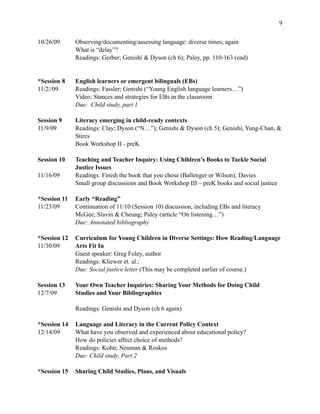
!9
10/26/09 Observing/documenting/assessing language: diverse times, again
What is “delay”?
Readings: Gerber; Genishi & Dyson (ch 6); Paley, pp. 110-163 (end)
*Session 8 English learners or emergent bilinguals (EBs)
11/2//09 Readings: Fassler; Genishi (“Young English language learners…”)
Video: Stances and strategies for EBs in the classroom
Due: Child study, part 1
Session 9 Literacy emerging in child-ready contexts
11/9/09 Readings: Clay; Dyson (“N…”); Genishi & Dyson (ch 5); Genishi, Yung-Chan, &
Stires
Book Workshop II - preK
Session 10 Teaching and Teacher Inquiry: Using Children’s Books to Tackle Social
Justice Issues
11/16/09 Readings: Finish the book that you chose (Ballenger or Wilson); Davies
Small group discussions and Book Workshop III – preK books and social justice
*Session 11 Early “Reading”
11/23/09 Continuation of 11/10 (Session 10) discussion, including EBs and literacy
McGee; Slavin & Cheung; Paley (article “On listening…”)
Due: Annotated bibliography
*Session 12 Curriculum for Young Children in Diverse Settings: How Reading/Language
11/30/09 Arts Fit In
Guest speaker: Greg Foley, author
Readings: Kliewer et. al.;
Due: Social justice letter (This may be completed earlier of course.)
Session 13 Your Own Teacher Inquiries: Sharing Your Methods for Doing Child
12/7/09 Studies and Your Bibliographies
Readings: Genishi and Dyson (ch 6 again)
*Session 14 Language and Literacy in the Current Policy Context
12/14/09 What have you observed and experienced about educational policy?
How do policies affect choice of methods?
Readings: Kohn; Neuman & Roskos
Due: Child study, Part 2
*Session 15 Sharing Child Studies, Plans, and Visuals
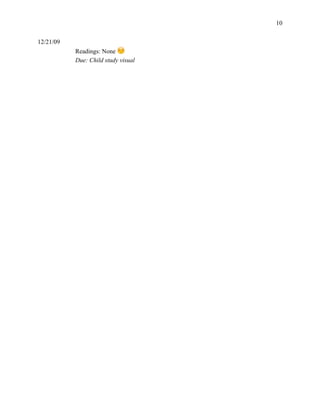
!10
12/21/09
Readings: None ☺
Due: Child study visual
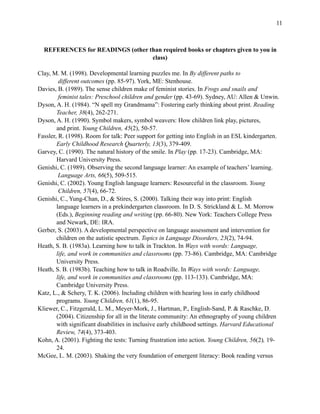
!11
REFERENCES for READINGS (other than required books or chapters given to you in
class)
Clay, M. M. (1998). Developmental learning puzzles me. In By different paths to
different outcomes (pp. 85-97). York, ME: Stenhouse.
Davies, B. (1989). The sense children make of feminist stories. In Frogs and snails and
feminist tales: Preschool children and gender (pp. 43-69). Sydney, AU: Allen & Unwin.
Dyson, A. H. (1984). “N spell my Grandmama”: Fostering early thinking about print. Reading
Teacher, 38(4), 262-271.
Dyson, A. H. (1990). Symbol makers, symbol weavers: How children link play, pictures,
and print. Young Children, 45(2), 50-57.
Fassler, R. (1998). Room for talk: Peer support for getting into English in an ESL kindergarten.
Early Childhood Research Quarterly, 13(3), 379-409.
Garvey, C. (1990). The natural history of the smile. In Play (pp. 17-23). Cambridge, MA:
Harvard University Press.
Genishi, C. (1989). Observing the second language learner: An example of teachers’ learning.
Language Arts, 66(5), 509-515.
Genishi, C. (2002). Young English language learners: Resourceful in the classroom. Young
Children, 57(4), 66-72.
Genishi, C., Yung-Chan, D., & Stires, S. (2000). Talking their way into print: English
language learners in a prekindergarten classroom. In D. S. Strickland & L. M. Morrow
(Eds.), Beginning reading and writing (pp. 66-80). New York: Teachers College Press
and Newark, DE: IRA.
Gerber, S. (2003). A developmental perspective on language assessment and intervention for
children on the autistic spectrum. Topics in Language Disorders, 23(2), 74-94.
Heath, S. B. (1983a). Learning how to talk in Trackton. In Ways with words: Language,
life, and work in communities and classrooms (pp. 73-86). Cambridge, MA: Cambridge
University Press.
Heath, S. B. (1983b). Teaching how to talk in Roadville. In Ways with words: Language,
life, and work in communities and classrooms (pp. 113-133). Cambridge, MA:
Cambridge University Press.
Katz, L., & Schery, T. K. (2006). Including children with hearing loss in early childhood
programs. Young Children, 61(1), 86-95.
Kliewer, C., Fitzgerald, L. M., Meyer-Mork, J., Hartman, P., English-Sand, P. & Raschke, D.
(2004). Citizenship for all in the literate community: An ethnography of young children
with significant disabilities in inclusive early childhood settings. Harvard Educational
Review, 74(4), 373-403.
Kohn, A. (2001). Fighting the tests: Turning frustration into action. Young Children, 56(2), 19-
24.
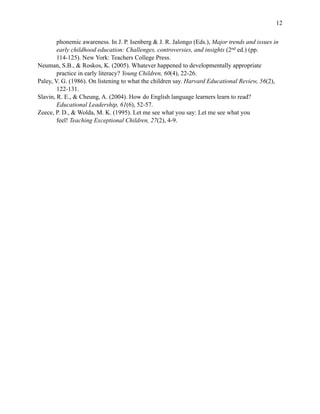
McGee, L. M. (2003). Shaking the very foundation of emergent literacy: Book reading versus
!12
phonemic awareness. In J. P. Isenberg & J. R. Jalongo (Eds.), Major trends and issues in
early childhood education: Challenges, controversies, and insights (2nd ed.) (pp.
114-125). New York: Teachers College Press.
Neuman, S.B., & Roskos, K. (2005). Whatever happened to developmentally appropriate
practice in early literacy? Young Children, 60(4), 22-26.
Paley, V. G. (1986). On listening to what the children say. Harvard Educational Review, 56(2),
122-131.
Slavin, R. E., & Cheung, A. (2004). How do English language learners learn to read?
Educational Leadership, 61(6), 52-57.
Zeece, P. D., & Wolda, M. K. (1995). Let me see what you say: Let me see what you
feel! Teaching Exceptional Children, 27(2), 4-9.

4131 SY

  • 1.
    Department of Curriculumand Teaching Program in Integrated Early Childhood Education Teachers College, Columbia University Fall 2008 CT4131 Language and Literacy in the Early Childhood Curriculum Mondays, 7:20-9:00pm 285 Grace Dodge Hall Instructor: Prof. Celia Genishi Co-instructor: Ms. Julianne Wurm, MA, EdM (212) 678 3079; (212) 678 3765 (Felicia, sec’y) wurm.julianne@gmail.com genishi@tc.edu Office: 302F Zankel Building Office: 306E Zankel Building Ofc hour: Monday 3:30-4:30 Ofc hours: Tues 3 - 5; Wed 4 - 5, and by appointment COURSE PURPOSE This methods course is an introduction to early communication and spoken and written language in the early childhood curriculum (infancy through age 4-5 or prekindergarten). Course content provides: • an overview of how very young learners communicate and learn language, including English language learners or “emergent bilinguals”; • an inquiry-based focus on practices and curricula that promote communication, talk, and emergent literacy in educational settings for children with a range of abilities; and • a sociocultural framework for teaching in the multiple contexts in which children learn and in which adults and children can work toward social justice. (This course offers 3 credits toward the New York State Early Childhood certification requirement of 6 credits in language acquisition and literacy.) COURSE OBJECTIVES By the end of this course, it is intended that you will make progress toward these objectives: • understand the wonder and importance of children’s communication and language by learning about language—nonverbal and verbal; language in culture and social relationships; and language and literacy acquisition processes; • become observers, assessors, and inquirers into children’s language and emergent literacy, by focusing on the learning of one or two children, preferably English learners or “emergent bilinguals”; • become curriculum makers for children of differing abilities by learning about and applying a range of language and literacy methods, through observation and participation in this course and a classroom or center that helps you answer the question,
  • 2.
    !2 “What does ‘teaching’language and literacy look like in the birth through grade 2 range?” • become advocates for social justice, through inquiring and making curriculum, as well as acting on your beliefs through letter-writing and other concrete means. ACCOMMODATIONS FOR INDIVIDUALS WITH DISABILITIES The College will make reasonable accommodations for persons with documented disabilities. Students are encouraged to contact the Office of Access and Services for Individuals with Disabilities for information about registration (166 Thorndike Hall). Services are available only to students who are registered and submit appropriate documentation. As your instructors, we are happy to discuss specific needs with you as well. COURSE REQUIREMENTS AND ASSIGNMENTS 1 ClassWeb: So that we can communicate with each other often and efficiently, please refer to our C&T 4131 ClassWeb site and e-mail regularly. Check ClassWeb as soon as possible and make sure the e-mail address listed for you is the one that you use. If it isn't, please make the appropriate changes (see Login Help on ClassWeb homepage, one of us, or an assistant in the College’s Computing and Information Services [CIS] Center, 242 Horace Mann). You will need to post your assignments to our ClassWeb site. 2 Attendance and participation: You are required to attend and participate in all classes, including whole-class and small-group work, and complete required readings and assignments prior to each session so that these can be woven into class discussions. (10% of grade) Students who cannot attend class because of illness, religious holiday, or an emergency must contact one of us prior to the session. Ground rules: It is presumed that all students will display respect for student colleagues and instructors, openness to new ideas and challenges, and integrity in completion of all assignments. Students are expected to maintain high professional standards in this course. These include honesty, punctuality, attendance, and attention to class activities. You will not need to use a laptop or any other electronic device in class. Please remember to turn off your cell phones and/or Blackberry-like devices before class begins. 3 Story-telling (to be done individually, 3 groups of storytellers on 3 days—, Oct 5, 12, or 19. However, anyone who wishes to may tell her/his story before Oct 5. Just let us know when.): Tell a story to the 4131 class that would be appropriate and engaging for an audience of young children (within birth through 4 or 5 age range). This may be a story you create, remember from childhood, or adapt from a book that you know. It should be told without any notes or props, and not read or recited or quoted from a book. On each story-telling day, we will have brief informal talks about the stories, their themes and cultural content, their impact on you
  • 3.
    !3 as listeners, andso on. A reflection about the significance and cultural content of your story, of no more than one typed, double-spaced page, should be given to us, after you tell your story. You should choose a story that: a) you consider to be a “good story” and that you really like and you think young children of a range of backgrounds and abilities will like; b) takes between 3 and 4 minutes to tell (since this is for an audience of young children and there are a large number of you); c) reveals something about culture, either your own culture or another. Try to tell the story to a group of prekindergarten children before you tell it to us as a “rehearsal”; and consider audio taping yourself and classmates, so that you can begin a collection of stories to tell. (10% for storytelling and 5% for written reflection) 4 Child Study and Plan. In order to apply ideas and concepts addressed in the course, you will develop a study of a young language learner, if at all possible, an English learner (EL) or an “emergent bilingual” (EB). For the child study and plan, you will focus on a child’s communication, language, and emergent literacy experiences (we’re defining both language and literacy broadly here, since the children you will work with are primarily within the birth through age 4 range). You will collect observations and data to document how the child uses and experiences language with the objective of understanding one child’s process of learning language. Throughout the process, you will make connections between your child study participant and course readings and discussions with the goal of understanding how research and practice can inform one another. If you like, you can do this assignment collaboratively in pairs. If one of you will be regularly in a setting with young children and the other will not, then the other can be an occasional visitor in that setting. Please identify in writing the learner by October 12 at the latest. You and your partner can share and discuss observations as you develop your ideas; Parts 1 and 2, however, should be written up individually. Part 1 Due Nov 2nd For Part 1 please respond to these questions: • What are you learning about how children in general learn to communicate and use language, including a second language? • What are you learning about one language learner, that is, your child study participant? In what kind of setting are you learning about her/him? • Because we know that language learning is part of a complex social and cultural process, you should focus on the social environment as well: o What are you learning about the child as an interactive social being with adults or children and as a participant in groups?
  • 4.
    !4 o What areyou learning about his or her relationships with peers? (This should be based on careful note-taking across varied situations, or as many as you can observe in the weeks before Part 1 is due.) • How is what you are learning about your child specifically related to course readings, class discussions, or materials, such as videos? What points or ideas can you connect with what you’ve observed? Cite at least 5 specific readings or other sources in Part 1. Part 1 should include a copy of 2 or 3 pages of your observational notes. These may be legibly hand-written. Part 1 should be presented in essay form. You should be responsive to the questions bulleted above, although you do not have to answer them in the order in which they are listed. Length: no more than 8 double-spaced pages, typed. [20% of grade] For Parts 1 and 2: Providing documentation for yourself: Keep a journal or “log” of notes, ideas, and questions about readings and other content, such as class discussion, which will remind you of how and what you’re learning. Include reflective notes that show you’re stepping back and analyzing yourself as a learner (participant in class discussions, inquirer, reader, listener, etc.) as well as how you are making connections between readings and your child study participant. Part 2 Due Dec 14th Part 2 builds on Part 1 and should incorporate and reflect the feedback you received on it. It should be also be presented in essay form, although in it you can incorporate quotations or excerpts of dialogues involving your child participant and others. Respond more fully to the 3 questions for Part 1, and add these two: • Think in terms of making curriculum for your child study participant. If you had the opportunity, what specific things would you like to do next to enhance her or his learning of language? Create two lessons to demonstrate what you would plan for her/him if you could. One lesson should be an individual lesson while the other should be a small or large group lesson that demonstrates how you will address individual needs within the classroom context. (The lesson plan can be general, like an overview, not highly detailed.) If you are focusing on an EB, what would you do to enhance her/his learning of English? How are your recommendations and lessons supported by your observations and your course reading/learning? • What have you learned about yourself as a learner, listener, reader, and writer? Do you learn more from listening or reading, for example? Or more from writing than listening, etc.? What helped you learn about yourself: talking with colleagues, reading specific pieces, working with children, etc.? This question is based on the assumption that awareness of your own learning processes helps you to become aware of children’s varied language learning processes.
  • 5.
    !5 Length: No morethan 16 double-spaced pages, typed As an extension of Part 2, please create a visual representation of your child, child study process, and/or your learning regarding the process of language and literacy development. You may include a photo of the child, but go beyond a photo to represent your learning. We will be displaying and sharing these on the last night of class, Dec 21st. Be creative and try to limit the number of words that you incorporate into your visual, so that it is as nonverbal as possible. [part 2, 20% for written part, 5% for visual] 5 Annotated bibliography of books (Due Nov 23): Throughout the semester you should keep a card file or e-file of books that you will use in the future with young children. It should consist of at least 50 books, cited according to the following: Author(s), illustrator(s) if different from author Date of publication/writing Title Place of publication and publisher. The books may be commercially published or child- or teacher-made. Write a brief description (2 or 3 sentences) of the book that also states why the book is worth using with children in the birth through age 4 range. We will be browsing and reviewing books for different age ranges in class, and you should make a habit of browsing in the TC Bookstore, Barnes and Noble, the public and TC libraries (there are picture books on the 2nd floor), and the Bank Street Bookstore on 112th St and Broadway so you can select the books you consider to be most worthwhile. (10%) 6 Letter related to social justice (Due by Nov 30th): Throughout the semester it is expected that you will be part of an information exchange, by sharing news and stories about upcoming events, teaching, politics, all related to children, language, and literacy, that are being addressed in the media (newspaper, journals, on-line, etc.). Two places we can exchange such information is through Facebook (group called C&T 4131) and ClassWeb. Each of you must contribute at least once to this discussion. What you share should NOT be the piece on which you base your letter. Each student will write a formal letter responding to an article, publication, commentary, etc., published in a newspaper, magazine, online source, etc. on language and literacy issues. We’ll talk about the “genre” and format of this kind of letter in class. You should take a clear stance on some issue related to language and literacy. That is, your letter should persuasively agree or disagree with the theories or issues in language/literacy that are publicly presented. (And in the letter the overall gist of the theories or issues should be clear to the reader.) For models, see the editorial and op-ed pages of various newspapers, such as the Daily News (www.nydailynews.com), New York Times, www.nytimes.com, Newsday (www.newsday.com), or another publication that is accessible to you in hard copy or online. While it is not mandatory, you are strongly urged to mail your letter to the newspaper editor or writer of the publication that you are responding to. By Nov 30th, you should 1) hand in a hard copy of both your letter and
  • 6.
    !6 the article thatyou are responding to and 2) post your letter for everyone in ClassWeb Files in the folder called, Social Justice Letters. Length: no more than one double-spaced page, typed. (Making the letter this short is a real challenge so give yourself time to write and revise.) [letter 15% of grade; participation in the information exchange throughout the semester 5%] 7 Readings Required Texts: Genishi, C., & Dyson, A. Haas. (2009). Children, language, and literacy: Diverse learners in diverse times. New York: Teachers College Press & Washington, DC: National Association for the Education of Young Children. Paley, V. (1990). The boy who would be a helicopter. Cambridge, MA: Harvard University Press. Choose one additional required text from these two: Ballenger, C. (1999). Teaching other people’s children: Literacy and learning in a bilingual classroom. New York: Teachers College Press. (one preK teacher’s learning and teaching in her own bilingual classroom with Haitian Creole-speaking children and families) Wilson, C. (2000). Telling a different story: Teaching and literacy in an urban preschool. New York: Teachers College Press. (the story of a collaborative project between the author and two teachers in Head Start; especially good as a demonstration of curriculum-making for social justice) Recommended Text: Vasquez, V. M. (2004). Negotiating critical literacies with young children. Mahwah, NJ: Erlbaum. (We will probably distribute a chapter or two from this for you to read.) ASSIGNMENTS and GRADING Final grades will be based on the following: Attendance and Participation 10 % Story-telling 10% Written reflection on story 5% Child Study and Plan, Part 1 20% Child Study and Plan, Part 2 20% Plus visual 5% Annotated Bibliography 10% Social Justice Letter and 15% On-line participation 5% 
 Your punctuality for class and for handing in assignments will be much appreciated. Lateness
  • 7.
    !7 may reflected inyour grade, in fairness to the punctual people.
 Incomplete (INC). An Incomplete is NOT an option in this course, except in an emergency. Your lack of organization or an "overextended life style" is not an emergency. Please let me know if an emergency arises. The following is Teachers College’s policy on Incompletes: The grade of Incomplete is to be assigned only when the course attendance requirement has been met but, for reasons satisfactory to the instructor, the granting of a final grade has been postponed because certain course assignments are outstanding. If the outstanding assignments are completed within one calendar year from the date of the close of term in which the grade of Incomplete was received and a final grade submitted, the final grade will be recorded on the permanent transcript, replacing the grade of Incomplete, with a transcript notation indicating the date that the grade of Incomplete was replaced by a final grade. If the outstanding work is not completed within one calendar year from the date of the close of term in which the grade of Incomplete was received, the grade will remain as a permanent Incomplete on the transcript. In such instances, if the course is a required course or part of an approved program of study, students will be required to re-enroll in the course including repayment of all tuition and fee charges for the new registration and satisfactorily complete all course requirements. If the required course is not offered in subsequent terms, the student should speak with the faculty advisor or Program Coordinator about their options for fulfilling the degree requirement. Doctoral students with six or more credits with grades of Incomplete included on their program of study will not be allowed to sit for the certification exam.
  • 8.
    !8 C&T 4131 Fall 2009 WEEKLYTOPICS AND ASSIGNMENTS (There may be additional readings that are related to your interests.) * = assignment due Session 1 Introduction to the wonder of language(s) and overview of course requirements 9/14/09 What are some wonders of language(s)? Multimodal and multilingual language stories: What do you remember of yourself as a young language learner? Student survey: What would you like to learn about language? Examples of stories (CG and JW) Session 2 Diversity and early communication 9/21/09 Diverse times from the start: Communication, meaning, and social foundations of language Readings: Garvey (smile); Genishi & Dyson book, ch 1; Genishi & Dyson, e- reserve from Language assessment book, ch 1 and 2; Sowell, ch 1 Video: early communication Session 3 Children as language learners in diverse cultural contexts 9/28/09 What is universal about language development? How universal are stories? Readings: Heath (both chapters); Engel; Genishi & Dyson, ch 2 Book workshop I: infants and toddlers *Session 4 Storytellers (11 of you); emergent bilinguals and the importance of play 10/5/09 Readings: Genishi & Dyson, ch 3; Paley, Foreword through p. 26. *Session 5 Storytellers (10 of you); Play and “multiliteracies”: The role of different 10/12/09 media Reggio Emilia as a source of languages and literacies Readings: Dyson (symbols); Genishi & Dyson, ch 4; Paley, pp 27-78 Let us know who your child study participant is by today. *Session 6 Storytellers (10 of you); Communicating with and without speech 10/19/09 Learning a new language: The importance of observing gesture and expression Communicating with signs Readings: Genishi (“Observing…”); Katz & Schery; Zeece & Wolda; Paley, pp. 78-110 Video: Communication among the Deaf: American Sign Language *Session 7 “Atypical” language development
  • 9.
    !9 10/26/09 Observing/documenting/assessing language:diverse times, again What is “delay”? Readings: Gerber; Genishi & Dyson (ch 6); Paley, pp. 110-163 (end) *Session 8 English learners or emergent bilinguals (EBs) 11/2//09 Readings: Fassler; Genishi (“Young English language learners…”) Video: Stances and strategies for EBs in the classroom Due: Child study, part 1 Session 9 Literacy emerging in child-ready contexts 11/9/09 Readings: Clay; Dyson (“N…”); Genishi & Dyson (ch 5); Genishi, Yung-Chan, & Stires Book Workshop II - preK Session 10 Teaching and Teacher Inquiry: Using Children’s Books to Tackle Social Justice Issues 11/16/09 Readings: Finish the book that you chose (Ballenger or Wilson); Davies Small group discussions and Book Workshop III – preK books and social justice *Session 11 Early “Reading” 11/23/09 Continuation of 11/10 (Session 10) discussion, including EBs and literacy McGee; Slavin & Cheung; Paley (article “On listening…”) Due: Annotated bibliography *Session 12 Curriculum for Young Children in Diverse Settings: How Reading/Language 11/30/09 Arts Fit In Guest speaker: Greg Foley, author Readings: Kliewer et. al.; Due: Social justice letter (This may be completed earlier of course.) Session 13 Your Own Teacher Inquiries: Sharing Your Methods for Doing Child 12/7/09 Studies and Your Bibliographies Readings: Genishi and Dyson (ch 6 again) *Session 14 Language and Literacy in the Current Policy Context 12/14/09 What have you observed and experienced about educational policy? How do policies affect choice of methods? Readings: Kohn; Neuman & Roskos Due: Child study, Part 2 *Session 15 Sharing Child Studies, Plans, and Visuals
  • 10.
  • 11.
    !11 REFERENCES for READINGS(other than required books or chapters given to you in class) Clay, M. M. (1998). Developmental learning puzzles me. In By different paths to different outcomes (pp. 85-97). York, ME: Stenhouse. Davies, B. (1989). The sense children make of feminist stories. In Frogs and snails and feminist tales: Preschool children and gender (pp. 43-69). Sydney, AU: Allen & Unwin. Dyson, A. H. (1984). “N spell my Grandmama”: Fostering early thinking about print. Reading Teacher, 38(4), 262-271. Dyson, A. H. (1990). Symbol makers, symbol weavers: How children link play, pictures, and print. Young Children, 45(2), 50-57. Fassler, R. (1998). Room for talk: Peer support for getting into English in an ESL kindergarten. Early Childhood Research Quarterly, 13(3), 379-409. Garvey, C. (1990). The natural history of the smile. In Play (pp. 17-23). Cambridge, MA: Harvard University Press. Genishi, C. (1989). Observing the second language learner: An example of teachers’ learning. Language Arts, 66(5), 509-515. Genishi, C. (2002). Young English language learners: Resourceful in the classroom. Young Children, 57(4), 66-72. Genishi, C., Yung-Chan, D., & Stires, S. (2000). Talking their way into print: English language learners in a prekindergarten classroom. In D. S. Strickland & L. M. Morrow (Eds.), Beginning reading and writing (pp. 66-80). New York: Teachers College Press and Newark, DE: IRA. Gerber, S. (2003). A developmental perspective on language assessment and intervention for children on the autistic spectrum. Topics in Language Disorders, 23(2), 74-94. Heath, S. B. (1983a). Learning how to talk in Trackton. In Ways with words: Language, life, and work in communities and classrooms (pp. 73-86). Cambridge, MA: Cambridge University Press. Heath, S. B. (1983b). Teaching how to talk in Roadville. In Ways with words: Language, life, and work in communities and classrooms (pp. 113-133). Cambridge, MA: Cambridge University Press. Katz, L., & Schery, T. K. (2006). Including children with hearing loss in early childhood programs. Young Children, 61(1), 86-95. Kliewer, C., Fitzgerald, L. M., Meyer-Mork, J., Hartman, P., English-Sand, P. & Raschke, D. (2004). Citizenship for all in the literate community: An ethnography of young children with significant disabilities in inclusive early childhood settings. Harvard Educational Review, 74(4), 373-403. Kohn, A. (2001). Fighting the tests: Turning frustration into action. Young Children, 56(2), 19- 24. McGee, L. M. (2003). Shaking the very foundation of emergent literacy: Book reading versus
  • 12.
    !12 phonemic awareness. InJ. P. Isenberg & J. R. Jalongo (Eds.), Major trends and issues in early childhood education: Challenges, controversies, and insights (2nd ed.) (pp. 114-125). New York: Teachers College Press. Neuman, S.B., & Roskos, K. (2005). Whatever happened to developmentally appropriate practice in early literacy? Young Children, 60(4), 22-26. Paley, V. G. (1986). On listening to what the children say. Harvard Educational Review, 56(2), 122-131. Slavin, R. E., & Cheung, A. (2004). How do English language learners learn to read? Educational Leadership, 61(6), 52-57. Zeece, P. D., & Wolda, M. K. (1995). Let me see what you say: Let me see what you feel! Teaching Exceptional Children, 27(2), 4-9.