“MASTER-SLAVE ROBOTIC ARM USING ARDUINO
UNO AND WIRELESS TRANSMISSION”
Project Synopsis
OF MAJOR PROJECT
BACHELOR OF ENGINEERING
ELECTRONICS & TELECOMMUNICATION ENGINEERING
SUBMITTED BY
VAIBHAV G. POTE VIPUL R. DESHBHRATAR RAJESHKUMAR N. YADAV
YOGESH M. BURDE ATUL S. WANKHEDE MAYUR Y. PATIL
(VII SEMESTER)
DEPARTMENT OF ELECTRONICS & TELECOMMUNICATION ENGINEERING
UNDER THE GUIDANCE OF
PROF. A. G. GALE
OM COLLEGE OF ENGINEERING
INZAPUR, WARDHA
RASHTRASANT TUKDOJI MAHARAJ NAGPUR UNIVERSITY
SESSION 2013-2014
APPENDIX
Sr. No. TOPIC NAME PAGE NO.
1. ABSTRACT
2. INTRODUCTION
3. LITERATURE REVIEW
4. AIM AND OBJECTIVES
5. RESEARCH METHODOLOGY
6. CONCLUSION
7. REFERENCES
ABSTRACT
In this paper, we present the concept of transmitting power without using wires
i.e., transmitting power as electromagnetic waves from one place to another is in order
to reduce the transmission and distribution losses. This concept is known as Wireless
Power transmission (WPT). We also discussed the technological developments in
Wireless Power Transmission (WPT).
Also we are using this power transmission in master slave robotic arm system
where the master arm gets its complete power through wireless transmitting coil. The
design of master slave robotic arm is based entirely on mechanically coupling between
the master and slave arms. Derivatives of this system are still seen in places where
handling of things or product is required, as well as in painting applications on the
assembly line in automobile industry. The design of the robotic arm can be used to do
any sort of work by using arm robot and controlled by using master arm robot. The
proposed arm master system consists of voltage varying hardware in the form of pots at
each arm joint. The purpose of this master unit is to measure the respective voltage with
reference to the angular position of the joints of the user’s arm. These voltages are
transmitted, as analog signals, to the arduino interface. For Slave Robot, the arm can
cover a range of human arm movements.
INTRODUCTION
1.0 Introduction
Interpretation of master slave system is used for human-machine interaction in
the area of robotics. The main purpose of master slave system research is to identify
and give a particular human movement and convey information to the robot pertaining
to individual movement. Specific movement of interest can be given, and on the basis of
that, specific command for execution of action can be given to robotic system. Overall
aim is to make the microcontroller understand human body language, thereby bridging
the gap between machine and human. Hand gesture recognition can be used to
enhance human–machine interaction without depending on traditional input devices
such as keyboard and mouse. Hand gestures are extensively used for telerobotic
control applications. Robotic systems can be controlled naturally and intuitively with
such telerobotic communication. A prominent benefit of such a system is that it presents
a natural way to send geometrical information to the robot such as: left, right, etc.
Robotic hand can be controlled remotely by hand movements. Research is being
carried out in this area for a long time. Several approaches have been developed for
sensing hand movements and controlling robotic hand. Glove based technique is a well-
known means of recognizing hand gestures. It utilizes sensor attached mechanical
glove devices that directly measure hand and/or arm joint angles and spatial position.
Although glove-based gestural interfaces give more precision, it limits freedom as it
requires users to wear cumbersome patch of devices. Technologists have used entropy
analysis to extract hand region in complex background for master slave robotic system.
Robot controlling is done by fusion of hand positioning and arm gestures using dummy
arm. Although it gives more precision, it limits freedom due to necessity of dummy arm
movement. For capturing hand gestures correctly, proper pots and angles are required.
The problem of précised position recognition and tracking is quite challenging. Many
early approaches used lengthy programming and different codes to make the problem
of position recognition easier, but due to their inconvenience, they cannot be considered
as a natural interface for the robot control. The use of specific pots, servos and arduino
microcontroller board could be the best solution for this as arduino can be coded in
higher level languages. It can be extended to any robotic system with a number of
specific commands suitable to that system.
One of the major issue in power system is the losses occurs during the
transmission and distribution of electrical power. As the demand increases day by day,
the power generation increases and the power loss is also increased. The major
amount of power loss occurs during transmission and distribution. The percentage of
loss of power during transmission and distribution is approximated as 26%. The main
reason for power loss during transmission and distribution is the resistance of wires
used for grid. The efficiency of power transmission can be improved to certain level by
using high strength composite overhead conductors and underground cables that use
high temperature super conductor. But, the transmission is still inefficient. According to
the World Resources Institute (WRI), India’s electricity grid has the highest transmission
and distribution losses in the world – a whopping 27%. Numbers published by various
Indian government agencies put that number at 30%, 40% and greater than 40%. This
is attributed to technical losses (grid’s inefficiencies) and theft [1]. Any problem can be
solved by state–of-the-art technology. The above discussed problem can be solved by
choose an alternative option for power transmission which could provide much higher
efficiency, low transmission cost and avoid power theft. Microwave Power Transmission
is one of the promising technologies and may be the righteous alternative for efficient
power transmission.
1.1 Problem Statement
The main purpose to develop this project is to clearly and cleverly use wireless
power; in the field of robotics, where a large amount of power is required for operating
robots continuously. This project deals with précised amount of power supply through
wireless. It also deals with the synchronism of servos with the power source. The
amperage and voltage for operating the servos should be precisely same as its
requirement. Then there’s the problem of synchronism of master arm with the slave
arm. We are dealing with both the arms and that is the key aspect, hence there needs
to be much accurate motion of the slave arm with respect to master arm. All the aspects
have been taken into account and the same points would be used for further research
and implementation of the project keeping the maximum efficiency and output in mind.
LITERATURE REVIEW
2.0 Master-Slave Robotic Arm
A robot is an electro-mechanical device that can perform autonomous or
preprogrammed tasks. A robot may act under the direct control of a human (e.g. the
robotic arm of the space shuttle) or autonomously under the control of a programmed
computer. Robots may be used to perform tasks that are too dangerous or difficult for
humans to implement directly (e.g. nuclear waste cleanup) or may be used to automate
repetitive tasks that can be performed with more precision by a robot than by the
employment of a human (e.g. automobile production). The word robot is used to refer
to a wide range of machines, the common feature of which is that they are all capable of
movement and can be used to perform physical tasks. Robots take on many different
forms, ranging from humanoid, which mimic the human form and way of moving, to
industries, whose appearance is dictated by the function they are to perform. Robots
can be grouped generally as mobile robots (e.g. autonomous vehicles), manipulator
robots (e.g. industrial robots) and self-reconfigurable robots, which can confirm
themselves to the task at hand. Robots may be controlled directly by a human, such as
remotely-controlled bomb- disposal robots, robotic arms or shuttles, or may act
according to their own decision making ability, provided by artificial intelligence.
However, the majority of robots fall in-between these extremes, being controlled by pre-
programmed such robots computers; may include feedback loops such that they can
interact with their environment, but do not display actual intelligence.
Much of the research is based on the comparison between master and slave
arms working. They are as follows:
Master Slave
 Request to move robot.
 Request to stop robot.
 Measure the potential difference in pots
and feed to microcontroller.
 Control robot to move to desired
position.
 Control robot to stand still.
 Movement with respect to the received
signal.
2.1 Wireless Transmission
Wireless power or wireless energy transmission is the transmission of
electrical energy from a power source to an electrical load without man-made
conductors.
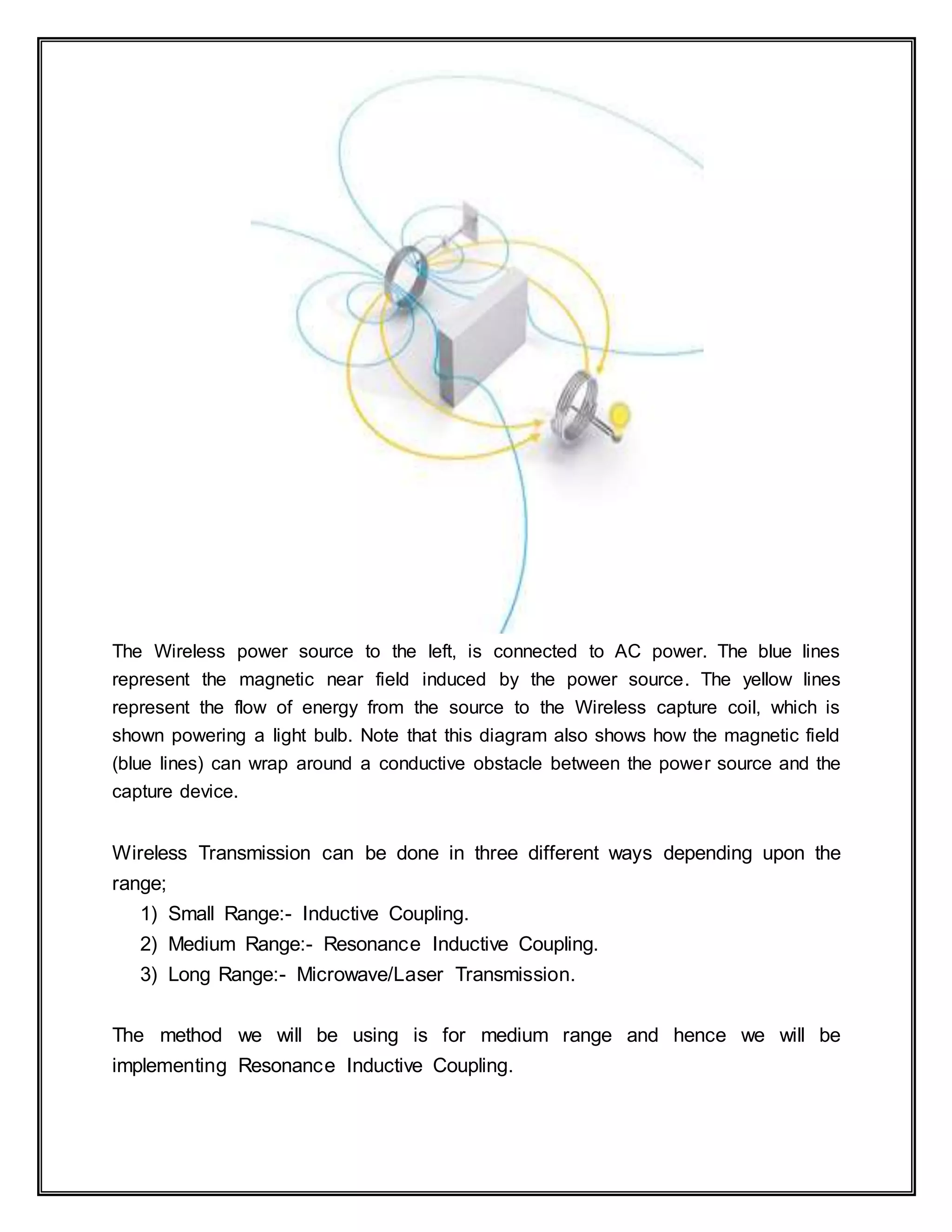
The Wireless power source to the left, is connected to AC power. The blue lines
represent the magnetic near field induced by the power source. The yellow lines
represent the flow of energy from the source to the Wireless capture coil, which is
shown powering a light bulb. Note that this diagram also shows how the magnetic field
(blue lines) can wrap around a conductive obstacle between the power source and the
capture device.
Wireless Transmission can be done in three different ways depending upon the
range;
1) Small Range:- Inductive Coupling.
2) Medium Range:- Resonance Inductive Coupling.
3) Long Range:- Microwave/Laser Transmission.
The method we will be using is for medium range and hence we will be
implementing Resonance Inductive Coupling.
AIM & OBJECTIVES
3.0 Aim
The main aim of this project is to incorporate the Wireless Electricity in the field of
robotics. We are going to develop a robotic arm that gets it power through a wireless
electricity transmitter. The arm is a “Master- Slave System” where we are using a
Master arm to control the Slave arm. The Slave arm copies the movements of Master
arm exactly in the way we move it.
3.1 Objectives
The objective of this research project is to explore the basis for a consistent
power and hardware environment, and a flexible framework;
 This framework will facilitate and speed up the design process of robots.
 This prototype robot will be used as an educational tool in the field of robotics
and wireless transmission.
 This project will establish a basis of design automation of robot manipulators.
RESEARCH METHODOLOGY
4.0 Research Technique
As discussed above, the important techniques we are using for the project
development are wireless transmission and master slave robotic arm technique. Here
on the basis of our requirements we have selected some components for this purpose.
The main components shall be explained in the further points. The main components to
be used are,
1. Arduino Uno Microcontroller Board.
2. Servo motors
3. Potentiometers.
4.1 Arduino Uno Microcontroller Board
The Arduino Uno is a microcontroller board based on the ATmega32u4. It has 20
digital input/output pins of which 7 can be used as PWM outputs and 12 as analog
inputs, a 16 MHz crystal oscillator, a micro USB connection, a power jack, an ICSP
header, and a reset button. It contains everything needed to support the microcontroller;
simply connect it to a computer with a USB cable or power it with an AC-to-DC adapter
or battery to get started. Some specs are as below
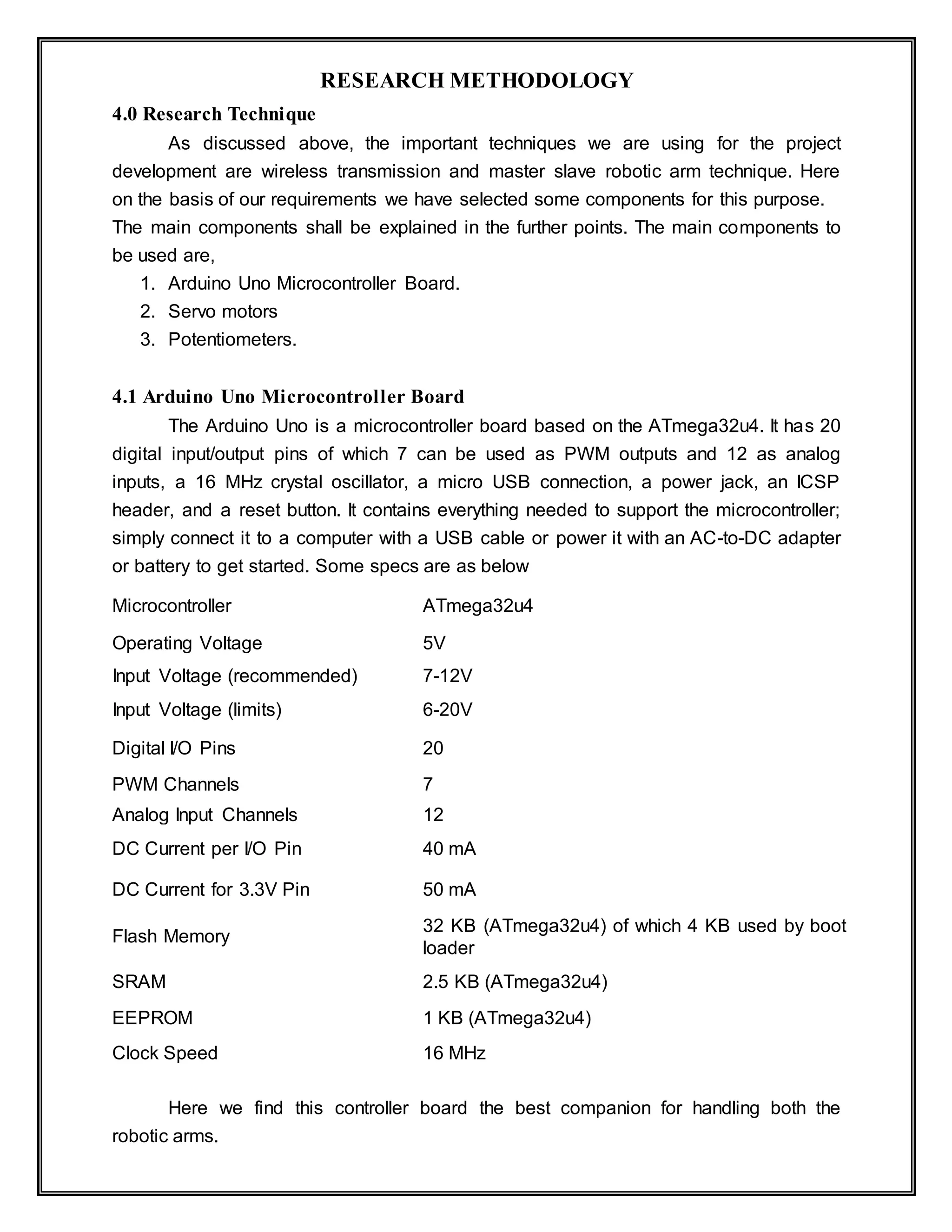
Microcontroller ATmega32u4
Operating Voltage 5V
Input Voltage (recommended) 7-12V
Input Voltage (limits) 6-20V
Digital I/O Pins 20
PWM Channels 7
Analog Input Channels 12
DC Current per I/O Pin 40 mA
DC Current for 3.3V Pin 50 mA
Flash Memory
32 KB (ATmega32u4) of which 4 KB used by boot
loader
SRAM 2.5 KB (ATmega32u4)
EEPROM 1 KB (ATmega32u4)
Clock Speed 16 MHz
Here we find this controller board the best companion for handling both the
robotic arms.
4.2 Potentiometers
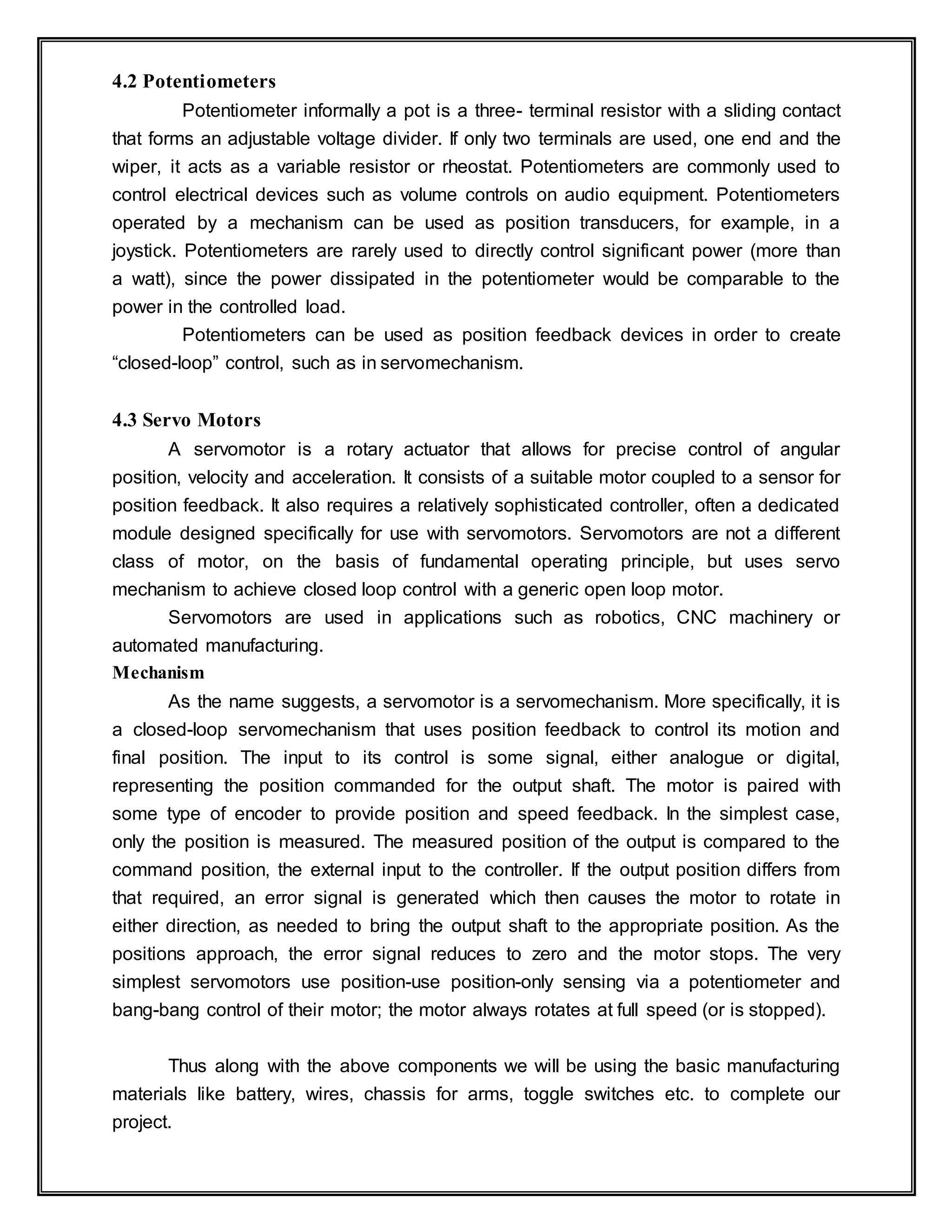
Potentiometer informally a pot is a three- terminal resistor with a sliding contact
that forms an adjustable voltage divider. If only two terminals are used, one end and the
wiper, it acts as a variable resistor or rheostat. Potentiometers are commonly used to
control electrical devices such as volume controls on audio equipment. Potentiometers
operated by a mechanism can be used as position transducers, for example, in a
joystick. Potentiometers are rarely used to directly control significant power (more than
a watt), since the power dissipated in the potentiometer would be comparable to the
power in the controlled load.
Potentiometers can be used as position feedback devices in order to create
“closed-loop” control, such as in servomechanism.
4.3 Servo Motors
A servomotor is a rotary actuator that allows for precise control of angular
position, velocity and acceleration. It consists of a suitable motor coupled to a sensor for
position feedback. It also requires a relatively sophisticated controller, often a dedicated
module designed specifically for use with servomotors. Servomotors are not a different
class of motor, on the basis of fundamental operating principle, but uses servo
mechanism to achieve closed loop control with a generic open loop motor.
Servomotors are used in applications such as robotics, CNC machinery or
automated manufacturing.
Mechanism
As the name suggests, a servomotor is a servomechanism. More specifically, it is
a closed-loop servomechanism that uses position feedback to control its motion and
final position. The input to its control is some signal, either analogue or digital,
representing the position commanded for the output shaft. The motor is paired with
some type of encoder to provide position and speed feedback. In the simplest case,
only the position is measured. The measured position of the output is compared to the
command position, the external input to the controller. If the output position differs from
that required, an error signal is generated which then causes the motor to rotate in
either direction, as needed to bring the output shaft to the appropriate position. As the
positions approach, the error signal reduces to zero and the motor stops. The very
simplest servomotors use position-use position-only sensing via a potentiometer and
bang-bang control of their motor; the motor always rotates at full speed (or is stopped).
Thus along with the above components we will be using the basic manufacturing
materials like battery, wires, chassis for arms, toggle switches etc. to complete our
project.
4.4 Flowchart
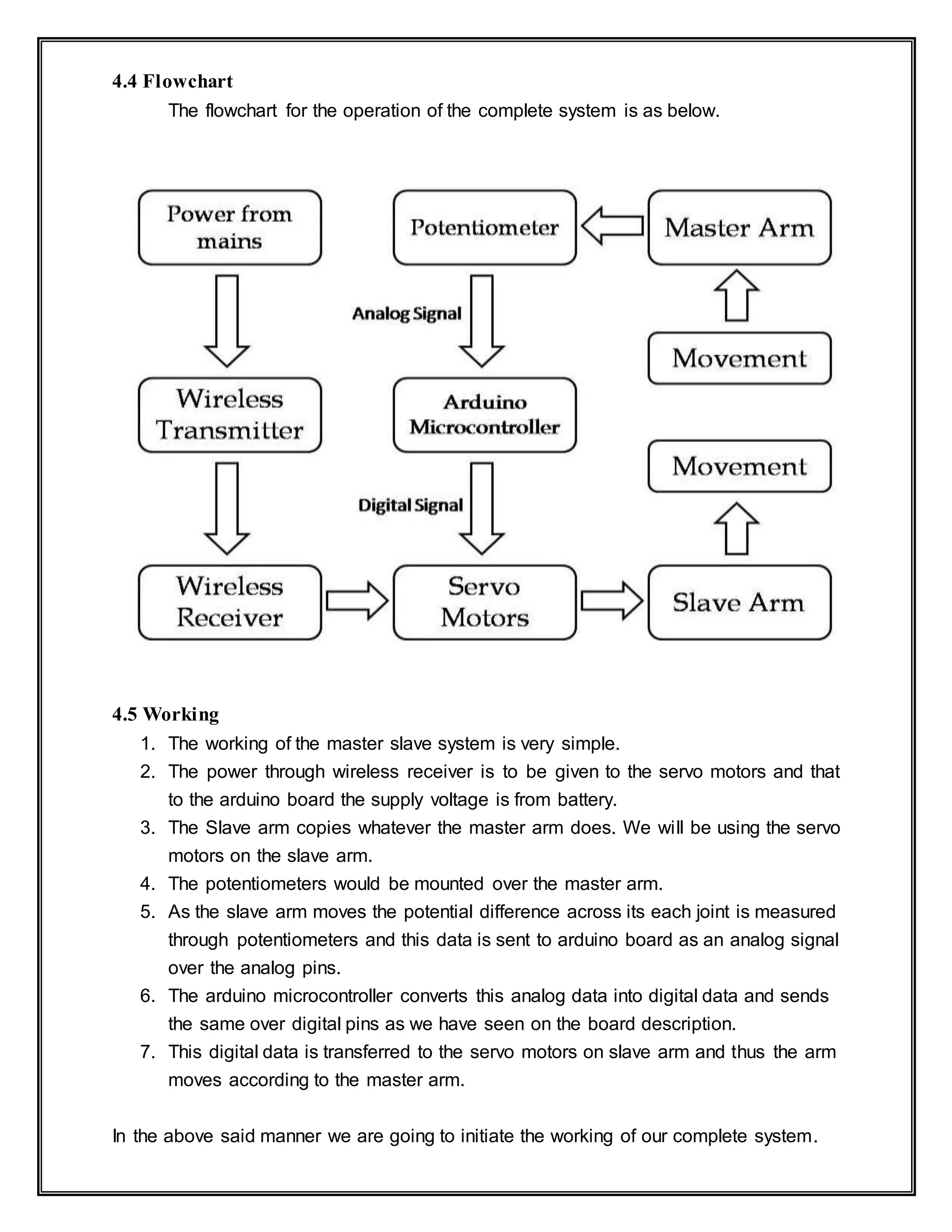
The flowchart for the operation of the complete system is as below.
4.5 Working
1. The working of the master slave system is very simple.
2. The power through wireless receiver is to be given to the servo motors and that
to the arduino board the supply voltage is from battery.
3. The Slave arm copies whatever the master arm does. We will be using the servo
motors on the slave arm.
4. The potentiometers would be mounted over the master arm.
5. As the slave arm moves the potential difference across its each joint is measured
through potentiometers and this data is sent to arduino board as an analog signal
over the analog pins.
6. The arduino microcontroller converts this analog data into digital data and sends
the same over digital pins as we have seen on the board description.
7. This digital data is transferred to the servo motors on slave arm and thus the arm
moves according to the master arm.
In the above said manner we are going to initiate the working of our complete system.
CONCLUSION
The system we are going to develop is a device which is efficient, light weight,
comprising less machinery, and has applications in various domestic and industrial
purposes. There is a need of such devices which show higher efficiency in
consideration of power as well as performance. It is also needed to be cheap and
effective in skills. With a particular level and amount of synchronization such devices
can be the future of robotic mechanisms having human like gestures. The sense for
wireless power needs to be developed among all the communities, either scientific or
social. The pros and cons of this transmission system have to be discussed and if any
query so obtained must be cleared. There is a need for more précised research in this
field. Our system; in a nutshell can be the role model for such effective indulgence of
effective power and précised skill of robots.
REFERENCES
PDF EDITION OF CARL DAVID TODD (ED), "THE POTENTIOMETER
HANDBOOK",MCGRAW HILL, NEW YORK 1975 ISBN 0-07-006690-6
UPSON, A.R; BATCHELOR, J.H. (1978) [1965]. SYNCHRO ENGINEERING
HANDBOOK . BECKENHAM: MUIRHEAD VACTRIC COMPONENTS. PP. 7, 67–90.
ROBOTICS, AUTOMATION AND MECHATRONICS, 2004 IEEE CONFERENCE ON
(VOLUME:1 ) PAGES 37 - 42 VOL.1 ISBN:0-7803-8645-0
HU, A.P. (2009). WIRELESS/CONTACTLESS POWER SUPPLY: INDUCTIVE
COUPLED RESONANT CONVERTER SOLUTIONS, SAARBRUCKEN, GERMANY:
VDM VERLAG, DR. MULLER.
SYSTEM FOR TRANSMISSION OF ELECTRICAL ENERGY, U.S. PATENT NO. 645,576
MARCH 20, 1900.
OWI ROBOTIC ARM EDGE ASIN: B0017OFRCY
BUILD YOUR OWN ROBOTIC ARM LESSON PDF MANUAL.
"PROGRAMMING ARDUINO GETTING STARTED WITH SKETCHES" . MCGRAW-
HILL . NOV 8, 2011. RETRIEVED 2013-03-28.
"THE ARDUINO SOURCE CODE" . THE ARDUINO SOURCE CODE. "POLICY" .
ARDUINO.CC. RETRIEVED 2013-01-18.
WEBSITES
www.arduino.cc
www.wikipedia.com
www.instructables.com
www.societyofrobots.com
www.letsmakerobots.com
www.google.com
UNDER THE GUIDANCE OF:
Prof. A. G. Gale
Head of Department
(Department of Electronics & Telecommunication Engineering)
OMCOE, Inzapur, Wardha.
SUBMITTED BY:
VAIBHAV G. POTE RAJESHKUMAR N. YADAV VIPUL R. DESHBHRATAR
YOGESH M. BURDE ATUL S. WANKHEDE MAYUR Y. PATIL
Date:

Master Slave Robotic Arm Using Wireless Transmission Of electricity

  • 1.
    “MASTER-SLAVE ROBOTIC ARMUSING ARDUINO UNO AND WIRELESS TRANSMISSION” Project Synopsis OF MAJOR PROJECT BACHELOR OF ENGINEERING ELECTRONICS & TELECOMMUNICATION ENGINEERING SUBMITTED BY VAIBHAV G. POTE VIPUL R. DESHBHRATAR RAJESHKUMAR N. YADAV YOGESH M. BURDE ATUL S. WANKHEDE MAYUR Y. PATIL (VII SEMESTER) DEPARTMENT OF ELECTRONICS & TELECOMMUNICATION ENGINEERING UNDER THE GUIDANCE OF PROF. A. G. GALE OM COLLEGE OF ENGINEERING INZAPUR, WARDHA RASHTRASANT TUKDOJI MAHARAJ NAGPUR UNIVERSITY SESSION 2013-2014
  • 2.
    APPENDIX Sr. No. TOPICNAME PAGE NO. 1. ABSTRACT 2. INTRODUCTION 3. LITERATURE REVIEW 4. AIM AND OBJECTIVES 5. RESEARCH METHODOLOGY 6. CONCLUSION 7. REFERENCES
  • 3.
    ABSTRACT In this paper,we present the concept of transmitting power without using wires i.e., transmitting power as electromagnetic waves from one place to another is in order to reduce the transmission and distribution losses. This concept is known as Wireless Power transmission (WPT). We also discussed the technological developments in Wireless Power Transmission (WPT). Also we are using this power transmission in master slave robotic arm system where the master arm gets its complete power through wireless transmitting coil. The design of master slave robotic arm is based entirely on mechanically coupling between the master and slave arms. Derivatives of this system are still seen in places where handling of things or product is required, as well as in painting applications on the assembly line in automobile industry. The design of the robotic arm can be used to do any sort of work by using arm robot and controlled by using master arm robot. The proposed arm master system consists of voltage varying hardware in the form of pots at each arm joint. The purpose of this master unit is to measure the respective voltage with reference to the angular position of the joints of the user’s arm. These voltages are transmitted, as analog signals, to the arduino interface. For Slave Robot, the arm can cover a range of human arm movements.
  • 4.
    INTRODUCTION 1.0 Introduction Interpretation ofmaster slave system is used for human-machine interaction in the area of robotics. The main purpose of master slave system research is to identify and give a particular human movement and convey information to the robot pertaining to individual movement. Specific movement of interest can be given, and on the basis of that, specific command for execution of action can be given to robotic system. Overall aim is to make the microcontroller understand human body language, thereby bridging the gap between machine and human. Hand gesture recognition can be used to enhance human–machine interaction without depending on traditional input devices such as keyboard and mouse. Hand gestures are extensively used for telerobotic control applications. Robotic systems can be controlled naturally and intuitively with such telerobotic communication. A prominent benefit of such a system is that it presents a natural way to send geometrical information to the robot such as: left, right, etc. Robotic hand can be controlled remotely by hand movements. Research is being carried out in this area for a long time. Several approaches have been developed for sensing hand movements and controlling robotic hand. Glove based technique is a well- known means of recognizing hand gestures. It utilizes sensor attached mechanical glove devices that directly measure hand and/or arm joint angles and spatial position. Although glove-based gestural interfaces give more precision, it limits freedom as it requires users to wear cumbersome patch of devices. Technologists have used entropy analysis to extract hand region in complex background for master slave robotic system. Robot controlling is done by fusion of hand positioning and arm gestures using dummy arm. Although it gives more precision, it limits freedom due to necessity of dummy arm movement. For capturing hand gestures correctly, proper pots and angles are required. The problem of précised position recognition and tracking is quite challenging. Many early approaches used lengthy programming and different codes to make the problem of position recognition easier, but due to their inconvenience, they cannot be considered as a natural interface for the robot control. The use of specific pots, servos and arduino microcontroller board could be the best solution for this as arduino can be coded in higher level languages. It can be extended to any robotic system with a number of specific commands suitable to that system. One of the major issue in power system is the losses occurs during the transmission and distribution of electrical power. As the demand increases day by day, the power generation increases and the power loss is also increased. The major amount of power loss occurs during transmission and distribution. The percentage of loss of power during transmission and distribution is approximated as 26%. The main reason for power loss during transmission and distribution is the resistance of wires used for grid. The efficiency of power transmission can be improved to certain level by using high strength composite overhead conductors and underground cables that use high temperature super conductor. But, the transmission is still inefficient. According to the World Resources Institute (WRI), India’s electricity grid has the highest transmission and distribution losses in the world – a whopping 27%. Numbers published by various Indian government agencies put that number at 30%, 40% and greater than 40%. This is attributed to technical losses (grid’s inefficiencies) and theft [1]. Any problem can be solved by state–of-the-art technology. The above discussed problem can be solved by choose an alternative option for power transmission which could provide much higher efficiency, low transmission cost and avoid power theft. Microwave Power Transmission
  • 5.
    is one ofthe promising technologies and may be the righteous alternative for efficient power transmission. 1.1 Problem Statement The main purpose to develop this project is to clearly and cleverly use wireless power; in the field of robotics, where a large amount of power is required for operating robots continuously. This project deals with précised amount of power supply through wireless. It also deals with the synchronism of servos with the power source. The amperage and voltage for operating the servos should be precisely same as its requirement. Then there’s the problem of synchronism of master arm with the slave arm. We are dealing with both the arms and that is the key aspect, hence there needs to be much accurate motion of the slave arm with respect to master arm. All the aspects have been taken into account and the same points would be used for further research and implementation of the project keeping the maximum efficiency and output in mind.
  • 6.
    LITERATURE REVIEW 2.0 Master-SlaveRobotic Arm A robot is an electro-mechanical device that can perform autonomous or preprogrammed tasks. A robot may act under the direct control of a human (e.g. the robotic arm of the space shuttle) or autonomously under the control of a programmed computer. Robots may be used to perform tasks that are too dangerous or difficult for humans to implement directly (e.g. nuclear waste cleanup) or may be used to automate repetitive tasks that can be performed with more precision by a robot than by the employment of a human (e.g. automobile production). The word robot is used to refer to a wide range of machines, the common feature of which is that they are all capable of movement and can be used to perform physical tasks. Robots take on many different forms, ranging from humanoid, which mimic the human form and way of moving, to industries, whose appearance is dictated by the function they are to perform. Robots can be grouped generally as mobile robots (e.g. autonomous vehicles), manipulator robots (e.g. industrial robots) and self-reconfigurable robots, which can confirm themselves to the task at hand. Robots may be controlled directly by a human, such as remotely-controlled bomb- disposal robots, robotic arms or shuttles, or may act according to their own decision making ability, provided by artificial intelligence. However, the majority of robots fall in-between these extremes, being controlled by pre- programmed such robots computers; may include feedback loops such that they can interact with their environment, but do not display actual intelligence. Much of the research is based on the comparison between master and slave arms working. They are as follows: Master Slave  Request to move robot.  Request to stop robot.  Measure the potential difference in pots and feed to microcontroller.  Control robot to move to desired position.  Control robot to stand still.  Movement with respect to the received signal. 2.1 Wireless Transmission Wireless power or wireless energy transmission is the transmission of electrical energy from a power source to an electrical load without man-made conductors.
  • 7.
    The Wireless powersource to the left, is connected to AC power. The blue lines represent the magnetic near field induced by the power source. The yellow lines represent the flow of energy from the source to the Wireless capture coil, which is shown powering a light bulb. Note that this diagram also shows how the magnetic field (blue lines) can wrap around a conductive obstacle between the power source and the capture device. Wireless Transmission can be done in three different ways depending upon the range; 1) Small Range:- Inductive Coupling. 2) Medium Range:- Resonance Inductive Coupling. 3) Long Range:- Microwave/Laser Transmission. The method we will be using is for medium range and hence we will be implementing Resonance Inductive Coupling.
  • 8.
    AIM & OBJECTIVES 3.0Aim The main aim of this project is to incorporate the Wireless Electricity in the field of robotics. We are going to develop a robotic arm that gets it power through a wireless electricity transmitter. The arm is a “Master- Slave System” where we are using a Master arm to control the Slave arm. The Slave arm copies the movements of Master arm exactly in the way we move it. 3.1 Objectives The objective of this research project is to explore the basis for a consistent power and hardware environment, and a flexible framework;  This framework will facilitate and speed up the design process of robots.  This prototype robot will be used as an educational tool in the field of robotics and wireless transmission.  This project will establish a basis of design automation of robot manipulators.
  • 9.
    RESEARCH METHODOLOGY 4.0 ResearchTechnique As discussed above, the important techniques we are using for the project development are wireless transmission and master slave robotic arm technique. Here on the basis of our requirements we have selected some components for this purpose. The main components shall be explained in the further points. The main components to be used are, 1. Arduino Uno Microcontroller Board. 2. Servo motors 3. Potentiometers. 4.1 Arduino Uno Microcontroller Board The Arduino Uno is a microcontroller board based on the ATmega32u4. It has 20 digital input/output pins of which 7 can be used as PWM outputs and 12 as analog inputs, a 16 MHz crystal oscillator, a micro USB connection, a power jack, an ICSP header, and a reset button. It contains everything needed to support the microcontroller; simply connect it to a computer with a USB cable or power it with an AC-to-DC adapter or battery to get started. Some specs are as below Microcontroller ATmega32u4 Operating Voltage 5V Input Voltage (recommended) 7-12V Input Voltage (limits) 6-20V Digital I/O Pins 20 PWM Channels 7 Analog Input Channels 12 DC Current per I/O Pin 40 mA DC Current for 3.3V Pin 50 mA Flash Memory 32 KB (ATmega32u4) of which 4 KB used by boot loader SRAM 2.5 KB (ATmega32u4) EEPROM 1 KB (ATmega32u4) Clock Speed 16 MHz Here we find this controller board the best companion for handling both the robotic arms.
  • 10.
    4.2 Potentiometers Potentiometer informallya pot is a three- terminal resistor with a sliding contact that forms an adjustable voltage divider. If only two terminals are used, one end and the wiper, it acts as a variable resistor or rheostat. Potentiometers are commonly used to control electrical devices such as volume controls on audio equipment. Potentiometers operated by a mechanism can be used as position transducers, for example, in a joystick. Potentiometers are rarely used to directly control significant power (more than a watt), since the power dissipated in the potentiometer would be comparable to the power in the controlled load. Potentiometers can be used as position feedback devices in order to create “closed-loop” control, such as in servomechanism. 4.3 Servo Motors A servomotor is a rotary actuator that allows for precise control of angular position, velocity and acceleration. It consists of a suitable motor coupled to a sensor for position feedback. It also requires a relatively sophisticated controller, often a dedicated module designed specifically for use with servomotors. Servomotors are not a different class of motor, on the basis of fundamental operating principle, but uses servo mechanism to achieve closed loop control with a generic open loop motor. Servomotors are used in applications such as robotics, CNC machinery or automated manufacturing. Mechanism As the name suggests, a servomotor is a servomechanism. More specifically, it is a closed-loop servomechanism that uses position feedback to control its motion and final position. The input to its control is some signal, either analogue or digital, representing the position commanded for the output shaft. The motor is paired with some type of encoder to provide position and speed feedback. In the simplest case, only the position is measured. The measured position of the output is compared to the command position, the external input to the controller. If the output position differs from that required, an error signal is generated which then causes the motor to rotate in either direction, as needed to bring the output shaft to the appropriate position. As the positions approach, the error signal reduces to zero and the motor stops. The very simplest servomotors use position-use position-only sensing via a potentiometer and bang-bang control of their motor; the motor always rotates at full speed (or is stopped). Thus along with the above components we will be using the basic manufacturing materials like battery, wires, chassis for arms, toggle switches etc. to complete our project.
  • 11.
    4.4 Flowchart The flowchartfor the operation of the complete system is as below. 4.5 Working 1. The working of the master slave system is very simple. 2. The power through wireless receiver is to be given to the servo motors and that to the arduino board the supply voltage is from battery. 3. The Slave arm copies whatever the master arm does. We will be using the servo motors on the slave arm. 4. The potentiometers would be mounted over the master arm. 5. As the slave arm moves the potential difference across its each joint is measured through potentiometers and this data is sent to arduino board as an analog signal over the analog pins. 6. The arduino microcontroller converts this analog data into digital data and sends the same over digital pins as we have seen on the board description. 7. This digital data is transferred to the servo motors on slave arm and thus the arm moves according to the master arm. In the above said manner we are going to initiate the working of our complete system.
  • 12.
    CONCLUSION The system weare going to develop is a device which is efficient, light weight, comprising less machinery, and has applications in various domestic and industrial purposes. There is a need of such devices which show higher efficiency in consideration of power as well as performance. It is also needed to be cheap and effective in skills. With a particular level and amount of synchronization such devices can be the future of robotic mechanisms having human like gestures. The sense for wireless power needs to be developed among all the communities, either scientific or social. The pros and cons of this transmission system have to be discussed and if any query so obtained must be cleared. There is a need for more précised research in this field. Our system; in a nutshell can be the role model for such effective indulgence of effective power and précised skill of robots.
  • 13.
    REFERENCES PDF EDITION OFCARL DAVID TODD (ED), "THE POTENTIOMETER HANDBOOK",MCGRAW HILL, NEW YORK 1975 ISBN 0-07-006690-6 UPSON, A.R; BATCHELOR, J.H. (1978) [1965]. SYNCHRO ENGINEERING HANDBOOK . BECKENHAM: MUIRHEAD VACTRIC COMPONENTS. PP. 7, 67–90. ROBOTICS, AUTOMATION AND MECHATRONICS, 2004 IEEE CONFERENCE ON (VOLUME:1 ) PAGES 37 - 42 VOL.1 ISBN:0-7803-8645-0 HU, A.P. (2009). WIRELESS/CONTACTLESS POWER SUPPLY: INDUCTIVE COUPLED RESONANT CONVERTER SOLUTIONS, SAARBRUCKEN, GERMANY: VDM VERLAG, DR. MULLER. SYSTEM FOR TRANSMISSION OF ELECTRICAL ENERGY, U.S. PATENT NO. 645,576 MARCH 20, 1900. OWI ROBOTIC ARM EDGE ASIN: B0017OFRCY BUILD YOUR OWN ROBOTIC ARM LESSON PDF MANUAL. "PROGRAMMING ARDUINO GETTING STARTED WITH SKETCHES" . MCGRAW- HILL . NOV 8, 2011. RETRIEVED 2013-03-28. "THE ARDUINO SOURCE CODE" . THE ARDUINO SOURCE CODE. "POLICY" . ARDUINO.CC. RETRIEVED 2013-01-18. WEBSITES www.arduino.cc www.wikipedia.com www.instructables.com www.societyofrobots.com www.letsmakerobots.com www.google.com
  • 14.
    UNDER THE GUIDANCEOF: Prof. A. G. Gale Head of Department (Department of Electronics & Telecommunication Engineering) OMCOE, Inzapur, Wardha. SUBMITTED BY: VAIBHAV G. POTE RAJESHKUMAR N. YADAV VIPUL R. DESHBHRATAR YOGESH M. BURDE ATUL S. WANKHEDE MAYUR Y. PATIL Date: