Synopsis On Wireless Controlled Robotic Arm
OBJECTIVE:
The main objective of this project is to build a wireless controlled Robotic arm that is
capable of picking and placing an object. During the completion of this project, the objectives to
be achieved are to:
 Understand the basic Configuration of Robot
 To understand programming for robot.
 To construct the electrical Diagram
 Fabricate and run the robot
IMPLEMENTATION:
This project is implemented using a microcontroller that is AT89S52 (8051) with RF
module pair of transmitter and receiver and DC motors with motor driving IC’s.
The Intel MCS-51 (commonly referred to as 8051) is a Harvard
architecture, CISC instruction set, single chip microcontroller (µC) series which was developed
by Intel in 1980 for use in embedded. Intel's original versions were popular in the 1980s and
early 1990s and enhanced binary compatible derivatives remain popular today.
Intel's original MCS-51 family was developed using NMOS technology, but later
versions, identified by a letter C in their name (e.g., 80C51) used CMOS technology and
consume less power than their NMOS predecessors. This made them more suitable for battery-
powered devices.
The family was in 1996 continued with the enhanced 8-bit MCS-151 and the 8/16/32-
bitMCS-251 family of binary compatible microcontrollers.[2]
While Intel no longer manufactures
the MCS-51, MCS-151 and MCS-251 family, enhanced binary compatible derivatives made by
numerous vendors remain popular today. Some derivatives integrate a digital signal
processor (DSP). In addition to these physical devices, several companies also offer MCS-51
derivatives as IP cores for use in FPGAs or ASICs designs.
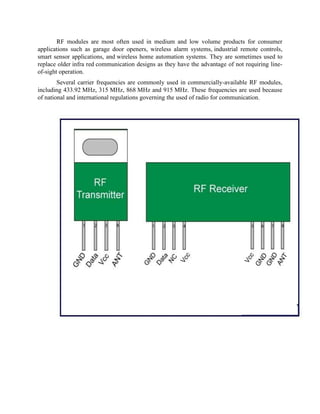
An RF module (radio frequency module) is a (usually) small electronic circuit used to
transmit and/or receive radio signals on one of a number of carrier frequencies. RF modules are
widely used in electronic design owing to the difficulty of designing radio circuitry. Good
electronic radio design is notoriously complex because of the sensitivity of radio circuits and the
accuracy of components and layouts required achieving operation on a specific frequency.
Design engineers will design a circuit for an application which requires radio communication
and then "drop in" a radio module rather than attempt a discrete design, saving time and money
on development.
RF modules are most often used in medium and low volume products for consumer
applications such as garage door openers, wireless alarm systems, industrial remote controls,
smart sensor applications, and wireless home automation systems. They are sometimes used to
replace older infra red communication designs as they have the advantage of not requiring line-
of-sight operation.
Several carrier frequencies are commonly used in commercially-available RF modules,
including 433.92 MHz, 315 MHz, 868 MHz and 915 MHz. These frequencies are used because
of national and international regulations governing the used of radio for communication.
BLOCK DIAGRAM:
INTRODUCTION:
Your arm's job is to move your hand from place to place. Similarly, the robotic arm's job
is to move an end effectors from place to place. You can outfit robotic arms with all sorts of end
effectors, which are suited to a particular application. One common end effectors is a simplified
version of the hand, which can grasp and carry different objects. Robotic hands often have built-
in pressure sensors that tell the computer how hard the robot is gripping a particular object. This
keeps the robot from dropping or breaking whatever it's carrying. Other end effectors include
blowtorches, drills and spray painters.
An industrial robot with six joints closely resembles a human arm -- it has the equivalent
of a shoulder, an elbow and a wrist. Typically, the shoulder is mounted to a stationary base
structure rather than to a movable body. This type of robot has six degrees of freedom, meaning
it can pivot in six different ways. A human arm, by comparison, has seven degrees of freedom.
Industrial robots are designed to do exactly the same thing, in a controlled environment,
over and over again. For example, a robot might twist the caps onto peanut butter jars coming
down an assembly line. To teach a robot how to do its job, the programmer guides the arm
through the motions using a handheld controller. The robot stores the exact sequence of
movements in its memory, and does it again and again every time a new unit comes down the
assembly line.
Most industrial robots work in auto assembly lines, putting cars together. Robots can do a
lot of this work more efficiently than human beings because they are so precise. They always
drill in the exactly the same place, and they always tighten bolts with the same amount of force,
no matter how many hours they've been working. Manufacturing robots are also very important
in the computer industry. It takes an incredibly precise hand to put together a tiny microchip.
A robotic arm is a type of mechanical arm, usually programmable, with similar
functions to a human arm; the arm may be the sum total of the mechanism or may be part of a
more complex robot. The links of such a manipulator are connected by joints allowing either
rotational motion (such as in an articulated robot) or translational (linear) displacement.
Robotic arm has been widely use in manufacturing industry as part of automation system.
Typical applications of robotics arms in industry include welding, painting, assembly pick and
place, packaging and palletizing, product inspection, and testing. The wireless controlled robotic
arm has the same mechanism as the robots in industry. This robotic arm is fully controlled by a
microcontrolled based system, where the user has to control the movement of robot using the DC
motors.
Here we are using a RF Module pair for providing communication between the controller
and the motor circuit. The signal from the Transmitter will be received by the AT89S52 at the
circuit. The justified signal will then be use to execute the output to the DC motor, thus provide
the necessary movement of the robotic arm. The special attributes of the project is the robotic
arm is wireless control based, that makes it different than typical manual control robotic arm.
The project is very useful in gaining new experience and knowledge on robot arm fabrication
and programming.
CONCLUSION:
This is an ambitious robotic arm project, but one that is exciting, challenging, and staying
on schedule. The concept of robotic arm presented here is meant to be easily extendable in future
years. The following few months will be dedicated to the testing, analysis, assembly,
microcontroller programming, and final development of this project. The overall project will be
assembled and wired to the AT89S52.
FUTURE ASPECTS:
In industry use of robotic arms are welding, painting, assembly pick and place, packaging
and palletizing, product inspection, and testing etc. And it may be used in other purpose like in
defense for controlling guns and other weapons. The end effectors, or robotic hand, can be
designed to perform any desired task such as welding, gripping, spinning etc., depending on the
application. For example robot arms in automotive assembly lines perform a variety of tasks
such as welding and parts rotation and placement during assembly. In some circumstances, close
emulation of the human hand is desired, as in robots designed to conduct bomb.

Wireless controlled robotic arm

  • 1.
    Synopsis On WirelessControlled Robotic Arm OBJECTIVE: The main objective of this project is to build a wireless controlled Robotic arm that is capable of picking and placing an object. During the completion of this project, the objectives to be achieved are to:  Understand the basic Configuration of Robot  To understand programming for robot.  To construct the electrical Diagram  Fabricate and run the robot IMPLEMENTATION: This project is implemented using a microcontroller that is AT89S52 (8051) with RF module pair of transmitter and receiver and DC motors with motor driving IC’s. The Intel MCS-51 (commonly referred to as 8051) is a Harvard architecture, CISC instruction set, single chip microcontroller (µC) series which was developed by Intel in 1980 for use in embedded. Intel's original versions were popular in the 1980s and early 1990s and enhanced binary compatible derivatives remain popular today. Intel's original MCS-51 family was developed using NMOS technology, but later versions, identified by a letter C in their name (e.g., 80C51) used CMOS technology and consume less power than their NMOS predecessors. This made them more suitable for battery- powered devices. The family was in 1996 continued with the enhanced 8-bit MCS-151 and the 8/16/32- bitMCS-251 family of binary compatible microcontrollers.[2] While Intel no longer manufactures the MCS-51, MCS-151 and MCS-251 family, enhanced binary compatible derivatives made by numerous vendors remain popular today. Some derivatives integrate a digital signal processor (DSP). In addition to these physical devices, several companies also offer MCS-51 derivatives as IP cores for use in FPGAs or ASICs designs. An RF module (radio frequency module) is a (usually) small electronic circuit used to transmit and/or receive radio signals on one of a number of carrier frequencies. RF modules are widely used in electronic design owing to the difficulty of designing radio circuitry. Good electronic radio design is notoriously complex because of the sensitivity of radio circuits and the accuracy of components and layouts required achieving operation on a specific frequency. Design engineers will design a circuit for an application which requires radio communication and then "drop in" a radio module rather than attempt a discrete design, saving time and money on development.
  • 2.
    RF modules aremost often used in medium and low volume products for consumer applications such as garage door openers, wireless alarm systems, industrial remote controls, smart sensor applications, and wireless home automation systems. They are sometimes used to replace older infra red communication designs as they have the advantage of not requiring line- of-sight operation. Several carrier frequencies are commonly used in commercially-available RF modules, including 433.92 MHz, 315 MHz, 868 MHz and 915 MHz. These frequencies are used because of national and international regulations governing the used of radio for communication.
  • 3.
    BLOCK DIAGRAM: INTRODUCTION: Your arm'sjob is to move your hand from place to place. Similarly, the robotic arm's job is to move an end effectors from place to place. You can outfit robotic arms with all sorts of end effectors, which are suited to a particular application. One common end effectors is a simplified version of the hand, which can grasp and carry different objects. Robotic hands often have built- in pressure sensors that tell the computer how hard the robot is gripping a particular object. This keeps the robot from dropping or breaking whatever it's carrying. Other end effectors include blowtorches, drills and spray painters. An industrial robot with six joints closely resembles a human arm -- it has the equivalent of a shoulder, an elbow and a wrist. Typically, the shoulder is mounted to a stationary base structure rather than to a movable body. This type of robot has six degrees of freedom, meaning it can pivot in six different ways. A human arm, by comparison, has seven degrees of freedom. Industrial robots are designed to do exactly the same thing, in a controlled environment, over and over again. For example, a robot might twist the caps onto peanut butter jars coming
  • 4.
    down an assemblyline. To teach a robot how to do its job, the programmer guides the arm through the motions using a handheld controller. The robot stores the exact sequence of movements in its memory, and does it again and again every time a new unit comes down the assembly line. Most industrial robots work in auto assembly lines, putting cars together. Robots can do a lot of this work more efficiently than human beings because they are so precise. They always drill in the exactly the same place, and they always tighten bolts with the same amount of force, no matter how many hours they've been working. Manufacturing robots are also very important in the computer industry. It takes an incredibly precise hand to put together a tiny microchip. A robotic arm is a type of mechanical arm, usually programmable, with similar functions to a human arm; the arm may be the sum total of the mechanism or may be part of a more complex robot. The links of such a manipulator are connected by joints allowing either rotational motion (such as in an articulated robot) or translational (linear) displacement. Robotic arm has been widely use in manufacturing industry as part of automation system. Typical applications of robotics arms in industry include welding, painting, assembly pick and place, packaging and palletizing, product inspection, and testing. The wireless controlled robotic arm has the same mechanism as the robots in industry. This robotic arm is fully controlled by a microcontrolled based system, where the user has to control the movement of robot using the DC motors. Here we are using a RF Module pair for providing communication between the controller and the motor circuit. The signal from the Transmitter will be received by the AT89S52 at the circuit. The justified signal will then be use to execute the output to the DC motor, thus provide the necessary movement of the robotic arm. The special attributes of the project is the robotic arm is wireless control based, that makes it different than typical manual control robotic arm. The project is very useful in gaining new experience and knowledge on robot arm fabrication and programming. CONCLUSION: This is an ambitious robotic arm project, but one that is exciting, challenging, and staying on schedule. The concept of robotic arm presented here is meant to be easily extendable in future years. The following few months will be dedicated to the testing, analysis, assembly, microcontroller programming, and final development of this project. The overall project will be assembled and wired to the AT89S52.
  • 5.
    FUTURE ASPECTS: In industryuse of robotic arms are welding, painting, assembly pick and place, packaging and palletizing, product inspection, and testing etc. And it may be used in other purpose like in defense for controlling guns and other weapons. The end effectors, or robotic hand, can be designed to perform any desired task such as welding, gripping, spinning etc., depending on the application. For example robot arms in automotive assembly lines perform a variety of tasks such as welding and parts rotation and placement during assembly. In some circumstances, close emulation of the human hand is desired, as in robots designed to conduct bomb.