Mass
spectroscopy
INTRODUCTION :
• Mass spectrometry (MS) is an analytical technique that measures
the mass-to-charge ratio (m/z) of ions."
• "It provides information about the composition and structure of
molecules."
• This technique basically studies the effect of ionizing energy on
molecules.
• Now a day's mass spectrometry is used in many areas
including pharmaceutical, clinical, geological, biotechnology
and environmental.
PRINCIPLE
:• In this technique, molecules are bombarded with a beam
of energetic electrons.
• The molecules are ionized and broken up into many fragments,
some of which are positive ions. Each kind of ion has a
particular ratio of mass to charge, i.e. m/e ratio (value).
• For most ions, the charge is one and thus, m/e ratio is
simply the molecular mass of the ion.
• The ions pass through magnetic and electric fields to reach
detector where they are detected and signals are recorded to
give a mass spectra.
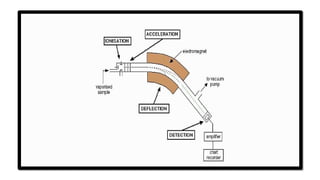
INSTRUMENTATION :
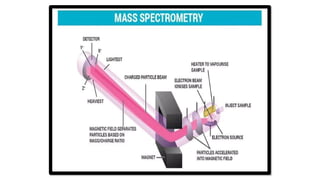
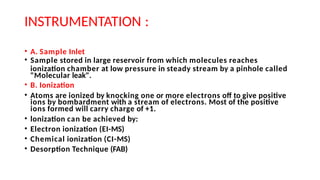
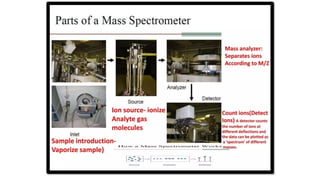
• A. Sample Inlet
• Sample stored in large reservoir from which molecules reaches
ionization chamber at low pressure in steady stream by a pinhole called
"Molecular leak".
• B. Ionization
• Atoms are ionized by knocking one or more electrons off to give positive
ions by bombardment with a stream of electrons. Most of the positive
ions formed will carry charge of +1.
• lonization can be achieved by:
• Electron ionization (EI-MS)
• Chemical ionization (CI-MS)
• Desorption Technique (FAB)
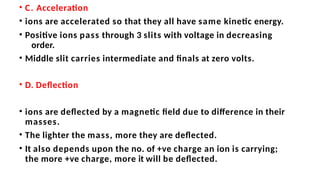
• C. Acceleration
• ions are accelerated so that they all have same kinetic energy.
• Positive ions pass through 3 slits with voltage in decreasing
order.
• Middle slit carries intermediate and finals at zero volts.
• D. Deflection
• ions are deflected by a magnetic field due to difference in their
masses.
• The lighter the mass, more they are deflected.
• It also depends upon the no. of +ve charge an ion is carrying;
the more +ve charge, more it will be deflected.
• E. Detection
• The beam of ions passing through the mass analyzer is
detected by detector on the basis of m/e ratio.
• When an ion hit the metal box, charge is neutralized by an
electron jumping from metal on to the ion.
• APPLICATION :
• Environmental monitoring and analysis (soil, water and air
pollutants, water quality, etc.).
• Chemical and Petrochemical industry - Quality control.
• Identify structures of biomolecules, such as carbohydrates,
nucleic acids
• Sequence biopolymers such as proteins and
oligosaccharides
• Determination of molecular mass of peptides, proteins, and
oligonucleotides.
• Monitoring gases in patients breath during surgery.
• Identification of drugs abuse and metabolites of drugs of
abuse in blood, urine, and saliva.
• Advantages:
• High Sensitivity:
• Mass spectrometry can detect and quantify even trace amounts of substances, making it ideal for analyzing samples with very
low concentrations.
• High Specificity:
• The mass-to-charge ratio (m/z) provides a unique fingerprint for each molecule, allowing for accurate identification and
differentiation of compounds.
• Versatility:
• Mass spectrometry can be used to analyze a wide range of substances, including small molecules, proteins, polymers, and even
complex mixtures.
• Structural Information:
• Fragmentation patterns in mass spectra can provide valuable information about the structure and chemical properties of
molecules.
• Isotopic Information:
• Mass spectrometry can determine the isotopic composition of a sample, which is useful in various applications, such as carbon
dating and tracing metabolic pathways.
• Coupling with other Techniques:
• Mass spectrometry is often coupled with separation techniques like Gas chromatography (GC-MS) and Liquid chromatography
(LC-MS) greatly enhancing the ability to analyze complex mixtures.
• Disadvantages:
• Cost:
• Sample Preparation:
• Some samples require extensive preparation before they can be analyzed by mass spectrometry, which can be time-consuming
and labor-intensive.
• Vacuum requirements:
• Mass spectrometers operate under high vacuum conditions, which adds to the complexity of the instrument.
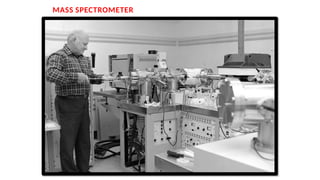
MASS SPECTROMETER
• https://images.app.goo.gl/9ucH
• https://images.app.goo.gl/7m1u
• https://youtu.be/w3LS22E10Zc?si=z3aksI9OHQSGw8DG
Reference :
Mass Spectroscopy Principale and Its Application

Mass Spectroscopy Principale and Its Application

  • 1.
  • 2.
    INTRODUCTION : • Massspectrometry (MS) is an analytical technique that measures the mass-to-charge ratio (m/z) of ions." • "It provides information about the composition and structure of molecules." • This technique basically studies the effect of ionizing energy on molecules. • Now a day's mass spectrometry is used in many areas including pharmaceutical, clinical, geological, biotechnology and environmental.
  • 4.
    PRINCIPLE :• In thistechnique, molecules are bombarded with a beam of energetic electrons. • The molecules are ionized and broken up into many fragments, some of which are positive ions. Each kind of ion has a particular ratio of mass to charge, i.e. m/e ratio (value). • For most ions, the charge is one and thus, m/e ratio is simply the molecular mass of the ion. • The ions pass through magnetic and electric fields to reach detector where they are detected and signals are recorded to give a mass spectra.
  • 6.
    INSTRUMENTATION : • A.Sample Inlet • Sample stored in large reservoir from which molecules reaches ionization chamber at low pressure in steady stream by a pinhole called "Molecular leak". • B. Ionization • Atoms are ionized by knocking one or more electrons off to give positive ions by bombardment with a stream of electrons. Most of the positive ions formed will carry charge of +1. • lonization can be achieved by: • Electron ionization (EI-MS) • Chemical ionization (CI-MS) • Desorption Technique (FAB)
  • 7.
    • C. Acceleration •ions are accelerated so that they all have same kinetic energy. • Positive ions pass through 3 slits with voltage in decreasing order. • Middle slit carries intermediate and finals at zero volts. • D. Deflection • ions are deflected by a magnetic field due to difference in their masses. • The lighter the mass, more they are deflected. • It also depends upon the no. of +ve charge an ion is carrying; the more +ve charge, more it will be deflected.
  • 8.
    • E. Detection •The beam of ions passing through the mass analyzer is detected by detector on the basis of m/e ratio. • When an ion hit the metal box, charge is neutralized by an electron jumping from metal on to the ion.
  • 9.
    • APPLICATION : •Environmental monitoring and analysis (soil, water and air pollutants, water quality, etc.). • Chemical and Petrochemical industry - Quality control. • Identify structures of biomolecules, such as carbohydrates, nucleic acids • Sequence biopolymers such as proteins and oligosaccharides • Determination of molecular mass of peptides, proteins, and oligonucleotides. • Monitoring gases in patients breath during surgery. • Identification of drugs abuse and metabolites of drugs of abuse in blood, urine, and saliva.
  • 10.
    • Advantages: • HighSensitivity: • Mass spectrometry can detect and quantify even trace amounts of substances, making it ideal for analyzing samples with very low concentrations. • High Specificity: • The mass-to-charge ratio (m/z) provides a unique fingerprint for each molecule, allowing for accurate identification and differentiation of compounds. • Versatility: • Mass spectrometry can be used to analyze a wide range of substances, including small molecules, proteins, polymers, and even complex mixtures. • Structural Information: • Fragmentation patterns in mass spectra can provide valuable information about the structure and chemical properties of molecules. • Isotopic Information: • Mass spectrometry can determine the isotopic composition of a sample, which is useful in various applications, such as carbon dating and tracing metabolic pathways. • Coupling with other Techniques: • Mass spectrometry is often coupled with separation techniques like Gas chromatography (GC-MS) and Liquid chromatography (LC-MS) greatly enhancing the ability to analyze complex mixtures. • Disadvantages: • Cost: • Sample Preparation: • Some samples require extensive preparation before they can be analyzed by mass spectrometry, which can be time-consuming and labor-intensive. • Vacuum requirements: • Mass spectrometers operate under high vacuum conditions, which adds to the complexity of the instrument.
  • 12.
  • 13.
    • https://images.app.goo.gl/9ucH • https://images.app.goo.gl/7m1u •https://youtu.be/w3LS22E10Zc?si=z3aksI9OHQSGw8DG Reference :