MARKETING 
STRATEGY AND 
PLANNING 
Dilip S. Mutum PhD 
Nottingham University Business School 
dilip.mutum@nottingham.edu.my 
twitter: @admutum
Learning Outcomes 
 To define strategy, strategic planning 
and to understand the key concepts of 
the marketing planning process. 
 To understand the differences between 
strategic and tactical marketing 
planning. 
 To understand the key concepts and 
some strategic marketing analysis tools.
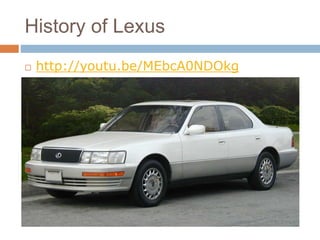
History of Lexus 
 http://youtu.be/MEbcA0NDOkg
Strategy 
 A strategy is a plan of action designed to 
achieve certain defined objectives 
 Strategy is a plan that aims to give the 
enterprise a competitive advantage over 
rivals. 
Strategy is about understanding what you do, 
Knowing what you want to become, 
and most importantly 
Focusing on how you plan to get there. 
Strategy is indeed a process!!
Strategy 
 Strategies are developed at multiple 
levels in the organizations – corporate, 
divisional, business unit, and 
departmental. They form an 
integrated plan for the organization as a 
whole. 
 Corporate strategies are the sum of 
business unit strategies plus any plans 
for new business initiatives.
Strategic Planning 
Strategic planning is the process of 
developing and maintaining a 
strategic fit 
between the organization’s goals 
and capabilities and its changing 
marketing opportunities.
Excellent Companies 
 In Search of Excellence – (Tom Peters and 
Robert Waterman,1982) 
 43 “excellent companies” 
 8 years later - only 6 excellent companies 
left (Pascale, 1990) 
 Fixation with excellent tactics at the 
expense of strategy 
 Pascale, R.T. (1990), Managing on the edge, New York: 
Simon and Schuster, 352 pp
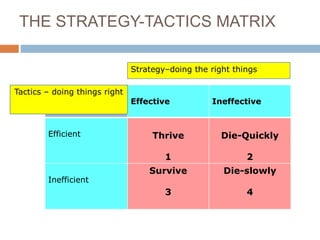
THE STRATEGY-TACTICS MATRIX 
Effective Ineffective 
Efficient Thrive 
1 
Die-Quickly 
2 
Inefficient 
Survive 
3 
Die-slowly 
4 
Tactics – doing things right 
Strategy–doing the right things
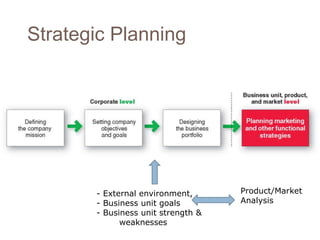
Strategic Planning 
- External environment, 
- Business unit goals 
- Business unit strength & 
weaknesses 
Product/Market 
Analysis
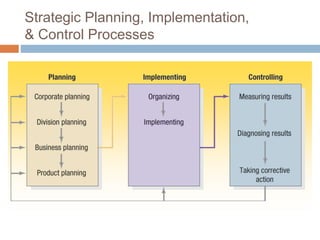
Strategic Planning, Implementation, 
& Control Processes
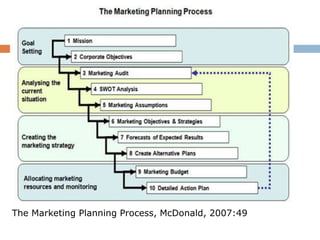
The Marketing Planning Process, McDonald, 2007:49
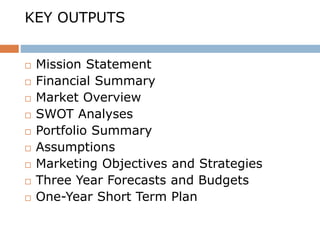
KEY OUTPUTS 
 Mission Statement 
 Financial Summary 
 Market Overview 
 SWOT Analyses 
 Portfolio Summary 
 Assumptions 
 Marketing Objectives and Strategies 
 Three Year Forecasts and Budgets 
 One-Year Short Term Plan
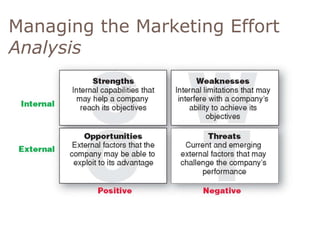
Managing the Marketing Effort 
Analysis 
Marketing Analysis – SWOT Analysis
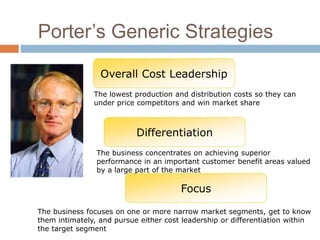
Porter’s Generic Strategies 
Overall Cost Leadership 
The lowest production and distribution costs so they can 
under price competitors and win market share 
Differentiation 
The business concentrates on achieving superior 
performance in an important customer benefit areas valued 
by a large part of the market 
Focus 
The business focuses on one or more narrow market segments, get to know 
them intimately, and pursue either cost leadership or differentiation within 
the target segment
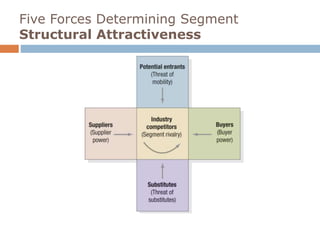
Five Forces Determining Segment 
Structural Attractiveness
Example 
 Mat Ramli is deciding whether to switch 
career and become a farmer 
 He's always loved the countryside, and 
wants to switch to a career where he's 
his own boss. 
 He creates the following Five Forces 
Analysis as he thinks the situation 
through:
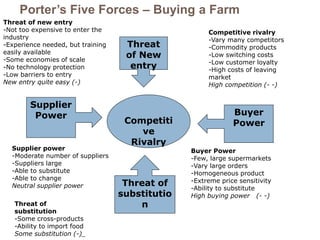
Porter’s Five Forces – Buying a Farm 
Threat 
of New 
entry 
Supplier 
Power Buyer 
Power 
Threat of 
substitutio 
n 
Threat of new entry 
-Not too expensive to enter the 
industry 
-Experience needed, but training 
easily available 
-Some economies of scale 
-No technology protection 
-Low barriers to entry 
New entry quite easy (-) 
Competitive rivalry 
-Vary many competitors 
-Commodity products 
-Low switching costs 
-Low customer loyalty 
-High costs of leaving 
market 
High competition (- -) 
Buyer Power 
-Few, large supermarkets 
-Vary large orders 
-Homogeneous product 
-Extreme price sensitivity 
-Ability to substitute 
High buying power (- -) 
Supplier power 
-Moderate number of suppliers 
-Suppliers large 
-Able to substitute 
-Able to change 
Neutral supplier power 
Threat of 
substitution 
-Some cross-products 
-Ability to import food 
Some substitution (-)_ 
Competiti 
ve 
Rivalry
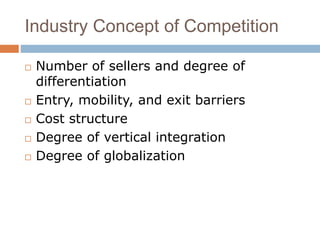
Industry Concept of Competition 
 Number of sellers and degree of 
differentiation 
 Entry, mobility, and exit barriers 
 Cost structure 
 Degree of vertical integration 
 Degree of globalization
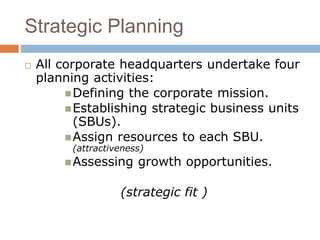
Strategic Planning 
 All corporate headquarters undertake four 
planning activities: 
Defining the corporate mission. 
Establishing strategic business units 
(SBUs). 
Assign resources to each SBU. 
(attractiveness) 
Assessing growth opportunities. 
(strategic fit )
Strategic Planning 
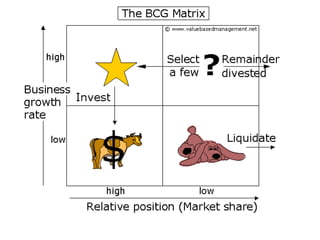
 The business portfolio is the collection 
of businesses and products that make up 
the company 
 Portfolio analysis is a major activity in 
strategic planning whereby management 
evaluates the products and businesses 
that make up the company
Strategic Planning 
Analyzing the Current Business Portfolio 
Strategic business unit (SBU) is a 
unit of the company that has a 
separate mission and objectives 
that can be planned separately 
from other company businesses 
 Company division 
 Product line within a division 
 Single product or brand
Strategic Planning 
Strategic planning is the 
process of developing and 
maintaining a strategic fit 
between the organization’s 
goals and capabilities and 
its changing marketing 
opportunities.
Strategic Planning – Assessing 
Growth Opportunities 
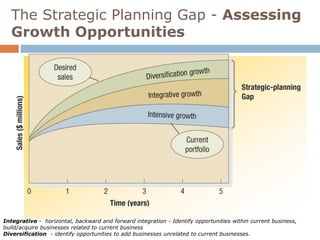
 Assessing growth opportunities include 
planning new businesses, downsizing and 
terminating older businesses. 
 If there is a gap between future desired 
sales and projected sales, corporate 
management will need to develop /acquire 
new businesses to fill in. 
 To release needed resources for other use, 
and to reduce costs, companies must be 
carefully prune, harvest or divest tired old 
businesses.
Strategic Planning 
Problems with Matrix Approaches 
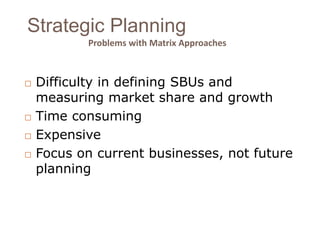
 Difficulty in defining SBUs and 
measuring market share and growth 
 Time consuming 
 Expensive 
 Focus on current businesses, not future 
planning
The Strategic Planning Gap - Assessing 
Growth Opportunities 
Integrative - horizontal, backward and forward integration - Identify opportunities within current business, 
build/acquire businesses related to current business 
Diversification - identify opportunities to add businesses unrelated to current businesses.
Strategic Planning – Intensive 
Growth 
Developing Strategies for Growth and Downsizing 
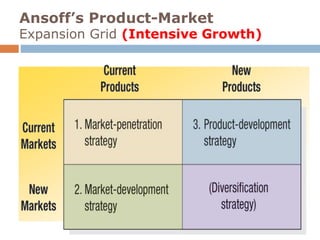
Product/market expansion grid is a 
tool for identifying company growth 
opportunities through 
 market penetration 
 market development 
 product development or 
 diversification
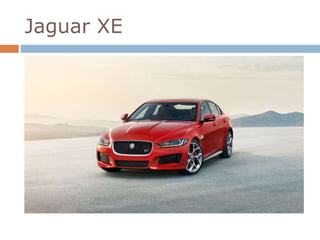
Jaguar XE
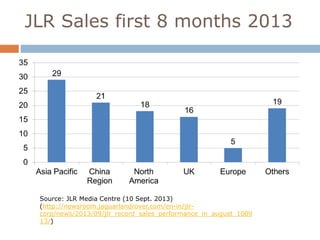
JLR Sales first 8 months 2013 
Source: JLR Media Centre (10 Sept. 2013) 
(http://newsroom.jaguarlandrover.com/en-in/jlr-corp/ 
news/2013/09/jlr_record_sales_performance_in_august_1009 
13/)
Ansoff’s Product-Market 
Expansion Grid (Intensive Growth)
Strategic Planning 
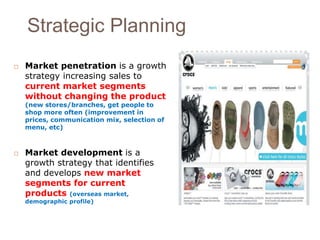
 Market penetration is a growth 
strategy increasing sales to 
current market segments 
without changing the product 
(new stores/branches, get people to 
shop more often (improvement in 
prices, communication mix, selection of 
menu, etc) 
 Market development is a 
growth strategy that identifies 
and develops new market 
segments for current 
products (overseas market, 
demographic profile)
Strategic Planning 
 Product development is a growth 
strategy that offers new or modified 
products to existing market 
segments (bank, new menu) 
 Diversification is a growth strategy 
through starting up or acquiring 
businesses outside the company’s 
current products and markets – Virgin 
group of Companies
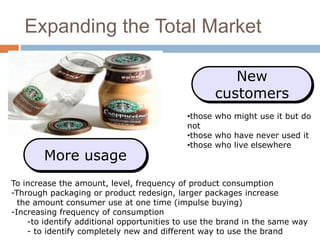
Expanding the Total Market 
New 
customers 
More usage 
•those who might use it but do 
not 
•those who have never used it 
•those who live elsewhere 
To increase the amount, level, frequency of product consumption 
-Through packaging or product redesign, larger packages increase 
the amount consumer use at one time (impulse buying) 
-Increasing frequency of consumption 
-to identify additional opportunities to use the brand in the same way 
- to identify completely new and different way to use the brand
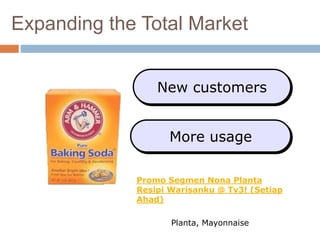
Expanding the Total Market 
New customers 
More usage 
Promo Segmen Nona Planta 
Resipi Warisanku @ Tv3! (Setiap 
Ahad) 
Planta, Mayonnaise
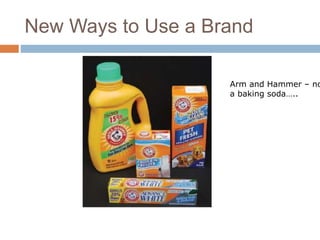
New Ways to Use a Brand 
Arm and Hammer – not a baking soda…..
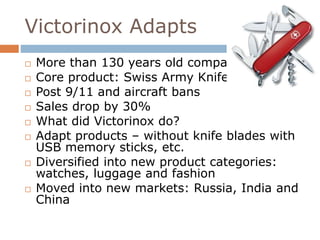
Victorinox Adapts 
 More than 130 years old company 
 Core product: Swiss Army Knife 
 Post 9/11 and aircraft bans 
 Sales drop by 30% 
 What did Victorinox do? 
 Adapt products – without knife blades with 
USB memory sticks, etc. 
 Diversified into new product categories: 
watches, luggage and fashion 
 Moved into new markets: Russia, India and 
China
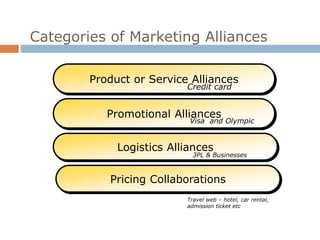
Categories of Marketing Alliances 
Product or Service Alliances 
Credit card 
Promotional Alliances 
Visa and Olympic 
Logistics Alliances 
3PL & Businesses 
Pricing Collaborations 
Travel web – hotel, car rental, 
admission ticket etc
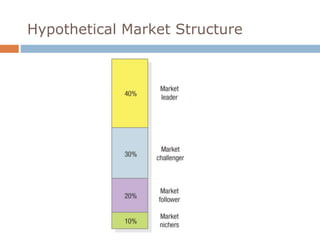
Hypothetical Market Structure
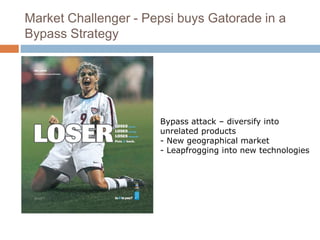
Market Challenger - Pepsi buys Gatorade in a 
Bypass Strategy 
Bypass attack – diversify into 
unrelated products 
- New geographical market 
- Leapfrogging into new technologies
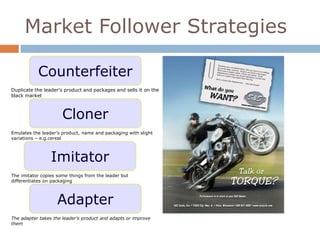
Market Follower Strategies 
Counterfeiter 
Duplicate the leader’s product and packages and sells it on the 
black market 
Cloner 
Emulates the leader’s product, name and packaging with slight 
variations – e.g.cereal 
Imitator 
The imitator copies some things from the leader but 
differentiates on packaging 
Adapter 
The adapter takes the leader’s product and adapts or improve 
them
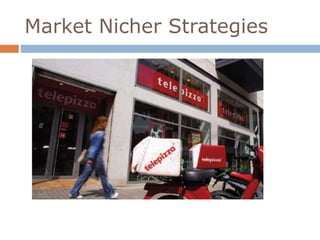
Market Nicher Strategies
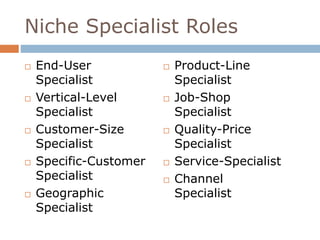
Niche Specialist Roles 
 End-User 
Specialist 
 Vertical-Level 
Specialist 
 Customer-Size 
Specialist 
 Specific-Customer 
Specialist 
 Geographic 
Specialist 
 Product-Line 
Specialist 
 Job-Shop 
Specialist 
 Quality-Price 
Specialist 
 Service-Specialist 
 Channel 
Specialist
Brand Leadership 
 Consumer Insights: Dulux 
• ‘Paint’ is not consumer friendly 
• Don’t think of paint not until we have to 
paint our house 
• We choose the color but painter will decide 
the brand 
• Low involvement, no interaction, not ‘thrill’ 
about shopping for paint 
• recommend by contractor, painter 
• boring functional value (cold hard facts) – 
fungus free, color doesn’t fade
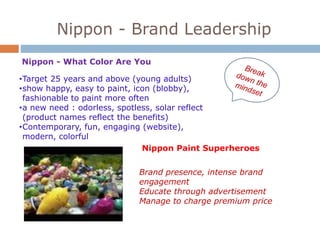
Nippon - Brand Leadership 
Nippon - What Color Are You 
•Target 25 years and above (young adults) 
•show happy, easy to paint, icon (blobby), 
fashionable to paint more often 
•a new need : odorless, spotless, solar reflect 
(product names reflect the benefits) 
•Contemporary, fun, engaging (website), 
modern, colorful 
Nippon Paint Superheroes 
Brand presence, intense brand 
engagement 
Educate through advertisement 
Manage to charge premium price
Thanks www.dilipmutum.com

Marketing strategy and planning

  • 1.
    MARKETING STRATEGY AND PLANNING Dilip S. Mutum PhD Nottingham University Business School dilip.mutum@nottingham.edu.my twitter: @admutum
  • 2.
    Learning Outcomes To define strategy, strategic planning and to understand the key concepts of the marketing planning process.  To understand the differences between strategic and tactical marketing planning.  To understand the key concepts and some strategic marketing analysis tools.
  • 3.
    History of Lexus  http://youtu.be/MEbcA0NDOkg
  • 4.
    Strategy  Astrategy is a plan of action designed to achieve certain defined objectives  Strategy is a plan that aims to give the enterprise a competitive advantage over rivals. Strategy is about understanding what you do, Knowing what you want to become, and most importantly Focusing on how you plan to get there. Strategy is indeed a process!!
  • 5.
    Strategy  Strategiesare developed at multiple levels in the organizations – corporate, divisional, business unit, and departmental. They form an integrated plan for the organization as a whole.  Corporate strategies are the sum of business unit strategies plus any plans for new business initiatives.
  • 6.
    Strategic Planning Strategicplanning is the process of developing and maintaining a strategic fit between the organization’s goals and capabilities and its changing marketing opportunities.
  • 7.
    Excellent Companies In Search of Excellence – (Tom Peters and Robert Waterman,1982)  43 “excellent companies”  8 years later - only 6 excellent companies left (Pascale, 1990)  Fixation with excellent tactics at the expense of strategy  Pascale, R.T. (1990), Managing on the edge, New York: Simon and Schuster, 352 pp
  • 8.
    THE STRATEGY-TACTICS MATRIX Effective Ineffective Efficient Thrive 1 Die-Quickly 2 Inefficient Survive 3 Die-slowly 4 Tactics – doing things right Strategy–doing the right things
  • 9.
    Strategic Planning -External environment, - Business unit goals - Business unit strength & weaknesses Product/Market Analysis
  • 10.
  • 11.
    The Marketing PlanningProcess, McDonald, 2007:49
  • 13.
    KEY OUTPUTS Mission Statement  Financial Summary  Market Overview  SWOT Analyses  Portfolio Summary  Assumptions  Marketing Objectives and Strategies  Three Year Forecasts and Budgets  One-Year Short Term Plan
  • 14.
    Managing the MarketingEffort Analysis Marketing Analysis – SWOT Analysis
  • 15.
    Porter’s Generic Strategies Overall Cost Leadership The lowest production and distribution costs so they can under price competitors and win market share Differentiation The business concentrates on achieving superior performance in an important customer benefit areas valued by a large part of the market Focus The business focuses on one or more narrow market segments, get to know them intimately, and pursue either cost leadership or differentiation within the target segment
  • 16.
    Five Forces DeterminingSegment Structural Attractiveness
  • 17.
    Example  MatRamli is deciding whether to switch career and become a farmer  He's always loved the countryside, and wants to switch to a career where he's his own boss.  He creates the following Five Forces Analysis as he thinks the situation through:
  • 18.
    Porter’s Five Forces– Buying a Farm Threat of New entry Supplier Power Buyer Power Threat of substitutio n Threat of new entry -Not too expensive to enter the industry -Experience needed, but training easily available -Some economies of scale -No technology protection -Low barriers to entry New entry quite easy (-) Competitive rivalry -Vary many competitors -Commodity products -Low switching costs -Low customer loyalty -High costs of leaving market High competition (- -) Buyer Power -Few, large supermarkets -Vary large orders -Homogeneous product -Extreme price sensitivity -Ability to substitute High buying power (- -) Supplier power -Moderate number of suppliers -Suppliers large -Able to substitute -Able to change Neutral supplier power Threat of substitution -Some cross-products -Ability to import food Some substitution (-)_ Competiti ve Rivalry
  • 19.
    Industry Concept ofCompetition  Number of sellers and degree of differentiation  Entry, mobility, and exit barriers  Cost structure  Degree of vertical integration  Degree of globalization
  • 20.
    Strategic Planning All corporate headquarters undertake four planning activities: Defining the corporate mission. Establishing strategic business units (SBUs). Assign resources to each SBU. (attractiveness) Assessing growth opportunities. (strategic fit )
  • 21.
    Strategic Planning The business portfolio is the collection of businesses and products that make up the company  Portfolio analysis is a major activity in strategic planning whereby management evaluates the products and businesses that make up the company
  • 22.
    Strategic Planning Analyzingthe Current Business Portfolio Strategic business unit (SBU) is a unit of the company that has a separate mission and objectives that can be planned separately from other company businesses  Company division  Product line within a division  Single product or brand
  • 23.
    Strategic Planning Strategicplanning is the process of developing and maintaining a strategic fit between the organization’s goals and capabilities and its changing marketing opportunities.
  • 24.
    Strategic Planning –Assessing Growth Opportunities  Assessing growth opportunities include planning new businesses, downsizing and terminating older businesses.  If there is a gap between future desired sales and projected sales, corporate management will need to develop /acquire new businesses to fill in.  To release needed resources for other use, and to reduce costs, companies must be carefully prune, harvest or divest tired old businesses.
  • 26.
    Strategic Planning Problemswith Matrix Approaches  Difficulty in defining SBUs and measuring market share and growth  Time consuming  Expensive  Focus on current businesses, not future planning
  • 27.
    The Strategic PlanningGap - Assessing Growth Opportunities Integrative - horizontal, backward and forward integration - Identify opportunities within current business, build/acquire businesses related to current business Diversification - identify opportunities to add businesses unrelated to current businesses.
  • 28.
    Strategic Planning –Intensive Growth Developing Strategies for Growth and Downsizing Product/market expansion grid is a tool for identifying company growth opportunities through  market penetration  market development  product development or  diversification
  • 29.
  • 30.
    JLR Sales first8 months 2013 Source: JLR Media Centre (10 Sept. 2013) (http://newsroom.jaguarlandrover.com/en-in/jlr-corp/ news/2013/09/jlr_record_sales_performance_in_august_1009 13/)
  • 31.
    Ansoff’s Product-Market ExpansionGrid (Intensive Growth)
  • 32.
    Strategic Planning Market penetration is a growth strategy increasing sales to current market segments without changing the product (new stores/branches, get people to shop more often (improvement in prices, communication mix, selection of menu, etc)  Market development is a growth strategy that identifies and develops new market segments for current products (overseas market, demographic profile)
  • 33.
    Strategic Planning Product development is a growth strategy that offers new or modified products to existing market segments (bank, new menu)  Diversification is a growth strategy through starting up or acquiring businesses outside the company’s current products and markets – Virgin group of Companies
  • 34.
    Expanding the TotalMarket New customers More usage •those who might use it but do not •those who have never used it •those who live elsewhere To increase the amount, level, frequency of product consumption -Through packaging or product redesign, larger packages increase the amount consumer use at one time (impulse buying) -Increasing frequency of consumption -to identify additional opportunities to use the brand in the same way - to identify completely new and different way to use the brand
  • 35.
    Expanding the TotalMarket New customers More usage Promo Segmen Nona Planta Resipi Warisanku @ Tv3! (Setiap Ahad) Planta, Mayonnaise
  • 36.
    New Ways toUse a Brand Arm and Hammer – not a baking soda…..
  • 37.
    Victorinox Adapts More than 130 years old company  Core product: Swiss Army Knife  Post 9/11 and aircraft bans  Sales drop by 30%  What did Victorinox do?  Adapt products – without knife blades with USB memory sticks, etc.  Diversified into new product categories: watches, luggage and fashion  Moved into new markets: Russia, India and China
  • 38.
    Categories of MarketingAlliances Product or Service Alliances Credit card Promotional Alliances Visa and Olympic Logistics Alliances 3PL & Businesses Pricing Collaborations Travel web – hotel, car rental, admission ticket etc
  • 39.
  • 40.
    Market Challenger -Pepsi buys Gatorade in a Bypass Strategy Bypass attack – diversify into unrelated products - New geographical market - Leapfrogging into new technologies
  • 41.
    Market Follower Strategies Counterfeiter Duplicate the leader’s product and packages and sells it on the black market Cloner Emulates the leader’s product, name and packaging with slight variations – e.g.cereal Imitator The imitator copies some things from the leader but differentiates on packaging Adapter The adapter takes the leader’s product and adapts or improve them
  • 42.
  • 43.
    Niche Specialist Roles  End-User Specialist  Vertical-Level Specialist  Customer-Size Specialist  Specific-Customer Specialist  Geographic Specialist  Product-Line Specialist  Job-Shop Specialist  Quality-Price Specialist  Service-Specialist  Channel Specialist
  • 44.
    Brand Leadership Consumer Insights: Dulux • ‘Paint’ is not consumer friendly • Don’t think of paint not until we have to paint our house • We choose the color but painter will decide the brand • Low involvement, no interaction, not ‘thrill’ about shopping for paint • recommend by contractor, painter • boring functional value (cold hard facts) – fungus free, color doesn’t fade
  • 45.
    Nippon - BrandLeadership Nippon - What Color Are You •Target 25 years and above (young adults) •show happy, easy to paint, icon (blobby), fashionable to paint more often •a new need : odorless, spotless, solar reflect (product names reflect the benefits) •Contemporary, fun, engaging (website), modern, colorful Nippon Paint Superheroes Brand presence, intense brand engagement Educate through advertisement Manage to charge premium price
  • 46.