







zz
Creative
Strategy:
Planning &
Development
Chapter 8
z
 One of the most important components of an integrated marketing
communications program is the advertising message
 Ads and commercials appeal to, and often create or shape, consumers’
problems, desires, and goals.
 Advertising can also be used to create images or associations and
position a brand in the consumer’s mind as well as transform the
experience of buying and/or using a product or service
z
z
z
zz
 Underlying all of these
messages, however,
are a creative strategy
that determines what
the advertising
message will say or
communicate and
creative tactics for
how the message
strategy will be
executed.
z
The Importance of Creativity in
Advertising
 Good creative strategy and execution can often be central to
determining the success of a product or service or reversing the
fortunes of a struggling brand.
z
z
zz
 Conversely, an advertising campaign
that is poorly conceived or executed
can be a liability.
 Many companies have solid marketing
and promotional plans and spend
substantial amounts of money on
advertising, yet have difficulty coming
up with a creative campaign that will
differentiate them from their
competitors.
 For example, Burger King has
changed its advertising theme 11 times
in the past 15 years and changed
agencies 6 times in search of a
campaign that would give the chain a
strong identity in the fast-food market
z
z
 Which Local Brand has Struggled to Find a Good Creative Approach?
z
 ‘Truly Yours’
 ‘Dil ki Chaa’
 ‘Tum Mein or Aik Cup Chai’
 ‘Meray Man ki Dhun’
z
 Just because an ad or commercial is creative or popular does not mean
it will increase sales or revive a declining brand. Many ads have won
awards for creativity but failed to increase sales
z
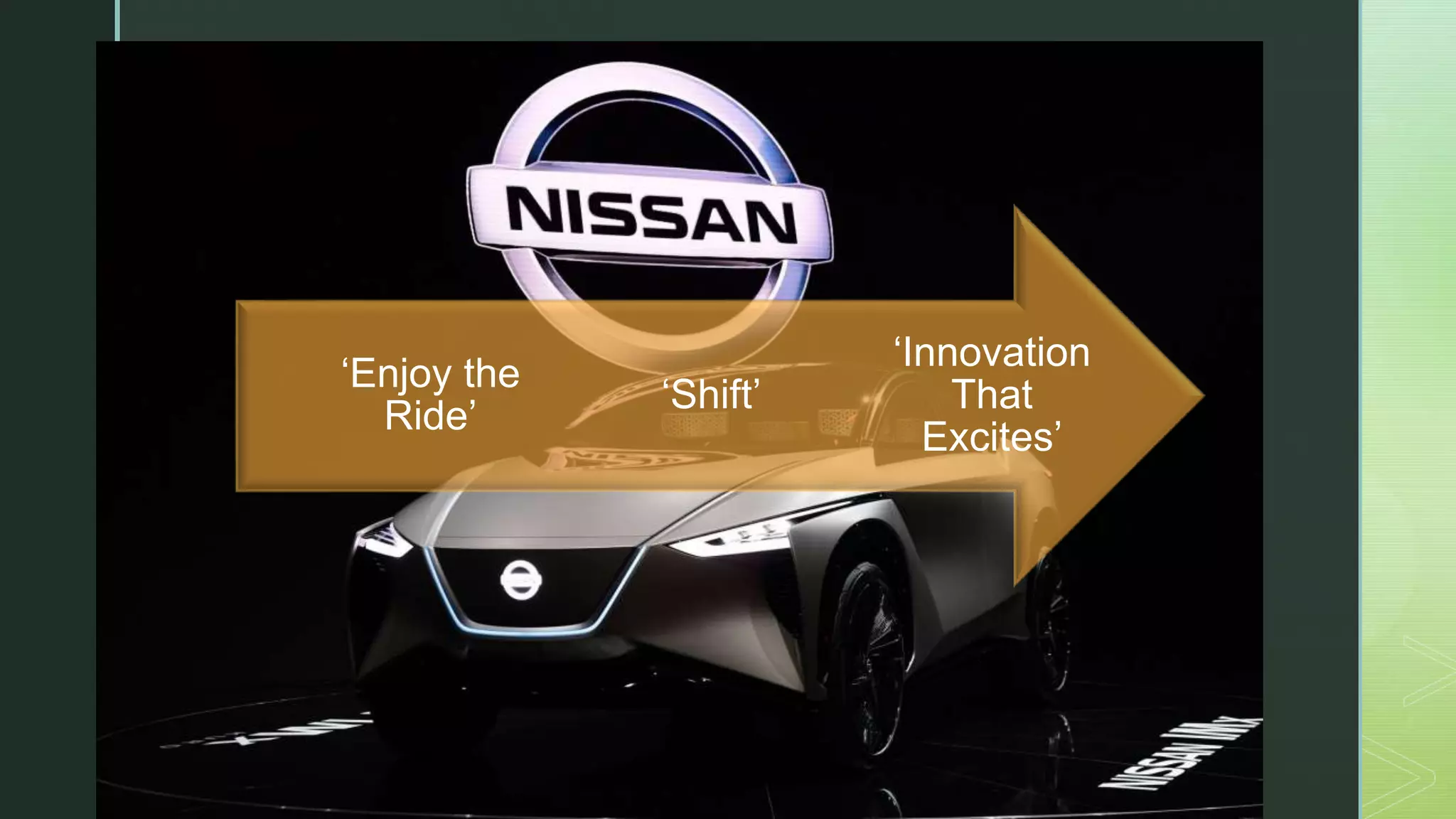
‘Innovation
That
Excites’
‘Shift’
‘Enjoy the
Ride’
z
What is Creativity?
zz
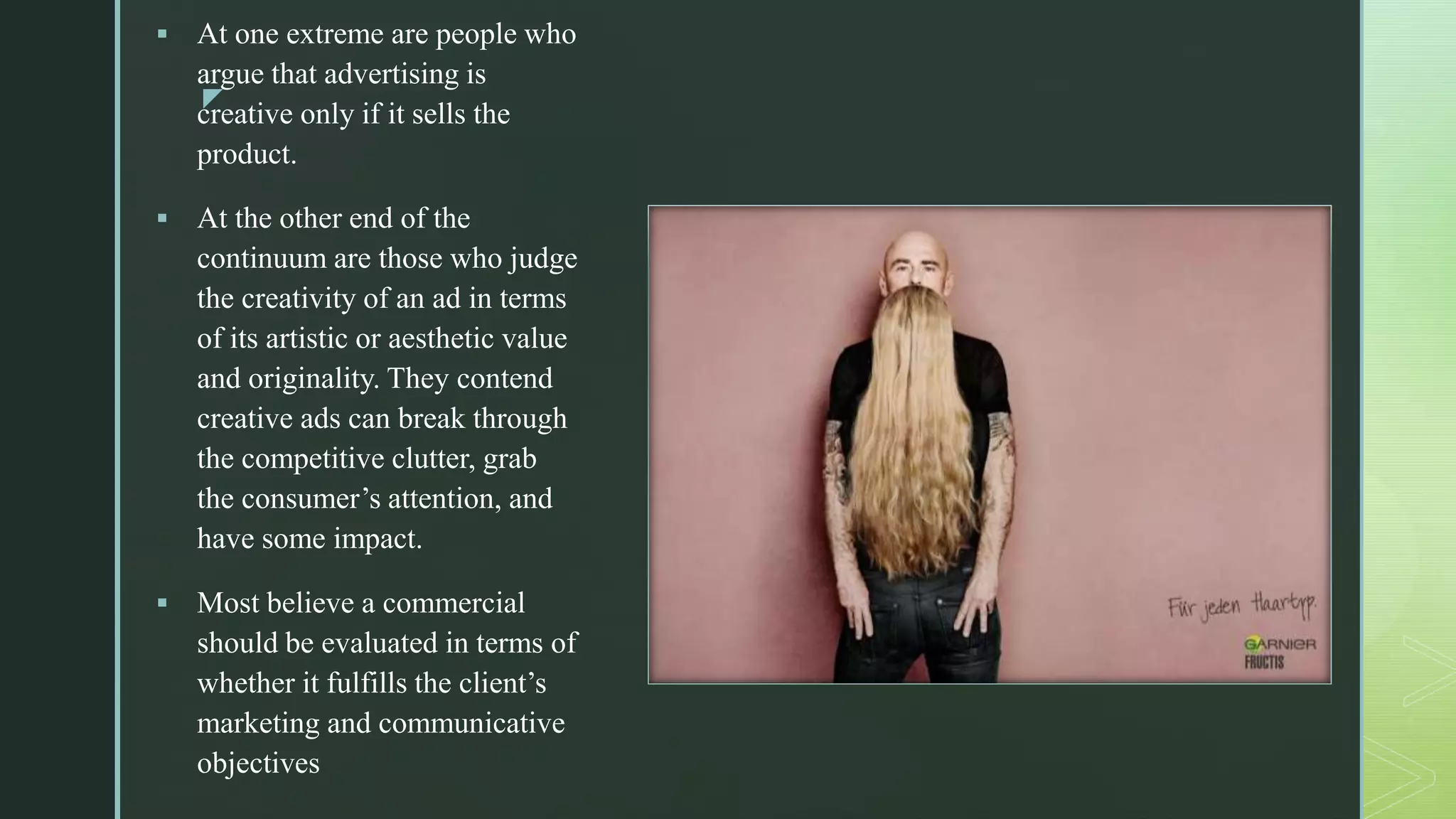
 At one extreme are people who
argue that advertising is
creative only if it sells the
product.
 At the other end of the
continuum are those who judge
the creativity of an ad in terms
of its artistic or aesthetic value
and originality. They contend
creative ads can break through
the competitive clutter, grab
the consumer’s attention, and
have some impact.
 Most believe a commercial
should be evaluated in terms of
whether it fulfills the client’s
marketing and communicative
objectives
z
Advertising Creativity
 Advertising creativity is the ability to
generate fresh, unique, and appropriate
ideas that can be used as solutions to
communications problems.
 The agency views a creative
advertising message as one that is built
around a creative core or power idea
and uses excellent design and
execution to communicate information
that interests the target audience.
z
“Everlasting Creativity”
z
Taking Creative
Risks
z
 Very few clients realize
that the reason that their
work is so bad is that they
are the ones who
commandeered it and
directed it to be that way
 Many creative people say
it is important for clients to
take some risks if they
want breakthrough
advertising that gets
noticed
z
z
The Creative Process
z
1. Immersion. Gathering raw material and information
through background research and immersing
yourself in the problem.
2. Digestion. Taking the information, working it over,
and wrestling with it in the mind.
3. Incubation. Putting the problems out of your
conscious mind and turning the information over to
the subconscious to do the work.
4. Illumination. The birth of an idea—the “Eureka! I
have it!” phenomenon.
5. Reality or verification. Studying the idea to see if it
still looks good or solves the problem; then shaping
the idea to practical usefulness
z
Account Planningz
 Account planning plays an important role during
creative strategy development by driving the
process from the customers’ point of view.
 Planners will work with the client as well as other
agency personnel, such as the creative team and
media specialists.
 They discuss how the knowledge and information
they have gathered can be used in the
development of the creative strategy as well as
other aspects of the advertising campaign.
 Account planners are usually responsible for all
the research (both qualitative and quantitative)
conducted during the creative strategy
development process.
z
Inputs to the Creative Process: Preparation,
Incubation, Illumination
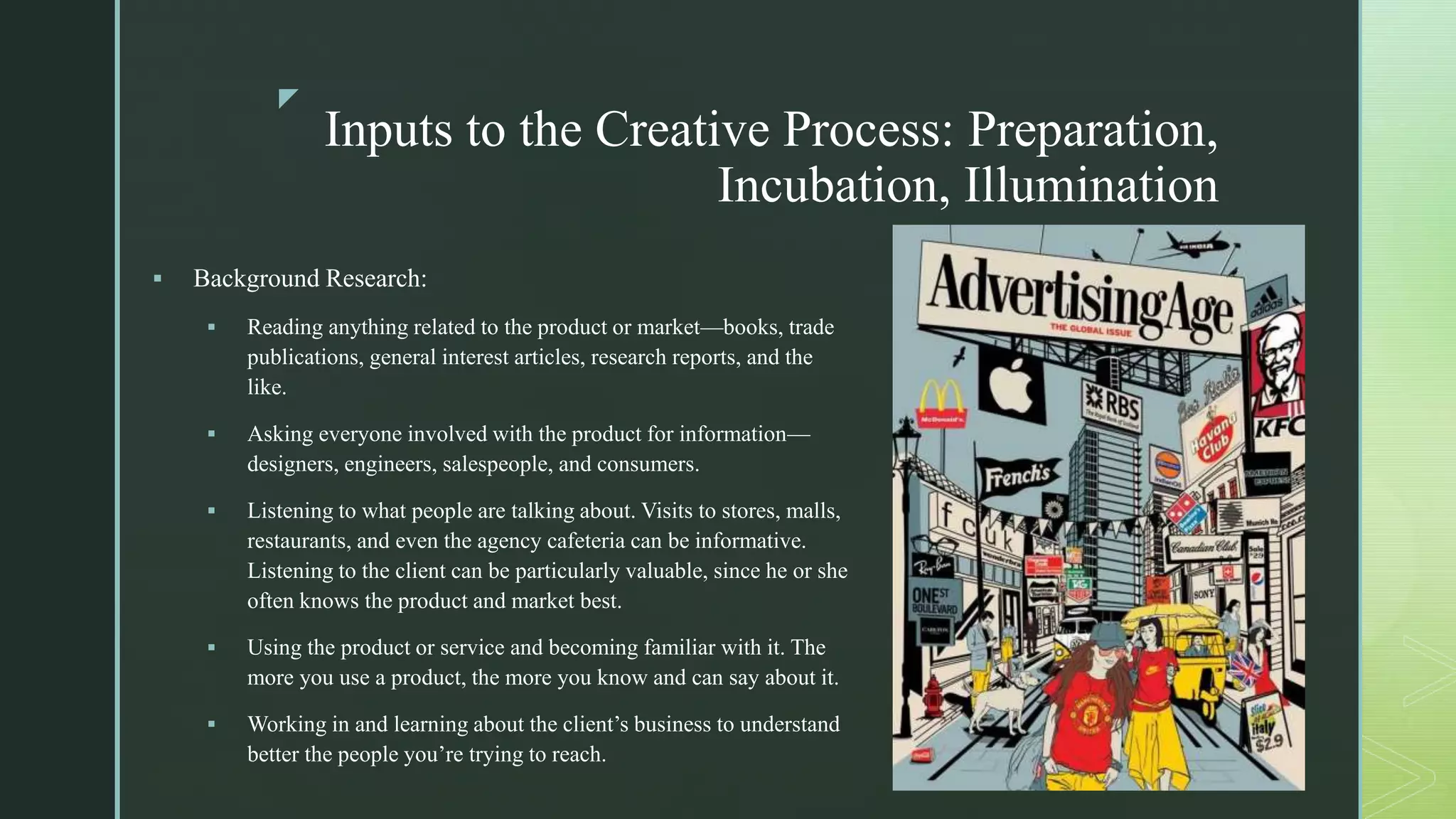
 Background Research:
 Reading anything related to the product or market—books, trade
publications, general interest articles, research reports, and the
like.
 Asking everyone involved with the product for information—
designers, engineers, salespeople, and consumers.
 Listening to what people are talking about. Visits to stores, malls,
restaurants, and even the agency cafeteria can be informative.
Listening to the client can be particularly valuable, since he or she
often knows the product and market best.
 Using the product or service and becoming familiar with it. The
more you use a product, the more you know and can say about it.
 Working in and learning about the client’s business to understand
better the people you’re trying to reach.
z
Inputs to the Creative Process: Preparation,
Incubation, Illumination
 Product/Service-Specific Research
 In addition to getting general background research and preplanning input,
creative people receive product/service-specific preplanning input.
 This information generally comes in the form of specific studies
conducted on the product or service, the target audience, or a combination
of the two.
 Quantitative and qualitative consumer research such as attitude studies,
market structure and positioning studies such as perceptual mapping and
lifestyle research, focus group interviews, and demographic and
psychographic profiles of users of a particular product, service, or brand
are examples of product-specific preplanning input.
z
z
z
Inputs to the Creative Process:
Preparation, Incubation,
Illumination
z
 Qualitative Research Input
 Focus Groups
 Ethnographic
Research
z
Ethnographic Research
 Involves observing consumers in
their natural environment.
 Some agencies send
anthropologists or trained
researchers into the field to study
and observe consumers in their
homes, at work, or at play
z
Focus Groups Vs. Ethnographic Research
 Many marketing and agency researchers prefer ethnographic research
over the use of focus groups, as the latter technique has a number of
limitations.
 Strong personalities can often wield undue influence in focus groups,
and participants often will not admit, or may not even recognize, their
behavior patterns and motivations.
 However, ethnographic studies can cost more to conduct and are more
difficult to administer.
z
Inputs to the Creative Process: Verification,
Revision
 The verification and revision stage of the creative process evaluates
ideas generated during the illumination stage, rejects inappropriate
ones, refines and polishes those that remain, and gives them final
expression.
 Techniques used at this stage include directed focus groups to evaluate
creative concepts, ideas, or themes; message communication studies;
portfolio tests; and evaluation measures such as viewer reaction
profiles.
z
Inputs to the Creative Process: Verification,
Revision
 At this stage of the creative process, members of the target audience may be asked to
evaluate rough creative layouts and to indicate what meaning they get from the ad, what
they think of its execution, or how they react to a slogan or theme.
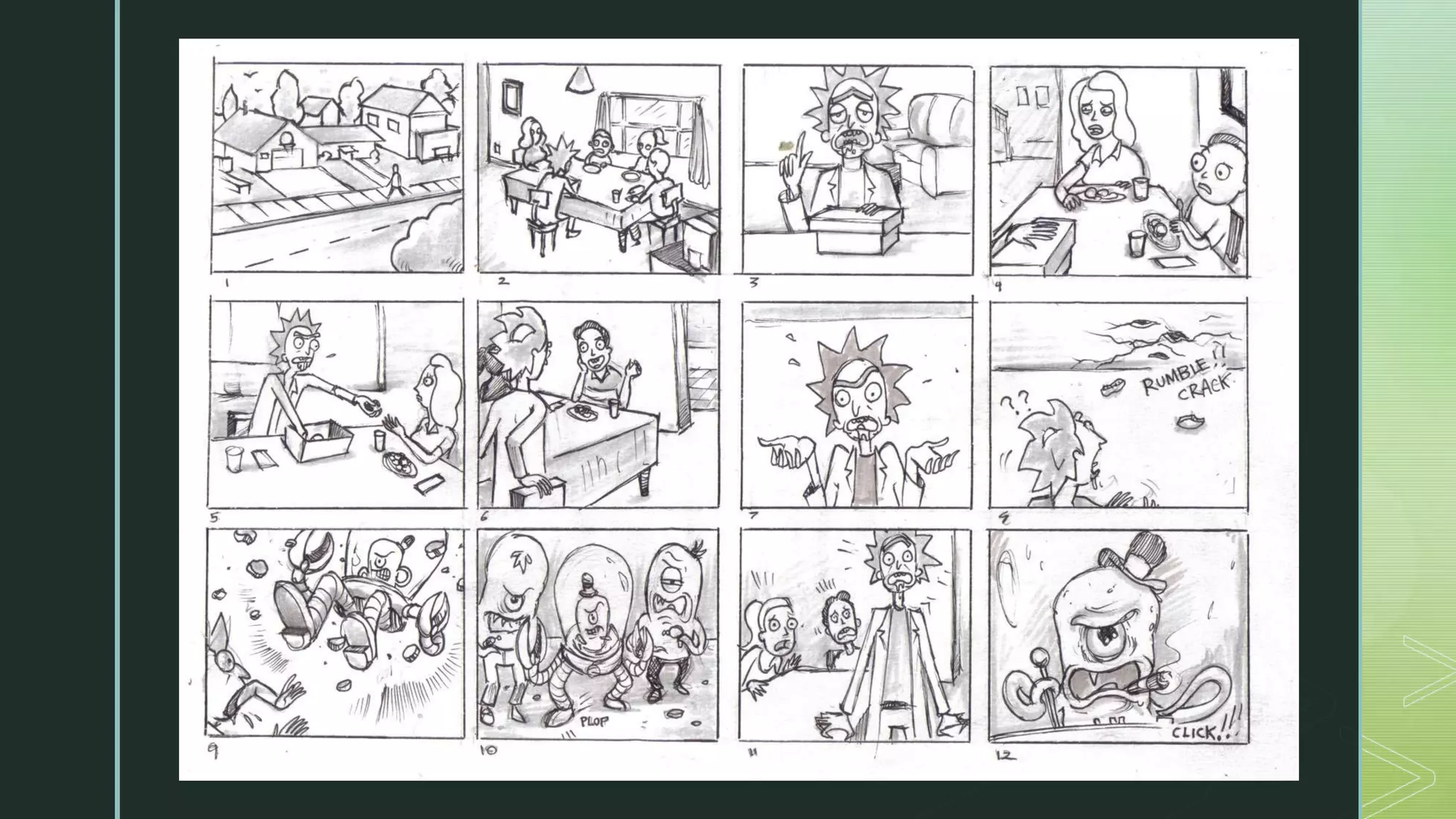
 The creative team can gain insight into how a TV commercial might communicate its
message by having members of the target market evaluate the ad in storyboard form. A
storyboard is a series of drawings used to present the visual plan or layout of a proposed
commercial.
 Testing a commercial in storyboard form can be difficult because storyboards are too
abstract for many consumers to understand. To make the creative layout more realistic and
easier to evaluate, the agency may produce an animatic, a videotape of the storyboard
along with an audio soundtrack.
z
z
Animatic
z
Creative Strategy
Development
z
 Advertising Campaigns
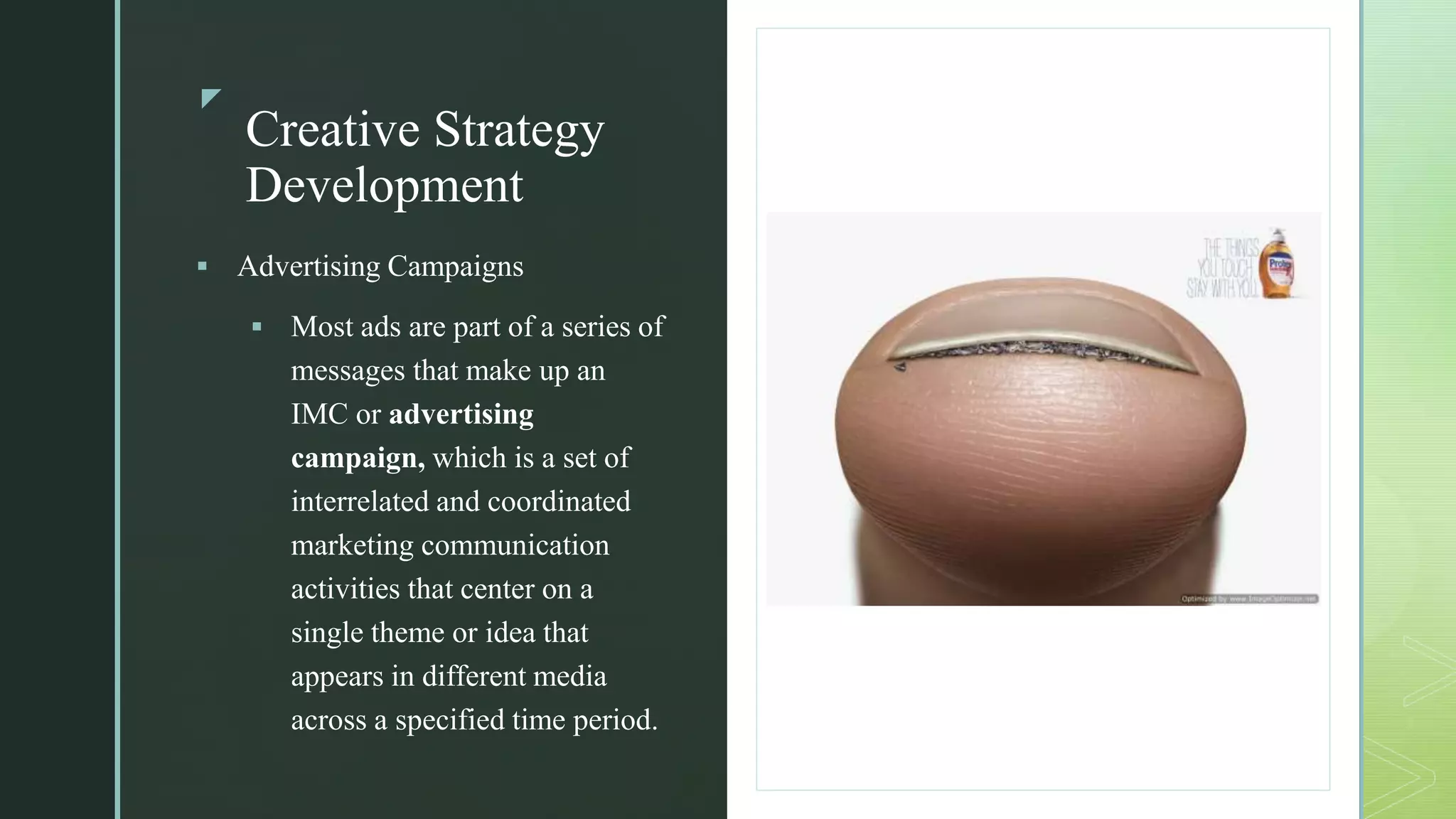
 Most ads are part of a series of
messages that make up an
IMC or advertising
campaign, which is a set of
interrelated and coordinated
marketing communication
activities that center on a
single theme or idea that
appears in different media
across a specified time period.
z
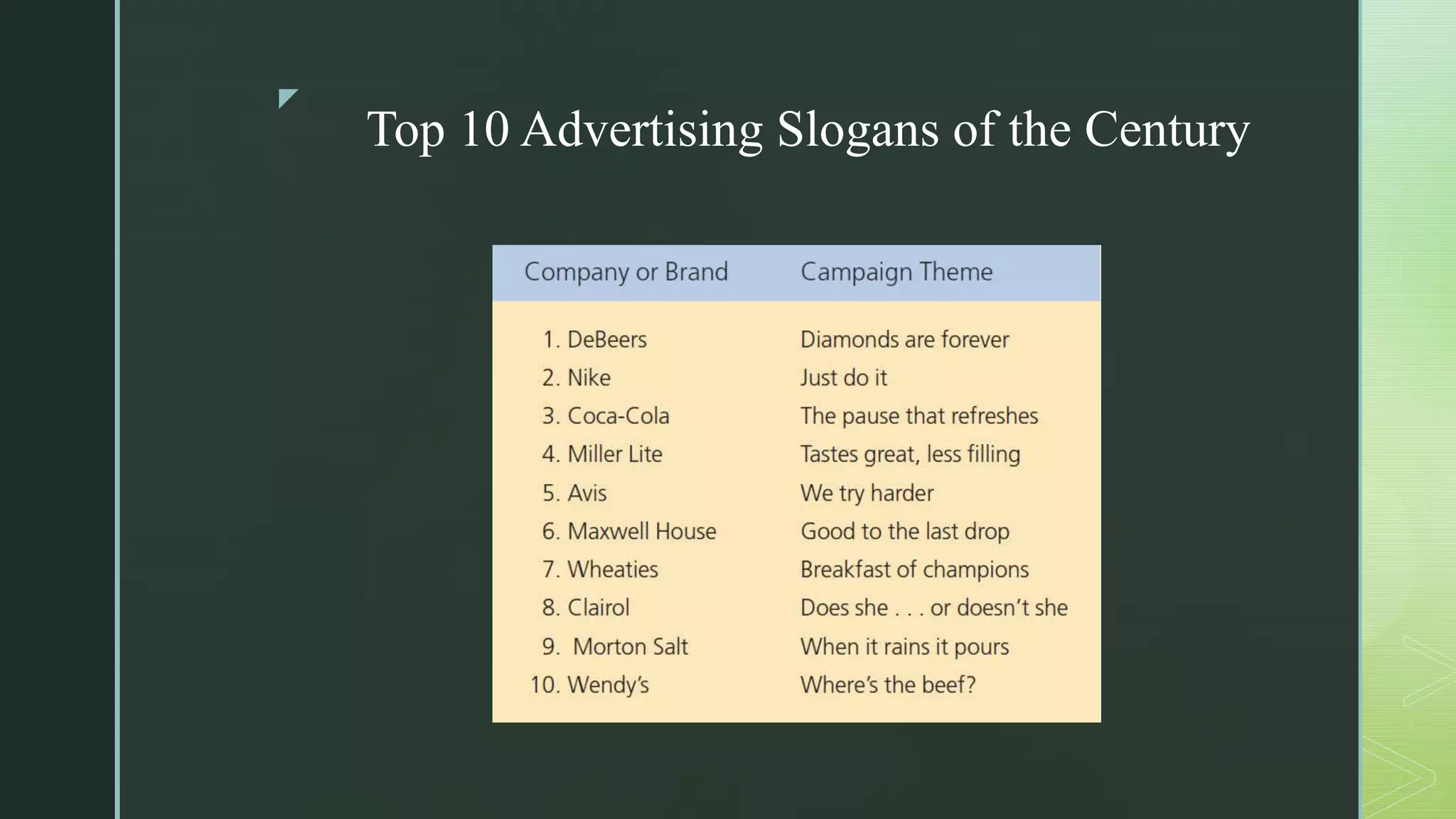
Top 10 Advertising Slogans of the Century
z
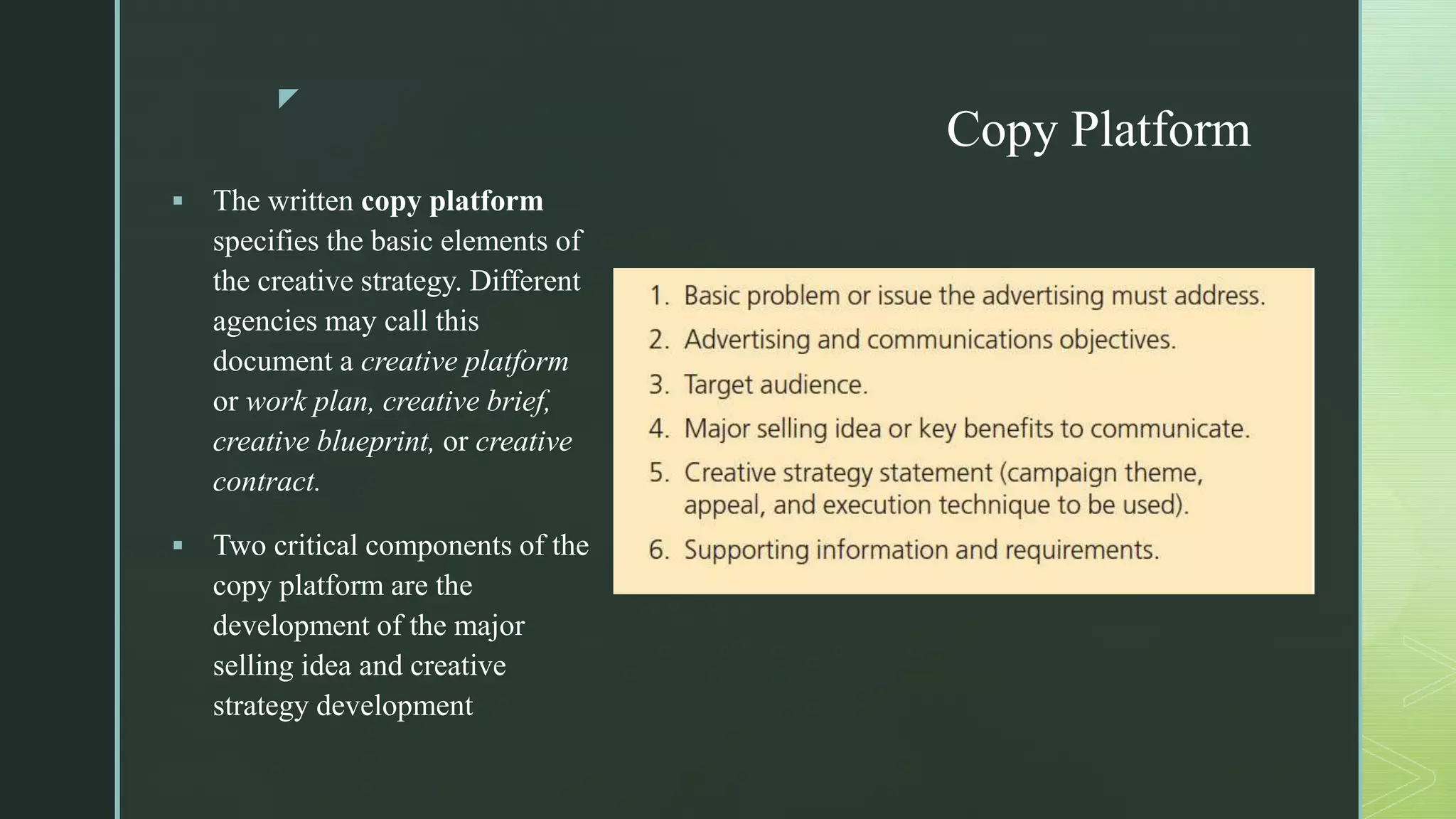
Copy Platform
 The written copy platform
specifies the basic elements of
the creative strategy. Different
agencies may call this
document a creative platform
or work plan, creative brief,
creative blueprint, or creative
contract.
 Two critical components of the
copy platform are the
development of the major
selling idea and creative
strategy development
z
The Search for the Major Selling Idea
 The major selling idea should emerge as the strongest singular thing
you can say about your product or service.
 This should be the claim with the broadest and most meaningful
appeal to your target audience.
 Once you determine this message, be certain you can live with it; be
sure it stands strong enough to remain the central issue in every ad and
commercial in the campaign
z
z
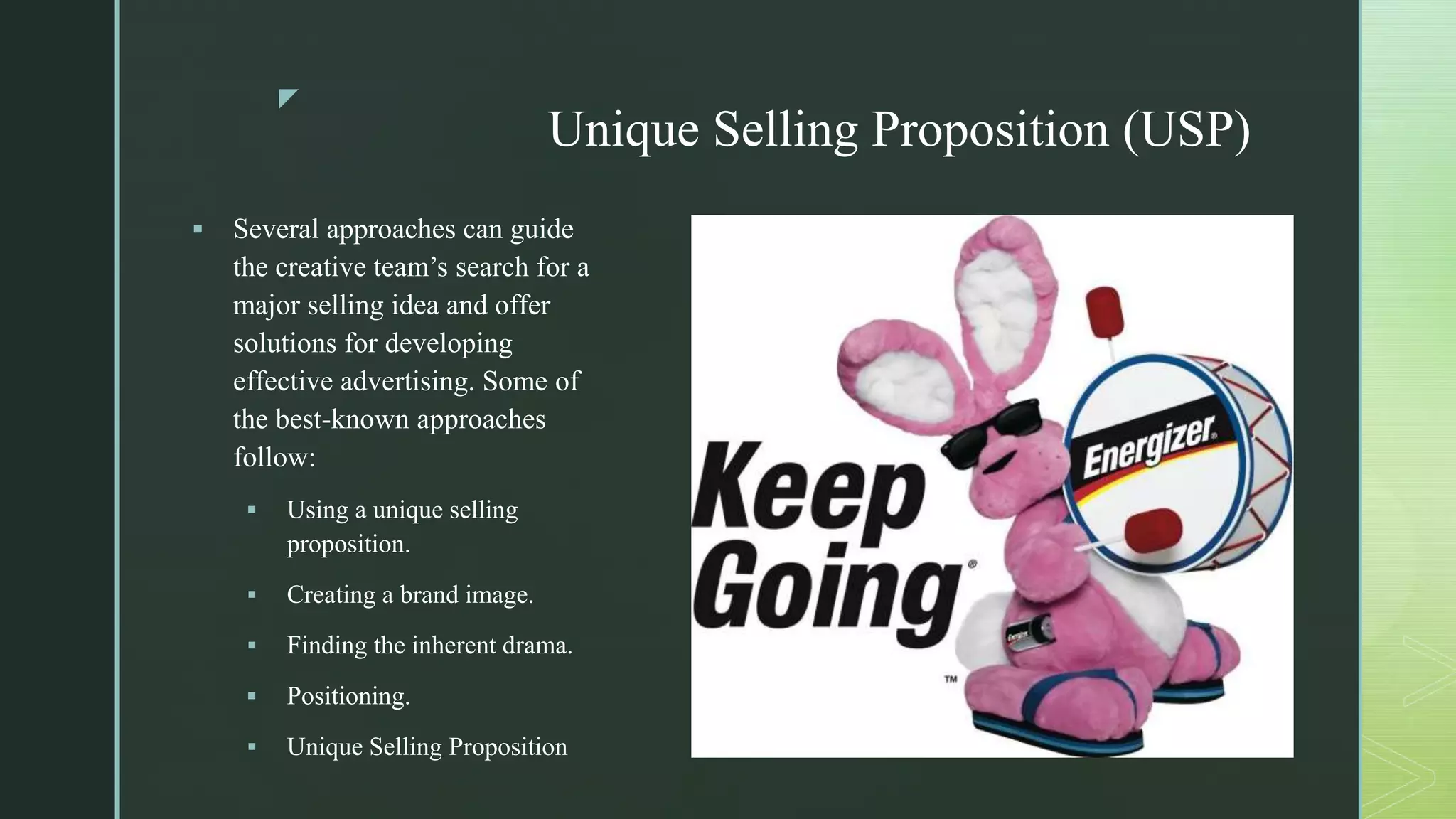
Unique Selling Proposition (USP)
 Several approaches can guide
the creative team’s search for a
major selling idea and offer
solutions for developing
effective advertising. Some of
the best-known approaches
follow:
 Using a unique selling
proposition.
 Creating a brand image.
 Finding the inherent drama.
 Positioning.
 Unique Selling Proposition
z
Three Characteristics of Unique Selling
Propositions
1. Each advertisement must make a proposition to the consumer. Not
just words, not just product puffery, not just show-window
advertising. Each advertisement must say to each reader: “Buy this
product and you will get this benefit.”
2. The proposition must be one that the competition either cannot or
does not offer. It must be unique either in the brand or in the claim.
3. The proposition must be strong enough to move the mass millions,
that is, pull over new customers to your brand.
z
What is the USP of the Above Which has Changed Pakistan?
z
1. Request from anywhere,
2. Ride with style, safety and convenience,
and
3. Hassle-free payment.
z
z
The Need for A Sustainable Competitive
Advantage
z
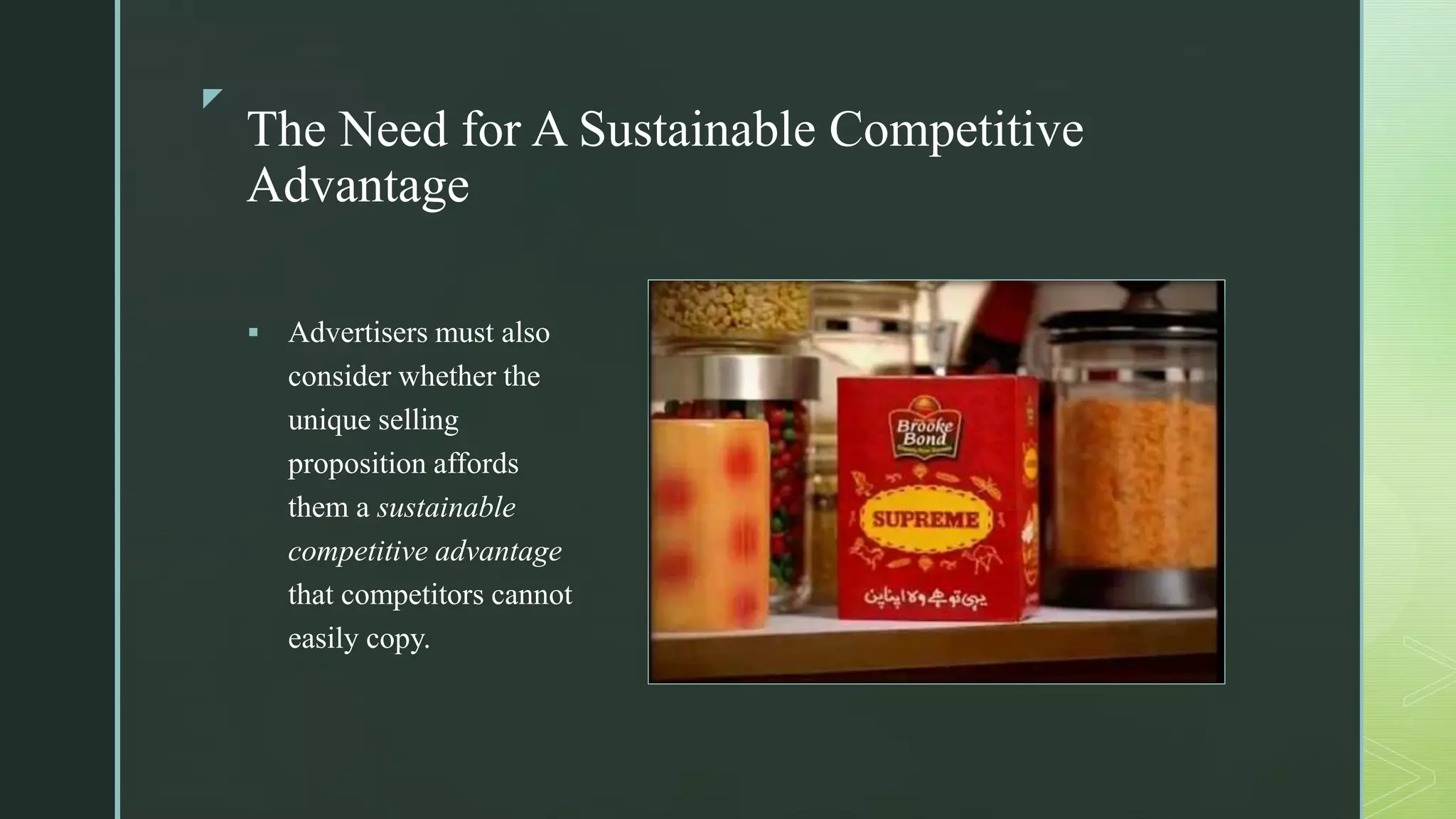
 Advertisers must also
consider whether the
unique selling
proposition affords
them a sustainable
competitive advantage
that competitors cannot
easily copy.
z
The Need for A Sustainable Competitive
Advantage
z
z
Creating a Brand Image
 In many product and service
categories, competing brands are so
similar that it is very difficult to find or
create a unique attribute or benefit to
use as the major selling idea.
 The creative strategy used to sell these
products is based on the development
of a strong, memorable identity for the
brand through image advertising.
z
Creating a Brand Image
z
 Image advertising has become
increasingly popular and is used
as the main selling idea for a
variety of products and services,
including soft drinks, liquor,
cigarettes, cars, airlines, financial
services, perfume/ colognes, and
clothing.
 Many consumers wear designer
jeans or Ralph Lauren polo shirts
or drink certain brands of soft
drinks because of the image of
these brands.
z
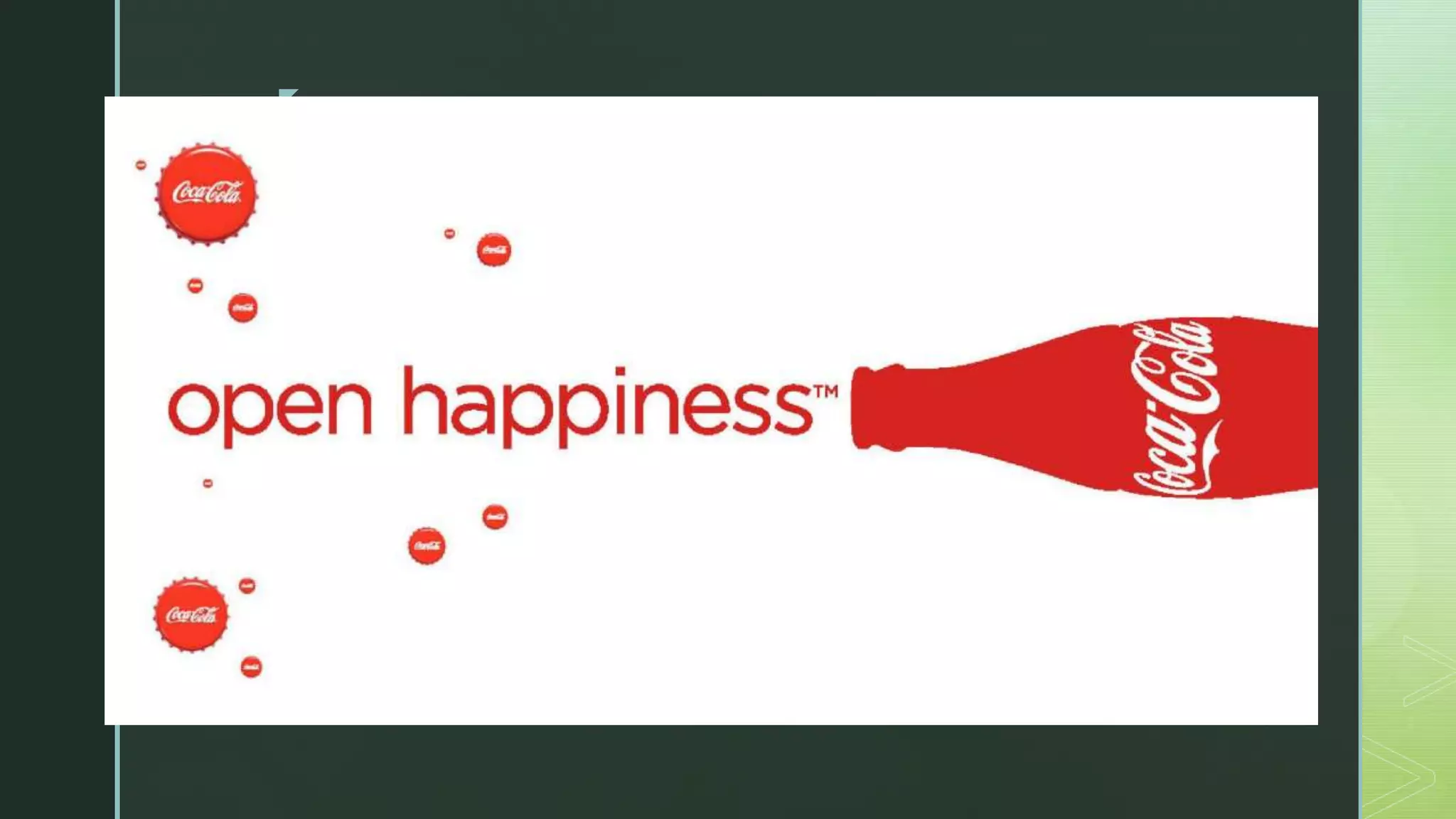
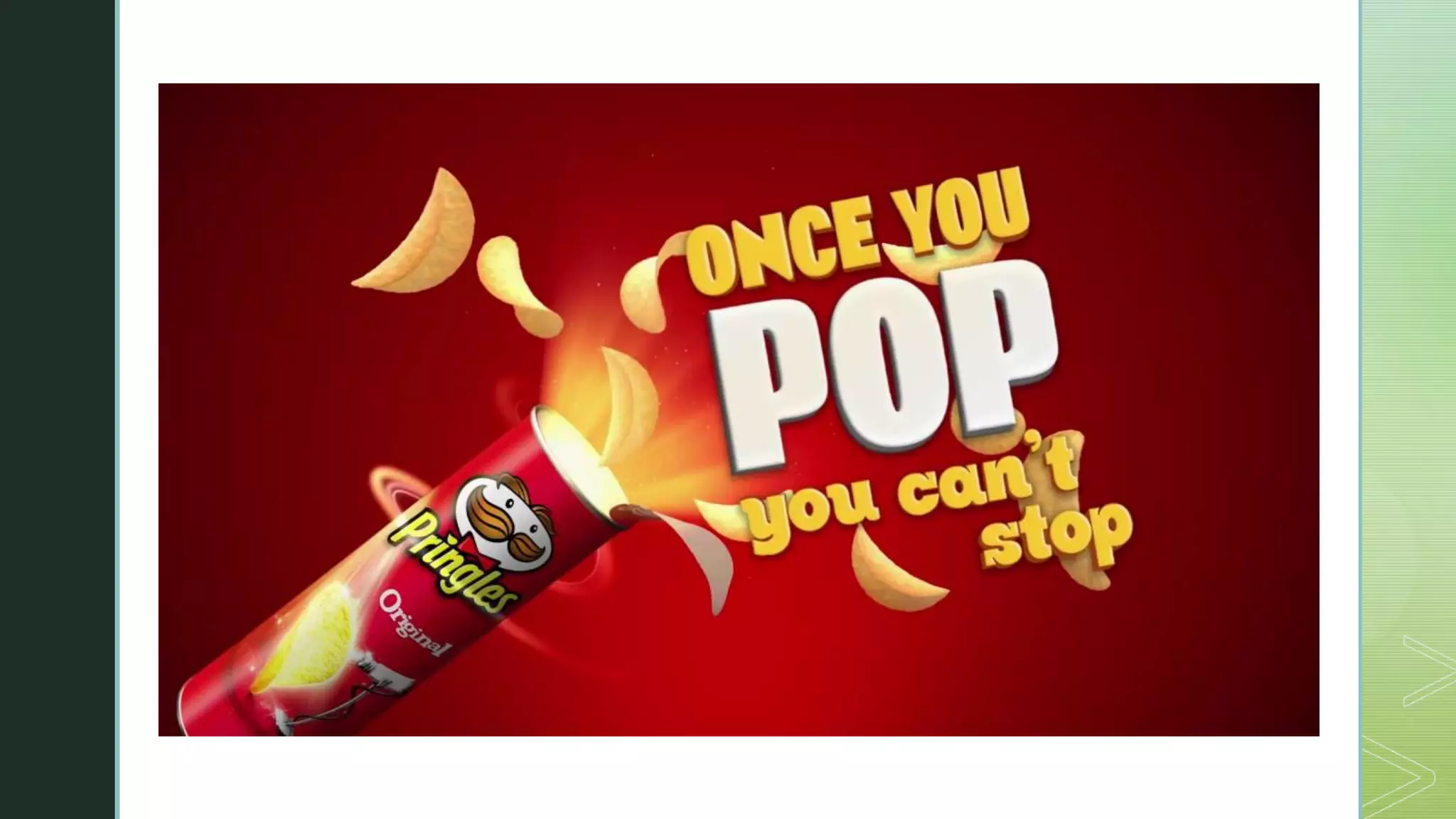
Finding the Inherent Drama
 Another approach to determining the
major selling idea is finding the
inherent drama or characteristic of the
product that makes the consumer
purchase it.
 Advertising should be based on a
foundation of consumer benefits with an
emphasis on the dramatic element in
expressing those benefits.
z
z
z
Positioning
 The basic idea is that
advertising is used to
establish or “position” the
product or service in a
particular place in the
consumer’s mind.
 Positioning is done for
companies as well as for
brands.
z
z
z
z
z
Thank You

Chapter 8

  • 1.
  • 2.
    z  One ofthe most important components of an integrated marketing communications program is the advertising message  Ads and commercials appeal to, and often create or shape, consumers’ problems, desires, and goals.  Advertising can also be used to create images or associations and position a brand in the consumer’s mind as well as transform the experience of buying and/or using a product or service
  • 3.
  • 4.
  • 5.
  • 6.
    zz  Underlying allof these messages, however, are a creative strategy that determines what the advertising message will say or communicate and creative tactics for how the message strategy will be executed.
  • 7.
    z The Importance ofCreativity in Advertising  Good creative strategy and execution can often be central to determining the success of a product or service or reversing the fortunes of a struggling brand.
  • 8.
  • 9.
  • 10.
    zz  Conversely, anadvertising campaign that is poorly conceived or executed can be a liability.  Many companies have solid marketing and promotional plans and spend substantial amounts of money on advertising, yet have difficulty coming up with a creative campaign that will differentiate them from their competitors.  For example, Burger King has changed its advertising theme 11 times in the past 15 years and changed agencies 6 times in search of a campaign that would give the chain a strong identity in the fast-food market
  • 11.
  • 12.
    z  Which LocalBrand has Struggled to Find a Good Creative Approach?
  • 13.
    z  ‘Truly Yours’ ‘Dil ki Chaa’  ‘Tum Mein or Aik Cup Chai’  ‘Meray Man ki Dhun’
  • 14.
    z  Just becausean ad or commercial is creative or popular does not mean it will increase sales or revive a declining brand. Many ads have won awards for creativity but failed to increase sales
  • 15.
  • 16.
  • 17.
    zz  At oneextreme are people who argue that advertising is creative only if it sells the product.  At the other end of the continuum are those who judge the creativity of an ad in terms of its artistic or aesthetic value and originality. They contend creative ads can break through the competitive clutter, grab the consumer’s attention, and have some impact.  Most believe a commercial should be evaluated in terms of whether it fulfills the client’s marketing and communicative objectives
  • 18.
    z Advertising Creativity  Advertisingcreativity is the ability to generate fresh, unique, and appropriate ideas that can be used as solutions to communications problems.  The agency views a creative advertising message as one that is built around a creative core or power idea and uses excellent design and execution to communicate information that interests the target audience.
  • 19.
  • 20.
    z Taking Creative Risks z  Veryfew clients realize that the reason that their work is so bad is that they are the ones who commandeered it and directed it to be that way  Many creative people say it is important for clients to take some risks if they want breakthrough advertising that gets noticed
  • 21.
  • 22.
    z The Creative Process z 1.Immersion. Gathering raw material and information through background research and immersing yourself in the problem. 2. Digestion. Taking the information, working it over, and wrestling with it in the mind. 3. Incubation. Putting the problems out of your conscious mind and turning the information over to the subconscious to do the work. 4. Illumination. The birth of an idea—the “Eureka! I have it!” phenomenon. 5. Reality or verification. Studying the idea to see if it still looks good or solves the problem; then shaping the idea to practical usefulness
  • 23.
    z Account Planningz  Accountplanning plays an important role during creative strategy development by driving the process from the customers’ point of view.  Planners will work with the client as well as other agency personnel, such as the creative team and media specialists.  They discuss how the knowledge and information they have gathered can be used in the development of the creative strategy as well as other aspects of the advertising campaign.  Account planners are usually responsible for all the research (both qualitative and quantitative) conducted during the creative strategy development process.
  • 24.
    z Inputs to theCreative Process: Preparation, Incubation, Illumination  Background Research:  Reading anything related to the product or market—books, trade publications, general interest articles, research reports, and the like.  Asking everyone involved with the product for information— designers, engineers, salespeople, and consumers.  Listening to what people are talking about. Visits to stores, malls, restaurants, and even the agency cafeteria can be informative. Listening to the client can be particularly valuable, since he or she often knows the product and market best.  Using the product or service and becoming familiar with it. The more you use a product, the more you know and can say about it.  Working in and learning about the client’s business to understand better the people you’re trying to reach.
  • 25.
    z Inputs to theCreative Process: Preparation, Incubation, Illumination  Product/Service-Specific Research  In addition to getting general background research and preplanning input, creative people receive product/service-specific preplanning input.  This information generally comes in the form of specific studies conducted on the product or service, the target audience, or a combination of the two.  Quantitative and qualitative consumer research such as attitude studies, market structure and positioning studies such as perceptual mapping and lifestyle research, focus group interviews, and demographic and psychographic profiles of users of a particular product, service, or brand are examples of product-specific preplanning input.
  • 26.
  • 27.
  • 28.
    z Inputs to theCreative Process: Preparation, Incubation, Illumination z  Qualitative Research Input  Focus Groups  Ethnographic Research
  • 29.
    z Ethnographic Research  Involvesobserving consumers in their natural environment.  Some agencies send anthropologists or trained researchers into the field to study and observe consumers in their homes, at work, or at play
  • 30.
    z Focus Groups Vs.Ethnographic Research  Many marketing and agency researchers prefer ethnographic research over the use of focus groups, as the latter technique has a number of limitations.  Strong personalities can often wield undue influence in focus groups, and participants often will not admit, or may not even recognize, their behavior patterns and motivations.  However, ethnographic studies can cost more to conduct and are more difficult to administer.
  • 31.
    z Inputs to theCreative Process: Verification, Revision  The verification and revision stage of the creative process evaluates ideas generated during the illumination stage, rejects inappropriate ones, refines and polishes those that remain, and gives them final expression.  Techniques used at this stage include directed focus groups to evaluate creative concepts, ideas, or themes; message communication studies; portfolio tests; and evaluation measures such as viewer reaction profiles.
  • 32.
    z Inputs to theCreative Process: Verification, Revision  At this stage of the creative process, members of the target audience may be asked to evaluate rough creative layouts and to indicate what meaning they get from the ad, what they think of its execution, or how they react to a slogan or theme.  The creative team can gain insight into how a TV commercial might communicate its message by having members of the target market evaluate the ad in storyboard form. A storyboard is a series of drawings used to present the visual plan or layout of a proposed commercial.  Testing a commercial in storyboard form can be difficult because storyboards are too abstract for many consumers to understand. To make the creative layout more realistic and easier to evaluate, the agency may produce an animatic, a videotape of the storyboard along with an audio soundtrack.
  • 33.
  • 34.
  • 35.
    z Creative Strategy Development z  AdvertisingCampaigns  Most ads are part of a series of messages that make up an IMC or advertising campaign, which is a set of interrelated and coordinated marketing communication activities that center on a single theme or idea that appears in different media across a specified time period.
  • 36.
    z Top 10 AdvertisingSlogans of the Century
  • 37.
    z Copy Platform  Thewritten copy platform specifies the basic elements of the creative strategy. Different agencies may call this document a creative platform or work plan, creative brief, creative blueprint, or creative contract.  Two critical components of the copy platform are the development of the major selling idea and creative strategy development
  • 38.
    z The Search forthe Major Selling Idea  The major selling idea should emerge as the strongest singular thing you can say about your product or service.  This should be the claim with the broadest and most meaningful appeal to your target audience.  Once you determine this message, be certain you can live with it; be sure it stands strong enough to remain the central issue in every ad and commercial in the campaign
  • 39.
  • 40.
    z Unique Selling Proposition(USP)  Several approaches can guide the creative team’s search for a major selling idea and offer solutions for developing effective advertising. Some of the best-known approaches follow:  Using a unique selling proposition.  Creating a brand image.  Finding the inherent drama.  Positioning.  Unique Selling Proposition
  • 41.
    z Three Characteristics ofUnique Selling Propositions 1. Each advertisement must make a proposition to the consumer. Not just words, not just product puffery, not just show-window advertising. Each advertisement must say to each reader: “Buy this product and you will get this benefit.” 2. The proposition must be one that the competition either cannot or does not offer. It must be unique either in the brand or in the claim. 3. The proposition must be strong enough to move the mass millions, that is, pull over new customers to your brand.
  • 42.
    z What is theUSP of the Above Which has Changed Pakistan?
  • 43.
    z 1. Request fromanywhere, 2. Ride with style, safety and convenience, and 3. Hassle-free payment.
  • 44.
  • 45.
    z The Need forA Sustainable Competitive Advantage z  Advertisers must also consider whether the unique selling proposition affords them a sustainable competitive advantage that competitors cannot easily copy.
  • 46.
    z The Need forA Sustainable Competitive Advantage z
  • 47.
    z Creating a BrandImage  In many product and service categories, competing brands are so similar that it is very difficult to find or create a unique attribute or benefit to use as the major selling idea.  The creative strategy used to sell these products is based on the development of a strong, memorable identity for the brand through image advertising.
  • 48.
    z Creating a BrandImage z  Image advertising has become increasingly popular and is used as the main selling idea for a variety of products and services, including soft drinks, liquor, cigarettes, cars, airlines, financial services, perfume/ colognes, and clothing.  Many consumers wear designer jeans or Ralph Lauren polo shirts or drink certain brands of soft drinks because of the image of these brands.
  • 49.
    z Finding the InherentDrama  Another approach to determining the major selling idea is finding the inherent drama or characteristic of the product that makes the consumer purchase it.  Advertising should be based on a foundation of consumer benefits with an emphasis on the dramatic element in expressing those benefits.
  • 50.
  • 51.
  • 52.
    z Positioning  The basicidea is that advertising is used to establish or “position” the product or service in a particular place in the consumer’s mind.  Positioning is done for companies as well as for brands.
  • 53.
  • 54.
  • 55.
  • 56.
  • 57.