Company and Marketing Strategy: Partnering to Build Customer Relationships
“ If you fail to plan,  you plan to fail”
 
Strategic Planning Strategic planning is defined as: “The process of developing and maintaining a strategic fit between the organization’s goals and capabilities and its changing marketing opportunities.”
Strategic Planning Planning activities occur at the business unit, product, and market levels, and include: Defining the purpose and mission Setting objectives and goals Designing the business portfolio Developing detailed marketing and departmental plans
Strategic Planning Mission statements should . . . serve as a guide for what the organization wants to accomplish. be “market-oriented” rather than “product-oriented”. be neither too narrow, nor too broad. fit with the market environment. be motivating.
Defining the Organization’s Mission A mission may begin with these questions: What business are we in? What customers should we serve? How should we develop the firm’s capabilities and focus its efforts?
http://www.southwest.com/travel_center/customer_service_commitment.html
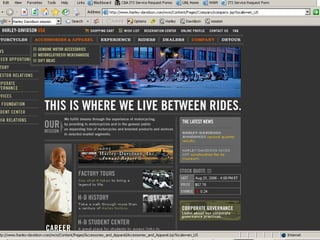
Evolution of Harley Davidson Mission
Evolution of Harley  Davidson Mission
 
Virgin Mission Statement We believe in making a difference. In our customers' eyes, Virgin stands for value for money, quality, innovation, fun and a sense of competitive challenge. We deliver a quality service by empowering our employees and we facilitate and monitor customer feedback to continually improve the customer's experience through innovation.
http://www.celestialseasonings.com/whoweare/corporatehistory/mission.php
Strategic Planning Business portfolio:  “the collection of businesses  and products that make up  the company.” Designing the business portfolio  is a key element of the strategic planning process.
Limited Brands Limited Brands is committed to building a family of the world's best fashion brands offering captivating customer experiences that drive long-term loyalty and deliver sustained growth for our shareholders.
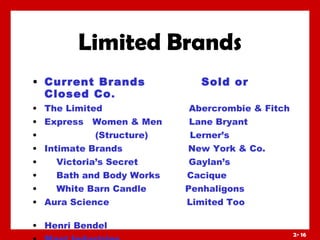
Limited Brands Current Brands   Sold or Closed Co . The Limited  Abercrombie & Fitch Express  Women & Men  Lane Bryant (Structure)  Lerner’s Intimate Brands  New York & Co. Victoria’s Secret  Gaylan’s  Bath and Body Works  Cacique White Barn Candle  Penhaligons Aura Science  Limited Too  Henri Bendel Mast Industries C.O. Bigelow
Strategic Planning Step 1:   Analyze the current business portfolio Step 2:  Shape the future business portfolio Identify strategic business units (SBUs) Assess each SBU: The BCG growth-share matrix classifies SBUs into one of four categories using the: Market growth rate  SBU’s relative market share within the market. Portfolio Design
Strategic Planning BCG Growth-Share Matrix High Relative Market Share High  Market  Growth Low  Market  Growth Stars Cash  Cows Question  Marks Dogs Low Relative Market Share
Strategic Planning Step 1:  Analyze the current business portfolio Step 2:  Shape the future business portfolio Determine the future role of each SBU and choose the appropriate resource allocation strategy: Build Hold Harvest Divest SBUs change positions over time Portfolio Design
Strategic Planning Matrix approaches to formal planning share many problems: Difficult, time-consuming, and costly to implement. Difficult to define SBU’s & Measure Market Share/Growth Focus only on current businesses. Too strongly emphasize market share growth or growth via diversification. Can lead to unwise expansion or diversification
Strategic Planning Product/Market Expansion Grid Existing Products New Products Existing  Markets New  Markets Market  Penetration Market Development Product Development Diversification
The Business Portfolio Which strategy is this? Market penetration Market development Product development Diversification -
The Business Portfolio Which strategy  is this? Market penetration Market development Product development Diversification 2 -
Market Penetration Strategy:  to  increase sales to current buyers without changing the products  being sold.  Market penetration can be achieved by adding new stores in  current  market areas, improving advertising, lowering prices, adding services, etc.
Market Development Strategy:  identify and develop new markets – demographic or geographic – for current products .  Bass Pro Shops has aggressively developed new geographic markets for its Outdoor World retail stores.
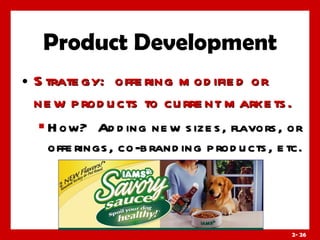
Product Development Strategy:  offering modified or new products to current markets.  How?  Adding new sizes, flavors, or offerings, co-branding products, etc.
Diversification Strategy:  start up or buy businesses outside of current products and markets. Diversification is the riskiest strategy. Firms that diversify too broadly into unfamiliar products or industries can lose their market focus. www.timewarner.com/corp / www.virgin.com
Marketing’s Role in Strategic Planning Provides a  Guiding Philosophy Provides Inputs  to  Strategic Planners Designs Strategies for Reaching Unit’s Objectives
The Marketing Process Target Consumers Product Place Price Promotion Marketing Implementation Marketing Planning Marketing Control Marketing Analysis Competitors Marketing Intermediaries Publics Suppliers Demographic- Economic Environment Technological- Natural Environment Political- Legal Environment Social- Cultural Environment
The Marketing Process The strategic planning  and business portfolio analysis processes help to identify and evaluate marketing opportunities. The purpose of the marketing process is to help the firm plan how to capitalize on these opportunities.   Analyzing marketing opportunities Selecting target markets Developing the marketing mix Managing the marketing effort Key Elements
The Marketing Process The segmentation process divides the total market into  market segments. Target marketing  determines which segment(s) are pursued. The  market positioning   for the product is then determined. Analyzing marketing opportunities Selecting target markets Developing the marketing mix Managing the marketing effort Key Elements
Process of Selecting Target Consumers Market Segment  - consumers who respond in similar way to a given set of marketing efforts. Market Segmentation:  process of dividing a market into distinct groups buyers (segments) with different needs, etc. who might require separate products. Target Marketing : evaluating each market segment’s attractiveness and selecting one or more target segments to enter. Market Positioning:  products and or services  clear, distinctive and desirable place relative to competing products in the minds of target segments.
What Market Segment is this targeted to ?
Market Segmentation Clinique for Men products are designed for a segment of men who will pay more for skin care products.
Target Markets Lucky Magazine is targeted to younger women who are shoppers
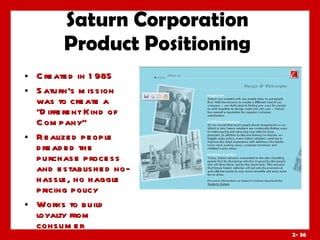
Saturn Corporation Product Positioning Created in 1985 Saturn’s mission was to create a “Different Kind of Company” Realized people dreaded the purchase process and established no-hassle, no haggle pricing policy Works to build loyalty from consumer
By 1990 Saturn was winning awards from Popular Science, Popular Mechanics, AAA, MotorWeek. First Saturn Homecoming in 1994 at its manufacturing complex had 38,000 Saturn owners attending Saturn Corporation Product Positioning
Scion by Toyota www.scion.com What is the market segment?  Target Market? Product Positioning ?
The Marketing Process Competitor analysis guides competitive marketing strategy development. Strategy leads to tactics by way of the marketing mix:   The “Four Ps” – product, price, place, promotion (seller viewpoint) The “Four Cs” – customer solution, cost, convenience, and communication (customer viewpoint) Analyzing marketing opportunities Selecting target markets Developing the marketing mix Managing the marketing effort Key Elements
Figure 2-5:   The Marketing Mix
The Marketing Process Marketing analysis Provides information helpful in planning, implementation, and control Marketing planning Strategies and tactics Marketing implementation Turns plans into action Marketing control Operating control Strategic control Marketing audit Analyzing marketing opportunities Selecting target markets Developing the marketing mix Managing the marketing effort Key Elements
Four Marketing Management Functions   Planning Develop  Strategic  Plans Develop Marketing Plans  Implementation Carry Out the  Plans Marketing Analysis of Company’s Situation Control Measure Results Evaluate Results Take Corrective Action
Figure 2-7 SWOT Analysis
Brand / Product Marketing Plan: Executive summary Current marketing situation Analysis of threats and opportunities Objectives for the brand Marketing strategy Action programs Marketing budget Controls  Marketing Management: Planning
Figure 2-8 Return on Marketing
Measuring Effectiveness Return on marketing (marketing ROI) The net return from a marketing investment divided by the costs of the investments

Mar 20 presentation #2

  • 1.
    Company and MarketingStrategy: Partnering to Build Customer Relationships
  • 2.
    “ If youfail to plan, you plan to fail”
  • 3.
  • 4.
    Strategic Planning Strategicplanning is defined as: “The process of developing and maintaining a strategic fit between the organization’s goals and capabilities and its changing marketing opportunities.”
  • 5.
    Strategic Planning Planningactivities occur at the business unit, product, and market levels, and include: Defining the purpose and mission Setting objectives and goals Designing the business portfolio Developing detailed marketing and departmental plans
  • 6.
    Strategic Planning Missionstatements should . . . serve as a guide for what the organization wants to accomplish. be “market-oriented” rather than “product-oriented”. be neither too narrow, nor too broad. fit with the market environment. be motivating.
  • 7.
    Defining the Organization’sMission A mission may begin with these questions: What business are we in? What customers should we serve? How should we develop the firm’s capabilities and focus its efforts?
  • 8.
  • 9.
    Evolution of HarleyDavidson Mission
  • 10.
    Evolution of Harley Davidson Mission
  • 11.
  • 12.
    Virgin Mission StatementWe believe in making a difference. In our customers' eyes, Virgin stands for value for money, quality, innovation, fun and a sense of competitive challenge. We deliver a quality service by empowering our employees and we facilitate and monitor customer feedback to continually improve the customer's experience through innovation.
  • 13.
  • 14.
    Strategic Planning Businessportfolio: “the collection of businesses and products that make up the company.” Designing the business portfolio is a key element of the strategic planning process.
  • 15.
    Limited Brands LimitedBrands is committed to building a family of the world's best fashion brands offering captivating customer experiences that drive long-term loyalty and deliver sustained growth for our shareholders.
  • 16.
    Limited Brands CurrentBrands Sold or Closed Co . The Limited Abercrombie & Fitch Express Women & Men Lane Bryant (Structure) Lerner’s Intimate Brands New York & Co. Victoria’s Secret Gaylan’s Bath and Body Works Cacique White Barn Candle Penhaligons Aura Science Limited Too Henri Bendel Mast Industries C.O. Bigelow
  • 17.
    Strategic Planning Step1: Analyze the current business portfolio Step 2: Shape the future business portfolio Identify strategic business units (SBUs) Assess each SBU: The BCG growth-share matrix classifies SBUs into one of four categories using the: Market growth rate SBU’s relative market share within the market. Portfolio Design
  • 18.
    Strategic Planning BCGGrowth-Share Matrix High Relative Market Share High Market Growth Low Market Growth Stars Cash Cows Question Marks Dogs Low Relative Market Share
  • 19.
    Strategic Planning Step1: Analyze the current business portfolio Step 2: Shape the future business portfolio Determine the future role of each SBU and choose the appropriate resource allocation strategy: Build Hold Harvest Divest SBUs change positions over time Portfolio Design
  • 20.
    Strategic Planning Matrixapproaches to formal planning share many problems: Difficult, time-consuming, and costly to implement. Difficult to define SBU’s & Measure Market Share/Growth Focus only on current businesses. Too strongly emphasize market share growth or growth via diversification. Can lead to unwise expansion or diversification
  • 21.
    Strategic Planning Product/MarketExpansion Grid Existing Products New Products Existing Markets New Markets Market Penetration Market Development Product Development Diversification
  • 22.
    The Business PortfolioWhich strategy is this? Market penetration Market development Product development Diversification -
  • 23.
    The Business PortfolioWhich strategy is this? Market penetration Market development Product development Diversification 2 -
  • 24.
    Market Penetration Strategy: to increase sales to current buyers without changing the products being sold. Market penetration can be achieved by adding new stores in current market areas, improving advertising, lowering prices, adding services, etc.
  • 25.
    Market Development Strategy: identify and develop new markets – demographic or geographic – for current products . Bass Pro Shops has aggressively developed new geographic markets for its Outdoor World retail stores.
  • 26.
    Product Development Strategy: offering modified or new products to current markets. How? Adding new sizes, flavors, or offerings, co-branding products, etc.
  • 27.
    Diversification Strategy: start up or buy businesses outside of current products and markets. Diversification is the riskiest strategy. Firms that diversify too broadly into unfamiliar products or industries can lose their market focus. www.timewarner.com/corp / www.virgin.com
  • 28.
    Marketing’s Role inStrategic Planning Provides a Guiding Philosophy Provides Inputs to Strategic Planners Designs Strategies for Reaching Unit’s Objectives
  • 29.
    The Marketing ProcessTarget Consumers Product Place Price Promotion Marketing Implementation Marketing Planning Marketing Control Marketing Analysis Competitors Marketing Intermediaries Publics Suppliers Demographic- Economic Environment Technological- Natural Environment Political- Legal Environment Social- Cultural Environment
  • 30.
    The Marketing ProcessThe strategic planning and business portfolio analysis processes help to identify and evaluate marketing opportunities. The purpose of the marketing process is to help the firm plan how to capitalize on these opportunities. Analyzing marketing opportunities Selecting target markets Developing the marketing mix Managing the marketing effort Key Elements
  • 31.
    The Marketing ProcessThe segmentation process divides the total market into market segments. Target marketing determines which segment(s) are pursued. The market positioning for the product is then determined. Analyzing marketing opportunities Selecting target markets Developing the marketing mix Managing the marketing effort Key Elements
  • 32.
    Process of SelectingTarget Consumers Market Segment - consumers who respond in similar way to a given set of marketing efforts. Market Segmentation: process of dividing a market into distinct groups buyers (segments) with different needs, etc. who might require separate products. Target Marketing : evaluating each market segment’s attractiveness and selecting one or more target segments to enter. Market Positioning: products and or services clear, distinctive and desirable place relative to competing products in the minds of target segments.
  • 33.
    What Market Segmentis this targeted to ?
  • 34.
    Market Segmentation Cliniquefor Men products are designed for a segment of men who will pay more for skin care products.
  • 35.
    Target Markets LuckyMagazine is targeted to younger women who are shoppers
  • 36.
    Saturn Corporation ProductPositioning Created in 1985 Saturn’s mission was to create a “Different Kind of Company” Realized people dreaded the purchase process and established no-hassle, no haggle pricing policy Works to build loyalty from consumer
  • 37.
    By 1990 Saturnwas winning awards from Popular Science, Popular Mechanics, AAA, MotorWeek. First Saturn Homecoming in 1994 at its manufacturing complex had 38,000 Saturn owners attending Saturn Corporation Product Positioning
  • 38.
    Scion by Toyotawww.scion.com What is the market segment? Target Market? Product Positioning ?
  • 39.
    The Marketing ProcessCompetitor analysis guides competitive marketing strategy development. Strategy leads to tactics by way of the marketing mix: The “Four Ps” – product, price, place, promotion (seller viewpoint) The “Four Cs” – customer solution, cost, convenience, and communication (customer viewpoint) Analyzing marketing opportunities Selecting target markets Developing the marketing mix Managing the marketing effort Key Elements
  • 40.
    Figure 2-5: The Marketing Mix
  • 41.
    The Marketing ProcessMarketing analysis Provides information helpful in planning, implementation, and control Marketing planning Strategies and tactics Marketing implementation Turns plans into action Marketing control Operating control Strategic control Marketing audit Analyzing marketing opportunities Selecting target markets Developing the marketing mix Managing the marketing effort Key Elements
  • 42.
    Four Marketing ManagementFunctions Planning Develop Strategic Plans Develop Marketing Plans Implementation Carry Out the Plans Marketing Analysis of Company’s Situation Control Measure Results Evaluate Results Take Corrective Action
  • 43.
  • 44.
    Brand / ProductMarketing Plan: Executive summary Current marketing situation Analysis of threats and opportunities Objectives for the brand Marketing strategy Action programs Marketing budget Controls Marketing Management: Planning
  • 45.
    Figure 2-8 Returnon Marketing
  • 46.
    Measuring Effectiveness Returnon marketing (marketing ROI) The net return from a marketing investment divided by the costs of the investments

Editor's Notes

  • #23 This is mostly product development where a new product is offered to U.S. consumers. Some may say it is market development because they are beginning to target the health-conscious consumer.
  • #24 There are several potential answers to this categorization: Starbucks is appealing to the at-home coffee drinking market. This is market development. Some students might argue this is market penetration if it is selling ADDITIONAL coffee to current drinkers. The answer could also be product development where Starbucks is offering coffee in areas where there are no Starbucks retail outlets.