ALL ABOUT MARKETING PRESENTED BY: MARKETING GROUP(PGDM 2008-10)
 
Identifying & meeting human and social needs profitably.
‘ Exchange’ At least  two parties Each party has something of value to other party Each party is capable of communication and delivery Each party is free to accept or reject the exchange offer Each party believes it is appropriate or desirable to deal with the other party
 
What is Marketed  ? Goods Services Events Experiences Persons Places Organization
Marketing environment The marketing environment surrounds and impacts upon the organization. There are three key perspectives on the marketing environment, namely 'macro-environment  'micro-environment'
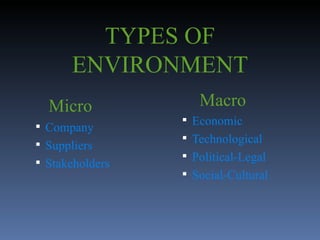
TYPES OF ENVIRONMENT Micro   Company Suppliers Stakeholders Macro Economic Technological Political-Legal Social-Cultural
LAWS OF MARKETING Law #1: The Law of Leadership Law #2: The Law of the Category Law #3: The Law of Perception Law #4: The Law of Focus Law #5: The Law of Exclusivity Law #6: The Law of success Law #7: The Law of  hype Law #8: The Law of  resource
MARKETING MIX 4P’S PRODUCT PRICE PROMOTION PLACE
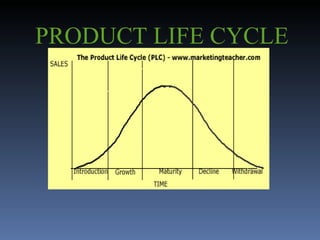
PRODUCT LIFE CYCLE
Different Stages of Product Life Cycle Introduction Growth Maturity Decline In reality very few products follow such a  prescriptive cycle.  Some go from introduction to decline. It is not easy to tell which stage the product is in. Remember that PLC is like all other tools. Use it to inform your gut feeling.
Those activities directly involved in obtaining , consuming and disposing of products and services, including the decision processes that precede and follow these actions
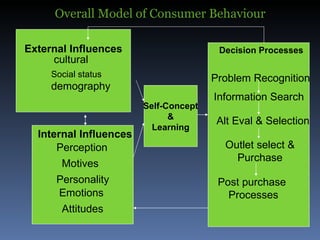
Overall Model of Consumer Behaviour Self-Concept & Learning Decision Processes External Influences Internal Influences cultural Social status demography Perception Motives Personality Emotions Attitudes Problem Recognition Information Search Alt Eval & Selection Outlet select & Purchase Post purchase Processes
MARKET RESEARCH What is Marketing Research ? Systematic design, collection, analysis and reporting of data and findings relevant to a specific marketing situation facing the company .
MARKET RESEARCH Why is Market Research required ? Identify & define problems including cause, Important to understand consumer, likes and dislikes and reasons for them. Design new products or services accordingly. Develop promotional and distribution strategies in line with consumer preference.
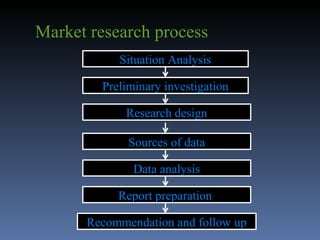
Market research process Situation Analysis Research design Sources of data Data analysis Report preparation  Recommendation and follow up Preliminary investigation
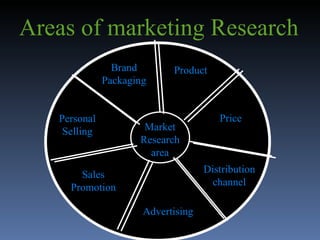
Areas of marketing Research Market Research area Product Price Distribution channel Advertising Sales Promotion Personal Selling Brand Packaging
DEFINATION Market segmentation is the process in Marketing of dividing a market  into distinct subsets (segments) that behave in the same way or have similar needs
Why Segmentation? To identify Different Segment of Buyers  Select One or More segment to enter  To select Market Offering  To compete Effectively
Targeting It is the  second  step in market identification process. It recognizes the diversity of customers and does not try to please them with the same offering Target market  is, the market segment to which a particular product is marketed.  Targeting  is the selection of the customers you wish to service. The decisions involved in targeting strategy include: which segments to targeting  how many products to offer  which products to offer in which segments
Positioning   Positioning is the development of a service and a marketing mix to occupy a specific place in the minds of customers within target markets.
Positioning is all about 'perception'.  As perception differs from person to person, so do the results of the positioning map.  The term  'positioning‘  also refers to the consumer's perception of a product or service in relation to its competitors.
 
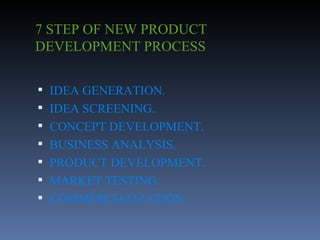
7 STEP OF NEW PRODUCT DEVELOPMENT PROCESS IDEA GENERATION. IDEA SCREENING. CONCEPT DEVELOPMENT. BUSINESS ANALYSIS. PRODUCT DEVELOPMENT. MARKET TESTING. COMMERCIALIZATION.
WHY NEW PRODUCT FAIL OR SUCCED
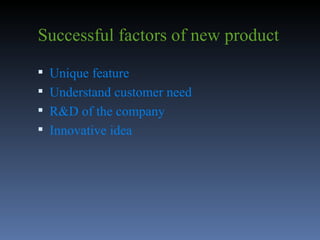
Successful factors of new product Unique feature Understand customer need R&D of the company Innovative idea
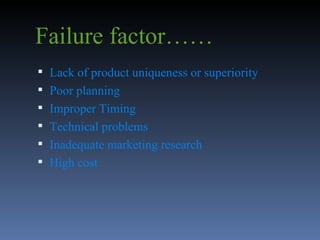
Failure factor……  Lack of product uniqueness or superiority Poor planning Improper Timing Technical problems Inadequate marketing research High cost
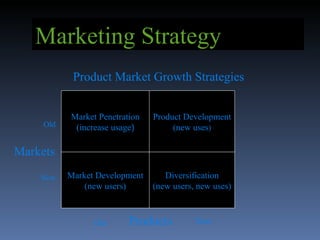
Marketing Strategy Product Market Growth Strategies Market Penetration (increase usage ) Product Development (new uses ) Market Development (new users) Diversification (new users, new uses) Markets Products Old Old New New
Marketing Strategy Difference Between where we want to go & where we are. A  marketing strategy  is a process that can allow an organization to concentrate its limited resources on the greatest opportunities to increase sales and achieve a sustainable competitive advantage [3  A marketing strategy should be the key concept that customer satisfaction is the main goal.
NICHE MARKETING A NICHE IS A NARROWLY DEFINED CUSTOMER GROUP.SEEKING A DISTINCTIVE MIX OF BENEFITS. CUSTOMER ARE READY TO PAY A PREMIUM AMOUNT. NICHE IS FAIRLY SMALL SIZE,BUT HAS PROFIT AND GROWTH POTENTIAL. NICHE MARKETERS AIM TO UNDERSTAND THEIR CUSTOMER NEEDS VERY WELL.
EXAMPLES………… EZEE – LIQUID DETERGENT QTV,AASTHA – T.V CHANNEL  HALL MARK – PERSONAL EXPRESSION CARD D.C - CAR MODYFICATION FIRM
Distribution Channel There may be a chain of intermediaries, each passing the product down the chain to the next organization, before it finally reaches the consumer or end-user.  This process is known as the 'distribution chain' or the 'channel.'  Each of the elements in these chains will have their own specific needs, which the producer must take into account, along with those of the all-important end-user
Types of Distribution Intensive Distribution Exclusive Distribution Selective Distribution
BRANDING What is Brand? E.g. of the brand : Orange : Wherever you go, our network follows. Reliance India Mobile : Kar lo Duniya Mutthi Mein. Raymond : For the complete man. Tata Salt : Desh ka namak Nokia  :Connecting people Aaj Tak : Sabse Tej.
  Role of Brand Management: Long Term Short Term Types of Brands: Manufacture Brands. Dealer Brands.
Branding strategies : Generic products Vs. Branded products Manufacturer’s brands Vs. Private brands Individual brands Vs. Family brands
CONCEPT OF INTERNATIONAL MARKETING Domestic market extension Multi –domestic market Global marketing
REASON FOR GOING INTERNATIONAL Saturated home market Competition Excess capacity Advantage in product, skill or technology Product life cycle differences Geographic diversification Organizational reasons Financial reasons
DO’S AND DON’T’S IN MARKETING Do’s Time Plan & Prioritize Renewing Contacts Relationships Enthusiasm & Momentum Praise Logically Rhetorical Find & Help
DO’S AND DON’T’S IN MARKETING DON’T’S Trifling – Conversations Never Fail –Appreciation ; Lead Never Forget  &  Never Let Commitments – Clients/Customers Inside; Outside  – Ball court Don’t Only Products – But also Ideas Trickery & Subterfuge – Dishonest action to achieve aim Meet & Greet Convince & Confuse
THANK YOU !

all about marketing

  • 1.
    ALL ABOUT MARKETINGPRESENTED BY: MARKETING GROUP(PGDM 2008-10)
  • 2.
  • 3.
    Identifying & meetinghuman and social needs profitably.
  • 4.
    ‘ Exchange’ Atleast two parties Each party has something of value to other party Each party is capable of communication and delivery Each party is free to accept or reject the exchange offer Each party believes it is appropriate or desirable to deal with the other party
  • 5.
  • 6.
    What is Marketed ? Goods Services Events Experiences Persons Places Organization
  • 7.
    Marketing environment Themarketing environment surrounds and impacts upon the organization. There are three key perspectives on the marketing environment, namely 'macro-environment 'micro-environment'
  • 8.
    TYPES OF ENVIRONMENTMicro Company Suppliers Stakeholders Macro Economic Technological Political-Legal Social-Cultural
  • 9.
    LAWS OF MARKETINGLaw #1: The Law of Leadership Law #2: The Law of the Category Law #3: The Law of Perception Law #4: The Law of Focus Law #5: The Law of Exclusivity Law #6: The Law of success Law #7: The Law of hype Law #8: The Law of resource
  • 10.
    MARKETING MIX 4P’SPRODUCT PRICE PROMOTION PLACE
  • 11.
  • 12.
    Different Stages ofProduct Life Cycle Introduction Growth Maturity Decline In reality very few products follow such a prescriptive cycle. Some go from introduction to decline. It is not easy to tell which stage the product is in. Remember that PLC is like all other tools. Use it to inform your gut feeling.
  • 13.
    Those activities directlyinvolved in obtaining , consuming and disposing of products and services, including the decision processes that precede and follow these actions
  • 14.
    Overall Model ofConsumer Behaviour Self-Concept & Learning Decision Processes External Influences Internal Influences cultural Social status demography Perception Motives Personality Emotions Attitudes Problem Recognition Information Search Alt Eval & Selection Outlet select & Purchase Post purchase Processes
  • 15.
    MARKET RESEARCH Whatis Marketing Research ? Systematic design, collection, analysis and reporting of data and findings relevant to a specific marketing situation facing the company .
  • 16.
    MARKET RESEARCH Whyis Market Research required ? Identify & define problems including cause, Important to understand consumer, likes and dislikes and reasons for them. Design new products or services accordingly. Develop promotional and distribution strategies in line with consumer preference.
  • 17.
    Market research processSituation Analysis Research design Sources of data Data analysis Report preparation Recommendation and follow up Preliminary investigation
  • 18.
    Areas of marketingResearch Market Research area Product Price Distribution channel Advertising Sales Promotion Personal Selling Brand Packaging
  • 19.
    DEFINATION Market segmentationis the process in Marketing of dividing a market into distinct subsets (segments) that behave in the same way or have similar needs
  • 20.
    Why Segmentation? Toidentify Different Segment of Buyers Select One or More segment to enter To select Market Offering To compete Effectively
  • 21.
    Targeting It isthe second step in market identification process. It recognizes the diversity of customers and does not try to please them with the same offering Target market is, the market segment to which a particular product is marketed. Targeting is the selection of the customers you wish to service. The decisions involved in targeting strategy include: which segments to targeting how many products to offer which products to offer in which segments
  • 22.
    Positioning Positioning is the development of a service and a marketing mix to occupy a specific place in the minds of customers within target markets.
  • 23.
    Positioning is allabout 'perception'. As perception differs from person to person, so do the results of the positioning map. The term 'positioning‘ also refers to the consumer's perception of a product or service in relation to its competitors.
  • 24.
  • 25.
    7 STEP OFNEW PRODUCT DEVELOPMENT PROCESS IDEA GENERATION. IDEA SCREENING. CONCEPT DEVELOPMENT. BUSINESS ANALYSIS. PRODUCT DEVELOPMENT. MARKET TESTING. COMMERCIALIZATION.
  • 26.
    WHY NEW PRODUCTFAIL OR SUCCED
  • 27.
    Successful factors ofnew product Unique feature Understand customer need R&D of the company Innovative idea
  • 28.
    Failure factor…… Lack of product uniqueness or superiority Poor planning Improper Timing Technical problems Inadequate marketing research High cost
  • 29.
    Marketing Strategy ProductMarket Growth Strategies Market Penetration (increase usage ) Product Development (new uses ) Market Development (new users) Diversification (new users, new uses) Markets Products Old Old New New
  • 30.
    Marketing Strategy DifferenceBetween where we want to go & where we are. A marketing strategy is a process that can allow an organization to concentrate its limited resources on the greatest opportunities to increase sales and achieve a sustainable competitive advantage [3 A marketing strategy should be the key concept that customer satisfaction is the main goal.
  • 31.
    NICHE MARKETING ANICHE IS A NARROWLY DEFINED CUSTOMER GROUP.SEEKING A DISTINCTIVE MIX OF BENEFITS. CUSTOMER ARE READY TO PAY A PREMIUM AMOUNT. NICHE IS FAIRLY SMALL SIZE,BUT HAS PROFIT AND GROWTH POTENTIAL. NICHE MARKETERS AIM TO UNDERSTAND THEIR CUSTOMER NEEDS VERY WELL.
  • 32.
    EXAMPLES………… EZEE –LIQUID DETERGENT QTV,AASTHA – T.V CHANNEL HALL MARK – PERSONAL EXPRESSION CARD D.C - CAR MODYFICATION FIRM
  • 33.
    Distribution Channel Theremay be a chain of intermediaries, each passing the product down the chain to the next organization, before it finally reaches the consumer or end-user. This process is known as the 'distribution chain' or the 'channel.' Each of the elements in these chains will have their own specific needs, which the producer must take into account, along with those of the all-important end-user
  • 34.
    Types of DistributionIntensive Distribution Exclusive Distribution Selective Distribution
  • 35.
    BRANDING What isBrand? E.g. of the brand : Orange : Wherever you go, our network follows. Reliance India Mobile : Kar lo Duniya Mutthi Mein. Raymond : For the complete man. Tata Salt : Desh ka namak Nokia :Connecting people Aaj Tak : Sabse Tej.
  • 36.
    Roleof Brand Management: Long Term Short Term Types of Brands: Manufacture Brands. Dealer Brands.
  • 37.
    Branding strategies :Generic products Vs. Branded products Manufacturer’s brands Vs. Private brands Individual brands Vs. Family brands
  • 38.
    CONCEPT OF INTERNATIONALMARKETING Domestic market extension Multi –domestic market Global marketing
  • 39.
    REASON FOR GOINGINTERNATIONAL Saturated home market Competition Excess capacity Advantage in product, skill or technology Product life cycle differences Geographic diversification Organizational reasons Financial reasons
  • 40.
    DO’S AND DON’T’SIN MARKETING Do’s Time Plan & Prioritize Renewing Contacts Relationships Enthusiasm & Momentum Praise Logically Rhetorical Find & Help
  • 41.
    DO’S AND DON’T’SIN MARKETING DON’T’S Trifling – Conversations Never Fail –Appreciation ; Lead Never Forget & Never Let Commitments – Clients/Customers Inside; Outside – Ball court Don’t Only Products – But also Ideas Trickery & Subterfuge – Dishonest action to achieve aim Meet & Greet Convince & Confuse
  • 42.