Chapter 2 
Company and marketing strategy: 
partnering to build customer relationships
 Companies need growth is they are to compete 
more effectively, satisfy their stakeholders and 
attract top talent. 
 The company’s objective must be ‘profitable 
growth’. 
 Marketing is mainly responsible for profitable 
growth. Must identify, evaluate and select market 
opportunities and plan strategies to capture them. 
 Product/market expansion grid is a useful tool for
 A portfolio-planning tool for identifying company 
growth opportunities through market penetration, 
market development, product development or 
diversification. 
 Lets look at Starbucks as an example: 
Howard Schultz thought of bringing a European 
style coffee house to America. He believed people 
needed to slow down. They needed to smell the 
coffee and enjoy life a little more. Starbucks does 
not just sell coffee it sells the ‘Starbuck’s 
experience’.
 A strategy for company growth by increasing sales 
of current products to current market segments 
without changing the product. 
 E.g. Starbucks might add more stores in current 
market areas for customers to visit easily. 
 Improved advertising, prices, services, menu 
selection, store design (encourages customers to 
stay longe). 
 Add drive through windows. 
 Starbuck cards allows to prepay for coffee and 
snacks or gift Starbucks to friends and families.
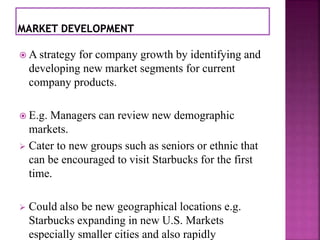
 A strategy for company growth by identifying and 
developing new market segments for current 
company products. 
 E.g. Managers can review new demographic 
markets. 
 Cater to new groups such as seniors or ethnic that 
can be encouraged to visit Starbucks for the first 
time. 
 Could also be new geographical locations e.g. 
Starbucks expanding in new U.S. Markets 
especially smaller cities and also rapidly
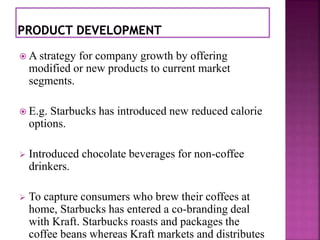
 A strategy for company growth by offering 
modified or new products to current market 
segments. 
 E.g. Starbucks has introduced new reduced calorie 
options. 
 Introduced chocolate beverages for non-coffee 
drinkers. 
 To capture consumers who brew their coffees at 
home, Starbucks has entered a co-branding deal 
with Kraft. Starbucks roasts and packages the 
coffee beans whereas Kraft markets and distributes
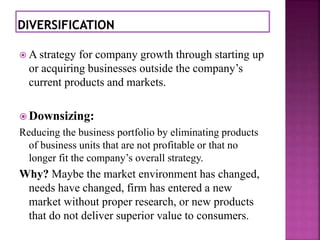
 A strategy for company growth through starting up 
or acquiring businesses outside the company’s 
current products and markets. 
Downsizing: 
Reducing the business portfolio by eliminating products 
of business units that are not profitable or that no 
longer fit the company’s overall strategy. 
Why? Maybe the market environment has changed, 
needs have changed, firm has entered a new 
market without proper research, or new products 
that do not deliver superior value to consumers.
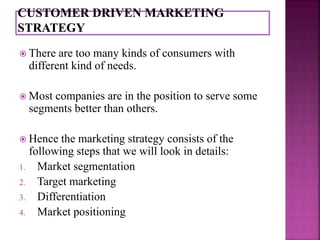
 There are too many kinds of consumers with 
different kind of needs. 
 Most companies are in the position to serve some 
segments better than others. 
 Hence the marketing strategy consists of the 
following steps that we will look in details: 
1. Market segmentation 
2. Target marketing 
3. Differentiation 
4. Market positioning
 Dividing a market into distinct groups of buyers 
who have distinct needs, characteristics or 
behaviour and who might require separate products 
or marketing programs. 
 Marketers have to determine which segments offer 
the best opportunities. Consumers can be grouped 
based on geographic, demographic and 
behavioural factors. 
 A market segment consists of a group of 
consumers who respond in a similar way to a given 
set of marketing efforts.
 The process of evaluating each market segment’s 
attractiveness and selecting one or more segments to 
enter. 
 Target segments in which a firm can profitably 
generate the greatest customer value and sustain it over 
time. 
 Companies with limited resources will target a few 
segments. Or serve several related segments, with 
several different consumers with same basic want e.g. 
Clothing. 
 Large companies on the other hand eventually seek full 
market coverage. E.g GM says they make a car for
 Once a company has decided which market 
segments to enter it must decide how it will 
differentiate its market offerings for each segments 
and what positions it wants to occupy in those 
segments. 
 Marketers want to develop unique market 
positions for their products. If the product is 
perceived to be exactly the same as others in the 
market, consumers will have no reason to but it. 
 Examples PTO
 E.g. BMW makes the ‘ultimate driving machine’. 
 Ford is ‘built for the road ahead’ 
 Kia promises ‘the power to surprise’ 
 Master card gives you ‘priceless experience’. 
 Positioning: 
Arranging for a product to occupy a clear, 
distinctive and desirable place relative to 
competing products in the minds of target 
consumers. 
 Differentiation: 
Actually differentiating the market offering to create 
superior customer value.
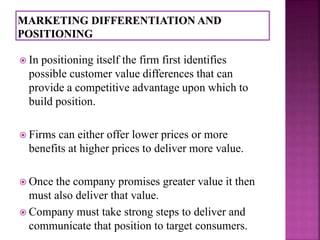
 In positioning itself the firm first identifies 
possible customer value differences that can 
provide a competitive advantage upon which to 
build position. 
 Firms can either offer lower prices or more 
benefits at higher prices to deliver more value. 
 Once the company promises greater value it then 
must also deliver that value. 
 Company must take strong steps to deliver and 
communicate that position to target consumers.
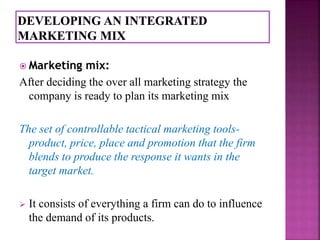
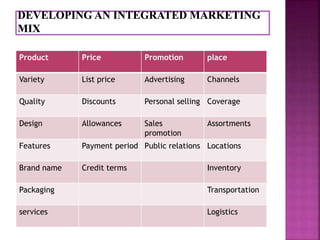
 Marketing mix: 
After deciding the over all marketing strategy the 
company is ready to plan its marketing mix 
The set of controllable tactical marketing tools-product, 
price, place and promotion that the firm 
blends to produce the response it wants in the 
target market. 
 It consists of everything a firm can do to influence 
the demand of its products.
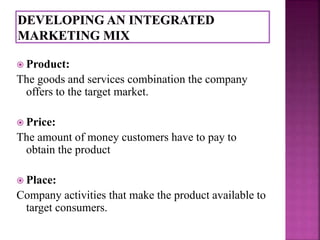
 Product: 
The goods and services combination the company 
offers to the target market. 
 Price: 
The amount of money customers have to pay to 
obtain the product 
 Place: 
Company activities that make the product available to 
target consumers.
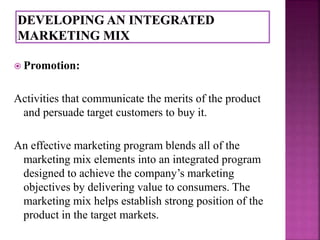
 Promotion: 
Activities that communicate the merits of the product 
and persuade target customers to buy it. 
An effective marketing program blends all of the 
marketing mix elements into an integrated program 
designed to achieve the company’s marketing 
objectives by delivering value to consumers. The 
marketing mix helps establish strong position of the 
product in the target markets.
Product Price Promotion place 
Variety List price Advertising Channels 
Quality Discounts Personal selling Coverage 
Design Allowances Sales 
promotion 
Assortments 
Features Payment period Public relations Locations 
Brand name Credit terms Inventory 
Packaging Transportation 
services Logistics
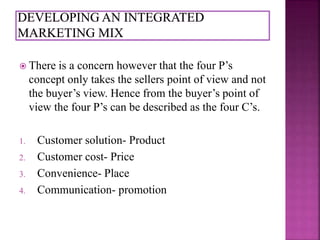
 There is a concern however that the four P’s 
concept only takes the sellers point of view and not 
the buyer’s view. Hence from the buyer’s point of 
view the four P’s can be described as the four C’s. 
1. Customer solution- Product 
2. Customer cost- Price 
3. Convenience- Place 
4. Communication- promotion

Slide_R_A_A2 slide #7

  • 1.
    Chapter 2 Companyand marketing strategy: partnering to build customer relationships
  • 2.
     Companies needgrowth is they are to compete more effectively, satisfy their stakeholders and attract top talent.  The company’s objective must be ‘profitable growth’.  Marketing is mainly responsible for profitable growth. Must identify, evaluate and select market opportunities and plan strategies to capture them.  Product/market expansion grid is a useful tool for
  • 3.
     A portfolio-planningtool for identifying company growth opportunities through market penetration, market development, product development or diversification.  Lets look at Starbucks as an example: Howard Schultz thought of bringing a European style coffee house to America. He believed people needed to slow down. They needed to smell the coffee and enjoy life a little more. Starbucks does not just sell coffee it sells the ‘Starbuck’s experience’.
  • 4.
     A strategyfor company growth by increasing sales of current products to current market segments without changing the product.  E.g. Starbucks might add more stores in current market areas for customers to visit easily.  Improved advertising, prices, services, menu selection, store design (encourages customers to stay longe).  Add drive through windows.  Starbuck cards allows to prepay for coffee and snacks or gift Starbucks to friends and families.
  • 5.
     A strategyfor company growth by identifying and developing new market segments for current company products.  E.g. Managers can review new demographic markets.  Cater to new groups such as seniors or ethnic that can be encouraged to visit Starbucks for the first time.  Could also be new geographical locations e.g. Starbucks expanding in new U.S. Markets especially smaller cities and also rapidly
  • 6.
     A strategyfor company growth by offering modified or new products to current market segments.  E.g. Starbucks has introduced new reduced calorie options.  Introduced chocolate beverages for non-coffee drinkers.  To capture consumers who brew their coffees at home, Starbucks has entered a co-branding deal with Kraft. Starbucks roasts and packages the coffee beans whereas Kraft markets and distributes
  • 7.
     A strategyfor company growth through starting up or acquiring businesses outside the company’s current products and markets. Downsizing: Reducing the business portfolio by eliminating products of business units that are not profitable or that no longer fit the company’s overall strategy. Why? Maybe the market environment has changed, needs have changed, firm has entered a new market without proper research, or new products that do not deliver superior value to consumers.
  • 8.
     There aretoo many kinds of consumers with different kind of needs.  Most companies are in the position to serve some segments better than others.  Hence the marketing strategy consists of the following steps that we will look in details: 1. Market segmentation 2. Target marketing 3. Differentiation 4. Market positioning
  • 9.
     Dividing amarket into distinct groups of buyers who have distinct needs, characteristics or behaviour and who might require separate products or marketing programs.  Marketers have to determine which segments offer the best opportunities. Consumers can be grouped based on geographic, demographic and behavioural factors.  A market segment consists of a group of consumers who respond in a similar way to a given set of marketing efforts.
  • 10.
     The processof evaluating each market segment’s attractiveness and selecting one or more segments to enter.  Target segments in which a firm can profitably generate the greatest customer value and sustain it over time.  Companies with limited resources will target a few segments. Or serve several related segments, with several different consumers with same basic want e.g. Clothing.  Large companies on the other hand eventually seek full market coverage. E.g GM says they make a car for
  • 11.
     Once acompany has decided which market segments to enter it must decide how it will differentiate its market offerings for each segments and what positions it wants to occupy in those segments.  Marketers want to develop unique market positions for their products. If the product is perceived to be exactly the same as others in the market, consumers will have no reason to but it.  Examples PTO
  • 12.
     E.g. BMWmakes the ‘ultimate driving machine’.  Ford is ‘built for the road ahead’  Kia promises ‘the power to surprise’  Master card gives you ‘priceless experience’.  Positioning: Arranging for a product to occupy a clear, distinctive and desirable place relative to competing products in the minds of target consumers.  Differentiation: Actually differentiating the market offering to create superior customer value.
  • 13.
     In positioningitself the firm first identifies possible customer value differences that can provide a competitive advantage upon which to build position.  Firms can either offer lower prices or more benefits at higher prices to deliver more value.  Once the company promises greater value it then must also deliver that value.  Company must take strong steps to deliver and communicate that position to target consumers.
  • 14.
     Marketing mix: After deciding the over all marketing strategy the company is ready to plan its marketing mix The set of controllable tactical marketing tools-product, price, place and promotion that the firm blends to produce the response it wants in the target market.  It consists of everything a firm can do to influence the demand of its products.
  • 15.
     Product: Thegoods and services combination the company offers to the target market.  Price: The amount of money customers have to pay to obtain the product  Place: Company activities that make the product available to target consumers.
  • 16.
     Promotion: Activitiesthat communicate the merits of the product and persuade target customers to buy it. An effective marketing program blends all of the marketing mix elements into an integrated program designed to achieve the company’s marketing objectives by delivering value to consumers. The marketing mix helps establish strong position of the product in the target markets.
  • 17.
    Product Price Promotionplace Variety List price Advertising Channels Quality Discounts Personal selling Coverage Design Allowances Sales promotion Assortments Features Payment period Public relations Locations Brand name Credit terms Inventory Packaging Transportation services Logistics
  • 18.
     There isa concern however that the four P’s concept only takes the sellers point of view and not the buyer’s view. Hence from the buyer’s point of view the four P’s can be described as the four C’s. 1. Customer solution- Product 2. Customer cost- Price 3. Convenience- Place 4. Communication- promotion