



BY MD.MAHOFUZUR RAHMAN,PCIU,CHITTAGONG
Market & Marketing
 Market : A set of actual and potential buyers
 Marketing is a group of interrelated activities
designed to identify consumer needs and to
develop, distribute, promote and price goods and
services to satisfy these needs at a profit.
 “The process by which companies create value for
customers and build strong customer relationships
in order to capture value from customers in return”-
Philip Kotler
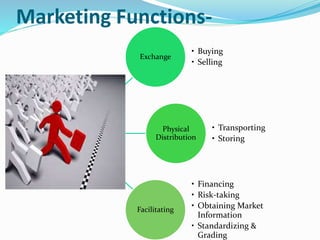
Marketing Functions-
Exchange
• Buying
• Selling
Physical
Distribution
• Transporting
• Storing
Facilitating
• Financing
• Risk-taking
• Obtaining Market
Information
• Standardizing &
Grading
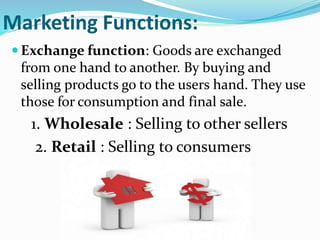
Marketing Functions:
 Exchange function: Goods are exchanged
from one hand to another. By buying and
selling products go to the users hand. They use
those for consumption and final sale.
1. Wholesale : Selling to other sellers
2. Retail : Selling to consumers
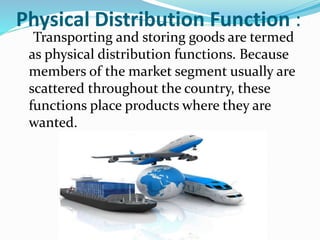
Physical Distribution Function :
Transporting and storing goods are termed
as physical distribution functions. Because
members of the market segment usually are
scattered throughout the country, these
functions place products where they are
wanted.
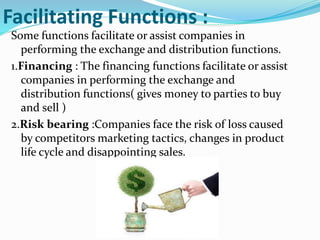
Facilitating Functions :
Some functions facilitate or assist companies in
performing the exchange and distribution functions.
1.Financing : The financing functions facilitate or assist
companies in performing the exchange and
distribution functions( gives money to parties to buy
and sell )
2.Risk bearing :Companies face the risk of loss caused
by competitors marketing tactics, changes in product
life cycle and disappointing sales.
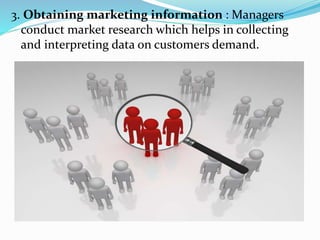
3. Obtaining marketing information : Managers
conduct market research which helps in collecting
and interpreting data on customers demand.
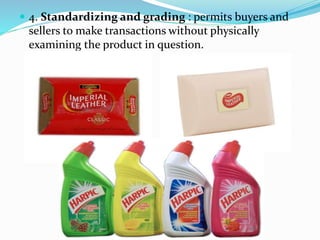
 4. Standardizing and grading : permits buyers and
sellers to make transactions without physically
examining the product in question.
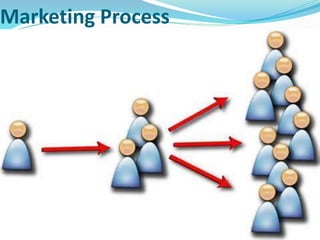
Marketing Process
Marketing Process
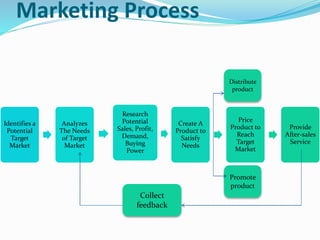
A process involves some sequential acts.
Marketing process-
1. Identifies a potential target market of consumers( age , income,
location).
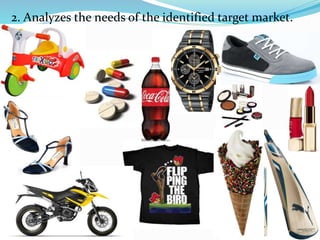
2. Analyzes the needs of the identified target market.
3. Researches the potential of the target market for demand, sales,
buying power and potential profit.
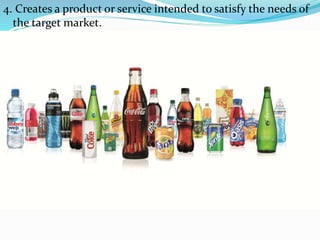
4. Creates a product or service intended to satisfy the needs of the
target market
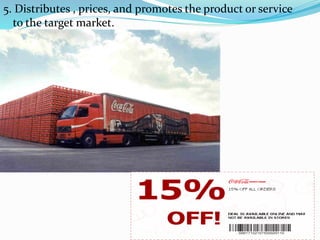
5. Distributes , prices, and promotes the product or service to the
target market.
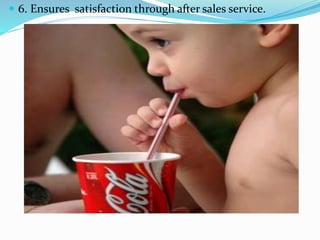
6. Ensures satisfaction through after sales service.
Marketing Process
Identifies a
Potential
Target
Market
Analyzes
The Needs
of Target
Market
Research
Potential
Sales, Profit,
Demand,
Buying
Power
Create A
Product to
Satisfy
Needs
Price
Product to
Reach
Target
Market
Provide
After-sales
Service
Distribute
product
Promote
product
Collect
feedback
Marketing-
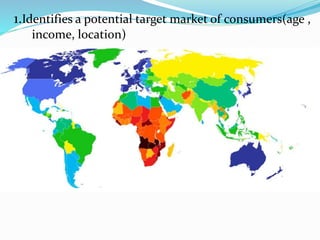
1.Identifies a potential target market of consumers(age ,
income, location)
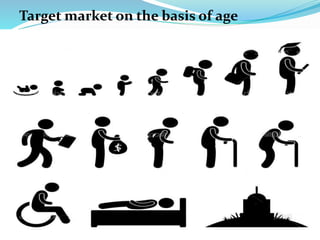
Target market on the basis of age
Target Market on the Basis of Income & Location
Marketing-
2. Analyzes the needs of the identified target market.
 Marketing-
 3. Researches the potential of the target market for demand,
sales, buying power and potential profit.
Marketing-
4. Creates a product or service intended to satisfy the needs of
the target market.
Marketing-
5. Distributes , prices, and promotes the product or service
to the target market.
 Marketing-
 6. Ensures satisfaction through after sales service.
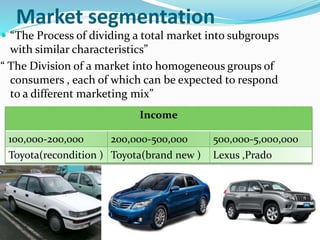
Market Segmentation
 “The Process of dividing a total market into subgroups
with similar characteristics”
“ The Division of a market into homogeneous groups of
consumers , each of which can be expected to respond
to a different marketing mix”
Income
100,000-200,000 200,000-500,000 500,000-5,000,000
Toyota(recondition ) Toyota(brand new ) Lexus ,Prado
Steps of Segmentation
Step-1 : Identify the characteristics and needs of the
market.
Information needed:
1.Data on family income , geographic location.
2. Behavior patterns ( amounts of a specific product
consumed, social status, language )
3. Physical characteristics ( age , sex , health )
4.Phychologic traits ( personality , hobbies )
5.Opinions of goods on the market
6.Degree of competition
Steps of Segmentation
Step-2 : Analyze the potential of the market.
1. Sales potential: Sufficient number of prospective
buyers
2. Demand potential : Must have demands. Products
such as smoke alarms, antibiotic drugs are sold in
response to needs.
3.Buying power: Potential customers must have
financial capacity to purchase goods.
4. Profit potential : The segment will be profitable
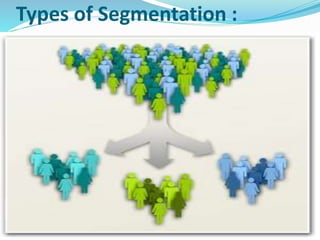
Types of Segmentation :
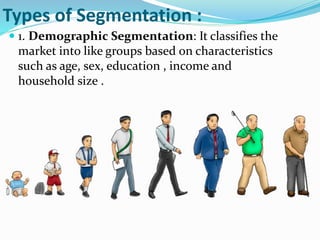
 1. Demographic Segmentation: It classifies the
market into like groups based on characteristics
such as age, sex, education , income and
household size .
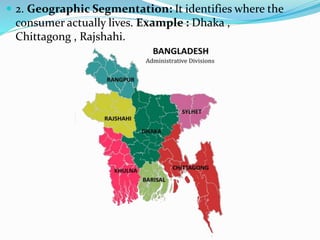
 2. Geographic Segmentation: It identifies where the
consumer actually lives. Example : Dhaka ,
Chittagong , Rajshahi.
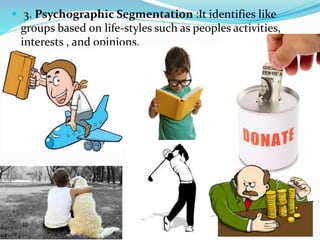
 3. Psychographic Segmentation :It identifies like
groups based on life-styles such as peoples activities,
interests , and opinions.
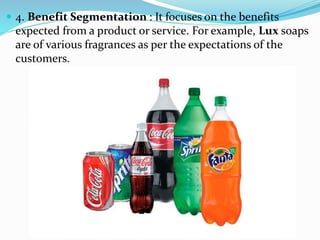
 4. Benefit Segmentation : It focuses on the benefits
expected from a product or service. For example, Lux soaps
are of various fragrances as per the expectations of the
customers.
Marketing Mix
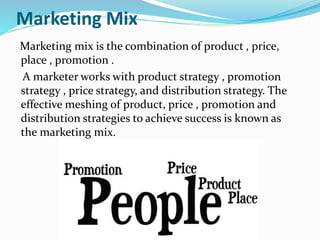
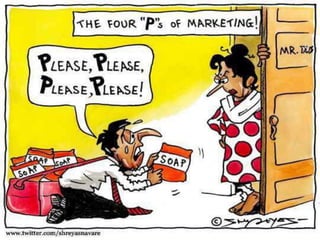
Marketing mix is the combination of product , price,
place , promotion .
A marketer works with product strategy , promotion
strategy , price strategy, and distribution strategy. The
effective meshing of product, price , promotion and
distribution strategies to achieve success is known as
the marketing mix.
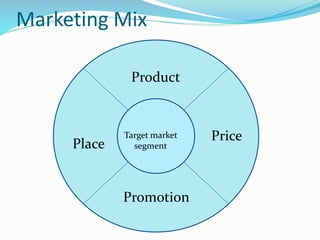
Marketing Mix
Target market
segment
Product
Promotion
Place
Price
Elements in Marketing Mix
1. Product strategy : It extends beyond the physical
item itself to include decisions about brands,
trademarks, packaging , new product development
and the product life cycle .
2.Pricing strategy : It is concerned with establishing
prices for products that will return a profit.
3.Promotional strategy : It involves developing the
correct blend of the promotional mix elements-
advertising , personal selling, sales promotion and
publicity.
4. Place : Place involves the distribution systems and
channels used to place the product in the customers
hands.
Product
A product consists of the basic physical offering
and an accompanying set of image and service
features that seek to satisfy needs.
Categories of product :
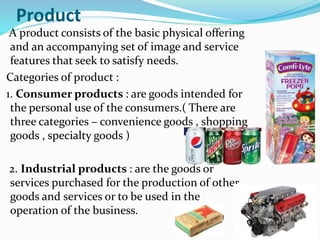
1. Consumer products : are goods intended for
the personal use of the consumers.( There are
three categories – convenience goods , shopping
goods , specialty goods )
2. Industrial products : are the goods or
services purchased for the production of other
goods and services or to be used in the
operation of the business.
Product
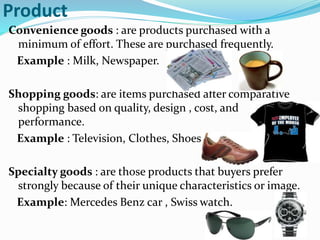
Convenience goods : are products purchased with a
minimum of effort. These are purchased frequently.
Example : Milk, Newspaper.
Shopping goods: are items purchased after comparative
shopping based on quality, design , cost, and
performance.
Example : Television, Clothes, Shoes
Specialty goods : are those products that buyers prefer
strongly because of their unique characteristics or image.
Example: Mercedes Benz car , Swiss watch.
Product Strategy :
A strategy is a plan of action or policy in business.
Product strategy aims at distinguishing own product
from all others .
Product strategy has following two dimensions-
2. Use of brand
2. Use of packaging
Use of brands : “A brand is a name , symbol , design or a
combination of these that identifies the products or
services of a company”
Four Brand Identifications
1. A brand name is a letter , a word or a group of letters or
words used to identify the product.
Example : Lux , Toyota, Tata, Honda, Maruti
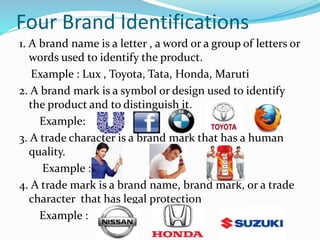
2. A brand mark is a symbol or design used to identify
the product and to distinguish it.
Example: :
3. A trade character is a brand mark that has a human
quality.
Example :
4. A trade mark is a brand name, brand mark, or a trade
character that has legal protection
Example :
Advantages of Brand
 1. Ease of reorganization
 2. Projecting a message
 3. Universal
 4. Differentiation
 5. Extra profit
Generic products : Products with no brands
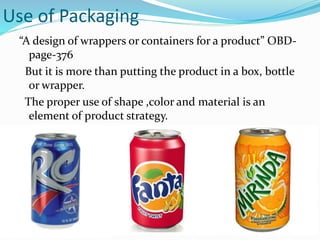
Use of Packaging
“A design of wrappers or containers for a product” OBD-
page-376
But it is more than putting the product in a box, bottle
or wrapper.
The proper use of shape ,color and material is an
element of product strategy.
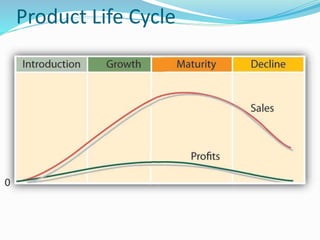
Product Life Cycle :
 “The course of a “product's” sales and
profitability over its life time” OBD-407
 “The succession of phases including the
introduction, growth, maturity and decline of
a product in its market”
Product Life Cycle
Introduction
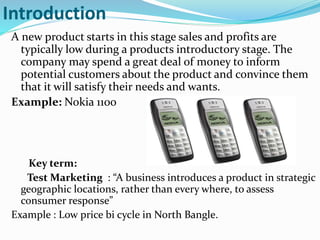
A new product starts in this stage sales and profits are
typically low during a products introductory stage. The
company may spend a great deal of money to inform
potential customers about the product and convince them
that it will satisfy their needs and wants.
Example: Nokia 1100
Key term:
Test Marketing : “A business introduces a product in strategic
geographic locations, rather than every where, to assess
consumer response”
Example : Low price bi cycle in North Bangle.
Growth
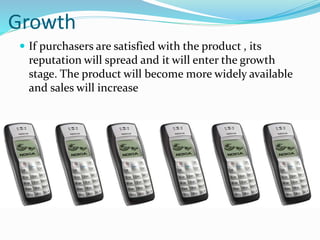
 If purchasers are satisfied with the product , its
reputation will spread and it will enter the growth
stage. The product will become more widely available
and sales will increase
Maturity
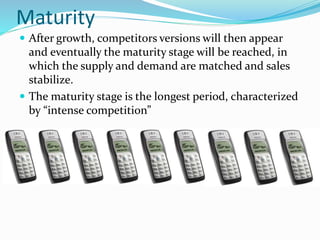
 After growth, competitors versions will then appear
and eventually the maturity stage will be reached, in
which the supply and demand are matched and sales
stabilize.
 The maturity stage is the longest period, characterized
by “intense competition”
Decline
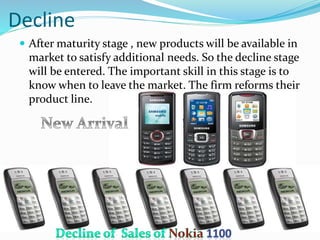
 After maturity stage , new products will be available in
market to satisfy additional needs. So the decline stage
will be entered. The important skill in this stage is to
know when to leave the market. The firm reforms their
product line.
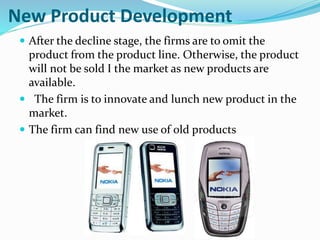
New Product Development
 After the decline stage, the firms are to omit the
product from the product line. Otherwise, the product
will not be sold I the market as new products are
available.
 The firm is to innovate and lunch new product in the
market.
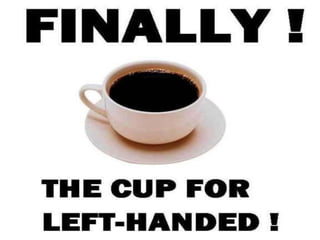
 The firm can find new use of old products
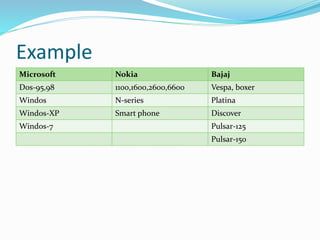
Example
Microsoft Nokia Bajaj
Dos-95,98 1100,1600,2600,6600 Vespa , Boxer
Windows N-Series Platina
Windows -XP Smart Phone Discover
Windows -7 Pulsar-125
Pulsar-150

PRIMARY CONCEPT OF MARKETING BY MD.MAHOFUZUR RAHMAN,PCIU

  • 1.
  • 2.
    Market & Marketing Market : A set of actual and potential buyers  Marketing is a group of interrelated activities designed to identify consumer needs and to develop, distribute, promote and price goods and services to satisfy these needs at a profit.  “The process by which companies create value for customers and build strong customer relationships in order to capture value from customers in return”- Philip Kotler
  • 3.
    Marketing Functions- Exchange • Buying •Selling Physical Distribution • Transporting • Storing Facilitating • Financing • Risk-taking • Obtaining Market Information • Standardizing & Grading
  • 4.
    Marketing Functions:  Exchangefunction: Goods are exchanged from one hand to another. By buying and selling products go to the users hand. They use those for consumption and final sale. 1. Wholesale : Selling to other sellers 2. Retail : Selling to consumers
  • 5.
    Physical Distribution Function: Transporting and storing goods are termed as physical distribution functions. Because members of the market segment usually are scattered throughout the country, these functions place products where they are wanted.
  • 6.
    Facilitating Functions : Somefunctions facilitate or assist companies in performing the exchange and distribution functions. 1.Financing : The financing functions facilitate or assist companies in performing the exchange and distribution functions( gives money to parties to buy and sell ) 2.Risk bearing :Companies face the risk of loss caused by competitors marketing tactics, changes in product life cycle and disappointing sales.
  • 7.
    3. Obtaining marketinginformation : Managers conduct market research which helps in collecting and interpreting data on customers demand.
  • 8.
     4. Standardizingand grading : permits buyers and sellers to make transactions without physically examining the product in question.
  • 9.
  • 10.
    Marketing Process A processinvolves some sequential acts. Marketing process- 1. Identifies a potential target market of consumers( age , income, location). 2. Analyzes the needs of the identified target market. 3. Researches the potential of the target market for demand, sales, buying power and potential profit. 4. Creates a product or service intended to satisfy the needs of the target market 5. Distributes , prices, and promotes the product or service to the target market. 6. Ensures satisfaction through after sales service.
  • 11.
    Marketing Process Identifies a Potential Target Market Analyzes TheNeeds of Target Market Research Potential Sales, Profit, Demand, Buying Power Create A Product to Satisfy Needs Price Product to Reach Target Market Provide After-sales Service Distribute product Promote product Collect feedback
  • 12.
    Marketing- 1.Identifies a potentialtarget market of consumers(age , income, location)
  • 13.
    Target market onthe basis of age
  • 14.
    Target Market onthe Basis of Income & Location
  • 15.
    Marketing- 2. Analyzes theneeds of the identified target market.
  • 16.
     Marketing-  3.Researches the potential of the target market for demand, sales, buying power and potential profit.
  • 17.
    Marketing- 4. Creates aproduct or service intended to satisfy the needs of the target market.
  • 18.
    Marketing- 5. Distributes ,prices, and promotes the product or service to the target market.
  • 19.
     Marketing-  6.Ensures satisfaction through after sales service.
  • 20.
    Market Segmentation  “TheProcess of dividing a total market into subgroups with similar characteristics” “ The Division of a market into homogeneous groups of consumers , each of which can be expected to respond to a different marketing mix” Income 100,000-200,000 200,000-500,000 500,000-5,000,000 Toyota(recondition ) Toyota(brand new ) Lexus ,Prado
  • 21.
    Steps of Segmentation Step-1: Identify the characteristics and needs of the market. Information needed: 1.Data on family income , geographic location. 2. Behavior patterns ( amounts of a specific product consumed, social status, language ) 3. Physical characteristics ( age , sex , health ) 4.Phychologic traits ( personality , hobbies ) 5.Opinions of goods on the market 6.Degree of competition
  • 22.
    Steps of Segmentation Step-2: Analyze the potential of the market. 1. Sales potential: Sufficient number of prospective buyers 2. Demand potential : Must have demands. Products such as smoke alarms, antibiotic drugs are sold in response to needs. 3.Buying power: Potential customers must have financial capacity to purchase goods. 4. Profit potential : The segment will be profitable
  • 23.
  • 24.
    Types of Segmentation:  1. Demographic Segmentation: It classifies the market into like groups based on characteristics such as age, sex, education , income and household size .
  • 25.
     2. GeographicSegmentation: It identifies where the consumer actually lives. Example : Dhaka , Chittagong , Rajshahi.
  • 26.
     3. PsychographicSegmentation :It identifies like groups based on life-styles such as peoples activities, interests , and opinions.
  • 27.
     4. BenefitSegmentation : It focuses on the benefits expected from a product or service. For example, Lux soaps are of various fragrances as per the expectations of the customers.
  • 28.
    Marketing Mix Marketing mixis the combination of product , price, place , promotion . A marketer works with product strategy , promotion strategy , price strategy, and distribution strategy. The effective meshing of product, price , promotion and distribution strategies to achieve success is known as the marketing mix.
  • 30.
  • 31.
    Elements in MarketingMix 1. Product strategy : It extends beyond the physical item itself to include decisions about brands, trademarks, packaging , new product development and the product life cycle . 2.Pricing strategy : It is concerned with establishing prices for products that will return a profit. 3.Promotional strategy : It involves developing the correct blend of the promotional mix elements- advertising , personal selling, sales promotion and publicity. 4. Place : Place involves the distribution systems and channels used to place the product in the customers hands.
  • 32.
    Product A product consistsof the basic physical offering and an accompanying set of image and service features that seek to satisfy needs. Categories of product : 1. Consumer products : are goods intended for the personal use of the consumers.( There are three categories – convenience goods , shopping goods , specialty goods ) 2. Industrial products : are the goods or services purchased for the production of other goods and services or to be used in the operation of the business.
  • 33.
    Product Convenience goods :are products purchased with a minimum of effort. These are purchased frequently. Example : Milk, Newspaper. Shopping goods: are items purchased after comparative shopping based on quality, design , cost, and performance. Example : Television, Clothes, Shoes Specialty goods : are those products that buyers prefer strongly because of their unique characteristics or image. Example: Mercedes Benz car , Swiss watch.
  • 34.
    Product Strategy : Astrategy is a plan of action or policy in business. Product strategy aims at distinguishing own product from all others . Product strategy has following two dimensions- 2. Use of brand 2. Use of packaging Use of brands : “A brand is a name , symbol , design or a combination of these that identifies the products or services of a company”
  • 35.
    Four Brand Identifications 1.A brand name is a letter , a word or a group of letters or words used to identify the product. Example : Lux , Toyota, Tata, Honda, Maruti 2. A brand mark is a symbol or design used to identify the product and to distinguish it. Example: : 3. A trade character is a brand mark that has a human quality. Example : 4. A trade mark is a brand name, brand mark, or a trade character that has legal protection Example :
  • 36.
    Advantages of Brand 1. Ease of reorganization  2. Projecting a message  3. Universal  4. Differentiation  5. Extra profit Generic products : Products with no brands
  • 37.
    Use of Packaging “Adesign of wrappers or containers for a product” OBD- page-376 But it is more than putting the product in a box, bottle or wrapper. The proper use of shape ,color and material is an element of product strategy.
  • 38.
    Product Life Cycle:  “The course of a “product's” sales and profitability over its life time” OBD-407  “The succession of phases including the introduction, growth, maturity and decline of a product in its market”
  • 39.
  • 40.
    Introduction A new productstarts in this stage sales and profits are typically low during a products introductory stage. The company may spend a great deal of money to inform potential customers about the product and convince them that it will satisfy their needs and wants. Example: Nokia 1100 Key term: Test Marketing : “A business introduces a product in strategic geographic locations, rather than every where, to assess consumer response” Example : Low price bi cycle in North Bangle.
  • 41.
    Growth  If purchasersare satisfied with the product , its reputation will spread and it will enter the growth stage. The product will become more widely available and sales will increase
  • 42.
    Maturity  After growth,competitors versions will then appear and eventually the maturity stage will be reached, in which the supply and demand are matched and sales stabilize.  The maturity stage is the longest period, characterized by “intense competition”
  • 43.
    Decline  After maturitystage , new products will be available in market to satisfy additional needs. So the decline stage will be entered. The important skill in this stage is to know when to leave the market. The firm reforms their product line.
  • 44.
    New Product Development After the decline stage, the firms are to omit the product from the product line. Otherwise, the product will not be sold I the market as new products are available.  The firm is to innovate and lunch new product in the market.  The firm can find new use of old products
  • 46.
    Example Microsoft Nokia Bajaj Dos-95,981100,1600,2600,6600 Vespa , Boxer Windows N-Series Platina Windows -XP Smart Phone Discover Windows -7 Pulsar-125 Pulsar-150