
COMPETITIVE DYNAMICS
IBM-Mini Case
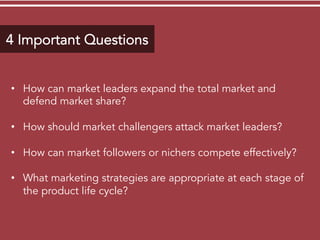
4 Important Questions
•  How can market leaders expand the total market and
defend market share?
•  How should market challengers attack market leaders?
•  How can market followers or nichers compete effectively?
•  What marketing strategies are appropriate at each stage of
the product life cycle?
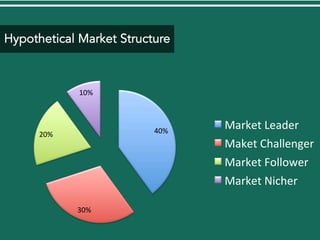
Hypothetical Market Structure
40%	
  
30%	
  
20%	
  
10%	
  
Market	
  Leader	
  
Maket	
  Challenger	
  
Market	
  Follower	
  
Market	
  Nicher	
  
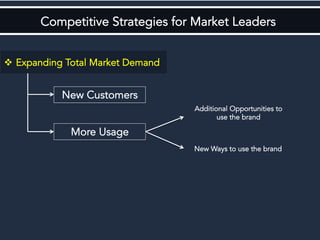
Competitive Strategies for Market Leaders
v  Expanding Total Market Demand
New Customers
More Usage
Additional Opportunities to
use the brand
New Ways to use the brand
Competitive Strategies for Market Leaders
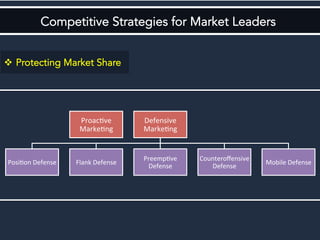
v  Protecting Market Share
Proac<ve	
  
Marke<ng	
  
Defensive	
  
Marke<ng	
  
Posi<on	
  Defense	
   Flank	
  Defense	
  
Preemp<ve	
  
Defense	
  
Counteroffensive	
  
Defense	
  
Mobile	
  Defense	
  
Competitive Strategies for Market Leaders
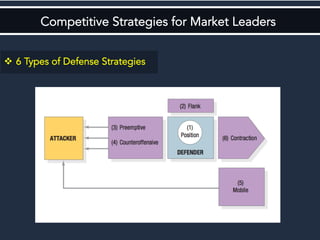
v  6 Types of Defense Strategies
Competitive Strategies for Market Leaders
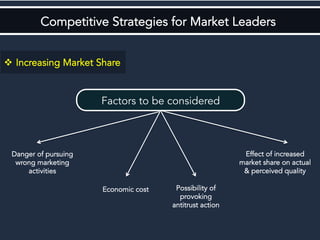
v  Increasing Market Share
Possibility of
provoking
antitrust action
Economic cost
Danger of pursuing
wrong marketing
activities
Effect of increased
market share on actual
& perceived quality
Factors to be considered
Strategies for Market Challengers
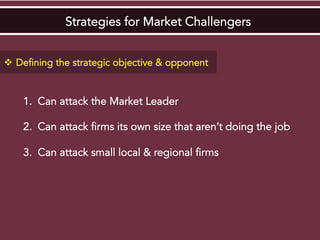
v  Defining the strategic objective & opponent
1.  Can attack the Market Leader
2.  Can attack firms its own size that aren’t doing the job
3.  Can attack small local & regional firms
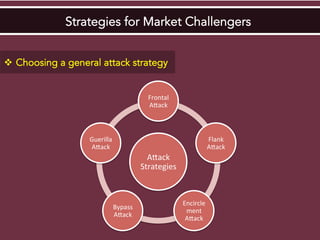
Strategies for Market Challengers
v  Choosing a general attack strategy
AGack	
  
Strategies	
  
Frontal	
  
AGack	
  
Flank	
  
AGack	
  
Encircle
ment	
  
AGack	
  
Bypass	
  
AGack	
  
Guerilla	
  
AGack	
  
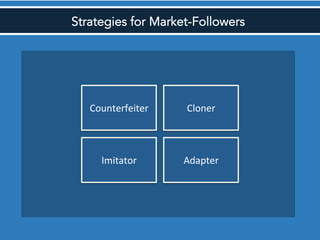
Strategies for Market-Followers
Counterfeiter	
   Cloner	
  
Imitator	
   Adapter	
  
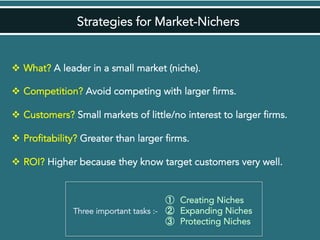
Strategies for Market-Nichers
v  What? A leader in a small market (niche).
v  Competition? Avoid competing with larger firms.
v  Customers? Small markets of little/no interest to larger firms.
v  Profitability? Greater than larger firms.
v  ROI? Higher because they know target customers very well.
①  Creating Niches
②  Expanding Niches
③  Protecting Niches
Three important tasks :-
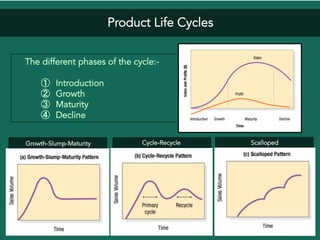
Product Life Cycles
Growth-Slump-Maturity Cycle-Recycle Scalloped
The different phases of the cycle:-
①  Introduction
②  Growth
③  Maturity
④  Decline
International Business Machines – A mini case study!
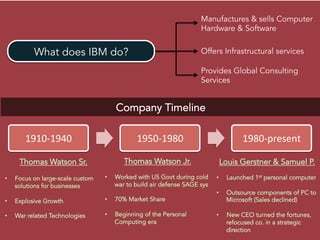
Manufactures & sells Computer
Hardware & Software
Offers Infrastructural services
Provides Global Consulting
Services
What does IBM do?
Company Timeline
1910-­‐1940	
   1950-­‐1980	
   1980-­‐present	
  
Thomas Watson Sr.
•  Focus on large-scale custom
solutions for businesses
•  Explosive Growth
•  War related Technologies
Thomas Watson Jr.
•  Worked with US Govt during cold
war to build air defense SAGE sys
•  70% Market Share
•  Beginning of the Personal
Computing era
Louis Gerstner & Samuel P.
•  Launched 1st personal computer
•  Outsource components of PC to
Microsoft (Sales declined)
•  New CEO turned the fortunes,
refocused co. in a strategic
direction
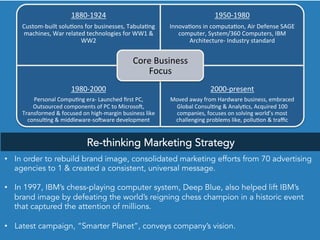
1880-­‐1924	
  
Custom-­‐built	
  solu<ons	
  for	
  businesses,	
  Tabula<ng	
  
machines,	
  War	
  related	
  technologies	
  for	
  WW1	
  &	
  
WW2	
  
1950-­‐1980	
  
Innova<ons	
  in	
  computa<on,	
  Air	
  Defense	
  SAGE	
  
computer,	
  System/360	
  Computers,	
  IBM	
  
Architecture-­‐	
  Industry	
  standard	
  
1980-­‐2000	
  
Personal	
  Compu<ng	
  era-­‐	
  Launched	
  first	
  PC,	
  
Outsourced	
  components	
  of	
  PC	
  to	
  MicrosoZ,	
  
Transformed	
  &	
  focused	
  on	
  high-­‐margin	
  business	
  like	
  
consul<ng	
  &	
  middleware-­‐soZware	
  development	
  
2000-­‐present	
  
Moved	
  away	
  from	
  Hardware	
  business,	
  embraced	
  
Global	
  Consul<ng	
  &	
  Analy<cs,	
  Acquired	
  100	
  
companies,	
  focuses	
  on	
  solving	
  world’s	
  most	
  
challenging	
  problems	
  like,	
  pollu<on	
  &	
  traffic	
  
Core	
  Business	
  
Focus	
  
Re-thinking Marketing Strategy
•  In order to rebuild brand image, consolidated marketing efforts from 70 advertising
agencies to 1 & created a consistent, universal message.
•  In 1997, IBM’s chess-playing computer system, Deep Blue, also helped lift IBM’s
brand image by defeating the world’s reigning chess champion in a historic event
that captured the attention of millions.
•  Latest campaign, “Smarter Planet”, conveys company’s vision.
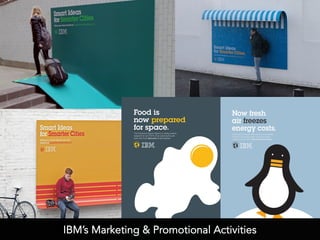
IBM’s Marketing & Promotional Activities
Few companies have had such a long history of ups and downs as IBM. What
were some of the keys to its recent success? Can its plans to solve some of the
world’s most challenging problems succeed? Why or why not?
•  The	
  key	
  to	
  IBM’s	
  recent	
  success	
  is	
  focusing	
  on	
  big	
  problems	
  that	
  might	
  affect	
  
businesses	
  and	
  consumers.	
  	
  
•  Yes,	
  I	
  believe	
  that	
  IBM	
  is	
  able	
  to	
  solve	
  some	
  of	
  the	
  world’s	
  problem,	
  such	
  as	
  
pollu<on,	
  traffic	
  conges<on,	
  etc.	
  With	
  a	
  technically	
  proficient	
  workforce	
  
comprising	
  of	
  scien<sts,	
  engineers,	
  consultants,	
  and	
  sales	
  professionals,	
  they	
  
can	
  help	
  solve	
  some	
  of	
  the	
  big	
  problem	
  and	
  make	
  people’s	
  life	
  easier	
  and	
  
healthier.	


•  IBM	
  has	
  been	
  inves<ng	
  30%	
  of	
  their	
  annual	
  budget	
  into	
  R&D,	
  which	
  bound	
  to	
  
yield	
  results.	
  We	
  can	
  expect	
  them	
  to	
  come	
  up	
  with	
  something	
  that	
  will	
  fix	
  some	
  
of	
  the	
  important	
  problems	
  that	
  we	
  are	
  facing.	


Who are IBM’s biggest competitors today, and what
risks do they face with their current strategy?
IBM’s	
  major	
  rivals	
  include	
  Technical	
  &	
  Consul<ng	
  firm	
  that	
  are	
  into	
  the	
  Hardware	
  
&	
  SoZware	
  sector.	
  	
  For	
  eg,	
  Accenture,	
  HP,	
  XEROX,	
  CSC,	
  etc	


The	
  risks	
  involved	
  with	
  the	
  current	
  strategy	
  are:-­‐	


•  Focusing	
  on	
  solving	
  big	
  issues	
  may	
  involve	
  greater	
  resources	
  (<me,	
  money	
  &	
  
energy)	
  &	
  may	
  not	
  yield	
  desirable	
  results.	
  
•  AZer	
  heavily	
  inves<ng	
  resources	
  in	
  solving	
  big	
  issues,	
  IBM	
  may	
  have	
  to	
  face	
  
situa<ons	
  when	
  rival	
  companies	
  come	
  out	
  with	
  more	
  efficient	
  solu<ons.	
  
•  R&D	
  may	
  become	
  obsolete	
  coupled	
  with	
  low	
  success	
  rate.	
  	
  
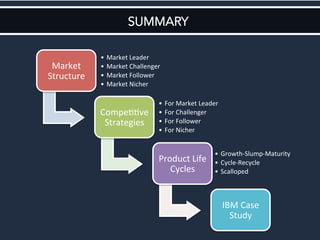
SUMMARY
Market	
  
Structure	
  
•  Market	
  Leader	
  
•  Market	
  Challenger	
  
•  Market	
  Follower	
  
•  Market	
  Nicher	
  
Compe<<ve	
  
Strategies	
  
•  For	
  Market	
  Leader	
  
•  For	
  Challenger	
  
•  For	
  Follower	
  
•  For	
  Nicher	
  
Product	
  Life	
  
Cycles	
  
•  Growth-­‐Slump-­‐Maturity	
  
•  Cycle-­‐Recycle	
  
•  Scalloped	
  
IBM	
  Case	
  
Study	
  
DISCLAIMER
Created by Akshay Julka(DTU, Delhi), during a Marketing
internship under Prof. Sameer Mathur, IIM Lucknow.
Marketing Dynamics & IBM Case Study

Marketing Dynamics & IBM Case Study

  • 1.
  • 2.
    4 Important Questions • How can market leaders expand the total market and defend market share? •  How should market challengers attack market leaders? •  How can market followers or nichers compete effectively? •  What marketing strategies are appropriate at each stage of the product life cycle?
  • 3.
    Hypothetical Market Structure 40%   30%   20%   10%   Market  Leader   Maket  Challenger   Market  Follower   Market  Nicher  
  • 4.
    Competitive Strategies forMarket Leaders v  Expanding Total Market Demand New Customers More Usage Additional Opportunities to use the brand New Ways to use the brand
  • 5.
    Competitive Strategies forMarket Leaders v  Protecting Market Share Proac<ve   Marke<ng   Defensive   Marke<ng   Posi<on  Defense   Flank  Defense   Preemp<ve   Defense   Counteroffensive   Defense   Mobile  Defense  
  • 6.
    Competitive Strategies forMarket Leaders v  6 Types of Defense Strategies
  • 7.
    Competitive Strategies forMarket Leaders v  Increasing Market Share Possibility of provoking antitrust action Economic cost Danger of pursuing wrong marketing activities Effect of increased market share on actual & perceived quality Factors to be considered
  • 8.
    Strategies for MarketChallengers v  Defining the strategic objective & opponent 1.  Can attack the Market Leader 2.  Can attack firms its own size that aren’t doing the job 3.  Can attack small local & regional firms
  • 9.
    Strategies for MarketChallengers v  Choosing a general attack strategy AGack   Strategies   Frontal   AGack   Flank   AGack   Encircle ment   AGack   Bypass   AGack   Guerilla   AGack  
  • 10.
    Strategies for Market-Followers Counterfeiter   Cloner   Imitator   Adapter  
  • 11.
    Strategies for Market-Nichers v What? A leader in a small market (niche). v  Competition? Avoid competing with larger firms. v  Customers? Small markets of little/no interest to larger firms. v  Profitability? Greater than larger firms. v  ROI? Higher because they know target customers very well. ①  Creating Niches ②  Expanding Niches ③  Protecting Niches Three important tasks :-
  • 12.
    Product Life Cycles Growth-Slump-MaturityCycle-Recycle Scalloped The different phases of the cycle:- ①  Introduction ②  Growth ③  Maturity ④  Decline
  • 13.
    International Business Machines– A mini case study!
  • 14.
    Manufactures & sellsComputer Hardware & Software Offers Infrastructural services Provides Global Consulting Services What does IBM do? Company Timeline 1910-­‐1940   1950-­‐1980   1980-­‐present   Thomas Watson Sr. •  Focus on large-scale custom solutions for businesses •  Explosive Growth •  War related Technologies Thomas Watson Jr. •  Worked with US Govt during cold war to build air defense SAGE sys •  70% Market Share •  Beginning of the Personal Computing era Louis Gerstner & Samuel P. •  Launched 1st personal computer •  Outsource components of PC to Microsoft (Sales declined) •  New CEO turned the fortunes, refocused co. in a strategic direction
  • 15.
    1880-­‐1924   Custom-­‐built  solu<ons  for  businesses,  Tabula<ng   machines,  War  related  technologies  for  WW1  &   WW2   1950-­‐1980   Innova<ons  in  computa<on,  Air  Defense  SAGE   computer,  System/360  Computers,  IBM   Architecture-­‐  Industry  standard   1980-­‐2000   Personal  Compu<ng  era-­‐  Launched  first  PC,   Outsourced  components  of  PC  to  MicrosoZ,   Transformed  &  focused  on  high-­‐margin  business  like   consul<ng  &  middleware-­‐soZware  development   2000-­‐present   Moved  away  from  Hardware  business,  embraced   Global  Consul<ng  &  Analy<cs,  Acquired  100   companies,  focuses  on  solving  world’s  most   challenging  problems  like,  pollu<on  &  traffic   Core  Business   Focus   Re-thinking Marketing Strategy •  In order to rebuild brand image, consolidated marketing efforts from 70 advertising agencies to 1 & created a consistent, universal message. •  In 1997, IBM’s chess-playing computer system, Deep Blue, also helped lift IBM’s brand image by defeating the world’s reigning chess champion in a historic event that captured the attention of millions. •  Latest campaign, “Smarter Planet”, conveys company’s vision.
  • 16.
    IBM’s Marketing &Promotional Activities
  • 17.
    Few companies havehad such a long history of ups and downs as IBM. What were some of the keys to its recent success? Can its plans to solve some of the world’s most challenging problems succeed? Why or why not? •  The  key  to  IBM’s  recent  success  is  focusing  on  big  problems  that  might  affect   businesses  and  consumers.     •  Yes,  I  believe  that  IBM  is  able  to  solve  some  of  the  world’s  problem,  such  as   pollu<on,  traffic  conges<on,  etc.  With  a  technically  proficient  workforce   comprising  of  scien<sts,  engineers,  consultants,  and  sales  professionals,  they   can  help  solve  some  of  the  big  problem  and  make  people’s  life  easier  and   healthier.       •  IBM  has  been  inves<ng  30%  of  their  annual  budget  into  R&D,  which  bound  to   yield  results.  We  can  expect  them  to  come  up  with  something  that  will  fix  some   of  the  important  problems  that  we  are  facing.    
  • 18.
    Who are IBM’sbiggest competitors today, and what risks do they face with their current strategy? IBM’s  major  rivals  include  Technical  &  Consul<ng  firm  that  are  into  the  Hardware   &  SoZware  sector.    For  eg,  Accenture,  HP,  XEROX,  CSC,  etc     The  risks  involved  with  the  current  strategy  are:-­‐     •  Focusing  on  solving  big  issues  may  involve  greater  resources  (<me,  money  &   energy)  &  may  not  yield  desirable  results.   •  AZer  heavily  inves<ng  resources  in  solving  big  issues,  IBM  may  have  to  face   situa<ons  when  rival  companies  come  out  with  more  efficient  solu<ons.   •  R&D  may  become  obsolete  coupled  with  low  success  rate.    
  • 19.
    SUMMARY Market   Structure   • Market  Leader   •  Market  Challenger   •  Market  Follower   •  Market  Nicher   Compe<<ve   Strategies   •  For  Market  Leader   •  For  Challenger   •  For  Follower   •  For  Nicher   Product  Life   Cycles   •  Growth-­‐Slump-­‐Maturity   •  Cycle-­‐Recycle   •  Scalloped   IBM  Case   Study  
  • 20.
    DISCLAIMER Created by AkshayJulka(DTU, Delhi), during a Marketing internship under Prof. Sameer Mathur, IIM Lucknow.