Group 9
Ashutosh | Vasu | Anirbed | Tarun | Akhil | Kashvi | Nikil

IIM Lucknow
PRE LOUIS GERSTNER (EARLY 90S)
 Organizational Structure
-

Mechanistic structure

-

Vertical and tall structure – ineffective communication within divisions

-

Centralized product development

-

Focus on internal rules rather than market trends and demand

 Organizational Culture
-

Bureaucracy

-

Low stock ownership – strong property rights tied to employee longevity rather
than performance

 Product Line
-

90% earnings from mainframe business
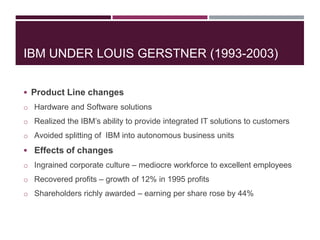
IBM UNDER LOUIS GERSTNER (1993-2003)
 Factors for change
o Four clear priorities of 1993 - To be profitable, more competitive, increase

shareholder value and grow
o As an outsider, Gerstner had no emotional attachment
o Low focus on marketing techniques and public relationship
o Research department and market activities were not connected
o Customer relationships were deteriorating
o Executive – customer disconnect
o Overhead costs were high – Incurred high losses in 1992 and 1993
o More employees than needed
IBM UNDER LOUIS GERSTNER (1993-2003)
 Organization Structure Changes
o Organic structure
o Eliminated bureaucracy by decentralization – more authority to divisions
o Eliminated non-performing units – benchmarking against competitors
o Changed emphasis from Product centric to customer-centric
o ONE IBM - Consolidated its many advertising agencies down to one

, Ogilvy & Mather
 Organization Culture Changes
o Removed strong property rights – performance based culture
o Brought customer oriented culture in the organization
o Removal of White Shirt-Tie dress code
IBM UNDER LOUIS GERSTNER (1993-2003)
 Product Line changes
o Hardware and Software solutions
o Realized the IBM’s ability to provide integrated IT solutions to customers
o Avoided splitting of IBM into autonomous business units

 Effects of changes
o Ingrained corporate culture – mediocre workforce to excellent employees
o Recovered profits – growth of 12% in 1995 profits
o Shareholders richly awarded – earning per share rose by 44%
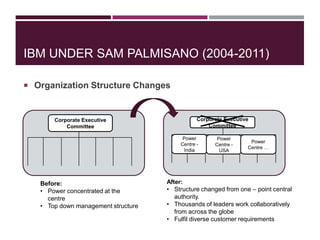
IBM UNDER SAM PALMISANO (2004-2011)
 Organization Structure Changes

Corporate Executive
Committee

Corporate Executive
Committee
Power
Centre India

Before:
• Power concentrated at the
centre
• Top down management structure

Power
Centre USA

Power
Centre …

After:
• Structure changed from one – point central
authority.
• Thousands of leaders work collaboratively
from across the globe
• Fulfil diverse customer requirements
IBM UNDER SAM PALMISANO (2004-2011)
 Organization Culture Changes
o ValuesJam
-

Mega online chat for about 100,000 employees

-

Redraft 100-year-old values

-

Everyone has a platform to voice their opinions

-

Encourage independent thought

 Product Line changes
o Decision of IBM to sell off its PC division to Lenovo
o Relatively small deal, worth less than $2 billion
o Lenovo licensed the rights to continue to use the IBM brand for a while
IBM UNDER SAM PALMISANO (2004-2011)
 Effects of changes
o Close in the trust gap between the clients and the company
o “$100 million trust fund” - $5000 fund to all managers to help

develop business or client relationship
o Innovation that matters – for the company and the world
o Trust and personal responsibility in all relationships

o Stock prices rose by 125%; sales raised from $81 billion to $107

billion
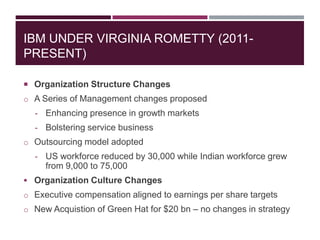
IBM UNDER VIRGINIA ROMETTY (2011PRESENT)
 Organization Structure Changes

o A Series of Management changes proposed
- Enhancing presence in growth markets
- Bolstering service business
o Outsourcing model adopted

- US workforce reduced by 30,000 while Indian workforce grew

from 9,000 to 75,000
 Organization Culture Changes
o Executive compensation aligned to earnings per share targets

o New Acquistion of Green Hat for $20 bn – no changes in strategy
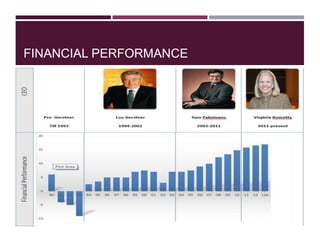
FINANCIAL PERFORMANCE
THANK YOU

IBM Transformation

  • 1.
    Group 9 Ashutosh |Vasu | Anirbed | Tarun | Akhil | Kashvi | Nikil IIM Lucknow
  • 2.
    PRE LOUIS GERSTNER(EARLY 90S)  Organizational Structure - Mechanistic structure - Vertical and tall structure – ineffective communication within divisions - Centralized product development - Focus on internal rules rather than market trends and demand  Organizational Culture - Bureaucracy - Low stock ownership – strong property rights tied to employee longevity rather than performance  Product Line - 90% earnings from mainframe business
  • 3.
    IBM UNDER LOUISGERSTNER (1993-2003)  Factors for change o Four clear priorities of 1993 - To be profitable, more competitive, increase shareholder value and grow o As an outsider, Gerstner had no emotional attachment o Low focus on marketing techniques and public relationship o Research department and market activities were not connected o Customer relationships were deteriorating o Executive – customer disconnect o Overhead costs were high – Incurred high losses in 1992 and 1993 o More employees than needed
  • 4.
    IBM UNDER LOUISGERSTNER (1993-2003)  Organization Structure Changes o Organic structure o Eliminated bureaucracy by decentralization – more authority to divisions o Eliminated non-performing units – benchmarking against competitors o Changed emphasis from Product centric to customer-centric o ONE IBM - Consolidated its many advertising agencies down to one , Ogilvy & Mather  Organization Culture Changes o Removed strong property rights – performance based culture o Brought customer oriented culture in the organization o Removal of White Shirt-Tie dress code
  • 5.
    IBM UNDER LOUISGERSTNER (1993-2003)  Product Line changes o Hardware and Software solutions o Realized the IBM’s ability to provide integrated IT solutions to customers o Avoided splitting of IBM into autonomous business units  Effects of changes o Ingrained corporate culture – mediocre workforce to excellent employees o Recovered profits – growth of 12% in 1995 profits o Shareholders richly awarded – earning per share rose by 44%
  • 6.
    IBM UNDER SAMPALMISANO (2004-2011)  Organization Structure Changes Corporate Executive Committee Corporate Executive Committee Power Centre India Before: • Power concentrated at the centre • Top down management structure Power Centre USA Power Centre … After: • Structure changed from one – point central authority. • Thousands of leaders work collaboratively from across the globe • Fulfil diverse customer requirements
  • 7.
    IBM UNDER SAMPALMISANO (2004-2011)  Organization Culture Changes o ValuesJam - Mega online chat for about 100,000 employees - Redraft 100-year-old values - Everyone has a platform to voice their opinions - Encourage independent thought  Product Line changes o Decision of IBM to sell off its PC division to Lenovo o Relatively small deal, worth less than $2 billion o Lenovo licensed the rights to continue to use the IBM brand for a while
  • 8.
    IBM UNDER SAMPALMISANO (2004-2011)  Effects of changes o Close in the trust gap between the clients and the company o “$100 million trust fund” - $5000 fund to all managers to help develop business or client relationship o Innovation that matters – for the company and the world o Trust and personal responsibility in all relationships o Stock prices rose by 125%; sales raised from $81 billion to $107 billion
  • 9.
    IBM UNDER VIRGINIAROMETTY (2011PRESENT)  Organization Structure Changes o A Series of Management changes proposed - Enhancing presence in growth markets - Bolstering service business o Outsourcing model adopted - US workforce reduced by 30,000 while Indian workforce grew from 9,000 to 75,000  Organization Culture Changes o Executive compensation aligned to earnings per share targets o New Acquistion of Green Hat for $20 bn – no changes in strategy
  • 10.
  • 11.