LOGO
IBMIBM
From ComputerDesignFrom ComputerDesign
to IT Solutions & Customizationto IT Solutions & Customization
IntroductionIntroduction
IBM is one of the most successful companies in
the world and the 2nd
most expensive brand
behind Coke. Leadership and culture have been
a constant for IBM and the reason for their
continued success. They have continuously
sought out innovation and have been a market
leader in several areas of technology. They have
shown an incredible resilience and have
transitioned at necessary moments in order to
survive business competition to become one of
the very best companies in the world.
ContentsContents
Foundation & Conclusion
IBM TimeLine
1960s – 2000s
Organization Culture Change
Transition (Specialization)
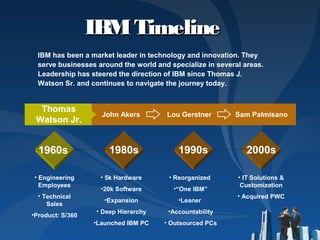
IBMTimelineIBMTimeline
John Akers
Thomas
Watson Jr.
Lou Gerstner Sam Palmisano
1960s 1980s 1990s 2000s
• Engineering
Employees
• Technical
Sales
•Product: S/360
• 5k Hardware
•20k Software
•Expansion
• Deep Hierarchy
•Launched IBM PC
• Reorganized
•“One IBM”
•Leaner
•Accountability
• Outsourced PCs
• IT Solutions &
Customization
• Acquired PWC
IBM has been a market leader in technology and innovation. They
serve businesses around the world and specialize in several areas.
Leadership has steered the direction of IBM since Thomas J.
Watson Sr. and continues to navigate the journey today.
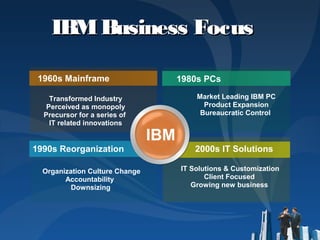
IBMBusiness FocusIBMBusiness Focus
1960s Mainframe
1990s Reorganization
1980s PCs
2000s IT Solutions
Transformed Industry
Perceived as monopoly
Precursor for a series of
IT related innovations
Market Leading IBM PC
Product Expansion
Bureaucratic Control
Organization Culture Change
Accountability
Downsizing
IT Solutions & Customization
Client Focused
Growing new business
IBM
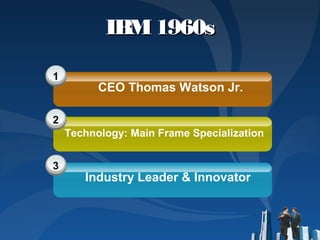
IBM1960sIBM1960s
1
2
3
CEO Thomas Watson Jr.
Technology: Main Frame Specialization
Industry Leader & Innovator
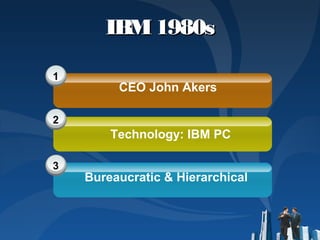
IBM1980sIBM1980s
1
2
3
CEO John Akers
Technology: IBM PC
Bureaucratic & Hierarchical
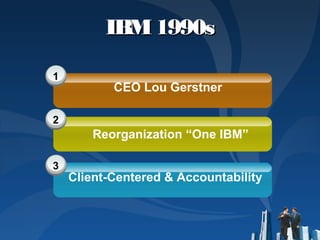
IBM1990sIBM1990s
1
2
3
CEO Lou Gerstner
Reorganization “One IBM”
Client-Centered & Accountability
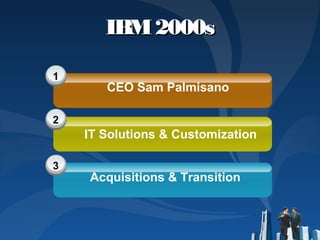
IBM2000sIBM2000s
1
2
3
CEO Sam Palmisano
IT Solutions & Customization
Acquisitions & Transition
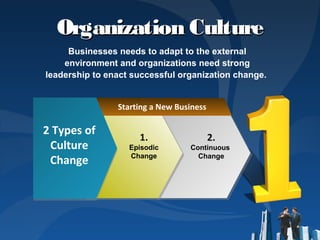
Organization CultureOrganization Culture
2 Types of
Culture
Change
Starting a New Business
2.
Continuous
Change
Businesses needs to adapt to the external
environment and organizations need strong
leadership to enact successful organization change.
1.
Episodic
Change
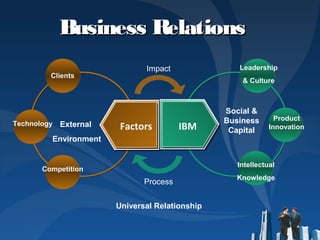
Business RelationsBusiness Relations
External
Environment
Clients
Social &
Business
Capital
Leadership
& Culture
Universal Relationship
Competition
Technology
Intellectual
Knowledge
Product
InnovationFactors IBM
Impact
Process
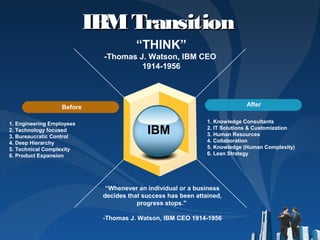
IBMTransitionIBMTransition
Before After
“THINK”
-Thomas J. Watson, IBM CEO
1914-1956
1. Engineering Employees
2. Technology focused
3. Bureaucratic Control
4. Deep Hierarchy
5. Technical Complexity
6. Product Expansion
1. Knowledge Consultants
2. IT Solutions & Customization
3. Human Resources
4. Collaboration
5. Knowledge (Human Complexity)
6. Lean Strategy
“Whenever an individual or a business
decides that success has been attained,
progress stops."
-Thomas J. Watson, IBM CEO 1914-1956
IBM
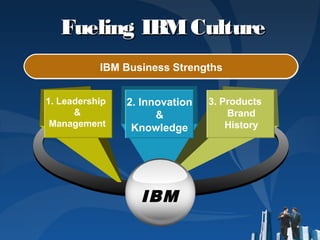
Fueling IBMCultureFueling IBMCulture
IBM Business Strengths
1. Leadership
&
Management
2. Innovation
&
Knowledge
3. Products
Brand
History
IBM
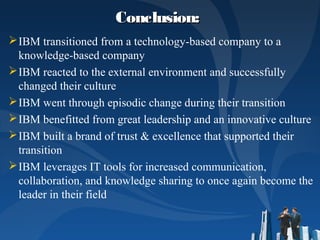
Conclusion: Conclusion: 
IBM transitioned from a technology-based company to a
knowledge-based company
IBM reacted to the external environment and successfully
changed their culture
IBM went through episodic change during their transition
IBM benefitted from great leadership and an innovative culture
IBM built a brand of trust & excellence that supported their
transition
IBM leverages IT tools for increased communication,
collaboration, and knowledge sharing to once again become the
leader in their field
ReferencesReferences
Applegate, L., Austin, R. O. B. E. R. T., & Collins, E. L. I. Z. A. B. E. T. H. (2005). IBM’s decade of
transformation: Turnaround to growth. Harvard Business School Case 805, 130.
Daft, R. L. (2009). Organization theory and design. South-Western Pub.
IBM Highlights 1970-1984
Retrieved on April 19th
: http://www-03.ibm.com/ibm/history/documents/
IBM Highlights 1985-1989
Retrieved on April 19th
: http://www-03.ibm.com/ibm/history/documents/
IBM Highlights 1990-1995
Retrieved on April 19th
: http://www-03.ibm.com/ibm/history/documents/
IBM Highlights 1996-1999
Retrieved on April 19th
: http://www-03.ibm.com/ibm/history/documents/
IBM Highlights 2000-2006
Retrieved on April 19th
: http://www-03.ibm.com/ibm/history/documents/

IBM presentation

  • 1.
    LOGO IBMIBM From ComputerDesignFrom ComputerDesign toIT Solutions & Customizationto IT Solutions & Customization
  • 2.
    IntroductionIntroduction IBM is oneof the most successful companies in the world and the 2nd most expensive brand behind Coke. Leadership and culture have been a constant for IBM and the reason for their continued success. They have continuously sought out innovation and have been a market leader in several areas of technology. They have shown an incredible resilience and have transitioned at necessary moments in order to survive business competition to become one of the very best companies in the world.
  • 3.
    ContentsContents Foundation & Conclusion IBMTimeLine 1960s – 2000s Organization Culture Change Transition (Specialization)
  • 4.
    IBMTimelineIBMTimeline John Akers Thomas Watson Jr. LouGerstner Sam Palmisano 1960s 1980s 1990s 2000s • Engineering Employees • Technical Sales •Product: S/360 • 5k Hardware •20k Software •Expansion • Deep Hierarchy •Launched IBM PC • Reorganized •“One IBM” •Leaner •Accountability • Outsourced PCs • IT Solutions & Customization • Acquired PWC IBM has been a market leader in technology and innovation. They serve businesses around the world and specialize in several areas. Leadership has steered the direction of IBM since Thomas J. Watson Sr. and continues to navigate the journey today.
  • 5.
    IBMBusiness FocusIBMBusiness Focus 1960sMainframe 1990s Reorganization 1980s PCs 2000s IT Solutions Transformed Industry Perceived as monopoly Precursor for a series of IT related innovations Market Leading IBM PC Product Expansion Bureaucratic Control Organization Culture Change Accountability Downsizing IT Solutions & Customization Client Focused Growing new business IBM
  • 6.
    IBM1960sIBM1960s 1 2 3 CEO Thomas WatsonJr. Technology: Main Frame Specialization Industry Leader & Innovator
  • 7.
    IBM1980sIBM1980s 1 2 3 CEO John Akers Technology:IBM PC Bureaucratic & Hierarchical
  • 8.
    IBM1990sIBM1990s 1 2 3 CEO Lou Gerstner Reorganization“One IBM” Client-Centered & Accountability
  • 9.
    IBM2000sIBM2000s 1 2 3 CEO Sam Palmisano ITSolutions & Customization Acquisitions & Transition
  • 10.
    Organization CultureOrganization Culture 2Types of Culture Change Starting a New Business 2. Continuous Change Businesses needs to adapt to the external environment and organizations need strong leadership to enact successful organization change. 1. Episodic Change
  • 11.
    Business RelationsBusiness Relations External Environment Clients Social& Business Capital Leadership & Culture Universal Relationship Competition Technology Intellectual Knowledge Product InnovationFactors IBM Impact Process
  • 12.
    IBMTransitionIBMTransition Before After “THINK” -Thomas J.Watson, IBM CEO 1914-1956 1. Engineering Employees 2. Technology focused 3. Bureaucratic Control 4. Deep Hierarchy 5. Technical Complexity 6. Product Expansion 1. Knowledge Consultants 2. IT Solutions & Customization 3. Human Resources 4. Collaboration 5. Knowledge (Human Complexity) 6. Lean Strategy “Whenever an individual or a business decides that success has been attained, progress stops." -Thomas J. Watson, IBM CEO 1914-1956 IBM
  • 13.
    Fueling IBMCultureFueling IBMCulture IBMBusiness Strengths 1. Leadership & Management 2. Innovation & Knowledge 3. Products Brand History IBM
  • 14.
    Conclusion: Conclusion:  IBM transitioned froma technology-based company to a knowledge-based company IBM reacted to the external environment and successfully changed their culture IBM went through episodic change during their transition IBM benefitted from great leadership and an innovative culture IBM built a brand of trust & excellence that supported their transition IBM leverages IT tools for increased communication, collaboration, and knowledge sharing to once again become the leader in their field
  • 15.
    ReferencesReferences Applegate, L., Austin,R. O. B. E. R. T., & Collins, E. L. I. Z. A. B. E. T. H. (2005). IBM’s decade of transformation: Turnaround to growth. Harvard Business School Case 805, 130. Daft, R. L. (2009). Organization theory and design. South-Western Pub. IBM Highlights 1970-1984 Retrieved on April 19th : http://www-03.ibm.com/ibm/history/documents/ IBM Highlights 1985-1989 Retrieved on April 19th : http://www-03.ibm.com/ibm/history/documents/ IBM Highlights 1990-1995 Retrieved on April 19th : http://www-03.ibm.com/ibm/history/documents/ IBM Highlights 1996-1999 Retrieved on April 19th : http://www-03.ibm.com/ibm/history/documents/ IBM Highlights 2000-2006 Retrieved on April 19th : http://www-03.ibm.com/ibm/history/documents/