



MARKETING CONTROL
SYSTEMS
www.aravindts.com
MARKETING IS NOT ANY
CONTROLLED ACTIVITY WHICH CAN
BE PERFORMED IN AN INSULATED LAB.
It is very important for a marketer to have a good
knowledge of customer’s perception for the firm
and for the competitor firms, his satisfaction level,
marketing effectiveness, sales, market share, profits,
etc.
ROLE OF MARKETING
CONTROL- 1/4

Establishing Standards for Marketing Appraisal 

ROLE OF MARKETING
CONTROL- 2/4

Effective Performance Measurement 

ROLE OF MARKETING
CONTROL- 3/4

Determining the Strengths and Weaknesses of
Marketing Programmes 

ROLE OF MARKETING
CONTROL- 4/4

Setting up Corrective Mechanisms
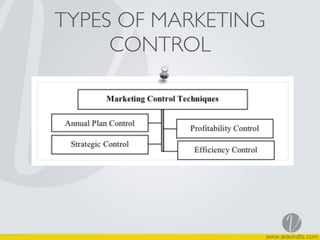
TYPES OF MARKETING
CONTROL

TYPES OF MARKETING
CONTROL

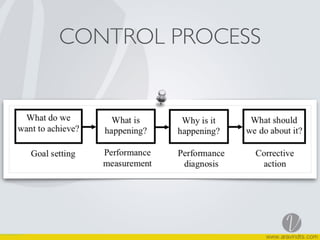
CONTROL PROCESS
MARKETING AUDIT
It is a comprehensive, periodic, independent and systematic analysis of
— firms objectives
— marketing environment
— strategies and
— activities for determining the various areas of problems
— opportunities and suggesting appropriate course of action for overall
increase in sales and productivity.
FEATURES OF MARKETING
AUDIT 1/4
1. Comprehensive and Functional
a) Horizontal Audit 

Tracking a process from one end to other end is the main activity performed
under this audit.
b) Vertical Audit
When a detailed analysis of a single aspect of the company’s marketing strategy
(such as product planning) is done, it is regarded as vertical auditing. 


FEATURES OF MARKETING
AUDIT 2/4
II. Systematic : A corrective action plan must be
implemented after the diagnosis which should
include both short-term and long-term actions by
which the overall marketing effectiveness of a firm
can be significantly improved.


FEATURES OF MARKETING
AUDIT 3/4
III. Independent: Marketing audits are of independent
nature as there are mainly six methods by which the
marketing audit can be conducted
i) Self-audit,
ii) Audit from across,
iii) Audit from above
FEATURES OF MARKETING
AUDIT 3/4
IV. Periodic: When audits are conducted
periodically, companies gain a healthy competitive
position in the market.
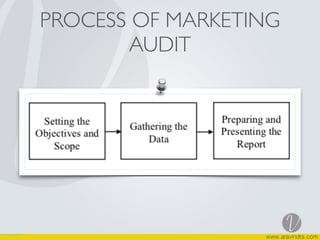
PROCESS OF MARKETING
AUDIT

THANKYOU
www.aravindts.com

MARKETING CONTROL SYSTEMS

  • 1.
  • 2.
    MARKETING IS NOTANY CONTROLLED ACTIVITY WHICH CAN BE PERFORMED IN AN INSULATED LAB.
  • 3.
    It is veryimportant for a marketer to have a good knowledge of customer’s perception for the firm and for the competitor firms, his satisfaction level, marketing effectiveness, sales, market share, profits, etc.
  • 4.
    ROLE OF MARKETING CONTROL-1/4
 Establishing Standards for Marketing Appraisal 

  • 5.
    ROLE OF MARKETING CONTROL-2/4
 Effective Performance Measurement 

  • 6.
    ROLE OF MARKETING CONTROL-3/4
 Determining the Strengths and Weaknesses of Marketing Programmes 

  • 7.
    ROLE OF MARKETING CONTROL-4/4
 Setting up Corrective Mechanisms
  • 8.
  • 9.
  • 10.
  • 11.
    MARKETING AUDIT It isa comprehensive, periodic, independent and systematic analysis of — firms objectives — marketing environment — strategies and — activities for determining the various areas of problems — opportunities and suggesting appropriate course of action for overall increase in sales and productivity.
  • 12.
    FEATURES OF MARKETING AUDIT1/4 1. Comprehensive and Functional a) Horizontal Audit 
 Tracking a process from one end to other end is the main activity performed under this audit. b) Vertical Audit When a detailed analysis of a single aspect of the company’s marketing strategy (such as product planning) is done, it is regarded as vertical auditing. 
 

  • 13.
    FEATURES OF MARKETING AUDIT2/4 II. Systematic : A corrective action plan must be implemented after the diagnosis which should include both short-term and long-term actions by which the overall marketing effectiveness of a firm can be significantly improved. 
 

  • 14.
    FEATURES OF MARKETING AUDIT3/4 III. Independent: Marketing audits are of independent nature as there are mainly six methods by which the marketing audit can be conducted i) Self-audit, ii) Audit from across, iii) Audit from above
  • 15.
    FEATURES OF MARKETING AUDIT3/4 IV. Periodic: When audits are conducted periodically, companies gain a healthy competitive position in the market.
  • 16.
  • 17.