Module 19
Measuring and Delivering Marketing
Performance
By: Dr Shahinaz Abdellatif
Objective of this session
1. To examine how to design strategic control
systems
2. To consider design decisions for marketing
performance measurement
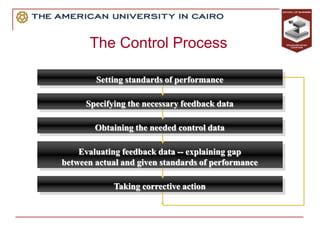
The Control Process
Setting standards of performance
Specifying the necessary feedback data
Obtaining the needed control data
Evaluating feedback data -- explaining gap
between actual and given standards of performance
Taking corrective action
1- Setting standard for performance
• These standards derive largely from the objectives and
strategies set forth at the SBU and individual product-
market entry level. They generate a series of
performance expectations for profitability (return on
equity or return on assets managed), market share, and
sales.
• At the product-market level, standards of performance
include sales and market-share determinants such as
per cent effective distribution, relative shelf-facings,
awareness, consumers’ attitude change toward a given
product attribute, customer satisfaction, and the extent of
price parity.
2- Specify the necessary feedback data
• Analysts obtain feedback data from a variety of sources,
including company accounting records and syndicated
marketing information services such as Nielsen. The sales
invoice or other transaction records, such as those produced by
retailers’ point-of-sale systems, are the basic internal source of
data because they provide a detailed record of each transaction
and the basis for measuring profitability, sales, and various
budget items.
• Another source, and typically the most expensive and time-
consuming, involves undertaking one or more marketing
research projects to obtain needed information.
• In-house research projects are apt to take longer and be more
expensive than using an outside syndicated service.
3- Evaluating Feedback Data
• Management evaluates feedback data to find out
whether there is any deviation from the plan, and if so
why.
• Typically, managers use a variety of information to
determine what the company’s performance should have
been under the actual market conditions that existed
when the plan was executed.
• At the line-item level, whether for revenue or expenses,
results are compared with the standards set in step one
of the control process.
4- Taking Corrective Action
• The last step in the control process concerns
prescribing the needed action to correct the
situation.
• Most control systems are ‘based on the
assumption that corrective action is known
should significant variations arise.
• Unfortunately, marketing still is not at a stage
where performance deviations can be corrected
with certainty.
Design Decisions for Strategic Control
Systems
• Strategic control is concerned with monitoring and
evaluating a firm’s SBU-level Strategies. Such a system
is difficult to implement because there is usually a
substantial amount of time between strategy formulation
and when a strategy takes hold and results are evident.
• Since both the external and internal environments are
constantly evolving, strategic control must provide some
way of changing the firm’s thrust if new information about
the environment and/or the firm’s performance so
dictates. Inevitably, much of this intermediate
assessment is based on information about the
marketplace and the results obtained from the firm’s
marketing plan.
Examples of questions a strategic control system
should be able to answer
1. What changes in the environment have negatively affected the
current strategy (e.g. interest rates, government controls or
price changes in substitute products)?
2. What changes have major competitors made in their
objectives and strategies?
3. What changes have occurred in the industry in such attributes
as capacity, entry barriers or substitute products?
4. What new opportunities or threats have derived from changes
in the environment, competitors’ strategies or the nature of the
industry?
5. What changes have occurred in the industry’s key success
factors?
6. To what extent is the firm’s current strategy consistent with the
preceding changes?
1- Identifying Key Variables
• To implement strategic control, a company must
identify the key variables to monitor, which are
usually the major assumptions made in
formulating the strategy.
• The key variables to monitor are of two types:
• those concerned with external forces;
• and those concerned with the effects of certain
actions taken by the firm to implement the
strategy.
2- Tracking and Monitoring
• The next step is to specify what information or
measures are needed on each of the key
variables to determine whether the
implementation of the strategic plan is on
schedule – and if not, why not.
• The firm can use the control plan as an early
warning system as well as a diagnostic tool.
3- Strategy Reassessment
• This can take place at periodic intervals – for example,
quarterly or annually, when the firm evaluates its
performance to date along with major changes in the
external environment.
• A strategic control system can also alert management of
a significant change in either or both its external/internal
environments.
• This involves setting triggers to signal the need to
reassess the viability of the firm’s strategy. It requires a
specification of both the level at which an alert will be
called and the combination of events that must occur
before the firm reacts.
• In today’s fast-changing world, strategy reassessment
may happen much more quickly, as competitive and
technological developments cause firms to quickly
change their entire strategies and business models.
Key Questions For Designing Control
Systems to Manage Marketing Performance
• Who needs what information?
• When and how often is it needed?
• In what media and in what formats
should it be provided?
• What contingencies should be planned
for?
The Contingency Planning
Process
Identifying critical assumptions about the future
Assigning probability of each critical assumption’s being right
Rank ordering of critical assumptions
Tracking/monitoring of action plan
Setting triggers to activate contingency plan
Specifying alternative response options
Types of Audits
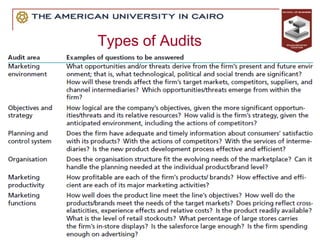
• The marketing environment audit requires an analysis of the
firm’s present and future environment with respect to its macro
components. The intent is to identify the more significant trends
to see how they affect the firm’s customers, competitors, channel
intermediaries, and suppliers.
• The objectives and strategy audit calls for an assessment of
how appropriate these internal factors are, given current major
environmental trends and any changes in the firm’s resources.
• The unit’s planning and control system audit evaluates the
adequacy of the systems that develop the firm’s product-market
entry action plans and the control and reappraisal process. The
audit also evaluates the firm’s new product development
procedures.
Types of Audits
• The organisation audit deals with the firm’s overall
structure (can it meet the changing needs of the
marketplace?); how the marketing department is
organised (can it accommodate the planning
requirements of the firm’s assortment of brands?); and
the extent of synergy between the various marketing
units (are there good relations between sales and
merchandising?).
• The marketing productivity audit evaluates the
profitability of the company’s individual products,
markets (including sales territories), and key accounts. It
also studies the cost-effectiveness of the various
marketing activities.
Types of Audits
• The marketing functions audit examines, in depth, how adequately the firm
handles each of the marketing-mix elements.
• Questions relating to the product concern the attainability of the present product-
line objective, the extent to which individual products fit the needs of the target
markets, and whether the product line should be expanded or contracted.
• Price questions have to do with price elasticity; experience effects, relative costs,
and the actions of major competitors; and consumers’ perceptions of the
relationship between a product’s price and its value.
• Distribution questions center on coverage, functions performed, and cost-
effectiveness.
• Questions about advertising focus on advertising objectives and strategies, media
schedules, and the procedures used to develop advertising objectives and
strategies, media schedules, and the procedures used to develop advertising
messages.
• The audit of the sales force covers its objectives, role, size, coverage,
organisation, and duties plus the quality of its selection, training, motivation,
compensation, and control activities.
Types of Audits
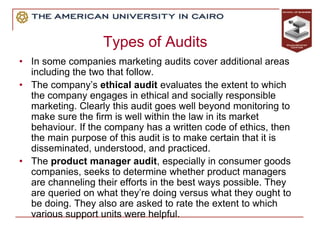
• In some companies marketing audits cover additional areas
including the two that follow.
• The company’s ethical audit evaluates the extent to which
the company engages in ethical and socially responsible
marketing. Clearly this audit goes well beyond monitoring to
make sure the firm is well within the law in its market
behaviour. If the company has a written code of ethics, then
the main purpose of this audit is to make certain that it is
disseminated, understood, and practiced.
• The product manager audit, especially in consumer goods
companies, seeks to determine whether product managers
are channeling their efforts in the best ways possible. They
are queried on what they’re doing versus what they ought to
be doing. They also are asked to rate the extent to which
various support units were helpful.
Types of Audits
• and strategy, planning and control systems,
organisation, productivity, and individual marketing
activities such as sales and advertising.

Marketing_Module_19.ppt

  • 1.
    Module 19 Measuring andDelivering Marketing Performance By: Dr Shahinaz Abdellatif
  • 2.
    Objective of thissession 1. To examine how to design strategic control systems 2. To consider design decisions for marketing performance measurement
  • 3.
    The Control Process Settingstandards of performance Specifying the necessary feedback data Obtaining the needed control data Evaluating feedback data -- explaining gap between actual and given standards of performance Taking corrective action
  • 4.
    1- Setting standardfor performance • These standards derive largely from the objectives and strategies set forth at the SBU and individual product- market entry level. They generate a series of performance expectations for profitability (return on equity or return on assets managed), market share, and sales. • At the product-market level, standards of performance include sales and market-share determinants such as per cent effective distribution, relative shelf-facings, awareness, consumers’ attitude change toward a given product attribute, customer satisfaction, and the extent of price parity.
  • 5.
    2- Specify thenecessary feedback data • Analysts obtain feedback data from a variety of sources, including company accounting records and syndicated marketing information services such as Nielsen. The sales invoice or other transaction records, such as those produced by retailers’ point-of-sale systems, are the basic internal source of data because they provide a detailed record of each transaction and the basis for measuring profitability, sales, and various budget items. • Another source, and typically the most expensive and time- consuming, involves undertaking one or more marketing research projects to obtain needed information. • In-house research projects are apt to take longer and be more expensive than using an outside syndicated service.
  • 6.
    3- Evaluating FeedbackData • Management evaluates feedback data to find out whether there is any deviation from the plan, and if so why. • Typically, managers use a variety of information to determine what the company’s performance should have been under the actual market conditions that existed when the plan was executed. • At the line-item level, whether for revenue or expenses, results are compared with the standards set in step one of the control process.
  • 7.
    4- Taking CorrectiveAction • The last step in the control process concerns prescribing the needed action to correct the situation. • Most control systems are ‘based on the assumption that corrective action is known should significant variations arise. • Unfortunately, marketing still is not at a stage where performance deviations can be corrected with certainty.
  • 8.
    Design Decisions forStrategic Control Systems • Strategic control is concerned with monitoring and evaluating a firm’s SBU-level Strategies. Such a system is difficult to implement because there is usually a substantial amount of time between strategy formulation and when a strategy takes hold and results are evident. • Since both the external and internal environments are constantly evolving, strategic control must provide some way of changing the firm’s thrust if new information about the environment and/or the firm’s performance so dictates. Inevitably, much of this intermediate assessment is based on information about the marketplace and the results obtained from the firm’s marketing plan.
  • 9.
    Examples of questionsa strategic control system should be able to answer 1. What changes in the environment have negatively affected the current strategy (e.g. interest rates, government controls or price changes in substitute products)? 2. What changes have major competitors made in their objectives and strategies? 3. What changes have occurred in the industry in such attributes as capacity, entry barriers or substitute products? 4. What new opportunities or threats have derived from changes in the environment, competitors’ strategies or the nature of the industry? 5. What changes have occurred in the industry’s key success factors? 6. To what extent is the firm’s current strategy consistent with the preceding changes?
  • 10.
    1- Identifying KeyVariables • To implement strategic control, a company must identify the key variables to monitor, which are usually the major assumptions made in formulating the strategy. • The key variables to monitor are of two types: • those concerned with external forces; • and those concerned with the effects of certain actions taken by the firm to implement the strategy.
  • 11.
    2- Tracking andMonitoring • The next step is to specify what information or measures are needed on each of the key variables to determine whether the implementation of the strategic plan is on schedule – and if not, why not. • The firm can use the control plan as an early warning system as well as a diagnostic tool.
  • 12.
    3- Strategy Reassessment •This can take place at periodic intervals – for example, quarterly or annually, when the firm evaluates its performance to date along with major changes in the external environment. • A strategic control system can also alert management of a significant change in either or both its external/internal environments. • This involves setting triggers to signal the need to reassess the viability of the firm’s strategy. It requires a specification of both the level at which an alert will be called and the combination of events that must occur before the firm reacts. • In today’s fast-changing world, strategy reassessment may happen much more quickly, as competitive and technological developments cause firms to quickly change their entire strategies and business models.
  • 13.
    Key Questions ForDesigning Control Systems to Manage Marketing Performance • Who needs what information? • When and how often is it needed? • In what media and in what formats should it be provided? • What contingencies should be planned for?
  • 14.
    The Contingency Planning Process Identifyingcritical assumptions about the future Assigning probability of each critical assumption’s being right Rank ordering of critical assumptions Tracking/monitoring of action plan Setting triggers to activate contingency plan Specifying alternative response options
  • 15.
    Types of Audits •The marketing environment audit requires an analysis of the firm’s present and future environment with respect to its macro components. The intent is to identify the more significant trends to see how they affect the firm’s customers, competitors, channel intermediaries, and suppliers. • The objectives and strategy audit calls for an assessment of how appropriate these internal factors are, given current major environmental trends and any changes in the firm’s resources. • The unit’s planning and control system audit evaluates the adequacy of the systems that develop the firm’s product-market entry action plans and the control and reappraisal process. The audit also evaluates the firm’s new product development procedures.
  • 16.
    Types of Audits •The organisation audit deals with the firm’s overall structure (can it meet the changing needs of the marketplace?); how the marketing department is organised (can it accommodate the planning requirements of the firm’s assortment of brands?); and the extent of synergy between the various marketing units (are there good relations between sales and merchandising?). • The marketing productivity audit evaluates the profitability of the company’s individual products, markets (including sales territories), and key accounts. It also studies the cost-effectiveness of the various marketing activities.
  • 17.
    Types of Audits •The marketing functions audit examines, in depth, how adequately the firm handles each of the marketing-mix elements. • Questions relating to the product concern the attainability of the present product- line objective, the extent to which individual products fit the needs of the target markets, and whether the product line should be expanded or contracted. • Price questions have to do with price elasticity; experience effects, relative costs, and the actions of major competitors; and consumers’ perceptions of the relationship between a product’s price and its value. • Distribution questions center on coverage, functions performed, and cost- effectiveness. • Questions about advertising focus on advertising objectives and strategies, media schedules, and the procedures used to develop advertising objectives and strategies, media schedules, and the procedures used to develop advertising messages. • The audit of the sales force covers its objectives, role, size, coverage, organisation, and duties plus the quality of its selection, training, motivation, compensation, and control activities.
  • 18.
    Types of Audits •In some companies marketing audits cover additional areas including the two that follow. • The company’s ethical audit evaluates the extent to which the company engages in ethical and socially responsible marketing. Clearly this audit goes well beyond monitoring to make sure the firm is well within the law in its market behaviour. If the company has a written code of ethics, then the main purpose of this audit is to make certain that it is disseminated, understood, and practiced. • The product manager audit, especially in consumer goods companies, seeks to determine whether product managers are channeling their efforts in the best ways possible. They are queried on what they’re doing versus what they ought to be doing. They also are asked to rate the extent to which various support units were helpful.
  • 19.
    Types of Audits •and strategy, planning and control systems, organisation, productivity, and individual marketing activities such as sales and advertising.

Editor's Notes