MARKETING EVALUATION, CONTROL
AND AUDIT
PRESENTED BY:
PRATIKSHA SAHU P(012)
ROHIT PATEL QA(003)
MINAXI SALUNKE QA(005)
THE RIGHT INGREDIENT OF
PERFORMANCE, FOR THE GREAT TASTE
OF SUCCESS
WHY NECESSARY ???
THE FLIP SIDE OF A COIN
IMPLEMENTATON
Process that turns marketing
plans into action
Ensures better allocation of
marketing resources and better
management of marketing assets
 Marketing resource
management(MRM)
MARKETING
EVALUATION
 Return on investment
Sales number
Market penetration
Customer response
Salesperson
MARKETING
CONTROL
1. GOAL SETTING
2. PERFORMANCE MEASUREMENT
3. PERFORMANCE DIAGNOSIS
4. CORRECTIVE ACTION
It ensures the company
achieves the sales, profit
and other goals
established in its annual
plan.
Annual-plan
control
Profitability
control
Companies should measure the profitability of
their products, customer groups, segments,
trade channels, and order size to help
determine whether to expand, reduce or
eliminate any products or marketing activities.
Some companies have established a
marketing control position to work out of
controler’s office but specialize in
improving marketing efficiency.
Efficiency
control
Each company should periodically reassess its
strategic approach to the marketplace with a good
marketing audit. Company can also perform
marketing excellence reviews and ethical
responsibility reviews.
Strategic
control
Type of
control
Prime responsibility Purpose of control Approaches
Annual plan
control
Top management
Middle management
To examine whether the
planned results are being
achieved
Sales analysis
•Market share
analysis
•Sales to expense
ratio
•Financial analysis
•Market based
scorecard analysis
Profitability
control
Marketing controller To examine where the
company is making and losing
money
Profitability by:
•Product
•Territory
•Customer
•Segment
•Trade channel
•Order size
Type of
control
Prime responsibility Purpose of control Approaches
Efficiency
control
Line and staff
management
Marketing controller
To evaluate and improve the
spending efficiency and
impact of marketing
expenditures
Efficiency of:
•Sales force
•Advertising
•Sales promotion
•Distribution
Strategic
control
Top management
Marketing auditor
To examine whether the
company is pursuing its best
opportunities with respect
to markets, products and
channels.
•Marketing
effectiveness rating
instrument
•Marketing audit
•Marketing excellence
review
•Company ethical and
social responsibility
review
MARKETING AUDIT
• A marketing audit is a structured approach to
the collection and analysis of information and
data on the internal and external
environment, including information on the
business and economic climate, the market,
competition, major competitors and the
company’s operating performance.
• The purpose of a marketing audit is not to
criticise particular activities, but rather to
identify whether there are any working
practices that could be more effective.
What Is A Marketing Audit?
The Marketing Audit Process
Pre-Audit Activities
The Audit Process
Information Analysis
Data Collection
Post-Audit Activities
Preparing Recommendations
The Marketing Audit Team
• Self-audit
• Company auditing office
• Outside audit
Marketing Environment Audit
Macroenvironment
COMPONENTS OF A MARKETING AUDIT
•What major demographic developments and trends pose opportunities or threats to
this company? What actions have the company taken in response to these
developments and trends?
•What major developments in income, prices, savings, and credit will affect the
company? What actions have the company been taking in response to these
developments and trends?
•What is the outlook for the cost and availability of natural resources and energy
needed by the company?
•What major changes are occurring in product and process technology?
•What changes in laws and regulations might affect marketing strategy and tactics?
•What changes in customer lifestyles and values might affect the company?
Task Environment
Distribution and
DealersCompetitors
Market
Suppliers
Customers
• What is happening to market size, growth, geographical distribution, and profits? What
are the major market segments?
•What are the customers’ needs and buying processes? How do customers and
prospects rate the company and its competitors on reputation, product quality, service,
sales force, and price? How do different customer segments make their buying
decisions?
•Who are the major competitors? What are their objectives, strategies, strengths,
weaknesses, sizes, and market shares? What trends will affect future competition and
substitutes for the company’s products?
•What are the main trade channels for bringing products to customers? What are the
efficiency levels and growth potentials of the different trade channels?
•What is the outlook for the availability of key resources used in production? What
trends are occurring among suppliers?
•What is the cost and availability outlook for transportation services, warehousing
facilities, and financial resources?
Marketing Strategy Audit
Business Mission
•Is the business mission clearly stated in market-oriented
terms?
•Are the company and marketing objectives and goals stated
clearly enough to guide marketing planning and performance
measurement? Are the marketing objectives appropriate, given
the company’s competitive position, resources, and
opportunities?
•Has the management articulated a clear marketing strategy for
achieving its marketing objectives? Is the strategy convincing? Is
the strategy appropriate to the stage of the product life cycle,
competitors’ strategies, and the state of the economy? Is the
company using the best basis for market segmentation?
Marketing Organization Audit
Functional Efficiency
Interface Efficiency
•Are there good communication and working relations between
marketing and sales? Is the product-management system
working effectively? Are there any groups in marketing that
need more training, motivation, supervision, or evaluation?
•Are there any problems between marketing and
manufacturing, R&D, purchasing, finance, accounting, and/or
legal that need attention?
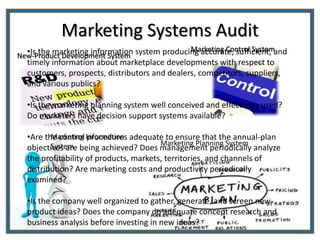
New-Product Development System
Marketing Control System
Marketing Planning System
Marketing Information
System
Marketing Systems Audit
•Is the marketing information system producing accurate, sufficient, and
timely information about marketplace developments with respect to
customers, prospects, distributors and dealers, competitors, suppliers,
and various publics?
•Is the marketing planning system well conceived and effectively used?
Do marketers have decision support systems available?
•Are the control procedures adequate to ensure that the annual-plan
objectives are being achieved? Does management periodically analyze
the profitability of products, markets, territories, and channels of
distribution? Are marketing costs and productivity periodically
examined?
•Is the company well organized to gather, generate, and screen new-
product ideas? Does the company do adequate concept research and
business analysis before investing in new ideas?
Marketing Proaductivity Audit
Profitability Analysis
Cost-Effectiveness Analysis•What is the profitability of the company’s different
products, markets, territories, and channels of distribution?
Should the company enter, expand, contract, or withdraw
from any business segments?
•Do any marketing activities seem to have excessive costs?
Can cost-reducing steps be taken?
Marketing Function Audits
•What is the current state of New Product evelopment? (Product)
•How profitable is our product portfolio? (Product)
•Are we pricing in the right way? (Price)
•How effective and efficient is distribution? (Place)
•Are we getting our marketing communications
right?(Promotion)
• MARKETING MANAGEMENT 14E BY
PHILIP KOTLER AND KEVIN LANE KELLER,
ISBN 13: 978-0-13-210292-6, PAGE
NO:643 -646
References
THANK
YOU

marketing evaluation , control and audit

  • 1.
    MARKETING EVALUATION, CONTROL ANDAUDIT PRESENTED BY: PRATIKSHA SAHU P(012) ROHIT PATEL QA(003) MINAXI SALUNKE QA(005)
  • 2.
    THE RIGHT INGREDIENTOF PERFORMANCE, FOR THE GREAT TASTE OF SUCCESS
  • 3.
  • 4.
    THE FLIP SIDEOF A COIN
  • 5.
  • 6.
    Process that turnsmarketing plans into action Ensures better allocation of marketing resources and better management of marketing assets  Marketing resource management(MRM)
  • 7.
  • 8.
     Return oninvestment Sales number Market penetration Customer response Salesperson
  • 9.
  • 12.
    1. GOAL SETTING 2.PERFORMANCE MEASUREMENT 3. PERFORMANCE DIAGNOSIS 4. CORRECTIVE ACTION
  • 14.
    It ensures thecompany achieves the sales, profit and other goals established in its annual plan. Annual-plan control
  • 15.
    Profitability control Companies should measurethe profitability of their products, customer groups, segments, trade channels, and order size to help determine whether to expand, reduce or eliminate any products or marketing activities.
  • 16.
    Some companies haveestablished a marketing control position to work out of controler’s office but specialize in improving marketing efficiency. Efficiency control
  • 17.
    Each company shouldperiodically reassess its strategic approach to the marketplace with a good marketing audit. Company can also perform marketing excellence reviews and ethical responsibility reviews. Strategic control
  • 18.
    Type of control Prime responsibilityPurpose of control Approaches Annual plan control Top management Middle management To examine whether the planned results are being achieved Sales analysis •Market share analysis •Sales to expense ratio •Financial analysis •Market based scorecard analysis Profitability control Marketing controller To examine where the company is making and losing money Profitability by: •Product •Territory •Customer •Segment •Trade channel •Order size
  • 19.
    Type of control Prime responsibilityPurpose of control Approaches Efficiency control Line and staff management Marketing controller To evaluate and improve the spending efficiency and impact of marketing expenditures Efficiency of: •Sales force •Advertising •Sales promotion •Distribution Strategic control Top management Marketing auditor To examine whether the company is pursuing its best opportunities with respect to markets, products and channels. •Marketing effectiveness rating instrument •Marketing audit •Marketing excellence review •Company ethical and social responsibility review
  • 20.
  • 21.
    • A marketingaudit is a structured approach to the collection and analysis of information and data on the internal and external environment, including information on the business and economic climate, the market, competition, major competitors and the company’s operating performance. • The purpose of a marketing audit is not to criticise particular activities, but rather to identify whether there are any working practices that could be more effective. What Is A Marketing Audit?
  • 22.
    The Marketing AuditProcess Pre-Audit Activities The Audit Process Information Analysis Data Collection Post-Audit Activities Preparing Recommendations
  • 23.
    The Marketing AuditTeam • Self-audit • Company auditing office • Outside audit
  • 24.
    Marketing Environment Audit Macroenvironment COMPONENTSOF A MARKETING AUDIT •What major demographic developments and trends pose opportunities or threats to this company? What actions have the company taken in response to these developments and trends? •What major developments in income, prices, savings, and credit will affect the company? What actions have the company been taking in response to these developments and trends? •What is the outlook for the cost and availability of natural resources and energy needed by the company? •What major changes are occurring in product and process technology? •What changes in laws and regulations might affect marketing strategy and tactics? •What changes in customer lifestyles and values might affect the company?
  • 25.
    Task Environment Distribution and DealersCompetitors Market Suppliers Customers •What is happening to market size, growth, geographical distribution, and profits? What are the major market segments? •What are the customers’ needs and buying processes? How do customers and prospects rate the company and its competitors on reputation, product quality, service, sales force, and price? How do different customer segments make their buying decisions? •Who are the major competitors? What are their objectives, strategies, strengths, weaknesses, sizes, and market shares? What trends will affect future competition and substitutes for the company’s products? •What are the main trade channels for bringing products to customers? What are the efficiency levels and growth potentials of the different trade channels? •What is the outlook for the availability of key resources used in production? What trends are occurring among suppliers? •What is the cost and availability outlook for transportation services, warehousing facilities, and financial resources?
  • 26.
    Marketing Strategy Audit BusinessMission •Is the business mission clearly stated in market-oriented terms? •Are the company and marketing objectives and goals stated clearly enough to guide marketing planning and performance measurement? Are the marketing objectives appropriate, given the company’s competitive position, resources, and opportunities? •Has the management articulated a clear marketing strategy for achieving its marketing objectives? Is the strategy convincing? Is the strategy appropriate to the stage of the product life cycle, competitors’ strategies, and the state of the economy? Is the company using the best basis for market segmentation?
  • 27.
    Marketing Organization Audit FunctionalEfficiency Interface Efficiency •Are there good communication and working relations between marketing and sales? Is the product-management system working effectively? Are there any groups in marketing that need more training, motivation, supervision, or evaluation? •Are there any problems between marketing and manufacturing, R&D, purchasing, finance, accounting, and/or legal that need attention?
  • 28.
    New-Product Development System MarketingControl System Marketing Planning System Marketing Information System Marketing Systems Audit •Is the marketing information system producing accurate, sufficient, and timely information about marketplace developments with respect to customers, prospects, distributors and dealers, competitors, suppliers, and various publics? •Is the marketing planning system well conceived and effectively used? Do marketers have decision support systems available? •Are the control procedures adequate to ensure that the annual-plan objectives are being achieved? Does management periodically analyze the profitability of products, markets, territories, and channels of distribution? Are marketing costs and productivity periodically examined? •Is the company well organized to gather, generate, and screen new- product ideas? Does the company do adequate concept research and business analysis before investing in new ideas?
  • 29.
    Marketing Proaductivity Audit ProfitabilityAnalysis Cost-Effectiveness Analysis•What is the profitability of the company’s different products, markets, territories, and channels of distribution? Should the company enter, expand, contract, or withdraw from any business segments? •Do any marketing activities seem to have excessive costs? Can cost-reducing steps be taken?
  • 30.
    Marketing Function Audits •Whatis the current state of New Product evelopment? (Product) •How profitable is our product portfolio? (Product) •Are we pricing in the right way? (Price) •How effective and efficient is distribution? (Place) •Are we getting our marketing communications right?(Promotion)
  • 31.
    • MARKETING MANAGEMENT14E BY PHILIP KOTLER AND KEVIN LANE KELLER, ISBN 13: 978-0-13-210292-6, PAGE NO:643 -646 References
  • 32.