Marketing Environment
&
Marketing Strategies
UNIT – 2
What is ‘Marketing Environment’?
• Marketing environment consists of all the
factors and forces, internal as well external that
influence the business and its capacity to
operate.
• Some of these factors are under the control of
the company while others are not under the
company’s control
Marketing Environment: Characteristics
• Marketing environment is dynamic, it keeps on
changing
• Marketing environment is proportional to the
size of the company. Larger the company,
larger is its marketing environment
• Marketing environment is place specific,
different countries have different marketing
environments
Marketing Environment: Characteristics
• Marketing environment provides strength,
weakness, opportunities and threats to the
business
• Marketing environment is complex, many
factors and forces come into play together in
marketing environment
• Marketing environment is uncertain, its future
course can only be guessed
Marketing Environment: Classification
• Marketing Environment can be classified into
two categories:
Internal environment: internal to the company
or the organization, controllable
External environment: external to the company
of the organization, non controllable
Internal Marketing Environment
• The internal environment considers everything
inside of the bounds of the company.
• This includes staff at all levels and from all
departments, financial and management
decisions / influences and more.
• Factors in the internal environment can be
controlled by the organization.
• Internal marketing environment offers strength
and weakness to the business
Internal Marketing Environment:
Factors
• Internal Marketing Environment includes:
Staff members – all departments
e.g. management, finance, research and
development, purchasing, business operations and
accounting
Capital assets
Company policy
Logistics
Inventory
External Marketing Environment
• The external environment considers everything
outside of the bounds of the company.
• This includes competitors, customers etc .
• Factors in the internal environment cannot be
controlled by the organization.
• External marketing environment offers
opportunities and threats to the business
External Marketing Environment
• External Marketing Environment includes:
 P – Political Environment
E – Economic Environment
T – Technological Environment
E – Ecological Environment
L – Legal Environment
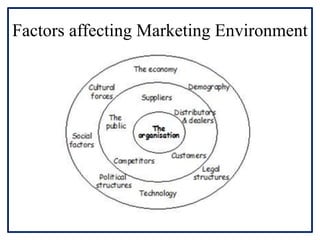
Factors affecting Marketing Environment
Functions of Marketing Environment
It offers strength to the business [internal
environment]
It offers opportunities to the business to operate
and expand
Marketing environment encourages growth of
companies and economy, it is a growth enabler
Marketing environment encourages new product
development
It helps in expanding customers choice of
products through innovation
Strategic Marketing Planning
Strategic marketing planning involves setting
goals and objectives, analyzing internal and
external business factors, product planning,
implementation, and tracking your progress.
Strategic marketing plans are based on three
key components: diagnosis, strategy, and
communication.
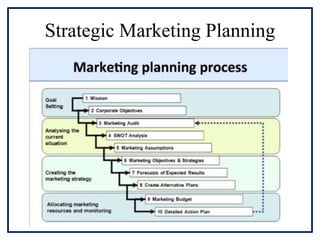
Strategic Marketing Planning
Strategic Marketing Planning:
Advantages
Helps the company to evaluate current marketing
environment
Helps the company to establish clear marketing
goals
Helps to identify the actions needed to achieve
goals
Contributes to the success of the company in the
market
Prepares the company for facing the dynamic
marketing environment
Managing and Controlling Marketing
Program
There is no planning without control.
Marketing control is the process of monitoring
the proposed marketing plans as they proceed
and making adjustments where necessary
Control is a very important managerial
function in which gaps are identified and
corrective actions are taken
Types of Marketing Control
• There are four types of marketing controls:
Annual Plan Control
Profitability Control
Efficiency Control
Strategic Control
Annual Plan Control
• Annual plan control is the monitoring of
current marketing efforts and results to ensure
that the annual sales and the profit goals are
achieved.
• Annual plan control signifies continuous
ongoing performance verification against the
annual plan and taking the necessary corrective
actions.
Annual Plan Control Process
• Setting Monthly or quarterly targets
• Monitoring actual performance
• Identifying serious deviations
• Taking corrective actions
Annual Plan Control Tools
• Five tools are considered in annual plan
control process:
• Sales Analysis
• Market Share analysis
• Market expense analysis
• Financial Analysis [Ratio Analysis]
• Customer Attitude tracking [through surveys]
Profitability Control
• Profitability control is to determine the actual
profitability of the firm’s products, territories,
market segments and trade channels.
• Profitability control is exercised to examine
whether the company is making and losing the
money.
Profitability Control
• This profitability control information is so vital
to the management that it is possible to take
discerning decisions on expansion, contraction
or suspension of marketing activities.
• Profitability control or profit analysis refers to
the study of profit generated and contribution
made to it by different products, regions and
the customers.
Efficiency Control
• Efficiency control is the task of improving the
efficiency of such marketing activities as
personal selling, advertising, sales-promotion
and distribution.
• Efficiency control is undertaken to evaluate
and improve the spending efficiency and
impact of marketing expenditures on the
marketing operations.
Efficiency Control
• The responsibility rests with the marketing
controller and marketing departmental line and
staff people.
• There is close relationship between
profitability and efficiency. Poor profits mean
less efficient management of sales-force,
advertising, sales-promotion and physical
distribution.
Efficiency Control
• These four areas are analyzed for efficiency
control:
Sales efficiency
Advertizing efficiency
Sales promotion efficiency
Distribution efficiency
Strategic Control
• Strategic control is the crucial task of making
sure that the company’s marketing objectives,
strategies and systems are optimally adapted to
the current and forecasted marketing
environment.
• Strategic control refers to the in-depth study
undertaken to examine whether the company is
pursuing its best opportunities with respect to
markets, products and channels.
Strategic Control
• It is the responsibility of the top management
and the marketing auditor.
• Such an investigation is a must because;
marketing is an area where rapid obsolescence
of objectives, policies, strategies and
programmes is a regular possibility.

Unit 2 marketing_environment_marketing_strategy

  • 1.
  • 2.
    What is ‘MarketingEnvironment’? • Marketing environment consists of all the factors and forces, internal as well external that influence the business and its capacity to operate. • Some of these factors are under the control of the company while others are not under the company’s control
  • 3.
    Marketing Environment: Characteristics •Marketing environment is dynamic, it keeps on changing • Marketing environment is proportional to the size of the company. Larger the company, larger is its marketing environment • Marketing environment is place specific, different countries have different marketing environments
  • 4.
    Marketing Environment: Characteristics •Marketing environment provides strength, weakness, opportunities and threats to the business • Marketing environment is complex, many factors and forces come into play together in marketing environment • Marketing environment is uncertain, its future course can only be guessed
  • 5.
    Marketing Environment: Classification •Marketing Environment can be classified into two categories: Internal environment: internal to the company or the organization, controllable External environment: external to the company of the organization, non controllable
  • 6.
    Internal Marketing Environment •The internal environment considers everything inside of the bounds of the company. • This includes staff at all levels and from all departments, financial and management decisions / influences and more. • Factors in the internal environment can be controlled by the organization. • Internal marketing environment offers strength and weakness to the business
  • 7.
    Internal Marketing Environment: Factors •Internal Marketing Environment includes: Staff members – all departments e.g. management, finance, research and development, purchasing, business operations and accounting Capital assets Company policy Logistics Inventory
  • 8.
    External Marketing Environment •The external environment considers everything outside of the bounds of the company. • This includes competitors, customers etc . • Factors in the internal environment cannot be controlled by the organization. • External marketing environment offers opportunities and threats to the business
  • 9.
    External Marketing Environment •External Marketing Environment includes:  P – Political Environment E – Economic Environment T – Technological Environment E – Ecological Environment L – Legal Environment
  • 10.
  • 11.
    Functions of MarketingEnvironment It offers strength to the business [internal environment] It offers opportunities to the business to operate and expand Marketing environment encourages growth of companies and economy, it is a growth enabler Marketing environment encourages new product development It helps in expanding customers choice of products through innovation
  • 12.
    Strategic Marketing Planning Strategicmarketing planning involves setting goals and objectives, analyzing internal and external business factors, product planning, implementation, and tracking your progress. Strategic marketing plans are based on three key components: diagnosis, strategy, and communication.
  • 13.
  • 14.
    Strategic Marketing Planning: Advantages Helpsthe company to evaluate current marketing environment Helps the company to establish clear marketing goals Helps to identify the actions needed to achieve goals Contributes to the success of the company in the market Prepares the company for facing the dynamic marketing environment
  • 15.
    Managing and ControllingMarketing Program There is no planning without control. Marketing control is the process of monitoring the proposed marketing plans as they proceed and making adjustments where necessary Control is a very important managerial function in which gaps are identified and corrective actions are taken
  • 16.
    Types of MarketingControl • There are four types of marketing controls: Annual Plan Control Profitability Control Efficiency Control Strategic Control
  • 17.
    Annual Plan Control •Annual plan control is the monitoring of current marketing efforts and results to ensure that the annual sales and the profit goals are achieved. • Annual plan control signifies continuous ongoing performance verification against the annual plan and taking the necessary corrective actions.
  • 18.
    Annual Plan ControlProcess • Setting Monthly or quarterly targets • Monitoring actual performance • Identifying serious deviations • Taking corrective actions
  • 19.
    Annual Plan ControlTools • Five tools are considered in annual plan control process: • Sales Analysis • Market Share analysis • Market expense analysis • Financial Analysis [Ratio Analysis] • Customer Attitude tracking [through surveys]
  • 20.
    Profitability Control • Profitabilitycontrol is to determine the actual profitability of the firm’s products, territories, market segments and trade channels. • Profitability control is exercised to examine whether the company is making and losing the money.
  • 21.
    Profitability Control • Thisprofitability control information is so vital to the management that it is possible to take discerning decisions on expansion, contraction or suspension of marketing activities. • Profitability control or profit analysis refers to the study of profit generated and contribution made to it by different products, regions and the customers.
  • 22.
    Efficiency Control • Efficiencycontrol is the task of improving the efficiency of such marketing activities as personal selling, advertising, sales-promotion and distribution. • Efficiency control is undertaken to evaluate and improve the spending efficiency and impact of marketing expenditures on the marketing operations.
  • 23.
    Efficiency Control • Theresponsibility rests with the marketing controller and marketing departmental line and staff people. • There is close relationship between profitability and efficiency. Poor profits mean less efficient management of sales-force, advertising, sales-promotion and physical distribution.
  • 24.
    Efficiency Control • Thesefour areas are analyzed for efficiency control: Sales efficiency Advertizing efficiency Sales promotion efficiency Distribution efficiency
  • 25.
    Strategic Control • Strategiccontrol is the crucial task of making sure that the company’s marketing objectives, strategies and systems are optimally adapted to the current and forecasted marketing environment. • Strategic control refers to the in-depth study undertaken to examine whether the company is pursuing its best opportunities with respect to markets, products and channels.
  • 26.
    Strategic Control • Itis the responsibility of the top management and the marketing auditor. • Such an investigation is a must because; marketing is an area where rapid obsolescence of objectives, policies, strategies and programmes is a regular possibility.