MARKETING CHANNELS AND
   VALUE NETWORKS
    Marketing Management
            2012


                           1
Introduction
 Most producers do not sell their goods
 directly to the final users; between them
 stands a set of intermeriaries performing a
 variety of functions
 These intermediaries costitute a marketing
 channel (also called a trade channel or
 distribution channel)


                                               2
Introduction
 Marketing channels are sets of
  interdependent organizations participating in
  the process of making a product or service
  available for use or consumption


                                                  3
The Importance of Channels
o Marketing channels also represent a
  substantial opportunity cost
o One of their chief roles is to convert potential
  buyers into profitable customer,
o Marketing channels must not just serve
  markets, they must also make markets


                                                     4
Push versus Pull Strategy1
 A push strategy uses the manufacturer’s sales
 force, trade promotion money, or other
 means to induce intermediaries to
 carry, promote, and sell the product to end
 users
 A push strategy is particularly appropriate
 when there is low brand loyalty in a
 category, brand choice is made in the
 store, the product is an impulse item, and
 product benefits are well understood
                                                  5
Push versus Pull Strategy2
 In a pull strategy the manufacturer uses
 adevertising, promotion, and other forms of
 communication to persuade consumers to
 demand the product from intermediaries, thus to
 inducing the intermediaries to order it
 Pull strategy is particularly appropriate when
 there is high brand loyalty and high involvement
 in the category, when consumers are able to
 perceive differences between brands, and when
 they choose the brand before they go to the store

                                                 6
Channel Member Functions
 Gather information about potential and current
  customers, competitors, and other actors and
  forces in the marketing environment
 Develop and disseminate persuasive
  communications to stimulate purchasing
 Negotiate and reach agreements on price and
  other terms so that transfer of ownership or
  possesion can be affected
 Place orders with manufacturers
                                                   7
Channel Member Functions
 Acquire the funds to finance inventories at
  different levels in the marketing channel
 Assume risks connected with carrying out
  channel work
 Provide for the successive storage and
  movement of physical products
 Provide for buyers’ payment of their bills
  through banks and other financial institutions

                                                   8
Major Factors in Selecting a
           Marketingt Channel
1)   Market,
2)   Product,
3)   Organizational,
4)   Competitive


                                       9
General Categories
         of Distribution Intensity
 Intensive distribution seeks to distribute a
  product through all available channels in a
  trade area,
 Selective distribution chooses a limited
  number of retailers in a market area,
 Exclusive distribution grants exclusive rights to
  a wholesaler or retailer to sell a
  manufacturer’s products

                                                  10
Types of Channel Conflict
 Horizontal conflict results from
 disagreements among channel members at
 the same level
 Vertical conflict occurs when channel
 members at different level disagree


                                          11
Elements of Physical Distribution
 customer service,
 transportation,
 inventory control,
 materials handling and protective packaging,
 order processing, and
 warehousing


                                                 12
The Types of Warehouse
 Storage warehouses; hold goods for moderate
  to long periods of time to balance supply and
  demand
 Distribution warehouse; assemble and
  redistribute goods as quickly as possible


                                              13
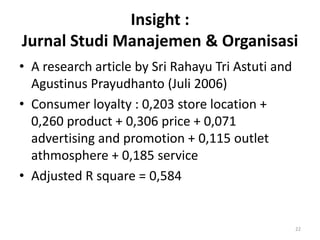
Insight :
Jurnal Studi Manajemen & Organisasi
• A research article by Sri Rahayu Tri Astuti and
  Agustinus Prayudhanto (Juli 2006)
• Consumer loyalty : 0,203 store location +
  0,260 product + 0,306 price + 0,071
  advertising and promotion + 0,115 outlet
  athmosphere + 0,185 service
• Adjusted R square = 0,584


                                                    22
rizalharimagnadi@undip.ac.id
    Management Departement
Faculty of Economics and Business
      Diponegoro University
             Semarang


                                    23

Marketing channels and value networks

  • 1.
    MARKETING CHANNELS AND VALUE NETWORKS Marketing Management 2012 1
  • 2.
    Introduction  Most producersdo not sell their goods directly to the final users; between them stands a set of intermeriaries performing a variety of functions  These intermediaries costitute a marketing channel (also called a trade channel or distribution channel) 2
  • 3.
    Introduction  Marketing channelsare sets of interdependent organizations participating in the process of making a product or service available for use or consumption 3
  • 4.
    The Importance ofChannels o Marketing channels also represent a substantial opportunity cost o One of their chief roles is to convert potential buyers into profitable customer, o Marketing channels must not just serve markets, they must also make markets 4
  • 5.
    Push versus PullStrategy1  A push strategy uses the manufacturer’s sales force, trade promotion money, or other means to induce intermediaries to carry, promote, and sell the product to end users  A push strategy is particularly appropriate when there is low brand loyalty in a category, brand choice is made in the store, the product is an impulse item, and product benefits are well understood 5
  • 6.
    Push versus PullStrategy2  In a pull strategy the manufacturer uses adevertising, promotion, and other forms of communication to persuade consumers to demand the product from intermediaries, thus to inducing the intermediaries to order it  Pull strategy is particularly appropriate when there is high brand loyalty and high involvement in the category, when consumers are able to perceive differences between brands, and when they choose the brand before they go to the store 6
  • 7.
    Channel Member Functions Gather information about potential and current customers, competitors, and other actors and forces in the marketing environment  Develop and disseminate persuasive communications to stimulate purchasing  Negotiate and reach agreements on price and other terms so that transfer of ownership or possesion can be affected  Place orders with manufacturers 7
  • 8.
    Channel Member Functions Acquire the funds to finance inventories at different levels in the marketing channel  Assume risks connected with carrying out channel work  Provide for the successive storage and movement of physical products  Provide for buyers’ payment of their bills through banks and other financial institutions 8
  • 9.
    Major Factors inSelecting a Marketingt Channel 1) Market, 2) Product, 3) Organizational, 4) Competitive 9
  • 10.
    General Categories of Distribution Intensity  Intensive distribution seeks to distribute a product through all available channels in a trade area,  Selective distribution chooses a limited number of retailers in a market area,  Exclusive distribution grants exclusive rights to a wholesaler or retailer to sell a manufacturer’s products 10
  • 11.
    Types of ChannelConflict  Horizontal conflict results from disagreements among channel members at the same level  Vertical conflict occurs when channel members at different level disagree 11
  • 12.
    Elements of PhysicalDistribution  customer service,  transportation,  inventory control,  materials handling and protective packaging,  order processing, and  warehousing 12
  • 13.
    The Types ofWarehouse  Storage warehouses; hold goods for moderate to long periods of time to balance supply and demand  Distribution warehouse; assemble and redistribute goods as quickly as possible 13
  • 22.
    Insight : Jurnal StudiManajemen & Organisasi • A research article by Sri Rahayu Tri Astuti and Agustinus Prayudhanto (Juli 2006) • Consumer loyalty : 0,203 store location + 0,260 product + 0,306 price + 0,071 advertising and promotion + 0,115 outlet athmosphere + 0,185 service • Adjusted R square = 0,584 22
  • 23.
    rizalharimagnadi@undip.ac.id Management Departement Faculty of Economics and Business Diponegoro University Semarang 23