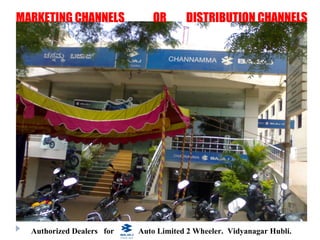
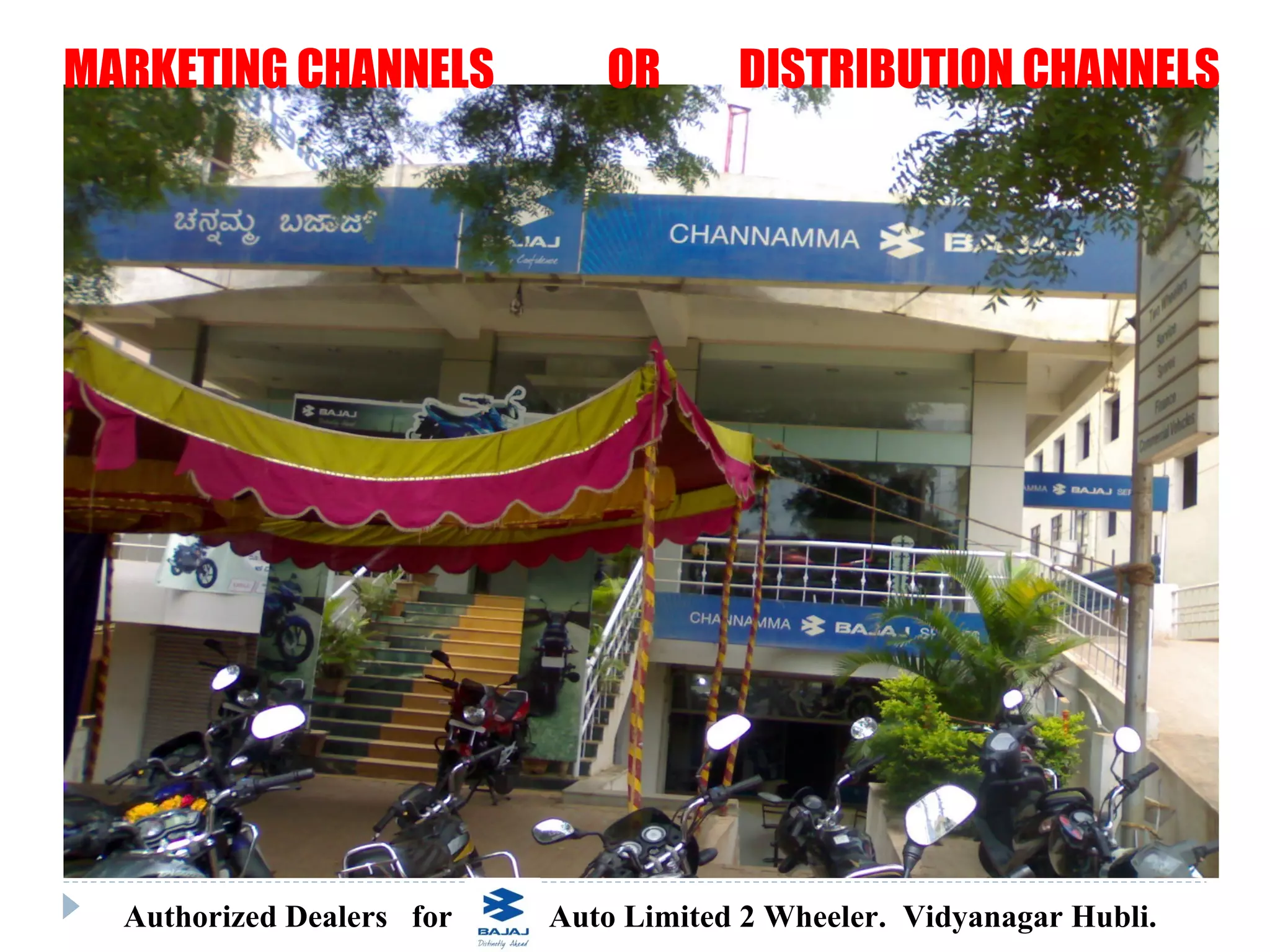
MARKETING CHANNELS            OR       DISTRIBUTION CHANNELS


  Authorized Dealers for   Auto Limited 2 Wheeler. Vidyanagar Hubli.
Marketing Channels
What is Marketing Channel?
   A set of interdependent organizations that help make a
    product or service available for use or consumption by
    consumer or business user.
   Also known as Distribution Channels.
   This Concept of Managing interdependent organizations is
    known as “Supply Chain Management”( SCM)
   Marketing Channels are based on VDN i.e. Value Delivery
    Network.
   which means:
   The network made up of company, suppliers, distributers
    & ultimately customers who partner with each other to
    improve the performance of the entire system in delivering
    customer value.
Marketing Channels
According to AMA
(American Marketing Association)


   “Channel of Distribution is the Structure of Intra
    Company Organization units and Extra Company
    Agents and Dealers, Wholesale and Retails, through
    which commodity, a product or Service is Marketed”.
Marketing Channels
Characteristics of MC
   Link between Producer and Consumer.

   Flow of Goods.

   Remuneration.

   Classification-Direct and Indirect.

   Activities- Financing, Credit Facility Etc.
Marketing Channels
Importance of MC


   Push Strategy:
   This Involves manufacturer using it sales force and trade
    promotion money to induce intermediaries to carry,
    promote and sell the product to end users.

   It is appropriate strategy where there is:
   Low Brand or Product Loyalty.
Marketing Channels
Importance of MC

   Pull Strategy:
   Manufacturer using advertising and promotion to persuade
    consumers to ask intermediaries for the product. Thus
    inducing intermediaries to order it.

   This Strategy is appropriate where there is high brand or
    Product loyalty and high Involvement.
   Top marketing companies like:

    Skillfully employ both push and pull strategies
Example of Push & Pull Strategy of
Marketing Channels
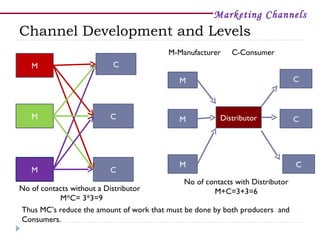
Channel Development and Levels
                                         M-Manufacturer    C-Consumer
   M                      C

                                            M                                  C


   M                     C                  M          Distributor             C


                                            M                                  C
   M                     C
                                             No of contacts with Distributor
No of contacts without a Distributor                 M+C=3+3=6
           M*C= 3*3=9
Thus MC’s reduce the amount of work that must be done by both producers and
Consumers.
Marketing Channels
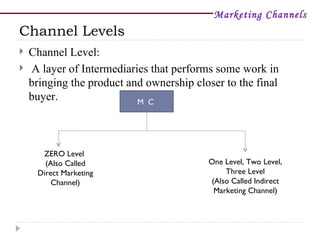
Channel Levels
   Channel Level:
    A layer of Intermediaries that performs some work in
    bringing the product and ownership closer to the final
    buyer.                  M C


      ZERO Level
       (Also Called                       One Level, Two Level,
     Direct Marketing                         Three Level
         Channel)                         (Also Called Indirect
                                           Marketing Channel)
Channel Levels
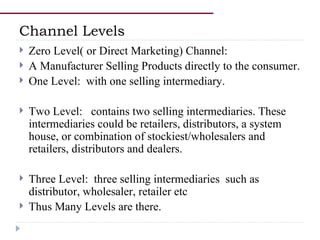
   Zero Level( or Direct Marketing) Channel:
   A Manufacturer Selling Products directly to the consumer.
   One Level: with one selling intermediary.

   Two Level: contains two selling intermediaries. These
    intermediaries could be retailers, distributors, a system
    house, or combination of stockiest/wholesalers and
    retailers, distributors and dealers.

   Three Level: three selling intermediaries such as
    distributor, wholesaler, retailer etc
   Thus Many Levels are there.
Marketing Channels
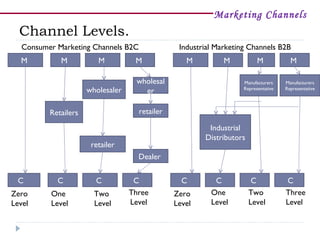
  Channel Levels.
   Consumer Marketing Channels B2C               Industrial Marketing Channels B2B
  M          M           M          M              M          M           M            M

                                    wholesal                        Manufacturers    Manufacturers
                      wholesaler      er                            Representative   Representative


          Retailers                  retailer

                                                         Industrial
                                                        Distributors
                       retailer
                                     Dealer


 C          C           C           C             C        C            C            C
Zero      One           Two        Three        Zero      One          Two           Three
Level     Level         Level      Level        Level     Level        Level         Level
Marketing Channels
Channel Design Decisions.
1)   Analyzing Customers’ Desired Service Output Levels.

3)   Establishing Objectives and Constraints.

5)   Identifying Major Channel Alternatives.

7)   Evaluating the Major Alternatives.
Marketing Channels
Analyzing Customers’ Desired Service Output Levels.
   In designing marketing channel, the marketer must understand the service
    output levels desired by target customers. Channels produce five service
    outputs.
s   Lot Size: the no of units the channel permits a typical customer to purchase
    on one occasion.
t   Waiting and delivery time: the average time customers of that channel wait
    for the receipt of goods.
o   Spatial Convenience: the degree to which marketing channels make it easy
    for customers to purchase the product.
    Product Variety: the assortment breadth provided by the marketing channel
r   Service Backup: the add on services(credit, delivery, installation, repairs)
    provided by the channel.
Marketing Channels
Establishing Objectives and Constraints.

1.   Perfect STP Planning.

2.   Objectives Vary with Product Characteristics.

3.   Cost Management Plays Very Important Role.

4.   The objectives to be set upon the environment which the

     company is operating.
Marketing Channels

Identifying Major Channel Alternatives.
    A Channel Alternative is described by three elements:


3.   Types of business intermediaries available.

4.   The no of intermediaries needed.

5.   Terms and responsibilities of each channel member.
Marketing Channels
Types of Business Intermediaries available:
   The people and Organizations that assist in the flow of goods and services from producer to
    customer are known as Marketing Intermediaries.
   The following are the common type of intermediaries:
   Agent or Broker: legal authority to goods/services on behalf of producer.
   Middleman: just anybody acting as mediator between Producer & Consumer
   Wholesaler: who deal bulk sales from the producers to organizations.
   Retailer: last link of the channel who deal directly with consumers.
   Distributor: distributor deal on their own account and push the products.
   Dealer: sell only to final consumers.
   Value Added Resellers(VAR’s): buy the basic product from producer and add value
    to it or, depending on the nature of the product modify it and then resell it to final
    customers.
   Merchants: Assume ownership of goods that they sell to customers or other
    intermediaries.
   Facilitating (C&F) Agents: they are the people and organizations that assists the
    flow of products and information to marketing channels and include banking
    insurance functions. Transportation and Storage Agent. Covering the risk. Financial
    Service.
Marketing Channels
The no of Intermediaries Needed.
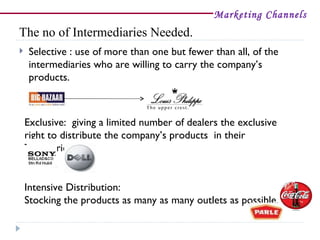
   Selective : use of more than one but fewer than all, of the
    intermediaries who are willing to carry the company’s
    products.


    Exclusive: giving a limited number of dealers the exclusive
    right to distribute the company’s products in their
    Territories.


    Intensive Distribution:
    Stocking the products as many as many outlets as possible.
Marketing Channels
Evaluating the Major Alternatives
   Each channel alternative needs to be evaluated against:

   Economic
   Control
   Adaptive Criteria.
Marketing Channels
Economic Criteria
   It includes: sales, cost, profitability of different channel
    alternatives.

   Channel Advantage:
   When a company successfully switches to its customers to
    lower cost channels, while assuming no loss of sales or
    deterioration in service quality.
Marketing Channels
Control & Adaptive Criteria
   Sales agency is an independent firm seeking to maximize
    its profits.
   Better approach is needed to adapt the product and to sell.
   Long term relationships.
Marketing Channels
Channel Management Decisions
   Marketing Channel Management(MCM):
   Selecting, managing and motivating individual channel
    members and evaluating their performance over a time.
   Channel decision refers to various decisions related to
    selection of right channel member for distribution of
    goods as well as services from the manufacturer to the
    ultimate consumer.
   It includes:
   Selecting The Channel Members.
   Managing Channel Members.
   Motivating the Channel Members
   Training & Evaluating the Channel Members
Marketing Channels
Selecting the Channel Members
   Factors involving in the selection of channels:
g   Market Consideration: B2C or B2B, Number of potential
    customers, size of order, buying habits of customers,
    geographical concentration of the market.
c   Product Consideration: unit value, product line, technical
    nature, size and weight, life cycle, value.
    Company considerations: volume of production, financial
    resources, experienced and competent management, services
    provided by channels, desire of control of the channels.
n   Middlemen considerations: availability of desired middlemen,
    financial ability, attitude, sales potential, cost, competition and
    legal constraints.
Marketing Channels
Managing the Channel Members
   The following decisions are considered important while
    making the decision:
   Marketing mix variables.
   Long term commitments.(PRM)
   Degree of channel control.
   Level of customer services.
   Price of the product/services.
Marketing Channels
Motivating the Channel Member.
   Relationship Marketing.
   The Concept of Marketing Which emphasis on building mutually satisfying
    long term relationships with key parties in order to earn and retain their
    business.
   PRM: Activities of the firm undertakes to build mutually satisfying long
    term relations with key partners such as suppliers, distributors, ad agencies,
    and marketing research suppliers.
   Benefits and cost offered to intermediaries:
   Reduction in the amount of capital employed by the distributor.
   Lower operating cost.
   Availability of specialists’ services.
   Reduction of overall risk.
   Customer finance schemes.
   Increased sales promotion.
Marketing Channels
Motivating the Channel Member.
   Cooperative Programs: Traditional Methods which
    includes:
   Advertising allowances, training sales people, payment for
    displays, free goods, commission on extra sales.
   DAC: Distribution Advisory Council:
   It helps in an overall improvement of channel
    communication which in turn, helps manufacturer learn
    more about the needs and problems of his channel
    members.
Marketing Channels
Motivating the Channel Member.
   Channel Power:
   Ability to alter channel members’ behavior so that they take
    actions they would not have taken otherwise.
   Coercive Power: manufacturers threaten to withdraw a
    resource or terminate relationship if intermediaries fail to
    cooperate.
   Reward Power: extra benefit for achievements.
   Legitimate power: requests a behavior that is warranted under
    a contract.
   Expert Power: special knowledge about intermediaries value.
   Referent Power: highly respected to be associated with them.
Marketing Channels
Training & Evaluating the Channel Member
   Training:
   Training programs.


   Requires third party service engineers to complete set of
    courses and take certification exams. Those who pass
    formerly recognized as Microsoft Certified Professionals,
    and they can use this designation to promote business.

   Evaluation:
   Performance Appraisal of each member periodically.
Marketing Channels
Channel Conflict & solutions.
   Channel Conflict: when one channel member’s action
    prevent the channel from achieving goal.
   Reasons for Conflict:
   Product Range Mix
   Ordering Procedures
   Delivery schedules
   Trading terms and credit arrangements
   Packaging & handling
   Joint promotion
   Different perception of the market.
Marketing Channels
Types of Conflict
   Horizontal Conflict: conflict at the same level between
    channel members
   Ex: retailers on issue of pricing.
   Vertical Conflict: conflict between different level with in
    the same channel
   Ex: wholesaler & Manufacturer Conflict on issue of
    delivery of goods.
   Multichannel Conflict: with two or more channels
    established by the manufacturer to sell in the market
   Ex: retailer-distributor- manufacturer conflict related to
    credit facility
Marketing Channels
Remedies or Solutions to Conflict
   Channel Coordination: bringing channel members
    together to solve the issues.
   Proper Communication.
   Superordinate goals.
Marketing Channels
    Examples of Marketing Channels
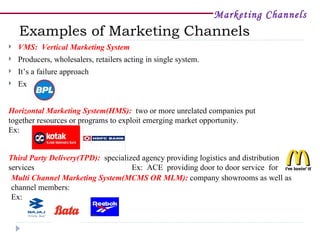
   VMS: Vertical Marketing System
   Producers, wholesalers, retailers acting in single system.
   It’s a failure approach
   Ex:


Horizontal Marketing System(HMS): two or more unrelated companies put
together resources or programs to exploit emerging market opportunity.
Ex:


Third Party Delivery(TPD): specialized agency providing logistics and distribution
services                            Ex: ACE providing door to door service for
 Multi Channel Marketing System(MCMS OR MLM): company showrooms as well as
 channel members:
 Ex:

Marketing channels.doc

  • 1.
    MARKETING CHANNELS OR DISTRIBUTION CHANNELS Authorized Dealers for Auto Limited 2 Wheeler. Vidyanagar Hubli.
  • 2.
    Marketing Channels What isMarketing Channel?  A set of interdependent organizations that help make a product or service available for use or consumption by consumer or business user.  Also known as Distribution Channels.  This Concept of Managing interdependent organizations is known as “Supply Chain Management”( SCM)  Marketing Channels are based on VDN i.e. Value Delivery Network.  which means:  The network made up of company, suppliers, distributers & ultimately customers who partner with each other to improve the performance of the entire system in delivering customer value.
  • 3.
    Marketing Channels According toAMA (American Marketing Association)  “Channel of Distribution is the Structure of Intra Company Organization units and Extra Company Agents and Dealers, Wholesale and Retails, through which commodity, a product or Service is Marketed”.
  • 4.
    Marketing Channels Characteristics ofMC  Link between Producer and Consumer.  Flow of Goods.  Remuneration.  Classification-Direct and Indirect.  Activities- Financing, Credit Facility Etc.
  • 5.
    Marketing Channels Importance ofMC  Push Strategy:  This Involves manufacturer using it sales force and trade promotion money to induce intermediaries to carry, promote and sell the product to end users.  It is appropriate strategy where there is:  Low Brand or Product Loyalty.
  • 6.
    Marketing Channels Importance ofMC  Pull Strategy:  Manufacturer using advertising and promotion to persuade consumers to ask intermediaries for the product. Thus inducing intermediaries to order it.  This Strategy is appropriate where there is high brand or Product loyalty and high Involvement.  Top marketing companies like: Skillfully employ both push and pull strategies
  • 7.
    Example of Push& Pull Strategy of
  • 8.
    Marketing Channels Channel Developmentand Levels M-Manufacturer C-Consumer M C M C M C M Distributor C M C M C No of contacts with Distributor No of contacts without a Distributor M+C=3+3=6 M*C= 3*3=9 Thus MC’s reduce the amount of work that must be done by both producers and Consumers.
  • 9.
    Marketing Channels Channel Levels  Channel Level:  A layer of Intermediaries that performs some work in bringing the product and ownership closer to the final buyer. M C ZERO Level (Also Called One Level, Two Level, Direct Marketing Three Level Channel) (Also Called Indirect Marketing Channel)
  • 10.
    Channel Levels  Zero Level( or Direct Marketing) Channel:  A Manufacturer Selling Products directly to the consumer.  One Level: with one selling intermediary.  Two Level: contains two selling intermediaries. These intermediaries could be retailers, distributors, a system house, or combination of stockiest/wholesalers and retailers, distributors and dealers.  Three Level: three selling intermediaries such as distributor, wholesaler, retailer etc  Thus Many Levels are there.
  • 11.
    Marketing Channels Channel Levels. Consumer Marketing Channels B2C Industrial Marketing Channels B2B M M M M M M M M wholesal Manufacturers Manufacturers wholesaler er Representative Representative Retailers retailer Industrial Distributors retailer Dealer C C C C C C C C Zero One Two Three Zero One Two Three Level Level Level Level Level Level Level Level
  • 12.
    Marketing Channels Channel DesignDecisions. 1) Analyzing Customers’ Desired Service Output Levels. 3) Establishing Objectives and Constraints. 5) Identifying Major Channel Alternatives. 7) Evaluating the Major Alternatives.
  • 13.
    Marketing Channels Analyzing Customers’Desired Service Output Levels.  In designing marketing channel, the marketer must understand the service output levels desired by target customers. Channels produce five service outputs. s Lot Size: the no of units the channel permits a typical customer to purchase on one occasion. t Waiting and delivery time: the average time customers of that channel wait for the receipt of goods. o Spatial Convenience: the degree to which marketing channels make it easy for customers to purchase the product. Product Variety: the assortment breadth provided by the marketing channel r Service Backup: the add on services(credit, delivery, installation, repairs) provided by the channel.
  • 14.
    Marketing Channels Establishing Objectivesand Constraints. 1. Perfect STP Planning. 2. Objectives Vary with Product Characteristics. 3. Cost Management Plays Very Important Role. 4. The objectives to be set upon the environment which the company is operating.
  • 15.
    Marketing Channels Identifying MajorChannel Alternatives.  A Channel Alternative is described by three elements: 3. Types of business intermediaries available. 4. The no of intermediaries needed. 5. Terms and responsibilities of each channel member.
  • 16.
    Marketing Channels Types ofBusiness Intermediaries available:  The people and Organizations that assist in the flow of goods and services from producer to customer are known as Marketing Intermediaries.  The following are the common type of intermediaries:  Agent or Broker: legal authority to goods/services on behalf of producer.  Middleman: just anybody acting as mediator between Producer & Consumer  Wholesaler: who deal bulk sales from the producers to organizations.  Retailer: last link of the channel who deal directly with consumers.  Distributor: distributor deal on their own account and push the products.  Dealer: sell only to final consumers.  Value Added Resellers(VAR’s): buy the basic product from producer and add value to it or, depending on the nature of the product modify it and then resell it to final customers.  Merchants: Assume ownership of goods that they sell to customers or other intermediaries.  Facilitating (C&F) Agents: they are the people and organizations that assists the flow of products and information to marketing channels and include banking insurance functions. Transportation and Storage Agent. Covering the risk. Financial Service.
  • 17.
    Marketing Channels The noof Intermediaries Needed.  Selective : use of more than one but fewer than all, of the intermediaries who are willing to carry the company’s products. Exclusive: giving a limited number of dealers the exclusive right to distribute the company’s products in their Territories. Intensive Distribution: Stocking the products as many as many outlets as possible.
  • 18.
    Marketing Channels Evaluating theMajor Alternatives  Each channel alternative needs to be evaluated against:  Economic  Control  Adaptive Criteria.
  • 19.
    Marketing Channels Economic Criteria  It includes: sales, cost, profitability of different channel alternatives.  Channel Advantage:  When a company successfully switches to its customers to lower cost channels, while assuming no loss of sales or deterioration in service quality.
  • 20.
    Marketing Channels Control &Adaptive Criteria  Sales agency is an independent firm seeking to maximize its profits.  Better approach is needed to adapt the product and to sell.  Long term relationships.
  • 21.
    Marketing Channels Channel ManagementDecisions  Marketing Channel Management(MCM):  Selecting, managing and motivating individual channel members and evaluating their performance over a time.  Channel decision refers to various decisions related to selection of right channel member for distribution of goods as well as services from the manufacturer to the ultimate consumer.  It includes:  Selecting The Channel Members.  Managing Channel Members.  Motivating the Channel Members  Training & Evaluating the Channel Members
  • 22.
    Marketing Channels Selecting theChannel Members  Factors involving in the selection of channels: g Market Consideration: B2C or B2B, Number of potential customers, size of order, buying habits of customers, geographical concentration of the market. c Product Consideration: unit value, product line, technical nature, size and weight, life cycle, value. Company considerations: volume of production, financial resources, experienced and competent management, services provided by channels, desire of control of the channels. n Middlemen considerations: availability of desired middlemen, financial ability, attitude, sales potential, cost, competition and legal constraints.
  • 23.
    Marketing Channels Managing theChannel Members  The following decisions are considered important while making the decision:  Marketing mix variables.  Long term commitments.(PRM)  Degree of channel control.  Level of customer services.  Price of the product/services.
  • 24.
    Marketing Channels Motivating theChannel Member.  Relationship Marketing.  The Concept of Marketing Which emphasis on building mutually satisfying long term relationships with key parties in order to earn and retain their business.  PRM: Activities of the firm undertakes to build mutually satisfying long term relations with key partners such as suppliers, distributors, ad agencies, and marketing research suppliers.  Benefits and cost offered to intermediaries:  Reduction in the amount of capital employed by the distributor.  Lower operating cost.  Availability of specialists’ services.  Reduction of overall risk.  Customer finance schemes.  Increased sales promotion.
  • 25.
    Marketing Channels Motivating theChannel Member.  Cooperative Programs: Traditional Methods which includes:  Advertising allowances, training sales people, payment for displays, free goods, commission on extra sales.  DAC: Distribution Advisory Council:  It helps in an overall improvement of channel communication which in turn, helps manufacturer learn more about the needs and problems of his channel members.
  • 26.
    Marketing Channels Motivating theChannel Member.  Channel Power:  Ability to alter channel members’ behavior so that they take actions they would not have taken otherwise.  Coercive Power: manufacturers threaten to withdraw a resource or terminate relationship if intermediaries fail to cooperate.  Reward Power: extra benefit for achievements.  Legitimate power: requests a behavior that is warranted under a contract.  Expert Power: special knowledge about intermediaries value.  Referent Power: highly respected to be associated with them.
  • 27.
    Marketing Channels Training &Evaluating the Channel Member  Training:  Training programs.  Requires third party service engineers to complete set of courses and take certification exams. Those who pass formerly recognized as Microsoft Certified Professionals, and they can use this designation to promote business.  Evaluation:  Performance Appraisal of each member periodically.
  • 28.
    Marketing Channels Channel Conflict& solutions.  Channel Conflict: when one channel member’s action prevent the channel from achieving goal.  Reasons for Conflict:  Product Range Mix  Ordering Procedures  Delivery schedules  Trading terms and credit arrangements  Packaging & handling  Joint promotion  Different perception of the market.
  • 29.
    Marketing Channels Types ofConflict  Horizontal Conflict: conflict at the same level between channel members  Ex: retailers on issue of pricing.  Vertical Conflict: conflict between different level with in the same channel  Ex: wholesaler & Manufacturer Conflict on issue of delivery of goods.  Multichannel Conflict: with two or more channels established by the manufacturer to sell in the market  Ex: retailer-distributor- manufacturer conflict related to credit facility
  • 30.
    Marketing Channels Remedies orSolutions to Conflict  Channel Coordination: bringing channel members together to solve the issues.  Proper Communication.  Superordinate goals.
  • 31.
    Marketing Channels Examples of Marketing Channels  VMS: Vertical Marketing System  Producers, wholesalers, retailers acting in single system.  It’s a failure approach  Ex: Horizontal Marketing System(HMS): two or more unrelated companies put together resources or programs to exploit emerging market opportunity. Ex: Third Party Delivery(TPD): specialized agency providing logistics and distribution services Ex: ACE providing door to door service for Multi Channel Marketing System(MCMS OR MLM): company showrooms as well as channel members: Ex: