

Market Failure

                 1
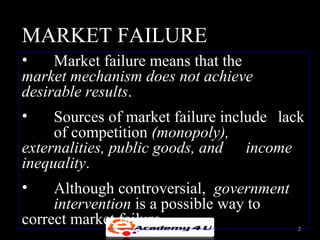
MARKET FAILURE
•    Market failure means that the
market mechanism does not achieve
desirable results.
•    Sources of market failure include lack
     of competition (monopoly),
externalities, public goods, and income
inequality.
•    Although controversial, government
     intervention is a possible way to
correct market failure.                   2
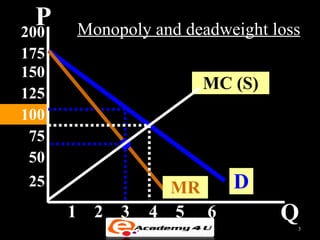
P
200       Monopoly and deadweight loss
175
150
                         MC (S)
125
100
 75
 50
 25                   MR  D
      1     2   3   4 5 6          Q 3
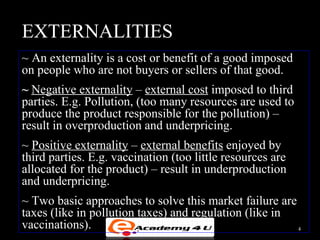
EXTERNALITIES
~ An externality is a cost or benefit of a good imposed
on people who are not buyers or sellers of that good.
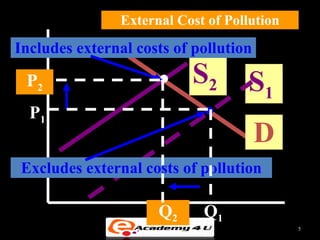
~ Negative externality – external cost imposed to third
parties. E.g. Pollution, (too many resources are used to
produce the product responsible for the pollution) –
result in overproduction and underpricing.
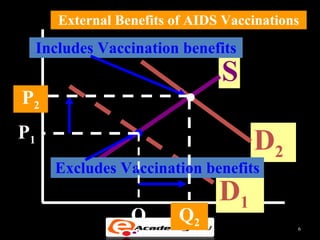
~ Positive externality – external benefits enjoyed by
third parties. E.g. vaccination (too little resources are
allocated for the product) – result in underproduction
and underpricing.
~ Two basic approaches to solve this market failure are
taxes (like in pollution taxes) and regulation (like in
vaccinations).                                          4
External Cost of Pollution
Includes external costs of pollution

 P2                        S2       S1
  P1
                                       D
Excludes external costs of pollution

                      Q2     Q1
                                             5
External Benefits of AIDS Vaccinations
     Includes Vaccination benefits
                                 S
P2
P1
                                      D2
       Excludes Vaccination benefits
                                 D1
                   Q1      Q2                6
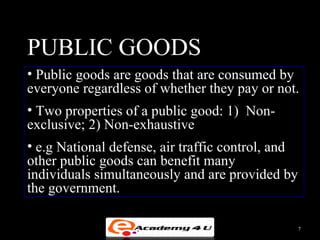
PUBLIC GOODS
• Public goods are goods that are consumed by
everyone regardless of whether they pay or not.
• Two properties of a public good: 1) Non-
exclusive; 2) Non-exhaustive
• e.g National defense, air traffic control, and
other public goods can benefit many
individuals simultaneously and are provided by
the government.

                                                   7
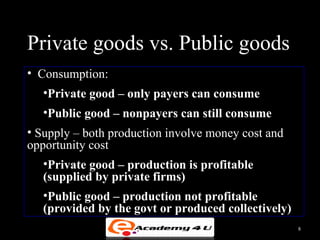
Private goods vs. Public goods
• Consumption:
   •Private good – only payers can consume
   •Public good – nonpayers can still consume
• Supply – both production involve money cost and
opportunity cost
   •Private good – production is profitable
   (supplied by private firms)
   •Public good – production not profitable
   (provided by the govt or produced collectively)
                                                     8

Market failure

  • 1.
  • 2.
    MARKET FAILURE • Market failure means that the market mechanism does not achieve desirable results. • Sources of market failure include lack of competition (monopoly), externalities, public goods, and income inequality. • Although controversial, government intervention is a possible way to correct market failure. 2
  • 3.
    P 200 Monopoly and deadweight loss 175 150 MC (S) 125 100 75 50 25 MR D 1 2 3 4 5 6 Q 3
  • 4.
    EXTERNALITIES ~ An externalityis a cost or benefit of a good imposed on people who are not buyers or sellers of that good. ~ Negative externality – external cost imposed to third parties. E.g. Pollution, (too many resources are used to produce the product responsible for the pollution) – result in overproduction and underpricing. ~ Positive externality – external benefits enjoyed by third parties. E.g. vaccination (too little resources are allocated for the product) – result in underproduction and underpricing. ~ Two basic approaches to solve this market failure are taxes (like in pollution taxes) and regulation (like in vaccinations). 4
  • 5.
    External Cost ofPollution Includes external costs of pollution P2 S2 S1 P1 D Excludes external costs of pollution Q2 Q1 5
  • 6.
    External Benefits ofAIDS Vaccinations Includes Vaccination benefits S P2 P1 D2 Excludes Vaccination benefits D1 Q1 Q2 6
  • 7.
    PUBLIC GOODS • Publicgoods are goods that are consumed by everyone regardless of whether they pay or not. • Two properties of a public good: 1) Non- exclusive; 2) Non-exhaustive • e.g National defense, air traffic control, and other public goods can benefit many individuals simultaneously and are provided by the government. 7
  • 8.
    Private goods vs.Public goods • Consumption: •Private good – only payers can consume •Public good – nonpayers can still consume • Supply – both production involve money cost and opportunity cost •Private good – production is profitable (supplied by private firms) •Public good – production not profitable (provided by the govt or produced collectively) 8