Presentation on-:Scarcity and its roleBy-ShubhamSinghalAkashBharti
Introduction-: Scarcity means “of limited availability”. E.g.
 During Famine period, food is ‘scarce’ i.e. Scarcity of food.
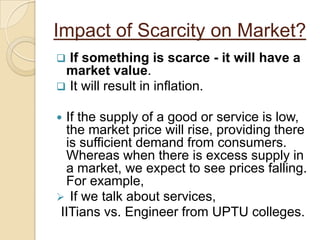
 Scarcity is a fundamental economic problem of having humans who have unlimited wants & needs in world of limited resources.When will  a resource be consider as ‘SCARCE’?A resource is considered scarce when its availability is not enough to meet its demand .For e.g.
  When supply of onion in market is not enough to meet the demand, that condition can be referred as Scarcity of Onions.
In arid areas, like Rajasthan, there is lack of water i.e. supply of water≠ its demand. This condition is called scarcity of water.
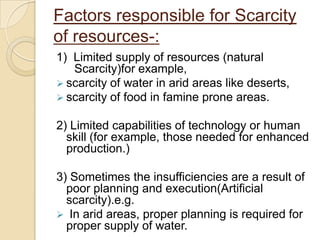
 Moreover, in institutions, when supply of internal marks is not enough to meet the demand of students, this condition is called scarcity of Internals.Factors responsible for Scarcity of resources-:1)  Limited supply of resources (natural Scarcity)for example,scarcity of water in arid areas like deserts,
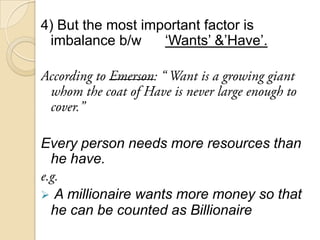
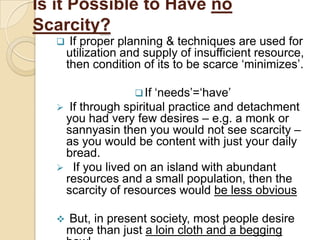
scarcity of food in famine prone areas.2) Limited capabilities of technology or human skill (for example, those needed for enhanced production.)3) Sometimes the insufficiencies are a result of poor planning and execution(Artificial scarcity).e.g.  In arid areas, proper planning is required for proper supply of water.4) But the most important factor is imbalance b/w      ‘Wants’ &’Have’.According to Emerson: “ Want is a growing giant whom the coat of Have is never large enough to cover.”Every person needs more resources than he have.e.g.A millionaire wants more money so that he can be counted as BillionaireIs it Possible to Have no Scarcity? If proper planning & techniques are used for utilization and supply of insufficient resource, then condition of its to be scarce ‘minimizes’.
If ‘needs’=‘have’
 If through spiritual practice and detachment you had very few desires – e.g. a monk or sannyasin then you would not see scarcity – as you would be content with just your daily bread.
  If you lived on an island with abundant resources and a small population, then the scarcity of resources would be less obvious

Scarcity of resources

  • 1.
    Presentation on-:Scarcity andits roleBy-ShubhamSinghalAkashBharti
  • 2.
    Introduction-: Scarcity means“of limited availability”. E.g.
  • 3.
    During Famineperiod, food is ‘scarce’ i.e. Scarcity of food.
  • 4.
    Scarcity isa fundamental economic problem of having humans who have unlimited wants & needs in world of limited resources.When will a resource be consider as ‘SCARCE’?A resource is considered scarce when its availability is not enough to meet its demand .For e.g.
  • 5.
    Whensupply of onion in market is not enough to meet the demand, that condition can be referred as Scarcity of Onions.
  • 6.
    In arid areas,like Rajasthan, there is lack of water i.e. supply of water≠ its demand. This condition is called scarcity of water.
  • 7.
    Moreover, ininstitutions, when supply of internal marks is not enough to meet the demand of students, this condition is called scarcity of Internals.Factors responsible for Scarcity of resources-:1) Limited supply of resources (natural Scarcity)for example,scarcity of water in arid areas like deserts,
  • 8.
    scarcity of foodin famine prone areas.2) Limited capabilities of technology or human skill (for example, those needed for enhanced production.)3) Sometimes the insufficiencies are a result of poor planning and execution(Artificial scarcity).e.g. In arid areas, proper planning is required for proper supply of water.4) But the most important factor is imbalance b/w ‘Wants’ &’Have’.According to Emerson: “ Want is a growing giant whom the coat of Have is never large enough to cover.”Every person needs more resources than he have.e.g.A millionaire wants more money so that he can be counted as BillionaireIs it Possible to Have no Scarcity? If proper planning & techniques are used for utilization and supply of insufficient resource, then condition of its to be scarce ‘minimizes’.
  • 9.
  • 10.
    If throughspiritual practice and detachment you had very few desires – e.g. a monk or sannyasin then you would not see scarcity – as you would be content with just your daily bread.
  • 11.
    Ifyou lived on an island with abundant resources and a small population, then the scarcity of resources would be less obvious