Chapter 14
Environmental Economics
     • Key Concepts
     • Summary
     • Practice Quiz
     • Internet Exercises
        ©2000 South-Western College Publishing
                                                 1
In this chapter, you will
  learn to solve these
   economic puzzles:
Why do competitive markets
   How can government
       Can government
produce too largereduce
                    a quantity
    legislation, taxes, and
      intervention
        permits achieve
 and charge too low a price
   environmental quality?
 environmental efficiency?
  for products that pollute?
                      2
What assumption is
 made in this chapter?
There is sufficient foreign
 and domestic competition to
 allow us to use the perfectly
 competitive model

                      3
When does Economic
  Efficiency exist?
Efficiency exists when the
 price to consumers,
 reflecting marginal benefit,
 equals marginal cost

                      4
Who is a Third Party?
People outside the market
 transaction who are
 affected by the product


                    5
What are Private
Benefits and Costs?
Benefits and costs to the
 decision maker,
 ignoring benefits and
 costs to third parties
                    6
What are Externalities?
Benefits or costs that are
 not considered by market
 buyers and sellers


                    7
What is an example of
  an Externality?
 Air pollution is an
  externality that affects
  third parties not
  driving automobiles

                     8
What is an example of
a Positive Externality?
 The enjoyment you
  derive from your
  neighbors well-kept yard


                   9
What happens when
Externalities are present?
 Competitive markets are
  not likely to achieve
  economic efficiency

                    10
What are
  Social Benefits?
The sum of benefits to
 everyone, including
 both private benefits
 and external benefits

                   11
What are Private Costs?
  Production costs of
   capital, labor, land,
   and entrepreneurship


                    12
What are Social Costs?
  The sum of costs to
   everyone, including
   both private costs
   and external costs

                   13
When is Social Welfare
    maximized?
   It is achieved when
  marginal social benefit
equals marginal social cost

                    14
Why can’t businesses
acting on their own solve
the problem of Pollution?
The added costs of cleaning
 up the environment will
 make them less competitive
 in the market place
                    15
What may happen to a
firm that takes on the
 added costs of Anti-
  pollution Devices?
They eventually will be
 driven out of business
 by lower cost firms
                   16
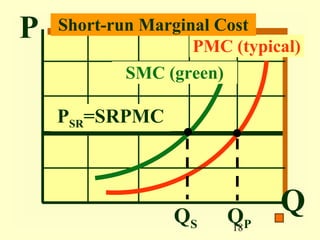
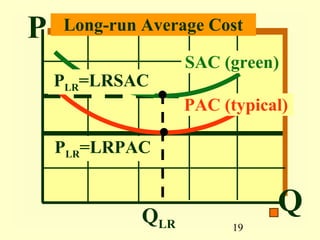
The following graphs show the
 short-run marginal cost
 curves and the long-run
 average cost curves for two
 firms; one pays private costs
 (typical) and the other pays
 both private and external
 costs (green firm)
                      17
P   Short-run Marginal Cost
                    PMC (typical)
            SMC (green)

    PSR=SRPMC


                 QS     QP
                              Q
                        18
P   Long-run Average Cost

                   SAC (green)
    PLR=LRSAC
                   PAC (typical)

    PLR=LRPAC


             QLR
                              Q
                         19
What happens
    when External
   Costs are ignored?
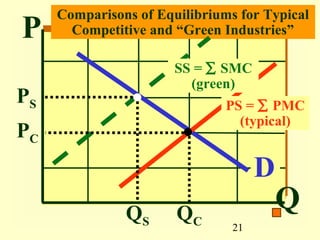
Competitive firms produce
 “too much,” and the
 market equilibrium price is
 “too low,” compared to a
 socially efficient industry
                     20
Comparisons of Equilibriums for Typical
P      Competitive and “Green Industries”

                       SS = ∑ SMC
                         (green)
PS                             PS = ∑ PMC
                                 (typical)
PC
                                     D
               QS      QC
                                         Q
                                21
Do Markets Fail when
Externalities are present?
  Externalities illustrate
   that private markets fail
   to produce society’s
   preferred outcome
                      22
How can society
achieve Efficiency
when markets fail?
Government has a
 potential role when
 there is market failure

                    23
What is an example of
Government Failure?
Government can fail to
 correct market failure by
 doing too little or too
 much about pollution
                    24
What are two
Government Approaches?
• Incentive-based regulations
• Command-and-control
  regulations

                     25
What is a Command-
and-control Regulation?
Government regulations
 that set an environmental
 goal and dictate how the
 goal will be achieved

                     26
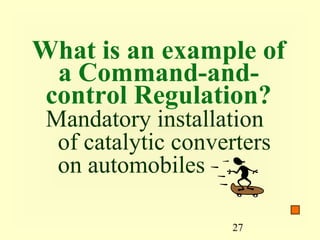
What is an example of
  a Command-and-
 control Regulation?
 Mandatory installation
  of catalytic converters
  on automobiles

                    27
What is an Incentive-
 based Regulation?
Government regulations
 that set an environmental
 goal, but are flexible in
 how buyers and sellers
 achieve the goal
                     28
What is an Effluent Tax?
   A tax on the pollutant


                     29
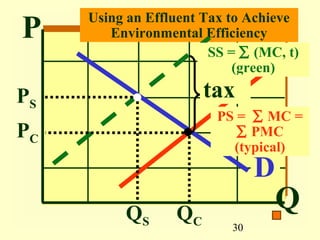
P    Using an Effluent Tax to Achieve
        Environmental Efficiency
                        SS = ∑ (MC, t)
                            (green)

PS                     tax
                         PS = ∑ MC =
PC                          ∑ PMC
                           (typical)
                                D
          QS      QC
                                    Q
                           30
What is
Emissions Trading?
Trading that allows
 firms to buy and sell
 the right to pollute


                  31
What is
    New-source Bias?
Bias that occurs when there is
 an incentive to keep assets
 past the efficient point as a
 result of regulation

                      32
Is the Efficient amount of
Pollution typically Zero?
  No, the marginal social
   cost of achieving one
   more unit of clean air
   may be greater than the
   marginal social benefit
                     33
What is the
     Coase Theorem?
The proposition that private
 market negotiations can
 achieve social efficiency,
 regardless of the initial
 definition of property rights
                      34
How comprehensive is
the Coase Theorem?
Only a small number of
 environmental problems
 qualify for Coase
 Theorem solutions

                  35
Which cases qualify for
 the Coase Theorem?
  • no transaction costs
  • no income effects
  • only two parties in
    the negotiation
                     36
What is a
  Transaction Cost?
The costs of negotiating
 and enforcing a contract


                     37
What is the
Free-rider Problem?
If some people benefit
  while others pay, few
  will be willing to pay
  for improvement of
  the environment or
  other public goods
                    38
What is the result of the
 Free-rider Problem?
   Goods affected are
    underproduced


                   39
Key Concepts


           40
Key Concepts
•   When does Economic Efficiency exist?
•   Who is a Third Party?
•   What are Private Benefits and Costs?
•   What are Externalities?
•   What are Social Benefits?
•   What are Private Costs?
•   What are Social Costs?
•   Where is Social Welfare maximized?
•   Why can’t businesses action on their own solv

                                  41
Key Concepts cont.
•   How can society achieve Efficiency when mark
•   What is a Command-and-control Regulation?
•   What is an Incentive-based Regulation?
•   What is an Effluent Tax?
•   What is Emissions Trading?
•   What is New-source Bias?
•   What is the Coase Theorem?


                                 42
Summary


          43
Externalities are benefits or
costs that fall on third parties who
are neither buyers nor sellers.
Pollution is a negative externality or
external cost that is a byproduct of
many industrial production
processes.


                             44
Market failure is present when the
market produces a socially inefficient
outcome. One instance is when there
are externalities All firms , including
competitive firms, consider private
costs, but disregard external costs, in
making decisions..


                             45
Government failure occurs
when public-sector actions move us
away from desired outcomes, such
as efficiency. Government officials
seeking campaign contributions and
votes may choose environmental
measures that favor wealthy
contributors over society’s best
interests.

                           46
Command-and-control
regulations occur when the
government dictates the approach to
achieving an environmental goal.


                            47
Command-and-control (CAC)
regulations are generally inefficient
on three grounds: They do not
distinguish between high and low
pollution areas, they do not allow
firms to choose lower cost
technologies that could achieve the
environmental standard, and they do
not encourage improved technology
to lower future emissions.
                             48
Incentive-based regulations
build on markets to achieve
environmental efficiency. Effluent
taxes are taxes that reflect external
costs. Emissions-trading allows firms
to buy and sell the “right to pollute.”


                             49
The Coase Theorem maintains
that markets can be efficient in the
presence of externalities with
minimal government intervention.
Even in the presence of externalities,
markets may produce efficient
outcomes so long as property rights
are clearly established.


                             50
Transactions costs, income effects,
and free-rider problems are obstacles to
achieving environmental efficiency
through markets. Transactions costs are
the costs of negotiating an agreement,
income effects are present when limited
income prevents one party from being
able to afford the efficient solution, and
free-rider problems are present when
participants are better off hiding than
revealing their willingness to pay for an
environmental improvement.
                               51
Chapter 14 Quiz


   ©2000 South-Western College Publishing
                                            52
1. Recently the city of New Orleans discovered
  chemical compounds in its drinking water.
  The source is the waste discharges of
  industrial plants upstream. This is an example
  of
   a. an external cost imposed on the citizens of
     New Orleans by the industrial plants
     upstream.
   b. a market failure where the market price of
     the output of these industrial plants does
     not fully reflect the social cost of producing
     these goods.
   c. an externality where the marginal social
     costs of producing these industrial goods
     differ from the marginal private costs.
   d. all of the above.
                                     53
1.
D. The upstream firm is releasing chemicals
   into the water, an external cost to the citizens
   of New Orleans. The upstream firm is not
   including these costs when pricing its
   product; hence, the market price is too low.
   Marginal social costs would include the
   marginal private cost of the industrial
   product (their costs of labor, capital,
   materials, etc.) and the external cost of the
   chemicals released into the water. Choices
   (a), (b), and (c)each are correct, so that all of
   the above is the correct choice.

                                       54
2. A government policy that charges steel
  firms a fee per ton of steel produced (an
  effluent charge) where the fee is determined
  by the amount of pollutants discharged into
  the air or water will lead to
   a. a decrease in the market equilibrium
     quantity of steel produced.
   b. a decrease in the market equilibrium
     price of steel.
   c. an increase in the market equilibrium
     price of steel.
   d. the results in (a) and (b).
   e. the results in (a) and (c ).
                                  55
2.
E. Essentially, the government is employing an
   effluent tax to reduce pollution. The tax
   increases the cost of production. Supply
   decreases, leading to a higher price and
   smaller quantity. So choice (e), where (a)
   quantity decreases and (c)price increases, is
   the best choice.


                                    56
3. Social costs are
   a. the full resource costs of an economic
     activity.
   b. usually less than private costs.
   c. the costs of an economic activity borne by
     the producer.
   d. all of the above.


                                    57
3.
A. Social costs include both private costs (the
   costs of the firm’s inputs, including labor,
   capital, land, etc.) and external costs (the
   costs to third parties, such as pollution
   emitted by the producer). Social costs are at
   least as large as private costs. Producers will
   not consider external costs, which are a part
   of social costs, unless they are forced to do so
   by government or court.


                                      58
4. As a general rule, if pollution costs are
  external, firms will produce
   a. too much of a polluting good.
   b. too little of a polluting good.
   c. an optimal amount of a polluting good.
   d. an amount that cannot be determined
     without additional information.


                                   59
4.
A. Private firms will make their production
   decision using private costs. If there are
   external costs, social costs exceed private
   costs. If production decisions included
   external costs, supply would be smaller than
   when private costs alone are considered. So
   if external costs are ignored, the firm will
   produce too much, as compared to the social
   efficient level.


                                    60
5. Many economists would argue
   a. the optimal amount of pollution is
     greater than zero.
   b. all pollution should be eliminated.
   c. the market mechanism can handle
     pollution without any government
     intervention.
   d. central planning is the most efficient
     way to eliminate pollution.


                                   61
5.
A. The optimal amount of pollution is where
   marginal social cost equals marginal social
   benefit. This amount typically exceeds zero.
   The marginal cost of eliminating all pollution
   would likely be very high. For example, we
   would have to eliminate all cars. However,
   firms tend to ignore external costs such as
   pollution, in an unfettered market. While
   government is likely to be needed, pollution
   has actually been worse in centrally planned
   economies.

                                    62
6. Which of the following used marketable
  pollution permits as an incentive for
  reducing pollution?
   a. The 1970 Clean Air Act.
   b. The Comprehensive Environmental
     Response, Compensation, and Liability
     Act of 1980.
   c. The 1990 Clean Air Act amendments.
   d. The Water Quality and Improvement
     Act of 1970.


                                 63
6.
C. The 1990 Clean Air Act was the first piece
   of federal legislation to introduce emissions
   trading. It introduced this approach for
   sulfur emissions, thought to contribute to
   acid rain.


                                     64
7. The disposable diaper industry is perfectly
  competitive. Which of the following is true?
   a. Since the industry is perfectly
     competitive, price and quantity are at the
     socially efficient levels.
   b. Competitive price is higher and
     competitive quantity lower than the
     socially efficient point.
   c. Competitive price is higher and
     competitive quantity higher than the
     socially efficient point.
   d. Competitive price is lower and
     competitive quantity higher than the
     socially efficient point.
                                      65
7.
D. Disposable diapers have an external cost, to
   the extent that they are not biodegradable and
   sit in landfills. Producers in a competitive
   market consider only private costs, ignoring
   disposal issues. Similarly, consumers just
   want to prevent leaks that affect them, but
   ignore leaks that affect landfills. So
   producers and consumers use private costs
   and benefits. Social costs are higher, so that
   social supply is smaller. The competitive
   price, based on private costs and benefits, is
   lower than the social cost. Competitive
   quantity is larger, given the larger supply,
   than the socially efficient quantity.
                                     66
8. An example of the command-and-control
  approach to environmental policy is
   a. placing a tax on high-sulfur coal to
     reduce its use and the corresponding
     sulfur emissions (which contribute to acid
     rain).
   b. requiring electric utilities to install
     scrubbers to reduce sulfur dioxide
     emissions (which contribute to acid rain).
   c. allowing coal producers to buy and sell
     permits to allow sulfur emissions.
   d. allowing individuals to sue coal
     producers if sulfur emissions exceed
     government-set standard.
                                     67
8.
B. Command-and-control is a regulation
   whereby the government establishes a
   pollution target and dictates the method to
   achieve the target. An example is requiring
   scrubbers to reduce sulfur emissions.
   Sulfur emission permits and effluent taxes
   are example of incentive-based approaches.
   With taxes, for example, the firm can
   choose low-sulfur coal to avoid the tax.


                                   68
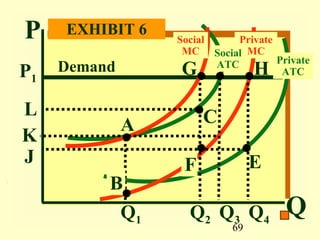
P    EXHIBIT 6
                  Social     Private
                   MC Social MC
                                     Private
P1   Demand       G      ATC
                                 H    ATC


L                      C
              A
K
J                  F             E
          B
           Q1       Q2 Q3 Q4           Q
                            69
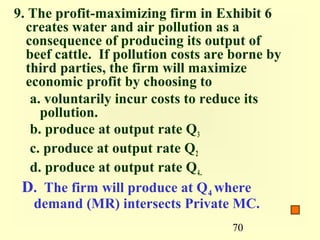
9. The profit-maximizing firm in Exhibit 6
  creates water and air pollution as a
  consequence of producing its output of
  beef cattle. If pollution costs are borne by
  third parties, the firm will maximize
  economic profit by choosing to
   a. voluntarily incur costs to reduce its
     pollution.
   b. produce at output rate Q3
   c. produce at output rate Q2
   d. produce at output rate Q4..
 D. The firm will produce at Q4 where
    demand (MR) intersects Private MC.
                                     70
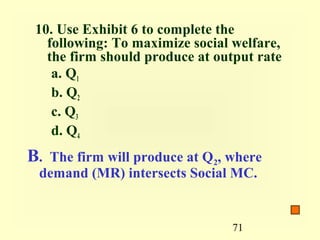
10. Use Exhibit 6 to complete the
   following: To maximize social welfare,
   the firm should produce at output rate
    a. Q1
    b. Q2
    c. Q3
    d. Q4
B. The firm will produce at Q2, where
 demand (MR) intersects Social MC.


                                 71
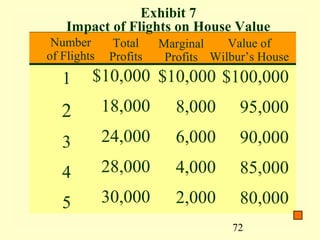
Exhibit 7
    Impact of Flights on House Value
 Number       Total    Marginal    Value of
of Flights   Profits    Profits Wilbur’s House
   1     $10,000 $10,000 $100,000

   2         18,000       8,000      95,000
   3         24,000       6,000      90,000
   4         28,000       4,000      85,000
   5         30,000       2,000      80,000
                                    72
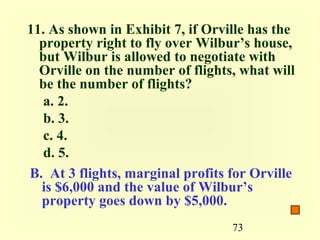
11. As shown in Exhibit 7, if Orville has the
  property right to fly over Wilbur’s house,
  but Wilbur is allowed to negotiate with
  Orville on the number of flights, what will
  be the number of flights?
   a. 2.
   b. 3.
   c. 4.
   d. 5.
B. At 3 flights, marginal profits for Orville
  is $6,000 and the value of Wilbur’s
  property goes down by $5,000.
                                  73
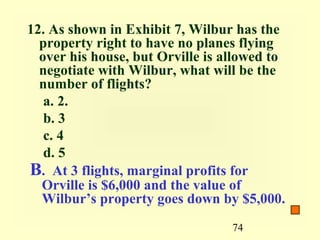
12. As shown in Exhibit 7, Wilbur has the
  property right to have no planes flying
  over his house, but Orville is allowed to
  negotiate with Wilbur, what will be the
  number of flights?
   a. 2.
   b. 3
   c. 4
   d. 5
B. At 3 flights, marginal profits for
  Orville is $6,000 and the value of
  Wilbur’s property goes down by $5,000.
                                  74
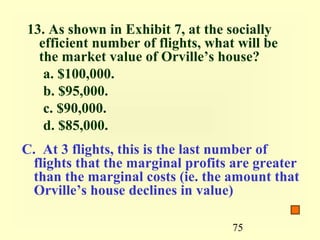
13. As shown in Exhibit 7, at the socially
  efficient number of flights, what will be
  the market value of Orville’s house?
   a. $100,000.
   b. $95,000.
   c. $90,000.
   d. $85,000.
C. At 3 flights, this is the last number of
 flights that the marginal profits are greater
 than the marginal costs (ie. the amount that
 Orville’s house declines in value)

                                   75
Internet Exercises
Click on the picture of the book,
 choose updates by chapter for
 the latest internet exercises


                            76
END

      77

14 environmental economics

  • 1.
    Chapter 14 Environmental Economics • Key Concepts • Summary • Practice Quiz • Internet Exercises ©2000 South-Western College Publishing 1
  • 2.
    In this chapter,you will learn to solve these economic puzzles: Why do competitive markets How can government Can government produce too largereduce a quantity legislation, taxes, and intervention permits achieve and charge too low a price environmental quality? environmental efficiency? for products that pollute? 2
  • 3.
    What assumption is made in this chapter? There is sufficient foreign and domestic competition to allow us to use the perfectly competitive model 3
  • 4.
    When does Economic Efficiency exist? Efficiency exists when the price to consumers, reflecting marginal benefit, equals marginal cost 4
  • 5.
    Who is aThird Party? People outside the market transaction who are affected by the product 5
  • 6.
    What are Private Benefitsand Costs? Benefits and costs to the decision maker, ignoring benefits and costs to third parties 6
  • 7.
    What are Externalities? Benefitsor costs that are not considered by market buyers and sellers 7
  • 8.
    What is anexample of an Externality? Air pollution is an externality that affects third parties not driving automobiles 8
  • 9.
    What is anexample of a Positive Externality? The enjoyment you derive from your neighbors well-kept yard 9
  • 10.
    What happens when Externalitiesare present? Competitive markets are not likely to achieve economic efficiency 10
  • 11.
    What are Social Benefits? The sum of benefits to everyone, including both private benefits and external benefits 11
  • 12.
    What are PrivateCosts? Production costs of capital, labor, land, and entrepreneurship 12
  • 13.
    What are SocialCosts? The sum of costs to everyone, including both private costs and external costs 13
  • 14.
    When is SocialWelfare maximized? It is achieved when marginal social benefit equals marginal social cost 14
  • 15.
    Why can’t businesses actingon their own solve the problem of Pollution? The added costs of cleaning up the environment will make them less competitive in the market place 15
  • 16.
    What may happento a firm that takes on the added costs of Anti- pollution Devices? They eventually will be driven out of business by lower cost firms 16
  • 17.
    The following graphsshow the short-run marginal cost curves and the long-run average cost curves for two firms; one pays private costs (typical) and the other pays both private and external costs (green firm) 17
  • 18.
    P Short-run Marginal Cost PMC (typical) SMC (green) PSR=SRPMC QS QP Q 18
  • 19.
    P Long-run Average Cost SAC (green) PLR=LRSAC PAC (typical) PLR=LRPAC QLR Q 19
  • 20.
    What happens when External Costs are ignored? Competitive firms produce “too much,” and the market equilibrium price is “too low,” compared to a socially efficient industry 20
  • 21.
    Comparisons of Equilibriumsfor Typical P Competitive and “Green Industries” SS = ∑ SMC (green) PS PS = ∑ PMC (typical) PC D QS QC Q 21
  • 22.
    Do Markets Failwhen Externalities are present? Externalities illustrate that private markets fail to produce society’s preferred outcome 22
  • 23.
    How can society achieveEfficiency when markets fail? Government has a potential role when there is market failure 23
  • 24.
    What is anexample of Government Failure? Government can fail to correct market failure by doing too little or too much about pollution 24
  • 25.
    What are two GovernmentApproaches? • Incentive-based regulations • Command-and-control regulations 25
  • 26.
    What is aCommand- and-control Regulation? Government regulations that set an environmental goal and dictate how the goal will be achieved 26
  • 27.
    What is anexample of a Command-and- control Regulation? Mandatory installation of catalytic converters on automobiles 27
  • 28.
    What is anIncentive- based Regulation? Government regulations that set an environmental goal, but are flexible in how buyers and sellers achieve the goal 28
  • 29.
    What is anEffluent Tax? A tax on the pollutant 29
  • 30.
    P Using an Effluent Tax to Achieve Environmental Efficiency SS = ∑ (MC, t) (green) PS tax PS = ∑ MC = PC ∑ PMC (typical) D QS QC Q 30
  • 31.
    What is Emissions Trading? Tradingthat allows firms to buy and sell the right to pollute 31
  • 32.
    What is New-source Bias? Bias that occurs when there is an incentive to keep assets past the efficient point as a result of regulation 32
  • 33.
    Is the Efficientamount of Pollution typically Zero? No, the marginal social cost of achieving one more unit of clean air may be greater than the marginal social benefit 33
  • 34.
    What is the Coase Theorem? The proposition that private market negotiations can achieve social efficiency, regardless of the initial definition of property rights 34
  • 35.
    How comprehensive is theCoase Theorem? Only a small number of environmental problems qualify for Coase Theorem solutions 35
  • 36.
    Which cases qualifyfor the Coase Theorem? • no transaction costs • no income effects • only two parties in the negotiation 36
  • 37.
    What is a Transaction Cost? The costs of negotiating and enforcing a contract 37
  • 38.
    What is the Free-riderProblem? If some people benefit while others pay, few will be willing to pay for improvement of the environment or other public goods 38
  • 39.
    What is theresult of the Free-rider Problem? Goods affected are underproduced 39
  • 40.
  • 41.
    Key Concepts • When does Economic Efficiency exist? • Who is a Third Party? • What are Private Benefits and Costs? • What are Externalities? • What are Social Benefits? • What are Private Costs? • What are Social Costs? • Where is Social Welfare maximized? • Why can’t businesses action on their own solv 41
  • 42.
    Key Concepts cont. • How can society achieve Efficiency when mark • What is a Command-and-control Regulation? • What is an Incentive-based Regulation? • What is an Effluent Tax? • What is Emissions Trading? • What is New-source Bias? • What is the Coase Theorem? 42
  • 43.
  • 44.
    Externalities are benefitsor costs that fall on third parties who are neither buyers nor sellers. Pollution is a negative externality or external cost that is a byproduct of many industrial production processes. 44
  • 45.
    Market failure ispresent when the market produces a socially inefficient outcome. One instance is when there are externalities All firms , including competitive firms, consider private costs, but disregard external costs, in making decisions.. 45
  • 46.
    Government failure occurs whenpublic-sector actions move us away from desired outcomes, such as efficiency. Government officials seeking campaign contributions and votes may choose environmental measures that favor wealthy contributors over society’s best interests. 46
  • 47.
    Command-and-control regulations occur whenthe government dictates the approach to achieving an environmental goal. 47
  • 48.
    Command-and-control (CAC) regulations aregenerally inefficient on three grounds: They do not distinguish between high and low pollution areas, they do not allow firms to choose lower cost technologies that could achieve the environmental standard, and they do not encourage improved technology to lower future emissions. 48
  • 49.
    Incentive-based regulations build onmarkets to achieve environmental efficiency. Effluent taxes are taxes that reflect external costs. Emissions-trading allows firms to buy and sell the “right to pollute.” 49
  • 50.
    The Coase Theoremmaintains that markets can be efficient in the presence of externalities with minimal government intervention. Even in the presence of externalities, markets may produce efficient outcomes so long as property rights are clearly established. 50
  • 51.
    Transactions costs, incomeeffects, and free-rider problems are obstacles to achieving environmental efficiency through markets. Transactions costs are the costs of negotiating an agreement, income effects are present when limited income prevents one party from being able to afford the efficient solution, and free-rider problems are present when participants are better off hiding than revealing their willingness to pay for an environmental improvement. 51
  • 52.
    Chapter 14 Quiz ©2000 South-Western College Publishing 52
  • 53.
    1. Recently thecity of New Orleans discovered chemical compounds in its drinking water. The source is the waste discharges of industrial plants upstream. This is an example of a. an external cost imposed on the citizens of New Orleans by the industrial plants upstream. b. a market failure where the market price of the output of these industrial plants does not fully reflect the social cost of producing these goods. c. an externality where the marginal social costs of producing these industrial goods differ from the marginal private costs. d. all of the above. 53
  • 54.
    1. D. The upstreamfirm is releasing chemicals into the water, an external cost to the citizens of New Orleans. The upstream firm is not including these costs when pricing its product; hence, the market price is too low. Marginal social costs would include the marginal private cost of the industrial product (their costs of labor, capital, materials, etc.) and the external cost of the chemicals released into the water. Choices (a), (b), and (c)each are correct, so that all of the above is the correct choice. 54
  • 55.
    2. A governmentpolicy that charges steel firms a fee per ton of steel produced (an effluent charge) where the fee is determined by the amount of pollutants discharged into the air or water will lead to a. a decrease in the market equilibrium quantity of steel produced. b. a decrease in the market equilibrium price of steel. c. an increase in the market equilibrium price of steel. d. the results in (a) and (b). e. the results in (a) and (c ). 55
  • 56.
    2. E. Essentially, thegovernment is employing an effluent tax to reduce pollution. The tax increases the cost of production. Supply decreases, leading to a higher price and smaller quantity. So choice (e), where (a) quantity decreases and (c)price increases, is the best choice. 56
  • 57.
    3. Social costsare a. the full resource costs of an economic activity. b. usually less than private costs. c. the costs of an economic activity borne by the producer. d. all of the above. 57
  • 58.
    3. A. Social costsinclude both private costs (the costs of the firm’s inputs, including labor, capital, land, etc.) and external costs (the costs to third parties, such as pollution emitted by the producer). Social costs are at least as large as private costs. Producers will not consider external costs, which are a part of social costs, unless they are forced to do so by government or court. 58
  • 59.
    4. As ageneral rule, if pollution costs are external, firms will produce a. too much of a polluting good. b. too little of a polluting good. c. an optimal amount of a polluting good. d. an amount that cannot be determined without additional information. 59
  • 60.
    4. A. Private firmswill make their production decision using private costs. If there are external costs, social costs exceed private costs. If production decisions included external costs, supply would be smaller than when private costs alone are considered. So if external costs are ignored, the firm will produce too much, as compared to the social efficient level. 60
  • 61.
    5. Many economistswould argue a. the optimal amount of pollution is greater than zero. b. all pollution should be eliminated. c. the market mechanism can handle pollution without any government intervention. d. central planning is the most efficient way to eliminate pollution. 61
  • 62.
    5. A. The optimalamount of pollution is where marginal social cost equals marginal social benefit. This amount typically exceeds zero. The marginal cost of eliminating all pollution would likely be very high. For example, we would have to eliminate all cars. However, firms tend to ignore external costs such as pollution, in an unfettered market. While government is likely to be needed, pollution has actually been worse in centrally planned economies. 62
  • 63.
    6. Which ofthe following used marketable pollution permits as an incentive for reducing pollution? a. The 1970 Clean Air Act. b. The Comprehensive Environmental Response, Compensation, and Liability Act of 1980. c. The 1990 Clean Air Act amendments. d. The Water Quality and Improvement Act of 1970. 63
  • 64.
    6. C. The 1990Clean Air Act was the first piece of federal legislation to introduce emissions trading. It introduced this approach for sulfur emissions, thought to contribute to acid rain. 64
  • 65.
    7. The disposablediaper industry is perfectly competitive. Which of the following is true? a. Since the industry is perfectly competitive, price and quantity are at the socially efficient levels. b. Competitive price is higher and competitive quantity lower than the socially efficient point. c. Competitive price is higher and competitive quantity higher than the socially efficient point. d. Competitive price is lower and competitive quantity higher than the socially efficient point. 65
  • 66.
    7. D. Disposable diapershave an external cost, to the extent that they are not biodegradable and sit in landfills. Producers in a competitive market consider only private costs, ignoring disposal issues. Similarly, consumers just want to prevent leaks that affect them, but ignore leaks that affect landfills. So producers and consumers use private costs and benefits. Social costs are higher, so that social supply is smaller. The competitive price, based on private costs and benefits, is lower than the social cost. Competitive quantity is larger, given the larger supply, than the socially efficient quantity. 66
  • 67.
    8. An exampleof the command-and-control approach to environmental policy is a. placing a tax on high-sulfur coal to reduce its use and the corresponding sulfur emissions (which contribute to acid rain). b. requiring electric utilities to install scrubbers to reduce sulfur dioxide emissions (which contribute to acid rain). c. allowing coal producers to buy and sell permits to allow sulfur emissions. d. allowing individuals to sue coal producers if sulfur emissions exceed government-set standard. 67
  • 68.
    8. B. Command-and-control isa regulation whereby the government establishes a pollution target and dictates the method to achieve the target. An example is requiring scrubbers to reduce sulfur emissions. Sulfur emission permits and effluent taxes are example of incentive-based approaches. With taxes, for example, the firm can choose low-sulfur coal to avoid the tax. 68
  • 69.
    P EXHIBIT 6 Social Private MC Social MC Private P1 Demand G ATC H ATC L C A K J F E B Q1 Q2 Q3 Q4 Q 69
  • 70.
    9. The profit-maximizingfirm in Exhibit 6 creates water and air pollution as a consequence of producing its output of beef cattle. If pollution costs are borne by third parties, the firm will maximize economic profit by choosing to a. voluntarily incur costs to reduce its pollution. b. produce at output rate Q3 c. produce at output rate Q2 d. produce at output rate Q4.. D. The firm will produce at Q4 where demand (MR) intersects Private MC. 70
  • 71.
    10. Use Exhibit6 to complete the following: To maximize social welfare, the firm should produce at output rate a. Q1 b. Q2 c. Q3 d. Q4 B. The firm will produce at Q2, where demand (MR) intersects Social MC. 71
  • 72.
    Exhibit 7 Impact of Flights on House Value Number Total Marginal Value of of Flights Profits Profits Wilbur’s House 1 $10,000 $10,000 $100,000 2 18,000 8,000 95,000 3 24,000 6,000 90,000 4 28,000 4,000 85,000 5 30,000 2,000 80,000 72
  • 73.
    11. As shownin Exhibit 7, if Orville has the property right to fly over Wilbur’s house, but Wilbur is allowed to negotiate with Orville on the number of flights, what will be the number of flights? a. 2. b. 3. c. 4. d. 5. B. At 3 flights, marginal profits for Orville is $6,000 and the value of Wilbur’s property goes down by $5,000. 73
  • 74.
    12. As shownin Exhibit 7, Wilbur has the property right to have no planes flying over his house, but Orville is allowed to negotiate with Wilbur, what will be the number of flights? a. 2. b. 3 c. 4 d. 5 B. At 3 flights, marginal profits for Orville is $6,000 and the value of Wilbur’s property goes down by $5,000. 74
  • 75.
    13. As shownin Exhibit 7, at the socially efficient number of flights, what will be the market value of Orville’s house? a. $100,000. b. $95,000. c. $90,000. d. $85,000. C. At 3 flights, this is the last number of flights that the marginal profits are greater than the marginal costs (ie. the amount that Orville’s house declines in value) 75
  • 76.
    Internet Exercises Click onthe picture of the book, choose updates by chapter for the latest internet exercises 76
  • 77.
    END 77