Dr. A. Aziz Bhatti
CS-439: Cloud Computing
1
Introduction to MapReduce
Dr. A. Aziz Bhatti
Plan for today
 Introduction
 Census example
 MapReduce architecture
 Data flow
 Execution flow
 Fault tolerance etc.
2
NEXT
Dr. A. Aziz Bhatti
Example: National census
3
http://www.census.gov/2010census/pdf/2010_Questionnaire_Info.pdf
Dr. A. Aziz Bhatti
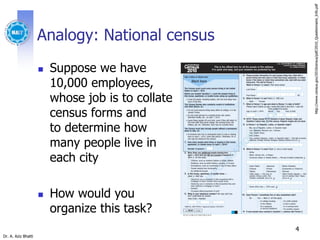
Analogy: National census
 Suppose we have
10,000 employees,
whose job is to collate
census forms and
to determine how
many people live in
each city
 How would you
organize this task?
4
http://www.census.gov/2010census/pdf/2010_Questionnaire_Info.pdf
Dr. A. Aziz Bhatti
National census "data flow"
5
Dr. A. Aziz Bhatti
Making things more complicated
 Suppose people take vacations, get sick, work
at different rates
 Suppose some forms are incorrectly filled out
and require corrections or need to be thrown
away
 What if the supervisor gets sick?
 How big should the stacks be?
 How do we monitor progress?
 ...
6
Dr. A. Aziz Bhatti
A bit of introspection
 What is the main challenge?
 Are the individual tasks complicated?
 If not, what makes this so challenging?
 How resilient is our solution?
 How well does it balance work across
employees?
 What factors affect this?
 How general is the set of techniques?
7
Dr. A. Aziz Bhatti
I don't want to deal with all this!!!
 Wouldn't it be nice if there were some system
that took care of all these details for you?
 Ideally, you'd just tell the system what needs
to be done
 That's the MapReduce framework.
8
Dr. A. Aziz Bhatti
Data Partitioning for Map Reduce
 We decided that the best scheme for
parallelism in doing a census was:
 Given n workers, divide the workload into k*n tasks
 Each worker starts a task, reports back (with stack of cards) to a
coordinator when done
 Receives a new task if there are any left
 If anyone is a long-time straggler, may reassign the task to someone
else
 Take the stacks, sort them by region / city / zip or whatever
we want to count
 Assign counting of the regions in parallel
9
Dr. A. Aziz Bhatti
Abstracting into a digital data flow
10
Filter+Stack
Worker
Filter+Stack
Worker
Filter+Stack
Worker
Filter+Stack
Worker
CountStack
Worker
CountStack
Worker
CountStack
Worker
CountStack
Worker
CountStack
Worker
blue: 4k
green: 4k
cyan: 3k
gray: 1k
orange: 4k
Dr. A. Aziz Bhatti
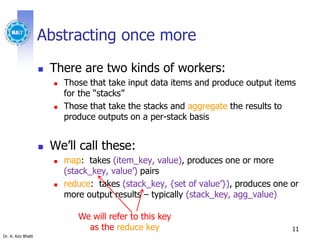
Abstracting once more
 There are two kinds of workers:
 Those that take input data items and produce output items
for the “stacks”
 Those that take the stacks and aggregate the results to
produce outputs on a per-stack basis
 We’ll call these:
 map: takes (item_key, value), produces one or more
(stack_key, value’) pairs
 reduce: takes (stack_key, {set of value’}), produces one or
more output results – typically (stack_key, agg_value)
11
We will refer to this key
as the reduce key
Dr. A. Aziz Bhatti
Why MapReduce?
 Scenario:
 You have a huge amount of data, e.g., all the Google
searches of the last three years
 You would like to perform a computation on the data, e.g.,
find out which search terms were the most popular
 How would you do it?
 Analogy to the census example:
 The computation isn't necessarily difficult, but parallelizing
and distributing it, as well as handling faults, is challenging
 Idea: A programming language!
 Write a simple program to express the (simple) computation,
and let the language runtime do all the hard work
12
Dr. A. Aziz Bhatti
Plan for today
 Introduction
 Census example
 MapReduce architecture
 Data flow
 Execution flow
 Fault tolerance etc.
13
NEXT
Dr. A. Aziz Bhatti
What is MapReduce?
 A famous distributed programming model
 In many circles, considered the key building block for
much of Google’s data analysis
 A programming language built on it: Sawzall,
http://labs.google.com/papers/sawzall.html
 … Sawzall has become one of the most widely used programming languages at
Google. … [O]n one dedicated Workqueue cluster with 1500 Xeon CPUs, there were
32,580 Sawzall jobs launched, using an average of 220 machines each. While running
those jobs, 18,636 failures occurred (application failure, network outage, system
crash, etc.) that triggered rerunning some portion of the job. The jobs read a total of
3.2x1015 bytes of data (2.8PB) and wrote 9.9x1012 bytes (9.3TB).
 Other similar languages: Yahoo’s Pig Latin and Pig; Microsoft’s
Dryad
 Cloned in open source: Hadoop,
http://hadoop.apache.org/
14
Dr. A. Aziz Bhatti
What is MapReduce?
 A famous distributed programming model
 In many circles, considered the key building
block for much of Google’s data analysis
 Example of usage rates for one language that
compiled to MapReduce, in 2010:
 … [O]n one dedicated Workqueue cluster with 1500 Xeon CPUs, there were
32,580 Sawzall jobs launched, using an average of 220 machines each.
While running those jobs, 18,636 failures occurred (application failure,
network outage, system crash, etc.) that triggered rerunning some portion
of the job. The jobs read a total of 3.2x1015 bytes of data (2.8PB) and
wrote 9.9x1012 bytes (9.3TB).
 Other similar languages: Yahoo’s Pig Latin and Pig;
Microsoft’s Dryad
 Many “successors” now – we’ll talk about them
later
15
Dr. A. Aziz Bhatti
The MapReduce programming model
 Simple distributed functional programming primitives
 Modeled after Lisp primitives:
 map (apply function to all items in a collection) and
 reduce (apply function to set of items with a common key)
 We start with:
 A user-defined function to be applied to all data,
map: (key,value)  (key, value)
 Another user-specified operation
reduce: (key, {set of values})  result
 A set of n nodes, each with data
 All nodes run map on all of their data, producing new
data with keys
 This data is collected by key, then shuffled, and finally reduced
 Dataflow is through temp files on GFS
16
Dr. A. Aziz Bhatti
Simple example: Word count
 Goal: Given a set of documents, count how
often each word occurs
 Input: Key-value pairs (document:lineNumber, text)
 Output: Key-value pairs (word, #occurrences)
 What should be the intermediate key-value pairs?
map(String key, String value) {
// key: document name, line no
// value: contents of line
}
reduce(String key, Iterator values) {
}
for each word w in value:
emit(w, "1")
// key: a word
// values: a list of counts
int result = 0;
for each v in values:
result += ParseInt(v);
emit(key, result)
17
Dr. A. Aziz Bhatti
Simple example: Word count
18
Mapper
(1-2)
Mapper
(3-4)
Mapper
(5-6)
Mapper
(7-8)
Reducer
(A-G)
Reducer
(H-N)
Reducer
(O-U)
Reducer
(V-Z)
(1, the apple)
(2, is an apple)
(3, not an orange)
(4, because the)
(5, orange)
(6, unlike the apple)
(7, is orange)
(8, not green)
(the, 1)
(apple, 1)
(is, 1)
(apple, 1)
(an, 1)
(not, 1)
(orange, 1)
(an, 1)
(because, 1)
(the, 1)
(orange, 1)
(unlike, 1)
(apple, 1)
(the, 1)
(is, 1)
(orange, 1)
(not, 1)
(green, 1)
(apple, 3)
(an, 2)
(because, 1)
(green, 1)
(is, 2)
(not, 2)
(orange, 3)
(the, 3)
(unlike, 1)
(apple, {1, 1, 1})
(an, {1, 1})
(because, {1})
(green, {1})
(is, {1, 1})
(not, {1, 1})
(orange, {1, 1, 1})
(the, {1, 1, 1})
(unlike, {1})
Each mapper
receives some
of the KV-pairs
as input
The mappers
process the
KV-pairs
one by one
Each KV-pair output
by the mapper is sent
to the reducer that is
responsible for it
The reducers
sort their input
by key
and group it
The reducers
process their
input one group
at a time
1 2 3 4 5
Key range the node
is responsible for
Dr. A. Aziz Bhatti
MapReduce dataflow
19
Mapper
Mapper
Mapper
Mapper
Reducer
Reducer
Reducer
Reducer
Inputdata
Outputdata
"The Shuffle"
Intermediate
(key,value) pairs
What is meant by a 'dataflow'?
What makes this so scalable?
Dr. A. Aziz Bhatti
More examples
 Distributed grep – all lines matching a pattern
 Map: filter by pattern
 Reduce: output set
 Count URL access frequency
 Map: output each URL as key, with count 1
 Reduce: sum the counts
 Reverse web-link graph
 Map: output (target,source) pairs when link to target
found in souce
 Reduce: concatenates values and emits (target,list(source))
 Inverted index
 Map: Emits (word,documentID)
 Reduce: Combines these into (word,list(documentID))
20
Dr. A. Aziz Bhatti
Common mistakes to avoid
 Mapper and reducer should be stateless
 Don't use static variables - after map +
reduce return, they should remember
nothing about the processed data!
 Reason: No guarantees about which
key-value pairs will be processed by
which workers!
 Don't try to do your own I/O!
 Don't try to read from, or write to,
files in the file system
 The MapReduce framework does all
the I/O for you:
 All the incoming data will be fed as arguments to map and reduce
 Any data your functions produce should be output via emit
21
HashMap h = new HashMap();
map(key, value) {
if (h.contains(key)) {
h.add(key,value);
emit(key, "X");
}
} Wrong!
map(key, value) {
File foo =
new File("xyz.txt");
while (true) {
s = foo.readLine();
...
}
} Wrong!
Dr. A. Aziz Bhatti
More common mistakes to avoid
 Mapper must not map too much data to the
same key
 In particular, don't map everything to the same key!!
 Otherwise the reduce worker will be overwhelmed!
 It's okay if some reduce workers have more work than others
 Example: In WordCount, the reduce worker that works on the key 'and'
has a lot more work than the reduce worker that works on 'syzygy'.
22
map(key, value) {
emit("FOO", key + " " + value);
}
reduce(key, value[]) {
/* do some computation on
all the values */
}
Wrong!
Dr. A. Aziz Bhatti
Designing MapReduce algorithms
 Key decision: What should be done by map,
and what by reduce?
 map can do something to each individual key-value pair, but
it can't look at other key-value pairs
 Example: Filtering out key-value pairs we don't need
 map can emit more than one intermediate key-value pair for
each incoming key-value pair
 Example: Incoming data is text, map produces (word,1) for each word
 reduce can aggregate data; it can look at multiple values, as
long as map has mapped them to the same (intermediate) key
 Example: Count the number of words, add up the total cost, ...
 Need to get the intermediate format right!
 If reduce needs to look at several values together, map
must emit them using the same key!
23
Dr. A. Aziz Bhatti
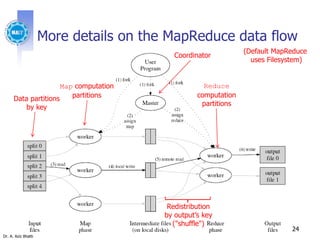
More details on the MapReduce data flow
24
Data partitions
by key
Map computation
partitions
Reduce
computation
partitions
Redistribution
by output’s key
("shuffle")
Coordinator
(Default MapReduce
uses Filesystem)
Dr. A. Aziz Bhatti
Some additional details
 To make this work, we need a few more parts…
 The file system (distributed across all nodes):
 Stores the inputs, outputs, and temporary results
 The driver program (executes on one node):
 Specifies where to find the inputs, the outputs
 Specifies what mapper and reducer to use
 Can customize behavior of the execution
 The runtime system (controls nodes):
 Supervises the execution of tasks
 Esp. JobTracker
25
Dr. A. Aziz Bhatti
Some details
 Fewer computation partitions than data partitions
 All data is accessible via a distributed filesystem with
replication
 Worker nodes produce data in key order (makes it easy to
merge)
 The master is responsible for scheduling, keeping all
nodes busy
 The master knows how many data partitions there are,
which have completed – atomic commits to disk
 Locality: Master tries to do work on nodes that
have replicas of the data
 Master can deal with stragglers (slow machines) by
re-executing their tasks somewhere else
26
Dr. A. Aziz Bhatti
What if a worker crashes?
 We rely on the file system being shared
across all the nodes
 Two types of (crash) faults:
 Node wrote its output and then crashed
 Here, the file system is likely to have a copy of the complete output
 Node crashed before finishing its output
 The JobTracker sees that the job isn’t making progress, and restarts
the job elsewhere on the system
 (Of course, we have fewer nodes to do
work…)
 But what if the master crashes?
27
Dr. A. Aziz Bhatti
Other challenges
 Locality
 Try to schedule map task on machine that already has data
 Task granularity
 How many map tasks? How many reduce tasks?
 Dealing with stragglers
 Schedule some backup tasks
 Saving bandwidth
 E.g., with combiners
 Handling bad records
 "Last gasp" packet with current sequence number
28
Dr. A. Aziz Bhatti
Scale and MapReduce
 From a particular Google paper on a language built
over MapReduce:
 … Sawzall has become one of the most widely used programming
languages at Google. …
[O]n one dedicated Workqueue cluster with 1500 Xeon CPUs, there
were 32,580 Sawzall jobs launched, using an average of 220
machines each.
While running those jobs, 18,636 failures occurred (application
failure, network outage, system crash, etc.) that triggered
rerunning some portion of the job. The jobs read a total of
3.2x1015 bytes of data (2.8PB) and wrote 9.9x1012 bytes (9.3TB).
 We will see some of MapReduce-based languages,
like Pig Latin, later in the semester
29
Source:InterpretingtheData:ParallelAnalysiswithSawzall(RobPike,SeanDorward,RobertGriesemer,SeanQuinlan)
Dr. A. Aziz Bhatti
Stay tuned
Next time you will learn about:
Programming in MapReduce (cont.)
30

Introduction to MapReduce

  • 1.
    Dr. A. AzizBhatti CS-439: Cloud Computing 1 Introduction to MapReduce
  • 2.
    Dr. A. AzizBhatti Plan for today  Introduction  Census example  MapReduce architecture  Data flow  Execution flow  Fault tolerance etc. 2 NEXT
  • 3.
    Dr. A. AzizBhatti Example: National census 3 http://www.census.gov/2010census/pdf/2010_Questionnaire_Info.pdf
  • 4.
    Dr. A. AzizBhatti Analogy: National census  Suppose we have 10,000 employees, whose job is to collate census forms and to determine how many people live in each city  How would you organize this task? 4 http://www.census.gov/2010census/pdf/2010_Questionnaire_Info.pdf
  • 5.
    Dr. A. AzizBhatti National census "data flow" 5
  • 6.
    Dr. A. AzizBhatti Making things more complicated  Suppose people take vacations, get sick, work at different rates  Suppose some forms are incorrectly filled out and require corrections or need to be thrown away  What if the supervisor gets sick?  How big should the stacks be?  How do we monitor progress?  ... 6
  • 7.
    Dr. A. AzizBhatti A bit of introspection  What is the main challenge?  Are the individual tasks complicated?  If not, what makes this so challenging?  How resilient is our solution?  How well does it balance work across employees?  What factors affect this?  How general is the set of techniques? 7
  • 8.
    Dr. A. AzizBhatti I don't want to deal with all this!!!  Wouldn't it be nice if there were some system that took care of all these details for you?  Ideally, you'd just tell the system what needs to be done  That's the MapReduce framework. 8
  • 9.
    Dr. A. AzizBhatti Data Partitioning for Map Reduce  We decided that the best scheme for parallelism in doing a census was:  Given n workers, divide the workload into k*n tasks  Each worker starts a task, reports back (with stack of cards) to a coordinator when done  Receives a new task if there are any left  If anyone is a long-time straggler, may reassign the task to someone else  Take the stacks, sort them by region / city / zip or whatever we want to count  Assign counting of the regions in parallel 9
  • 10.
    Dr. A. AzizBhatti Abstracting into a digital data flow 10 Filter+Stack Worker Filter+Stack Worker Filter+Stack Worker Filter+Stack Worker CountStack Worker CountStack Worker CountStack Worker CountStack Worker CountStack Worker blue: 4k green: 4k cyan: 3k gray: 1k orange: 4k
  • 11.
    Dr. A. AzizBhatti Abstracting once more  There are two kinds of workers:  Those that take input data items and produce output items for the “stacks”  Those that take the stacks and aggregate the results to produce outputs on a per-stack basis  We’ll call these:  map: takes (item_key, value), produces one or more (stack_key, value’) pairs  reduce: takes (stack_key, {set of value’}), produces one or more output results – typically (stack_key, agg_value) 11 We will refer to this key as the reduce key
  • 12.
    Dr. A. AzizBhatti Why MapReduce?  Scenario:  You have a huge amount of data, e.g., all the Google searches of the last three years  You would like to perform a computation on the data, e.g., find out which search terms were the most popular  How would you do it?  Analogy to the census example:  The computation isn't necessarily difficult, but parallelizing and distributing it, as well as handling faults, is challenging  Idea: A programming language!  Write a simple program to express the (simple) computation, and let the language runtime do all the hard work 12
  • 13.
    Dr. A. AzizBhatti Plan for today  Introduction  Census example  MapReduce architecture  Data flow  Execution flow  Fault tolerance etc. 13 NEXT
  • 14.
    Dr. A. AzizBhatti What is MapReduce?  A famous distributed programming model  In many circles, considered the key building block for much of Google’s data analysis  A programming language built on it: Sawzall, http://labs.google.com/papers/sawzall.html  … Sawzall has become one of the most widely used programming languages at Google. … [O]n one dedicated Workqueue cluster with 1500 Xeon CPUs, there were 32,580 Sawzall jobs launched, using an average of 220 machines each. While running those jobs, 18,636 failures occurred (application failure, network outage, system crash, etc.) that triggered rerunning some portion of the job. The jobs read a total of 3.2x1015 bytes of data (2.8PB) and wrote 9.9x1012 bytes (9.3TB).  Other similar languages: Yahoo’s Pig Latin and Pig; Microsoft’s Dryad  Cloned in open source: Hadoop, http://hadoop.apache.org/ 14
  • 15.
    Dr. A. AzizBhatti What is MapReduce?  A famous distributed programming model  In many circles, considered the key building block for much of Google’s data analysis  Example of usage rates for one language that compiled to MapReduce, in 2010:  … [O]n one dedicated Workqueue cluster with 1500 Xeon CPUs, there were 32,580 Sawzall jobs launched, using an average of 220 machines each. While running those jobs, 18,636 failures occurred (application failure, network outage, system crash, etc.) that triggered rerunning some portion of the job. The jobs read a total of 3.2x1015 bytes of data (2.8PB) and wrote 9.9x1012 bytes (9.3TB).  Other similar languages: Yahoo’s Pig Latin and Pig; Microsoft’s Dryad  Many “successors” now – we’ll talk about them later 15
  • 16.
    Dr. A. AzizBhatti The MapReduce programming model  Simple distributed functional programming primitives  Modeled after Lisp primitives:  map (apply function to all items in a collection) and  reduce (apply function to set of items with a common key)  We start with:  A user-defined function to be applied to all data, map: (key,value)  (key, value)  Another user-specified operation reduce: (key, {set of values})  result  A set of n nodes, each with data  All nodes run map on all of their data, producing new data with keys  This data is collected by key, then shuffled, and finally reduced  Dataflow is through temp files on GFS 16
  • 17.
    Dr. A. AzizBhatti Simple example: Word count  Goal: Given a set of documents, count how often each word occurs  Input: Key-value pairs (document:lineNumber, text)  Output: Key-value pairs (word, #occurrences)  What should be the intermediate key-value pairs? map(String key, String value) { // key: document name, line no // value: contents of line } reduce(String key, Iterator values) { } for each word w in value: emit(w, "1") // key: a word // values: a list of counts int result = 0; for each v in values: result += ParseInt(v); emit(key, result) 17
  • 18.
    Dr. A. AzizBhatti Simple example: Word count 18 Mapper (1-2) Mapper (3-4) Mapper (5-6) Mapper (7-8) Reducer (A-G) Reducer (H-N) Reducer (O-U) Reducer (V-Z) (1, the apple) (2, is an apple) (3, not an orange) (4, because the) (5, orange) (6, unlike the apple) (7, is orange) (8, not green) (the, 1) (apple, 1) (is, 1) (apple, 1) (an, 1) (not, 1) (orange, 1) (an, 1) (because, 1) (the, 1) (orange, 1) (unlike, 1) (apple, 1) (the, 1) (is, 1) (orange, 1) (not, 1) (green, 1) (apple, 3) (an, 2) (because, 1) (green, 1) (is, 2) (not, 2) (orange, 3) (the, 3) (unlike, 1) (apple, {1, 1, 1}) (an, {1, 1}) (because, {1}) (green, {1}) (is, {1, 1}) (not, {1, 1}) (orange, {1, 1, 1}) (the, {1, 1, 1}) (unlike, {1}) Each mapper receives some of the KV-pairs as input The mappers process the KV-pairs one by one Each KV-pair output by the mapper is sent to the reducer that is responsible for it The reducers sort their input by key and group it The reducers process their input one group at a time 1 2 3 4 5 Key range the node is responsible for
  • 19.
    Dr. A. AzizBhatti MapReduce dataflow 19 Mapper Mapper Mapper Mapper Reducer Reducer Reducer Reducer Inputdata Outputdata "The Shuffle" Intermediate (key,value) pairs What is meant by a 'dataflow'? What makes this so scalable?
  • 20.
    Dr. A. AzizBhatti More examples  Distributed grep – all lines matching a pattern  Map: filter by pattern  Reduce: output set  Count URL access frequency  Map: output each URL as key, with count 1  Reduce: sum the counts  Reverse web-link graph  Map: output (target,source) pairs when link to target found in souce  Reduce: concatenates values and emits (target,list(source))  Inverted index  Map: Emits (word,documentID)  Reduce: Combines these into (word,list(documentID)) 20
  • 21.
    Dr. A. AzizBhatti Common mistakes to avoid  Mapper and reducer should be stateless  Don't use static variables - after map + reduce return, they should remember nothing about the processed data!  Reason: No guarantees about which key-value pairs will be processed by which workers!  Don't try to do your own I/O!  Don't try to read from, or write to, files in the file system  The MapReduce framework does all the I/O for you:  All the incoming data will be fed as arguments to map and reduce  Any data your functions produce should be output via emit 21 HashMap h = new HashMap(); map(key, value) { if (h.contains(key)) { h.add(key,value); emit(key, "X"); } } Wrong! map(key, value) { File foo = new File("xyz.txt"); while (true) { s = foo.readLine(); ... } } Wrong!
  • 22.
    Dr. A. AzizBhatti More common mistakes to avoid  Mapper must not map too much data to the same key  In particular, don't map everything to the same key!!  Otherwise the reduce worker will be overwhelmed!  It's okay if some reduce workers have more work than others  Example: In WordCount, the reduce worker that works on the key 'and' has a lot more work than the reduce worker that works on 'syzygy'. 22 map(key, value) { emit("FOO", key + " " + value); } reduce(key, value[]) { /* do some computation on all the values */ } Wrong!
  • 23.
    Dr. A. AzizBhatti Designing MapReduce algorithms  Key decision: What should be done by map, and what by reduce?  map can do something to each individual key-value pair, but it can't look at other key-value pairs  Example: Filtering out key-value pairs we don't need  map can emit more than one intermediate key-value pair for each incoming key-value pair  Example: Incoming data is text, map produces (word,1) for each word  reduce can aggregate data; it can look at multiple values, as long as map has mapped them to the same (intermediate) key  Example: Count the number of words, add up the total cost, ...  Need to get the intermediate format right!  If reduce needs to look at several values together, map must emit them using the same key! 23
  • 24.
    Dr. A. AzizBhatti More details on the MapReduce data flow 24 Data partitions by key Map computation partitions Reduce computation partitions Redistribution by output’s key ("shuffle") Coordinator (Default MapReduce uses Filesystem)
  • 25.
    Dr. A. AzizBhatti Some additional details  To make this work, we need a few more parts…  The file system (distributed across all nodes):  Stores the inputs, outputs, and temporary results  The driver program (executes on one node):  Specifies where to find the inputs, the outputs  Specifies what mapper and reducer to use  Can customize behavior of the execution  The runtime system (controls nodes):  Supervises the execution of tasks  Esp. JobTracker 25
  • 26.
    Dr. A. AzizBhatti Some details  Fewer computation partitions than data partitions  All data is accessible via a distributed filesystem with replication  Worker nodes produce data in key order (makes it easy to merge)  The master is responsible for scheduling, keeping all nodes busy  The master knows how many data partitions there are, which have completed – atomic commits to disk  Locality: Master tries to do work on nodes that have replicas of the data  Master can deal with stragglers (slow machines) by re-executing their tasks somewhere else 26
  • 27.
    Dr. A. AzizBhatti What if a worker crashes?  We rely on the file system being shared across all the nodes  Two types of (crash) faults:  Node wrote its output and then crashed  Here, the file system is likely to have a copy of the complete output  Node crashed before finishing its output  The JobTracker sees that the job isn’t making progress, and restarts the job elsewhere on the system  (Of course, we have fewer nodes to do work…)  But what if the master crashes? 27
  • 28.
    Dr. A. AzizBhatti Other challenges  Locality  Try to schedule map task on machine that already has data  Task granularity  How many map tasks? How many reduce tasks?  Dealing with stragglers  Schedule some backup tasks  Saving bandwidth  E.g., with combiners  Handling bad records  "Last gasp" packet with current sequence number 28
  • 29.
    Dr. A. AzizBhatti Scale and MapReduce  From a particular Google paper on a language built over MapReduce:  … Sawzall has become one of the most widely used programming languages at Google. … [O]n one dedicated Workqueue cluster with 1500 Xeon CPUs, there were 32,580 Sawzall jobs launched, using an average of 220 machines each. While running those jobs, 18,636 failures occurred (application failure, network outage, system crash, etc.) that triggered rerunning some portion of the job. The jobs read a total of 3.2x1015 bytes of data (2.8PB) and wrote 9.9x1012 bytes (9.3TB).  We will see some of MapReduce-based languages, like Pig Latin, later in the semester 29 Source:InterpretingtheData:ParallelAnalysiswithSawzall(RobPike,SeanDorward,RobertGriesemer,SeanQuinlan)
  • 30.
    Dr. A. AzizBhatti Stay tuned Next time you will learn about: Programming in MapReduce (cont.) 30