ANALYSIS AND MODELING THE DOMAIN OF
OPEN EDUCATIONAL RESOURCES FROM
LEARNING ANALYTICS PERSPECTIVE
Malinka IVANOVA
Technical University of Sofia, Bulgaria
Gabriela GROSSECK
West University of Timisoara, Romania
Carmen HOLOTESCU
Ioan Slavici University, Timisoara, Romania
The 16th International Scientific Conference, eLearning and Software for Education
Bucharest, April 30th - May 1st, 2020
The aim
• To review, analyze and model the domain of the
OERs focusing on the following research questions:
– What is the current state of research in the area of OERs?
– What are typical features of OERs?
– What kind of tools are used for OERs development,
tracing and analysis?
– How learning analytics contributes to OERs creation,
improvement and reusing?
The methodology
• The applied methodology consists of several
procedures related to:
– discovery of appropriate scientific literature
in abstract and citation databases and usage of search
engines, indexing and delivering the full text or
metadata concerning available scientific production;
– summarization and analysis of returned results
through bibliometric and machine learning methods
and techniques;
– development of analytical models that outline
the current achievements and predictive models that
show the future trends.
Learning analytics tools
• This extensive production of learning materials requires learning
analytics algorithms and tools to track the emerged content, to
analyze it and to improve/remove the re-mixed learning materials.
• A Resource Inspection, Selection, and Enhancement Framework (RISE) is
developed for comparing the students’ use of resources and their grades
with the aim similar and different resources among the utilized learning
content in one course to be identified.
• The result is related to continuously course content optimization as
ineffective resources are improved or removed .
• A platform (called Serendipity) with two analytical tools: a search
engine for datasets extraction from digital repositories of
OpenCourseWare (OCW) and OERs and a map that gives graphical
information about projects related to open courses and open resources is
created.
Learning analytics tools
• Another analytical tool for tracing the OERs in support
of educators is proposed to facilitate material/content
construction and evaluation the quality of OERs;
• The tool is implemented as a module from a LMS;
• At this moment, only one part of university libraries
proposes to their students and educators a wide
variety of services for fast access, search, re-mix and
evaluation of OERs;
• For example, the Illinois University Library not only
gives extended information, tips, and guides regarding
different aspects of OERs, but also the Openly
Available Sources Integrated Search (OASIS) tool is
integrated on its web site.
Learning analytics tools
• University of Washington Libraries facilitates the research, knowledge
discovery and open content development through extensive
catalogues, classifications, and guidance, concerning available open
services and digital repositories;
• It proposes information about existing authoring tools and ToolKits for
open contend creation;
• The library of the University of Queensland informs about creative
commons licenses and copyright law at production, re-usage and
distribution of OERs, points out the collections of open textbooks,
ebooks, open journals, search engines for open image archives, audio
and video collections, open software and applications;
• A list with MOOC courses, MOOC platforms and MOOC search engines
is published;
• A check list for evaluation of OERs is designed for identification the
most suitable open content by students and researchers for a given
purpose.
Drawing OERs Landscape
The constructed bibliometric network for the term open educational
resources (keywords co-occurrence network map
VOSViewer network visualization)
Drawing OERs Landscape
Groups (O/TLS) Additional terms (O/TLS)
Learning analytics
(16/88)
content analysis (11/50), information retrieval (7/25), linked data (26/109),
metadata (17/100)
Pedagogy (18/85) instructional design (18/156), connectivism (7/25), competences (10/51),
personalization (14/95), social networks (27/144), serious games (5/12), course
design (11/44), peer production (8/50), learning design (17/55), curriculum design
(12/83), assessment (9/66), teaching (23/158)
Copyright (10/81) open license (9/40), creative commons (19/92), policy (8/30)
Learning context
(17/88)
distance learning (48/301), language learning (8/27), mobile learning (27/152),
eLearning (89/365), life-long learning (23/130), MOOC (132/482), teachers
training (17/69), collaborative learning (29/121), engineering education (7/25), HE
(74/308), blended-learning (22/103), PLE (11/47), self-regulated learning (10/49)
Quality in OERs
(11/39)
quality assurance (12/72), quality model (5/16), quality control (1/30), quality
criteria (4/11)
Technology (15/46) Web 2.0 (16/97), cloud computing (12/40), web accessibility (6/23), widgets
(6/33), wiki (6/52), youtube (5/23), ontology (18/68), semantic web (22/128),
search engines (7/37)
Infrastructure (6/21) learning objects repository (12/52)
Services for content
creation and
interacting (12/37)
interactive learning resources (5/20), open textbooks (5/22), open courseware
(53/236), open access (46/276), usability (11/34), reuse (21/100), sharing (6/22),
learning objects (9/35)
• The terms connected to the term open educational resources
Drawing OERs Landscape
• The dependency between number
of articles and years (generated by
Biblioshiny)
• The dependency between
number of citations and countries
(generated by Biblioshiny)
Drawing OERs Landscape
• The most relevant publishing sources (generated by Biblioshiny)
Indexed in SCOPUS
Indexed by Web of science
Indexed in Dimensions
Drawing OERs Landscape
The dependency between frequency of the used terms and years
(visualization, made by Biblioshiny)
Drawing OERs Landscape
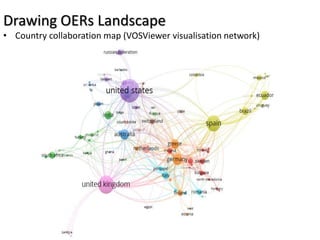
• Country collaboration map (VOSViewer visualisation network)
Drawing OERs Landscape
Bulgaria
Romania
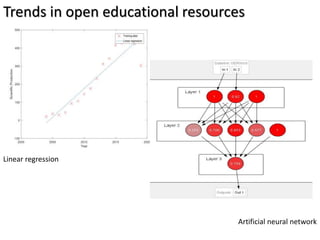
Trends in open educational resources
Linear regression
Artificial neural network
CONCLUSIONS
• The paper presents an approach for learning analytics
application for the purposes of OERs domain analysis;
• It is based on datasets extraction from abstract and citation
databases SCOPUS, Web of Science and Dimensions, bibliographic
data processing and visualization of constructed bibliometric
networks with VOSViewer and Biblioshiny;
• The findings include extensive information about the context of
OERs usage, trending topics, the scientific production, the most
relevant sources – journals and conferences, the countries of
actively involved authors, as well as the collaboration among
them;
• The proposed approach is used for development of predictive
models based on supervised machine learning methods like
linear regression and artificial neural networks. They are capable
to predict the future evolvement of scientific production in the
area of OERs, as well as any other topics in this field.
CONCLUSIONS
• This study about the domain of OERs could be used by
researchers and educators for:
– understanding the current research and
– as an opportunity to be involved in the recently discussed topics;
– starting point for further research of a given issue, stepping on the
outlined in this work “big picture” and on the created prognosis.
• The researchers could take into account the proposed research
approach that includes statistical and machine learning
techniques and that describes conceptually the OERs domain.
• The educators could take this overview picture to propose novelty
and more effective solutions for implementation of OERs in
educational process.
• In the context of the critical situation brought by the
COVID-19, when a large number of countries
suspended their courses in schools and universities,
moving to online learning, the OERs, MOOCs and
Open Educational Practices (OEPs) proved their
usefulness, being adopted by many educational
institutions and teachers.
• They bring innovation, flexibility, openness and
collaboration in international communities of learning
and practice, as revealed by the exchange of best
practices in the international webinar “How to Keep
Students Learning during Schools Disruption in COVID-
19 Situation”, organized by the Smart Learning
Institute of Beijing Normal University in March 13.
• Teachers should become curators and facilitators of
quality OERs and MOOCs, integrating them in their
courses.
https://iite.unesco.org/news/handbook-on-facilitating-
flexible-learning-during-educational-disruption/
https://link.springer.com/chapter/10.1007/978-981-15-3040-1_9
CONCLUSIONS
CONCLUSIONS
• FutureLearn (https://www.futurelearn.com), the most
important European MOOC platform, support
teachers with two new sections “How to Teach Online
Courses” and “Disease Outbreak Prevention Courses”;
• Searching on the classcentral.com directory or
directly on the big MOOC platforms edx.org,
coursera.org and udacity.com, teachers could find
MOOCs to improve their knowledge in their academic
and research areas, and skills as Open Educators; also
they could guide their students to follow different
(parts) of such massive courses, supporting them to
become autonomous Open Learners, participating in
distributed learning communities.
Thank you for your
attention!
The picture is taken from: https://www.cc-pl.org/digital-branch
Carmen Holotescu Gabriela Grosseck
Malinka Ivanova

Presentation Learning Analytics Open Educational Resources

  • 1.
    ANALYSIS AND MODELINGTHE DOMAIN OF OPEN EDUCATIONAL RESOURCES FROM LEARNING ANALYTICS PERSPECTIVE Malinka IVANOVA Technical University of Sofia, Bulgaria Gabriela GROSSECK West University of Timisoara, Romania Carmen HOLOTESCU Ioan Slavici University, Timisoara, Romania The 16th International Scientific Conference, eLearning and Software for Education Bucharest, April 30th - May 1st, 2020
  • 2.
    The aim • Toreview, analyze and model the domain of the OERs focusing on the following research questions: – What is the current state of research in the area of OERs? – What are typical features of OERs? – What kind of tools are used for OERs development, tracing and analysis? – How learning analytics contributes to OERs creation, improvement and reusing?
  • 3.
    The methodology • Theapplied methodology consists of several procedures related to: – discovery of appropriate scientific literature in abstract and citation databases and usage of search engines, indexing and delivering the full text or metadata concerning available scientific production; – summarization and analysis of returned results through bibliometric and machine learning methods and techniques; – development of analytical models that outline the current achievements and predictive models that show the future trends.
  • 4.
    Learning analytics tools •This extensive production of learning materials requires learning analytics algorithms and tools to track the emerged content, to analyze it and to improve/remove the re-mixed learning materials. • A Resource Inspection, Selection, and Enhancement Framework (RISE) is developed for comparing the students’ use of resources and their grades with the aim similar and different resources among the utilized learning content in one course to be identified. • The result is related to continuously course content optimization as ineffective resources are improved or removed . • A platform (called Serendipity) with two analytical tools: a search engine for datasets extraction from digital repositories of OpenCourseWare (OCW) and OERs and a map that gives graphical information about projects related to open courses and open resources is created.
  • 5.
    Learning analytics tools •Another analytical tool for tracing the OERs in support of educators is proposed to facilitate material/content construction and evaluation the quality of OERs; • The tool is implemented as a module from a LMS; • At this moment, only one part of university libraries proposes to their students and educators a wide variety of services for fast access, search, re-mix and evaluation of OERs; • For example, the Illinois University Library not only gives extended information, tips, and guides regarding different aspects of OERs, but also the Openly Available Sources Integrated Search (OASIS) tool is integrated on its web site.
  • 6.
    Learning analytics tools •University of Washington Libraries facilitates the research, knowledge discovery and open content development through extensive catalogues, classifications, and guidance, concerning available open services and digital repositories; • It proposes information about existing authoring tools and ToolKits for open contend creation; • The library of the University of Queensland informs about creative commons licenses and copyright law at production, re-usage and distribution of OERs, points out the collections of open textbooks, ebooks, open journals, search engines for open image archives, audio and video collections, open software and applications; • A list with MOOC courses, MOOC platforms and MOOC search engines is published; • A check list for evaluation of OERs is designed for identification the most suitable open content by students and researchers for a given purpose.
  • 7.
    Drawing OERs Landscape Theconstructed bibliometric network for the term open educational resources (keywords co-occurrence network map VOSViewer network visualization)
  • 8.
    Drawing OERs Landscape Groups(O/TLS) Additional terms (O/TLS) Learning analytics (16/88) content analysis (11/50), information retrieval (7/25), linked data (26/109), metadata (17/100) Pedagogy (18/85) instructional design (18/156), connectivism (7/25), competences (10/51), personalization (14/95), social networks (27/144), serious games (5/12), course design (11/44), peer production (8/50), learning design (17/55), curriculum design (12/83), assessment (9/66), teaching (23/158) Copyright (10/81) open license (9/40), creative commons (19/92), policy (8/30) Learning context (17/88) distance learning (48/301), language learning (8/27), mobile learning (27/152), eLearning (89/365), life-long learning (23/130), MOOC (132/482), teachers training (17/69), collaborative learning (29/121), engineering education (7/25), HE (74/308), blended-learning (22/103), PLE (11/47), self-regulated learning (10/49) Quality in OERs (11/39) quality assurance (12/72), quality model (5/16), quality control (1/30), quality criteria (4/11) Technology (15/46) Web 2.0 (16/97), cloud computing (12/40), web accessibility (6/23), widgets (6/33), wiki (6/52), youtube (5/23), ontology (18/68), semantic web (22/128), search engines (7/37) Infrastructure (6/21) learning objects repository (12/52) Services for content creation and interacting (12/37) interactive learning resources (5/20), open textbooks (5/22), open courseware (53/236), open access (46/276), usability (11/34), reuse (21/100), sharing (6/22), learning objects (9/35) • The terms connected to the term open educational resources
  • 9.
    Drawing OERs Landscape •The dependency between number of articles and years (generated by Biblioshiny) • The dependency between number of citations and countries (generated by Biblioshiny)
  • 10.
    Drawing OERs Landscape •The most relevant publishing sources (generated by Biblioshiny) Indexed in SCOPUS Indexed by Web of science Indexed in Dimensions
  • 11.
    Drawing OERs Landscape Thedependency between frequency of the used terms and years (visualization, made by Biblioshiny)
  • 12.
    Drawing OERs Landscape •Country collaboration map (VOSViewer visualisation network)
  • 13.
  • 14.
    Trends in openeducational resources Linear regression Artificial neural network
  • 15.
    CONCLUSIONS • The paperpresents an approach for learning analytics application for the purposes of OERs domain analysis; • It is based on datasets extraction from abstract and citation databases SCOPUS, Web of Science and Dimensions, bibliographic data processing and visualization of constructed bibliometric networks with VOSViewer and Biblioshiny; • The findings include extensive information about the context of OERs usage, trending topics, the scientific production, the most relevant sources – journals and conferences, the countries of actively involved authors, as well as the collaboration among them; • The proposed approach is used for development of predictive models based on supervised machine learning methods like linear regression and artificial neural networks. They are capable to predict the future evolvement of scientific production in the area of OERs, as well as any other topics in this field.
  • 16.
    CONCLUSIONS • This studyabout the domain of OERs could be used by researchers and educators for: – understanding the current research and – as an opportunity to be involved in the recently discussed topics; – starting point for further research of a given issue, stepping on the outlined in this work “big picture” and on the created prognosis. • The researchers could take into account the proposed research approach that includes statistical and machine learning techniques and that describes conceptually the OERs domain. • The educators could take this overview picture to propose novelty and more effective solutions for implementation of OERs in educational process.
  • 17.
    • In thecontext of the critical situation brought by the COVID-19, when a large number of countries suspended their courses in schools and universities, moving to online learning, the OERs, MOOCs and Open Educational Practices (OEPs) proved their usefulness, being adopted by many educational institutions and teachers. • They bring innovation, flexibility, openness and collaboration in international communities of learning and practice, as revealed by the exchange of best practices in the international webinar “How to Keep Students Learning during Schools Disruption in COVID- 19 Situation”, organized by the Smart Learning Institute of Beijing Normal University in March 13. • Teachers should become curators and facilitators of quality OERs and MOOCs, integrating them in their courses. https://iite.unesco.org/news/handbook-on-facilitating- flexible-learning-during-educational-disruption/ https://link.springer.com/chapter/10.1007/978-981-15-3040-1_9 CONCLUSIONS
  • 18.
    CONCLUSIONS • FutureLearn (https://www.futurelearn.com),the most important European MOOC platform, support teachers with two new sections “How to Teach Online Courses” and “Disease Outbreak Prevention Courses”; • Searching on the classcentral.com directory or directly on the big MOOC platforms edx.org, coursera.org and udacity.com, teachers could find MOOCs to improve their knowledge in their academic and research areas, and skills as Open Educators; also they could guide their students to follow different (parts) of such massive courses, supporting them to become autonomous Open Learners, participating in distributed learning communities.
  • 19.
    Thank you foryour attention! The picture is taken from: https://www.cc-pl.org/digital-branch Carmen Holotescu Gabriela Grosseck Malinka Ivanova