Manufacturing of
Bricks for Masonry
construction-
Methods and Process
Presented by Dr. D. Naresh Kumar
Hello!
I am D. Naresh Kumar
I am here because I love to give presentations.
You can find me at nareshkumarce@smec.ac.in
2
The process of manufacturing
of bricks from clay involves
preparation of clay, molding
and then drying and burning of
bricks. The bricks are building
materials which are generally
available as rectangular
blocks. The bricks do not
require any dressing and brick
laying is very simple compared
to stone masonry.
Let’s start with the first set of slides
“
● Site selection for manufacturing of
bricks
● For the manufacturing of bricks, the
site should be selected based on some
important considerations such as:
● The ground should be of plain surface.
● The site should be connected with
communicating roads for transporting
materials etc.,
● Good brick earth should be easily
available.
● The site should offer all facilities to the
workers
4
Manufacturing
process of bricks
● There are four different operations are
involved in the process of manufacturing
of bricks:
● Preparation of clay
● Molding
● Drying
● Burning 5
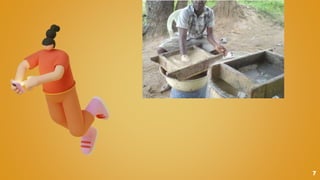
Preparation of clay for bricks manufacturing is done in six
steps: Unsoiling of clay We need pure clay for the preparation
of bricks. The top layer of soil may contains impurities, so the
clay in top layer of soil about 200mm depth is thrown away.
This is called unsoiling. Digging After the removal of top layer,
the clay is dug out from the ground and spread on the plain
ground. Cleaning In this stage, the clay is cleaned of stones,
vegetable matter etc. if large quantity of particulate matter is
present, then the clay is washed and screened. The lumps of
clay are converted into powder with earth crushing rollers. 6
7
Weathering
The cleaned clay is
exposed to
atmosphere for
softening. The
period of
weathering may be
3 to 4 weeks or a
full rainy season.
Generally, the clay
is dug out just
before the rainy
season for larger
projects.
Blending If we
want to add any
ingredient to the
clay, it is to be
added in this stage
by making the clay
loose and spread
the ingredient over
it. Then take small
portion of clay into
the hands and
tuning it up and
down in vertical
direction. This
process is called
blending of clay.
Tempering In this
stage, water is added
to clay and pressed or
mixed. The pressing
will be done by cattle
or with feet of men
for small scale
projects, pug mill is
used as grinder for
large scale projects.
So, the clay obtains
the plastic nature and
now it is suitable for
molding.
8
A picture is worth
a thousand words
A complex idea can be conveyed with just a
single still image, namely making it possible to
absorb large amounts of data quickly.
9
2. Molding of clay
for brick
manufacturing 10
In the molding process, prepared
clay is mold into brick shape
(generally rectangular). This
process can be done in two ways
according to scale of project.
11
Machine
molding
Hand
molding
Hand molding of bricks
If manufacturing of bricks is on a small scale
and manpower is also cheap then we can go
for hand molding. The molds are in
rectangular shape made of wood or steel
which are opened at the top and bottom.
The longer sides of molds are projected out
of the box to serve it as handles. If we take
durability in consideration steel molds are
better than wooden molds. In hand molding
again there are two types and they are
12
Ground molded
bricks
Table-molded
bricks
13
Ground molded bricks
14
● In this process of ground molding, first level the ground and sand or
ash is sprinkled over it.
● Now place the wet mold in the ground and filled it with tempered clay
and press hard to fill all corners of the mold. Extra clay is removed with
metal strike or wood strike or with wire.
● The mold is then lifted up and we have raw brick in the ground. And
again wet the mold by dipping it in water and repeat the same process.
The process of dipping mold every time to make bricks is called slop
molding.
● Sometimes, the inside surface of mold is sprinkled with sand or ash
instead of dipping in water this is called sand molding
● Frog mark of bricks are made by using a pair of pallet boards. Frog
mark means the mark of depth which is placed on raw brick while
molding. The depth may be 10mm to 20mm.
● Frog mark stats the trademark of manufacturing company and also it is
useful to store mortar in it when the bricks is placed over it.
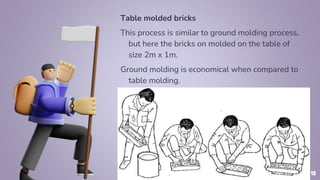
Table molded bricks
This process is similar to ground molding process,
but here the bricks on molded on the table of
size 2m x 1m.
Ground molding is economical when compared to
table molding.
15
16
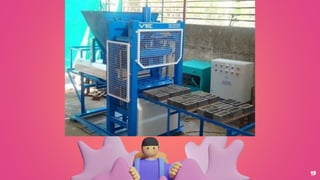
Machine molding of
bricks
The bricks required are in large quantity, then
machine molding is economical and also saves
more time. Here also we are having two types of
machines,
● Plastic clay machines
● Dry clay machines
17
Plastic clay machines This
machines contain an opening in
rectangular shape and when we
place the tempered clay in to this
machine it will come out through
this opening. Now, the
rectangular strips coming out the
opening are cut by wires to get
required thickness of brick. So,
these are also called wire cut
bricks. Now these raw bricks are
ready for the drying process..
18
Dry clay machines Dry clay machines
are more time saving machines. We
can put the blended clay into these
machines directly without tempering.
Means tempering is also done in this
machine by adding some water. When
the required stiffness is obtained the
clay is placed in mold and pressed
hard and well-shaped bricks are
delivered. These are called pressed
bricks and these do not require drying
they may directly sent to burning
Thanks!
Any questions?
You can find me at @username & user@mail.me
19
3. Drying of raw bricks
● After molding process the bricks contain some amount
of moisture in it. So, drying is to be done otherwise
they may cracked while burning. The drying of raw
bricks is done by natural process.
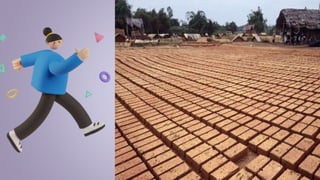
● The bricks are laid in stacks. A stack consists 8 to 10
stairs. The bricks in these stacks should be arranged in
such a way that circulation of air in between the bricks
is free.
● The period of drying may be 3 to 10 days. It also
depends upon the weather conditions.
● The drying yards are also prepared on higher level
than the normal ground for the prevention of bricks
from rain water.
● In Some situations artificial drying is adopted under
special dryers or hot gases. 20
Presentation
design
This presentation uses the following typographies:
● Titles: Fredoka One
● Body copy: Nunito
Download for free at:
https://www.fontsquirrel.com/fonts/fredoka
https://www.fontsquirrel.com/fonts/nunito
You don’t need to keep this slide in your presentation. It’s only here to serve you as a design
guide if you need to create new slides or download the fonts to edit the presentation in
PowerPoint®
21
4. Burning of bricks
In the process of burning, the dried bricks are
burned either in clamps (small scale) or kilns
(large scale) up to certain degree temperature.
In this stage, the bricks will gain hardness and
strength so it is important stage in
manufacturing of bricks.
The temperature required for burning is about
1100oC. If they burnt beyond this limit they will
be brittle and easy to break. If they burnt under
this limit, they will not gain full strength and
there is a chance to absorb moisture from the
atmosphere.
Hence burning should be done properly to meet the
requirements of good brick.
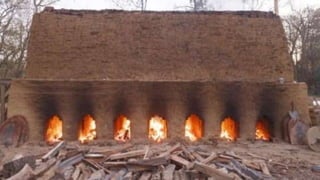
Clamp or Open Kiln:
23
This is a temporary structure with some
advantages like low initial cost, low fuel cost and a
few skilled labourers are sufficient to complete the
process. The disadvantage is only a small quantity
of bricks is manufactured at a time and in that
only 60% are good quality bricks.
Timeline
24
DEC
NOV
OCT
SEP
AUG
JUL
JUN
MAY
APR
MAR
FEB
JAN
Blue is the colour of the
clear sky and the deep
sea
Red is the colour of
danger and courage
Black is the color of
ebony and of outer
space
Yellow is the color of
gold, butter and ripe
lemons
White is the color of
milk and fresh snow
Blue is the colour of the
clear sky and the deep
sea
Yellow is the color of
gold, butter and ripe
lemons
White is the color of
milk and fresh snow
Blue is the colour of the
clear sky and the deep
sea
Red is the colour of
danger and courage
Black is the color of
ebony and of outer
space
Yellow is the color
of gold, butter and
ripe lemons
25
Intermittent Kiln: When a large number of
good quality bricks are needed,
intermittent or continuous kilns are
preferred. In this kilns, the process of
burning is discontinuous.
There are two kind of intermittent kilns:
(i) Up-draught Intermittent Kilns
(ii) Down draught Intermittent Kilns
Down draught kilns are more efficient, because
the heat is utilized more by moving the hot
gases in the larger area of the kiln. In up
draught kilns the hot gases are released after
they rise up to chimney entrance.
Continuous Kilns:
These kilns are called continuous because all
the processes of loading, unloading,
cooling, Heating, preheating take place
simultaneously.
They are used when the bricks are demanded
in larger scale and in short time. Bricks
burning is completed in one day, so it is a fast
method of burning.
There are two well known continuous
kilns:
26
Bull’s Trench Kiln:
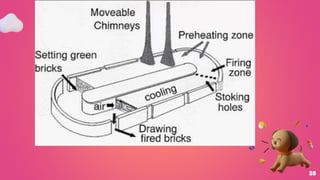
Bull’s trench kiln consist of a rectangular, circular or
oval plan shape. They are constructed below the
ground level by excavating a trench of the required
width for the given capacity of brick manufacturing.
This Trench is divided generally in 12 chambers so
that 2 numbers of cycles of brick burning can take
place at the same time for the larger production of
the bricks. Or it may happen that one cycle is carried
out at one time in all the 12 chambers by using a
single process in the 2-3 chambers at the same time.
27
28
The structure is under-ground so the heat is
conserved to a large extent so it is more
efficient. Once fire is started it constantly travels
from one chamber to the other chamber, while other
operations like loading, unloading, cooling, burning
and preheating taking place simultaneously.
Such kilns are generally constructed to have a
manufacturing capacity of about 20,000 bricks per
day. The drawback of this kiln is that there is not a
permanent roof, so it is not easy to manufacture the
bricks in the monsoon seasons
.
29
Hoffman’s Kiln
The main difference between the Bull’s
trench kiln and the Hoffman kilns are:
Hoffman’s kiln is an over the ground
structure while Bull’s Trench Kiln is an
underground structure.
Hoffman’s kiln have a permanent roof while
Bull’s trench Kiln do not have so it former can
be used in 12 months a year to manufacture
bricks but later is stopped in the monsoon
season.
30
31
Hoffman’s kiln is generally circular
in plan, and is constructed over the
ground. The whole structure is
divided into the 12 chambers and
all the processes takes place
simultaneously like in Bull’s trench
Kiln.
32
THE END
33

Manufacturing of bricks for masonry construction method and process

  • 1.
    Manufacturing of Bricks forMasonry construction- Methods and Process Presented by Dr. D. Naresh Kumar
  • 2.
    Hello! I am D.Naresh Kumar I am here because I love to give presentations. You can find me at nareshkumarce@smec.ac.in 2
  • 3.
    The process ofmanufacturing of bricks from clay involves preparation of clay, molding and then drying and burning of bricks. The bricks are building materials which are generally available as rectangular blocks. The bricks do not require any dressing and brick laying is very simple compared to stone masonry. Let’s start with the first set of slides
  • 4.
    “ ● Site selectionfor manufacturing of bricks ● For the manufacturing of bricks, the site should be selected based on some important considerations such as: ● The ground should be of plain surface. ● The site should be connected with communicating roads for transporting materials etc., ● Good brick earth should be easily available. ● The site should offer all facilities to the workers 4
  • 5.
    Manufacturing process of bricks ●There are four different operations are involved in the process of manufacturing of bricks: ● Preparation of clay ● Molding ● Drying ● Burning 5
  • 6.
    Preparation of clayfor bricks manufacturing is done in six steps: Unsoiling of clay We need pure clay for the preparation of bricks. The top layer of soil may contains impurities, so the clay in top layer of soil about 200mm depth is thrown away. This is called unsoiling. Digging After the removal of top layer, the clay is dug out from the ground and spread on the plain ground. Cleaning In this stage, the clay is cleaned of stones, vegetable matter etc. if large quantity of particulate matter is present, then the clay is washed and screened. The lumps of clay are converted into powder with earth crushing rollers. 6
  • 7.
  • 8.
    Weathering The cleaned clayis exposed to atmosphere for softening. The period of weathering may be 3 to 4 weeks or a full rainy season. Generally, the clay is dug out just before the rainy season for larger projects. Blending If we want to add any ingredient to the clay, it is to be added in this stage by making the clay loose and spread the ingredient over it. Then take small portion of clay into the hands and tuning it up and down in vertical direction. This process is called blending of clay. Tempering In this stage, water is added to clay and pressed or mixed. The pressing will be done by cattle or with feet of men for small scale projects, pug mill is used as grinder for large scale projects. So, the clay obtains the plastic nature and now it is suitable for molding. 8
  • 9.
    A picture isworth a thousand words A complex idea can be conveyed with just a single still image, namely making it possible to absorb large amounts of data quickly. 9
  • 10.
    2. Molding ofclay for brick manufacturing 10
  • 11.
    In the moldingprocess, prepared clay is mold into brick shape (generally rectangular). This process can be done in two ways according to scale of project. 11 Machine molding Hand molding
  • 12.
    Hand molding ofbricks If manufacturing of bricks is on a small scale and manpower is also cheap then we can go for hand molding. The molds are in rectangular shape made of wood or steel which are opened at the top and bottom. The longer sides of molds are projected out of the box to serve it as handles. If we take durability in consideration steel molds are better than wooden molds. In hand molding again there are two types and they are 12
  • 13.
  • 14.
    Ground molded bricks 14 ●In this process of ground molding, first level the ground and sand or ash is sprinkled over it. ● Now place the wet mold in the ground and filled it with tempered clay and press hard to fill all corners of the mold. Extra clay is removed with metal strike or wood strike or with wire. ● The mold is then lifted up and we have raw brick in the ground. And again wet the mold by dipping it in water and repeat the same process. The process of dipping mold every time to make bricks is called slop molding. ● Sometimes, the inside surface of mold is sprinkled with sand or ash instead of dipping in water this is called sand molding ● Frog mark of bricks are made by using a pair of pallet boards. Frog mark means the mark of depth which is placed on raw brick while molding. The depth may be 10mm to 20mm. ● Frog mark stats the trademark of manufacturing company and also it is useful to store mortar in it when the bricks is placed over it.
  • 15.
    Table molded bricks Thisprocess is similar to ground molding process, but here the bricks on molded on the table of size 2m x 1m. Ground molding is economical when compared to table molding. 15
  • 16.
    16 Machine molding of bricks Thebricks required are in large quantity, then machine molding is economical and also saves more time. Here also we are having two types of machines, ● Plastic clay machines ● Dry clay machines
  • 17.
    17 Plastic clay machinesThis machines contain an opening in rectangular shape and when we place the tempered clay in to this machine it will come out through this opening. Now, the rectangular strips coming out the opening are cut by wires to get required thickness of brick. So, these are also called wire cut bricks. Now these raw bricks are ready for the drying process..
  • 18.
    18 Dry clay machinesDry clay machines are more time saving machines. We can put the blended clay into these machines directly without tempering. Means tempering is also done in this machine by adding some water. When the required stiffness is obtained the clay is placed in mold and pressed hard and well-shaped bricks are delivered. These are called pressed bricks and these do not require drying they may directly sent to burning
  • 19.
    Thanks! Any questions? You canfind me at @username & user@mail.me 19
  • 20.
    3. Drying ofraw bricks ● After molding process the bricks contain some amount of moisture in it. So, drying is to be done otherwise they may cracked while burning. The drying of raw bricks is done by natural process. ● The bricks are laid in stacks. A stack consists 8 to 10 stairs. The bricks in these stacks should be arranged in such a way that circulation of air in between the bricks is free. ● The period of drying may be 3 to 10 days. It also depends upon the weather conditions. ● The drying yards are also prepared on higher level than the normal ground for the prevention of bricks from rain water. ● In Some situations artificial drying is adopted under special dryers or hot gases. 20
  • 21.
    Presentation design This presentation usesthe following typographies: ● Titles: Fredoka One ● Body copy: Nunito Download for free at: https://www.fontsquirrel.com/fonts/fredoka https://www.fontsquirrel.com/fonts/nunito You don’t need to keep this slide in your presentation. It’s only here to serve you as a design guide if you need to create new slides or download the fonts to edit the presentation in PowerPoint® 21
  • 22.
    4. Burning ofbricks In the process of burning, the dried bricks are burned either in clamps (small scale) or kilns (large scale) up to certain degree temperature. In this stage, the bricks will gain hardness and strength so it is important stage in manufacturing of bricks. The temperature required for burning is about 1100oC. If they burnt beyond this limit they will be brittle and easy to break. If they burnt under this limit, they will not gain full strength and there is a chance to absorb moisture from the atmosphere. Hence burning should be done properly to meet the requirements of good brick.
  • 23.
    Clamp or OpenKiln: 23 This is a temporary structure with some advantages like low initial cost, low fuel cost and a few skilled labourers are sufficient to complete the process. The disadvantage is only a small quantity of bricks is manufactured at a time and in that only 60% are good quality bricks.
  • 24.
    Timeline 24 DEC NOV OCT SEP AUG JUL JUN MAY APR MAR FEB JAN Blue is thecolour of the clear sky and the deep sea Red is the colour of danger and courage Black is the color of ebony and of outer space Yellow is the color of gold, butter and ripe lemons White is the color of milk and fresh snow Blue is the colour of the clear sky and the deep sea Yellow is the color of gold, butter and ripe lemons White is the color of milk and fresh snow Blue is the colour of the clear sky and the deep sea Red is the colour of danger and courage Black is the color of ebony and of outer space Yellow is the color of gold, butter and ripe lemons
  • 25.
    25 Intermittent Kiln: Whena large number of good quality bricks are needed, intermittent or continuous kilns are preferred. In this kilns, the process of burning is discontinuous. There are two kind of intermittent kilns: (i) Up-draught Intermittent Kilns (ii) Down draught Intermittent Kilns Down draught kilns are more efficient, because the heat is utilized more by moving the hot gases in the larger area of the kiln. In up draught kilns the hot gases are released after they rise up to chimney entrance.
  • 26.
    Continuous Kilns: These kilnsare called continuous because all the processes of loading, unloading, cooling, Heating, preheating take place simultaneously. They are used when the bricks are demanded in larger scale and in short time. Bricks burning is completed in one day, so it is a fast method of burning. There are two well known continuous kilns: 26
  • 27.
    Bull’s Trench Kiln: Bull’strench kiln consist of a rectangular, circular or oval plan shape. They are constructed below the ground level by excavating a trench of the required width for the given capacity of brick manufacturing. This Trench is divided generally in 12 chambers so that 2 numbers of cycles of brick burning can take place at the same time for the larger production of the bricks. Or it may happen that one cycle is carried out at one time in all the 12 chambers by using a single process in the 2-3 chambers at the same time. 27
  • 28.
  • 29.
    The structure isunder-ground so the heat is conserved to a large extent so it is more efficient. Once fire is started it constantly travels from one chamber to the other chamber, while other operations like loading, unloading, cooling, burning and preheating taking place simultaneously. Such kilns are generally constructed to have a manufacturing capacity of about 20,000 bricks per day. The drawback of this kiln is that there is not a permanent roof, so it is not easy to manufacture the bricks in the monsoon seasons . 29
  • 30.
    Hoffman’s Kiln The maindifference between the Bull’s trench kiln and the Hoffman kilns are: Hoffman’s kiln is an over the ground structure while Bull’s Trench Kiln is an underground structure. Hoffman’s kiln have a permanent roof while Bull’s trench Kiln do not have so it former can be used in 12 months a year to manufacture bricks but later is stopped in the monsoon season. 30
  • 31.
  • 32.
    Hoffman’s kiln isgenerally circular in plan, and is constructed over the ground. The whole structure is divided into the 12 chambers and all the processes takes place simultaneously like in Bull’s trench Kiln. 32
  • 33.