CEMENT CONCRETE
GENERAL INTRODUCTION
The cement concrete is a mixture of cement,sand,pebbles
or crushed rocks and water which when placed in the
skeleton of forms and allowed to cure becomes hard like
stone
• It can be easily moulded into any shape of various sizes
• It possesses adequate plasticity for the mechanical working.
• The cement concrete has attained the status of a major building
construction material due to the above reasons.
PROPERTIES OF CEMENT
CONCRETE
• High compressive strength.
• Free from corrosion and there is no appreciable effect of atmospheric
agents.
• It hardens with time and the process of hardening continues for a long
time after the concrete has attained sufficient strength.
• It is more economical than steel
• It binds with steel and as it is weak in tension,steel reinforcement is placed
in cement concrete at suitable place to take up the tensile stresses which is
also called REINFORCED CEMENT CONCRETE
• CEMENT
A powdery substance made by calcining lime and clay,
mixed with water to form mortar or mixed with sand, gravel,
and water to make concrete.
• AGGREGATES
These are chemically inactive material which form the
bulk of cement concrete.They are of 2 types:
1. Fine - The aggregate which passes the BIS test are
Fine Aggregates. Naturally river sand is used as
fine aggregates
2. Coarse - The aggregate which is retained on BIS
test termed as Coarsed Aggregates. The broken
stone is generally used as coarse aggregate
MATERIAL USED IN CEMEMT
CONCRETE
• STEEL
1. The steel reinforcement is generally in the form of
round bars of mild steel.
2. For road slabs and such other constructions,the
reinforcement may also consists of sheets of steel of
suitable thickness.
• WATER
The water,which is used for making cement
concrete should be clean and free from harmful
impurities such as oils,alkalies, acids etc..
PROPORTIONING CONCRETE
The process of selection of relative proportions of cement,sand,coarse aggregate and wate
so as to obtain a concrete of desired quality is known as Proportioning Concrete.
Proportion Of Mix Concrete Nature Of Work
1:1:2 Heavily loaded R.C.C.
columns,arches of long spans.
1:1½:3 Water retaining structures, pre-
cast products
1:2½:3½ Footpaths and road works.
1:2:4 For all general R.C.C works in
buildings like
stairs,columns,beams,lintel etc..
1:3:6 Mass concrete work in retaining
walls etc.
1:4:8 Mass concrete work for heavy
walls,foundation footing, etc.
WATER CEMENT RATIO
Some thumb rules are developed for deciding the quantity of
water in concrete
a) Weight of water = of the weight of the cement+4% of the
weight of the total aggregate
b) Weight of water = of the weight of the cement+5%of the
weight of total aggregate
WORKABILITY
• The term Workability is used to describe the ease or difficulty with which
the concrete is handled,transported and placed between the forms with
minimum loss of homogeneity.
• The workability,as a physical property of concrete can be defined as the
amount of useful internal work necessary to produce full compaction.
• Depends upon the water-cement ratio,aggregate-cement ratio
• Also depends upon the grading,shape,texture and maximum size of the
coarse aggregate to be used in the mixture.
TYPES OF CEMENT CONCRETE
• The NO-FINE CEMENTconcrete consists of cement,
coarse aggregate and water.
• The fine aggregates or sand are eliminated and such
concrete has been adopted for external load bearing
wall of single and multi-storey houses,small retaining
wall,damp-proofing sub-base material,etc..
No-Fine Cement Concrete
• Precast concrete is a construction product
produced by casting concrete in a reusable mold or
"form" which is then cured in a controlled
environment, transported to the construction site and
lifted into place.
• Products made such as fencingposts,pipes.paving
slabs and complicated artificial blocks.
Pre-Cast Cement Concrete
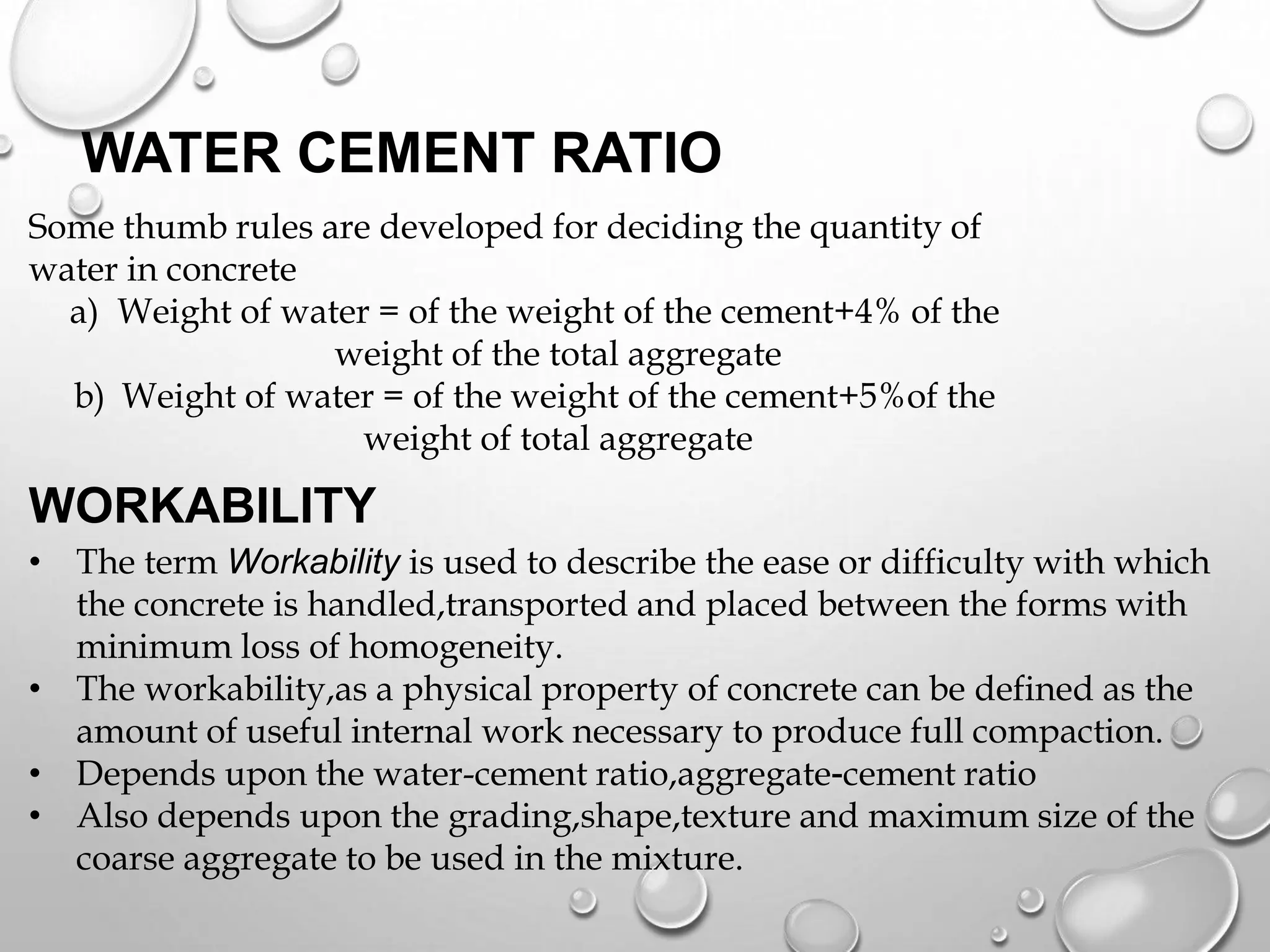
• Ready-Mix Cement Concrete
• Ready-Mix Cement concrete that is manufactured
in a factory according to th set recipe and then
delivered to the worksite by truck or transit-mixers
• It saves labour associated with production of concrete
• It reduces time required to prepare concrete.
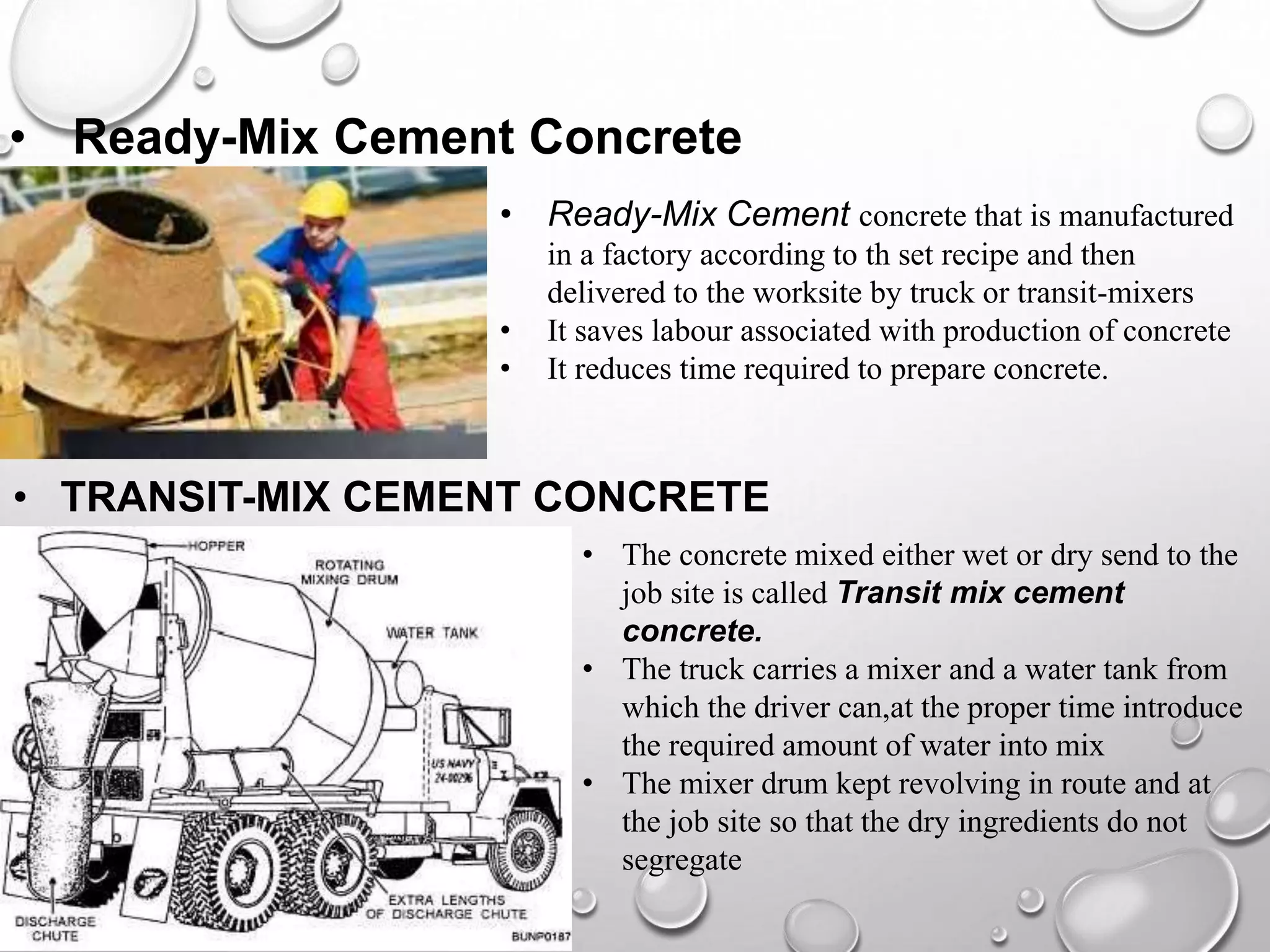
• TRANSIT-MIX CEMENT CONCRETE
• The concrete mixed either wet or dry send to the
job site is called Transit mix cement
concrete.
• The truck carries a mixer and a water tank from
which the driver can,at the proper time introduce
the required amount of water into mix
• The mixer drum kept revolving in route and at
the job site so that the dry ingredients do not
segregate
GUNITING
Advantages:
• The high compressive strength is
obtained
• The high impermeability is
obtained
• The repairs are carried out in any
situation in a short time
• The Guniting is the most effective process of repairing concrete work which has
been damaged due to inferior work or other reasons.It is also used for providing
an impervious layer
• The GUNITE is a mixture of cement and sand (1:3).Then this mixture is sprayed
by a spraying gun on the concrete surface under a pressure of about 20-30N/cm
CURING OF CONCRETE
• The concrete surfaces are kept wet for a certain
period after placing so as to promote the hardening of
cement.
• It consists of a control of temperature.
• It also consists of control of moisture movement into
and from the concrete.
• Curing protects the concrete surfaces from wind and
sun.
• By proper curing the durability and workability of
concrete are increased and shrinkage is reduced.

Cement Concrete Building Construction & Management(bcm)-IV sem

  • 1.
  • 2.
    GENERAL INTRODUCTION The cementconcrete is a mixture of cement,sand,pebbles or crushed rocks and water which when placed in the skeleton of forms and allowed to cure becomes hard like stone • It can be easily moulded into any shape of various sizes • It possesses adequate plasticity for the mechanical working. • The cement concrete has attained the status of a major building construction material due to the above reasons.
  • 3.
    PROPERTIES OF CEMENT CONCRETE •High compressive strength. • Free from corrosion and there is no appreciable effect of atmospheric agents. • It hardens with time and the process of hardening continues for a long time after the concrete has attained sufficient strength. • It is more economical than steel • It binds with steel and as it is weak in tension,steel reinforcement is placed in cement concrete at suitable place to take up the tensile stresses which is also called REINFORCED CEMENT CONCRETE
  • 4.
    • CEMENT A powderysubstance made by calcining lime and clay, mixed with water to form mortar or mixed with sand, gravel, and water to make concrete. • AGGREGATES These are chemically inactive material which form the bulk of cement concrete.They are of 2 types: 1. Fine - The aggregate which passes the BIS test are Fine Aggregates. Naturally river sand is used as fine aggregates 2. Coarse - The aggregate which is retained on BIS test termed as Coarsed Aggregates. The broken stone is generally used as coarse aggregate MATERIAL USED IN CEMEMT CONCRETE
  • 5.
    • STEEL 1. Thesteel reinforcement is generally in the form of round bars of mild steel. 2. For road slabs and such other constructions,the reinforcement may also consists of sheets of steel of suitable thickness. • WATER The water,which is used for making cement concrete should be clean and free from harmful impurities such as oils,alkalies, acids etc..
  • 6.
    PROPORTIONING CONCRETE The processof selection of relative proportions of cement,sand,coarse aggregate and wate so as to obtain a concrete of desired quality is known as Proportioning Concrete. Proportion Of Mix Concrete Nature Of Work 1:1:2 Heavily loaded R.C.C. columns,arches of long spans. 1:1½:3 Water retaining structures, pre- cast products 1:2½:3½ Footpaths and road works. 1:2:4 For all general R.C.C works in buildings like stairs,columns,beams,lintel etc.. 1:3:6 Mass concrete work in retaining walls etc. 1:4:8 Mass concrete work for heavy walls,foundation footing, etc.
  • 7.
    WATER CEMENT RATIO Somethumb rules are developed for deciding the quantity of water in concrete a) Weight of water = of the weight of the cement+4% of the weight of the total aggregate b) Weight of water = of the weight of the cement+5%of the weight of total aggregate WORKABILITY • The term Workability is used to describe the ease or difficulty with which the concrete is handled,transported and placed between the forms with minimum loss of homogeneity. • The workability,as a physical property of concrete can be defined as the amount of useful internal work necessary to produce full compaction. • Depends upon the water-cement ratio,aggregate-cement ratio • Also depends upon the grading,shape,texture and maximum size of the coarse aggregate to be used in the mixture.
  • 8.
    TYPES OF CEMENTCONCRETE • The NO-FINE CEMENTconcrete consists of cement, coarse aggregate and water. • The fine aggregates or sand are eliminated and such concrete has been adopted for external load bearing wall of single and multi-storey houses,small retaining wall,damp-proofing sub-base material,etc.. No-Fine Cement Concrete • Precast concrete is a construction product produced by casting concrete in a reusable mold or "form" which is then cured in a controlled environment, transported to the construction site and lifted into place. • Products made such as fencingposts,pipes.paving slabs and complicated artificial blocks. Pre-Cast Cement Concrete
  • 9.
    • Ready-Mix CementConcrete • Ready-Mix Cement concrete that is manufactured in a factory according to th set recipe and then delivered to the worksite by truck or transit-mixers • It saves labour associated with production of concrete • It reduces time required to prepare concrete. • TRANSIT-MIX CEMENT CONCRETE • The concrete mixed either wet or dry send to the job site is called Transit mix cement concrete. • The truck carries a mixer and a water tank from which the driver can,at the proper time introduce the required amount of water into mix • The mixer drum kept revolving in route and at the job site so that the dry ingredients do not segregate
  • 10.
    GUNITING Advantages: • The highcompressive strength is obtained • The high impermeability is obtained • The repairs are carried out in any situation in a short time • The Guniting is the most effective process of repairing concrete work which has been damaged due to inferior work or other reasons.It is also used for providing an impervious layer • The GUNITE is a mixture of cement and sand (1:3).Then this mixture is sprayed by a spraying gun on the concrete surface under a pressure of about 20-30N/cm
  • 11.
    CURING OF CONCRETE •The concrete surfaces are kept wet for a certain period after placing so as to promote the hardening of cement. • It consists of a control of temperature. • It also consists of control of moisture movement into and from the concrete. • Curing protects the concrete surfaces from wind and sun. • By proper curing the durability and workability of concrete are increased and shrinkage is reduced.