GEOGRAPHICAL INFORMATION
SYSTEM
D. Naresh Kumar
Assistant professor
Civil Engineering Department
St. Martin’s EngineeringCollege
Introduction to GIS
 A geographic information system (GIS) is
basically a computerized information system
like any other database, but with an
important difference: all information in GIS
must be linked to a geographic (spatial)
reference (latitude/longitude, or other spatial
coordinates).
D. Naresh Kumar St. Martin's Engineering College
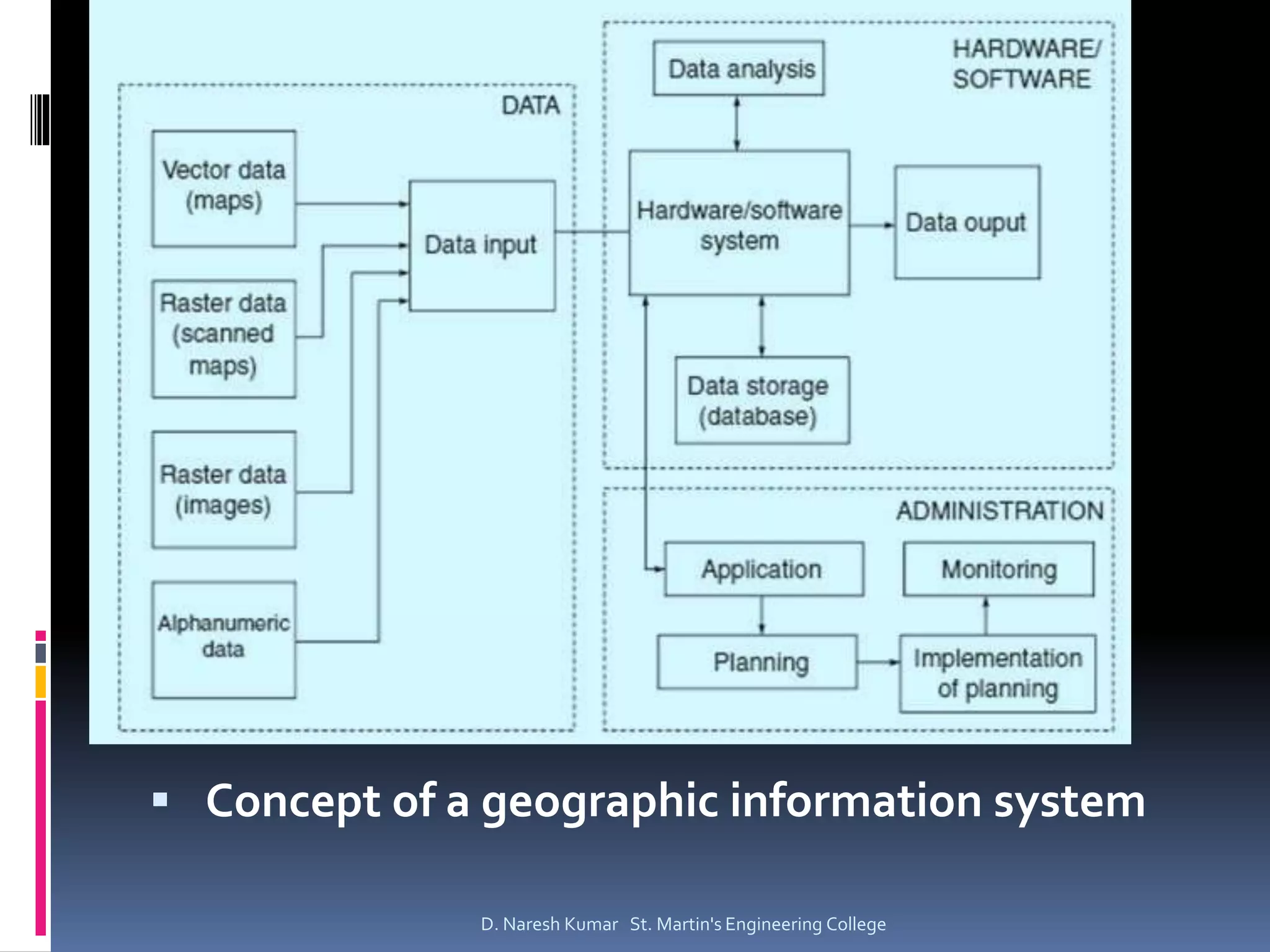
 Concept of a geographic information system
D. Naresh Kumar St. Martin's Engineering College
Component
 here are four main components of a true GIS system
(Marble 1990).These are:
 Data input system: collects and/or processes spatial data
from existing sources such as maps, remote sensing data,
images, etc. Data can be "collected" through digitizing,
scanning, interactive entry, etc.
 Data storage and retrieval: organizes spatial data and
allows for quick retrieval and updates (i.e., editing).
 Data analysis and manipulation: allows for changing form
of data, simulation modeling, spatial-temporal comparison,
etc.
 Output: displays spatial database and analysis in graphic
(i.e., map) or tabular form.
D. Naresh Kumar St. Martin's Engineering College
 GIS component can also be divided by in this manner:
 Computer hardware.
 Sets of application software modules.
 Skilled people to manage it.
 GIS Software
 The software modules can be grouped as follow-
 Data input and verification
 Data storage and database management
 Data output and presentation
 Data transformation
 interaction with the user
D. Naresh Kumar St. Martin's Engineering College
GIS Functional Components
 Data capture and input processing
 Data storage and data management
 Data manipulation
 Data display and output
D. Naresh Kumar St. Martin's Engineering College
Geospatial data
 Geospatial data is data about objects, events, or phenomena that have a
location on the surface of the earth.The location may be static in the short-term
(e.g., the location of a road, an earthquake event, children living in poverty), or
dynamic (e.g., a moving vehicle or pedestrian, the spread of an infectious
disease). Geospatial data combines location information (usually coordinates on
the earth), attribute information (the characteristics of the object, event, or
phenomena concerned), and often also temporal information (the time or life
span at which the location and attributes exist).
 Much geospatial data is of general interest to a wide range of users. For
example, roads, localities, water bodies, and public amenities are useful as
reference information for a number of purposes. For this reason, whether
collected by public or private organizations, large amounts of geospatial data
are available as open data.This means that it can be accessed freely by users,
and is made available through open standards.The development and use of
open standards within the geospatial community have been heavily supported
because of the wide range of uses to which geospatial data can be applied, and
because of the large numbers of agencies both globally and locally that are
involved in collecting such data.
D. Naresh Kumar St. Martin's Engineering College
Spatial data
 Spatial data comprise the relative geographic information
about the earth and its features. A pair of latitude and
longitude coordinates defines a specific location on earth.
Spatial data are of two types according to the storing
technique, namely, raster data and vector data.
 Raster data are composed of grid cells identified by row
and column.The whole geographic area is divided into
groups of individual cells, which represent an image.
Satellite images, photographs, scanned images, etc., are
examples of raster data.
 Vector data are composed of points, polylines, and
polygons.Wells, houses, etc., are represented by points.
Roads, rivers, streams, etc., are represented by polylines.
Villages and towns are represented by polygons
D. Naresh Kumar St. Martin's Engineering College
Attribute data
 Attribute data comprise the pertinent
information about the spatial data.The
querying feature works based on attribute
data, i.e., it is attached to geospatial data.
Types of attribute data are:
 •nominal data;
 •ordinal data;
 •interval data;
 •ratio data.
D. Naresh Kumar St. Martin's Engineering College
Spatial Data Collection
 Spatial data are one of the content-richest forms of information
since they can be collected by earth observation satellites in a
much larger scale. These satellites are equipped with broad
spectral observation technologies and are capable of high-
resolution photography. The most accurate resolution can reach
to 0.06 m, making available highly refined spatial data. There
have been several imaging sensors with high performance in
both spatial and spectral resolution, especially the C-SAR sensor
with 1 m resolution, and the GF-5 hyperspectral sensor. The GF-5
hyperspectral sensor is claimed to have 10 m resolution, making
its potential for practical purposes noteworthy. The GF-
4 geostationary orbit satellite has an advantage in time resolution
over other satellites. It has high application value in
meteorological monitoring and emergency response. For areas
requiring emergency response or timely protection, unmanned
aerial vehicles are used to collect the local spatial data. By this
means, emergency response times can be limited within 3 h and
the collection of spatial data can be finished within 3 days.
D. Naresh Kumar St. Martin's Engineering College
 Image data are collected mainly by ground photography
and aerial photography, which are the original data
for three-dimensional modeling. Ground photography
includes manual photographing and streetscape scanning.
Aerial photography refers to low-altitude aerial
photography here, using unmanned aerial vehicles and
delta-winged drones as the remote sensing platforms.
Aerial photography is the major means for regional three-
dimensional modeling. Multiple aerial photographic
cameras are available for aerial photography, including
ordinary cameras, A3, ADS40/80, the Trimble AOS inclined
camera, Pictometry camera, and SWDC-5 inclined camera
and so on.
D. Naresh Kumar St. Martin's Engineering College
Spatial model
Spatial data are an important asset contributing to detection of
geographic interdependencies in networks. The ESRI shapefile file
format is one of the most common geospatial data format for GIS
software. It consists of a collection of files that store geometry of
objects and attribute columns for each geometrical object. Here,
ESRI shapefiles provide a vector model of a city: building contours,
network connections, and objects, which are depicted using the
following main types of geometry objects:
•Point—a point in space represented by a pair of coordinates (x, y). In the
context of utility networks, points might represent measuring
devices, valves, pressure regulators, hydrants, and other equipment.
•PolyLine (or multiline)—an ordered set of points that form line
segments. These segments may be connected or intersected and not
connected or not intersected. In the context of utility networks,
polylines represent conduits of utility networks, such as water pipes
or electricity lines.
•Polygon—a geometric shape that is represented by sets of four points
that form a closed nonself-intersecting loop. In the context of utility
networks, polygons are buildings, power plants, substations, gutters,
and other appliances and structures.
D. Naresh Kumar St. Martin's Engineering College
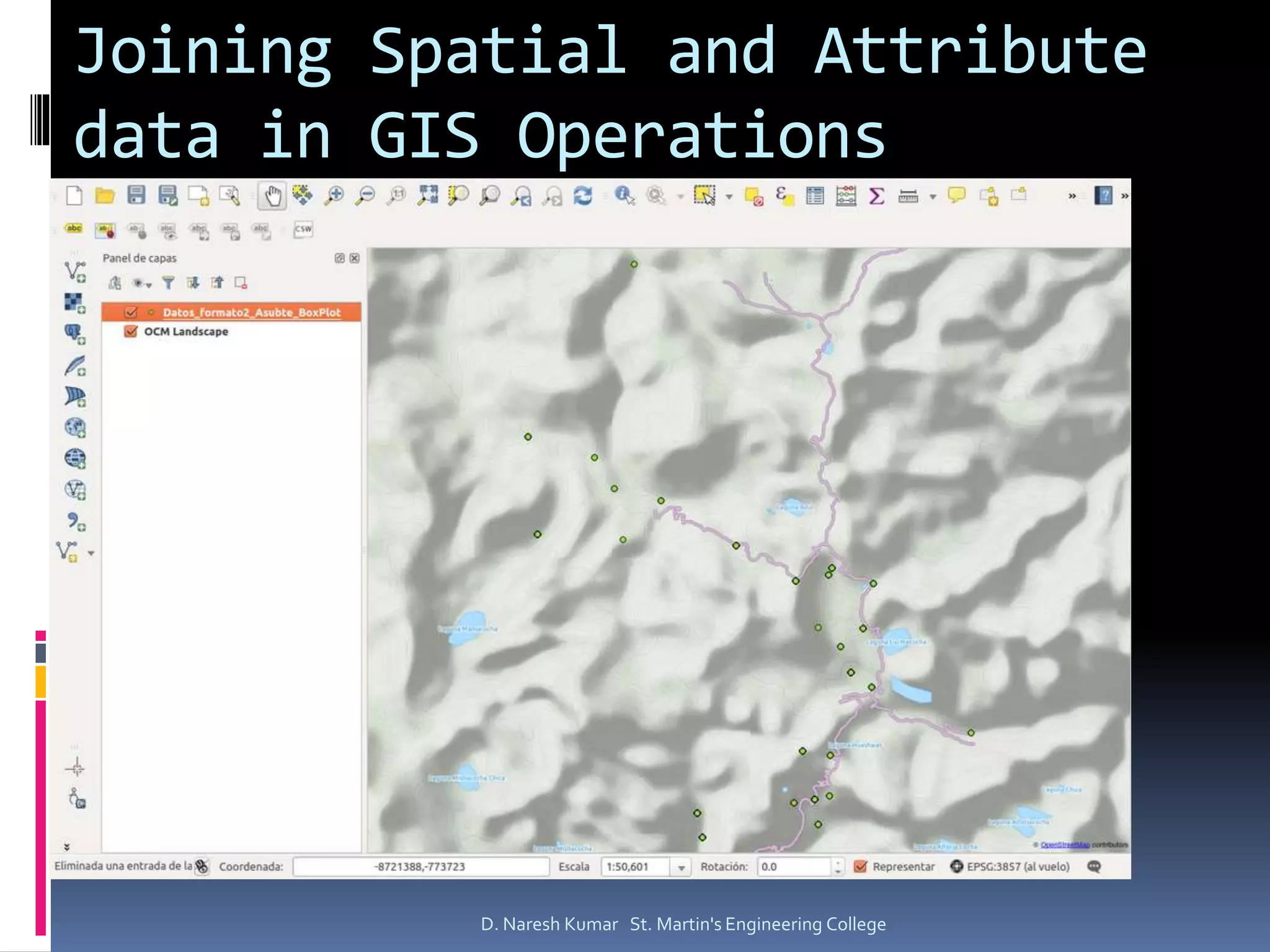
Joining Spatial and Attribute
data in GIS Operations
D. Naresh Kumar St. Martin's Engineering College
Save data in CSV format
 sing the "Explore" button choose the CSV file that needs to be
imported.
Then, where it says "Coordinate X" and "CoordinateY" choose from
the dropdown menu the name of the Excel columns that have the
values indicated.
D. Naresh Kumar St. Martin's Engineering College

Geographical information system

  • 1.
    GEOGRAPHICAL INFORMATION SYSTEM D. NareshKumar Assistant professor Civil Engineering Department St. Martin’s EngineeringCollege
  • 2.
    Introduction to GIS A geographic information system (GIS) is basically a computerized information system like any other database, but with an important difference: all information in GIS must be linked to a geographic (spatial) reference (latitude/longitude, or other spatial coordinates). D. Naresh Kumar St. Martin's Engineering College
  • 3.
     Concept ofa geographic information system D. Naresh Kumar St. Martin's Engineering College
  • 4.
    Component  here arefour main components of a true GIS system (Marble 1990).These are:  Data input system: collects and/or processes spatial data from existing sources such as maps, remote sensing data, images, etc. Data can be "collected" through digitizing, scanning, interactive entry, etc.  Data storage and retrieval: organizes spatial data and allows for quick retrieval and updates (i.e., editing).  Data analysis and manipulation: allows for changing form of data, simulation modeling, spatial-temporal comparison, etc.  Output: displays spatial database and analysis in graphic (i.e., map) or tabular form. D. Naresh Kumar St. Martin's Engineering College
  • 5.
     GIS componentcan also be divided by in this manner:  Computer hardware.  Sets of application software modules.  Skilled people to manage it.  GIS Software  The software modules can be grouped as follow-  Data input and verification  Data storage and database management  Data output and presentation  Data transformation  interaction with the user D. Naresh Kumar St. Martin's Engineering College
  • 6.
    GIS Functional Components Data capture and input processing  Data storage and data management  Data manipulation  Data display and output D. Naresh Kumar St. Martin's Engineering College
  • 7.
    Geospatial data  Geospatialdata is data about objects, events, or phenomena that have a location on the surface of the earth.The location may be static in the short-term (e.g., the location of a road, an earthquake event, children living in poverty), or dynamic (e.g., a moving vehicle or pedestrian, the spread of an infectious disease). Geospatial data combines location information (usually coordinates on the earth), attribute information (the characteristics of the object, event, or phenomena concerned), and often also temporal information (the time or life span at which the location and attributes exist).  Much geospatial data is of general interest to a wide range of users. For example, roads, localities, water bodies, and public amenities are useful as reference information for a number of purposes. For this reason, whether collected by public or private organizations, large amounts of geospatial data are available as open data.This means that it can be accessed freely by users, and is made available through open standards.The development and use of open standards within the geospatial community have been heavily supported because of the wide range of uses to which geospatial data can be applied, and because of the large numbers of agencies both globally and locally that are involved in collecting such data. D. Naresh Kumar St. Martin's Engineering College
  • 8.
    Spatial data  Spatialdata comprise the relative geographic information about the earth and its features. A pair of latitude and longitude coordinates defines a specific location on earth. Spatial data are of two types according to the storing technique, namely, raster data and vector data.  Raster data are composed of grid cells identified by row and column.The whole geographic area is divided into groups of individual cells, which represent an image. Satellite images, photographs, scanned images, etc., are examples of raster data.  Vector data are composed of points, polylines, and polygons.Wells, houses, etc., are represented by points. Roads, rivers, streams, etc., are represented by polylines. Villages and towns are represented by polygons D. Naresh Kumar St. Martin's Engineering College
  • 9.
    Attribute data  Attributedata comprise the pertinent information about the spatial data.The querying feature works based on attribute data, i.e., it is attached to geospatial data. Types of attribute data are:  •nominal data;  •ordinal data;  •interval data;  •ratio data. D. Naresh Kumar St. Martin's Engineering College
  • 10.
    Spatial Data Collection Spatial data are one of the content-richest forms of information since they can be collected by earth observation satellites in a much larger scale. These satellites are equipped with broad spectral observation technologies and are capable of high- resolution photography. The most accurate resolution can reach to 0.06 m, making available highly refined spatial data. There have been several imaging sensors with high performance in both spatial and spectral resolution, especially the C-SAR sensor with 1 m resolution, and the GF-5 hyperspectral sensor. The GF-5 hyperspectral sensor is claimed to have 10 m resolution, making its potential for practical purposes noteworthy. The GF- 4 geostationary orbit satellite has an advantage in time resolution over other satellites. It has high application value in meteorological monitoring and emergency response. For areas requiring emergency response or timely protection, unmanned aerial vehicles are used to collect the local spatial data. By this means, emergency response times can be limited within 3 h and the collection of spatial data can be finished within 3 days. D. Naresh Kumar St. Martin's Engineering College
  • 11.
     Image dataare collected mainly by ground photography and aerial photography, which are the original data for three-dimensional modeling. Ground photography includes manual photographing and streetscape scanning. Aerial photography refers to low-altitude aerial photography here, using unmanned aerial vehicles and delta-winged drones as the remote sensing platforms. Aerial photography is the major means for regional three- dimensional modeling. Multiple aerial photographic cameras are available for aerial photography, including ordinary cameras, A3, ADS40/80, the Trimble AOS inclined camera, Pictometry camera, and SWDC-5 inclined camera and so on. D. Naresh Kumar St. Martin's Engineering College
  • 12.
    Spatial model Spatial dataare an important asset contributing to detection of geographic interdependencies in networks. The ESRI shapefile file format is one of the most common geospatial data format for GIS software. It consists of a collection of files that store geometry of objects and attribute columns for each geometrical object. Here, ESRI shapefiles provide a vector model of a city: building contours, network connections, and objects, which are depicted using the following main types of geometry objects: •Point—a point in space represented by a pair of coordinates (x, y). In the context of utility networks, points might represent measuring devices, valves, pressure regulators, hydrants, and other equipment. •PolyLine (or multiline)—an ordered set of points that form line segments. These segments may be connected or intersected and not connected or not intersected. In the context of utility networks, polylines represent conduits of utility networks, such as water pipes or electricity lines. •Polygon—a geometric shape that is represented by sets of four points that form a closed nonself-intersecting loop. In the context of utility networks, polygons are buildings, power plants, substations, gutters, and other appliances and structures. D. Naresh Kumar St. Martin's Engineering College
  • 13.
    Joining Spatial andAttribute data in GIS Operations D. Naresh Kumar St. Martin's Engineering College
  • 14.
    Save data inCSV format  sing the "Explore" button choose the CSV file that needs to be imported. Then, where it says "Coordinate X" and "CoordinateY" choose from the dropdown menu the name of the Excel columns that have the values indicated. D. Naresh Kumar St. Martin's Engineering College
  • 15.
    D. Naresh KumarSt. Martin's Engineering College
  • 16.
    D. Naresh KumarSt. Martin's Engineering College
  • 17.
    D. Naresh KumarSt. Martin's Engineering College
  • 18.
    D. Naresh KumarSt. Martin's Engineering College