BricksBricks
Manufacturing - Types – Uses
ManufacturingManufacturing
The method used to form a brick has a major impact on its texture.
Sand-finished surfaces are typical with molded brick.
A variety of textures can be achieved with extruded brick.
Brick manufacturers address sustainability by locating
manufacturing facilities near clay sources to reduce
transportation, by recycling of process waste, by reclaiming land
where mining has occurred, and by taking measures to reduce
plant emissions. Most brick are used within 500 miles of a brick
manufacturing facility.
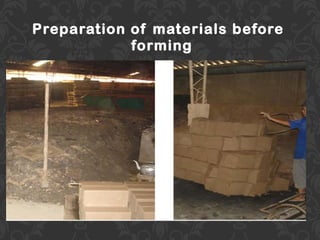
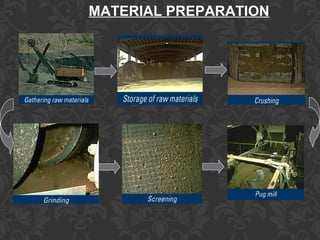
Preparation of materials before
forming
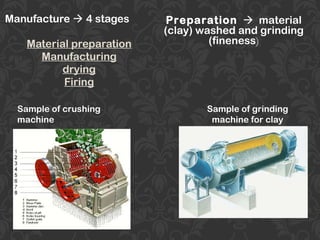
Manufacture  4 stages
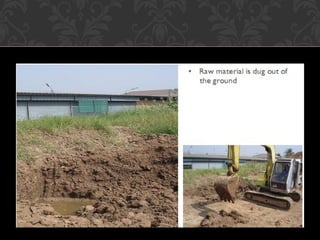
Material preparation
Manufacturing
drying
Firing
Sample of grinding
machine for clay
Sample of crushing
machine
Preparation  material
(clay) washed and grinding
(fineness)
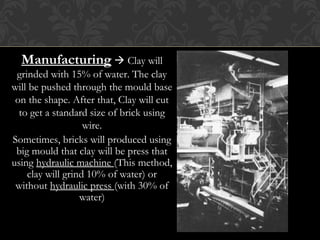
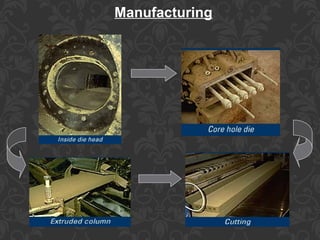
ManufacturingManufacturing  Clay will
grinded with 15% of water. The clay
will be pushed through the mould base
on the shape. After that, Clay will cut
to get a standard size of brick using
wire.
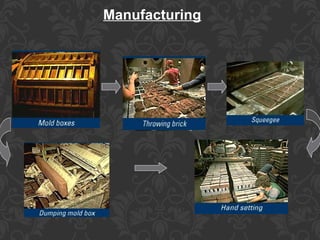
Sometimes, bricks will produced using
big mould that clay will be press that
using hydraulic machine (This method,
clay will grind 10% of water) or
without hydraulic press (with 30% of
water)
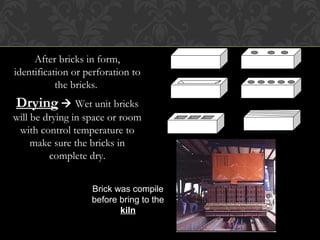
After bricks in form,
identification or perforation to
the bricks.
Drying  Wet unit bricks
will be drying in space or room
with control temperature to
make sure the bricks in
complete dry.
Brick was compile
before bring to the
kilnkiln
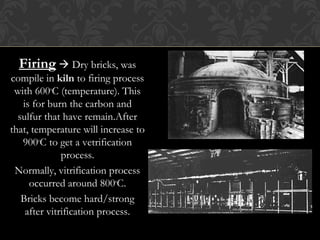
Firing  Dry bricks, was
compile in kiln to firing process
with 600o
C (temperature). This
is for burn the carbon and
sulfur that have remain.After
that, temperature will increase to
900o
C to get a vetrification
process.
Normally, vitrification process
occurred around 800o
C.
Bricks become hard/strong
after vitrification process.
MATERIAL PREPARATION
Manufacturing
Manufacturing
TypesTypes
Mud bricks
Mud-cement bricks
Burnt bricks
Cement block
MudMud
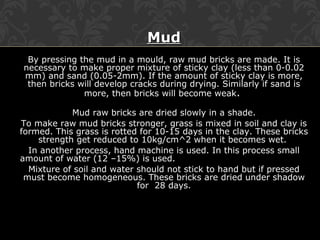
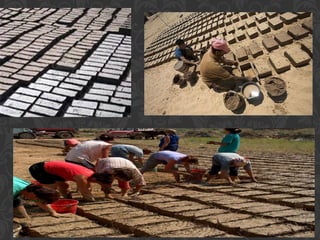
By pressing the mud in a mould, raw mud bricks are made. It is
necessary to make proper mixture of sticky clay (less than 0-0.02
mm) and sand (0.05-2mm). If the amount of sticky clay is more,
then bricks will develop cracks during drying. Similarly if sand is
more, then bricks will become weak.
Mud raw bricks are dried slowly in a shade.
To make raw mud bricks stronger, grass is mixed in soil and clay is
formed. This grass is rotted for 10-15 days in the clay. These bricks
strength get reduced to 10kg/cm^2 when it becomes wet.
In another process, hand machine is used. In this process small
amount of water (12 –15%) is used.
Mixture of soil and water should not stick to hand but if pressed
must become homogeneous. These bricks are dried under shadow
for 28 days.
Mud -Cement Bricks
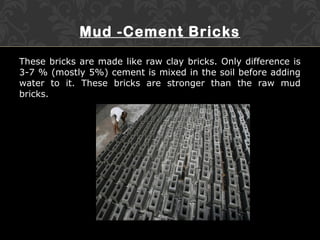
These bricks are made like raw clay bricks. Only difference is
3-7 % (mostly 5%) cement is mixed in the soil before adding
water to it. These bricks are stronger than the raw mud
bricks.
Burned Bricks
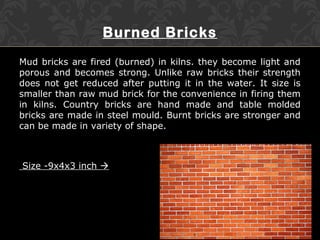
Mud bricks are fired (burned) in kilns. they become light and
porous and becomes strong. Unlike raw bricks their strength
does not get reduced after putting it in the water. It size is
smaller than raw mud brick for the convenience in firing them
in kilns. Country bricks are hand made and table molded
bricks are made in steel mould. Burnt bricks are stronger and
can be made in variety of shape.
Size -9x4x3 inch 
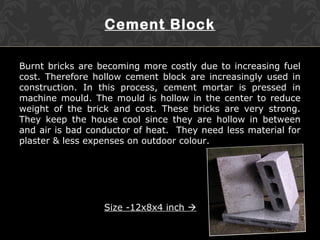
Cement Block
Burnt bricks are becoming more costly due to increasing fuel
cost. Therefore hollow cement block are increasingly used in
construction. In this process, cement mortar is pressed in
machine mould. The mould is hollow in the center to reduce
weight of the brick and cost. These bricks are very strong.
They keep the house cool since they are hollow in between
and air is bad conductor of heat. They need less material for
plaster & less expenses on outdoor colour.
Size -12x8x4 inch 
Uses
Structural uses 
Such as foundations walls and floors.
Decorative/ornamental uses 
May be cast to from moldings and other decorative features may be
carved also may be used in a variety of colors, textures,
bonds and joints.
May be concealed by other finish materials such as stucco,
plaster or paint, or may be exposed both on
the interior and exterior.
Bricks are also used in the metallurgy and glass industries for lining
furnaces.
They have various uses, especially refractory bricks such as silica,
magnesia, chamotte andneutral (chromomagnesite) refractory
bricks. This type of brick must have good thermal shock
resistance, under load, high melting point, and satisfactory
porosity.
Bricks are used for building and pavement . Earlier brick pavement
was found incapable of withstanding heavy traffic,but it is coming
back into use as a method of traffic calming or as adecorative
surface in pedestrian precincts.

Bricks.

  • 1.
  • 2.
    ManufacturingManufacturing The method usedto form a brick has a major impact on its texture. Sand-finished surfaces are typical with molded brick. A variety of textures can be achieved with extruded brick. Brick manufacturers address sustainability by locating manufacturing facilities near clay sources to reduce transportation, by recycling of process waste, by reclaiming land where mining has occurred, and by taking measures to reduce plant emissions. Most brick are used within 500 miles of a brick manufacturing facility.
  • 4.
  • 5.
    Manufacture  4stages Material preparation Manufacturing drying Firing Sample of grinding machine for clay Sample of crushing machine Preparation  material (clay) washed and grinding (fineness)
  • 6.
    ManufacturingManufacturing  Claywill grinded with 15% of water. The clay will be pushed through the mould base on the shape. After that, Clay will cut to get a standard size of brick using wire. Sometimes, bricks will produced using big mould that clay will be press that using hydraulic machine (This method, clay will grind 10% of water) or without hydraulic press (with 30% of water)
  • 7.
    After bricks inform, identification or perforation to the bricks. Drying  Wet unit bricks will be drying in space or room with control temperature to make sure the bricks in complete dry. Brick was compile before bring to the kilnkiln
  • 8.
    Firing  Drybricks, was compile in kiln to firing process with 600o C (temperature). This is for burn the carbon and sulfur that have remain.After that, temperature will increase to 900o C to get a vetrification process. Normally, vitrification process occurred around 800o C. Bricks become hard/strong after vitrification process.
  • 9.
  • 10.
  • 11.
  • 12.
  • 13.
    MudMud By pressing themud in a mould, raw mud bricks are made. It is necessary to make proper mixture of sticky clay (less than 0-0.02 mm) and sand (0.05-2mm). If the amount of sticky clay is more, then bricks will develop cracks during drying. Similarly if sand is more, then bricks will become weak. Mud raw bricks are dried slowly in a shade. To make raw mud bricks stronger, grass is mixed in soil and clay is formed. This grass is rotted for 10-15 days in the clay. These bricks strength get reduced to 10kg/cm^2 when it becomes wet. In another process, hand machine is used. In this process small amount of water (12 –15%) is used. Mixture of soil and water should not stick to hand but if pressed must become homogeneous. These bricks are dried under shadow for 28 days.
  • 15.
    Mud -Cement Bricks Thesebricks are made like raw clay bricks. Only difference is 3-7 % (mostly 5%) cement is mixed in the soil before adding water to it. These bricks are stronger than the raw mud bricks.
  • 16.
    Burned Bricks Mud bricksare fired (burned) in kilns. they become light and porous and becomes strong. Unlike raw bricks their strength does not get reduced after putting it in the water. It size is smaller than raw mud brick for the convenience in firing them in kilns. Country bricks are hand made and table molded bricks are made in steel mould. Burnt bricks are stronger and can be made in variety of shape. Size -9x4x3 inch 
  • 17.
    Cement Block Burnt bricksare becoming more costly due to increasing fuel cost. Therefore hollow cement block are increasingly used in construction. In this process, cement mortar is pressed in machine mould. The mould is hollow in the center to reduce weight of the brick and cost. These bricks are very strong. They keep the house cool since they are hollow in between and air is bad conductor of heat. They need less material for plaster & less expenses on outdoor colour. Size -12x8x4 inch 
  • 18.
  • 19.
    Structural uses  Such as foundations wallsand floors. Decorative/ornamental uses  May be cast to from moldings and other decorative features may be carved also may be used in a variety of colors, textures, bonds and joints. May be concealed by other finish materials such as stucco, plaster or paint, or may be exposed both on the interior and exterior. Bricks are also used in the metallurgy and glass industries for lining furnaces. They have various uses, especially refractory bricks such as silica, magnesia, chamotte andneutral (chromomagnesite) refractory bricks. This type of brick must have good thermal shock resistance, under load, high melting point, and satisfactory porosity. Bricks are used for building and pavement . Earlier brick pavement was found incapable of withstanding heavy traffic,but it is coming back into use as a method of traffic calming or as adecorative surface in pedestrian precincts.