3. FRICATIVE
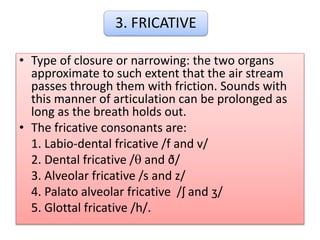
• Type of closure or narrowing: the two organs
approximate to such extent that the air stream
passes through them with friction. Sounds with
this manner of articulation can be prolonged as
long as the breath holds out.
• The fricative consonants are:
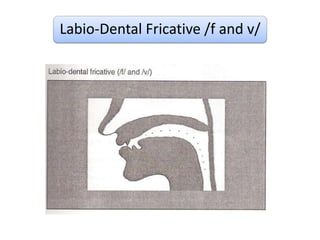
1. Labio-dental fricative /f and v/
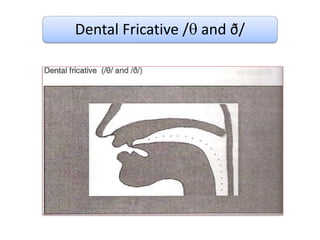
2. Dental fricative / and ð/
3. Alveolar fricative /s and z/
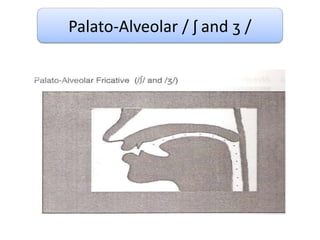
4. Palato alveolar fricative /ʃ and ʒ/
5. Glottal fricative /h/.
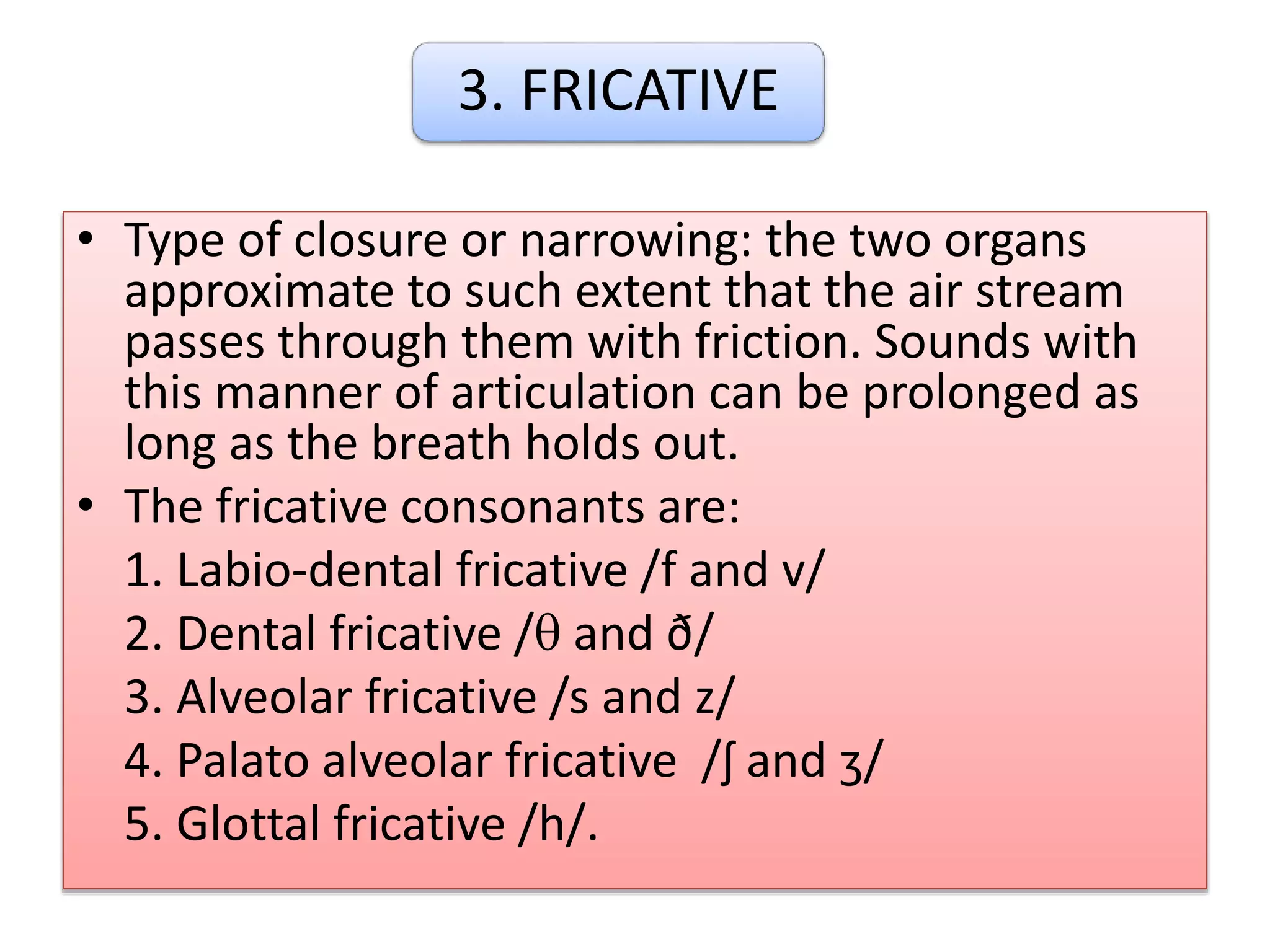
Descriptions of /f/
• distinctive features
/ f / is consonantal, continuant, anterior, strident, voiceless,
labiodentals, fricative.
• pronunciation
When we pronounce / f / the lower lip is pressed against the upper
teeth and causing the air to force its way between them. The soft
palate is raised. There is no vibration in the vocal cords.
• occurrences
/ f / occurs initially, medially and finally.
• spelling forms
f, ff, ph, gh feet, fit, father, fool, fail, photo, affair, offer,
defend, leaf, fry, laugh, cough, stuff, strife, fly,
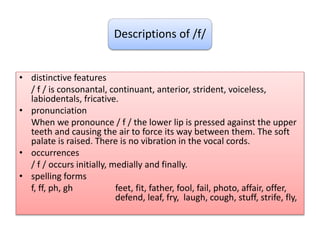
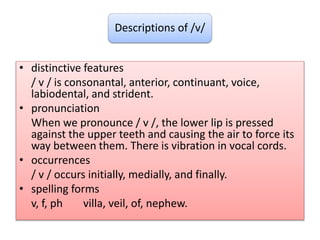
Descriptions of /v/
• distinctive features
/ v / is consonantal, anterior, continuant, voice,
labiodental, and strident.
• pronunciation
When we pronounce / v /, the lower lip is pressed
against the upper teeth and causing the air to force its
way between them. There is vibration in vocal cords.
• occurrences
/ v / occurs initially, medially, and finally.
• spelling forms
v, f, ph villa, veil, of, nephew.
Labio-Dental Fricative /f and v/
Descriptions of /  /
• distinctive features
/ θ / is consonantal, coronal, anterior, voiceless, and continuant.
• pronunciation
When we pronounce / θ /, the tip of the tongue is held closely to
the upper teeth and allowing the air to stream through the narrow
passage thus formed. The soft palate is raised. There is no vibration
in vocal cords.
• occurrences
/ θ / occurs initially, medially, and finally.
• spelling form
th think, thank, method, month, south
• Notice that th is pronounced t in Themes /temz/, Thomas /toməs,
and thyme /taɪm/.
Descriptions of / ð /
• pronunciation
When we pronounce / ð /, it is articulated like / θ
/. Except that there is a vibration in the vocal
cords.
• occurrences
/ ð / occurs initially, medially and finally.
• spelling form
• th there, this, then, soothe, clothe,
Dental Fricative / and ð/
Descriptions of /s/
• distinctive features
/ s / is consonantal, continuant, anterior, coronal, strident,
voiceless, alveolar, fricative.
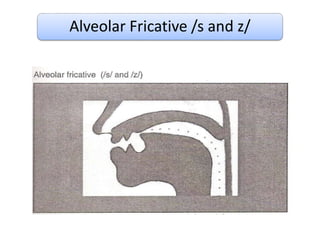
• pronunciation
/ s / is articulated between the blade or tip and blade of the
tongue and the teeth ridge. The air passage at the point of
articulation is extremely narrow. The soft plate is raised.
The teeth are close together. The lips are spread. There is
no vibration in the vocal cords.
• occurrences
/ s / occurs initially, medially and finally.
• spelling forms
s, ss, c, sc, x (ks) cease, pieces, losses, essay, exes,
concert, escape, scenery, scarce, helps
Descriptions of /z/
• distinctive features
/ z / is consonantal, continuant, anterior, coronal, voice,
strident, alveolar, fricative.
• pronunciation
/ z / is articulated like / s / except that the vocal cords
vibrate
• occurrences
/ z / occurs initially, medially and finally.
• spelling forms
s, ss, z, zz, x (gz) zeal, zest, easy, hesitate, bazaar,
thousand, palsy, fees, is, says, was, ooze,
Example, examine
Alveolar Fricative /s and z/
Descriptions of / ʃ /
• distinctive features
/ ʃ / Is consonantal, continuant, coronal, high, voiceless, strident, palatal,
fricative.
• pronunciation
/ ʃ / is articulated between the tip and the blade of the tongue and the
back teeth ridge, and the main body of the tongue is raised at the same
time in the direction of the hard palate. The air passage at the point of
articulation is wider than for / s /, but the main body of the tongue is
closer to the palate. The soft palate is raised. The teeth are fairly close
together. The lips are protruded. There is no vibration in the vocal cords.
• occurrences
/ ʃ / occurs initially, medially and finally.
• spelling forms
sh, ch, sch, s or ss before u, -ti-, -si-, I -, ee – sheet, shed, special, ocean,
shop, sugar, charade, assure, schedule, nation, mansion, machine,
conscience, Asia,
Descriptions of / ʒ /
• distinctive features
/ ʒ / is consonantal, continuant, coronal, high, voice,
strident, palatal, fricative.
• pronunciation
/ ʒ / is articulated like / ʃ /, except that there is a
vibration in the vocal cords.
• occurrences
/ ʒ / occurs medially and finally.
• spelling forms
si, s, z, before u, and, in French loan words, final – ge –
gigue, vision, measure, seizure, beige, pleasure, leisure,
usual, confusion, decision, prestige,
Palato-Alveolar / ʃ and ʒ /
Descriptions of /h/
• distinctive features
/ h / is continuant, low, sonorant, glottal, voiceless,
fricative.
• pronunciation
When we pronounce / h /, the mouth is held in position for
the vowel immediately while air is emitted t, through the
wide open glottis, producing audible friction, the soft
palate is raised and there is no vibration in the vocal cords.
• occurrences: initially and medially
• spelling forms
h, wh how, hat, who, whom, heat, hate, high, hallo,
ahead, behave, behind, perhaps, anyhow.

Manners of articulation 2

  • 1.
    3. FRICATIVE • Typeof closure or narrowing: the two organs approximate to such extent that the air stream passes through them with friction. Sounds with this manner of articulation can be prolonged as long as the breath holds out. • The fricative consonants are: 1. Labio-dental fricative /f and v/ 2. Dental fricative / and ð/ 3. Alveolar fricative /s and z/ 4. Palato alveolar fricative /ʃ and ʒ/ 5. Glottal fricative /h/.
  • 2.
    Descriptions of /f/ •distinctive features / f / is consonantal, continuant, anterior, strident, voiceless, labiodentals, fricative. • pronunciation When we pronounce / f / the lower lip is pressed against the upper teeth and causing the air to force its way between them. The soft palate is raised. There is no vibration in the vocal cords. • occurrences / f / occurs initially, medially and finally. • spelling forms f, ff, ph, gh feet, fit, father, fool, fail, photo, affair, offer, defend, leaf, fry, laugh, cough, stuff, strife, fly,
  • 3.
    Descriptions of /v/ •distinctive features / v / is consonantal, anterior, continuant, voice, labiodental, and strident. • pronunciation When we pronounce / v /, the lower lip is pressed against the upper teeth and causing the air to force its way between them. There is vibration in vocal cords. • occurrences / v / occurs initially, medially, and finally. • spelling forms v, f, ph villa, veil, of, nephew.
  • 4.
  • 5.
    Descriptions of / / • distinctive features / θ / is consonantal, coronal, anterior, voiceless, and continuant. • pronunciation When we pronounce / θ /, the tip of the tongue is held closely to the upper teeth and allowing the air to stream through the narrow passage thus formed. The soft palate is raised. There is no vibration in vocal cords. • occurrences / θ / occurs initially, medially, and finally. • spelling form th think, thank, method, month, south • Notice that th is pronounced t in Themes /temz/, Thomas /toməs, and thyme /taɪm/.
  • 6.
    Descriptions of /ð / • pronunciation When we pronounce / ð /, it is articulated like / θ /. Except that there is a vibration in the vocal cords. • occurrences / ð / occurs initially, medially and finally. • spelling form • th there, this, then, soothe, clothe,
  • 7.
  • 8.
    Descriptions of /s/ •distinctive features / s / is consonantal, continuant, anterior, coronal, strident, voiceless, alveolar, fricative. • pronunciation / s / is articulated between the blade or tip and blade of the tongue and the teeth ridge. The air passage at the point of articulation is extremely narrow. The soft plate is raised. The teeth are close together. The lips are spread. There is no vibration in the vocal cords. • occurrences / s / occurs initially, medially and finally. • spelling forms s, ss, c, sc, x (ks) cease, pieces, losses, essay, exes, concert, escape, scenery, scarce, helps
  • 9.
    Descriptions of /z/ •distinctive features / z / is consonantal, continuant, anterior, coronal, voice, strident, alveolar, fricative. • pronunciation / z / is articulated like / s / except that the vocal cords vibrate • occurrences / z / occurs initially, medially and finally. • spelling forms s, ss, z, zz, x (gz) zeal, zest, easy, hesitate, bazaar, thousand, palsy, fees, is, says, was, ooze, Example, examine
  • 10.
  • 11.
    Descriptions of /ʃ / • distinctive features / ʃ / Is consonantal, continuant, coronal, high, voiceless, strident, palatal, fricative. • pronunciation / ʃ / is articulated between the tip and the blade of the tongue and the back teeth ridge, and the main body of the tongue is raised at the same time in the direction of the hard palate. The air passage at the point of articulation is wider than for / s /, but the main body of the tongue is closer to the palate. The soft palate is raised. The teeth are fairly close together. The lips are protruded. There is no vibration in the vocal cords. • occurrences / ʃ / occurs initially, medially and finally. • spelling forms sh, ch, sch, s or ss before u, -ti-, -si-, I -, ee – sheet, shed, special, ocean, shop, sugar, charade, assure, schedule, nation, mansion, machine, conscience, Asia,
  • 12.
    Descriptions of /ʒ / • distinctive features / ʒ / is consonantal, continuant, coronal, high, voice, strident, palatal, fricative. • pronunciation / ʒ / is articulated like / ʃ /, except that there is a vibration in the vocal cords. • occurrences / ʒ / occurs medially and finally. • spelling forms si, s, z, before u, and, in French loan words, final – ge – gigue, vision, measure, seizure, beige, pleasure, leisure, usual, confusion, decision, prestige,
  • 13.
  • 14.
    Descriptions of /h/ •distinctive features / h / is continuant, low, sonorant, glottal, voiceless, fricative. • pronunciation When we pronounce / h /, the mouth is held in position for the vowel immediately while air is emitted t, through the wide open glottis, producing audible friction, the soft palate is raised and there is no vibration in the vocal cords. • occurrences: initially and medially • spelling forms h, wh how, hat, who, whom, heat, hate, high, hallo, ahead, behave, behind, perhaps, anyhow.