Page | 1
Performance Analysis of AODV and DSDV
Routing Protocols for MANETs in NS-2
A project report submitted in partial fulfillment of the
requirement for the award of the degree of
BACHELOR OF TECHNOLOGY
IN
COMPUTER SCIENCE & ENGINEERING
by
T.DHARMA (N090136)
P.RAVI TEJA (N091032)
G.SUSHEELA (N090462)
Under the esteemed guidance of
Ms. M.SAI SUDHA
Lecturer in Department of Computer Science & Engineering
RGUKT-NUZVID
NUZVID, Krishna, Andhra Pradesh - 521202.
April 2015
Page | 2
APPROVAL OF THE VIVA VOCE BOARD
We Certified that the project work "Performance Analysis of AODV and DSDV
Routing Protocols for MANETs in NS-2" submitted by T.Dharma (N090136),
P.Ravi Teja(N091032), G.Susheela (N090462) to the Rajiv Gandhi University of
Knowledge Technologies, Nuzvid, in partial fulfillment of the requirement for the award
of the degree Bachelor of Technology in COMPUTER SCIENCE AND
ENGINEERING has been accepted by the external examiners and that the students have
successfully defended the project work in the viva-voce examination.
DEPARTMENTOF COMPUTER SCIENCE AND ENGINEERING
RAJIVGANDHI UNIVERSITYOF KNOWLEDGE TECHNOLOGIES
(A.P. Government Act 18 of 2008)
Nuzvid, Krishna, Andhra Pradesh – 521202.
Phone : 08656-234147; Telefax: 08656 – 235150
ProjectGuide
Ms. M. Sai Sudha
Faculty-Department of CSE
RGUKT-Nuzvid
External Examiner
Ms. Kalpana Gangwar
Faculty-Department of CSE
RGUKT-Nuzvid
Page | 3
CERTIFICATE
This is to certify that the project entitled “Performance Analysis of AODV & DSDV
Routing Protocols for MANETs in NS-2” is a record of bonafied work carried out by
T.Dharma (N090136), P.RaviTeja (N091032), G.Susheela (N090462) under my
guidance and supervision for the partial fulfillment of the degree of Bachelor of
Technology in Computer Science and Engineering during the academic session August
2014 – May 2015 at RGUKT – Nuzvid.
To the best of my knowledge, the results embodied in this dissertation work
have not been submitted to any university or institute for the award of any degree or
diploma.
.
DEPARTMENTOF COMPUTER SCIENCE AND ENGINEERING
RAJIVGANDHI UNIVERSITYOF KNOWLEDGE TECHNOLOGIES
(A.P. Government Act 18 of 2008)
Nuzvid, Krishna, Andhra Pradesh – 521202.
Phone : 08656-234147; Telefax: 08656 – 235150
Project Guide
Ms. M.Sai Sudha
Lecturer-Department of CSE
RGUKT-Nuzvid
Head of Department
Mrs. D.V. Nagarjuna Devi
Lecturer-Department of CSE
RGUKT-Nuzvid
Page | 4
ACKNOWLEDGEMENT
We take this opportunity to acknowledge the co-operation, good will and both moral and
technical support extended by several individuals out of which this project has evolved.
We always cherish our association with them.
We express our sincere and deepest regards to our guide Ms. M.Sai Sudha for her
valued guidance during this period of our major project at RGUKT NUZVID.
We owe a great many thanks to Ms. M.Sai Sudha for spending her valuable hours to
review and analyze our project at every stage. We considered ourselves extremely
fortunate to have this opportunity of associating with her.
We express our sincere thanks to the head of the department (CSE) and the members of
Department of Computer Science and Engineering, RGUKT-NUZVID for their
cooperation.
Finally we would like to thank all the people associated with us in the evolvement of our
project and for helping us in their own way and contributing in the completion of
Project.
Page | 5
DECLARATION
I hereby declare that the work entitled “Performance Analysis of AODV and DSDV
Routing Protocols for MANETs in NS-2” submitted to RGUKT Nuzvid is a record of
an original work done by us under the guidance of Ms. M.Sai Sudha and this project
work is submitted in the partial fulfillment of the requirement for award of Bachelor of
Technology in Computer Science and Engineering. The results embodied in this project
have not been submitted to any other institute for the award of any degree.
T.Dharma (ID No: N090136)
P.Ravi Teja (ID No: N091032)
G.Susheela (ID No: N090462)
Page | 6
ABSTRACT
The Mobile Ad hoc Networks (MANET) is a set of wireless mobile nodes dynamically
form spontaneous network which works without centralized administration. Due to this
characteristic, there are some challenges that protocol designers and network developers
are faced with. These challenges include routing, service and frequently topology
changes. Therefore routing discovery and maintenance are critical issues in these
networks. There are also limited battery power and low bandwidth available in each
node. In this project the problem of routing is considered. And we compare AODV and
DSDV routing protocols, which are used for efficient routing under different scenarios
in Mobile Ad-hoc Network (MANET), which plays a critical role in places where wired
network are neither available nor economical to deploy.
Our objective was to implement the three routing protocols using Network Simulators
and run it for different number of nodes. Then we compared the three routing protocols
for different network parameters and studied the efficient protocol under a particular
scenario on the basis of four metrics.
(1) Throughput
(2) End to End delay
(3) Routing overhead
(4) Packet delivery ratio
Page | 7
TABLE OF CONTENTS
Acknowledgement 4
Abstract 6
Table of Contents: 7
List of Figures: 8
1. Introduction 9
1.1 Wireless Networks 10
1.2 Problems in Wireless Networks 11
2. Problem Statement 11
3. Review of Literature 12
3.1 Manets Overview 12
3.2 Routing in Manets 14
4. Stimulation Study 16
4.1 Ad Hoc On-Demand Distance Vector (AODV) routing protocol 16
4.2 Destination Sequenced Distance Vector (DSDV) routing protocol 17
5. Network Simulator 19
5.1 About NS2 19
5.2 Defining global variables 20
5.3 Defining standard ns/nam trace 20
5.4 Mobile node configuration 20
6. Simulation design 21
6.1 Simulation of AODV and DSDV 21
6.2 Performance Metrics 24
7. Simulation results and comparisons 25
7.1 Introduction to Xgraph 25
7.2 Simulation Results on Xgraph 25
7.2.1 Throughput 25
7.2.2 Packet Delivery Ratio 26
7.2.3 End-to-End Delay 27
7.2.4 Routing Overhead 28
Page | 8
8. Conclusions 29
9. References 30
List Of Figures
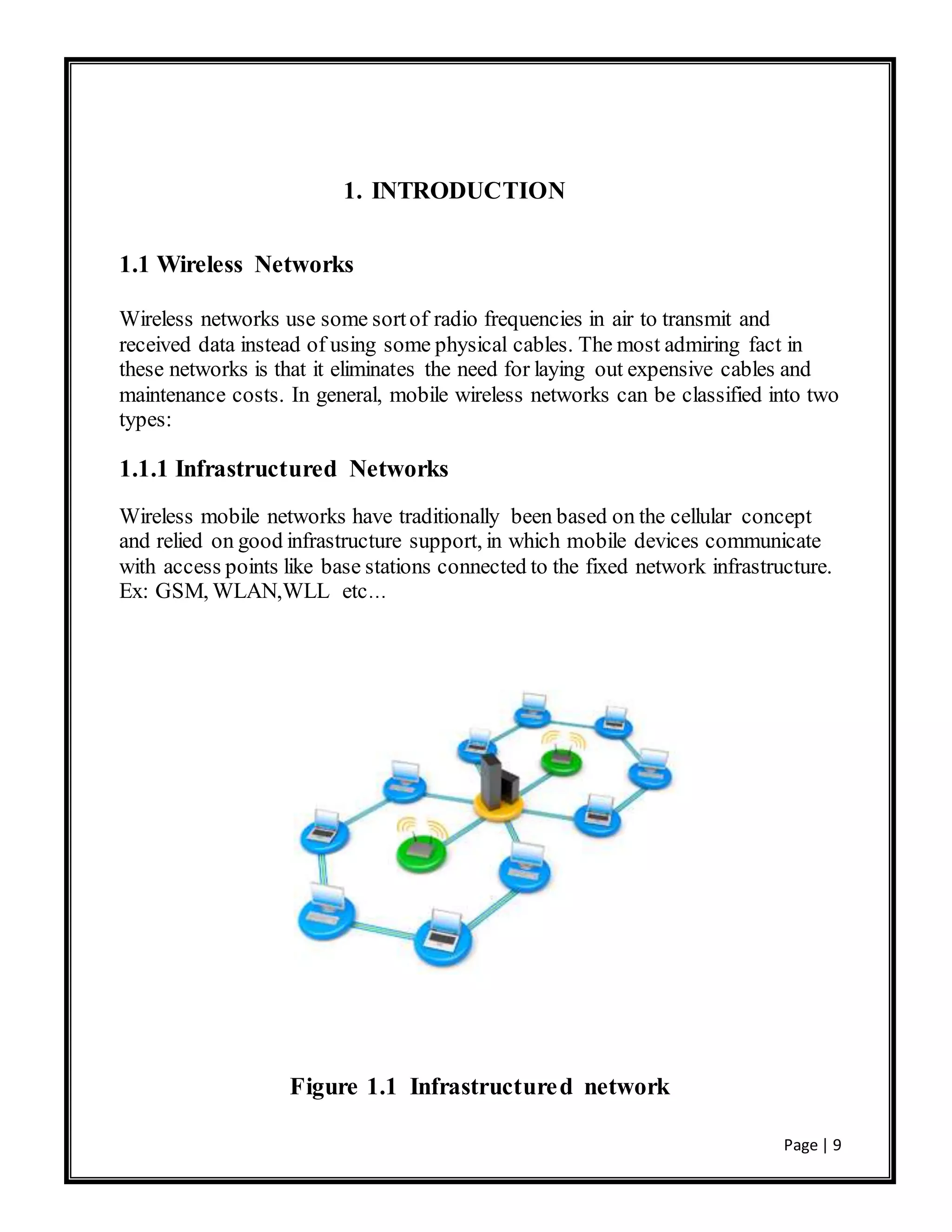
Figure 1.1: Infrastructured Network
Figure 1.2: Infrastructure less Network
Figure 3.1: Mobile Ad-Hoc Network
Figure 3.2: Classification of Routing Protocol’s in MANETS
Figure 4.1: Flow chart of Route Discovery
Figure 4.2: Flow chart of Route Maintenance
Figure 4.3: Destination Sequenced Distance Vector Routing Table
Figure 6.1: NAM file output of AODV
Figure 6.2: Trace File output of AODV
Figure 6.3: NAM file output of DSDV
Figure 6.4: Trace File output of DSDV
Figure 7.2.1: Xgraph for Throughput
Figure 7.2.2: Xgraph for Packet Delivery Ratio
Figure 7.2.3: Xgraph for End-to-End Delay
Figure 7.2.4: Xgraph for Routing Overhead
Page | 9
1. INTRODUCTION
1.1 Wireless Networks
Wireless networks use some sortof radio frequencies in air to transmit and
received data instead of using some physical cables. The most admiring fact in
these networks is that it eliminates the need for laying out expensive cables and
maintenance costs. In general, mobile wireless networks can be classified into two
types:
1.1.1 Infrastructured Networks
Wireless mobile networks have traditionally been based on the cellular concept
and relied on good infrastructure support, in which mobile devices communicate
with access points like base stations connected to the fixed network infrastructure.
Ex: GSM, WLAN,WLL etc…
Figure 1.1 Infrastructured network
Page | 10
1.1.2 Infrastructure less mobile network (Ad-hoc networks)
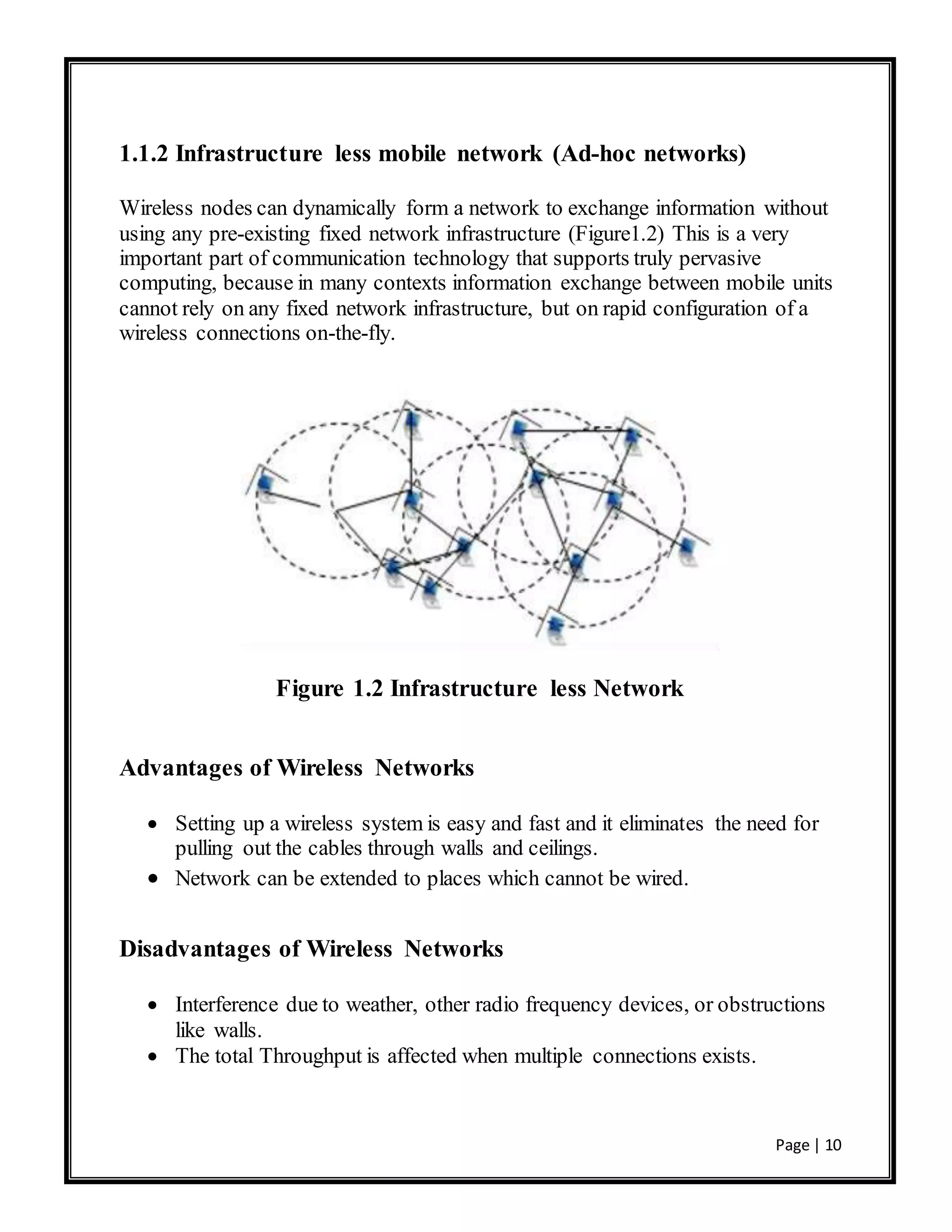
Wireless nodes can dynamically form a network to exchange information without
using any pre-existing fixed network infrastructure (Figure1.2) This is a very
important part of communication technology that supports truly pervasive
computing, because in many contexts information exchange between mobile units
cannot rely on any fixed network infrastructure, but on rapid configuration of a
wireless connections on-the-fly.
Figure 1.2 Infrastructure less Network
Advantages of Wireless Networks
 Setting up a wireless system is easy and fast and it eliminates the need for
pulling out the cables through walls and ceilings.
 Network can be extended to places which cannot be wired.
Disadvantages of Wireless Networks
 Interference due to weather, other radio frequency devices, or obstructions
like walls.
 The total Throughput is affected when multiple connections exists.
Page | 11
1.2 Problems in Wireless communications
Some of the problems related to wireless communication are multipath
propagation, path loss, interference, and limited frequency spectrum. Multipath
Propagation is, when a signal travels from its source to destination, in between
there are obstacles which make the signal propagate in paths beyond the direct
line of sight due to reflections, refraction and diffraction and scattering. Path loss
is the attenuation of the transmitted signal strength as it propagates away from the
sender. Path loss can be determined as the ratio between the powers of the
transmitted signal to the receiver signal. This is mainly dependent on a number of
factors such as radio frequency and the nature of the terrain. It is sometimes
important to estimate the path loss in wireless communication networks.
Due to the radio frequency and the nature of the terrain are not same
everywhere, it is hard to estimate the path loss during communication. During
communication a number of signals in the atmosphere may interfere with each
other resulting in the destruction of the original signal. Limited Frequency
Spectrum is where, frequency bands are shared by many wireless technologies and
not by one single wireless technology.
2. Problem Statement
Comparative Performance Analysis of Ad-hoc On Demand Distance Vector and
Destination Sequenced Distance Vector Routing Protocols forMANETS using
NS-2 under different Network Sizes based on Throughput, Packet Delivery Ratio,
End to End Delay, Routing Overhead performance metrics
Page | 12
3. Review of Literature
3.1 MANETS Overview
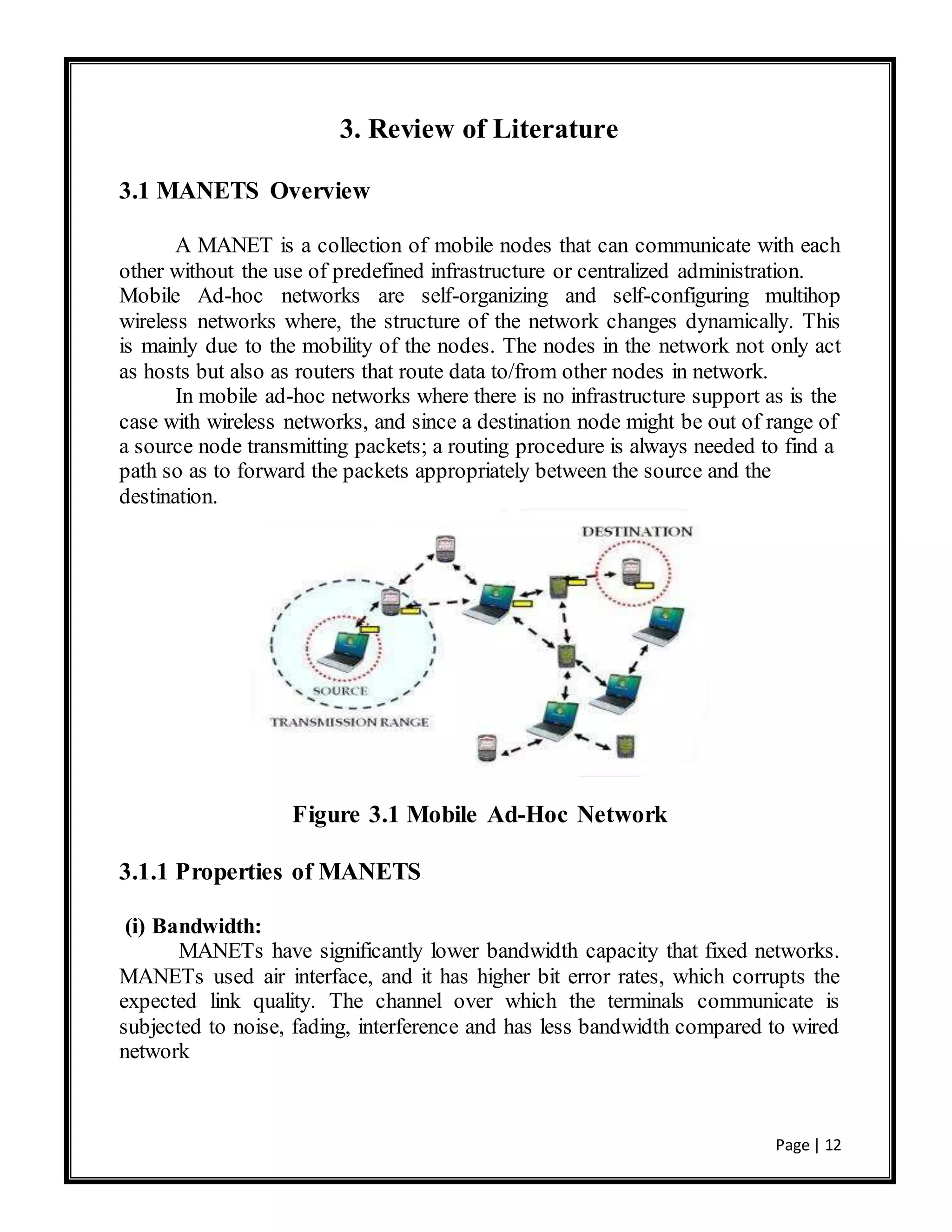
A MANET is a collection of mobile nodes that can communicate with each
other without the use of predefined infrastructure or centralized administration.
Mobile Ad-hoc networks are self-organizing and self-configuring multihop
wireless networks where, the structure of the network changes dynamically. This
is mainly due to the mobility of the nodes. The nodes in the network not only act
as hosts but also as routers that route data to/from other nodes in network.
In mobile ad-hoc networks where there is no infrastructure support as is the
case with wireless networks, and since a destination node might be out of range of
a source node transmitting packets; a routing procedure is always needed to find a
path so as to forward the packets appropriately between the source and the
destination.
Figure 3.1 Mobile Ad-Hoc Network
3.1.1 Properties of MANETS
(i) Bandwidth:
MANETs have significantly lower bandwidth capacity that fixed networks.
MANETs used air interface, and it has higher bit error rates, which corrupts the
expected link quality. The channel over which the terminals communicate is
subjected to noise, fading, interference and has less bandwidth compared to wired
network
Page | 13
(ii) Dynamic Topology:
Due to mobility of nodes, topology changes continuously and
unpredictably. Link connectivity among terminals of network varies in arbitrary
manner. It is also subjected to frequent disconnection during node’s mobility.
Mobile nodes in the network dynamic all establish routing among themselves as
they move about, forming their own network.
(iii) Energy:
All mobile devices will get their energy from batteries, which is a scarce
resource. Therefore, energy conservation plays an important role in MANETs. So,
this important resource has to be utilized very efficiently. One of the most
important system design criteria for optimization may be energy conservation.
(iv) Security:
Nodes and the information in MANETs are exposed to the same threats like
in other networks. Higher security risks may occur in mobility than static
operation because portable devices may be stolen or their traffic may insecurely
cross wireless links. Eavesdropping, spoofing and denial of service attacks should
be considered.
3.1.2 Applications of MANETS
(i) Crisis Management Applications
These arise, for example, as a result of natural disasters where the entire
communications infrastructure is in disorder. Restoring communications quickly
is essential. By using ad hoc networks, a communication channel could be set up
in hours instead of days/weeks required for wire-line communications.
(ii) Military Battlefield:
The modern digital battlefield demands robust and reliable communication
in many forms. At times when wireless base station is destroyed by enemy, a
soldier will be prohibited from communicating with other soldiers if the called
party is not within the radio range. This is the scenario where mobile ad hoc
networks come into play.
Page | 14
3.2 Routing in MANETS
3.2.1 Routing
Routing is the act of moving information from a sourceto a destination in
an internetwork. The routing conceptbasically involves, two activities: firstly,
determining optimal routing paths and secondly, transferring the information
groups (called packets) through an internetwork.
Routing protocols use several metrics to calculate the best path for routing
the packets to its destination. These metrics are a standard measurement that could
be number of hops, which is used by the routing algorithm to determine the
optimal path for the packet to its destination. The process ofpath determination is
that, routing algorithms initialize and maintain routing tables, which contain the
total route information for the packet. This route information varies from one
routing algorithm to another.
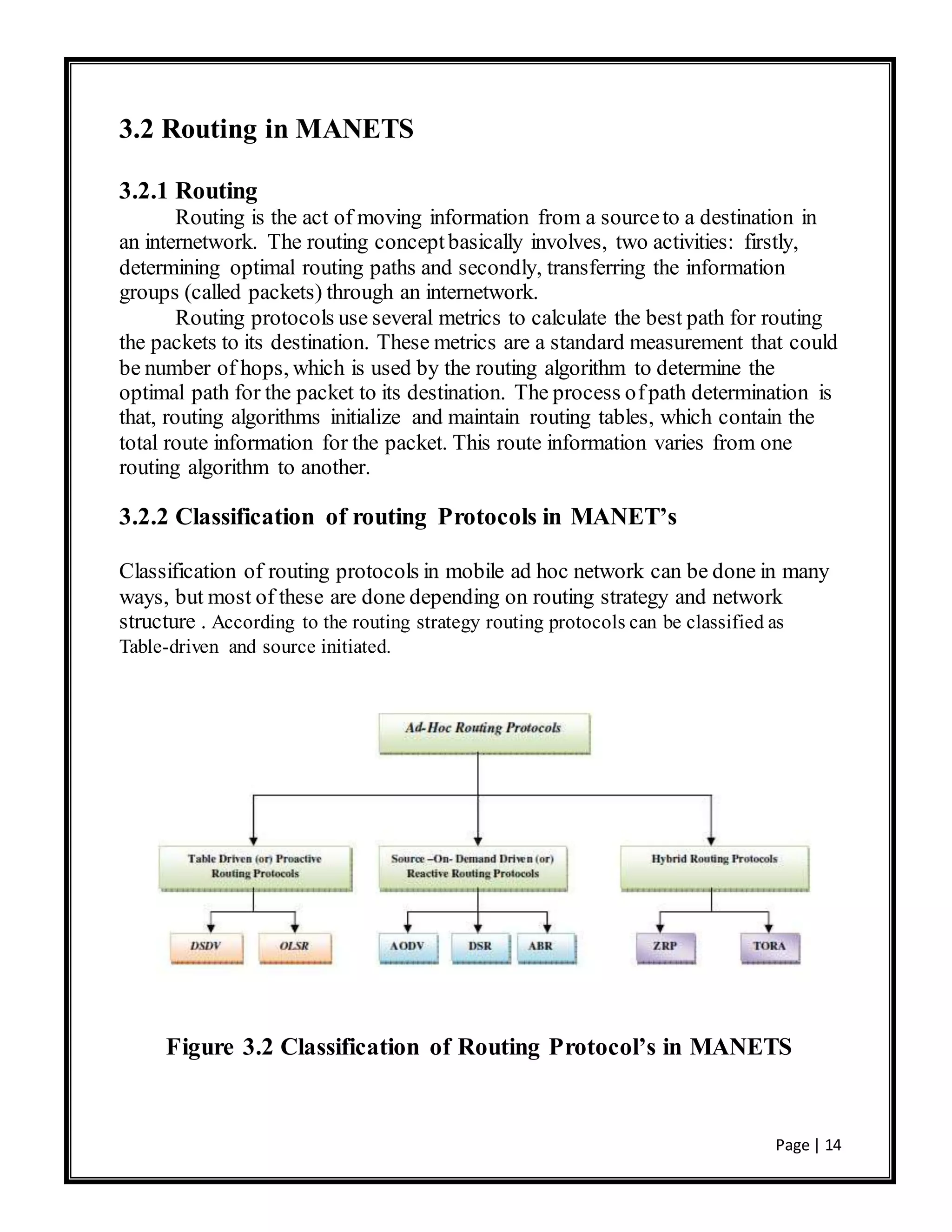
3.2.2 Classification of routing Protocols in MANET’s
Classification of routing protocols in mobile ad hoc network can be done in many
ways, but most of these are done depending on routing strategy and network
structure . According to the routing strategy routing protocols can be classified as
Table-driven and source initiated.
Figure 3.2 Classification of Routing Protocol’s in MANETS
Page | 15
(i) Proactive routing protocols
Proactive protocols are also called as Table-driven protocols and will
actively determine the layout of the network. In table driven routing protocols,
consistent and up-t o-date routing information to all nodes is maintained at each
node.
Examples of Proactive protocols
 Destination Sequenced Distance Vector (DSDV)
 Optimized Link Source Routing (OLSR)
(ii) Reactive routing protocols
Reactive protocols are also called as On-Demand routing protocols. In On-
Demand routing protocols, the routes are created as and when required or on
demand. In these protocols route discovery mechanisms to find the path to the
destination.
Examples of Reactive protocols
 Ad hoc On Demand Distance Vector (AODV)
 Dynamic Source Routing Protocol (DSR)
 Temporally Ordered Routing Algorithm (TORA)
(Iii) Hybrid Routing Protocol:
Since proactive and reactive protocols each work best in oppositely
different scenarios, hybrid method uses both. It is used to find a balance between
both protocols. Proactive operations are restricted to small domain, whereas,
reactive protocols are used for locating nodes outside those domains
Examples of Reactive protocols
 Zone Routing Protocol (ZRP)
 Wireless Ad hoc Routing Protocol (WARP)
Page | 16
4. Stimulation Study
4.1 Ad-hoc on demand Distance Vector Protocol (AODV)
AODV is reactive routing protocol. In this route is discovered or maintain
according to node request. For loop freedom and freshness of route, AODV uses
destination sequence number. It is capable for both unicast and multicast routing.
Mobile nodes respond to the any change in network topology and link failures
in necessary times. In case of the link failures the respective defective nodes are
notified with the message, and then the affected nodes will revoke the routes using
the lost link. AODV uses the message types Route Request (RREQ), Route
Replies (RREP) and Route Error (RERR) in finding the route from source to
destination. AODV performs two operations: (1) Route discovery and (2) Route
maintenance (3) Route Caching.
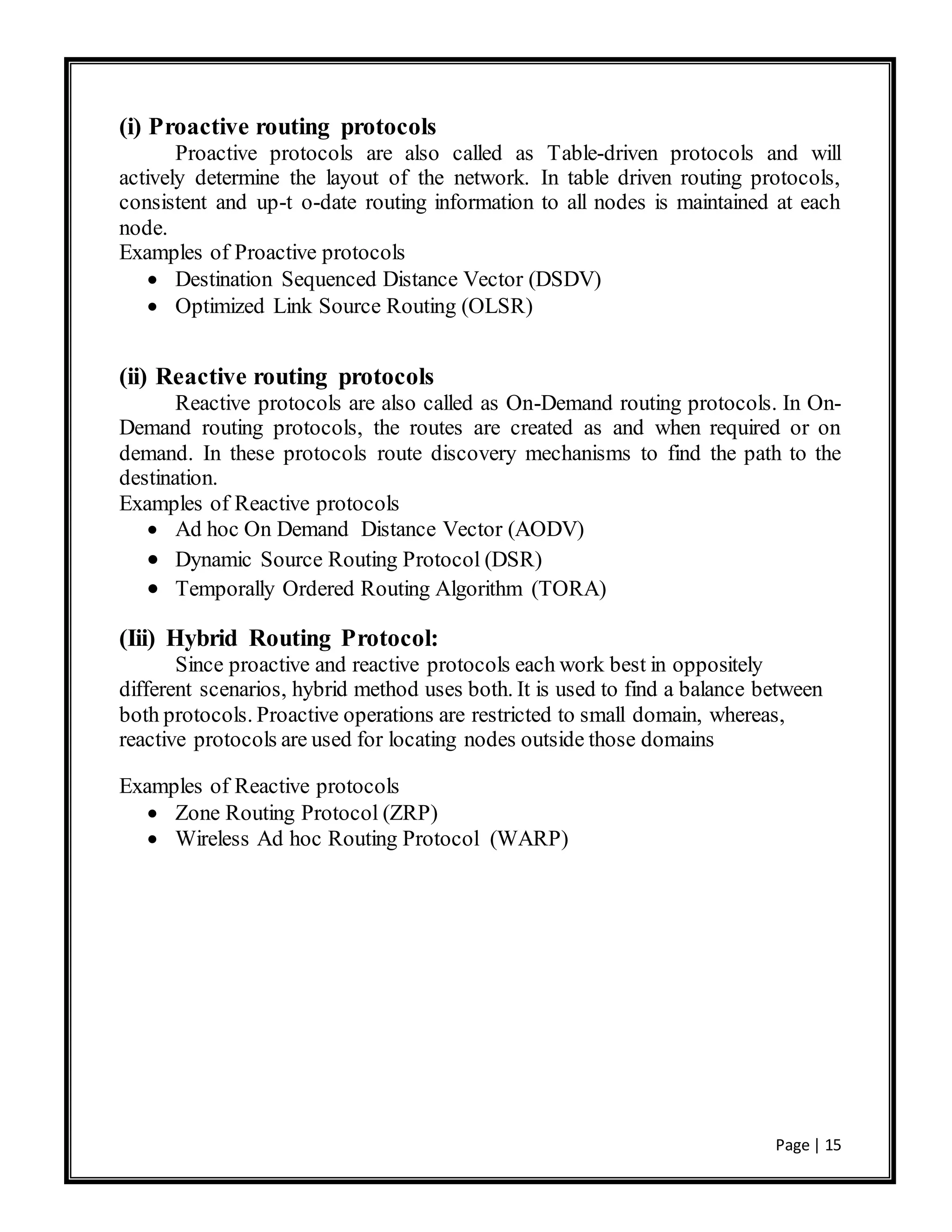
4.1.1 Route Discovery
In AODV routing, when a source has data to transmit to a new destination,
it broadcasta RREQ for that destination. A neighbor’s node receiving the RREQ
checks if it has not received the same request before using the ROUTE-ID. It is
not the destination and does not have a current route to the destination, it
rebroadcasts the RREQ and at same time backward route to the sourceis created.
If the receiving node is the destination or has a current route to the destination, it
generates a RREP. The RREP propagates; each intermediate node creates a route
to the destination. When the sourcereceives the RREP, it records the forward
route to the destination and begins sending data.
Page | 17
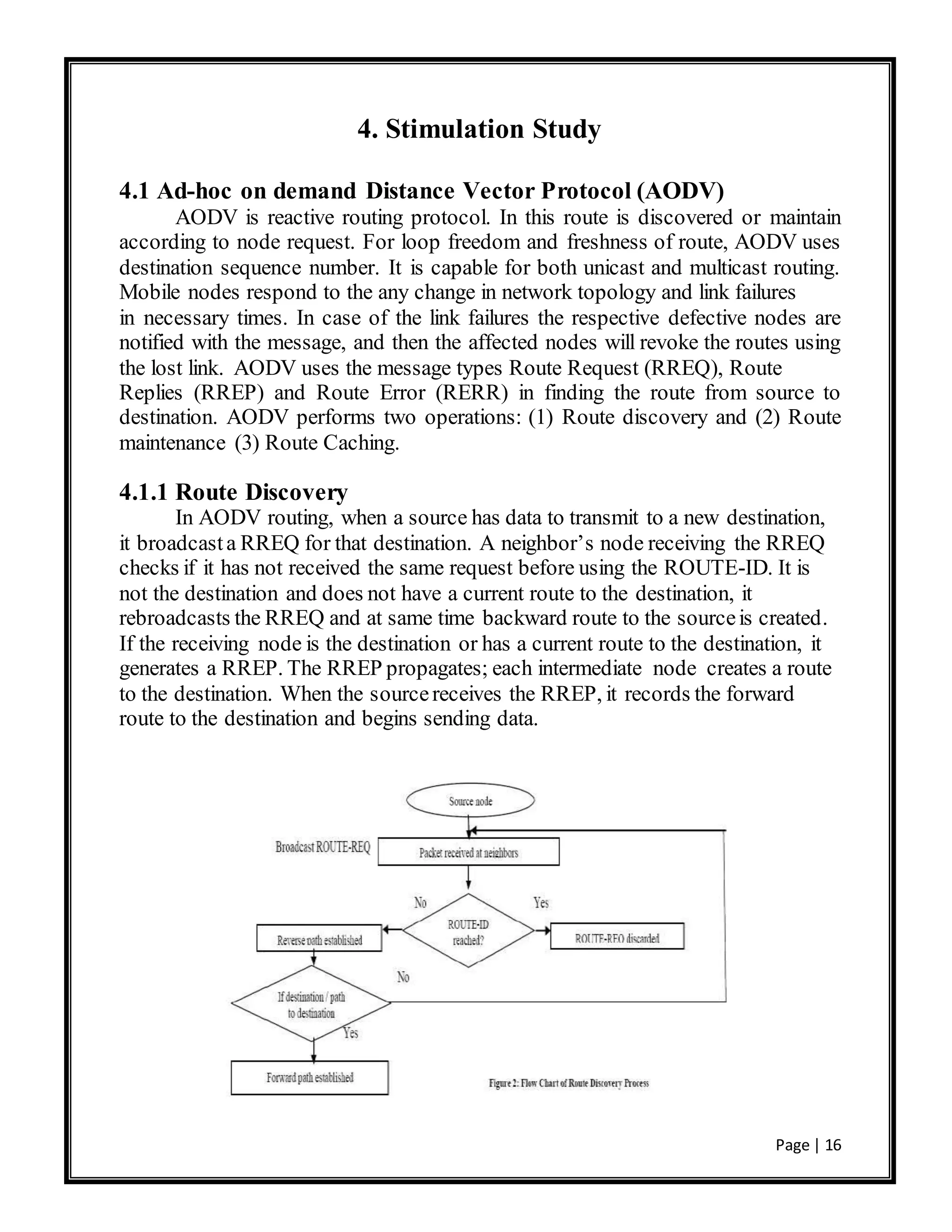
4.1.2 Route Maintenance
Once the route is established, a route maintenance protocol provides
feedback about the links of the route and to allow the route to be modified
maintenance of the discovered / established route is necessary for two main
advantages: Achieve stability in the network. (2) To reduce the excessive
overhead required in discovering new route.
Figure 4.2 Flow Chart of Route Maintenance
4.1.3 Route Caching
Route caching is carried out for two purposes:
 A cached route is available to the demanding node to reducing the routing
latency significantly.
 Route caching avoids route discovery process forreduces the control
Page | 18
4.2 Destination Sequenced Distance Vector (DSDV)
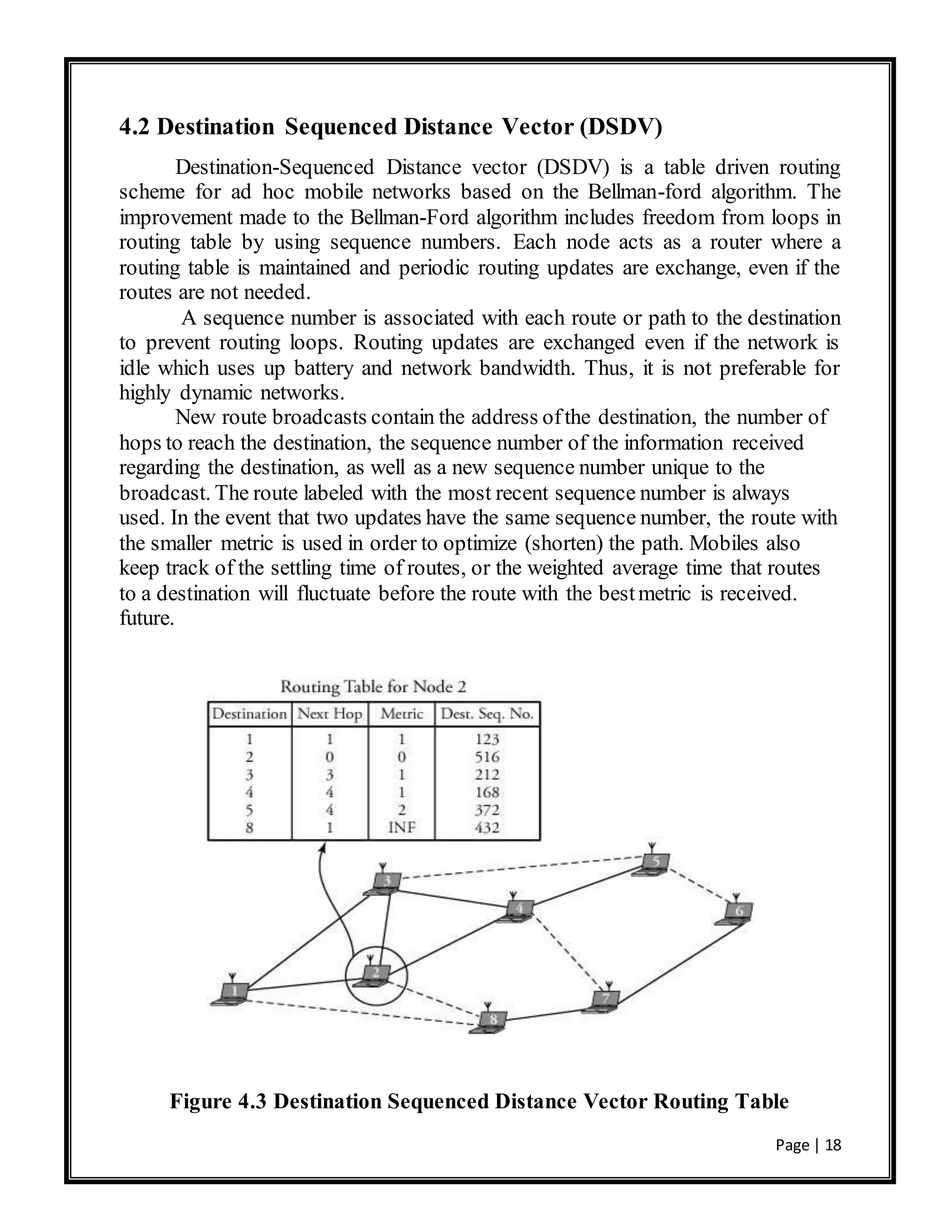
Destination-Sequenced Distance vector (DSDV) is a table driven routing
scheme for ad hoc mobile networks based on the Bellman-ford algorithm. The
improvement made to the Bellman-Ford algorithm includes freedom from loops in
routing table by using sequence numbers. Each node acts as a router where a
routing table is maintained and periodic routing updates are exchange, even if the
routes are not needed.
A sequence number is associated with each route or path to the destination
to prevent routing loops. Routing updates are exchanged even if the network is
idle which uses up battery and network bandwidth. Thus, it is not preferable for
highly dynamic networks.
New route broadcasts contain the address ofthe destination, the number of
hops to reach the destination, the sequence number of the information received
regarding the destination, as well as a new sequence number unique to the
broadcast. The route labeled with the most recent sequence number is always
used. In the event that two updates have the same sequence number, the route with
the smaller metric is used in order to optimize (shorten) the path. Mobiles also
keep track of the settling time of routes, or the weighted average time that routes
to a destination will fluctuate before the route with the bestmetric is received.
future.
Figure 4.3 Destination Sequenced Distance Vector Routing Table
Page | 19
5. Network Simulator
AODV and DSDV routing protocols can be implemented using Network
Simulator 2. NS is a discrete event simulator targeted at networking research. It
provides substantial support for TCP routing and multicast protocols over wired
and wireless networks. Using Xgraph (A plotting program) we can create
graphical representation of simulation results. All the work is done under Linux
platform, preferably Ubuntu.
5.1 About NS-2:
NS is an object oriented simulator, written in C++, with an OTcl interpreter
as a frontend. NS uses two languages because simulator has two different kinds of
things it needs to do. On one hand, detailed simulations of protocols require a
systems programming language which can efficiently manipulate bytes, packet
headers, and implement algorithms that run over large data sets. For these tasks
run-time speed is important and turn-around time (run simulation, find bug, fix
bug, recompile, re-run) is less important.
On the other hand, a large part of network research involves slightly
varying parameters or configurations, or quickly exploring a number of scenarios.
In these cases, iteration time (change the model and re-run) is more important.
Since configuration runs once (at the beginning of the simulation), run-time of this
part of the task is less important.
NS meets both of these needs with two languages, C++ and OTcl. C++ is
fast to run but slower to change, making it suitable for detailed protocol
implementation. OTcl runs much slower but can be changed very quickly (and
interactively), making it ideal for simulation configuration.
In NS-2, the frontend of the program is written in TCL(Tool Command
Language). The backend of NS-2 simulator is written in C++ and when the tcl
program is compiled, a trace file and nam file are created which define the
movement pattern of the nodes and keeps track of the number of packets sent,
number of hops between 2 nodes, connection type etc at each instance of time.
Page | 20
5.2 Defining Global Variables:
set ns_ [new Simulator] #creates a new simulator instance
set topo [new Topography] #creates a new topology
$topo load_flatgrid 670 670 #defines it in 670X670 area
Here set command is used to create a global variable. The first argument is the
variable name (ns_, topo, etc.). the second argument is used to get the value of the
variable.
5.3 Defining Standard NS/NAM Trace:
To run the output of the program in an animator we need a nam file, and to
analyze the output we need trace file. So the program must output certain files
called nam file and trace file. We can do so by the following commands:
Set tracefd [open demo.tr w]
$ns_ trace-all $tracefd
Set namtrace [open demo.nam w]
$ns_ namtrace-all-wireless $namtrace 670 670
5.4 Mobile Node Configuration:
We can configure a mobile node by following codes.
$ns_node-config -adhocRouting DSDV
-llType LL 
-macType Mac/802_11
-ifqLen 50 
-ifqType Queue/DropTail/PriQueue 
-antType Antenna/OmniAntenna 
-propType Propagation/TwoRayGround 
-phyType Phy/WirelessPhy  20
Page | 21
6. Simulation Design
Initializing the routing protocol within a TCL file as inputs in association of
particular traffic and movement files, the NS-2 simulates accordingly. Ultimately,
as a result, it generates two files i.e. Network Animator File (*.nam) and a Trace
files (*.tr) as the outputs.
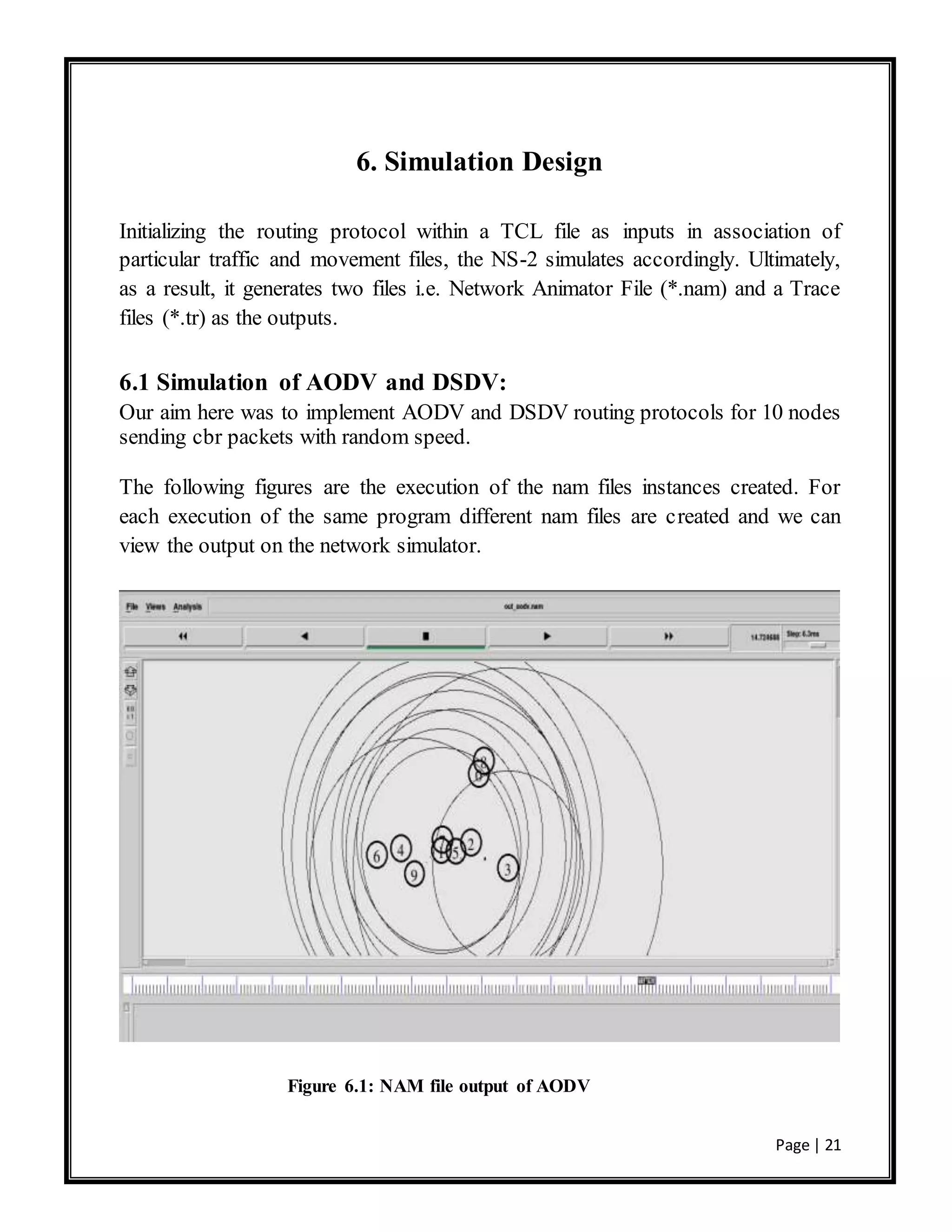
6.1 Simulation of AODV and DSDV:
Our aim here was to implement AODV and DSDV routing protocols for 10 nodes
sending cbr packets with random speed.
The following figures are the execution of the nam files instances created. For
each execution of the same program different nam files are created and we can
view the output on the network simulator.
Figure 6.1: NAM file output of AODV
Page | 22
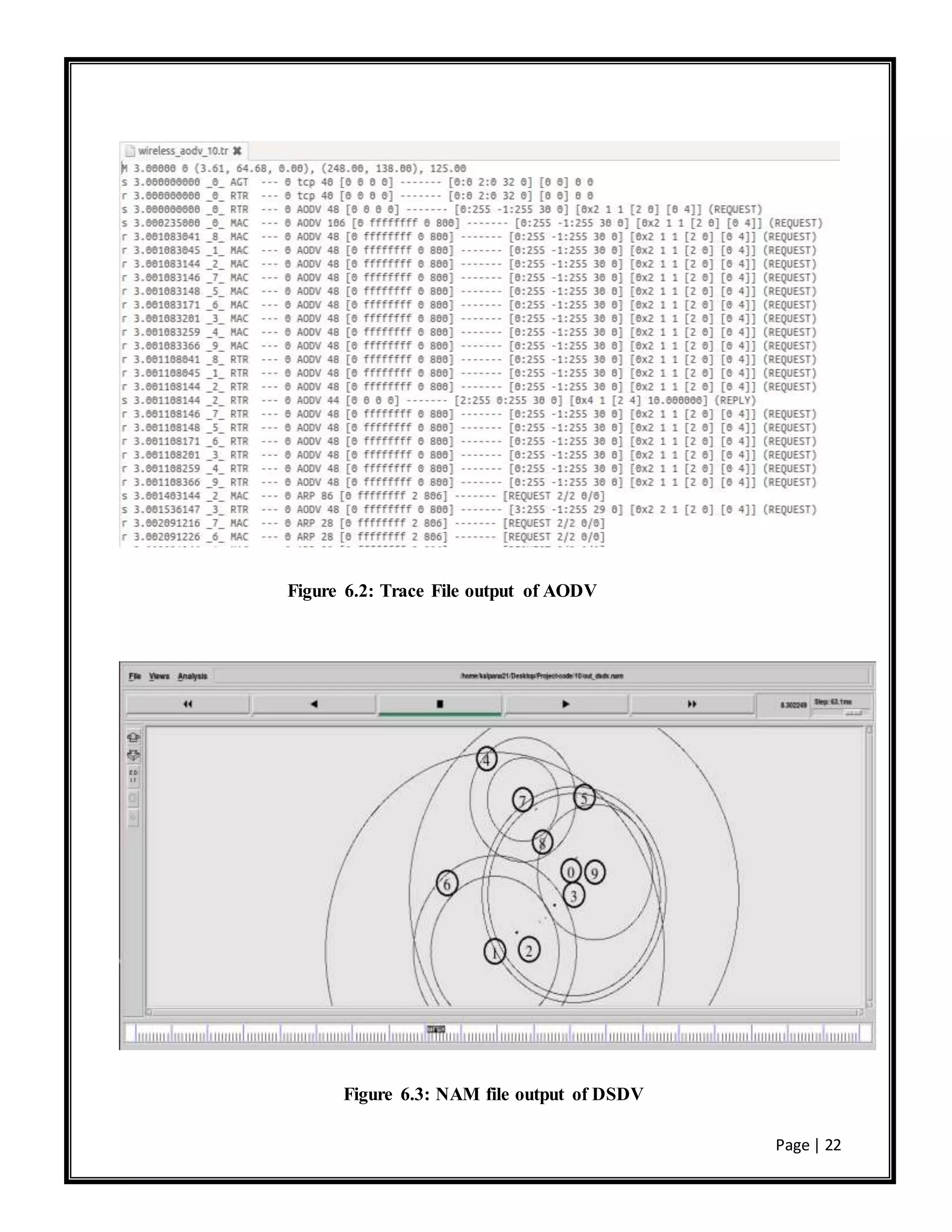
Figure 6.2: Trace File output of AODV
Figure 6.3: NAM file output of DSDV
Page | 23
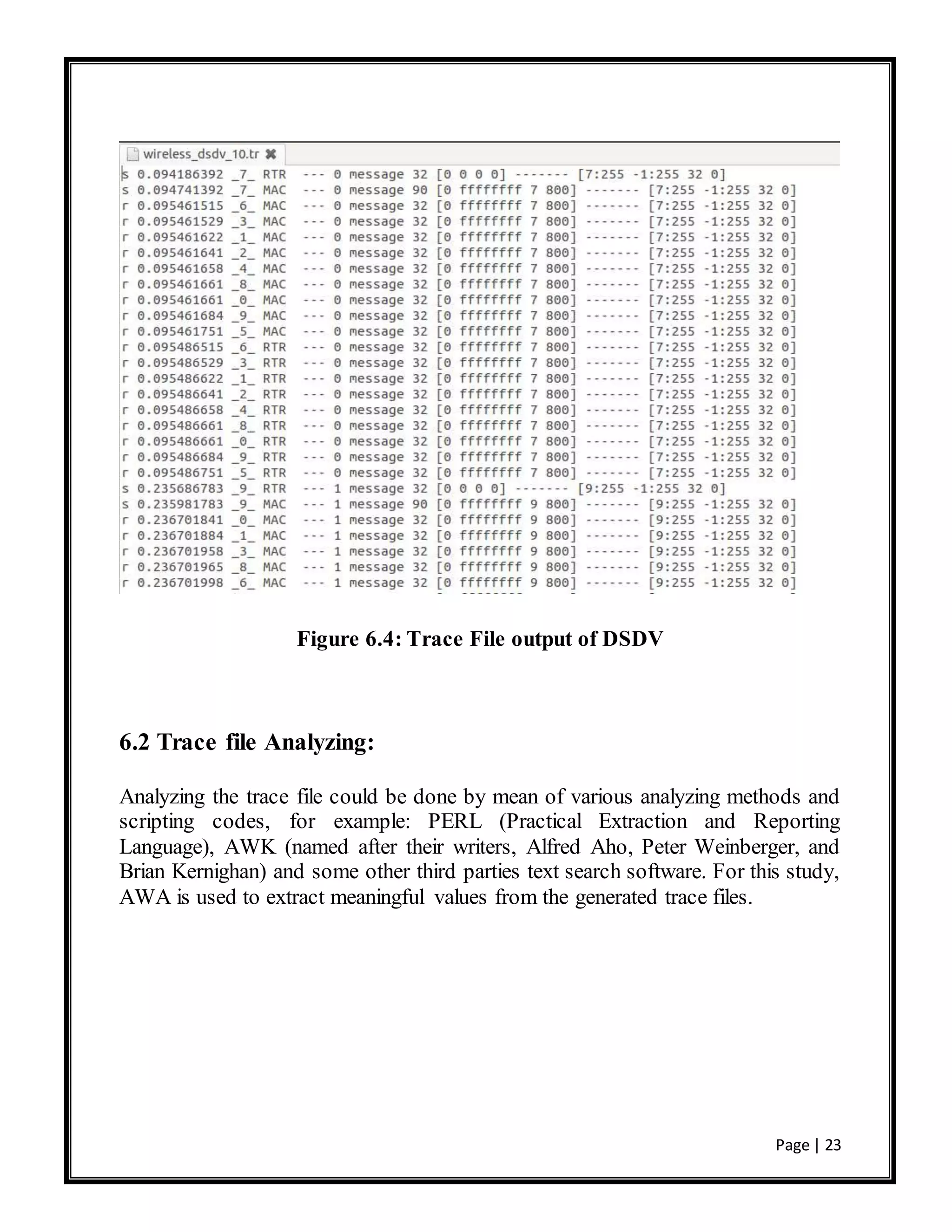
Figure 6.4: Trace File output of DSDV
6.2 Trace file Analyzing:
Analyzing the trace file could be done by mean of various analyzing methods and
scripting codes, for example: PERL (Practical Extraction and Reporting
Language), AWK (named after their writers, Alfred Aho, Peter Weinberger, and
Brian Kernighan) and some other third parties text search software. For this study,
AWA is used to extract meaningful values from the generated trace files.
Page | 24
6.3 PERFORMANCE METRICS:
For MANET simulation, there are many performance metrics which are used to
analysis the various proposals. In this project we have used four performance
metrics that evaluate routing protocols in all important aspects.
1) Throughput:
The ratio of the total amount of data that reaches a receiver from a
sender to the time it takes for the receiver to get the last packet is referred to
as throughput. It is measured by bits/sec or packets per second. A high
throughput network is desirable.
2) Packet Delivery Ratio:
Packet delivery ratio is the ratio of number of packets received at the
destination nodes to the number of packets sent from the source nodes. The
performance is better when packet delivery ratio is high.
3) End-to-End Delay:
End-to-end delay is the average time delay for data packets from the
source node to the destination node. To find out the end-to-end delay the
difference of packet sent and received time was stored and then dividing the
total time difference over the total number of packet received gave the
average end-to-end delay for the received packets. The performance is
better when packet end-to-end delay is low.
4) Routing Overhead:
Routing Overhead is the number of routing packets required for
network communication. The performance is better when routing overhead
is low.
Page | 25
7. Simulation Results and Comparison
7.1 Introduction to Xgraph:
Xgraph is a plotting program which can be used to create graphic
representations of simulation results. You can create output files in your Tcl
scripts, which can beused as data sets for xgraph. Call xgraph to display the results
with thecommand “xgraph <data-file>”.
7.2 Simulation Results on Xgraph:
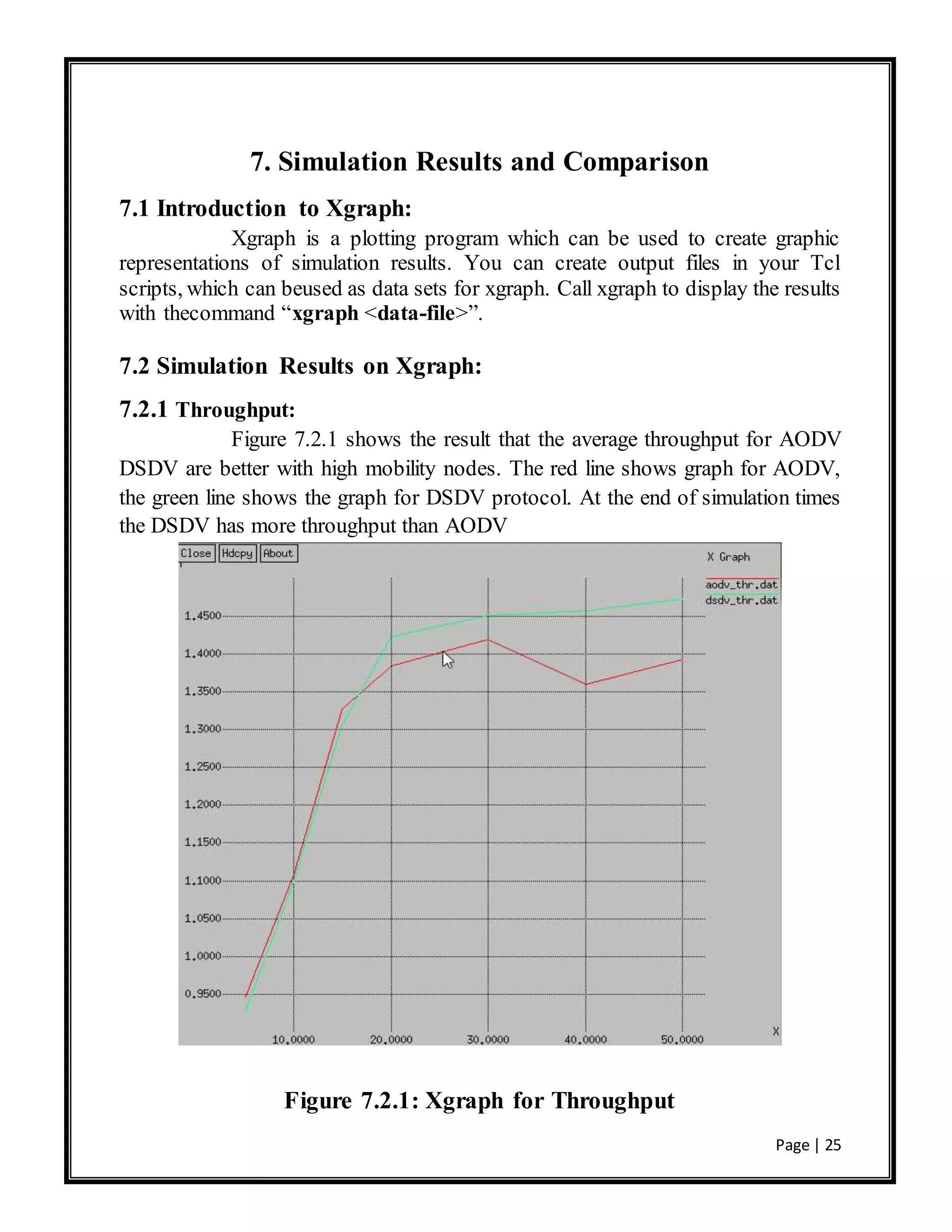
7.2.1 Throughput:
Figure 7.2.1 shows the result that the average throughput for AODV
DSDV are better with high mobility nodes. The red line shows graph for AODV,
the green line shows the graph for DSDV protocol. At the end of simulation times
the DSDV has more throughput than AODV
Figure 7.2.1: Xgraph for Throughput
Page | 26
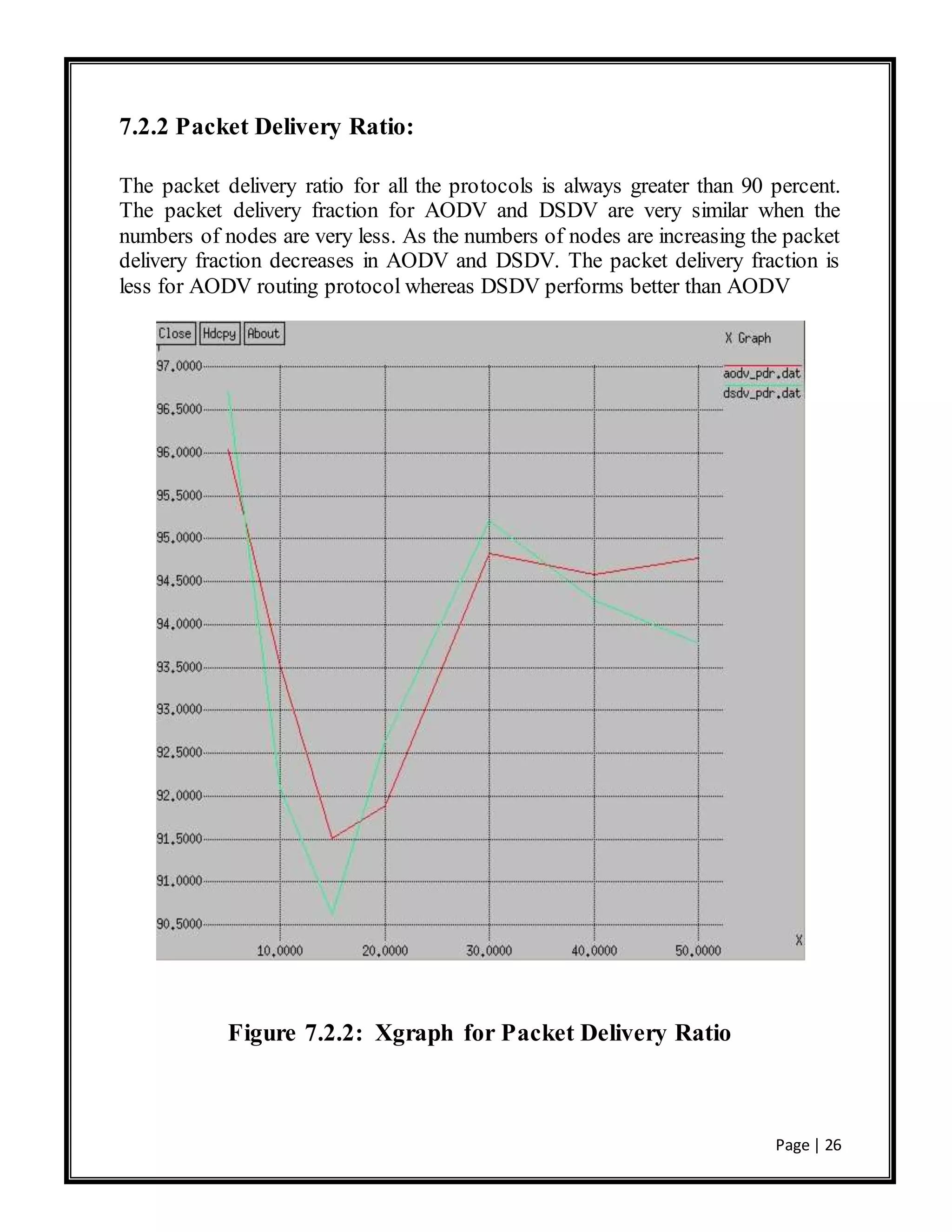
7.2.2 Packet Delivery Ratio:
The packet delivery ratio for all the protocols is always greater than 90 percent.
The packet delivery fraction for AODV and DSDV are very similar when the
numbers of nodes are very less. As the numbers of nodes are increasing the packet
delivery fraction decreases in AODV and DSDV. The packet delivery fraction is
less for AODV routing protocol whereas DSDV performs better than AODV
Figure 7.2.2: Xgraph for Packet Delivery Ratio
Page | 27
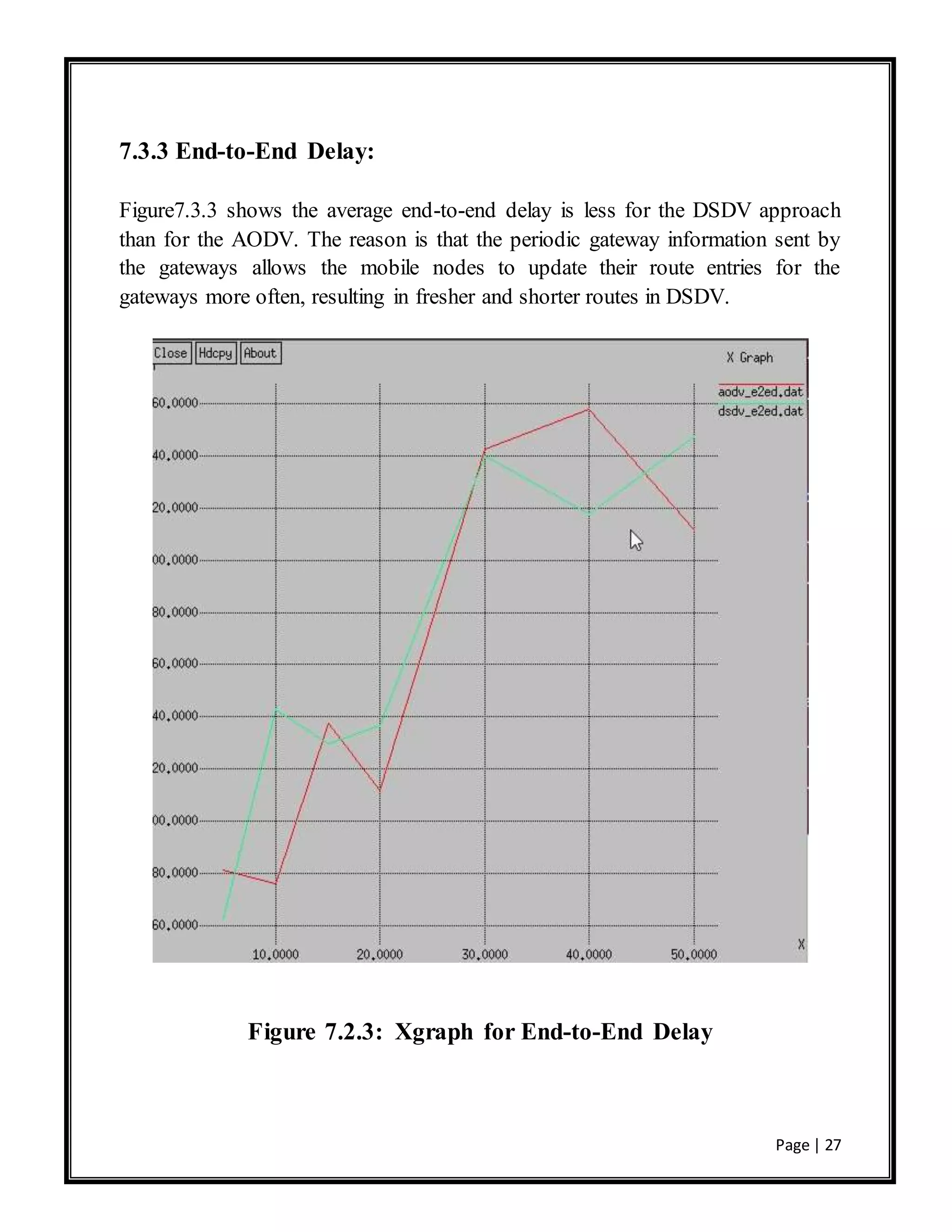
7.3.3 End-to-End Delay:
Figure7.3.3 shows the average end-to-end delay is less for the DSDV approach
than for the AODV. The reason is that the periodic gateway information sent by
the gateways allows the mobile nodes to update their route entries for the
gateways more often, resulting in fresher and shorter routes in DSDV.
Figure 7.2.3: Xgraph for End-to-End Delay
Page | 28
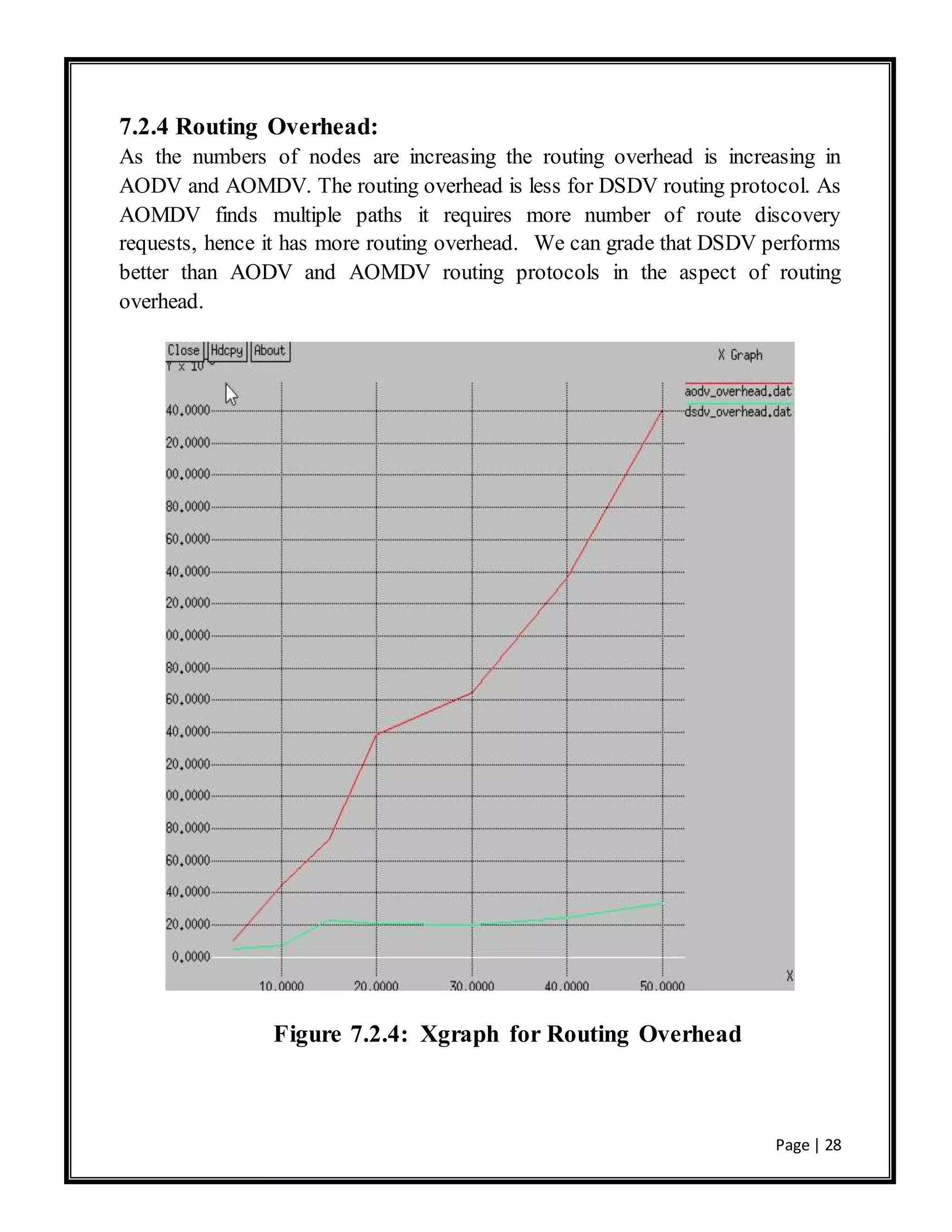
7.2.4 Routing Overhead:
As the numbers of nodes are increasing the routing overhead is increasing in
AODV and AOMDV. The routing overhead is less for DSDV routing protocol. As
AOMDV finds multiple paths it requires more number of route discovery
requests, hence it has more routing overhead. We can grade that DSDV performs
better than AODV and AOMDV routing protocols in the aspect of routing
overhead.
Figure 7.2.4: Xgraph for Routing Overhead
Page | 29
9. Conclusions
We have simulated and compared one reactive protocols AODV and one
proactive protocol i.e. DSDV in different simulation scenarios and observing their
performance in terms of four significant parameters i.e. Throughput, Packet
delivery ratio, End-to-End delay and Routing Overhead in order to find out which
one should be preferred when the mobile ad-hoc network has to be set up for the
particular duration. The whole simulation scenario consisting of minimum 5 and
maximum of 50 nodes is created by writing the OTCL script in NS-2 and
analyzing the parameters Throughput, Packet delivery ratio, End-to-End delay and
Routing Overhead with the help of generated X Graph.
By studying and analyzing the outputs appeared in X Graph we come to this
conclusion that AODV must be preferred over DSDV for the Packet delivery ratio
as it is out performed well due its ability to search for alternate routes when the
current links breaks down.
In terms of end-to-end delay, all the two protocols performs differently for
different number of nodes, but as the number of nodes are increasing the delay of
AODV is increasing compare to other.
In terms of Throughput all the two protocols have almost the same performance
for different number of nodes but if the nodes are increased throughput of DSDV
is increasing compare to AODV.
In terms of Routing Overhead DSDV must be preferred over AODV. We can
grade that DSDV performs better than AODV routing protocol in the aspect of
routing overhead.
Page | 30
9. References
1. Mina Vajed Khiavi, Shahram Jamali, Performance Comparison of AODV
and DSDV Routing Protocols in Mobile Ad Hoc Networks,International
Research Journal of Applied and Basic Sciences, 2013
2. Manjusha S. Patil Bokade, Prof. M.N.Thakare, Prof. B. J. Chilke,
Performance Evaluation of MANET Routing Protocols DSDV, DSR and
AODV for Different Mobility Models,International Journal of Application
or Innovation in Engineering & Management (IJAIEM), 2014
3. Dr. Srinivasa Rao Angajala, A New Algorithm for CR Protocols In AD-Hoc
Networks, Professor Mekapati Rajamohan Reddy Institute of Technology &
Science,[IJESAT]International Journal Of Engineering Science & Advanced
Technology, 2012
4. G. Jose Moses* D. Sunil Kumar Prof.P.Suresh Varma N.Supriya, A
Simulation Based Study of AODV, DSR, DSDV Routing Protocols in
MANET Using NS-2, International Journal of Advanced Research in
Computer Science and Software Engineering, 201

Performance Analysis of AODV and DSDV - FINAL YEAR PROJECT

  • 1.
    Page | 1 PerformanceAnalysis of AODV and DSDV Routing Protocols for MANETs in NS-2 A project report submitted in partial fulfillment of the requirement for the award of the degree of BACHELOR OF TECHNOLOGY IN COMPUTER SCIENCE & ENGINEERING by T.DHARMA (N090136) P.RAVI TEJA (N091032) G.SUSHEELA (N090462) Under the esteemed guidance of Ms. M.SAI SUDHA Lecturer in Department of Computer Science & Engineering RGUKT-NUZVID NUZVID, Krishna, Andhra Pradesh - 521202. April 2015
  • 2.
    Page | 2 APPROVALOF THE VIVA VOCE BOARD We Certified that the project work "Performance Analysis of AODV and DSDV Routing Protocols for MANETs in NS-2" submitted by T.Dharma (N090136), P.Ravi Teja(N091032), G.Susheela (N090462) to the Rajiv Gandhi University of Knowledge Technologies, Nuzvid, in partial fulfillment of the requirement for the award of the degree Bachelor of Technology in COMPUTER SCIENCE AND ENGINEERING has been accepted by the external examiners and that the students have successfully defended the project work in the viva-voce examination. DEPARTMENTOF COMPUTER SCIENCE AND ENGINEERING RAJIVGANDHI UNIVERSITYOF KNOWLEDGE TECHNOLOGIES (A.P. Government Act 18 of 2008) Nuzvid, Krishna, Andhra Pradesh – 521202. Phone : 08656-234147; Telefax: 08656 – 235150 ProjectGuide Ms. M. Sai Sudha Faculty-Department of CSE RGUKT-Nuzvid External Examiner Ms. Kalpana Gangwar Faculty-Department of CSE RGUKT-Nuzvid
  • 3.
    Page | 3 CERTIFICATE Thisis to certify that the project entitled “Performance Analysis of AODV & DSDV Routing Protocols for MANETs in NS-2” is a record of bonafied work carried out by T.Dharma (N090136), P.RaviTeja (N091032), G.Susheela (N090462) under my guidance and supervision for the partial fulfillment of the degree of Bachelor of Technology in Computer Science and Engineering during the academic session August 2014 – May 2015 at RGUKT – Nuzvid. To the best of my knowledge, the results embodied in this dissertation work have not been submitted to any university or institute for the award of any degree or diploma. . DEPARTMENTOF COMPUTER SCIENCE AND ENGINEERING RAJIVGANDHI UNIVERSITYOF KNOWLEDGE TECHNOLOGIES (A.P. Government Act 18 of 2008) Nuzvid, Krishna, Andhra Pradesh – 521202. Phone : 08656-234147; Telefax: 08656 – 235150 Project Guide Ms. M.Sai Sudha Lecturer-Department of CSE RGUKT-Nuzvid Head of Department Mrs. D.V. Nagarjuna Devi Lecturer-Department of CSE RGUKT-Nuzvid
  • 4.
    Page | 4 ACKNOWLEDGEMENT Wetake this opportunity to acknowledge the co-operation, good will and both moral and technical support extended by several individuals out of which this project has evolved. We always cherish our association with them. We express our sincere and deepest regards to our guide Ms. M.Sai Sudha for her valued guidance during this period of our major project at RGUKT NUZVID. We owe a great many thanks to Ms. M.Sai Sudha for spending her valuable hours to review and analyze our project at every stage. We considered ourselves extremely fortunate to have this opportunity of associating with her. We express our sincere thanks to the head of the department (CSE) and the members of Department of Computer Science and Engineering, RGUKT-NUZVID for their cooperation. Finally we would like to thank all the people associated with us in the evolvement of our project and for helping us in their own way and contributing in the completion of Project.
  • 5.
    Page | 5 DECLARATION Ihereby declare that the work entitled “Performance Analysis of AODV and DSDV Routing Protocols for MANETs in NS-2” submitted to RGUKT Nuzvid is a record of an original work done by us under the guidance of Ms. M.Sai Sudha and this project work is submitted in the partial fulfillment of the requirement for award of Bachelor of Technology in Computer Science and Engineering. The results embodied in this project have not been submitted to any other institute for the award of any degree. T.Dharma (ID No: N090136) P.Ravi Teja (ID No: N091032) G.Susheela (ID No: N090462)
  • 6.
    Page | 6 ABSTRACT TheMobile Ad hoc Networks (MANET) is a set of wireless mobile nodes dynamically form spontaneous network which works without centralized administration. Due to this characteristic, there are some challenges that protocol designers and network developers are faced with. These challenges include routing, service and frequently topology changes. Therefore routing discovery and maintenance are critical issues in these networks. There are also limited battery power and low bandwidth available in each node. In this project the problem of routing is considered. And we compare AODV and DSDV routing protocols, which are used for efficient routing under different scenarios in Mobile Ad-hoc Network (MANET), which plays a critical role in places where wired network are neither available nor economical to deploy. Our objective was to implement the three routing protocols using Network Simulators and run it for different number of nodes. Then we compared the three routing protocols for different network parameters and studied the efficient protocol under a particular scenario on the basis of four metrics. (1) Throughput (2) End to End delay (3) Routing overhead (4) Packet delivery ratio
  • 7.
    Page | 7 TABLEOF CONTENTS Acknowledgement 4 Abstract 6 Table of Contents: 7 List of Figures: 8 1. Introduction 9 1.1 Wireless Networks 10 1.2 Problems in Wireless Networks 11 2. Problem Statement 11 3. Review of Literature 12 3.1 Manets Overview 12 3.2 Routing in Manets 14 4. Stimulation Study 16 4.1 Ad Hoc On-Demand Distance Vector (AODV) routing protocol 16 4.2 Destination Sequenced Distance Vector (DSDV) routing protocol 17 5. Network Simulator 19 5.1 About NS2 19 5.2 Defining global variables 20 5.3 Defining standard ns/nam trace 20 5.4 Mobile node configuration 20 6. Simulation design 21 6.1 Simulation of AODV and DSDV 21 6.2 Performance Metrics 24 7. Simulation results and comparisons 25 7.1 Introduction to Xgraph 25 7.2 Simulation Results on Xgraph 25 7.2.1 Throughput 25 7.2.2 Packet Delivery Ratio 26 7.2.3 End-to-End Delay 27 7.2.4 Routing Overhead 28
  • 8.
    Page | 8 8.Conclusions 29 9. References 30 List Of Figures Figure 1.1: Infrastructured Network Figure 1.2: Infrastructure less Network Figure 3.1: Mobile Ad-Hoc Network Figure 3.2: Classification of Routing Protocol’s in MANETS Figure 4.1: Flow chart of Route Discovery Figure 4.2: Flow chart of Route Maintenance Figure 4.3: Destination Sequenced Distance Vector Routing Table Figure 6.1: NAM file output of AODV Figure 6.2: Trace File output of AODV Figure 6.3: NAM file output of DSDV Figure 6.4: Trace File output of DSDV Figure 7.2.1: Xgraph for Throughput Figure 7.2.2: Xgraph for Packet Delivery Ratio Figure 7.2.3: Xgraph for End-to-End Delay Figure 7.2.4: Xgraph for Routing Overhead
  • 9.
    Page | 9 1.INTRODUCTION 1.1 Wireless Networks Wireless networks use some sortof radio frequencies in air to transmit and received data instead of using some physical cables. The most admiring fact in these networks is that it eliminates the need for laying out expensive cables and maintenance costs. In general, mobile wireless networks can be classified into two types: 1.1.1 Infrastructured Networks Wireless mobile networks have traditionally been based on the cellular concept and relied on good infrastructure support, in which mobile devices communicate with access points like base stations connected to the fixed network infrastructure. Ex: GSM, WLAN,WLL etc… Figure 1.1 Infrastructured network
  • 10.
    Page | 10 1.1.2Infrastructure less mobile network (Ad-hoc networks) Wireless nodes can dynamically form a network to exchange information without using any pre-existing fixed network infrastructure (Figure1.2) This is a very important part of communication technology that supports truly pervasive computing, because in many contexts information exchange between mobile units cannot rely on any fixed network infrastructure, but on rapid configuration of a wireless connections on-the-fly. Figure 1.2 Infrastructure less Network Advantages of Wireless Networks  Setting up a wireless system is easy and fast and it eliminates the need for pulling out the cables through walls and ceilings.  Network can be extended to places which cannot be wired. Disadvantages of Wireless Networks  Interference due to weather, other radio frequency devices, or obstructions like walls.  The total Throughput is affected when multiple connections exists.
  • 11.
    Page | 11 1.2Problems in Wireless communications Some of the problems related to wireless communication are multipath propagation, path loss, interference, and limited frequency spectrum. Multipath Propagation is, when a signal travels from its source to destination, in between there are obstacles which make the signal propagate in paths beyond the direct line of sight due to reflections, refraction and diffraction and scattering. Path loss is the attenuation of the transmitted signal strength as it propagates away from the sender. Path loss can be determined as the ratio between the powers of the transmitted signal to the receiver signal. This is mainly dependent on a number of factors such as radio frequency and the nature of the terrain. It is sometimes important to estimate the path loss in wireless communication networks. Due to the radio frequency and the nature of the terrain are not same everywhere, it is hard to estimate the path loss during communication. During communication a number of signals in the atmosphere may interfere with each other resulting in the destruction of the original signal. Limited Frequency Spectrum is where, frequency bands are shared by many wireless technologies and not by one single wireless technology. 2. Problem Statement Comparative Performance Analysis of Ad-hoc On Demand Distance Vector and Destination Sequenced Distance Vector Routing Protocols forMANETS using NS-2 under different Network Sizes based on Throughput, Packet Delivery Ratio, End to End Delay, Routing Overhead performance metrics
  • 12.
    Page | 12 3.Review of Literature 3.1 MANETS Overview A MANET is a collection of mobile nodes that can communicate with each other without the use of predefined infrastructure or centralized administration. Mobile Ad-hoc networks are self-organizing and self-configuring multihop wireless networks where, the structure of the network changes dynamically. This is mainly due to the mobility of the nodes. The nodes in the network not only act as hosts but also as routers that route data to/from other nodes in network. In mobile ad-hoc networks where there is no infrastructure support as is the case with wireless networks, and since a destination node might be out of range of a source node transmitting packets; a routing procedure is always needed to find a path so as to forward the packets appropriately between the source and the destination. Figure 3.1 Mobile Ad-Hoc Network 3.1.1 Properties of MANETS (i) Bandwidth: MANETs have significantly lower bandwidth capacity that fixed networks. MANETs used air interface, and it has higher bit error rates, which corrupts the expected link quality. The channel over which the terminals communicate is subjected to noise, fading, interference and has less bandwidth compared to wired network
  • 13.
    Page | 13 (ii)Dynamic Topology: Due to mobility of nodes, topology changes continuously and unpredictably. Link connectivity among terminals of network varies in arbitrary manner. It is also subjected to frequent disconnection during node’s mobility. Mobile nodes in the network dynamic all establish routing among themselves as they move about, forming their own network. (iii) Energy: All mobile devices will get their energy from batteries, which is a scarce resource. Therefore, energy conservation plays an important role in MANETs. So, this important resource has to be utilized very efficiently. One of the most important system design criteria for optimization may be energy conservation. (iv) Security: Nodes and the information in MANETs are exposed to the same threats like in other networks. Higher security risks may occur in mobility than static operation because portable devices may be stolen or their traffic may insecurely cross wireless links. Eavesdropping, spoofing and denial of service attacks should be considered. 3.1.2 Applications of MANETS (i) Crisis Management Applications These arise, for example, as a result of natural disasters where the entire communications infrastructure is in disorder. Restoring communications quickly is essential. By using ad hoc networks, a communication channel could be set up in hours instead of days/weeks required for wire-line communications. (ii) Military Battlefield: The modern digital battlefield demands robust and reliable communication in many forms. At times when wireless base station is destroyed by enemy, a soldier will be prohibited from communicating with other soldiers if the called party is not within the radio range. This is the scenario where mobile ad hoc networks come into play.
  • 14.
    Page | 14 3.2Routing in MANETS 3.2.1 Routing Routing is the act of moving information from a sourceto a destination in an internetwork. The routing conceptbasically involves, two activities: firstly, determining optimal routing paths and secondly, transferring the information groups (called packets) through an internetwork. Routing protocols use several metrics to calculate the best path for routing the packets to its destination. These metrics are a standard measurement that could be number of hops, which is used by the routing algorithm to determine the optimal path for the packet to its destination. The process ofpath determination is that, routing algorithms initialize and maintain routing tables, which contain the total route information for the packet. This route information varies from one routing algorithm to another. 3.2.2 Classification of routing Protocols in MANET’s Classification of routing protocols in mobile ad hoc network can be done in many ways, but most of these are done depending on routing strategy and network structure . According to the routing strategy routing protocols can be classified as Table-driven and source initiated. Figure 3.2 Classification of Routing Protocol’s in MANETS
  • 15.
    Page | 15 (i)Proactive routing protocols Proactive protocols are also called as Table-driven protocols and will actively determine the layout of the network. In table driven routing protocols, consistent and up-t o-date routing information to all nodes is maintained at each node. Examples of Proactive protocols  Destination Sequenced Distance Vector (DSDV)  Optimized Link Source Routing (OLSR) (ii) Reactive routing protocols Reactive protocols are also called as On-Demand routing protocols. In On- Demand routing protocols, the routes are created as and when required or on demand. In these protocols route discovery mechanisms to find the path to the destination. Examples of Reactive protocols  Ad hoc On Demand Distance Vector (AODV)  Dynamic Source Routing Protocol (DSR)  Temporally Ordered Routing Algorithm (TORA) (Iii) Hybrid Routing Protocol: Since proactive and reactive protocols each work best in oppositely different scenarios, hybrid method uses both. It is used to find a balance between both protocols. Proactive operations are restricted to small domain, whereas, reactive protocols are used for locating nodes outside those domains Examples of Reactive protocols  Zone Routing Protocol (ZRP)  Wireless Ad hoc Routing Protocol (WARP)
  • 16.
    Page | 16 4.Stimulation Study 4.1 Ad-hoc on demand Distance Vector Protocol (AODV) AODV is reactive routing protocol. In this route is discovered or maintain according to node request. For loop freedom and freshness of route, AODV uses destination sequence number. It is capable for both unicast and multicast routing. Mobile nodes respond to the any change in network topology and link failures in necessary times. In case of the link failures the respective defective nodes are notified with the message, and then the affected nodes will revoke the routes using the lost link. AODV uses the message types Route Request (RREQ), Route Replies (RREP) and Route Error (RERR) in finding the route from source to destination. AODV performs two operations: (1) Route discovery and (2) Route maintenance (3) Route Caching. 4.1.1 Route Discovery In AODV routing, when a source has data to transmit to a new destination, it broadcasta RREQ for that destination. A neighbor’s node receiving the RREQ checks if it has not received the same request before using the ROUTE-ID. It is not the destination and does not have a current route to the destination, it rebroadcasts the RREQ and at same time backward route to the sourceis created. If the receiving node is the destination or has a current route to the destination, it generates a RREP. The RREP propagates; each intermediate node creates a route to the destination. When the sourcereceives the RREP, it records the forward route to the destination and begins sending data.
  • 17.
    Page | 17 4.1.2Route Maintenance Once the route is established, a route maintenance protocol provides feedback about the links of the route and to allow the route to be modified maintenance of the discovered / established route is necessary for two main advantages: Achieve stability in the network. (2) To reduce the excessive overhead required in discovering new route. Figure 4.2 Flow Chart of Route Maintenance 4.1.3 Route Caching Route caching is carried out for two purposes:  A cached route is available to the demanding node to reducing the routing latency significantly.  Route caching avoids route discovery process forreduces the control
  • 18.
    Page | 18 4.2Destination Sequenced Distance Vector (DSDV) Destination-Sequenced Distance vector (DSDV) is a table driven routing scheme for ad hoc mobile networks based on the Bellman-ford algorithm. The improvement made to the Bellman-Ford algorithm includes freedom from loops in routing table by using sequence numbers. Each node acts as a router where a routing table is maintained and periodic routing updates are exchange, even if the routes are not needed. A sequence number is associated with each route or path to the destination to prevent routing loops. Routing updates are exchanged even if the network is idle which uses up battery and network bandwidth. Thus, it is not preferable for highly dynamic networks. New route broadcasts contain the address ofthe destination, the number of hops to reach the destination, the sequence number of the information received regarding the destination, as well as a new sequence number unique to the broadcast. The route labeled with the most recent sequence number is always used. In the event that two updates have the same sequence number, the route with the smaller metric is used in order to optimize (shorten) the path. Mobiles also keep track of the settling time of routes, or the weighted average time that routes to a destination will fluctuate before the route with the bestmetric is received. future. Figure 4.3 Destination Sequenced Distance Vector Routing Table
  • 19.
    Page | 19 5.Network Simulator AODV and DSDV routing protocols can be implemented using Network Simulator 2. NS is a discrete event simulator targeted at networking research. It provides substantial support for TCP routing and multicast protocols over wired and wireless networks. Using Xgraph (A plotting program) we can create graphical representation of simulation results. All the work is done under Linux platform, preferably Ubuntu. 5.1 About NS-2: NS is an object oriented simulator, written in C++, with an OTcl interpreter as a frontend. NS uses two languages because simulator has two different kinds of things it needs to do. On one hand, detailed simulations of protocols require a systems programming language which can efficiently manipulate bytes, packet headers, and implement algorithms that run over large data sets. For these tasks run-time speed is important and turn-around time (run simulation, find bug, fix bug, recompile, re-run) is less important. On the other hand, a large part of network research involves slightly varying parameters or configurations, or quickly exploring a number of scenarios. In these cases, iteration time (change the model and re-run) is more important. Since configuration runs once (at the beginning of the simulation), run-time of this part of the task is less important. NS meets both of these needs with two languages, C++ and OTcl. C++ is fast to run but slower to change, making it suitable for detailed protocol implementation. OTcl runs much slower but can be changed very quickly (and interactively), making it ideal for simulation configuration. In NS-2, the frontend of the program is written in TCL(Tool Command Language). The backend of NS-2 simulator is written in C++ and when the tcl program is compiled, a trace file and nam file are created which define the movement pattern of the nodes and keeps track of the number of packets sent, number of hops between 2 nodes, connection type etc at each instance of time.
  • 20.
    Page | 20 5.2Defining Global Variables: set ns_ [new Simulator] #creates a new simulator instance set topo [new Topography] #creates a new topology $topo load_flatgrid 670 670 #defines it in 670X670 area Here set command is used to create a global variable. The first argument is the variable name (ns_, topo, etc.). the second argument is used to get the value of the variable. 5.3 Defining Standard NS/NAM Trace: To run the output of the program in an animator we need a nam file, and to analyze the output we need trace file. So the program must output certain files called nam file and trace file. We can do so by the following commands: Set tracefd [open demo.tr w] $ns_ trace-all $tracefd Set namtrace [open demo.nam w] $ns_ namtrace-all-wireless $namtrace 670 670 5.4 Mobile Node Configuration: We can configure a mobile node by following codes. $ns_node-config -adhocRouting DSDV -llType LL -macType Mac/802_11 -ifqLen 50 -ifqType Queue/DropTail/PriQueue -antType Antenna/OmniAntenna -propType Propagation/TwoRayGround -phyType Phy/WirelessPhy 20
  • 21.
    Page | 21 6.Simulation Design Initializing the routing protocol within a TCL file as inputs in association of particular traffic and movement files, the NS-2 simulates accordingly. Ultimately, as a result, it generates two files i.e. Network Animator File (*.nam) and a Trace files (*.tr) as the outputs. 6.1 Simulation of AODV and DSDV: Our aim here was to implement AODV and DSDV routing protocols for 10 nodes sending cbr packets with random speed. The following figures are the execution of the nam files instances created. For each execution of the same program different nam files are created and we can view the output on the network simulator. Figure 6.1: NAM file output of AODV
  • 22.
    Page | 22 Figure6.2: Trace File output of AODV Figure 6.3: NAM file output of DSDV
  • 23.
    Page | 23 Figure6.4: Trace File output of DSDV 6.2 Trace file Analyzing: Analyzing the trace file could be done by mean of various analyzing methods and scripting codes, for example: PERL (Practical Extraction and Reporting Language), AWK (named after their writers, Alfred Aho, Peter Weinberger, and Brian Kernighan) and some other third parties text search software. For this study, AWA is used to extract meaningful values from the generated trace files.
  • 24.
    Page | 24 6.3PERFORMANCE METRICS: For MANET simulation, there are many performance metrics which are used to analysis the various proposals. In this project we have used four performance metrics that evaluate routing protocols in all important aspects. 1) Throughput: The ratio of the total amount of data that reaches a receiver from a sender to the time it takes for the receiver to get the last packet is referred to as throughput. It is measured by bits/sec or packets per second. A high throughput network is desirable. 2) Packet Delivery Ratio: Packet delivery ratio is the ratio of number of packets received at the destination nodes to the number of packets sent from the source nodes. The performance is better when packet delivery ratio is high. 3) End-to-End Delay: End-to-end delay is the average time delay for data packets from the source node to the destination node. To find out the end-to-end delay the difference of packet sent and received time was stored and then dividing the total time difference over the total number of packet received gave the average end-to-end delay for the received packets. The performance is better when packet end-to-end delay is low. 4) Routing Overhead: Routing Overhead is the number of routing packets required for network communication. The performance is better when routing overhead is low.
  • 25.
    Page | 25 7.Simulation Results and Comparison 7.1 Introduction to Xgraph: Xgraph is a plotting program which can be used to create graphic representations of simulation results. You can create output files in your Tcl scripts, which can beused as data sets for xgraph. Call xgraph to display the results with thecommand “xgraph <data-file>”. 7.2 Simulation Results on Xgraph: 7.2.1 Throughput: Figure 7.2.1 shows the result that the average throughput for AODV DSDV are better with high mobility nodes. The red line shows graph for AODV, the green line shows the graph for DSDV protocol. At the end of simulation times the DSDV has more throughput than AODV Figure 7.2.1: Xgraph for Throughput
  • 26.
    Page | 26 7.2.2Packet Delivery Ratio: The packet delivery ratio for all the protocols is always greater than 90 percent. The packet delivery fraction for AODV and DSDV are very similar when the numbers of nodes are very less. As the numbers of nodes are increasing the packet delivery fraction decreases in AODV and DSDV. The packet delivery fraction is less for AODV routing protocol whereas DSDV performs better than AODV Figure 7.2.2: Xgraph for Packet Delivery Ratio
  • 27.
    Page | 27 7.3.3End-to-End Delay: Figure7.3.3 shows the average end-to-end delay is less for the DSDV approach than for the AODV. The reason is that the periodic gateway information sent by the gateways allows the mobile nodes to update their route entries for the gateways more often, resulting in fresher and shorter routes in DSDV. Figure 7.2.3: Xgraph for End-to-End Delay
  • 28.
    Page | 28 7.2.4Routing Overhead: As the numbers of nodes are increasing the routing overhead is increasing in AODV and AOMDV. The routing overhead is less for DSDV routing protocol. As AOMDV finds multiple paths it requires more number of route discovery requests, hence it has more routing overhead. We can grade that DSDV performs better than AODV and AOMDV routing protocols in the aspect of routing overhead. Figure 7.2.4: Xgraph for Routing Overhead
  • 29.
    Page | 29 9.Conclusions We have simulated and compared one reactive protocols AODV and one proactive protocol i.e. DSDV in different simulation scenarios and observing their performance in terms of four significant parameters i.e. Throughput, Packet delivery ratio, End-to-End delay and Routing Overhead in order to find out which one should be preferred when the mobile ad-hoc network has to be set up for the particular duration. The whole simulation scenario consisting of minimum 5 and maximum of 50 nodes is created by writing the OTCL script in NS-2 and analyzing the parameters Throughput, Packet delivery ratio, End-to-End delay and Routing Overhead with the help of generated X Graph. By studying and analyzing the outputs appeared in X Graph we come to this conclusion that AODV must be preferred over DSDV for the Packet delivery ratio as it is out performed well due its ability to search for alternate routes when the current links breaks down. In terms of end-to-end delay, all the two protocols performs differently for different number of nodes, but as the number of nodes are increasing the delay of AODV is increasing compare to other. In terms of Throughput all the two protocols have almost the same performance for different number of nodes but if the nodes are increased throughput of DSDV is increasing compare to AODV. In terms of Routing Overhead DSDV must be preferred over AODV. We can grade that DSDV performs better than AODV routing protocol in the aspect of routing overhead.
  • 30.
    Page | 30 9.References 1. Mina Vajed Khiavi, Shahram Jamali, Performance Comparison of AODV and DSDV Routing Protocols in Mobile Ad Hoc Networks,International Research Journal of Applied and Basic Sciences, 2013 2. Manjusha S. Patil Bokade, Prof. M.N.Thakare, Prof. B. J. Chilke, Performance Evaluation of MANET Routing Protocols DSDV, DSR and AODV for Different Mobility Models,International Journal of Application or Innovation in Engineering & Management (IJAIEM), 2014 3. Dr. Srinivasa Rao Angajala, A New Algorithm for CR Protocols In AD-Hoc Networks, Professor Mekapati Rajamohan Reddy Institute of Technology & Science,[IJESAT]International Journal Of Engineering Science & Advanced Technology, 2012 4. G. Jose Moses* D. Sunil Kumar Prof.P.Suresh Varma N.Supriya, A Simulation Based Study of AODV, DSR, DSDV Routing Protocols in MANET Using NS-2, International Journal of Advanced Research in Computer Science and Software Engineering, 201