Managing talent by Toronto Training and HR January 2011
	3-4 	Introduction to Toronto 	Training and HR	5-7	Definitions	8-9	Core characteristics or talents	10-12	Key assumptions13-14	Individual development plans	15-16	Drill	17-25	Global talent risk	26-29	Organizational effectiveness30-36	Linking reward to talent management37-38	Battle for talent in China39-40 	A talent-based recipe	41-44	Tailoring talent strategy to context45-49	Effective talent conversations50-57	Example-talent management in the finance 		sector	58-67	Emergent best practices68-74	Implementation of talent management 		processes75-77	Making talent programs work78-92	The future talent agenda 	93-98	Case studies99-100	Conclusion and questionsContents
Page 3Introduction
Page 4Introduction to Toronto Training and HRToronto Training and HRis a specialist training and human resources consultancy headed by Timothy Holden 10 years in banking10 years in training and human resourcesFreelance practitioner since 2006The core services provided by Toronto Training and HR are:Training course design
Training course delivery-  Reducing costsSaving time
Improving employee engagement & morale
Services for job seekersPage 5Definitions
Page 6Definitions 1 of 2Who is talent?What is critical talent?What is missing talent?Talent and skills scarcities-the numbersLink between top-performing talent and productivity advantages
Page 7Definitions 2 of 2TESTS FOR TALENTKnow them by what they wantKnow them by their influence on othersKnow them by how they demand to be spoiled
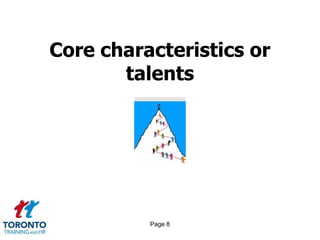
Page 8Core characteristics or talents
Page 9Core characteristics or talentsVisionSelf-beliefPassion and principlesA questioning dispositionThe networking factor
Page 10Key assumptions
Page 11Key assumptions 1 of 2Talent is a key driver of organizational performance across the entire business lifecycle-growth and recessionDon’t think talent management, but rather talent-informed strategic decision-making
Page 12Key assumptions 2 of 2A focus on human capital in a knowledge economyA focus on scarce and valuable people (the powercurve) – the exclusive rather than inclusive approachA focus on buy rather than makeA focus on potential rather than experience
Page 13Individual development plans
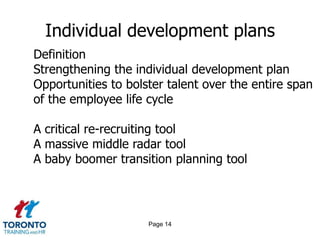
Page 14Individual development plansDefinitionStrengthening the individual development planOpportunities to bolster talent over the entire span of the employee life cycleA critical re-recruiting toolA massive middle radar toolA baby boomer transition planning tool
Page 15Drill
Page 16Drill
Page 17Global talent risk
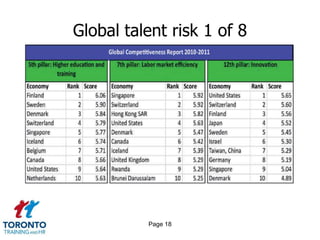
Page 18Global talent risk 1 of 8 Introduce strategic workforce planningEase migrationFoster brain circulationIncrease employabilityDevelop a talent “trellis”Encourage temporary and virtual mobilityExtend the pool
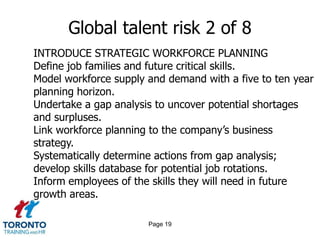
Page 19Global talent risk 2 of 8INTRODUCE STRATEGIC WORKFORCE PLANNINGDefine job families and future critical skills.Model workforce supply and demand with a five to ten year planning horizon.Undertake a gap analysis to uncover potential shortages and surpluses.Link workforce planning to the company’s business strategy. Systematically determine actions from gap analysis; develop skills database for potential job rotations.Inform employees of the skills they will need in future growth areas.
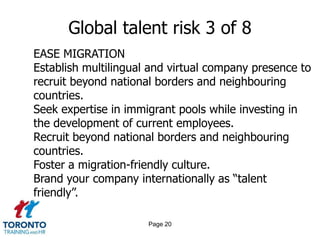
Page 20Global talent risk 3 of 8EASE MIGRATIONEstablish multilingual and virtual company presence to recruit beyond national borders and neighbouring countries.Seek expertise in immigrant pools while investing in the development of current employees.Recruit beyond national borders and neighbouring countries. Foster a migration-friendly culture. Brand your company internationally as “talent friendly”.
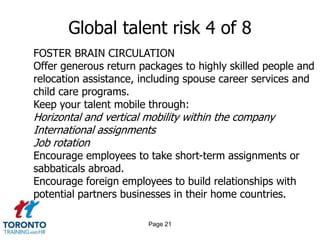
Page 21Global talent risk 4 of 8FOSTER BRAIN CIRCULATIONOffer generous return packages to highly skilled people and relocation assistance, including spouse career services and child care programs.Keep your talent mobile through:Horizontal and vertical mobility within the companyInternational assignmentsJob rotationEncourage employees to take short-term assignments or sabbaticals abroad.Encourage foreign employees to build relationships with potential partners businesses in their home countries.
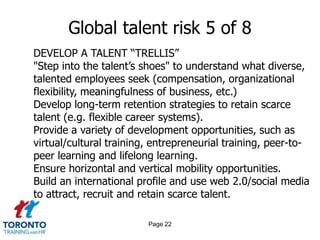
Page 22Global talent risk 5 of 8DEVELOP A TALENT “TRELLIS”"Step into the talent’s shoes" to understand what diverse,talented employees seek (compensation, organizationalflexibility, meaningfulness of business, etc.)Develop long-term retention strategies to retain scarce talent (e.g. flexible career systems).Provide a variety of development opportunities, such asvirtual/cultural training, entrepreneurial training, peer-to-peer learning and lifelong learning.Ensure horizontal and vertical mobility opportunities. Build an international profile and use web 2.0/social media to attract, recruit and retain scarce talent.
Page 23Global talent risk 6 of 8TEMPORARY AND VIRTUAL MOBILITYIntroduce flexible work arrangements. Explore virtual work opportunities for employees abroad.Set up rotation programs and short-term assignment between business units and geographies.Foster virtual recruiting events and activities.
Page 24Global talent risk 7 of 8EXTEND THE TALENT POOLCreate a presence for the company brand at universities locally and internationally.Display cultural sensitivity in targeting minorities and women. Hire graduates from abroad with limited language skills and offer intensive language courses.Give employees support to contribute part-time as they raise families.Engage retirees (your own or those of other companies) to mentor, consult or complete short-term assignments.Recruit from other industries’ pools with similar skill sets.
Page 25Global talent risk 8 of 8INCREASE EMPLOYABILITYMake education a priority of the corporate social responsibility agenda (e.g. through pro bono training locally and internationally).Offer internships and vocational training opportunities Offer certified training opportunities beyond current job and educational leaves to foster upskilling.Engage with academia and government to equip talent with a balance of theoretical and practical skills (e.g. “teach the teachers” program).
Page 26Organizational effectiveness
Page 27Organizational effectiveness 1 of 3 Definition
Page 28Organizational effectiveness 2 of 3 LEADERSHIPVisionVigourORGANIZATIONAL ENABLERSCapabilityArchitectureActionENTERPRISE ACCELERATORSEnterprise alignmentEnterprise agility
Page 29Organizational effectiveness 3 of 3 IMPLICATIONS FOR TALENT MANAGEMENTTalent management is central to the success of the entire business machineTalent management strategies and practices must be alignedTalent management strategies and practices also must become agile
Page 30Linking reward to talent management
Page 31Linking reward to talent management 1 of 6INTRODUCTIONBanish silosGet some dataBe inclusiveShow people the wayLink reward and performancePick some quick winsCommunicate benefitsBe creativeKeep it simpleMeasure and review
Page 32Linking reward to talent management 2 of 6TAKING AN INTEGRATED APPROACHLess likely to experience problems attracting critical-skill employees and top-performing employees Less likely to report having trouble retainingcritical-skill employees and top-performing employees More likely to be high-performingorganizations
Page 33Linking reward to talent management 3 of 6BEST PRACTICES TO ADOPTDefine an organization-wide employee valueproposition (EVP) for attraction, retention, payand talent managementManage and design programs according to anorganization-wide total rewards philosophyPerform formal workforce planning activities thatoptimize the supply of talent versus demand
Page 34Linking reward to talent management 4 of 6BEST PRACTICES TO ADOPTLeverage competency models across recruiting,career management and pay activitiesFacilitate healthy work/life balance and takemeasures to moderate employees’ levels ofwork-related stress
Page 35Linking reward to talent management 5 of 6BEST PRACTICES TO ADOPTLink employee performance goals to thebusiness, and effectively communicate performance expectations and results to employeesLeverage total cash rewards throughdifferentiation of merit increases and annualincentive awardsLink individual and organization results to rewardsEffectively deploy recognition programs
Page 36Linking reward to talent management 6 of 6TO CONCLUDEAlignIntegrate and optimizeExecute
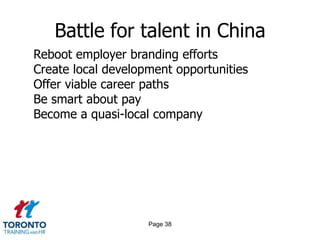
Page 37Battle for talent in China
Page 38Battle for talent in ChinaReboot employer branding effortsCreate local development opportunitiesOffer viable career pathsBe smart about payBecome a quasi-local company
Page 39A talent-based recipe
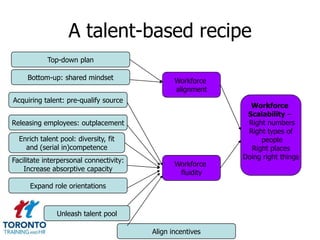
A talent-based recipeTop-down planBottom-up: shared mindsetWorkforce alignmentAcquiring talent: pre-qualify sourceWorkforce Scalability –  Right numbersRight types of peopleRight placesDoing right thingsReleasing employees: outplacementEnrich talent pool: diversity, fitand (serial in)competenceWorkforce fluidityFacilitate interpersonal connectivity:Increase absorptive capacityExpand role orientationsUnleash talent poolAlign incentives
Page 41Tailoring talent strategy to context
Page 42Tailoring talent strategy to context 1 of 3RECRUIT AND INTEGRATEHow are the requisite capabilities obtained?How are job candidates selected?
Page 43Tailoring talent strategy to context 2 of 3DEPLOY, REVIEW AND DEVELOPHow does talent get deployed?What level of career guidance should be provided?What types of behaviours get rewarded?To what extent do we differentiate performance?What are the boundaries for under-achievement?
Page 44Tailoring talent strategy to context 3 of 3ENGAGE AND CONNECTHow do we keep talent connected to one another?How do we energize our talent?
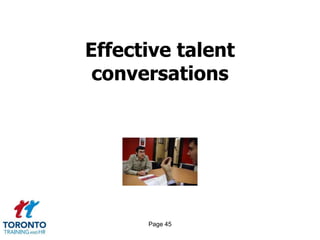
Page 45Effective talent conversations
Page 46Effective talent conversations 1 of 4QUESTIONS TO ASKDo I have the right person in the job?Who are our rising stars and next generation leaders?Who should I promote?How do I get more out of …?Who is my successor?
Page 47Effective talent conversations 2 of 4WHY TALENT REVIEWS OFTEN FAILThere is too little focus on strategic contextPredicting executive success is toughVested interests can lead to uninspired conversations
Page 48Effective talent conversations 3 of 4PRINCIPLES FOR IMPROVING THE TALENT CONVERSATIONGet clear on the critical role requirementsPick your spotsHolistic assessmentFocus on learning potentialPut the right people in the assessment roomFigure out the role of HRActively seek meaningful conversationsOpen and honest
Page 49Effective talent conversations 4 of 4PRINCIPLES FOR IMPROVING THE TALENT CONVERSATIONAct with good willFocus on identifying development opportunities
Page 50Example-talent management in the finance sector
Page 51Example-talent management in the finance sector 1 of 7INTEGRATED TALENT MANAGEMENTDefinition of talentRecruitment and talent identificationCompetency frameworksTargeted developmentComprehensive learningStructured career pathsPerformance measurement and rewardOngoing review
Page 52Example-talent management in the finance sector 2 of 7CHALLENGES AHEADHow do CFOs structure the finance function and the roles within it to ensure maximisation of resources and a strong long-term talent pipeline?How do CFOs access the specialists they need – must they recruit or can internal talent be trained?What is the best way to improve the commerciality of the finance function and boost its internal credibility?
Page 53Example-talent management in the finance sector 3 of 7CHALLENGES AHEADHow can individuals in roles deemed less critical bemotivated and their expertise retained if they see training priorities being focused on others?How can the organization create a sufficiently stimulating career path to retain the talents of Generation Y?How can finance assess return on investment in its people in order to target learning and development and general talent management spend most effectively?
Page 54Example-talent management in the finance sector 4 of 7STRATEGY FOR ORGANIZATION DESIGNWhat is the value-creating objective of the organization?Where and how can finance best contribute to supporting the organization in value creation? (What do our internal and external stakeholders want and need from the finance function?)How capable is finance in delivering these objectives currently?
Page 55Example-talent management in the finance sector 5 of 7STRATEGY FOR ORGANIZATION DESIGNHow much will it cost and what metrics can be used to measure success?Could a new structure – people, process, systems – improve the success of finance in supporting the organization?
Page 56Example-talent management in the finance sector 6 of 7FINANCE FUNCTION EFFECTIVENESSCentres of excellenceShared servicesOutsourcing and offshoringBusiness partnering
Page 57Example-talent management in the finance sector 7 of 7INTEGRATED TALENT MANAGEMENTCentres of excellenceShared servicesOutsourcing and offshoringBusiness partnering
Page 58Emerging best practices
Page 59Emerging best practices 1 of 9RecruitDevelopEngageAssessRetain
Page 60Emerging best practices 2 of 9TURNOVER RISKThose with skills in short supply and high demandHigh performersKey contributors/technical expertsThose with leadership potential at mid-levelThose with leadership potential at an entry levelThose in roles critical to delivering the business strategySenior leadershipThe entire workforce
Page 61Emerging best practices 3 of 9PRIORITIESPerformance managementAssessing/developing high potentials and top talentRecognizing exceptional performersAssessing/developing senior leadersMeasuring/increasing employee engagementStrengthening the talent pipeline and succession managementTraining managers
Page 62Emerging best practices 4 of 9PRIORITIES AND EFFECTIVENESSMentoring of key talentDeploying key talent across roles/functions/regionsCareer pathing and planningIdentifying and integrating competenciesOnboardingDeveloping/implementing an employment value proposition
Page 63Emerging best practices 5 of 9WHAT DOES TALENT WANT?Accessible talent bordersDiversityHigh level of freedom of mindInspiring work environmentLifelong learning opportunitiesPositive country brandSkill recognition institutionsThe “Perfect Employer” Inc.Virtual mobility
Page 64Emerging best practices 6 of 9REASONS TO JOIN A PARTICULAR ORGANIZATIONEmployeeEmployer
Page 65Emerging best practices 7 of 9CATEGORIES OF BENEFIT THAT DETERMINES IF TALENT STAYS OR LEAVESGreat leadersGreat companyGreat jobAttractive compensation
Page 66Emerging best practices 8 of 9ACCOMODATING THE REQUIREMENTS OF GENERATION YMore flexi-time options More recognition programsAccess to state-of-the-art technologyIncreased compensationAccess to educational programsPay for cell phones and blackberrysTelecommuting optionsMore vacation time
Page 67Emerging best practices 9 of 9HARNESSING THE TALENT OF SKILLED IMMIGRANTSBuilding increased awareness among senior leaders and decision makers of the significance of the immigrant population as a source of skilled talentProviding recognition for the value and transferability of international skills and credentialsDeveloping a data-driven understanding of the potential benefits of employing skilled immigrantsCreating awareness among leaders of the value of skilledimmigrants for access to international markets, and localniche/ethno-specific marketsRecognizing that skilled immigrants bring access to new ideas and perspectives to support innovation
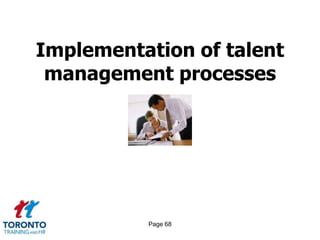
Page 68Implementation of talent management processes
Page 69Implementation of talent management processes 1 of 6Linking rewards more closely to performanceGiving employees self-service tools to search and apply for new roles in the organizationFocusing more on key workforce segmentsGiving business leaders greater ownership and accountability for building the talent pipelineUsing branding/marketing techniques to enhance the employment value proposition
Page 70Implementation of talent management processes 2 of 6Creating more consistency in how talent is identified, developed and moved throughout the organizationCreating a formal governance structure and process for talent management activitiesRedefining the critical attributes and competencies needed for the next generation of leadersIntegrating talent management processes more directly into business strategy and operations
Page 71Implementation of talent management processes 3 of 6Scaling and adapting talent strategies on a global basisIncreasing use of technology to streamline talent management processes and activitiesGiving managers self-service tools to source and deploy internal talentCreating an experience “punchlist” for critical roles and designing targeted career paths to ensureadequate succession
Page 72Implementation of talent management processes 4 of 6Improving quality and use of analytics to monitor the need for, and supply of, talentand better differentiate performanceAdopting just-in-time talent-sourcing approaches, including contingent  workforce designsLeveraging social networking tools to access and engage the workforce in new ways
Page 73Implementation of talent management processes 5 of 6PROCESSES MOST CRITICAL TO ACHIEVING RESULTS AND TOUGHEST TO IMPLEMENT & SUSTAINIntegrating talent management processes more directly into business strategy and operationsGiving business leaders greater ownership and accountability for building the talent pipelineRedefining the critical attributes and competencies needed for the next generation of leadersCreating more consistency in how talent is identified, developed and moved throughout the organization
Page 74Implementation of talent management processes 6 of 6IMPLEMENTING A PROACTIVE TALENT MANAGEMENT PROGRAMCreedStrategySystem
Page 75Making talent programswork
Page 76Making talent programs work 1 of 2Clearly communicate the core objectives-set expectations at the start and manage them throughoutEven though the organization as a whole may sponsor talent activities, it is beneficial to have HR/talent running the program, and visibility is important to maintain credibility and consistencyConsider implementing a selection process for the top talent program to increase its perceived value and motivate participants to perform-make the selection process a learning event in itself and ensure all applicants receive constructive feedback
Page 77Making talent programs work 2 of 2Review the structure of the talent program/pool with the business sponsor-coaching, mentoring and networking are the elements most valued by senior talent pool membersDevelop ways of harnessing the peer group created as part of the talent program by creating opportunities beyond the lifespan of the program
Page 78The future talent agenda
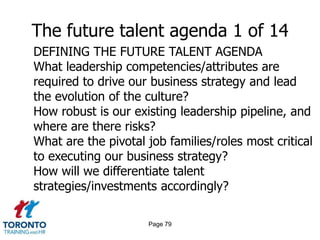
Page 79The future talent agenda 1 of 14DEFINING THE FUTURE TALENT AGENDAWhat leadership competencies/attributes are required to drive our business strategy and leadthe evolution of the culture?How robust is our existing leadership pipeline, and where are there risks?What are the pivotal job families/roles most critical to executing our business strategy?How will we differentiate talent strategies/investments accordingly?
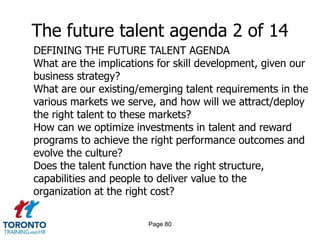
Page 80The future talent agenda 2 of 14DEFINING THE FUTURE TALENT AGENDAWhat are the implications for skill development, given our business strategy?What are our existing/emerging talent requirements in the various markets we serve, and how will we attract/deploy the right talent to these markets?How can we optimize investments in talent and reward programs to achieve the right performance outcomes and evolve the culture?Does the talent function have the right structure, capabilities and people to deliver value to theorganization at the right cost?
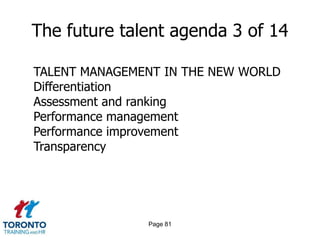
Page 81The future talent agenda 3 of 14TALENT MANAGEMENT IN THE NEW WORLDDifferentiationAssessment and rankingPerformance managementPerformance improvementTransparency
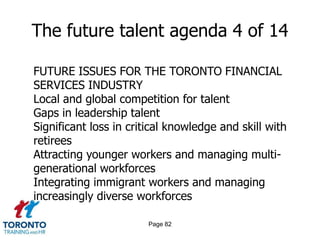
Page 82The future talent agenda 4 of 14FUTURE ISSUES FOR THE TORONTO FINANCIAL SERVICES INDUSTRYLocal and global competition for talentGaps in leadership talentSignificant loss in critical knowledge and skill with retireesAttracting younger workers and managing multi-generational workforcesIntegrating immigrant workers and managing increasingly diverse workforces
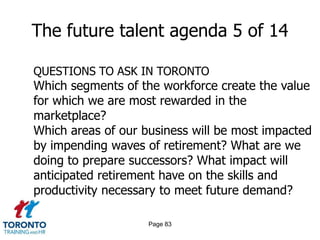
Page 83The future talent agenda 5 of 14QUESTIONS TO ASK IN TORONTOWhich segments of the workforce create the value for which we are most rewarded in the marketplace?Which areas of our business will be most impacted by impending waves of retirement? What are we doing to prepare successors? What impact will anticipated retirement have on the skills and productivity necessary to meet future demand?
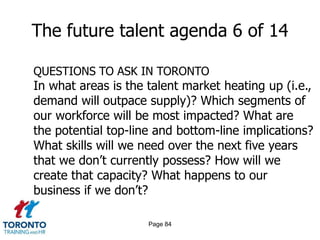
Page 84The future talent agenda 6 of 14QUESTIONS TO ASK IN TORONTOIn what areas is the talent market heating up (i.e., demand will outpace supply)? Which segments of our workforce will be most impacted? What are the potential top-line and bottom-line implications?What skills will we need over the next five years that we don’t currently possess? How will we create that capacity? What happens to our business if we don’t?
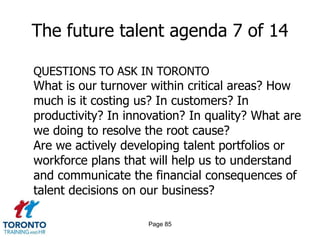
Page 85The future talent agenda 7 of 14QUESTIONS TO ASK IN TORONTOWhat is our turnover within critical areas? How much is it costing us? In customers? In productivity? In innovation? In quality? What are we doing to resolve the root cause?Are we actively developing talent portfolios or workforce plans that will help us to understand and communicate the financial consequences of talent decisions on our business?
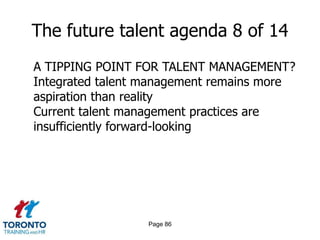
Page 86The future talent agenda 8 of 14A TIPPING POINT FOR TALENT MANAGEMENT?Integrated talent management remains more aspiration than realityCurrent talent management practices are insufficiently forward-looking
Page 87The future talent agenda 9 of 14CHALLENGES AHEAD-WESTERN COUNTRIESA step change in productivity is requiredNew kinds of jobsAging populationDifferent preferences of Generation Y compared to other groupsDifferent offering needed from employers
Page 88The future talent agenda 10 of 14CHALLENGES AHEAD-DEVELOPING COUNTRIESChina alone will build “one Canada” in the next ten yearsAsia returning to its natural half-share of the world economyEmerging markets provide access to large skilled talent poolsNot all graduates are treated equallyThe supply of professionals in China is fragmented
Page 89The future talent agenda 11 of 14CHALLENGES AHEAD-DEVELOPING COUNTRIESChina alone will build “one Canada” in the next ten yearsAsia returning to its natural half-share of the world economyEmerging markets provide access to large skilled talent poolsNot all graduates are treated equallyThe supply of professionals in China is fragmented
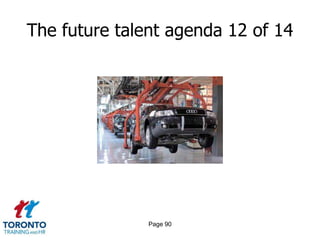
The future talent agenda 12 of 14Page 90
The future talent agenda 13 of 14
Page 92The future talent agenda 14 of 14CHALLENGES AHEAD-SUMMARYIs talent management strategy as embedded as business and financial strategy?Are you tapping into non traditional talent pools and who are you competing against?Is your employee value proposition as tailored as possible to key segments (age, gender, diversity) and do you have five “compelling” stories?To what extent are you accelerating the development of high performers and how are you retaining them?
Page 93Case study A
Page 94Case study A
Page 95Case study B
Page 96Case study B
Page 97Case study C
Page 98Case study C

Managing talent January 2011

  • 1.
    Managing talent byToronto Training and HR January 2011
  • 2.
    3-4 Introduction toToronto Training and HR 5-7 Definitions 8-9 Core characteristics or talents 10-12 Key assumptions13-14 Individual development plans 15-16 Drill 17-25 Global talent risk 26-29 Organizational effectiveness30-36 Linking reward to talent management37-38 Battle for talent in China39-40 A talent-based recipe 41-44 Tailoring talent strategy to context45-49 Effective talent conversations50-57 Example-talent management in the finance sector 58-67 Emergent best practices68-74 Implementation of talent management processes75-77 Making talent programs work78-92 The future talent agenda 93-98 Case studies99-100 Conclusion and questionsContents
  • 3.
  • 4.
    Page 4Introduction toToronto Training and HRToronto Training and HRis a specialist training and human resources consultancy headed by Timothy Holden 10 years in banking10 years in training and human resourcesFreelance practitioner since 2006The core services provided by Toronto Training and HR are:Training course design
  • 5.
    Training course delivery- Reducing costsSaving time
  • 6.
  • 7.
    Services for jobseekersPage 5Definitions
  • 8.
    Page 6Definitions 1of 2Who is talent?What is critical talent?What is missing talent?Talent and skills scarcities-the numbersLink between top-performing talent and productivity advantages
  • 9.
    Page 7Definitions 2of 2TESTS FOR TALENTKnow them by what they wantKnow them by their influence on othersKnow them by how they demand to be spoiled
  • 10.
  • 11.
    Page 9Core characteristicsor talentsVisionSelf-beliefPassion and principlesA questioning dispositionThe networking factor
  • 12.
  • 13.
    Page 11Key assumptions1 of 2Talent is a key driver of organizational performance across the entire business lifecycle-growth and recessionDon’t think talent management, but rather talent-informed strategic decision-making
  • 14.
    Page 12Key assumptions2 of 2A focus on human capital in a knowledge economyA focus on scarce and valuable people (the powercurve) – the exclusive rather than inclusive approachA focus on buy rather than makeA focus on potential rather than experience
  • 15.
  • 16.
    Page 14Individual developmentplansDefinitionStrengthening the individual development planOpportunities to bolster talent over the entire span of the employee life cycleA critical re-recruiting toolA massive middle radar toolA baby boomer transition planning tool
  • 17.
  • 18.
  • 19.
  • 20.
    Page 18Global talentrisk 1 of 8 Introduce strategic workforce planningEase migrationFoster brain circulationIncrease employabilityDevelop a talent “trellis”Encourage temporary and virtual mobilityExtend the pool
  • 21.
    Page 19Global talentrisk 2 of 8INTRODUCE STRATEGIC WORKFORCE PLANNINGDefine job families and future critical skills.Model workforce supply and demand with a five to ten year planning horizon.Undertake a gap analysis to uncover potential shortages and surpluses.Link workforce planning to the company’s business strategy. Systematically determine actions from gap analysis; develop skills database for potential job rotations.Inform employees of the skills they will need in future growth areas.
  • 22.
    Page 20Global talentrisk 3 of 8EASE MIGRATIONEstablish multilingual and virtual company presence to recruit beyond national borders and neighbouring countries.Seek expertise in immigrant pools while investing in the development of current employees.Recruit beyond national borders and neighbouring countries. Foster a migration-friendly culture. Brand your company internationally as “talent friendly”.
  • 23.
    Page 21Global talentrisk 4 of 8FOSTER BRAIN CIRCULATIONOffer generous return packages to highly skilled people and relocation assistance, including spouse career services and child care programs.Keep your talent mobile through:Horizontal and vertical mobility within the companyInternational assignmentsJob rotationEncourage employees to take short-term assignments or sabbaticals abroad.Encourage foreign employees to build relationships with potential partners businesses in their home countries.
  • 24.
    Page 22Global talentrisk 5 of 8DEVELOP A TALENT “TRELLIS”"Step into the talent’s shoes" to understand what diverse,talented employees seek (compensation, organizationalflexibility, meaningfulness of business, etc.)Develop long-term retention strategies to retain scarce talent (e.g. flexible career systems).Provide a variety of development opportunities, such asvirtual/cultural training, entrepreneurial training, peer-to-peer learning and lifelong learning.Ensure horizontal and vertical mobility opportunities. Build an international profile and use web 2.0/social media to attract, recruit and retain scarce talent.
  • 25.
    Page 23Global talentrisk 6 of 8TEMPORARY AND VIRTUAL MOBILITYIntroduce flexible work arrangements. Explore virtual work opportunities for employees abroad.Set up rotation programs and short-term assignment between business units and geographies.Foster virtual recruiting events and activities.
  • 26.
    Page 24Global talentrisk 7 of 8EXTEND THE TALENT POOLCreate a presence for the company brand at universities locally and internationally.Display cultural sensitivity in targeting minorities and women. Hire graduates from abroad with limited language skills and offer intensive language courses.Give employees support to contribute part-time as they raise families.Engage retirees (your own or those of other companies) to mentor, consult or complete short-term assignments.Recruit from other industries’ pools with similar skill sets.
  • 27.
    Page 25Global talentrisk 8 of 8INCREASE EMPLOYABILITYMake education a priority of the corporate social responsibility agenda (e.g. through pro bono training locally and internationally).Offer internships and vocational training opportunities Offer certified training opportunities beyond current job and educational leaves to foster upskilling.Engage with academia and government to equip talent with a balance of theoretical and practical skills (e.g. “teach the teachers” program).
  • 28.
  • 29.
  • 30.
    Page 28Organizational effectiveness2 of 3 LEADERSHIPVisionVigourORGANIZATIONAL ENABLERSCapabilityArchitectureActionENTERPRISE ACCELERATORSEnterprise alignmentEnterprise agility
  • 31.
    Page 29Organizational effectiveness3 of 3 IMPLICATIONS FOR TALENT MANAGEMENTTalent management is central to the success of the entire business machineTalent management strategies and practices must be alignedTalent management strategies and practices also must become agile
  • 32.
    Page 30Linking rewardto talent management
  • 33.
    Page 31Linking rewardto talent management 1 of 6INTRODUCTIONBanish silosGet some dataBe inclusiveShow people the wayLink reward and performancePick some quick winsCommunicate benefitsBe creativeKeep it simpleMeasure and review
  • 34.
    Page 32Linking rewardto talent management 2 of 6TAKING AN INTEGRATED APPROACHLess likely to experience problems attracting critical-skill employees and top-performing employees Less likely to report having trouble retainingcritical-skill employees and top-performing employees More likely to be high-performingorganizations
  • 35.
    Page 33Linking rewardto talent management 3 of 6BEST PRACTICES TO ADOPTDefine an organization-wide employee valueproposition (EVP) for attraction, retention, payand talent managementManage and design programs according to anorganization-wide total rewards philosophyPerform formal workforce planning activities thatoptimize the supply of talent versus demand
  • 36.
    Page 34Linking rewardto talent management 4 of 6BEST PRACTICES TO ADOPTLeverage competency models across recruiting,career management and pay activitiesFacilitate healthy work/life balance and takemeasures to moderate employees’ levels ofwork-related stress
  • 37.
    Page 35Linking rewardto talent management 5 of 6BEST PRACTICES TO ADOPTLink employee performance goals to thebusiness, and effectively communicate performance expectations and results to employeesLeverage total cash rewards throughdifferentiation of merit increases and annualincentive awardsLink individual and organization results to rewardsEffectively deploy recognition programs
  • 38.
    Page 36Linking rewardto talent management 6 of 6TO CONCLUDEAlignIntegrate and optimizeExecute
  • 39.
    Page 37Battle fortalent in China
  • 40.
    Page 38Battle fortalent in ChinaReboot employer branding effortsCreate local development opportunitiesOffer viable career pathsBe smart about payBecome a quasi-local company
  • 41.
  • 42.
    A talent-based recipeTop-downplanBottom-up: shared mindsetWorkforce alignmentAcquiring talent: pre-qualify sourceWorkforce Scalability – Right numbersRight types of peopleRight placesDoing right thingsReleasing employees: outplacementEnrich talent pool: diversity, fitand (serial in)competenceWorkforce fluidityFacilitate interpersonal connectivity:Increase absorptive capacityExpand role orientationsUnleash talent poolAlign incentives
  • 43.
    Page 41Tailoring talentstrategy to context
  • 44.
    Page 42Tailoring talentstrategy to context 1 of 3RECRUIT AND INTEGRATEHow are the requisite capabilities obtained?How are job candidates selected?
  • 45.
    Page 43Tailoring talentstrategy to context 2 of 3DEPLOY, REVIEW AND DEVELOPHow does talent get deployed?What level of career guidance should be provided?What types of behaviours get rewarded?To what extent do we differentiate performance?What are the boundaries for under-achievement?
  • 46.
    Page 44Tailoring talentstrategy to context 3 of 3ENGAGE AND CONNECTHow do we keep talent connected to one another?How do we energize our talent?
  • 47.
  • 48.
    Page 46Effective talentconversations 1 of 4QUESTIONS TO ASKDo I have the right person in the job?Who are our rising stars and next generation leaders?Who should I promote?How do I get more out of …?Who is my successor?
  • 49.
    Page 47Effective talentconversations 2 of 4WHY TALENT REVIEWS OFTEN FAILThere is too little focus on strategic contextPredicting executive success is toughVested interests can lead to uninspired conversations
  • 50.
    Page 48Effective talentconversations 3 of 4PRINCIPLES FOR IMPROVING THE TALENT CONVERSATIONGet clear on the critical role requirementsPick your spotsHolistic assessmentFocus on learning potentialPut the right people in the assessment roomFigure out the role of HRActively seek meaningful conversationsOpen and honest
  • 51.
    Page 49Effective talentconversations 4 of 4PRINCIPLES FOR IMPROVING THE TALENT CONVERSATIONAct with good willFocus on identifying development opportunities
  • 52.
  • 53.
    Page 51Example-talent managementin the finance sector 1 of 7INTEGRATED TALENT MANAGEMENTDefinition of talentRecruitment and talent identificationCompetency frameworksTargeted developmentComprehensive learningStructured career pathsPerformance measurement and rewardOngoing review
  • 54.
    Page 52Example-talent managementin the finance sector 2 of 7CHALLENGES AHEADHow do CFOs structure the finance function and the roles within it to ensure maximisation of resources and a strong long-term talent pipeline?How do CFOs access the specialists they need – must they recruit or can internal talent be trained?What is the best way to improve the commerciality of the finance function and boost its internal credibility?
  • 55.
    Page 53Example-talent managementin the finance sector 3 of 7CHALLENGES AHEADHow can individuals in roles deemed less critical bemotivated and their expertise retained if they see training priorities being focused on others?How can the organization create a sufficiently stimulating career path to retain the talents of Generation Y?How can finance assess return on investment in its people in order to target learning and development and general talent management spend most effectively?
  • 56.
    Page 54Example-talent managementin the finance sector 4 of 7STRATEGY FOR ORGANIZATION DESIGNWhat is the value-creating objective of the organization?Where and how can finance best contribute to supporting the organization in value creation? (What do our internal and external stakeholders want and need from the finance function?)How capable is finance in delivering these objectives currently?
  • 57.
    Page 55Example-talent managementin the finance sector 5 of 7STRATEGY FOR ORGANIZATION DESIGNHow much will it cost and what metrics can be used to measure success?Could a new structure – people, process, systems – improve the success of finance in supporting the organization?
  • 58.
    Page 56Example-talent managementin the finance sector 6 of 7FINANCE FUNCTION EFFECTIVENESSCentres of excellenceShared servicesOutsourcing and offshoringBusiness partnering
  • 59.
    Page 57Example-talent managementin the finance sector 7 of 7INTEGRATED TALENT MANAGEMENTCentres of excellenceShared servicesOutsourcing and offshoringBusiness partnering
  • 60.
  • 61.
    Page 59Emerging bestpractices 1 of 9RecruitDevelopEngageAssessRetain
  • 62.
    Page 60Emerging bestpractices 2 of 9TURNOVER RISKThose with skills in short supply and high demandHigh performersKey contributors/technical expertsThose with leadership potential at mid-levelThose with leadership potential at an entry levelThose in roles critical to delivering the business strategySenior leadershipThe entire workforce
  • 63.
    Page 61Emerging bestpractices 3 of 9PRIORITIESPerformance managementAssessing/developing high potentials and top talentRecognizing exceptional performersAssessing/developing senior leadersMeasuring/increasing employee engagementStrengthening the talent pipeline and succession managementTraining managers
  • 64.
    Page 62Emerging bestpractices 4 of 9PRIORITIES AND EFFECTIVENESSMentoring of key talentDeploying key talent across roles/functions/regionsCareer pathing and planningIdentifying and integrating competenciesOnboardingDeveloping/implementing an employment value proposition
  • 65.
    Page 63Emerging bestpractices 5 of 9WHAT DOES TALENT WANT?Accessible talent bordersDiversityHigh level of freedom of mindInspiring work environmentLifelong learning opportunitiesPositive country brandSkill recognition institutionsThe “Perfect Employer” Inc.Virtual mobility
  • 66.
    Page 64Emerging bestpractices 6 of 9REASONS TO JOIN A PARTICULAR ORGANIZATIONEmployeeEmployer
  • 67.
    Page 65Emerging bestpractices 7 of 9CATEGORIES OF BENEFIT THAT DETERMINES IF TALENT STAYS OR LEAVESGreat leadersGreat companyGreat jobAttractive compensation
  • 68.
    Page 66Emerging bestpractices 8 of 9ACCOMODATING THE REQUIREMENTS OF GENERATION YMore flexi-time options More recognition programsAccess to state-of-the-art technologyIncreased compensationAccess to educational programsPay for cell phones and blackberrysTelecommuting optionsMore vacation time
  • 69.
    Page 67Emerging bestpractices 9 of 9HARNESSING THE TALENT OF SKILLED IMMIGRANTSBuilding increased awareness among senior leaders and decision makers of the significance of the immigrant population as a source of skilled talentProviding recognition for the value and transferability of international skills and credentialsDeveloping a data-driven understanding of the potential benefits of employing skilled immigrantsCreating awareness among leaders of the value of skilledimmigrants for access to international markets, and localniche/ethno-specific marketsRecognizing that skilled immigrants bring access to new ideas and perspectives to support innovation
  • 70.
    Page 68Implementation oftalent management processes
  • 71.
    Page 69Implementation oftalent management processes 1 of 6Linking rewards more closely to performanceGiving employees self-service tools to search and apply for new roles in the organizationFocusing more on key workforce segmentsGiving business leaders greater ownership and accountability for building the talent pipelineUsing branding/marketing techniques to enhance the employment value proposition
  • 72.
    Page 70Implementation oftalent management processes 2 of 6Creating more consistency in how talent is identified, developed and moved throughout the organizationCreating a formal governance structure and process for talent management activitiesRedefining the critical attributes and competencies needed for the next generation of leadersIntegrating talent management processes more directly into business strategy and operations
  • 73.
    Page 71Implementation oftalent management processes 3 of 6Scaling and adapting talent strategies on a global basisIncreasing use of technology to streamline talent management processes and activitiesGiving managers self-service tools to source and deploy internal talentCreating an experience “punchlist” for critical roles and designing targeted career paths to ensureadequate succession
  • 74.
    Page 72Implementation oftalent management processes 4 of 6Improving quality and use of analytics to monitor the need for, and supply of, talentand better differentiate performanceAdopting just-in-time talent-sourcing approaches, including contingent workforce designsLeveraging social networking tools to access and engage the workforce in new ways
  • 75.
    Page 73Implementation oftalent management processes 5 of 6PROCESSES MOST CRITICAL TO ACHIEVING RESULTS AND TOUGHEST TO IMPLEMENT & SUSTAINIntegrating talent management processes more directly into business strategy and operationsGiving business leaders greater ownership and accountability for building the talent pipelineRedefining the critical attributes and competencies needed for the next generation of leadersCreating more consistency in how talent is identified, developed and moved throughout the organization
  • 76.
    Page 74Implementation oftalent management processes 6 of 6IMPLEMENTING A PROACTIVE TALENT MANAGEMENT PROGRAMCreedStrategySystem
  • 77.
  • 78.
    Page 76Making talentprograms work 1 of 2Clearly communicate the core objectives-set expectations at the start and manage them throughoutEven though the organization as a whole may sponsor talent activities, it is beneficial to have HR/talent running the program, and visibility is important to maintain credibility and consistencyConsider implementing a selection process for the top talent program to increase its perceived value and motivate participants to perform-make the selection process a learning event in itself and ensure all applicants receive constructive feedback
  • 79.
    Page 77Making talentprograms work 2 of 2Review the structure of the talent program/pool with the business sponsor-coaching, mentoring and networking are the elements most valued by senior talent pool membersDevelop ways of harnessing the peer group created as part of the talent program by creating opportunities beyond the lifespan of the program
  • 80.
    Page 78The futuretalent agenda
  • 81.
    Page 79The futuretalent agenda 1 of 14DEFINING THE FUTURE TALENT AGENDAWhat leadership competencies/attributes are required to drive our business strategy and leadthe evolution of the culture?How robust is our existing leadership pipeline, and where are there risks?What are the pivotal job families/roles most critical to executing our business strategy?How will we differentiate talent strategies/investments accordingly?
  • 82.
    Page 80The futuretalent agenda 2 of 14DEFINING THE FUTURE TALENT AGENDAWhat are the implications for skill development, given our business strategy?What are our existing/emerging talent requirements in the various markets we serve, and how will we attract/deploy the right talent to these markets?How can we optimize investments in talent and reward programs to achieve the right performance outcomes and evolve the culture?Does the talent function have the right structure, capabilities and people to deliver value to theorganization at the right cost?



  • 83.
    Page 81The futuretalent agenda 3 of 14TALENT MANAGEMENT IN THE NEW WORLDDifferentiationAssessment and rankingPerformance managementPerformance improvementTransparency
  • 84.
    Page 82The futuretalent agenda 4 of 14FUTURE ISSUES FOR THE TORONTO FINANCIAL SERVICES INDUSTRYLocal and global competition for talentGaps in leadership talentSignificant loss in critical knowledge and skill with retireesAttracting younger workers and managing multi-generational workforcesIntegrating immigrant workers and managing increasingly diverse workforces
  • 85.
    Page 83The futuretalent agenda 5 of 14QUESTIONS TO ASK IN TORONTOWhich segments of the workforce create the value for which we are most rewarded in the marketplace?Which areas of our business will be most impacted by impending waves of retirement? What are we doing to prepare successors? What impact will anticipated retirement have on the skills and productivity necessary to meet future demand?
  • 86.
    Page 84The futuretalent agenda 6 of 14QUESTIONS TO ASK IN TORONTOIn what areas is the talent market heating up (i.e., demand will outpace supply)? Which segments of our workforce will be most impacted? What are the potential top-line and bottom-line implications?What skills will we need over the next five years that we don’t currently possess? How will we create that capacity? What happens to our business if we don’t?
  • 87.
    Page 85The futuretalent agenda 7 of 14QUESTIONS TO ASK IN TORONTOWhat is our turnover within critical areas? How much is it costing us? In customers? In productivity? In innovation? In quality? What are we doing to resolve the root cause?Are we actively developing talent portfolios or workforce plans that will help us to understand and communicate the financial consequences of talent decisions on our business?
  • 88.
    Page 86The futuretalent agenda 8 of 14A TIPPING POINT FOR TALENT MANAGEMENT?Integrated talent management remains more aspiration than realityCurrent talent management practices are insufficiently forward-looking
  • 89.
    Page 87The futuretalent agenda 9 of 14CHALLENGES AHEAD-WESTERN COUNTRIESA step change in productivity is requiredNew kinds of jobsAging populationDifferent preferences of Generation Y compared to other groupsDifferent offering needed from employers
  • 90.
    Page 88The futuretalent agenda 10 of 14CHALLENGES AHEAD-DEVELOPING COUNTRIESChina alone will build “one Canada” in the next ten yearsAsia returning to its natural half-share of the world economyEmerging markets provide access to large skilled talent poolsNot all graduates are treated equallyThe supply of professionals in China is fragmented
  • 91.
    Page 89The futuretalent agenda 11 of 14CHALLENGES AHEAD-DEVELOPING COUNTRIESChina alone will build “one Canada” in the next ten yearsAsia returning to its natural half-share of the world economyEmerging markets provide access to large skilled talent poolsNot all graduates are treated equallyThe supply of professionals in China is fragmented
  • 92.
    The future talentagenda 12 of 14Page 90
  • 93.
    The future talentagenda 13 of 14
  • 94.
    Page 92The futuretalent agenda 14 of 14CHALLENGES AHEAD-SUMMARYIs talent management strategy as embedded as business and financial strategy?Are you tapping into non traditional talent pools and who are you competing against?Is your employee value proposition as tailored as possible to key segments (age, gender, diversity) and do you have five “compelling” stories?To what extent are you accelerating the development of high performers and how are you retaining them?
  • 95.
  • 96.
  • 97.
  • 98.
  • 99.
  • 100.