Beyond Mere Measurement: Using HR Metrics to Impact Your Organization’s Business Performance Presented by:Keith Dalton, SPHRPresented April 15, 2010SHRM - JC
OverviewThe Case for HR MetricsAn Approach for HR MetricsScorecards, Dashboards, and MetricsPresenting Metrics to the BusinessExamples of MetricsResourcesQ&A
“There are three kinds of lies: Lies, Damn Lies and Statistics” Mark TwainWhen HR pulls out metrics there can certainly be suspicion by your partners about their use. Especially if HR is holding a business accountable to shared metrics.When we talk about HR metrics what are we trying to achieve?
The Case for HR MetricsChange our way of thinking“I’m a business person that happens to be in HR, not an HR person who happens to be in the business” “If you can’t measure it, you can’t manage itTransform the role of HR4 HR “Evolutionary” RolesIncrease HR value to the business
Business MetricsBusinesses have a variety of ways at looking at how it is doing usually backed by reams of data to make various decisions and to track, report, and communicate that information. Unfortunately, most HR individuals avoid the facts and data running through their organization or choose to ignore it. In other cases they may not find “value” in “the numbers” or in other cases dealing in “hard numbers” isn’t what they view as “HR” work. The point here is that HR can have significant impact to not only what appears on an Income Statement but also to the businesses’ long term success.Human Capital is one of the few assets a business or organization has that appreciates in value versus what most assets do which is depreciate. HR has power and the potential to influence the business bottom line.
The Business Approach to MetricsA Common Understanding for All StakeholdersIncome StatementsCash Flow StatementsBalance SheetsRisk EvaluationsBudgetsAnd many more Various Methods of AnalyzingHorizontal VerticalQuantitativeQualitative
An approach to HR Metrics:The Good, The Bad, andThe Ugly
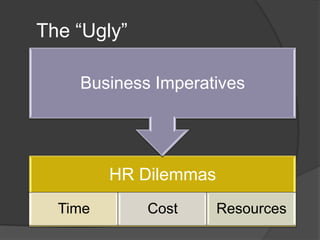
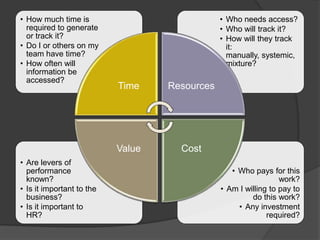
The “Good”HR can help the business make better decisions with facts and data.Without data, how can we assess our impact to the business and the bottom line?Increase HR value and business impactHR manages processes and assets (the PEOPLE) typically the largest expense of a business.The “Bad”Who defines the metrics used?How will the measures be used?What does the measure tell us about HR performance?What does the measure not tell us?Is the result good or bad?How do you know?The “Ugly”
Scorecards, Dashboards, and MetricsSince the focus of our session is about using HR metrics we will briefly review what should be the predecessor process before using metrics in isolation. Typically, the business initiates its strategic goal setting process each year coupled with longer range strategic planning as the first step.
Scorecard/Dashboard ProcessIdentify/Define the Business StrategyDevelop a business strategy map Link HR activities to the strategy mapCreate measuresLink to strategic business resultsSet targetsDevelop HR Scorecard/DashboardCommunicate results
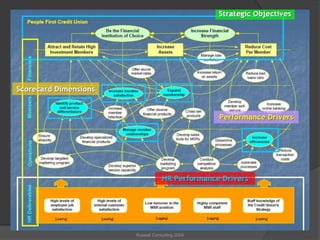
Scorecard/Dashboard exampleThis example on the next slide reflects a strategy map based on the business imperatives of a fictional credit unionWe can see the Strategic Objectives across the top (Be the Financial Institution of Choice, Increase Financial Strength)We can also see the various drivers to support the Strategic Objectives mostly the oval boxes in the swim lanes (Increase efficiencies, Cross-sell products, etc)Additionally, we see the HR Performance Drivers (Job Sat, Customer Sat, Staff Knowledge of CU’s Strategy, etc.) which would be tied to various underlying HR metrics.Lastly, you will notice these HR Performance Drivers have designations of leading or lagging. This ties to another important aspect of HR metrics.
Russell Consulting 2004
What are my Leading or Lagging indicators?
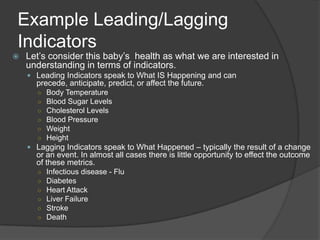
Example Leading/Lagging IndicatorsLet’s consider this baby’s  health as what we are interested in understanding in terms of indicators.Leading Indicators speak to What IS Happening and can precede, anticipate, predict, or affect the future.Body TemperatureBlood Sugar LevelsCholesterol LevelsBlood PressureWeightHeightLagging Indicators speak to What Happened – typically the result of a change or an event. In almost all cases there is little opportunity to effect the outcome of these metrics.Infectious disease - FluDiabetesHeart AttackLiver FailureStrokeDeath
Presenting Metrics to the BusinessLet’s talk about the other aspect of using metrics with our business partners. If we understand the business strategy we can be effective in communicating HR metrics to the organization. Even if you don’t go through the deeper strategy map process, discussed earlier, you can tie critical metrics to the organization’s goals.You may find your metrics naturally fall where they have direct or indirect impact on revenue or on costs. But what is more important is what action will HR take based on the results? Firms that carefully link HR activities to Business Strategy measured by metrics have a 33% higher return on Total Capital than those that do not. Watson Wyatt Research 2003
Building the HR caseJustify cost?Increase budget or expand services?Recognition of contribution?A call for action?
Building the presentationPresentation must focus on desired outcome(s)What are your business partner’s preferences in receiving data?Hit the high points early Do your homework! If possible, cultivate business champion to sell your organization during discussion
Pitfalls to Avoid	Identify how your business partners view successListen for clues about how your HR organization is viewedWhere do you bring value to the organization?Providing data that is not relevant/meaningful is worse than providing no data at all!What are the levers that drive business success?Do they connect with HR initiatives?Are they dependent or independent to HR?Know that metrics used aren’t universal for every industry or even company to companyYour metrics may change over time
Examples of Metrics
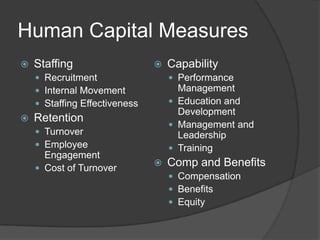
Human Capital MeasuresStaffingRecruitmentInternal MovementStaffing EffectivenessRetentionTurnoverEmployee EngagementCost of TurnoverCapabilityPerformance ManagementEducation and DevelopmentManagement and LeadershipTrainingComp and BenefitsCompensationBenefitsEquity
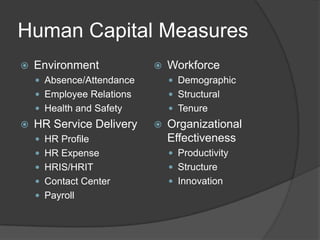
Human Capital Measures	EnvironmentAbsence/AttendanceEmployee RelationsHealth and SafetyHR Service DeliveryHR ProfileHR ExpenseHRIS/HRITContact CenterPayrollWorkforceDemographicStructuralTenureOrganizational EffectivenessProductivityStructureInnovation
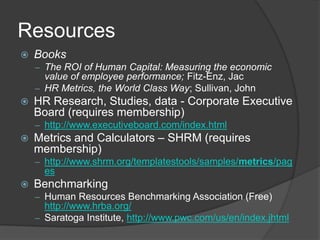
ResourcesBooksThe ROI of Human Capital: Measuring the economic value of employee performance; Fitz-Enz, Jac
HR Metrics, the World Class Way; Sullivan, JohnHR Research, Studies, data - Corporate Executive Board (requires membership) http://www.executiveboard.com/index.htmlMetrics and Calculators – SHRM (requires membership)http://www.shrm.org/templatestools/samples/metrics/pagesBenchmarking Human Resources Benchmarking Association (Free) http://www.hrba.org/
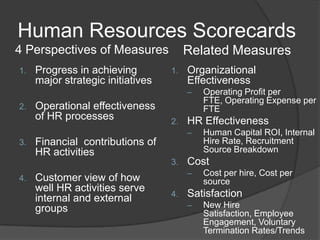
Saratoga Institute, http://www.pwc.com/us/en/index.jhtmlHuman Resources Scorecards4 Perspectives of Measures	Related MeasuresProgress in achieving major strategic initiativesOperational effectiveness of HR processesFinancial  contributions of HR activitiesCustomer view of how well HR activities serve internal and external groupsOrganizational EffectivenessOperating Profit per FTE, Operating Expense per FTEHR EffectivenessHuman Capital ROI, Internal Hire Rate, Recruitment Source BreakdownCost Cost per hire, Cost per sourceSatisfaction New Hire Satisfaction, Employee Engagement, Voluntary Termination Rates/Trends
HR  Metrics 3 0

HR Metrics 3 0

  • 1.
    Beyond Mere Measurement:Using HR Metrics to Impact Your Organization’s Business Performance Presented by:Keith Dalton, SPHRPresented April 15, 2010SHRM - JC
  • 2.
    OverviewThe Case forHR MetricsAn Approach for HR MetricsScorecards, Dashboards, and MetricsPresenting Metrics to the BusinessExamples of MetricsResourcesQ&A
  • 3.
    “There are threekinds of lies: Lies, Damn Lies and Statistics” Mark TwainWhen HR pulls out metrics there can certainly be suspicion by your partners about their use. Especially if HR is holding a business accountable to shared metrics.When we talk about HR metrics what are we trying to achieve?
  • 4.
    The Case forHR MetricsChange our way of thinking“I’m a business person that happens to be in HR, not an HR person who happens to be in the business” “If you can’t measure it, you can’t manage itTransform the role of HR4 HR “Evolutionary” RolesIncrease HR value to the business
  • 5.
    Business MetricsBusinesses havea variety of ways at looking at how it is doing usually backed by reams of data to make various decisions and to track, report, and communicate that information. Unfortunately, most HR individuals avoid the facts and data running through their organization or choose to ignore it. In other cases they may not find “value” in “the numbers” or in other cases dealing in “hard numbers” isn’t what they view as “HR” work. The point here is that HR can have significant impact to not only what appears on an Income Statement but also to the businesses’ long term success.Human Capital is one of the few assets a business or organization has that appreciates in value versus what most assets do which is depreciate. HR has power and the potential to influence the business bottom line.
  • 6.
    The Business Approachto MetricsA Common Understanding for All StakeholdersIncome StatementsCash Flow StatementsBalance SheetsRisk EvaluationsBudgetsAnd many more Various Methods of AnalyzingHorizontal VerticalQuantitativeQualitative
  • 7.
    An approach toHR Metrics:The Good, The Bad, andThe Ugly
  • 8.
    The “Good”HR canhelp the business make better decisions with facts and data.Without data, how can we assess our impact to the business and the bottom line?Increase HR value and business impactHR manages processes and assets (the PEOPLE) typically the largest expense of a business.The “Bad”Who defines the metrics used?How will the measures be used?What does the measure tell us about HR performance?What does the measure not tell us?Is the result good or bad?How do you know?The “Ugly”
  • 10.
    Scorecards, Dashboards, andMetricsSince the focus of our session is about using HR metrics we will briefly review what should be the predecessor process before using metrics in isolation. Typically, the business initiates its strategic goal setting process each year coupled with longer range strategic planning as the first step.
  • 11.
    Scorecard/Dashboard ProcessIdentify/Define theBusiness StrategyDevelop a business strategy map Link HR activities to the strategy mapCreate measuresLink to strategic business resultsSet targetsDevelop HR Scorecard/DashboardCommunicate results
  • 12.
    Scorecard/Dashboard exampleThis exampleon the next slide reflects a strategy map based on the business imperatives of a fictional credit unionWe can see the Strategic Objectives across the top (Be the Financial Institution of Choice, Increase Financial Strength)We can also see the various drivers to support the Strategic Objectives mostly the oval boxes in the swim lanes (Increase efficiencies, Cross-sell products, etc)Additionally, we see the HR Performance Drivers (Job Sat, Customer Sat, Staff Knowledge of CU’s Strategy, etc.) which would be tied to various underlying HR metrics.Lastly, you will notice these HR Performance Drivers have designations of leading or lagging. This ties to another important aspect of HR metrics.
  • 13.
  • 14.
    What are myLeading or Lagging indicators?
  • 15.
    Example Leading/Lagging IndicatorsLet’sconsider this baby’s health as what we are interested in understanding in terms of indicators.Leading Indicators speak to What IS Happening and can precede, anticipate, predict, or affect the future.Body TemperatureBlood Sugar LevelsCholesterol LevelsBlood PressureWeightHeightLagging Indicators speak to What Happened – typically the result of a change or an event. In almost all cases there is little opportunity to effect the outcome of these metrics.Infectious disease - FluDiabetesHeart AttackLiver FailureStrokeDeath
  • 16.
    Presenting Metrics tothe BusinessLet’s talk about the other aspect of using metrics with our business partners. If we understand the business strategy we can be effective in communicating HR metrics to the organization. Even if you don’t go through the deeper strategy map process, discussed earlier, you can tie critical metrics to the organization’s goals.You may find your metrics naturally fall where they have direct or indirect impact on revenue or on costs. But what is more important is what action will HR take based on the results? Firms that carefully link HR activities to Business Strategy measured by metrics have a 33% higher return on Total Capital than those that do not. Watson Wyatt Research 2003
  • 17.
    Building the HRcaseJustify cost?Increase budget or expand services?Recognition of contribution?A call for action?
  • 18.
    Building the presentationPresentationmust focus on desired outcome(s)What are your business partner’s preferences in receiving data?Hit the high points early Do your homework! If possible, cultivate business champion to sell your organization during discussion
  • 19.
    Pitfalls to Avoid Identifyhow your business partners view successListen for clues about how your HR organization is viewedWhere do you bring value to the organization?Providing data that is not relevant/meaningful is worse than providing no data at all!What are the levers that drive business success?Do they connect with HR initiatives?Are they dependent or independent to HR?Know that metrics used aren’t universal for every industry or even company to companyYour metrics may change over time
  • 20.
  • 21.
    Human Capital MeasuresStaffingRecruitmentInternalMovementStaffing EffectivenessRetentionTurnoverEmployee EngagementCost of TurnoverCapabilityPerformance ManagementEducation and DevelopmentManagement and LeadershipTrainingComp and BenefitsCompensationBenefitsEquity
  • 22.
    Human Capital Measures EnvironmentAbsence/AttendanceEmployeeRelationsHealth and SafetyHR Service DeliveryHR ProfileHR ExpenseHRIS/HRITContact CenterPayrollWorkforceDemographicStructuralTenureOrganizational EffectivenessProductivityStructureInnovation
  • 23.
    ResourcesBooksThe ROI ofHuman Capital: Measuring the economic value of employee performance; Fitz-Enz, Jac
  • 24.
    HR Metrics, theWorld Class Way; Sullivan, JohnHR Research, Studies, data - Corporate Executive Board (requires membership) http://www.executiveboard.com/index.htmlMetrics and Calculators – SHRM (requires membership)http://www.shrm.org/templatestools/samples/metrics/pagesBenchmarking Human Resources Benchmarking Association (Free) http://www.hrba.org/
  • 25.
    Saratoga Institute, http://www.pwc.com/us/en/index.jhtmlHumanResources Scorecards4 Perspectives of Measures Related MeasuresProgress in achieving major strategic initiativesOperational effectiveness of HR processesFinancial contributions of HR activitiesCustomer view of how well HR activities serve internal and external groupsOrganizational EffectivenessOperating Profit per FTE, Operating Expense per FTEHR EffectivenessHuman Capital ROI, Internal Hire Rate, Recruitment Source BreakdownCost Cost per hire, Cost per sourceSatisfaction New Hire Satisfaction, Employee Engagement, Voluntary Termination Rates/Trends

Editor's Notes

  • #4 Words to live by?When HR pulls out metrics there can certainly be suspicion by your partners about their use. Especially if HR is holding a business accountable to shared metrics.When we talk about HR metrics what are we trying to achieve?
  • #5 First bullet point: The case for implementing HR metrics is strong. In this period of uncertainty, where organizations are continually looking for ways to reduce costs, increase productivity, or even to justify the needs for functions and people, it is critical HR enables better decision-making through facts and data. This requires many of us to radically alter our thinking about how we work with the business. We can no longer ignore the fact we are first and foremost business people. Review Second bullet point: The need to move beyond “basic” support to an organization as a Service Provider or even to move further along the continuum of HR roles is a key method to increasing HR’s role at the table and its value to the business. The four roles HR may play related to metrics and data are (Corporate Executive Board “The Metrics Standard”): Service Provider – Builds repositories and provides information to the line as requested (ad hoc requests, databases capture human capital history)Business Enabler – Provides tools and services that enables real time, consistent, support that increases overall efficiency of the org (Ensures consistency of measurement across org, support data self service within and outside HR, multi-dimensional reports).Business Partner – Educates the organization regarding the impact of human capital on business performance, and identifies opptys for improvement (Identifies trends, Defines oppty with Human Capital interventions, educates the org. about Human Capital trends)Business Driver – Consults with the line providing direction how talent is best managed and leveraged to drive business success (Define Human capital drivers of organizational success, model impacts on organization’s goals, provide Human capital perspective in strategic decisions).
  • #16 This example reflects a strategy map based on the business imperatives of a fictional credit unionWe can see the Strategic Objectives across the top (Be the Financial Institution of Choice, Increase Financial Strength)We can also see the various drivers to support the Strategic Objectives mostly the oval boxes in the swim lanes (Increase efficiencies, Cross-sell products, etc)Additionally, we see the HR Performance Drivers (Job Sat, Customer Sat, Staff Knowledge of CU’s Strategy, etc.) which would be tied to various underlying HR metrics.Lastly, you will notice these HR Performance Drivers have designations of leading or lagging. This ties to another important aspect of HR metrics.
  • #23 So to provide additional context about what HR metrics might cover I’ve included several general categories in the next few slides and will share some specific measures which might help illustrate each area.