Created in collaboration with the
Canadian Council of Chief Executives
and its members
Increasing the
Return on Talent
Development for
Canadian Companies
EMPLOYEE SUCCESS
OBJECTIVES
TALENT
2
Canadian companies have an opportunity
to pioneer new ways to improve business
outcomes from training expenditures. In the
end, it’s not only about how much you spend
on training; it is the results you get from that
spend. This report, based in part on interviews
with executives from leading companies in
Canada, highlights important innovation across
the talent management lifecycle—defining,
discovering, developing and delivering
talent—that can improve return on
talent development.
2
3
Introduction
Canadian companies are at different
levels of maturity when it comes to talent
development capabilities—the methods
by which they define talent needs, source,
develop and manage talent with business
performance goals in mind. Some are
deploying advanced learning methods
involving a blend of in-person and
technology-based training. Others rely on
instructor-based methods in the classroom.
This variety in approach is one challenge to
capturing a real sense of talent development
capabilities and mindsets in Canada using
traditional measures such as expenditure
per employee. Using that measure alone,
one can see that training investments have
steadily declined over the past 20 years; but
is that an indicator of decreased commitment,
increased efficiency or some combination of
both factors?
One of the executives interviewed for this
report—Neil Hunter, Director of Learning and
Capability at Suncor—summarized this matter
well: “In terms of building talent, there’s no
shortage of investment. The challenge instead
is being targeted in what we do invest in.
There are so many opportunities to improve
and develop, so the challenge is actually
prioritizing where to begin, where to start
and how to sustain. There’s no shortage of
great ideas, but how to sustain them over a
longer period of time and achieve continuity
is absolutely critical to the success of
any investment.”
From this outcome-based perspective,
there are some signs that not all is well
when it comes to linking corporate talent
development with an area such as national
competitiveness. For example, ongoing
research from the Conference Board of
Canada has found that Canada ranks near
the bottom of its peer group in the area of
innovation—ranking 13th out of 16 countries
studied. Such a finding should raise concerns
across the country from business, government
and educational institutions. Countries that
are more innovative, notes the Board’s report,
“are passing Canada on measures such as
income per capita, productivity, and the
quality of social programs.”1
Given the need for better outcomes, as well as
the existing operating pressures on Canadian
companies, it is critically important to spend
Canadian training dollars wisely, and focus on
approaches, technologies and innovation
that increase return on investment in
talent development.
1. http://www.conferenceboard.ca/hcp/details/innovation.aspx
4
5
Overview
Accenture believes the time is right for
Canadian companies to reassess the way they
address knowledge and skill requirements
for their organizations. This report presents
a comprehensive assessment and a set of
recommendations for companies along the
entire “supply chain” of talent development
and management:
Define: Understand employee types - where,
how many and the existing knowledge and
skill base-required to address current and
future business needs.
Discover: Use a diverse network to identify
internal and external talent sources and
seamlessly onboard them.
Develop: Implement training solutions that
advance the skills of the workforce, including
managing a broad learning ecosystem
that promotes continuous learning through
universities, certification programs and
external vendor offerings.
Deploy: Mobilize workforces around
specific business and operational needs and
manage performance.
We supplement the analysis of these four
dimensions with the insights of HR and
Learning executives from Canadian companies
from a variety of industries including banking,
insurance, energy and retail. These executives
were interviewed exclusively for this report.
The payoff from improved talent development
capabilities is a greater return on investment
and stronger workforce performance, which
added to higher levels of innovation and
productivity, and translates into higher
revenues and growth. At a greater level,
the payoff is in improved innovation and
productivity for the entire country.
6
Defining Talent Needs
The acquisition and retention of workforce knowledge
and skills are more important than ever to establish
and maintain competitive advantage. Hiring for agility
and capability to learn required skills quickly
is critical.
The primary question Talent Management teams
should be able to answer is: “What are the
competencies, needed by role, for their organization
to operate and compete effectively?”
Competency models in most organizations remain
very high level and provide little clarity on which
candidates to pursue and hire and where performance
gaps exist—for example, when a financial services
company looks to fill a position. To say that
candidates “must have a strong grasp of financial
calculations” is very different from saying they
“must be able to calculate present value of ordinary
annuities given cash flow, interest rates and number
of payments.” The latter is a more precise definition
of what a person must be able to do, and should be
closer to the level of detail talent professionals strive
to catalog in competency models.
At the same time, desired characteristics should
be balanced with attitudes and mindsets. Telus, for
example, seeks co-ownership over the elements of
development needed to be successful. As Josh Blair,
Chief Corporate Officer and Executive Vice President
of Telus, notes, “We offer programs that help people
figure out and chart their path forward. At the same
time we’re looking for people who show initiative and
want to own their own career and who have a thirst
to learn and perform and find the right programs. So,
we try to make it easy but not too easy; we like to see
the individuals who rise to that philosophy.”
For certain skills, detailed analysis of performer
requirements is needed at the task level and forms
an organizational competency library. The library is
then integrated with upstream recruiting systems and
downstream work systems. Such an integrated effort
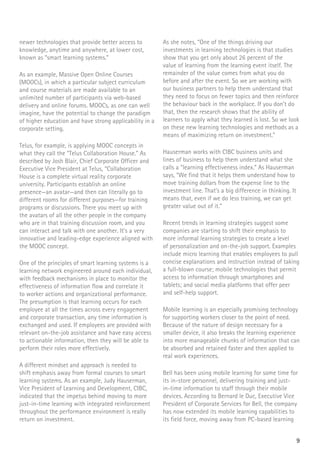
enables companies to:
1. Inventory and assess worker competency from entry
to exit.
2. Understand performance gaps between desired
competencies and the existing workforce.
3. Determine real capability differences between roles
to clearly map career paths requiring the shortest up-
skill investment.
4. Identify the impact of prospective candidate
development programs and employee performance
support systems.
Suncor is an example of a company in the early
stages of implementing a competency modeling for
their technical operations, with plans to launch it for
the rest of the company following some pilot work.
Suncor uses SuccessFactors as the warehouse for
competencies, with the intention of updating the
models annually. Neil Hunter, Director of Learning
and Capability at Suncor, commented on the use of
competency models across hiring, development and
performance management functions. “At the early
stage of using competency models, the quality of the
conversation is often leader-dependent until broader
consensus can be gained about how the models are to
be used and integrated.”
In summary, a succinct definition of the skills,
capabilities and competencies required leads
to effective recruiting and more impactful
business outcomes.
7
Discovering Talent
An organization’s talent partnerships, employee
recruitment, internal demand management and
leadership development all depend on how effectively
they can find people. Organizations should be able
to identify internal and external talent sources
and develop strategies for attracting and moving
individuals to points of need. To this effect,
companies will need to respond not only by tapping
into new labour markets but by proactively educating
those markets to ensure they are developing relevant
knowledge and skills.
Through co-ops, joint training programs and research
partnerships, businesses have demonstrated a
willingness to partner with educational institutions
to address skill shortages. Still, new opportunities
for innovation are emerging. Massive Open Online
Courses (MOOCs) are an example of how companies
like Accenture, HP and Microsoft have implemented
a talent development strategy to enhance their
discovery capabilities. Accenture Open Education
is free and available to anyone with an Internet
connection. Content is specifically designed for
online learning–broken into short chunks–that guides
students to think through whether a career in IT is
right for them and specifically prepares students for
jobs in companies such as Accenture. Once students
are confident with the material, they can take the
Software Developer Certification from PROXCER, an
affiliate of Carnegie Mellon University. This credential
is crucial for the student to be able to provide proof
of competence to a potential employer. Although
students can take their credential to any employer
who recognizes it, Accenture will offer a place in its
recruitment process to any student who has
the credential.
Our executive interviews uncovered other innovations
in the area of talent discovery. RBC is also using social
media in innovative ways to attract candidates. For
the “RBC Career Launch” internship program where
recruitment and application processes run exclusively
through social media. According to Susan Uchida,
Vice President of Learning and Development at RBC,
“We leverage an external partnership with youth job
boards, like TalentEgg, to profile the opportunity, and
use social media tools like Twitter, Facebook, LinkedIn
and TalentEgg for the ongoing conversation. In the
first and second years of the program we attracted
thousands of applicants for 100 associate positions
and set new records for how RBC uses social media in
talent attraction.”
Properly designed and executed, social media
programs can be a powerful way to give candidates
a good feel for what it would be like to work for the
company. This is the principle behind National Bank’s
approach. According to Lucie Houle, Vice-president,
Talent Management, at National Bank, “We’ve been
using LinkedIn and creating webpages with our
videos, and we’re making our leaders quite visible
in those videos, so that candidates can get a feel of
what it’s like to work here.”
Talent discovery also needs to take place inside an
organization, to identify internal candidates with
the right background and experience to move to a
different job within the company. TD Bank Group,
for example, focuses on resource planning as part of
corporate strategy. Not only does the bank ensure
a robust succession plan for critical leadership
positions, but it looks further into the future to find
the next generation of leaders. “We evaluate our
‘bench strength’ well into the middle management
levels, and leaders are responsible for reviewing their
teams annually to confirm who has both the
potential and ambition to move into more senior
roles,” said David Fellows, SVP Human Resources at
TD Bank Group.
TD’s commitment to developing leaders is reflected
in both formal programs and informal activities.
Managers and employees are expected to have
annual development conversations, separate from
performance assessments, to talk about employees’
accomplishments, career interests and long- and
short-term plans. Career development is also a
popular topic on TD’s internal social media network,
called “Connections,” where employees at all levels
engage in online discussions about topics such as
mentoring, interview tips and skill-building resources.
8
Internal talent discovery can also be enabled through
structured approaches to career management.
Enbridge, for example, utilizes “career ladders” for
every functional level with clear specifications for
how to advance up the ladder. At the same time,
they employ an approach they call “career mapping.”
As explained by Linda Palladino, Vice President of
HR for Enbridge, “We show our different jobs across
functional areas and try to open their minds to
those jobs as lateral moves. So, just because you’re
accountants doesn’t mean you can’t go work in
strategic planning or project management.”
Enbridge also runs internal job fairs twice a year.
According to Palladino, “We will set up booths for a
couple of days so our people can actually go and visit
the different areas or departments and talk about
what they do.”
Developing Talent
Companies are part of a life-long learning ecosystem.
Working to build on and integrate with traditional
education systems can help address the ongoing skills
shortage and so should work to better integrate and
build on traditional educational systems. Shortages
in technical skills, for example, are prompting
organizations to strengthen relationships with key
suppliers who can create a skilled talent pool (e.g.,
universities/community colleges, labour unions,
certification/accreditation programs).
Suncor is working hard with industry and colleges
in Alberta to accelerate the development of talent.
According to Pat White, Vice President of Talent at
Suncor, “The industry in northern Alberta is working
together to make sure that our apprenticeship
programs are sound and consistent, and that the
local colleges are invested in them and supportive.
We also partner with our major contractors who
actually represent a great deal of the skilled trade and
operators that work on site. Skills shortages can be a
threat to operational and growth agendas, so if we all
band together to solve the skills shortage problem, it
won’t threaten any proprietary advantage and it will
serve all of us.”
Opportunities still exist, however, for companies to
implement smarter learning systems within their
own corporations to more effectively target learning,
minimize operational disruption, improve corporate
agility and reduce transactional costs.
By and large, learning organizations at most
companies are product- and program-oriented,
generally geared toward numbers of courses created
and delivered. However, given advancements in
technology, organizations can strive to minimize a
scheduled learning intervention approach, which is
costly to administer and maintain, and usually lacks
the level of engagement that actually results in
retention of knowledge and new kinds of performance
behaviours. The dominant philosophy that underpins
most training approaches is the belief that learning
is constructed, deployed and managed; and although
today’s high-performing learning organizations do
a better job of “producing and managing,” many are
ultimately challenged to sustain a model that will
require proportionally more investment with the
increasing learning demands placed on them.
Organizations should consider the advantages of
9
newer technologies that provide better access to
knowledge, anytime and anywhere, at lower cost,
known as “smart learning systems.”
As an example, Massive Open Online Courses
(MOOCs), in which a particular subject curriculum
and course materials are made available to an
unlimited number of participants via web-based
delivery and online forums. MOOCs, as one can well
imagine, have the potential to change the paradigm
of higher education and have strong applicability in a
corporate setting.
Telus, for example, is applying MOOC concepts in
what they call the “Telus Collaboration House.” As
described by Josh Blair, Chief Corporate Officer and
Executive Vice President at Telus, “Collaboration
House is a complete virtual reality corporate
university. Participants establish an online
presence—an avatar—and then can literally go to
different rooms for different purposes—for training
programs or discussions. There you meet up with
the avatars of all the other people in the company
who are in that training discussion room, and you
can interact and talk with one another. It’s a very
innovative and leading-edge experience aligned with
the MOOC concept.
One of the principles of smart learning systems is a
learning network engineered around each individual,
with feedback mechanisms in place to monitor the
effectiveness of information flow and correlate it
to worker actions and organizational performance.
The presumption is that learning occurs for each
employee at all the times across every engagement
and corporate transaction, any time information is
exchanged and used. If employees are provided with
relevant on-the-job assistance and have easy access
to actionable information, then they will be able to
perform their roles more effectively.
A different mindset and approach is needed to
shift emphasis away from formal courses to smart
learning systems. As an example, Judy Hauserman,
Vice President of Learning and Development, CIBC,
indicated that the impetus behind moving to more
just-in-time learning with integrated reinforcement
throughout the performance environment is really
return on investment.
As she notes, “One of the things driving our
investments in learning technologies is that studies
show that you get only about 26 percent of the
value of learning from the learning event itself. The
remainder of the value comes from what you do
before and after the event. So we are working with
our business partners to help them understand that
they need to focus on fewer topics and then reinforce
the behaviour back in the workplace. If you don’t do
that, then the research shows that the ability of
learners to apply what they learned is lost. So we look
on these new learning technologies and methods as a
means of maximizing return on investment.”
Hauserman works with CIBC business units and
lines of business to help them understand what she
calls a “learning effectiveness index.” As Hauserman
says, “We find that it helps them understand how to
move training dollars from the expense line to the
investment line. That’s a big difference in thinking. It
means that, even if we do less training, we can get
greater value out of it.”
Recent trends in learning strategies suggest some
companies are starting to shift their emphasis to
more informal learning strategies to create a level
of personalization and on-the-job support. Examples
include micro learning that enables employees to pull
concise explanations and instruction instead of taking
a full-blown course; mobile technologies that permit
access to information through smartphones and
tablets; and social media platforms that offer peer
and self-help support.
Mobile learning is an especially promising technology
for supporting workers closer to the point of need.
Because of the nature of design necessary for a
smaller device, it also breaks the learning experience
into more manageable chunks of information that can
be absorbed and retained faster and then applied to
real work experiences.
Bell has been using mobile learning for some time for
its in-store personnel, delivering training and just-
in-time information to staff through their mobile
devices. According to Bernard le Duc, Executive Vice
President of Corporate Services for Bell, the company
has now extended its mobile learning capabilities to
its field force, moving away from PC-based learning
10
to mobile devices. The next phase of work, according
to le Duc, is to extend mobile learning to the rest of
the office staff and the call centres.
Mobile learning is especially effective for companies
with an extensive field force or large retail presence.
Loblaw, for example, is beginning to move into mobile
learning to meet the needs of its large number of
employees in stores. Right now, about one-fourth of
the overall employee population has access to online
training. But with mobile learning, most staff will be
able to gain access to the information and training
they need. As noted by Heather Sheehan, Senior
Director of Learning & Development at Loblaw, “We
believe that mobile learning will be a big opportunity
for us down the road because we will be better able
to reach people like our young, part-time colleagues.
We think reaching them with learning through their
mobile devices will be a strategic differentiator for us
down the road.”
The use of innovative technologies—especially for
informal learning and just-in-time learning—is often
hampered by traditional learning and development
models. The Conference Board of Canada “Learning
and Development Outlook,” 12th edition, notes,
“Online collaborative learning still has not caught
on within organizations, representing a mere two
percent of all learning delivery. This is surprising,
given that online collaboration through social media
is thought to be one of the fastest-growing means of
information-sharing at work.”2
Social media is a hot technology at most companies,
to be sure. The question is whether those companies
are reaping the true potential of social platforms.
Today, social media is most often used in the context
of courses or to help people deliberate. The real
opportunity is to support work processes in real-time.
According to the findings from APQC’s “Putting
Knowledge in the Flow of Work Best Practices
Study,” successful organizations integrate knowledge
sharing into work activities.3
NASA’s Jet Propulsion
Laboratory, for instance, has integrated knowledge
sources in the various electronic workspaces that
their employees use. The United States Patent and
Trademark Office (USPTO) Peer-to-Patent pilot
is perhaps the strongest example of progressive
collaboration. As a means of improving patent
quality and tackling a significant backlog of
outstanding patent reviews, the Peer-to-Patent
website allows private citizens and organizations to
participate and help USPTO agents as they review
patent submissions.4
While organizations have been
slow to fully commit to this degree of progressive
collaboration, Canadian organizations can take the
lead and embed collaboration capabilities within
internal, business-to-business and business-to-
customer processes to drive just-in-time support and
achieve specific business outcomes.
In our interviews we found one company, CIBC,
that has moved to a new e-learning course creation
tool based on the Tin Can protocol. The protocol
records the learner experience as they complete
the e-learning course. This information, taken in
aggregate, allows the learning team to improve the
course design and enhance employee experience in
taking the course, thus improving ease of learning,
overall retention and return on training investment.
Further advancements in machine learning will enable
companies to personalize a worker’s support resources
based on real-time, on-the-job activities and build
automated learning assistants that can monitor
and coach employees as they work. While this level
of sophistication has been well utilized by direct
marketing strategies, it has not yet revolutionized
talent management practices.
2. “Learning and Development Outlook 2014: Strong Learning Organizations, Strong Leadership, ”The Conference Board of Canada,
February 2014. http://www.conferenceboard.ca/e-library/abstract.aspx?did=5734
3. http://www.apqc.org/knowledge-base/collections/putting-knowledge-flow-work-collection
4. www.peertopatent.org
11
Deploying Talent
When it comes to deploying talent, high-performance
organizations demonstrate a number of distinctive
capabilities. They assign talent to roles in a way
that gives individuals meaningful opportunities to
grow while also improving the strategic impact of
the business. They have institutionalized methods
for moving the right internal and external talent
to positions critical to business success—and they
manage and govern that process effectively in an
ongoing manner.5
Talent deployment focuses on the
following activities:
• Managing and assessing performance over time to
improve individual, group and business performance.
• Managing careers to ensure the best possible match
between employee talent and aspiration and the
strategic goals of the organization.
• Measuring the impact of talent development
strategies and practices on overall business
performance.
Let’s look a bit more in depth at some of
these activities.
5. See The Talent Powered Organization, Peter Cheese, Robert J. Thomas and Elizabeth Craig (Kogan Page, 2008), p. 144.
Performance Management
Several of the companies we interviewed are pursuing
innovative practices in performance management
that vary from forced ranking (including terminating
the bottom 5-10 percent) to focusing on the
intrinsic elements of positive motivation, leadership
development and coaching by managers, to set short-
and long-term goals that can be self-evaluated.
Accenture’s Workforce of the Future research
suggests the fundamental dynamics of the workforce
as we know it will continue to change, bringing
greater diversity, expectation and innovation. Over the
next several years, the need to continuously evolve
and enhance existing performance management
techniques to meet the unique needs of the
workforce will be a key priority. Our research
indicates the following:
• 40 percent of most workforces will be millennials
by 2020
• 45 percent of the talent pool in 2015 will be
contractors
• 27 percent of the workforce will work remotely by
the end of 2015
• 84 percent of employees consider making an impact
in the community more important than
professional recognition
As we become more connected, huge populations of
previously inaccessible talent will join and integrate
into existing workforces. This injection of talent will
bring new expectations to performance management
and cast a very different lens on how employees
are measured and rewarded for the work they do.
Understanding the dynamics of a more globally
diverse workforce and being open to innovative
performance management ideas will be key when
attracting and retaining the best talent.
12
Career Management
Career management is another way organizations
can continuously deploy their people to
appropriate roles and job assignments, while
also advancing employees’ skills and capabilities.
Research has shown that one of the most
important factors that determine the performance
of senior executives and their companies is the
range of experiences these executives have had
in their careers. As the authors of The Talent
Powered Organization write, “Exposure to a
variety of corporate functions, industry sectors
and types of roles … helps to develop a variety of
skills and competencies, builds the individuals’
specific knowledge while increasing their
adaptability and better prepares them for future
leadership roles.”6
One way career management is accomplished is
through the annual review. At National Bank of
Canada, for example, the review always includes
a discussion of employee development—the
competencies needed to be successful in a
current role or, for those who have been in a
particular role for some time, the competencies
needed to advance to a different position. In
career assessments, employees can benchmark
themselves against profiles of particular
managerial roles, helping them plot a course
toward roles that are good for them and good
for the firm.
Dan West, Senior Manager of Human Resources
at BHP Billiton, reminds us, however, that
companies do not serve their people well by
being too prescriptive about career moves; much
depends on an employee’s own work and drive
to understand the company and forge their own
path, with the general guidance of their leaders.
“We are reluctant to define what a single career
path could be for people,” says West, “because we
truly believe that employees need to determine
what their preferred and desired career is. So
we’re not going to say to someone, ‘Well, if you
want to get to a certain career objective, these
are the one-two-three steps you need to take.’
Our focus has been on leaders working with
employees to say, ‘Given your career aspirations,
let’s look at what development experiences
you need to get there. What are some of the
experiences you might want to build on that
would set you up to be successful in those future
roles?’ It’s not a leader’s job to tell employees
what their career path should be. Employees own
their career, and the leader’s role is to support
them in defining possible paths and then helping
them to execute their own career objectives.”
6. The Talent Powered Organization, p. 150.
13
Governance and Measurement
In today’s market, there remains a strong need
for organizations to invest in governance models
that align strategies to business direction
and correlate talent development investment
to business performance. High-performance
organizations achieve this by providing a direct
line of accountability and control on quality
through centres of excellence for talent and
operational support. These centres provide
corporate-wide process management, workforce
planning, competency management, recruitment,
instructional design, performance consulting,
administration technology management, user
support and procurement. The more tightly
these centres are integrated through processes,
information sharing and decision making, the
more enabled they are to identify performance
issues and implement system solutions.
14
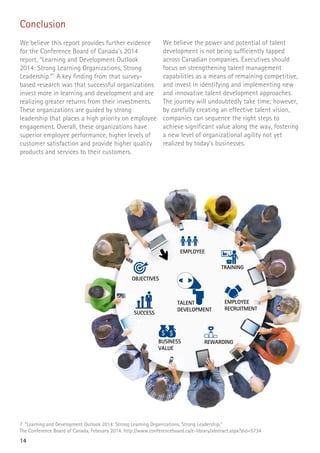
EMPLOYEE
TRAINING
EMPLOYEE
RECRUITMENT
TALENT
DEVELOPMENT
REWARDINGBUSINESS
VALUE
SUCCESS
OBJECTIVES
Conclusion
We believe this report provides further evidence
for the Conference Board of Canada’s 2014
report, “Learning and Development Outlook
2014: Strong Learning Organizations, Strong
Leadership.”7
A key finding from that survey-
based research was that successful organizations
invest more in learning and development and are
realizing greater returns from their investments.
These organizations are guided by strong
leadership that places a high priority on employee
engagement. Overall, these organizations have
superior employee performance, higher levels of
customer satisfaction and provide higher quality
products and services to their customers.
7. “Learning and Development Outlook 2014: Strong Learning Organizations, Strong Leadership,”
The Conference Board of Canada, February 2014. http://www.conferenceboard.ca/e-library/abstract.aspx?did=5734
We believe the power and potential of talent
development is not being sufficiently tapped
across Canadian companies. Executives should
focus on strengthening talent management
capabilities as a means of remaining competitive,
and invest in identifying and implementing new
and innovative talent development approaches.
The journey will undoubtedly take time; however,
by carefully creating an effective talent vision,
companies can sequence the right steps to
achieve significant value along the way, fostering
a new level of organizational agility not yet
realized by today’s businesses.
About this Report
This report was developed in collaboration with
the Canadian Council of Chief Executives (CCCE)
and its members. It is part of the CCCE’s multi-
year initiative–Taking Action for Canada: Jobs and
Skills for the 21st Century.
The Canadian Council of Chief Executives is a
not-for-profit, non-partisan organization
composed of the CEOs of Canada’s leading
enterprises. It engages in an active program of
research, consultation and advocacy on issues of
national importance to the economic and social
fabric of Canada.
CCCE member CEOs and entrepreneurs
represent all sectors of the Canadian economy.
The companies they lead collectively administer
$6 trillion in assets, have annual revenues in
excess of $850 billion, and are responsible for the
vast majority of Canada’s exports, investment,
research and development, and training. Its
homepage is www.ceocouncil.ca.
About the Authors
Danielle Francis is an Executive in Accenture’s
Financial Services practice, specializing in
Workforce Enablement, Talent Management and
Learning, based in Toronto. She brings a global
lens to innovative learning and collaboration
strategies. She focuses on unique strategies to
enable and evolve the Talent Management agenda
for Financial Services companies. In addition to
this role, she leads Accenture Canada’s Women’s
Initiatives. danielle.francis@accenture.com
Janet Krstevski is a Managing Director responsible
for Canada’s Talent & Organization practice.
Based in Toronto, she has more than 21 years
of experience managing projects and teams in
environments of rapid growth and organizational
change. Working with a wide variety of major
global organizations, Janet specializes in
delivering business outcomes on large-scale
workforce transformations. Janet’s expertise
includes transformation involving organization
design, leadership and culture as well as
innovative talent management, learning and
change strategies. janet.krstevski@accenture.com
*The Canadian Council of Chief Executives and Accenture do
not guarantee the accuracy or completeness of the information
in this presentation. The Canadian Council of Chief Executives
and Accenture make no representation or warranty, express
or implied, and accepts no liability concerning the fairness,
accuracy, or completeness of the information contained herein
or for any consequences of you or anyone else acting, or
refraining to act, in reliance on the information contained in this
presentation or for any decision based on it.
15
About Accenture
Accenture is a global management
consulting, technology services and
outsourcing company, with more
than 323,000 people serving clients in
more than 120 countries. Combining
unparalleled experience, comprehensive
capabilities across all industries and
business functions, and extensive
research on the world’s most successful
companies, Accenture collaborates
with clients to help them become
high-performance businesses and
governments. The company generated
net revenues of US$30.0 billion for the
fiscal year ended Aug. 31, 2014. Its
home page is www.accenture.com.
Copyright © 2015 Accenture
All rights reserved.
Accenture, its logo, and
High Performance Delivered
are trademarks of Accenture.

accenture-increasing-return-talent-development-canadian-companies

  • 1.
    Created in collaborationwith the Canadian Council of Chief Executives and its members Increasing the Return on Talent Development for Canadian Companies EMPLOYEE SUCCESS OBJECTIVES TALENT
  • 2.
    2 Canadian companies havean opportunity to pioneer new ways to improve business outcomes from training expenditures. In the end, it’s not only about how much you spend on training; it is the results you get from that spend. This report, based in part on interviews with executives from leading companies in Canada, highlights important innovation across the talent management lifecycle—defining, discovering, developing and delivering talent—that can improve return on talent development. 2
  • 3.
    3 Introduction Canadian companies areat different levels of maturity when it comes to talent development capabilities—the methods by which they define talent needs, source, develop and manage talent with business performance goals in mind. Some are deploying advanced learning methods involving a blend of in-person and technology-based training. Others rely on instructor-based methods in the classroom. This variety in approach is one challenge to capturing a real sense of talent development capabilities and mindsets in Canada using traditional measures such as expenditure per employee. Using that measure alone, one can see that training investments have steadily declined over the past 20 years; but is that an indicator of decreased commitment, increased efficiency or some combination of both factors? One of the executives interviewed for this report—Neil Hunter, Director of Learning and Capability at Suncor—summarized this matter well: “In terms of building talent, there’s no shortage of investment. The challenge instead is being targeted in what we do invest in. There are so many opportunities to improve and develop, so the challenge is actually prioritizing where to begin, where to start and how to sustain. There’s no shortage of great ideas, but how to sustain them over a longer period of time and achieve continuity is absolutely critical to the success of any investment.” From this outcome-based perspective, there are some signs that not all is well when it comes to linking corporate talent development with an area such as national competitiveness. For example, ongoing research from the Conference Board of Canada has found that Canada ranks near the bottom of its peer group in the area of innovation—ranking 13th out of 16 countries studied. Such a finding should raise concerns across the country from business, government and educational institutions. Countries that are more innovative, notes the Board’s report, “are passing Canada on measures such as income per capita, productivity, and the quality of social programs.”1 Given the need for better outcomes, as well as the existing operating pressures on Canadian companies, it is critically important to spend Canadian training dollars wisely, and focus on approaches, technologies and innovation that increase return on investment in talent development. 1. http://www.conferenceboard.ca/hcp/details/innovation.aspx
  • 4.
  • 5.
    5 Overview Accenture believes thetime is right for Canadian companies to reassess the way they address knowledge and skill requirements for their organizations. This report presents a comprehensive assessment and a set of recommendations for companies along the entire “supply chain” of talent development and management: Define: Understand employee types - where, how many and the existing knowledge and skill base-required to address current and future business needs. Discover: Use a diverse network to identify internal and external talent sources and seamlessly onboard them. Develop: Implement training solutions that advance the skills of the workforce, including managing a broad learning ecosystem that promotes continuous learning through universities, certification programs and external vendor offerings. Deploy: Mobilize workforces around specific business and operational needs and manage performance. We supplement the analysis of these four dimensions with the insights of HR and Learning executives from Canadian companies from a variety of industries including banking, insurance, energy and retail. These executives were interviewed exclusively for this report. The payoff from improved talent development capabilities is a greater return on investment and stronger workforce performance, which added to higher levels of innovation and productivity, and translates into higher revenues and growth. At a greater level, the payoff is in improved innovation and productivity for the entire country.
  • 6.
    6 Defining Talent Needs Theacquisition and retention of workforce knowledge and skills are more important than ever to establish and maintain competitive advantage. Hiring for agility and capability to learn required skills quickly is critical. The primary question Talent Management teams should be able to answer is: “What are the competencies, needed by role, for their organization to operate and compete effectively?” Competency models in most organizations remain very high level and provide little clarity on which candidates to pursue and hire and where performance gaps exist—for example, when a financial services company looks to fill a position. To say that candidates “must have a strong grasp of financial calculations” is very different from saying they “must be able to calculate present value of ordinary annuities given cash flow, interest rates and number of payments.” The latter is a more precise definition of what a person must be able to do, and should be closer to the level of detail talent professionals strive to catalog in competency models. At the same time, desired characteristics should be balanced with attitudes and mindsets. Telus, for example, seeks co-ownership over the elements of development needed to be successful. As Josh Blair, Chief Corporate Officer and Executive Vice President of Telus, notes, “We offer programs that help people figure out and chart their path forward. At the same time we’re looking for people who show initiative and want to own their own career and who have a thirst to learn and perform and find the right programs. So, we try to make it easy but not too easy; we like to see the individuals who rise to that philosophy.” For certain skills, detailed analysis of performer requirements is needed at the task level and forms an organizational competency library. The library is then integrated with upstream recruiting systems and downstream work systems. Such an integrated effort enables companies to: 1. Inventory and assess worker competency from entry to exit. 2. Understand performance gaps between desired competencies and the existing workforce. 3. Determine real capability differences between roles to clearly map career paths requiring the shortest up- skill investment. 4. Identify the impact of prospective candidate development programs and employee performance support systems. Suncor is an example of a company in the early stages of implementing a competency modeling for their technical operations, with plans to launch it for the rest of the company following some pilot work. Suncor uses SuccessFactors as the warehouse for competencies, with the intention of updating the models annually. Neil Hunter, Director of Learning and Capability at Suncor, commented on the use of competency models across hiring, development and performance management functions. “At the early stage of using competency models, the quality of the conversation is often leader-dependent until broader consensus can be gained about how the models are to be used and integrated.” In summary, a succinct definition of the skills, capabilities and competencies required leads to effective recruiting and more impactful business outcomes.
  • 7.
    7 Discovering Talent An organization’stalent partnerships, employee recruitment, internal demand management and leadership development all depend on how effectively they can find people. Organizations should be able to identify internal and external talent sources and develop strategies for attracting and moving individuals to points of need. To this effect, companies will need to respond not only by tapping into new labour markets but by proactively educating those markets to ensure they are developing relevant knowledge and skills. Through co-ops, joint training programs and research partnerships, businesses have demonstrated a willingness to partner with educational institutions to address skill shortages. Still, new opportunities for innovation are emerging. Massive Open Online Courses (MOOCs) are an example of how companies like Accenture, HP and Microsoft have implemented a talent development strategy to enhance their discovery capabilities. Accenture Open Education is free and available to anyone with an Internet connection. Content is specifically designed for online learning–broken into short chunks–that guides students to think through whether a career in IT is right for them and specifically prepares students for jobs in companies such as Accenture. Once students are confident with the material, they can take the Software Developer Certification from PROXCER, an affiliate of Carnegie Mellon University. This credential is crucial for the student to be able to provide proof of competence to a potential employer. Although students can take their credential to any employer who recognizes it, Accenture will offer a place in its recruitment process to any student who has the credential. Our executive interviews uncovered other innovations in the area of talent discovery. RBC is also using social media in innovative ways to attract candidates. For the “RBC Career Launch” internship program where recruitment and application processes run exclusively through social media. According to Susan Uchida, Vice President of Learning and Development at RBC, “We leverage an external partnership with youth job boards, like TalentEgg, to profile the opportunity, and use social media tools like Twitter, Facebook, LinkedIn and TalentEgg for the ongoing conversation. In the first and second years of the program we attracted thousands of applicants for 100 associate positions and set new records for how RBC uses social media in talent attraction.” Properly designed and executed, social media programs can be a powerful way to give candidates a good feel for what it would be like to work for the company. This is the principle behind National Bank’s approach. According to Lucie Houle, Vice-president, Talent Management, at National Bank, “We’ve been using LinkedIn and creating webpages with our videos, and we’re making our leaders quite visible in those videos, so that candidates can get a feel of what it’s like to work here.” Talent discovery also needs to take place inside an organization, to identify internal candidates with the right background and experience to move to a different job within the company. TD Bank Group, for example, focuses on resource planning as part of corporate strategy. Not only does the bank ensure a robust succession plan for critical leadership positions, but it looks further into the future to find the next generation of leaders. “We evaluate our ‘bench strength’ well into the middle management levels, and leaders are responsible for reviewing their teams annually to confirm who has both the potential and ambition to move into more senior roles,” said David Fellows, SVP Human Resources at TD Bank Group. TD’s commitment to developing leaders is reflected in both formal programs and informal activities. Managers and employees are expected to have annual development conversations, separate from performance assessments, to talk about employees’ accomplishments, career interests and long- and short-term plans. Career development is also a popular topic on TD’s internal social media network, called “Connections,” where employees at all levels engage in online discussions about topics such as mentoring, interview tips and skill-building resources.
  • 8.
    8 Internal talent discoverycan also be enabled through structured approaches to career management. Enbridge, for example, utilizes “career ladders” for every functional level with clear specifications for how to advance up the ladder. At the same time, they employ an approach they call “career mapping.” As explained by Linda Palladino, Vice President of HR for Enbridge, “We show our different jobs across functional areas and try to open their minds to those jobs as lateral moves. So, just because you’re accountants doesn’t mean you can’t go work in strategic planning or project management.” Enbridge also runs internal job fairs twice a year. According to Palladino, “We will set up booths for a couple of days so our people can actually go and visit the different areas or departments and talk about what they do.” Developing Talent Companies are part of a life-long learning ecosystem. Working to build on and integrate with traditional education systems can help address the ongoing skills shortage and so should work to better integrate and build on traditional educational systems. Shortages in technical skills, for example, are prompting organizations to strengthen relationships with key suppliers who can create a skilled talent pool (e.g., universities/community colleges, labour unions, certification/accreditation programs). Suncor is working hard with industry and colleges in Alberta to accelerate the development of talent. According to Pat White, Vice President of Talent at Suncor, “The industry in northern Alberta is working together to make sure that our apprenticeship programs are sound and consistent, and that the local colleges are invested in them and supportive. We also partner with our major contractors who actually represent a great deal of the skilled trade and operators that work on site. Skills shortages can be a threat to operational and growth agendas, so if we all band together to solve the skills shortage problem, it won’t threaten any proprietary advantage and it will serve all of us.” Opportunities still exist, however, for companies to implement smarter learning systems within their own corporations to more effectively target learning, minimize operational disruption, improve corporate agility and reduce transactional costs. By and large, learning organizations at most companies are product- and program-oriented, generally geared toward numbers of courses created and delivered. However, given advancements in technology, organizations can strive to minimize a scheduled learning intervention approach, which is costly to administer and maintain, and usually lacks the level of engagement that actually results in retention of knowledge and new kinds of performance behaviours. The dominant philosophy that underpins most training approaches is the belief that learning is constructed, deployed and managed; and although today’s high-performing learning organizations do a better job of “producing and managing,” many are ultimately challenged to sustain a model that will require proportionally more investment with the increasing learning demands placed on them. Organizations should consider the advantages of
  • 9.
    9 newer technologies thatprovide better access to knowledge, anytime and anywhere, at lower cost, known as “smart learning systems.” As an example, Massive Open Online Courses (MOOCs), in which a particular subject curriculum and course materials are made available to an unlimited number of participants via web-based delivery and online forums. MOOCs, as one can well imagine, have the potential to change the paradigm of higher education and have strong applicability in a corporate setting. Telus, for example, is applying MOOC concepts in what they call the “Telus Collaboration House.” As described by Josh Blair, Chief Corporate Officer and Executive Vice President at Telus, “Collaboration House is a complete virtual reality corporate university. Participants establish an online presence—an avatar—and then can literally go to different rooms for different purposes—for training programs or discussions. There you meet up with the avatars of all the other people in the company who are in that training discussion room, and you can interact and talk with one another. It’s a very innovative and leading-edge experience aligned with the MOOC concept. One of the principles of smart learning systems is a learning network engineered around each individual, with feedback mechanisms in place to monitor the effectiveness of information flow and correlate it to worker actions and organizational performance. The presumption is that learning occurs for each employee at all the times across every engagement and corporate transaction, any time information is exchanged and used. If employees are provided with relevant on-the-job assistance and have easy access to actionable information, then they will be able to perform their roles more effectively. A different mindset and approach is needed to shift emphasis away from formal courses to smart learning systems. As an example, Judy Hauserman, Vice President of Learning and Development, CIBC, indicated that the impetus behind moving to more just-in-time learning with integrated reinforcement throughout the performance environment is really return on investment. As she notes, “One of the things driving our investments in learning technologies is that studies show that you get only about 26 percent of the value of learning from the learning event itself. The remainder of the value comes from what you do before and after the event. So we are working with our business partners to help them understand that they need to focus on fewer topics and then reinforce the behaviour back in the workplace. If you don’t do that, then the research shows that the ability of learners to apply what they learned is lost. So we look on these new learning technologies and methods as a means of maximizing return on investment.” Hauserman works with CIBC business units and lines of business to help them understand what she calls a “learning effectiveness index.” As Hauserman says, “We find that it helps them understand how to move training dollars from the expense line to the investment line. That’s a big difference in thinking. It means that, even if we do less training, we can get greater value out of it.” Recent trends in learning strategies suggest some companies are starting to shift their emphasis to more informal learning strategies to create a level of personalization and on-the-job support. Examples include micro learning that enables employees to pull concise explanations and instruction instead of taking a full-blown course; mobile technologies that permit access to information through smartphones and tablets; and social media platforms that offer peer and self-help support. Mobile learning is an especially promising technology for supporting workers closer to the point of need. Because of the nature of design necessary for a smaller device, it also breaks the learning experience into more manageable chunks of information that can be absorbed and retained faster and then applied to real work experiences. Bell has been using mobile learning for some time for its in-store personnel, delivering training and just- in-time information to staff through their mobile devices. According to Bernard le Duc, Executive Vice President of Corporate Services for Bell, the company has now extended its mobile learning capabilities to its field force, moving away from PC-based learning
  • 10.
    10 to mobile devices.The next phase of work, according to le Duc, is to extend mobile learning to the rest of the office staff and the call centres. Mobile learning is especially effective for companies with an extensive field force or large retail presence. Loblaw, for example, is beginning to move into mobile learning to meet the needs of its large number of employees in stores. Right now, about one-fourth of the overall employee population has access to online training. But with mobile learning, most staff will be able to gain access to the information and training they need. As noted by Heather Sheehan, Senior Director of Learning & Development at Loblaw, “We believe that mobile learning will be a big opportunity for us down the road because we will be better able to reach people like our young, part-time colleagues. We think reaching them with learning through their mobile devices will be a strategic differentiator for us down the road.” The use of innovative technologies—especially for informal learning and just-in-time learning—is often hampered by traditional learning and development models. The Conference Board of Canada “Learning and Development Outlook,” 12th edition, notes, “Online collaborative learning still has not caught on within organizations, representing a mere two percent of all learning delivery. This is surprising, given that online collaboration through social media is thought to be one of the fastest-growing means of information-sharing at work.”2 Social media is a hot technology at most companies, to be sure. The question is whether those companies are reaping the true potential of social platforms. Today, social media is most often used in the context of courses or to help people deliberate. The real opportunity is to support work processes in real-time. According to the findings from APQC’s “Putting Knowledge in the Flow of Work Best Practices Study,” successful organizations integrate knowledge sharing into work activities.3 NASA’s Jet Propulsion Laboratory, for instance, has integrated knowledge sources in the various electronic workspaces that their employees use. The United States Patent and Trademark Office (USPTO) Peer-to-Patent pilot is perhaps the strongest example of progressive collaboration. As a means of improving patent quality and tackling a significant backlog of outstanding patent reviews, the Peer-to-Patent website allows private citizens and organizations to participate and help USPTO agents as they review patent submissions.4 While organizations have been slow to fully commit to this degree of progressive collaboration, Canadian organizations can take the lead and embed collaboration capabilities within internal, business-to-business and business-to- customer processes to drive just-in-time support and achieve specific business outcomes. In our interviews we found one company, CIBC, that has moved to a new e-learning course creation tool based on the Tin Can protocol. The protocol records the learner experience as they complete the e-learning course. This information, taken in aggregate, allows the learning team to improve the course design and enhance employee experience in taking the course, thus improving ease of learning, overall retention and return on training investment. Further advancements in machine learning will enable companies to personalize a worker’s support resources based on real-time, on-the-job activities and build automated learning assistants that can monitor and coach employees as they work. While this level of sophistication has been well utilized by direct marketing strategies, it has not yet revolutionized talent management practices. 2. “Learning and Development Outlook 2014: Strong Learning Organizations, Strong Leadership, ”The Conference Board of Canada, February 2014. http://www.conferenceboard.ca/e-library/abstract.aspx?did=5734 3. http://www.apqc.org/knowledge-base/collections/putting-knowledge-flow-work-collection 4. www.peertopatent.org
  • 11.
    11 Deploying Talent When itcomes to deploying talent, high-performance organizations demonstrate a number of distinctive capabilities. They assign talent to roles in a way that gives individuals meaningful opportunities to grow while also improving the strategic impact of the business. They have institutionalized methods for moving the right internal and external talent to positions critical to business success—and they manage and govern that process effectively in an ongoing manner.5 Talent deployment focuses on the following activities: • Managing and assessing performance over time to improve individual, group and business performance. • Managing careers to ensure the best possible match between employee talent and aspiration and the strategic goals of the organization. • Measuring the impact of talent development strategies and practices on overall business performance. Let’s look a bit more in depth at some of these activities. 5. See The Talent Powered Organization, Peter Cheese, Robert J. Thomas and Elizabeth Craig (Kogan Page, 2008), p. 144. Performance Management Several of the companies we interviewed are pursuing innovative practices in performance management that vary from forced ranking (including terminating the bottom 5-10 percent) to focusing on the intrinsic elements of positive motivation, leadership development and coaching by managers, to set short- and long-term goals that can be self-evaluated. Accenture’s Workforce of the Future research suggests the fundamental dynamics of the workforce as we know it will continue to change, bringing greater diversity, expectation and innovation. Over the next several years, the need to continuously evolve and enhance existing performance management techniques to meet the unique needs of the workforce will be a key priority. Our research indicates the following: • 40 percent of most workforces will be millennials by 2020 • 45 percent of the talent pool in 2015 will be contractors • 27 percent of the workforce will work remotely by the end of 2015 • 84 percent of employees consider making an impact in the community more important than professional recognition As we become more connected, huge populations of previously inaccessible talent will join and integrate into existing workforces. This injection of talent will bring new expectations to performance management and cast a very different lens on how employees are measured and rewarded for the work they do. Understanding the dynamics of a more globally diverse workforce and being open to innovative performance management ideas will be key when attracting and retaining the best talent.
  • 12.
    12 Career Management Career managementis another way organizations can continuously deploy their people to appropriate roles and job assignments, while also advancing employees’ skills and capabilities. Research has shown that one of the most important factors that determine the performance of senior executives and their companies is the range of experiences these executives have had in their careers. As the authors of The Talent Powered Organization write, “Exposure to a variety of corporate functions, industry sectors and types of roles … helps to develop a variety of skills and competencies, builds the individuals’ specific knowledge while increasing their adaptability and better prepares them for future leadership roles.”6 One way career management is accomplished is through the annual review. At National Bank of Canada, for example, the review always includes a discussion of employee development—the competencies needed to be successful in a current role or, for those who have been in a particular role for some time, the competencies needed to advance to a different position. In career assessments, employees can benchmark themselves against profiles of particular managerial roles, helping them plot a course toward roles that are good for them and good for the firm. Dan West, Senior Manager of Human Resources at BHP Billiton, reminds us, however, that companies do not serve their people well by being too prescriptive about career moves; much depends on an employee’s own work and drive to understand the company and forge their own path, with the general guidance of their leaders. “We are reluctant to define what a single career path could be for people,” says West, “because we truly believe that employees need to determine what their preferred and desired career is. So we’re not going to say to someone, ‘Well, if you want to get to a certain career objective, these are the one-two-three steps you need to take.’ Our focus has been on leaders working with employees to say, ‘Given your career aspirations, let’s look at what development experiences you need to get there. What are some of the experiences you might want to build on that would set you up to be successful in those future roles?’ It’s not a leader’s job to tell employees what their career path should be. Employees own their career, and the leader’s role is to support them in defining possible paths and then helping them to execute their own career objectives.” 6. The Talent Powered Organization, p. 150.
  • 13.
    13 Governance and Measurement Intoday’s market, there remains a strong need for organizations to invest in governance models that align strategies to business direction and correlate talent development investment to business performance. High-performance organizations achieve this by providing a direct line of accountability and control on quality through centres of excellence for talent and operational support. These centres provide corporate-wide process management, workforce planning, competency management, recruitment, instructional design, performance consulting, administration technology management, user support and procurement. The more tightly these centres are integrated through processes, information sharing and decision making, the more enabled they are to identify performance issues and implement system solutions.
  • 14.
    14 EMPLOYEE TRAINING EMPLOYEE RECRUITMENT TALENT DEVELOPMENT REWARDINGBUSINESS VALUE SUCCESS OBJECTIVES Conclusion We believe thisreport provides further evidence for the Conference Board of Canada’s 2014 report, “Learning and Development Outlook 2014: Strong Learning Organizations, Strong Leadership.”7 A key finding from that survey- based research was that successful organizations invest more in learning and development and are realizing greater returns from their investments. These organizations are guided by strong leadership that places a high priority on employee engagement. Overall, these organizations have superior employee performance, higher levels of customer satisfaction and provide higher quality products and services to their customers. 7. “Learning and Development Outlook 2014: Strong Learning Organizations, Strong Leadership,” The Conference Board of Canada, February 2014. http://www.conferenceboard.ca/e-library/abstract.aspx?did=5734 We believe the power and potential of talent development is not being sufficiently tapped across Canadian companies. Executives should focus on strengthening talent management capabilities as a means of remaining competitive, and invest in identifying and implementing new and innovative talent development approaches. The journey will undoubtedly take time; however, by carefully creating an effective talent vision, companies can sequence the right steps to achieve significant value along the way, fostering a new level of organizational agility not yet realized by today’s businesses.
  • 15.
    About this Report Thisreport was developed in collaboration with the Canadian Council of Chief Executives (CCCE) and its members. It is part of the CCCE’s multi- year initiative–Taking Action for Canada: Jobs and Skills for the 21st Century. The Canadian Council of Chief Executives is a not-for-profit, non-partisan organization composed of the CEOs of Canada’s leading enterprises. It engages in an active program of research, consultation and advocacy on issues of national importance to the economic and social fabric of Canada. CCCE member CEOs and entrepreneurs represent all sectors of the Canadian economy. The companies they lead collectively administer $6 trillion in assets, have annual revenues in excess of $850 billion, and are responsible for the vast majority of Canada’s exports, investment, research and development, and training. Its homepage is www.ceocouncil.ca. About the Authors Danielle Francis is an Executive in Accenture’s Financial Services practice, specializing in Workforce Enablement, Talent Management and Learning, based in Toronto. She brings a global lens to innovative learning and collaboration strategies. She focuses on unique strategies to enable and evolve the Talent Management agenda for Financial Services companies. In addition to this role, she leads Accenture Canada’s Women’s Initiatives. danielle.francis@accenture.com Janet Krstevski is a Managing Director responsible for Canada’s Talent & Organization practice. Based in Toronto, she has more than 21 years of experience managing projects and teams in environments of rapid growth and organizational change. Working with a wide variety of major global organizations, Janet specializes in delivering business outcomes on large-scale workforce transformations. Janet’s expertise includes transformation involving organization design, leadership and culture as well as innovative talent management, learning and change strategies. janet.krstevski@accenture.com *The Canadian Council of Chief Executives and Accenture do not guarantee the accuracy or completeness of the information in this presentation. The Canadian Council of Chief Executives and Accenture make no representation or warranty, express or implied, and accepts no liability concerning the fairness, accuracy, or completeness of the information contained herein or for any consequences of you or anyone else acting, or refraining to act, in reliance on the information contained in this presentation or for any decision based on it. 15
  • 16.
    About Accenture Accenture isa global management consulting, technology services and outsourcing company, with more than 323,000 people serving clients in more than 120 countries. Combining unparalleled experience, comprehensive capabilities across all industries and business functions, and extensive research on the world’s most successful companies, Accenture collaborates with clients to help them become high-performance businesses and governments. The company generated net revenues of US$30.0 billion for the fiscal year ended Aug. 31, 2014. Its home page is www.accenture.com. Copyright © 2015 Accenture All rights reserved. Accenture, its logo, and High Performance Delivered are trademarks of Accenture.