MANAGING INTERPERSONAL EFFECTIVENESS
1
Dr.N.R.SARAVANAN, MBA, MBA, M.PHIL, PGDHRM, MA (Yoga), Ph.D.,
Professor – MBA, BON SECOURS COLLEGE FOR WOMEN
UNIT- I
Self-perception theory posits that people determine their attitudes and
preferences by interpreting the meaning of their own behavior. Critcher and
Gilovich looked at whether people also rely on the unobservable behavior
that is their mind wandering when making inferences about their attitudes
and preferences.
Self-presentation is behavior that attempts to convey some information
about oneself or some image of oneself to other people. It denotes a class of
motivations in human behavior. These motivations are in part stable
dispositions of individuals but they depend on situational factors to elicit
them.
Self-perception theory (SPT) is an account of attitude formation developed
by psychologist Daryl Bem. It asserts that people develop their attitudes
(when there is no previous attitude due to a lack of experience, etc.—and the
emotional response is ambiguous) by observing their own behavior and
concluding what attitudes must have caused it. The theory is
counterintuitive in nature, as the conventional wisdom is that attitudes
determine behaviors. Furthermore, the theory suggests that people induce
attitudes without accessing internal cognition and mood states. The person
interprets their own overt behaviors rationally in the same way they attempt
to explain others' behaviors.
Self-presentation
Self-presentation is conveying information about oneself – or an image of
oneself – to others. There are two types and motivations of self-presentation:
presentation meant to match one's own self-image, and presentation meant
to match audience expectations and preferences.
Self-presentation is expressive. Individuals construct an image of themselves
to claim personal identity, and present themselves in a manner that is
consistent with that image. If they feel like it is restricted, they often exhibit
reactance or become defiant – try to assert their freedom against those who
would seek to curtail self-presentation expressiveness. An example of this
MANAGING INTERPERSONAL EFFECTIVENESS
2
Dr.N.R.SARAVANAN, MBA, MBA, M.PHIL, PGDHRM, MA (Yoga), Ph.D.,
Professor – MBA, BON SECOURS COLLEGE FOR WOMEN
dynamic is the "preacher's daughter", whose suppressed personal identity
and emotions cause an eventual backlash at her family and community.
Boasting – Millon notes that in self-presentation individuals are challenged
to balance boasting against discrediting themselves via excessive self-
promotion or being caught and being proven wrong. Individuals often have
limited ability to perceive how their efforts impact their acceptance and
likeability by others.
Flattery – Flattery or praise to increase social attractiveness
Intimidation aggressively showing anger to get others to hear and obey one's
demands.
Self-presentation can be either defensive or assertive strategies. Whereas
defensive strategies include behaviours like avoidance of threatening
situations or means of self-handicapping, assertive strategies refer to more
active behaviour like the verbal idealisation of the self, the use of status
symbols or similar practices.
These strategies play important roles in one's maintenance of self-esteem.
One's self-esteem is affected by their evaluation of their own performance
and their perception of how others react to their performance. As a result,
people actively portray impressions that will elicit self-esteem enhancing
reactions from others.
Perceiving and Presenting Self
LEARNING OBJECTIVES
Define self-concept and discuss how we develop our self-concept.
Define self-esteem and discuss how we develop self-esteem.
Explain how social comparison theory and self-discrepancy theory influence
self-perception.
Discuss how social norms, family, culture, and media influence self-
perception.
Define self-presentation and discuss common self-presentation strategies.
Self-Concept
MANAGING INTERPERSONAL EFFECTIVENESS
3
Dr.N.R.SARAVANAN, MBA, MBA, M.PHIL, PGDHRM, MA (Yoga), Ph.D.,
Professor – MBA, BON SECOURS COLLEGE FOR WOMEN
Self-concept refers to the overall idea of who a person thinks he or she is. If I
said, “Tell me who you are,” your answers would be clues as to how you see
yourself, your self-concept. Each person has an overall self-concept that
might be encapsulated in a short list of overarching characteristics that he
or she finds important. But each person’s self-concept is also influenced by
context, meaning we think differently about ourselves depending on the
situation we are in. In some situations, personal characteristics, such as our
abilities, personality, and other distinguishing features, will best describe
who we are. You might consider yourself laid back, traditional, funny, open
minded, or driven, or you might label yourself a leader or a thrill seeker. In
other situations, our self-concept may be tied to group or cultural
membership. For example, you might consider yourself a member of the
Sigma Phi Epsilon fraternity, a Southerner, or a member of the track team.
Men are more likely than women to include group memberships in their self-
concept descriptions.
Our self-concept is also formed through our interactions with others
and their reactions to us. The concept of the looking glass self explains that
we see ourselves reflected in other people’s reactions to us and then form
our self-concept based on how we believe other people see us.Charles
Cooley, Human Nature and the Social Order (New York, NY: Scribner, 1902).
This reflective process of building our self-concept is based on what other
people have actually said, such as “You’re a good listener,” and other
people’s actions, such as coming to you for advice. These thoughts evoke
emotional responses that feed into our self-concept. For example, you may
think, “I’m glad that people can count on me to listen to their problems.”
Self-Esteem
Self-esteem refers to the judgments and evaluations we make about our self-
concept. While self-concept is a broad description of the self, self-esteem is a
MANAGING INTERPERSONAL EFFECTIVENESS
4
Dr.N.R.SARAVANAN, MBA, MBA, M.PHIL, PGDHRM, MA (Yoga), Ph.D.,
Professor – MBA, BON SECOURS COLLEGE FOR WOMEN
more specifically an evaluation of the self.Barbara M. Byrne, Measuring Self-
Concept across the Life Span: Issues and Instrumentation (Washington, DC:
American Psychological Association, 1996), 5. If I again prompted you to
“Tell me who you are,” and then asked you to evaluate (label as good/bad,
positive/negative, desirable/undesirable) each of the things you listed about
yourself, I would get clues about your self-esteem. Like self-concept, self-
esteem has general and specific elements. Generally, some people are more
likely to evaluate themselves positively while others are more likely to
evaluate themselves negatively.Joel Brockner, Self-Esteem at Work
(Lexington, MA: Lexington Books, 1988), More specifically, our self-esteem
varies across our life span and across contexts.
Self-esteem varies throughout our lives, but some people generally
think more positively of themselves and some people think more negatively.
Influences on Self-Perception
We have already learned that other people influence our self-concept and
self-esteem. While interactions we have with individuals and groups are
definitely important to consider, we must also note the influence that larger,
more systemic forces have on our self-perception. Social and family
influences, culture, and the media all play a role in shaping who we think
we are and how we feel about ourselves. Although these are powerful
socializing forces, there are ways to maintain some control over our self-
perception.
Social and Family Influences
Various forces help socialize us into our respective social and cultural
groups and play a powerful role in presenting us with options about who we
can be. While we may like to think that our self-perception starts with a
blank canvas, our perceptions are limited by our experiences and various
social and cultural contexts.
Parents and peers shape our self-perceptions in positive and negative
ways. Feedback that we get from significant others, which includes close
family, can lead to positive views of self. Owen Hargie, Skilled Interpersonal
MANAGING INTERPERSONAL EFFECTIVENESS
5
Dr.N.R.SARAVANAN, MBA, MBA, M.PHIL, PGDHRM, MA (Yoga), Ph.D.,
Professor – MBA, BON SECOURS COLLEGE FOR WOMEN
Interaction: Research, Theory, and Practice (London: Routledge, 2011), 99.
In the past few years, however, there has been a public discussion and
debate about how much positive reinforcement people should give to others,
especially children. The following questions have been raised: Do we have
current and upcoming generations that have been overpraised? Is the praise
given warranted? What are the positive and negative effects of praise? What
is the end goal of the praise? Let’s briefly look at this discussion and its
connection to self-perception.
SELF-EFFECTIVENESS
self-effectiveness is defined as a personal judgement of "how well one can
execute courses of action required to deal with prospective
situations". Expectations of self-efficacy determine whether an individual
will be able to exhibit coping behavior and how long effort will be sustained
in the face of obstacles. Individuals who have high self-efficacy will exert
sufficient effort that, if well executed, leads to successful outcomes, whereas
those with low self-efficacy are likely to cease effort early and
fail. Psychologists have studied self-efficacy from several perspectives, noting
various paths in the development of self-efficacy; the dynamics of self-
efficacy, and lack thereof, in many different settings; interactions between
self-efficacy and self-concept; and habits of attribution that contribute to, or
detract from, self-efficacy.
Self-efficacy affects every area of human endeavor. By determining the
beliefs a person holds regarding his or her power to affect situations, it
strongly influences both the power a person actually has to face challenges
competently and the choices a person is most likely to make. These effects
are particularly apparent, and compelling, with regard to behaviors affecting
health.
Social cognitive theory
Psychologist Albert Bandura has defined self-efficacy as one's belief in one's
ability to succeed in specific situations or accomplish a task. One's sense of
self-efficacy can play a major role in how one approaches goals, tasks, and
challenges. The theory of self-efficacy lies at the center of Bandura's social
cognitive theory, which emphasizes the role of observational learning and
social experience in the development of personality. The main concept in
social cognitive theory is that an individual's actions and reactions,
including social behaviors and cognitive processes, in almost every situation
are influenced by the actions that individual has observed in others.
MANAGING INTERPERSONAL EFFECTIVENESS
6
Dr.N.R.SARAVANAN, MBA, MBA, M.PHIL, PGDHRM, MA (Yoga), Ph.D.,
Professor – MBA, BON SECOURS COLLEGE FOR WOMEN
Because self-efficacy is developed from external experiences and self-
perception and is influential in determining the outcome of many events, it
is an important aspect of social cognitive theory. Self-efficacy represents the
personal perception of external social factors.
According to Bandura's theory, people with high self-efficacy—that is,
those who believe they can perform well—are more likely to view difficult
tasks as something to be mastered rather than something to be avoided.
Social learning theory
Social learning theory describes the acquisition of skills that are developed
exclusively or primarily within a social group. Social learning depends on
how individuals either succeed or fail at dynamic interactions within groups,
and promotes the development of individual emotional and practical skills
as well as accurate perception of self and acceptance of others. According to
this theory, people learn from one another through observation, imitation,
and modeling. Self-efficacy reflects an individual's understanding of what
skills he/she can offer in a group setting. This video describes the way in
which self-efficacy impacts learning.
Self-concept theory
Self-concept theory seeks to explain how people perceive and interpret their
own existence from clues they receive from external sources, focusing on
how these impressions are organized and how they are active throughout
life. Successes and failures are closely related to the ways in which people
have learned to view themselves and their relationships with others. This
theory describes self-concept as learned (i.e., not present at birth); organized
(in the way it is applied to the self); and dynamic (i.e., ever-changing, and
not fixed at a certain age).
Attribution theory
Attribution theory focuses on how people attribute events and how those
beliefs interact with self-perception. Self-efficacy has both direct and
reciprocal links with causal attributions. Attribution theory defines three
major elements of cause:
Locus is the location of the perceived cause. If the locus is internal
(dispositional), feelings of self-esteem and self-efficacy will be enhanced by
success and diminished by failure.
Stability describes whether the cause is perceived as static or dynamic over
time. It is closely related to expectations and goals, in that when people
MANAGING INTERPERSONAL EFFECTIVENESS
7
Dr.N.R.SARAVANAN, MBA, MBA, M.PHIL, PGDHRM, MA (Yoga), Ph.D.,
Professor – MBA, BON SECOURS COLLEGE FOR WOMEN
attribute their failures to stable factors such as the difficulty of a task, they
will expect to fail in that task in the future.
Controllability describes whether a person feels actively in control of the
cause. Failing at a task one thinks one cannot control can lead to feelings of
humiliation, shame, and/or anger.
SELF-PRESENTATION
The self-concept seems like a very private phenomenon. After all, people’s
thoughts about themselves are hidden and are often highly personal. Yet the
self-concept is also very much a social phenomenon. It has social roots (e.g.,
reflected appraisals, social comparison), it includes social identities and
roles, and it guides our perception of others and our behavior in social
settings.
The Nature of Self-Presentation
A. Why Do People Engage in Self-Presentation? We begin our discussion by
considering why people engage in self-presentation. Why do we bother to
lead people to see us in one way or another?
1. Facilitate Social Interaction The most basic function of self-
presentation is to define the nature of a social situation (Goffman, 1959).
Most social interactions are very role governed. Each person has a role to
play, and the interaction proceeds smoothly when these roles are enacted
effectively. For example, airline pilots are expected to be poised and
dignified. As long as they convince their passengers that they possess these
qualities, their passengers remain calm and behave in an orderly fashion.
(Imagine, for example, how unsettling it would be if your airline pilot acted
like the character “Kramer” on the television show Seinfeld!)
2. Gain Material and Social Rewards People also strive to create
impressions of themselves in the minds of others in order to gain material
and social rewards (or avoid material and social punishments). As discussed
earlier, it is usually in our best interests to have others view us in a
particular way. Employees generally have a material interest in being
perceived as bright, committed, and promising. To the extent that they are
successful in inducing these impressions in the minds of their employers,
they are apt to be promoted and given raises. Social rewards also depend on
our ability to convince others that we possess particular qualities. Being
February 19, 2013 at 9:44 PM 452_chapter_07.docx page 4 of 42 liked
entails convincing others that we are likable; being a leader involves
convincing others that we are capable of leading
3. Self-Construction Another reason we try to create impressions of
ourselves in the minds of others is to construct a particular identity for
ourselves (Baumeister, 1982b; Rosenberg, 1979; Schlenker, 1980). This type
MANAGING INTERPERSONAL EFFECTIVENESS
8
Dr.N.R.SARAVANAN, MBA, MBA, M.PHIL, PGDHRM, MA (Yoga), Ph.D.,
Professor – MBA, BON SECOURS COLLEGE FOR WOMEN
of self-presentational behavior serves a more private, personal function.
Convincing others that we possess some quality or attribute is a means of
convincing ourselves.
4. Summary In this section, we distinguished three functions of self-
presentation. Although conceptually distinct, the three functions often
operate simultaneously in the real world. For example, airline pilots project
an air of dignity because doing so (1) makes the plane ride go smoother; (2)
helps them retain their jobs; and (3) leads them to think of themselves as
dignified people, which in turn makes them feel good about themselves.
SELF-PRESENTATION MOTIVES AND STRATEGIES
1. HOUSING SELF-DEFEATING MINDSETS.
This is an unconscious form of self-destructive behavior because it
results in self-fulfilling prophecies. Examples include thoughts such
as: “I’m going to fail, I just know it”, “I’ll never get out alive”, “This
will completely destroy me”, etc.
2. FAILING TO TAKE ACTION.
This is a passive symptom, but still self-destructive in nature. When
we know something is bad for us, but fail to take any action or steps
to remedy the issue, we are essentially setting ourselves up for,
and guaranteeing, failure.
3. OVER-EATING.
A nasty habit that results in many long-term health issues.
4. UNDER-EATING.
Many under-eaters fool themselves into thinking they’re benefiting
themselves. Truth is that under-eating is usually a band aid for
serious self-image and other psychological issues.
5. FORCED INCOMPETENCE.
This means portraying oneself as unintelligent or incapable of
successfully achieving something. Forced incompetence usually
stems from a lack of confidence in ones abilities and can function as
a coping mechanism, e.g. academically.
6. GOING OUT OF YOUR WAY TO HARM OTHERS.
What goes around comes around they say, and the negative influence
you have on others, whether by words or deeds, will eventually
manifest itself in your own life (e.g. sicknesses, tragedy, legal issues,
isolation).
7. SELF-HARM.
An extreme. Self-harm is a sign of self-hatred and is mentally and
physically destructive.
MANAGING INTERPERSONAL EFFECTIVENESS
9
Dr.N.R.SARAVANAN, MBA, MBA, M.PHIL, PGDHRM, MA (Yoga), Ph.D.,
Professor – MBA, BON SECOURS COLLEGE FOR WOMEN
8. SELF-PITY.
This is an unconsciously manifested form of self-destructive
behavior. Self-pity is destructive because it encourages us to remain
inactive (i.e. wallowing in our misfortunes), rather than encouraging
a proactive approach towards life.
9. DRUG AND ALCOHOL ABUSE.
A self-evident form of destructive behavior, drug and alcohol abuse
creates endless misery in the lives of addicts and their friends and
family members.
10. SOCIAL SUICIDE.
Not always committed consciously, social suicide is the act of
deliberately alienating yourself from your peers. This could be
through a variety of irritating, repelling or antisocial behaviors.
11. HIDING FROM EMOTIONS.
Failing to acknowledge negative (and sometimes positive) emotions
creates a host of mental, emotional and physiological illnesses. This
is another form of unconsciously manifested self-destructive
behavior.
12. REFUSING TO BE HELPED.
Pushing away advice, refusing to go to rehab, avoiding the
psychologist … not wanting to be helped cries “I don’t care about my
well-being!” and screams “self-sabotage!”
13. UNNECESSARY SELF-SACRIFICE.
Some people are in love with their misery because that is all they
have known for a large portion of their lives. Unnecessary self-
sacrifice is a good way of making one feel “noble” and “altruistic”
while masking the actual act of self-sabotage: giving up on hopes,
dreams and passions that make one truly happy.
14. SPENDING TOO MUCH.
Whether through chronic gambling or constant eBay purchases,
overspending may seem unusual to have on this list, but is
nevertheless a form of self-destructive behavior that limits ones
freedom and peace of mind.
15. PHYSICAL NEGLECT.
Getting poor sleep, refusing to exercise, eating unhealthy foods, and
failing to maintain the general well-being of your body are all classic
signs of self-destructive behavior.
16. MENTAL NEGLECT.
Refusing, avoiding or failing to confront our psychological health
issues (e.g. stress, anxiety, depression, paranoia, OCD, etc.) delays
the healing process, resulting in significant long-term issues.
MANAGING INTERPERSONAL EFFECTIVENESS
10
Dr.N.R.SARAVANAN, MBA, MBA, M.PHIL, PGDHRM, MA (Yoga), Ph.D.,
Professor – MBA, BON SECOURS COLLEGE FOR WOMEN
17. SABOTAGING RELATIONSHIPS.
This is a complex one, and involves a large variety of destructive
behaviors such as jealousy, possessiveness, emotional manipulation,
neediness, violence and so forth. When we don’t feel worthy of love,
we unconsciously manifest this in our relationships through the way
we choose to behave.
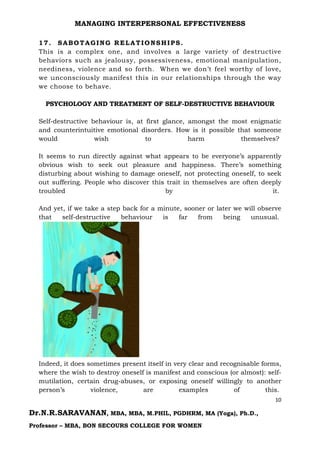
PSYCHOLOGY AND TREATMENT OF SELF-DESTRUCTIVE BEHAVIOUR
Self-destructive behaviour is, at first glance, amongst the most enigmatic
and counterintuitive emotional disorders. How is it possible that someone
would wish to harm themselves?
It seems to run directly against what appears to be everyone’s apparently
obvious wish to seek out pleasure and happiness. There’s something
disturbing about wishing to damage oneself, not protecting oneself, to seek
out suffering. People who discover this trait in themselves are often deeply
troubled by it.
And yet, if we take a step back for a minute, sooner or later we will observe
that self-destructive behaviour is far from being unusual.
Indeed, it does sometimes present itself in very clear and recognisable forms,
where the wish to destroy oneself is manifest and conscious (or almost): self-
mutilation, certain drug-abuses, or exposing oneself willingly to another
person’s violence, are examples of this.
MANAGING INTERPERSONAL EFFECTIVENESS
11
Dr.N.R.SARAVANAN, MBA, MBA, M.PHIL, PGDHRM, MA (Yoga), Ph.D.,
Professor – MBA, BON SECOURS COLLEGE FOR WOMEN
However, these manifestations, so blatantly recognisable, are not by any
means the most common forms of self-destructive behaviour. Far more
common are all the subtle and compulsive forms of self-sabotage, of which
the individual has no awareness whatsoever, and that effectively attack her
or his wellbeing.
To be continually self-derogatory, seeking humiliation without realising it,
approaching everything from a negative standpoint, going through
mysterious and repetitive failures, insidiously (and firmly) hanging onto
pernicious situations, or constantly finding oneself in the position of a victim
are among the many ways that can be used to harm oneself.
Self-Destructive Behavior: Signs, Causes & Effects
Self-Destructive Behavior
Imagine the following scenario. Mark notices that Janet, his new employee,
seems to be spending a lot of time in the restroom and that she always
appears to be a little 'out of it' when she returns to her desk. One day, while
looking for a stapler, he instead finds a bottle of pills.
Self-destructive behavior is any deliberate action that has a negative
impact on your mind or body. It can come in many forms, and sufferers are
often unaware of how much damage their self-destructive behavior is
causing themselves or others.
Signs
Identifying self-destructive behavior in yourself and others is a matter of
keeping an objective point of view when it comes to what's really going on in
a person's mind.
Let's go over some of the more common signs of self-destructive behavior,
beginning with depression or pessimism.
Depression or Pessimism
The belief that life is bad, and will continue to go badly, is a sign of a self-
destructive mentality. It is based on a deep belief that the person is not
worthy of good things. At school, a student may only see the 'down' side of
situations. At work, an employee, like Janet, may not believe anything
positive will come of her efforts or try to push others away when they try to
help.
Avoiding Responsibility
Another sign of destructive behavior is avoiding responsibility. Self-
destructive people tend to avoid opportunities and responsibilities. They
have little faith in their abilities and try to take the easiest route when
approaching a situation or task. Because self-destructive behavior involves
MANAGING INTERPERSONAL EFFECTIVENESS
12
Dr.N.R.SARAVANAN, MBA, MBA, M.PHIL, PGDHRM, MA (Yoga), Ph.D.,
Professor – MBA, BON SECOURS COLLEGE FOR WOMEN
excessive attention on the self, they tend to forget or be emotionally unable
to do things, eventually becoming unreliable.
Hypersensitivity or Emotional Numbness
Hypersensitivity or emotional numbness is also a sign of self-destructive
behavior. When people are prone to blow ups or seem indifferent, they are in
a self-destructive mode. They may be trying to push others away, or they
may be so involved in their own pain that they have no interest in what is
happening around them. In either case, the behavior leads to negative
results. This intensifies their feelings of unworthiness.
Compulsion or Addictive Behavior
Self-destructive people exhibit compulsive or addictive behaviors. When
people feel a compulsion to act in a certain way, such as driving past the
cemetery every day at exactly five o'clock, the cause is usually an internal
sense of failure or loss. Addictions, such as alcohol, nicotine, and substance
abuse, gambling, sexual activity, and self-mutilation are typically signs of
inward pain and insecurity, which must somehow be alleviated.
Neediness, Constant Desire for Recognition or Approval
Some other signs include neediness, and a constant desire for recognition or
approval. Self-destructive individuals may try to fill the emptiness within by
seeking the approval or recognition of others, often through damaging
behaviors, like overt sexual advances or loud and inappropriate laughter at
a weak joke.
The self concept in psychology
In psychology Self-concept has many definitions but they all have the
same meaning. Your self concept is your perception of your own self and
of your own abilities. When I ask you to describe yourself in one page you
are going to write down all the beliefs you hold about yourself as a person.
The way you view yourself and your capabilities is called the "Self-
concept".
Examples of Self concept could be:
“I am a sociable person”
“I can solve any problem”
“I am fat”
“I am unattractive”
“I am clumsy”
“I am uncontrollable”
How your psychological Self-Concept affects your whole life
The most dangerous thing about having a distorted self-concept is that
your subconscious mind always works to prove your self concept true.
For example,if you consider yourself an unattractive person then your
subconscious mind won't motivate you to do anything to become
MANAGING INTERPERSONAL EFFECTIVENESS
13
Dr.N.R.SARAVANAN, MBA, MBA, M.PHIL, PGDHRM, MA (Yoga), Ph.D.,
Professor – MBA, BON SECOURS COLLEGE FOR WOMEN
attractive. This self-concept may hinder you from trying to follow a healthy
diet, may prevent you from buying attractive clothes and can even force
you to act in an unattractive way!!
Trying to become attractive without changing your self-concept will never
work as You will always feel that there is something artificial in your
behavior. If you want to change something about yourself then know that
you must begin by changing your psychological self concept self-concept.
If your self-concept states that you are clumsy then you will always act
according to it even if you tried your best to conceal that side of you. The
harder you try to do something that doesn’t match your self-concept the
more you will find your attempts useless.
The salesperson who believes that he is a failure because of his self
concept will always fail to sell anything. The guy who believes that he is
worthless because of his self concept will always act in a non
confident way even if he tried hard. The athlete whose self-concept states
that he doesn't have the ability to win the gold medal will never get it.
To summarize this, it's almost impossible to challenge your psychological
self-concept and that’s why you should try to change it instead of
challenging it.
Psychological Self-Concept and Behavior
Suppose that someone's self-concept made him believe that he
is persistent, How do you think will this impact his behavior?
This person will keep trying to reach his goals even if he failed hundreds
of times. On the other hand if his self-concept made him believe that he
is a victim then would have given up after the first try!!!
So it's all about the self-concept. If your self concept made you believe that
you are self motivated then you will always feel motivated.
When you change your self-concept your subconscious mind will change
everything accordingly in order to fulfill that self-concept. So whenever
you want to change just change your self-concept and let your
subconscious mind do the adjustments.
The Psychological self concept and breakups
Some people fail to recover from breakups quickly just because they have
the self concept of being broken or of not being resilient, in my book How
to get over anyone in few days i described how following repetitive
behavior that reinforces the self concept of being broken can prevent you
from recovering fast.
After a breakup you should reinforce the self concept of being resilient and
solid in order to recover within a short period of time.
MANAGING INTERPERSONAL EFFECTIVENESS
14
Dr.N.R.SARAVANAN, MBA, MBA, M.PHIL, PGDHRM, MA (Yoga), Ph.D.,
Professor – MBA, BON SECOURS COLLEGE FOR WOMEN
How to change your Self-concept
your Self concept was formed as a results of the different beliefs you
formed about yourself earlier in your life. You are not born with it and
that’s why you can change it.
Your self-talk is what forms your beliefs, and your beliefs are the pillars
that hold your self-concept So in order to change your self-concept you
should first question all of the beliefs you have about yourself. You should
then discard false ones then adjust your self-talk in order not to form
additional incorrect beliefs.
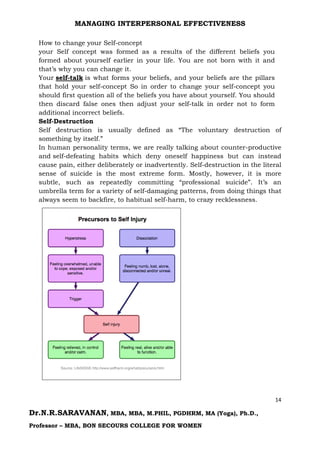
Self-Destruction
Self destruction is usually defined as “The voluntary destruction of
something by itself.”
In human personality terms, we are really talking about counter-productive
and self-defeating habits which deny oneself happiness but can instead
cause pain, either deliberately or inadvertently. Self-destruction in the literal
sense of suicide is the most extreme form. Mostly, however, it is more
subtle, such as repeatedly committing “professional suicide”. It’s an
umbrella term for a variety of self-damaging patterns, from doing things that
always seem to backfire, to habitual self-harm, to crazy recklessness.
MANAGING INTERPERSONAL EFFECTIVENESS
15
Dr.N.R.SARAVANAN, MBA, MBA, M.PHIL, PGDHRM, MA (Yoga), Ph.D.,
Professor – MBA, BON SECOURS COLLEGE FOR WOMEN
Self-injury is usually a primitive way of coping with the emotional
numbness. It is as if, by replacing one’s emotional pain with a physical one,
life becomes more bearable. It is also easier to demonstrate that one is in
pain when the injury is visible and physical rather than “just psychological”.
Development of Self-Destruction
Like all negative personality traits, self-destruction typically develops
through the following sequence:
1. Early negative experiences
2. Misconceptions about the nature of self, life or others
3. A constant fear and sense of insecurity
4. A maladaptive strategy to protect the self
5. A persona to hide all of the above in adulthood
IMPRESSION MANAGEMENT
Impression management is a conscious or subconscious process in which
people attempt to influence the perceptions of other people about a person,
object or event. They do so by regulating and controlling information in
social interaction.[1] It was first conceptualized by Erving Goffman in 1959,
and then was expanded upon in 1967. An example of impression
management theory in play is in sports such as soccer. At an important
game, a player would want to showcase themselves in the best light
possible, because there are college recruiters watching. This person would
have the flashiest pair of cleats and try and perform their best to show off
their skills. Their main goal may be to impress the college recruiters in a
way that maximizes their chances of being chosen for a college team rather
than winning the game.[2]
Impression management is usually used synonymously with self-
presentation, in which a person tries to influence the perception of their
image. The notion of impression management was first applied to face-to-
face communication, but then was expanded to apply to computer-mediated
communication. The concept of impression management is applicable to
academic fields of study such as psychology and sociology as well as
practical fields such as corporate communication and media.
What Is Impression Management?
Impression management is the effort to control or influence other people's
perceptions. This could be their perception of a certain person (including
you), a material possession or an event. The theory goes on to explain that
we try to make the perception consistent with our goals. For example, a girl
who only shares good things about her boyfriend to her parents may be
trying to present him as a good catch so they can stay together. If a woman
MANAGING INTERPERSONAL EFFECTIVENESS
16
Dr.N.R.SARAVANAN, MBA, MBA, M.PHIL, PGDHRM, MA (Yoga), Ph.D.,
Professor – MBA, BON SECOURS COLLEGE FOR WOMEN
spends hours thinking about the right outfit to wear to a party, she may be
trying to present herself as beautiful and stylish while looking for a date. Of
course, many of us can identify with the desire (and resulting actions) to be
seen a certain way or cause someone or something we care about to be seen
a certain way. Sometimes it's conscious and sometimes it isn't, but when we
pay attention, we may find several perceptions we are striving to get from
others.
The most common types of impression management have to do with self-
presentation, and in the business world, the presentation of
merchandise. How often have you wondered what someone will think of you
if you do this or that, or if you don't do it? We strive to have others view us
positively, because we tend to put emphasis on other views in ways that
impact our self-esteem. As far as marketing goes, businessmen are going to
present a product in the best light possible. Their job relies on managing the
impressions of the audience in specific ways that boosts revenues. Also, in
their understanding of human behavior, they might even imply that if you
own this product you may be more liked by others.
The Dangerous Art of Impression Management
1. Know Thyself. Self-awareness is critically important in successful
impression management and in being an authentic person. Sociologist
Erving Goffman proposed a “dramaturgical theory” that stated that we are
actually just a conglomeration of the different roles that we play. It is very
important, however, to have a sense of self -- Who are you? What do you
value? What do you stand for? – to avoid becoming just a “social chameleon”
who simply tries to fit in and go along with the crowd.
2. Be Thoughtful and Prudent. We need to engage our brains when
interacting with others. We must be effective listeners, trying to understand
others’ points of view. We need to think about the consequences of our
statements and our actions. Self-disclosure is an important part of forming
a good relationship with others, but we need to be careful to not disclose too
much information too fast, and always consider how the other person is
reacting to what we tell them.
3. Master Your Emotions. Nothing creates a negative impression faster
than an inappropriate emotional outburst. Emotions are important in
connecting with others, but we need to regulate and moderate our emotions
and our emotional displays. Negative affect – anger, irritation, disgust –
should always be displayed carefully and strategically. For leaders, it is
critically important to show emotional restraint, but to subtly let others
know when you are pleased or displeased.
4. Observe Rules of Etiquette. There are a range of social rules , or
“norms” that tell us how we should behave in various social situations. To
MANAGING INTERPERSONAL EFFECTIVENESS
17
Dr.N.R.SARAVANAN, MBA, MBA, M.PHIL, PGDHRM, MA (Yoga), Ph.D.,
Professor – MBA, BON SECOURS COLLEGE FOR WOMEN
maintain a positive impression, it is critical to follow these social norms and
demonstrate that we have manners and know how to behave in different
situations. Being polite is always a good impression management strategy.
5. Have Courage and Conviction. There are times when you need to be
socially bold and courageous. Take the initiative to start up a conversation
with a stranger, to ask a good question, or to aid someone in distress. In
addition, it is important to stand up for principles that you believe in,
particularly in positions of leadership. Most people will respect you for being
true to your convictions.
6. Be Positive. There is a wealth of research that supports the importance
of positive affect in making good impressions. A smile and positive energy is
always better than a negative tone. Leaders who are optimistic and display
positive affect are rated as more effective by their followers.
SELF-MONITORING
Self-monitoring is a personality characteristic that makes an individual pay closer
attention to a social situation so that they can change their behaviors to fit that
situation.
High self-monitors easily blend into social situations, knowing what to do or say
with each person. They appear more friendly and less anxious to observers, and are
sensitive to social cues are likely to vary their behavior from situation to situation. High
self-monitors read non-verbal behavior better, and will change their behavior to suit the
situation as they perceive it. They are more concerned with acting appropriately than
being true to themselves.
If an outcome depends on another person, high self-monitors will recall more
information about the other person, and make more confident judgments and extreme
inferences about the other person.
High self-monitors (HSMs) describe themselves as flexible, adaptive, and shrewd.
They tend to use situational factors to explain their behavior. They have many friends,
but are not very close with most of them. They have different friends for different
activities. Friendship loss is not a difficulty, as there are other friends to take the place
of any that are lost. They tend to date around, and have different dates for different
places. They are concerned about their date's appearance.
Low self-monitors (LSMs), on the other hand, act themselves regardless of the
situation, so they rarely conform to the norms of the social setting. LSMs are less
sensitive to social cues, and less likely to change their behavior from one situation to
another.
LSMs prefer to be seen as they really are, and they behave so as to express internal
attitudes and dispositions. Their attitudes are more accessible, so LSMs have a greater
consistency between their attitudes and their behavior. LSMs are more likely to show
MANAGING INTERPERSONAL EFFECTIVENESS
18
Dr.N.R.SARAVANAN, MBA, MBA, M.PHIL, PGDHRM, MA (Yoga), Ph.D.,
Professor – MBA, BON SECOURS COLLEGE FOR WOMEN
effects of fatigue and moods than HSMs.
Low self-monitors describe themselves as consistent and principled, and they use
dispositional explanations to explain their behavior. They have few friends, but these
friends are quite close to them. They have the same friends for all of their activities.
They select friends with similar attitudes. Friendship loss is difficult, because there are
so few that each will be missed quite a bit, and the loss will affect, most if not all,
activities. They tend to have steady, and more intimate relationships, and they care
about their partner's personality.
Neither high nor low self monitoring is a better way of viewing the world. These are
simply different approaches to the world. People tend to prefer friends and romantic
partners who are similar to themselves in self-monitoring style. HSMs see LSMs as
insensitive, while LSMs see HSMs as superficial
MANAGING INTERPERSONAL EFFECTIVENESS
19
Dr.N.R.SARAVANAN, MBA, MBA, M.PHIL, PGDHRM, MA (Yoga), Ph.D.,
Professor – MBA, BON SECOURS COLLEGE FOR WOMEN
UNIT- II
Communication is neither the transmission of a message nor the message itself. It is
the mutual exchange of understanding, originating with the receiver. Communication needs
to be effective in business. Communication is the essence of management. The basic
functions of management (Planning, Organizing, Staffing, Directing and Controlling) cannot
be performed well without effective communication.
Business communication involves constant flow of information. Feedback is integral
part of business communication. Organizations these days are verly large and involve large
number of people. There are various levels of hierarchy in an organization. Greater the
number of levels, the more difficult is the job of managing the organization. Communication
here plays a very important role in process of directing and controlling the people in the
oragnization. Immediate feedback can be obtained and misunderstandings if any can be
avoided. There should be effective communication between superiors and subordinated in an
organization, between organization and society at large (for example between management
and trade unions). It is essential for success and growth of an organization. Communication
gaps should not occur in any organization.
Business Communication is goal oriented. The rules, regulations and policies of a
company have to be communicated to people within and outside the organization. Business
Communication is regulated by certain rules and norms. In early times, business
communication was limited to paper-work, telephone calls etc. But now with advent of
technology, we have cell phones, video conferencing, emails, satellite communication to
support business communication. Effective business communication helps in building
goodwill of an organization.
Business Communication can be of two types:
1. Oral Communication - An oral communication can be formal or informal. Generally
business communication is a formal means of communication, like : meetings,
interviews, group discussion, speeches etc. An example of Informal business
communication would be - Grapevine.
2. Written Communication - Written means of business communication includes -
agenda, reports, manuals etc.
Components of Communication Process
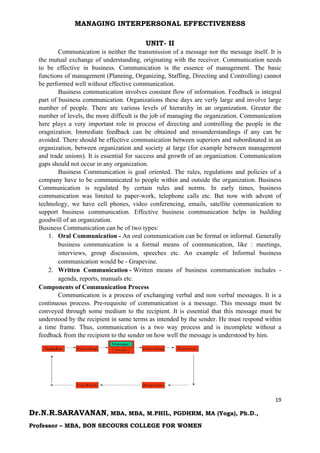
Communication is a process of exchanging verbal and non verbal messages. It is a
continuous process. Pre-requisite of communication is a message. This message must be
conveyed through some medium to the recipient. It is essential that this message must be
understood by the recipient in same terms as intended by the sender. He must respond within
a time frame. Thus, communication is a two way process and is incomplete without a
feedback from the recipient to the sender on how well the message is understood by him.
MANAGING INTERPERSONAL EFFECTIVENESS
20
Dr.N.R.SARAVANAN, MBA, MBA, M.PHIL, PGDHRM, MA (Yoga), Ph.D.,
Professor – MBA, BON SECOURS COLLEGE FOR WOMEN
The main components of communication process are as follows:
1. Context - Communication is affected by the context in which it takes place. This
context may be physical, social, chronological or cultural. Every communication
proceeds with context. The sender chooses the message to communicate within a
context.
2. Sender / Encoder - Sender / Encoder is a person who sends the message. A sender
makes use of symbols (words or graphic or visual aids) to convey the message and
produce the required response. For instance - a training manager conducting training
for new batch of employees. Sender may be an individual or a group or an
organization. The views, background, approach, skills, competencies, and knowledge
of the sender have a great impact on the message. The verbal and non verbal symbols
chosen are essential in ascertaining interpretation of the message by the recipient in
the same terms as intended by the sender.
3. Message - Message is a key idea that the sender wants to communicate. It is a sign
that elicits the response of recipient. Communication process begins with deciding
about the message to be conveyed. It must be ensured that the main objective of the
message is clear.
4. Medium - Medium is a means used to exchange / transmit the message. The sender
must choose an appropriate medium for transmitting the message else the message
might not be conveyed to the desired recipients. The choice of appropriate medium of
communication is essential for making the message effective and correctly interpreted
by the recipient. This choice of communication medium varies depending upon the
features of communication. For instance - Written medium is chosen when a message
has to be conveyed to a small group of people, while an oral medium is chosen when
spontaneous feedback is required from the recipient as misunderstandings are cleared
then and there.
5. Recipient / Decoder - Recipient / Decoder is a person for whom the message is
intended / aimed / targeted. The degree to which the decoder understands the message
is dependent upon various factors such as knowledge of recipient, their
responsiveness to the message, and the reliance of encoder on decoder.
6. Feedback - Feedback is the main component of communication process as it permits
the sender to analyze the efficacy of the message. It helps the sender in confirming the
correct interpretation of message by the decoder. Feedback may be verbal (through
words) or non-verbal (in form of smiles, sighs, etc.). It may take written form also in
form of memos, reports, etc.
Oral Communication - Meaning, Advantages and Limitations
Oral communication implies communication through mouth. It includes individuals
conversing with each other, be it direct conversation or telephonic conversation. Speeches,
presentations, discussions are all forms of oral communication. Oral communication is
generally recommended when the communication matter is of temporary kind or where a
MANAGING INTERPERSONAL EFFECTIVENESS
21
Dr.N.R.SARAVANAN, MBA, MBA, M.PHIL, PGDHRM, MA (Yoga), Ph.D.,
Professor – MBA, BON SECOURS COLLEGE FOR WOMEN
direct interaction is required. Face to face communication (meetings, lectures, conferences,
interviews, etc.) is significant so as to build a rapport and trust.
Advantages of Oral Communication
 There is high level of understanding and transparency in oral communication as it is
interpersonal.
 There is no element of rigidity in oral communication. There is flexibility for
allowing changes in the decisions previously taken.
 The feedback is spontaneous in case of oral communication. Thus, decisions can be
made quickly without any delay.
 Oral communication is not only time saving, but it also saves upon money and
efforts.
 Oral communication is best in case of problem resolution. The conflicts, disputes and
many issues/differences can be put to an end by talking them over.
 Oral communication is an essential for teamwork and group energy.
 Oral communication promotes a receptive and encouraging morale among
organizational employees.
 Oral communication can be best used to transfer private and confidential
information/matter.
Disadvantages/Limitations of Oral Communication
 Relying only on oral communication may not be sufficient as business
communication is formal and very organized.
 Oral communication is less authentic than written communication as they are informal
and not as organized as written communication.
 Oral communication is time-saving as far as daily interactions are concerned, but in
case of meetings, long speeches consume lot of time and are unproductive at times.
 Oral communications are not easy to maintain and thus they are unsteady.
 There may be misunderstandings as the information is not complete and may lack
essentials.
 It requires attentiveness and great receptivity on part of the receivers/audience.
 Oral communication (such as speeches) is not frequently used as legal records except
in investigation work.
Written Communication - Meaning, Advantages and Disadvantages
Written communication has great significance in today’s business world. It is an innovative
activity of the mind. Effective written communication is essential for preparing worthy
promotional materials for business development. Speech came before writing. But writing is
more unique and formal than speech. Effective writing involves careful choice of words, their
organization in correct order in sentences formation as well as cohesive composition of
sentences. Also, writing is more valid and reliable than speech. But while speech is
spontaneous, writing causes delay and takes time as feedback is not immediate.
MANAGING INTERPERSONAL EFFECTIVENESS
22
Dr.N.R.SARAVANAN, MBA, MBA, M.PHIL, PGDHRM, MA (Yoga), Ph.D.,
Professor – MBA, BON SECOURS COLLEGE FOR WOMEN
Advantages of Written Communication
Written communication helps in laying down apparent principles, policies and rules for
running of an organization.
It is a permanent means of communication. Thus, it is useful where record maintenance
is required.
It assists in proper delegation of responsibilities. While in case of oral communication, it
is impossible to fix and delegate responsibilities on the grounds of speech as it can be
taken back by the speaker or he may refuse to acknowledge.
Written communication is more precise and explicit.
Effective written communication develops and enhances an organization’s image.
It provides ready records and references.
Legal defenses can depend upon written communication as it provides valid records.
Disadvantages of Written Communication
Written communication does not save upon the costs. It costs huge in terms of stationery
and the manpower employed in writing/typing and delivering letters.
Also, if the receivers of the written message are separated by distance and if they need to
clear their doubts, the response is not spontaneous.
Written communication is time-consuming as the feedback is not immediate. The
encoding and sending of message takes time.
Effective written communication requires great skills and competencies in language and
vocabulary use. Poor writing skills and quality have a negative impact on organization’s
reputation.
Too much paper work and e-mails burden is involved.
What is Non Verbal Communication ?
It is communication of feelings, emotions, attitudes, and thoughts through body movements /
gestures / eye contact, etc.
The components of Non Verbal Communication are:
 Kinesics: It is the study of facial expressions, postures & gestures. Did you know that
while in Argentina to raise a fist in the air with knuckles pointing outwards expresses
victory, in Lebanon, raising a closed fist is considered rude?
 Oculesics: It is the study of the role of eye contact in non verbal communication. Did
you know that in the first 90 sec - 4 min you decide that you are interested in someone
or not. Studies reveal that 50% of this first impression comes from non-verbal
communication which includes oculesics. Only 7% of comes from words - that we
actually say.
 Haptics: It is the study of touching. Did you know that acceptable level of touching
vary from one culture to another? In Thailand, touching someone's head may be
considered as rude.
MANAGING INTERPERSONAL EFFECTIVENESS
23
Dr.N.R.SARAVANAN, MBA, MBA, M.PHIL, PGDHRM, MA (Yoga), Ph.D.,
Professor – MBA, BON SECOURS COLLEGE FOR WOMEN
 Proxemics: It is the study of measurable distance between people as they interact.
Did you know that the amount of personal space when having an informal
conversation should vary between 18 inches - 4 feet while, the personal distance
needed when speaking to a crowd of people should be around 10-12 feet?
 Chronemics: It is the study of use of time in non verbal communication. Have you
ever observed that while AN employee will not worry about running a few minutes
late to meet a colleague, a manager who has a meeting with the CEO, a late arrival
will be considered as a nonverbal cue that he / she does not give adequate respect to
his superior?
 Paralinguistics: It is the study of variations in pitch, speed, volume, and pauses to
convey meaning. Interestingly, when the speaker is making a presentation and is
looking for a response, he will pause. However, when no response is desired, he will
talk faster with minimal pause.
 Physical Appearance: Your physical appearance always contributes towards how
people perceive you. Neatly combed hair, ironed clothes and a lively smile will
always carry more weight than words.
IMPORTANCE OF COMMUNICATION
Effective Communication is significant for managers in the organizations so as to perform the
basic functions of management, i.e., Planning, Organizing, Leading and Controlling.
Communication helps managers to perform their jobs and responsibilities. Communication
serves as a foundation for planning. All the essential information must be communicated to
the managers who in-turn must communicate the plans so as to implement them. Organizing
also requires effective communication with others about their job task. Similarly leaders as
managers must communicate effectively with their subordinates so as to achieve the team
goals. Controlling is not possible without written and oral communication.
Managers devote a great part of their time in communication. They generally devote
approximately 6 hours per day in communicating. They spend great time on face to face or
telephonic communication with their superiors, subordinates, colleagues, customers or
suppliers. Managers also use Written Communication in form of letters, reports or memos
wherever oral communication is not feasible.
Thus, we can say that “effective communication is a building block of successful
organizations”. In other words, communication acts as organizational blood.
The importance of communication in an organization can be summarized as follows:
1. Communication promotes motivation by informing and clarifying the employees
about the task to be done, the manner they are performing the task, and how to
improve their performance if it is not up to the mark.
2. Communication is a source of information to the organizational members for
decision-making process as it helps identifying and assessing alternative course of
actions.
3. Communication also plays a crucial role in altering individual’s attitudes, i.e., a
well informed individual will have better attitude than a less-informed individual.
MANAGING INTERPERSONAL EFFECTIVENESS
24
Dr.N.R.SARAVANAN, MBA, MBA, M.PHIL, PGDHRM, MA (Yoga), Ph.D.,
Professor – MBA, BON SECOURS COLLEGE FOR WOMEN
Organizational magazines, journals, meetings and various other forms of oral and
written communication help in moulding employee’s attitudes.
4. Communication also helps in socializing. In todays life the only presence of another
individual fosters communication. It is also said that one cannot survive without
communication.
5. As discussed earlier, communication also assists in controlling process. It helps
controlling organizational member’s behaviour in various ways. There are various
levels of hierarchy and certain principles and guidelines that employees must follow
in an organization. They must comply with organizational policies, perform their job
role efficiently and communicate any work problem and grievance to their superiors.
Thus, communication helps in controlling function of management.
An effective and efficient communication system requires managerial proficiency in
delivering and receiving messages. A manager must discover various barriers to
communication, analyze the reasons for their occurrence and take preventive steps to avoid
those barriers. Thus, the primary responsibility of a manager is to develop and maintain an
effective communication system in the organization.
Communication Barriers - Reasons for Communication Breakdown
Communication is a process beginning with a sender who encodes the message and passes it
through some channel to the receiver who decodes the message. Communication is fruitful if
and only if the messages sent by the sender is interpreted with same meaning by the receiver.
If any kind of disturbance blocks any step of communication, the message will be destroyed.
Due to such disturbances, managers in an organization face severe problems. Thus the
managers must locate such barriers and take steps to get rid of them.
There are several barriers that affects the flow of communication in an organization. These
barriers interrupt the flow of communication from the sender to the reciever, thus making
communication ineffective. It is essential for managers to overcome these barriers. The main
barriers of communication are summarized below.
Following are the main communication barriers:
1. Perceptual and Language Differences: Perception is generally how each individual
interprets the world around him. All generally want to receive messages which are
significant to them. But any message which is against their values is not accepted. A
same event may be taken differently by different individuals. For example : A person
is on leave for a month due to personal reasons (family member being critical). The
HR Manager might be in confusion whether to retain that employee or not, the
immediate manager might think of replacement because his teams productivity is
being hampered, the family members might take him as an emotional support.
The linguistic differences also lead to communication breakdown. Same word may
mean different to different individuals. For example: consider a word “value”.
a. What is the value of this Laptop?
b. I value our relation?
MANAGING INTERPERSONAL EFFECTIVENESS
25
Dr.N.R.SARAVANAN, MBA, MBA, M.PHIL, PGDHRM, MA (Yoga), Ph.D.,
Professor – MBA, BON SECOURS COLLEGE FOR WOMEN
c. What is the value of learning technical skills?
“Value” means different in different sentences. Communication breakdown occurs if
there is wrong perception by the receiver.
2. Information Overload: Managers are surrounded with a pool of information. It is
essential to control this information flow else the information is likely to be
misinterpreted or forgotten or overlooked. As a result communication is less effective.
3. Inattention: At times we just not listen, but only hear. For example a traveler may
pay attention to one “NO PARKING” sign, but if such sign is put all over the city, he
no longer listens to it. Thus, repetitive messages should be ignored for effective
communication. Similarly if a superior is engrossed in his paper work and his
subordinate explains him his problem, the superior may not get what he is saying and
it leads to disappointment of subordinate.
4. Time Pressures: Often in organization the targets have to be achieved within a
specified time period, the failure of which has adverse consequences. In a haste to
meet deadlines, the formal channels of communication are shortened, or messages are
partially given, i.e., not completely transferred. Thus sufficient time should be given
for effective communication.
5. Distraction/Noise: Communication is also affected a lot by noise to distractions.
Physical distractions are also there such as, poor lightning, uncomfortable sitting,
unhygienic room also affects communication in a meeting. Similarly use of loud
speakers interferes with communication.
6. Emotions: Emotional state at a particular point of time also affects communication. If
the receiver feels that communicator is angry he interprets that the information being
sent is very bad. While he takes it differently if the communicator is happy and jovial
(in that case the message is interpreted to be good and interesting).
7. Complexity in Organizational Structure: Greater the hierarchy in an organization
(i.e. more the number of managerial levels), more is the chances of communication
getting destroyed. Only the people at the top level can see the overall picture while the
people at low level just have knowledge about their own area and a little knowledge
about other areas.
8. Poor retention: Human memory cannot function beyond a limit. One cant always
retain what is being told specially if he is not interested or not attentive. This leads to
communication breakdown.
Communication Flows in an Organization
In an organization, communication flows in 5 main directions-
1. Downward
2. Upward
3. Lateral
4. Diagonal
5. External
MANAGING INTERPERSONAL EFFECTIVENESS
26
Dr.N.R.SARAVANAN, MBA, MBA, M.PHIL, PGDHRM, MA (Yoga), Ph.D.,
Professor – MBA, BON SECOURS COLLEGE FOR WOMEN
1. Downward Flow of Communication: Communication that flows from a higher level
in an organization to a lower level is a downward communication. In other words,
communication from superiors to subordinates in a chain of command is a downward
communication. This communication flow is used by the managers to transmit work-
related information to the employees at lower levels. Employees require this
information for performing their jobs and for meeting the expectations of their
managers. Downward communication is used by the managers for the following
purposes -
Providing feedback on employees performance
Giving job instructions
Providing a complete understanding of the employees job as well as to
communicate them how their job is related to other jobs in the organization.
Communicating the organizations mission and vision to the employees.
Highlighting the areas of attention.
Organizational publications, circulars, letter to employees, group meetings etc are all
examples of downward communication. In order to have effective and error-free
downward communication, managers must:
 Specify communication objective
 Ensure that the message is accurate, specific and unambiguous.
 Utilize the best communication technique to convey the message to
the receiver in right form
2. Upward Flow of Communication: Communication that flows to a higher level in an
organization is called upward communication. It provides feedback on how well the
organization is functioning. The subordinates use upward communication to convey
their problems and performances to their superiors.
The subordinates also use upward communication to tell how well they have
understood the downward communication. It can also be used by the employees to
share their views and ideas and to participate in the decision-making process.
Upward communication leads to a more committed and loyal workforce in an
organization because the employees are given a chance to raise and speak
dissatisfaction issues to the higher levels. The managers get to know about the
employees feelings towards their jobs, peers, supervisor and organization in general.
Managers can thus accordingly take actions for improving things.
Grievance Redressal System, Complaint and Suggestion Box, Job Satisfaction
surveys etc all help in improving upward communication. Other examples of Upward
Communication are -performance reports made by low level management for
reviewing by higher level management, employee attitude surveys, letters from
employees, employee-manager discussions etc.
3. Lateral / Horizontal Communication: Communication that takes place at same
levels of hierarchy in an organization is called lateral communication, i.e.,
communication between peers, between managers at same levels or between any
MANAGING INTERPERSONAL EFFECTIVENESS
27
Dr.N.R.SARAVANAN, MBA, MBA, M.PHIL, PGDHRM, MA (Yoga), Ph.D.,
Professor – MBA, BON SECOURS COLLEGE FOR WOMEN
horizontally equivalent organizational member. The advantages of horizontal
communication are as follows:
It is time saving.
It facilitates co-ordination of the task.
It facilitates co-operation among team members.
It provides emotional and social assistance to the organizational members.
It helps in solving various organizational problems.
It is a means of information sharing
It can also be used for resolving conflicts of a department with other department or
conflicts within a department.
4. Diagonal Communication: Communication that takes place between a manager and
employees of other workgroups is called diagonal communication. It generally does
not appear on organizational chart. For instance - To design a training module a
training manager interacts with an Operations personnel to enquire about the way they
perform their task.
5. External Communication: Communication that takes place between a manager and
external groups such as - suppliers, vendors, banks, financial institutes etc. For
instance - To raise capital the Managing director would interact with the Bank
Manager.
Types on non-verbal communication:
1. Facial Expressions
Facial expressions are responsible for a huge proportion of nonverbal communication.
Consider how much information can be conveyed with a smile or a frown. The look on a
person's face is often the first thing we see, even before we hear what they have to say.
While nonverbal communication and behavior can vary dramatically between cultures,
the facial expressions for happiness, sadness, anger, and fear are similar throughout the
world.
2. Gestures
Deliberate movements and signals are an important way to communicate meaning without
words. Common gestures include waving, pointing, and using fingers to indicate numeric
amounts. Other gestures are arbitrary and related to culture.
In courtroom settings, lawyers have been known to utilize different nonverbal signals to
attempt to sway juror opinions.
An attorney might glance at his watch to suggest that the opposing lawyer's argument is
tedious or might even roll his eyes at the testimony offered by a witness in an attempt to
undermine his or her credibility. These nonverbal signals are seen as being so powerful and
influential that some judges even place limits on what type of nonverbal behaviors are
allowed in the courtroom.
MANAGING INTERPERSONAL EFFECTIVENESS
28
Dr.N.R.SARAVANAN, MBA, MBA, M.PHIL, PGDHRM, MA (Yoga), Ph.D.,
Professor – MBA, BON SECOURS COLLEGE FOR WOMEN
3. Paralinguistics
Paralinguistics refers to vocal communication that is separate from actual language. This
includes factors such as tone of voice, loudness, inflection and pitch. Consider the powerful
effect that tone of voice can have on the meaning of a sentence. When said in a strong tone of
voice, listeners might interpret approval and enthusiasm. The same words said in a hesitant
tone of voice might convey disapproval and a lack of interest.
Consider all the different ways simply changing your tone of voice might change the meaning
of a sentence. A friend might ask you how you are doing, and you might respond with the
standard "I'm fine," but how you actually say those words might reveal a tremendous amount
of how you are really feeling. A cold tone of voice might suggest that you are actually not
fine, but you don't wish to discuss it.
A bright, happy tone of voice will reveal that you are actually doing quite well. A somber,
downcast tone would indicate that you are the opposite of fine and that perhaps your friend
should inquire further.
4. Body Language and Posture
Posture and movement can also convey a great deal on information. Research on body
language has grown significantly since the 1970's, but popular media have focused on the
over-interpretation of defensive postures, arm-crossing, and leg-crossing, especially after
publishing Julius Fast's book Body Language. While these nonverbal behaviors can indicate
feelings and attitudes, research suggests that body language is far more subtle and less
definitive that previously believed.
5. Proxemics
People often refer to their need for "personal space," which is also an important type of
nonverbal communication. The amount of distance we need and the amount of space we
perceive as belonging to us is influenced by a number of factors including social norms,
cultural expectations, situational factors, personality characteristics, and level of familiarity.
For example, the amount of personal space needed when having a casual conversation with
another person usually varies between 18 inches to four feet. On the other hand, the personal
distance needed when speaking to a crowd of people is around 10 to 12 feet.
6. Eye Gaze
The eyes play an important role in nonverbal communication and such things as looking,
staring and blinking are important nonverbal behaviors. When people encounter people or
things that they like, the rate of blinking increases and pupils dilate. Looking at another
person can indicate a range of emotions including hostility, interest, and attraction.
People also utilize eye gaze a means to determine if someone is being honest. Normal, steady
eye contact is often taken as a sign that a person is telling the truth and is trustworthy. Shifty
eyes and an inability to maintain eye contact, on the other hand, is frequently seen as an
indicator that someone is lying or being deceptive.
7. Haptics
Communicating through touch is another important nonverbal behavior. There has been a
substantial amount of research on the importance of touch in infancy and early
childhood. Harry Harlow's classic monkey study demonstrated how deprived touch and
MANAGING INTERPERSONAL EFFECTIVENESS
29
Dr.N.R.SARAVANAN, MBA, MBA, M.PHIL, PGDHRM, MA (Yoga), Ph.D.,
Professor – MBA, BON SECOURS COLLEGE FOR WOMEN
contact impedes development. Baby monkeys raised by wire mothers experienced permanent
deficits in behavior and social interaction. Touch can be used to communicate affection,
familiarity, sympathy, and other emotions.
In her book Interpersonal Communication: Everyday Encounters, author Julia Wood writes
that touch is also often used as a way to communicate both status and power. Researchers
have found that high-status individuals tend to invade other people's personal space with
greater frequency and intensity than lower-status individuals. Sex differences also play a role
in how people utilize touch to communicate meaning. Women tend to use touch to convey
care, concern, and nurturance. Men, on the other hand, are more likely to use touch to assert
power or control over others.
8. Appearance
Our choice of color, clothing, hairstyles, and other factors affecting appearance are also
considered a means of nonverbal communication. Research on color psychologyhas
demonstrated that different colors can evoke different moods. Appearance can also alter
physiological reactions, judgments, and interpretations. Just think of all the subtle judgments
you quickly make about someone based on his or her appearance. These first impressions are
important, which is why experts suggest that job seekers dress appropriately for interviews
with potential employers.
Researchers have found that appearance can play a role in how people are perceived and even
how much they earn. One 1996 study found that attorneys who were rated as more attractive
than their peers earned nearly 15 percent more than those ranked as less attractive. Culture is
an important influence on how appearances are judged. While thinness tends to be valued in
Western cultures, some African cultures relate full-figured bodies to better health, wealth,
and social status.
9. Artifacts
Objects and images are also tools that can be used to communicate nonverbally. On an online
forum, for example, you might select an avatar to represent your identity online and to
communicate information about who you are and the things you like. People often spend a
great deal of time developing a particular image and surrounding themselves with objects
designed to convey information about the things that are important to them. Uniforms, for
example, can be used to transmit a tremendous amount of information about a person. A
soldier will don fatigues, a police offers will wear a uniform, and a doctor will wear a white
lab coat. At a mere glance, these outfits tell people what a person does for a living.
Kinesics
Kinesics is the non-verbal behaviour related to movement, either of any part of the body, or
the body as a whole. In short all communicative body movements are generally classified as
kinesic. There are basically five different types of kinesics; emblems, regulators, illustrators,
affective display and adaptors.
Emblems:
Emblems are non-verbal cues that have a verbal counterpart.For example, the British sign for
Victory (forefinger and middle finger erect) symbolises the letter V, a sign for victory often
seen painted onto house walls during WWII. However, the same movement may symbolise
MANAGING INTERPERSONAL EFFECTIVENESS
30
Dr.N.R.SARAVANAN, MBA, MBA, M.PHIL, PGDHRM, MA (Yoga), Ph.D.,
Professor – MBA, BON SECOURS COLLEGE FOR WOMEN
the number two in the US and may be seen as insulting in Australia.
Another example is the “ok” sign made by forming a circle with your thumb and forefinger
and streching out the rest of the three fingers. This may be seen as an indication for zero or
the number three in some countries. It is considered obscene in Australia though. Emblems as
such are a bewildering array of different meanings. The list of possible interpretations and
different meanings is, unfortunately, sheer endless. In short, emblems are signs used to refer
to certain words. Its interpretation may vary across different cultures and groups of people.
Regulators:
Regulators are non-verbal signs that regulate, modulate and maintain the flow of speech
during a conversation. These can be both kinesic, such as the nodding of a head, as well as
nonkinesic, such as eye movements. They are often used as feedback to find out if one is
clear of the instructions given or if the audience is intrested in the speech. Different cultures
use different forms of regulators to show confusion or understanding of a certain information.
For example, the white american students may use sounds such as “uh-huh” followed by
nodding of the head to indicate understanding. However, the black american students use
silence to show understanding. Therefore, it may lead to confusion for the white americans as
to whether the black students understand what is being said. Regulators may also modulate
the flow of speech when someone who wishes to interrupt with a point, he/she raises up
his/her hand to indicate that he/she has something to say. This action is a form of regulator as
it controls the flow of speech by an interuption and changes it flow towards a new speaker.
Illustrators:
Illustrators are used more consistently to illustrate what is being said. For example pointing to
something that you are discussing about. It reinforces what you are saying. Again, the usage
and the amount of illustrators used is different from culture to culture. For example Latin
cultures in general make more use of illustrators than Anglo-Saxon cultures. And again,
Anglo-Saxon cultures make more use of illustrators than many Asian cultures. In Asian
culture, the use of illustrators show lack of intelligence while the absence of illustrators,
indicate lack of intrest in the Latin culture.
Affective Display:
Affective Displays are body, or more frequently facial, movements that display a certain
affective state, i.e. emotions. A lack of such affective displays may well be understood as a
lack of emotion, which in turn is probably wrong. Different cultures may practice the
displaying of emotions differently. Although two people may be feeling just as angry, their
display of anger may be totally different. One may blow up in the face while the other may
use silence to show displeasure. Therefore the lack of display may not indicate the lack of
emotions.
Adaptors:
Adaptors include postural changes and other movements at a low level of awareness,
frequently made to feel more comfortable or to perform a specific physical function. Because
adaptors are usually carried out a low level of awareness, they have been hailed as the secret
MANAGING INTERPERSONAL EFFECTIVENESS
31
Dr.N.R.SARAVANAN, MBA, MBA, M.PHIL, PGDHRM, MA (Yoga), Ph.D.,
Professor – MBA, BON SECOURS COLLEGE FOR WOMEN
to understanding what your conversation partner really thinks. A slumped posure indicates
that you have low spirits, fatigued or that you feel inferior.Whereas, an erect posture shows
high spirits and confidence. If you lean foward it implies that you are open and interested.
Leaning away shows disinterest and defensiveness. Maintaining a rigid posture may mean
that you are defensive, while a relaxed posture may translate to openess. Crossed legs and
arms shows unwillingness to listen while uncrossed arms and leg indicates that you are
approcahable.
Non verbal leakage
Non-verbal leakage is a form of body language. This happens when a person verbalizes one
thing but their body language does another. The most common forms of non-verbal leakage
are hand-to-face gestures.[1]
One of the most important concepts in the study of body language is that of non-
verbal leakage. This occurs when we say one thing but our body language gestures give a
different impression.
The most obvious of these are hand-to-face gestures. The best way to understand these is
to think how you
behaved when you were a small child.What did you do then if you saw something
frightening? You put your hands over your eyes, because in a toddler’s mind, if you can’t see
it, it’s not there.
Imagine your national football team is playing in the World Cup Final. One minute into extra
time and your main striker steps up to take a penalty that will hand your team the World Cup.
He shoots ...... and the opposition goalkeeper tips the ball around the post, putting the game
into extra time. What would most of the fans do?
As one,
millions of fans
would raise both
hands to their
faces and slap
them to their
foreheads or eyes
while wailing in
despair (virtually every fan in the crowd has used very similar gestures in the image below).
They'd do this unselfconsciously because of the emotion of the moment. Indeed, it’s very
likely that the striker himself would use the exact same gesture.
MANAGING INTERPERSONAL EFFECTIVENESS
32
Dr.N.R.SARAVANAN, MBA, MBA, M.PHIL, PGDHRM, MA (Yoga), Ph.D.,
Professor – MBA, BON SECOURS COLLEGE FOR WOMEN
Watch an audience watching a horror movie in the cinema. When the females scream at a
moment of high tension, it is often accompanied by the placing of both hans on the cheeks or
over the mouth or eyes (the more deep throated male scream is reserved almost exclusively
for pain). Afterwards, they may watch the rest of the movie throught heir fingers. Thinki
about this for a second. If you don't want to watch something, there's a much easier way to do
that than putting your hand over your eyes. How about CLOSING them? That's much
simpler. Yet subconsciously, we still create a barrier with our hands rather than do that.
However, in everyday, mundane situations such reactions would
be seen as ‘overkill’, so when you see or hear something you don’t
like, your hand flicks automatically towards your face and then at
the last moment, realising you are going to look foolish, you give it
an ‘excuse’ to be there by doing something with it.
The significance of this to your public speaking is that at times
you're going to have to deliver a message you are uncomfortable
with. You may simply not like what you have to say. You could be
required to exaggerate or put a gloss on something or deliver a
‘sanitised’ version for some reason. Events could force you to deliberately omit some facts or
even tell an outright lie. Or you may just be uncomfortable with what is being said to you
during a question & answer session.
If you aren’t aware of non-verbal leakage, your body language will scream out to
your audience that something is wrong. They won’t necessarily know exactly what that is,
but they will subconsciously pick up the incongruity between your verbal and non-verbal
messages, and that you are uncomfortable in some way about what you are saying.
Therefore you need to know the telltale signs of leakage so you can avoid making them
and rehearse your delivery showing open, confident body language instead.
MANAGING INTERPERSONAL EFFECTIVENESS
33
Dr.N.R.SARAVANAN, MBA, MBA, M.PHIL, PGDHRM, MA (Yoga), Ph.D.,
Professor – MBA, BON SECOURS COLLEGE FOR WOMEN
So, what do people do when they see, hear or have to say something they are
uncomfortable with?
Hand To Eyes
The hand(s) move to cover the eyes and then at the last moment rubs one of them instead,
or pulls at its corner.Or it rubs the forehead or smoothes a fringe. In the photo below, Jesse
Jackson (pictured at the Michael Jackson child molestation trial) is almost watching
proceedings through his fingers like he's watching a scary movie.
Hand To Eyes
The same thing occurs, but the hand wipes the mouth, scratches the face or strokes the
chin. This is especially common when politicians are listening to other people speak, as they
are chomping at the bit to reply but have to literally hold the words back.
This gesture can be mistaken for interest and deep thought, but when this occurs the hand
tends to be lower and holds or strokes the chin without touching the mouth. It is the
fingers covering the mouth that makes all the difference. Look at the photo below of Bill
Clinton; he looks genuinely thoughtful about what is being said. In the photos above, the
politicians all look like they are dying to interrupt whoever is speaking.
MANAGING INTERPERSONAL EFFECTIVENESS
34
Dr.N.R.SARAVANAN, MBA, MBA, M.PHIL, PGDHRM, MA (Yoga), Ph.D.,
Professor – MBA, BON SECOURS COLLEGE FOR WOMEN
UNIT - III
What Are Attitudes?
Anyone who has ever had a 2-year-old fully understands the terrible twos and the attitude a 2-
year-old can give you. While that person might be pint-sized, his attitude during the terrible
twos can be over ten feet tall and bulletproof.
Now, not all attitudes are as intense as our little 2-year-old, but they are indeed present in
every person, and they are part of who we are. Our attitudes are shaped by our experiences,
and as we experience more, our attitudes can change. You see, attitudes are a way of
thinking, and they shape how we relate to the world both in work and outside of work.
Taking this a step further, attitudes have several different components, and those are
cognitive, affective and behavioral.
Components of Attitudes
Before we can discuss how attitudes impact the workplace, we need to understand the
components of attitudes. Those components are:
 Cognitive: This represents our thoughts, beliefs and ideas about something. Typically
these come to light in generalities or stereotypes, such as 'all teenagers are lazy,' or 'all
babies are cute.'
 Affective: This component deals with feelings or emotions that are brought to the
surface about something, such as fear or hate. Using our above example, someone
might have the attitude that they hate teenagers because they are lazy or that they love
all babies because they are cute.
 Conative: This can also be called the behavioral component and centers on
individuals acting a certain way towards something, such as 'we better keep those lazy
teenagers out of the library,' or 'I cannot wait to kiss that baby.'
Each one of these components is very different from the other, and they can build upon one
another to form our attitudes and, therefore, affect how we relate to the world. For example,
we can believe teenagers are lazy (cognitive), we do not have to hate the teenagers for being
lazy (affective), but we could still try to keep them out of the library because of that fact
(conative). Or, we could indeed believe they are all lazy (cognitive), hate them for it
(affective) and that would drive our behavior towards them (conative).
An attitude is a positive, negative, or mixed evaluation of an object that is expressed at some
level of intensity. Our attitude can vary in strength along both positive affect, and with
MANAGING INTERPERSONAL EFFECTIVENESS
35
Dr.N.R.SARAVANAN, MBA, MBA, M.PHIL, PGDHRM, MA (Yoga), Ph.D.,
Professor – MBA, BON SECOURS COLLEGE FOR WOMEN
negative affect, with ambivalence or with apathy and indifference. It usually implies feelings
that are either positive or negative. Social psychologists use the term attitude differently.
Gordon Allport formulated the following definition: “An altitude is a mental and neural stale
of readiness, organized through experience, exerting a directive or dynamic influence upon
the individual’s response to ill objects and situations with which it is related.”
Nature of Attitude
Attitude are a complex combination of things we tend to call personality, beliefs, values,
behaviors, and motivations.
An attitude exists in every person’s mind. It helps to define our identity, guide our actions,
and influence how we judge people.
Although the feeling and belief components of attitude are internal to a person, we can view
a person’s attitude from his or her resulting behavior.
Attitude helps us define how we see situations, as well as define how we behave toward the
situation or object.
Attitude provides us with internal cognitions or beliefs and thoughts about people and
objects. Attitude cause us to behave in a particular way toward an object or person.
Characteristics of attitudes
Attitude can be characterized by:
Affective Cognitive consistency: The degree of consistency between the affective and
cognitive components influences the attitude—behavior relationship. That is, the greater the
consistency between cognition and evaluation, the greater the strength of the attitude-
behavior relation.
Strength: Attitudes based on direct experience with the object may be held with greater
certainty. Certainty is also influenced by whether affect or cognition was involved in the
creation of the attitude. Attitudes formed based on affect are more certain than attitudes based
on cognition
Valence: It refers to the degree or grade of likeliness or unlikeliness toward the
entity/incident. If a person is fairly unconcerned toward an object then his attitude has low
valence.
MANAGING INTERPERSONAL EFFECTIVENESS
36
Dr.N.R.SARAVANAN, MBA, MBA, M.PHIL, PGDHRM, MA (Yoga), Ph.D.,
Professor – MBA, BON SECOURS COLLEGE FOR WOMEN
Direct Experience:An attitude is a summary of a person’s past experience; thus, an attitude
is grounded in direct experience predicts future behavior more accurately. Moreover, direct
experience makes more information available about the object itself.
Multiplicity: It refers to the amount of features creating the attitude. For example, one may
show interest in becoming a doctor, but another not only shows interest, but also works hard,
is sincere, and serious.
Relation to Needs: Attitudes vary in relative to requirements they serve. Attitudes of an
individual toward the pictures serve only entertainment needs, but attitudes of an employee
toward task may serve strong needs for security, achievement, recognition, and satisfaction.
Attitudes
The term 'attitude' refers to an individual's mental state, which is based on his/her beliefs or
value system, emotions, and the tendency to act in a certain way. One's attitude reflects how
one thinks, feels, and behaves in a given situation.
Krech and Crutchfield defined attitude as an, “enduring organization of motivational,
emotional, perceptual and cognitive processes with respect to some aspect of individual
world.”
Definition
“Attitude is a tendency or predisposition to evaluate an object or symbol of that object in a
certain way.” -Katz & Scotland
Relatively stable clusters of feelings, beliefs and behavioural intentions towards specific
objects, people or institutions.
Three components: Affective component Behavioural component Cognitive component
Components of Attitudes
AFFECTIVE COMPONENT: The emotional and feeling segment of attitude. These are
verbal statements about feelings. It refers to an individual’s feeling about something or
someone. E. g. I like this.
BEHAVIOURAL COMPONENT: An intention to behave in a certain way toward someone
or something. It reflects observed behaviour. E.g. I want to change my job.
COGNITIVE COMPONENT: The opinion or belief segment of an attitude. These are
evaluative beliefs and are measured by attitude scales by taking about thoughts. E.g. I
believe my boss is partial for some employees.
Types of Attitude
Job Satisfaction: A positive job resulting from an characteristics. feeling about one’s
evaluation of its
MANAGING INTERPERSONAL EFFECTIVENESS
37
Dr.N.R.SARAVANAN, MBA, MBA, M.PHIL, PGDHRM, MA (Yoga), Ph.D.,
Professor – MBA, BON SECOURS COLLEGE FOR WOMEN
Job Involvement: The degree to which a person identifies with his or her job,
actively participates in it, and considers his or her performance important to self worth
Organizational Commitment: The degree to which an employee identifies with a particular
organization and its goals, and wishes to maintain membership in the organization.
Changing Attitudes
How to Change Attitude?
Changing Attitudes Attitude can be changed if we differentiate negative attitude from a
positive attitude.
A positive attitude can bring positive change in life, It is difficult to change attitudes but with
some effort, it can be done.
The individual from a culturally deprived environment who holds an array of hostile attitudes
may change often he is given opportunities for education. A person from a privileged
subculture, who has always held to a democratic attitude, may become negative towards
some group because of one unfortunate experience. Well established attitudes tend to be
resistant to change, but others may be more amenable to change.
Attitudes can be changed by a variety of ways.
Ways of Changing Attitude
 New information will help to change attitudes.
 Negative attitudes are mainly formed owing to insufficient information.
 Attitudes may change through direct experience.
 Another way in which attitudes can be changed is by resolving discrepancies between
attitudes and behavior.
 Change of attitude can come through the persuasion of friends or peers.
 Attitudes may change through legislation.
 Since person’s attitudes are anchored in his membership group and reference groups,
one way to change the attitude is to modify one or the other.
 Fear can change attitude. If low levels of fear are used, people often ignore them.
 Changing the attitude differs with reference to the situation also.
MANAGING INTERPERSONAL EFFECTIVENESS
38
Dr.N.R.SARAVANAN, MBA, MBA, M.PHIL, PGDHRM, MA (Yoga), Ph.D.,
Professor – MBA, BON SECOURS COLLEGE FOR WOMEN
Simple Things That Can Help Change Your Attitude
1. Identify and understand what you want to change.
The first step towards change clearly understands what needs to be changed. Setting clear
goals is the key to success in any endeavor. When it comes to changing your attitude, you
need to do an honest and in-depth self-evaluation so you could point out exactly which of
your traits need to be improved or totally changed.
2. Look for a role model.
We all need to know that what we’re trying to accomplish can in fact be achieved; that we
can be more optimistic, more social or more patient. Find someone who has the kind of
attitude that you want to have, and let his or her life give you inspiration and encouragement
to move beyond your temporary failures in your journey towards becoming a better person.
3. Think about how your attitude change will affect your life.
To be able to hurtle through all the difficulties that lie ahead of you in your journey towards
self betterment, you need to figure out exactly what this supposed change could bring to your
life. Will changing your attitude mean a happier family or social life? Will a change in your
attitude mean a more successful career or business? Fix your mind on the things that would
come as a result of your attitude change and you will have a greater chance of reaching your
goal.
4. Choose the right company.
As they say, “Bad company corrupts good character.” You don’t expect yourself to be able to
change if you go on surrounding yourself with people who possess all the negative traits that
you want to change. Consider befriending new people, especially those who are optimistic
and have a healthy attitude towards life. You will see that your effort to change will be easier
with these kinds of people as friends.
5. Believe that you are able to change.
Often, the greatest obstacle between us and our goals is ourselves or our inability to trust in
what we are able to do. If you don’t believe in yourself or believe that you or your life can
change, it just won’t happen—you will either never start, or give up quickly so you won’t
have even given yourself the opportunity to succeed.
It cannot be denied that a positive attitude is very important for living a successful and
satisfying life, so it is only right to strive to have a positive attitude. I have struggled with
MANAGING INTERPERSONAL EFFECTIVENESS
39
Dr.N.R.SARAVANAN, MBA, MBA, M.PHIL, PGDHRM, MA (Yoga), Ph.D.,
Professor – MBA, BON SECOURS COLLEGE FOR WOMEN
reforming my negative attitude as well, but over the years, through persistence and self
evaluation, I have managed to change for the better. You can too!
Theories of attitudes
1. Cognitive Consistency Theories:
Research has generally concluded that people seek consistency among their attitudes and
between their attitudes and their behaviour. This means that people seek to reconcile
divergent attitudes and align their attitudes and behaviour so that they appear rational and
consistent. When there is an inconsistency, forces are initiated to return the individual to an
equilibrium state where attitudes and behaviour are again consistent. This can be done by
either altering the attitude or the behaviour or by developing a rationalization for the
discrepancy.
The cognitive consistency theories are concerned with inconsistencies that arise between
related beliefs, bits of knowledge and evaluation about an object or an issue. Though various
consistency theories differ in several respects, all of them have a common object that is
reducing the inconsistency and returning the individual to the equilibrium state.
MANAGING INTERPERSONAL EFFECTIVENESS
40
Dr.N.R.SARAVANAN, MBA, MBA, M.PHIL, PGDHRM, MA (Yoga), Ph.D.,
Professor – MBA, BON SECOURS COLLEGE FOR WOMEN
There are four important theories under this grouping:
(A) Balance Theory:
F. Heider provided the basic model of balance theory. The theory is basically concerned with
the consistency in the judgment of people and/or issues that are linked by some form of
relationship.
According to this theory there are three elements in attitude formation:
Between these three
elements two generic types of relationships are considered to exist: Sentiment relations and
unit relations.
The sentiment or linking relations include all form of sentiments or effect and the unit
relations express the fact that two elements are perceived as belonging together. Both
sentiment relations and the unit relations can be positive and negative.
All these elements and relations are illustrated with the help of the following figure:
In this three
elements system balance exists if all three relations are positive or two relations are negative
MANAGING INTERPERSONAL EFFECTIVENESS
41
Dr.N.R.SARAVANAN, MBA, MBA, M.PHIL, PGDHRM, MA (Yoga), Ph.D.,
Professor – MBA, BON SECOURS COLLEGE FOR WOMEN
and one positive. There will be imbalance if all three relations are negative or if two relations
are positive and one is negative. People tend to perceive others and objects linked to them so
that the system is balanced. This theory assumes that balanced states are stable and
imbalanced states are unstable. When imbalanced state occurs, the psychological tension
which is created motivates the person to restore the balance cognitively by changing the
relations. Thus a person’s attitude towards an object depends on his attitudes towards a
source who is linked with the object.
Example:
A person consistently argued that the quality of Indian cars is not up to that of the imported
cars and that he would never own anything other than an imported car. His father gifts give
him a latest model Maruti car. In this situation there are three elements the person, his father
and the car. To bring the balance in this situation he will either change his negative relation
with the Maruti car, he can ask his father to change his attitude and give him an imported car.
Thus if that person starts saying that the Maruti car is not so bad, it means he has changed his
relation and brought the balance in the situation.
B. Congruity Theory:
C.E. Os good and P.H. Tannenbaum have proposed the congruity theory of attitudes which is
similar to the balance theory. This theory focuses on the changes in the evaluation of a source
and a concept that are linked by an associative or dissociative assertion. Congruity exists
when a source and concept that are positively associated have exactly the same evaluations
and when a source and concept that are negatively associated have exactly the opposite
evaluations attached to them.
Congruity is a stable state and incongruity is an unstable one. As a result, incongruity leads to
a change of attitude. This theory states that how much change should be there in the attitudes
towards the source and the concept so that incongruity is resolved.
C. Affective Cognitive Consistency Theory:
M.I. Rosenberg has suggested the affective-cognitive consistency theory which is concerned
with the consistency between a person’s overall attitude or effect towards an object or issue
and his beliefs about its relationship to his more general values. This theory is concerned
mainly with what happens within the individual when an attitude changes. It assumes that the
relationship between the affective and cognitive components of the attitude change when an
attitude is altered.
MANAGING INTERPERSONAL EFFECTIVENESS
42
Dr.N.R.SARAVANAN, MBA, MBA, M.PHIL, PGDHRM, MA (Yoga), Ph.D.,
Professor – MBA, BON SECOURS COLLEGE FOR WOMEN
The theory postulates the following points:
(i) A person’s effect towards or evaluation of the attitude object tends to be consistent- with
this cognitive structural component.
(ii) When there is inconsistency beyond a certain level of tolerance, the individual is
motivated to reduce the inconsistency and thereby to change one or both components to make
them more consistent.
(iii) The theory, thus, suggests that changes in the affective component produce changes in
the cognitive component in order to bring about consistency between the two.
(iv) The theory also suggests that persuasive communication can also be used to change the
attitudes, by revaluating the goals themselves.
D. Cognitive Dissonance Theory:
Leon Festinger, in the late 1950s proposed the theory of cognitive dissonance. Dissonance
means an inconsistency. Cognitive dissonance refers to any incompatibility that an individual
might perceive between two or more of his attitudes or between his behaviour and attitudes.
Festinger argued that any form of inconsistency is uncomfortable and that individuals will
attempt to reduce the dissonance and hence the discomfort.
Therefore, individuals will seek a stable state where there is a minimum of dissonance,
because an individual cannot completely avoid dissonance.
The desire to reduce dissonance is determined by three factors:
(i) Importance of the elements creating the dissonance
(ii) The degree of influence the individual believes he has over the elements.
(iii) The rewards that may be involved in dissonance.
If the elements creating the dissonance are relatively unimportant, the pressure to
correct this imbalance will be low. But if the elements are important then a person will have
to correct this imbalance. He can either change his behaviour, or he can change his
dissonance, or he can change his attitude. Another choice can be to find out more consonant
elements to outweigh the dissonant ones.
The degree of influence the individuals believe they have over the elements will have
an impact on how they will react to the dissonance. If they perceive the dissonance to be an
uncontrollable result, something over which they have no choice, they are less likely to be
receptive to attitude change. While dissonance exists, it can be rationalized and justified.
MANAGING INTERPERSONAL EFFECTIVENESS
43
Dr.N.R.SARAVANAN, MBA, MBA, M.PHIL, PGDHRM, MA (Yoga), Ph.D.,
Professor – MBA, BON SECOURS COLLEGE FOR WOMEN
Rewards also influence the degree to which individuals are motivated to reduce dissonance.
High rewards accompanying high dissonance tend to reduce the discomfort inherent in the
dissonance because it increases the consistency side of the individual’s balance sheet.
These factors suggest that just because individual experiences dissonance, they will
not necessarily move directly toward consistency, that is, toward reduction of this dissonance.
This theory helps to predict the propensity of an individual to engage in attitude and
behavioural change, if individuals are required.
For example, by the demands of their jobs to do or say things which contradict their personal
attitude, they will tend to modify their attitude in order to make it compatible with the
cognition of what they have said or done.
Further, the greater the dissonance, after it has been moderated by the above
mentioned factors, the greater the pressures to reduce it.
2. Functional Theory:
The functional theory considers how attitudes and efforts are related to the motivational
structure of the individual.
This theory focuses on two things:
(i) The meaning of the influence situation in terms of both the kinds of motives that it arouses
and
(ii) The individual’s method of coping and achieving his goals.
An understanding of the functions served by attitudes is important for attitude change
procedures since a particular method may produce change in individuals whose attitudes
serve one particular function, but may produce no change in individuals for whom the
attitudes serve a different function.
The most prominent person who visualized functional theory is Katz and he suggested four
functions of attitudes. However, Katz functional theory has not stimulated much research
except for the work on changing ego defensive attitudes.
Kelman has given another approach about the functional approach of attitudes.
He has distinguished three processes of attitude formation and change:
(i) Compliance
(ii) Identification and
(iii) Internalisation.
MANAGING INTERPERSONAL EFFECTIVENESS
44
Dr.N.R.SARAVANAN, MBA, MBA, M.PHIL, PGDHRM, MA (Yoga), Ph.D.,
Professor – MBA, BON SECOURS COLLEGE FOR WOMEN
This theory is directed towards the types of social relationships that occur in social
influence situations. Compliance occurs when an attitude is formed or changed in order to
gain a favourable impression from other person or group. Identification occurs when a person
forms or changes his attitude because this adoption helps him establish or maintain a positive
self defining relationship with the influencing agent. Internalization involves adopting an
attitude because it is congruent with one’s overall value systems. This approach makes an
important contribution towards an understanding of the conditions that influence the
maintenance and stability of attitude change.
3. Social Judgment Theory:
The social judgment theory was originally formulated by Sherif and Hoveland. This theory
attempts to explain how existing attitudes produce distortions of attitude related objects and
how these judgments mediate attitude change. Thus, a person’s initial attitude towards an
issue, serves as an anchor for the judgment of attitude related stimuli. The person’s initial
attitude on an issue provides a point of reference against which he evaluates other opinions.
These views can be considered in terms of attitudinal continuum and can be considered as
comprised of latitudes. The latitude of acceptance, which is the range of opinions the
individual finds acceptable, encompasses the opinion that best characterises his own stand.
The attitude of rejection, which is the range of opinions the individual finds objectionable,
encompasses the opinion he finds most objectionable. The attitude of non-commitment is the
range of opinions that the person finds neither acceptable nor unacceptable.
CHANGING ATTITUDES WITH ACTIONS
An attitude is any cognitive representation that summarizes our evaluation of an attitude
object.
People’s attitudes and behaviors are related and consistent because:
1. Actions influence attitudes, both superficially (people make simple inferences about
their actions, and then bring their attitudes in line with their behavior), and in a more
deep/thorough way (when actions have more serious consequences, people work hard
to justify their actions, which results in attitude change).
2. Attitudes influence actions, also both superficially (with very little forethought; e.g.,
parents focusing only on a child’s positive qualities, may pamper him), and in more
deliberate/thorough ways. When the process is more deliberate, attitudes produce
MANAGING INTERPERSONAL EFFECTIVENESS
45
Dr.N.R.SARAVANAN, MBA, MBA, M.PHIL, PGDHRM, MA (Yoga), Ph.D.,
Professor – MBA, BON SECOURS COLLEGE FOR WOMEN
intentions to act in particular ways, and people put much time and effort into fulfilling
these intentions.
However, people’s behavior isn’t always in line with their attitudes because:
1. Several important processes are needed before attitudes can affect behavior.
2. Attitudes are only one of several factors that affect behavior. Social norms also
influence attitudes greatly.
“Our deeds determine us as much as we determine our deeds.” Almost any kind of action
can influence attitudes (e.g., people end up liking those they help, and disliking those they
hurt). So behavior is an important part of the information on which attitude formation is
based.
How actions influence attitudes depends on the level of processing: people can make
simple action-to-attitude inferences, or can make deeper considerations of the implications of
their actions.
From Action to Attitude via Superficial Processing
When people process information superficially, attitudes are based on the associations
with actions. It is more likely that actions will influence attitudes in this way if people are not
motivated, or do not have the ability, to process the information at a deeper/more thorough
level.
One example of actions affecting attitudes at a superficial level involved a study on
people nodding or shaking their heads while listening to a radio broadcast about an increase
in tuition: those people nodding their heads agreed with the increase in tuition more than
those shaking their heads.
Self-perception theory
This theory states that actions influence attitudes because people infer their attitudes
by observing their own behavior and the situations in which their behavior occurs. So people
make direct inferences from their behavior to their attitude.
Numerous studies support this theory; one example includes a study on religious
beliefs of students; those whose attention had been drawn to the frequency of their religious
activities reported favorable attitudes towards religion, while the attitudes of those whose
attention had been drawn to how seldom they engaged in religious activities were not
favorable. These people inferred their attitudes from their behavior.
MANAGING INTERPERSONAL EFFECTIVENESS
46
Dr.N.R.SARAVANAN, MBA, MBA, M.PHIL, PGDHRM, MA (Yoga), Ph.D.,
Professor – MBA, BON SECOURS COLLEGE FOR WOMEN
The process of self-perception has become a popular technique of social influence among
advertisers and sales personnel (e.g., getting customers to spend hours thinking up a good
slogan for their brand).
Cognitive Dissonance: Changing Attitudes to Justify Behavior
The theory of cognitive dissonance
The theory of cognitive dissonance states that when people become aware that their freely
chosen actions violate important or relevant attitudes, the inconsistency produces an
uncomfortable state of arousal called dissonance, which motivates people to change their
initial attitudes to make them consistent with their behavior. For cognitive dissonance to
occur, it is important that the attitude is important and self-relevant.
This theory was formed by Leon Festinger in 1957.
Tensions between important cognitions (attitudes, thoughts, beliefs) are often reduced by
changes in thinking, not in behavior.
Four steps are necessary to produce dissonance, and for that dissonance to produce attitude
change:
1. The individual must perceive the action as inconsistent: Inconsistency alone is enough
to cause discomfort/dissonance. Dissonance is most likely to be provoked when
actions are inconsistent with positive and important self-images.
2. The individual must take personal responsibility for the action: Dissonance is only
aroused when an internal attribution is made: if people can attribute their actions to
external rewards or punishments, they will not experience dissonance. Those
individuals who routinely attribute their behavior to external causes don’t experience
dissonance in the same way as those who attribute actions to internal causes.
3. The individual must experience uncomfortable physiological arousal: Studies have
found that dissonance is actually experienced as a state of uncomfortable or
unpleasant physical arousal.
4. The individual must attribute the arousal to the inconsistency between attitude and
action: People have to believe that their unpleasant feelings are a result of the
inconsistency of their behavior with their attitudes, in order to focus their attention on
that inconsistency.
Alternatives to attitude change
Attitude change is not the only way people can reduce dissonance.
MANAGING INTERPERSONAL EFFECTIVENESS
47
Dr.N.R.SARAVANAN, MBA, MBA, M.PHIL, PGDHRM, MA (Yoga), Ph.D.,
Professor – MBA, BON SECOURS COLLEGE FOR WOMEN
Examples of alternative ways to reduce dissonance include:
 trivializing the attitude-discrepant behavior;
 adding cognitions to make it consonant;
 minimizing personal responsibility;
 attributing the experienced dissonance-induced arousal to a different source;
 using alcohol;
 reaffirming one’s positive sense of self-worth and integrity (or identity); or
 changing the attitude-discrepant behavior in the future.
People use whatever means of reducing dissonance that are most readily available.
Direct ways are preferred over indirect ways.
Motivational factors also play a role, because the more important the attitude, the less
likely it is that people will change that attitude to reduce dissonance.
Cultural differences and dissonance
As dissonance arises when an important part of the self is violated (an important attitude, a
central self-definition), dissonance might arise differently in people from different cultures,
who define their “selves” differently.
For members of independence-oriented cultures (such as in the West), making a
wrong decision is personally threatening and will induce dissonance, but interdependence-
oriented (e.g., Japanese) people will not find this as threatening. A typical dissonance-
inducing study was conducted in both these cultures, and an additional feature was included
by telling participants that their decision had implications for important others. Western
participants experienced dissonance, and justified their decisions by adjusting their attitudes
in all conditions; Eastern participants only did so when the social context was made obvious
to them. So behaviors that violate important attitudes about the self cause dissonance across
cultures, but what exactly constitutes such a violation is culturally sensitive.
When freely chosen but inconsistent actions are trivial or small, and do not violate
self-images or important attitudes, self-perception processes can explain the easy/simple
change made in the attitude. However, when freely chosen behavior violates an important
attitude, people have to think extensively about, or process, their behavior, which causes
dissonance; so, in this case, attitude change can be explained by the process of dissonance
reduction.
MANAGING INTERPERSONAL EFFECTIVENESS
48
Dr.N.R.SARAVANAN, MBA, MBA, M.PHIL, PGDHRM, MA (Yoga), Ph.D.,
Professor – MBA, BON SECOURS COLLEGE FOR WOMEN
THE PITFALLS OF SELF-REPORTED ATTITUDE CHANGE
A classic example of the pitfalls of self-reported attitude change is the famous study
of death penalty attitudes by Charles G. Lord and two co-authors. After reading counter-
attitudinal evidence, people reported becoming more certain of their prior attitude. But
experimental tests that measure before-and-after attitudes have failed to validate the finding.
Instead, people update their attitudes in the direction of the evidence.
Before-and-after measures avoid the pitfalls of self-reporting. In panel surveys, the
same respondents are asked the same questions at multiple points in time. This allows
individual-level attitude change to be directly measured at both points in time, then
compared. Lacking a panel, we can still get a good estimate of overall attitude change by
comparing random samples of different people taken before and after the event.
In Roy Moore’s case, there were no panel surveys running at the time. The best we
can do is compare polls taken before and after the event. Such polls show a decline in
support. This doesn’t prove that there are no individuals whose support strengthened after the
event. The only evidence we have about attitude change in response to the allegations is that
Moore lost support. The extent to which some peoples’ support increased is a matter of
speculation.
Acknowledging the limits of our data is no fun. Why not just interpret the data we
have? Beyond the obvious call for scientific integrity, survey researchers need to defend
against naïve interpretations of data because of the message it sends to Americans about their
fellow citizens. Mass polarization is in part an affective phenomenon: Democrats and
Republicans don’t feel any more positive about their own party than in the past, but they feel
significantly more negative about the opposing party. Exaggerated narratives about public
irrationality are likely to contribute to this dynamic—especially due to the well-known
phenomenon of out-group attribution bias. People tend to view their own group’s flaws as an
exception and the other group’s flaws as personal shortcomings. In the context of mass
polarization, exaggerated accounts of public irrationality give each party an excuse to look
down on the other party while excusing its own flaws.
All researchers want their work to have an impact. Feeding the beast of mass
polarization is probably not the impact many researchers have in mind. Social scientists have
a responsibility to give Americans accurate information about their fellow citizens. Resisting
MANAGING INTERPERSONAL EFFECTIVENESS
49
Dr.N.R.SARAVANAN, MBA, MBA, M.PHIL, PGDHRM, MA (Yoga), Ph.D.,
Professor – MBA, BON SECOURS COLLEGE FOR WOMEN
the temptation to read too much into polls about Roy Moore is one small part of this
obligation.
Conditions promoting and reducing consistency
Attitude-behavior consistency or the lack of it, has been the focus of continual debates
among behavioral res.archers. Evidence regarding the strength of the attitude-behavior link
has failed to resolve the question of whether attitudes can be expected to predict behavioral
acts. A large number of studies shows little or no relationship between attitudes and behavior
(see Wicker 1969) whereas other investigations provide evidence for substantial attitude-
behavior relationships (see Schuman and Johnson 1976).
Recent investigations in the area have changed the focus of attention from the issue of
whether an attitude-behavior link exists to the question of when an attitude-behavior
relationship should be expected. Emphasis is now being placed on defining the conditions
under which attitudes can be expected to correlate significantly with behavioral actions. One
promising explanation implicates information availability as the factor responsible for the
MANAGING INTERPERSONAL EFFECTIVENESS
50
Dr.N.R.SARAVANAN, MBA, MBA, M.PHIL, PGDHRM, MA (Yoga), Ph.D.,
Professor – MBA, BON SECOURS COLLEGE FOR WOMEN
strength of attitude-behavior relationships (Fazio and Zanna 1981). According to this view
attitude-behavior consistency is likely to be observed when the same information is available
at the time that attitudes and behavioral judgments are rendered. Factors affecting
information availability can therefore be expected to affect attitude-behavior consistency.
Evidence congenial to the availability interpretation has been obtained in several
studies investigation the role of direct experience and self-monitoring on attitude-behavior
consistency. Researchers have found that attitudes formed on the basis of direct experience
predict behavior better than attitudes formed on the basis or indirect experience (Regan and
Fazio 1977). Assuming that direct experience strengthens the associations that are formed
about an object in memory, attitudinal information regarding the object is apt to be more
accessible and utilizable when behavior is contemplated. Also consistent with the availability
view is the finding that low self-monitors exhibit higher attitude-behavior consistency than
high self-monitors (Zanna, Olson and Fazio, 1980). High self-monitors are more sensitive to
situational cues than low self-monitors who are apt to consider internal dispositions. To the
extent that situational cues can be expected to differ at the time attitudes and behavior are
considered, high self-monitors are likely to have different types of information available at
the attitude and behavioral phases.
Although these results are consistent with the availability interpretation, they do not
provide a strong test of the availability explanation. Differences between direct and indirect
experience and between low and high self-monitors can be attributed to factors other than
information availability. Evidence is required which demonstrates differences in attitude-
behavior consistency as a function of variables thought to affect information availability.
The purpose of this paper is to examine the availability explanation by considering the
impact of imagery on attitude-behavior consistency. Imagery is thought to affect information
availability by eliciting multiple associations in memory concerning the information being
presented. Because imagery has an effect on information availability, imagery should also
affect attitude-behavior consistency. In examining, the role of imagery in attitude-behavior
consistency, evidence regarding the influence of imagery on information availability will be
considered first. Based upon this evidence, the specific role that imagery may play in
facilitating or inhibiting attitude-behavior consistency will he discussed. The final section
provides some suggestions for future research on the hypothesized effects of imagery on
attitude-behavior consistency.
MANAGING INTERPERSONAL EFFECTIVENESS
51
Dr.N.R.SARAVANAN, MBA, MBA, M.PHIL, PGDHRM, MA (Yoga), Ph.D.,
Professor – MBA, BON SECOURS COLLEGE FOR WOMEN
MAGERY AND AVAILABILITY
Imagery is thought to enhance the availability of information by stimulating greater
cognitive elaboration (Power, 1972; Kisielius, 1982; Nisbett and Ross, 1980). Elaboration
results in the development of more storage locations and sensory pathways which render
information easier to access or retrieve. Extensive support for the view that imagery affects
the availability of information can be found in verbal learning and cognitive psychology
studies. The most pervasive finding emerging from these studies is the superiority of imagery
in learning. Consistent with the availability view of imagery, highly imaginal stimuli have
been found to yield significantly higher levels of learning than less imaginal stimuli (e.g.,
Paivio and Csapo, 1969).
The superior memorability of imaginal information has been found for the various
operationalizations of imagery. Perhaps the largest body of this research has focused on the
pictorial operationalization of imagery. Substantial evidence has been found for the
contention that the highly imaginal pictorial stimuli are learned more extensively than the less
imaginal verbal stimuli (e.g., Dallet and Wilcox, 1969; Paivio and Csapo, 1971; Shepard,
1967). The superior memorability of imagery has also been documented for the concreteness
operationalization of imagery in which hi<>h and low levels of imagery are represented,
respectively, by concrete and abstract words and sentences (e.g., Paivio, Yuille, and Rogers,
1969). In addition, imagery has also been manipulated by the use of imagery instructions.
Typically in these studies, subjects in the high imagery condition are instructed to create
mental pictures or images of the information they are being presented with; whereas in the
low imagery condition, no such instructions are given. The advantage of using imagery
instructions for learning information has been reliably shown in a number of studies (e.g.
Bower, 1972).
IMAGERY AND ATTITUDE-BEHAVIOR CONSISTENCY
Evidence regarding the relationship between imagery and availability suggests that
imagery should also affect attitude-behavior consistency. The availability view of attitude-
behavior consistency predicts that consistency will be enhanced when he same information is
considered at the time of attitude and behavioral judgment. Thus, in order to make specific
predictions regarding the effects of imagery in moderating attitude-behavior consistency,
MANAGING INTERPERSONAL EFFECTIVENESS
52
Dr.N.R.SARAVANAN, MBA, MBA, M.PHIL, PGDHRM, MA (Yoga), Ph.D.,
Professor – MBA, BON SECOURS COLLEGE FOR WOMEN
attention needs to be directed towards recognizing the type of information that is being made
available through imagery. Specifically, it is predicted that if imagery increases the
availability of similar information at the attitude and behavior phases, imagery should have a
facilitative effect on attitude-behavior consistency. Conversely, if imagery has the effect of
making different information available at either the attitude or behavior stage, imagery should
inhibit attitude-behavior consistency.
An important issue that needs to be considered in predicting the effect of imagery on
attitude-behavior consistency is understanding the means by which the different types of
information can be made available through the use of imagery. It is contended that imagery
can affect the availability of thoughts regarding a focal object by promoting well-formed
associations to the focal object at the time attitudes are formed. In turn, the existence of well-
formed associations in memory should increase the probability that attitudinal information
regarding the focal object will be retrieved sand considered at the time behavioral aces
toward the focal object are being considered. Imagery, in this case, would have the effect of
promoting the consideration of similar information at both the attitude and behavior stage. As
a result, imagery should facilitate attitude-behavior consistency (Kisielius, 1981).
Imagery could also affect the availability of differing thoughts regarding the focal
object or alternative objects at the time behavioral actions are considered. In this case,
imagery could actually inhibit attitude-behavior consistency by increasing the probability that
different information would be considered at the behavior stage than that available at the time
attitude judgments were rendered. If imagery elicits different associations to the focal object
at the behavior phase than those available at the attitude phase, attitude-behavior consistency
should be negatively affected. Imagery which increases the availability of thoughts regarding
objects other than those connected with the focal object should have a similar effect.
Assuming that detailed information regarding alternative objects or options was not likely to
be considered at the time an attitude judgment was rendered for the focal object, imagery
would decrease the probability that similar information is considered at the attitude and
behavior stage (Roedder, 1980).
Attitude-Behavior Consistency: Fulfilling the Need For Cognitive Structure
MANAGING INTERPERSONAL EFFECTIVENESS
53
Dr.N.R.SARAVANAN, MBA, MBA, M.PHIL, PGDHRM, MA (Yoga), Ph.D.,
Professor – MBA, BON SECOURS COLLEGE FOR WOMEN
In answering the question, "why do people have attitudes; of what use are people's
attitudes to them?", various theorists have noted that people must hold the attitudes they do
because in having and using them they are somehow functional for the individual. To have
and to hold attitudes must serve to reduce various psychological needs, to satisfy various
motivational drives. Although such needs and drives may be of chronic and enduring concern
to the individual, they may also be of acute origin, and it is an examination of people's
attitudinal responses to situated needs and motives that is the focus of the present paper. The
situated conditions we chose to examine have been conceptualized as ones promoting or
inducing the need for cognitive structure.
Following from the similar notion of intolerance of ambiguity, Arie Kruglanski (in
press) has characterized the need or motivation for structure as a cognitive need, defined
specifically as the desire for clear, certain or unambiguous knowledge that will guide
perception, judgment and action, in preference to the undesirable alternative of ambiguity and
confusion. When the need for structure is aroused, people will be less likely to generate new
ideas or hypotheses about the world as well as less likely to validate their knowledge. Instead,
they will tend to "freeze" on their current knowledge and rely upon it to guide them in their
perceptions, decisions and behavior.
Evidence has now been generated to support this general notion. Kruglanski and his
co-workers, for example, have shown that high need for structure conditions can cause
"freezing" on a wide variety of cognitive tasks, inducing effects such as heightened primacy
in impression formation and increased numerical anchoring in probability estimation (Freund,
Kruglanski & Shpitzajzen, 1985; Kruglanski & Freund, 1983). Moreover, convergent support
may be found in other literatures, if manipulation of stress and arousal can be
reconceptualized in need for structure terms (e. g., Holmes, Zanna & Whitehead, 1986). The
overall conclusions drawn for these studies is that an aroused need for structure causes
restrictions in information processing, and the retreat to overlearned or recently activated
knowledge.
The question an attitude theorist must naturally ask is whether or not an individual's
evaluation of some stimulus object, that is, his or her attitude about that object, is the kind of
knowledge that the individual would find at all useful to rely upon in conditions motivating
the need for structure. The answer may be that people's evaluative knowledge is, indeed, a
particularly efficient guide for sizing up the world. It is efficient because all objects are
MANAGING INTERPERSONAL EFFECTIVENESS
54
Dr.N.R.SARAVANAN, MBA, MBA, M.PHIL, PGDHRM, MA (Yoga), Ph.D.,
Professor – MBA, BON SECOURS COLLEGE FOR WOMEN
ordered along a common evaluative metric. What better way to know how to react to an
object than to know how one feels about it, to know what one's attitude is about it? In other
words, attitudes may fulfill basic needs for clarity and structure when people are confronted
with the "blooming, buzzing confusion" of the world because they quite simply summarize
the basic goodness versus badness of objects, and therefore imply what a person's approach
versus avoidance tendencies should be with regard to those objects.
Such an idea is hardly new. Katz's (1960) knowledge function and Smith, Bruner and
White's (1956) object appraisal function both asserted that one of the primary functions of
attitudes was to impart structure, consistency and understanding to the world. And it would
seem that maximum clarity can be achieved by ordering objects along a single evaluative
dimension. Thus, theoretical precedents exist for the view that attitudes, one's evaluative
summaries of the world, are prime candidates as structures that may be seized upon when
situational conditions motivate an acute need for clarity and structure.
Let me now turn to some recent tests of the notion that attitudes may function to well-
serve a person's need for guiding organization in situations demanding clarity of judgment,
even, I should add, when the norms of the situation suggest that it is inappropriate to let one's
attitudes "color" one's judgments. In these experiments, conducted in collaboration with
David Jamieson of the University of Manitoba, subjects participated in a decision-making
simulation in which they were placed in the role of jurors and asked to render individual
verdicts on a series of court cases. The cases were crafted to be fairly ambiguous and to
potentially implicate subjects' attitudes about controversial social topics such as affirmative
action and capital punishment. We hypothesized that when our subjects found themselves in a
situation that aroused a need for cognitive structure, they would increasingly rely on their
evaluations of the relevant general issues to structure their perceptions of the specific cases,
and to guide their judgments and decision making, even though we made it clear to them that
as "jurors" they were to be as "objective" as possible in their deliberations. Because of this
clear demand to be "data-driven," attitudes were not expected to relate to perceptions and
judgments when the situation aroused the need for cognitive structure to a lesser degree.
Following Kruglanski, we used the pressure of time to manipulate need for structure.
In our control or Low Need for Structure condition, subjects were given as much time as they
needed to complete their task. In the experimental or High Need for Structure condition,
subjects were placed under severe time constraints.
MANAGING INTERPERSONAL EFFECTIVENESS
55
Dr.N.R.SARAVANAN, MBA, MBA, M.PHIL, PGDHRM, MA (Yoga), Ph.D.,
Professor – MBA, BON SECOURS COLLEGE FOR WOMEN
Now, in addition to manipulating need for structure via the induction of time pressure,
we also measured the degree of subjects' self-monitoring propensities. We reasoned that the
increased reliance on attitudes to structure perception and guide judgments when the need to
do so is great might be a process especially characteristic of those individuals for whom
attitudes normally serve important functions in the organization of their social worlds. Low
self-monitors have been conceived as just such individuals, whose perception, judgment and
behavior are most likely to be influenced by internal referents such as attitudes (Snyder,
1974, 1979). High self-monitors, in contrast, tend to prefer external referents such as social
norms and situational cues to behavioral appropriateness as their guides for social perception,
thought and action.
We, therefore, expected that situational conditions demanding structure and
dispositional tendencies to self-monitor might interactively moderate attitude-judgment
consistency in our studies, with attitudes exerting their greatest influence on case judgments
among low self-monitoring individuals in high need for structure circumstances.
MANAGING INTERPERSONAL EFFECTIVENESS
56
Dr.N.R.SARAVANAN, MBA, MBA, M.PHIL, PGDHRM, MA (Yoga), Ph.D.,
Professor – MBA, BON SECOURS COLLEGE FOR WOMEN
Unit IV
ENVIRONMENTAL INFLUENCE
Territoriality
Territoriality is a pattern of attitudes and behavior held by a person or group that is
based on perceived, attempted, or actual control of a physical space, object, or idea, which
may involve habitual occupation, defense, personalization, and marking of the territory.
Marking means placing an object or substance in a space to indicate one’s territorial
intentions. Cafeteria diners leave coats or books on a chair or table. Prospectors stake claims.
Personalization means marking in a manner that indicates one’s identity. Many employees
decorate their workspaces with pictures and mementoes. Some car owners purchase vanity
license plates.
Territoriality usually is associated with the possession of some physical space, but it
can also involve such processes as dominance, control, conflict, security, claim staking,
vigilance, and identity. If a territory is important to a person, his or her sense of identity may
be closely tied to it. Although it is sometimes associated with aggression, territoriality
actually is much more responsible for the smooth operation of society because most people,
most of the time, respect the territories of others.
Types of Territories
Territoriality is extremely widespread. Once you recognize them, the signs of human
territoriality are everywhere: books spread out on a cafeteria table to save a place,
nameplates, fences, locks, no-trespassing signs, even copyright notices. There are billions of
territories in the world; some are large, others small, some are nested within others (such as a
person’s “own” chair within a home), and some are shared.
Primary territories are spaces owned by individuals or primary groups, controlled on a
relatively permanent basis by them and central to their daily lives. Examples include your
bedroom or a family’s dwelling. The psychological importance of primary territories to their
owners is always high.
Secondary territories are less important to their occupiers than primary territories, but
they do possess moderate significance to their occupants. A person’s desk at work, favorite
restaurant, locker in the gym, and home playing field are examples. Control of these
territories is less essential to the occupant and is more likely to change, rotate, or be shared
with strangers.
MANAGING INTERPERSONAL EFFECTIVENESS
57
Dr.N.R.SARAVANAN, MBA, MBA, M.PHIL, PGDHRM, MA (Yoga), Ph.D.,
Professor – MBA, BON SECOURS COLLEGE FOR WOMEN
Public territories are areas open to anyone in good standing with the community.
Beaches, sidewalks, and hotel lobbies are public territories. Occasionally, because of
discrimination or unacceptable behavior, public territories are closed to some individuals.
Retail stores, for example, are public territories open to anyone. However, someone who
causes trouble may be banned from a particular store.
The physical self may be considered as a body territory. The boundary is at one’s
skin. Bodies may be entered with permission (as in surgery) or without permission (as in a
knife attack). Some people mark and personalize their own bodies with makeup, jewelry,
tattoos, piercings, and clothing, but they certainly defend and try to control access to their
bodies by other people.
Two other types of territories exist, although they are not universally considered
territories. Objects meet some of the criteria for territories—we mark, personalize, defend,
and control our possessions. Ideas are also, in some ways, territories. We defend them
through patents and copyrights. There are rules against plagiarism. Software authors and
songwriters try to protect ownership of their programs and songs.
Territoriality Infringements
Even though territories usually work to keep society hassle-free, sometimes they are
infringed upon. The most obvious form of infringement is invasion, in which an outsider
physically enters someone else’s territory, usually with the intention of taking it from its
current owner. One obvious example is one country trying to take the territory of another.
The second form of infringement is violation, a temporary infringement of someone’s
territory. Usually, the goal is not ownership but annoyance or harm. Vandalism, hit-and-run
attacks, and burglary fall into this category.
Sometimes a violation occurs out of ignorance, as when a boy who cannot yet read
walks into a women’s wash-room. Other times the violation is deliberate, such as computer
pranksters worming their way into others’ machines. Violation may occur without the
infringer personally entering the territory. Jamming radio waves and playing loud music are
some examples.
The third form of infringement is contamination, in which the infringer fouls someone
else’s territory by putting something awful in the territory. Examples would be a chemical
company leaving poisonous waste in the ground for later residents to deal with, a house-guest
leaving the kitchen filthy, or pesticide spray drifting into your yard.
MANAGING INTERPERSONAL EFFECTIVENESS
58
Dr.N.R.SARAVANAN, MBA, MBA, M.PHIL, PGDHRM, MA (Yoga), Ph.D.,
Professor – MBA, BON SECOURS COLLEGE FOR WOMEN
Territoriality Defences
Just as there are a three general ways to infringe on territories, there are three different
types of defense. When someone uses a coat, sign, or fence to defend a territory, it is called a
prevention defense. One anticipates infringement and acts to stop it before it occurs.
Reaction defenses, on the other hand, are responses to an infringement after it
happens. Examples range from slamming a door in someone’s face or physically striking the
infringer to court actions for copyright violations.
The third type is the social boundary defense. Used at the edge of interactional
territories, the social boundary defense consists of a ritual engaged in by hosts and visitors.
For example, you need a password to enter many Web sites. Another example is the customs
office at the national border. Social boundary defenses serve to separate wanted visitors from
unwanted ones.
Territoriality in Everyday Life
One way territoriality has been used in everyday life involves defensible space theory,
sometimes called crime prevention through environmental design. The theory proposes that
certain design features, such as real or symbolic barriers to separate public territory from
private territory and opportunities for territory owners to observe suspicious activity in their
spaces, will increase residents’ sense of security and make criminals feel uneasy. It has been
used widely to reduce crime in residences, neighbourhoods, and retail stores.
CROWDING
Environmental psychologists study how human behavior and the physical
environment interrelate. Decision making and behavior make an impact on environmental
quality—did you walk, bike, drive, or use public transit to get to school today? The physical
environment also affects behavior. Crowding illustrates how the physical environment can
affect human behavior.
Psychologists distinguish between crowding, a psychological construct wherein the
amount of space available is less than desired, and purely physical indices of physical space
such as density. Density is typically indexed as people per room or people per square foot.
More external density measures like people per acre are less relevant for human well-being.
MANAGING INTERPERSONAL EFFECTIVENESS
59
Dr.N.R.SARAVANAN, MBA, MBA, M.PHIL, PGDHRM, MA (Yoga), Ph.D.,
Professor – MBA, BON SECOURS COLLEGE FOR WOMEN
The more immediate experience of the close presence of others, particularly in living and
working spaces, matters most. The distinction between psychological and physical
perspectives on crowding explains why a high-density social event (e.g., party) is fun,
whereas a high-density living or work space can be negative. When you need more space and
can’t have it, you experience crowding.
The most common reaction to crowding is stress, particularly over time and in an
important space like home. For example when it is crowded, people typically have negative
feelings such as anxiety and frustration about restricted behavioral options. Our choices of
what, where, and when we do things are constrained. If these restrictions are experienced
repeatedly, crowding can also lead to feelings of helplessness wherein we start to question
our own ability to effectively manage the environment. Studies in India and in the United
States have found that children and adolescents who live in more crowded homes,
independent of socioeconomic status, are less likely to persist on challenging puzzles, giving
up sooner than those living under un-crowded conditions.
When people experience crowding, their social interactions change. Two results are
common: They withdraw from others, creating more psychological space when physical
space is limited, and they become more irritable and potentially aggressive. The natural
tendency to cope with crowding by social withdrawal may become a characteristic way of
interacting with others. For example, one study of college roommates found that when they
initially moved in together, the number of people per room in their apartment was unrelated
to how much social support they perceived from their housemates. But after 6 months of
living together, more crowded undergraduates felt more withdrawn and less social support
from their roommates. When these college students were brought into a laboratory to interact
with a stranger, they exhibited this same more socially withdrawn style. Furthermore, when
the stranger (who was really a confederate working with the experimenter) offered them
some emotional support during a stressful experience, the higher the density of the apartment
the student lived in, the less likely they were to accept the stranger’s offer of support. Thus,
even when in an un-crowded situation, students who had adapted to living under more
crowded conditions were more withdrawn and less receptive to offers of social support.
Parents in more crowded homes are also less responsive to their children.
One of the ways researchers mark whether a situation is stressful or not is to use
physiological measures like blood pressure or stress hormones (e.g., cortisol, epinephrine). If
MANAGING INTERPERSONAL EFFECTIVENESS
60
Dr.N.R.SARAVANAN, MBA, MBA, M.PHIL, PGDHRM, MA (Yoga), Ph.D.,
Professor – MBA, BON SECOURS COLLEGE FOR WOMEN
crowding is a stressor, then it should affect these physiological measures. Both laboratory
research, usually with college students, and community studies provide evidence that
crowding can cause physiological stress. If you carefully observe yourself or others who are
in a crowded situation, you can also see nonverbal indicators of stress.
For example when it’s crowded, people will fidget; adjust their clothes, hair, jewelry,
and so on; and often avoid eye contact. Next time you are in a very crowded setting (e.g.,
elevator, train), see if you notice a link between how crowded the setting is and how much
these behaviors occur.
Will crowding make you seriously disturbed or damage your health? Will it ruin your
grades and undermine your college experience because you are in a dorm room that isn’t big
enough? No, but it will probably lead to more distress and more social withdrawal, especially
from your roommates. If you have an exam to study for or a difficult, challenging task,
crowding could have some negative effects. Laboratory experiments show that crowding
impairs complex, but not simple, task performance. If the task is demanding, requiring a lot
of effort and attention to multiple components, it is likely to suffer under crowded conditions.
What about individual differences in sensitivity to crowding—does everyone respond the
same way to a crowded situation? If you are studying and your friend is talking with his
friends, crowding is likely to have drastically different effects on each of you. Men may react
more physiologically to crowding, their blood pressure and stress hormones elevating more,
whereas women (at least initially) try to get along with those around them when it’s crowded.
However, over time, if these attempts are unsuccessful, women may actually react
more negatively because their attempts at affiliation prove futile. One study of tripled college
dorm rooms designed for two people found more psychological distress in women than in
men, but it took more time for this to occur in the females. The tripled-up men, but not the
women, evidenced elevated stress hormones. How about culture or ethnicity? Some groups of
people (e.g., Asian, Latin Americans) do indeed perceive high-density situations as less
crowded than do others (e.g., White and Black North Americans). But their negative
reactions to crowding are similar across cultures. The threshold to experience crowding may
be different, but once it happens, their reactions are parallel to one another.
One final topic worth brief mention is the potential role of architecture and design in
crowding. Space is not simply area or volume. For example, in a study of elementary school
children, the impacts of residential density were related to the type of housing. Children
MANAGING INTERPERSONAL EFFECTIVENESS
61
Dr.N.R.SARAVANAN, MBA, MBA, M.PHIL, PGDHRM, MA (Yoga), Ph.D.,
Professor – MBA, BON SECOURS COLLEGE FOR WOMEN
living in larger, multifamily residences, independently of social class, reacted more
negatively to higher-density living spaces than did children living in single-family homes.
ENVIRONMENTAL QUALITY AND SOCIAL BEHAVIOUR
People have changed the environment in unprecedented ways. In turn, these global
environmental changes—such as pollution, climate change, biodiversity loss, and freshwater
decline—affect people worldwide. Left unchecked, feedback loops between human and
environmental systems may have devastating consequences (Intergovernmental Panel on
Climate Change, 2013). For individuals, families, and communities, these changes threaten
basic needs and livelihoods, emotional and physical health, financial security, and overall
well-being. Opportunities for social development and potential for people to live fully
capable, productive lives are compromised (Humphreys, 2009; Mearns & Norton, 2010).
For decades, environmental scientists have sounded alarms to the public and
policymakers. Some gains have been made. In the United States, air quality has improved
since passage of the 1970 Clean Air Act (Bachmann, 2007), several states have adopted
renewable energy policies (Delmas & Montes-Sancho, 2011), and a growing number of cities
are creating climate adaptation plans (Bierbaum et al., 2013). Still, the social and health
impacts of pollution are of critical concern (Sadd, Pastor, Morello-Frosch, Scoggins, &
Jesdale, 2011), and more than 42,000 U.S. bodies of water are impaired (United States
Environmental Protection Agency, 2014). Recently, the devastation of Hurricane Katrina and
Superstorm Sandy disrupted lives, livelihoods, and entire communities inmultiple states
(Lein, Angel, Bell, & Beausoleil, 2009; Neria & Shultz, 2012).
Social Problems, Social Solutions
The human impacts of environmental change are often social in nature. They affect
family and community stability, social relationships, health, and sometimes survival.
Consequences of global environmental change range from minor inconvenience to injury and
death. Common effects are food and water insecurity, respiratory illness and diseases, mental
distress and emotional health problems, family separation, social network loss, housing
damage, unemployment, income disruption, and asset depletion (Burton, Kates, & White,
1993; Carter, Little, Mogues & Negatu, 2007; Füssel & Ebi, 2009; Mearns & Norton, 2010).
MANAGING INTERPERSONAL EFFECTIVENESS
62
Dr.N.R.SARAVANAN, MBA, MBA, M.PHIL, PGDHRM, MA (Yoga), Ph.D.,
Professor – MBA, BON SECOURS COLLEGE FOR WOMEN
Unfortunately, disparities abound. The consequences of environmental change are
much worse for some groups than others. In the 1990s, social vulnerability emerged as an
explanation for these disparities, out of theories from disaster (Cuny, 1983), political
economy (Blaikie, Cannon, Davis, & Wisner, 1994), and entitlements research (Drèze & Sen,
1989; Sen, 1981). Social vulnerability suggests that people with less social, economic, or
political advantage are more likely to fare worse and experience more negative effects from
pollution, climate change, and other environmental problems than those with more
structurally determined advantage.
Areas of Inquiry
In launching this research area, CSD will examine strategies for social action and
adaptation. Social action is the mobilization of people in organized, collective efforts to
question the status quo and advocate policy change. Here, we emphasize social action that
leads to reduction in negative environmental problems. Adaptation is the increased capacity
to cope with changes that are already in motion or expected in the future. Here, we emphasize
adaptation through formal programs and policies designed to reduce vulnerability to the
impacts of environmental change.
Social Action
Applied research should study, test, and disseminate strategies for increasing civic
engagement and political participation around environmental social action. Topics for social
action might include greenhouse gas mitigation, reevaluation of national clean air and water
policies, and environmental justice hazards (e.g., pollution physically located near
marginalized groups). Policy change targets may be corporations, city councils, county
commissions, and state and national legislative bodies and agencies.
Social Practices
An emphasis on the social and collective, rather than the individual, is foundational to
our approach. Everyday consumption in modern society—which produces significant
environmental waste and greenhouse gas pollution—is typically conceived as an individual
practice. Linear approaches to behavior change (e.g., theory of planned behavior), however,
have had mixed success in changing environmental behaviors (Hargreaves, 2011). Recent
scholarship calls for reconceiving individual environmental behaviors as social practices that
can be influenced by social policy (Lee & Koski, 2012), social computing and technology
(Wright, Duncan, & Lach 2009), and formal or informal social networks (Moloney &
MANAGING INTERPERSONAL EFFECTIVENESS
63
Dr.N.R.SARAVANAN, MBA, MBA, M.PHIL, PGDHRM, MA (Yoga), Ph.D.,
Professor – MBA, BON SECOURS COLLEGE FOR WOMEN
Strengers, 2014; Semenza & March, 2009; White, Hall, & Johnson, 2014). Organized,
collective action may have an important, and testable, role in the reconception of
environmental behavior as social behavior, with ensuing implications for program and policy
change.
People, Place, and Usable Science
There is growing evidence that tailored, localized, and place-based communication
about environmental problems can affect people’s willingness to take action (Schweizer,
Davis, & Thompson, 2013). The public is not a tabula rasa on which scientists convey
environmental information. People have lived experience that shapes how they perceive,
process, and respond to environmental information (Bickerstaff & Walker, 1999; Johnson,
2012). More scientific inquiry at finer scales of analysis would provide localized data that
social action efforts can use for policy advocacy linked to actual individual, household, and
community concerns (Cardwell & Elliott, 2013; Mason, in press). For scientific inquiry to be
usable—for example, to a community coalition starting to organize around a local
environmental problem—it should be designed with diverse stakeholder input from the early
stages of research (Ford, Knight, & Pearce, 2013; Nerlich, Koteyko, &, Brown 2010;
ENVIRONMENT AND SOCIAL DEVELOPMENT
Emerging Action
Specific to climate change, organized action is starting to emerge (Moser, 2007;
Russell, Greenaway, Carswell, & Weaver, 2014). With expertise and training in community
organizing and participatory governance, social work scholars and practitioners can play key
roles in stimulating further action and helping existing efforts more effectively advocate for
change (Pawar, 2013). Barriers to overcome—through inquiry and new testing—include the
commonly held views that we cannot act until more is known or until we are sure that our
actions are the correct ones to take (Fleming, Vanclay, Hiller, & Wilson, 2014).
Adaptation
A sizeable body of adaptation scholarship has emerged over the past 20 years. Often
in case study form, research tends to describe household-level adaptation or coping strategies
(Arku & Arku, 2010; Molua, 2009) or adaptation planning or intentions without actual
MANAGING INTERPERSONAL EFFECTIVENESS
64
Dr.N.R.SARAVANAN, MBA, MBA, M.PHIL, PGDHRM, MA (Yoga), Ph.D.,
Professor – MBA, BON SECOURS COLLEGE FOR WOMEN
assessment of adaptation efforts (Berrang-Ford, Ford, & Paterson, 2011). Though a
practitioner community of adaptation professionals from many disciplines and sectors has
begun to emerge, the actual science of adaptation lags behind. Rigorous applied research on
adaptation should conduct baseline vulnerability assessment, design and test the effectiveness
of adaptation interventions, and inform policy change that supports evidence-based
adaptation strategies.
Resource Distribution
A promising focus for adaptation intervention is resource distribution. Institutional
norms and structural inequities can lead to unequal distribution of the human, social,
financial, physical, and natural resources that individuals, households, and communities need
for successful adaptation (Mason, 2014; Mearns & Norton, 2010; Wutich & Brewis, 2014).
Through well-designed studies that examine how and to what extent resource redistribution
(or accumulation) affects vulnerability and adaptation to the impacts of environmental
change, meaningful policy and program implications can emerge.
Local Focus
While National Adaptation Programmes of Action (NAPAs) are well known among
global adaptation experts, local-level communities and cities are now being recognized as
important scales for new adaptation inquiry. Cities may arguably be a more viable level for
effective adaptation policy, as they should be responsive to local conditions (Lee & Koski,
2012). In cities, there is also potential for more civic engagement or ability of grassroots
groups to influence local decision-making than at state or national levels (Bond, 2010). Also,
new efforts to obtain localized data for usable science (described above) may provide unique
opportunities for scientists, policymakers, and the public to jointly develop socio–technical
solutions for adaptation that integrate social research with cutting edge technologies (Miller
et al. 2014); for example, coupling local environmental sensor monitoring with near-real-time
feedback on how environmental conditions affect human health and well-being.
ENVIRONMENT AND SOCIAL DEVELOPMENT
Vision
MANAGING INTERPERSONAL EFFECTIVENESS
65
Dr.N.R.SARAVANAN, MBA, MBA, M.PHIL, PGDHRM, MA (Yoga), Ph.D.,
Professor – MBA, BON SECOURS COLLEGE FOR WOMEN
Through this work, the Environment and Social Development initiative aims to
contribute to a more environmentally sustainable world, in which all people have fair and
optimal opportunities to live full, healthy, and productive lives. All people should have
opportunities for social development, unconstrained by the impacts of environmental change.
The time to rigorously study and intervene in the compelling problems of human-induced
environmental problems is now.
Social work is well positioned to help lead and organize this effort. Social workers are
skilled at bridging academic, policy, and practitioner worlds through applied social research,
policy partnerships, and practice in a wide range of settings. Social workers can serve as
brokers among scientists, policymakers, and the public, which good science communication
and effective policy change often need (Dilling & Lemos, 2012).
But this vision cannot be accomplished alone. Multidisciplinary and multispectral
collaboration and response is necessary. An active and engaged public—along with the best
thinkers in academia, policy, nonprofits, and the public and private sectors—can and will
solve coupled human– environmental problems. Rigorous, applied research will be key to
designing, testing, and disseminating solutions.
Impact of our surroundings
The Impact of Social and Cultural Environment on Health
Health is determined by several factors including genetic inheritance, personal
behaviors, access to quality health care, and the general external environment (such as the
quality of air, water, and housing conditions). In addition, a growing body of research has
documented associations between social and cultural factors and health (Berkman and
Kawachi, 2000; Marmot and Wilkinson, 2006). For some types of social variables, such as
socioeconomic status (SES) or poverty, robust evidence of their links to health has existed
since the beginning of official record keeping. For other kinds of variables—such as social
networks and social support or job stress—evidence of their links to health has accumulated
over the past 30 years. The purpose of this chapter is to provide an overview of the social
variables that have been researched as inputs to health (the so-called social determinants of
health), as well as to describe approaches to their measurement and the empirical evidence
linking each variable to health outcomes.
THE INFLUENCE OF SOCIAL AND CULTURAL VARIABLES ON HEALTH
MANAGING INTERPERSONAL EFFECTIVENESS
66
Dr.N.R.SARAVANAN, MBA, MBA, M.PHIL, PGDHRM, MA (Yoga), Ph.D.,
Professor – MBA, BON SECOURS COLLEGE FOR WOMEN
In recent years, social scientists and social epidemiologists have turned their attention
to a growing range of social and cultural variables as antecedents of health. These variables
include SES, race/ethnicity, gender and sex roles, immigration status and acculturation,
poverty and deprivation, social networks and social support, and the psychosocial work
environment, in addition to aggregate characteristics of the social environments such as the
distribution of income, social cohesion, social capital, and collective efficacy.
SES and Health
An association between SES and health has been recognized for centuries
(Antonovsky, 1967). Socioeconomic differences in health are large, persistent, and
widespread across different societies and for a diverse range of health outcomes. In the social
sciences, SES has been measured by three different indicators, taken either separately or in
combination: educational attainment, income, and occupational status. Although these
measures are moderately correlated, each captures distinctive aspects of social position, and
each potentially is related to health and health behaviors through distinct mechanisms.
Educational Attainment
Education is usually assessed by the use of two standard questions that ask about the
number of years of schooling completed and the educational credentials gained. The quality
of education also may be relevant to health, but it is more difficult to assess accurately. An
extensive literature has linked education to health outcomes, including mortality, morbidity,
health behaviors, and functional limitations. The relationship between lower educational
attainment and worse health outcomes occurs throughout the life course. For example, infants
born to Caucasian mothers with fewer than 12 years of schooling are 2.4 times more likely to
die before their first birthday than infants born to mothers with 16 or more years of education
(NCHS, 1998). The pattern of association between maternal education and infant mortality
has been described as a “gradient,” with higher mortality risk occurring with successively
lower levels of educational attainment.
Income
The measurement of income is more complex than assessing educational attainment.
Survey-based questions inquiring about income must minimally specify the following
MANAGING INTERPERSONAL EFFECTIVENESS
67
Dr.N.R.SARAVANAN, MBA, MBA, M.PHIL, PGDHRM, MA (Yoga), Ph.D.,
Professor – MBA, BON SECOURS COLLEGE FOR WOMEN
components: (a) time frame—for example monthly, annually, or over a lifetime (in general,
the shorter the time frame for the assessment of income, the greater the measurement error);
(b) sources, such as wages and salary, self-employment income, rent, interest and dividends,
pensions and social security, unemployment benefits, alimony and near-cash sources such as
food stamps; (c) unit of measurement, that is, whether income is assessed for the individual
or the household (with appropriate adjustments for household size in the latter case); and (d)
whether it is gross or disposable income (i.e., taking account of taxes and transfer payments).
Occupational Status
The third standard component of SES that typically is measured by social scientists is
occupational status, which summarizes the levels of prestige, authority, power, and other
resources that are associated with different positions in the labor market. Occupational status
has the advantage over income of being a more permanent marker of access to economic
resources.
Social Networks, Social Support, and Health
An independent social determinant of health is the extent, strength, and quality of our
social connections with others. Recognition of the importance of social connections for health
dates back as far as the work of Emile Durkheim. More recently John Bowlby (1969)
maintained that secure attachments are not only necessary for food, warmth, and other
material resources, but also because they provide love, security, and other nonmaterial
resources that are necessary for normal human development.
The Psychosocial Work Environment and Health
The psychosocial work environment—particularly exposure to job stress—has been
linked to the onset of several conditions, including cardiovascular disease, musculoskeletal
disorders, and mental illness (Marmot and Wilkinson, 2006). Two models of job stress have
received particular attention in the literature: the job demand-control model (Karasek and
Theorell, 1990) and the effort-reward imbalance model (Siegrist et al., 1986). The demand-
control model posits that it is the combination of high psychological demands and low level
of control (low decision authority and skill utilization) that leads to high physiological strain
among workers and hence to the onset of disease (such as hypertension and cardiovascular
disease)
MANAGING INTERPERSONAL EFFECTIVENESS
68
Dr.N.R.SARAVANAN, MBA, MBA, M.PHIL, PGDHRM, MA (Yoga), Ph.D.,
Professor – MBA, BON SECOURS COLLEGE FOR WOMEN
UNIT – V
QUALITY OF WORK LIFE
Quality of Work Life: it’s Meaning and Definition
The present era is an era of knowledge workers and the society in which we
are living has come, to be known as knowledge society. The intellectual
pursuits have taken precedence over the physical efforts.
Some knowledge workers work for more than 60 hours a week. As a result of
this, their personal hobbies and interests clash with their work. Life is a
bundle that contains all the strands together and hence the need to balance
work life with other related issues.’
One must have both love and work in one’s life to make it healthy. Gone are
the days when the priority of employees used to be for physical and material
needs. With the increasing shift of the economy towards knowledge
economy, the meaning and quality of work life has undergone a drastic
change.
Meaning:
Quality of work life (QWL) refers to the favourableness or unfavourableness
of a job environment for the people working in an organisation. The period of
scientific management which focused solely on specialisation and efficiency,
has undergone a revolutionary change.
The traditional management (like scientific management) gave inadequate
attention to human values. In the present scenario, needs and aspirations of
the employees are changing. Employers are now redesigning jobs for better
QWL.
Definition:
The QWL as strategy of Human Resource Management has assumed
increasing interest and importance. Many other terms have come to be used
interchangeably with QWL such as ‘humanisations of work’ ‘quality of
working life, ‘industrial democracy’ and ‘participative work’.
A few definitions given by eminent authors on QWL are given below:
1. “QWL is a process of work organisations which enable its members at all
levels to actively; participate in shaping the organizations environment,
methods and outcomes. This value based process is aimed towards meeting
MANAGING INTERPERSONAL EFFECTIVENESS
69
Dr.N.R.SARAVANAN, MBA, MBA, M.PHIL, PGDHRM, MA (Yoga), Ph.D.,
Professor – MBA, BON SECOURS COLLEGE FOR WOMEN
the twin goals of enhanced effectiveness of organisations and improved
quality of life at work for employees. ”
2. “QWL is a way of thinking about people, work and organisations, its
distinctive elements are (i) a concern about the impact of work on people as
well as on organisational effectiveness, and (ii) the idea of participation in
organisational problem-solving and decision making. ” —Nadler and Lawler
3. “The overriding purpose of QWL is to change the climate at work so that
the human-technological-organisational interface leads to a better quality of
work life.”
-Luthans
4. “QWL is based on a general approach and an organisation approach. The
general approach includes all those factors affecting the physical, social,
economic, psychological and cultural well-being of workers, while the
organisational approach refers to the redesign and operation of
organisations in accordance with the value of democratic society. ”
Advertisement:
Advertising is the best way to communicate to the customers. Advertising
helps informs the customers about the brands available in the market and
the variety of products useful to them. Advertising is for everybody including
kids, young and old. It is done using various media types, with different
techniques and methods most suited.
Let us take a look on the main objectives and importance of advertising.
Objectives of Advertising
Four main Objectives of advertising are:
i. Trial
ii. Continuity
iii. Brand switch
iv. Switching back
Let’s take a look on these various types of objectives.
1. Trial: the companies which are in their introduction stage generally
work for this objective. The trial objective is the one which involves
convincing the customers to buy the new product introduced in the
market. Here, the advertisers use flashy and attractive ads to make
customers take a look on the products and purchase for trials.
2. Continuity: this objective is concerned about keeping the existing
customers to stick on to the product. The advertisers here generally
keep on bringing something new in the product and the advertisement
so that the existing customers keep buying their products.
MANAGING INTERPERSONAL EFFECTIVENESS
70
Dr.N.R.SARAVANAN, MBA, MBA, M.PHIL, PGDHRM, MA (Yoga), Ph.D.,
Professor – MBA, BON SECOURS COLLEGE FOR WOMEN
3. Brand switch: this objective is basically for those companies who
want to attract the customers of the competitors. Here, the advertisers
try to convince the customers to switch from the existing brand they
are using to their product.
4. Switching back: this objective is for the companies who want their
previous customers back, who have switched to their competitors. The
advertisers use different ways to attract the customers back like
discount sale, new advertise, some reworking done on packaging, etc.
Basically, advertising is a very artistic way of communicating with the
customers. The main characteristics one should have to get on their
objectives are great communication skills and very good convincing power.
Importance of Advertising
Advertising plays a very important role in today’s age of competition.
Advertising is one thing which has become a necessity for everybody in
today’s day to day life, be it the producer, the traders, or the customer.
Advertising is an important part. Lets have a look on how and where is
advertising important:
1. Advertising is important for the customers
Just imagine television or a newspaper or a radio channel without an
advertisement! No, no one can any day imagine this. Advertising plays a
very important role in customers life. Customers are the people who buy
the product only after they are made aware of the products available in
the market. If the product is not advertised, no customer will come to
know what products are available and will not buy the product even if
the product was for their benefit. One more thing is that advertising
helps people find the best products for themselves, their kids, and their
family. When they come to know about the range of products, they are
able to compare the products and buy so that they get what they desire
after spending their valuable money. Thus, advertising is important for
the customers.
2. Advertising is important for the seller and companies producing the
products
Yes, advertising plays very important role for the producers and the
sellers of the products, because
 Advertising helps increasing sales
 Advertising helps producers or the companies to know their competitors
and plan accordingly to meet up the level of competition.
MANAGING INTERPERSONAL EFFECTIVENESS
71
Dr.N.R.SARAVANAN, MBA, MBA, M.PHIL, PGDHRM, MA (Yoga), Ph.D.,
Professor – MBA, BON SECOURS COLLEGE FOR WOMEN
 If any company wants to introduce or launch a new product in the
market, advertising will make a ground for the product. Advertising
helps making people aware of the new product so that the consumers
come and try the product.
 Advertising helps creating goodwill for the company and gains customer
loyalty after reaching a mature age.
 The demand for the product keeps on coming with the help of
advertising and demand and supply become a never ending process.
3. Advertising is important for the society
Advertising helps educating people. There are some social issues also
which advertising deals with like child labour, liquor consumption, girl
child killing, smoking, family planning education, etc. thus, advertising
plays a very important role in society.
Advantages of Advertising:
Advertisements offer following benefits:
1. Mass Reach:
Through advertisement we can cover a large geographical area. Thus, by
reaching a large number of people, a manufacturer can make them aware of
his products. For example, an advertisement in a newspaper or news
channel like Aaj Tak reaches crores of people. More awareness obviously
leads to more demand. Hence, manufacturer will sell more & profit more.
2. Enhancing Customer Satisfaction and Confidence:
Advertising informs potential customers about a product and assures them
about its quality.
Even for existing users of a product, its ad is welcome. They tend to
associate themselves with the ad and feel reassured about the product as
well as about their decision.
3. Expressiveness:
Advancement of technology has promoted the use of computers, designs,
graphics etc. in advertisement thus making it more attractive and forceful.
And why not? After all it’s really advertising only that can reveal the latent
quality and beauty of a product to the world at large.
4. Economy:
Advertisement reaching a large number of people leads to more benefits in
comparison to its cost. Through advertisements demand can be created. To
MANAGING INTERPERSONAL EFFECTIVENESS
72
Dr.N.R.SARAVANAN, MBA, MBA, M.PHIL, PGDHRM, MA (Yoga), Ph.D.,
Professor – MBA, BON SECOURS COLLEGE FOR WOMEN
meet the demand, manufacturer has to produce more. Increase in
production helps in lowering the per unit cost of production. Thus, it helps
in increasing the profitability of an enterprise. Cumulatively therefore, it is
bound to boost nation’s economy too.
Limitations of Advertising:
The following are the main limitations of advertising:
1. Less Forceful:
Absence of personal touch makes advertising less forceful. Paying attention
to the message is not compulsory for the customers.
2. Lack of Feedback:
It is very difficult to judge the effectiveness of an advertising message as
there is no accurate feedback regarding its impact.
3. Inflexibility:
Advertising message is standardized and hence cannot be changed
according to the requirements of different customers.
4. Low Effectiveness:
An increase in the volume of advertising has made it difficult to make any
advertising message in general to be received properly by the target
customers. Many messages don’ts really get even noticed, not to speak of
being effective etc.
Various media for Advertising
Advertising media are the means to transmit the message of the advertiser
to the desired class of people. Channels or vehicle by which an advertising
message is brought to the notice of the prospective buyer:
Types of Media
There is no dearth of media today. It may be direct or indirect. Direct
method of advertising refers to such methods used by the advertiser with
which he could establish a direct contact with the prospective hand involve
the use of a hired agency for spreading the information. Most of the media
are indirect in nature, e.g., press publicity, cinema, etc. The various media
that are commonly used are being explained here under:
Newspapers
Newspaper (Hindi or English) (morning or evening editions) are bought
largely for their news value as such they are most appropriate for
announcing new products and new development of existing products. The
choice of a particular news paper for advertising depends upon many factors
i.e., circulation of the newspaper, the type of readers it serves, the
MANAGING INTERPERSONAL EFFECTIVENESS
73
Dr.N.R.SARAVANAN, MBA, MBA, M.PHIL, PGDHRM, MA (Yoga), Ph.D.,
Professor – MBA, BON SECOURS COLLEGE FOR WOMEN
geographical region in which it is popular, the costs of space and general
reputation of the paper etc.
Magazines
Another medium under press publicity is magazines and journals. They also
offer good facility because magazine are read leisurely when the reader is
mentally prepared to receive advertisements.
Objective / Functions of advertising
The purpose of advertising is nothing but to sell something -a product, a
service or an idea. The real objective of advertising is effective
communication between producers and consumers. The following are the
main objectives of advertising:
Preparing Ground for New Product
New product needs introduction because potential customers have never
used such product earlier and the advertisement prepare a ground for that
new product.
Creation of Demand
The main objective of the advertisement is to create a favorable climate for
maintaining of improving sales. Customers are to be reminded about the
product and the brand. It may induce new customers to buy the product by
informing them its qualities since it is possible that some of the customers
may change their brands.
Facing the Competition
Another important objective of the advertisement is to face to competition.
Under competitive conditions, advertisement helps to build up brand image
and brand loyalty and when customers have developed brand loyalty,
becomes difficult for the middlemen to change it.
Creating or Enhancing Goodwill: Large scale advertising is often
undertaken with the objective of creating or enhancing the goodwill of the
advertising company. This, in turn, increases the market receptiveness of
the company’s product and helps the salesmen to win customers easily.
Informing the Changes to the Customers
Whenever changes are made in the prices, channels of distribution or in the
product by way of any improvement in quality, size, weight, brand, packing,
etc., they must be informed to the public by the producer through
advertisement.
Neutralizing Competitor’s Advertising
Advertising is unavoidable to complete with or neutralize competitor’s
advertising. When competitors are adopting intensive advertising as their
promotional strategy, it is reasonable to follow similar practices to neutralize
MANAGING INTERPERSONAL EFFECTIVENESS
74
Dr.N.R.SARAVANAN, MBA, MBA, M.PHIL, PGDHRM, MA (Yoga), Ph.D.,
Professor – MBA, BON SECOURS COLLEGE FOR WOMEN
their effects. In such cases, it is essential for the manufacturer to create a
different image of his product.
Consumer behaviour
Consumer behaviour consists of activities/process followed in making any
buying decision of goods as well as a service. In recent time service (holiday,
travel, etc.), decisions are forming large part of consumer behaviour.
One thing needs to be highlighted here is that consumer behaviour does not
end with purchase of goods or service, but also post purchase activities are
included in consumer behaviour.
Consumer behaviour and consumption behaviour are two different concepts
developed and cannot be used as a substitute. Consumer behaviour deals
with the process of an individual or organization in coming to the purchase
decision, whereas consumption behaviour is a study focus on consuming
unit or service.
Furthermore, there is a difference between consumer behaviour and buying
behaviour. Consumer behaviour as highlighted before talks about process
and actions taken by the final or end users where as buyer behaviour looks
at intermediate users (who add value to goods and service) and final users.
Understanding of the consumer behaviour begins with study of the
consumer buying process. Consumer buying process is five step activities.
The starting with need recognition, which leads to information search, once
information is obtained from different sources next step, is the evaluation
and intent where in consumer evaluates various parameters of the product
or service. The next step in five-step activity is the purchase decision where
in intent is converted into an actual purchase of the good or the service. The
final step is post-purchase reaction where in customer if she is satisfied with
goods or services recommends to other prospective customers or repeat the
purchase. If the customer is not happy with purchase, a bad word of mouth
follows, and she looks for alternative product or service.
Three factors are identified as determinants to consumer behaviour namely
economic determinants, psychological determinant and sociological
determinant. Economic Determinants are personal income (individual’s
purchasing power), family income (total purchasing power of the family), the
future income expectations (expected increase or decrease in availability of
disposable income), availability of liquid asset (asset, which can be
converted to cash), consumer market credit (if market conditions are good
credit easily available) and social class (effluent class, upper-middle class,
middle class, etc.).
In compare the industrial buying process is much more formal process done
according to pre-defined policy and norms. The key features of organization
buying are it’s a formal and standardized process, it is done in large
MANAGING INTERPERSONAL EFFECTIVENESS
75
Dr.N.R.SARAVANAN, MBA, MBA, M.PHIL, PGDHRM, MA (Yoga), Ph.D.,
Professor – MBA, BON SECOURS COLLEGE FOR WOMEN
quantities and may be done at periodic intervals of time, and decision-
making process usually involves more than one individual.
As there are determinants for consumer behaviour, similar industrial buying
behaviour has its own set of determinants, which are overall objectives of
the organization, technological capabilities of the organization which consist
of information systems and network capabilities and finally organization
structure, which includes its capital and number of employees.
Using social psychology How to Improve the Quality of Work
Life?
1. Reward and Recognition:
There should be a reward and recognition system that includes both
material as well as psychological rewards. Reward begets commitment and
the bottom-line for any employee to work is to earn proper reward and
recognition. This is the main reason why everyone works and once this is
given to an employee, he will be motivated to invest more time and energy in
his job.
2. Growth Opportunities:
Another powerful measure which can cause commitment among employees
is growth opportunities provided by the company. Growth and development
is an inborn need of human beings and everyone desires to achieve growth.
There are many ways which a company can adopt to help its employees
grow.
Providing opportunities for greater responsibility, promotion, value-added
jobs, meaningful and worthwhile job, and learning culture enable employees
to grow and develop. Once they recognize that growth of the company will
result in their growth, they will put in committed efforts.
3. Respect and Boosting Self Esteem:
Whatever the status, people equally need respect. A good manager respects
people at all levels. In turn, they will always try to prove him right by doing
whatever is necessary. In 1989, a pacemaker manufacturing company had
initiated a major organisational improvement programme involving quality
teams.
In one of the meetings while talking to the factory workers who were
involved as teams, the general manager addressed them and said “We are
very lucky to have you in this factory paying only for your two hands, and
using, your brains for free. You are very capable people because each one of
you has this excellent asset. We would highly appreciate if from today
MANAGING INTERPERSONAL EFFECTIVENESS
76
Dr.N.R.SARAVANAN, MBA, MBA, M.PHIL, PGDHRM, MA (Yoga), Ph.D.,
Professor – MBA, BON SECOURS COLLEGE FOR WOMEN
onwards in addition to your hands you also used this greatest asset for
bringing new ideas and suggestions on how we could improve our
performance”.
The workers felt great and respected. As a result, they committed with their
hearts and souls and made the project a total success. The company
achieved enormous results. Thus, when people are respected, they do their
best to attain success for any project or company plan.
4. Vision and Get Supported:
Commitment cannot be achieved if people do not know “Commitment
towards what”. Organisations and its leaders must provide a compelling
vision of the future to the employees. People will act if they can visualize
what they are supposed to achieve. An effective leader will motivate people
by giving them a vision of what they can become and how they can
transform their organisations. People are vision directed.
Vision is a group effort and it must be communicated, shared and supported
by everyone in the company. A good manager will make the company vision
compatible with the employees’ individual visions and dreams in life. It can
be done by showing employees how achievement of the organisation will
contribute to their lives in the form of good salaries, better working
conditions, career advancement or share holdings. People will give their best
if they are clear about rewards as ‘people work for their reasons, not ours.’
5. Mutual Commitment:
In order to get support from employees, employers should initiate it in terms
of leadership by example or self-commitment. They should provide proper
tools and equipment; adequate training and other inputs needed by the
people for successfully performing their jobs.
6. Good Working Environment:
Today, most of the working people spend their major portion of time at work.
One major factor which employees would highly appreciate is the congenial
working environment, where they are happy to work with others. Teamwork,
cooperation, friendship with colleagues and bosses and mutual respect are
the signs of a good working environment which attract employees and retain
them to stay longer with a company.
7. Empowerment:
Empowerment means giving people the power, authority, freedom and
responsibility to carry out their jobs. This give them a sense of control over
their work and makes them feel worthy of doing things on their own.
MANAGING INTERPERSONAL EFFECTIVENESS
77
Dr.N.R.SARAVANAN, MBA, MBA, M.PHIL, PGDHRM, MA (Yoga), Ph.D.,
Professor – MBA, BON SECOURS COLLEGE FOR WOMEN
Empowerment leads to greater job satisfaction and sense of control, which
can result in better commitment and loyalty.
Empowerment is an important motivational tool that makes employees
independent by giving them the means, ability and authority to do the work.
8. Hiring the Right People:
One of the worst mistakes companies can make is hiring wrong people with
negative attitudes, low job competence, who do not meet the requirements of
the jobs they are hired for. To sustain a good pool of committed employees,
companies need to hire right people with desired skills and capabilities.
9. Work/Life Balance:
Helping employees to achieve balance between the work and personal lives
encourages people to stay with the organisation. Many studies have revealed
that work life balance is one of the main concerns of employees.
Organisations which enable employees to balance work and family
responsibilities have positive impact on employees’ decision to stay with
them.
10. Out of the Way Help:
One of the highly appreciated things especially in eastern culture is out of
the way help people receive from their employers and managers. Depending
on situations, things like visiting employees when they are sick, attending
their relatives’ weddings or support through depression are some of the out
of the way things which managers can do for their employees. These
gestures are normally reciprocated by employees in the form of commitment
to their employers.

Managing interpersonal effectiveness

  • 1.
    MANAGING INTERPERSONAL EFFECTIVENESS 1 Dr.N.R.SARAVANAN,MBA, MBA, M.PHIL, PGDHRM, MA (Yoga), Ph.D., Professor – MBA, BON SECOURS COLLEGE FOR WOMEN UNIT- I Self-perception theory posits that people determine their attitudes and preferences by interpreting the meaning of their own behavior. Critcher and Gilovich looked at whether people also rely on the unobservable behavior that is their mind wandering when making inferences about their attitudes and preferences. Self-presentation is behavior that attempts to convey some information about oneself or some image of oneself to other people. It denotes a class of motivations in human behavior. These motivations are in part stable dispositions of individuals but they depend on situational factors to elicit them. Self-perception theory (SPT) is an account of attitude formation developed by psychologist Daryl Bem. It asserts that people develop their attitudes (when there is no previous attitude due to a lack of experience, etc.—and the emotional response is ambiguous) by observing their own behavior and concluding what attitudes must have caused it. The theory is counterintuitive in nature, as the conventional wisdom is that attitudes determine behaviors. Furthermore, the theory suggests that people induce attitudes without accessing internal cognition and mood states. The person interprets their own overt behaviors rationally in the same way they attempt to explain others' behaviors. Self-presentation Self-presentation is conveying information about oneself – or an image of oneself – to others. There are two types and motivations of self-presentation: presentation meant to match one's own self-image, and presentation meant to match audience expectations and preferences. Self-presentation is expressive. Individuals construct an image of themselves to claim personal identity, and present themselves in a manner that is consistent with that image. If they feel like it is restricted, they often exhibit reactance or become defiant – try to assert their freedom against those who would seek to curtail self-presentation expressiveness. An example of this
  • 2.
    MANAGING INTERPERSONAL EFFECTIVENESS 2 Dr.N.R.SARAVANAN,MBA, MBA, M.PHIL, PGDHRM, MA (Yoga), Ph.D., Professor – MBA, BON SECOURS COLLEGE FOR WOMEN dynamic is the "preacher's daughter", whose suppressed personal identity and emotions cause an eventual backlash at her family and community. Boasting – Millon notes that in self-presentation individuals are challenged to balance boasting against discrediting themselves via excessive self- promotion or being caught and being proven wrong. Individuals often have limited ability to perceive how their efforts impact their acceptance and likeability by others. Flattery – Flattery or praise to increase social attractiveness Intimidation aggressively showing anger to get others to hear and obey one's demands. Self-presentation can be either defensive or assertive strategies. Whereas defensive strategies include behaviours like avoidance of threatening situations or means of self-handicapping, assertive strategies refer to more active behaviour like the verbal idealisation of the self, the use of status symbols or similar practices. These strategies play important roles in one's maintenance of self-esteem. One's self-esteem is affected by their evaluation of their own performance and their perception of how others react to their performance. As a result, people actively portray impressions that will elicit self-esteem enhancing reactions from others. Perceiving and Presenting Self LEARNING OBJECTIVES Define self-concept and discuss how we develop our self-concept. Define self-esteem and discuss how we develop self-esteem. Explain how social comparison theory and self-discrepancy theory influence self-perception. Discuss how social norms, family, culture, and media influence self- perception. Define self-presentation and discuss common self-presentation strategies. Self-Concept
  • 3.
    MANAGING INTERPERSONAL EFFECTIVENESS 3 Dr.N.R.SARAVANAN,MBA, MBA, M.PHIL, PGDHRM, MA (Yoga), Ph.D., Professor – MBA, BON SECOURS COLLEGE FOR WOMEN Self-concept refers to the overall idea of who a person thinks he or she is. If I said, “Tell me who you are,” your answers would be clues as to how you see yourself, your self-concept. Each person has an overall self-concept that might be encapsulated in a short list of overarching characteristics that he or she finds important. But each person’s self-concept is also influenced by context, meaning we think differently about ourselves depending on the situation we are in. In some situations, personal characteristics, such as our abilities, personality, and other distinguishing features, will best describe who we are. You might consider yourself laid back, traditional, funny, open minded, or driven, or you might label yourself a leader or a thrill seeker. In other situations, our self-concept may be tied to group or cultural membership. For example, you might consider yourself a member of the Sigma Phi Epsilon fraternity, a Southerner, or a member of the track team. Men are more likely than women to include group memberships in their self- concept descriptions. Our self-concept is also formed through our interactions with others and their reactions to us. The concept of the looking glass self explains that we see ourselves reflected in other people’s reactions to us and then form our self-concept based on how we believe other people see us.Charles Cooley, Human Nature and the Social Order (New York, NY: Scribner, 1902). This reflective process of building our self-concept is based on what other people have actually said, such as “You’re a good listener,” and other people’s actions, such as coming to you for advice. These thoughts evoke emotional responses that feed into our self-concept. For example, you may think, “I’m glad that people can count on me to listen to their problems.” Self-Esteem Self-esteem refers to the judgments and evaluations we make about our self- concept. While self-concept is a broad description of the self, self-esteem is a
  • 4.
    MANAGING INTERPERSONAL EFFECTIVENESS 4 Dr.N.R.SARAVANAN,MBA, MBA, M.PHIL, PGDHRM, MA (Yoga), Ph.D., Professor – MBA, BON SECOURS COLLEGE FOR WOMEN more specifically an evaluation of the self.Barbara M. Byrne, Measuring Self- Concept across the Life Span: Issues and Instrumentation (Washington, DC: American Psychological Association, 1996), 5. If I again prompted you to “Tell me who you are,” and then asked you to evaluate (label as good/bad, positive/negative, desirable/undesirable) each of the things you listed about yourself, I would get clues about your self-esteem. Like self-concept, self- esteem has general and specific elements. Generally, some people are more likely to evaluate themselves positively while others are more likely to evaluate themselves negatively.Joel Brockner, Self-Esteem at Work (Lexington, MA: Lexington Books, 1988), More specifically, our self-esteem varies across our life span and across contexts. Self-esteem varies throughout our lives, but some people generally think more positively of themselves and some people think more negatively. Influences on Self-Perception We have already learned that other people influence our self-concept and self-esteem. While interactions we have with individuals and groups are definitely important to consider, we must also note the influence that larger, more systemic forces have on our self-perception. Social and family influences, culture, and the media all play a role in shaping who we think we are and how we feel about ourselves. Although these are powerful socializing forces, there are ways to maintain some control over our self- perception. Social and Family Influences Various forces help socialize us into our respective social and cultural groups and play a powerful role in presenting us with options about who we can be. While we may like to think that our self-perception starts with a blank canvas, our perceptions are limited by our experiences and various social and cultural contexts. Parents and peers shape our self-perceptions in positive and negative ways. Feedback that we get from significant others, which includes close family, can lead to positive views of self. Owen Hargie, Skilled Interpersonal
  • 5.
    MANAGING INTERPERSONAL EFFECTIVENESS 5 Dr.N.R.SARAVANAN,MBA, MBA, M.PHIL, PGDHRM, MA (Yoga), Ph.D., Professor – MBA, BON SECOURS COLLEGE FOR WOMEN Interaction: Research, Theory, and Practice (London: Routledge, 2011), 99. In the past few years, however, there has been a public discussion and debate about how much positive reinforcement people should give to others, especially children. The following questions have been raised: Do we have current and upcoming generations that have been overpraised? Is the praise given warranted? What are the positive and negative effects of praise? What is the end goal of the praise? Let’s briefly look at this discussion and its connection to self-perception. SELF-EFFECTIVENESS self-effectiveness is defined as a personal judgement of "how well one can execute courses of action required to deal with prospective situations". Expectations of self-efficacy determine whether an individual will be able to exhibit coping behavior and how long effort will be sustained in the face of obstacles. Individuals who have high self-efficacy will exert sufficient effort that, if well executed, leads to successful outcomes, whereas those with low self-efficacy are likely to cease effort early and fail. Psychologists have studied self-efficacy from several perspectives, noting various paths in the development of self-efficacy; the dynamics of self- efficacy, and lack thereof, in many different settings; interactions between self-efficacy and self-concept; and habits of attribution that contribute to, or detract from, self-efficacy. Self-efficacy affects every area of human endeavor. By determining the beliefs a person holds regarding his or her power to affect situations, it strongly influences both the power a person actually has to face challenges competently and the choices a person is most likely to make. These effects are particularly apparent, and compelling, with regard to behaviors affecting health. Social cognitive theory Psychologist Albert Bandura has defined self-efficacy as one's belief in one's ability to succeed in specific situations or accomplish a task. One's sense of self-efficacy can play a major role in how one approaches goals, tasks, and challenges. The theory of self-efficacy lies at the center of Bandura's social cognitive theory, which emphasizes the role of observational learning and social experience in the development of personality. The main concept in social cognitive theory is that an individual's actions and reactions, including social behaviors and cognitive processes, in almost every situation are influenced by the actions that individual has observed in others.
  • 6.
    MANAGING INTERPERSONAL EFFECTIVENESS 6 Dr.N.R.SARAVANAN,MBA, MBA, M.PHIL, PGDHRM, MA (Yoga), Ph.D., Professor – MBA, BON SECOURS COLLEGE FOR WOMEN Because self-efficacy is developed from external experiences and self- perception and is influential in determining the outcome of many events, it is an important aspect of social cognitive theory. Self-efficacy represents the personal perception of external social factors. According to Bandura's theory, people with high self-efficacy—that is, those who believe they can perform well—are more likely to view difficult tasks as something to be mastered rather than something to be avoided. Social learning theory Social learning theory describes the acquisition of skills that are developed exclusively or primarily within a social group. Social learning depends on how individuals either succeed or fail at dynamic interactions within groups, and promotes the development of individual emotional and practical skills as well as accurate perception of self and acceptance of others. According to this theory, people learn from one another through observation, imitation, and modeling. Self-efficacy reflects an individual's understanding of what skills he/she can offer in a group setting. This video describes the way in which self-efficacy impacts learning. Self-concept theory Self-concept theory seeks to explain how people perceive and interpret their own existence from clues they receive from external sources, focusing on how these impressions are organized and how they are active throughout life. Successes and failures are closely related to the ways in which people have learned to view themselves and their relationships with others. This theory describes self-concept as learned (i.e., not present at birth); organized (in the way it is applied to the self); and dynamic (i.e., ever-changing, and not fixed at a certain age). Attribution theory Attribution theory focuses on how people attribute events and how those beliefs interact with self-perception. Self-efficacy has both direct and reciprocal links with causal attributions. Attribution theory defines three major elements of cause: Locus is the location of the perceived cause. If the locus is internal (dispositional), feelings of self-esteem and self-efficacy will be enhanced by success and diminished by failure. Stability describes whether the cause is perceived as static or dynamic over time. It is closely related to expectations and goals, in that when people
  • 7.
    MANAGING INTERPERSONAL EFFECTIVENESS 7 Dr.N.R.SARAVANAN,MBA, MBA, M.PHIL, PGDHRM, MA (Yoga), Ph.D., Professor – MBA, BON SECOURS COLLEGE FOR WOMEN attribute their failures to stable factors such as the difficulty of a task, they will expect to fail in that task in the future. Controllability describes whether a person feels actively in control of the cause. Failing at a task one thinks one cannot control can lead to feelings of humiliation, shame, and/or anger. SELF-PRESENTATION The self-concept seems like a very private phenomenon. After all, people’s thoughts about themselves are hidden and are often highly personal. Yet the self-concept is also very much a social phenomenon. It has social roots (e.g., reflected appraisals, social comparison), it includes social identities and roles, and it guides our perception of others and our behavior in social settings. The Nature of Self-Presentation A. Why Do People Engage in Self-Presentation? We begin our discussion by considering why people engage in self-presentation. Why do we bother to lead people to see us in one way or another? 1. Facilitate Social Interaction The most basic function of self- presentation is to define the nature of a social situation (Goffman, 1959). Most social interactions are very role governed. Each person has a role to play, and the interaction proceeds smoothly when these roles are enacted effectively. For example, airline pilots are expected to be poised and dignified. As long as they convince their passengers that they possess these qualities, their passengers remain calm and behave in an orderly fashion. (Imagine, for example, how unsettling it would be if your airline pilot acted like the character “Kramer” on the television show Seinfeld!) 2. Gain Material and Social Rewards People also strive to create impressions of themselves in the minds of others in order to gain material and social rewards (or avoid material and social punishments). As discussed earlier, it is usually in our best interests to have others view us in a particular way. Employees generally have a material interest in being perceived as bright, committed, and promising. To the extent that they are successful in inducing these impressions in the minds of their employers, they are apt to be promoted and given raises. Social rewards also depend on our ability to convince others that we possess particular qualities. Being February 19, 2013 at 9:44 PM 452_chapter_07.docx page 4 of 42 liked entails convincing others that we are likable; being a leader involves convincing others that we are capable of leading 3. Self-Construction Another reason we try to create impressions of ourselves in the minds of others is to construct a particular identity for ourselves (Baumeister, 1982b; Rosenberg, 1979; Schlenker, 1980). This type
  • 8.
    MANAGING INTERPERSONAL EFFECTIVENESS 8 Dr.N.R.SARAVANAN,MBA, MBA, M.PHIL, PGDHRM, MA (Yoga), Ph.D., Professor – MBA, BON SECOURS COLLEGE FOR WOMEN of self-presentational behavior serves a more private, personal function. Convincing others that we possess some quality or attribute is a means of convincing ourselves. 4. Summary In this section, we distinguished three functions of self- presentation. Although conceptually distinct, the three functions often operate simultaneously in the real world. For example, airline pilots project an air of dignity because doing so (1) makes the plane ride go smoother; (2) helps them retain their jobs; and (3) leads them to think of themselves as dignified people, which in turn makes them feel good about themselves. SELF-PRESENTATION MOTIVES AND STRATEGIES 1. HOUSING SELF-DEFEATING MINDSETS. This is an unconscious form of self-destructive behavior because it results in self-fulfilling prophecies. Examples include thoughts such as: “I’m going to fail, I just know it”, “I’ll never get out alive”, “This will completely destroy me”, etc. 2. FAILING TO TAKE ACTION. This is a passive symptom, but still self-destructive in nature. When we know something is bad for us, but fail to take any action or steps to remedy the issue, we are essentially setting ourselves up for, and guaranteeing, failure. 3. OVER-EATING. A nasty habit that results in many long-term health issues. 4. UNDER-EATING. Many under-eaters fool themselves into thinking they’re benefiting themselves. Truth is that under-eating is usually a band aid for serious self-image and other psychological issues. 5. FORCED INCOMPETENCE. This means portraying oneself as unintelligent or incapable of successfully achieving something. Forced incompetence usually stems from a lack of confidence in ones abilities and can function as a coping mechanism, e.g. academically. 6. GOING OUT OF YOUR WAY TO HARM OTHERS. What goes around comes around they say, and the negative influence you have on others, whether by words or deeds, will eventually manifest itself in your own life (e.g. sicknesses, tragedy, legal issues, isolation). 7. SELF-HARM. An extreme. Self-harm is a sign of self-hatred and is mentally and physically destructive.
  • 9.
    MANAGING INTERPERSONAL EFFECTIVENESS 9 Dr.N.R.SARAVANAN,MBA, MBA, M.PHIL, PGDHRM, MA (Yoga), Ph.D., Professor – MBA, BON SECOURS COLLEGE FOR WOMEN 8. SELF-PITY. This is an unconsciously manifested form of self-destructive behavior. Self-pity is destructive because it encourages us to remain inactive (i.e. wallowing in our misfortunes), rather than encouraging a proactive approach towards life. 9. DRUG AND ALCOHOL ABUSE. A self-evident form of destructive behavior, drug and alcohol abuse creates endless misery in the lives of addicts and their friends and family members. 10. SOCIAL SUICIDE. Not always committed consciously, social suicide is the act of deliberately alienating yourself from your peers. This could be through a variety of irritating, repelling or antisocial behaviors. 11. HIDING FROM EMOTIONS. Failing to acknowledge negative (and sometimes positive) emotions creates a host of mental, emotional and physiological illnesses. This is another form of unconsciously manifested self-destructive behavior. 12. REFUSING TO BE HELPED. Pushing away advice, refusing to go to rehab, avoiding the psychologist … not wanting to be helped cries “I don’t care about my well-being!” and screams “self-sabotage!” 13. UNNECESSARY SELF-SACRIFICE. Some people are in love with their misery because that is all they have known for a large portion of their lives. Unnecessary self- sacrifice is a good way of making one feel “noble” and “altruistic” while masking the actual act of self-sabotage: giving up on hopes, dreams and passions that make one truly happy. 14. SPENDING TOO MUCH. Whether through chronic gambling or constant eBay purchases, overspending may seem unusual to have on this list, but is nevertheless a form of self-destructive behavior that limits ones freedom and peace of mind. 15. PHYSICAL NEGLECT. Getting poor sleep, refusing to exercise, eating unhealthy foods, and failing to maintain the general well-being of your body are all classic signs of self-destructive behavior. 16. MENTAL NEGLECT. Refusing, avoiding or failing to confront our psychological health issues (e.g. stress, anxiety, depression, paranoia, OCD, etc.) delays the healing process, resulting in significant long-term issues.
  • 10.
    MANAGING INTERPERSONAL EFFECTIVENESS 10 Dr.N.R.SARAVANAN,MBA, MBA, M.PHIL, PGDHRM, MA (Yoga), Ph.D., Professor – MBA, BON SECOURS COLLEGE FOR WOMEN 17. SABOTAGING RELATIONSHIPS. This is a complex one, and involves a large variety of destructive behaviors such as jealousy, possessiveness, emotional manipulation, neediness, violence and so forth. When we don’t feel worthy of love, we unconsciously manifest this in our relationships through the way we choose to behave. PSYCHOLOGY AND TREATMENT OF SELF-DESTRUCTIVE BEHAVIOUR Self-destructive behaviour is, at first glance, amongst the most enigmatic and counterintuitive emotional disorders. How is it possible that someone would wish to harm themselves? It seems to run directly against what appears to be everyone’s apparently obvious wish to seek out pleasure and happiness. There’s something disturbing about wishing to damage oneself, not protecting oneself, to seek out suffering. People who discover this trait in themselves are often deeply troubled by it. And yet, if we take a step back for a minute, sooner or later we will observe that self-destructive behaviour is far from being unusual. Indeed, it does sometimes present itself in very clear and recognisable forms, where the wish to destroy oneself is manifest and conscious (or almost): self- mutilation, certain drug-abuses, or exposing oneself willingly to another person’s violence, are examples of this.
  • 11.
    MANAGING INTERPERSONAL EFFECTIVENESS 11 Dr.N.R.SARAVANAN,MBA, MBA, M.PHIL, PGDHRM, MA (Yoga), Ph.D., Professor – MBA, BON SECOURS COLLEGE FOR WOMEN However, these manifestations, so blatantly recognisable, are not by any means the most common forms of self-destructive behaviour. Far more common are all the subtle and compulsive forms of self-sabotage, of which the individual has no awareness whatsoever, and that effectively attack her or his wellbeing. To be continually self-derogatory, seeking humiliation without realising it, approaching everything from a negative standpoint, going through mysterious and repetitive failures, insidiously (and firmly) hanging onto pernicious situations, or constantly finding oneself in the position of a victim are among the many ways that can be used to harm oneself. Self-Destructive Behavior: Signs, Causes & Effects Self-Destructive Behavior Imagine the following scenario. Mark notices that Janet, his new employee, seems to be spending a lot of time in the restroom and that she always appears to be a little 'out of it' when she returns to her desk. One day, while looking for a stapler, he instead finds a bottle of pills. Self-destructive behavior is any deliberate action that has a negative impact on your mind or body. It can come in many forms, and sufferers are often unaware of how much damage their self-destructive behavior is causing themselves or others. Signs Identifying self-destructive behavior in yourself and others is a matter of keeping an objective point of view when it comes to what's really going on in a person's mind. Let's go over some of the more common signs of self-destructive behavior, beginning with depression or pessimism. Depression or Pessimism The belief that life is bad, and will continue to go badly, is a sign of a self- destructive mentality. It is based on a deep belief that the person is not worthy of good things. At school, a student may only see the 'down' side of situations. At work, an employee, like Janet, may not believe anything positive will come of her efforts or try to push others away when they try to help. Avoiding Responsibility Another sign of destructive behavior is avoiding responsibility. Self- destructive people tend to avoid opportunities and responsibilities. They have little faith in their abilities and try to take the easiest route when approaching a situation or task. Because self-destructive behavior involves
  • 12.
    MANAGING INTERPERSONAL EFFECTIVENESS 12 Dr.N.R.SARAVANAN,MBA, MBA, M.PHIL, PGDHRM, MA (Yoga), Ph.D., Professor – MBA, BON SECOURS COLLEGE FOR WOMEN excessive attention on the self, they tend to forget or be emotionally unable to do things, eventually becoming unreliable. Hypersensitivity or Emotional Numbness Hypersensitivity or emotional numbness is also a sign of self-destructive behavior. When people are prone to blow ups or seem indifferent, they are in a self-destructive mode. They may be trying to push others away, or they may be so involved in their own pain that they have no interest in what is happening around them. In either case, the behavior leads to negative results. This intensifies their feelings of unworthiness. Compulsion or Addictive Behavior Self-destructive people exhibit compulsive or addictive behaviors. When people feel a compulsion to act in a certain way, such as driving past the cemetery every day at exactly five o'clock, the cause is usually an internal sense of failure or loss. Addictions, such as alcohol, nicotine, and substance abuse, gambling, sexual activity, and self-mutilation are typically signs of inward pain and insecurity, which must somehow be alleviated. Neediness, Constant Desire for Recognition or Approval Some other signs include neediness, and a constant desire for recognition or approval. Self-destructive individuals may try to fill the emptiness within by seeking the approval or recognition of others, often through damaging behaviors, like overt sexual advances or loud and inappropriate laughter at a weak joke. The self concept in psychology In psychology Self-concept has many definitions but they all have the same meaning. Your self concept is your perception of your own self and of your own abilities. When I ask you to describe yourself in one page you are going to write down all the beliefs you hold about yourself as a person. The way you view yourself and your capabilities is called the "Self- concept". Examples of Self concept could be: “I am a sociable person” “I can solve any problem” “I am fat” “I am unattractive” “I am clumsy” “I am uncontrollable” How your psychological Self-Concept affects your whole life The most dangerous thing about having a distorted self-concept is that your subconscious mind always works to prove your self concept true. For example,if you consider yourself an unattractive person then your subconscious mind won't motivate you to do anything to become
  • 13.
    MANAGING INTERPERSONAL EFFECTIVENESS 13 Dr.N.R.SARAVANAN,MBA, MBA, M.PHIL, PGDHRM, MA (Yoga), Ph.D., Professor – MBA, BON SECOURS COLLEGE FOR WOMEN attractive. This self-concept may hinder you from trying to follow a healthy diet, may prevent you from buying attractive clothes and can even force you to act in an unattractive way!! Trying to become attractive without changing your self-concept will never work as You will always feel that there is something artificial in your behavior. If you want to change something about yourself then know that you must begin by changing your psychological self concept self-concept. If your self-concept states that you are clumsy then you will always act according to it even if you tried your best to conceal that side of you. The harder you try to do something that doesn’t match your self-concept the more you will find your attempts useless. The salesperson who believes that he is a failure because of his self concept will always fail to sell anything. The guy who believes that he is worthless because of his self concept will always act in a non confident way even if he tried hard. The athlete whose self-concept states that he doesn't have the ability to win the gold medal will never get it. To summarize this, it's almost impossible to challenge your psychological self-concept and that’s why you should try to change it instead of challenging it. Psychological Self-Concept and Behavior Suppose that someone's self-concept made him believe that he is persistent, How do you think will this impact his behavior? This person will keep trying to reach his goals even if he failed hundreds of times. On the other hand if his self-concept made him believe that he is a victim then would have given up after the first try!!! So it's all about the self-concept. If your self concept made you believe that you are self motivated then you will always feel motivated. When you change your self-concept your subconscious mind will change everything accordingly in order to fulfill that self-concept. So whenever you want to change just change your self-concept and let your subconscious mind do the adjustments. The Psychological self concept and breakups Some people fail to recover from breakups quickly just because they have the self concept of being broken or of not being resilient, in my book How to get over anyone in few days i described how following repetitive behavior that reinforces the self concept of being broken can prevent you from recovering fast. After a breakup you should reinforce the self concept of being resilient and solid in order to recover within a short period of time.
  • 14.
    MANAGING INTERPERSONAL EFFECTIVENESS 14 Dr.N.R.SARAVANAN,MBA, MBA, M.PHIL, PGDHRM, MA (Yoga), Ph.D., Professor – MBA, BON SECOURS COLLEGE FOR WOMEN How to change your Self-concept your Self concept was formed as a results of the different beliefs you formed about yourself earlier in your life. You are not born with it and that’s why you can change it. Your self-talk is what forms your beliefs, and your beliefs are the pillars that hold your self-concept So in order to change your self-concept you should first question all of the beliefs you have about yourself. You should then discard false ones then adjust your self-talk in order not to form additional incorrect beliefs. Self-Destruction Self destruction is usually defined as “The voluntary destruction of something by itself.” In human personality terms, we are really talking about counter-productive and self-defeating habits which deny oneself happiness but can instead cause pain, either deliberately or inadvertently. Self-destruction in the literal sense of suicide is the most extreme form. Mostly, however, it is more subtle, such as repeatedly committing “professional suicide”. It’s an umbrella term for a variety of self-damaging patterns, from doing things that always seem to backfire, to habitual self-harm, to crazy recklessness.
  • 15.
    MANAGING INTERPERSONAL EFFECTIVENESS 15 Dr.N.R.SARAVANAN,MBA, MBA, M.PHIL, PGDHRM, MA (Yoga), Ph.D., Professor – MBA, BON SECOURS COLLEGE FOR WOMEN Self-injury is usually a primitive way of coping with the emotional numbness. It is as if, by replacing one’s emotional pain with a physical one, life becomes more bearable. It is also easier to demonstrate that one is in pain when the injury is visible and physical rather than “just psychological”. Development of Self-Destruction Like all negative personality traits, self-destruction typically develops through the following sequence: 1. Early negative experiences 2. Misconceptions about the nature of self, life or others 3. A constant fear and sense of insecurity 4. A maladaptive strategy to protect the self 5. A persona to hide all of the above in adulthood IMPRESSION MANAGEMENT Impression management is a conscious or subconscious process in which people attempt to influence the perceptions of other people about a person, object or event. They do so by regulating and controlling information in social interaction.[1] It was first conceptualized by Erving Goffman in 1959, and then was expanded upon in 1967. An example of impression management theory in play is in sports such as soccer. At an important game, a player would want to showcase themselves in the best light possible, because there are college recruiters watching. This person would have the flashiest pair of cleats and try and perform their best to show off their skills. Their main goal may be to impress the college recruiters in a way that maximizes their chances of being chosen for a college team rather than winning the game.[2] Impression management is usually used synonymously with self- presentation, in which a person tries to influence the perception of their image. The notion of impression management was first applied to face-to- face communication, but then was expanded to apply to computer-mediated communication. The concept of impression management is applicable to academic fields of study such as psychology and sociology as well as practical fields such as corporate communication and media. What Is Impression Management? Impression management is the effort to control or influence other people's perceptions. This could be their perception of a certain person (including you), a material possession or an event. The theory goes on to explain that we try to make the perception consistent with our goals. For example, a girl who only shares good things about her boyfriend to her parents may be trying to present him as a good catch so they can stay together. If a woman
  • 16.
    MANAGING INTERPERSONAL EFFECTIVENESS 16 Dr.N.R.SARAVANAN,MBA, MBA, M.PHIL, PGDHRM, MA (Yoga), Ph.D., Professor – MBA, BON SECOURS COLLEGE FOR WOMEN spends hours thinking about the right outfit to wear to a party, she may be trying to present herself as beautiful and stylish while looking for a date. Of course, many of us can identify with the desire (and resulting actions) to be seen a certain way or cause someone or something we care about to be seen a certain way. Sometimes it's conscious and sometimes it isn't, but when we pay attention, we may find several perceptions we are striving to get from others. The most common types of impression management have to do with self- presentation, and in the business world, the presentation of merchandise. How often have you wondered what someone will think of you if you do this or that, or if you don't do it? We strive to have others view us positively, because we tend to put emphasis on other views in ways that impact our self-esteem. As far as marketing goes, businessmen are going to present a product in the best light possible. Their job relies on managing the impressions of the audience in specific ways that boosts revenues. Also, in their understanding of human behavior, they might even imply that if you own this product you may be more liked by others. The Dangerous Art of Impression Management 1. Know Thyself. Self-awareness is critically important in successful impression management and in being an authentic person. Sociologist Erving Goffman proposed a “dramaturgical theory” that stated that we are actually just a conglomeration of the different roles that we play. It is very important, however, to have a sense of self -- Who are you? What do you value? What do you stand for? – to avoid becoming just a “social chameleon” who simply tries to fit in and go along with the crowd. 2. Be Thoughtful and Prudent. We need to engage our brains when interacting with others. We must be effective listeners, trying to understand others’ points of view. We need to think about the consequences of our statements and our actions. Self-disclosure is an important part of forming a good relationship with others, but we need to be careful to not disclose too much information too fast, and always consider how the other person is reacting to what we tell them. 3. Master Your Emotions. Nothing creates a negative impression faster than an inappropriate emotional outburst. Emotions are important in connecting with others, but we need to regulate and moderate our emotions and our emotional displays. Negative affect – anger, irritation, disgust – should always be displayed carefully and strategically. For leaders, it is critically important to show emotional restraint, but to subtly let others know when you are pleased or displeased. 4. Observe Rules of Etiquette. There are a range of social rules , or “norms” that tell us how we should behave in various social situations. To
  • 17.
    MANAGING INTERPERSONAL EFFECTIVENESS 17 Dr.N.R.SARAVANAN,MBA, MBA, M.PHIL, PGDHRM, MA (Yoga), Ph.D., Professor – MBA, BON SECOURS COLLEGE FOR WOMEN maintain a positive impression, it is critical to follow these social norms and demonstrate that we have manners and know how to behave in different situations. Being polite is always a good impression management strategy. 5. Have Courage and Conviction. There are times when you need to be socially bold and courageous. Take the initiative to start up a conversation with a stranger, to ask a good question, or to aid someone in distress. In addition, it is important to stand up for principles that you believe in, particularly in positions of leadership. Most people will respect you for being true to your convictions. 6. Be Positive. There is a wealth of research that supports the importance of positive affect in making good impressions. A smile and positive energy is always better than a negative tone. Leaders who are optimistic and display positive affect are rated as more effective by their followers. SELF-MONITORING Self-monitoring is a personality characteristic that makes an individual pay closer attention to a social situation so that they can change their behaviors to fit that situation. High self-monitors easily blend into social situations, knowing what to do or say with each person. They appear more friendly and less anxious to observers, and are sensitive to social cues are likely to vary their behavior from situation to situation. High self-monitors read non-verbal behavior better, and will change their behavior to suit the situation as they perceive it. They are more concerned with acting appropriately than being true to themselves. If an outcome depends on another person, high self-monitors will recall more information about the other person, and make more confident judgments and extreme inferences about the other person. High self-monitors (HSMs) describe themselves as flexible, adaptive, and shrewd. They tend to use situational factors to explain their behavior. They have many friends, but are not very close with most of them. They have different friends for different activities. Friendship loss is not a difficulty, as there are other friends to take the place of any that are lost. They tend to date around, and have different dates for different places. They are concerned about their date's appearance. Low self-monitors (LSMs), on the other hand, act themselves regardless of the situation, so they rarely conform to the norms of the social setting. LSMs are less sensitive to social cues, and less likely to change their behavior from one situation to another. LSMs prefer to be seen as they really are, and they behave so as to express internal attitudes and dispositions. Their attitudes are more accessible, so LSMs have a greater consistency between their attitudes and their behavior. LSMs are more likely to show
  • 18.
    MANAGING INTERPERSONAL EFFECTIVENESS 18 Dr.N.R.SARAVANAN,MBA, MBA, M.PHIL, PGDHRM, MA (Yoga), Ph.D., Professor – MBA, BON SECOURS COLLEGE FOR WOMEN effects of fatigue and moods than HSMs. Low self-monitors describe themselves as consistent and principled, and they use dispositional explanations to explain their behavior. They have few friends, but these friends are quite close to them. They have the same friends for all of their activities. They select friends with similar attitudes. Friendship loss is difficult, because there are so few that each will be missed quite a bit, and the loss will affect, most if not all, activities. They tend to have steady, and more intimate relationships, and they care about their partner's personality. Neither high nor low self monitoring is a better way of viewing the world. These are simply different approaches to the world. People tend to prefer friends and romantic partners who are similar to themselves in self-monitoring style. HSMs see LSMs as insensitive, while LSMs see HSMs as superficial
  • 19.
    MANAGING INTERPERSONAL EFFECTIVENESS 19 Dr.N.R.SARAVANAN,MBA, MBA, M.PHIL, PGDHRM, MA (Yoga), Ph.D., Professor – MBA, BON SECOURS COLLEGE FOR WOMEN UNIT- II Communication is neither the transmission of a message nor the message itself. It is the mutual exchange of understanding, originating with the receiver. Communication needs to be effective in business. Communication is the essence of management. The basic functions of management (Planning, Organizing, Staffing, Directing and Controlling) cannot be performed well without effective communication. Business communication involves constant flow of information. Feedback is integral part of business communication. Organizations these days are verly large and involve large number of people. There are various levels of hierarchy in an organization. Greater the number of levels, the more difficult is the job of managing the organization. Communication here plays a very important role in process of directing and controlling the people in the oragnization. Immediate feedback can be obtained and misunderstandings if any can be avoided. There should be effective communication between superiors and subordinated in an organization, between organization and society at large (for example between management and trade unions). It is essential for success and growth of an organization. Communication gaps should not occur in any organization. Business Communication is goal oriented. The rules, regulations and policies of a company have to be communicated to people within and outside the organization. Business Communication is regulated by certain rules and norms. In early times, business communication was limited to paper-work, telephone calls etc. But now with advent of technology, we have cell phones, video conferencing, emails, satellite communication to support business communication. Effective business communication helps in building goodwill of an organization. Business Communication can be of two types: 1. Oral Communication - An oral communication can be formal or informal. Generally business communication is a formal means of communication, like : meetings, interviews, group discussion, speeches etc. An example of Informal business communication would be - Grapevine. 2. Written Communication - Written means of business communication includes - agenda, reports, manuals etc. Components of Communication Process Communication is a process of exchanging verbal and non verbal messages. It is a continuous process. Pre-requisite of communication is a message. This message must be conveyed through some medium to the recipient. It is essential that this message must be understood by the recipient in same terms as intended by the sender. He must respond within a time frame. Thus, communication is a two way process and is incomplete without a feedback from the recipient to the sender on how well the message is understood by him.
  • 20.
    MANAGING INTERPERSONAL EFFECTIVENESS 20 Dr.N.R.SARAVANAN,MBA, MBA, M.PHIL, PGDHRM, MA (Yoga), Ph.D., Professor – MBA, BON SECOURS COLLEGE FOR WOMEN The main components of communication process are as follows: 1. Context - Communication is affected by the context in which it takes place. This context may be physical, social, chronological or cultural. Every communication proceeds with context. The sender chooses the message to communicate within a context. 2. Sender / Encoder - Sender / Encoder is a person who sends the message. A sender makes use of symbols (words or graphic or visual aids) to convey the message and produce the required response. For instance - a training manager conducting training for new batch of employees. Sender may be an individual or a group or an organization. The views, background, approach, skills, competencies, and knowledge of the sender have a great impact on the message. The verbal and non verbal symbols chosen are essential in ascertaining interpretation of the message by the recipient in the same terms as intended by the sender. 3. Message - Message is a key idea that the sender wants to communicate. It is a sign that elicits the response of recipient. Communication process begins with deciding about the message to be conveyed. It must be ensured that the main objective of the message is clear. 4. Medium - Medium is a means used to exchange / transmit the message. The sender must choose an appropriate medium for transmitting the message else the message might not be conveyed to the desired recipients. The choice of appropriate medium of communication is essential for making the message effective and correctly interpreted by the recipient. This choice of communication medium varies depending upon the features of communication. For instance - Written medium is chosen when a message has to be conveyed to a small group of people, while an oral medium is chosen when spontaneous feedback is required from the recipient as misunderstandings are cleared then and there. 5. Recipient / Decoder - Recipient / Decoder is a person for whom the message is intended / aimed / targeted. The degree to which the decoder understands the message is dependent upon various factors such as knowledge of recipient, their responsiveness to the message, and the reliance of encoder on decoder. 6. Feedback - Feedback is the main component of communication process as it permits the sender to analyze the efficacy of the message. It helps the sender in confirming the correct interpretation of message by the decoder. Feedback may be verbal (through words) or non-verbal (in form of smiles, sighs, etc.). It may take written form also in form of memos, reports, etc. Oral Communication - Meaning, Advantages and Limitations Oral communication implies communication through mouth. It includes individuals conversing with each other, be it direct conversation or telephonic conversation. Speeches, presentations, discussions are all forms of oral communication. Oral communication is generally recommended when the communication matter is of temporary kind or where a
  • 21.
    MANAGING INTERPERSONAL EFFECTIVENESS 21 Dr.N.R.SARAVANAN,MBA, MBA, M.PHIL, PGDHRM, MA (Yoga), Ph.D., Professor – MBA, BON SECOURS COLLEGE FOR WOMEN direct interaction is required. Face to face communication (meetings, lectures, conferences, interviews, etc.) is significant so as to build a rapport and trust. Advantages of Oral Communication  There is high level of understanding and transparency in oral communication as it is interpersonal.  There is no element of rigidity in oral communication. There is flexibility for allowing changes in the decisions previously taken.  The feedback is spontaneous in case of oral communication. Thus, decisions can be made quickly without any delay.  Oral communication is not only time saving, but it also saves upon money and efforts.  Oral communication is best in case of problem resolution. The conflicts, disputes and many issues/differences can be put to an end by talking them over.  Oral communication is an essential for teamwork and group energy.  Oral communication promotes a receptive and encouraging morale among organizational employees.  Oral communication can be best used to transfer private and confidential information/matter. Disadvantages/Limitations of Oral Communication  Relying only on oral communication may not be sufficient as business communication is formal and very organized.  Oral communication is less authentic than written communication as they are informal and not as organized as written communication.  Oral communication is time-saving as far as daily interactions are concerned, but in case of meetings, long speeches consume lot of time and are unproductive at times.  Oral communications are not easy to maintain and thus they are unsteady.  There may be misunderstandings as the information is not complete and may lack essentials.  It requires attentiveness and great receptivity on part of the receivers/audience.  Oral communication (such as speeches) is not frequently used as legal records except in investigation work. Written Communication - Meaning, Advantages and Disadvantages Written communication has great significance in today’s business world. It is an innovative activity of the mind. Effective written communication is essential for preparing worthy promotional materials for business development. Speech came before writing. But writing is more unique and formal than speech. Effective writing involves careful choice of words, their organization in correct order in sentences formation as well as cohesive composition of sentences. Also, writing is more valid and reliable than speech. But while speech is spontaneous, writing causes delay and takes time as feedback is not immediate.
  • 22.
    MANAGING INTERPERSONAL EFFECTIVENESS 22 Dr.N.R.SARAVANAN,MBA, MBA, M.PHIL, PGDHRM, MA (Yoga), Ph.D., Professor – MBA, BON SECOURS COLLEGE FOR WOMEN Advantages of Written Communication Written communication helps in laying down apparent principles, policies and rules for running of an organization. It is a permanent means of communication. Thus, it is useful where record maintenance is required. It assists in proper delegation of responsibilities. While in case of oral communication, it is impossible to fix and delegate responsibilities on the grounds of speech as it can be taken back by the speaker or he may refuse to acknowledge. Written communication is more precise and explicit. Effective written communication develops and enhances an organization’s image. It provides ready records and references. Legal defenses can depend upon written communication as it provides valid records. Disadvantages of Written Communication Written communication does not save upon the costs. It costs huge in terms of stationery and the manpower employed in writing/typing and delivering letters. Also, if the receivers of the written message are separated by distance and if they need to clear their doubts, the response is not spontaneous. Written communication is time-consuming as the feedback is not immediate. The encoding and sending of message takes time. Effective written communication requires great skills and competencies in language and vocabulary use. Poor writing skills and quality have a negative impact on organization’s reputation. Too much paper work and e-mails burden is involved. What is Non Verbal Communication ? It is communication of feelings, emotions, attitudes, and thoughts through body movements / gestures / eye contact, etc. The components of Non Verbal Communication are:  Kinesics: It is the study of facial expressions, postures & gestures. Did you know that while in Argentina to raise a fist in the air with knuckles pointing outwards expresses victory, in Lebanon, raising a closed fist is considered rude?  Oculesics: It is the study of the role of eye contact in non verbal communication. Did you know that in the first 90 sec - 4 min you decide that you are interested in someone or not. Studies reveal that 50% of this first impression comes from non-verbal communication which includes oculesics. Only 7% of comes from words - that we actually say.  Haptics: It is the study of touching. Did you know that acceptable level of touching vary from one culture to another? In Thailand, touching someone's head may be considered as rude.
  • 23.
    MANAGING INTERPERSONAL EFFECTIVENESS 23 Dr.N.R.SARAVANAN,MBA, MBA, M.PHIL, PGDHRM, MA (Yoga), Ph.D., Professor – MBA, BON SECOURS COLLEGE FOR WOMEN  Proxemics: It is the study of measurable distance between people as they interact. Did you know that the amount of personal space when having an informal conversation should vary between 18 inches - 4 feet while, the personal distance needed when speaking to a crowd of people should be around 10-12 feet?  Chronemics: It is the study of use of time in non verbal communication. Have you ever observed that while AN employee will not worry about running a few minutes late to meet a colleague, a manager who has a meeting with the CEO, a late arrival will be considered as a nonverbal cue that he / she does not give adequate respect to his superior?  Paralinguistics: It is the study of variations in pitch, speed, volume, and pauses to convey meaning. Interestingly, when the speaker is making a presentation and is looking for a response, he will pause. However, when no response is desired, he will talk faster with minimal pause.  Physical Appearance: Your physical appearance always contributes towards how people perceive you. Neatly combed hair, ironed clothes and a lively smile will always carry more weight than words. IMPORTANCE OF COMMUNICATION Effective Communication is significant for managers in the organizations so as to perform the basic functions of management, i.e., Planning, Organizing, Leading and Controlling. Communication helps managers to perform their jobs and responsibilities. Communication serves as a foundation for planning. All the essential information must be communicated to the managers who in-turn must communicate the plans so as to implement them. Organizing also requires effective communication with others about their job task. Similarly leaders as managers must communicate effectively with their subordinates so as to achieve the team goals. Controlling is not possible without written and oral communication. Managers devote a great part of their time in communication. They generally devote approximately 6 hours per day in communicating. They spend great time on face to face or telephonic communication with their superiors, subordinates, colleagues, customers or suppliers. Managers also use Written Communication in form of letters, reports or memos wherever oral communication is not feasible. Thus, we can say that “effective communication is a building block of successful organizations”. In other words, communication acts as organizational blood. The importance of communication in an organization can be summarized as follows: 1. Communication promotes motivation by informing and clarifying the employees about the task to be done, the manner they are performing the task, and how to improve their performance if it is not up to the mark. 2. Communication is a source of information to the organizational members for decision-making process as it helps identifying and assessing alternative course of actions. 3. Communication also plays a crucial role in altering individual’s attitudes, i.e., a well informed individual will have better attitude than a less-informed individual.
  • 24.
    MANAGING INTERPERSONAL EFFECTIVENESS 24 Dr.N.R.SARAVANAN,MBA, MBA, M.PHIL, PGDHRM, MA (Yoga), Ph.D., Professor – MBA, BON SECOURS COLLEGE FOR WOMEN Organizational magazines, journals, meetings and various other forms of oral and written communication help in moulding employee’s attitudes. 4. Communication also helps in socializing. In todays life the only presence of another individual fosters communication. It is also said that one cannot survive without communication. 5. As discussed earlier, communication also assists in controlling process. It helps controlling organizational member’s behaviour in various ways. There are various levels of hierarchy and certain principles and guidelines that employees must follow in an organization. They must comply with organizational policies, perform their job role efficiently and communicate any work problem and grievance to their superiors. Thus, communication helps in controlling function of management. An effective and efficient communication system requires managerial proficiency in delivering and receiving messages. A manager must discover various barriers to communication, analyze the reasons for their occurrence and take preventive steps to avoid those barriers. Thus, the primary responsibility of a manager is to develop and maintain an effective communication system in the organization. Communication Barriers - Reasons for Communication Breakdown Communication is a process beginning with a sender who encodes the message and passes it through some channel to the receiver who decodes the message. Communication is fruitful if and only if the messages sent by the sender is interpreted with same meaning by the receiver. If any kind of disturbance blocks any step of communication, the message will be destroyed. Due to such disturbances, managers in an organization face severe problems. Thus the managers must locate such barriers and take steps to get rid of them. There are several barriers that affects the flow of communication in an organization. These barriers interrupt the flow of communication from the sender to the reciever, thus making communication ineffective. It is essential for managers to overcome these barriers. The main barriers of communication are summarized below. Following are the main communication barriers: 1. Perceptual and Language Differences: Perception is generally how each individual interprets the world around him. All generally want to receive messages which are significant to them. But any message which is against their values is not accepted. A same event may be taken differently by different individuals. For example : A person is on leave for a month due to personal reasons (family member being critical). The HR Manager might be in confusion whether to retain that employee or not, the immediate manager might think of replacement because his teams productivity is being hampered, the family members might take him as an emotional support. The linguistic differences also lead to communication breakdown. Same word may mean different to different individuals. For example: consider a word “value”. a. What is the value of this Laptop? b. I value our relation?
  • 25.
    MANAGING INTERPERSONAL EFFECTIVENESS 25 Dr.N.R.SARAVANAN,MBA, MBA, M.PHIL, PGDHRM, MA (Yoga), Ph.D., Professor – MBA, BON SECOURS COLLEGE FOR WOMEN c. What is the value of learning technical skills? “Value” means different in different sentences. Communication breakdown occurs if there is wrong perception by the receiver. 2. Information Overload: Managers are surrounded with a pool of information. It is essential to control this information flow else the information is likely to be misinterpreted or forgotten or overlooked. As a result communication is less effective. 3. Inattention: At times we just not listen, but only hear. For example a traveler may pay attention to one “NO PARKING” sign, but if such sign is put all over the city, he no longer listens to it. Thus, repetitive messages should be ignored for effective communication. Similarly if a superior is engrossed in his paper work and his subordinate explains him his problem, the superior may not get what he is saying and it leads to disappointment of subordinate. 4. Time Pressures: Often in organization the targets have to be achieved within a specified time period, the failure of which has adverse consequences. In a haste to meet deadlines, the formal channels of communication are shortened, or messages are partially given, i.e., not completely transferred. Thus sufficient time should be given for effective communication. 5. Distraction/Noise: Communication is also affected a lot by noise to distractions. Physical distractions are also there such as, poor lightning, uncomfortable sitting, unhygienic room also affects communication in a meeting. Similarly use of loud speakers interferes with communication. 6. Emotions: Emotional state at a particular point of time also affects communication. If the receiver feels that communicator is angry he interprets that the information being sent is very bad. While he takes it differently if the communicator is happy and jovial (in that case the message is interpreted to be good and interesting). 7. Complexity in Organizational Structure: Greater the hierarchy in an organization (i.e. more the number of managerial levels), more is the chances of communication getting destroyed. Only the people at the top level can see the overall picture while the people at low level just have knowledge about their own area and a little knowledge about other areas. 8. Poor retention: Human memory cannot function beyond a limit. One cant always retain what is being told specially if he is not interested or not attentive. This leads to communication breakdown. Communication Flows in an Organization In an organization, communication flows in 5 main directions- 1. Downward 2. Upward 3. Lateral 4. Diagonal 5. External
  • 26.
    MANAGING INTERPERSONAL EFFECTIVENESS 26 Dr.N.R.SARAVANAN,MBA, MBA, M.PHIL, PGDHRM, MA (Yoga), Ph.D., Professor – MBA, BON SECOURS COLLEGE FOR WOMEN 1. Downward Flow of Communication: Communication that flows from a higher level in an organization to a lower level is a downward communication. In other words, communication from superiors to subordinates in a chain of command is a downward communication. This communication flow is used by the managers to transmit work- related information to the employees at lower levels. Employees require this information for performing their jobs and for meeting the expectations of their managers. Downward communication is used by the managers for the following purposes - Providing feedback on employees performance Giving job instructions Providing a complete understanding of the employees job as well as to communicate them how their job is related to other jobs in the organization. Communicating the organizations mission and vision to the employees. Highlighting the areas of attention. Organizational publications, circulars, letter to employees, group meetings etc are all examples of downward communication. In order to have effective and error-free downward communication, managers must:  Specify communication objective  Ensure that the message is accurate, specific and unambiguous.  Utilize the best communication technique to convey the message to the receiver in right form 2. Upward Flow of Communication: Communication that flows to a higher level in an organization is called upward communication. It provides feedback on how well the organization is functioning. The subordinates use upward communication to convey their problems and performances to their superiors. The subordinates also use upward communication to tell how well they have understood the downward communication. It can also be used by the employees to share their views and ideas and to participate in the decision-making process. Upward communication leads to a more committed and loyal workforce in an organization because the employees are given a chance to raise and speak dissatisfaction issues to the higher levels. The managers get to know about the employees feelings towards their jobs, peers, supervisor and organization in general. Managers can thus accordingly take actions for improving things. Grievance Redressal System, Complaint and Suggestion Box, Job Satisfaction surveys etc all help in improving upward communication. Other examples of Upward Communication are -performance reports made by low level management for reviewing by higher level management, employee attitude surveys, letters from employees, employee-manager discussions etc. 3. Lateral / Horizontal Communication: Communication that takes place at same levels of hierarchy in an organization is called lateral communication, i.e., communication between peers, between managers at same levels or between any
  • 27.
    MANAGING INTERPERSONAL EFFECTIVENESS 27 Dr.N.R.SARAVANAN,MBA, MBA, M.PHIL, PGDHRM, MA (Yoga), Ph.D., Professor – MBA, BON SECOURS COLLEGE FOR WOMEN horizontally equivalent organizational member. The advantages of horizontal communication are as follows: It is time saving. It facilitates co-ordination of the task. It facilitates co-operation among team members. It provides emotional and social assistance to the organizational members. It helps in solving various organizational problems. It is a means of information sharing It can also be used for resolving conflicts of a department with other department or conflicts within a department. 4. Diagonal Communication: Communication that takes place between a manager and employees of other workgroups is called diagonal communication. It generally does not appear on organizational chart. For instance - To design a training module a training manager interacts with an Operations personnel to enquire about the way they perform their task. 5. External Communication: Communication that takes place between a manager and external groups such as - suppliers, vendors, banks, financial institutes etc. For instance - To raise capital the Managing director would interact with the Bank Manager. Types on non-verbal communication: 1. Facial Expressions Facial expressions are responsible for a huge proportion of nonverbal communication. Consider how much information can be conveyed with a smile or a frown. The look on a person's face is often the first thing we see, even before we hear what they have to say. While nonverbal communication and behavior can vary dramatically between cultures, the facial expressions for happiness, sadness, anger, and fear are similar throughout the world. 2. Gestures Deliberate movements and signals are an important way to communicate meaning without words. Common gestures include waving, pointing, and using fingers to indicate numeric amounts. Other gestures are arbitrary and related to culture. In courtroom settings, lawyers have been known to utilize different nonverbal signals to attempt to sway juror opinions. An attorney might glance at his watch to suggest that the opposing lawyer's argument is tedious or might even roll his eyes at the testimony offered by a witness in an attempt to undermine his or her credibility. These nonverbal signals are seen as being so powerful and influential that some judges even place limits on what type of nonverbal behaviors are allowed in the courtroom.
  • 28.
    MANAGING INTERPERSONAL EFFECTIVENESS 28 Dr.N.R.SARAVANAN,MBA, MBA, M.PHIL, PGDHRM, MA (Yoga), Ph.D., Professor – MBA, BON SECOURS COLLEGE FOR WOMEN 3. Paralinguistics Paralinguistics refers to vocal communication that is separate from actual language. This includes factors such as tone of voice, loudness, inflection and pitch. Consider the powerful effect that tone of voice can have on the meaning of a sentence. When said in a strong tone of voice, listeners might interpret approval and enthusiasm. The same words said in a hesitant tone of voice might convey disapproval and a lack of interest. Consider all the different ways simply changing your tone of voice might change the meaning of a sentence. A friend might ask you how you are doing, and you might respond with the standard "I'm fine," but how you actually say those words might reveal a tremendous amount of how you are really feeling. A cold tone of voice might suggest that you are actually not fine, but you don't wish to discuss it. A bright, happy tone of voice will reveal that you are actually doing quite well. A somber, downcast tone would indicate that you are the opposite of fine and that perhaps your friend should inquire further. 4. Body Language and Posture Posture and movement can also convey a great deal on information. Research on body language has grown significantly since the 1970's, but popular media have focused on the over-interpretation of defensive postures, arm-crossing, and leg-crossing, especially after publishing Julius Fast's book Body Language. While these nonverbal behaviors can indicate feelings and attitudes, research suggests that body language is far more subtle and less definitive that previously believed. 5. Proxemics People often refer to their need for "personal space," which is also an important type of nonverbal communication. The amount of distance we need and the amount of space we perceive as belonging to us is influenced by a number of factors including social norms, cultural expectations, situational factors, personality characteristics, and level of familiarity. For example, the amount of personal space needed when having a casual conversation with another person usually varies between 18 inches to four feet. On the other hand, the personal distance needed when speaking to a crowd of people is around 10 to 12 feet. 6. Eye Gaze The eyes play an important role in nonverbal communication and such things as looking, staring and blinking are important nonverbal behaviors. When people encounter people or things that they like, the rate of blinking increases and pupils dilate. Looking at another person can indicate a range of emotions including hostility, interest, and attraction. People also utilize eye gaze a means to determine if someone is being honest. Normal, steady eye contact is often taken as a sign that a person is telling the truth and is trustworthy. Shifty eyes and an inability to maintain eye contact, on the other hand, is frequently seen as an indicator that someone is lying or being deceptive. 7. Haptics Communicating through touch is another important nonverbal behavior. There has been a substantial amount of research on the importance of touch in infancy and early childhood. Harry Harlow's classic monkey study demonstrated how deprived touch and
  • 29.
    MANAGING INTERPERSONAL EFFECTIVENESS 29 Dr.N.R.SARAVANAN,MBA, MBA, M.PHIL, PGDHRM, MA (Yoga), Ph.D., Professor – MBA, BON SECOURS COLLEGE FOR WOMEN contact impedes development. Baby monkeys raised by wire mothers experienced permanent deficits in behavior and social interaction. Touch can be used to communicate affection, familiarity, sympathy, and other emotions. In her book Interpersonal Communication: Everyday Encounters, author Julia Wood writes that touch is also often used as a way to communicate both status and power. Researchers have found that high-status individuals tend to invade other people's personal space with greater frequency and intensity than lower-status individuals. Sex differences also play a role in how people utilize touch to communicate meaning. Women tend to use touch to convey care, concern, and nurturance. Men, on the other hand, are more likely to use touch to assert power or control over others. 8. Appearance Our choice of color, clothing, hairstyles, and other factors affecting appearance are also considered a means of nonverbal communication. Research on color psychologyhas demonstrated that different colors can evoke different moods. Appearance can also alter physiological reactions, judgments, and interpretations. Just think of all the subtle judgments you quickly make about someone based on his or her appearance. These first impressions are important, which is why experts suggest that job seekers dress appropriately for interviews with potential employers. Researchers have found that appearance can play a role in how people are perceived and even how much they earn. One 1996 study found that attorneys who were rated as more attractive than their peers earned nearly 15 percent more than those ranked as less attractive. Culture is an important influence on how appearances are judged. While thinness tends to be valued in Western cultures, some African cultures relate full-figured bodies to better health, wealth, and social status. 9. Artifacts Objects and images are also tools that can be used to communicate nonverbally. On an online forum, for example, you might select an avatar to represent your identity online and to communicate information about who you are and the things you like. People often spend a great deal of time developing a particular image and surrounding themselves with objects designed to convey information about the things that are important to them. Uniforms, for example, can be used to transmit a tremendous amount of information about a person. A soldier will don fatigues, a police offers will wear a uniform, and a doctor will wear a white lab coat. At a mere glance, these outfits tell people what a person does for a living. Kinesics Kinesics is the non-verbal behaviour related to movement, either of any part of the body, or the body as a whole. In short all communicative body movements are generally classified as kinesic. There are basically five different types of kinesics; emblems, regulators, illustrators, affective display and adaptors. Emblems: Emblems are non-verbal cues that have a verbal counterpart.For example, the British sign for Victory (forefinger and middle finger erect) symbolises the letter V, a sign for victory often seen painted onto house walls during WWII. However, the same movement may symbolise
  • 30.
    MANAGING INTERPERSONAL EFFECTIVENESS 30 Dr.N.R.SARAVANAN,MBA, MBA, M.PHIL, PGDHRM, MA (Yoga), Ph.D., Professor – MBA, BON SECOURS COLLEGE FOR WOMEN the number two in the US and may be seen as insulting in Australia. Another example is the “ok” sign made by forming a circle with your thumb and forefinger and streching out the rest of the three fingers. This may be seen as an indication for zero or the number three in some countries. It is considered obscene in Australia though. Emblems as such are a bewildering array of different meanings. The list of possible interpretations and different meanings is, unfortunately, sheer endless. In short, emblems are signs used to refer to certain words. Its interpretation may vary across different cultures and groups of people. Regulators: Regulators are non-verbal signs that regulate, modulate and maintain the flow of speech during a conversation. These can be both kinesic, such as the nodding of a head, as well as nonkinesic, such as eye movements. They are often used as feedback to find out if one is clear of the instructions given or if the audience is intrested in the speech. Different cultures use different forms of regulators to show confusion or understanding of a certain information. For example, the white american students may use sounds such as “uh-huh” followed by nodding of the head to indicate understanding. However, the black american students use silence to show understanding. Therefore, it may lead to confusion for the white americans as to whether the black students understand what is being said. Regulators may also modulate the flow of speech when someone who wishes to interrupt with a point, he/she raises up his/her hand to indicate that he/she has something to say. This action is a form of regulator as it controls the flow of speech by an interuption and changes it flow towards a new speaker. Illustrators: Illustrators are used more consistently to illustrate what is being said. For example pointing to something that you are discussing about. It reinforces what you are saying. Again, the usage and the amount of illustrators used is different from culture to culture. For example Latin cultures in general make more use of illustrators than Anglo-Saxon cultures. And again, Anglo-Saxon cultures make more use of illustrators than many Asian cultures. In Asian culture, the use of illustrators show lack of intelligence while the absence of illustrators, indicate lack of intrest in the Latin culture. Affective Display: Affective Displays are body, or more frequently facial, movements that display a certain affective state, i.e. emotions. A lack of such affective displays may well be understood as a lack of emotion, which in turn is probably wrong. Different cultures may practice the displaying of emotions differently. Although two people may be feeling just as angry, their display of anger may be totally different. One may blow up in the face while the other may use silence to show displeasure. Therefore the lack of display may not indicate the lack of emotions. Adaptors: Adaptors include postural changes and other movements at a low level of awareness, frequently made to feel more comfortable or to perform a specific physical function. Because adaptors are usually carried out a low level of awareness, they have been hailed as the secret
  • 31.
    MANAGING INTERPERSONAL EFFECTIVENESS 31 Dr.N.R.SARAVANAN,MBA, MBA, M.PHIL, PGDHRM, MA (Yoga), Ph.D., Professor – MBA, BON SECOURS COLLEGE FOR WOMEN to understanding what your conversation partner really thinks. A slumped posure indicates that you have low spirits, fatigued or that you feel inferior.Whereas, an erect posture shows high spirits and confidence. If you lean foward it implies that you are open and interested. Leaning away shows disinterest and defensiveness. Maintaining a rigid posture may mean that you are defensive, while a relaxed posture may translate to openess. Crossed legs and arms shows unwillingness to listen while uncrossed arms and leg indicates that you are approcahable. Non verbal leakage Non-verbal leakage is a form of body language. This happens when a person verbalizes one thing but their body language does another. The most common forms of non-verbal leakage are hand-to-face gestures.[1] One of the most important concepts in the study of body language is that of non- verbal leakage. This occurs when we say one thing but our body language gestures give a different impression. The most obvious of these are hand-to-face gestures. The best way to understand these is to think how you behaved when you were a small child.What did you do then if you saw something frightening? You put your hands over your eyes, because in a toddler’s mind, if you can’t see it, it’s not there. Imagine your national football team is playing in the World Cup Final. One minute into extra time and your main striker steps up to take a penalty that will hand your team the World Cup. He shoots ...... and the opposition goalkeeper tips the ball around the post, putting the game into extra time. What would most of the fans do? As one, millions of fans would raise both hands to their faces and slap them to their foreheads or eyes while wailing in despair (virtually every fan in the crowd has used very similar gestures in the image below). They'd do this unselfconsciously because of the emotion of the moment. Indeed, it’s very likely that the striker himself would use the exact same gesture.
  • 32.
    MANAGING INTERPERSONAL EFFECTIVENESS 32 Dr.N.R.SARAVANAN,MBA, MBA, M.PHIL, PGDHRM, MA (Yoga), Ph.D., Professor – MBA, BON SECOURS COLLEGE FOR WOMEN Watch an audience watching a horror movie in the cinema. When the females scream at a moment of high tension, it is often accompanied by the placing of both hans on the cheeks or over the mouth or eyes (the more deep throated male scream is reserved almost exclusively for pain). Afterwards, they may watch the rest of the movie throught heir fingers. Thinki about this for a second. If you don't want to watch something, there's a much easier way to do that than putting your hand over your eyes. How about CLOSING them? That's much simpler. Yet subconsciously, we still create a barrier with our hands rather than do that. However, in everyday, mundane situations such reactions would be seen as ‘overkill’, so when you see or hear something you don’t like, your hand flicks automatically towards your face and then at the last moment, realising you are going to look foolish, you give it an ‘excuse’ to be there by doing something with it. The significance of this to your public speaking is that at times you're going to have to deliver a message you are uncomfortable with. You may simply not like what you have to say. You could be required to exaggerate or put a gloss on something or deliver a ‘sanitised’ version for some reason. Events could force you to deliberately omit some facts or even tell an outright lie. Or you may just be uncomfortable with what is being said to you during a question & answer session. If you aren’t aware of non-verbal leakage, your body language will scream out to your audience that something is wrong. They won’t necessarily know exactly what that is, but they will subconsciously pick up the incongruity between your verbal and non-verbal messages, and that you are uncomfortable in some way about what you are saying. Therefore you need to know the telltale signs of leakage so you can avoid making them and rehearse your delivery showing open, confident body language instead.
  • 33.
    MANAGING INTERPERSONAL EFFECTIVENESS 33 Dr.N.R.SARAVANAN,MBA, MBA, M.PHIL, PGDHRM, MA (Yoga), Ph.D., Professor – MBA, BON SECOURS COLLEGE FOR WOMEN So, what do people do when they see, hear or have to say something they are uncomfortable with? Hand To Eyes The hand(s) move to cover the eyes and then at the last moment rubs one of them instead, or pulls at its corner.Or it rubs the forehead or smoothes a fringe. In the photo below, Jesse Jackson (pictured at the Michael Jackson child molestation trial) is almost watching proceedings through his fingers like he's watching a scary movie. Hand To Eyes The same thing occurs, but the hand wipes the mouth, scratches the face or strokes the chin. This is especially common when politicians are listening to other people speak, as they are chomping at the bit to reply but have to literally hold the words back. This gesture can be mistaken for interest and deep thought, but when this occurs the hand tends to be lower and holds or strokes the chin without touching the mouth. It is the fingers covering the mouth that makes all the difference. Look at the photo below of Bill Clinton; he looks genuinely thoughtful about what is being said. In the photos above, the politicians all look like they are dying to interrupt whoever is speaking.
  • 34.
    MANAGING INTERPERSONAL EFFECTIVENESS 34 Dr.N.R.SARAVANAN,MBA, MBA, M.PHIL, PGDHRM, MA (Yoga), Ph.D., Professor – MBA, BON SECOURS COLLEGE FOR WOMEN UNIT - III What Are Attitudes? Anyone who has ever had a 2-year-old fully understands the terrible twos and the attitude a 2- year-old can give you. While that person might be pint-sized, his attitude during the terrible twos can be over ten feet tall and bulletproof. Now, not all attitudes are as intense as our little 2-year-old, but they are indeed present in every person, and they are part of who we are. Our attitudes are shaped by our experiences, and as we experience more, our attitudes can change. You see, attitudes are a way of thinking, and they shape how we relate to the world both in work and outside of work. Taking this a step further, attitudes have several different components, and those are cognitive, affective and behavioral. Components of Attitudes Before we can discuss how attitudes impact the workplace, we need to understand the components of attitudes. Those components are:  Cognitive: This represents our thoughts, beliefs and ideas about something. Typically these come to light in generalities or stereotypes, such as 'all teenagers are lazy,' or 'all babies are cute.'  Affective: This component deals with feelings or emotions that are brought to the surface about something, such as fear or hate. Using our above example, someone might have the attitude that they hate teenagers because they are lazy or that they love all babies because they are cute.  Conative: This can also be called the behavioral component and centers on individuals acting a certain way towards something, such as 'we better keep those lazy teenagers out of the library,' or 'I cannot wait to kiss that baby.' Each one of these components is very different from the other, and they can build upon one another to form our attitudes and, therefore, affect how we relate to the world. For example, we can believe teenagers are lazy (cognitive), we do not have to hate the teenagers for being lazy (affective), but we could still try to keep them out of the library because of that fact (conative). Or, we could indeed believe they are all lazy (cognitive), hate them for it (affective) and that would drive our behavior towards them (conative). An attitude is a positive, negative, or mixed evaluation of an object that is expressed at some level of intensity. Our attitude can vary in strength along both positive affect, and with
  • 35.
    MANAGING INTERPERSONAL EFFECTIVENESS 35 Dr.N.R.SARAVANAN,MBA, MBA, M.PHIL, PGDHRM, MA (Yoga), Ph.D., Professor – MBA, BON SECOURS COLLEGE FOR WOMEN negative affect, with ambivalence or with apathy and indifference. It usually implies feelings that are either positive or negative. Social psychologists use the term attitude differently. Gordon Allport formulated the following definition: “An altitude is a mental and neural stale of readiness, organized through experience, exerting a directive or dynamic influence upon the individual’s response to ill objects and situations with which it is related.” Nature of Attitude Attitude are a complex combination of things we tend to call personality, beliefs, values, behaviors, and motivations. An attitude exists in every person’s mind. It helps to define our identity, guide our actions, and influence how we judge people. Although the feeling and belief components of attitude are internal to a person, we can view a person’s attitude from his or her resulting behavior. Attitude helps us define how we see situations, as well as define how we behave toward the situation or object. Attitude provides us with internal cognitions or beliefs and thoughts about people and objects. Attitude cause us to behave in a particular way toward an object or person. Characteristics of attitudes Attitude can be characterized by: Affective Cognitive consistency: The degree of consistency between the affective and cognitive components influences the attitude—behavior relationship. That is, the greater the consistency between cognition and evaluation, the greater the strength of the attitude- behavior relation. Strength: Attitudes based on direct experience with the object may be held with greater certainty. Certainty is also influenced by whether affect or cognition was involved in the creation of the attitude. Attitudes formed based on affect are more certain than attitudes based on cognition Valence: It refers to the degree or grade of likeliness or unlikeliness toward the entity/incident. If a person is fairly unconcerned toward an object then his attitude has low valence.
  • 36.
    MANAGING INTERPERSONAL EFFECTIVENESS 36 Dr.N.R.SARAVANAN,MBA, MBA, M.PHIL, PGDHRM, MA (Yoga), Ph.D., Professor – MBA, BON SECOURS COLLEGE FOR WOMEN Direct Experience:An attitude is a summary of a person’s past experience; thus, an attitude is grounded in direct experience predicts future behavior more accurately. Moreover, direct experience makes more information available about the object itself. Multiplicity: It refers to the amount of features creating the attitude. For example, one may show interest in becoming a doctor, but another not only shows interest, but also works hard, is sincere, and serious. Relation to Needs: Attitudes vary in relative to requirements they serve. Attitudes of an individual toward the pictures serve only entertainment needs, but attitudes of an employee toward task may serve strong needs for security, achievement, recognition, and satisfaction. Attitudes The term 'attitude' refers to an individual's mental state, which is based on his/her beliefs or value system, emotions, and the tendency to act in a certain way. One's attitude reflects how one thinks, feels, and behaves in a given situation. Krech and Crutchfield defined attitude as an, “enduring organization of motivational, emotional, perceptual and cognitive processes with respect to some aspect of individual world.” Definition “Attitude is a tendency or predisposition to evaluate an object or symbol of that object in a certain way.” -Katz & Scotland Relatively stable clusters of feelings, beliefs and behavioural intentions towards specific objects, people or institutions. Three components: Affective component Behavioural component Cognitive component Components of Attitudes AFFECTIVE COMPONENT: The emotional and feeling segment of attitude. These are verbal statements about feelings. It refers to an individual’s feeling about something or someone. E. g. I like this. BEHAVIOURAL COMPONENT: An intention to behave in a certain way toward someone or something. It reflects observed behaviour. E.g. I want to change my job. COGNITIVE COMPONENT: The opinion or belief segment of an attitude. These are evaluative beliefs and are measured by attitude scales by taking about thoughts. E.g. I believe my boss is partial for some employees. Types of Attitude Job Satisfaction: A positive job resulting from an characteristics. feeling about one’s evaluation of its
  • 37.
    MANAGING INTERPERSONAL EFFECTIVENESS 37 Dr.N.R.SARAVANAN,MBA, MBA, M.PHIL, PGDHRM, MA (Yoga), Ph.D., Professor – MBA, BON SECOURS COLLEGE FOR WOMEN Job Involvement: The degree to which a person identifies with his or her job, actively participates in it, and considers his or her performance important to self worth Organizational Commitment: The degree to which an employee identifies with a particular organization and its goals, and wishes to maintain membership in the organization. Changing Attitudes How to Change Attitude? Changing Attitudes Attitude can be changed if we differentiate negative attitude from a positive attitude. A positive attitude can bring positive change in life, It is difficult to change attitudes but with some effort, it can be done. The individual from a culturally deprived environment who holds an array of hostile attitudes may change often he is given opportunities for education. A person from a privileged subculture, who has always held to a democratic attitude, may become negative towards some group because of one unfortunate experience. Well established attitudes tend to be resistant to change, but others may be more amenable to change. Attitudes can be changed by a variety of ways. Ways of Changing Attitude  New information will help to change attitudes.  Negative attitudes are mainly formed owing to insufficient information.  Attitudes may change through direct experience.  Another way in which attitudes can be changed is by resolving discrepancies between attitudes and behavior.  Change of attitude can come through the persuasion of friends or peers.  Attitudes may change through legislation.  Since person’s attitudes are anchored in his membership group and reference groups, one way to change the attitude is to modify one or the other.  Fear can change attitude. If low levels of fear are used, people often ignore them.  Changing the attitude differs with reference to the situation also.
  • 38.
    MANAGING INTERPERSONAL EFFECTIVENESS 38 Dr.N.R.SARAVANAN,MBA, MBA, M.PHIL, PGDHRM, MA (Yoga), Ph.D., Professor – MBA, BON SECOURS COLLEGE FOR WOMEN Simple Things That Can Help Change Your Attitude 1. Identify and understand what you want to change. The first step towards change clearly understands what needs to be changed. Setting clear goals is the key to success in any endeavor. When it comes to changing your attitude, you need to do an honest and in-depth self-evaluation so you could point out exactly which of your traits need to be improved or totally changed. 2. Look for a role model. We all need to know that what we’re trying to accomplish can in fact be achieved; that we can be more optimistic, more social or more patient. Find someone who has the kind of attitude that you want to have, and let his or her life give you inspiration and encouragement to move beyond your temporary failures in your journey towards becoming a better person. 3. Think about how your attitude change will affect your life. To be able to hurtle through all the difficulties that lie ahead of you in your journey towards self betterment, you need to figure out exactly what this supposed change could bring to your life. Will changing your attitude mean a happier family or social life? Will a change in your attitude mean a more successful career or business? Fix your mind on the things that would come as a result of your attitude change and you will have a greater chance of reaching your goal. 4. Choose the right company. As they say, “Bad company corrupts good character.” You don’t expect yourself to be able to change if you go on surrounding yourself with people who possess all the negative traits that you want to change. Consider befriending new people, especially those who are optimistic and have a healthy attitude towards life. You will see that your effort to change will be easier with these kinds of people as friends. 5. Believe that you are able to change. Often, the greatest obstacle between us and our goals is ourselves or our inability to trust in what we are able to do. If you don’t believe in yourself or believe that you or your life can change, it just won’t happen—you will either never start, or give up quickly so you won’t have even given yourself the opportunity to succeed. It cannot be denied that a positive attitude is very important for living a successful and satisfying life, so it is only right to strive to have a positive attitude. I have struggled with
  • 39.
    MANAGING INTERPERSONAL EFFECTIVENESS 39 Dr.N.R.SARAVANAN,MBA, MBA, M.PHIL, PGDHRM, MA (Yoga), Ph.D., Professor – MBA, BON SECOURS COLLEGE FOR WOMEN reforming my negative attitude as well, but over the years, through persistence and self evaluation, I have managed to change for the better. You can too! Theories of attitudes 1. Cognitive Consistency Theories: Research has generally concluded that people seek consistency among their attitudes and between their attitudes and their behaviour. This means that people seek to reconcile divergent attitudes and align their attitudes and behaviour so that they appear rational and consistent. When there is an inconsistency, forces are initiated to return the individual to an equilibrium state where attitudes and behaviour are again consistent. This can be done by either altering the attitude or the behaviour or by developing a rationalization for the discrepancy. The cognitive consistency theories are concerned with inconsistencies that arise between related beliefs, bits of knowledge and evaluation about an object or an issue. Though various consistency theories differ in several respects, all of them have a common object that is reducing the inconsistency and returning the individual to the equilibrium state.
  • 40.
    MANAGING INTERPERSONAL EFFECTIVENESS 40 Dr.N.R.SARAVANAN,MBA, MBA, M.PHIL, PGDHRM, MA (Yoga), Ph.D., Professor – MBA, BON SECOURS COLLEGE FOR WOMEN There are four important theories under this grouping: (A) Balance Theory: F. Heider provided the basic model of balance theory. The theory is basically concerned with the consistency in the judgment of people and/or issues that are linked by some form of relationship. According to this theory there are three elements in attitude formation: Between these three elements two generic types of relationships are considered to exist: Sentiment relations and unit relations. The sentiment or linking relations include all form of sentiments or effect and the unit relations express the fact that two elements are perceived as belonging together. Both sentiment relations and the unit relations can be positive and negative. All these elements and relations are illustrated with the help of the following figure: In this three elements system balance exists if all three relations are positive or two relations are negative
  • 41.
    MANAGING INTERPERSONAL EFFECTIVENESS 41 Dr.N.R.SARAVANAN,MBA, MBA, M.PHIL, PGDHRM, MA (Yoga), Ph.D., Professor – MBA, BON SECOURS COLLEGE FOR WOMEN and one positive. There will be imbalance if all three relations are negative or if two relations are positive and one is negative. People tend to perceive others and objects linked to them so that the system is balanced. This theory assumes that balanced states are stable and imbalanced states are unstable. When imbalanced state occurs, the psychological tension which is created motivates the person to restore the balance cognitively by changing the relations. Thus a person’s attitude towards an object depends on his attitudes towards a source who is linked with the object. Example: A person consistently argued that the quality of Indian cars is not up to that of the imported cars and that he would never own anything other than an imported car. His father gifts give him a latest model Maruti car. In this situation there are three elements the person, his father and the car. To bring the balance in this situation he will either change his negative relation with the Maruti car, he can ask his father to change his attitude and give him an imported car. Thus if that person starts saying that the Maruti car is not so bad, it means he has changed his relation and brought the balance in the situation. B. Congruity Theory: C.E. Os good and P.H. Tannenbaum have proposed the congruity theory of attitudes which is similar to the balance theory. This theory focuses on the changes in the evaluation of a source and a concept that are linked by an associative or dissociative assertion. Congruity exists when a source and concept that are positively associated have exactly the same evaluations and when a source and concept that are negatively associated have exactly the opposite evaluations attached to them. Congruity is a stable state and incongruity is an unstable one. As a result, incongruity leads to a change of attitude. This theory states that how much change should be there in the attitudes towards the source and the concept so that incongruity is resolved. C. Affective Cognitive Consistency Theory: M.I. Rosenberg has suggested the affective-cognitive consistency theory which is concerned with the consistency between a person’s overall attitude or effect towards an object or issue and his beliefs about its relationship to his more general values. This theory is concerned mainly with what happens within the individual when an attitude changes. It assumes that the relationship between the affective and cognitive components of the attitude change when an attitude is altered.
  • 42.
    MANAGING INTERPERSONAL EFFECTIVENESS 42 Dr.N.R.SARAVANAN,MBA, MBA, M.PHIL, PGDHRM, MA (Yoga), Ph.D., Professor – MBA, BON SECOURS COLLEGE FOR WOMEN The theory postulates the following points: (i) A person’s effect towards or evaluation of the attitude object tends to be consistent- with this cognitive structural component. (ii) When there is inconsistency beyond a certain level of tolerance, the individual is motivated to reduce the inconsistency and thereby to change one or both components to make them more consistent. (iii) The theory, thus, suggests that changes in the affective component produce changes in the cognitive component in order to bring about consistency between the two. (iv) The theory also suggests that persuasive communication can also be used to change the attitudes, by revaluating the goals themselves. D. Cognitive Dissonance Theory: Leon Festinger, in the late 1950s proposed the theory of cognitive dissonance. Dissonance means an inconsistency. Cognitive dissonance refers to any incompatibility that an individual might perceive between two or more of his attitudes or between his behaviour and attitudes. Festinger argued that any form of inconsistency is uncomfortable and that individuals will attempt to reduce the dissonance and hence the discomfort. Therefore, individuals will seek a stable state where there is a minimum of dissonance, because an individual cannot completely avoid dissonance. The desire to reduce dissonance is determined by three factors: (i) Importance of the elements creating the dissonance (ii) The degree of influence the individual believes he has over the elements. (iii) The rewards that may be involved in dissonance. If the elements creating the dissonance are relatively unimportant, the pressure to correct this imbalance will be low. But if the elements are important then a person will have to correct this imbalance. He can either change his behaviour, or he can change his dissonance, or he can change his attitude. Another choice can be to find out more consonant elements to outweigh the dissonant ones. The degree of influence the individuals believe they have over the elements will have an impact on how they will react to the dissonance. If they perceive the dissonance to be an uncontrollable result, something over which they have no choice, they are less likely to be receptive to attitude change. While dissonance exists, it can be rationalized and justified.
  • 43.
    MANAGING INTERPERSONAL EFFECTIVENESS 43 Dr.N.R.SARAVANAN,MBA, MBA, M.PHIL, PGDHRM, MA (Yoga), Ph.D., Professor – MBA, BON SECOURS COLLEGE FOR WOMEN Rewards also influence the degree to which individuals are motivated to reduce dissonance. High rewards accompanying high dissonance tend to reduce the discomfort inherent in the dissonance because it increases the consistency side of the individual’s balance sheet. These factors suggest that just because individual experiences dissonance, they will not necessarily move directly toward consistency, that is, toward reduction of this dissonance. This theory helps to predict the propensity of an individual to engage in attitude and behavioural change, if individuals are required. For example, by the demands of their jobs to do or say things which contradict their personal attitude, they will tend to modify their attitude in order to make it compatible with the cognition of what they have said or done. Further, the greater the dissonance, after it has been moderated by the above mentioned factors, the greater the pressures to reduce it. 2. Functional Theory: The functional theory considers how attitudes and efforts are related to the motivational structure of the individual. This theory focuses on two things: (i) The meaning of the influence situation in terms of both the kinds of motives that it arouses and (ii) The individual’s method of coping and achieving his goals. An understanding of the functions served by attitudes is important for attitude change procedures since a particular method may produce change in individuals whose attitudes serve one particular function, but may produce no change in individuals for whom the attitudes serve a different function. The most prominent person who visualized functional theory is Katz and he suggested four functions of attitudes. However, Katz functional theory has not stimulated much research except for the work on changing ego defensive attitudes. Kelman has given another approach about the functional approach of attitudes. He has distinguished three processes of attitude formation and change: (i) Compliance (ii) Identification and (iii) Internalisation.
  • 44.
    MANAGING INTERPERSONAL EFFECTIVENESS 44 Dr.N.R.SARAVANAN,MBA, MBA, M.PHIL, PGDHRM, MA (Yoga), Ph.D., Professor – MBA, BON SECOURS COLLEGE FOR WOMEN This theory is directed towards the types of social relationships that occur in social influence situations. Compliance occurs when an attitude is formed or changed in order to gain a favourable impression from other person or group. Identification occurs when a person forms or changes his attitude because this adoption helps him establish or maintain a positive self defining relationship with the influencing agent. Internalization involves adopting an attitude because it is congruent with one’s overall value systems. This approach makes an important contribution towards an understanding of the conditions that influence the maintenance and stability of attitude change. 3. Social Judgment Theory: The social judgment theory was originally formulated by Sherif and Hoveland. This theory attempts to explain how existing attitudes produce distortions of attitude related objects and how these judgments mediate attitude change. Thus, a person’s initial attitude towards an issue, serves as an anchor for the judgment of attitude related stimuli. The person’s initial attitude on an issue provides a point of reference against which he evaluates other opinions. These views can be considered in terms of attitudinal continuum and can be considered as comprised of latitudes. The latitude of acceptance, which is the range of opinions the individual finds acceptable, encompasses the opinion that best characterises his own stand. The attitude of rejection, which is the range of opinions the individual finds objectionable, encompasses the opinion he finds most objectionable. The attitude of non-commitment is the range of opinions that the person finds neither acceptable nor unacceptable. CHANGING ATTITUDES WITH ACTIONS An attitude is any cognitive representation that summarizes our evaluation of an attitude object. People’s attitudes and behaviors are related and consistent because: 1. Actions influence attitudes, both superficially (people make simple inferences about their actions, and then bring their attitudes in line with their behavior), and in a more deep/thorough way (when actions have more serious consequences, people work hard to justify their actions, which results in attitude change). 2. Attitudes influence actions, also both superficially (with very little forethought; e.g., parents focusing only on a child’s positive qualities, may pamper him), and in more deliberate/thorough ways. When the process is more deliberate, attitudes produce
  • 45.
    MANAGING INTERPERSONAL EFFECTIVENESS 45 Dr.N.R.SARAVANAN,MBA, MBA, M.PHIL, PGDHRM, MA (Yoga), Ph.D., Professor – MBA, BON SECOURS COLLEGE FOR WOMEN intentions to act in particular ways, and people put much time and effort into fulfilling these intentions. However, people’s behavior isn’t always in line with their attitudes because: 1. Several important processes are needed before attitudes can affect behavior. 2. Attitudes are only one of several factors that affect behavior. Social norms also influence attitudes greatly. “Our deeds determine us as much as we determine our deeds.” Almost any kind of action can influence attitudes (e.g., people end up liking those they help, and disliking those they hurt). So behavior is an important part of the information on which attitude formation is based. How actions influence attitudes depends on the level of processing: people can make simple action-to-attitude inferences, or can make deeper considerations of the implications of their actions. From Action to Attitude via Superficial Processing When people process information superficially, attitudes are based on the associations with actions. It is more likely that actions will influence attitudes in this way if people are not motivated, or do not have the ability, to process the information at a deeper/more thorough level. One example of actions affecting attitudes at a superficial level involved a study on people nodding or shaking their heads while listening to a radio broadcast about an increase in tuition: those people nodding their heads agreed with the increase in tuition more than those shaking their heads. Self-perception theory This theory states that actions influence attitudes because people infer their attitudes by observing their own behavior and the situations in which their behavior occurs. So people make direct inferences from their behavior to their attitude. Numerous studies support this theory; one example includes a study on religious beliefs of students; those whose attention had been drawn to the frequency of their religious activities reported favorable attitudes towards religion, while the attitudes of those whose attention had been drawn to how seldom they engaged in religious activities were not favorable. These people inferred their attitudes from their behavior.
  • 46.
    MANAGING INTERPERSONAL EFFECTIVENESS 46 Dr.N.R.SARAVANAN,MBA, MBA, M.PHIL, PGDHRM, MA (Yoga), Ph.D., Professor – MBA, BON SECOURS COLLEGE FOR WOMEN The process of self-perception has become a popular technique of social influence among advertisers and sales personnel (e.g., getting customers to spend hours thinking up a good slogan for their brand). Cognitive Dissonance: Changing Attitudes to Justify Behavior The theory of cognitive dissonance The theory of cognitive dissonance states that when people become aware that their freely chosen actions violate important or relevant attitudes, the inconsistency produces an uncomfortable state of arousal called dissonance, which motivates people to change their initial attitudes to make them consistent with their behavior. For cognitive dissonance to occur, it is important that the attitude is important and self-relevant. This theory was formed by Leon Festinger in 1957. Tensions between important cognitions (attitudes, thoughts, beliefs) are often reduced by changes in thinking, not in behavior. Four steps are necessary to produce dissonance, and for that dissonance to produce attitude change: 1. The individual must perceive the action as inconsistent: Inconsistency alone is enough to cause discomfort/dissonance. Dissonance is most likely to be provoked when actions are inconsistent with positive and important self-images. 2. The individual must take personal responsibility for the action: Dissonance is only aroused when an internal attribution is made: if people can attribute their actions to external rewards or punishments, they will not experience dissonance. Those individuals who routinely attribute their behavior to external causes don’t experience dissonance in the same way as those who attribute actions to internal causes. 3. The individual must experience uncomfortable physiological arousal: Studies have found that dissonance is actually experienced as a state of uncomfortable or unpleasant physical arousal. 4. The individual must attribute the arousal to the inconsistency between attitude and action: People have to believe that their unpleasant feelings are a result of the inconsistency of their behavior with their attitudes, in order to focus their attention on that inconsistency. Alternatives to attitude change Attitude change is not the only way people can reduce dissonance.
  • 47.
    MANAGING INTERPERSONAL EFFECTIVENESS 47 Dr.N.R.SARAVANAN,MBA, MBA, M.PHIL, PGDHRM, MA (Yoga), Ph.D., Professor – MBA, BON SECOURS COLLEGE FOR WOMEN Examples of alternative ways to reduce dissonance include:  trivializing the attitude-discrepant behavior;  adding cognitions to make it consonant;  minimizing personal responsibility;  attributing the experienced dissonance-induced arousal to a different source;  using alcohol;  reaffirming one’s positive sense of self-worth and integrity (or identity); or  changing the attitude-discrepant behavior in the future. People use whatever means of reducing dissonance that are most readily available. Direct ways are preferred over indirect ways. Motivational factors also play a role, because the more important the attitude, the less likely it is that people will change that attitude to reduce dissonance. Cultural differences and dissonance As dissonance arises when an important part of the self is violated (an important attitude, a central self-definition), dissonance might arise differently in people from different cultures, who define their “selves” differently. For members of independence-oriented cultures (such as in the West), making a wrong decision is personally threatening and will induce dissonance, but interdependence- oriented (e.g., Japanese) people will not find this as threatening. A typical dissonance- inducing study was conducted in both these cultures, and an additional feature was included by telling participants that their decision had implications for important others. Western participants experienced dissonance, and justified their decisions by adjusting their attitudes in all conditions; Eastern participants only did so when the social context was made obvious to them. So behaviors that violate important attitudes about the self cause dissonance across cultures, but what exactly constitutes such a violation is culturally sensitive. When freely chosen but inconsistent actions are trivial or small, and do not violate self-images or important attitudes, self-perception processes can explain the easy/simple change made in the attitude. However, when freely chosen behavior violates an important attitude, people have to think extensively about, or process, their behavior, which causes dissonance; so, in this case, attitude change can be explained by the process of dissonance reduction.
  • 48.
    MANAGING INTERPERSONAL EFFECTIVENESS 48 Dr.N.R.SARAVANAN,MBA, MBA, M.PHIL, PGDHRM, MA (Yoga), Ph.D., Professor – MBA, BON SECOURS COLLEGE FOR WOMEN THE PITFALLS OF SELF-REPORTED ATTITUDE CHANGE A classic example of the pitfalls of self-reported attitude change is the famous study of death penalty attitudes by Charles G. Lord and two co-authors. After reading counter- attitudinal evidence, people reported becoming more certain of their prior attitude. But experimental tests that measure before-and-after attitudes have failed to validate the finding. Instead, people update their attitudes in the direction of the evidence. Before-and-after measures avoid the pitfalls of self-reporting. In panel surveys, the same respondents are asked the same questions at multiple points in time. This allows individual-level attitude change to be directly measured at both points in time, then compared. Lacking a panel, we can still get a good estimate of overall attitude change by comparing random samples of different people taken before and after the event. In Roy Moore’s case, there were no panel surveys running at the time. The best we can do is compare polls taken before and after the event. Such polls show a decline in support. This doesn’t prove that there are no individuals whose support strengthened after the event. The only evidence we have about attitude change in response to the allegations is that Moore lost support. The extent to which some peoples’ support increased is a matter of speculation. Acknowledging the limits of our data is no fun. Why not just interpret the data we have? Beyond the obvious call for scientific integrity, survey researchers need to defend against naïve interpretations of data because of the message it sends to Americans about their fellow citizens. Mass polarization is in part an affective phenomenon: Democrats and Republicans don’t feel any more positive about their own party than in the past, but they feel significantly more negative about the opposing party. Exaggerated narratives about public irrationality are likely to contribute to this dynamic—especially due to the well-known phenomenon of out-group attribution bias. People tend to view their own group’s flaws as an exception and the other group’s flaws as personal shortcomings. In the context of mass polarization, exaggerated accounts of public irrationality give each party an excuse to look down on the other party while excusing its own flaws. All researchers want their work to have an impact. Feeding the beast of mass polarization is probably not the impact many researchers have in mind. Social scientists have a responsibility to give Americans accurate information about their fellow citizens. Resisting
  • 49.
    MANAGING INTERPERSONAL EFFECTIVENESS 49 Dr.N.R.SARAVANAN,MBA, MBA, M.PHIL, PGDHRM, MA (Yoga), Ph.D., Professor – MBA, BON SECOURS COLLEGE FOR WOMEN the temptation to read too much into polls about Roy Moore is one small part of this obligation. Conditions promoting and reducing consistency Attitude-behavior consistency or the lack of it, has been the focus of continual debates among behavioral res.archers. Evidence regarding the strength of the attitude-behavior link has failed to resolve the question of whether attitudes can be expected to predict behavioral acts. A large number of studies shows little or no relationship between attitudes and behavior (see Wicker 1969) whereas other investigations provide evidence for substantial attitude- behavior relationships (see Schuman and Johnson 1976). Recent investigations in the area have changed the focus of attention from the issue of whether an attitude-behavior link exists to the question of when an attitude-behavior relationship should be expected. Emphasis is now being placed on defining the conditions under which attitudes can be expected to correlate significantly with behavioral actions. One promising explanation implicates information availability as the factor responsible for the
  • 50.
    MANAGING INTERPERSONAL EFFECTIVENESS 50 Dr.N.R.SARAVANAN,MBA, MBA, M.PHIL, PGDHRM, MA (Yoga), Ph.D., Professor – MBA, BON SECOURS COLLEGE FOR WOMEN strength of attitude-behavior relationships (Fazio and Zanna 1981). According to this view attitude-behavior consistency is likely to be observed when the same information is available at the time that attitudes and behavioral judgments are rendered. Factors affecting information availability can therefore be expected to affect attitude-behavior consistency. Evidence congenial to the availability interpretation has been obtained in several studies investigation the role of direct experience and self-monitoring on attitude-behavior consistency. Researchers have found that attitudes formed on the basis of direct experience predict behavior better than attitudes formed on the basis or indirect experience (Regan and Fazio 1977). Assuming that direct experience strengthens the associations that are formed about an object in memory, attitudinal information regarding the object is apt to be more accessible and utilizable when behavior is contemplated. Also consistent with the availability view is the finding that low self-monitors exhibit higher attitude-behavior consistency than high self-monitors (Zanna, Olson and Fazio, 1980). High self-monitors are more sensitive to situational cues than low self-monitors who are apt to consider internal dispositions. To the extent that situational cues can be expected to differ at the time attitudes and behavior are considered, high self-monitors are likely to have different types of information available at the attitude and behavioral phases. Although these results are consistent with the availability interpretation, they do not provide a strong test of the availability explanation. Differences between direct and indirect experience and between low and high self-monitors can be attributed to factors other than information availability. Evidence is required which demonstrates differences in attitude- behavior consistency as a function of variables thought to affect information availability. The purpose of this paper is to examine the availability explanation by considering the impact of imagery on attitude-behavior consistency. Imagery is thought to affect information availability by eliciting multiple associations in memory concerning the information being presented. Because imagery has an effect on information availability, imagery should also affect attitude-behavior consistency. In examining, the role of imagery in attitude-behavior consistency, evidence regarding the influence of imagery on information availability will be considered first. Based upon this evidence, the specific role that imagery may play in facilitating or inhibiting attitude-behavior consistency will he discussed. The final section provides some suggestions for future research on the hypothesized effects of imagery on attitude-behavior consistency.
  • 51.
    MANAGING INTERPERSONAL EFFECTIVENESS 51 Dr.N.R.SARAVANAN,MBA, MBA, M.PHIL, PGDHRM, MA (Yoga), Ph.D., Professor – MBA, BON SECOURS COLLEGE FOR WOMEN MAGERY AND AVAILABILITY Imagery is thought to enhance the availability of information by stimulating greater cognitive elaboration (Power, 1972; Kisielius, 1982; Nisbett and Ross, 1980). Elaboration results in the development of more storage locations and sensory pathways which render information easier to access or retrieve. Extensive support for the view that imagery affects the availability of information can be found in verbal learning and cognitive psychology studies. The most pervasive finding emerging from these studies is the superiority of imagery in learning. Consistent with the availability view of imagery, highly imaginal stimuli have been found to yield significantly higher levels of learning than less imaginal stimuli (e.g., Paivio and Csapo, 1969). The superior memorability of imaginal information has been found for the various operationalizations of imagery. Perhaps the largest body of this research has focused on the pictorial operationalization of imagery. Substantial evidence has been found for the contention that the highly imaginal pictorial stimuli are learned more extensively than the less imaginal verbal stimuli (e.g., Dallet and Wilcox, 1969; Paivio and Csapo, 1971; Shepard, 1967). The superior memorability of imagery has also been documented for the concreteness operationalization of imagery in which hi<>h and low levels of imagery are represented, respectively, by concrete and abstract words and sentences (e.g., Paivio, Yuille, and Rogers, 1969). In addition, imagery has also been manipulated by the use of imagery instructions. Typically in these studies, subjects in the high imagery condition are instructed to create mental pictures or images of the information they are being presented with; whereas in the low imagery condition, no such instructions are given. The advantage of using imagery instructions for learning information has been reliably shown in a number of studies (e.g. Bower, 1972). IMAGERY AND ATTITUDE-BEHAVIOR CONSISTENCY Evidence regarding the relationship between imagery and availability suggests that imagery should also affect attitude-behavior consistency. The availability view of attitude- behavior consistency predicts that consistency will be enhanced when he same information is considered at the time of attitude and behavioral judgment. Thus, in order to make specific predictions regarding the effects of imagery in moderating attitude-behavior consistency,
  • 52.
    MANAGING INTERPERSONAL EFFECTIVENESS 52 Dr.N.R.SARAVANAN,MBA, MBA, M.PHIL, PGDHRM, MA (Yoga), Ph.D., Professor – MBA, BON SECOURS COLLEGE FOR WOMEN attention needs to be directed towards recognizing the type of information that is being made available through imagery. Specifically, it is predicted that if imagery increases the availability of similar information at the attitude and behavior phases, imagery should have a facilitative effect on attitude-behavior consistency. Conversely, if imagery has the effect of making different information available at either the attitude or behavior stage, imagery should inhibit attitude-behavior consistency. An important issue that needs to be considered in predicting the effect of imagery on attitude-behavior consistency is understanding the means by which the different types of information can be made available through the use of imagery. It is contended that imagery can affect the availability of thoughts regarding a focal object by promoting well-formed associations to the focal object at the time attitudes are formed. In turn, the existence of well- formed associations in memory should increase the probability that attitudinal information regarding the focal object will be retrieved sand considered at the time behavioral aces toward the focal object are being considered. Imagery, in this case, would have the effect of promoting the consideration of similar information at both the attitude and behavior stage. As a result, imagery should facilitate attitude-behavior consistency (Kisielius, 1981). Imagery could also affect the availability of differing thoughts regarding the focal object or alternative objects at the time behavioral actions are considered. In this case, imagery could actually inhibit attitude-behavior consistency by increasing the probability that different information would be considered at the behavior stage than that available at the time attitude judgments were rendered. If imagery elicits different associations to the focal object at the behavior phase than those available at the attitude phase, attitude-behavior consistency should be negatively affected. Imagery which increases the availability of thoughts regarding objects other than those connected with the focal object should have a similar effect. Assuming that detailed information regarding alternative objects or options was not likely to be considered at the time an attitude judgment was rendered for the focal object, imagery would decrease the probability that similar information is considered at the attitude and behavior stage (Roedder, 1980). Attitude-Behavior Consistency: Fulfilling the Need For Cognitive Structure
  • 53.
    MANAGING INTERPERSONAL EFFECTIVENESS 53 Dr.N.R.SARAVANAN,MBA, MBA, M.PHIL, PGDHRM, MA (Yoga), Ph.D., Professor – MBA, BON SECOURS COLLEGE FOR WOMEN In answering the question, "why do people have attitudes; of what use are people's attitudes to them?", various theorists have noted that people must hold the attitudes they do because in having and using them they are somehow functional for the individual. To have and to hold attitudes must serve to reduce various psychological needs, to satisfy various motivational drives. Although such needs and drives may be of chronic and enduring concern to the individual, they may also be of acute origin, and it is an examination of people's attitudinal responses to situated needs and motives that is the focus of the present paper. The situated conditions we chose to examine have been conceptualized as ones promoting or inducing the need for cognitive structure. Following from the similar notion of intolerance of ambiguity, Arie Kruglanski (in press) has characterized the need or motivation for structure as a cognitive need, defined specifically as the desire for clear, certain or unambiguous knowledge that will guide perception, judgment and action, in preference to the undesirable alternative of ambiguity and confusion. When the need for structure is aroused, people will be less likely to generate new ideas or hypotheses about the world as well as less likely to validate their knowledge. Instead, they will tend to "freeze" on their current knowledge and rely upon it to guide them in their perceptions, decisions and behavior. Evidence has now been generated to support this general notion. Kruglanski and his co-workers, for example, have shown that high need for structure conditions can cause "freezing" on a wide variety of cognitive tasks, inducing effects such as heightened primacy in impression formation and increased numerical anchoring in probability estimation (Freund, Kruglanski & Shpitzajzen, 1985; Kruglanski & Freund, 1983). Moreover, convergent support may be found in other literatures, if manipulation of stress and arousal can be reconceptualized in need for structure terms (e. g., Holmes, Zanna & Whitehead, 1986). The overall conclusions drawn for these studies is that an aroused need for structure causes restrictions in information processing, and the retreat to overlearned or recently activated knowledge. The question an attitude theorist must naturally ask is whether or not an individual's evaluation of some stimulus object, that is, his or her attitude about that object, is the kind of knowledge that the individual would find at all useful to rely upon in conditions motivating the need for structure. The answer may be that people's evaluative knowledge is, indeed, a particularly efficient guide for sizing up the world. It is efficient because all objects are
  • 54.
    MANAGING INTERPERSONAL EFFECTIVENESS 54 Dr.N.R.SARAVANAN,MBA, MBA, M.PHIL, PGDHRM, MA (Yoga), Ph.D., Professor – MBA, BON SECOURS COLLEGE FOR WOMEN ordered along a common evaluative metric. What better way to know how to react to an object than to know how one feels about it, to know what one's attitude is about it? In other words, attitudes may fulfill basic needs for clarity and structure when people are confronted with the "blooming, buzzing confusion" of the world because they quite simply summarize the basic goodness versus badness of objects, and therefore imply what a person's approach versus avoidance tendencies should be with regard to those objects. Such an idea is hardly new. Katz's (1960) knowledge function and Smith, Bruner and White's (1956) object appraisal function both asserted that one of the primary functions of attitudes was to impart structure, consistency and understanding to the world. And it would seem that maximum clarity can be achieved by ordering objects along a single evaluative dimension. Thus, theoretical precedents exist for the view that attitudes, one's evaluative summaries of the world, are prime candidates as structures that may be seized upon when situational conditions motivate an acute need for clarity and structure. Let me now turn to some recent tests of the notion that attitudes may function to well- serve a person's need for guiding organization in situations demanding clarity of judgment, even, I should add, when the norms of the situation suggest that it is inappropriate to let one's attitudes "color" one's judgments. In these experiments, conducted in collaboration with David Jamieson of the University of Manitoba, subjects participated in a decision-making simulation in which they were placed in the role of jurors and asked to render individual verdicts on a series of court cases. The cases were crafted to be fairly ambiguous and to potentially implicate subjects' attitudes about controversial social topics such as affirmative action and capital punishment. We hypothesized that when our subjects found themselves in a situation that aroused a need for cognitive structure, they would increasingly rely on their evaluations of the relevant general issues to structure their perceptions of the specific cases, and to guide their judgments and decision making, even though we made it clear to them that as "jurors" they were to be as "objective" as possible in their deliberations. Because of this clear demand to be "data-driven," attitudes were not expected to relate to perceptions and judgments when the situation aroused the need for cognitive structure to a lesser degree. Following Kruglanski, we used the pressure of time to manipulate need for structure. In our control or Low Need for Structure condition, subjects were given as much time as they needed to complete their task. In the experimental or High Need for Structure condition, subjects were placed under severe time constraints.
  • 55.
    MANAGING INTERPERSONAL EFFECTIVENESS 55 Dr.N.R.SARAVANAN,MBA, MBA, M.PHIL, PGDHRM, MA (Yoga), Ph.D., Professor – MBA, BON SECOURS COLLEGE FOR WOMEN Now, in addition to manipulating need for structure via the induction of time pressure, we also measured the degree of subjects' self-monitoring propensities. We reasoned that the increased reliance on attitudes to structure perception and guide judgments when the need to do so is great might be a process especially characteristic of those individuals for whom attitudes normally serve important functions in the organization of their social worlds. Low self-monitors have been conceived as just such individuals, whose perception, judgment and behavior are most likely to be influenced by internal referents such as attitudes (Snyder, 1974, 1979). High self-monitors, in contrast, tend to prefer external referents such as social norms and situational cues to behavioral appropriateness as their guides for social perception, thought and action. We, therefore, expected that situational conditions demanding structure and dispositional tendencies to self-monitor might interactively moderate attitude-judgment consistency in our studies, with attitudes exerting their greatest influence on case judgments among low self-monitoring individuals in high need for structure circumstances.
  • 56.
    MANAGING INTERPERSONAL EFFECTIVENESS 56 Dr.N.R.SARAVANAN,MBA, MBA, M.PHIL, PGDHRM, MA (Yoga), Ph.D., Professor – MBA, BON SECOURS COLLEGE FOR WOMEN Unit IV ENVIRONMENTAL INFLUENCE Territoriality Territoriality is a pattern of attitudes and behavior held by a person or group that is based on perceived, attempted, or actual control of a physical space, object, or idea, which may involve habitual occupation, defense, personalization, and marking of the territory. Marking means placing an object or substance in a space to indicate one’s territorial intentions. Cafeteria diners leave coats or books on a chair or table. Prospectors stake claims. Personalization means marking in a manner that indicates one’s identity. Many employees decorate their workspaces with pictures and mementoes. Some car owners purchase vanity license plates. Territoriality usually is associated with the possession of some physical space, but it can also involve such processes as dominance, control, conflict, security, claim staking, vigilance, and identity. If a territory is important to a person, his or her sense of identity may be closely tied to it. Although it is sometimes associated with aggression, territoriality actually is much more responsible for the smooth operation of society because most people, most of the time, respect the territories of others. Types of Territories Territoriality is extremely widespread. Once you recognize them, the signs of human territoriality are everywhere: books spread out on a cafeteria table to save a place, nameplates, fences, locks, no-trespassing signs, even copyright notices. There are billions of territories in the world; some are large, others small, some are nested within others (such as a person’s “own” chair within a home), and some are shared. Primary territories are spaces owned by individuals or primary groups, controlled on a relatively permanent basis by them and central to their daily lives. Examples include your bedroom or a family’s dwelling. The psychological importance of primary territories to their owners is always high. Secondary territories are less important to their occupiers than primary territories, but they do possess moderate significance to their occupants. A person’s desk at work, favorite restaurant, locker in the gym, and home playing field are examples. Control of these territories is less essential to the occupant and is more likely to change, rotate, or be shared with strangers.
  • 57.
    MANAGING INTERPERSONAL EFFECTIVENESS 57 Dr.N.R.SARAVANAN,MBA, MBA, M.PHIL, PGDHRM, MA (Yoga), Ph.D., Professor – MBA, BON SECOURS COLLEGE FOR WOMEN Public territories are areas open to anyone in good standing with the community. Beaches, sidewalks, and hotel lobbies are public territories. Occasionally, because of discrimination or unacceptable behavior, public territories are closed to some individuals. Retail stores, for example, are public territories open to anyone. However, someone who causes trouble may be banned from a particular store. The physical self may be considered as a body territory. The boundary is at one’s skin. Bodies may be entered with permission (as in surgery) or without permission (as in a knife attack). Some people mark and personalize their own bodies with makeup, jewelry, tattoos, piercings, and clothing, but they certainly defend and try to control access to their bodies by other people. Two other types of territories exist, although they are not universally considered territories. Objects meet some of the criteria for territories—we mark, personalize, defend, and control our possessions. Ideas are also, in some ways, territories. We defend them through patents and copyrights. There are rules against plagiarism. Software authors and songwriters try to protect ownership of their programs and songs. Territoriality Infringements Even though territories usually work to keep society hassle-free, sometimes they are infringed upon. The most obvious form of infringement is invasion, in which an outsider physically enters someone else’s territory, usually with the intention of taking it from its current owner. One obvious example is one country trying to take the territory of another. The second form of infringement is violation, a temporary infringement of someone’s territory. Usually, the goal is not ownership but annoyance or harm. Vandalism, hit-and-run attacks, and burglary fall into this category. Sometimes a violation occurs out of ignorance, as when a boy who cannot yet read walks into a women’s wash-room. Other times the violation is deliberate, such as computer pranksters worming their way into others’ machines. Violation may occur without the infringer personally entering the territory. Jamming radio waves and playing loud music are some examples. The third form of infringement is contamination, in which the infringer fouls someone else’s territory by putting something awful in the territory. Examples would be a chemical company leaving poisonous waste in the ground for later residents to deal with, a house-guest leaving the kitchen filthy, or pesticide spray drifting into your yard.
  • 58.
    MANAGING INTERPERSONAL EFFECTIVENESS 58 Dr.N.R.SARAVANAN,MBA, MBA, M.PHIL, PGDHRM, MA (Yoga), Ph.D., Professor – MBA, BON SECOURS COLLEGE FOR WOMEN Territoriality Defences Just as there are a three general ways to infringe on territories, there are three different types of defense. When someone uses a coat, sign, or fence to defend a territory, it is called a prevention defense. One anticipates infringement and acts to stop it before it occurs. Reaction defenses, on the other hand, are responses to an infringement after it happens. Examples range from slamming a door in someone’s face or physically striking the infringer to court actions for copyright violations. The third type is the social boundary defense. Used at the edge of interactional territories, the social boundary defense consists of a ritual engaged in by hosts and visitors. For example, you need a password to enter many Web sites. Another example is the customs office at the national border. Social boundary defenses serve to separate wanted visitors from unwanted ones. Territoriality in Everyday Life One way territoriality has been used in everyday life involves defensible space theory, sometimes called crime prevention through environmental design. The theory proposes that certain design features, such as real or symbolic barriers to separate public territory from private territory and opportunities for territory owners to observe suspicious activity in their spaces, will increase residents’ sense of security and make criminals feel uneasy. It has been used widely to reduce crime in residences, neighbourhoods, and retail stores. CROWDING Environmental psychologists study how human behavior and the physical environment interrelate. Decision making and behavior make an impact on environmental quality—did you walk, bike, drive, or use public transit to get to school today? The physical environment also affects behavior. Crowding illustrates how the physical environment can affect human behavior. Psychologists distinguish between crowding, a psychological construct wherein the amount of space available is less than desired, and purely physical indices of physical space such as density. Density is typically indexed as people per room or people per square foot. More external density measures like people per acre are less relevant for human well-being.
  • 59.
    MANAGING INTERPERSONAL EFFECTIVENESS 59 Dr.N.R.SARAVANAN,MBA, MBA, M.PHIL, PGDHRM, MA (Yoga), Ph.D., Professor – MBA, BON SECOURS COLLEGE FOR WOMEN The more immediate experience of the close presence of others, particularly in living and working spaces, matters most. The distinction between psychological and physical perspectives on crowding explains why a high-density social event (e.g., party) is fun, whereas a high-density living or work space can be negative. When you need more space and can’t have it, you experience crowding. The most common reaction to crowding is stress, particularly over time and in an important space like home. For example when it is crowded, people typically have negative feelings such as anxiety and frustration about restricted behavioral options. Our choices of what, where, and when we do things are constrained. If these restrictions are experienced repeatedly, crowding can also lead to feelings of helplessness wherein we start to question our own ability to effectively manage the environment. Studies in India and in the United States have found that children and adolescents who live in more crowded homes, independent of socioeconomic status, are less likely to persist on challenging puzzles, giving up sooner than those living under un-crowded conditions. When people experience crowding, their social interactions change. Two results are common: They withdraw from others, creating more psychological space when physical space is limited, and they become more irritable and potentially aggressive. The natural tendency to cope with crowding by social withdrawal may become a characteristic way of interacting with others. For example, one study of college roommates found that when they initially moved in together, the number of people per room in their apartment was unrelated to how much social support they perceived from their housemates. But after 6 months of living together, more crowded undergraduates felt more withdrawn and less social support from their roommates. When these college students were brought into a laboratory to interact with a stranger, they exhibited this same more socially withdrawn style. Furthermore, when the stranger (who was really a confederate working with the experimenter) offered them some emotional support during a stressful experience, the higher the density of the apartment the student lived in, the less likely they were to accept the stranger’s offer of support. Thus, even when in an un-crowded situation, students who had adapted to living under more crowded conditions were more withdrawn and less receptive to offers of social support. Parents in more crowded homes are also less responsive to their children. One of the ways researchers mark whether a situation is stressful or not is to use physiological measures like blood pressure or stress hormones (e.g., cortisol, epinephrine). If
  • 60.
    MANAGING INTERPERSONAL EFFECTIVENESS 60 Dr.N.R.SARAVANAN,MBA, MBA, M.PHIL, PGDHRM, MA (Yoga), Ph.D., Professor – MBA, BON SECOURS COLLEGE FOR WOMEN crowding is a stressor, then it should affect these physiological measures. Both laboratory research, usually with college students, and community studies provide evidence that crowding can cause physiological stress. If you carefully observe yourself or others who are in a crowded situation, you can also see nonverbal indicators of stress. For example when it’s crowded, people will fidget; adjust their clothes, hair, jewelry, and so on; and often avoid eye contact. Next time you are in a very crowded setting (e.g., elevator, train), see if you notice a link between how crowded the setting is and how much these behaviors occur. Will crowding make you seriously disturbed or damage your health? Will it ruin your grades and undermine your college experience because you are in a dorm room that isn’t big enough? No, but it will probably lead to more distress and more social withdrawal, especially from your roommates. If you have an exam to study for or a difficult, challenging task, crowding could have some negative effects. Laboratory experiments show that crowding impairs complex, but not simple, task performance. If the task is demanding, requiring a lot of effort and attention to multiple components, it is likely to suffer under crowded conditions. What about individual differences in sensitivity to crowding—does everyone respond the same way to a crowded situation? If you are studying and your friend is talking with his friends, crowding is likely to have drastically different effects on each of you. Men may react more physiologically to crowding, their blood pressure and stress hormones elevating more, whereas women (at least initially) try to get along with those around them when it’s crowded. However, over time, if these attempts are unsuccessful, women may actually react more negatively because their attempts at affiliation prove futile. One study of tripled college dorm rooms designed for two people found more psychological distress in women than in men, but it took more time for this to occur in the females. The tripled-up men, but not the women, evidenced elevated stress hormones. How about culture or ethnicity? Some groups of people (e.g., Asian, Latin Americans) do indeed perceive high-density situations as less crowded than do others (e.g., White and Black North Americans). But their negative reactions to crowding are similar across cultures. The threshold to experience crowding may be different, but once it happens, their reactions are parallel to one another. One final topic worth brief mention is the potential role of architecture and design in crowding. Space is not simply area or volume. For example, in a study of elementary school children, the impacts of residential density were related to the type of housing. Children
  • 61.
    MANAGING INTERPERSONAL EFFECTIVENESS 61 Dr.N.R.SARAVANAN,MBA, MBA, M.PHIL, PGDHRM, MA (Yoga), Ph.D., Professor – MBA, BON SECOURS COLLEGE FOR WOMEN living in larger, multifamily residences, independently of social class, reacted more negatively to higher-density living spaces than did children living in single-family homes. ENVIRONMENTAL QUALITY AND SOCIAL BEHAVIOUR People have changed the environment in unprecedented ways. In turn, these global environmental changes—such as pollution, climate change, biodiversity loss, and freshwater decline—affect people worldwide. Left unchecked, feedback loops between human and environmental systems may have devastating consequences (Intergovernmental Panel on Climate Change, 2013). For individuals, families, and communities, these changes threaten basic needs and livelihoods, emotional and physical health, financial security, and overall well-being. Opportunities for social development and potential for people to live fully capable, productive lives are compromised (Humphreys, 2009; Mearns & Norton, 2010). For decades, environmental scientists have sounded alarms to the public and policymakers. Some gains have been made. In the United States, air quality has improved since passage of the 1970 Clean Air Act (Bachmann, 2007), several states have adopted renewable energy policies (Delmas & Montes-Sancho, 2011), and a growing number of cities are creating climate adaptation plans (Bierbaum et al., 2013). Still, the social and health impacts of pollution are of critical concern (Sadd, Pastor, Morello-Frosch, Scoggins, & Jesdale, 2011), and more than 42,000 U.S. bodies of water are impaired (United States Environmental Protection Agency, 2014). Recently, the devastation of Hurricane Katrina and Superstorm Sandy disrupted lives, livelihoods, and entire communities inmultiple states (Lein, Angel, Bell, & Beausoleil, 2009; Neria & Shultz, 2012). Social Problems, Social Solutions The human impacts of environmental change are often social in nature. They affect family and community stability, social relationships, health, and sometimes survival. Consequences of global environmental change range from minor inconvenience to injury and death. Common effects are food and water insecurity, respiratory illness and diseases, mental distress and emotional health problems, family separation, social network loss, housing damage, unemployment, income disruption, and asset depletion (Burton, Kates, & White, 1993; Carter, Little, Mogues & Negatu, 2007; Füssel & Ebi, 2009; Mearns & Norton, 2010).
  • 62.
    MANAGING INTERPERSONAL EFFECTIVENESS 62 Dr.N.R.SARAVANAN,MBA, MBA, M.PHIL, PGDHRM, MA (Yoga), Ph.D., Professor – MBA, BON SECOURS COLLEGE FOR WOMEN Unfortunately, disparities abound. The consequences of environmental change are much worse for some groups than others. In the 1990s, social vulnerability emerged as an explanation for these disparities, out of theories from disaster (Cuny, 1983), political economy (Blaikie, Cannon, Davis, & Wisner, 1994), and entitlements research (Drèze & Sen, 1989; Sen, 1981). Social vulnerability suggests that people with less social, economic, or political advantage are more likely to fare worse and experience more negative effects from pollution, climate change, and other environmental problems than those with more structurally determined advantage. Areas of Inquiry In launching this research area, CSD will examine strategies for social action and adaptation. Social action is the mobilization of people in organized, collective efforts to question the status quo and advocate policy change. Here, we emphasize social action that leads to reduction in negative environmental problems. Adaptation is the increased capacity to cope with changes that are already in motion or expected in the future. Here, we emphasize adaptation through formal programs and policies designed to reduce vulnerability to the impacts of environmental change. Social Action Applied research should study, test, and disseminate strategies for increasing civic engagement and political participation around environmental social action. Topics for social action might include greenhouse gas mitigation, reevaluation of national clean air and water policies, and environmental justice hazards (e.g., pollution physically located near marginalized groups). Policy change targets may be corporations, city councils, county commissions, and state and national legislative bodies and agencies. Social Practices An emphasis on the social and collective, rather than the individual, is foundational to our approach. Everyday consumption in modern society—which produces significant environmental waste and greenhouse gas pollution—is typically conceived as an individual practice. Linear approaches to behavior change (e.g., theory of planned behavior), however, have had mixed success in changing environmental behaviors (Hargreaves, 2011). Recent scholarship calls for reconceiving individual environmental behaviors as social practices that can be influenced by social policy (Lee & Koski, 2012), social computing and technology (Wright, Duncan, & Lach 2009), and formal or informal social networks (Moloney &
  • 63.
    MANAGING INTERPERSONAL EFFECTIVENESS 63 Dr.N.R.SARAVANAN,MBA, MBA, M.PHIL, PGDHRM, MA (Yoga), Ph.D., Professor – MBA, BON SECOURS COLLEGE FOR WOMEN Strengers, 2014; Semenza & March, 2009; White, Hall, & Johnson, 2014). Organized, collective action may have an important, and testable, role in the reconception of environmental behavior as social behavior, with ensuing implications for program and policy change. People, Place, and Usable Science There is growing evidence that tailored, localized, and place-based communication about environmental problems can affect people’s willingness to take action (Schweizer, Davis, & Thompson, 2013). The public is not a tabula rasa on which scientists convey environmental information. People have lived experience that shapes how they perceive, process, and respond to environmental information (Bickerstaff & Walker, 1999; Johnson, 2012). More scientific inquiry at finer scales of analysis would provide localized data that social action efforts can use for policy advocacy linked to actual individual, household, and community concerns (Cardwell & Elliott, 2013; Mason, in press). For scientific inquiry to be usable—for example, to a community coalition starting to organize around a local environmental problem—it should be designed with diverse stakeholder input from the early stages of research (Ford, Knight, & Pearce, 2013; Nerlich, Koteyko, &, Brown 2010; ENVIRONMENT AND SOCIAL DEVELOPMENT Emerging Action Specific to climate change, organized action is starting to emerge (Moser, 2007; Russell, Greenaway, Carswell, & Weaver, 2014). With expertise and training in community organizing and participatory governance, social work scholars and practitioners can play key roles in stimulating further action and helping existing efforts more effectively advocate for change (Pawar, 2013). Barriers to overcome—through inquiry and new testing—include the commonly held views that we cannot act until more is known or until we are sure that our actions are the correct ones to take (Fleming, Vanclay, Hiller, & Wilson, 2014). Adaptation A sizeable body of adaptation scholarship has emerged over the past 20 years. Often in case study form, research tends to describe household-level adaptation or coping strategies (Arku & Arku, 2010; Molua, 2009) or adaptation planning or intentions without actual
  • 64.
    MANAGING INTERPERSONAL EFFECTIVENESS 64 Dr.N.R.SARAVANAN,MBA, MBA, M.PHIL, PGDHRM, MA (Yoga), Ph.D., Professor – MBA, BON SECOURS COLLEGE FOR WOMEN assessment of adaptation efforts (Berrang-Ford, Ford, & Paterson, 2011). Though a practitioner community of adaptation professionals from many disciplines and sectors has begun to emerge, the actual science of adaptation lags behind. Rigorous applied research on adaptation should conduct baseline vulnerability assessment, design and test the effectiveness of adaptation interventions, and inform policy change that supports evidence-based adaptation strategies. Resource Distribution A promising focus for adaptation intervention is resource distribution. Institutional norms and structural inequities can lead to unequal distribution of the human, social, financial, physical, and natural resources that individuals, households, and communities need for successful adaptation (Mason, 2014; Mearns & Norton, 2010; Wutich & Brewis, 2014). Through well-designed studies that examine how and to what extent resource redistribution (or accumulation) affects vulnerability and adaptation to the impacts of environmental change, meaningful policy and program implications can emerge. Local Focus While National Adaptation Programmes of Action (NAPAs) are well known among global adaptation experts, local-level communities and cities are now being recognized as important scales for new adaptation inquiry. Cities may arguably be a more viable level for effective adaptation policy, as they should be responsive to local conditions (Lee & Koski, 2012). In cities, there is also potential for more civic engagement or ability of grassroots groups to influence local decision-making than at state or national levels (Bond, 2010). Also, new efforts to obtain localized data for usable science (described above) may provide unique opportunities for scientists, policymakers, and the public to jointly develop socio–technical solutions for adaptation that integrate social research with cutting edge technologies (Miller et al. 2014); for example, coupling local environmental sensor monitoring with near-real-time feedback on how environmental conditions affect human health and well-being. ENVIRONMENT AND SOCIAL DEVELOPMENT Vision
  • 65.
    MANAGING INTERPERSONAL EFFECTIVENESS 65 Dr.N.R.SARAVANAN,MBA, MBA, M.PHIL, PGDHRM, MA (Yoga), Ph.D., Professor – MBA, BON SECOURS COLLEGE FOR WOMEN Through this work, the Environment and Social Development initiative aims to contribute to a more environmentally sustainable world, in which all people have fair and optimal opportunities to live full, healthy, and productive lives. All people should have opportunities for social development, unconstrained by the impacts of environmental change. The time to rigorously study and intervene in the compelling problems of human-induced environmental problems is now. Social work is well positioned to help lead and organize this effort. Social workers are skilled at bridging academic, policy, and practitioner worlds through applied social research, policy partnerships, and practice in a wide range of settings. Social workers can serve as brokers among scientists, policymakers, and the public, which good science communication and effective policy change often need (Dilling & Lemos, 2012). But this vision cannot be accomplished alone. Multidisciplinary and multispectral collaboration and response is necessary. An active and engaged public—along with the best thinkers in academia, policy, nonprofits, and the public and private sectors—can and will solve coupled human– environmental problems. Rigorous, applied research will be key to designing, testing, and disseminating solutions. Impact of our surroundings The Impact of Social and Cultural Environment on Health Health is determined by several factors including genetic inheritance, personal behaviors, access to quality health care, and the general external environment (such as the quality of air, water, and housing conditions). In addition, a growing body of research has documented associations between social and cultural factors and health (Berkman and Kawachi, 2000; Marmot and Wilkinson, 2006). For some types of social variables, such as socioeconomic status (SES) or poverty, robust evidence of their links to health has existed since the beginning of official record keeping. For other kinds of variables—such as social networks and social support or job stress—evidence of their links to health has accumulated over the past 30 years. The purpose of this chapter is to provide an overview of the social variables that have been researched as inputs to health (the so-called social determinants of health), as well as to describe approaches to their measurement and the empirical evidence linking each variable to health outcomes. THE INFLUENCE OF SOCIAL AND CULTURAL VARIABLES ON HEALTH
  • 66.
    MANAGING INTERPERSONAL EFFECTIVENESS 66 Dr.N.R.SARAVANAN,MBA, MBA, M.PHIL, PGDHRM, MA (Yoga), Ph.D., Professor – MBA, BON SECOURS COLLEGE FOR WOMEN In recent years, social scientists and social epidemiologists have turned their attention to a growing range of social and cultural variables as antecedents of health. These variables include SES, race/ethnicity, gender and sex roles, immigration status and acculturation, poverty and deprivation, social networks and social support, and the psychosocial work environment, in addition to aggregate characteristics of the social environments such as the distribution of income, social cohesion, social capital, and collective efficacy. SES and Health An association between SES and health has been recognized for centuries (Antonovsky, 1967). Socioeconomic differences in health are large, persistent, and widespread across different societies and for a diverse range of health outcomes. In the social sciences, SES has been measured by three different indicators, taken either separately or in combination: educational attainment, income, and occupational status. Although these measures are moderately correlated, each captures distinctive aspects of social position, and each potentially is related to health and health behaviors through distinct mechanisms. Educational Attainment Education is usually assessed by the use of two standard questions that ask about the number of years of schooling completed and the educational credentials gained. The quality of education also may be relevant to health, but it is more difficult to assess accurately. An extensive literature has linked education to health outcomes, including mortality, morbidity, health behaviors, and functional limitations. The relationship between lower educational attainment and worse health outcomes occurs throughout the life course. For example, infants born to Caucasian mothers with fewer than 12 years of schooling are 2.4 times more likely to die before their first birthday than infants born to mothers with 16 or more years of education (NCHS, 1998). The pattern of association between maternal education and infant mortality has been described as a “gradient,” with higher mortality risk occurring with successively lower levels of educational attainment. Income The measurement of income is more complex than assessing educational attainment. Survey-based questions inquiring about income must minimally specify the following
  • 67.
    MANAGING INTERPERSONAL EFFECTIVENESS 67 Dr.N.R.SARAVANAN,MBA, MBA, M.PHIL, PGDHRM, MA (Yoga), Ph.D., Professor – MBA, BON SECOURS COLLEGE FOR WOMEN components: (a) time frame—for example monthly, annually, or over a lifetime (in general, the shorter the time frame for the assessment of income, the greater the measurement error); (b) sources, such as wages and salary, self-employment income, rent, interest and dividends, pensions and social security, unemployment benefits, alimony and near-cash sources such as food stamps; (c) unit of measurement, that is, whether income is assessed for the individual or the household (with appropriate adjustments for household size in the latter case); and (d) whether it is gross or disposable income (i.e., taking account of taxes and transfer payments). Occupational Status The third standard component of SES that typically is measured by social scientists is occupational status, which summarizes the levels of prestige, authority, power, and other resources that are associated with different positions in the labor market. Occupational status has the advantage over income of being a more permanent marker of access to economic resources. Social Networks, Social Support, and Health An independent social determinant of health is the extent, strength, and quality of our social connections with others. Recognition of the importance of social connections for health dates back as far as the work of Emile Durkheim. More recently John Bowlby (1969) maintained that secure attachments are not only necessary for food, warmth, and other material resources, but also because they provide love, security, and other nonmaterial resources that are necessary for normal human development. The Psychosocial Work Environment and Health The psychosocial work environment—particularly exposure to job stress—has been linked to the onset of several conditions, including cardiovascular disease, musculoskeletal disorders, and mental illness (Marmot and Wilkinson, 2006). Two models of job stress have received particular attention in the literature: the job demand-control model (Karasek and Theorell, 1990) and the effort-reward imbalance model (Siegrist et al., 1986). The demand- control model posits that it is the combination of high psychological demands and low level of control (low decision authority and skill utilization) that leads to high physiological strain among workers and hence to the onset of disease (such as hypertension and cardiovascular disease)
  • 68.
    MANAGING INTERPERSONAL EFFECTIVENESS 68 Dr.N.R.SARAVANAN,MBA, MBA, M.PHIL, PGDHRM, MA (Yoga), Ph.D., Professor – MBA, BON SECOURS COLLEGE FOR WOMEN UNIT – V QUALITY OF WORK LIFE Quality of Work Life: it’s Meaning and Definition The present era is an era of knowledge workers and the society in which we are living has come, to be known as knowledge society. The intellectual pursuits have taken precedence over the physical efforts. Some knowledge workers work for more than 60 hours a week. As a result of this, their personal hobbies and interests clash with their work. Life is a bundle that contains all the strands together and hence the need to balance work life with other related issues.’ One must have both love and work in one’s life to make it healthy. Gone are the days when the priority of employees used to be for physical and material needs. With the increasing shift of the economy towards knowledge economy, the meaning and quality of work life has undergone a drastic change. Meaning: Quality of work life (QWL) refers to the favourableness or unfavourableness of a job environment for the people working in an organisation. The period of scientific management which focused solely on specialisation and efficiency, has undergone a revolutionary change. The traditional management (like scientific management) gave inadequate attention to human values. In the present scenario, needs and aspirations of the employees are changing. Employers are now redesigning jobs for better QWL. Definition: The QWL as strategy of Human Resource Management has assumed increasing interest and importance. Many other terms have come to be used interchangeably with QWL such as ‘humanisations of work’ ‘quality of working life, ‘industrial democracy’ and ‘participative work’. A few definitions given by eminent authors on QWL are given below: 1. “QWL is a process of work organisations which enable its members at all levels to actively; participate in shaping the organizations environment, methods and outcomes. This value based process is aimed towards meeting
  • 69.
    MANAGING INTERPERSONAL EFFECTIVENESS 69 Dr.N.R.SARAVANAN,MBA, MBA, M.PHIL, PGDHRM, MA (Yoga), Ph.D., Professor – MBA, BON SECOURS COLLEGE FOR WOMEN the twin goals of enhanced effectiveness of organisations and improved quality of life at work for employees. ” 2. “QWL is a way of thinking about people, work and organisations, its distinctive elements are (i) a concern about the impact of work on people as well as on organisational effectiveness, and (ii) the idea of participation in organisational problem-solving and decision making. ” —Nadler and Lawler 3. “The overriding purpose of QWL is to change the climate at work so that the human-technological-organisational interface leads to a better quality of work life.” -Luthans 4. “QWL is based on a general approach and an organisation approach. The general approach includes all those factors affecting the physical, social, economic, psychological and cultural well-being of workers, while the organisational approach refers to the redesign and operation of organisations in accordance with the value of democratic society. ” Advertisement: Advertising is the best way to communicate to the customers. Advertising helps informs the customers about the brands available in the market and the variety of products useful to them. Advertising is for everybody including kids, young and old. It is done using various media types, with different techniques and methods most suited. Let us take a look on the main objectives and importance of advertising. Objectives of Advertising Four main Objectives of advertising are: i. Trial ii. Continuity iii. Brand switch iv. Switching back Let’s take a look on these various types of objectives. 1. Trial: the companies which are in their introduction stage generally work for this objective. The trial objective is the one which involves convincing the customers to buy the new product introduced in the market. Here, the advertisers use flashy and attractive ads to make customers take a look on the products and purchase for trials. 2. Continuity: this objective is concerned about keeping the existing customers to stick on to the product. The advertisers here generally keep on bringing something new in the product and the advertisement so that the existing customers keep buying their products.
  • 70.
    MANAGING INTERPERSONAL EFFECTIVENESS 70 Dr.N.R.SARAVANAN,MBA, MBA, M.PHIL, PGDHRM, MA (Yoga), Ph.D., Professor – MBA, BON SECOURS COLLEGE FOR WOMEN 3. Brand switch: this objective is basically for those companies who want to attract the customers of the competitors. Here, the advertisers try to convince the customers to switch from the existing brand they are using to their product. 4. Switching back: this objective is for the companies who want their previous customers back, who have switched to their competitors. The advertisers use different ways to attract the customers back like discount sale, new advertise, some reworking done on packaging, etc. Basically, advertising is a very artistic way of communicating with the customers. The main characteristics one should have to get on their objectives are great communication skills and very good convincing power. Importance of Advertising Advertising plays a very important role in today’s age of competition. Advertising is one thing which has become a necessity for everybody in today’s day to day life, be it the producer, the traders, or the customer. Advertising is an important part. Lets have a look on how and where is advertising important: 1. Advertising is important for the customers Just imagine television or a newspaper or a radio channel without an advertisement! No, no one can any day imagine this. Advertising plays a very important role in customers life. Customers are the people who buy the product only after they are made aware of the products available in the market. If the product is not advertised, no customer will come to know what products are available and will not buy the product even if the product was for their benefit. One more thing is that advertising helps people find the best products for themselves, their kids, and their family. When they come to know about the range of products, they are able to compare the products and buy so that they get what they desire after spending their valuable money. Thus, advertising is important for the customers. 2. Advertising is important for the seller and companies producing the products Yes, advertising plays very important role for the producers and the sellers of the products, because  Advertising helps increasing sales  Advertising helps producers or the companies to know their competitors and plan accordingly to meet up the level of competition.
  • 71.
    MANAGING INTERPERSONAL EFFECTIVENESS 71 Dr.N.R.SARAVANAN,MBA, MBA, M.PHIL, PGDHRM, MA (Yoga), Ph.D., Professor – MBA, BON SECOURS COLLEGE FOR WOMEN  If any company wants to introduce or launch a new product in the market, advertising will make a ground for the product. Advertising helps making people aware of the new product so that the consumers come and try the product.  Advertising helps creating goodwill for the company and gains customer loyalty after reaching a mature age.  The demand for the product keeps on coming with the help of advertising and demand and supply become a never ending process. 3. Advertising is important for the society Advertising helps educating people. There are some social issues also which advertising deals with like child labour, liquor consumption, girl child killing, smoking, family planning education, etc. thus, advertising plays a very important role in society. Advantages of Advertising: Advertisements offer following benefits: 1. Mass Reach: Through advertisement we can cover a large geographical area. Thus, by reaching a large number of people, a manufacturer can make them aware of his products. For example, an advertisement in a newspaper or news channel like Aaj Tak reaches crores of people. More awareness obviously leads to more demand. Hence, manufacturer will sell more & profit more. 2. Enhancing Customer Satisfaction and Confidence: Advertising informs potential customers about a product and assures them about its quality. Even for existing users of a product, its ad is welcome. They tend to associate themselves with the ad and feel reassured about the product as well as about their decision. 3. Expressiveness: Advancement of technology has promoted the use of computers, designs, graphics etc. in advertisement thus making it more attractive and forceful. And why not? After all it’s really advertising only that can reveal the latent quality and beauty of a product to the world at large. 4. Economy: Advertisement reaching a large number of people leads to more benefits in comparison to its cost. Through advertisements demand can be created. To
  • 72.
    MANAGING INTERPERSONAL EFFECTIVENESS 72 Dr.N.R.SARAVANAN,MBA, MBA, M.PHIL, PGDHRM, MA (Yoga), Ph.D., Professor – MBA, BON SECOURS COLLEGE FOR WOMEN meet the demand, manufacturer has to produce more. Increase in production helps in lowering the per unit cost of production. Thus, it helps in increasing the profitability of an enterprise. Cumulatively therefore, it is bound to boost nation’s economy too. Limitations of Advertising: The following are the main limitations of advertising: 1. Less Forceful: Absence of personal touch makes advertising less forceful. Paying attention to the message is not compulsory for the customers. 2. Lack of Feedback: It is very difficult to judge the effectiveness of an advertising message as there is no accurate feedback regarding its impact. 3. Inflexibility: Advertising message is standardized and hence cannot be changed according to the requirements of different customers. 4. Low Effectiveness: An increase in the volume of advertising has made it difficult to make any advertising message in general to be received properly by the target customers. Many messages don’ts really get even noticed, not to speak of being effective etc. Various media for Advertising Advertising media are the means to transmit the message of the advertiser to the desired class of people. Channels or vehicle by which an advertising message is brought to the notice of the prospective buyer: Types of Media There is no dearth of media today. It may be direct or indirect. Direct method of advertising refers to such methods used by the advertiser with which he could establish a direct contact with the prospective hand involve the use of a hired agency for spreading the information. Most of the media are indirect in nature, e.g., press publicity, cinema, etc. The various media that are commonly used are being explained here under: Newspapers Newspaper (Hindi or English) (morning or evening editions) are bought largely for their news value as such they are most appropriate for announcing new products and new development of existing products. The choice of a particular news paper for advertising depends upon many factors i.e., circulation of the newspaper, the type of readers it serves, the
  • 73.
    MANAGING INTERPERSONAL EFFECTIVENESS 73 Dr.N.R.SARAVANAN,MBA, MBA, M.PHIL, PGDHRM, MA (Yoga), Ph.D., Professor – MBA, BON SECOURS COLLEGE FOR WOMEN geographical region in which it is popular, the costs of space and general reputation of the paper etc. Magazines Another medium under press publicity is magazines and journals. They also offer good facility because magazine are read leisurely when the reader is mentally prepared to receive advertisements. Objective / Functions of advertising The purpose of advertising is nothing but to sell something -a product, a service or an idea. The real objective of advertising is effective communication between producers and consumers. The following are the main objectives of advertising: Preparing Ground for New Product New product needs introduction because potential customers have never used such product earlier and the advertisement prepare a ground for that new product. Creation of Demand The main objective of the advertisement is to create a favorable climate for maintaining of improving sales. Customers are to be reminded about the product and the brand. It may induce new customers to buy the product by informing them its qualities since it is possible that some of the customers may change their brands. Facing the Competition Another important objective of the advertisement is to face to competition. Under competitive conditions, advertisement helps to build up brand image and brand loyalty and when customers have developed brand loyalty, becomes difficult for the middlemen to change it. Creating or Enhancing Goodwill: Large scale advertising is often undertaken with the objective of creating or enhancing the goodwill of the advertising company. This, in turn, increases the market receptiveness of the company’s product and helps the salesmen to win customers easily. Informing the Changes to the Customers Whenever changes are made in the prices, channels of distribution or in the product by way of any improvement in quality, size, weight, brand, packing, etc., they must be informed to the public by the producer through advertisement. Neutralizing Competitor’s Advertising Advertising is unavoidable to complete with or neutralize competitor’s advertising. When competitors are adopting intensive advertising as their promotional strategy, it is reasonable to follow similar practices to neutralize
  • 74.
    MANAGING INTERPERSONAL EFFECTIVENESS 74 Dr.N.R.SARAVANAN,MBA, MBA, M.PHIL, PGDHRM, MA (Yoga), Ph.D., Professor – MBA, BON SECOURS COLLEGE FOR WOMEN their effects. In such cases, it is essential for the manufacturer to create a different image of his product. Consumer behaviour Consumer behaviour consists of activities/process followed in making any buying decision of goods as well as a service. In recent time service (holiday, travel, etc.), decisions are forming large part of consumer behaviour. One thing needs to be highlighted here is that consumer behaviour does not end with purchase of goods or service, but also post purchase activities are included in consumer behaviour. Consumer behaviour and consumption behaviour are two different concepts developed and cannot be used as a substitute. Consumer behaviour deals with the process of an individual or organization in coming to the purchase decision, whereas consumption behaviour is a study focus on consuming unit or service. Furthermore, there is a difference between consumer behaviour and buying behaviour. Consumer behaviour as highlighted before talks about process and actions taken by the final or end users where as buyer behaviour looks at intermediate users (who add value to goods and service) and final users. Understanding of the consumer behaviour begins with study of the consumer buying process. Consumer buying process is five step activities. The starting with need recognition, which leads to information search, once information is obtained from different sources next step, is the evaluation and intent where in consumer evaluates various parameters of the product or service. The next step in five-step activity is the purchase decision where in intent is converted into an actual purchase of the good or the service. The final step is post-purchase reaction where in customer if she is satisfied with goods or services recommends to other prospective customers or repeat the purchase. If the customer is not happy with purchase, a bad word of mouth follows, and she looks for alternative product or service. Three factors are identified as determinants to consumer behaviour namely economic determinants, psychological determinant and sociological determinant. Economic Determinants are personal income (individual’s purchasing power), family income (total purchasing power of the family), the future income expectations (expected increase or decrease in availability of disposable income), availability of liquid asset (asset, which can be converted to cash), consumer market credit (if market conditions are good credit easily available) and social class (effluent class, upper-middle class, middle class, etc.). In compare the industrial buying process is much more formal process done according to pre-defined policy and norms. The key features of organization buying are it’s a formal and standardized process, it is done in large
  • 75.
    MANAGING INTERPERSONAL EFFECTIVENESS 75 Dr.N.R.SARAVANAN,MBA, MBA, M.PHIL, PGDHRM, MA (Yoga), Ph.D., Professor – MBA, BON SECOURS COLLEGE FOR WOMEN quantities and may be done at periodic intervals of time, and decision- making process usually involves more than one individual. As there are determinants for consumer behaviour, similar industrial buying behaviour has its own set of determinants, which are overall objectives of the organization, technological capabilities of the organization which consist of information systems and network capabilities and finally organization structure, which includes its capital and number of employees. Using social psychology How to Improve the Quality of Work Life? 1. Reward and Recognition: There should be a reward and recognition system that includes both material as well as psychological rewards. Reward begets commitment and the bottom-line for any employee to work is to earn proper reward and recognition. This is the main reason why everyone works and once this is given to an employee, he will be motivated to invest more time and energy in his job. 2. Growth Opportunities: Another powerful measure which can cause commitment among employees is growth opportunities provided by the company. Growth and development is an inborn need of human beings and everyone desires to achieve growth. There are many ways which a company can adopt to help its employees grow. Providing opportunities for greater responsibility, promotion, value-added jobs, meaningful and worthwhile job, and learning culture enable employees to grow and develop. Once they recognize that growth of the company will result in their growth, they will put in committed efforts. 3. Respect and Boosting Self Esteem: Whatever the status, people equally need respect. A good manager respects people at all levels. In turn, they will always try to prove him right by doing whatever is necessary. In 1989, a pacemaker manufacturing company had initiated a major organisational improvement programme involving quality teams. In one of the meetings while talking to the factory workers who were involved as teams, the general manager addressed them and said “We are very lucky to have you in this factory paying only for your two hands, and using, your brains for free. You are very capable people because each one of you has this excellent asset. We would highly appreciate if from today
  • 76.
    MANAGING INTERPERSONAL EFFECTIVENESS 76 Dr.N.R.SARAVANAN,MBA, MBA, M.PHIL, PGDHRM, MA (Yoga), Ph.D., Professor – MBA, BON SECOURS COLLEGE FOR WOMEN onwards in addition to your hands you also used this greatest asset for bringing new ideas and suggestions on how we could improve our performance”. The workers felt great and respected. As a result, they committed with their hearts and souls and made the project a total success. The company achieved enormous results. Thus, when people are respected, they do their best to attain success for any project or company plan. 4. Vision and Get Supported: Commitment cannot be achieved if people do not know “Commitment towards what”. Organisations and its leaders must provide a compelling vision of the future to the employees. People will act if they can visualize what they are supposed to achieve. An effective leader will motivate people by giving them a vision of what they can become and how they can transform their organisations. People are vision directed. Vision is a group effort and it must be communicated, shared and supported by everyone in the company. A good manager will make the company vision compatible with the employees’ individual visions and dreams in life. It can be done by showing employees how achievement of the organisation will contribute to their lives in the form of good salaries, better working conditions, career advancement or share holdings. People will give their best if they are clear about rewards as ‘people work for their reasons, not ours.’ 5. Mutual Commitment: In order to get support from employees, employers should initiate it in terms of leadership by example or self-commitment. They should provide proper tools and equipment; adequate training and other inputs needed by the people for successfully performing their jobs. 6. Good Working Environment: Today, most of the working people spend their major portion of time at work. One major factor which employees would highly appreciate is the congenial working environment, where they are happy to work with others. Teamwork, cooperation, friendship with colleagues and bosses and mutual respect are the signs of a good working environment which attract employees and retain them to stay longer with a company. 7. Empowerment: Empowerment means giving people the power, authority, freedom and responsibility to carry out their jobs. This give them a sense of control over their work and makes them feel worthy of doing things on their own.
  • 77.
    MANAGING INTERPERSONAL EFFECTIVENESS 77 Dr.N.R.SARAVANAN,MBA, MBA, M.PHIL, PGDHRM, MA (Yoga), Ph.D., Professor – MBA, BON SECOURS COLLEGE FOR WOMEN Empowerment leads to greater job satisfaction and sense of control, which can result in better commitment and loyalty. Empowerment is an important motivational tool that makes employees independent by giving them the means, ability and authority to do the work. 8. Hiring the Right People: One of the worst mistakes companies can make is hiring wrong people with negative attitudes, low job competence, who do not meet the requirements of the jobs they are hired for. To sustain a good pool of committed employees, companies need to hire right people with desired skills and capabilities. 9. Work/Life Balance: Helping employees to achieve balance between the work and personal lives encourages people to stay with the organisation. Many studies have revealed that work life balance is one of the main concerns of employees. Organisations which enable employees to balance work and family responsibilities have positive impact on employees’ decision to stay with them. 10. Out of the Way Help: One of the highly appreciated things especially in eastern culture is out of the way help people receive from their employers and managers. Depending on situations, things like visiting employees when they are sick, attending their relatives’ weddings or support through depression are some of the out of the way things which managers can do for their employees. These gestures are normally reciprocated by employees in the form of commitment to their employers.