MANAGEMENT OF
TETANUS
Ade Wijaya, MD
November 2018
INTRODUCTION
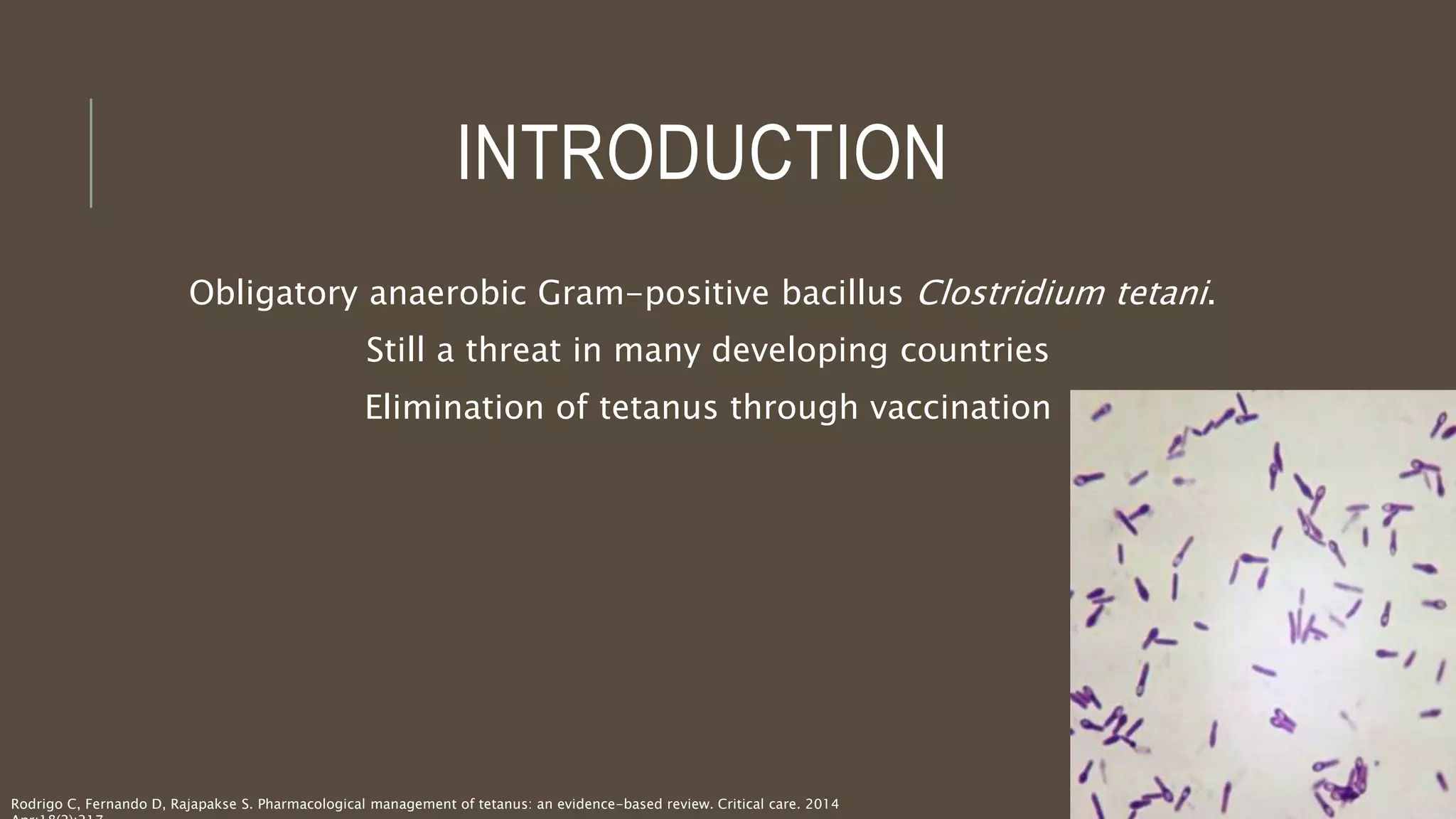
Obligatory anaerobic Gram-positive bacillus Clostridium tetani.
Still a threat in many developing countries
Elimination of tetanus through vaccination
Rodrigo C, Fernando D, Rajapakse S. Pharmacological management of tetanus: an evidence-based review. Critical care. 2014
PATHOPHYSIOLOGY
CLINICAL MANIFESTATION
 Trismus or “locked jaw”
 Generalized muscle rigidity, stiffness, reflex spasms, opisthotonus
and dysphagia
 Autonomic disturbances, such as swings in blood pressure,
arrhythmias, hyperpyrexia and sweating
 Exhaustion, autonomic disturbances, and complications from
muscle spasms (for example, asphyxiation, pneumonia,
rhabdomyolysis, pulmonary emboli) can contribute to the high fatality
rates observed in severe tetanus
Abrutyn E: Tetanus. In Harrison's Principles of Internal Medicine. 14th edition. Edited by: Isselbacher KL, Braunwald E, Wilson JD, Martin JB, Fauci AS, Kasper DL, Longo DL, Hauser SL. New York: McGraw Hill; 1998:901-9
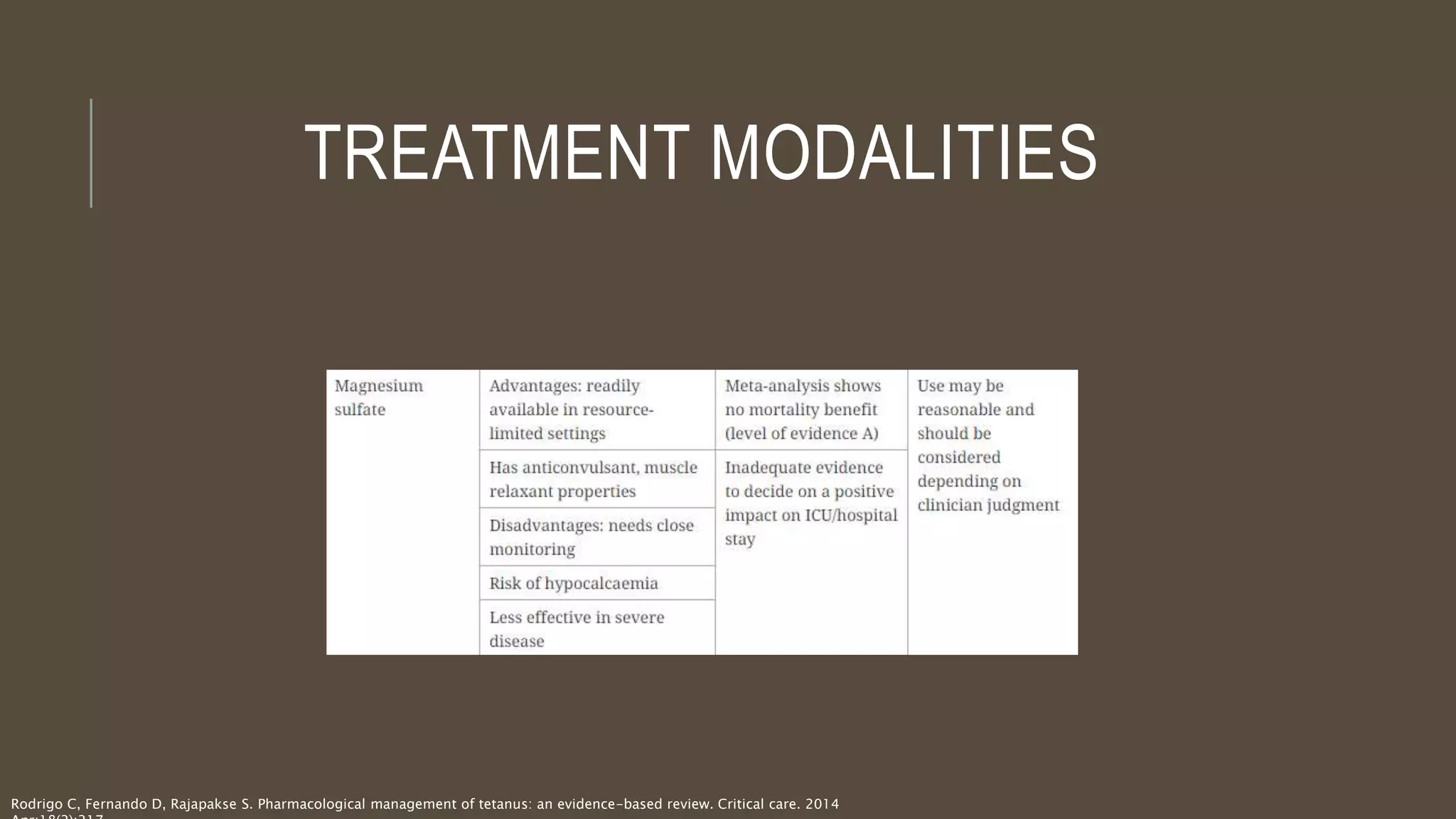
TREATMENT MODALITIES
Rodrigo C, Fernando D, Rajapakse S. Pharmacological management of tetanus: an evidence-based review. Critical care. 2014
TREATMENT MODALITIES
Rodrigo C, Fernando D, Rajapakse S. Pharmacological management of tetanus: an evidence-based review. Critical care. 2014
TREATMENT MODALITIES
Rodrigo C, Fernando D, Rajapakse S. Pharmacological management of tetanus: an evidence-based review. Critical care. 2014
TREATMENT MODALITIES
Rodrigo C, Fernando D, Rajapakse S. Pharmacological management of tetanus: an evidence-based review. Critical care. 2014
SUMMARY
Obligatory anaerobic Gram-positive bacillus Clostridium tetani.
Still a threat in many developing countries
Elimination of tetanus through vaccination
Treatment core:
Benzodiazepine and antibiotics (penicillin and metronidazole)
Management of Tetanus

Management of Tetanus

  • 1.
  • 2.
    INTRODUCTION Obligatory anaerobic Gram-positivebacillus Clostridium tetani. Still a threat in many developing countries Elimination of tetanus through vaccination Rodrigo C, Fernando D, Rajapakse S. Pharmacological management of tetanus: an evidence-based review. Critical care. 2014
  • 3.
  • 4.
    CLINICAL MANIFESTATION  Trismusor “locked jaw”  Generalized muscle rigidity, stiffness, reflex spasms, opisthotonus and dysphagia  Autonomic disturbances, such as swings in blood pressure, arrhythmias, hyperpyrexia and sweating  Exhaustion, autonomic disturbances, and complications from muscle spasms (for example, asphyxiation, pneumonia, rhabdomyolysis, pulmonary emboli) can contribute to the high fatality rates observed in severe tetanus Abrutyn E: Tetanus. In Harrison's Principles of Internal Medicine. 14th edition. Edited by: Isselbacher KL, Braunwald E, Wilson JD, Martin JB, Fauci AS, Kasper DL, Longo DL, Hauser SL. New York: McGraw Hill; 1998:901-9
  • 5.
    TREATMENT MODALITIES Rodrigo C,Fernando D, Rajapakse S. Pharmacological management of tetanus: an evidence-based review. Critical care. 2014
  • 6.
    TREATMENT MODALITIES Rodrigo C,Fernando D, Rajapakse S. Pharmacological management of tetanus: an evidence-based review. Critical care. 2014
  • 7.
    TREATMENT MODALITIES Rodrigo C,Fernando D, Rajapakse S. Pharmacological management of tetanus: an evidence-based review. Critical care. 2014
  • 8.
    TREATMENT MODALITIES Rodrigo C,Fernando D, Rajapakse S. Pharmacological management of tetanus: an evidence-based review. Critical care. 2014
  • 9.
    SUMMARY Obligatory anaerobic Gram-positivebacillus Clostridium tetani. Still a threat in many developing countries Elimination of tetanus through vaccination Treatment core: Benzodiazepine and antibiotics (penicillin and metronidazole)