Mrs. Babitha K Devu
Assistant Professor
SMVDCoN
Acute renal failure/ Acute Kidney Injury
Chronic renal failure/ ESRD
Introduction
also known as is
the partial or complete impairment of kidney
function. It result in an inability to excrete
metabolic waste products and water, and it
contributes to disturbances of all body system.
• The terms and renal failure
are used synonymously. The term uremic
syndrome describes a set of manifestations
that result from loss of renal function.
• Acute kidney failure occurs when your kidneys
suddenly become unable to filter waste
products from your blood. When your kidneys
lose their filtering ability, dangerous levels of
wastes may accumulate, and your blood's
chemical makeup may get out of balance.
Acute kidney injury is a syndrome characterized by:
• Sudden decline in GFR (hours to days )
• Retention of nitrogenous wastes in blood
(Azotemia)
• Disturbance in extracellular fluid volume and
• Disturbance in electrolyte and acid base
homeostasis
The causes of AKI, which are multiple and complex,
are categorized as:
Prerenal
Renal/ Intrinsic
Postrenal
Prerenal: These causes of AKI are factors external to the
kidneys.
Hypovolemia
Dehydration
Hemorrhage
GI losses (Diarrhea, Vomiting)
Excessive diuresis
Hypoalbuminemia
Burns
Prerenal: These causes of AKI are factors external
to the kidneys.
Decreased cardiac output
Cardiac dysrhythmias
Cardiogenic shock
Heart failure
MI
Prerenal: These causes of AKI are factors external to
the kidneys.
Decreased peripheral vascular resistance
Anaphylaxis
Neurologic injury
Septic shock
Decreased renovascular blood flow
Bilateral renal vein thrombosis
Embolism
Hepatorenal syndrome
Renal artery thrombosis
IntraRenal/ Intrinsic
Nephrotoxic injury
Drugs: Aminoglycosides
Contrast media
Hemolytic blood transfusion reaction
Severe crush injury
Chemical exposure
Interstitial Nephritis
Allergies
Infections: Bacterial, viral, fungal
IntraRenal/ Intrinsic
Other causes
Prolonged prerenal ischemia
AGN
Thrombotic disorders
Toxemia of pregnancy
Malignant HTN
SLE
Postrenal
BPH
Bladder Cancer
Calculi formation
Neuromuscular disorders
Prostate cancer
Spinal cord disease
Strictures
Trauma
• Being hospitalized, especially for a serious condition that
requires intensive care
• Advanced age
• Blockages in the blood vessels in your arms or legs
(peripheral artery disease)
• Diabetes
• High blood pressure
• Heart failure
• Kidney diseases
• Liver diseases
Due to the etiological factors
Reduced systemic circulation, causing a
reduction in renal blood flow.
Decreased glomerular perfusion and GFR
(But no damage to the kidney tissues)
Prerenal Azotemia
When there is a decrease in circulating blood
volume, autoregulatory mechanisms increase
angiotensin II, aldosterone, norepinehrine and
ADH as an attempt to preserve blood flow to
essential organs.
If the causes are not corrected, the decreased
perfusion persist, the kidney lose their ability to
compensate and damage to kidney parenchyma
occurs (intrarenal damage).
Due to the intrarenal causes
Direct damage to the kidney tissues from prolonged
ischemia, nephrotoxins, hemoglobin released from
hemolyzed RBCs, or myoglobin released from necrotic
muscle cells.
Impaired nephron function due to damage to the
epithelial cells of the tubules or Hb/myoglobins can
block the tubules or infections can damage GBM
Postrenal causes of AKI involve mechanical
obstruction in the outflow of urine
Urine refluxes into the renal pelvis leads to
hydronephrosis, increase in hydrostatic pressure
and tubular blockage.
Progressive decline in kidney function
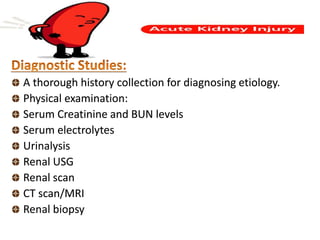
A thorough history collection for diagnosing etiology.
Physical examination:
Serum Creatinine and BUN levels
Serum electrolytes
Urinalysis
Renal USG
Renal scan
CT scan/MRI
Renal biopsy
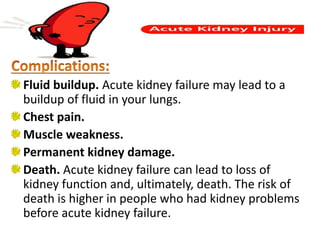
Fluid buildup. Acute kidney failure may lead to a
buildup of fluid in your lungs.
Chest pain.
Muscle weakness.
Permanent kidney damage.
Death. Acute kidney failure can lead to loss of
kidney function and, ultimately, death. The risk of
death is higher in people who had kidney problems
before acute kidney failure.
Goals of treatment for AKI
Eliminate the cause,
Manage the signs and symptoms, and
Prevent complications while the kidneys recover.
Determine is there adequate intra-vascular
volume and cardiac out-put to ensure adequate
perfusion of the kidneys.
Treatment for acute kidney failure involves
identifying the illness or injury that originally
damaged your kidneys. Your treatment options
depend on what's causing your kidney failure.
IV fluids if the renal failure is due to fluid loss.
Diuretics is often administered but not
recommended in high doses. Loop diuretics
(furosemide [Lasix], bumetanide [Bumex]) or an
osmotic diuretic (mannitol).
If AKI is already established, forcing fluids and
diuretics will not be effective and may, in fact, be
harmful.
Closely monitor fluid intake during the oliguric phase
of AKI.
The general rule for calculating the fluid restriction -
Add all losses for the previous 24 hours (urine,
diarrhea, emesis, blood) plus 600 mL for insensible
losses (respiration, diaphoresis). For example, if a
patient excreted 300 mL of urine on Tuesday with no
other losses, the fluid allocation on Wednesday
would be 900 mL.
Therapies for elevated Potassium Levels:-
Insulin and na+ bicarbonate serve as a temporary
measure for treatment of hyperkalemia by promoting
a shift of potassium into the cells, but potassium will
eventually be released.
IV glucose is given concurrently to prevent
hypoglycemia. When effects of insulin diminish,
potassium shifts back out of cells.
Therapies for elevated Potassium Levels:-
Calcium Gluconate IV. Generally used in advanced
cardiac toxicity (with evidence of hyperkalemic ECG
changes). Calcium raises the threshold for excitation,
resulting in dysrhythmias.
 Treatments that removes potassium from the body.
Sodium polystyrene sulfonate (Kayexalate) and
dialysis.
Therapies for elevated Potassium Levels:-
Sodium polystyrene sulfonate (Kayexalate). Cation-
exchange resin is administered by mouth or retention
enema. When resin is in the bowel, potassium is
exchanged for sodium. Therapy removes 1 mEq of
potassium per gram of drug. It is mixed in water with
sorbitol to produce osmotic diarrhea, allowing for
evacuation of potassium-rich stool from body.
 Dialysis for immediate remedy.
Conservative therapy IN AKI is all that is necessary until
kidney function improves. Controversy exists about the
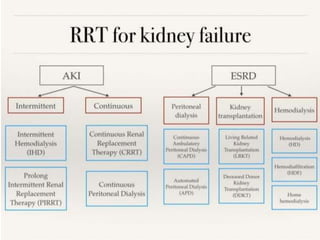
timing of renal replacement therapy (RRT) in AKI.
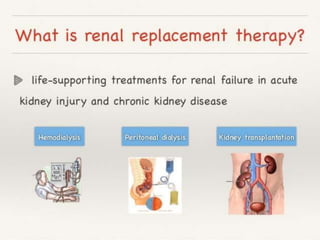
Even though peritoneal dialysis (PD) is considered a viable
option for RRT, it is not frequently used. Intermittent
hemodialysis (HD) (at intervals of 4 hours either daily,
every other day, or 3 or 4 times per week) and continuous
renal replacement therapy (CRRT) have both been used
effectively.
CRRT is provided continuously over approximately 24
hours through cannulation of an artery and vein or
cannulation of two veins.
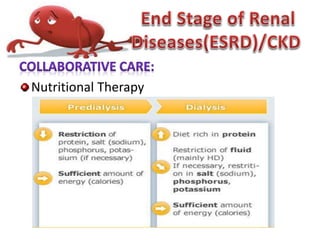
Nutritional Therapy:
– Maintain adequate caloric intake (30 to 35 kcal/kg
and 0.8 to 1 g of protein per Kg of body weight).
– Regulate potassium and sodium levels.
– Increase dietary fat intake
– Minimize fluid volume
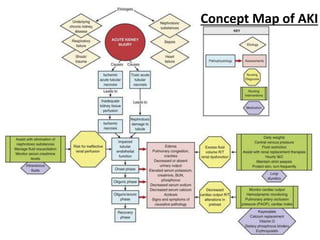
Concept Map of AKI
The kidneys filter waste and excess water from your
blood as urine. Chronic kidney disease causes
your kidneys to lose this function over time. End-
stage kidney disease is the final stage of chronic
kidney disease. It means your kidneys no longer
function well enough to meet the needs of daily
life.
The kidneys of people with ESRD function below 10
percent of their normal ability, which may mean
they’re barely functioning or not functioning at
all.
CKD is irreversible and progressive reduction of
functioning of renal tissue.
Structural or functional abnormalities of the
kidneys for >3 months, as manifested by either:
1. Kidney damage, with or without decreased GFR, as
defined by
• pathologic abnormalities
• markers of kidney damage, including abnormalities
in the composition of the blood or urine or
abnormalities in imaging tests
2. GFR <60 ml/min/1.73 m2, with or without kidney damage
In India, it has been recently estimated that the age-
adjusted incidence rate of ESRD to be 229 per million
population (pmp), and >100,000 new patients enter
renal replacement programs annually.
In the US, the incidence is 338 new cases pmp.
Approximately 28% have a functioning
transplant, 66%recevice hemodialysis, and
5.7% are undergoing a form of peritoneal
dialysis.
Although chronic kidney disease sometimes results from
primary diseases of the kidneys themselves, the major
causes are diabetes and high blood pressure.
• Type 1 and type 2 diabetes mellitus cause a
condition called diabetic nephropathy.
• High blood pressure (hypertension), if not
controlled, can damage the kidneys over time.
• Glomerulonephritis
• Polycystic kidney disease is a hereditary cause of
CKD
• Use of some drugs over long time
• Clogging and hardening of the
arteries (atherosclerosis)
• Obstruction of the flow of urine by stones,
an enlarged prostate, strictures (narrowings), or
cancers may also cause kidney disease.
• Other causes of chronic kidney disease include HIV
infection, sickle cell disease, heroin abuse,
amyloidosis, kidney stones, chronic kidney infections,
and certain cancers.
• AKI
If one has any of the following conditions, they are at
higher-than-normal risk of developing chronic kidney
disease. One's kidney function may need to be
monitored regularly.
• Diabetes mellitus type 1 or type 2
• High blood pressure
• High cholesterol
• Heart disease
• Liver disease
• Amyloidosis
• Sickle cell disease
• Vascular diseases such as arteritis, vasculitis or
fibromuscular dysplasia
• Vesicoureteral reflux (a urinary tract problem in which
urine travels from the bladder the wrong way back
toward the kidney)
• Require regular use of anti-inflammatory medications
• A family history of kidney disease
• Being African-American, Hispanic, Native American or
Asian
• Being over 60 years old
• Obesity
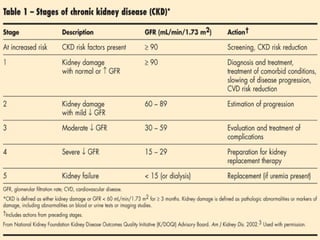
• Traditionally, the classification of the type of
CKD has been focused on pathology and
etiology. The Kidney Disease Outcome Quality
Initiative (K/DOQI) classification system
focuses on GFR, but remains important to
diagnose the cause of CKD.
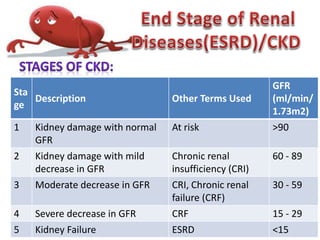
Sta
ge
Description Other Terms Used
GFR
(ml/min/
1.73m2)
1 Kidney damage with normal
GFR
At risk >90
2 Kidney damage with mild
decrease in GFR
Chronic renal
insufficiency (CRI)
60 - 89
3 Moderate decrease in GFR CRI, Chronic renal
failure (CRF)
30 - 59
4 Severe decrease in GFR CRF 15 - 29
5 Kidney Failure ESRD <15
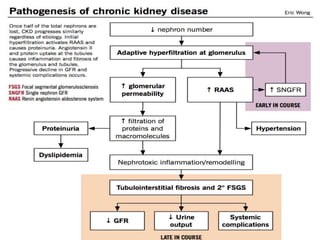
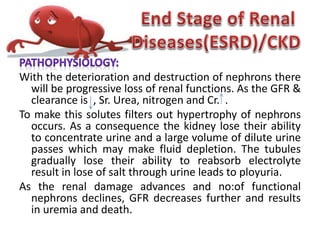
With the deterioration and destruction of nephrons there
will be progressive loss of renal functions. As the GFR &
clearance is , Sr. Urea, nitrogen and Cr. .
To make this solutes filters out hypertrophy of nephrons
occurs. As a consequence the kidney lose their ability
to concentrate urine and a large volume of dilute urine
passes which may make fluid depletion. The tubules
gradually lose their ability to reabsorb electrolyte
result in lose of salt through urine leads to ployuria.
As the renal damage advances and no:of functional
nephrons declines, GFR decreases further and results
in uremia and death.
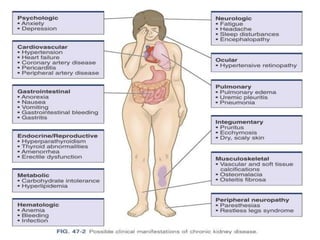
Patients with chronic kidney disease (CKD) stages 1-
3 (glomerular filtration rate [GFR] >30
mL/min/1.73 m²) are frequently asymptomatic.
When the glomerular filtration rate (GFR) slows to
below 30 mL/min, signs of uremia (high blood
level of protein by-products, such as urea) may
become noticeable. When the GFR falls below 15
mL/min most people become increasingly
symptomatic.
History and physical examination
Identification of reversible kidney disease
Blood test: BUN, Sr. Cr., electrolyte, lipid profile,
Hb and hematocrit
Urine analysis
USG
Renal scan
CT/MRI
Renal biopsy
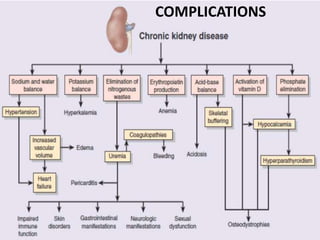
COMPLICATIONS
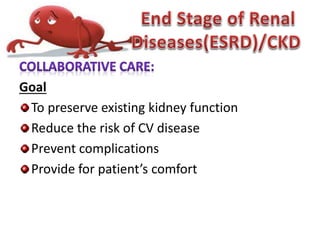
Goal
To preserve existing kidney function
Reduce the risk of CV disease
Prevent complications
Provide for patient’s comfort
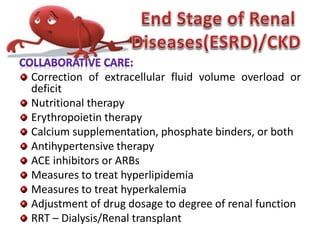
Correction of extracellular fluid volume overload or
deficit
Nutritional therapy
Erythropoietin therapy
Calcium supplementation, phosphate binders, or both
Antihypertensive therapy
ACE inhibitors or ARBs
Measures to treat hyperlipidemia
Measures to treat hyperkalemia
Adjustment of drug dosage to degree of renal function
RRT – Dialysis/Renal transplant
Drug Therapy
Hyperkalemia
Multiple strategies are used with dietary restriction
and drugs.
– IV glucose & insulin
– IV 10% calcium gluconate
– Sodium polystyrene sulfonate
– Dialysis may be required
Drug Therapy
Hypertension
• Target BP < 130/80 mm Hg
• Weight lose (if obese)
• Therapeutiic lifestyle changes
• DASH diet
• Administer antihypertensive drugs – ACE
inhibitors & ARBs
Drug Therapy
CKD-MBD
• Limiting dietary phosphorus
• Administer phosphate binders – calcium
acetate, calcium carbonate
• Supplemental calcium and vitamin D
• If hyperparathyroid disease persist – subtotal or
total parathyroidectomy
Drug Therapy
Anemia
• Exogenous erythropoietin (EPO) – epoetin alfa,
darbepoetin alfa. (in low doses)
• Iron supplement if plasma ferritin concentrations falls
• Folic acid supplement
• Avoid blood transfusion as it can cause iron overload
Dyslipidemia – best managed with statins
Nutritional Therapy
Notes on renal failure

Notes on renal failure

  • 1.
    Mrs. Babitha KDevu Assistant Professor SMVDCoN
  • 2.
    Acute renal failure/Acute Kidney Injury Chronic renal failure/ ESRD
  • 3.
    Introduction also known asis the partial or complete impairment of kidney function. It result in an inability to excrete metabolic waste products and water, and it contributes to disturbances of all body system. • The terms and renal failure are used synonymously. The term uremic syndrome describes a set of manifestations that result from loss of renal function.
  • 4.
    • Acute kidneyfailure occurs when your kidneys suddenly become unable to filter waste products from your blood. When your kidneys lose their filtering ability, dangerous levels of wastes may accumulate, and your blood's chemical makeup may get out of balance.
  • 5.
    Acute kidney injuryis a syndrome characterized by: • Sudden decline in GFR (hours to days ) • Retention of nitrogenous wastes in blood (Azotemia) • Disturbance in extracellular fluid volume and • Disturbance in electrolyte and acid base homeostasis
  • 6.
    The causes ofAKI, which are multiple and complex, are categorized as: Prerenal Renal/ Intrinsic Postrenal
  • 7.
    Prerenal: These causesof AKI are factors external to the kidneys. Hypovolemia Dehydration Hemorrhage GI losses (Diarrhea, Vomiting) Excessive diuresis Hypoalbuminemia Burns
  • 8.
    Prerenal: These causesof AKI are factors external to the kidneys. Decreased cardiac output Cardiac dysrhythmias Cardiogenic shock Heart failure MI
  • 9.
    Prerenal: These causesof AKI are factors external to the kidneys. Decreased peripheral vascular resistance Anaphylaxis Neurologic injury Septic shock Decreased renovascular blood flow Bilateral renal vein thrombosis Embolism Hepatorenal syndrome Renal artery thrombosis
  • 10.
    IntraRenal/ Intrinsic Nephrotoxic injury Drugs:Aminoglycosides Contrast media Hemolytic blood transfusion reaction Severe crush injury Chemical exposure Interstitial Nephritis Allergies Infections: Bacterial, viral, fungal
  • 11.
    IntraRenal/ Intrinsic Other causes Prolongedprerenal ischemia AGN Thrombotic disorders Toxemia of pregnancy Malignant HTN SLE
  • 12.
    Postrenal BPH Bladder Cancer Calculi formation Neuromusculardisorders Prostate cancer Spinal cord disease Strictures Trauma
  • 13.
    • Being hospitalized,especially for a serious condition that requires intensive care • Advanced age • Blockages in the blood vessels in your arms or legs (peripheral artery disease) • Diabetes • High blood pressure • Heart failure • Kidney diseases • Liver diseases
  • 14.
    Due to theetiological factors Reduced systemic circulation, causing a reduction in renal blood flow. Decreased glomerular perfusion and GFR (But no damage to the kidney tissues) Prerenal Azotemia
  • 15.
    When there isa decrease in circulating blood volume, autoregulatory mechanisms increase angiotensin II, aldosterone, norepinehrine and ADH as an attempt to preserve blood flow to essential organs. If the causes are not corrected, the decreased perfusion persist, the kidney lose their ability to compensate and damage to kidney parenchyma occurs (intrarenal damage).
  • 16.
    Due to theintrarenal causes Direct damage to the kidney tissues from prolonged ischemia, nephrotoxins, hemoglobin released from hemolyzed RBCs, or myoglobin released from necrotic muscle cells. Impaired nephron function due to damage to the epithelial cells of the tubules or Hb/myoglobins can block the tubules or infections can damage GBM
  • 17.
    Postrenal causes ofAKI involve mechanical obstruction in the outflow of urine Urine refluxes into the renal pelvis leads to hydronephrosis, increase in hydrostatic pressure and tubular blockage. Progressive decline in kidney function
  • 21.
    A thorough historycollection for diagnosing etiology. Physical examination: Serum Creatinine and BUN levels Serum electrolytes Urinalysis Renal USG Renal scan CT scan/MRI Renal biopsy
  • 22.
    Fluid buildup. Acutekidney failure may lead to a buildup of fluid in your lungs. Chest pain. Muscle weakness. Permanent kidney damage. Death. Acute kidney failure can lead to loss of kidney function and, ultimately, death. The risk of death is higher in people who had kidney problems before acute kidney failure.
  • 23.
    Goals of treatmentfor AKI Eliminate the cause, Manage the signs and symptoms, and Prevent complications while the kidneys recover.
  • 24.
    Determine is thereadequate intra-vascular volume and cardiac out-put to ensure adequate perfusion of the kidneys. Treatment for acute kidney failure involves identifying the illness or injury that originally damaged your kidneys. Your treatment options depend on what's causing your kidney failure.
  • 25.
    IV fluids ifthe renal failure is due to fluid loss. Diuretics is often administered but not recommended in high doses. Loop diuretics (furosemide [Lasix], bumetanide [Bumex]) or an osmotic diuretic (mannitol). If AKI is already established, forcing fluids and diuretics will not be effective and may, in fact, be harmful.
  • 26.
    Closely monitor fluidintake during the oliguric phase of AKI. The general rule for calculating the fluid restriction - Add all losses for the previous 24 hours (urine, diarrhea, emesis, blood) plus 600 mL for insensible losses (respiration, diaphoresis). For example, if a patient excreted 300 mL of urine on Tuesday with no other losses, the fluid allocation on Wednesday would be 900 mL.
  • 27.
    Therapies for elevatedPotassium Levels:- Insulin and na+ bicarbonate serve as a temporary measure for treatment of hyperkalemia by promoting a shift of potassium into the cells, but potassium will eventually be released. IV glucose is given concurrently to prevent hypoglycemia. When effects of insulin diminish, potassium shifts back out of cells.
  • 28.
    Therapies for elevatedPotassium Levels:- Calcium Gluconate IV. Generally used in advanced cardiac toxicity (with evidence of hyperkalemic ECG changes). Calcium raises the threshold for excitation, resulting in dysrhythmias.  Treatments that removes potassium from the body. Sodium polystyrene sulfonate (Kayexalate) and dialysis.
  • 29.
    Therapies for elevatedPotassium Levels:- Sodium polystyrene sulfonate (Kayexalate). Cation- exchange resin is administered by mouth or retention enema. When resin is in the bowel, potassium is exchanged for sodium. Therapy removes 1 mEq of potassium per gram of drug. It is mixed in water with sorbitol to produce osmotic diarrhea, allowing for evacuation of potassium-rich stool from body.  Dialysis for immediate remedy.
  • 30.
    Conservative therapy INAKI is all that is necessary until kidney function improves. Controversy exists about the timing of renal replacement therapy (RRT) in AKI. Even though peritoneal dialysis (PD) is considered a viable option for RRT, it is not frequently used. Intermittent hemodialysis (HD) (at intervals of 4 hours either daily, every other day, or 3 or 4 times per week) and continuous renal replacement therapy (CRRT) have both been used effectively. CRRT is provided continuously over approximately 24 hours through cannulation of an artery and vein or cannulation of two veins.
  • 31.
    Nutritional Therapy: – Maintainadequate caloric intake (30 to 35 kcal/kg and 0.8 to 1 g of protein per Kg of body weight). – Regulate potassium and sodium levels. – Increase dietary fat intake – Minimize fluid volume
  • 32.
  • 33.
    The kidneys filterwaste and excess water from your blood as urine. Chronic kidney disease causes your kidneys to lose this function over time. End- stage kidney disease is the final stage of chronic kidney disease. It means your kidneys no longer function well enough to meet the needs of daily life. The kidneys of people with ESRD function below 10 percent of their normal ability, which may mean they’re barely functioning or not functioning at all.
  • 34.
    CKD is irreversibleand progressive reduction of functioning of renal tissue. Structural or functional abnormalities of the kidneys for >3 months, as manifested by either: 1. Kidney damage, with or without decreased GFR, as defined by • pathologic abnormalities • markers of kidney damage, including abnormalities in the composition of the blood or urine or abnormalities in imaging tests 2. GFR <60 ml/min/1.73 m2, with or without kidney damage
  • 35.
    In India, ithas been recently estimated that the age- adjusted incidence rate of ESRD to be 229 per million population (pmp), and >100,000 new patients enter renal replacement programs annually. In the US, the incidence is 338 new cases pmp. Approximately 28% have a functioning transplant, 66%recevice hemodialysis, and 5.7% are undergoing a form of peritoneal dialysis.
  • 36.
    Although chronic kidneydisease sometimes results from primary diseases of the kidneys themselves, the major causes are diabetes and high blood pressure. • Type 1 and type 2 diabetes mellitus cause a condition called diabetic nephropathy. • High blood pressure (hypertension), if not controlled, can damage the kidneys over time. • Glomerulonephritis • Polycystic kidney disease is a hereditary cause of CKD
  • 37.
    • Use ofsome drugs over long time • Clogging and hardening of the arteries (atherosclerosis) • Obstruction of the flow of urine by stones, an enlarged prostate, strictures (narrowings), or cancers may also cause kidney disease. • Other causes of chronic kidney disease include HIV infection, sickle cell disease, heroin abuse, amyloidosis, kidney stones, chronic kidney infections, and certain cancers. • AKI
  • 38.
    If one hasany of the following conditions, they are at higher-than-normal risk of developing chronic kidney disease. One's kidney function may need to be monitored regularly. • Diabetes mellitus type 1 or type 2 • High blood pressure • High cholesterol • Heart disease • Liver disease • Amyloidosis • Sickle cell disease
  • 39.
    • Vascular diseasessuch as arteritis, vasculitis or fibromuscular dysplasia • Vesicoureteral reflux (a urinary tract problem in which urine travels from the bladder the wrong way back toward the kidney) • Require regular use of anti-inflammatory medications • A family history of kidney disease • Being African-American, Hispanic, Native American or Asian • Being over 60 years old • Obesity
  • 40.
    • Traditionally, theclassification of the type of CKD has been focused on pathology and etiology. The Kidney Disease Outcome Quality Initiative (K/DOQI) classification system focuses on GFR, but remains important to diagnose the cause of CKD.
  • 41.
    Sta ge Description Other TermsUsed GFR (ml/min/ 1.73m2) 1 Kidney damage with normal GFR At risk >90 2 Kidney damage with mild decrease in GFR Chronic renal insufficiency (CRI) 60 - 89 3 Moderate decrease in GFR CRI, Chronic renal failure (CRF) 30 - 59 4 Severe decrease in GFR CRF 15 - 29 5 Kidney Failure ESRD <15
  • 43.
    With the deteriorationand destruction of nephrons there will be progressive loss of renal functions. As the GFR & clearance is , Sr. Urea, nitrogen and Cr. . To make this solutes filters out hypertrophy of nephrons occurs. As a consequence the kidney lose their ability to concentrate urine and a large volume of dilute urine passes which may make fluid depletion. The tubules gradually lose their ability to reabsorb electrolyte result in lose of salt through urine leads to ployuria. As the renal damage advances and no:of functional nephrons declines, GFR decreases further and results in uremia and death.
  • 44.
    Patients with chronickidney disease (CKD) stages 1- 3 (glomerular filtration rate [GFR] >30 mL/min/1.73 m²) are frequently asymptomatic. When the glomerular filtration rate (GFR) slows to below 30 mL/min, signs of uremia (high blood level of protein by-products, such as urea) may become noticeable. When the GFR falls below 15 mL/min most people become increasingly symptomatic.
  • 46.
    History and physicalexamination Identification of reversible kidney disease Blood test: BUN, Sr. Cr., electrolyte, lipid profile, Hb and hematocrit Urine analysis USG Renal scan CT/MRI Renal biopsy
  • 48.
  • 49.
    Goal To preserve existingkidney function Reduce the risk of CV disease Prevent complications Provide for patient’s comfort
  • 50.
    Correction of extracellularfluid volume overload or deficit Nutritional therapy Erythropoietin therapy Calcium supplementation, phosphate binders, or both Antihypertensive therapy ACE inhibitors or ARBs Measures to treat hyperlipidemia Measures to treat hyperkalemia Adjustment of drug dosage to degree of renal function RRT – Dialysis/Renal transplant
  • 51.
    Drug Therapy Hyperkalemia Multiple strategiesare used with dietary restriction and drugs. – IV glucose & insulin – IV 10% calcium gluconate – Sodium polystyrene sulfonate – Dialysis may be required
  • 52.
    Drug Therapy Hypertension • TargetBP < 130/80 mm Hg • Weight lose (if obese) • Therapeutiic lifestyle changes • DASH diet • Administer antihypertensive drugs – ACE inhibitors & ARBs
  • 53.
    Drug Therapy CKD-MBD • Limitingdietary phosphorus • Administer phosphate binders – calcium acetate, calcium carbonate • Supplemental calcium and vitamin D • If hyperparathyroid disease persist – subtotal or total parathyroidectomy
  • 54.
    Drug Therapy Anemia • Exogenouserythropoietin (EPO) – epoetin alfa, darbepoetin alfa. (in low doses) • Iron supplement if plasma ferritin concentrations falls • Folic acid supplement • Avoid blood transfusion as it can cause iron overload Dyslipidemia – best managed with statins
  • 55.